University of Cape Town
The effect of LoLT on learner
performance in disadvantaged schools
in the Western Cape, South Africa
Alexander Molteno -‐ MLTALE002
A minor dissertation submitted in
partial fulfillment
of the requirements
for the award of the degree of Master of Education in Educational
Administration, Planning & Social Policy.
Faculty of Humanities
University of Cape Town
2017
DECLARATION
This work has not been previously submitted in whole, or in part, for the award of any degree. It is my own work. Each significant contribution to, and quotation in, this dissertation from the work, or works, of other people has been attributed, and has been cited and referenced.
Signature: Date: 13 March 2017
quotation from it or information derived from it is to be
published without full acknowledgement of the source.
The thesis is to be used for private study or
non-commercial research purposes only.
Published by the University of Cape Town (UCT) in terms
of the non-exclusive license granted to UCT by the author.
Alexander Molteno
ii
Acknowledgements
I would like to thank the research participants, Mr James Gilmour, Mr Andrew Deacon, Dr Audrey Wyngaard, Mr David Gough and Mrs Adrienne Pretorius kindly for their invaluable assistance with this research.
Table of Contents
List of Figures and Tables ... v
List of Abbreviations ... vi
1. Introduction ... 1
1.1 Context ... 1
1.2 The research problem ... 1
1.3 Purpose of the research project ... 2
1.4 Significance of the research problem ... 2
1.5 Research questions ... 3
1.6 Research design ... 4
1.7 Assumptions, limitations and scope ... 5
1.8 Overview ... 5
2. Research context ... 6
2.1 LoLT policy challenge ... 6
2.2 LoLT policy options ... 6
2.3 LoLT policy debate ... 7
2.4 SA school language education policy ... 8
2.5 Effects of LoLT policy implementation ... 10
a) LoLT accessibility ... 10
b) Educational outcomes ... 11
c) Learning and literacy development ... 12
d) LoLT transition ... 13
e) Instructional quality ... 16
f) Code switching and mixing ... 17
g) Experience of school ... 20
h) Language and cultural identity effects ... 21
2.6 Factors surrounding LoLT policy implementation and learner performance ... 22
a) Within the home ... 22
b) Within society ... 22
c) Within the school ... 24
3. Research methods ... 26
3.1 Part A: Learner performance compared by LoLT ... 26
3.1.1 Data source ... 26
3.1.2 Instrumentation ... 28
3.1.3 Design ... 30
3.1.4 Procedure ... 30
3.2 Part B: Implementation compared by LoLT ... 32
3.2.1 Data source ... 32 3.2.2 Instrumentation ... 34 3.2.3 Design ... 36 3.2.4 Procedure ... 37 3.3 Potential limitations ... 40 3.3.1 Part A ... 41 3.3.2 Part B ... 41
3.4 Research ethics, permissions and access ... 42
4. LoLT policy in reality ... 43
4.1 Part A: Learner performance compared by LoLT ... 43
Alexander Molteno
iv
4.1.2 Longitudinal comparison of performance between 2012 and 2015 ... 46
4.1.3 Summary of results ... 48
4.2 Part B: Implementation compared by LoLT ... 48
4.2.1 LoLT policy formulation ... 49
4.2.2 LoLT policy implementation ... 51
4.2.3 LoLT policy effects on learners ... 72
4.3 Overview of findings ... 77
5. Making LoLT policy work for disadvantaged SA ... 78
5.1 The LoLT policy conundrum ... 78
5.2 LoLT policy performance and implementation ... 78
5.2.1 Part A conclusions ... 78
5.2.2 Part B conclusions ... 79
5.3 LoLT policy for learning ... 80
5.4 The complicated but simple LoLT challenge ... 83
6. References ... 84
7. Appendices ... 94
7.1 Appendices A: Research instruments ... 94
List of Figures and Tables
Table 2.1: Anticipated learner performance in English at Grade 12 (Thomas & Collier,
1997, p. 76) ... 11
Figure 2.1: Learner performance per LoLT model (Thomas & Collier, 1997, p. 53) ... 15
Table 3.1: Sample sizes per learner performance data set ... 28
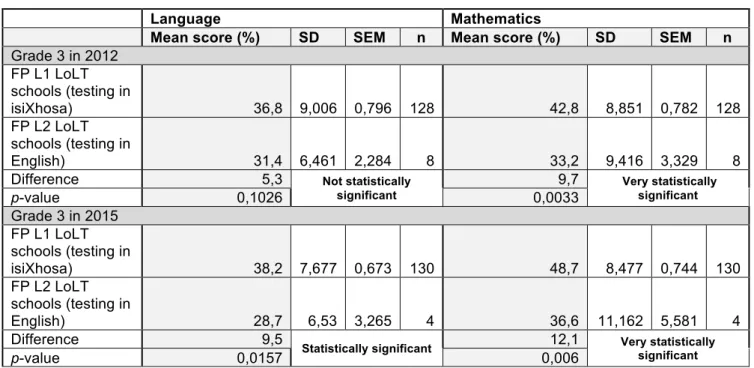
Table 4.1: Cross-‐sectional comparison of Grade 3 learner performance from alternate LoLT contexts in 2012 and 2015 ... 44
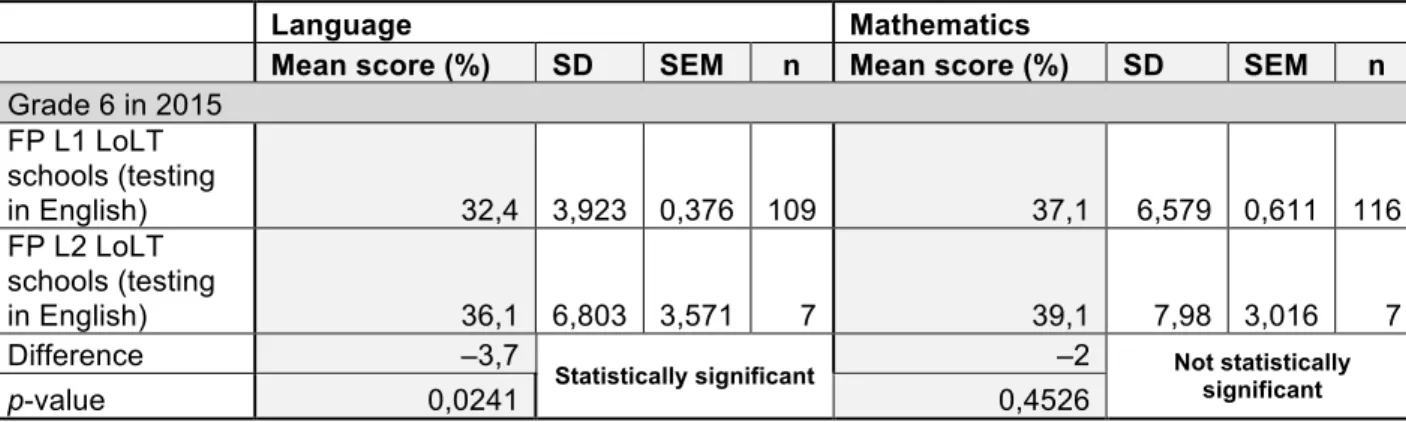
Table 4.2: Cross-‐sectional comparison of Grade 6 learner performance from alternate LoLT contexts in 2015 ... 46
Table 4.3: Comparison of difference in learner performance from alternate LoLT contexts between Grade 3 in 2012 and Grade 6 in 2015 ... 47
Figure 4.1: General LoLT policy sentiment ... 50
Figure 4.2: Extent of LoLT implementation ... 52
Table 4.4: Comparison of teacher and learner ability in the LoLT... 55
Table 4.5: Comparison of teacher and learner comfort between LoLT context ... 59
Alexander Molteno
vi
List of Abbreviations
CAPS Curriculum and Assessment Policy Statement CSM Code switching and code mixing
DBE Department of Basic Education DoE Department of Education
FP L1 LoLT First language language of learning and teaching in the Foundation Phase followed by a transition to L2 LoLT from Grade 4 onwards
FP L2 LoLT Second language language of learning and teaching in the Foundation Phase as well as throughout subsequent grades
HOD Head of department L1 First language L2 Second language
LiEP Language in Education Policy LoLT Language of learning and teaching NQ National quintile
SA South Africa
SASA South Africa School’s Act SES Socio-‐economic status SGB School Governing Body SMT School management team
TIMSS Trends in International Mathematics and Science Study UCT University of Cape Town
UNESCO The United Nations Educational, Scientific and Cultural Organization WCED Western Cape Education Department
1. Introduction
Language is what makes us uniquely human. It “is the house of the being”
(Heidegger, 2000, p. 83) and it “is the dress of thought” (Johnson, 1905, p. 67). It is also the vehicle that carries the content of life-giving education for disadvantaged learners in South Africa (SA).
The research was inspired by this, and led to investigating the manner in which the use of language during lessons has affected the extent to which learners within disadvantaged bilingual contexts of primary schooling have been able to learn.
The key issue investigated was the differential impact of the language of learning and teaching (LoLT) on learner performance in relation to learners’ first language (L1) compared to their second language (L2) as measured by the Western Cape Education Department (WCED) Systemic Testing results. The context within which this was investigated is discussed below.
1.1 Context
In SA, despite the fact that government allocated a greater percentage (19,3%) of its total expenditure to education than the global average for middle-income countries (15,7%) between 1997–2014 (World Bank, 2016), the learner performance of the country’s education system during this period was of the poorest in the world (Spaull, 2013, p. 3).
While the definite cause of this is subject to debate, the choice of LoLT policy in South African (SA) schools was a significant causal factor (Pinnock & Vijayakumar, 2009, p. 16). This highlights the importance of evaluating the available LoLT policy options for that which is most likely to facilitate optimal performance, raising the question: How does LoLT affect learner performance? This was the research problem.
1.2 The research problem
Responding to this problem was the reason for conducting the research. By answering this key question, the research aimed to contribute to filling gaps in the knowledge commonly held by LoLT policy role players on the topic.
Alexander Molteno
2
For informed decisions to be made on which LoLT policy is most likely to facilitate learner performance within the context of interest required further understanding of how LoLT affected learning within that context.
1.3 Purpose of the research project
The purpose of the research was to find out how LoLT policy, in the form of LoLT models, affected learner performance. In so doing, the research aimed to contribute to a LoLT discussion in SA by producing knowledge that would shed light on how LoLT policy was typically formulated, implemented, and performed within schools. It was hoped that such knowledge could then be used to guide the formulation as well as implementation of LoLT policy in the manner that served the educational interests of disadvantaged learners in SA, optimally. The value of responding to the research problem was significant because of the potential for the research to achieve this.
1.4 Significance of the research problem
As is the case in SA, “in multilingual societies, the choice of language of instruction and language policy in schools is critical for effective learning” (Education For All (EFA), 2005, p. 160). It is of crucial importance for a LoLT policy which is
appropriate for use in the context of implementation to be determined if effective learning and quality education are to be achieved. The research problem – how does LoLT affect learner performance – wassignificant, because informed and appropriate LoLT policy choices could be made using knowledge gathered by responding to the problem.
By responding to the problem within the context of interest, the research provided an indication of the model of LoLT that was evidently optimal for facilitating teaching and learning of maximal quality within a system of schooling that required learners to write school-leaving examinations in a L2 – as was the case for the vast majority of disadvantaged SA learners. This indication is critical if schools within such contexts are to make informed decisions when formulating LoLT policy that will facilitate the education of learners to their best long-term advantage.
Additionally, by responding to the problem, the research also generated knowledge of factors surrounding LoLT policy implementation that affected the extent to which it
supported quality teaching and learning .This knowledge holds significant value in that it indicates how such factors can be best managed for optimal teaching and learning as an outcome of using the LoLT.
It was necessary for several problem-related questions to be asked in order for the research to provide a comprehensive response to the problem.
1.5 Research questions
These questions are presented below. Together, they provided the structure within which the research was conducted. As the research engaged with each question, a questioning process that operated in a systematic self-reflexive cycle was employed in order to allow the development of new questions as the research progressed.
The purpose of the first set of questions was to find out what options disadvantaged primary schools in SA had when adopting LoLT policy models, as well as to determine the extent to which each option was educationally sound. The answers to these questions were found by reviewing the relevant literature and by visiting schools:
• To what extent did relevant evidence-based research on best practice manifest in LoLT policy at schools?
o What were the LoLT policy options available to schools?
o How did language in education experts view each particular LoLT policy option?
The second set of questions was answered by exploring whether a pattern existed between LoLT policy and learner performance:
• What effect did LoLT policy have on learner performance?
o More specifically, what was the relationship between LoLT policy and learner performance during Grade 3 and 6 WCED Systemic Tests in disadvantaged schools?
Lastly, the third set of questions investigated the nature of how LoLT policy materialised in schools according to role players involved in its implementation:
Alexander Molteno
4
o What reasons did role players give for having decided upon the LoLT policy at their schools?
o What theories of language had role players drawn upon when they made LoLT decisions?
o What language in education legislation had role players consulted when they made LoLT policy decisions, if any?
o How did role players regard the way that LoLT policy was implemented at their schools?
§ Did role players regard the LoLT policy at their schools as having been successfully implemented or not?
§ What problems or benefits had been experienced by role players in relation to the LoLT policy at their schools?
§ How was the designated LoLT policy reflected by classroom practices, according to role players?
These questions were answered by the research in order to provide a comprehensive response to the research problem by employing the following research design.
1.6 Research design
The research used a two-part mixed-methods design.
The first part (Part A) provided a quantitative indication of the learner performance associated with the implementation of two different LoLT models. These were the
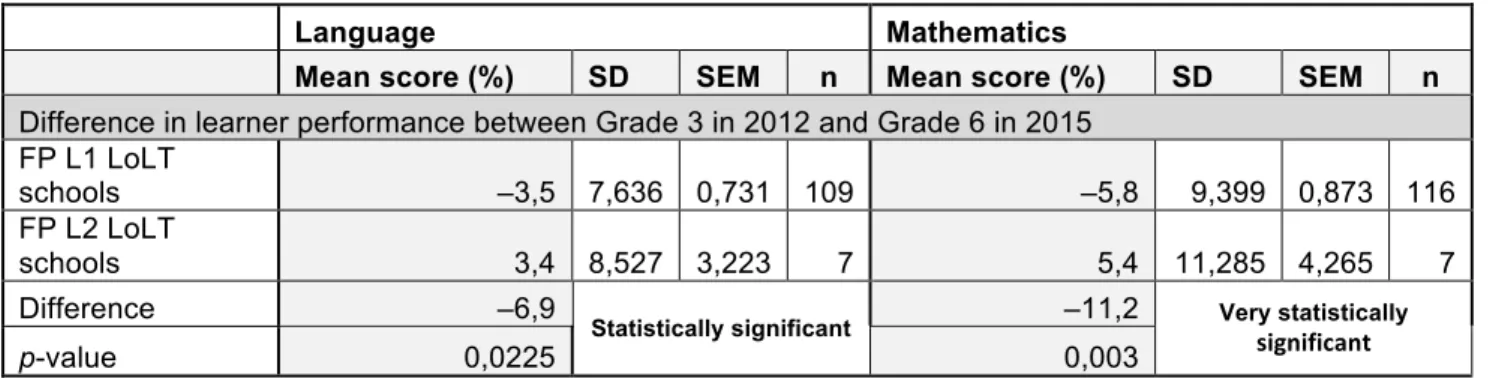
early-exit transitional LoLT model, which employed L1 as LoLT until Grade 4, where a transition to L2 LoLT occurs; and the straight-for-English LoLT model, which made use of a L2 LoLT from the start of primary schooling and throughout all grades thereafter. The performance of learners in schools following each LoLT model within a homogeneous sample was compared cross-sectionally as well as longitudinally using data from WCED Systemic Testing of Language and Mathematics. The findings from these comparisons were described statistically and tested for statistical significance.
The second part of the research (Part B) provided a qualitative assessment of how the two different LoLT models were typically formulated and implemented. To do this, a comparable sample comprised of several schools following each LoLT model was selected from those that were included within Part A. Teachers and members of
school management from these schools were surveyed using questionnaires made up of comparative rating scale response items as well as interviewed using a standardised open-ended interview schedule. The data collected was captured, analysed, and presented qualitatively.
1.7 Assumptions, limitations and scope
Several assumptions were inherent to the nature of the process described above.
The research assumed that the learner performance data used was accurate, and resulted from the use of reliable and valid instrumentation administered and captured under controlled circumstances. It was further assumed that participants engaged with surveys and interviews in a manner that was truthful and reliable.
The research was potentially limited by the extent to which it could be generalised owing to the small size of some data sets, as a result of scarcity. Factors such as perceptual misrepresentations and researcher bias add further potential limitations to the validity of the research.
In terms of scope, Part A used data sets reflecting the learner performance of an average of 128 schools/14 714 learners within disadvantaged contexts of the Western Cape, SA; while within the same context, Part B visited 5 schools and surveyed 11 teachers, as well as interviewed 14 teachers, members of school management.
1.8 Overview
Chapter 2 sets out the legislative, empirical and theoretical framework within which the investigation was located. A detailed account of the design and methodology employed follows in Chapter 3. Findings from the research are then presented in Chapter 4. Chapter 5 concludes the report. This chapter contains conclusions from the research as well as recommendations for the formulation and implementation of LoLT policy most likely to result in disadvantaged SA learners’ quality of education and brighter future.
Alexander Molteno
6
2. Research context
This chapter highlights the significance of this research, which is contextually located in WCED primary schools located in disadvantaged communities in SA. It reviews:
• The challenges faced in formulating LoLT policy in SA; • SA LoLT policy as legislated as opposed to its practice;
• What options are available to meet this challenge as well as the debate around these alternatives; and
• The repercussions of LoLT policy in SA on factors affecting learner performance.
2.1 LoLT policy challenge
Successful education for the majority of learners in SA depends on their becoming fluent in a language that is not their first language (L1). This is because all SA learners must write their school-leaving examinations in either English or Afrikaans, although English is more frequently chosen (Taylor & Coetzee, 2013, p. 33). In 2007, 83,4% of learners wrote their school-leaving examinations in a second language (L2) (DBE, 2010, p. 13). During this year, 81,4% of SA learners wrote these examinations in English, compared to 12,8% that wrote them in Afrikaans (DBE, 2010, p. 16).
This raises questions about what might be the most advantageous language education policy options. For example:
• Is learners’ L1 to be used in school, or is schooling to be conducted in English or Afrikaans?
• If learners’ L1 is to be used, should it be used as a LoLT or taught as a subject?
• If learners’ L1 is to be used as a LoLT, is this to be throughout schooling, or should there be a transition from L1 to L2 as the LoLT at some point? If so, at what point and how should such a transition take place?
2.2 LoLT policy options
Various LoLT policy options embody possible answers to these questions.
LoLT policy options can be divided into two often opposing groups: weak and strong bilingual models.
Weak bilingual models include: subtractive bilingual models, where the aim is to move learners from L1 to L2 LoLT as soon as possible; as well as transitional models
that aim to move learners from L1 to L2 LoLT in a transition (Heugh, 2006, p. 60). These models are referred to as ‘weak bilingual models’ as they have one language as a target for use as a LoLT, this language being a learner’s L2.
At the subtractive extreme of weak bilingual models is the submersion approach, where a L2 as a LoLT is used without any transition and without learners having had any prior exposure to it in school.
Should a transition from L1 to L2 LoLT be present and occur within the first 1 to 4 years of starting school, the model is an early-exit transitional model(Ouane & Glanz, 2011, p. 11). If transition occurs after 5 to 6 years of having started schooling, the model is a late-exit transitional model (Heugh, 2006, p. 114). Very-late-exit
transitional models also exist. Here, the transition from L1 to L2 LoLT occurs after 8 to 9 years of having started schooling (Heugh, 2006, p. 120).
Strong bilingual models are additive bilingual models. The target of LoLT is either the L1 with L2 taught as a subject, or the use of both L1 and L2 as LoLTs in a dual-medium style (Heugh, 2006, p. 61).
Within strong bilingual models the L1 is not removed as a LoLT and the target is a strong learner proficiency in both L1 and a L2 (Heugh, 2006, p. 114).
2.3 LoLT policy debate
The LoLT policy debate is one that draws on two conflicting pools of theoretical thought.
Proponents of a ‘stronger’ bilingual LoLT policy hold the view that a later transition to English LoLT is needed, as non-English L1 learners cannot understand English from day 1 of school and are not able to learn if it is used (Taylor & Coetzee, 2013, p. 3). This view is that L1 LoLT should be used until the learner has reached a level of academic proficiency in the L2. Consensus exists between L2 acquisition experts that this is the most pedagogically sound approach (Heugh, 2013: 220).
Alexander Molteno
8
Those in favour of a ‘weaker’ bilingual LoLT policy are of the opinion that using L1 as LoLT during early schooling delays and distracts learners’ learning of the L2 (Taylor & Coetzee, 2013, p. 4). This thinking is that L2 learning must begin as soon as possible to maximise time spent learning the L2 (Imhoff, 1990), and language learning is easier at a young age (Pinnock & Vijayakumar, 2009, p. 12).
2.4 SA school language education policy
LoLT policy in SA is based on the Constitution of the Republic of South Africa (RSA, 1996a) and the South African Schools Act (SASA) (RSA, 1996b). From these, the then Department of Education promulgated the Language in Education Policy (LiEP) (DoE, 1997), expanded upon in the Revised National Curriculum Statement (DoE, 2002), and the Curriculum and Assessment Policy Statement (CAPS) (DBE, 2010). In 2013, the now Department of Basic Education published a draft and
yet-to-be-finalised policy document, The Incremental Introduction of African Languages in South African Schools (DBE, 2013). This legislation currently sets the primary legal context for which LoLT policy is developed in SA.
The Constitution legislates the official and equal status of eleven languages in SA as well as the constitutional right of all South Africans to receive education in the official language(s) of their choice in public schools within reasonable practical limitations. Informed by this, SASA (RSA, 1996b) prescribes that school governing bodies (SGBs) determine the LoLT policies of schools subject to prevailing law. LiEP (DoE, 1997) adds voice to the Constitution and SASA’s views on LoLT policy. LiEP requires that schools formulate LoLT policy that:
• Promotes multilingualism (the ability to speak two or more languages) in the form of strong bilingual dual-medium LoLT implementation by “using more than one LoLT, and/or by offering additional languages as fully-fledged subjects” (DoE, 1997, p. 3); and
• Assists Provincial Education Departments to honour the constitutional right of learners to determine their LoLT.
LiEP (DoE, 1997) recommends schools adopt an “additive approach to bilingualism” (DoE, 1997, p. 1) as a way of achieving multilingualism where “the underlying principle is to maintain home language(s) while providing access to the effective acquisition of additional language(s)” (DoE, 1997, p. 1). As such, “an additive
approach to bilingualism is to be seen as the normal orientation of our [DoE]
language-in-education policy” as “most learners benefit cognitively and emotionally from the type of structured bilingual education found in dual-medium schooling” (DoE, 1997, p. 1).
In practice, SA primary schools are obliged to ensure that all learners learn:
• Their home language and at least one L2 which must include English, as prescribed by CAPS (DBE, 2011), as subjects from Grade 1; and
• An African language as a subject for a minimum of three years by the end of the General Education and Training band of schooling (Grades R up to and including Grade 9).
The schools must then determine all remaining aspects of LoLT policy via decisions made by SGBs (Taylor & Coetzee, 2013, p. 4).
In contrast to the additive approach to bilingualism as DBE’s normal orientation, how LoLT policy pans out for the majority of disadvantaged primary schools in SA is that a transitional approach is taken in the form of a late-exit transitional LoLT model where the L1 is used as the LoLT up to but not including Grade 4, while English is taught as a subject in this time. Then, from Grade 4 onwards, a transition occurs, and English is used as LoLT while the L1 is taught as a subject. Within a minority of disadvantaged SA schools a straight-for-English approach is taken, where English is LoLT from Grade 1, while the L1 is taught only as a subject. This is a type of submersion LoLT policy.
As such, and contrary to the prevailing language in education legislation, the models of LoLT policy prevalent in disadvantaged SA primary schools are subtractive, not additive, in their approach to bilingualism. DBE (2010) data illustrates this trend. In 2007, 70% Grade 4 African-language L1 learners in SA were taught in English (up from less than 30% in Grade 3) (Pluddeman, 2015, p. 192).
As such, a gap in implementation exists between the emphasis placed by the Constitution and LiEP on achieving multilingualism, and how LoLT policy is
formulated and implemented by schools. According to Heugh (2013, p. 1), this is as a result of a disjuncture between constitutional and other government policies, which results in “an assimilatory drive towards English” as the LoLT in SA schools.
Alexander Molteno
10
With regard to where responsibility for the implementation of LoLT policy in SA schools rests, this is only vaguely referred to within government policy documents as “the school”. The extent to which LoLT policy is implemented within SA schools is difficult to ascertain as doing so is reliant on reports from education role-players who often share some responsibility for the LoLT implementation — and are therefore unwilling to disclose information on the matter.
The high prevalence of teachers not using the LoLT when code switching and code mixing (switching between two languages when speaking) during lessons within L2 LoLT classrooms in Africa provides an indication of the limited extent to which LoLT policy is implemented in similar SA contexts (Benson, 2005, p. 2; Brock-Utne & Alidou, 2006, p. 116; Bush et al., 2009, p. 3; de Wet, 2002, p. 121).
2.5 Effects of LoLT policy implementation
LoLT policy implementation holds far-reaching effects on learners both inside and outside of the classroom. The research on these effects discussed below refers to LoLT policy contexts that are comparable to those found in disadvantaged SA schools.
a) LoLT accessibility
The majority of SA learners must accept schooling that is conducted in a L2 that they cannot understand to some degree. Because of this tendency of SA LoLT policy to presuppose learner (and teacher) competence in the LoLT, learners often do not understand what their teachers are saying (Brock-Utne & Alidou, 2006, p. 102) and are not able to access the curriculum because of miscommunication of a systematic nature found to exist between teachers and learners (Erickson, 1987).
Similarly, most teachers in disadvantaged SA schools must teach in a language that is not their L1 and in which they are not fully proficient. As such, communication of the curriculum is jeopardised because neither teachers’ nor learners’ L2 skills are
adequately developed (Probyn, 2008, p. 217). Learners’ and/or teachers’ inability to use the LoLT is therefore viewed as the central pedagogic problem in L2 LoLT schooling contexts as a result of the curriculum inaccessibility caused by inefficiency in ‘pedagogic transmission’, that is, learning (Smits, Huisman & Kruijff, 2008, p. 7).
Learners perform poorly in subjects taught in an unfamiliar LoLT, particularly in those that require decontextualised use of language such as Mathematics and Science (Heugh, 2006, p. 71). This is strikingly apparent in SA. During the most recent Trends in International Mathematics and Science Study (TIMSS) held in 2015, SA learner performance was amongst the very worst of the 57 countries that participated (The Economist, 2017).
b) Educational outcomes
A difference between the language that learners speak at home and LoLT negatively affects educational outcomes (Smits, Huisman & Kruijff, 2008, p. 6). Within
disadvantaged L2 LoLT contexts, learner performance and school attendance are lower, while repetition and drop-out rates are higher compared to similar contexts where learners are taught in their L1 (Pinnock & Vijayakumar, 2009, p. 26).
Learners learn better when they are taught in their L1 because they can understand their teachers better (Bender et al., 2005, p. 2). L1 LoLT use is also conducive to the effective teaching of early literacy because the language barrier introduced when learners are required to decode a language that they do not understand before making connections between spoken and written language is avoided (Smits, Huisman, & Kruijff, 2008, p. 8).
Table 2.1, below, developed from international research conducted by Thomas & Collier (1997, p. 76) shows anticipated learner performance of Grade 12 learners in the subject English following different LoLT models. Score A illustrates the
anticipated score of a learner who begins schooling in L2. Score B shows the
predicted score of a learner who begins learning in a L2 at the start of Grade 4. Score C indicates the predicted effect on the Grade12 English score of beginning to learn in the L2 from the start of Grade 8. Score D indicates the predicted learner score for learners who follow a type of dual-medium LoLT model, while Score E shows the anticipated score for those learners that learnt in the L1 throughout school with L2 as a subject.
Table 2.1: Anticipated learner performance in English at Grade 12 (Thomas & Collier, 1997, p. 76)
Alexander Molteno
12
c) Learning and literacy development
Compared to learners taught in their L1, learners taught in a L2 suffer a pedagogic processing disadvantage (Cooper, 1999, p. 254) because learning new ideas and information is most efficient when what is being taught is located within learners’ existing frame of reference, accessed easily via, and inextricably linked to, the L1, in a learning process where learners’ prior knowledge is built upon to create more advanced knowledge during a process of assimilation (Bransford, Brown & Cocking, 1999). Learners’ L1 is the primary vehicle upon which the success of their learning and cognitive development depends, because teaching in learners’ L1 better supports learners' ability to learn than teaching in a L2 does (Traoré, 2001).
Longitudinal experimental research on the effect of extended L1 LoLT use on learner performance in disadvantaged contexts gives evidence to the above and has shown that learners who are taught in their L1 for the first six years of school perform significantly better throughout their schooling (Brock-Utne & Alidou, 2006, p. 106) compared to those learners who were taught in their L1 only for the first three years of their schooling. Comparable studies have found similar results (Alidou, 1997; Bergman et al., 2002; Chekaraou, 2004; UNESCO, 2003). Research also shows that the use of L1 LoLT is more conducive to the development of literacy in learners, generally, than a L2 LoLT is (UNESCO, 2016, p. 3).
Learners who are taught in their L1 during the early years of school not only learn more quickly but also develop stronger reading and writing skills than learners in comparable contexts who are taught in a L2 (Smits, Huisman, & Kruijff, 2008, p. 8).
Learners are also able to learn and use a L2 for learning far more easily after they have fully learnt their L1, which takes about 12 years from birth to accomplish (Benson, 2005), compared to older learners or adults who have not fully developed their L1 (McLaughlin, 1992).
Understanding the effect of L1 on learning and L2 acquisition, research brings to light problematic implications for a learner who has had the mastery of their L1 curbed before it is fully developed:
• If a learner has not first learnt ideas and words in his or her L1, he/she will be less unable to later transfer his or her understanding of these ideas and words for use in a L2 (Daby, 2015, p. 7).
• A learner is likely to be unable to understand or use L2 words that relate to academic or abstract concepts if such concepts have not first been properly learnt in the learner’s L1 (Pinnock & Vijayakumar, 2009, p. 13).
• Any word that a learner learns to use but that does not understand is an exercise in memorisation, not the development of that learner’s literacy. The use of a L2 that a learner does not understand in learning to read and write is counterproductive (Pinnock & Vijayakumar, 2009, p. 13).
• If a learner’s L1 is not used at school, that learner will be unable use his or her L1 for academic and abstract purposes later because only through use can a language develop.
The relationship between LoLT and the development of literacy in learners1 emphasises the link between language development and literacy. Such research indicates that without L1 development, progress in gaining L1 and L2 literacy in learners is undermined in that a sufficient level of L1 development is required to attain literacy in any language, regardless of whether a L1 or a L2 (Mackenzie & Walker, 2013, p. 6). As an effect of subtractive bilingualism, this results in learners achieving only what scholars describe as semilingualism, the incomplete linguistic development of both the L1 and the L2 (Hibbert, 1995, p. 7).
d) LoLT transition
The extent to which a learner must be proficient in a L2 before being able to use it adequately as a LoLT is another prominent factor that should be taken into account when deciding upon the appropriate age for a learner to make the transition from
Alexander Molteno
14
learning in his or her L1 to learning in a L2, an unavoidable reality for most disadvantaged learners in SA.
While the ‘common sense’ notion is that the sooner a learner is exposed to a L2 at school, the better they will learn it, this is not the case and, to the contrary, is likely to have the opposite effect (Heugh, 2006, p. 64). It is not only unreasonable to expect that a learner learns in a L2 LoLT when they have not yet developed proficiency in using it, but expecting this from a learner is also likely to undermine the development of both the learner’s literacy in both the L1 and L2 (Mizza, 2014, p. 102).
An example of a LoLT model that requires learners to make the transition from L1 to L2 LoLT before they are adequately prepared to do so is the early-exit LoLT model, found in most disadvantaged SA primary schools. This model is criticised by those who favour for the following reasons a stronger bilingual approach to LoLT policy.
At the point of LoLT transition from L1 to L2 in Grade 4, learners experience a significant barrier to learning where the required cognitive leap for learners to
perform adequately from ‘learning to read’ the L2 to ‘reading (the L2) to learn’ is too great for the majority (Pretorius, 2002; Pretorius & Ribbens, 2005). A learner cannot be expected to learn a L2 as well as perform adequately using it as a LoLT at the same time (Heugh, 2006, p. 64). Should this be expected of learners, they are likely not to learn the L2 adequately, as well as to fail to understand explanations of concepts and skills that teachers attempt to teach them using it, thereby paralysing their learning. This will then result in such a learner declining in his or her
performance and falling behind the performance of learners of his or her age who are taught in their L1.
Research conducted throughout Africa, such as that by Halaoui (2003) in Niger and Sampa (2003) in Zambia, has examined the effect of early-exit LoLT models, where learners move from L1 to L2 LoLT in Grade 4, on learner performance. This research found that learner performance declined within one or two years after learners had begun learning in a L2, and further continued to decline in subsequent grades (Heugh, 2006, p. 71).
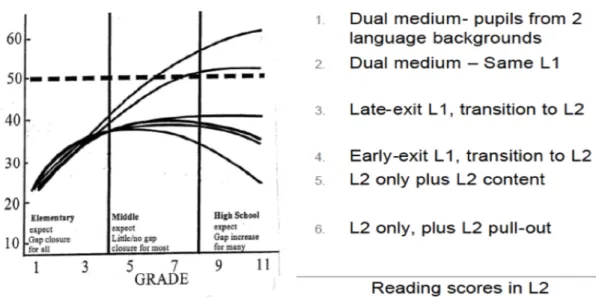
Illustrating further findings comparable to those found in SA, Figure 2.1 below, reproduced from work by Thomas & Collier (1997, p. 53), shows the learner
performance in reading scores of 43 217 L2 learners who followed alternate LoLT models between 1982 and 1996 in the USA. Amongst these learners, those in early-exit models (represented by Line 4 on Figure 2.1) showed a steady decline in their performance from the point of LoLT transition at the SA equivalent of Grade 4 when they began learning in a L2 LoLT, while those learners who continued to learn in L1 LoLT for a longer period (represented by Lines 1-3 on Figure 2.1) performed better over time.
Figure 2.1: Learner performance per LoLT model (Thomas & Collier, 1997, p. 53) A reason for the decline in learner performance from the point of L1-L2 LoLT transition in early-exit models is that learners are required to know the L2 LoLT impossibly well in order to access and meaningfully engage with the primary school curriculum. While a minimum active vocabulary of between approximately 5 000 and 7 000 words is required for understanding the curriculum in Grade 4 (Thomas & Collier, 1997), by the end of Grade 3 SA learners have been found to have been able to amass a L2 vocabulary of only about 500 words (Heugh, 2006, p. 65). Such learners are also unable to engage fully with, or express, their prior knowledge in the L2 during learning processes.
Learners in early-exit systems are often not allowed the time needed to learn the required vocabulary to access the curriculum in a L2. While most learners in
disadvantaged countries must learn in a L2 after having had little or no exposure to it at school, a learner needs to have spent between six and eight years learning the L2
Alexander Molteno
16
before they are able to understand curricular content in that language adequately (DoE, 2007, p. 2).
Not one example in Africa of an early-exit model has been found to have succeeded (Heugh, 2006, p. 66). For disadvantaged primary schools that follow this LoLT policy, the repercussions for education include poor performance (Heugh, 2006, p. 71), low literacy attainment, the underdevelopment of both the L1 and L2 (Heugh, 2006, p. 67), and escalations in repetition and attrition rates from the point where learning begins in the L2 (Heugh, 2006, p. 65), as well as the use of ineffective and inefficient teaching methods (Alidou & Brock-Utne, 2006, p. 85) that produce education of a low quality.
e) Instructional quality
The implementation of L2 LoLT policy within contexts where very few people can speak the LoLT is problematic as the language causes a barrier to teaching and learning when teachers and learners cannot use it to communicate and learn (Alidou & Brock-Utne, 2006, p. 85).
Within such contexts where teachers and learners cannot adequately use the L2 LoLT, classroom observations show that teachers tend to attempt overcoming the language barrier by providing learners with lessons, activities and assessments which are characterised by their tendency to facilitate cognitive processes that are limited to a lower order, and result in a poor quality of education (Alidou & Brock-Utne, 2006, p. 87). Lower-order cognitive processes are educationally ineffective because they do not facilitate the higher-level cognition required for learners’ effective learning. This is because teachers can engage learners’ higher-order thinking only by using
questions of a high quality, which is generally possible only when facilitated in the learners’ L1 as a result of teachers’ and learners’ proficiency in it (Alidou & Brock-Utne, 2006, p. 87).
Low-quality teaching practices commonly found to be employed by teachers in contexts where the LoLT is neither the teachers’ nor the learners’ L1 include those such as safe talk, repetition, memorisation, and chorus teaching, as well as code switching and mixing (Alidou & Brock-Utne, 2006, p. 85; Brock-Utne & Alidou, 2006, p. 102). In such contexts, learners tend to hold back from actively participating
and are typically passive and quiet during lessons taught in the L2 (Alidou & Brock-Utne, 2006, p. 85).
In contrast to patterns of low learner participation, teacher-centred and educationally-ineffective teaching styles and the poor quality of education typically found in L2 LoLT classrooms, experimental research from comparable contexts shows that in L1 LoLT classrooms:
• Teachers employ teaching methods that are more engaging and more educationally effective (Bender et al., 2005, p. 2);
• Learner participation is higher (Alidou & Maman, 2003; Dzinyela, 2001); • Greater active teacher-learner interaction is fostered, which further allows
learners to develop higher-order thinking skills (Chekaraou, 2004);
• The stronger development of problem-posing and problem-solving skills in learners is allowed (Fredua-Kwarteng & Ahia, 2005 [online]); and
• greater cognitive development in learners is evident (WCED, 2007, p. 2) L1 LoLT use is also likely, for pedagogical efficiency reasons, to reduce inequality, since it minimises classroom miscommunication and benefits learners’ desire to learn while bolstering their self-esteem as able learners (Smits, Huisman, & Kruijff, 2008, p. 10).
f) Code switching and mixing
Code switching and code mixing (CSM) are communication strategies frequently found in both L1 and L2 LoLT contexts employed by both teachers and learners in disadvantaged SA classrooms. Switching between L1 and L2 sentences during speaking is referred to as code switching, while the use of both the L1 and L2 within the same sentence is referred to as code mixing (Heugh, 2002, p. 190). The National Centre for Curriculum and Research Development in SA (DoE, 2000, p. 68) observes code switching in SA to be a “main linguistic feature in classrooms where the teacher and the learners share a common language, but ha[ve] to use an additional language for learning … the learners’ language is used as a form of scaffolding”.
CSM are variously employed by teachers, according to their views on the strategies and their own language skills, to help learners understand what is being taught and to
Alexander Molteno
18
increase learner participation during lessons (Probyn et al., 2002, p. 35), and involve teachers’ and/or learners’ mixed use of the LoLT and teachers’/learners’ L1 during lessons. These strategies are also commonly used by teachers to mitigate their own limited proficiency in using the LoLT (Banda, Mostert & Wikan, 2012, p. 24).
Generally, however, teachers employ CSM while they teach as they feel they have no choice but to do so within their circumstances, as the following quote from research conducted by Mwinsheikhe (2003, p. 16) illustrates: “I personally was compelled to switch to Kiswahili [learners’ L1] by a sense of helplessness born of the inability to make students understand the subject matter by using English”.
As such, the use of learners’ L1 for explanatory purposes is the main reason for code switching by teachers in lessons in L1 and L2 LoLT contexts (Probyn et al., 2002, p. 35). Teachers also make use of learners’ L1 via code switching for various
additional functions that fall under the categories ‘classroom management discourse’ and ‘interpersonal relations’ (Ferguson, 2003, 16, p. 2). Within L1 LoLT contexts, teachers and learners have also been found tocode switch to English when the L1 lexicon is inadequate, inefficient, or does not exist. Code switching for this reason occurs most within subjects such as Mathematics and Science.
Learners in L2 LoLT classrooms have been found to code switch predominantly in order to respond to questions, during individual or group interactions, as well as during whole-class interactions when engaging in discussion (Setati et al., 2002, p. 81).
Advantages of code switching/mixing in classrooms
The primary advantages of code switching within L2 LoLT classrooms are also the main reasons why code switching is employed by teachers and learners: to be understood, to understand, and to communicate. As such, within multilingual classrooms, code switching can be considered a social and linguistic skill (Mesthrie, 2008, p. 67) used to facilitate communication between people of different cultures (Wolff, 2011, p. 66) as well as to facilitate learning by improving the communication of curriculum between teachers and learners (Brock-Utne, 2007, p. 521). As a
pedagogical strategy, code switching is useful as it allows what research refers to as
explore concepts and ideas to a degree greater than would have been possible if they were to have been explored in the L2 LoLT alone (Setati et al., 2002, p. 78).
Research on L2 Mathematics teaching in SA has found that code switching, usually to give learners an explanation of concepts and processes in their home languages, is educationally beneficial and necessary for adequate learning to occur (Setati, Chitera, & Essien, 2009, p. 72).
In light of the educational advantages of code switching and mixing in classrooms, very little training is provided for teachers in SA on how to use code switching strategies as a linguistic resource in a manner that is planned and strategic (Probyn, 2008, p. 220).
Disadvantages of code switching/mixing in classrooms
Despite code switching as a practice in education being viewed positively as an educational resource (Setati et al., 2009, p. 66), its use remains dilemma-filled and an issue of considerable debate as a result of problems surrounding code switching’s impact on education. While most disadvantaged SA schools report an English L2 LoLT, this is largely inaccurate. Within such schools learners are expected to write and read in English while being taught using L1/L2 CSM (Heugh, 2013, p. 221). This difference between official LoLT and unofficial classroom practice has negative consequences for learner progress (Probyn et al., 2002, p. 42).
Despite having been often taught in L1 LoLT, when assessed, SA learners are required to answer questions in the L2 LoLT and will receive zero marks for any answer provided in their L1 even if they are correct (Brock-Utne & Alidou, 2006, p. 116). By their use of code switching during lessons, teachers set learners up for failure during assessment in this way. Studies conducted throughout Africa paint a related picture (Kalole, 2004), finding learners’ incompetence in the L2 LoLT to be the predominant factor negatively influencing learner performance during assessment.
Code mixing is even more prevalent in SA than code switching as a practice used by teachers during teaching (Heugh, 2002, p. 191). As such, the model of language provided in such schools is often a code-mixed model, the closest that teachers who are teaching in a second language can get to providing L2 LoLT learners with
Alexander Molteno
20
education in English. This is problematic within contexts where the goal is to learn a language, as very clear linguistic boundaries between the L1 and L2 need to exist in order for learners to learn either of the two languages well (Murray, 2004, p. 440).
This is because the process of developing a learner’s proficiency in a language is one facilitated by expanding the learner’s capacity to link an idea associated with a spoken word to text as a form of that word made visible in writing. For this to occur, the learner must be repeatedly provided with a correctly pronounced spoken word. This becomes impossible if a teacher is unable to provide learners with the correct pronunciation of a spoken word because of the teacher’s lack of proficiency in that language, or if the teacher frequently switches between words that are pronounced differently in the L1 versus the L2.
Developmental psycholinguistic research also indicates that learners in the foundation years of schooling are disadvantaged by CSM practices in this way because of the significant confusion that these practices cause for them while attempting learn a L2 while also navigating and comprehending new conceptual understandings (Henning, 2012, p. 69). The reason attributed to this is that such learners have not yet fully developed the socio-pragmatic skills (Myers-Scotton, 2002) that teachers use when they code switch or mix and are therefore psychologically unprepared (Cantone, 2007) to cope with the demands of learning from teachers who code switch or mix.
Research highlights code switching/mixing in early education as problematic because these practices: 1) create barriers to learning, and 2) undermine the cognitive
development of learners because of the intersection that exists where language and conceptual development must meet in order for cognitive growth to occur – but do not meet (Henning, 2012, p. 75). It is also argued that code switching in classrooms undermines learners’ development in learning a language as they are not challenged by the inputs that they receive during teaching and learning to learn that language further (Gough, 1993, p. 2).
g) Experience of school
The experience of schooling for a learner who is taught in his or her L2 is more uncomfortable than that for a learner taught in his or her L1, for various reasons. Learners who are taught in a language that is foreign to them find school intimidating
as they are not able to understand what his or her teachers are saying to them. Within such situations, learners become confused, bored and withdraw (Jhingran, 2005).
Further exacerbating the discomfort and frustration experienced by learners in L2 LoLT classrooms is the tendency in such circumstances for teachers to employ coercive measures intended to force learners to use the L2 LoLT. Such coercive measures range from learners who do not comply with the LoLT being humiliated to their being beaten in public. The effects of such measures include further reduced learner participation during lessons, increased learner anxiety associated with school, greater educational disaffection among learners, and the increased risk of learner dropout (Smith, 2003).
Teachers who must teach in a L2 also experience discomfort using the LoLT when they lack the proficiency in the language to do so effectively. In a survey of teachers in townships around Cape Town, it was found that many Xhosa teachers felt that they were not adequately trained to do so. This is reflected in a comment by one such teacher made during this survey: “Some of us are afraid of talking English. We feel uncomfortable because we don’t want to be laughed at, as well as making mistakes” (Hibbert, 1995, p. 5).
h) Language and cultural identity effects
Research conducted in SA has led to concerns around the negative effects of
subtractive bilingualism on cultural and linguistic heritage, these being the loss of L1 language proficiency and associated cultural identity (Murray, 2004, p. 438).
Relating to the linguistic threat of L1 loss that African learners are faced with when learning in a L2 LoLT is the challenge that L2 LoLT use poses to the African
learners’ cultural identities when “the social conditions of learning devalue the child’s first language and associated culture” which may also “impede (their) cognitive and social development” (Luckett, 1992, pp. 46–47). Learners who are submerged at school in a L2 show losses of self-confidence and self-esteem (WCED, 2007, p. 2).
Contrary to L2 LoLT effects, L1 LoLT use has been found by research to benefit learners psychosocially and culturally. L1 instruction has been shown to hold significant benefits for learners, such as developmental self-confidence and a strong
Alexander Molteno
22
self-concept, as well as holding advantages for the preservation of minority languages and cultures (Smits, Huisman, & Kruijff, 2008, p. 8-9).
2.6 Factors surrounding LoLT policy implementation and learner performance
Various factors are typically found to exist within learners’ home environments, communities and schools that have an effect on and/or are affected by LoLT policy implementation.
a) Within the home
While more privileged learners are supported in their learning at home by parents who are literate in the LoLT of their children and can provide learning conducive to the optimal development of literacy, for most L2 LoLT learners this is not the case. Their progress is hampered by factors that make achieving literacy more difficult. Such factors include lack of learning resources, inadequate parental support of learning, and the lack of parental involvement in learners’ learning, as parents have often missed out on education themselves and/or cannot speak, read, write or understand their child’s LoLT (UNESCO, 2008).
Compared to L2 LoLT use, which is shown to impact negatively on the degree to which parents support, and are involved in, their children’s learning, the use of learners’ L1 as LoLT in schooling is shown to lead to greater involvement of parents in their children’s education as well as having the effect of promoting more
favourable parent and learner attitudes towards school and education (Brock-Utne & Alidou, 2006, p. 112).
b) Within society
Many parents within disadvantaged contexts consider the need for their children to learn English as vital for their success in life (Pather, 1994) and because of this most such parents choose to have their children taught in English from as early in the child’s life as possible, at the expense of the L1 (Wolff, 2006, p. 42). This sentiment is illustrated by the following quote:
Many people have come to accept that ‘real’ education can only be obtained in a world language such as English. Even the idea that a child will benefit if his or her
initial education is given in the first language is disputed by many so-called educated parents (Bamgbose, 2000, p. 88).
This sentiment is one shared by African children and has contributed to the rise of what is known colloquially as the coconut or Oreo phenomenon. It is characterised by young African people shunning their cultures and languages in favour of English and Western ways. The result of this is the diminished use of African languages and loss of African culture, further worsened by a shortage of African writers as well the demise of African oral tradition. To use English as a LoLT aggravates this pattern of loss, as this quote reflects:
There is little doubt that the systematic but frequently ignored differences between the language and culture of the school and the language and culture of the learner’s community have often resulted in educational programmes with only marginal success at teaching anything except self-depreciation (Okonkwo, 1983, p. 377). The survival of African languages is also threatened by inherent linguistic difficulties within certain contexts on usage. For example, African teachers and learners tend to use English terminology when engaging with communication around mathematical and scientific concepts. The reasons for not using the African terminology is that if it does exist, it is often difficult to use and cumbersome in its usage, or is otherwise unavailable or unknown (Probyn, 2006, p. 396; Setati & Barwell, 2008, p. 3; Vorster et al., n.d., p. 151; Wolff, 2006, p. 43).
SA learners from townships are further disadvantaged by the lack of exposure to any pure form of language, whether it be their own language or English. This results in confusion as learners are exposed to mixtures of various different languages in an unstructured manner that undermines their progress in learning their language as well as English, resulting in learners not knowing enough of either language in order to engage optimally with lessons using them (Probyn, 2006, p. 406).
Within disadvantaged SA contexts, lexical borrowing, defined by Haugen, (1972 [1950]) as “the adoption into one language of items, patterns and meanings from another”, in addition to code switching and mixing, has been seen to give rise to varieties of unofficial languages that differ from area to area as local hybrids that have resulted from the melting of different linguistic codes in one pot. These varieties of language have developed as different languages have been used together in a mixed manner over time to the extent that a degree of convergence occurs between the
Alexander Molteno
24
languages being mixed (McCormick, 2004, p. 219), forming new ‘languages’ that are typically used informally. Slang or gangster language is also evident within such contexts.
In addition to the linguistic factors mentioned above that contribute to a learner’s linguistic confusion while trying to learn several languages simultaneously, within the languages themselves, particularly in the case for isiXhosa in the SA context, great linguistic variation is found to exist from region to region in the form of differing dialects of the same language (Branford & Claughton, 2004, p. 199).
c) Within the school
The ability of LoLT policies to facilitate learner performance is considered to be hampered by two sets of factors (Wolff, 2006, p. 50). The first set comprises those related to negative attitudes held by all stakeholders toward the use of African languages as LoLT. The second set of factors contributing to the failure of LoLT policy to produce good educational outcomes are those to do with the improper planning and implementation of LoLT policy.
Teacher training is also viewed as impairing LoLT implementation. Quality levels of pre-service and in-service teacher training in SA are low, and support to teachers in classrooms is inadequate (Modisaotsile, 2012, p. 2). The quantity of available in-service teacher development is minimal. Teacher training institutions in SA do not fully equip African home language-speaking teachers to teach English, or to teach in English – leaving newly qualified teachers unconfident in doing so, as well as likely to transfer their language errors to learners once in the classroom (Nel & Muller, 2010, p. 646).
The nature of teacher training available in SA is noted as largely inappropriate for the linguistic context of the country in that teacher training curriculum gaps around language education in multilingual classrooms (teaching methodologies, didactic tools and theoretical knowledge) exist (Alidou & Brock-Utne, 2006, p. 87; Calteaux, 1996, p. 158; Probyn, 2008, p. 220).
Learners’ educational progress is also further hampered within disadvantaged SA schools by a lack of basic material resources for use in teaching and learning, such as
classrooms and furniture, reading books, textbooks, dictionaries, and computers, as well as stationery supplies (Prinsloo & Janks, 2002, p. 37; Probyn, 2006, p. 406). A lack of printed material resources in African languages is particularly apparent within such schools, and when such resources are available they are often of poor quality (Banda, Mostert, & Wikan, 2012, p. 33).
Having established the policy context within which the research was conducted, the next chapter will detail how the research was conducted. In this chapter, all of the elements that made up the research design employed will be specified, including research methods, research tools, sources of data and, procedures of data collection and analysis. Potential limitations and ethical considerations will also be addressed.
Alexander Molteno
26
3. Research methods
The research was conducted in two parts: A and B.
Part A quantitatively compared the performance of learners in the WCED Systemic Testing of Language and Mathematics from National Quintile (NQ) 1–3 schools which followed different LoLT models in the Western Cape. These were studied because it is within such schools that the LoLT models in respect of which this research intended to gain an understanding were typically found, that is, straight-for-English and early-exit transitional LoLT models, as well as where teachers and learners are isiXhosa L1 speakers.
Part B adopted a mixed-methods approach (McMillan & Schumacher, 2010, p. 11), where a sample of schools from Part A was identified from each of the different LoLT models and visited for the purpose of investigating how LoLT model formulation and implementation affected learner performance.
While Part A aimed to indicate which LoLT model was associated with higher learner performance, Part B aimed to explore the extent to which Part A’s findings reflected LoLT model implementation, as well as how this implementation affected
performance.
3.1 Part A: Learner performance compared by LoLT
3.1.1 Data source
Part A data was sourced from WCED records of Grade 3 and Grade 6 learner performance during annual systemic evaluations of learner proficiency in language and Mathematics. It was collected by WCED officials in 2012 and 2015 via the administration of standardised tests written by all learners in public schools throughout the Western Cape. This data was used because it provided a valid and reliable assessment of learner performance within the schools of interest to the research.
a) Population
Part A data was sampled to represent a population of SA schools characterised by being:
• Public primary schools within socio-economically disadvantaged contexts; • Staffed by teachers who taught in a L2; and
• Attended by learners who learnt in a L2.
This population of schools, ‘Population A’, was relevant, because it was within such schools that the research aimed to find answers to the research problem: ‘How does LoLT affect learner performance?’
Finding these answers was valuable considering the size and demographic of learners who attended the population of schools of interest to the research in SA:
• 89,7% of black SA Grade 4–6 learners were reported by DBE (2010, p. 2) to be taught in a L2 in 2007, a percentage that has since increased (Taylor & Coetzee, 2013).
• 70,5% of black SA children lived in low income households in 2011 (Stats SA, 2013, p. 14)
• 75% of black SAs had not completed high school in 2011 (Stats SA, 2012, p. 39).
b) Sample
The sample of learner performance data analysed during Part A, ‘Sample A’, was determined by a non-probability purposive sampling strategy (McMillan & Schumacher, 2010, p. 138) in order to ensure that the data was from schools characteristically similar to the extent that valid and statistically significant comparisons were possible (Babbie & Mouton, 2005, p. 478).
Sample A selection criteria were determined by specifying required school
characteristics to be representative of Population A, allowing research that responded to the research problem in a valid manner. Sample A schools met the following criteria:
1. Administration by the same provincial education department, in this case the WCED;
2. A primary school;
3. Categorisation as NQ 1, 2 or 3; 4. No-fee status;
Alexander Molteno
28
5. Implementation of one of two LoLT models; either a straight-for-English model or a late-exit transitional model;
6. Attendance by learners who were predominantly (80%>) isiXhosa L1 speakers; and
7. Staffing by teachers who were predominantly isiXhosa L1 speakers.
The procedure followed to determine Sample A was to select schools that fulfilled the sampling criteria. During this, referring to the criteria above:
• Criterion no. 1: Satisfaction was a given as a result of all of the systemic testing data being from WCED schools.
• Information to apply criteria nos. 2 to 6 was readily available within WCED data.
• Only isiXhosa L1 learner performance data was sampled.
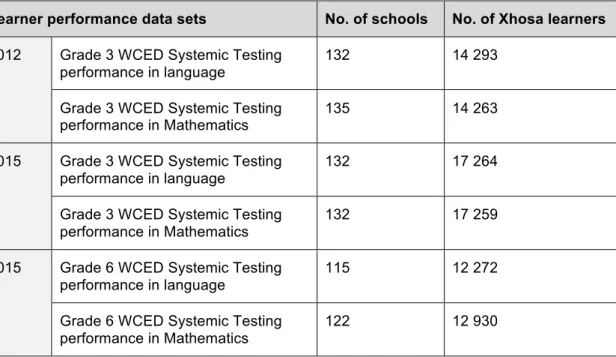
• Application of criterion no. 7 required schools to be evaluated individually. Table 3.1: Sample sizes per learner performance data set
Learner performance data sets No. of schools No. of Xhosa learners 2012 Grade 3 WCED Systemic Testing
performance in language
132 14 293
Grade 3 WCED Systemic Testing performance in Mathematics
135 14 263
2015 Grade 3 WCED Systemic Testing performance in language
132 17 264
Grade 3 WCED Systemic Testing performance in Mathematics
132 17 259
2015 Grade 6 WCED Systemic Testing performance in language
115 12 272
Grade 6 WCED Systemic Testing performance in Mathematics
122 12 930
The final sample of data was limited by availability of schools meeting the sampling criteria and varied between data sets analysed. After sampling , as per criteria, data of schools identified as outliers was removed (McMillan & Schumacher, 2010, p. 165). The size of the resultant sample data sets is reflected above, see Table 3.1. The way in which outlying data was identified will be specified later in this chapter. Furthermore,
the sizes of Grade 6 data sets were affected by the removal of schools that did not have corresponding 2012 and 2015 data sets available.
Sample A was representative of Population A because of the comparable nature of the demographics of learners attending schools included within the sample and
population.
3.1.2 Instrumentation
Instruments used to measure learner performance were tests of language and Mathematics written by learners.
Tests were composed of age-appropriate assessments items that measured learner proficiencies in language and Mathematics in a reliable and valid manner. Tests used were written in the LoLT of the learner: either English or isiXhosa.
Tests were standardised in various respects in order to allow a variety of valid comparisons of learner performance using the data produced (McMillan & Schumacher, 2010, p. 189):
• International comparisons. Test items were benchmarked against international assessment standards.
• Comparisons within the Western Cape. Only one version of tests was used for every learner in the province.
• Comparisons over time. Tests administered were standardised from year to year.
• Comparisons between grades. Test items were age-benchmarked. • Comparisons between LoLT contexts. Language used in test items was
standardised.
Owing to the standardised and controlled nature of the instrumentation employed during the WCED Systemic Testing of learner performance, the data resultant was eligible for use because it provided a valid indication of learner performance per LoLT context. This allowed valid comparisons of performance between LoLT contexts to be made.