2015
New reverse transfer: a case study analysis of
implementation between a community college and
a four-year institution
Sarah Lynn Wilson
Iowa State University
Follow this and additional works at:https://lib.dr.iastate.edu/etd
Part of theEducation Policy Commons,Higher Education Administration Commons, and the Higher Education and Teaching Commons
This Dissertation is brought to you for free and open access by the Iowa State University Capstones, Theses and Dissertations at Iowa State University Digital Repository. It has been accepted for inclusion in Graduate Theses and Dissertations by an authorized administrator of Iowa State University Digital Repository. For more information, please [email protected].
Recommended Citation
Wilson, Sarah Lynn, "New reverse transfer: a case study analysis of implementation between a community college and a four-year institution" (2015).Graduate Theses and Dissertations. 14716.
New Reverse Transfer: A case study analysis of implementation between a community college and a four-year institution
by
Sarah L. Wilson
A dissertation submitted to the graduate faculty in partial fulfillment of the requirements for the degree of
DOCTOR OF PHILOSOPHY Major: Education (Educational Leadership)
Program of Study Committee: Larry Ebbers, Co-major Professor Janice Nahra Friedel, Co-major Professor
Cynthia Fletcher Carol Heaverlo Cheryll Reitmeier
Iowa State University Ames, Iowa
2015
DEDICATION
To my high school sweetheart, Aaron,
for being a true partner.
For our children, Kate, Grant, and Eli, may this one day inspire you to achieve something bigger than yourself.
TABLE OF CONTENTS
Page
LIST OF FIGURES ... vi
LIST OF TABLES ... vii
ACKNOWLEDGMENTS ... viii
ABSTRACT ... xii
CHAPTER 1. INTRODUCTION ... 1
Statement of the Problem ... 2
Purpose of the Study ... 3
Research Questions ... 3
Significance of the Study ... 4
Theoretical Framework ... 4
Diffusion of Innovation... 5
Performance of State Higher Education Systems ... 6
Research Design... 8
Overview of the Dissertation ... 8
Definition of Terms... 9
CHAPTER 2. LITERATURE REVIEW ... 11
Reverse Transfer Terminology ... 11
Exploration of Traditional and New Reverse Transfer ... 14
Importance of the New Reverse Transfer ... 15
New Reverse Transfer Studies ... 17
Supporting College Completion ... 19
Theoretical Framework Critique ... 22
Summary ... 24
CHAPTER 3. METHODOLOGY ... 26
Research Questions ... 27
Methodological Approach ... 27
Epistemology: Constructivism ... 28
Theoretical Perspective: Basic Interpretive ... 28
Methodology: Case Study ... 29
Methods... 30 Participants ... 32 Data Collection ... 33 Data Analysis ... 38 Trustworthiness ... 41 Credibility ... 41 Transferability ... 42 Dependability ... 43
Ethical Issues ... 43 Positionality ... 45 Delimitations ... 46 Summary ... 46 CHAPTER 4. FINDINGS ... 48 Demographics ... 50 Donna ... 50 Christina ... 52 Rachel ... 53 Nate ... 54 Nick ... 55 Nancy ... 57 Leah... 57 Kelly ... 59 George ... 60 Julie ... 61 Thematic Findings ... 62
Theme 1: Measures of success ... 63
Subtheme 1a: Importance of relationships ... 64
Subtheme 1b: Efficient and effective practices ... 67
Theme 2: Influence and stability ... 70
Subtheme 2a: Influencing change ... 71
Subtheme 2b: Stability ... 74
Theme 3: Responding to something new ... 78
Subtheme 3a: The ripple effect ... 79
Subtheme 3b: Flexibility vs. rigidity ... 81
Theme 4: Benefits outweigh the cost ... 85
Subtheme 4a: Focus on students ... 85
Subtheme 4b: Belief in the program ... 89
Summary ... 92
CHAPTER 5. CONCLUSIONS AND RECOMMENDATIONS ... 95
Summary ... 95
Research Questions and Findings ... 96
Research Question 1a ... 97
Research Question 1b ... 99
Research Question 2 ...100
Discussion of Theoretical Framework ...103
Limitations ...105 Implications...107 Recommendations ...108 Practice ...108 Policy ...111 Future Research ...112 Personal Reflections...113
APPENDIX A. INSTITUTIONAL REVIEW BOARD APPROVAL ...115
APPENDIX B. INFORMED CONSENT ...116
APPENDIX C. INTERVIEW PROTOCOL ...119
APPENDIX D. REVERSE TRANSFER TEMPLATE ...120
APPENDIX E. SAMPLE LETTER TO DEPARTMENT HEADS ...121
LIST OF FIGURES
Figure 1. Literature Map ... 12
Figure 2. Influence in the Pacific Northwest State ... 34
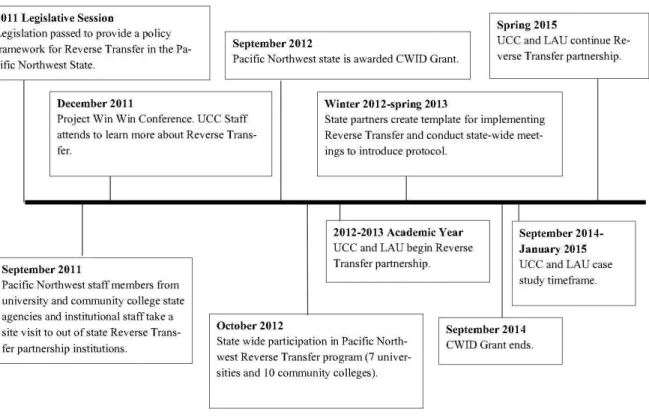
Figure 3. Reverse Transfer Timeline at Pacific Northwest ... 36
LIST OF TABLES
Table 1. Research studies related to reverse transfer ... 20 Table 2. Document analysis ... 38 Table 3. Demographics of the participants ... 51
ACKNOWLEDGMENTS
I am humbled and appreciative as I achieve this milestone in my educational journey. While these acknowledgements only demonstrate a small glimpse of my gratitude to those who have helped me along this path, I hope that it may convey my sincere appreciation.
I am one of the lucky few to have two major professors. It has been a joy to work with both Drs. Larry Ebbers and Janice Nahra Friedel. Thank you, Dr. Ebbers, for your support, kind words, and constant belief that I would accomplish this. As a mother to three small children and as fulltime professional, the path was steep. Nevertheless, you never wavered in your support of me and you never let me use that as a reason to stop working. Thank you for guiding me. Thank you, Dr. Friedel, for pushing me to do more and for seeing my potential. We had many long nights on Skype and numerous drafts between us, and you held me accountable and helped me to achieve. I am forever grateful for you bringing me under your research wing of reverse transfer and for encouraging me along the way.
As an undergraduate at Iowa State University, I was fortunate to take Fundamentals of Food Preparation with Dr. Cheryll Reitmeier. In that class, Dr. Reitmeier helped me to understand why milk is white, the standard characteristics of a fried egg, and how to be a critical thinker. As a young college student, she was instrumental in shaping me as a learner and as a professional. She made me feel important, smart, and valued; and I believe she is pretty special, too. Thank you, Dr. Reitmeier, for being a wonderful mentor to me for all of these years.
Thank you to two other very important members of my committee, Drs. Cynthia Fletcher and Carol Heaverlo. Thank you, Dr. Fletcher, for providing feedback and guidance on my research. I am so thankful to have had the opportunity to take a course with you in my
graduate studies, and I am appreciative of your perspective and expertise. Thank you, Dr. Heaverlo, for teaching me what it means to be a qualitative researcher. Your willingness to spend extra time with me and to be my researching sounding board is forever appreciated. Thank you for giving me room to grow as a researcher while also providing guidance whenever I needed it.
Thank you to my 10 participants of this study. I was able to conduct this study because of your insight and willingness to share with me your experiences. I am truly grateful for your involvement and stories.
Prior to this research, for the study to be considered, I was encouraged by some special individuals who believed in me before I believed in myself. To Dr. Tom Chacko, thank you for asking me every six weeks if I had applied to the PhD program. Your constant belief in me started the ball rolling. To Dr. Ann Coppernoll, for allowing me to start the program while I was working for you in undergraduate programs. To Dr. Diann Burright, for being a light in my life during this experience. Since working for you in the College of Business, you supported me and encouraged me through these “five individual papers”. I saw my way through this with your optimism, perspective, and support. To Danny Johnson, for telling me second-rate statistics jokes, for the chocolate, and for supporting me while I was pursing my dream.
I have been so lucky to have had such wonderful peers during this journey. Thank you to Zoë, Jared, and Lindsay for the laughs, feedback, and support. Thank you for peeling me off the ceiling when I needed it and for pushing me forward every time I stalled. While I was not in a traditional cohort, I was fortunate to be adopted by one. Thank you to all of you for letting me into your group and for providing the support from which we all benefited.
To my good work buddy, Leah, thank you for laughing at my jokes and for telling me some good ones, too. Your friendship has meant the world to me and I am thankful for your presence in my life. To my old graduate school pal turned friend-for-life, thank you, Dr. Julie Yankey, for being my inspiration and for making me think a PhD is not that big of deal. By the way, it is! We did it! Thank you for all your support, encouragement and many, many lunch dates and conversations. They meant the world to me.
I am especially grateful to the woman who shaped me into who I am today—my mom, Linda. My mom has always been supportive of me, even when she did not agree with what I was doing. She knows me too well—I was going to do it either way. During this journey, she never once told me I could not or should not do it. She was always supportive, yet understood how difficult it was. Thank you, Mom, for all the Saturday mornings with the kids and for covering for me when I needed you. Most importantly, thank you, Mom, for your love, for showing me the value of education, and for believing in me.
Thank you also to my wonderful mother and father-in-law, Nancy and Gary. Thank you for filling in for me when I was writing and for taking care of my family while I was attending class, traveling to conferences, or working late. Thank you for love and
understanding.
To my other family members, friends and colleagues, thank you for asking about my research even though you may not have understood the context of my study. Thank you to the staff in the College of Human Sciences Student Services for understanding when I was writing and for encouraging me as I finished.
Most importantly, I would like to thank my partner in life, my husband, Aaron, and my three children: Kate, Grant, and Eli. Thank you, Aaron, for feigning interest in my research, for editing my never-ending papers, and for giving me the space to pursue this
crazy dream. Your love and support kept me going to the finish. Thank you for this. I love you. Thank you to my children for their laughter, smooches, and snuggles. I especially thank you for making me feel so loved.
ABSTRACT
The new reverse transfer has emerged in recent years as an innovative pathway for degree completion. The term, once used to refer to students who transferred to a community college from a four-year institution, has undergone a contextual change (Hagedorn & Castro, 1999; Townsend & Dever, 1999; Yang, 2006). The term today has a new application and references a different pathway, which refers to students who transfer credits from a
community college to a four-year institution and retroactively earn a two-year degree with their newly earned four-year college credits (Bragg, Cullen, Bennett, & Rudd, 2011; Friedel & Wilson, 2015; Marling, 2012). The reverse transfer pathway has emerged as community colleges pursue innovative opportunities to serve students and improve completion rates. President Obama’s Completion Agenda and state accountability measures are also contributing to the need for innovative completion programs. To explore the growth and implementation of reverse transfer programs, a case study analysis was conducted in a Pacific Northwest state with an urban, multi-campus community college, a public liberal arts university, and their respective state higher education agencies. The case study analysis sought to understand the factors that influence the implementation process of the new reverse transfer and the challenges and support mechanisms that influence the implementation of the new reverse transfer program in the Pacific Northwest state. The data were coded, analyzed, and arranged into four emerging themes: (1) measures of success, (2) influence and stability, (3) responding to something new, and (4) benefits outweigh the cost. The findings revealed that strong working relationships between colleagues at each institution were a cornerstone to the successful implementation. Campus administrators and state higher education agencies support are important contributors to the implementation and future stability of the program.
Flexible and forward-thinking campuses are important attributes in successful
implementation. Finally, a focus on student achievement and a belief in the program were revealed as characteristics of a successful program. A discussion of the implications for practice, policy, and research are also presented.
CHAPTER 1. INTRODUCTION
The new reverse transfer has emerged in recent years as a new pathway for degree completion. The term once used to refer to students who transferred to a community college from a four-year college has undergone a contextual change (Hagedorn & Castro, 1999; Townsend & Dever, 1999; Yang, 2006). The term today has a new application and refers to a different pathway, which refers to students who transfer credits from a community college to a four-year institution and retroactively earn a two-year degree with their newly earned four-year college credits (Bragg, Cullen, Bennett, & Rudd, 2011; Friedel & Wilson, 2015; Marling, 2012). The reverse transfer pathway has emerged as community colleges pursue innovative opportunities to serve students and improve completion rates. President Obama’s Completion Agenda and state accountability measures, such as state performance based funding models, are also contributing to the need for innovative completion programs.
Subsequently, community colleges and four-year institutions are partnering together to create formal reverse transfer programs designed to improve degree completion rates (Friedel & Wilson, 2015).
With the evolving use of the term “reverse transfer” and the creation of academic programing to support reverse transfer, it is necessary to explore reverse transfer best
practices, implications for institutions, and outcome potential for students. In order to further explore the evolving application of the term “reverse transfer” and the academic programs used to support reverse transfer, a case study analysis was conducted in a Pacific Northwest state with an urban, multi-campus community college and its feeder institution, a public liberal arts university. In this study, the new reverse transfer program was investigated from the perspective of one theory and one model: Diffusion of Innovations theory (Rogers, 2003)
and Performance of State Higher Education Systems model (Richardson, Bracco, Callen, & Finney, 1999). This case study analysis sought to understand the factors that influenced the implementation process of the new reverse transfer and the challenges and support
mechanisms that influence the implementation of the new reverse transfer program in the Pacific Northwest. Through semi-structured interviews and document analysis, the study focused on the partnership between an urban, multi-campus community college, a public liberal arts university and their respective state agencies.
For purposes of this research study, unless otherwise noted, the term “reverse transfer” refers to the “new reverse transfer” (i.e., the transferring of credit from a four-year college back to a two-year college to retroactively earn an associate’s degree) and may be used interchangeably. This chapter provides the background of the dissertation research in the following sections: statement of the problem, purpose of the study, research questions, significance of the study, theoretical framework, research design, overview of the
dissertation, and definitions of common terms.
Statement of the Problem
In recent years, the number of institutions and states implementing reverse transfer programs has grown. As of 2013, 60% of states had reverse transfer programs, with the majority of those programs implemented at the state level (Friedel & Wilson, 2015). With the growing implementation of reverse transfer programs, a small number of quantitative studies have been conducted. These quantitative studies, however, have not been empirical studies, but rather have been primarily descriptive in nature (Bautsch, 2013; Ekal & Badillo, 2011; Friedel & Wilson, 2015; Iowa Department of Education, 2013; The University of Alabama, 2012).
At present, there are no known qualitative studies on the new reverse transfer. As such, in order to contribute to the literature, it is important to explore the experiences of individuals, staff, administrators, community colleges, and four-year colleges who work with reverse transfer programs. Additionally, there is much to learn and understand from these entities in terms of the influences of implementation. Research conducted by Richardson, Bracco, Callen, and Finney (1999) and Rogers (2003) addressed the influence that state higher education structure and individual persons, respectively, have on implementing a reverse transfer program. This research may potentially contribute to the literature to better inform institutional personnel, state administrators, and policy makers about the reverse transfer program.
Purpose of the Study
This case study analysis sought to better understand how individual persons and state higher education governance structures influence the implementation of the new reverse transfer program. The new reverse transfer, defined as students who transfer from a two-year college to a four-year institution and retroactively receive an associate’s degree with their newly earned four-year college credits, is emerging across the nation (Friedel & Wilson, 2015). This study may potentially contribute to the literature on the new reverse transfer. It was set in the Pacific Northwest and focused on the partnership between an urban, multi-campus community college, a public, liberal arts university and their respective state agencies.
Research Questions
The following questions guided the researcher in the collection and analysis of data:
1a. How do staff members describe their experience and influence over the implementation of the new reverse transfer program?
1b. How does a state system of higher education influence the implementation of the new reverse transfer?
2. What are the challenges and support mechanisms that influence the implementation
of the new reverse transfer program?
Significance of the Study
This study was conducted in response to the lack of qualitative research in the literature regarding the new reverse transfer. At the time of this writing, no known research existed that addressed the experiences of staff during the implementation phase of the new reverse transfer. The information garnered from this study may provide support and insight regarding the development of new reverse transfer programs and encourage others to implement a new program on college campuses. Additionally, this study may inspire institutions to seek new and potentially better ways to administer new reverse transfer programs. Findings from this study may also be helpful to those looking to understand the student experience in the process of participating in the new reverse transfer. The findings cannot be directly transferred to the student experience. They can, however, illuminate potential strengths and challenges students may encounter.
Theoretical Framework
In this study, the lens through which the new reverse transfer program was explored was through one theory and one model: Diffusion of Innovations theory (Rogers, 2003) and Performance of State Higher Education Systems model (Richardson, Bracco, Callen &
Finney, 1999). The researcher sought to use these concepts to help inform the study and were used as a means to frame the study.
Diffusion of Innovation
Implementing a new idea, process or product can be challenging, and even more challenging is encouraging individuals and organizations to quickly implement the
innovation. One such new initiative on college campuses is the new reverse transfer program. Similar to other innovative ideas, implementing the new reverse transfer can be challenging for personnel involved in the process. Roger’s (2010) Diffusion of Innovations (DI) theory was explored to better understand these challenges. Roger’s DI theory “explains social change” which is “one of the most fundamental human processes” (p. xviii). Diffusion is
defined by the DI theory as “the process by which (1) an innovation is (2) communicated
through certain channels (3) over time (4) among the members of a social system” (p. 11). Most notably for the purposes of this study is the influence that the social system (e.g., environment, campus culture) has on how readily an innovation is implemented. This is true and relevant to the new reverse transfer because the “social and communication structure of a system facilitates or impedes the diffusion of innovations” within the system or unit (i.e., community college or four-year college) (p. 37). Three of the four elements of DI
(innovation, communication channels, and social systems) are used as a framework to better understand how different variables in this case study influence the implementation of the new reverse transfer program.
DI postulates that the innovation-decision process requires an individual [or
evaluate the innovation (Rogers, 2010, p. 168). The nature of this process is outlined in a sequential process of innovation decision making:
1) Knowledge occurs when an individual (or other decision-making unit)
is exposed to an innovation’s existence and gains an understanding of how it functions.
2) Persuasion occurs when an individual (or other decision-making unit)
forms a favorable or unfavorable attitude toward the innovation.
3) Decision takes place when an individual (or other decision-making
unit) engages in activities that lead to a choice to adopt or reject the innovation.
4) Implementation occurs when an individual (or other decision-making
unit) puts a new idea into use.
5) Confirmation takes place when an individual seeks reinforcement of
an innovation-decision already made, but he or she may reverse this previous decision if exposed to conflicting messages about the innovation. (Rogers, 2010, p. 169)
According to Rogers (2010) this five stage process of DI is the progression in which an individual, over time, evaluates the new idea/program/product, forms an opinion, and decides whether to embrace or exclude the innovation in future practice. This process which an individual follows informed the study as to how and why certain actions were employed (or not employed) during the implementation of the new reverse transfer.
Performance of State Higher Education Systems
State systems of higher education include “the public and private postsecondary institutions within a state, as well as the arrangement for regulating, coordinating and funding them” (Richardson et al., 1999, p. viii). Thus, one can visualize the far-reaching scope that the state system of higher education plays on a college’s campus. Specifically, this model served as a lens to help inform the researcher as to how a state’s higher education structure influences the implementation of a new program, such as the new reverse transfer.
The higher education system within each state “…operates in a policy environment that is the result of efforts over time to balance the often conflicting interests of academic
professionals and … the market” (Richardson et al., 1999, p. 12). As defined by Richardson et al., the market is the broad concept of the “array of interests and influences that are external” (p. 12) to the state and college and university systems. Further, the relationship between state and higher education institutional priorities is a principle point of the authors’ study. This relationship comes together to form the Continuum of Governance Designs.
The two key components of Continuum of Governance Designs are: (1) state policy roles, and (2) system designs. In order to evaluate the state policy roles, Richardson et al. relied on Clark’s (1983) Triangle of Tension, which represented the tension between higher education, state authority and the market (1999). From Clark’s work, and another model by Williams (1995), Richardson et al. built a model to explore the state policy roles for higher education. This model explains how the state serves as: (1) provider; (2) regulator; (3) consumer advocate; or (4) steering role as defined on a continuum. The primary distinction between roles involves the “use that a state makes of the market. In a market dominated environment, price is a function of demand. In the consumer advocacy role, the state concentrates on supporting demand. In the regulating role, the state controls price” (Richardson et al., 1999, p. 15).
The second key component is system design of state governance structures for higher education systems. Richardson et al. categorize states into three main structures: (1)
segmented, (2) unified, or (3) federal. Segmented systems have “multiple governing boards” that manage many institutions without one sole state agency; unified systems share a
common “ways of communicating and measuring” and have one governing board that oversees all institutions in the state; federal systems have a statewide board to oversee budgeting and programming, but also allow for local independence on issues such as strategic planning and accountability (p. 16). While Richardson et al. did not attempt to
portray one structure as superior, they do agree that the structure of a higher education system is of importance and often understated (1999). This model was used to analyze the state system in the Pacific Northwest state and better understand how this structure
influences the colleges and universities within it.
Research Design
A case study methodology provided the framework to better understand how state higher education governance structure and individual persons influence the implementation of the new reverse transfer. Case study is an “intense description and analysis of a
phenomenon or social unit” that can “describe the phenomenon in depth” (Merriam, 2002, p. 8). According to Yin (2009), case study is an excellent methodology to employ when “a) ‘how’ or ‘why’ questions are being posed, b) the investigator has little control over the events, and c) the focus is on contemporary phenomenon within a real-life context” (p. 2).
Case study, as a research methodology, has been used “in many situations, to
contribute to our knowledge for individual, group, organization, social, political, and related phenomena” (Yin, 2009, p. 4). As discussed in Chapter 3, case study methodology may employ several data collection methods. For the purpose of this study, semi-structured interviews with staff members involved in reverse transfer programming were conducted. In addition to individual interviews, documents, letters and policies were analyzed as a form of document analysis. Document analyses assist in the research process because they
“corroborate and augment evidence from other sources” (Yin, p. 103).
Overview of the Dissertation
The dissertation is comprised of five chapters. Chapter 2 focuses on the literature review of the new reverse transfer research that specifically explores the outcomes of
traditional and new reverse transfer students, the importance and value of the new reverse transfer program, current research on reverse transfer participation, college completion initiatives, and a theoretical framework critique. Chapter 3 provides the methodology (case study) and methods used for this study. The analysis of the data is presented in Chapter 4, and in Chapter 5, a discussion of the findings and implications of the study is provided.
Definition of Terms
The most commonly used terms in this study were defined for this research:
Diffusion: The “process by which (1) an innovation is (2) communicated through certain
channels (3) over time (4) among the members of a social system” (Rogers, 2010, p. 11).
Innovation:An “idea, practice, or object that is perceived as new by an individual or another
unit of adoption” (Rogers, 2003, p. 475). For this study, the term innovation is referring to the new reverse transfer program.
New Reverse Transfer:An emerging term in higher education which refers to students who
begin at a two-year college and transfer to a four-year college before completing a degree. Credit is then transferred back to the two-year college retroactively in order to award a degree. Other terms, such as “new reverse transfer”, “transfer back”, “reverse university transfer”, and “reverse articulation” are also used interchangeably in the field (Bragg, Cullen, Bennett & Rudd, 2011; Friedel & Wilson, 2015; Marling, 2012).
Staff member:A term to refer to any non-faculty member involved in the reverse transfer
program. Also, it does not include students.
State system of higher education: Refers to all private and public postsecondary institutions
in a state, which includes the responsibility and oversight of regulation, coordination and funding models/sources (Richardson, Bracco, Callen & Finney, 1999).
Traditional Reverse Transfer:This term can be used to refer to multiple patterns of transfer. Historically, however, and for the purposes of this paper, the term refers to students who start at a four-year college and then transfer to a two-year college (Townsend & Dever, 1999).
CHAPTER 2. LITERATURE REVIEW
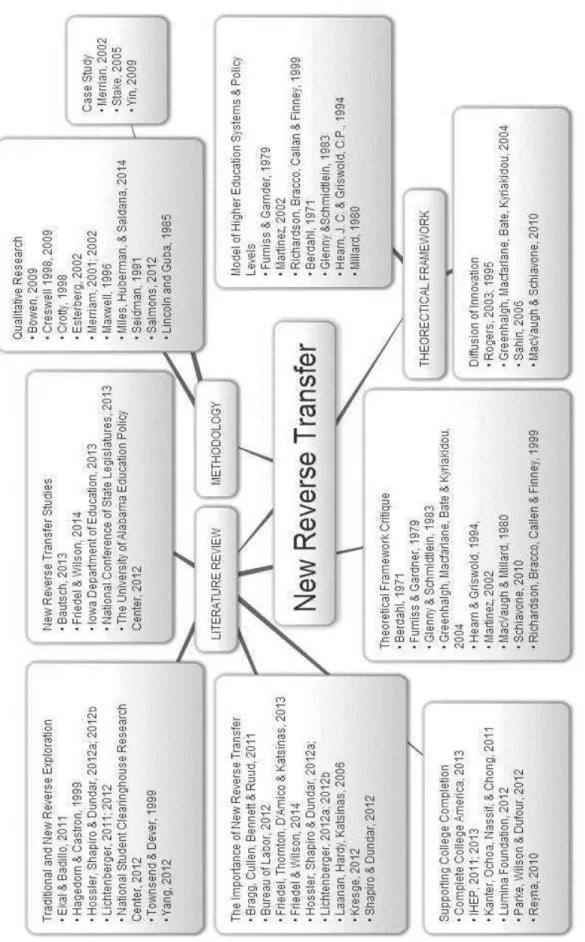
Chapter 2 serves as a review of the literature on the new reverse transfer programs and initiatives. The literature review is organized into five sections: (1) overview of the outcomes of traditional and new reverse transfer students; (2) importance and value of the new reverse transfer program; (3) current research on reverse transfer programming; (4) college completion initiatives; and 5) theoretical framework critique. To help organize the literature discussion, a literature map is provided in Figure 1.
Reverse Transfer Terminology
The mobility patterns of college students have changed significantly in the past twenty years. Researchers have studied the movement of transfer students and have illustrated the complicated patterns in transfer performance and movement (Bahr, 2012; Laanan, 2001; Pascarella & Terenzini, 2005; Townsend & Dever, 1999). Transfer student patterns are a “complex phenomenon that has been defined in different ways in research: transfer, swirling, double-dipping, etc.” (Hossler, Shapiro, & Dundar, 2012a, p. 11). Since multiple terms and transfer pathways exist, it is necessary to clarify the definition in order to focus on a specific pattern. The term “reverse transfer” has been applied to many transfer pathways and is explained differently by various researchers. One such example is Hossler, Shapiro, and Dundar’s (2012b) use of the reverse transfer term when referring to students who begin at a university and then subsequently transfer to a two-year institution. Three separate transfer pathways for reverse transfer students have been outlined in work by Townsend and Dever (1999). Largely, Townsend and Dever referred to reverse transfer as “students who move from a four-year college to a two-year college” because their “transfer [is] in a pattern that is the reverse of the traditional pipeline pattern” (1999, p. 5).
F ig u re 1 . L it er at u re M ap
Townsend and Dever referred to students who are “undergraduate reverse transfer students” (URTS), as those that either: (1) “begin their education at a four-year school and then transfer to a two-year school and stay there for a while” … or (2) briefly, reverse transfer …
“students who attend a two-year college, often during the summer, simply to earn a few credits that can be transferred back to their four-year college” (as cited by Friedel & Wilson, 2015, p. 6). This second grouping of students are called “summer sessioners” in research by Hagedorn and Castro (1999, p. 23). A third type of reverse transfer students are called post baccalaureate reverse transfer students (PRST) (Townsend & Dever, 1999; Yang, 2006). The post baccalaureate group of students typically has earned a bachelor’s degree before
attending a community college. They attend for different reasons than traditional students, including for personal growth, career exploration and professional advancement (Friedel & Wilson, 2015; Townsend & Dever, 1999).
For decades, these three subgroups of reverse transfer have existed and have been studied by researchers. Current community college and higher education policy literature, however, reflects a change in the term’s usage (Friedel & Wilson, 2015). An emerging pattern, the “new reverse transfer” has been appearing in the literature and on college
campuses in recent years. Beginning in the mid-2000s, the term reverse transfer evolved and started to refer to the new reverse transfer, students who transfer “academic credits for applicable coursework at the university…back to the community college for the purposes of awarding an associate’s degree” (Marling, 2012, p. 2). In addition to using the term “new reverse transfer”, “educational research and policy initiatives also use the terms ‘reverse credit transfer’, ’transfer back’, ‘reverse articulation’, and ‘reverse university transfer’ interchangeably” (Friedel & Wilson, 2015, p. 8).
Exploration of Traditional and New Reverse Transfer
With the growth of new reverse transfer programs across the nation, research on the topic has been slowly emerging. One known study on reverse transfer was at partnering institutions, the University of Texas at El Paso (UTEP) and El Paso Community College (EPCC). UTEP and EPPC’s initial report shows promise in their reverse transfer program. As of 2009, UTEP and EPCC awarded 2,874 associate degrees (AA/AS) to students in their new reverse transfer program. An impressive result from this report is that 70% of these reverse transfer students went on to earn a bachelor’s degree (Ekal & Badillo, 2011).
Performance outcomes on new reverse transfer have been slow to emerge and have not been widely published. In contrast, however, is the substantial amount of research on traditional reverse transfer populations (defined as students who start at a four year college and then later transfer to a community college) (Townsend & Dever, 1999; Yang, 2006). Unfortunately, research conducted on traditional reverse transfer students has not been overly promising in terms of outcomes and graduation rates. In one example, a study by National Student Clearinghouse Research Center (NSCRC) “examined the mobility and success of students who entered four-year colleges and universities and then transferred to two-year college. By the end of the six-year study period, 17.8% had returned back to their four-year college and one-third had either completed their associate degree or were still enrolled at the community college (Hossler, Shapiro, & Dundar, 2012a)” (Friedel & Wilson, 2015, p. 9). One positive outcome from related research notes the positive influence that receiving an associate’s degree has on rates of persistence and completion (Friedel & Wilson, 2015). A study on traditional reverse transfer students and postsecondary outcomes conducted by Lichtenberger’s (2011), revealed that “earning an associates’ degree was among the most important factors in predicting a timely return to a four-year degree” (p. 2). Additionally, a
NSCRC snapshot report determined that “graduation rates were highest for the students who transferred after receiving an associate’s degree. About 71% of these students earned their bachelor’s degree within four years, and nearly 80% either graduated or persisted at a four-year institution” (Lichtenberger, 2012, p. 1).
While it is promising that current research demonstrates that earning an associate degree before transferring leads to higher baccalaureate attainment rates, it does not demonstrate that the reverse transfer of four-year college credits will produce the same outcome for students in new reverse transfer programs. Additionally, it is important to note that “tracking the traditional reverse transfer student enrollment has shown that not all
reverse transfer students behave in the same manner, so generalizing any forthcoming data of the new reverse transfer programs may be problematic” (Friedel & Wilson, 2015, p. 9). For instance, Hossler, Shapiro, and Dundar (2012a) determined that “enrollment at a two-year institution after beginning college at a four-year college or university does not necessarily mean that a student has made a permanent reverse transfer” [to persist at the two-year
college] (p. 5). After attending a two-year college, some students return to their original four-year college, others transfer to a completely different four-four-year college, and some do not attend any college or university at all (Hossler et al., 2012b). Notably, “results also show that — whether or not they [students] had intended to return to their institution of origin — the majority of reverse transfer students did not return” (p. 5). Of equal importance, a NSCRC report found that “increasingly more students attend multiple institutions, transferring once, twice, or even three times before earning a degree” (Hossler, Shapiro, & Dundar, 2012b, p.5). Indeed, one third of all college students transfer at some point in time before finishing a degree (Hossler et al., 2012a). Due to the fact that a significant amount of transfer students attend several institutions, move to different states, and transfer from public to private
colleges, many students are simply not accounted for in mobility studies (Hossler et al., 2012a). One can clearly see that forecasting a student’s mobility pattern is “complicated, difficult to track, and not yet fully understood” (Friedel & Wilson, 2015, p. 9).
Importance of the New Reverse Transfer
The implementation of reverse transfer programming is an innovative program designed to improve the completion rate of students who attend community colleges. Students, college administrators, and policy creators may see the value in reverse transfer programs for three primary reasons. First, recent research studies demonstrate that
“associate’s degree completion is positively and significantly related to both a timely return and a timely completion of a bachelor’s degree” (Lichtenberger, 2012, p. 32). Research shows that completing an associate’s degree is one of the most important factors that influences a student’s return to a four-year institution (Friedel & Wilson, 2015; Lichtenberger, 2011). Second, students who have received their associate’s degree demonstrate higher employment and salary rates (Friedel & Wilson, 2015). In 2011, the Bureau of Labor Statistics revealed that a person with an associate degree had median weekly earnings of $768 a week. In contrast, a person with only a high school diploma earned almost $130 less a week (Bureau of Labor, 2012). Further, it is important to note that in 2011 the unemployment rate with an associate degree was 6.8%; whereas a person with only a high school diploma experienced an unemployment rate of 9.4 % (Bureau of Labor, 2012). The economic importance of education is far-reaching, and programs such as the new reverse transfer at community and four-year colleges help to develop human capital in our
communities and neighborhoods (Laanan, Hardy, & Katsinas, 2006). Finally, and perhaps most importantly, reverse transfer programs help community colleges increase their
completion rates and support student success in the classroom (Friedel & Wilson, 2015; Taylor, 2013). Due to the fact that “70 to 90 % of students make the move to four-year colleges and universities before earning two-year degrees” the reverse transfer program is aptly designed to address this issue (Kresge, 2012, para. 2). To add to these transfer statistics, it is also reported that community colleges are not credited with serving the nearly two- thirds of their students who go on to complete a four-year degree (Shapiro & Dundar, p.9). Administrators at community colleges and four-year institutions are fully aware that
policymakers are increasingly focused on “student outcomes as indicators of the success and quality of individual public institutions” (Hossler, Shapiro, & Dundar, 2012a, p.10) and are tying funding to performance (Bragg, Cullen, Bennett, & Ruud, 2011; Friedel, Thornton, D’Amico & Katsinas, 2013).
New Reverse Transfer Studies
Research is beginning to emerge on the new reverse transfer. Currently, there are four relevant studies to review: (1) 2012 Survey of Access and Finance conducted by The
University of Alabama Education Policy Center; (2) the National Conference of State Legislatures (NCSL) Hot Topics in Higher Education brief (Bautsch, 2013); (3) Summer 2013 survey of the National Council of State Directors of Community Colleges conducted by Iowa Department of Education; and (4) Friedel and Wilson’s 2015 study on the national landscape of the new reverse transfer. Studies 1-3 were largely outlined in Friedel and Wilson’s 2015 report and are briefly summarized as follows.
The first study is the 2012 Survey of Access and Finance Issues by the Education Policy Center, at The University of Alabama. This study surveyed members of the National Council of State Directors of Community Colleges (NCSDCC) as to whether or not reverse
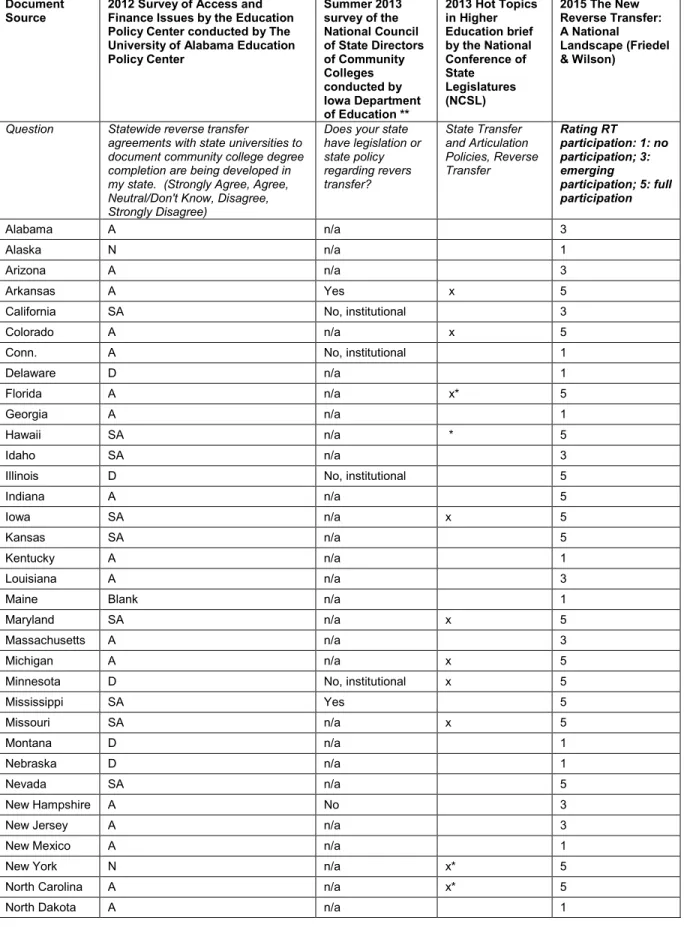
transfer was under development or fully present in their state. The study revealed 34 states had the program, six states were neutral (neither agreeing or disagreeing that reverse transfer was being developed in the state), nine states did not have the program, and two states did not respond to this question (The University of Alabama Education Policy Center, 2012). A second study was reported in a 2013 National Conference of State Legislatures (NCSL) publication. The NCSL brief outlined each state’s participation in the new reverse transfer (Bautsch, 2013). The report demonstrated, that as of January 2013, 15 states passed legislation which addressed reverse transfer, had active reverse transfer agreements in state, or were currently developing agreements (Bautsch, 2013). In early May 2013, the NCSL “was aware of at least three additional states that were introducing reverse transfer legislation during the current session” (Friedel & Wilson, 2015, p. 10).
The third study, conducted by the Iowa Department of Education, was administered at the April 2013 National Council of State Directors of Community Colleges’ (NCSDCC) meeting. An administrator in the Division of Community Colleges at the Iowa Department of Education surveyed participants about their state’s reverse transfer policy or legislation. The study revealed that “eleven states responded to the survey: four said that reverse transfer was supported by state policy or legislation, four stated that it was present in their state at the institutional level, and three said that it was not present at all in their state” (Friedel & Wilson, 2015, p. 10).
A fourth study was conducted by Friedel and Wilson (2015) to further explore the current state of the new reverse transfer. The study provided an “overview of the new reverse transfer and the current status of reverse transfer participation and implementation procedure within each of the 50 states” (Friedel & Wilson, 2015, p. 1). Findings revealed, through a numerical rating system of (1) no participation; (3) emerging participation; (5) full
participation), that 18 states had no participation, 11 states had emerging participation, and 21 states had strong participation in implementing state-wide reverse transfer programming. Table 1 provides an overview of each study and the results by state (Friedel & Wilson, 2015).
Supporting College Completion
Performance measures and completion rates have become hot topics in higher education policy and practice discussions. The Obama administration’s college completion agenda has set a goal of increasing the nation’s college degree completion rate to 60% by 2020 and adding at minimum 10 million more degrees awarded from community colleges and four-year institutions (Kanter, Ochoa, Nassif, & Chong, 2011). This goal strives to “ensure the vitality of our nation’s economy” and “to strengthen our community colleges… [so to] produce the best-educated and most-competitive workforce in the world” (Parke, Wilson & Dufour, 2012, p. 1).The initiative strives to “improve college completion rates [which] has caused community colleges and four-year colleges and universities to collaborate in creating strategies to reach these goals” (Friedel & Wilson, 2015, p. 11).
One such example of institutions partnering to improve completion rates is Project Win-Win, a partnership between the State Higher Education Executive Officers (SHEEO) and the Institute of Higher Education Policy (IHEP), funded by the Lumina Foundation for Education (and, in Michigan, by The Kresge Foundation). Sixty-one community colleges and four-year institutions in nine states (Florida, Louisiana, Michigan, Missouri, New York, Ohio, Oregon, Virginia, and Wisconsin) participated in Project Win-Win. The main
objective was to find former students who were no longer in college and who never earned a degree, and award qualified students a degree retroactively (Institute for Higher Education Policy, 2011). As of August 2013, over 6,700 eligible students were identified and more than
Table 1. Research studies related to reverse transfer
Document Source
2012 Survey of Access and Finance Issues by the Education Policy Center conducted by The University of Alabama Education Policy Center Summer 2013 survey of the National Council of State Directors of Community Colleges conducted by Iowa Department of Education ** 2013 Hot Topics in Higher Education brief by the National Conference of State Legislatures (NCSL) 2015 The New Reverse Transfer: A National Landscape (Friedel & Wilson)
Question Statewide reverse transfer
agreements with state universities to document community college degree completion are being developed in my state. (Strongly Agree, Agree, Neutral/Don't Know, Disagree, Strongly Disagree)
Does your state have legislation or state policy regarding revers transfer? State Transfer and Articulation Policies, Reverse Transfer Rating RT participation: 1: no participation; 3: emerging participation; 5: full participation Alabama A n/a 3 Alaska N n/a 1 Arizona A n/a 3 Arkansas A Yes x 5
California SA No, institutional 3
Colorado A n/a x 5
Conn. A No, institutional 1
Delaware D n/a 1
Florida A n/a x* 5
Georgia A n/a 1
Hawaii SA n/a * 5
Idaho SA n/a 3
Illinois D No, institutional 5
Indiana A n/a 5
Iowa SA n/a x 5
Kansas SA n/a 5
Kentucky A n/a 1
Louisiana A n/a 3
Maine Blank n/a 1
Maryland SA n/a x 5
Massachusetts A n/a 3
Michigan A n/a x 5
Minnesota D No, institutional x 5
Mississippi SA Yes 5 Missouri SA n/a x 5 Montana D n/a 1 Nebraska D n/a 1 Nevada SA n/a 5 New Hampshire A No 3
New Jersey A n/a 3
New Mexico A n/a 1
New York N n/a x* 5
North Carolina A n/a x* 5
Table 1. (Continued)
Ohio A n/a x 5
Oklahoma SA n/a 5
Oregon A Yes x* 5
Penn. D n/a 1
Rhode Island D n/a 1
South Carolina N n/a 3
South Dakota Blank n/a 1
Tennessee SA n/a x 5
Texas SA Yes * 5
Utah D No, institutional 1
Vermont A n/a 1 Virginia D n/a 1 Wash. A No 3 West Virginia A No 1 Wisconsin N n/a 3 Wyoming D n/a 1
* Per publication, only some higher education institutions currently participate in the reverse transfer agreement. ** States who did not respond to the NCSDCC survey are listed as n/a.
***Table from Friedel & Wilson, 2015.
4, 500 students were awarded a degree (Institute of Higher Education Policy, 2013). In addition to the degrees awarded, Project Win-Win participants shared their challenges and struggles with the program at the 2013 IHEP Institutional Policy Forum. The noted problems included “inadequate data systems, high volume and time-consuming reviews of student records, and difficulty locating eligible students at valid addresses” (Friedel & Wilson, 2015, p. 11). These findings are particularly compelling because they run parallel to problems experienced in reverse transfer programs (Friedel & Wilson, 2015).
Another completion initiative, specific to reverse transfer programming, is the “Credit When It’s Due: Recognizing the Value of the Quality Associate Degree” grant initiative. The grant is funded by The Bill & Melinda Gates Foundation, Helios Education Foundation, Kresge Foundation, Lumina Foundation, and USA Funds. The “Credit When It’s Due” program, beginning in 2012, was an initiative that was “designed to encourage partnerships
of community colleges and universities to significantly expand programs that award associate degrees to transfer students when the student completes the requirements for the associate degree while pursuing a bachelor’s degree” (Lumina Foundation, 2012, para. 2). The grant provided funding to 12 states (Arkansas, Colorado, Florida, Hawaii, Maryland, Michigan, Minnesota, Missouri, New York, North Carolina, Ohio, Oregon) in order to assist in executing and sustaining the program, as well as for reporting the participation of reverse transfer program in each state (Kresge Foundation, 2012). Preliminary data will likely be shared with the public in 2015. The forecast from the baseline data is expected to reveal the progress made by the 12 participating states.
Theoretical Framework Critique
In addition to exploring the literature on the new reverse transfer, the current study was also informed by diffusion of innovation research and by state higher education systems research. It is necessary to provide a critique on the theoretical frameworks used in this study in order to inform the reader about its application and historical context.
Diffusion of Innovations (DI) was first published in 1962 by Everett Rogers for use in rural sociology. The theory focuses on understanding how an innovation is adopted among individuals and organizations. DI is widely used by a variety of academic disciplines, including sociology, psychology, marketing, organizational management and many
interdisciplinary fields (Greenhalgh, Macfarlane, Bate, & Kyriakidou, 2004; MacVaugh & Schiavone, 2010).
The DOI model provides a lens to view how a new idea is communicated through an organization. While the framework helps to explain in what manner social structures and communication channels influence how an innovation is implemented, there are instances
where the theoretical framework may not be applicable or fully utilized. For example, Roger’s DOI theory assumes that when an innovation is presented to an organization, all members are given an opportunity to either adopt or reject the innovation. However, not all members of an organization are given a choice to participate; the decision to implement may be made at an administrative level. Additionally, DOI employs a simplified view of how a phenomenon moves through an organization (Lyytinen & Damsgaard, 2001). For example, implementing a new program, such as the new reverse transfer program, is a complex phenomenon and involves many facets of an organization; DOI may oversimplify these experiences and aspects. This is demonstrated by the fact that institutions of higher education are not homogeneous; not all individuals involved share a common culture or viewpoint (Rogers, 2010). The DOI model does, however, provide a valuable model that critically explores how communication channels and social systems influence the implementation of a new innovation. These two elements are particularly relevant to understanding reverse transfer implementation on college campuses and are focused on in this study.
State systems of higher education include “the public and private postsecondary institution within a state as well as the arrangement for regulating, coordinating and funding them” (Richardson, Bracco, Callen & Finney, 1999, p. viii). Higher education systems serve many masters and are accountable to both those that it serves and those that help provide service to students. Higher education needs “considerable autonomy in making internal education decisions,” but a government and its people, are “within its rights to demand accountability of all social institutions, including higher education” (Furniss & Garnder, 1979, p. ix). In order to better understand the system of accountability and the forces that impact university systems, researchers have spent considerable time exploring structure and
policy innovation in higher education systems (Berdahl, 1971; Glenny & Schmidtlein, 1983; Hearn & Griswold, 1994; Millard 1980).
While the majority of historical research on higher education systems has focused narrowly on certain aspects of the system (e.g., finance, legislation, change models, etc.); the work by Richardson, Bracco, Callen and Finney (1999) set out to develop a holistic
viewpoint of state higher education systems. In 1994, the California Higher Education Policy Center developed a “conceptual, holistic understanding of state higher education systems” which included higher education structures and the environments within the states (Martinez, 2002, p. 350). As a result of this study, the Richardson et al. (1999) model of State Higher Education Systems was formed. This model was intended to assist policymakers and higher education leaders in deciding if a state’s policy priorities and the role they would play balanced with the higher education’s structure (Martinez, 2002). The Richardson et al., model does not provide insight into whether or not certain attributes of a system are
necessary for success (Martinez, 2002). The model, however, does encourage the researcher to consider the context in which a process is occurring, which is a relevant perspective when considering how a state system operates. Further, the Richardson, et al., model encourages the researcher to consider the relationships between systems and the levels of compatibility in a higher education system (Martinez, 2002).
Summary
The literature review explored the historical context of the new reverse transfer program, current outcomes of traditional and new reverse transfer programs, the significance of the new reverse transfer, current national landscape of the new reverse transfer
framework was also provided. Chapter 3 will provide a detailed discussion of the methodology of the study.
CHAPTER 3. METHODOLOGY
Qualitative research in higher education embodies many forms, topics, and
approaches. However, what qualitative researchers share, “is the notion that all social reality is constructed, or created, by social actors” (Esterberg, 2002, p. 15). A qualitative
methodological approach is an appropriate and valuable approach for this study because it focuses on individual meaning and honors the complexity of a situation (Creswell, 2009). Within this field of research, one can look even closer to reveal the wide variety of characterization of qualitative research including the tendency of the research to use the natural setting of the participants, to utilize the researcher as the key instrument, and to employ multiple sources of data (Creswell). A qualitative approach was selected because of its ability to give voice to a phenomenon by asking those involved to use their experiences to share about the topic. This study sought to be richly descriptive and to deeply understand how people have constructed their world in relation to the implementation of the new reverse transfer program (Merriam, 2002).
The purpose of this case study was to better understand how a state’s higher
education system structure and how individual persons can influence the implementation of the new reverse transfer program. This chapter will explore the study’s methodology in the following nine sections: (1) research questions; (2) methodological approach; (3)
participants; (4) data collection; (5) data analysis; (6) trustworthiness; (7) ethical issues; (8) positionality; and (9) delimitations.
Research Questions
Seeking to understand how individual persons and state higher education governance structure influence the implementation of the new reverse transfer program, the study was framed by two central research questions. The research questions for this study follow:
1. What factors are influencing the implementation process of the new reverse transfer?
1a. How do staff members describe their experience and influence over the implementation of the new reverse transfer program?
1b. How does a state system of higher education influence the implementation of the new reverse transfer?
2. What are the challenges and support mechanisms that influence the implementation
of the new reverse transfer program?
Methodological Approach
Research design is the “underlying structure and interconnection of the components of the study and the implications of each component for the others” (Maxwell, 1996, p. 4). As such, it is important to lay a clear pathway of how a research study will be conducted and how the components interact. The following section provides a detailed account of the methodological approach of this study in effort to demonstrate the framework and the relationship between the study’s components. This study was designed following Crotty’s ETMM (epistemology, theoretical perspective, methodology and methods) model (1998). Framing the study around the ETMM model ensured the “soundness of [the] research and make[s] its outcomes convincing” (Crotty, 1998, p. 6).
Epistemology: Constructivism
The “E”—Epistemological framework, is Constructivism, which understands that knowledge is socially constructed by individuals based on their experiences within the world (Crotty, 1998). This epistemological perspective is relevant to this study because participants are asked to consider and describe their own experiences in relation to working on the
implementation of the new reverse transfer. Constructivism does not seek to find the one truth, but rather it seeks to understand how people construct their knowledge and own truth (Crotty). This is particularly relevant when studying how a program is implemented because it is understood that individuals may experience the same phenomenon differently.
Theoretical Perspective: Basic Interpretive
This qualitative study, like most qualitative studies, sought to learn more about how individuals make meaning and experience a phenomenon. The lens through which this study was viewed is grounded in the “T”—Theoretical perspective, of Crotty’s model. The use of a theoretical perspective offers a philosophical framework that “provides a context for the process and grounds its logic and criteria” (Crotty, 1998, p.7). The theoretical perspective used in this study is a basic interpretive approach, which seeks meaning and understanding of the social world (Merriam, 2002). This approach embodies all the features of qualitative research, which includes researcher as instrument, an inductive strategy and a descriptive outcome (Merriam). The basic interpretive approach helped to structure the study of implementation and provided the framework for participants to share their individual experiences with the new reverse transfer program.
Methodology: Case Study
To better understand how state higher education governance structure and individual persons influence the implementation of the new reverse transfer, a case study methodology provided the framework for the design of this study. Case study is an “intense description and analysis of a phenomenon or social unit” that can “describe the phenomenon in depth”
(Merriam, 2002, p. 8). According to Yin (2009), case study is an excellent methodology to employ when “a) ‘how’ or ‘why’ questions are being posed, b) the investigator has little control over the events, and c) the focus is on contemporary phenomenon within a real-life context” (p. 2). Case studies focus on a bounded and contained system within limiting structures. Merriam explained the bounded nature of a case study by describing it an “intensive description and analysis of a phenomenon or social unit such as an individual, group, institution, or community” (Merriam, 2002, p. 8).
Case study, as a research methodology, has been used “in many situations, to contribute to our knowledge of individual, group, organization, social, political, and related phenomena” (Yin, 2009, p. 4). According to Yin, case study design has five components: (1) the study’s questions; (2) its propositions to reflect on an issue; (3) its unit(s) of analysis; (4) the logic linking the data to the propositions; and (5) the criteria for interpreting the findings. Questions in a case study are typically constructed as “how” and “why” questions and should be used to clarify the purpose of the study (Yin). Next, study propositions should be
identified in order to help direct the study and focus the research. Third, the researcher must identify the unit of analysis; that is, what will be the focus of the case? For example, will the study focus on an individual, a group, or an organization? Next, the study will need to link data to propositions and provide the criteria for interpreting the findings (Yin). This is the analytics piece of the study, which includes identifying patterns, themes, and explanations.
Finally, in order to support the findings of a case study, the researcher must identify and address any contrary findings in other related research. (Yin).
Methods
Collecting data in a case study can take on many different forms and can be broad and diverse. Primarily, there are four main forms in which case study evidence may be collected: interviews, documents/records, observations, and artifacts. For the purposes of this study, interviews, documents/records, and artifacts were a part of the data collection process; observation was not used. Additionally, field notes were collected by the researcher during the study.
The first and primary data collection method was interviewing. Interviews are an excellent source for collecting data directly related to the case study topic. Since two principle uses of case study are to “obtain the descriptions and interpretations of others”, interviews are a common method in case study research (Stake, 1995, p. 64). Interviews provide a first-hand account of the case to be studied and allow the researcher to interpret and probe compelling issues and findings. Interviews, however, are not without their faults. For example, interviews may be skewed by researcher bias or may provide inaccurate
information due to unreliable recollection by the participant (Yin, 2009). Extensive practice and preparation are the keys to facilitating a successful interview (Stake, 1995).
Interview questions were designed to explore the influence of state systems and individual persons on implementing the new reverse transfer. Questions were also formulated to build on the knowledge of Wilson’s (2014) study on reverse transfer implementation. Wilson’s study resulted in six recommendations for practitioners, ranging from encouraging institutions to form cross-campus committees, automating the credentialing and evaluating of
degree requirements, and outlining the procedures to share data inter-institutionally (Wilson, 2015).
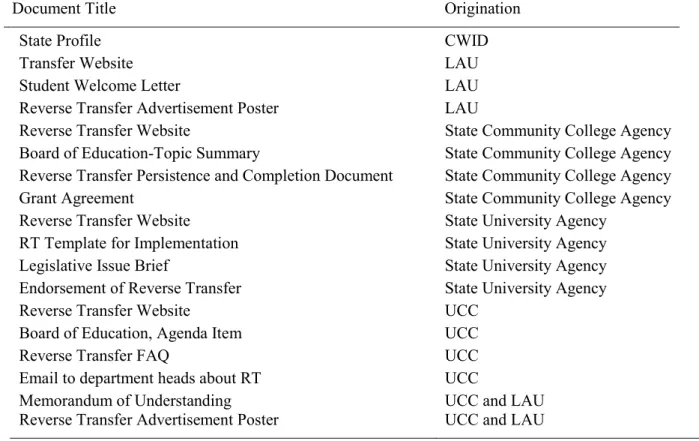
Document analysis and record review is another form of case study data collection. Document analysis is a “systematic procedure for reviewing and evaluating documents” which permits the data to be “examined and interpreted in order to elicit meaning, gain understanding, and develop empirical knowledge” (Bowen, 2009, p. 27). Documents can take on many different forms including newspapers, letters, administrative documents, emails, diaries, etc. Using both primary and secondary sources is important because both sources often “contain insights and clues into phenomenon” (Esterberg, 2002; Merriam, 2002). When reviewing documents, a researcher needs to “have one’s mind organized, yet be open for unexpected clues” (Stake, 1995, 68). Another important reason to study documents is that they “corroborate and augment evidence from other sources” (Yin, 2009, p. 103). As discussed later, providing multiple sources of data helps to create good and trustworthy research. For this study, documents ranged from (1) Memorandum of Understanding documents between the two institutions; (2) Example communication letters sent by each institution to participants regarding reverse transfer program; (3) Board approval documents; and (4) Website text regarding reverse transfer program (e.g., frequently asked questions, homepage for program).
As mentioned previously, many case study methods employ the use of direct
observation and participant-observation. For the purposes of the study, observation was not used due to the fact that the researcher was not able to directly observe the participants because the researcher was not able to travel to the state. The final source of data collection is the study of artifacts as a source of evidence. Such artifacts may include physical or cultural artifacts, tools or instruments, pieces of art, etc. (Yin, 2009). While the use of
artifacts is used less often, due to availability and applicability, they remain a valuable source of data in a case study.
Lastly, in addition to the interviews and document analysis, field notes were collected during the interviews. Field notes provided participant descriptions, inferences and
researcher reactions (Esterberg, 2002) and served as a reflective piece for the researcher during data analysis. In an effort to separate the researcher’s feelings and opinions on the data, bracketing was used to differentiate the participant’s responses and the researcher’s observations (Esterberg, 2002).
Participants
Common to a qualitative study, the participants in the study were determined through purposeful sampling (Merriam, 2002; Miles, Huberman, & Saldana, 2014) and were
determined through a connection established at the Office of Community College Research and Leadership, University of Illinois (OCCRL). OCCRL serves as the research and
assessment entity for the Lumina Foundation’s Credit When It’s Due Grant (CWID), and as discussed in Chapter 2, CWID is a grant program to support the new reverse transfer program across the nation. OCCRL supports the “research and impact assessment for CWID to
include research on reverse transfer, development/dissemination of briefing papers, assistance in planning/conducting grantee learning community convening to share best practices and policies, and facilitating communications” (Lumina Foundation, 2014, para. 13). A research assistant at OCCRL suggested these two institutions as a research study because they have had success implementing the program and the staff were “excited about the program.” Additionally, a formal relationship and memorandum of understanding were
already in place at the beginning of this study which provided the basis of an established program.
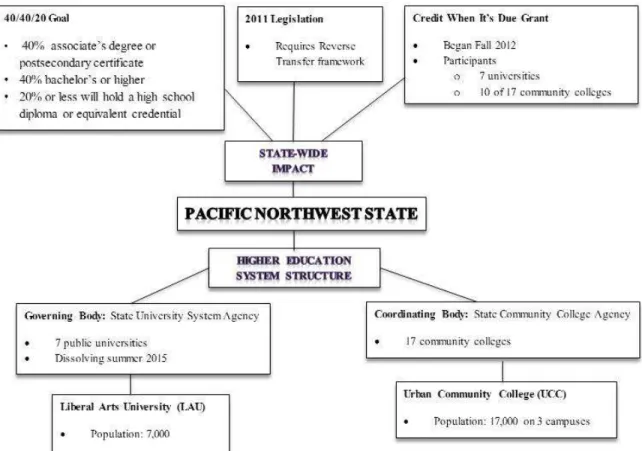
The participants in this case study are situated in a Pacific Northwest State which has influenced the implementation of the reverse transfer program at the two institutions (Figure 2). Urban Community College (UCC) has an annual enrollment of nearly 17,000 who attend classes on three campuses throughout the state. Liberal Arts University (LAU) is a public liberal arts college that serves approximately 7,000 students (see Figure 2). While there are multiple campuses and facilities associated with UCC and LAU, it is important to note that this case study focuses mostly on the campus on which UCC and LAU share a building. On this campus, the two institutions share a Higher Education Center which is utilized to teach classes, provide student services, and house faculty and staff members.
Within the Pacific Northwest state, the universities are governed by a university system agency, and its community colleges are coordinated by a state community college agency that oversees the community college and workforce development in the state. At the time reverse transfer was introduced at UCC and LAU, there was relative stability in the state higher education governance structure. However, during this study, there were dramatic changes to the governance structure within the state. In the summer of 2015, the university state agency will be dissolved and all universities will be independently governed. While the community colleges are all currently independent, there are upcoming changes to the board and commissions that assist with mission oversight and budgeting. The community colleges will likely see multiple governing boards. These changes were discussed by participants and are explored in Chapter 4.