AN EXAMINATION OF THE RELATIONSHIP
BETWEEN EMOTIONAL INTELLIGENCE,
LEADERSHIP STYLE AND PERCEIVED
LEADERSHIP EFFECTIVENESS
LISA A. WEINBERGER
DECEMBER 2003
Swanson & Associates
168 E. SIXTH STREET, SUITE 4002 ST. PAUL, MN 55101
HUMAN
RESOURCE
DEVELOPMENT
RESEARCH
CENTER
i TABLE OF CONTENTS
Chapter 1...1
INTRODUCTION ...1
Background and Purpose of the Study...3
Statement of the Problem...6
Significance of the Study...7
Limitations...8
Background of the Field Setting...10
Definition of Terms...12
Summary...13
Chapter 2...14
REVIEW OF LITERATURE AND HYPOTHESES...14
Historical Perspective – Emotion and Intelligence...14
Does Emotional Intelligence Exist?...17
Emotion and Human Resource Development...23
Emotional Intelligence...25
Trait Emotional Intelligence...26
Individual performance and success ...27
Relationships to personality measures...30
Leadership, management & management development ...31
Measurements of Trait Based Emotional Intelligence...34
ii
Trait-meta-mood-scale (TMMS) ...37
Emotional competence inventory (ECI) ...38
Ability Emotional Intelligence...39
Emotions and organizational research ...40
Ability emotional intelligence and personality...41
Emotions and leadership...42
Measurements of Ability Emotional Intelligence...43
Multifactor emotional intelligence survey (MEIS)...44
Mayer Salovey Caruso emotional intelligence test (MSCEIT) ...50
Leadership...55
Charismatic Leadership...57
Transformational Leadership...59
Multifactor leadership questionnaire (MLQ5x)...61
Exploratory Questions and Their Hypotheses...65
What is the Relationship Between the Emotional Intelligence of Leaders and Their Transformational Leadership Style?...66
What is the Relationship Between the Emotional Intelligence of Leaders and Their Transactional Leadership Style?...67
What is the Relationship Between the Emotional Intelligence of Leaders and Their Laissez-Faire Leadership Style?...68
What is the Relationship Between the Emotional Intelligence of Leaders and Their Subordinates Perception of Their Extra Effort?...70
iii What is the Relationship Between the Emotional Intelligence of Leaders and
Their Subordinates Satisfaction with Their Leadership?...71
What is the Relationship Between the Emotional Intelligence of Leaders and Their Perceived Leadership Effectiveness?...72
Summary...74
Chapter 3...77
RESEARCH METHOD ...77
Research Design...77
Population and Sample...78
Non-respondent Bias and Non-randomness of Responses...79
Data Collection Instruments...80
Mayer Salovey Caruso Emotional Intelligence Test (MSCEIT v2)...81
Multifactor Leadership Questionnaire (MLQ5x)...84
Demographic Variables...85
Administration...86
Phase One – MLQ5x...88
Phase Two – MSCEIT...90
Variables for Data Analysis and Statistical Treatment...91
Summary...93
Chapter 4...95
RESULTS ...95
iv
Descriptive Statistics of Mayer Salovey Caruso Emotional Intelligence Test....96
Descriptive Statistics of the Multifactor Leadership Style Questionnaire...99
What is the Relationship Between the Emotional Intelligence of Leaders and Their Leadership Style?...102
What is the Relationship Between the Emotional Intelligence of Leaders and Their Transformational Leadership Style?...103
What is the Relationship Between the Emotional Intelligence of Leaders and Their Transactional Leadership Style?...107
What is the Relationship Between the Emotional Intelligence of Leaders and Their Laissez-Faire Leadership Style?...110
What is the Relationship Between the Emotional Intelligence of Leaders and their Leadership Effectiveness?...112
What is the Relationship Between the Emotional Intelligence of Leaders and Their Subordinates Perception of Their Extra Effort?...113
What is the Relationship Between the Emotional Intelligence of Leaders and Their Subordinates Satisfaction with Their Leadership?...116
What is the Relationship Between the Emotional Intelligence of Leaders and Their Perceived Leadership Effectiveness?...118
Summary...121
Chapter 5...124
SUMMARY AND CONCLUSIONS ...124
v
Conclusions...127
Transformational Leadership and Emotional Intelligence...128
Transactional Leadership and Emotional Intelligence...129
Laissez-faire Leadership and Emotional Intelligence...130
Leadership Outcomes and Emotional Intelligence...130
Extra effort...130
Satisfaction...131
Effectiveness...131
Additional Survey Data...132
Implications for Practice...139
Implications for Theory...141
Future Research Needs...144
REFERENCES ...147
Appendix A...168
Institutional Review Board/Human Subjects Committee Approval...168
Appendix B ...170
Pre-Notification/Information Memo’s...170
Appendix C ...176
Survey Consent Forms...176
Appendix D...181
Survey Cover Letters ...181
Appendix E ...184
vi
Appendix F...189
Survey Instructions ...189
Appendix G...191
Summary of Survey Contents & Associated Survey Instruments ...191
Appendix H...197
MSCEIT Statistics ...197
Appendix I ...203
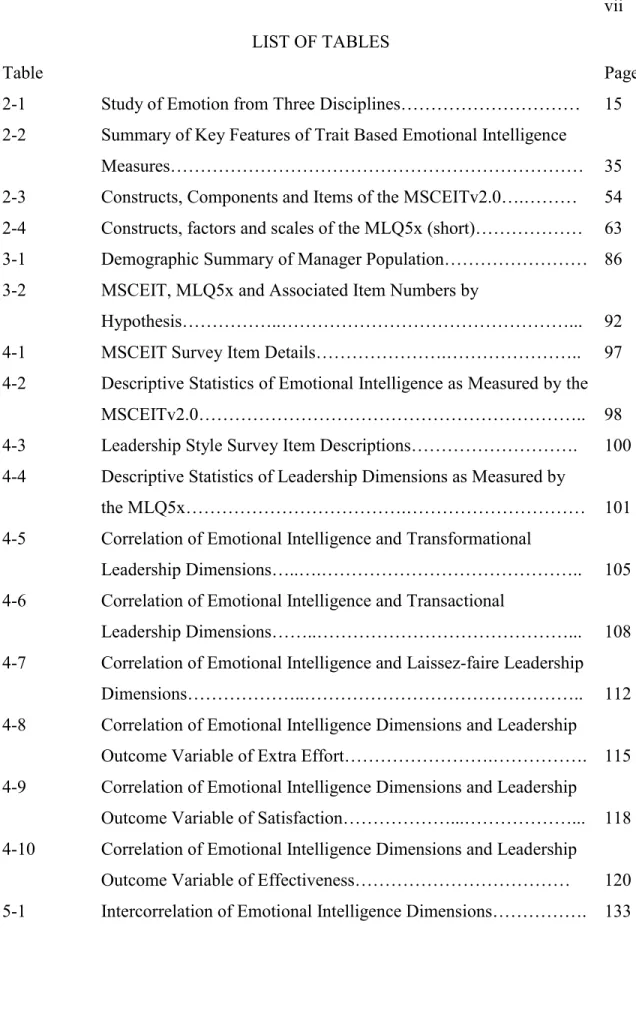
vii LIST OF TABLES
Table Page
2-1 Study of Emotion from Three Disciplines……… 15 2-2 Summary of Key Features of Trait Based Emotional Intelligence
Measures……… 35
2-3 Constructs, Components and Items of the MSCEITv2.0….……… 54 2-4 Constructs, factors and scales of the MLQ5x (short)……… 63 3-1 Demographic Summary of Manager Population……… 86 3-2 MSCEIT, MLQ5x and Associated Item Numbers by
Hypothesis………..………... 92
4-1 MSCEIT Survey Item Details……….……….. 97
4-2 Descriptive Statistics of Emotional Intelligence as Measured by the
MSCEITv2.0……….. 98
4-3 Leadership Style Survey Item Descriptions………. 100 4-4 Descriptive Statistics of Leadership Dimensions as Measured by
the MLQ5x……….……… 101
4-5 Correlation of Emotional Intelligence and Transformational
Leadership Dimensions…..….……….. 105 4-6 Correlation of Emotional Intelligence and Transactional
Leadership Dimensions……..………... 108 4-7 Correlation of Emotional Intelligence and Laissez-faire Leadership
Dimensions………..……….. 112
4-8 Correlation of Emotional Intelligence Dimensions and Leadership
Outcome Variable of Extra Effort……….………. 115 4-9 Correlation of Emotional Intelligence Dimensions and Leadership
Outcome Variable of Satisfaction………...………... 118 4-10 Correlation of Emotional Intelligence Dimensions and Leadership
Outcome Variable of Effectiveness……… 120 5-1 Intercorrelation of Emotional Intelligence Dimensions………. 133
viii 5-2 Emotional Intelligence Factor Reliability Analysis by Item………. 134
5-3 Leadership Factor Reliability Analysis by Item……… 135 5-4 Intercorrelation of Leadership Dimensions……… 136 5-5 Correlation of Leadership Dimensions as Compared to Technical
Manual……… 138
FIGURES
2-1 Pictorial Representation of Hypothesized Relationship of
Emotional Intelligence and Leadership Style……… 70 2-2 Pictorial Representation of Hypothesized Relationship of
Emotional Intelligence and Leadership Outcome Variables………. 74 4-1 Pictorial Representation of Hypothesized Relationship of
Emotional Intelligence and Leadership Style……… 103 4-2 Pictorial Representation of Hypothesized Relationship of
1
Chapter 1
INTRODUCTION
Many organizations today need to change rapidly to maintain their competitive edge. Rapid change requires that an organization has employees and leaders, who are adaptive, work effectively, constantly improve systems and processes, are customer focused, and who share the need to make a profit. The continuous environment of turmoil and change has been coined the “permanent white waters” of modern life (Vaill, 1996). Leadership is a key element in driving and managing these “white waters”. One only needs to look at the recent corporate scandals such as Enron and WorldCom and a corporate success such as Dell Computer to see that leadership makes a difference. Effective leaders are those that get results within timeframes that are considered appropriate for their industries and stakeholders (Goleman, 2000). Examples include Chrysler Corporation and their recovery under Lee Iacocca, Gillette under the
leadership of Colman Mockler and Kimberly-Clark during the years of Darwin Smith’s tenure (Collins, J., 2001).
Great leaders move us. They ignite our passion and inspire the best in us. When we try to explain why they are so effective, we speak of strategy, vision, or powerful ideas. But the reality is much more primal: Great leadership works through the emotions (Goleman, Boyatzis, McKee, 2002, p. 3).
Emotional Intelligence has been identified, through the popular press and some
researchers as that critical element needed for effective leadership. Goleman (1998b, p. 94) has said that, “the most effective leaders are alike in one crucial way; they all have a
2
high degree of what has come to be known as emotional intelligence.” He goes on to say that emotional intelligence is the “sine qua non” (1998a, p. 94) of leadership. Others have said, “By now, most executives have accepted that emotional intelligence is as critical as IQ to an individual’s effectiveness” (Druskat & Wolff, 2001, p.81). The challenge with these statements is twofold, (1) the study of leadership and what makes leaders effective has been found to be much more complicated than a single dimension like emotional intelligence; and (2) organizations have incorporated many of these emotional intelligence beliefs into their work systems and performance expectations without it being shown that it truly can accomplish what proponents are claiming. The study of leadership, its effectiveness and its impact on organizational performance is a key interest to Human Resource Development (HRD) scholars (Hamlin, 2003; Holton & Lynham, 2000; Kuchinke, 2000; Zehner & Holton III, 2003).
HRD has been defined multiple ways, but when looking at it through an
organizational performance lens, one would define it as “a process of developing and or unleashing human expertise through organization development and personnel training and development for the purpose of improving performance” (Swanson, 1995, p. 208). The development or unleashing of expertise is a critical component for HRD. Expertise has been defined as “displayed behavior within a specialized domain and/or related domain in the form of consistently demonstrated actions of an individual that are both optimally efficient in their execution and effective in their results” (Herling, 2000, p. 20). Emotional intelligence and its relationship to leadership expertise is an area needing further research in the field of HRD.
3
Background and Purpose of the Study
The intention of this study is to broaden the knowledge base of HRD through the investigation of emotional intelligence, leadership style and the effectiveness of that leadership. “One of the most universal cravings of our time is a hunger for compelling and creative leadership” (Burns, 1978, p.1). Even so, leadership is not easily defined. In fact, “there are almost as many different definitions of leadership as there are persons who have attempted to define the concept” (Stogdill, 1974, p. 259). The scientific study of leadership did not begin until the twentieth century. Much of its focus has been on the determinants of leadership effectiveness (Yukl, 1998). The social sciences have looked at leadership through behaviors, traits, abilities, situational influences and sources of power. Many questions have been asked about why some people emerge as leaders and others don’t, and how these leaders act, with a key concern around
leadership effectiveness (Yukl, 1998).
Beginning in the 1980’s, many of the conceptions of leadership recognized the importance of emotions as a basis of influence (Yukl, 1998). It is those emotional, value-based aspects of leadership that are believed to influence the achievements of groups and organizations. Much of this leadership research, with its recognition on the importance of emotion, concentrated on the characteristics and effects of charismatic and transformational leadership (Bass, 1985; Kanungo, 1998; Tichy & Devanna, 1990).
Burns (1978) developed the original idea of transformational leadership. He defined it as a process in which “leaders and followers raise one another to higher levels of morality and motivation” (p. 20). This definition was further refined by Bass (1985)
4
who looked at the theory as two distinct types of leadership processes, the first being transactional leadership and the second being transformational leadership. Though he defined these leadership processes as distinct, Bass did recognize that the same leader might use both types of leadership at different times in different situations. It was transformational leaders however, who would influence followers by arousing strong emotions and identification with the leader (Yukl, 1998).
Numerous studies have examined the correlation between transformational and transactional leadership styles and various criteria of leadership effectiveness (e.g., Avolio & Howell, 1992; Yammarino & Bass, 1990). A meta-analysis of results from 39 studies found that three transformational leadership behaviors (charisma,
individualized consideration, intellectual stimulation) were related to leadership effectiveness in most studies (Lowe, Kroeck & Sivasubramaniam, 1996). The transformational leadership behaviors correlated more strongly with leadership
effectiveness than did the transactional leadership behaviors. Utilizing the connection of emotion and leadership, Sosik and Megerian (1999) studied the relationship between transformational leadership behavior, emotional intelligence and leader effectiveness. They collected data from 63 managers who responded about their transformational leadership behavior and emotional intelligence, 192 subordinates who rated their manager’s transformational leadership behavior and performance outcomes and 63 superiors who rated managerial performance. They found that categorizations of self-awareness were correlated between emotional intelligence of leadership and leadership behavior. Subordinate ratings of transformational leadership behavior were positively
5
related to those leaders categorized as self-aware. They concluded “managers who maintain self-awareness (self-other rating agreement) possess more aspects of emotional intelligence and are rated as more effective by both superiors and
subordinates than those who are not self-aware” (Sosik & Megerian, 1999, p. 386). This study explained the influence of several aspects of emotional intelligence on leader effectiveness.
The topic of emotional intelligence and its impact on organizations and its leaders, grew largely through the popular publications of Goleman’s (1995) book titled Emotional Intelligence and his subsequent book Working with Emotional Intelligence (Goleman, 1998b). The interest in emotional intelligence continues today. The scholarly study of emotional intelligence began in the early 1990’s when Salovey and Mayer (1990) first defined it. Since that early inception, there continues to be
refinement, debate and dialogue around the topic of emotional intelligence in the research community. Practitioners have incorporated the concept of emotional intelligence into performance management systems and training and development programs as the result of the influence of the popular press and consultants. At this point in time, practices related to embracing emotional intelligence appear to be far ahead of what is actually known from the research and theory.
Researchers in the field of HRD have also looked at the role of emotions and emotional intelligence (Bryant, 2000; Callahan Fabian, 1999; Callahan & McCollum, 2002; Drodge & Murphy, 2002; Jordan & Troth, 2002; Landen, 2002; Leeamornsiri & Schwindt, 2002;Opengart, 2003; Opengart & Bierma, 2002; Short & Yorks, 2002;
6
Turnball, 2002; Weinberger, 2002a, 2002b; Wells & Callahan, 2002). The question asked by many of these authors is what role is emotions and/or emotional intelligence playing in the organization through change efforts, leadership effectiveness, training and organizational performance. Studies of leadership, its effectiveness and overall impact on improving performance are important to advancing the understanding in the field of HRD and its role in advancing the strategic capability of organizations.
Statement of the Problem
The purpose of this study is to investigate the relationship between emotional intelligence, leadership style and leadership effectiveness. The problem is the recognition that while a significant amount of research on leadership exists (see Stogdill, 1974; Yukl, 1998; Yukl & VanFleet, 1992), the emotional intelligence research is comparatively thin and the relationship between leadership and emotional intelligence is smaller yet. What is most troubling is the notion is seen by many as critically important for leaders to be emotionally intelligent for organizational success without the scholarly support behind it. The major research questions are briefly stated as follows:
1. What is the relationship between the emotional intelligence of leaders and their leadership style?
2. What is the relationship between the emotional intelligence of leaders and their leadership effectiveness?
7
Significance of the Study
The development of effective leaders is recognized as a high priority for business organizations. One only needs to look at some of the more popular recent publications in the areas of leadership and organizational success such as Good to Great (Collins, J., 2001) which speaks to those critical components for an organization to be “great”, as defined in cumulative stock return as compared to the general market. The foundation of their model is that the right leadership is in place. First, Break all the Rules (Buckingham & Coffman, 1999), is a summary of a Gallup survey on what effective managers did differently and finally, Results Based Leadership (Ulrich, Zenger & Smallwood, 1999), which speaks to the importance of connecting leadership skills with real business results. All of these business books use “unconventional wisdom” as their foundation. They are challenging the status quo, and reinforce the notion that “leadership ranks among the most researched and debated topics in the organizational sciences” (George, 2000, p. 1028).
Goleman (1995; 1998a; 1998b; 2000) has made the case through his many writings that the key to a leader’s effectiveness and success in an organization is his/her emotional intelligence. His premise also challenged conventional thinking, in that the emotions are important to consider in relation to one’s effectiveness. Emotions and emotional intelligence are no longer considered taboo in the workplace today. And it is that, that provides the foundation for performance. Since the publication of Emotional Intelligence (Goleman, 1995), the business writings in this area have exploded. The scholarly support of the claims made in these books however is behind the business
8
leader’s perceptions of the impact of high emotional intelligence on their effectiveness and success. The issue of leadership effectiveness is core to the field of HRD.
A better understanding of emotional intelligence and its relationship to leadership style and effectiveness can address the gaps currently existing in the literature today and provide a more informed link between theory and practice. This understanding can also better inform practitioners, and hence their leadership
development programs, and staffing within their organizations. This study will contribute to these areas.
Limitations
Leadership is a broad concept, with a wide variety of definitions and perspectives. There exist over 200 models of leadership with a wide variety of boundaries, concepts, construct validities, etc. (Bass & Stogdill, 1990). Though little agreement exists to what constitutes “leadership”, it is a core area of interest for
developers of human resources. This author believes that the limitation of using a broad construct like leadership is outweighed by the possibility of acquiring additional
knowledge in this domain.
Utilizing the emotional intelligence construct is a second limitation of this study. A wide variety of definitions of this construct exist ranging from a very broad
perspective inclusive of many personality characteristics, to a very narrow restrictive perspective. This area of research is relatively new (since the early 1990’s), with most of the work to date, definitional in nature. Only very recently has the research moved into how the construct of emotional intelligence impacts individuals and their
9
performance. Within the area of emotional intelligence research, there exist few instruments to study it.
The Mayer Salovey Caruso Emotional Intelligence Test v2 (MSCEIT) is a third limitation of this study. This newly published instrument (2002) has not had wide testing in the research community. Consequently, its reported validities and reliabilities require ongoing investigation. It is however, the only emotional intelligence instrument that is performance based (Mayer, Salovey & Caruso, 2002). All other emotional intelligence tests are self-assessment inventories. Although this instrument is not yet widely researched, it is a promising tool for research into the area of emotional intelligence and by itself will add to the body of knowledge in this area.
To measure managers’ leadership style and their leadership effectiveness, the Multifactor Leadership Questionnaire, MLQ5x (Bass & Avolio, 1995; 2000) was chosen. The MLQ5x (Bass & Avolio, 1995; 2000) has had its share of criticism and support, but is a widely used instrument in the area of leadership styles and leadership effectiveness. And this instrument has face validity within the organization studied, which provided critical support for this research to occur.
An additional limitation to this study is the use of a single organization. Though there are advantages to using a single organization due to its homogeneity and
minimizing the impact of external validity concerns, there are disadvantages in that the results are not generalizable.
10
Background of the Field Setting
A single international manufacturing organization headquartered in the Midwest was selected for this study. This organization is on the Fortune 1000 and has evolved over a hundred-year period. For confidentiality purposes, this organization will be referred to as CSW in this report. The author focused the study on the North American side of this organization. CSW has five manufacturing facilities in the Midwest, an extensive field sales and service network across the United States, along with various service centers in key cities. This organization had recently reorganized with a new executive team and had installed the first C.E.O. who was not a direct descendant (or spouse) of the founder within the past five years. CSW has recently undergone a transition. Historically, the CSW management team did not tolerate questioning of processes, policies, etc. from individual team members and they paid their employees on a merit-based pay system. The current CSW management team is attempting to create a culture where employees challenge the status quo, and look to outside market influences as part of their decision making process. In addition, the organization has moved to a performance based pay system. The executive team had selected leadership skills and emotional intelligence as two of their key competencies for performance measurement for their professional employees. CSW defined leadership skills to include: a) visionary, sees the bigger picture and longer-term impact of current initiatives; b) strategic, planner, creates a sense of common purpose; c) international, customer-focused business acumen; d) establishes a balanced set of measures for performance outcomes and marketplace successes; e) has the confidence, presence and
11
ability to inspire and motivate people; f) leads by example; g) coaches for growth and development. Emotional Intelligence was defined as: a) self-confident, understands own strengths and weaknesses and leverages them effectively; b) able to build
credibility with people; c) is comfortable with ambiguity and changing environments; d) treats people fairly and with respect; e) has the ability to build and lead teams; f)
actively engages in the process of learning for self and others. The investigation into the relationships between emotional intelligence and leadership style, therefore, was of keen interest to them. CSW employs about 2000 people in North America, with over 600 employees in various field sales and service positions.
Approximately 60% of CSW’s North American employees were invited to participate in the study. The additional details of the selection process are located in Chapter 3. The study was restricted to the North American employees of CSW, who must use English in their day-to-day communications in order to minimize language barriers, or potential conflicts with instruments not in the native or primary language of the participant.
CSW had an interest in more clearly defining the performance and attributes of their leaders. Through work with an external consultant, the management team selected emotional intelligence as one of their leadership competencies and incorporated this concept into their performance management system. They believed this would be a key contributor to their leadership’s success. The author was interested in evaluating the relationship between leadership style, effectiveness and emotional intelligence. These
12
dual interests provided the partnership for this study. The primary focus of this report is the results of the authors’ area of interest.
Definition of Terms
The following terms are generally defined to guide the reader through the literature review and the research methods section. More exact operational definitions of the core constructs and other dimensions of this study are provided in Chapters 2 and 3.
Manager. In this study, managers at various levels of the organization are involved. Although within this organization, some managers have no direct reports, for purposes of this study, managers are defined as those individuals who have direct supervisory responsibility. This ranges from front line supervisors to executive team members.
Emotional Intelligence. There are a wide variety of emotional intelligence definitions as Chapter 2 will provide, but the foundation of this study utilizes the Mayer and Salovey (1997) more restrictive definition. Emotional intelligence involves the ability to understand emotions in oneself and others, relate to others, and adapt emotionally to a changing environment and changing demands.
Transactional Leadership. Transactional leaders apply influence by setting clear goals, clarifying desired outcomes, providing feedback and exchanging rewards for accomplishments (Dvir, Eden, Avolio, Shamir, 2002). This is the basic, day-to-day leadership.
13
Transformational Leadership. Transformational leaders “exert additional influence by broadening and elevating followers’ goals and providing them with confidence to perform beyond expectations specified in the implicit or explicit exchange agreement” (Dvir, Eden, Avolio, Shamir, 2002, p. 735). Transformational leaders exhibit charismatic behaviors, arouse dormant needs in their followers and motivate them to perform beyond baseline expectations.
Leadership Effectiveness. With no consistent performance criteria that could be applied to all managers in this study, the managers’ effectiveness is evaluated through the eyes of the follower with a consistent set of questions from the MLQ5x.
Summary
This chapter developed the rationale and the importance for the study of leadership and emotional intelligence, outlined the research questions, and addressed the significance of the study. Additionally, the field setting was described, the
limitations of the study stated, and a high level list of definitions were provided that are used throughout the remainder of this report.
14
Chapter 2
REVIEW OF LITERATURE AND HYPOTHESES
This chapter explores the relevant emotion and leadership literature to lay the foundation for this study. The general question under investigation is ‘what is the relationship between emotional intelligence, leadership style, and leadership effectiveness?’ This chapter reviews the research in emotional intelligence and its significance to human resource development (HRD). Secondly, the area of leadership and its associated literature is wide and deep. The literature that is more closely linked to the study at hand is reviewed, specifically the areas of charismatic leadership and transformational leadership.
Historical Perspective – Emotion and Intelligence
Weinberger (2002b) provided a summary of the current state of research in the area of emotion work including emotional intelligence. This summary broke down the study of emotion from three disciplines; a) sociological domain; b) psychological domain and c) HRD. See Table 2-1.
The foundation of the study of emotional intelligence began in the early workings of the study of emotion and the study of intelligence. The initial research around the topic of emotion was in the sociological and psychological domains. Sociologically, the early researchers looked at such areas as emotional labor
15 Table 2-1
Study of Emotion from Three Disciplines
Sociological Domain Psychological Domain Human Resource Development Research Interests Emotional Labor Hochshild (1979; 1983)
Van Maanen and Kunda (1989) Rafaeli and Sutton
(1987; 1990) Morris and Feldman
(1996)
Wharton (1993)
Emotional Contagion
Rafaeli and Sutton (1987) Hatfield, Cacioppo, and Rapson (1994) Verbeke (1997) Doherty (1998) Domagalski (1999) Feeling rules/emotion of work setting Goffman (1969) Hochschild (1983) Rafaeli and Sutton
(1987) Scheff (1990) Emotion and Rationality Fineman (1993; 1999) Hearn (1993)
Putnam and Mumby (1993)
Ashforth and Humphrey (1995)
Emotion and Motivation
Pinder (1998)
Empathy
Mehrabian and Epstein (1972)
Mood
Mayer and Bremer (1985) Mayer and Gaschke (1988) Mayer, Mamby, and
Volarth (1988)
George and Brief (1992)
Affect and Mood
Estrada, Isen and Young (1997)
Weiss and Cropanzao (1996)
Emotion
Plutchik (1984) Mayer, DiPaolo, and
Salovey (1990) Damasio (1994)
Mayer and Geher (1996)
Emotional Intelligence
Mayer and Salovey (1993; 1997)
Mayer and Geher (1996) Mayer and Salovey (1997) Mayer, Salovey, and
Caruso (1999) Goleman (1995; 1998) Bar-On (1995)
Cooper and Sawaf (1997) Weisinger (1998) Various topics in emotion work Callahan Fabian (1999) Callahan and McCollum (2002) Turnball (2002) Short and Yorks
(2002) Wells and Callahan (2002) Emotional Intelligence Jordan and Troth (2002) Bryant (2000) Weinberger (2002) Opengart and Bierema (2002) Leeamornsiri and Schwindt (2002)
16 (Hochschild 1979; 1983), emotional contagion (Rafaeli & Sutton, 1987), feeling rules (Goffman, 1969), and emotion and rationality (Fineman, 1993; 1999). Additionally, within the psychological realm, the areas of emotion and motivation (Pinder, 1998), empathy (Mehrabian & Epstein, 1972), mood (Mayer & Bremer, 1985), and emotion (Plutchik, 1984) were all researched.
The research around intelligence was also rich and diverse. Numerous
definitions of intelligence emerged. Thorndike (1920) divided intelligent activity into three components: social intelligence, concrete intelligence, and abstract intelligence. Others defined intelligence as “ the aggregate or global capacity of the individual to act purposefully, to think rationally, and to deal effectively with his environment”
(Weschler, 1958, p. 10) or as a “finite set of independent abilities operating as a complex system” (Detterman, 1986, p. 57).
These two topics (intelligence and emotion) of research were undertaken independently until the early 1990’s when ‘emotional intelligence’ was first defined (Salovey & Mayer, 1990). This was initially described as a “type of social intelligence that involves the ability to monitor one’s own and others emotions, to discriminate among them, and to use the information to guide one’s thinking and actions” (Salovey & Mayer, 1990, p. 189). The connection of emotion to intelligence was made through the social intelligence construct.
Social intelligence was first defined as “the ability to understand and manage men and women, boys and girls – to act wisely in human relations” (Thorndike, 1920, p. 228). A slightly different approach viewed social intelligence within the more
17 general theory of intelligence as “the mental processes and structures used to attain contextual success” (Sternberg, 1985, p. 330). The definition of multiple intelligences however (Gardner, 1983), provided the connection for Salovey and Mayer. Gardner defined the interpersonal and intrapersonal intelligences as:
Interpersonal intelligence is the ability to understand other people: what motivates them, how they work, how to work cooperatively with them…..Intrapersonal Intelligence….is a correlative ability turned inward. It is a capacity to form an accurate, veridical model of oneself and to be able to use that model to operate effectively in life (p. 25).
Emotional intelligence is described as involving abilities that may be categorized into five domains: (a) self-awareness, (b) managing emotions, (c)
motivating oneself, (d) empathy, and (e) handling relationships. It was this foundation that provided the impetus for the emotional intelligence work throughout the 1990’s (Salovey & Mayer, 1990).
Does Emotional Intelligence Exist?
In 1990, Salovey and Mayer proposed the first framework of emotional
intelligence. In 1993, they attempted to support their choice of the word “intelligence”. Emotional intelligence as conceptualized by these authors included the verbal and nonverbal appraisal and expression of emotion, the regulation of emotion in the self and others, and the utilization of emotional content in problem solving. Although they could have labeled this construct emotional competence, they chose the word
18 intelligence to link their framework to the historical literature on intelligence. Mayer and Salovey (1993) argued that emotional intelligence is an ability and as such is probably related to general intelligence. It may have differences however, in terms of its mechanisms, such as emotionality and emotion management and its manifestations, such as greater verbal fluency in emotional domains. The Trait-Meta-Mood-Scale (TMMS) was devised to provide a reasonable operationalization of the aspects of the earlier definition (1990) of emotional intelligence (Salovey, Mayer, Goldman, Turvey and Palfai, 1995). This tool measured a three phase process: 1) attention to feelings; 2) clarity of feelings; and 3) mood repair. These three scales were created based on a factor analysis. Intercorrelations among the three factors were α = .86, α = .88 and α = .82 respectively (Cronbach alpha). The theoretical structure of the TMMS was tested and correlations among other measures were evaluated. Salovey et al. concluded that the trait meta mood construct was helpful in understanding individual differences in people’s reactions to changes in their feeling states and hence was a reasonable operationalizations of aspects of emotional intelligence.
The TMMS was used to survey 108 adults to assess their emotional intelligence, goal orientation, life satisfaction, and depression symptomatology (Martinez-Pons, 1997-98). The data was analyzed to test the construct validity of emotional intelligence as the three-component process assessed by the TMMS. In addition, it tested a
hypothetical model regarding emotional intelligence and other aspects of personal functioning. Path analysis was used to test the sequential dependency among the attention, clarity and repair components of emotional intelligence and their hypothetical
19 model. Their findings provided further evidence of the construct validity of emotional intelligence as the three-phase process assessed by the TMMS. This study provided further support for the emotional intelligence construct (Martinez-Pons, 1997-98). Others however, stipulated that the emotional intelligence construct is narrower than was postulated (Davies, Stankov & Roberts, 1998). It was stated that in order for emotional intelligence to be a unique type of human ability it must: 1) have an adequate methodology for its assessment; 2) demonstrate partial (or complete) independence from other, seemingly analogous, concepts. Using three studies (total N = 530), the view that emotional intelligence should be included within the traditional cognitive abilities framework was explored. Each of the correlation coefficients, including a series of variables describing emotional intelligence, social intelligence, personality and cognitive ability variables was used. The magnitude of the correlation coefficients suggested that emotional intelligence might not be entirely distinct from personality constructs. The authors concluded that their correlations obtained failed to support Mayer and Salovey’s (1990) hypothesis of the components of emotional intelligence as a set of conceptually interrelated skills. The emotion perception component, however, showed some promise and appeared to constitute an ability, but the balance of
emotional intelligence, as postulated at this time, was not unique nor psychometrically sound. Fox and Spector (2000) also found that that the TMMS was a weak instrument, and that one of the serious weaknesses of the emotional construct was the lack of specific, measurable and operationalizations of its various components.
20 Further development occurred around the emotional intelligence construct and a different measure of emotional intelligence was created and tested on 346 participants (Schutte, Malouff, Hall, Haggert, Cooper, Golden & Dornheim, 1998). (218 women and 111 men, average age of 29.27, S.D. = 10.23) rated themselves on each of the 62 items using a five-point response scale. In addition, a number of participants completed other established scales assessing constructs theoretically related to emotional
intelligence (Alexithymia, Affective Communications, Life Orientation). Their 33-item scale developed through factor analysis found good internal reliability with two
different samples (Cronbach alpha α = .90). In addition, the scale showed evidence of validity as the scores were related to eight of the nine measures predicted to be related to emotional intelligence. Using the Toronto Alexithymia Scale, they found that higher scores on the 33-item emotional intelligence scale were associated with less alexithymia ( r(24) = -0.65, p<0.0001). Utilizing the TMMS, they found that higher scores on the emotional intelligence scale were associated with greater attention to feelings ( r(48) = 0.63, p <.0001), greater clarity of feeling ( r(47) = 0.52, p<.0001), and more mood repair ( r(47) = 0.68, p<.0001). The Life Orientation Test measured the associations reported with optimism and pessimism. Higher scores on the emotional intelligence scale were associated with greater optimism ( r(26) =0.52, p<.0006), and less pessimism ( r(26) = -.43, p<.025). Finally, higher scores on the emotional intelligence scale were associated with less depression as measured by the Zung Depression Scale ( r(37) = -0.37, p<.021). The authors concluded that the self-reporting instrument was a validated measure of emotional intelligence.
21 Petrides and Furnham (2000a) however, scrutinized this measure of emotional intelligence developed by Schutte et al and identified several weaknesses with it. They primarily found psychometric problems and cautioned widespread use of the
instrument, suggesting instead that it could be used only as a tentative, face-valid measure of emotional intelligence. They stressed that the existence of a coherent domain of emotional intelligence has not yet been demonstrated, however, the recent differentiation by Mayer and Salovey (1997) to a revised ability model of emotional intelligence showed promise. This strongly cognitive definition of emotional
intelligence, and their measurement of it through the Multifactor Emotional Intelligence Scale (MEIS) have provided promising evidence that emotional intelligence might be embodied in the overall psychometric intelligence structure (Petrides & Furnham).
In order to answer the question, “Is it an intelligence?”, Mayer, Caruso and Salovey (1999) again positioned emotional intelligence as meeting the traditional standards for an intelligence. These authors postulated that for something to be an intelligence it must: 1) be capable of being operationalized as a set of abilities; 2) meet certain correlational criteria; and 3) be able to be developed with age. With the revised 1997 definition of emotional intelligence by Mayer and Salovey, these authors
developed a new instrument called the Multifactor Emotional Intelligence Scale (MEIS) and operationalized it on twelve ability tests of emotional intelligence. They stipulated that emotional intelligence is broader than social intelligence including not only
“reasoning about emotions in social relationships, but also reasoning about internal emotions that are important for personal growth” (p. 11). In addition, emotional
22 intelligence is more focused than social intelligence in that it pertains primarily to the emotional problems embedded in personal and social problems. Consequently, this increased focus makes this more distinct from traditional verbal intelligence than social intelligence is.
The emotional intelligence test was scored through consensus, and expert scoring on all four branches. The ratings were fairly highly associated (r = .61 to r = .80, p<.001) suggesting a close relationship between the two criteria. Since the MEIS had better answers that can be distinguished from worse answers (contrary to the TMMS) the authors were able to show support for emotional intelligence as a new domain of intelligence based on their above criteria. They found additional support for their concepualization of emotional intelligence. Ciaarrochi, Chan, and Caputi (2000) completed a study that critically evaluated the emotional intelligence construct also using the MEIS instrument and in general found support for the reliability and validity of the MEIS, though they had some limitations. The strengths of this measure were that it was based on actual performance, the test samples a wide range of behaviors, the subscales were generally reliable and the MEIS has been shown to correlate with a number of criterion measures including intelligence and empathy. They found that the emotional intelligence factors were reliable, and therefore it makes a case for the distinctiveness and usefulness of emotional intelligence. This construct showed a great deal of promise in predicting important outcomes.
23 As the literature describes, there is still an intellectual argument on the true existence of this construct as an intelligence, and a unique construct. In fact, Fineman (2000b) views the area of emotional intelligence as a
commodifiable emotion funnel, profitable to sell, which promises a fast route to organizational success, even individual fame…..Emotional intelligence is imprisoned in sales gloss that makes extravagant claims and promises…..and is highly contingent upon a certain sociocultural frame of organizational success (p. 112).
Though disagreement does exist in the literature, there is a fair amount of peer-reviewed research in the emotion and emotional intelligence domains to lay the foundation for further research in this often disputed construct.
Emotion and Human Resource Development
The topic of emotion research has also been a topic of interest and exploration within the discipline of HRD. The significant impact of emotions and emotional management in an organizational setting has driven this research. The concepts of emotion and emotion management have recently been brought to the forefront of HRD scholars through interests in emotion management and organizational functions
(Callahan Fabian, 1999) and a collection of articles titled Perspectives of Emotion and Organizational Change (Callahan, 2002). This collection brought forward the
importance of studying emotion within the organizational context for both HRD scholars and practitioners. The authors in this journal (Callahan & McCollum, 2002; Turnball, 2002; Kiefer, 2002; Jordan & Troth, 2002; and Short & Yorks, 2002) all
24 wrote on various derivations of emotion in research, ranging from its role in
organizational change efforts, training and conflict resolution.
Dialogue continues in HRD through studies on the impact of emotion on
organizational learning (Vince, 2002), the evaluation of the roles of gender and emotion management as evidence of a community of practice (Tomaszewski & Callahan, 2003) and emotion saturation as a theory of emotion in organizations (Callahan, 2003). The last topic further refined various perspectives on the importance of the role of emotion within the organization (Callahan, 2003).
Emotion work has also lent to discussions about the role of emotional
intelligence within the field of HRD. An argument of the importance of the topic for study and implications outlined for further research for HRD scholars to include leadership, management and individual and team performance has been made (Weinberger, 2002b). Emotions have been conceptualized holistically and that
relationship may interact with the process of leadership (Drodge & Murphy, 2002). This is one premise that lends support for further study of emotions in HRD. These areas of study provide a foundation of the emotion work discussion and suggest that emotional intelligence might be an aid to leadership development.
The literature has expanded through an evaluation of emotion work and emotional intelligence through a workforce development model (Opengart, 2003). It was argued that these bodies of work should be viewed as an area of overlap. One needs to not only look at the cognitive aspects of emotional intelligence, but also the contextual ones. Emotional intelligence is having the ability, whereas emotion work is
25 acting on that ability (Fabian, 1999). Finally, a word of caution and concern arises from Landen (2002). It’s contended that emotional intelligence is closely linked to issues of power and control and that if emotional intelligence is a construct, the question of whose interests are furthered by determining whether certain emotions are considered intelligent and others aren’t should be considered. The inclusion of context, however, in the exploration of emotional intelligence has not been explicitly addressed in the empirical research to date. Various authors have argued for the importance of the study of emotion and emotional intelligence within HRD, interestingly, most have evaluated emotional intelligence from a more limited perspective, which is not the case in all bodies of writing on the topic.
Emotional Intelligence
Goleman (1995) popularized the notion of emotional intelligence through his book Emotional Intelligence. Working with Emotional Intelligence (1998) and Primal Leadership (Goleman, Boyatzis & McKee, 2002) has recently followed. Primarily two diverging perspectives have emerged through the emotional intelligence definitional work occurring in the 1990’s: A more trait focused perspective of emotional
intelligence, incorporating personality characteristics and self-perceived abilities and a more cognitively focused perspective, narrowly confined to abilities that can be measured through performance components (Petrides & Furnham, 2001).
26
Trait Emotional Intelligence
The socioemotional approach of emotional intelligence has been described as a “mixed model” (Mayer, Caruso & Salovey, 2000). This perspective of emotional intelligence includes not only abilities, but also a set of traits, competencies, skills and key personality components. Most of the popular writings and many of the scholarly contributions in the area of emotional intelligence would fall under this category. Within this trait perspective, or “mixed model”, there are a number of variations. Goleman, the primary contributor in this domain, defines emotional intelligence as one’s ability to “motivate oneself and persist in the face of frustrations; to control impulses and delay gratification; to regulate one’s moods and keep distress from swamping the ability to think; to empathize and to hope” (1995, p. 34). A variety of definitions of emotional intelligence are put forth, including a description of it as a set of traits that could be referred to as one’s “character” (Goleman, 1995) and as “how leaders handle themselves and their relationships” (Goleman, Boyatzis & McKee, 2002, p. 6).
Goleman’s (1995; 1998a; 1998b) writings struck a nerve in the business community. His books were tailored to the non-academician, with lots of examples, statements of success and the feeling that one had found the elixir of life. It was as if the corporate world had found a new magic pill. One felt ‘good’ after reading his books and that you could really accomplish something in life through having a high emotional intelligence. A higher emotionally intelligence individual was equated as more
27 One of the most recent books on the topic of emotional intelligence is now on the New York Times bestseller list (Goleman, Boyatis, & McKee, 2002) pointing to the
continued popularity of this topic in the general community.
Some other foundational contributions in trait emotional intelligence were Bar-On (1995), Cooper and Sawaf (1997) and Weisinger (1998). All defined emotional intelligence within a trait perspective, with degrees of difference. Cooper and Sawaf and Weisinger made the connection from an individual’s emotional intelligence, to evaluating it within an organizational context and its impact on an organizations success. The literature related to trait emotional intelligence is presented under the following three headings:
• Individual Performance and Success
• Relationships to Personality Measures
• Leadership, Management & Management Development
Individual performance and success
Within the trait model of emotional intelligence, a variety of studies have recently been published. Boyatzis (2001) presented a model of individual change that he would now characterize as emotional intelligence. This model was based on the work of McClelland & Winter on achievement and power motivation, Kolb’s work on self-directed behavior change and some work on competency development. A review of this research is provided as evidence of a model or theory of individual change. That model is called emotional intelligence. Another study looked at whether emotional intelligence competencies can be developed in MBA students (Boyatzis, Stubbs, &
28 Taylor, 2002). This longitudinal study focused on the impact of an MBA program on the development of cognitive and emotional intelligence competencies. The article presented results from the 1988 – 2001 cohorts. The 1987-1989 cohort represented the baseline, as this was prior to the revisions in the MBA curriculum. Beginning in 1990, the Weatherhead School of Management at Case Western University started entering data collected from a required course titled Leadership Assessment and Development. Following the course, students pursue the learning plan through the remainder of their program. The students completed a series of instruments, including the Learning Skills Profile, a critical incident interview, a group discussion exercise, a presentation
exercise, a self-assessment questionnaire and an external assessment questionnaire. All cohorts showed a dramatic improvement over the impact of the baseline MBA program. They concluded that, with a non-typical MBA curriculum, those emotional intelligence competencies could be developed.
Schutte, Malouff, Simunek, McKenley and Hollander (2002) expanded on a study earlier completed by Ciarocchi, Chan and Caputi (2000). These authors broadened their scope of emotional intelligence to be more inclusive, hence trait focused and suggested a link between emotional intelligence and ones emotional well being. The emotion recognition component of emotional intelligence and its impact on organizational outcomes has also been explored (Elfenbein & Ambady, 2002). These emotions can be expressed through a number of different channels of the body, via body movements, vocal tones, facial expressions or combinations of them (DePaulo &
29 positive and negative emotions. Therefore, skillfully applying emotion recognition may not only depend on the non-verbal channel, but the specific emotion being expressed. Elfenbein and Ambady (2002) found a generally positive relationship between
workplace outcomes and emotion recognition ability, but not all types (positive and negative) of emotion recognition skill were equally appreciated and valued across all organizational settings. They recommended the necessity to develop a deeper understanding of the relationships between emotional intelligence skills and the organizations unique contexts, roles and demands.
The role of emotion recognition through nonverbal channels was also studied (Morand, 2001). This focused on the appraisal of emotion in others through non-verbal perception and empathy through the expression of emotion through faces. It was argued that emotional intelligence is at the heart, a nonverbal, activity. Through this
framework, one was looking at a better understanding of the emotional intelligence of managers and the applications to leadership, human relations skills and communication. Results indicated that “one facet of emotional intelligence, here operationalized as the accurate discernment of other’s emotional states, can be reliably measured at the nonverbal level in a laboratory setting” (Morand, 2001, p. 30).
Sims, Sims & Veres (1999) makes the argument that emotional intelligence is a critical skill for employee success. The emotionally intelligent skills of controlling one’s own emotions, and perceiving others are required for today’s employees to work effectively in groups or teams. The skills of persuasion, listening, patience, restraint, and offering sympathy are essential to harmoniously working with others and
30 navigating one’s career. Building on Golemans (1995; 1998) work and referring to him as the guru of emotional intelligence, the need for high emotional intelligence of
salespeople is applied (Sexton, 2001). In this popular article, he states “once you know how to apply it, you can jump from average performer to sales superstar” (p. 25). Speaking to the importance of understanding your customers so that you can more effectively sell them the items that they need.
Relationships to personality measures
Several authors have evaluated the emotional intelligence construct along with the Myers-Briggs type indicator (MBTI). One study looked at a relationship between the MBTI and emotional intelligence (Higgs, 2001). The dominant function of intuition in the MBTI was found to be significantly and positively correlated with higher levels of emotional intelligence, as defined in a broader, more trait-focused perspective. Sjoberg (2001) devised a test battery for use in the selection process in business and business education. This test battery was based on the notions of emotional intelligence and social competence. In this selection process, emotional intelligence contributed variance above and beyond the standard scales of personality.
Others examined the relationship of self and other ratings of emotional
intelligence with academic intelligence and personality (Van Der Zee, Thijs, & Schakel, 2002). The study was based on prior literature that showed a relationship between trait based emotional intelligence and the Big Five personality components. Additionally, they were interested in developing a non-self reporting measure of emotional
31 found. They utilized a stepwise regression of the combined ratings of emotional
intelligence on academic intelligence. Academic intelligence was only modestly related to emotional intelligence with an explained variance of 9% or less. And, in most cases negative, significant correlations were found between indicators of academic and emotional intelligence (r = -.24 to r = -.30, p< .01). Strong relationships, however, were identified between emotional intelligence and the Big Five, personality components, particularly, extraversion and respect as a combination for empathy (r = .39, r = .32, p<.01). These personality components were far more predictive of emotional
intelligence. It was concluded that the emotional intelligence dimensions were able to predict both academic and social success above traditional indicators of academic intelligence and personality (Van Der Zee, Thijs, & Schakel, 2002).
Leadership, management & management development
In addition to evaluating emotional intelligence and its relationships to
personality, several researchers were interested in the impact of emotional intelligence on leadership skills, management skills and management development. Johnson and Indvik (1999) argued for the organizational benefits to having emotionally intelligent managers and employees. They point to contemporary business cartoons that highlight situations where emotional intelligence is lacking in organizations. Huy (1999)
presented a multilevel theory of emotion and change, which focused on the attributes of emotional intelligence at the individual level. He stated that emotional intelligence facilitates ones ability for adaptation and change, which is helpful through an organizational change effort.
32 Other contributions in the area of emotional intelligence and management consist of Langley (2000), who explored the idea of whether emotional intelligence is a useful concept in determining a manager’s promotional readiness in global
organizations. It was argued that a better understanding and assessment of these emotional intelligence attributes and abilities would provide the foundation for their further development and an opportunity to enhance their potential (Langley, 2000). A sample of 295 undergraduate business majors was used to evaluate the links of
emotional intelligence and management development. Student demographics revealed that higher emotional intelligence scores were associated with self-selected membership in Greek organizations and involvement in sports organizations (Rozell, Pettijohn & Parker, 2002).
Leadership experiences and how they related to social and emotional
intelligence has also been explored (Kobe, Reiter-Palmon & Rickers, 2001). In this study, a broader definition of emotional intelligence was used. 192 undergraduate students participated in the study. Participants were asked to complete a questionnaire containing a measure of social intelligence, emotional intelligence and a measure of leadership. Correlation analysis assessed the relationships between the emotional intelligence and social intelligence dimensions. The relationship between each type of intelligence and self-reported leadership experiences was also assessed. Measures of emotional intelligence, social intelligence and leadership were all positively correlated with one another (r = .35 to r = .55, p< .01). Two hierarchical regression analyses were completed. In the first, emotional intelligence was entered first and in the second,
33 social intelligence was entered first. In the first analysis, emotional intelligence was found to account for a significant amount of variance in leadership (R2 = .12, F(1, 190) = 26.55, p< .001), and social intelligence accounted for an additional 17% of the variance in leadership experiences after controlling for emotional intelligence (∆R2 = .17, F(2, 189) = 45.23, p <. 001). In the second hierarchical regression analysis, where social intelligence was entered first, it accounted for 29% of the variance in leadership when entered by itself (R2 = .29, F(1,190) = 77.39, p<.001). The addition of emotional intelligence in step two was not significant (∆R2 = .003, ns). Through these analyses, both social and emotional intelligence accounted for the variance in leadership experiences, but emotional intelligence did not add unique variance beyond that of social intelligence. In fact there was significant overlap between these two constructs. It was concluded that social intelligence appears to play a primary role in leadership (Kobe, Reiter-Palmon, & Rickers, 2001). This study found that both emotional and social intelligence were components of leadership experiences. This study supported the assertion of Salovey and Mayer (1993) that social intelligence is a broader construct that subsumes emotional intelligence. But, since 1993, Salovey and Mayer have refined their original trait conceptualization of emotional intelligence. As shown here, a
broader definition of emotional intelligence and social intelligence significantly overlap, and may in some cases measure the same thing. With this broader, more trait focused perspective, it becomes more challenging to determine if emotional intelligence adds anything unique to the understanding of leadership and management.
34 This broadening of the concept of emotional intelligence, to be more trait
focused and to include many personality characteristics, has not only put it within a social intelligence umbrella (Kobe, Reiter-Palmon, & Rickers, 2001), but has generated the following comment: “Virtually any link between personality and good school outcomes could be attributed to this broad conception of emotional intelligence….the collection of character attributes now labeled as emotional intelligence was no longer one definable entity…”(Mayer & Cobb, 2000, p. 170). But even with this broader definition, there are still measurement tools that have been developed to aid in identifying whether one has a higher or lower emotional intelligence.
Measurements of Trait Based Emotional Intelligence
The commonly used tests to measure emotional intelligence have been previous outlined (Weinberger, 2002b). The self-reporting measures within trait emotional intelligence were the Emotional Quotient Inventory (EQi)(Bar-On, 1995), the Trait-Meta-Mood-Scale (TMMS) (Salovey, Mayer, Goldman, Turvey & Palfai, 1995) and the Emotional Competence Inventory (ECI) (Boyatzis, Goleman & Rhee, 2000; Goleman, 1998). See Table 2-2. A brief summary of the additional literature related to the measurements of emotional intelligence are presented under the following three headings:
• Emotional Quotient Inventory (EQi)
• Trait-Meta-Mood-Scale (TMMS)
35
Emotional quotient inventory (EQi)
The EQi developed by Bar-On (1995) assesses a person’s potential to succeed in life, in general, through using components of effective emotional and social functioning that lead to psychological well-being. Five areas are examined that pertain to one’s success: (a) interpersonal skills, (b) intrapersonal skills (to include emotional self-awareness, assertiveness, self-regard, self-actualization and independence [self-directed and self controlled in one’s thinking and actions]), (c) adaptability, (d) stress
management, and (e) general
Table 2-2
Summary of Key Features of Trait Based Emotional Intelligence Measures
EQi TMMS ECI Factors Interpersonal skills Intrapersonal skills Adaptability Stress management General mood Subfactors Self-regard Happiness Self-Actualization Factors Attention to feelings Clarity of feelings Mood Repair Factors Self-awareness Self-management Social awareness Social skills Subfactors Achievement orientation Initiative
Source: Adapted from Weinberger, L. (2002)
mood. It is asserted that the focus of emotional intelligence is on the personal,
36 This is a distinct difference between this perspective of emotional intelligence and Mayer and Salovey (1997).
The reliability and validity of the EQi with university students has been examined (Dawda & Hart, 2000). In addition to the EQi, a variety of other criterion measures including alexithymia, personality, psychological distress, intensity of individual reactions to common life events, and stress related symptoms were used. Generally speaking, the authors found that people with high emotional intelligence scores had high levels of positive affectivity and low levels of negative affectivity, they were conscientious and agreeable and had fewer difficulties identifying and describing feelings. They found average correlations approaching 0.5 between measures of the Big Five Personality Factors (i.e., neuroticism, extroversion, openness, agreeableness, and conscientiousness) and the EQi measure. It was suggested that the emotional
intelligence total score and the associated subscales might be a good overall index of emotional intelligence (Dawda & Hart, 2000). Or, one could make the argument that the EQi is a proxy measure of a composite of Big Five Personality Factors (Zeidner, Roberts & Matthews, 2002). The relationships among emotional intelligence, personality, leadership and managerial effectiveness utilizing the EQi were also examined (Buford, 2001). He examined the relationships between self-reported emotional intelligence, leadership and managerial effectiveness and that evaluated by self, subordinates and superiors. Numerous significant relationships were confirmed between all Big Five personality variables, emotional intelligence, transformational leadership and management effectiveness. It was summarized, that similar to other
37 studies, emotional intelligence as described by the EQi, more broadly constructed, likely reflects well-researched, already defined personality traits (Buford, 2001).
Thingujam (2002) cited a personal communication with Bar-On where Bar-On argued that the EQi is now not considered a measure of emotional intelligence, but as a way of describing emotionally and socially intelligent behavior. The EQi, until very recently, was one of the only published and commercially available measures of emotional intelligence. Consequently, it has been in very high demand by numerous corporations and consultants.
Trait-meta-mood-scale (TMMS)
The TMMS (Salovey, Mayer, Goldman, Turvey & Palfai, 1995) was devised to operationalize the aspects of emotional intelligence as originally defined by Salovey and Mayer’s 1990 mixed model definition. It measured a three factor structure: (a) attention to feelings, (b) clarity of feelings, which is an understanding of one’s feelings, and (c) mood repair, which are the attempts to maintain pleasant moods or repair unpleasant ones.
Utilizing the TMMS (Salovey, Mayer, Goldman, Turvey & Palfai, 1995), it was found that the emotional intelligence measures of empathy, self-regulation of mood and self-presentation, positive and negative affective traits and general and practical
intelligence were related to one’s performance on a job interview (Fox & Spector, 2000). The overall results were mixed in regards to the specific role of emotional intelligence in interview outcomes and the TMMS was identified as the weakest measure. “The most serious weakness in such research is the lack of specific,
38 measurable operationalizations of the various components of this rather vaguely defined notion (emotional intelligence)” (Fox & Spector, 2000, p. 218).
Emotional competence inventory (ECI)
The ECI (Boyatzis, Goleman & Rhee, 2000; Goleman, 1998) is a 360-degree assessment that includes components of Goleman’s (1998) 25 competencies of
emotional intelligence and Boyatzis’s (1994) competency questionnaire. The ECI (after several revisions since 1998) consists of four competency clusters: (a) self-awareness, (b) self-management, (c) social awareness, and (d) social skills. The ECI has been found to have a strong overlap with the Big Five personality domains (Murensky, 2000).
Reading articles today, eight years after Goleman wrote his first book on the topic, but thirteen years after Salovey and Mayer (1990) coined the term, Goleman receives the preponderance of citations. This is not only the case in the popular writings, but many of the scholarly contributions as well. If Salovey and Mayer are mentioned as a starting point, it is in passing and then the article builds upon Goleman’s work. When evaluating the literature in emotional intelligence there is a distinct
divergence into the trait focused perspective, most associated with Goleman, and the majority of the writing and research in this area and the ability focused perspective, with not only fewer contributions within the public domain, but also fewer research pursuits. In the trait focused emotional intelligence based research, the instruments have been found to be weak (TMMS) or the construct, along with related