issn1523-4614eissn1526-54980911030471 © 2009 INFORMS
Certification in the Indian Offshore
IT Services Industry
Anandasivam Gopal, Guodong (Gordon) Gao
Decision, Operations, and Information Technologies, Robert H. Smith School of Business, University of Maryland, College Park, Maryland 20742 {[email protected], [email protected]}
T
hird-party process certification programs such as the ISO 9001 and capability maturity model (CMM) have been widely adopted in recent years. In this study we employ three competing theoretical frameworks— signaling, efficiency gains, and institutional theory—to analyze the motivations for a firm to acquire quality certification and the performance implications thereafter. We test these hypotheses in the context of CMM certi-fication based on data from the Indian offshore IT services industry between 1997 and 2002. Our results indicate that more cost-effective firms and export-oriented firms are more likely to seek out and acquire certification. In addition, CMM-certified firms show significant improvements in exports, but not on the firm’s cost structure. Furthermore, our findings suggest that CMM certification helps indicate firm capabilities to potential customers and thus appear to be most consistent with signaling explanations of certification rather than the efficiency gains or institutional theories.Key words: certification; signaling; outsourcing; quality management; OM-information technology interface; technology management; process design; service operations
History: Received: December 13, 2006; accepted: June 16, 2008. Published online inArticles in Advance
October 7, 2008.
1. Introduction
Since the late 1990s, the global offshoring of IT ser-vices has experienced a period of rapid growth, reach-ing a market size of $297 billion in 2007 with an approximate growth rate of 20% annually, as per the consulting firm XMG. Although this sector has emerged as a viable strategic option for most Western firms, there are several risks that are faced by compa-nies looking to offshore. Key risks faced by potential clients include gauging the vendor’s ability to pro-vide efficient and high-quality services and the extent to which the vendor’s processes are disciplined. A recent report by the META Group shows that pro-cess discipline was one of the top concerns of clients (Davison 2003). In addition, a joint survey conducted by Duke University and Booz-Allen-Hamilton in 2006 listed service quality and operational efficiency as the top concerns informing U.S. firms’ offshoring deci-sions (Couto et al. 2006).
If productivity and quality concerns indeed influ-ence client decision making about potential vendors, it is clear that vendors need some mechanism
by which they can relay their true capabilities to potential clients. This need is satisfied to an extent by the development and adoption of voluntary man-agement certification programs, such as the ISO 9001 certification in manufacturing. In the context of IT services offshoring, the most well known certifica-tion standard is the capability maturity model (CMM) (Herbsleb et al. 1997). The CMM is focused on soft-ware development/services and originated as an out-growth of problems that the U.S. Department of Defense encountered during its large-scale software development and acquisition projects. Unlike the ISO, the CMM is designed specifically to optimize and con-tinuously improve processes that deliver quality soft-ware (Herbsleb et al. 1997) and is therefore uniquely suited to the IT services sector.
In the presence of significant uncertainty regarding service quality and process discipline in the offshore market for potential clients, it would appear reason-able that offshore vendors would use CMM certifi-cation as a signal of enhanced capabilities. Much of the existing literature has asserted that firms acquire 471
and use certification as a signal in markets driven by information asymmetry (King et al. 2005, Terlaak and King 2006). However, there are competing view-points for why firms may acquire certification. One such alternative explanation invokes institutional the-ory (DiMaggio and Powell 1983, Meyer and Rowan 1983), which suggests that firms seek certification to gain legitimacy in their fields rather than for eco-nomic reasons. Although prior work on certification in manufacturing has hinted at institutional influ-ences (Anderson et al. 1999), this reasoning has not been explored in detail. Finally, prior research also suggests that firms acquire certification due to the pro-cess efficiency gains associated with the changed pro-cesses within the firm (Krishnan et al. 2000). The expectation is that normative models of operations management underlying certification will improve the firm’s productivity and hence overall firm perfor-mance. This research tends to emphasize internal effi-ciency gains over market-based reasons for acquiring certification.
In this paper, we analyze CMM certification in the Indian offshore services industry using the three competing theoretical viewpoints to understand why firms acquire certification. Specifically, we study two research questions. First, we examine the conditions under which a firm chooses to acquire CMM cer-tification. Second, we study the performance bene-fits that accrue to firms from certification. These two research questions allow us to gain insights on the following question: is certification recognition of the
existing attributes of a firm, or does a firm use certifi-cation as a means of acquiringneworbetterattributes? In other words, is CMM certification a quality signal wherein only better firms can acquire the signal, or do firms acquire CMM to improve their processes (as a training program, for instance)? Alternatively, certi-fication may neither signal high quality nor improve processes but provide legitimacy to the firm in the offshore market, implying the strength of institutional forces in this market. We formally use the three com-peting theories to drive our analysis of both the firm’s certification decision and the subsequent performance implications. Thus, not only are we able to explore an issue of importance to managers in the field, but we are also able to extend existing empirical research in the respective theoretical domains.
We make three contributions in this study.First, we study the antecedents and effects of certification in the services sector, which accounts for the major portion of economic activity by financial value in the world. Whereas much of the existing work in certification pertains to the manufacturing sector (Anderson et al. 1999), there is little that has addressed the role of cer-tification in the services sector. Service-based firms operate in an intangible and experience-based world wherein customer satisfaction is critical and where problems are often “fuzzy” and “unstructured” (Roth and Menor 2003). In addition, outcomes in the ser-vices sector are often more difficult to measure quan-titatively and to judge ex ante. Thus, the impact of information asymmetry in the service sector is harder to resolve using standard signaling techniques and is an important topic for study.
Second, we provide a more nuanced analysis of the certification decision using signaling, institutional theory, and process efficiency than has been seen in the literature thus far. Specifically, these theories pro-vide strikingly different predictions for certification and its downstream effects; we explore these differ-ences in greater detail than is seen in the current lit-erature. Third, unlike prior research on certification, which has addressed either the certification decision or the impacts thereafter, we study both aspects of cer-tification. Although this positioning makes the empir-ical analysis more challenging, it adds significantly to our understanding of the relative effects of certi-fication on a firm’s performance. The use of panel data allows us to formulate stronger causal arguments about certification and the associated ex post benefits. We are also able to contribute significantly to the liter-ature on the business value of CMM certification in IT services. Much of the existing work on CMM focuses on project-level benefits, such as reduced cycle time and productivity (Krishnan et al. 2000). Little research has addressed the firm-level acquisition of CMM or the firm-level benefits that may accrue thereafter. We address this gap in the current study.
The rest of the paper is organized as follows. In §2, we describe the CMM and detail our research hypotheses and their relationship to existing theory. Our research methodology and data collection are discussed in §3, and §4 describes data analysis and results. Section 5 offers our conclusions and recommendations.
2. Background Theory and
Research Hypotheses
2.1. Capability Maturity Model
The capability maturity model (CMM) was developed by the SEI and Mitre Corporation to help organiza-tions improve their software processes. A “software process” is defined as a set of activities, methods, practices, and protocols that are used to develop and maintain software and associated products (project plans, design documents, code, etc.) (Paulk et al. 1993). A persistent problem impacting the cost and productivity of the software development process is the inability of firms to manage the process efficiently (Paulk et al. 1993), which leads to significant qual-ity problems in the developed software downstream (Krishnan et al. 2000). Software processes thus form the backbone of the CMM and are used to assess an organization’s software development and delivery methods and practices.
Traditionally, software models have concentrated on one of the following aspects of the software develop-ment process: the functional, the behavioral, the orga-nizational, or the informational (Curtis et al. 1992). The CMM attempts to combine and synthesize these different approaches in evaluating an organization’s
software process capabilityand the resultingprocess per-formance. “Software process capability” describes the range of expected results that can be achieved by fol-lowing a defined software process. “Software process performance” represents the actual results that are achieved by following a software process. The CMM provides guidelines on the basis of which firms can improve both their process capabilities and their pro-cess performance and hence reach a higher level of
software process maturity(Paulk et al. 1993).
“Software process maturity” is the extent to which a specific process is explicitly defined, managed, mea-sured, controlled, and made effective. The CMM con-sists of five maturity levels, each of which represents a distinct evolutionary plateau in the course of achieving a mature software process (Paulk et al. 1993). Organizations with software processes that are ad hoc and chaotic are categorized as Level 1 firms, whereas mature and disciplined processes earn firms a Level 5 certification. Organizations ascend from Level 1 through to Level 5 by institutionalizing disci-plined processes on several “key process areas” within
the software development life cycle, each improving the overall organizational capability.
Generally, significant improvements in processes are required to be certified at Level 3 and Level 5, because these represent sufficiently different approaches to managing projects (Eickelmann 2003, Keeni 2000). In addition, firms that are ISO 9000 certi-fied are considered to be equivalent to Level 2 of the CMM (Paulk 1995). As a signal of process excellence, a Level 3 certification represents a significant first step toward process maturity, and Level 5 is the final goal. CMM certification is typically carried out by CMM auditors and consulting firms trained by the SEI. In some cases, overhauling the existing processes within an organization to fulfill the stringent requirements of certification can be a costly, time-intensive process that may last months. Anecdotal evidence shows that mean time to transition from Level 2 to Level 3 is 24 months, with a median cost of $1,375 per engineer (Herbsleb et al. 1997), although Indian firms tend, on average, to ascend the maturity levels much faster than 24 months (Issac et al. 2004).
2.2. Certification and Signaling
Most markets are characterized by information asym-metry between the potential clients and vendors of services or products, a situation that is often inten-sified in offshore outsourcing relationships where geographical and cultural boundaries add to the existing organizational boundaries between vendors and clients. Specifically, information asymmetry in this domain implies that potential clients have inad-equate information on which to judge capabilities of offshore vendors. Similarly, vendors lack reliable sig-nals to demonstrate their real capabilities to poten-tial clients. There is, therefore, a need for third-party intermediaries who can provide a reliable signaling service to both clients and vendors. This signaling need is met to some extent by the development and adoption of voluntary management certification pro-grams such as the CMM. Spence (1973) analyzes the role of signaling in the decision to acquire a college degree and shows that the value of the signal is pred-icated upon the cost of acquiring the signal for var-ious parties. High-quality candidates will experience lower marginal costs in acquiring the signal (such as a college diploma) and therefore will acquire it.
Low-quality candidates will find the marginal cost of acquiring the signal too high. Therefore, the signal provides potential employers with credible informa-tion about the candidate’s capabilities while allow-ing the high-quality candidate to differentiate herself from other candidates in the field.
The use of the basic signaling model has seen appli-cation in several contexts in the OMliterature. Lai (2006) studies the level of inventory carried by a firm as a signal of its competence and shows that in situa-tions of high information asymmetry, the signal gen-erated by inventory holdings can lead to a pooling or splitting equilibrium. In a different context, Chesteen et al. (2005) study the role of nonprofit status on the performance of nursing homes, where the non-profit status can be interpreted as a signal. Prior work on TQMaward-winning firms has shown that the award-winning status confers both supply-side effi-ciencies and demand-side benefits to the firms stud-ied (Hendricks and Singhal 1997, 2001).
Much of the prior literature studying certification has adopted a signaling perspective, wherein certi-fication provides a signal of capability that distin-guishes a firm from its competitors (Anderson et al. 1999). King et al. (2005) use signaling arguments to study the acquisition of ISO 14001 environmental cer-tification in the manufacturing industry and demon-strate that organizations with an existing environmen-tal policy are more likely to acquire certification. In a similar analysis, Toffel (2006) showed that man-ufacturing firms with better environmental perfor-mance more readily acquire certification, providing additional support for the signaling argument. Argu-ments along identical lines are also made by Khanna and Damon (1999) in the context of voluntary EPA standards for environmental protection and by Rivera (2002) in the context of sustainable tourist policies in Costa Rica.
We use similar reasoning to examine the acquisition of CMM Level 3 certification in the Indian offshore industry. The primary benefit from signaling accrues in markets with information asymmetry between ven-dors and clients. In the context of IT services, informa-tion asymmetry is generally high, given the relatively intangible nature of the service offering (Nayyar 1990) and the offshore context of the engagements (Banerjee and Duflo 2000). Thus, clients typically have little
information to assist them in the process of distin-guishing high-capability vendors from low-capability vendors. Therefore, if any signal is to distinguish efficiently between high-capability and low-capability vendors, the cost of acquiring the signal must be low enough for the high-capability vendor to do so but high enough to deter the low-capability vendor from doing so.
Vendor capabilities in the offshore industry can be captured by two firm-level variables—average cost and exports. Average cost represents the operating cost per year for the firm, normalized by firm sales, and hence the firm’s supply-side efficiency.1 One of the objectives of the CMM is to enhance internal efficiencies within the firm, i.e., to improve cost effec-tiveness, reduce cycle times, and enhance employee productivity (Paulk et al. 1993, Herbsleb et al. 1997, Issac et al. 2004). In effect, these efficiencies should typ-ically manifest themselves in better control over the cost of software development activities, given constant quality.2 Therefore, firms with better cost structures (i.e., lower overall costs normalized for sales) should be able to acquire certification more easily than other firms, all else being equal. Indeed, this relationship between lower costs and certification forms the core of the signaling argument.
The second variable, firm software exports, pro-vides information about the firm’s current position in the services exports market. It could be argued that the firm’s current exports provide an adequate signal to potential clients about the firm’s internal capabili-ties and thereby resolve any information asymmetry. However, it is also true that certification of the firm’s internal processes and the firm’s market position are not perfectly correlated (Paulk et al. 1993, Spence 1973). In other words, there is still value attached 1Our measure of average cost also represents an indirect measure of firm efficiency because it represents the ratio of the value of inputs (total operating costs) to the value of the firm’s outputs (total sales) for a given year.
2The assumption of constant quality may not be entirely appropri-ate. However, we address this issue in the hypotheses on the effect of CMM on firm performance. The underlying issue resolved by signaling is that true quality is not observable because of infor-mation asymmetry. Therefore, certification and quality are code-termined and indistinguishable here; certification is thus used as a proxy for high-quality and disciplined processes.
to a signal of higher quality and process discipline above and beyond the firm’s current exports value. Certification provides direct evidence of internal qual-ity and disciplined processes within the vendor firm (Anderson et al. 1999) beyond judgments gleaned from existing exports or revenues. In addition, in the presence of CMM-certified competitors, not having certification can be viewed as a signal of the lack of internal quality and processes. Therefore, it would follow that, all else being equal, firms with larger exports would have a higher propensity to acquire certification because certification provides additional informational value to potential clients and reduces the risk of exacerbating information asymmetry in the marketplace.
Furthermore, note that certification is costly (Anderson et al. 1999, Paulk et al. 1993). Consider two firms with similar internal efficiencies and firm char-acteristics but with differing exports. Although the marginal cost of acquiring certification, normalized for firm size, may be equal for both firms, the firm with higher exports will have a greater revenue base to extract benefits from certification. In other words, if certification results in a price premium (Spence 1973), the firm with higher exports will obtain greater mon-etary benefits relative to its investment and therefore will have a larger probability of acquiring certification that provides clients with a signal that differentiates them from other firms (Anderson et al. 1999, Heras et al. 2002). Symmetrically, firms with higher exports also run the risk of higher revenue losses if lack of certification is viewed as a signal of uncertain pro-cess quality or capabilities in its market. Therefore, we propose the following hypotheses based on signaling theory:
Signaling Hypothesis 1A. The higher the software exports of an organization, the higher is the propensity to acquire certification.
Signaling Hypothesis 1B. The lower the average cost of operations in an organization, the higher is the propensity to acquire certification.
We can extend the signaling arguments to studying the effects of certification on firm performance after certification. Spence’s (1973) signaling theory asserts that providing potential employers with a credible signal will lead to a wage premium that offsets the
cost of acquiring the signal. In other words, a firm should see significant benefits accruing to the firm on its demand side after certification, i.e., a direct effect of certification on exports. However, the sig-naling argument does not predict an improvement in the supply side; i.e., average costs for the firm should not change significantly after certification. If certifica-tion is used to identify the high-capability firm from the low-capability firm, a significant change in firm costs after certification would be highly damaging to the fidelity of the signal (Spence 1973).3 Therefore, a concomitant improvement in the firm’s average costs would suggest that certification’s value as a signal is noisy and unreliable. The signaling argument would thus predict a significant improvement only on the firm’s exports and not on average costs. We thus propose:
Signaling Hypothesis 2. Certification will lead to greater exports, all else being equal.
Although the above expectations draw upon signal-ing theory, prior empirical research on the impacts of certification on firm performance has been ambigu-ous. The study of ISO 9001 certification on firm per-formance, based mostly on surveys, has shown mixed results (Casadesus et al. 2001, Naveh and Marcus 2004, Terziovski et al. 1997, Singels et al. 2001). More recent research using objective performance data from firms has shown significant benefits from adopting the ISO 9001 standard (Corbett et al. 2005, Terlaak and King 2006) and ISO 14001 (Toffel 2006). In the case of the ISO 14001 environmental management standard, the benefits have been observed on environmental performance rather than financial or firm-level per-formance. It is possible that the ambiguous results arise from other factors that influence the firm’s deci-sion to acquire certification as well as the resulting performance benefits. We consider these confounding theories and their arguments next.
2.3. Software Processes, Efficiency, and Certification
A significant motivation to acquire certification re-volves around the perceived or expected benefits from process standardization and optimization, which 3We are grateful to an anonymous reviewer for this point.
implies that firms that work toward acquiring cer-tification will radically improve their operational efficiency. Indeed, this reasoning has been used in studying various process methodologies such as total quality management (Hendricks and Singhal 1997), ISO 9001 (Anderson et al. 1999), and Six Sigma (Linderman et al. 2006). Specifically, the underlying motivation for adopting certification-related processes is based on the normative belief that the adopted processes will significantly enhance the firm’s ser-vice or product quality and/or productivity. There-fore, in anticipation of these benefits, firms are willing to incur the up-front costs of acquiring certification. The extent to which firms are willing to acquire cer-tification will be driven by the anticipated benefits accruing to the firm from better internal efficiencies. Therefore, more efficient firms will have less incen-tive to acquire certification whereas less efficient firms will find it more attractive to acquire certification. The efficiency argument does not require any demand-side effect on the certification decision (Krishnan et al. 2000, Herbsleb et al. 1997). Therefore, an alternative hypothesis follows:
Efficiency Hypothesis 1. The higher the average cost of operations in an organization, the higher is the propensity to acquire certification.
Prior research into the effects of ISO certification has found significant internal efficiencies from adopt-ing ISO 9000 (Casadesus et al. 2001). In addition, research on the impact of CMM-based software pro-cesses on performance has focused more on project-level benefits than on benefits at the firm project-level. Krishnan et al. (2000) reported that the project-level adoption of processes prescribed by the CMM stan-dards was positively associated with quality and pro-ductivity on a selection of software projects within a software products company. In a similar vein, Harter et al. (2000) provided evidence that CMM is positively associated with project cycle times and productivity. Based on a series of case studies of software development projects, Herbsleb et al. (1997) reported a 35% improvement in productivity and a 39% improvement on defect rates. Other case stud-ies in the literature have reported on the beneficial impact of CMM on productivity, accuracy of effort, and cost estimates (Eickelmann 2003); product quality
(Keeni 2000); increased employee productivity; and staff morale (Herbsleb et al. 1997). Thus, CMM certifi-cation is expected to significantly improve the firm’s supply side performance, as per the software pro-cesses argument.
In contrast to the effect of certification on the supply side, there is no corresponding effect of certification on the firm’s demand side from the software pro-cesses argument. In other words, although the firm may become more efficient or improve quality by acquiring CMM certification, there is no expectation that revenues or sales will increase directly from cer-tification alone. Enhancement of the firm’s internal efficiencies may lead to an indirect effect on the firm’s revenues; i.e., better processes and methodologies will lead to higher sales and revenues for the firm through better utilization of slack resources (Hendricks and Singhal 1997, Corbett et al. 2005).4 However, control-ling for internal efficiencies, certification should not have any direct impact on exports. We thus propose the following hypothesis:
Efficiency Hypothesis 2. Certification will lead to lower average costs, all else being equal.
2.4. Institutional Theory and Certification
Institutional theory concerns the study of organiza-tional isomorphism, i.e., the process by which certain processes or routines are adopted by all organiza-tions and therefore gradually attain legitimacy in that field. As opposed to decision-making models that focus primarily on economic motivations, insti-tutional theory postulates that organizations adopt certain practices for legitimacy even in the absence of any economic benefit (DiMaggio and Powell 1983, Meyer and Rowan 1983). The forces that prompt the adoption of new practices can be exerted upon organizations by the competitive environment in which they operate, by stakeholders such as cus-tomers and investors, and by regulatory agencies such as governments, accreditation boards, and oversight institutions.
DiMaggio and Powell (1983) describe three kinds of institutional forces that cause isomorphism in organi-zations—mimetic, coercive, and normative. Mimetic 4We test for these indirect effects in our empirical analysis described later in the paper.
forces influence organizations that are operating in uncertain environments to mimic other organizations that are perceived to be successful. Coercive forces are exerted on an organization by other organizations on which it is dependent, typically including govern-ment organizations, competitors, present and poten-tial clients, and regulatory agencies. Normative forces come from professionalization, defined as a move by members of an occupation to define the conditions and methods of their work to establish greater legit-imacy for their occupation. The impetus toward pro-fessionalization arises from universities and academic institutions on one hand and from professional and trade organizations on the other hand. Although the three types of institutional forces are theoretically dis-tinct, empirically they are often hard to distinguish because many institutional entities apply different types of pressure concurrently on firms to conform to norms.
Institutional theory has become increasingly popu-lar as a theoretical lens to study various phenomena in the OMliterature. Ketokivi and Schroeder (2004) use an institutional approach to understand the factors that drive firms to adopt new practices in manufactur-ing plants in the United States. In research on TQM and its performance implications, Yeung et al. (2006) and Sila (2007) use institutional theory to understand how the adoption of TQMpractices leads to perfor-mance improvements among manufacturing compa-nies. In the context of certification, Corbett et al. (2005) and Anderson et al. (1999) hint at institutional factors in their analysis, although they do not explicitly model them as institutional effects. King et al. (2005) use institutional arguments to model the probability that a manufacturing firm will adopt the ISO 14001 envi-ronmental standard. In a related stream of research, Corbett (2006) and Guler et al. (2002) model the diffu-sion of the ISO 9000 standard across supply chains and countries using institutional factors such as the pres-ence of competitors in the form of multinationals in the focal country, the forces applied by potential cus-tomers in a country, and the extent to which a firm’s competitors possess ISO certification. Their results are consistent with the patterns suggested by institutional theory and the drive for legitimacy.
One of the central tenets of institutional theory is that firms adopt processes to gain legitimacy in
their field. The legitimacy for a firm arises entirely on the demand side. For instance, the perceived value of CMM certification is high in Western countries because it provides clients with necessary information that may not be easily available otherwise. In many cases, CMM certification is a prerequisite for bid-ding for business in American and European markets (Keeni 2000). Thus, the firm’s motivation for acquiring certification could be driven entirely by the need to appear legitimate in the exports market. Specifically, the institutional argument suggests that the more firms are exposed to the norms of the exports mar-ket, the more likely they will be to adopt processes or artifacts that are considered legitimate therein, which is consistent with prior research (Corbett 2006, Guler et al. 2002). Therefore, firms with large exports are more subject to norms prevalent in this indus-try and thereby acquire certification, all else being equal.
With respect to the firm’s cost structure, there is no clear rationale for why firms with lower average costs would, on the margin, find it easier or more benefi-cial to acquire certification. Institutional norms in an industry are experienced by all firms in that industry, independent of the firm’s current supply-side perfor-mance (Meyer and Rowan 1983). Therefore, we pro-pose the following alternate hypothesis:
Institutional Hypothesis 1. The higher the firm’s exports, the higher is the propensity to acquire certification. We now turn to the implications of certification for exports viewed through the institutional lens. In general, institutional theory separates the motivation for managerial decision making from the outcomes of the decisions by its focus on legitimacy. Legitimacy is seen as a necessary condition to compete in a mar-ket and therefore drives organizations to adopt pro-cesses that finally lead to organizational isomorphism. Indeed, in many perverse examples, firms often make decisions in order to gain legitimacy that not only have no corresponding benefits on their demand side but could lead to significant losses (see, e.g., the exam-ple of hospital services on p. 154 in DiMaggio and Powell 1983). Therefore, it would follow from these arguments that firms would not expect any benefits
on their exports from certification because legitimacy is the primary objective.5
Extending this argument to the present context would imply that if legitimacy were the only moti-vation for acquiring CMM certification, vendor firms see this as a necessary condition for business. There-fore, certification by itself should have no impact on the firm’s demand-side performance; these benefits should arise from structural parameters within the firm such as superior resources or technologies but not from legitimacy per se. Certification merely allows the firm to be considered a viable participant in the market but confers no tangible benefits. Therefore, the institutional argument would predict no signifi-cant impact of certification on the firm’s exports after certification.
With respect to average cost, the institutional argu-ment is more nuanced. One of the primary objec-tives of CMM and CMM-specific processes is to enhance the firm’s internal efficiencies (Paulk et al. 1993). Therefore, because CMM certification directly influences the manner in which the firm’s internal processes are organized, it is possible that acquir-ing certification will improve the firm’s average costs. However, institutional theory suggests that the impact of certification on the firm’s costs will depend on whether the firm is an early or late adopter (DiMaggio and Powell 1983). Early adopters will often be able to adapt the organization to the new process in a more strategic, measured manner and therefore will be more likely to gain significant cost benefits from the adoption. Furthermore, early adopters are rela-tively free from the institutional pressures to conform that later adopters face. Therefore, early adopters are better able to customize the process to organizational needs, thereby leading to greater reductions in costs (Westphal et al. 1997, Yeung et al. 2006). By contrast, later adopters are constrained by the need to appear legitimate, based on the behavior of early adopters. In addition, later adopters are more likely to mimic early adopters and not adapt the process to the orga-nization, thereby leading to lower or no observed 5Although it is arguable that legitimacy by itself represents some economic gain because it may lead to increased business or better prices, we adopt the most conservative institutional argument— that legitimacy is an objective in itself without associated demand-side gains. We thank an anonymous reviewer for this point.
Figure 1 Proposed Hypotheses Average cost Exports Average cost Exports Pre-certification – + na + Signaling hypotheses Average cost Exports Average cost Exports + na – na
Processes and efficiency hypotheses
Average cost
Exports
Average cost for early adopters only
Exports na + – na Post-certification Pre-certification Post-certification Pre-certification Post-certification CMM certification CMM certification CMM certification Institutional hypotheses
performance benefits. Thus, although CMM certifica-tion may lead to reduccertifica-tions in average cost for the early-adopter firm, these benefits will not materialize for the late adopters for whom legitimacy is the key factor. We therefore propose the following alternative hypotheses:
Institutional Hypothesis 2. Only early adopters of certification will show reductions in average cost from certification.
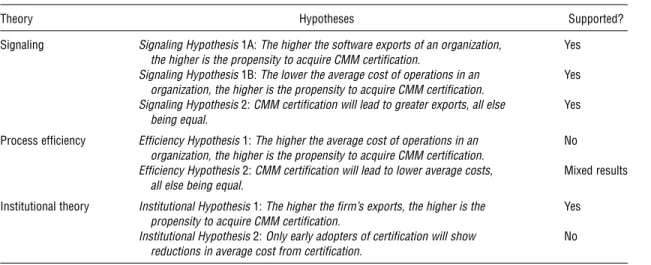
We can synthesize the above alternative hypothe-ses into a set of competing predictions, as shown in Figure 1. Specifically, the signaling argument implies that firms with lower average costs will lead to a greater propensity for certification, whereas the effi-ciency argument implies the opposite effect. The insti-tutional argument, however, suggests no significant effect of average cost on the firm’s decision to acquire certification. In addition, the firm’s cost structure should not change after certification, as per signal-ing, whereas the efficiency argument implies that the firm’s cost structure will improve and the institu-tional argument suggests that this will be true only for early adopters. With respect to exports, signaling and institutional theories indicate a higher propensity of
certification for firms with higher exports whereas the efficiency argument indicates no impact. In terms of post-certification impact on exports, the institutional and efficiency arguments suggest no direct positive impact on exports for certified firms whereas the sig-naling argument provides for a significant and posi-tive impact on the firm’s exports.
Using the above structure of arguments, we pro-vide a more nuanced analysis of whether certifica-tion is indeed a signal to potential clients or if there are confounding effects from other factors, as sug-gested by the efficiency and institutional arguments. In addition, we are able to test the predictions from theory in a more holistic manner by considering all of the hypothesized effects in a collective manner; this allows us to compare and contrast the explana-tory power of the theoretical paradigms across both the certification decision and the performance bene-fits from certification. This would not be feasible in reductionist analyses where only individual relation-ships are tested.
3. Data Collection and Variable
Operationalization
3.1. Data Sources
The Indian software industry has emerged as a mar-ket leader in IT services with exports of $24 billion in 2007 (www.nasscom.org). Of the 70 firms world-wide that have been assessed at the highest level of the CMM scale (CMM Level 5), 50 are located in India (King 2003). The Indian offshore industry there-fore represents a suitable candidate for the study of CMM certification. We test our hypotheses on panel data collected on Indian offshore vendors from 1997 to 2002, a period that coincides with the growth of the CMM’s popularity in the industry as well as growth within the Indian IT industry.
The data for this study were gathered from two sources. Our primary data source for this study was NASSCOM, an industry-level trade body consist-ing of software development organizations in India. NASSCOMcollects information on its member orga-nizations on a yearly basis and publishes these data in the form of annual directories. These directo-ries include information on companies, their officers, and certifications, as well as some information about
firm financials. We collated the information available from the NASSCOMdirectories published annually between 1997 and 2003. Each directory provides data on the firm for the previous financial year. Therefore, we have data on the firms for the years 1996 through 2002. The data for the financial year 1996 was found to be largely incomplete, possibly as a result of the nascent state of the exports market and NASSCOMat that time. Therefore, the data set we use in our anal-ysis pertains to the years 1997 through 2002. In addi-tion to these data, we are able to extract just the CMM certification information for the firms in our sample from 1996, thereby increasing the available sample for the analysis of the lagged effects of both CMM certi-fication and performance impacts.
We augment the data drawn from the NASSCOM directories with cost data acquired from the Center for Monitoring the Indian Economy (CMIE, www. cmie.com). CMIE is a think tank that collects public domain data on firms from different sectors of the Indian economy. The data are collated from earnings reports and other standard filings required of public companies in India. The CMIE data are available only for publicly listed companies in India; information on foreign subsidiaries and private firms is not avail-able. Most wholly owned subsidiaries do not pub-lish financial data on their Indian operations, and, therefore, the data provided to NASSCOMare the only source of financial information on their Indian operations.
The NASSCOMdirectories typically cover all of the member organizations, which have grown over time and numbered approximately 600 in the year 2002. However, most of these firms are small entities with minimal representation in the exports market. Addi-tionally, many member firms are almost always pri-vately held proprietorships with no compulsions to disclose accurate financial or operational informa-tion to the market. The Indian IT services industry is characterized by a heavy concentration of market power in a few firms that dominate the industry.
DataQuest, a leading Indian IT publication, reported in its 2005 survey of the IT industry that the top five firms accounted for more than 30% of Indian software exports,6whereas the top 20 firms accounted for 53% 6http://www.dqindia.com/dqtop20/2005/artdisp.asp?artid=72754 &secid=.
of the exports. Therefore, to gain an understanding of the IT exports industry and to keep the data collection process manageable, it is adequate to con-sider a smaller set of firms.
To identify this smaller set of relevant firms for this study, we used the DataQuestrankings of the top 200 firms in India for the years 1996–2000. From the firms on this list, we omitted hardware vendors, consulting firms, and infrastructure providers such as ISPs and telecom service providers, leaving us with 95 firms. Of these firms, 66 were successfully matched to the NASSCOMdirectories over the period of 1997–2003, leading to a usable sample of 344. There was no finan-cial or operational information on the remaining 29 firms available in the NASSCOMpublications, pos-sibly because they were all either private firms or wholly owned subsidiaries. The 66 firms (shown in the appendix) in our sample account for approxi-mately 65% of the Indian IT services exports market, providing us with a highly representative coverage of the exports industry. These firms include several wholly owned subsidiaries and private firms. Of the 66 firms, operating costs and profitability information are available for only 44 firms from CMIE, providing for a total of 220 observations.7
It is sometimes the case that multiple locations of the same firm have different CMM certification levels. Anecdotal evidence from India suggests that most subsequent certifications are at least on par with the first certification; that is, if a firm sets up a development center in a different location, the cer-tified processes from its first cercer-tified location are usually institutionalized at the new location (Keeni 2000). Therefore, in our analysis, we focus on the first reported CMM certification, because the effects of pro-cess maturity typically will start to emerge while the firm is being audited. This methodology is consis-tent with prior research on the study of certification (Corbett et al. 2005, Simmons and White 1999). 7A simple Box-Cox transformation using the year 2000 data shows that doubling the sample of 62 firms (in 2000) to 124 would result in an increase of total revenues in the sample of 14%. In other words, the contribution of the omitted Indian firms in our sam-ple to total exports is small. Because our focus is on the exports market of which our sample captures 65%, adding smaller firms to the analysis will not improve the generalizability significantly. The details of this procedure are available from the authors.
3.2. Variable Definitions 3.2.1. Dependent Variables.
CMM Level: Organizations are assessed at CMM Levels 1–5 on the basis of their development pro-cesses. In the Indian context, Levels 1 and 2 appear to have no value and are often not reported (Keeni 2000). The first significant signal of CMM certifica-tion occurs when organizacertifica-tions are assessed at CMM Level 3. Paulk (1995) describes CMM Level 2 as rea-sonably equivalent to ISO 9001 certification; hence, Level 3 represents a good starting point for studying CMM certification. For the purposes of our analysis, we treat the acquisition of CMM Level 3 certification as the dependent variable. In sensitivity analysis, we explore how our model extends to Level 4 and Level 5 certification as well. The acquisition of CMM Level 3 is coded as a binary variable, with 0 for the years that the firm is not certified and 1 for the year in which it was certified and each year thereafter.
Exports:Captures the total IT service exports from the firm in that financial year, in Indian rupees.
Average Cost: Is reported by CMIE and is mea-sured by the total cost of operations for the firm per year divided by total sales. This variable represents a size-normalized operational cost measure and is con-sistent with prior work (Hendricks and Singhal 1997, Corbett et al. 2005).8
3.2.2. Control Variables.
Service-Segment Specific Competition: NASS-COMreports the presence of each firm’s service offer-ings in 14 vertical segments shown in the appendix. The ideal measure for the firm’s competitive environ-ment would be based on a composite metric that takes into account the degree of competition and the result-ing revenues in each of the firm’s vertical segments (such as the Herfindahl index). However, that is not possible in the current situation, because NASSCOM does not provide revenue data broken down by seg-ments. Therefore, we construct an index of competi-tion faced by a firm in the following manner. To avoid confusion, we omit the time subscript below.
DefineSij=1 if firmioperates in segmentj, 0
other-wise;i=1 toN;j=1 toK. Our first step is to measure 8We also use total operating cost divided by number of employees in the analysis. The results from both measures are identical.
the degree of competition in each vertical, denoted as Mj. We define Mj as the reciprocal of the count of
firms that operate in each segment:Mj=1/Ni=1Sij.
Thus, the smallerMj, the more competitive that
seg-ment is. For each firm, we then sum up the recip-rocals of those segments in which the firm operates. This measure is biased upward for firms that operate in many segments. To eliminate this bias, we further divide the above measure by the number of vertical segments in which the firm operates. Thus, the com-petition index for each firm is defined as
Competitioni= K j=1 SijMj K j=1 Sij
Competitor CMM Certification: Captures the per-centage of a firm’s direct competitors in different ver-tical segments that are at least CMM Level 3 certified in that year.
ISO Certification:Dummy variable; 1 if the firm is ISO 9000 certified in that year and 0 otherwise. If ISO 9000-certified firms are equivalent to CMM Level 2 (Paulk 1995), ISO 9000-certified firms should find it marginally easier to acquire CMM certification. We include this variable as a control variable in the CMM choice model.
Firm Size:Is a control variable and is measured by the total number of employees in that year. This is consistent with prior research on studying certifica-tion programs (Corbett et al. 2005, King et al. 2005). The logarithm of this variable is used in the analysis.
Subscribed Capital: Represents the total capital in Indian rupees that is currently being used by the firm. Subscribed capital is typically less than or equal to the authorized capital that the firm can raise by way of equity or preference shares at the time of the firm’s incorporation. Additional capital can be infused into the firm either by the primary stakeholders or by equity. This variable is a suitable control for the level of financial resources available to the firm as well as a measure of firm size; that is, larger firms have larger subscribed capital. This variable is logged to reduce the skewness in its distribution.
Ownership: Is a dummy variable coded 1 if the firm is a domestic (Indian-owned) firm and 0 if the firm is a wholly owned subsidiary or a joint venture.
Legal Structure:Is a dummy variable coded 1 if the firm is a public firm and 0 if privately held.
Age:Of the firm in years. This variable is logged to reduce the skewness.
Location:The Indian IT industry was, in its earlier years, concentrated in the city of Bangalore. Although other cities have subsequently emerged as viable des-tinations, Bangalore remains the hub of the industry. Prior research has indicated the spillover effects in ISO 9000 adoption from firms located in the same region (Casadesus et al. 2001). We therefore con-trol for these city-specific effects. This variable is coded 1 if the firm is located in Bangalore and 0 if elsewhere.
Time Controls:We include two variables,Yearand
Year_Squared, to control for the unobserved trend in CMM certification over time, which might be asso-ciated with Indian macroeconomic and foreign trade factors. The results of using this quadratic form of time control are similar to using year dummies but allow us to capture the trends in CMM certification in a more parsimonious manner.
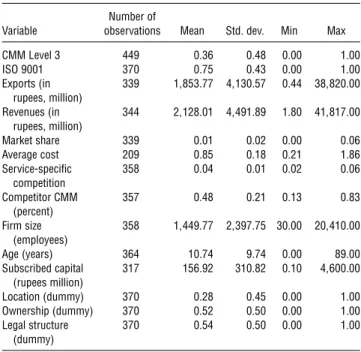
The summary statistics for the sample are pro-vided in Table 1, and the correlation table for the pooled sample is shown in Table 2. A total of 65.3% of the firms in our sample acquired CMM certifica-tion through the study period of 1997–2002. Figure 2 shows the yearwise acquisition of CMM Level 3 in our data set.
Table 1 Summary Statistics
Number of
Variable observations Mean Std. dev. Min Max
CMM Level 3 449 036 048 000 100 ISO9001 370 075 043 000 100 Exports (in 339 185377 413057 044 3882000 rupees, million) Revenues (in 344 212801 449189 180 4181700 rupees, million) Market share 339 001 002 000 006 Average cost 209 085 018 021 186 Service-specific 358 004 001 002 006 competition Competitor CMM 357 048 021 013 083 (percent) Firm size 358 144977 239775 3000 2041000 (employees) Age (years) 364 1074 974 000 8900 Subscribed capital 317 15692 31082 010 460000 (rupees million) Location (dummy) 370 028 045 000 100 Ownership (dummy) 370 052 050 000 100 Legal structure 370 054 050 000 100 (dummy)
Table 2 Correlation Matrix 1 2 3 4 5 6 7 8 9 10 11 12 13 14 CMM Level 3 (1) 1 ISO9001 (2) 038∗ 1 Exports (3) 055∗ 036∗ 1 Revenues (4) 052∗ 043∗ 090∗ 1 Market share (5) 037∗ 036∗ 077∗ 085∗ 1 Average cost (6) −017∗ −000 −027∗ −025∗ −025∗ 1 Competition (7) 019∗ 023∗ 011∗ 019∗ 024∗ 008 1 Competitor CMM (8) 045∗ 025∗ 040∗ 040∗ −002 −001 007 1 Firm size (9) 051∗ 048∗ 079∗ 087∗ 082∗ −029∗ 022∗ 028∗ 1 Age (10) 021∗ 015∗ 043∗ 044∗ 039∗ −015∗ 015∗ 020∗ 045∗ 1 Subscribed capital (11) 036∗ 037∗ 054∗ 065∗ 056∗ −026∗ 027∗ 036∗ 065∗ 030∗ 1 Location (12) −003 −011∗ 002 −002 −003 017∗ −007 −002 −011∗ −011∗ −002 1 Ownership (13) 003 007 012∗ 012∗ 011∗ 002 010∗ 007 012∗ 023∗ 027∗ −007 1 Legal structure (14) 012∗ 021∗ 022∗ 028∗ 028∗ −011 009 009 029∗ 044∗ 046∗ −014∗ 047∗ 1
Notes. Pairwise Spearman correlation is reported.∗indicatesp <005
4. Data Analysis
The hypotheses developed in §2 involve testing both the certification decision and the effects of certifica-tion on firm performance. Accordingly, our analysis is conducted in two stages. In the first stage, we esti-mate a CMM certification choice model. In the second stage, we estimate equations capturing the effects of CMM certification on firm exports and average cost.
4.1. CMM Adoption
Because the decision to acquire CMM certification is a discrete one, a logit model is suitable to test our hypotheses. We model the probability that a firm will acquire CMM certification in a given year based on the covariates identified in the previous section:
LogitCMMit
=0+1Average_Costi t−1+2Exportsi t−1 Figure 2 Count of CMM-Certified Firms Over 1996–2002
0 10 20 30 40 50 Count 1996 1998 2000 2002 Year
+3Market_Sharei t−1+4Competitioni t−1 +5Competitor_CMMi t−1+6ISOi t−1 +7Firm_Sizei t−1+8Legali t−1
+9Ownershipi t−1+10Agei t−1+11SubCapi t−1 +12Locationi t−1+13Yeart−1
+14Year_Squaredt−1+it (1)
In the above model, we are most interested in the coefficients of average cost and exports. A positive coefficient for average cost would provide evidence in favor of the efficiency hypothesis and against the sig-naling hypothesis. Similarly, a positive coefficient on exports leads to support of both signaling and institu-tional hypotheses. We include all of the control vari-ables defined in §3 to control for other factors that might influence a firm’s CMM certification decision. It is possible that there is a lag between a firm’s decision to acquire CMM certification and the actual acquisi-tion of CMM certificaacquisi-tion; therefore, consistent with prior work (Terlaak et al. 2005), all of the explanatory variables in Equation (1) are lagged by one year.
Once a firm has acquired CMM certification, it is relatively rare for the firm subsequently to lose cer-tification.9 Moreover, once the firm is certified, in subsequent years, the certification decision is mean-ingless. Behaviorally, because Equation (1) models the 9There are no instances of this occurring in our data, and anecdotal evidence suggests that this is rare with CMM certification in India (King 2003).
Table 3 CMM Acquisition
Dependent variable: CMM Level 3 certification
Logit (CMM L3 dummy, Logit (CMM L3 dummy,
dropping after adoption) Ordered logit without dropping)
Average cost −4643∗ (2.496) −3760∗ (2.318) −3777∗∗ (1.725) Exports 0980∗ (0.548) 1018∗∗(0.502) 1176∗∗∗(0.382) Market share −17762 (74.491) −9928 (63.356) 24409 (44.563) Service-specific competition 15356 (59.017) 8080 (42.027) −26853 (43.438) Competitor CMM −25132∗∗∗(9.564) −21757∗∗(10.362) 5644∗∗ (2.843) ISO9001 0831 (0.689) 1402 (0.999) 1274 (0.956) Subscribed capital −0500 (0.741) −0526 (0.464) −0211 (0.563)
Firm size (employees) 0577 (0.683) 0464 (0.649) 0076 (0.602)
Age (years) 0044 (0.698) 0578 (0.835) −0727 (0.491) Location (dummy) 0185 (0.797) 0654 (0.696) 0843 (0.848) Ownership (dummy) 0327 (0.573) −0062 (0.692) −0349 (0.498) Year (trend) 0647 (1.664) 1353 (1.497) −1902∗∗ (0.956) Year_squared (trend) 0447∗ (0.256) 0264 (0.197) 0300∗∗ (0.133) Constant −3572 (3.881) −2014 (3.038) N 85 85 151
Notes. All independent variables are one year lagged. Huber-White robust clustered standard errors are in parentheses.
∗Significant at 10%;∗∗significant at 5%;∗∗∗significant at 1%.
decision process of acquiring certification in a given year, if the firm is already certified, this modeling exercise is moot. Therefore, we drop the firm from the analysis after the firm acquires CMM Level 3 certifi-cation, as seen in King et al. (2005), Toffel (2006), and Khanna and Damon (1999).
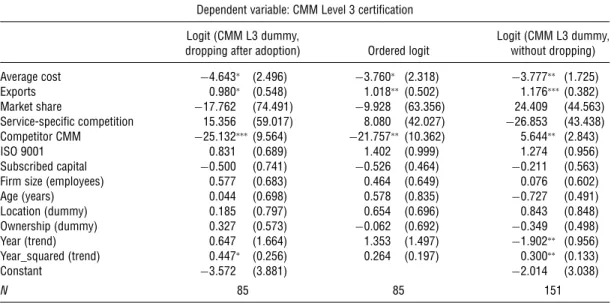
We estimate the model in Equation (1) using pooled logit regression. Because our sample is clustered, i.e., it contains repeated observations from the same firms, we apply the clustered Huber-White robust stan-dard errors, which allow for an arbitrary correlation of error terms among observations from the same firm, including heteroskedasticity and autocorrelation (Wooldridge 2002).10The results from the pooled logit are provided in Table 3, Column 1, and show that both signaling and institutional hypotheses regarding exports are supported (beta=0980, p <01). Firms with higher exports will be more likely to acquire CMM certification. An increase of one standard devi-ation in the firm’s exports enhances the firm’s prob-ability of acquiring certification by 13.1%, when all 10We also check for multicollinearity in the regression specifica-tion by using variance inflaspecifica-tion factor (VIF) guidelines provided by Belsley et al. (1980). The highest VIF encountered in our analysis was 7.94, which, as suggested by Belsley et al. (1980), is far below the cutoff for harmful multicollinearity.
variables are held at the sample mean. In our anal-ysis, it is not possible to separate out institutional arguments from signaling arguments because both are predicated on the role of demand-side variables upon influencing certification.
We also find that the coefficient of average cost is negative and significant at thep <01 level. This sug-gests that firms with lower average costs display a higher propensity to acquire CMM Level 3 certifica-tion. On average, a firm with one standard devia-tion lower in average costs is 8.47% more likely to acquire CMM certification, when all variables are held at the sample mean. This finding supports the Signal-ing Hypothesis 1B but provides evidence against the Efficiency Hypothesis 1.
We also perform supplementary analysis to estab-lish the robustness of our results. First, in Equa-tion (1), CMM Level 3 certificaEqua-tion is modeled as a binary decision. However, because there are differ-ent levels of CMM certification (Levels 3, 4, and 5), it is also possible to model this decision using the ordered logit to capture effects that might not appear in a simple logit regression. We perform this analy-sis, and the results are reported in Table 3, Column 2. Additionally, although we drop observations after the firm acquires certification, it is useful to retain these firms in the analysis to check if there are substantive
differences in the results. We provide the results from not dropping certified firms in Table 3, Column 3.
Results using the ordered logit analysis (Column 2 in Table 3) and with the retaining of certified firms (Column 3 in Table 3) provide consistent results; the effects of exports and average cost are even stronger statistically.11 Because the Hosmer-Lemeshow fit test is not recommend for use when the number of total observations is small (less than 400, according to Hosmer and Lemeshow 2000), we use the percent-age of correct prediction to test the goodness of fit of our model. The model predicts certification status cor-rectly 82.7% of the time. More specifically, it predicts correctly 79.3% of non-CMM adoption and 85.2% of CMM adoption. In addition, the Pearson chi-square fit statistic for the logit analysis is 74.6 with ap-value of 0.36, indicating a good fit of the model with the data and strength to the analysis.
4.2. CMM’s Effects on Exports
The effect of CMM certification on exports is captured by the following specification:
Exportsit =0+1CMMi t−1+2Competitionit
+3Competitor_CMMit+4Average_Costit
+5Firm_Sizeit+6SubCapit+7Ageit
+8Ownershipit+9Legalit+10Locationit
+11Yeart+12Year_Squaredt+it (2) In estimating Equation (2), we include a one-year-lagged CMM term because there is likely a slight lag between the firm acquiring the CMM certification and its eventual impact on the firm’s exports. Also, the effects of the CMM signal on the firm’s demand side (if any) are likely to be lagged by a small interval 11Among other variables, domestic firms appear to be marginally more likely to acquire CMM certification compared to foreign-owned firms. We also see some indications of larger and older firms being more prone to acquire CMM certification in our analysis, as previously suggested by Banerjee and Duflo (2000) in a study of the Indian offshore industry. Because of the relatively small sam-ple in these regressions, it is possible that these estimates do not reach statistical significance. A significant reduction in sample size is caused by including average cost in the regressions. When the full sample is utilized, the coefficients for firm age and size become significant.
as clients receive news of and recognize the value of certification. We also include firm size (number of employees) and subscribed capital in the analysis to account for any possible scale effects. In addition, we add the competition variables in this equation because these could conceivably impact a firm’s exports. In subsequent analysis, the firm’s lagged average cost is included as an explanatory variable, because supply-side efficiencies could influence the firm’s perfor-mance in the market (Hendricks and Singhal 1997).
Equation (2) can be estimated using ordinary least squared (OLS). However, there are two issues with using OLS. First, error variances may be unequal across observations in the sample, leading to a heteroskedastic error structure. The Breusch-Pagan Lagrange multiplier test rejects the null hypothesis of homoskedasticity in our sample, indicating that het-eroskedasticity is a concern. Furthermore, the pres-ence of repeated observations from the same firm in the sample suggests that the orthogonal error struc-ture assumption in the variance–covariance matrix required by OLS would not hold. We therefore use the Huber-White clustered robust standard errors to account for repeated observations of the same firm across time, which allows for both heteroskedasticity and autocorrelation in unobserved errors (Wooldridge 2002).12
A more serious concern is that OLS estimators of Equation (2) might be biased due to the endogeneity of CMM certification. This arises as a result of unob-served factors that influence both the certification decision and exports (Maddala 1983). In the context of panel data, there are several options available to control for this unobserved heterogeneity in the sam-ple that may lead to endogeneity (Wooldridge 2002). First, if the unobserved and hence omitted factors are time invariant, one straightforward option is to use a fixed-effects model that captures the unobserved firm-specific effects, which we report in Table 4. Sec-ond, if the omitted factors are assumed to change over time but are contemporaneous with exports, the 12We also perform our analysis using an AR(1) structure to capture the effect of serial autocorrelation. The effect of CMM on exports is robust to this specification and increases in magnitude. However, the robust clustered standard errors account for the serial corre-lation in the errors; we therefore report these results in Tables 4 and 5.
Table 4 Effects of CMM Certification on Exports
Dependent variable: Exports
OLS Fixed effects Random effects With average cost CMM (lagged) 0498∗∗ (0.226) 0294∗ (0.164) 0320∗∗ (0.149) 0324∗∗ (0.139)
Average cost −0049 (0.521)
Service-specific competition −7643 (6.690) −3189 (5.085) −4542 (4.726) −9290∗ (5.612) Competitor CMM −0827 (0.795) −1029∗ (0.584) −0890 (0.598) −0501 (0.707) Firm size (employees) 0970∗∗∗(0.115) 1003∗∗∗(0.229) 1001∗∗∗(0.099) 1010∗∗∗(0.100) Subscribed capital 0001 (0.073) −0019 (0.069) −0020 (0.053) −0027 (0.072)
Age (years) 0256 (0.160) 0337 (0.220) 0244 (0.169) 0498∗∗∗(0.137)
Location (dummy) 0261 (0.165) Ownership (dummy) 0116 (0.173) Legal structure (dummy) −0180 (0.162)
Year (trend) 0267∗∗ (0.115) 0453∗∗∗(0.107) 0421∗∗∗(0.103) 0312∗∗ (0.150) Year_squared (trend) −0002 (0.020) −0024 (0.015) −0021 (0.015) −0020 (0.020) Constant −1223∗∗∗(0.442) −1818 (1.220) −1572∗∗∗(0.542) −1863∗∗ (0.922) N 288 288 288 187 R-squared (overall) 0.72 0.70 0.71 0.69 Note. Huber-White robust cluster standard errors are in parentheses.
∗Significant at 10%;∗∗significant at 5%;∗∗∗significant at 1%.
independent variable of interest can be appropriately lagged (Wooldridge 2002, Lai 2006). Consistent with this reasoning, we introduce a one-year lag of the CMM certification variable in all of our models, which reduces the impact of simultaneity between the certi-fication decision and exports.
It is often not possible to accurately deduce the structure or pattern by which omitted factors may bias the OLS estimates in the presence of endogene-ity. In such cases, a ready solution is to use the treat-ment effects model, based on the Heckman two-stage procedure for self-selection (Maddala 1983). Although this procedure is acceptable in the context of cross-sectional data, there exists no clear alternative for panel data (Corbett et al. 2005, King et al. 2005). Therefore, we use different approaches based on the treatment effects model to estimate the impact of cer-tification on exports in the presence of endogeneity and report the most conservative results in Column 1 of Table 5. A detailed description of the different esti-mation approaches used is provided in the statistical appendix.
We report the pooled OLS results for Equation (2) with the Huber-White robust errors in Column 1 of Table 4. We also report the fixed-effects model results of Equation (2) in Column 2 of Table 4. Because the Hausman’s test does not reject the random effects
specification p=025, we also report the random-effects model estimation in Column 3 of Table 4 (Wooldridge 2002). The results with respect to CMM certification are consistent across all three specifica-tions in Table 4 as well as the conservative treatment effects model in Column 1 of Table 5,13 bolstering the reliability of our empirical findings. We find that CMM certification is significant and positive on its effect on exports. In both the OLS and random-effects models CMM certification is significant at thep <005 level. Even in the fixed-effects model, which has the most stringent specification, CMM remains significant at the p <01 level. The magnitude of the effect that certification appears to have on the firm’s exports is also substantial. The smallest estimate of the effect is the fixed-effects coefficient (beta=0294), which translates to an increase of approximately 34.2% in exports, all else being equal. This could result either from the effect of increased revenues on existing ser-vices or from higher margins (prices) on serser-vices with demonstrably higher quality. It is not possible in our data set to distinguish between these two cases; how-ever, the impact of certification on the firm’s demand 13The first-stage probit model has a good fit with the data. The model is significant at thep <001 level, with a pseudoR-squared of 38.5%, and predicts CMM certification correctly 86.5% of the time. The coefficient of the inverse Mills ratio is significant at the
Table 5 Further Explorations of CMM Certification’s Impacts on Exports
First difference model Heckman
corrected
estimationa One-year lag Two-year lag
CMM (lagged) 2180∗∗∗(0.831) 0257∗ (0.141) 0109 (0.116) Service-specific −32204 (20.640) −2125 (4.301) 0162 (4.618) competition Competitor CMM 3341 (5.267) −0232 (0.576) 0874 (0.790) Firm size 0500∗∗ (0.245) 0450∗∗∗(0.130) 0478∗∗∗ (0.161) (employees) Subscribed 0153 (0.205) −0045 (0.049) −0045 (0.062) capital Age (years) 0667 (0.456) Year (trend) −0095 (1.776) Year_squared −0049 (0.228) −0042∗∗∗(0.014) −0069∗∗ (0.028) (trend) Constant 00639 (4.322) 0597∗∗∗(0.123) 0663∗∗∗ (0.185) Lambda −1195∗∗ (0.535) N 67 215 169 R-squared 0.11 0.11
Notes. In the Heckman-corrected treatment-effects model, the sample is
smaller because (1) we first lag CMM by one year in the second-stage equa-tion; (2) in the first-stage equation, we lag independent variables by another year to predict the probability of CMM adoption. This procedure reduces the sample by removing two years of data. The results shown are from the conservative treatment-effects model described in the statistical appendix (online). Huber-White robust cluster standard errors are in parentheses.
aThis analysis was conducted usingtreatregon State 9. ∗Significant at 10%;∗∗significant at 5%;∗∗∗significant at 1%.
side is consistent with the expectation of signaling better quality in the offshore markets.
Because improvements in the firm’s cost structure could indirectly lead to greater revenues, we include average cost in the exports equation. Recall that the efficiency argument postulates a first-order effect of certification on improved internal efficiencies. There-fore, controlling for internal efficiencies, certification per se need not have a direct effect on the firm’s demand side, as per the efficiency argument. The results from the random-effects analysis with lagged average cost are shown in Column 4 of Table 4. There appears to be no direct impact of average cost on exports while the CMM variable consistently retains both significance and magnitude. We also introduce the difference in average cost from the previous year in the analysis, and the results remain consistent, sug-gesting that internal efficiency is not directly linked to exports performance.
The results described above suggest that certifica-tion’s effect on exports is consistent with the signaling hypothesis. However, it is possible that the process
of organizational transformation that is required of a firm in order to acquire certification, rather than the certification per se, leads to the increase in exports. If this is true, the signaling argument for CMM certifi-cation would be undermined, because signaling sug-gests that only those firms that are certified can send out the suitable signal. Because it typically takes more than a year for a firm to obtain CMM certification, the above argument can be tested by adding a binary variable representing a one-year lead of CMM into Equation (2), which proxies the action of undertaking and executing the CMM certification process. We find that a one-year lead of CMM variable is not signifi-cant, while the one-year lag of CMM remains signif-icant and the magnitude remains largely unchanged, providing further support for the signaling argument.
4.3. Further Explorations of CMM Certification’s Impacts on Exports
We conduct further analysis to understand how CMM certification boosts exports. The preceding analysis estimates the average impact of certification on exports after the firm is certified. It does not, however, provide insights into whether CMM certification has a short-term or a long-term effect on exports. The sig-naling argument suggests that certification’s impact will be strongest immediately after the firm gains the signal. Once the signal has been acquired, the firm may not continue to experience exports growth at an abnormal rate beyond a point (unless the firm’s struc-tural characteristics change). To test for this effect, we transform Equation (2) by first-differencing all of the variables as shown below:
Exportsit
=0+1CMMi t−1+2Competitionit
+3Competitor_CMMit+4Firm_Sizeit
+5Year_Squaredt+it (3)
Note that time-invariant variables like age, year, location, ownership, and legal structure are dropped because of the first-differencing method. TheCMMit
variable now captures only the impact of the signal when it is issued. Once the firm is certified,CMMit
returns to 0 for the remainder of the panel, unlike
CMMit in Equation (2), which remains 1 after