
The German statistical
category “migration
background”: Historical
roots, revisions and
shortcomings
Anne-Kathrin Will
Institut fu¨r Europ€aische Ethnologie und Berliner Institut fu¨r empirische Integrations- und Migrationsforschung (BIM), Humboldt-Universit€at zu Berlin, Berlin, Germany
Abstract
The term “migration background” is commonly used in Germany today, but this neol-ogism is only 20 years old. As an official category, it is even much younger. There has been only little research concerning the new population category, which emerged around the turn of the millennium. Thus, the question how the “migration background” could become the central category describing migration related diversity in Germany is not answered yet. This article fills this gap by exploring the context of the emergence of the “migration background” including the history of ethnic categories in German official statistics. It describes the actual definition of a “migration background” which became an official category in 2007 when the German Federal Statistical Office started pub-lishing data regarding “the population with a migration background” based on the microcensus, a 1% household survey with mandatory participation. The central ques-tions are: how national membership is imagined, how is it inscribed in definiques-tions, and what adaptions had to be made over time? To answer these questions, different sources as questionnaires, publications of results of the microcensus and national reports on children and youth are analysed. Using interpretative methods, it is shown how a new taxonomy of the population in Germany was created, how it was influenced by inter-national and inter-national educational research, and to which extent it reshaped the per-spectives on newcomers and natives. It is shown that the new category is tightly bound
Corresponding author:
Anne-Kathrin Will, Institut fu¨r Europ€aische Ethnologie und Berliner Institut fu¨r empirische Integrations- und Migrationsforschung (BIM), Humboldt-Universit€at zu Berlin, Unter den Linden 6, 10099 Berlin, Germany. Email: [email protected]
2019, Vol. 19(3) 535–557
!The Author(s) 2019 Article reuse guidelines: sagepub.com/journals-permissions DOI: 10.1177/1468796819833437 journals.sagepub.com/home/etn
to citizenship and summarizes a number of older ethnic categories, but excludes also immigrated Germans who immigrated shortly after Second World War and from the former German Democratic Republic. Therefore, the label “migration background” is misleading because inherited citizenship and ancestry is in the centre of the definition rather than migration experience.
Keywords
Migration background, ethnic categories, national statistic, German microcensus, statistical category, citizenship, national membership
In 2007, the German Federal Statistical Office started a new publication series entitled “Population with a migration background – results from the microcensus 2005”. To this purpose, the office developed a definition for people with a migra-tion background. Around the millennium social, educamigra-tional and health sciences had indeed employed this neologism, but very seldom and without any consistent definition. In the following pages, I will first recount the historical context of the official statistical category “migration background” and its antecedents; secondly, analyse how this category was conceptualized by the Federal Statistical Office and end with discussing some shortcomings and problematic implications of this concept for recent membership in the German nation.
Why did the concept “migration background” emerge
around the millennium?
Since the end of Second World War, the common official population categories in Germany1 in “natio-ethno-cultural” terms (Mecheril, 2003: 23ff.) have been citizenship and religion.2Henceforth, the German state has not collected explicit data on ethnicity and race, but rather related data on foreigners, migrants and their descendants, most consistently as part of the microcensus. This is Germany’s largest representative survey, conducted annually since 1957 by the Federal Statistical Office, working in cooperation with the statistical offices of Germany’s federal states (Bundeslander€ ). Data are gathered on population char-acteristics and living conditions, including questions about citizenship.
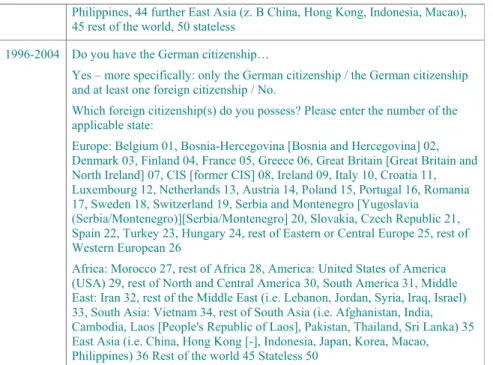
The categories in census questionnaires, such as this microcensus, can be seen as artefacts, which reveal information about membership within a society at a given time (Yanow, 2003: 22). A first observation concerning the German microcensus is that categories specifying different foreign citizenships were not considered in the first six years of the survey, but from 1964 onwards in increasing detail (see Figure 1).3
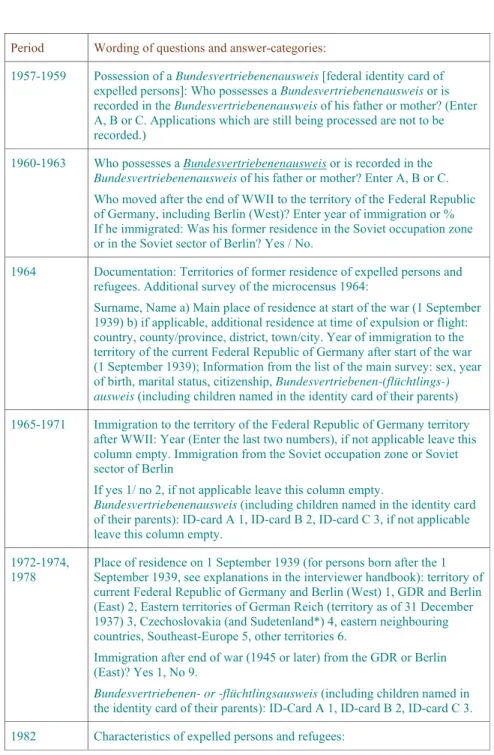
While the number of categories (and questions) regarding foreigners increased over time, it is important to note that until 1982 statisticians were much more concerned about tracking different groups of Germans, specifically people of
Figure 1. Categories regarding residents’ citizenship, 1957–2004. Source: Statistisches Bundesamt (1988: 13); Gesis (2017); own representation.
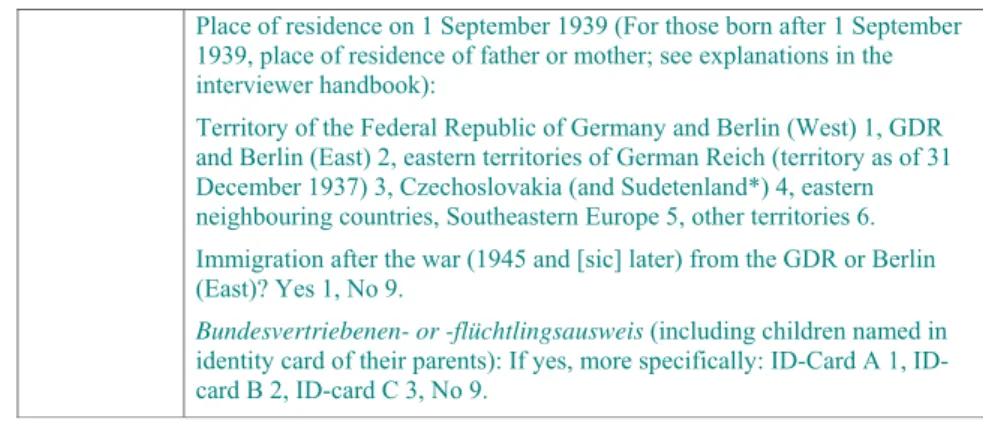
German descent who fled the GDR or left socialist countries such as Poland, Romania, Czechoslovakia, Hungary or Yugoslavia (see Figure 2). Ethnic German immigrants from the Eastern bloc were differentiated according to the region they came from and the kind of federal identity card they had received as
“expelled persons” (Bundesvertriebenenausweis). If they had lived before 31
December 1937 within the borders of the then internationally recognized German eastern territories, they received a Bundesvertriebenenausweis A. If they settled during Second World War in these or in German-occupied territories, they
received a Bundesvertriebenenausweis B. Refugees from the GDR received a
Bundesvertriebenenausweis C.
In short, the growing lists of detailed information on citizenships illustrate that foreigners with different citizenships were seen as an increasingly important category in the course of the 1980s, while questions regarding the ID-card of expelled Germans were asked in 1982 for the last time. After the reunification in 1989, the category of refugees from the Soviet-occupied zone or Soviet sector of Berlin became obsolete, and in 1993 the law on expelled persons changed. From then on, only persons from the former USSR with German ancestry, being discriminated for their Germanness, could enter Germany as “late resettlers” (Spataussiedler€ ). The categories of “expelled persons” and GDR-refugees lost their importance shortly after reunification.
Figure 2. Categories of ethnic German refugees and expelled persons, microcensus forms completed by interviewers. *Different border regions of Czechoslovakia with large German-speaking populations. Source: Statistisches Bundesamt (1988: 22 f.); own representation.
Indeed, Sp€ataussiedler became an important group during the 1990s, as their
numbers increased. However, how many Spataussiedler€ immigrated to Germany
can only be estimated. Since they were considered Germans, their entry was not documented separately in immigration statistics and they were not asked any ques-tions about their immigration or place of birth in the microcensus until 2005. Therefore,Spataussiedler€ were invisible as a population category. Nonetheless existed concerns about this group, and problems of integration, especially of youth, were reported (for example, Bayer, 1998; Claus, 1994; Steffen and Elsner, 2000).
At the same time, two other resident groups in Germany were growing: natu-ralized persons and the so-called “second generation” migrants, i.e. children of immigrants, who remained foreigners due to theius sanguinispolicy of the German citizenship law, first instated 1913. According to the ius sanguinis principle, German citizenship was granted to those whose parents were German citizens; children of foreigners inherited the foreign citizenship(s) of their parents. In 2000, German citizenship law reforms in part rescinded thisius sanguinis require-ment. Since then, children who have at least one foreign parent residing legally for a minimum of eight years in Germany may receive German citizenship.
As a consequence, the category of “Germans” became more diverse around the turn of the millennium – due to the immigration ofSpataussiedler€ , naturalizations and German-born children with foreign parents. By this point it had become obvi-ous that citizenship did not really differentiate between natives born in Germany and newcomers. The category of “Germans” actually included immigrants with the status of “expelled persons” and “refugees” in former rounds of the microcensus as well as naturalized andSpataussiedler€ . At the same time, the category “foreigners” actually included many natives, that is, people who had been born in Germany as foreigners, even if they had never left the country. With the annually growing groups of “German immigrants” due to immigration and “native foreigners”
due to children born to foreigners in Germany, political advisors and academic experts increasingly demanded that new categories be developed to include them adequately in population statistics (Salentin and Wilkening, 2003; Unabh€angige Kommission “Zuwanderung”, 2001).
The term “migration background” was used as early as 1998, as part of an expert discussion on youth welfare documented in a regularly issued governmental report, but still unsystematically and without further definition (Deutscher Bundestag, 1998). In the reports over the following two decades, the term was applied with increasing frequency (see Figure 3). The usage of “migration back-ground” did not wane until 2017, when it was overtaken by the term “asylum”, due to the arrival of about a million people seeking refuge in 2015, directing public interest to this specific group of newcomers and away from those who had already been in Germany a longer time.
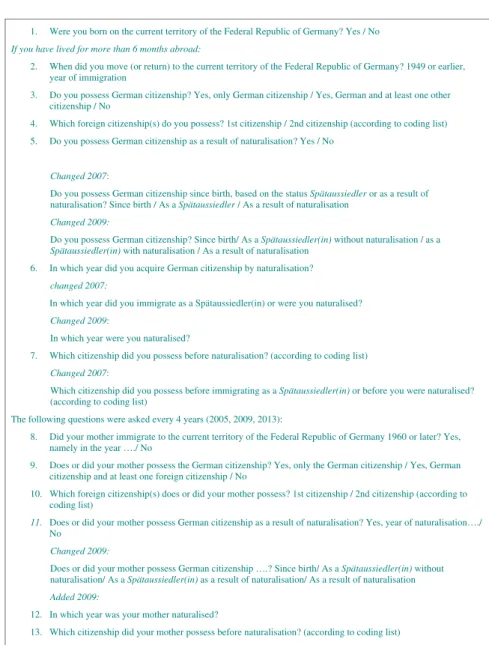
Starting in 2005, when “questions on migration” were introduced in the micro-census, and until 2013, the term “migration background” was used much more frequently in these governmental reports. The reports drew heavily from the micro-census data and thus refer frequently to the new category “migration background”, which had been operationalized for the first time in 2005 using these “questions on migration” (see Figure 4). In the following years, other surveys also included more
0 50 100 150 200 250 300 # 1 (1965) # 2 (1968) # 3 (1972) # 4 (1978) # 5 (1980) # 6 (1984) # 7 (1986) # 8 (1990) # 9 (1994) # 10 (1998) # 11 (2002) # 12 (2005) # 13 (2009) # 14 (2013) # 15 (2017)
asylum* reseler* foreign/er* migraon background refugee* Frequencies of Terms
The * indicates that also compounds are included which are frequent in German, for example asylum seeker (Asylbewerber/-in).
Report
Figure 3. Frequencies of the terms foreign/er, migration background, resettler, refugee and asylum in the governmental reports on children and youth from 1965 to 2017. Source: DJI (2017); Bundesministerium fu¨r Familie, Senioren, Frauen und Jugend (2017); own analysis and
1. Were you born on the current territory of the Federal Republic of Germany? Yes / No
If you have lived for more than 6 months abroad:
2. When did you move (or return) to the current territory of the Federal Republic of Germany? 1949 or earlier,
year of immigration
3. Do you possess German citizenship? Yes, only German citizenship / Yes, German and at least one other
citizenship / No
4. Which foreign citizenship(s) do you possess? 1st citizenship / 2nd citizenship (according to coding list)
5. Do you possess German citizenship as a result of naturalisation? Yes / No
Changed 2007:
Do you possess German citizenship since birth, based on the status Spätaussiedler or as a result of
naturalisation? Since birth / As a Spätaussiedler / As a result of naturalisation
Changed 2009:
Do you possess German citizenship? Since birth/ As a Spätaussiedler(in) without naturalisation / as a
Spätaussiedler(in) with naturalisation / As a result of naturalisation
6. In which year did you acquire German citizenship by naturalisation?
changed 2007:
In which year did you immigrate as a Spätaussiedler(in) or were you naturalised?
Changed 2009:
In which year were you naturalised?
7. Which citizenship did you possess before naturalisation? (according to coding list)
Changed 2007:
Which citizenship did you possess before immigrating as a Spätaussiedler(in) or before you were naturalised?
(according to coding list)
The following questions were asked every 4 years (2005, 2009, 2013):
8. Did your mother immigrate to the current territory of the Federal Republic of Germany 1960 or later? Yes,
namely in the year …./ No
9. Does or did your mother possess the German citizenship? Yes, only the German citizenship / Yes, German
citizenship and at least one foreign citizenship / No
10. Which foreign citizenship(s) does or did your mother possess? 1st citizenship / 2nd citizenship (according to coding list)
11. Does or did your mother possess German citizenship as a result of naturalisation? Yes, year of naturalisation…./
No
Changed 2009:
Does or did your mother possess German citizenship ….? Since birth/ As a Spätaussiedler(in) without
naturalisation/ As a Spätaussiedler(in) as a result of naturalisation/ As a result of naturalisation
Added 2009:
12. In which year was your mother naturalised?
13. Which citizenship did your mother possess before naturalisation? (according to coding list) Questions 8 to 13 are also asked of the father.
Figure 4. Questions on migration in the microcensus, 2005–2013. Note: In 2014, the questions were changed again. As a result of a new microcensus law in 2017, further questions were added, wordings changed and the questions on parents were to be asked annually from then on (all included in Figure 1 in the online Supplemental material).
or less similar operationalizations of the concept “migration background”. These observations thus mark the “surface of emergence” of the concept “migration background”, as described by Foucault (2002: 45).
The “questions on migration” made people who were German resettlers, natu-ralized and the second generation migrants visible in German population statistics. Strikingly, the justification of the microcensus law introducing these questions only explains their introduction with an interest in naturalized citizens and second gen-eration migrants:
The immigration and integration of migrants is an increasingly important political issue, for which there is still a lack of basic information. Information on naturaliza-tion is significant because through naturalizanaturaliza-tion a formal integranaturaliza-tion takes place which allows one to make conclusions about these migrants’ willingness to integrate. (Deutscher Bundestag, 2004: 11)
Questions about respondents’ parents were included every four years: “The ques-tion about the citizenship of one’s parents and possibly their naturalizaques-tion allows a differentiated analysis of the whole spectrum of features of the microcensus for the group of persons belonging to the second migrant generation” (Deutscher Bundestag, 2004: 13). Resettlers and third generation immigrants were not explic-itly mentioned at all. However, these two groups were also statistically included in the group defined as “people with a migration background”. Despite its use as a statistical category, the term “migration background” was then not mentioned in the microcensus law nor in the justification of the parliamentary proposal of it.
But why was “migration background” chosen and not another category? To understand this, one has to look at the context: in 2000 the OECD had started the Programme of International Student Assessment (PISA), which analysed the achievement of different categories of students. In 2003, the English version of the PISA report mentioned the term “migrant background” for the first time. Without an actual definition, it was used to describe the opposite of “native”: “When interpreting performance gaps between native students and those with a migrant background [. . .]” (OECD, 2004a: 169). Generally, the term “migrant background” was not used as often as the terms “immigrant background” and “immigrant students”, which would become the standard denomination in PISA for the overall category of students who have two foreign parents, separable into first and second generation by their own birth country. The German translation of
the 2003 PISA report uses the German term “Migrationshintergrund” 22 times
(OECD, 2004b) and over the following years this became an established part of the PISA publications in German (Will, 2018a).
Two years after this first German translation, an important point in the discur-sive development of this term is marked by the publication of two national reports: In 2006, the first German national educational report was released. It used data generated from the microcensus’ questions on migration to categorize particular population groups in Germany as “persons with a migration background”, as
“foreigners” of the first, second or third generation, “Germans” of the first or second generation and “persons without a migration background” (Konsortium Bildungsberichterstattung, 2006: 140). In turn, this taxonomy, originally developed for the monitoring of the population’s educational achievements, constituted the blueprint for the Federal Statistical Office’s new publication series focussing on migration, this being a part of the subseries titled “foreign population”. In the strict sense, it is inconsistent to statistically document “persons with a migration background” as part of the subseries titled “foreigners”, because more than half of the “persons with a migration background” are German citizens.
This anomaly is increased by the fact that the contrasting reference group in the
Federal Statistical Offices’ subseries is “Germans without a migration
back-ground”, changed from “persons without a migration background” in the
educa-tional report. Set in opposition to the subseries’ focus “persons with a migration background”, this change implies the equation “Germans¼those without a migra-tion background” while those with a “migramigra-tion background” are not presented as German. Even if unintended, this is at the very least an implicit denial that many Germans have ancestors who had immigrated to Germany at one point in time, which is a constitutive part of German history. At the same time, “persons with a migration background” are framed in the statistical report as a problematic part of the population, which has to be monitored until the third generation because “[a] ccording to scientific studies from all classic immigration countries, members of the 3rd generation are extraordinary ‘difficult’ in terms of integration politics” (Statistisches Bundesamt, 2009 (2007): 4).
The result is a taxonomy with 16 immigrant population subgroups, presented in contrast to a majority referred to as “Germans without a migration background”. Strikingly, the migration experience of “ethnic Germans”, which had been recorded until 1982 with the same accuracy as that of (former) foreigners, is partly excluded from this new taxonomy, because “only immigration into the actual territory of the Federal Republic from 1950 onwards is taken into account” (Statistisches Bundesamt, 2009 (2007): 4). These changes and omissions raise the question: How exactly is the category “migration background” defined?
The category “migration background” in Germany – The
official definition(s)
In 2005, the Federal Statistical Office defined this category for the first time:
Persons with a migration background are defined as ‘all migrants who entered the current territory of the Federal Republic of Germany after 1949, and all foreigners born in Germany and all those born in Germany as Germans with at least one parent who immigrated to Germany or who was born as a foreigner in Germany’. (Statistisches Bundesamt, 2009 (2007): 6)
The wording was changed and simplified in 2016. The current definition is: “A person has a migration background if s/he or at least one of his/her parents did not acquire the German citizenship at birth” (Statistisches Bundesamt, 2017: 4).
Following Yanow (2003), I try to trace the assumptions and inscriptions in this powerful category. The official definition of “migration background” was (and is) very complex. Possibly that is the reason why the classification is not commonly debated. In science and technology studies, one describes similar processes as a “black-box”-effect, for instance, complicated algorithms are accepted and not questioned once they have become established (Porter, 1996: 45). The same is true for the category “migration background”: for a long time there has been a lack of scientific and public critique of it,4which is surprising given the controver-sial nature of the topic and of decisions made in this policy field.
The categories’ creators had expected some discussion about their newly
designed taxonomy of immigrant groups (Sch€afer and Bru¨ckner, 2009: 1047),
but perhaps did not foresee that the category “migration background” would have such a significant impact on wider discourse. However, there is no such thing as naı¨ve science, especially not in state offices. Statistical offices are usually not only aware that statistics will have an effect on discourse and policy, but even gather them to this purpose. Official categories and figures inform and structure public and scientific discourse and lead to the passing and implementation of regulations, laws and measures. In this way, the official representations and def-initions of certain phenomena become factual and impact our reality.
Figures function additionally as evidence for a variety of argumentations and can be described as a “generalized communication medium”, to borrow and adapt Luhmanns concept (Heintz, 2007: 65). Everybody understands figures and can communicate about them, even if in detail the categories, upon which the numbers are based, are actually diffuse. By providing such easy-to-use figures, also the Federal Statistical Offices’ official categories shape the discourse and define what can be said and how (Foucault, 2002). Scientific categories are powerful actors that structure our world once they enter a discourse (Berger and Luckmann, 1990 (1969); Porter, 1996; Bowker and Star, 1999; Latour, 2001). Even though these categories are human constructs and do not exist as part of nature, they are none-theless bound to social interactions and become real through daily enactments (Yanow, 2003: 22, 44).
Similar to the Dutch categories of authochton and allochthon (and its
sub-categories), the category “migration background” has been created by statisticians. Respondents were not asked if they have a “migration background” or not. In the Netherlands, the data stem from the population registry, but the categories are created and people are classified within them, without asking the classified if they belong to these categories. In Germany participants of the microcensus initially had to answer 3 to 17 questions, depending on the skip rules (see Figure 4 for the questions). In 2009 and with a new microcensus law in 2017, the number of ques-tions increased to 19 quesques-tions and then 24, respectively (see Figure 1 in the online Supplemental material).
The answers to these questions are processed to come up with a classification of the respondents, using additional data of parents living in the same household. The Federal Statistical Office ascribes a “migration background” to the surveyed per-sons employing a complex program for their classification. The complexity resulted in some minor “mistakes”, and revisions have had to be made of the statistical publications based on this program. For example, German children of foreign parents (so-calledius solichildren who were granted German citizenship according to the reissued law of 2000) were “miscategorized” as foreigners despite their German citizenship. Foreign-born Germans were re-categorized – recently, in 2016/17. All former volumes of the subseries have since been revised (see Will, 2018b).
It is important to note that there was limited data on residents’ country of origin until 2017.5Until then, the microcensus only asked if somebody was born on the current territory of Germany with the answer options “yes” and “no”. Thus, no data on concrete countries of origin were available, only “Germany within its current borders” and “abroad”. Participants from “abroad” have also been asked when they entered Germany and which citizenship(s) they currently possess and possibly possessed earlier. All participants born in the current territory of Germany are asked about their (former) citizenship(s) and the basis for having German citizenship. Therefore, “origin” is operationalized in microcensus-data in terms of “citizenship”. A second important detail: there are no tick boxes in the microcensus asking for any self-categorization. Only (apparently) objective facts are asked about territories, citizenships, if applicable naturalization year, resettler status and year of entry, and all this is also asked about both parents if they do not live in the same household (between 2005 and 2016 every four years, since 2017 annually).
The Federal Statistical Office provides a four-quadrant classification matrix, organizing people according to their migration status using the criteria “birth inside/outside current German borders” and “German citizenship/non-German citizenship” (see Figure 5). The authors describe the categorizations in the first, second and third quadrant as rather unproblematic as far as discriminatory issues are concerned (Statistisches Bundesamt, 2009 (2007): 325f.). In the fourth quad-rant, persons with and without a “migration background” are grouped together and should be separated. In order to do this, additional data about the respondents are needed concerning their country of birth and citizenship at birth; this kind of boundary-drawing is portrayed as controversial by the authors (Statistisches Bundesamt, 2009 (2007)).
However, the third quadrant is problematic too, since Germans with and with-out a “migration background” are also combined in the same quadrant and not all immigrated Germans are counted as having a “migration background”; the cut-off year is 1949. Immigration of Germans until that date does not count as a criterion for ascribing a “migration background” to someone. Taking into account how much energy was invested in endless tables of German expelled persons and
refugees until a little more than 30 years ago, this decision is striking. A footnote at the cited four-quadrant matrix explains:
All interviewed experts deemed it consensus that it is inappropriate to confuse the definition of migration background by including those who came to the current Federal Republic of Germany as part of the migration flows during the Third Reich or in the years immediately following WWII as a consequence of resettlements, flight or expulsion. Therefore only those immigrants who immigrated after 1949 will be categorized as having a migration background. (Statistisches Bundesamt, 2009 (2007): 328)
By the time you read this article, the cited text will have been revised in the men-tioned recent revision of the whole series, including the results from 2005 until 2016.6In the revised version the “Annex 1 – persons with a migration background” is no longer included, and the cut-off year 1949 is not mentioned (Statistisches Bundesamt, 2017: 4ff., also in the revised series back to 2005), even if the latter is still being used (Statistisches Bundesamt, 6.3.17). While mentioning the cut-off
Country of birth
Abroad
[persons with own migration experience]
Inland
[persons without own migration experience]
C it ize ns hi p Non-Germa n I. Immigrant foreigners a) 1st generation foreigners [2.2.1.1 foreigner]
II. Foreigners born in Germany
a) 2nd generation foreigners (parents belong to I.)
[2.2.2.1 foreigners (2nd and 3rd generation)]
b) 3rd generation foreigners (parents belong to II.)
[2.2.2.1 foreigners (2nd and 3rd generation)]
German
III. Immigrant Germans a) resettlers, refugees and expelled persons of German ethnicity with German citizenship without naturalisation [2.2.1.2.1 German immigrants without naturalisation)] b) immigrants naturalised including naturalised resettlers [2.2.1.2.2 naturalised]
c) children of Germans without migration background born during a stay abroad [1 Germans without migration background]
IV. Germans born in Germany
a) Germans without migration background [1 Gemans without migration background] b) not immigrated but naturalised [2.2.2.2.1 naturalised]
c) children of resettlers, refugees and expelled persons of German ethnicity and with German citizenship without naturalisation [2.2.2.2.2.1 both-sided migration background*]
d) children of naturalised [2.2.2.2.2.1 both-sided migration background*]
e) Ius soli-children of foreigners [2.2.2.2.2.1 both-sided migration background*]
f) persons with one-sided migration background [2.2.2.2.2.2 one-sided migration background*]
Figure 5. Classification of population by migration status. Numbers in [ ] refer to the categories displayed on the right side of Figure 6. *“Both-sided migration background” means that both parents have a migration background. “One-sided migration background” means that only one parent has a migration background. Source: Statistisches Bundesamt (2009 (2007): 328).
year, at least let the reader know that the migration experience of many Germans has been “silenced” (Bowker and Star, 1999: 5), not even mentioning it deepens the silence about this part of German migration history.
The “migration background” results were first published on 4 May 2007, revised in 2009 and again in 2017. The title of the revised subseries reads “Series 1, Subseries 2.2 – Population and Employment: Population with a Migration Background – Results of the 2005 Microcensus” (“Fachserie 1, Reihe 2.2 – Bevolkerung und€ Erwerbstatigkeit:€ Bevolkerung€ mit Migrationshintergrund – Ergebnisse des Mikrozensus 2005”). As mentioned, this is part of a superordinate subseries analy-sing the foreign population in Germany, titled “Subseries 2 – Foreign Population” (“Reihe 2 – Auslandische Bev€ olkerung€ ”), which contains annually published results from the central registry of foreigners (Auslanderzentralregister€ ). This illustrates the logic behind the new subseries: even though it contains information on the whole population in Germany and not only foreigners, the focus is clearly directed toward “the others”.
The Federal Statistical Office used the taxonomy for the first national educa-tional report as blueprint for the new categories in the subseries. Not only does a comparison of the two taxonomies below (Figure 6) include similar subgroups, “Appendix 1” of the statistical subseries 2.2 explicitly states, “The herewith dis-played subcategorization of the population was first used in the classification of the population by migration status in the federal educational report” (Statistisches Bundesamt 2009 (2007): 332).
Despite the similarities in these two taxonomies, there is an important difference in the order of the represented groups. In the educational report, the first group is referred to as “persons with a migration background”, leading to the conclusion that “persons with a migration background” are the centre of the study’s interest. In contrast, the statistical subseries 2.2 names “persons with a migration background” in its title, but the first group referred to are “Germans without a migration background”. This makes the majority population the reference group – which is consistent with other publications of the Federal Statistical Office – additionally assigning it the number 1 and placing all other subgroups under number 2.
With this repositioning of the main and reference group in their taxonomical representation, the Federal Statistical Office automatically widened the visual dis-tance between the reference majority population and the group “Germans with a one-sided migration background”. The taxonomy in the educational report illus-trates a growing convergence, from “persons with a migration background” with foreign citizenship, followed by those with German citizenship, to “persons with-out a migration background”. In contrast, the statistical subseries illustrates the greatest distance between “Germans without a migration background” and chil-dren of mixed German and foreign descent (group 2.2.2.2.2.2). This observation draws attention to just one of the symbolic shortcomings of this taxonomy using “migration background”.
Figur e 6 . Comparison of taxonomies in the national educatio nal rep ort and statistical subs eries on persons with mi gration backgr ound. Sour ce: K onsortium Bildungsberichtersta ttung (2006: 140); Statistische s Bundesamt (2009 (2007): 332 ).
What are the shortcomings of the category
“migration background”?
The category “migration background” was an innovative concept in the discourse of the early 2000s. It widened the scientific and public understanding of migration-related, intergenerational transmissions of inequalities, regardless of citizenship, and contributed to the recognition of German society as one structured and shaped by migration. However, it also had exclusionary effects, especially due to the way the Federal Statistical Office operationalized the official concept of “migration background” and represented the microcensus results.
Strictly speaking, already the label “migration background” is misleading, since only certain migration experiences are considered in the definition and handed-over to descendants, and others are not. A “migration background” is ascribed to grandchildren of people born as foreigners, but not to children of immigrated German-born persons. The concept is grounded on citizenship, not migration experience. Given that the German citizenship law has historically been based on blood-ties (until 2000 exclusively7), it is still an “ethnic” rather than a migration category.
In addition, the term “migration background” is used as part of both
popula-tion categories, “people with a migrapopula-tion background” and “people without a
migration background”, and thus could be used for discussions on both groups. In fact, since “people without a migration background” are characterized as the majority, it would make sense that this category would come up more often. However, the opposite is the case. That is because “persons without a migration background” normally go unmarked and are equated with the category “Germans”, which is problematic since more than half of the “persons with a migration background” possess German citizenship. Thus, the latter are excluded from the category “German” within statistical representation, just as they are excluded in the everyday use of this categorization. The Federal Statistical Office reinforced this incorrect representation on its website, stating that the above-mentioned subseries displays “the situation of the population with a migra-tion background [. . .] in relation to the German population” (Figure 2 in the online Supplemental material). It was corrected only in September 2016. It is no surprise that linguistic analysis found exclusivist patterns for the use of the term “migration background” within the media (Scarvaglieri and Zech, 2013) and parliamentary discourse (Elrick and Schwartzman, 2015).
Furthermore is the category too complex. The Federal Statistical Office issued three categorical revisions in 10 years, not counting the changed wordings of the questions. In 2009, the changes were: (1) the so-called ius soli children were re-categorized into “Germans with a migration background”, prior to this they were categorized as foreigners; (2) the information on other people in the household was given priority over the statements of the respondent (Statistisches Bundesamt, 2009 (2007): without page number) and (3) the definition of “migration background” was changed completely, focussing clearly on citizenship in 2016. The complex
nature of the categorization resulted in a lack of public and scientific discourse. However, the described decisions are far-reaching and also questionable in the light of social research on integrational processes.
Different categories of immigrants and their descendants are collapsed for the category “persons with a migration background”, increasing their number artifi-cially. The category “persons with a migration background” includes first, second and parts of third generation “immigrants”. To join these three groups into one contradicts, the logic of migration theories which foresee an on-going adaption of immigrants from one generation to the next (Esser and Friedrichs, 1990; Portes and Rumbaut, 2001). The first generation is separable through its own migration experience in the tables, but the second and third generations are not. The Federal Statistical Office explains,
It is not readily possible to separate persons born in Germany into 2nd generation (parents immigrated) and 3rd generation (grandparents immigrated), because parents can belong to different immigration generations. [. . .] This would mean that an up-to-date, pragmatic differentiation can only be made between persons with their own migration experience (1st generation) and persons without their own migration expe-rience (2nd and 3rd generation). (Statistisches Bundesamt, 2017: 6)
As a result, the category of “persons with a migration background” has grouped together people who recently immigrated with others who have possibly only one immigrated grandparent and three grandparents, who are “Germans with German ancestors since birth”. This echoes – probably unconsciously – the Nazi definition of Aryans: all four grandparents had to be provable of Aryan descent to count as an Aryan. This legacy, and the fact that the data are available only if children and parents live together in one household, suggests to take the third generation (from the 2.5 generation onwards) out of the definition, so that first and second gener-ation may be represented more clearly
Another important and disputable decision made by the Federal Statistical Office is that children with one German-since-birth-parent and a (former) foreign parent count as having a “migration background”. Yanow shows for the U.S. that the “one-drop” rule is still active in classificatory practice, sorting people into the categories “black” or “non-White” if only one parent is not “White” (2003: 121). Why does the German-born parent not matter more than the foreign one, when a person is born and living in Germany? Austria, for example, also uses the category “migration background”, but counts children of mixed descent with an Austrian-born parent as “without a migration background”, justifying it with the “Recommendation of the 2020 censuses on population and houses” of the United Nations Economic Commission for Europe (Statistik Austria, 2016).
Also PISA did not include students with one native parent in its first reports, explaining that “students born in the country [of assessment, addition by author] who have one foreign-born parent (children of ‘combined’ families) were included in the native category, as previous research indicates that these students perform
similarly to native students” (OECD, 2006: 26). These findings hold for Germany as well and were confirmed by the Federal Statistical Office’s microcensus data (Statistisches Bundesamt, 2008: 15). Nonetheless, this empirical evidence was ignored in the Federal Statistical Office’s interpretation of its categories, classifying children with only one German-since-birth-parent as “persons with migration background”. This procedure breaks the rule of similarity, an important assump-tion underlying the construcassump-tion of categories. The invented categorizaassump-tion sug-gests that children with one German-since-birth-parent are more similar to “persons with a migration background” than to “Germans without a migration background”, contradicting the statistical data. As such, the aim of the Federal Statistical Office does not appear to be the representation of statistical data, but rather that of the different national, ethnic and cultural origins within Germany’s resident population. The core concept in the decision to count children with “only” one German-since-birth-parent as part of the group including foreigners, their descendants and German immigrants after 1949, is one of (lacking) ethnic (German) purity.
The Netherlands have a similar policy as Germany, excluding persons from the
category autochthon if one parent is born abroad. But in the Netherlands and
Austria, citizenship is not taken into account; both countries categorize solely on the basis of the country of birth of the respondent and his or her parents. Assumed migration is in the centre of the concept. In Germany, the category “migration background” is grounded in descent, although it is framed as citizenship.
Even if the microcensus collects this information as a kind of ethnic data, these data are not meaningful and usable for equal opportunities measures. The classi-fication takes only bureaucratic facts such as (former) citizenship(s) and resettler status into account, not lived experience or self-identification of the respondents. For the collection of data for equal opportunities policies, seven principles are crucial:
1. Self-identification
2. Voluntary participation/information 3. Information about the aim of the survey 4. Protection of personal data
5. Minority groups have to be involved in the development of the questions, cat-egories, data analysis and interpretation
6. Possibility to indicate multiple identities, different reasons for discrimination and perceptions of others
7. Principle of doing no harm (data must not be misused) (Ahyoud et al., 2018: 33).
The microcensus meets the first criteria of data protection, but none of the other requirements. There is no place for self-identification, “migration background” is a state-administered ethnic category, whereas ethnic German origin inherited from
two German-born parents is the reference category. The broader group combina-tions in the four-quadrant matrix in Figure 5 do not account for important differ-ences within each group, even if other tables complement this with a list of predominantly geographic subgroups (Europe, EU28, other Europe, Africa, America, North America, Middle and South America, Asia, Australia and Oceania) and selected national groups by (former) citizenship. A similarly “lumpy” categorization is described by Yanow for the U.S. census practice (Yanow, 2003: 146f.), which she criticizes as an insufficient approach to gathering equal oppor-tunities statistics, since underprivileged groups will be “overseen” within the broader group categories. The differences are greater than assumed, with the result that better off-groups in such a “lumpy” category can profit from equal opportunities measures more than those who are in greater need of it.
This means the category “migration background” is confusing and does not adequately portray diversity or diversity-related disparities in German society. It is time for a revision, maybe even a replacement of the category with one based on self-identification, accompanied by a question regarding one’s discrimi-nation experiences. To do this properly, organizations of “new Germans” and minority groups should be consulted in order to develop options for voluntary self-identifications.
Conclusion
Analysing German natio-ethno-cultural categories in the microcensus reveals a shift in attention, steering the focus away from German immigrants and toward foreigners. It also traces a shift to an overarching category which includes German immigrants after 1949 and onwards, foreigners and their descendants. The latter shift took place around the turn of the millennium and became official with the 2005 microcensus results concerning the “population with a migration back-ground”. The microcensus definition silences the war-related immigration of Germans, which had been of concern until the 1980s. Furthermore, the concept of “migration background” is exclusionary with regard to 15% of all Germans and half of all “persons with a migration background”. The Federal Statistical Office represents them as not being part of the general population in Germany – even if they are Germans. Thus excluded, they are othered through their separation from the German natio-ethno-cultural mainstream. Therefore, the formerly innovative category “migration background” evokes questions about national membership, especially for persons who may feel German, but whose belonging to Germany is questioned by the official category. Finally, the concept of “migration back-ground” is bound to “inherited citizenship” which values German descent higher than other descent. All of these points raise questions about the ability of the official category “migration background” to adequately represent the officially acknowledged diversity in the German population, perhaps indicating that Germany needs another concept innovation.
Declaration of conflicting interests
The author(s) declared no potential conflicts of interest with respect to the research, author-ship, and/or publication of this article.
Funding
The author(s) disclosed receipt of the following financial support for the research, author-ship, and/or publication of this article: The authors acknowledge support by the Open Access Publication Fund of Humboldt-Universit€at zu Berlin.
Supplemental material
Supplemental material is available for this article online.
Notes
1. The focus of this article is on the Federal Republic of Germany (FRG), because it continued to exist after 1989, and with it the microcensus, which includes the new terri-tories of the “reunited” Germany since 1991.
2. Data on religion were gathered for the census, but not for the microcensus, which is the focus of this article. The census was collected every 10 years. However, the census of 1980 was an object of massive protests and thus delayed until 1987. It was not conducted again until 2011. The questions on religion changed from one round of the census to the next (Wolf, 1999). An answer category for membership in Islamic communities, which is the recent marker for otherness (Spielhaus, 2011), was part of the census only in 1987 and in 2011.
3. All translations into English were written by the author. I thank my copyreader Melisa Salazar for her excellent support. Translations of questionnaires are kept as true to the intention and format of the surveys as possible.
4. There are some relatively recent exceptions, the impact of which has (still) been limited (see Aikins and Supik, 2018; Bednaschewsky and Supik, 2018; Elrick and Schwartzman, 2015; Scarvaglieri and Zech, 2013; Will, 2016, 2018a).
5. Since 2017 the name of the country of origin has been documented in order to make the data comparable with European and other international statistics.
6. The original text is available at: https://web.archive.org/web/20121117024907/https:// www.destatis.de/DE/Publikationen/Thematisch/Bevoelkerung/MigrationIntegration/ Migrationshintergrund2010220057004.pdf?__blob=publicationFile.
7. Since 2000 aius solicomponent has been included for children born to foreigners under certain conditions. There is on-going debate about whether people may keep this kind of German citizenship if they do not opt out their additional citizenship(s). The abolition of the so-called “double-passport” was a topic in all federal election programmes of con-servative and right-wing parties in 2017.
References
Ahyoud N, Aikins JK, Bartsch S, et al. (2018)Wer nicht gezahlt wird, z€ €ahlt nicht.Available at: https://cloud.citizensforeurope.org/index.php/s/fNgD0cOAAJmM57W#pdfviewer (accessed 30 November 2018).
Aikins JK and Supik L (2018) Gleichstellungsdaten – Differenzierte Erfassung als Grundlage fu¨r menschenrechtsbasierte Antidiskriminierungspolitik. In: Foroutan N, Spielhaus R and Karakayali J (eds) Postmigrantische Perspektiven. Frankfurt am Main: Campus, pp.97–112.
Bayer M (1998) Ethnische Minderheiten und Zuwanderer in der deutschen Mehrheitsgesellschaft: Zum fatalistischen Selbst- und Fremdbild junger Spataussiedler€ aus der GUS. Available at: www.migration-online.de/data/pdf_text_pdf_996583454.pdf (accessed 12 August 2017).
Bednaschewsky R and Supik L (2018) Vielf€altig Deutschsein – Von Deutschen of Color und Deutschen mit Migrationshintergrund in der Statistik. In: Gomolla M, Menk M and Kollender E (eds) Rassismus und Rechtsextremismus in Deutschland – Figurationen und Interventionen in Gesellschaft und staatlichen Institutionen. Weinheim/Basel: Beltz-Juventa, pp.179–194
Berger PL and Luckmann T (1990 (1969)) Die Gesellschaftliche Konstruktion der Wirklichkeit: Eine Theorie der Wissenssoziologie. Frankfurt am Main: Fischer Taschenbuch-Verl.
Bowker GC and Star SL (1999) Sorting Things Out: Classification and Its Consequences. Cambridge, MA: MIT Press.
Bundesministerium fu¨r Familie, Senioren, Frauen und Jugend (2017) 15. Kinder- und Jugendbericht. Bericht u¨ber die Lebenssituation junger Menschen und die Leistungen der Kinder- und Jugendhilfe in Deutschland. Available at: https://www.bmfsfj.de/blob/ 115438/d7ed644e1b7fac4f9266191459903c62/15-kinder-und-jugendbericht-bundestags-drucksache-data.pdf (accessed 26 February 2019).
Claus W (1994) Probleme der Integration der Sp€ataussiedler in der Region Su¨dniedersachsen. Gottingen: Universit€ €at Gottingen.€
Deutscher Bundestag (1998) Unterrichtung durch die Bundesregierung Bericht u¨ber die Lebenssituation von Kindern und die Leistungen der Kinderhilfen in Deutschland – Zehnter Kinder- und Jugendbericht – mit der Stellungnahme der Bundesregierung. Available at: www. dji.de/fileadmin/user_upload/bibs/Zehnter_Kinder-und_Jugendbericht.pdf (accessed 10 January 2018).
Deutscher Bundestag (2004)Gesetzentwurf der Bundesregierung.Entwurf eines Gesetzes zur Durchfu¨hrung einer Repr€asentativstatistik u¨ber die Bev€olkerung und den Arbeitsmarkt sowie die Wohnsituation der Haushalte (Mikrozensusgesetz 2005 – MZG 2005). Available at: http://dip21.bundestag.de/dip21/btd/15/025/1502543.pdf (accessed 12 August 2017).
DJI (2017)Kinder- und Jugendberichte 1–14. Mu¨nchen. Deutsches Jugendinstitut.
Elrick J and Schwartzman LF (2015) From Statistical Category to Social Category: Organized Politics and Official Categorizations of “Persons with a Migration Background” in Germany.Ethnic and Racial Studies38(9): 1539–1556.
Esser H and Friedrichs J (1990) Generation und Identitat: Theoretische und empirische€ Beitr€age zur Migrationssoziologie. Wiesbaden: ViewegþTeubner Verlag.
Foucault M (2002)Archaeology of Knowledge: Arche´ologie du Savoir. London: Routledge. Gesis (2017) Missy – Documents: MZ. Available at: www.gesis.org/missy/materials/MZ/
documents/frageboegen (accessed 9 September 2017).
Heintz B (2007) Zahlen, Wissen, Objektivit€at: Wissenschaftssoziologische Perspektiven. In: Mennicken A and Vollmer H (eds) Zahlenwerk. Kalkulation, Organisation Und Gesellschaft. Wiesbaden: VS Verlag, pp.65–88.
Konsortium Bildungsberichterstattung (2006)Bildung in Deutschland. Ein indikatorenges-tu¨tzter Bericht mit einer Analyse zu Bildung und Migration. Available at: www.bildungs bericht.de/de/bildungsberichte-seit-2006/bildungsbericht-2006/pdf-bildungsbericht-2006/ gesamtbericht.pdf (accessed 5 January 2016).
Latour B (2001) Das Parlament der Dinge: Fu¨r eine politische Okologie. Frankfurt am€ Main: Suhrkamp.
Mecheril P (2003) Prek€are Verhaltnisse:€ Uber€ Natio-ethno-kulturelle (Mehrfach-) Zugeh€origkeit. Mu¨nster: Waxmann.
OECD (2004a)Learning for Tomorrow’s World: First Results from PISA 2003.Available at: www.oecd-ilibrary.org/docserver/download/9604121e.pdf?
expires¼1483201813&id¼id&accname¼guest&
checksum¼CA3213D9F9AAAC25A71D 2F57F06E475A (accessed 31 December 2016). OECD (2004b)Lernen fu¨r die Welt von morgen: Erste Ergebnisse von PISA 2003.Available at: www.oecd-ilibrary.org/docserver/download/9604125e.pdf?expires¼1483201975&id¼ id&accname¼guest&checksum¼5C0ACC9D02738A22BAE7E6A99E6CB49F (accessed 31 December 2016).
OECD (2006)Where immigrant students succeed – A comparative review of performance and engagement in PISA 2003.Available at: www.oecd.org/education/school/programmefor internationalstudentassessmentpisa/whereimmigrantstudentssucceed-acomparativerevie wofperformanceandengagementinpisa2003.htm (accessed 28 November 2018).
Porter TM (1996)Trust in Numbers: The Pursuit of Objectivity in Science and Public Life. Princeton, NJ: Princeton Univ. Press.
Portes A and Rumbaut RG (2001)Legacies: The Story of the Immigrant Second Generation. Berkeley, CA/New York, NY: University of California Press/Russell Sage Foundation. Salentin K and Wilkening F (2003) Ausl€ander, Eingebu¨rgerte und das Problem einer real-istischen Zuwanderer-Integrationsbilanz. Kzfss Kolner Zeitschrift Fu¨r Soziologie Und€ Sozialpsychologie55(2): 278–298.
Scarvaglieri C and Zech C (2013) “ganz normale Jugendliche, allerdings meist mit Migrationshintergrund”. Eine funktional-semantische Analyse von “Migrationshintergrund”.Zeitschrift Fu¨r Angewandte Linguistik58(1): 201–227. Sch€afer T and Bru¨ckner G (2008) Soziale Homogenit€at der Bev€olkerung bei alternativen
Definitionen fu¨r Migration.Wirtschaft und Statistik87(12): 1046–1066.
Spielhaus R (2011) Wer ist hier Muslim? Die Entwicklung eines islamischen Selbstbewusstseins zwischen Selbstidentifikation und Fremdzuschreibung. Wu¨rzburg: Ergon Verlag.
Statistik Austria (2016) Bevolkerung in Privathaushalten nach Migrationshintergrund.€ Available at: www.statistik.at/web_de/statistiken/menschen_und_gesellschaft/bevoelker ung/bevoelkerungsstruktur/bevoelkerung_nach_migrationshintergrund/index.html (accessed 21 August 2017).
Statistisches Bundesamt (1988)Arbeitsunterlagen zum Mikrozensus. Das Erhebungsprogramm seit 1957. Wiesbaden: Statistisches Bundesamt.
Statistisches Bundesamt (2008) Menschen mit Migrationshintergrund – Was man zum Thema fu¨r den Auskunftsdienst wissen sollte. Presentation in an internal workshop of the German Statistical Office, 16 December 2008, Wiesbaden.
Statistisches Bundesamt (2009 (2007)) Bev€olkerung mit Migrationshintergrund: Ergebnisse des Mikrozensus 2005. Available at: https://web.archive.org/web/20121117024907/ https://www.destatis.de/DE/Publikationen/Thematisch/Bevoelkerung/
MigrationIntegration/Migrationshintergrund2010220057004.pdf?__blob= publicationFile (accessed 15 February 2018).
Statistisches Bundesamt (2017) Bev€olkerung mit Migrationshintergrund: Ergebnisse des Mikrozensus 2016. Available at: www.destatis.de/DE/Publikationen/Thematisch/ Bevoelkerung/MigrationIntegration/Migrationshintergrund2010220167004.pdf? __blob¼publicationFile (accessed 12 August 2017).
Statistisches Bundesamt (6.3.17) Revisionen Fachserie Migration, Statistisches Bundesamt, GZ 393785/551310. Wiesbaden: Statistisches Bundesamt.
Steffen W and Elsner E (2000)Kriminalit€at ist keine Frage des Passes, sondern eine Frage von Lebenslagen. Available at: www.polizei.bayern.de/content/4/3/7/jungeausl.pdf (accessed 12 August 2017).
Unabh€angige Kommission “Zuwanderung” (2001) Zuwanderung gestalten – Integration fordern. Available at: www.jugendsozialarbeit.de/media/raw/Zuwanderungsbericht_pdf.€ pdf (accessed 15 February 2019).
Will A (2016) 10 Jahre Migrationshintergrund in der Repr€asentativstatistik: Ein Konzept auf dem Pru¨fstand.Leviathan. Zeitschrift Fu¨r Sozialwissenschaft44(1): 9–35.
Will A (2018a) Transnational Interlacements of Statistical Categories Marking Natio-ethnic-cultural “others” in Germany.Transnational Social Review8(2): 185–202. Will A (2018b) Wie werden Zuwanderer und ihre Nachkommen in der Statistik erfasst?
Available at: https://mediendienst-integration.de/fileadmin/Dateien/Informationspapier_ Mediendienst_Integration_Migrationshintergrund_im_Mikrozensus_Aktualisierung_ 2018.pdf (accessed 30 November 2018).
Wolf C (1999)Religionszugehorigkeit in Westdeutschland 1939–1987.€ Available at: www.uni-koeln.de/wiso-fak/fisoz/Mitarbeiter/Wolf/Veroeffentlichungen/Religion.pdf (accessed 19 November 2017).
Yanow D (2003) Constructing “Race” and “Ethnicity” in America: Category-making in Public Policy and Administration. Armonk, NY: M.E. Sharpe.


![Figure 5. Classification of population by migration status. Numbers in [ ] refer to the categories displayed on the right side of Figure 6](https://thumb-us.123doks.com/thumbv2/123dok_us/10872838.2976178/13.663.95.581.114.460/figure-classification-population-migration-numbers-categories-displayed-figure.webp)
