OLLSCOIL NA HÉIREANN MÁ NUAD
THE NATIONAL UNIVERSITY OF IRELAND MAYNOOTH
Froebel Department of Primary and Early Childhood Education
M.Ed. (Research in Practice)
2019 - 2020
IMPROVING MY TEACHING OF MATHS TO DEVELOP STUDENT
ATTITUDES TOWARDS THE SUBJECT
Matthew Whyte
A Research Dissertation submitted to the Froebel Department of Primary and Early
Childhood Education, Maynooth University, in fulfilment of the requirements for the
degree of Master of Education (Research in Practice)
Date:
25/09/2020
Supervised by:
Dr. Tríona Stokes
Laoise Ní Chéirigh
DECLARATION OF AUTHENTICITY
“Plagiarism involves an attempt to use an element of another person’s work, without appropriate acknowledgement in order to gain academic credit. It may include the unacknowledged verbatim reproduction of material, unsanctioned collusion, but is not limited to these matters; it may also include the unacknowledged adoption of an argumentative structure, or the unacknowledged use of a source or of research materials, including computer code or elements of mathematical formulae in an inappropriate manner.”
Maynooth University Plagiarism Policy
I hereby declare that this project, which I now submit in partial fulfilment of the requirements for the degree of Master of Education (Research in Practice) is entirely my own work; that I have exercised reasonable care to ensure that the work is original and does not to the best of my knowledge breach any law of copyright, and has not been taken from the work of others save to the extent that such work has been cited and acknowledged within the text of my work.
Signed: ____________________________
ABSTRACT
The skills and concepts that are developed in our primary maths education have a significant impact on our daily lives through our engagements with each other and our environment. Therefore, it is important to promote maths education and learning in a positive and engaging way. The purpose of this Action Research study was to improve my teaching of maths to develop student attitudes towards the subject. The research took place in a senior national school, located in suburban Dublin, amongst a sample of 27 fourth class children.
The research was designed to take place over a ten-week period. This was reduced to nine weeks, as a result of the school closures due to the Covid-19 pandemic. There were two interventions phased over this time period, the first was phased at the start of the data gathering period and involved the integration of subjects into maths lessons. The second intervention was phased into the research at the mid-point of data collection and involved implementing ICT as a resource for teaching and learning in maths.
The research uncovers three findings that I will integrate into my future practice to further develop student attitudes towards maths. The first finding from this study suggests that through developing an increase in children’s confidence of their mathematical ability, an increase in performance of mathematical tasks and problems is offered. It was also suggested that using iPads as a tool for assessments in maths is effective when carried out using game-based applications. There was discussion around the positive impact of using meaningful maths games to stimulate motivation and engagement towards the subject. Through implementing the findings that are presented in this study, I believe my teaching of maths will be improved to support the development of student attitudes towards the subject. I have discovered that in doing so I my educational values of agency, communication and positivity will be a prominent feature of my own practice.
TABLE OF CONTENTS
DECLARATION OF AUTHENTICITY ... i
ABSTRACT ... ii
TABLE OF CONTENTS ... iii
TABLES AND FIGURES ... vi
ACKNOWLEDGEMENTS ... vii
ABBREVIATIONS ... viii
CHAPTER 1: INTRODUCTION ... 1
1.0 RESEARCH QUESTION ... 1
1.1 PURPOSE OF THE STUDY ... 1
1.2 VALUES AND PRACTICE ... 2
1.3 PERSONAL POSITION ... 4
1.4 JEAN PIAGET... 5
1.5 ORGANISATION OF THE THESIS ... 6
1.6 SUMMARY ... 7
CHAPTER 2: LITERATURE REVIEW ... 8
2.0 INTRODUCTION ... 8
2.1 MATHS ATTITUDES AND MATHS SELF-EFFICACY ... 8
2.2 MATHS ANXIETY IN EDUCATION ... 12
2.4 ASSESSMENT OF MATHS ... 15
2.5 ICT IN MATHS ... 17
2.6 SUMMARY ... 20
CHAPTER 3: RESEARCH METHODOLOGY OF THE STUDY ... 21
3.0 PURPOSE OF THE STUDY ... 21
3.1 RESEARCH QUESTION ... 21
3.2 RESEARCH PARADIGMS ... 21
3.3 RESEARCH DESIGN ... 23
3.4 DATA GATHERING INSTRUMENTS ... 27
3.5 LIMITATIONS OF THE RESEARCH DESIGN ... 32
3.6 ROLE OF THE RESEARCHER ... 33
3.7 SUMMARY ... 35
CHAPTER 4: FINDINGS AND DISCUSSION OF DATA ... 37
4.0 INTRODUCTION ... 37
4.1 DATA ANALYSIS PROCEDURES ... 37
4.2 PRESENTATION OF DATA... 39
Indicator Charts ... 39
Attitudinal Surveys ... 42
Development of Confidence in Mathematical Ability ... 47
Using ICT as a Resource for Maths Learning in the Classroom ... 50
Stimulating Student Motivation Through Meaningful Maths Games ... 51
4.3 THEORISING THE FINDINGS ... 54
Finding 1 ... 54
Finding 2 ... 55
CHAPTER 5: CONCLUSIONS AND RECOMMENDATIONS ... 58
5.0 RESEARCH QUESTION AND SUMMARY OF FINDINGS ... 58
5.1 LIMITATIONS OF THE STUDY... 60
5.2 IMPLICATIONS FOR PRACTICE ... 61
5.3 RECCOMMENDATIONS FOR FUTURE RESEARCH ... 62
5.4 END OF MY RESEARCH JOURNEY ... 64
5.5 SUMMARY OF THE STUDY ... 65
BIBLIOGRAPHY ... 67
APPENDICES ... 77
Appendix A: Declaration by Researcher ... 77
Appendix B: The Fennema-Sherman Mathematics Attitude Scale ... 78
Appendix C: Indicator Chart ... 79
Appendix D: Attitudinal Surveys... 80
Appendix E: Template for Observational Notes ... 81
Appendix F: Sample of Observational Note ... 82
Appendix G: Parent/ Guardian Information Letter ... 83
Appendix H: Parental Consent Form ... 85
Appendix I: Child Assent to Participate ... 86
Appendix J: Critical Friend Information Letter ... 87
Appendix K: Critical Friend Consent Form... 88
TABLES AND FIGURES
LIST OF TABLES
TITLE OF TABLE Page Number
Table 3.1 List of Topics Covered During Data Gathering Period 24
Table 3.2 Allocated Time for Research on Timetable 25
Table 3.3 Research Survey Weekly Responses 31
Table 4.1 Six Phases of Thematic Analysis 38
Table 4.2 Representation of Responses from Indicator Charts 42
Table 4.3 Number of Responses for Statement 1: I think that
today’s activity was fun
44
Table 4.4 Number of Responses for Statement 2: I think maths is
more fun when we do activities like we have today
46
Table 4.5 Number of Responses for Statement 2: I think that
doing maths is more fun now than I did at the start of fourth class
47
LIST OF FIGURES
TITLE OF FIGURE Page Number
FIGURE 3.1 Phases of Interventions Period 26
FIGURE 3.2 Indicator Chart 29
ACKNOWLEDGEMENTS
I would like to extend a sincere thanks to my thesis supervisors Dr Tríona Stokes and Laoise Ní Chléirigh for their continued encouragement, guidance and support throughout the process of this Action Research study. Their advice and constructive feedback were important from the first word to the last. To my class members and lecturers in the Froebel Department of Maynooth University, thank you for your advice and reassurance from our time together.
I would like to extend a special word of thanks to the course leader Dr Bernadette Wrynn for her continued guidance and support in regards to working comfortably and effectively within the domain of Action Research.
Finally, I would like to thank my family. I would like to express my sincere appreciation to my grandmother, mother, father and sister for their continued support, guidance and encouragement in motivating me to undertake and complete this self-study to the best of my ability.
ABBREVIATIONS
AR Action Research
PC Primary Curriculum
NCCA National Council for Curriculum and Assessment
CPD Continual Professional Development
FSMAS Fennema- Sherman Mathematics Attitude Scales
MSES Maths Self-Efficacy Scale
EVT Expectancy-Value Theory
ICT Information and Communication Technology
PLC Primary Language Curriculum
CHAPTER 1: INTRODUCTION
Chapter one will provide an outline for this thesis. It provides the research question and the aims of the research along with the purpose of the study. I will outline my educational values and state my role as an educator through a personal position statement. The structure of the thesis is outlined, introducing chapter titles and contents.
1.0 RESEARCH QUESTION
How can I improve my teaching of maths to develop student attitudes towards the subject?
1.1 PURPOSE OF THE STUDY
The purpose of this Action Research (AR) study is to develop and improve my teaching of maths in the classroom to support and develop student attitudes towards the subject in a positive and constructive way. The study begins by outlining my desire to assist children in their maths development. Through discussion with my critical friend, thesis supervisors, peers, colleagues and family members I decided that the study would be better positioned analysing an aspect of my practice of maths in an attempt to improve it, and better support and develop student attitudes for a subject that I feel great passion for.
The Irish Primary Curriculum (PC) for Mathematics states in its aims that the curriculum should enable children “to develop a positive attitude towards mathematics and an appreciation of both its practical and its aesthetic aspects” (NCCA, 1999:12). This is just one of the five aims outlined in the curriculum documents. Wilkin and Ma (2003) suggest that for most students, as they progress through school, their attitude towards maths education becomes increasingly negative. This discovery was eye opening for me as it allowed me to review my
attention to the student’s lens and my own perspective. In comparing the two, I decided that I would use this research study to develop and improve my teaching of maths in the classroom in order to support and develop student attitudes towards the subject in a positive and constructive way.
1.2 VALUES AND PRACTICE
Throughout the process of this AR Study there has been a development in my engagement with my educational values. The educational values that I regard as integral to my own personal beliefs and practices are agency, communication and positivity. In my value statement submitted to Maynooth University at the beginning of this study I outlined the importance of these values and documented
‘that my values are interlinked and work in allegiance with each other to help me live a life that is close to my values and one that enables me to explore them through my
practices and pedagogies as a primary teacher’ (Values Statement, 2019).
This was something I made a mental note of at the beginning of the research process as I wanted to find out if the study reflected my belief that my values are linked and work in allegiance with each other.
Agency is a value that I believe should be an important feature of primary classrooms. The National Council for Curriculum and Assessment (NCCA) (1999) discuss the importance of developing mathematical knowledge, skills and procedures through meaningful experiences. The value of agency is a central aspect of my teaching practice in the classroom as it enables children to have a voice amongst other children in the class and emphasises the importance of their right to a voice. It provides a motivation for learning through activities that are meaningful
to children. Elliot et al. (2000) supports this in suggesting that the learner employs a constructivist approach of knowledge acquisition through their own experiences.
Communication is a value that I believe is important in my own practice. Effective communication between a teacher and students will promote a communicative form of teaching and avoid the didactic style, that has long been associated with dated practice (Easingwood & Williams, 2004). The value of effective communication in the classroom has benefits for the children and class teacher. An example of this is when children experience agency in the classroom through effective communication, enabling them to discover their voice and its value in the context of their class. Personally, the main benefit of using effective communication as a class teacher, is its ability to enable me to explore practice in accordance with my educational values. There is growth in a person’s ability to dilute what Apple (2015) describes as ‘power in education’, in allowing a communicative dialogue between the children to naturally occur. Through this, there is opportunity to adapt a developed view of ‘self-image and self-esteem’ (Kelchtermans, 2018; 230) into my future practices across the curriculum.
Positivity is a value that I aim to model in the classroom consistently. Dweck (2017) suggests that positivity and self-belief are fundamental components of developing a positive and healthy growth mindset. Therefore, by providing lessons that enable children to develop an increase in confidence and ability, a foundation for the potential of a growth mindset is developed. Children can constructively build on this over time, so that if presented with failure in maths, the probability of children categorising themselves into what Elliott et al. (2000) describe as a ‘fixed mindset’ is minimised.
In conclusion, the educational values that I regard as integral to my beliefs and practices are Agency, Communication and Positivity. It was my intention to carry out this AR study, improving my teaching of maths in order to develop student attitudes towards the subject, while practicing in accordance with my educational values.
1.3 PERSONAL POSITION
As a lover of maths, I embarked on my teaching journey with aims to instil my own passion and motivation towards maths onto the children that are enrolled in my class. I have engaged in Continual Professional Development (CPD) within the discipline of maths completing a course on effective numeracy assessment in the primary classroom, as well as actively trying to acquire new knowledge from my colleagues around the subject area. Through the implementation of newly discovered strategies I was able to see a meaningful development of my practice and its impact on the children in my class. My realisation of the positive impact CPD has on a teachers practice inspired me to complete a Masters programme in the area of attitudinal development towards maths.
In 2013, I began studying to become a primary school teacher in Marino Institute of Education. My desire to become a teacher stems from work experience that I completed in the primary school I attended as a child. The experience of facilitating children with facets of the maths curriculum that provide a foundation for future learning and development was a fundamental factor in my choice to study primary education. I graduated from Marino Institute of Education in 2017 and have taught at a variety of class levels since.
I have worked as a primary school teacher in a mainstream classroom for the past 3 years. In this time, I have worked in both junior national schools and senior national schools, which have varied in their socio-economic status. I am currently a full-time mainstream class teacher in a
primary national school located in suburban Dublin teaching fourth class children. The school features a Catholic ethos and is co-educational. I felt that the school offered a supportive structure and environment from which I could carry out the research necessary for the purpose of this study.
In conclusion, there is an intersection of my ambition to further my professional development and practices and my desire to develop student attitudes towards maths. It is my belief that through improving my practice I can provide meaningful development of student attitudes towards maths.
1.4 JEAN PIAGET
“It is with children that we have the best chance of studying the development of logical knowledge, mathematical knowledge, physical knowledge, and so forth.” (Jean Piaget)
As a primary school teacher, much of my practice to date has been influenced and informed by the works of the Swiss psychologist Jean Piaget. I have developed my own educational values of agency, communication and positivity through studies of Piaget’s works and philosophy. The principle of Piaget’s theory of cognitive development enables teachers to view students as individual learners who develop personal understanding using previous related knowledge to construct and build an understanding for themselves (Isaacs &
Lawrence, 2015). The nature of this constructivist approach to learning is learner-centred and involves children becoming active agents in their own learning. I believe that agency is an important value and one that I aim to provide to children as an educator. Piaget’s theory supports agency in the classroom, promoting constructive learning through activities that are
meaningful to the children. I aim to bring these elements into my practices and develop my teaching to align with my values.
1.5 ORGANISATION OF THE THESIS
Chapter One
An overview for this thesis is presented in Chapter One. The research question, aims of the research along with the purpose of the study were discussed. It provided an outline of my educational values and an account of my role as an educator is furnished.
Chapter Two
There is an examination of the literature pertaining to attitude and maths education in Chapter Two. The literature examined in this chapter looks at maths attitudes and maths self-efficacy in relation to the research question. There is a review of maths anxiety and implementing a growth mindset. The areas of assessment of maths and ICT in mathematics are examined.
Chapter Three
The research methodology of the study is outlined in Chapter Three which includes an overview of the methods used for the purpose of this study. The aim of the research is to improve my teaching to develop student attitudes towards maths. The design of the research is outlined and the data gathering instruments are provided. There is discussion around the role of the researcher in this chapter.
Chapter Four
This chapter includes the analysis of the data collected during the research process. The findings are theorised and presented in Chapter Four.
Chapter Five
There is a summary of the main findings presented in Chapter Five. The limitations of the study are outlined and future recommendations are made in relation to the findings. Implications for practice are discussed and a final summary is drawn.
1.6 SUMMARY
This chapter outlined the overall purpose of this thesis. It provided the research question and the aims of the research along with the purpose of the study. It offered the reader an insight into my educational values and my role as an educator through a personal position statement. The organisation of the thesis is outlined introducing chapter titles and contents.
CHAPTER 2: LITERATURE REVIEW
2.0 INTRODUCTION
This chapter seeks to review literature in relation to attitudinal change and development within the domain of maths education. There will be an outline of maths attitudes and maths self-efficacy change at a fundamental level, which will be related to maths anxiety and examined in relation to attitudinal change and the development of a growth mindset. Assessment in maths is discussed in relation to enacting a development towards an educational discipline, such as maths. The research aims to provide an overview of the comprising elements of maths attitude and review the implementation of a growth mindset in relation to this. The literature review will provide an in-depth examination of literature in relation to the context of this study. The research question will be placed into context and supported throughout the literature review.
2.1 MATHS ATTITUDES AND MATHS SELF-EFFICACY
Maths Attitudes: Research has suggested that it is difficult to accurately define an attitude,
but rather, attempt to understand why attitudes matter and the characteristics that shape them (Maio & Haddock, 2015). Hannula (2002) presents the theory that math attitudes are influenced by emotion, expectations and values, which implies that a person’s attitude towards maths can change dramatically in a relatively short time. This theory is supported through McLeod’s (1992) belief that mathematical attitudes are determined through an individual’s positive or negative emotional disposition toward maths. Tocci and Engelhard (1991) identified a positive relationship between students’ maths attitudes and subsequent academic achievements. Further studies have suggested that for a majority of students, as they progress through school, their attitude towards maths education becomes increasingly negative. It is suggested that through the negative perception of the social implications of maths in everyday life student attitudes
In 2004, Tsao conducted a study making a comparison of math attitudes amongst ten and eleven-year-old students from Denver, Colorado with students in Taipei, Taiwan to determine if math attitudes affected students’ mathematical performance. A sample of 21 American students and 37 Taiwanese students responded to an attitude survey, which revealed the Taiwanese students having a more positive perception towards maths than the American students. The emphasis placed on studying maths in the Taiwanese culture is outlined in the study, which discuss the initiatives carried out by the Ministry of Education in Taiwan towards maths learning at a national level. It is primarily evident in the area of curriculum development and practice, where the Ministry of Education in Taiwan ‘publishes all textbooks.… with every school using the same textbook’ (Tsao, 2004: 149). In contrast, the mathematics curriculum in the United States varies from state to state, providing inconsistencies in standardisation of maths teaching and learning. Therefore, there is a great deal of variation in the publication of maths textbooks for schools in the United States (Stigler, Lee, Lucker and Stevenson, 1982). This is further evidenced through the importance the American students place on memorisation of methods and formulae, where the understanding of methods and formulae is less important than achieving a high-test score. In contrast to this the Taiwanese student’s belief that maths is a ‘creative discipline where one can discover and learn to be logical’ (Tsao, 2004: 151).
The Fennema-Sherman Mathematics Attitude Scales (FSMAS) are used to measure maths attitudes. It uses a 5-point scale ranging from 1 (Strongly Disagree) to 5 (Strongly Agree). There are ten items on the scale, all of which pertain to math confidence/ anxiety, perceptions of mathematical applications in real life settings and motivation in maths (Betz & Hackett, 1983; Hackett & Betz, 1989). Higher scores on the scale indicates a positive attitude towards maths, a lower tendency towards maths anxiety, a perception that maths skills, knowledge and procedures are applicable and important in real life settings and an increased motivation
towards the subject. In contrast, lower scores on the scale imply a negative attitude towards maths, characteristics of maths anxiety are displayed, a perception that maths skills, knowledge and procedures are not important and a decrease in motivation towards the subject (Fennema & Sherman, 1976). A sample of the FSMAS can be found in the appendices. Although an effective tool for assessing mathematical attitude, the FSMAS should be altered for the participants in attempt to gain responses that correlate with current thinking (Ren, Green & Smith, 2016). Measuring children’s attitude towards maths provides important information to the teacher about individual children’s outlook of maths, assisting the teacher in understanding the mathematical journey of each child and enabling the teacher to develop student attitude towards maths.
Maths Self-Efficacy: Bandura’s (1977) theory on self-efficacy was developed through the belief that an individual possesses the innate characteristics necessary to exercise control over their own feelings, thoughts and actions. Hackett and Betz (1989:262) support this theory through their definition of self-efficacy within the context of maths as “a situational or problem-specific assessment of an individual’s confidence in his or her ability to successfully perform or accomplish a particular mathematical task or problem”. Thus, the innate characteristics necessary for enacting change in our feelings, thoughts and actions are driven by personal engagement with success/ failure in maths. If the individual has a lack of belief in his/ her ability to achieve a desired goal or aim, then the incentive to act towards the task is minimised (Bandura, Barbaranelli, Caprara, & Pastorelli, 1996). Bandura et al. (1996) further suggest that children’s personal beliefs in their efficacy may affect academic motivation, interest level and academic performance. Therefore, it is important that a teacher establishes a positive development of maths learning in early maths learning (Kaskens et al., 2020). Pajares (1996) discusses a variety if motivating factors within self-efficacy, the relationship between
success and failure, theory of self-concept, attainable goals and expectancy value. It is further suggested in his thinking that through evaluating both the decisions that are made and the knowledge gained from the engagement of a task, individuals are more likely to feel competent and confident in the area, while in avoiding this form of self-evaluation these feelings of success are denied. Individuals who experience high levels of self-efficacy tend to display a deeper interest in problems, tricky problems as puzzles that they can solve and are less effected by failure in the area, recovering from mistakes with the intention of developing growth in confidence and ability (Zimmerman & Martinez-Ponz, 1990; Dweck, 2017; Kaskens et al., 2020). In contrast to this, those who experience low levels of self-efficacy, particularly children who experience negativity towards maths from an early age, tend to develop low self confidence in ability, while avoiding tasks that they feel are difficult due to a doubt in their own ability (Bandura et al., 1996; Bhowmick, Young, Clarke & Bhowmick, 2017).
In an attempt to measure self-efficacy within the discipline of mathematics the 52- item Math Self-Efficacy Scale (MSES) has been developed and implemented by a variety of researchers (Hackett & Betz, 1989; Betz & Hackett, 1983). The assessment involves the analysis of the participants confidence levels when engaging with a maths problem and the subsequent mathematical performance generated from this. Participants are required to rate their level of confidence in solving mathematical problems and subsequently solve the same or similar math problems. Their confidence levels were drawn from a detailed analysis of these results (Pajares & Miller, 1994, 1995). Bandura et al. (1996) indicate that ascertaining an understanding of an individual’s self-efficacy is important. It enables practitioners to create a foundation of knowledge from which academic motivation, interest level and academic performance can increase. The aim of this study is to improve my teaching to develop student attitudes towards maths. The review of literature around self-efficacy suggests that development of children’s
self-efficacy within the discipline of mathematics is in correlation with their development of attitudes towards maths.
2.2 MATHS ANXIETY IN EDUCATION
Maths anxiety is defined as “a person's negative affective reaction to situations involving numbers, math, and mathematics calculations” (Ashcraft & Moore, 2009: 197). Guay et al. (2003) suggest that achieving an objective through the positive completion of a task enables the participant to develop confidence in a specific area or field. Furthermore, this enhances the probability that the participant will endure a positive and confident approach in future engagements with the subject or topic through a constructive form of self- development. In support of this, it is debated that negative experiences of a topic or subject contributes to an increase in anxiety and lowered performance level in the area (Dweck, 1986; 2017). Therefore, it is important that children experience a positive exposure of maths learning from a young age.
The Expectancy-Value Theory (EVT) of achievement motivation was initially developed by Eccles et al. (1983). The theory describes various cultural, social, interpersonal, and individual factors that influence children’s motivations, task values, expectations for success, and achievement related choices (Garcia et al., 2018; Wormington & Linnenbrink-Garcia, 2017). As previously mentioned, it is important that a teacher establishes a positive development of maths learning in early maths learning (Kaskens et al., 2020) in attempt to influence children’s motivations, task values, expectations for success, etc. from an early age. Included in the cultural milieu factors are cultural stereotypes about the subject and occupation and socialisers’ beliefs and behaviours, as well as children’s own perceptions of socializers’ beliefs and society’s stereotypes about the domain (Cased et al, 2015:2). Studies of the theory has yielded results that show the effect of parental role in their child or children’s maths values,
performance, expectations and beliefs as pivotal for the child’s success in the chosen subject or domain (Fan, 2011). Teachers and parents share a common role in socialising children’s academic attitudes and values from an early age through providing positive mathematical experiences for children and modelling competency and enjoyment in procedural application (Cased et al, 2015). However, there is a “need for continued investigation of the role of parents’ anxiety in children’s anxiety in various developmental stages to determine when this effect begins” (Beilock et al, 2010: 2; Cased et al., 2015).
The classroom is an important place as an environment for learning. It should offer a variety of stimuli and create a space that is safe, fun and engaging for children to learn and express themselves (NCCA, 2019). Rubinsten and Tannock (2010) suggest that although a stimulating environment should encourage children to participate and engage with lessons, there will be children who will continue to experience high levels of anxiety when speaking out in group settings, irrespective of their environment. Children often present themselves confidently in the classroom when they may suffer from a mild, moderate or severe amount of anxiety within subjects that they feel less confident in (Bekdemir, 2010).
Jansen et al (2012) carried out a study investigating the effect of using a computer adaptive programme on maths anxiety levels of the children. Assessments were carried out around maths anxiety, perceived competence, and math performance were performed before and after the practice period. Performing assessments at these stages ensured a fair and accurate test (Jansen et al, 2012: 196). The research subsequently found that the initial prediction of using a computer adaptive programme to produce a reduction in maths anxiety was verified by the results. It was found that the computer programme expressed high success rates due to its tailoring and adapting of any problems to the individual participant. It offered feedback in a
way that was constructive and was given in a confidential manner in contrast to experiencing failure in front of a group of peers. The report mentions that children were inquisitive towards the results prior to the administration of the test. There were a number of inquiries relating to any effect the test would have on their individual academic grades that year, indicating a concern for achieving a test score rather than a meaningful learning experience (Jansen et al. 2012; Tsao, 2004). Jansen et al. further document that assurance was given to the participants stating the research being conducted would have no effect on their academic grading. It was expressed that the activity would only involve engaging with a computer application.
2.3 IMPLEMENTING A GROWTH MINDSET
Dweck (2017) believes that implementing a growth mindset is a beneficial skill in developing a positive and healthy growth in attitude towards a desired criterion. Dweck (2017) defines a mindset as a self-perception or self-theory that people hold about themselves. Believing that you are ‘mathematically competent’ or ‘mathematically incompetent’ is an example of this. According to Dweck, people can be ‘aware or unaware’ of their own mindset. This can have a profound effect on an individual’s social development, acquisition of skills, professional success, as well as many aspects of life (Dweck, 2006; Oyserman, Sorensen, Reber & Chen, 2009). Children engage in self-evaluation as they progress through school life. It is suggested that as this process occurs, children can become afraid of challenges and may revert away from a growth mindset. There can be regression towards a fixed mindset, where children can experience comfort through familiarity. They can become anxious at not being considered smart or intelligent amongst their peers (Brock & Hundley, 2016; Dweck, 2017). Therefore, in order to improve teaching and develop student attitudes towards maths, it is important to encourage a mindset that promotes positive self-development. A growth mindset involves people believing that their most basic abilities and qualities can be developed through hard
work and dedication. Through enabling a growth mindset, a person creates a passion for learning and a resilience that is essential for great accomplishment (Dweck, 2015). Furthermore, through developing a growth mindset in a classroom setting the teacher can narrow the achievement gap between students and motivate those who underperform in the area of mathematics to persist (Elliott, Kratochwill, Cook & Travers, 2000; Chao, Visaria, Mukhopadhyay & Dehejia, 2017; Dweck, 2017).
A common misconception around the development of a growth mindset is the idea of success, which leads itself towards a fixed mindset rather than a growth mindset. The idea of having a growth mindset around a subject invites the participant to become open to the prospect of self-development within that discipline being explored (Oyserman, Sorensen, Reber & Chen, 2009). Implementing a growth mindset in the classroom will encourage children to believe that their mathematical aims and targets can be reached through hard work and dedication. This is assisted through teacher modelling of confidence and competence, the children may become motivated to employ strategies and elements associated with a growth mindset within their own thinking, ultimately having a positive effect on their learning and developing lifelong habits (Hymer & Hailstone, 2014; Brock & Hundley, 2016; Boylan, Barblett & Knaus, 2018). Implementing a growth mindset in a classroom will assist the development of children’s agency for learning, further developing lifelong habits that can assist develop attitudes towards maths learning (Boylan, Barblett & Knaus, 2018).
2.4 ASSESSMENT OF MATHS
Assessment is a crucial element of teaching and learning. It allows teachers to ascertain an understanding of a child’s previous related knowledge of a topic. The results are used to create a foundation of learning that can be built on through the careful planning and execution of lessons (Taylor-Cox, 2013). Through examining this it has been shown that “continuous
assessment is particularly useful for diagnosis and planning in mathematics” (NCCA, 1999: 5). It is important that teaching practitioners derive strengths and areas of development from their assessments, as they inform the teacher of any discrepancies in ability, learning styles and even delve into a deeper understanding of an individual child’s mechanical process and thinking around a mathematical topic or concept (Steiner & Ashcraft, 2012). In understanding this, teachers are much better equipped to set out a plan that will enable them to create a learning environment that will assist children in their learning of the components of the maths curriculum as outlined above (NCCA, 1999).
It is outlined in the introductory chapters of the Revised Primary Mathematics Curriculum (1999) that continuous assessment is particularly useful for teachers as it provides the continuous development of children as they engage with a topic. Mathematics is built upon a foundation and information and mathematical strategies are layered on top of this foundation (NCCA, 1999). It is therefore important that teachers engage with continuous assessments of children’s individual interactions with a concept or topic in attempt to ascertain a foundation for constructivist learning (Furnham et al, 2013). Furthermore, this enables children to experience their own development within maths learning, developing a growth mindset where they believe mathematical aims and targets can be achieved through hard work and effort (Dweck, 2015). There are different forms of assessment implemented by teachers in schools, particularly around the area of mathematics. It is documented that some of forms of assessment are more effective at deriving strengths and areas of development than others. An example of this is technology-enhanced form of assessment (Stickney, Sharp & Kenyon, 2012).
The assessment process facilitates the opportunity for teachers to provide feedback to children at various levels and at individual and group settings, which enables children to become active
agents in their own learning. This can allow children to foster a sense of responsibility for learning (Cook-Sather & Luz, 2014) enabling them to set mathematical targets and allow confidence to develop around their own ability to reach the targets. Brown and Glasner (2003) discuss the cycle of assessment as a process of self- discovery, analysis and evaluation. Firstone et al. support this in their views that children “are not simply passive recipients of knowledge” (2004: 19) but rather inquisitive and curious by nature. In the study carried out by Tsao (2004:151), as previously discussed, there is an emphasis placed on national mathematical development by the Ministry of Education in Taiwan with the aim of viewing maths as a ‘creative discipline where one can discover and learn to be logical’. It is suggested by Brown and Glasner (2003) that the benefits of constructive feedback are heightened in stature when given on a regular basis. Regular feedback highlights areas of success/ difficulty across the spectrum of a subject. This is contrasted with the negative effects of a yearly test form of assessment, where the student receives only an overall grade. There has been a significant amount of research carried out in the area of assessment in recent years and it is worth noting the importance of individual personality traits when looking at the overall assessment of a student. The validity of the traditional methods of what is accepted as satisfactory scholastic achievement is brought into question as it does not include many external factors of a child’s being such as emotional intelligence or even personal motivation (Ackerman & Heggestad, 1997; Laborde et al. 2010).
2.5 ICT IN MATHS
In recent years Information and Communications Technology (ICT) has become an important resource in the classroom across the spectrum of subjects. It shows an advancement in technology and willingness to transcend with current times and societal normalities (Hardman, 2019). Moreover, the advancement in digital literacy and technological use has proven to be a
useful tool in the classroom as a faculty of learning and assessment (Voogt & Pareja Roblin, 2012). Primary schools in Ireland have ICT policies that stipulate a variety of requirements. These policies can include areas such as safe search on the internet, acceptable ICT usage, restrictions placed on school-based IT systems and various other topics (Elliott, Kratochwill, Cook & Travers, 2000; Moreno, Egan, Bare, Young & Cox, 2013). Although ICT is commonly perceived as a positive modern addition to schools’ researchers have formed a consensus that ICT use should be considered complex and multi-layered instead of a monolithic phenomenon (Vanderlinde, Aesaert & Braak, 2015).
Easingwood and Williams (2004) discuss the idea that maths is an easy subject to teach badly. They hypothesise that this is because most teachers themselves have a lack of in-depth knowledge of the subject coupled with a misunderstanding of the real-life application of the many mathematical skills and components and why they are there. Children respond to real life experiences, as they are able to relate to them on both a personal and cognitive level, which allows the learning of a topic to become meaningful (Garrick, Bath, Dunn, Maconochie, Willis & Wolstenholme, 2010). It is suggested that ICT will help teachers and children bridge the gap of creating and partaking in continuous, fun and engaging activities and assessments (Hardman, 2019). The first component of using ICT in the primary classroom is planning. An “important point to make about the use of ICT is that it cannot and should not replace the teacher. Excellent teaching and effective learning can only occur when a good teacher is present” (Easingwood & Williams, 2004: 9; Way & Beardon, 2003).
In 2010 Apple announced their first tablet computer, the iPad. Its popularity from then to the current day is unquestionably high. The application of tablet-based devices, particularly the iPad, into the school and classroom setting has increased year on year (Elyas & Al-Bogami,
2019). In their report of Tablet Based Maths Assessment Cayton-Hodges et al. (2015) outline the four key dimensions that they used in their mathematical review; “(1) the quality of mathematical content, (2) feedback and scaffolding, (3) richness of interactions, and (4) adaptability of the applications. These four areas were cultivated from prior research on digital tools in mathematics” (Cayton-Hodges et al, 2015: 3). The criteria were used on an initial sample of sixty-four apps that were available on the Apple App Store in 2015 and featured in different genres of mathematics. The results showed that although some apps took the form of eBooks and personal tutors, the vast majority came in the form of games. Primary schools in Ireland have made advancements in their engagements with digital technologies that promote mathematical learning through the medium of ICT. Advancements in this area provides a platform for CPD for teachers in the area of attitudinal development. In addition, it is documented that through a game-oriented app “the player needs to solve mathematics problems to earn points and achieve game goals” (Cayton-Hodges et al, 2015: 4). It was also found that there were no applications that claimed to be ‘assessment apps’ but rather a platform of exploring mathematical skills and concepts within a game setting. An example of this from the Apple App Store is ‘Math Geometry: Learning 2D and 3D Shapes’. The app is designed for teachers and children and features informative shape related text, images and a multiple-choice quiz, where the user answers questions related to 2D or 3D shapes. It is suggested that iPads provide a great resource within the subject of math and the mathematics curriculum as they can be used as a resource to support various stages of a maths lesson. Apps such as ‘Math Geometry: Learning 2D and 3D Shapes’ support the learning of new mathematical skills and strategies in a way that is fun and engaging for children and is a valuable stimulus. When assessing children in these areas it is important that the teacher plans appropriately, to observe or make checklists that are completed to ensure an accurate gathering of the children’s individual learning of a particular topic (Torrance, 2009).
2.6 SUMMARY
The Literature Review has identified and outlined some of the key insights, elements and challenges surrounding the development of student attitudes towards maths. The literature outlined in the chapter discusses attitudinal change at a fundamental level, where self-efficacy and maths anxiety are examined in relation to attitudinal change. The development of a growth mindset is discussed in relation to enacting a development towards an educational discipline, such as maths. From the literature reviewed it is clear that achieving a meaningful development of attitude towards maths is deeply complex and involves elements that are sometimes beyond the control of the teacher. The methods of teaching maths education are changing within the Irish context. The aim of this study is to improve my teaching of maths to develop student attitudes towards the subject. Engagement with this Literature Review has facilitated a deeper insight into the elements of maths attitude and its relationship with self-efficacy, anxiety and the development of one’s mindset. It has outlined links between assessment of maths and the role ICT can have in future teaching.
CHAPTER 3: RESEARCH METHODOLOGY OF THE STUDY
3.0 PURPOSE OF THE STUDY
The purpose of this AR study was to examine how I can improve my teaching of maths to assist the development of student attitudes towards the subject for fourth class students in a senior national school. It was my aim to improve my teaching to enable children to develop a positive attitude towards maths, allowing students to enjoy the subject without hesitation around their ability.
3.1 RESEARCH QUESTION
- How can I improve my teaching of maths to assist the development of student attitudes towards the subject?
3.2 RESEARCH PARADIGMS
The definition of a paradigm is explored by (Cohen at al., 2007) when they outline the definition to be a way of looking at and researching phenomena. This is more commonly simplified as a world view. Kuhn adds to this definition when he states that it is often seen as a view of what counts as accepted, corrected scientific knowledge or a way of working. Ultimately an ‘accepted model or pattern’ (Kuhn 1962: 23). For the purpose of my study I have used the AR paradigm.
Action Research Paradigm
AR in the context of education has progressed over the past ten years (Bassey, 1990) and is regarded as a powerful tool for initiating change and addressing the need for continuous improvement in a specific area chosen by the researcher (Cohen et al., 2007). Bargal (2008:
25) suggests that the AR paradigm primarily ‘deals with the creation of change in human systems.’ Cohen, et al. (2007: 297) further explore AR as a method that can be used in most organisational environments ‘where a problem involving people, tasks and procedures cries out for solution, or where some change of feature results in a more desirable outcome’. This is recently exampled in the Irish education system through the Department of Education and Skills development and integration of the (PLC) Primary Language Curriculum in schools. The PLC aims to ‘develop children’s lives through language development and improve connections and communications with others’ (NCCA, 2019: 34). This is a constructivist approach which has a strong link with my own educational values. The constructivist approach to learning takes place when ‘people actively construct or make their own knowledge and that reality is determined by the experiences of the learner’ (Elliott et al., 2000: 256). It is suggested that prior knowledge influences what new or modified knowledge an individual will construct from new learning experiences and can assist shape a person’s opinion or attitude (Phillips, 1995).
AR is a process that enables both the researcher and the participants to engage with a study that aims to upskill and develop the knowledge and understanding of all participants, primarily that of the researcher in a collaborative manner (McNiff & Whitehead, 2010: 20). Clear communication is an educational value that I bring into my teaching and practice. I believe that good communication is the foundation of good teaching practice. AR enabled me to explore positive and ethical practices of communication between the various participants of this research study. It provided a platform for discussion and feedback. Coghlan and Brannick (2009) support this idea by affirming AR as a collaborative problem-solving relationship between researcher and the subject of the research, with the objective of solving the problem while generating new knowledge through continuous improvement.
The AR paradigm allows the researching practitioner to respond to issues within the study using a cycle of inquiry (Glenn, Roache, McDonagh, & Sullivan, 2017). This enables the researcher to understand and intervene these issues in real time as part of a frequentative activity (Kuhne & Quigley, 1997). The participatory nature of AR (Edwards-Groves,
Grootenboer & Wilinson, 2018) was an important feature of the research for me, as it allowed me to enhance my practice and understanding through a paradigm of research that is in direct accordance with my educational values.
3.3 RESEARCH DESIGN
Research Site
The research took place in a primary school classroom in a mixed gender senior school in Co. Dublin. A senior school is established when the number of students in each class stream exceeds a certain number and a school is split into separate junior and senior schools. For the purpose of this study the names and location of the school and its students have remained anonymous. The research was carried out in a fourth class where I was the class teacher. The members of the school community at the research site offered a supportive environment for the research to be carried out. Members of the staff gave their consent and approval for the research to be carried out in the school.
Research Participants
The opportunity for participation in the research was offered to all children in my fourth class. Parental consent forms and child assent forms were received from all of the children in my class to engage and participate. A sample of these can be found in the appendices. As the research progressed, I actively engaged with my critical friend. Through our partnered
research and provided a representation of the children’s attitudes towards maths at the various stages of data collection. Throughout the process, I used a reflective journal to document feedback. The staff members of the school were informed of my AR study through a presentation at a staff meeting.
Overall design
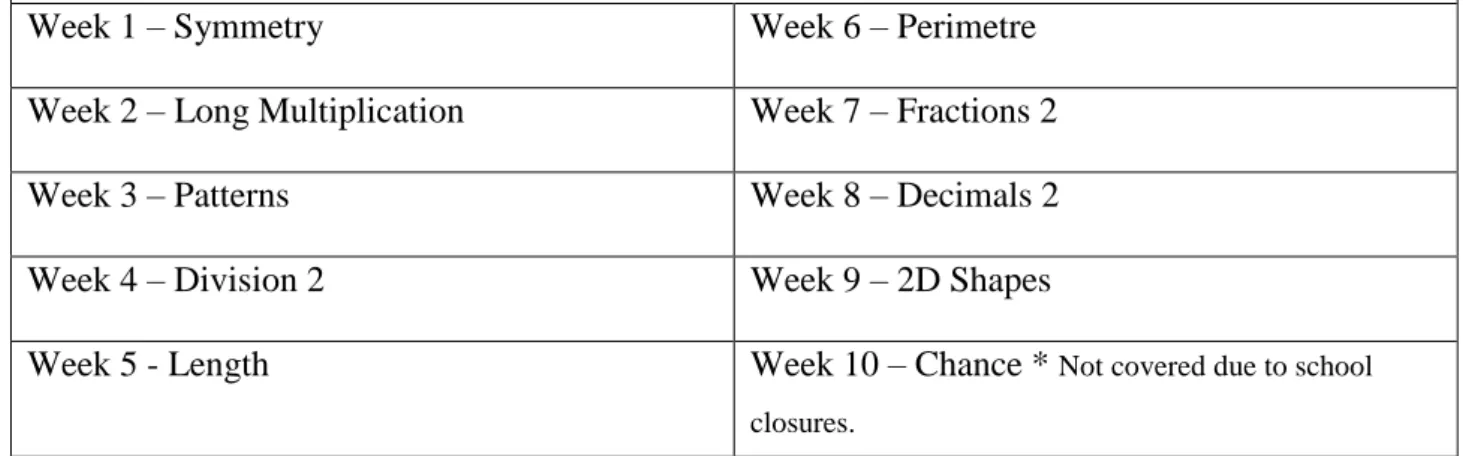
The overall design was through an intervention process that would cover a total of ten topics over the course of this study. Due to school closures nine topics were covered. In Table 3.1 below a list of topics can be seen.
Topics
Week 1 – Symmetry Week 6 – Perimetre
Week 2 – Long Multiplication Week 7 – Fractions 2
Week 3 – Patterns Week 8 – Decimals 2
Week 4 – Division 2 Week 9 – 2D Shapes
Week 5 - Length Week 10 – Chance * Not covered due to school closures.
Table 3.1 List of Topics Covered During Data Gathering Period
Data collection took place on a weekly basis and was gathered during a specific time on the class timetable. This can be seen in the Table 3.2 below. Data was collected from the participants in the fourth-class room and the iPad hub located along the corridor on the same floor. It was made clear to children that I would collect data during this time. Each data gathering session was structured and involved planned maths-based activities. I recorded the data using my observational notes during teacher designed tasks, surveys and indicator charts, which were designed to show attitudinal changes of the children at various points of the process
and reflections from my own reflective journal. The collection of data using the data gathering instruments and is highlighted in the next section of this chapter. Each data gathering session was reviewed and discussed with my critical friend. The suggestions that were derived from our discussions were implemented into my planning to improve the efficiency and effectiveness of collection of data through the planned lessons. The children completed a survey that used a likert scale to determine their attitudes towards maths upon completing the activities on each topic. The surveys showed any changes in the children’s attitude towards maths based on the activity completed. The children completed an indicator chart at three points of the data collection process. These were distributed during the first week, fifth week and ninth and final week of the process. The data was then analysed and findings were drawn from this analysis. Friday 9.00 9.50 10.40 10.55 11.35 12.00 12.30 1.00 1.45 Gaeilge (40 mins) Maths (60 mins)
Break SPHE SESE Music Lunch Art Drama
Table 3.2 Allocated Time for Research on Timetable
Description of Intervention
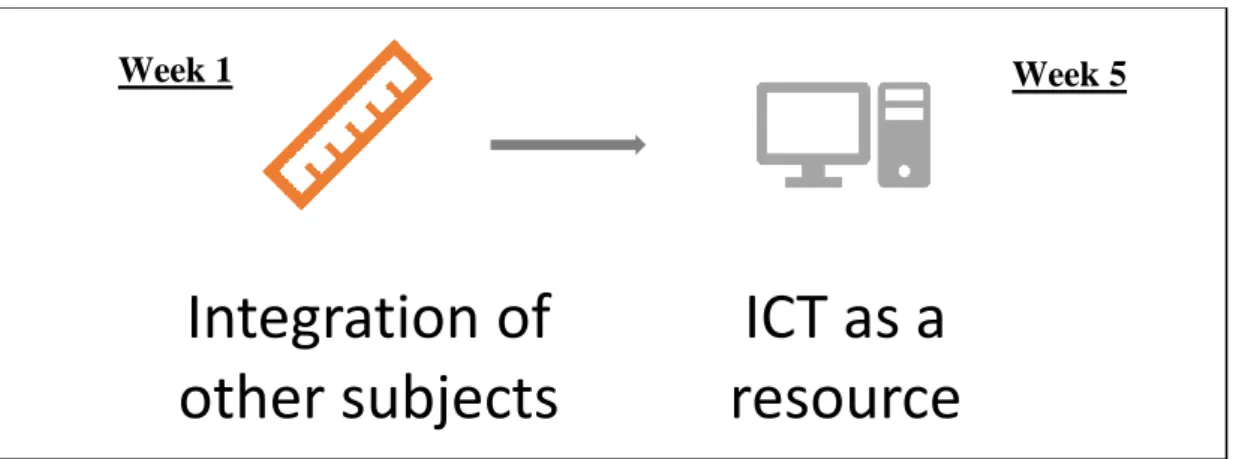
The study was designed to feature an intervention at two points of the data collection process. The interventions involved integration of other subjects into my teaching of maths, as well as enhancing my use of ICT as a resource and its effective use in the classroom. The interventions can be seen in Figure 3.1 below, where the intervention is named and the week when each was phased into the research is outlined. The interventions were designed and developed through discussion with my critical friend, reflections from my journal and findings from a review of literature. The interventions were phased into the research at two points. The first point, which
was the integration of various curriculum subjects, was phased in Week 1. This initially involved the use of visual arts as a method of teaching mathematical topics and concepts. (SESE) Social Environmental and Scientific Education subjects, Science and Geography were further used to teach the topics outlined in the AR plan.
The second intervention was introduced in Week 5 of the data collection process. It involved using ICT to support lessons through tablet-based activities. IPads were available for each participant during the lessons from week 5 to week 9. The initial use of the iPads involved the children documenting data and using the camera feature to record their work. Progressing from this in week 6 the iPads were further used to enable the children to employ mathematical knowledge, skills and procedures through a range of applications and games. Cayton-Hodges et al. (2015) suggest that using game-based applications is beneficial as it provides a platform of exploring a variety of mathematical skills and concepts within the confines of a games setting. The integration of iPads in the lessons provided an opportunity to record and document work, explore mathematical language and skills and provided an alternative means of assessment.
Figure 3.1 Phases of Interventions
Integration of
other subjects
ICT as a
resource
3.4 DATA GATHERING INSTRUMENTS
Teacher Reflective Journal:
I made use of a teacher reflective journal during the data gathering period. In this journal, I engaged with reflection and meta-reflection around my observations of teacher-designed tasks. I made my reflections using elements of Brookfield’s (2006) reflective lenses, paying careful attention to both the student lens and my own perspective. I decided to focus primarily on these two lenses as it provided an opportunity to examine both the student and my own engagement with maths teaching and learning, drawing comparisons between our experiences of the data gathering sessions. Doing this enabled me to gain an insight into thinking critically on my own planning from an alternate view. ‘When we collect data from students we see the different ways they interpret what we say and do’ (Brookfield, 1995: 8). It was my aim that my reflective journal would develop my learning and understanding of what was successful in each lesson and what I could change and phase into my future planning. The practice of reflection was a ‘meaningful process of learning’ (Moon, 2004: 100) that informed my teaching and helped me to improve my teaching and develop student attitudes towards maths.
Observations During Teacher-Designed Tasks:
I used observations during teacher-designed tasks to collect ‘live’ data during our weekly research time (Cohen et al., 2007: 398). I documented my observations in a notebook in-practice, writing any observations that I made pertaining to changes in the children’s attitudes towards maths. The observations took place through a semi-structured process, where I used prepared prompt questions to elicit responses from the children around their engagement with the activity, while allowing the lesson to develop naturally, enabling children to generate their own responses mitigating external influences. Patton (1990: 202) suggests this process can be ‘hypothesis-generating rather than hypothesis testing and will allow the observer to review the
data before suggesting an explanation for the phenomena being observed’. I began to observe the children completing specific tasks that were related to a topic outlined at each stage of the interventions. Using observations as a data gathering instrument enabled me to collect information that could not be detected by other data gathering instruments, for example, Morrison (1993: 80) ‘formal and informal conversations, verbal and non-verbal interactions, etc’. Cohen et al. (2007) discuss the value of using observation in this way as it enables the teacher to focus on different events as they happen and unfold naturally in the classroom. Using a semi-structured observation approach allowed me to additionally document live peer interactions during the research time. This was a prominent feature throughout the data collection process and through my practice of reflection both in and of my own teaching I was able to record and document the various situations and responses in a manner that would provide a variety of perspectives (Brookfield, 2006) of attitudes towards maths. These were further reflected upon using my reflective journal. A sample of my observational notes from week 7 (Fractions 2) can be found in the appendices.
Surveys and Indicator Charts:
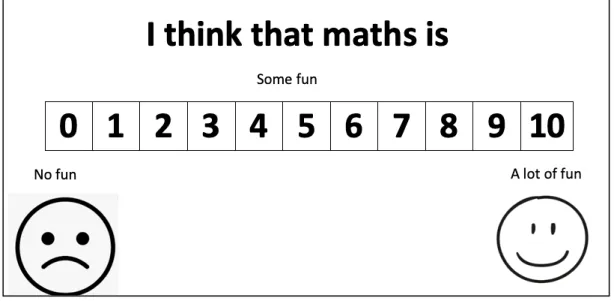
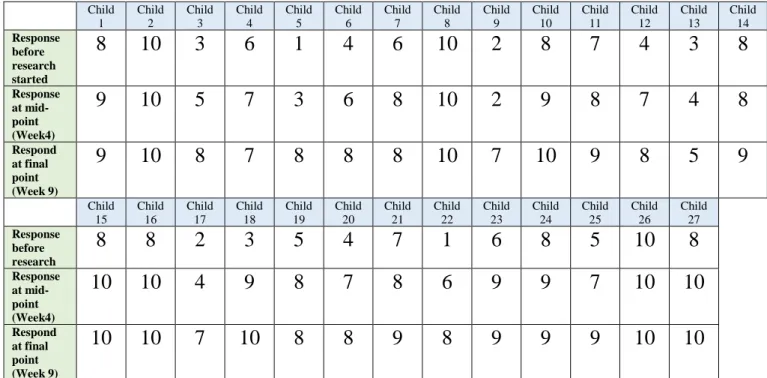
I used both surveys and indicator charts as data gathering instruments. I used indicator charts at three points during the data collection process. These points were Week 1, Week 5 and Week 9 and the indicator charts were distributed at these varying points. The indicator chart used a word-based and numerical likert scale. The scale outlined if the children believe that maths is ‘fun’, ‘some fun’ or ‘a lot of fun’ using numbers ranging from 0 to 10, where 0 represented ‘no fun’, 5 represented ‘some fun’ and 10 represented ‘lots of fun’. Mellor and Moore (2014) discuss the benefits of using words as well as numbers when creating a likert scale format for children, highlighting its ability generate a more accurate representation of the children’s
attitudes. Figure 3.2 below displays the indicator chart that was used for the purpose of this research.A sample of the indicator chart can be found in the appendices.
Figure 3.2 Indicator Chart
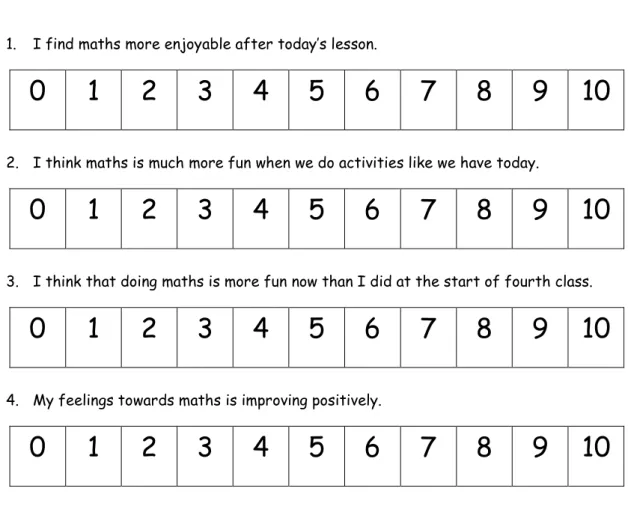
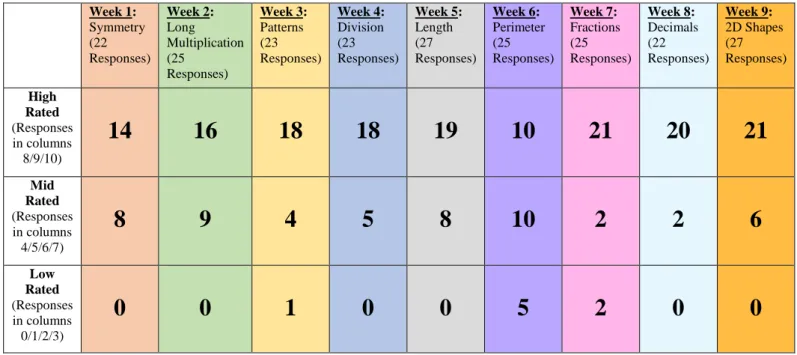
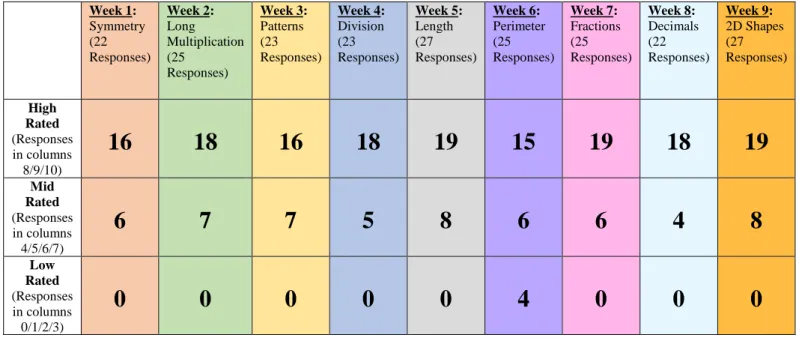
I used attitudinal surveys throughout the research. A sample of the attitudinal survey can be found in the appendices. They contained a series of statements that outline key elements of the children’s attitudes towards maths. Similar to the indicator charts the attitudinal surveys featured a Likert scale graded from 0-10 where the children responded to the statements by selecting a number that represents their attitude or feelings towards maths. Sprato and Bandalos (2019: 3) outline the Likert scale as an effective method of data collection as it gives a precise numerical value rather than ‘a more extreme response’ that can be given in questionnaires. Using a Likert scale enabled the children to correlate their attitudes at the time of data collection with a number on the scale. Figure 3.3 below shows the attitudinal survey that was distributed amongst the children after each research session.
1. I find maths more enjoyable after today’s lesson.
2. I think maths is much more fun when we do activities like we have today.
3. I think that doing maths is more fun now than I did at the start of fourth class.
4. My feelings towards maths is improving positively.
Figure 3.3 Statements from Attitudinal Survey
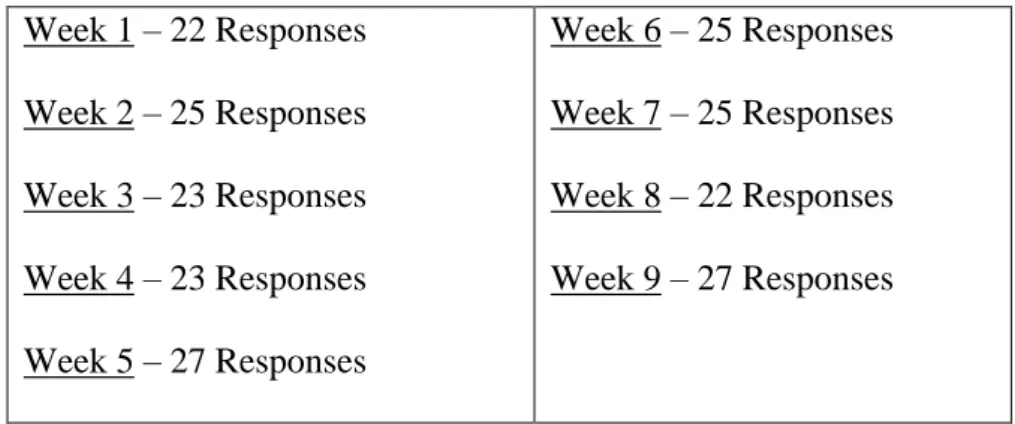
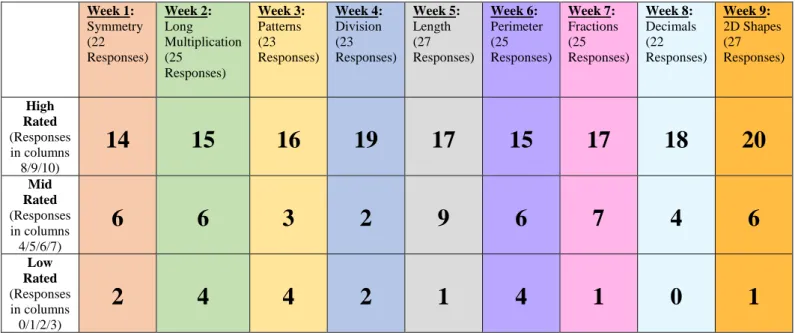
The attitudinal surveys were distributed on a weekly basis at the end of each data gathering session. Each data gathering session featured a single survey that was prepared for a total of 27 participants. However, due to absences from the class at the time of data collection each week, the number of completed surveys that were received fluctuated from the initial sample of 27 participants. There was a total of 219 of survey responses gathered over the course of the data collection process. A breakdown of a weekly amount can be seen in Table 3.3 below.
0 1 2 3 4 5 6 7 8 9 10
0 1 2 3 4 5 6 7 8 9 10
0 1 2 3 4 5 6 7 8 9 10
Table 3.3 Research Survey Weekly Responses
Group Conferencing:
The children were also invited to take part in group conferencing for the purpose of this study. I decided to use group conferencing as a data collection instrument because of its ability to draw oral responses from the children around their current attitudes and feelings towards maths in a small group setting. Larkin (2006: 25) discusses the benefits of collaborative group work and conferencing, its ability to assist metacognition through student-teacher interactions and its ‘importance for academic achievement and for motivation’. The conference was semi-structured in nature and were led using specific prompt questions to elicit responses from the children. Group conferencing occurred each week after the research time had taken place with a random target group. I documented the responses in my notebook that is also used to observe the children as they complete teacher-designed tasks. This method of data collection enabled me to take direct quotes from the children’s own discussions and reflections from the lesson and further link my own reflections which informed planning and teaching.
Week 1 – 22 Responses Week 2 – 25 Responses Week 3 – 23 Responses Week 4 – 23 Responses Week 5 – 27 Responses Week 6 – 25 Responses Week 7 – 25 Responses Week 8 – 22 Responses Week 9 – 27 Responses
3.5 LIMITATIONS OF THE RESEARCH DESIGN
Limitations in an AR study enables the researcher to assess any external deficiencies that may impact the process and outcome of the study. Through identifying and acknowledging the limitations present the researcher is enabled to carry out one of two possible actions. They can adjust their planning and make changes to their research design before the data collection takes place or continue to complete the data collection without alteration, providing a justification for the research study as it is presented (Schanzenbach, 2012).
The following limitations were considered for the purpose of this study:
1.) The academic schedule of the school was a limitation of the study as certain children were scheduled to attend learning support/ motor skill groups at the time of data collection each week. Through working with learning support teachers at fourth class level, we were able to adjust the timetables and ensure that the children who wanted to participate were afforded the opportunity.
2.) Time was also a limitation. As aforementioned, the study was scheduled to take place over a ten-week process. Due to the Covid-19 and the subsequent school closures this data collection period was reduced to nine weeks. This put a strain on collecting the data for the ninth and final week as it had to take place earlier than planned on the timetable.
3.) The access and reliability of ICT equipment was a limitation of the study. There was a sample of 27 participants for the purpose of this study, with 30 iPads available at the time of data collection each week. There were instances when the iPads were late arriving to the room and some without a sufficient charge of battery. This was mitigated through discussions with teachers who would use the
iPads in the morning and ensuring that they were fully charged the evening before I was due to collect any data.
3.6 ROLE OF THE RESEARCHER
Credibility:
To ensure credibility throughout the data collection process and analysis, I used the triangulation method. The meaning of triangulation involves using more than one method to collect data on a topic (Stringer, 2020). The methods used to collect data for this AR study included indicator charts, attitudinal surveys, observational notes during teacher-designed tasks, teacher reflective journal and group conferencing. The indicator charts and attitudinal surveys were distributed at various points of the research, as mentioned above. These methods provided a quantitative approach to data collection. In contrast, the observational notes during teacher-designed tasks, teacher reflective journal and group conferencing provided a qualitative approach to the collection of data.
Validity:
Validity, ‘depends on concrete examples of actual practices, fully elaborated so that members of a relevant research community can judge for themselves their “trustworthiness” and the validity of observations, interpretations’ (Lyons & LaBoskey, 2002: 20). Validating is seen as a process of knowledge creation, in which establishing and judging the trustworthiness of a study is the key element (Sullivan, Glenn, Roche & McDonagh, 2016). When collecting data for this self-study I have documented quotes from children in my observational notes from teacher designed tasks and using prompt questions generated for group conferencing during the research time. These quotes have been recorded as a direct transcript of what the child said
reader of the data who ultimately judges the validity of the study by considering whether it is informative, relevant or useful in his/her own setting (Hamilton & Pinnegar, 2009).
Methodological Assumptions:
As the class teacher I am aware that I have generated my own thoughts and opinions of each child’s attitude towards maths in my class. This has come through personal observations, test scores, the children’s previous engagement with other curriculum subjects and knowledge of children who attend learning support for maths. Therefore, during this study, I have made conscious attempts to mitigate bias I have around the aforementioned thoughts and opinions by documenting data accurately. All of the data that was gathered was anonymised to circumvent assumptions when analysing the data as well as adhering to ethical guidelines within the study.
Ethical Issues:
The issue of ethics is paramount within the discipline of education. Ethical conduct becomes even more important when conducting research as it pertains to the conventions of how we should approach and interact with each other (Eikeland, 2006). When explaining the purpose of the research to the various participants; critical friend, Board of Management, principal, teaching and non-teaching staff in the school, children and parents, I was clear in my explanations that I was not researching them, but rather using their data to research myself and improve my teaching around this area. A sample of the information letters and consent/ assent forms can be found in the appendices. At the beginning of each data gathering session the children were informed of the decision to participate in the research. On one occasion a child decided that he/ she would not like to be involved in the data collection during a research