DISSERTATION
Defense hold on 24/02/2016 in Luxembourg to obtain the degree of
DOCTEUR DE L’UNIVERSITÉ DU LUXEMBOURG
EN INFORMATIQUE
by
Sviatlana HÖHN
Born on 14 October 1978 in Vitebsk (Belarus)
D
ATA
-
DRIVEN
R
EPAIR
M
ODELS FOR
T
EXT
C
HAT
WITH
L
ANGUAGE
L
EARNERS
Dissertation defense committee
Dr. Christoph Schommer, dissertation supervisor Professor, Université du LuxembourgDr. Stephan Busemann, Vice-Chairman
Professor, Deutsches Forschungszentrum für Künstliche Intelligenz GmbH, Saarbrücken Dr. Leon van der Torre, Chairman
Professor, Université du Luxembourg Dr. Charles Max
Professor, Université du Luxembourg Dr. Karola Pirsch
This research analyses participants’ orientation to linguistic identities in chat and intro-duces data-driven computational models for communicative Intelligent Computer-Assisted Language Learning (communicative ICALL). Based on non-pedagogical chat conversa-tions between native speakers and non-native speakers, computational models of the fol-lowing types are presented: exposed and embedded corrections, explanations of unknown words following learner’s request. Conversation Analysis helped to obtain patterns from a corpus of dyadic chat conversations in a longitudinal setting, bringing together German native speakers and advanced learners of German as a foreign language. More specifically, this work states a bottom-up, data-driven research design which takes “conversation” from its genuine personalised dyadic environment to a model of a conversational agent. It allows for an informal functional specification of such an agent to which a technical specification for two specific repair types is provided.
Starting with the open research objective to create a machine that behaves like a language expert in an informal conversation, this research shows that various forms of orientation to linguistic identities are on participants’ disposal in chat. In addition it shows that dealing with computational complexity can be approached by a separation between local models of specific practices and a high-level regulatory mechanism to activate them. More specif-ically, this work shows that learners’ repair initiations may be analysed as turn formats containing resources for signalling trouble and referencing trouble source. Based on this finding, this work shows how computational models for recognition of the repair initiations and trouble source extraction can be formalised and implemented in a chatbot. Further, this work makes clear which level of description of error corrections is required to satisfy com-putational needs, and how these descriptions may be transformed to patterns for various error correction formats and which technological requirements they imply. Finally, this research shows which factors in interaction influence the decision to correct and how the creation of a high-level decision model for error correction in a Conversation-for-Learning can be approached.
In sum, this research enriches the landscape of various communication setups between language learners and communicative ICALL systems explicitly covering Conversations-for-Learning. It strengthens multidisciplinary connections by showing how the multidis-ciplinary research field of ICALL benefits from including Conversation Analysis into the research paradigm. It highlights the impact of the micro-analytic understanding of actions accomplished by utterances in talk within a specific speech exchange system on computa-tional modelling on the example of chat with language learners.
I.
Background
1
1. Setting the Scene 3
1.1. Multidisciplinary nature of ICALL . . . 4
1.2. Participants orientation to linguistic identities . . . 7
1.3. Research objectives . . . 9
1.4. Methodology . . . 11
1.5. Contribution of the work . . . 12
2. Learning from Other’s Experience 15 2.1. Communicative ICALL . . . 16
2.1.1. Communication modalities . . . 17
2.1.2. User and interaction models . . . 18
2.1.3. Language understanding in conversations with learners . . . 19
2.1.4. Learner error recognition . . . 21
2.1.5. Automatic feedback generation . . . 23
2.1.6. Learner corpora and error annotation . . . 27
2.2. What communicative ICALL can learn from Conversation Analysis . . . 30
2.2.1. Chat-Conversation-for-Learning as a speech exchange system . . 31
2.2.2. The problem with instant messaging data . . . 33
2.2.3. Conversation analysis of native/non-native speaker chat . . . 35
2.2.4. Constructing identities of expert and novice in conversation . . . 36
2.2.5. The power of repair . . . 38
2.2.6. Embedded corrections as form of implicit feedback . . . 43
2.3. Conversation Analysis and Artificial Intelligence . . . 46
2.3.1. Conversation Analysis for Dialogue Processing . . . 46
2.3.2. Types of repair for conversational agents . . . 47
2.3.3. Conversation Analysis in Human-Robot Interaction . . . 53
II.
Analysis of Empirical Data for Modelling
57
3. Patterns for Expert-Novice Chat 61 3.1. Face work and evaluation . . . 623.2. Learning in meta-talk and collaborative learning . . . 68
3.3. Repair with linguistic trouble source . . . 71
3.3.1. Native speaker’s self-initiated self-repair . . . 72
3.3.2. Other-initiated self-repair with linguistic trouble source . . . 74
3.3.3. Self-initiated other-repair: word searches and definitions . . . 76
3.3.4. Other-corrections of linguistic errors . . . 78
3.4. Preliminary findings and discussion . . . 82
3.4.1. Participants’ orientation to their linguistic identities . . . 82
3.4.2. Doing being a language expert: towards interaction profiles for an artificial conversation partner . . . 88
4. Other-initiated Self-repair with Linguistic trouble source 93 4.1. Repair initiation: signalling trouble in chat . . . 94
4.1.1. Interactional resources available in chat for repair initiation . . . . 94
4.1.2. When the recognition of the repair other-initiation fails . . . 99
4.2. Repair carry-out strategies . . . 101
4.2.1. Providing definitions, paraphrases and synonyms . . . 102
4.2.2. Translations and demonstrations . . . 102
4.2.3. Non-present repair carry-out after other-initiation . . . 105
4.3. Preliminary findings and discussion . . . 106
5. Exposed Corrections 111 5.1. Types of corrected errors . . . 112
5.1.1. Lexical errors . . . 112
5.1.2. Morpho-syntactic errors . . . 114
5.1.3. Spelling errors and typos . . . 115
5.2. Turn design and turn-taking in exposed corrections . . . 117
5.2.1. Simple explicit corrections . . . 117
5.2.2. Contrasting explicit corrections . . . 121
5.2.3. Explicit corrections integrated into the next relevant action . . . . 121
5.2.4. Other-corrections by tools of OISR . . . 123
5.3. Types of accountings and emphasis on correction . . . 124
5.4. Preliminary findings and discussion . . . 125
6. Embedded Corrections 129 6.1. Embedded corrections of linguistic errors . . . 130
6.1.1. Errors addressed by embedded corrections . . . 131
6.1.2. Embedded corrections of linguistic errors and turn-taking . . . 133
6.2. Other types of embedded corrections . . . 140
6.2.1. Conceptual embedded corrections . . . 140
6.2.2. Embedded correction of style . . . 141
6.3. The mechanics of embedded corrections . . . 142
6.3.1. A modified coding scheme for question-answer pairs . . . 143
6.3.3. Embedded corrections dedicated to counter questions . . . 151
6.3.4. Errors for which embedded corrections are impossible . . . 152
6.3.5. Unavoidable embedded corrections . . . 154
6.4. Discussion and preliminary findings . . . 155
7. To Correct or not to Correct 159 7.1. Learner errors in chat and opportunities to correct . . . 162
7.1.1. Language standard, chat conventions and L2 errors . . . 164
7.1.2. Orthography and social closeness . . . 166
7.1.3. The role of learners’ self-corrections . . . 168
7.2. Discussion and preliminary findings . . . 170
III. Computational Models of Explanations and Corrections
173
8. A Local Model of Other-initiated Self-repair 177 8.1. Two steps for dealing with trouble . . . 1788.1.1. Recognition of repair initiation . . . 179
8.1.2. Self-repair carry-out . . . 181
8.2. An implementation case study: a chatbot extended with a repair manager 184 8.2.1. Recognition ofunclear(x)and repair generation . . . 185
8.2.2. Recognition ofequals(x, y)and response generation . . . 187
8.3. Preliminary findings and discussion . . . 187
9. Modelling Corrections of L2 Errors 189 9.1. Learner error annotation . . . 190
9.2. Generation of exposed corrections . . . 192
9.2.1. Turn format and turn taking . . . 193
9.2.2. Language-specific and medium-specific devices . . . 198
9.3. Generation of embedded and integrated corrections . . . 202
9.3.1. Embedded corrections in answers to polar questions . . . 204
9.3.2. Integrated corrections in answers to polar questions . . . 206
9.4. Applicability of the models for communicative ICALL . . . 207
9.4.1. Templates for exposed corrections . . . 207
9.4.2. Generation of embedded and integrated corrections . . . 210
9.4.3. Dealing with multiple target hypotheses . . . 212
9.5. Discussion and preliminary findings . . . 213
10. Towards a Decision Model for Corrections 215 10.1. User Model . . . 217
10.1.1. Professional relevance of L2 . . . 217
10.1.2. Learner’s requests to correct and uptake . . . 218
10.2. Interaction process and interaction history . . . 219
10.2.2. Role of preceding forms of orientation to linguistic identities . . . 220
10.2.3. Correction history and format selection . . . 221
10.2.4. Learners’ self-correction . . . 222
10.3. Error properties . . . 223
10.4. Correction decision model . . . 226
10.5. Preliminary findings and discussion . . . 228
IV. Results
231
11. Findings and Discussion 233 11.1. Participants’ orientation to linguistic identities . . . 23511.2. Dealing with troubles in comprehension . . . 237
11.2.1. Repair initiation and resolution in chat with language learners . . 238
11.2.2. Computational models of other-initiated self-repair . . . 242
11.3. Other-corrections of linguistic errors . . . 245
11.3.1. Error recognition and learner corpus research . . . 248
11.3.2. Data-driven models of side-sequence exposed corrections . . . . 249
11.3.3. Data-driven models of embedded and integrated corrections . . . 252
11.4. To correct or not to correct . . . 257
11.4.1. Interactional relevance of a correction . . . 258
11.4.2. Computational decision model for corrections in chat . . . 259
12. Future Research Directions 263 12.1. Further work on repair for Communicative ICALL . . . 263
12.1.1. Other-initiated learner’s self-repair . . . 264
12.1.2. Learner’s self-initiated other-repair . . . 264
12.1.3. Embedded corrections not in answers to polar questions . . . 264
12.1.4. Exposed corrections of language form . . . 265
12.1.5. Creating a better correction decision model . . . 266
12.2. Dialogue Processing and Affective Computing . . . 266
12.2.1. Dialogue topics . . . 267
12.2.2. Emotions in text chat . . . 268
12.2.3. Improving conversational agents with CA . . . 268
12.2.4. Chatbots as minimum viable products . . . 269
12.3. Long-term human-machine interaction . . . 270
12.4. Effects on learning and learner corpus research . . . 271
12.4.1. Evidence of language learning . . . 271
12.4.2. The data issue . . . 272
12.4.3. Language classroom without grades . . . 273
13. Conclusions 275 13.1. Findings, conclusions and theoretical implications . . . 276
13.1.2. Theoretical implications . . . 281
13.2. Recommendations for future communicative ICALL . . . 283
13.2.1. Strengths, weaknesses, opportunities and threats . . . 284
13.2.2. Strategic implications and recommendations . . . 284
13.3. Final conclusion . . . 287
V.
Supplements
289
A. Data 291 A.1. Data collection . . . 291A.1.1. Study preparation . . . 291
A.1.2. The longitudinal instant messaging dialogues . . . 294
A.1.3. Questions for retrospective interviews . . . 296
A.1.4. Questionnaires . . . 297
A.1.5. Technical issues . . . 297
A.1.6. Participant-related issues . . . 298
A.1.7. Ethical issues . . . 299
A.2. Corpus creation . . . 299
A.2.1. TEI-P5 modules and customisation . . . 300
A.2.2. Text replacements . . . 301
A.2.3. Chat structure in TEI-P5 XML . . . 301
A.2.4. Chat log annotation . . . 302
List of Abbreviations
CA Conversation AnalysisSLA Second Language Acquisition, interactionists SLA theory L1 First Language or Native Language
L2 Second Language or Foreign Language (for me here the same) DaF Deutsch als Fremdsprache (German as a foreign language) ESL English as a Second Language
NS Native Speaker NNS Non-Native Speaker
CMC Computer Mediated Communication (includes synchronous for instance, chat, in-stant messaging, and asynchronous, such as email)
SCMC Synchronous Computer-Mediated Communication (such as text chat, video call, instant messaging)
CALL Computer-Assisted Language Learning
ICALL Intelligent Computer-Assisted Language Learning RI Repair Initiation
ROI Repair Other-Initiation RCO Repair Carry-out
OISR Other-initiated Self-repair NLP Natural Language Processing HLT Human Language Technology AI Artificial Intelligence
HCI Human-Computer Interaction HRI Human-Robot Interaction
The ability to speak foreign languages became one of the key competences in the glob-alised world. People learn foreign languages for professional purposes, with the goal to study abroad or for private reasons. Distance language learning and training based on tu-toring videos or online exercise books offer a convenient way to integrate language classes into a busy day. Practicing conversation with an artificial agent is seen as a good alternative if a native speaker is not available or not affordable. Computer-Assisted Language Learn-ing (CALL) was expected to facilitate learnLearn-ing and teachLearn-ing by providLearn-ing electronic work-books with automatic evaluation and vocabulary training. CALL technology extended with Natural Language Processing (NLP) techniques became a new research field called Intel-ligent Computer-Assisted Language Learning (ICALL). Language technology has been integrated into CALL application with the purpose of automatised exercise generation (Ai et al., 2015), complex error analysis and automated feedback generation (Amaral, 2011). Education industry and language learners benefit from various deployed applications, for instance (Sagae et al., 2011; von Ahn and Hacker, 2012; Heine et al., 2007). A number of mobile applications in the AppStore and GooglePlay Store target conversation training and traditional task-based language instruction. Frequently cited real-life ICALL applications are E-Tutor for German learners (Heift, 2002, 2003), Robo-Sensei for Japanese learners (Nagata, 2009) and TAGARELLA to learn Portuguese (Amaral et al., 2011). Conversa-tional agents, chatbots and dialogue systems for foreign language training have been devel-oped as stand-alone conversation partners (Jia, 2009; Zakos and Capper, 2008) and as part of intelligent tutoring systems (ITS) (Petersen, 2010), serious games (Gray, 1992; Sagae et al., 2011; Wik et al., 2007; Amoia et al., 2012) and micro-worlds (DeSmedt, 1995). A new trend in technology-aided language teaching is robot-assisted language learning (RALL) (Han, 2012). Robotic language teaching assistants have been studied in a tradi-tional language classroom (Chang et al., 2010; Kwok, 2015; Mubin et al., 2013) and for teaching autistic children to speak foreign languages (Alemi et al., 2015).
Petersen makes a distinction between a communicative ICALL and a non-communicative ICALL and sees the communicative ICALL as an extension of human-computer interac-tion field. His understanding of communicative ICALL is that "communicative ICALL employs methods and techniques similar to those used in HCI research, but focuses on interaction in an L2 context" (Petersen, 2010, p. 25). As a consequence, corrective feed-back in communicative ICALL should incorporate corrections of L2 errors into dialogues with the user. Hence, an ability to provide corrections of linguistic errors in conversation is seen as one of the key features of such a dialogue system or a conversational agent.
Consequently, the majority of ICALL applications see the artificial agent in the role of a tutor or a teacher who have the right to provide corrections. While students and teachers in language classrooms have been taken as "role models" for user and agent models in communicative ICALL applications, there is a gap in computational simulation of types of interaction other than language classroom. Conversational agents in the role of an equal but more knowledgeable peer are under-represented in communicative ICALL research. This dissertation seeks to close this gap and to show that new data-driven user and agent models may be helpful for designing conversational agents, which act in other roles than a teacher or a tutor. To approach this objective, Conversation Analysis is included into the multidisciplinary research paradigm of ICALL.
1.1. Multidisciplinary nature of ICALL
ICALL research labs usually employ specialists bringing expertise in Software Engineer-ing, Natural Language ProcessEngineer-ing, Pedagogy, Computer Science and CALL (Greene et al., 2004). The multidisciplinary nature of CALL research is recognised and claimed in CALL literature. (Greene et al., 2004, Sec. 3) list four research principles of the ICALL lab of the Dublin City University: "(i) reuse of existing NLP resources, (ii) reuse of existing CALL research experience, (iii) user-centred design and evaluation and (iv) interdisciplinarity". CALL works on the intersection of Computer-Mediated Communication (CMC) and Sec-ond Language Acquisition (SLA) research, which in turn are also multidisciplinary fields of work employing Computer Science, Linguistics, Psychology, Education and Sociology among others. Thus, interdisciplinary or multidisciplinary perspective and involvement of latest results in related disciplines is a must in building ICALL applications of high quality. Nonetheless, Schulze (2008) confirms (Oxford, 1993)’ critique of ICALL research based on "homespun notions of language learning or notions borrowed from discourses in SLA which had long been criticised severely and/or superseded by theoretical approaches with improved explanatory power" (Schulze, 2008, p. 513). Schulze (2008) also emphasises the importance of multidisciplinary cooperation for ICALL research:
Of course, ICALL cannot afford to ignore current discourses in SLA [...] but also needs to consider issues related to the computational implementation of SLA theories and approaches in language pedagogy. This makes it more im-portant for ICALL researchers to foster links with researchers in SLA and NLP, and such links can only be established after fruitful discussions in which researchers from both communities participate (p. 513).
However, for realistic and individualised user models and dialogue design for communica-tive ICALL applications, relying barely on SLA-results is not sufficient. Markee criticises the rationalistic tradition to approach SLA studies because "an experimental, quantitatively oriented methodology inevitably loses important details of individual behavior" (Markee, 2000, p. 29). He suggest to develop an alternative, emic perspective to SLA studies and "a critical attitude toward quantified data" (Markee, 2000, p. 29).
Effects on learning with an ICALL system and learning when using text, voice and video based communication for language learning have been studied earlier from the educational perspective. Second Language Acquisition theory (SLA), mainly following the Interaction Hypothesis usually credited to Long (Long, 1996) but very similar to Krashen (1981)’s Input Hypothesis, emphasises the role of specific dialogue routines in language learning. ICALL research from its perspective is mainly focused on opportunities (affordances) pro-vided by the technology to elicit such dialogue routines in interaction with learners. Such routines are for instance corrective feedback (Lyster et al., 2013) and meaning negotiation (Varonis and Gass, 1985). Corrective feedback and meaning negotiations are seen as im-portant conditions for learning. Imitation as a language acquisition strategy formulated as the Imitation Hypothesis (Aguado Padilla, 2002) received less uptake in the ICALL community.
Corrective feedback is acknowledged as an important tool in language instruction to help the learner to notice the produced deviations and to give the learner a chance to improve. Classifications of corrective feedback in language classroom have been obtained from classroom data (Panova and Lyster, 2002; Lyster et al., 2013) and compared to correc-tive feedback in computer-mediated communication (CMC) in various language learning or practicing scenarios, see for instance (Zourou, 2012; Sauro, 2009). However, not every error is corrected even in a language classroom, specifically, if the focus is on fluency. Fur-thermore, in non-educational situations, corrective feedback is dispreferred, and therefore, rare. This observation has been taken up by the designers of conversational systems for SLA, see for instance (Wik and Hjalmarsson, 2009) where the authors make a difference between two embodied conversational agents (ECA). One of them plays a role of a virtual language teacher, and therefore, provides corrective feedback on pronunciation and lan-guage use. The other ECA is a role-play conversational training system with the goal to maintain an interesting conversation. Here, the agent "has the role of a native speaker, for example, a person with a service occupation, whom you need to communicate with using your new language" (Wik and Hjalmarsson, 2009, p. 1039) and therefore, the user cannot expect any corrective feedback from the ECA.
The subject of research in Conversation Analysis (CA) is, in its originals, naturally occur-ring interaction. However, because more and more people use a foreign language for their everyday interaction in business, educational, institutional and leisure contexts, foreign language talk came also under the lens of CA. For instance, CA analyses how partici-pants construct together identities of language experts and language novices in interaction and whether there are differences between conversations with learners and between learn-ers, and native-speaker-only talk. CA-driven research showed, for instance, that language learners are able to accomplish all complex social actions even with limited linguistic re-sources (Markee, 2000). There are also attempts to identify the process of learning by CA methods, however, not very successful till now. Kasper (2004) proposed to perform longi-tudinal studiesto approach this problem. Markee (2008) introduced a learning behaviour tracking system which is not easy to implement in practice. González-Lloret (2011) pro-poses to change the definition of learning itself to make use of CA as a tool for research on learning:
As for the methodological feasibility of CA to demonstrate learning, expand-ing the definition of learnexpand-ing may be necessary, [...] so that SLA is not limited only to linguistic features but also includes the social context and sequen-tial development of interactions. In this sense, learning is understood as par-ticipation based, focusing on the improvement of the interactional resources used by learners for talk-in-interaction rather than just on their linguistic skills (González-Lloret, 2011, pp. 317-318) citing (Markee, 2008).
Studies applying methods of Conversation Analysis in Second Language Acquisition (CA-for-SLA) research show that language learners interacting with native speakers in non-educational settings engage in various types of talk focusing on linguistic matters, includ-ing error corrections provided by native speakers (Markee, 2000; Hosoda, 2006). Such types of talk are referred to as repairin CA. Linguistic repair is a dispreferred social ac-tion both in native speaker to native speaker (NS-NS) and native speaker to non-native speaker (NS-NNS) talk (Schegloff, 2007). However, the participants analysed in this work reported that they prefer to be corrected more often in order to learn (Danilava et al., 2013a). Hosoda (2006) points out that repair sequences distinguish interaction with lan-guage learners from NS-only talk in the following way. Repair with linguistic trouble source is found in conversations with non-native speakers more frequently and is typical even for informal conversations between learners and their native speaker peers. Multiple occurrences of linguistic repair in chat dialogues produced by NS without being instructed to correct indicate that the context of a Conversation-for-Learning seems to modify social preferences providing opportunities for repair and minimising face threatening (Tudini, 2010, p.64).
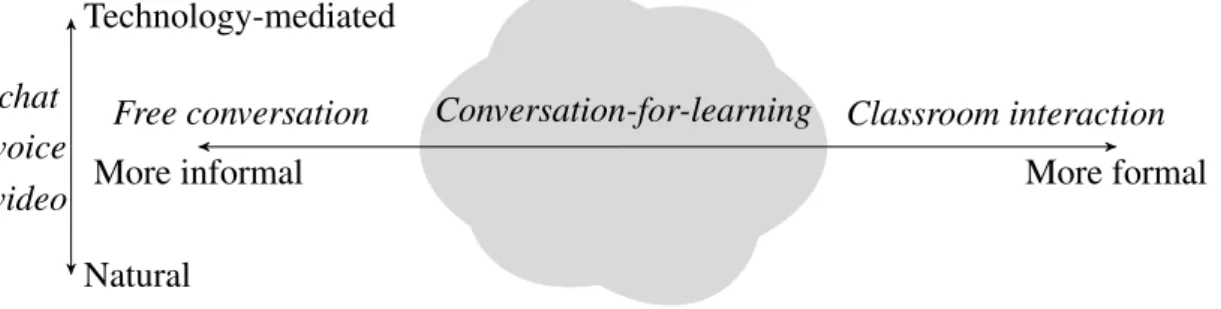
Kasper (2004) argues that there is a separate type of informal talk Conversation-for-Learning where conversation parties come together because one of them has a higher level of language proficiency than the other. The term Conversation-for-Learning reflects more precisely the application scenario where users engage in dialogues with an artificial agent in order to practice their language skills in an informal conversation. The learners would use such a system because they want to practice. ICALL developers need to be careful in dialogue and task modelling, because CA showed that different types of speech exchange systems work differently, and insights from research on institutional talk, such as teacher-fronted language classroom, are not necessarily valid for informal conversation or a Conversation-for-Learning (Schegloff, 1993; Markee, 2000).
Chat-Conversations-for-Learning between an artificial conversational agent and a language learner can be investigated from different perspectives and incorporates first of all techno-logical and socio-linguistic but also learning aspects. From the technotechno-logical perspective, both research results in Computer-Mediated Communication (CMC) between learners and native speakers and in Human-Computer Interaction (HCI) between learners and artificial agents may be relevant. CMC studies how communication mediated by a technology in-fluences the interaction. In the SLA context, these studies demonstrate how technology provides opportunities for learning. SLA theory-driven studies showed that chat commu-nication positively influences oral performance in terms of language quantity (Abrams,
2003). A small number of CA-informed studies of NS-NNS chat communication provide qualitative and quantitative analysis of different phenomena in chat interaction, such as error corrections and explanations of unknown words in Italian (Tudini, 2003, 2010) and German (Marques-Schäfer, 2013). Another study shows how Spanish learners develop the competence to interact in trouble-talk (González-Lloret, 2011). In particular, the study by González-Lloret (2011) showed that
CA can be an appropriate tool for the study of SCMC [Synchronous Computer-Mediated Communication], depending on the focus of the study. CA is better suited for discovering patterns of how the participants carry out the interaction and how they orient to the sequences developed while they construct authentic conversation, and CMC produces large quantities of authentic materials, being one of the fastest growing communicative media in the world. (pp. 317-318)
For these reasons, expertise in Conversation Analysis, and specifically CA-for-SLA, may be an additional advantage for creating communicative ICALL applications. Looking at conversations with learners through the lens of CA-for-SLA could help to identify char-acteristic features of dialogues between language learners and native speakers in order to understand, to what extent the native speaker may be a model for the artificial agent and which of the key features are implementable.
1.2. Participants orientation to linguistic identities
An idealised concept of a native speaker was long time accepted in applied linguistics as the object for studies of communicative competence (Canale and Swain, 1980). The native speaker was put in the role of a language expert, and the non-native speakers were automatically classified as the complementary category of language novices. However, as Hosoda (2006) criticises and discusses in detail, these two absolute categories were "poorly supported by the sociolinguistic evidence" because "native speaker status does not necessarily correlate with a high command of the language" (Hosoda, 2006, p. 25). For a critical discussion see also (Markee, 2000; Kasper, 2006; Vickers, 2010; Wagner and Gardner, 2004).
The concept ofexpertiseis seen as better reflecting the empirical research results on inter-action, specifically in the context of second language communication, because the partic-ipants of an interaction may change their roles of expert or novice during the interaction. Hosoda (2006) argues that the notion of thedifferential language expertise suggested by Kasper (2004) is attractive for CA studies because
in CA, language expertise, like any other social category or attribute, is not primarily subject to an outside observer’s judgment. Instead, analysts are li-censed to invoke descriptions pertaining to the participants only when the par-ties orient to such matters through their talk and other interactional conduct. [...] Consequently, whether or not language expertise is relevant at any point
in the interaction is determined by the participants themselves through their observable orientation to linguistic matters" (Hosoda, 2006, p. 26).
In the same line, Brandt analyses how participants make differential language expertise rel-evant in NNS-NNS conversations in which no NS-NNS relationship exists (Brandt, 2011, Sec. 2.3.3). Kurhila (2006) uses the term the knowledgeable participant instead of ex-pertand the term non-expert instead ofnoviceallowing less extreme formulations of the differences in linguistic knowledge from both sides.
For all these reasons, I will use the termsnative speaker of language Xto refer to persons who learned a particular language X as a native language, andlanguage expertto refer to participants of a conversation when they make their differential language expertise rele-vant in conversation. Thus, the termslanguage expertandnative speaker are not used as synonyms in this work. As a complementary category for the "non-experts", I will use the term non-native speaker of a language X or learner of a language X to refer to persons who learn a language X as a foreign language, and the term language noviceto refer to participants of a conversation when they orient in conversation to their linguistic identity as not-yet-fully-proficient speakers of a particular language.
Example 1.1. NS corrects an error and provides wrong metalinguistic information ("denken" is in fact not reflexive). Orig. excerpt 61 from (Marques-Schäfer, 2013, p. 185), line num-bers and translation added. M learner, G tutor, native speaker of German.
1 11:39:25 M er denkt nur an selbst
he thinks only on [*error: missing reflexive pronoun] self
2 11:39:49 M verstehst du mich?
do you understand me
3 11:40:07 G Der Chef?
The boss?
4 11:40:39 M du kannst mich korrigieren wenn ich fehler schreibe
you can correct me when I write [* error: lexical] mistakes
5 11:40:53 M ja der chef Bush
yes the boss Bush
6 11:41:26 G Okay, denn es heißt richtig: Er denkt nur an sich selbst.
okay, then it is called correctly: He thinks only on himself.
7 11:41:57 G Denken ist ein reflexives Verb.
to think is a reflexive verb
8 11:41:57 M seine politik macht wennig sinn
his policy makes little [* error: orthography] sense
9 11:41:57 M danke
thanks
Although CA-for-SLA researchers clearly define language experts, it remains difficult to assign the status of a language expert to one of the participants in local sequences of talk where the differential language expertise is made relevant in conversation. We still need to keep in mind that the participants who position themselves as language experts
in conversation may make mistakes even in the turns of talk where this positioning is performed. Example 1.1 shows a sequence from NS-NNS chat interaction that took place as part of the projectJETZT Deutsch lernenwhere learners of German communicated in chat with other learners and tutors (Marques-Schäfer, 2013). The excerpt in Example 1.1 is taken form a tutored session, and G is a tutor and a native speaker of German. She is explicitly asked by M, the learner and non-native speaker to correct errors in turn 4. G corrects in turn 6 an error that M made in turn 1 providing metalinguistic information to the correction. However, the metalinguistic information contains an error: the verb
denken(Engl. to think) is in fact not reflexive. The learner accepts the correction and the explanation in turn 9.
In Example 1.1, the native speaker G who has in addition the tutor role, is selected by the learner M as a language expert by G’s request to correct errors. M accepts this role by doing correction, however, M also produces an error. There is a difference between "doing being language expert" (or "doing being a more knowledgeable participant") and "being language expert" (or "being a more knowledgeable participant"). These discrepan-cies may be described by the termsepistemic stance(expectations towards own and others’ knowledge)epistemic status(the factual state of the knowledge) Heritage (2012). The par-ticipants who position themselves as experts when theythinkthey are more knowledgeable than their partners (they do not pretend to be experts while knowing that they are wrong), however, it does not mean, that they objectively do not produce any errors. Moreover, even if they produce errors, they may still be more knowledgeable than their partners, which is already stated by the term differential language expertise. In Example 1.1, M appears to be more knowledgeable than G in constructing a correct German sentence, even if the theoretical explanation of the rule for this construction is wrong.
This is an extremely important difference for the remainder of the work. A conversational agent can possess as much linguistic knowledge as we can prepare for it using all available linguistic resources, but all this knowledge is useless as long as there is no need to make it relevant in conversations with the user. Even if someone positions himself or herself as a language expert in conversation, it does not mean, that he or she is no longer allowed to make mistakes. Not the actual language expertise of the conversational agent is in focus of the work, but thepractices of orientation to differential language expertise in conversation
are under the loupe.
1.3. Research objectives
This dissertation aims to contribute to the field of communicative ICALL by bringing Con-versation Analysis as a research methodology into ICALL application design. Specifically, it seeks to addresss the following two research objectives:
Conversation-for-Learning where chat participants orient to their linguistic identi-ties of language experts and language novices.
II Create computational models of those practices and analyse technical requirements and limitations to implement the resulting models in a communicative ICALL ap-plication.
Looking ahead to the results of the first part of this research, I disclose the specific research questions which were formulated after the initial research phase of "unmotivated looking" at the data:
RQ1 Which interactional resources do language learners use in a chat-based Conversation-for-Learning with native speakers to initiate repair in order to deal with troubles in comprehension and how do native speakers deal with these repair initiations? RQ2 How can other-initiated self-repair when the machine is the trouble-speaker be
han-dled in a chat-based communicative ICALL system?
RQ3 Which types of other-corrections of linguistic errors exist in the dataset representing a chat-based Conversation-for-Learning?
RQ4 How can these types of other-corrections of linguistic errors be modelled in order to be implemented in a chat-based communicative ICALL system?
RQ5 Apart from the occurrence of an error, are there other factors which are relevant for the occurrence of a correction of a linguistic error in native/non-native speaker chat-based Conversation-for-Learning?
RQ6 If such factors exist, how can they be modelled in order to be implemented in a chat-based communicative ICALL system?
The restriction to chat-based communication in the research questions is necessary because of the specific speech exchange system and a specific communication medium, namely me-dially written dyadic Conversation-for-Learning. Based on (Hosoda, 2006)’s observation, it can be expected that there might be other interactional phenomena in native/non-native speaker chat, which distinguish them form native/native speaker chat. Specifically, it may be expected to find other types of sequences than error corrections in chat where partici-pants orient to their linguistic identities in talk.
With regard to other-corrections of linguistic errors, I do not expect to find big numbers of occurrences of those in the data because other-corrections of linguistic errors are dispre-ferred, even in native/non-native speaker conversations. However, from the point of view of qualitative language research, I am interested in finding what istypical, but not neces-sarily frequent (typical sequences, typical structure of such sequences). Conversation is a cultural action, therefore, chat participants formulate their turns in a way that the action is recognisable for the partner. In the same time, they formulate their turns individually in order to be different than others. For this reason, plain prototypes of particular actions can be seen in natural data very rarely, and the variants of that prototypes can be found more often. Even for a small number of occurrences of a particular type of a sequence, it
is possible to analyse, how atypicalsequence of this kind is organised. Therefore, a gen-eralisation based on a small number of instances is common in CA and is a valid approach to modelling.
1.4. Methodology
The methodological novelty of this research consists mainly of bringing Conversation Analysis into the ICALL research paradigm with the purpose to discover new models for the expert and learner behaviour in a communicative ICALL application. Specifically, I use methods of Conversation Analysis (Heritage and Goodwin, 1990; ten Have, 2007; Lid-dicoat, 2011; Schegloff, 2007) to identify typical structures in close-to-natural longitudinal chat interactions between native speakers of German and advanced learners of German as a foreign language. The data-driven research was performed in three phases. The first phase of "unmotivated looking" in order to find typical structures was followed by the phase of micro-analysis of specific structures to obtain patterns. In the final, third phase computational modelling of these structures was performed based on identified patterns. The implementability of the new models is validated by an implementation case study and an analysis of the required language technology and knowledge bases.
I provide here a short description of the dataset. A comprehensive documentation can be found in Appendix A. The participants of the data collection were 9 advanced learners of German as a foreign language and 4 German native speakers. All of the learners were Rus-sian native speakers and students of German at a BelorusRus-sian university. Native speakers are friends and colleagues of the researcher. Each native speaker was assigned to two or three non-native speakers in pairs according to the time slots that the participants specified (when they had time to chat). Only the first appointment was arranged by the researcher. The only instruction was "just chat". The participants were expected to have a free conver-sation and to talk about whatever they want. The goal communicated to the participants was to produce 8 dialogues in total and to interact 4 weeks long 2 times per week, every time approximately 30 minutes.
The participants interacted using Google Talk infrastructure. A forwarding chatbot hosted on Google App Engine was used to collect the data instantly. Participants did not see each other directly, they sent the messages to the bot and the bot instantly forwarded the messages to the partner. All the chat logs were available to the researcher immediately. The participants were informed that their talks were recorded in the beginning of the data collection. The participants agreed to publish the produced chat data prior to starting the interaction.
The participants produced 73 dialogues in total (8 dialogues by each of 6 pairs, 9 dialogues by each of 2 other pairs, and 7 dialogues by the 9th pair). Besides that the participants sometimes missed each other oder forgot appointments. In these cases, the participants sent each other notifications and apologies, but in some cases several days passed between
turns. The decision was made to include only full dialogue sessions in the final data set where participants met and talked. Each dialogue is between 20 and 45 minutes duration. The total size of the final dataset is 4548 messages that correspond to 236 302 text symbols. The message length ranges from 1 to 774 text symbols and of an average length of 58,5 symbols over all pairs. Table 1.1 summarises the statistics.
Metrics Pair 1 Pair 2 Pair 3 Pair 4 Pair 5 Pair 6 Pair 7 Pair 8 Pair 9 MaxTL 335 405 774 313 414 277 637 460 232 MinTL 1 1 2 1 2 2 2 2 1 AvTL 62,98 72,40 105,13 38,13 86,80 38,99 42,23 48,85 31,38 # Turns 365 410 346 650 218 421 730 694 714 # Symb. 22989 29683 36374 24784 18923 16413 30825 33903 22408
Table 1.1.: Corpus statistics: MaxTL - maximum turn length (# symbols), MinTL - mini-mum turn length (# symbols), AvTL - average turn length (# symbols) followed by the total number of turns and total number of symbols for each pair.
I will provide many examples of specific pieces of dialogues to illustrate the identified phenomena. All examples are formatted so that the reader can easily grasp the intention of the example. Each turn (message) contains a message number, a time stamp, a speaker code and a message body. Line breaks added by the speakers were kept as in the original message and marked by a line break tag. All other line breaks in the examples are caused by the page width and were not added explicitly to the formatting. Each message body contains the original wording and spelling of the message and an English translation, if needed. Messages consisting of only an emoticon or an "OK" were not translated. A word-by-word transcription is added between the original message and the translation if it was required for the understanding of the discussed phenomena. Errors are annotated in the examples only where it was necessary for the analysis. An inline error annotation containing the error desciption was performed either in the transcription line or in the translation line and is inserted in square brackets [] and marked with an asterisk *.
1.5. Contribution of the work
This research shows that Conversation Analysis as a research methodology can be effec-tively used for the purpose of computational modelling of dialogue. Specifically, this work shows that the multidisciplinary field of communicative ICALL may greatly benefit from including Conversation Analysis into the highly multidisciplinary field of ICALL. As a consequence, this research makes several contributions to the related research disciplines, such as Conversation Analysis, Second Language Acquisition, Computer-mediated Com-munication and Artificial Intelligence.
The study contributes to research on identities and membership categorisation, advances the state-of-the-art on learner and expert models, roles and personalities in dialogue re-search, conversational agents and communicative ICALL. The identified sub-dialogues prepare an empirically grounded basis for an informal functional specification for con-versational agents in communicative ICALL in roles other than tutors or teachers. The description of what the user and the agent can do outside of these sub-dialogues remains by the intuitive concept of a free conversation.
Two types of identified sub-dialogues which are found important for SLA were selected for a deeper analysis and detailed computational modelling. These two types are:
1. Other-initiated self-repair with linguistic trouble source where the learner is the re-cipient of the trouble talk and
2. Other-correction of linguistic errors.
A data-driven classification of repair initiation formats has been proposed, which is dis-tinct form existing classifications described in the academic literature in CA (Dingemanse et al., 2014) and SLA (Varonis and Gass, 1985). This model covers previously under-researched scenarios in HCI where the user may not completely comprehend machine’s talk because of user’s limited linguistic knowledge. Repair carry-outs were analysed from the perspective of interactional resources deployed by participants in interaction and Nat-ural Language Technology as well as linguistic resources required to reproduce them in a communicative ICALL application. This part of the study advances the state-of-the-art in CA-for-SLA and AI and their intersections, in particular dialogue modelling, language un-derstanding and generation by models for recognition of repair initiations, trouble source extraction and explanation generation.
In contrast to SLA-driven classifications of corrective feedback obtained from classroom data, which are usually used in communicative ICALL applications, this dissertation intro-duces a classification of correction formats obtained from chat Conversations-for-Learning. The advantage of the new classification is that pragmatic function of different linguistic de-vices for corrections are taken into account for modelling, such as highlighting, repetitions, replacements, accountings and backlinks. Moreover, sequential environments for embed-ded corrections were analysed. Specific data-driven models of exposed and embedembed-ded cor-rections provide the required basis to offer the user a variety of correction formats as part of the ongoing conversation. In addition, a first step towards formulating a feature-based decision model for corrections in conversation is made. The study of other-corrections of linguistic errors contributes to research on corrective feedback (SLA, CA-for-SLA) and learner language research (error and dialogue moves annotation), advances state-of-the-art in communicative and non-communicative ICALL by separation of error recognition from local models of correction and decisions to correct.
Overall, this dissertation is a further step toward mutually beneficial multidisciplinary col-laboration between Conversation Analysis and communicative ICALL as well as Artificial Intelligence as a larger research field.
A large number of various CALL and ICALL projects have been described in different review articles. L’Haire (2011) provides a list of 152 CALL and ICALL systems which appeared from 1970 to 2011. This list includes 3 authoring software tools, 42 educational software tools, 12 micro-worlds, 36 intelligent systems, and 22 writing assistance tools. Heift and Schulze (2007) found 119 ICALL applications which appeared between 1978 and 2004 and were documented in German and English.
Schulze (2008) criticises the situation with academic publications on ICALL, specifically mentioning that there is a small number of journals dedicated to CALL, and a large number of publications, but a very small number of authors. In addition, many CALL publications appear in a variety of other academic publishing resources, for instance in Computational Linguistics. Schulze, citing Zock (1996, p. 1002) orients to the "communication problem and a mutual lack of interest concerning the work done in the neighboring disciplines" (Schulze, 2008, p. 511) in his critical review of ICALL literature. Addressing the mul-tidisciplinary nature of ICALL in Section 1.1 I claimed that communicative ICALL will benefit from including Conversation Analysis into the circle of related disciplines. I see differences in language (concepts and terminology) used by different communities as one of the obstacles in multidisciplinary collaboration. Therefore, this inclusion will imply conceptual work on terminology and (re-)definitions of commonly used notions borrowed from SLA, NLP, HCI, AI and CA for ICALL.
Building on Oxford’s key desiderata for ICALL (Oxford, 1993), Schulze (2008) reflects on how each of them was met in the 25-30 years before he wrote his article (Schulze, 2008, p. 512). The key desiderata discussed by Schulze are:
1. Communicative competence must be the cornerstone of ICALL.
2. ICALL must provide appropriate language assistance tailored to meet student needs. 3. ICALL must offer rich, authentic language input.
4. The ICALL student model must be based in part on a variety of learning styles. 5. ICALL material is most easily learned through associations, which are facilitated by
interesting and relevant themes and meaningful language tasks.
6. ICALL tasks must involve interactions of many kinds, and these interactions need not be just student-tutor interactions.
7. ICALL must provide useful, appropriate error correction suited to the student’s changing needs.
8. ICALL must involve all relevant language skills and must use each skill to support all other skills.
9. ICALL must teach students to become increasingly self-directed and self-confident language learners through explicit training in the use of learning strategies. (Oxford, 1993, p. 174)
The sociolinguistic notion of communicative competence credited to Hymes (1972) con-verges with the concept of interactional competence in Conversation Analysis (Markee, 2000, p. 52).
Communicative ICALL is first of all focused on development of the communicative com-petence, interpreting the remaining 8 points of Oxford’s desiderata as a condition for its development. While points 2-6 and 8-9 reflect concerns of all ICALL applications, com-municative ICALL handled the requirement to provide error corrections in two ways: ei-ther simulating a language teacher in a language classroom or taking free native speaker conversations as a model where corrections of linguistic errors are absolutely dispreferred, and therefore, not corrected by the communicative ICALL system. I will discuss below in detail existing communicative ICALL systems in Section 2.1. Specifically, I will address issues in learner language understanding, user modelling, learner corpus research and error corrections.
To start the announced work on a common terminology required for collaboration, I will explain the basic important concepts and the relevant research results from CA and CA-for-SLA in Section 2.2, and discuss how they may improve the state-of-the-art in Com-municative ICALL research. There are many successful attempts to integrate CA into Human-Computer Interaction (HCI) and dialogue modelling obtaining models for human-robot communication and dialogue systems from naturally occurring interaction data and experiments with robots in the wild. I will discuss related research projects in Section 2.3.
2.1. Communicative ICALL
Effects of ICALL systems on learning depend on different properties of the system it-self. Is it communicative or just an electronic workbook? If it is communicative, which technology exactly is used as a communication medium? I focus here on communication modalities chosen for Communicative ICALL in earlier academic publications in Section 2.1.1, I discuss the ways chosen by researchers to approach user and activity modelling in Section 2.1.2, and to deal with issues in learner language understanding in Section 2.1.6. Communicative ICALL research showed that learners benefit in a similar way from cor-rective feedback provided by a human tutor as compared to an artificial agent (Petersen, 2010). Because error correction has a prominent position in language acquisition research,
it received an important role in ICALL (communicative or not). I provide a review on re-cent achievements in automatic error recognition and automatic feedback generation in Section 2.1.4 and 2.1.5.
2.1.1. Communication modalities
Every communication medium provides affordances and sets constraints for communi-cation in terms of interactional resources that can be made available by participants. In addition, every way of communication with artificial agents implies technological limita-tions and provides opportunities for implementation. Conversational systems of different complexity and communication modalities (text, voice, video) have been employed for helping learners to practice conversation.
Even simple chatbots not explicitly designed for communication with learners have been tested as conversation practice helpers with a concluding recommendation to use them for advanced or keen learners (Fryer and Carpenter, 2006; Jia, 2004). To make chatbots more useful for a broader learner audience, additional functionality like spelling error correction (Jia, 2009) and knowledge of the learner’s native language in order to facilitate the com-munication for beginners. For instance a chatbot presented in (Zakos and Capper, 2008) targets beginner learners of English with Greek as mother tongue. Avatars, talking heads and embodied agents as well as integration of text-to-speech engines became nice-to-have extensions for chatbots because they appeared to positively influence user’s engagement in chat, though a simple chatbot was still hiding behind them (Zakos and Capper, 2008; Stewart and File, 2007; Matt Chatbot, English; Ariel Chatbot, Spanish; Diego Chatbot, Spanish). Selection of an utterance from a set of possible utterances is offered by Let’s Chat conversation training system (Stewart and File, 2007), this kind of interactional re-sources is normally not available in human-human communication.
Speech recognition techniques became more mature in the last years, so that they can be successfully used for conversations with leaners, specifically for pronunciation and prosody training, see for instance (Wik and Hjalmarsson, 2009; Ai and Xu, 2015; Bonneau and Colotte, 2011). Multimodal interaction using humanoid robots in language classes in the role of a teaching assistant was investigated in (Chang et al., 2010; Kwok, 2015; Mubin et al., 2013; Alemi et al., 2015). Robots positively influence engagement and learning, however, modelling and evaluation of human-robot interaction increases the complexity. Every communication modality and communication medium provides its own constraints and affordances in terms of interactional resources, and therefore, has influence on com-petences that can be improved when the communication is restricted to a specific modality (Darhower, 2008). In particular, pronunciation cannot be improved when the communi-cation modality is limited to only text chat. However, text chat has been found helpful for language learners to improve language accuracy and support their vocabulary acqui-sition (Kost, 2004; Kim, 2003), moreover, text chat may be helpful in acquiring complex language structures, improving fluency and oral performance (Fredriksson, 2013; Abrams,
2003). This may be explained by the fact that chat interaction is medially written but conceptually oral (Koch, 1994; Beißwenger, 2002).
Chat interaction has advantages for language learners because the learners can re-read the chat history, they have more time for production and comprehension, and they even can use other tools to deal with troubles in production or comprehension, which is not possible in oral conversation. In addition, text chat helps to avoid implementation issues related to speech recognition in learner language addressed to in (Ivanov et al., 2015). Therefore, I will focus in my work on text-based chat dialogues between advanced learners of German as a foreign language (Deutsch als Fremdsprache, DaF) and native speakers of German in the data analysis phase. Based on the data analysis results, I will then focus on computational models of specific structures in text-based conversations where language learners are supposed to communicate with an artificial conversation partner.
2.1.2. User and interaction models
In the domain of dialogue systems, to which Communicative ICALL belongs, a user model is "a knowledge source [...] which contains explicit assumptions on all aspects of the user that may be relevant for the dialog behavior of the system" (Wahlster and Kobsa, 1986, p. 3). Such aspects include user’s beliefs, goals and plans. The attempt to grasp individual characteristics of a particular user was approached in form of assigning specific
conversational roles to the users and the dialogue system, like for instance a hotel guest and a hotel manager, a library visitor and a librarian or a beginner UNIX user and a UNIX consultant (see (Wahlster and Kobsa, 1986) for references to specific projects on each of them).
Many academic publications are concerned with user modelling in ICALL (Chrysafiadi and Virvou, 2013; Read and Bárcena, 2014; Martinez, 2013; Heift, 2015). Schulze (2008) and Vandewaetere and Clarebout (2014) emphasise the importance ofstudentmodels and
expertmodels in ICALL systems. This reflects the common understanding in ICALL that the role of a student has to be assigned to the user and the system has to be put in the role of a tutor (Yang and Zapata-Rivera, 2010; Gardent et al., 2013). This role dichotomy determines systems behaviour, the system is expected to mimic a teacher. This makes the interaction with an ICALL system similar to a language classroom. Other roles of ICALL systems have been rarely considered, but there are a few attempts to escape from the tutor-learner dichotomy. For instance, Greene et al. (2004) mention a artificial German co-learner. Different roles are involved in a role-play application for culture and language training of Arabic where the user is involved in a simulation of talks with local speakers in a village (Sagae et al., 2011).
Amaral and Meurers (2011) describe the student model used in a real-life ICALL applica-tion. The model includes personal information, interaction preferences and knowledge of linguistic forms. Amaral and Meurers (2007) see the need to include a set of competences into user model, which they callstrategic competences:
the student model needs to be extended to include the learner’s abilities to use language in context for specific goals, such as scanning a text for specific information, describing situations, or using appropriate vocabulary to make requests (p. 340).
This claim is supported by findings reported in CA-for-SLA literature, which I will discuss in Section 2.2, that communicative or interactional competence goes beyond knowledge of vocabulary or grammar. Learners ability to perform specific social actions using the foreign language is as important as grammar and fluency.
Individualised instruction and adaptive ICALL have been approached by creating learner personas (Heift, 2007). The author observed how learners interacted with E-Tutor, an e-learning platform for German as a foreign language (Heift, 2002, 2003). Learners have different options, how they go through material, and Heift (2007) tracked, which links they use and which material they are interested in (more cultural or more grammar and vocab-ulary notes). In addition, Heift (2007) considered learner variables such as gender or level of L2 proficiency although gender did not give a significant difference. She found differ-ent interaction patterns for learners with differdiffer-ent levels of L2. Nonetheless, all possible paths in interaction with E-Tutor are determined in advance by the system’s developers. User-centered design approaches to ICALL may help to create ICALL systems tailored for learning needs of different learner groups and offering more specific options for per-sonalisation and incremental adaptation of the system to a particular user (Petrelli et al., 1999).
Data-driven methods have been frequently used to approach user-centered design and persona-based user modelling (McGinn and Kotamraju, 2008). In light of the decision to use text-based chat as a communication medium and a free chat conversation as the only activity for the study (Section 2.1.1), the question that needs to be answered in the user modelling phase is "If there are different user types in a free conversation with a conversational agent, what are the important differences for user modelling?"
In this research, I will approach the problem of user modelling in roles other than teach-ers or tutors by using methods of Convteach-ersation Analysis. In particular, I will focus on informal text-based instant messaging conversations to find typical structures in conver-sations between advanced DaF learners and German native speakers with the purpose to obtain user models from learners’ behaviour. System’s behaviour will be then modelled according to patterns obtained from native speakers’ talk. Because learners’ and native speakers’ behaviour in interaction are not independent, a special attention will be put to mutual dependencies among patterns.
2.1.3. Language understanding in conversations with learners
Learner language is mentioned asnon-canonical languagein NLP literature because "learn-ers tend to make errors when writing in a second language and in this regard, can be seen to violate the canonical rules of a language" (Cahill, 2015). Different approaches have been
used to manage the contents of the conversation with the user and to deal with learner er-rors. Wilske (2014) mentions constraining possible input and error diagnosis as strategies used by researchers and systems’ designers to deal with the complexity of learner input. Meurers (2009) points out that it is not easy to determine the state-of-the-art in automatic learning language analysis in terms of influence of error properties on their automatic diagnosis, kind of learner language and task type. He emphasises the importance of learner corpus research for the automatic analysis of learner language in ICALL and summarises:
feedback and learner modelling in ICALL systems and the annotation of learner corpora for SLA and FLT research are both dependent on consistently identifi-able learner language properties, their systematisation in annotation schemes, and the development of NLP tools for automating such analysis as part of ICALL systems or to make the annotation of large learner corpora feasible. (Meurers, 2009, p. 470)
Amaral and Meurers (2011) see constraining the learner input as one of the main chal-lenges in designing an ICALL system, however a necessary step because of the need to restrict the search space for syntactic processing and meaning analysis. Constraints on input in a talk with a conversational agent can be made for instance in form of domain re-strictions (Pulman et al., 2010; Gardent et al., 2013) or activity restriction(Petersen, 2010). Domain restriction in SLA context is frequently achieved through strategies like role-play in a serious game (Sagae et al., 2011; Wik and Hjalmarsson, 2009), task-based dialogues (Raux and Eskenazi, 2004b), micro-worlds (DeSmedt, 1995) and virtual worlds like Sec-ond Life (Chat, 2008) where the interaction is determined by the role of the agent or avatar. Other approaches to deal with the limitations in learner language understanding is to of-fer the learner only a predefined set of possible inputs or to use pattern-based language understanding keeping the coverage as wide as possible and the responses as generic as possible, for instance by means of Artificial Intelligence Markup Language (AIML) (Wal-lace, 2003). A predefined set of phrases that can be used by the user are offered in (Stewart and File, 2007) where a chatbot helps the learner to acquire prototypes in specific commu-nicative situations.
As in applications targeting mostly L1 speakers, the same general observations about the depths of the language understanding can be made for the learner domain. Namely, there is a tradeoff between deep language understanding covering only very restricted domains, and shallow language understanding with very limited understanding capabilities, like for instance pattern matching and keyword spotting, and there are also techniques combining the both (Schäfer, 2008).
Typical examples of pattern-based language understanding with a wide coverage and generic responses provide AIML-based chatbots. Free AIML sets for various languages can be easily found on the Internet, for instance German (Droßmann, 2005). AIML-chatbots are easy to use and to configure, therefore there are attempts to improve very limited conversa-tional skills by incorporating ontologies (Hallili, 2014; Al-Zubaide et al., 2011), linguistic
information and reasoning (Klüwer, 2009; Jia, 2009) and knowledge about repair initia-tions (Höhn, 2015)1.
This dissertation seeks to find data-driven models of interaction patterns in conversations with language learners. Different NLP tools of different complexity may be required to make the desired models part of communicative ICALL applications or integrate them into dialogue systems and conversational agents. I will discuss the required NLP tools and knowledge bases in order to make practical applications benefit from this research.
2.1.4. Learner error recognition
Dodigovic (2005) discusses different AI and HLT techniques used by ICALL systems to evaluate the language produced by language learners. The systems discussed in her book are designed to support and evaluate production of medially and conceptually written language like essay grading. Dodigovic (2005) noticed two trends from her discussion of the automatic essay grading: the inconsistency of automatic essay graders in scoring NS writing compared to NNS writing; and the inability of parsers designed for NS language to deal with NNS language errors. She compares different grammar formalisms according to a list of criteria specified in (Matthews, 1993). The criteria are computational effectiveness, linguistic perspicuity and acquisitional perspicuity. The following formalisms have been compared:
1. Context Free Phrase Structure Grammar (CFPSG).
2. Augmented Phrase Structure Grammar (APSG) and Definite Clause Grammar (DCG). 3. Shift-Reduce Parser.
4. Principles and Parameters Theory (PPT), Principle-based parsing and Chunk parser. 5. Lexical Functional Grammar (LFG).
6. Head-Driven Phrase Structure Grammar (HPSG).
She concludes that HPSG appears to be a system with the most advantages, specifically because it combines semantic and syntactic information.
Meurers (2012) classifies methods for error diagnosis in learner language into two main categories: pattern-matching approaches and language licensing approaches. Pattern-matching based approaches work rely either on specific error patterns or on context pat-terns for error recognition. Licensing approaches are based on formal grammars that either provide a set of constraints that need to be satisfied or a set of rules according to which valid strings of the language can be recognised. This is usually done by a definition of explicitmal-rulesfor recognition of the deviations from the standard language. Such er-ror recognition methods focus on erer-rors of form (syntax, morphology, orthography) but
cannot deal with vocabulary or pragmatics errors. Some efforts have been made towards automatic analysis of meaning in learner language, see (Meurers, 2012) and references therein.
The precision in the error diagnosis is very important for ICALL applications, this has been emphasised in multiple academic publications, for instance (Bender et al., 2004; Amaral et al., 2011). Bender et al. (2004) argue therefore that mal-rule-based error recognition techniques have advantages compared with constraint-relaxation-based techniques:
The increased precision afforded by adding particular mal-rules rather than removing constraints on existing rules increases the utility of the grammar as a component of a dialogue-based language tutoring system (Bender et al., 2004, Sec. 4).
Amaral and Meurers (2011) criticise the research approaches to create and evaluate new techniques for parsing learner language because of the mismatch in the aims to recognise errors in student sentences and the application to "hand-constructed examples."
Petersen (2010) made use of various open source English NLP tools for automatic analy-sis of grammatical and semantic structures in written questions in a conversational system called Sasha. The agent communicated with learners of English as a second language (ESL). A standard NLP pipeline was applied to each user’s input: spellchecking tokenisa-tion, lemmatisatokenisa-tion, POS-tagging (Brill-tagger) and a syntactic parsing. The Collins parser implementing a probabilistic context free grammar was re-trained on ill-formed questions which were artificially created from a set of examples. The author remarks that neither the Brill tagger nor the Collins parser were intended to work with non-native like input, therefore, a set post-parse checks were needed to analyse the integrity of the structural representation of compound nouns, prepositional phrases and embedded clauses (Petersen, 2010, p. 92). The system attempted to recognise and correct all lexical, morphological and syntactic errors in learner questions. With other words, the system had to determine the
target hypothesis, thus reconstruct the utterance intended by the learner. Both agreement on a target hypothesis and correct parsing of learner data, is a challenging task even for human annotators (Reznicek et al., 2013; Ragheb and Dickinson, 2013).
The obstacles with parsing learner language are mastered by a prediction-driven parsing in a small-world for learning intermediate German (DeSmedt, 1995). The learner plays the role of a crime detective and has to solve a murder mystery by questioning five suspects. The parser tries first to identify the verb and then to extract all the other parts of the sentence with relation to the verb. Since questions are the most likely input type in this setting, the parser was probably not challenged by the whole palette of possible inputs occurring in a free conversation.
NLP problems with learner language are often known problems in general NLP. For in-stance, Bender et al. (2004) see the problem of error detection based on mal-rules as closely related to the problem of parse selection, because parse versions for an input with and with-out mal-rules will be concurring. As Meurers (2012) points with-out, recognition of errors of meaning is closely related to NLP tasks like paraphrase recognition and textual entailment.