Dipartimento di Energia, ingegneria dell’Informazione e modelli
Matematici (DEIM)
Dottorato in Ingegneria Elettronica e delle Telecomunicazioni
Tesi di Dottorato
Supporting Code Mobility and dynamic
reconfigurations over the Wireless MAC
Processor prototype
Settore scientifico disciplinare ING-INF/03Autore:
FabrizioGiuliano
Tutor: Ing. Ilenia Tinnirello
Coordinatore:
Ing. Prof. Giovanni Garbo
XXIV CICLO ANNO ACCADEMICO 2012-2013 Dottorato in Storia della Sicilia e del Mediterraneo Antico
LOREM IPUSM DOLOR SIT AMEN
CONSECTETUR ADIPISCING ELIT.
Fusce nec eros eros, eu sollicitudin nisi.
TESI DI
MARIO ROSSI
TUTOR
PROF. MARIO ROSSI
XXII CICLO ANNO ACCADEMICO 2010-2011 Settore scientifico disciplinare L-ANT/01
COORDINATORE DEL DOTTORATO
Mobile networks for Internet Access are a fundamental segment of Internet access net-works, where resource optimization are really critical because of the limited bandwidth availability. While traditionally resource optimizations have been focused on high effi-cient modulation and coding schemes, to be dynamically tuned according to the wireless channel and interference conditions, it has also been shown how medium access schemes can have a significant impact on the network performance according to the application and networking scenarios.
This thesis work proposes an architectural solution for supporting Medium Access Con-trol (MAC) reconfigurations in terms of dynamic programming and code mobility. Since the MAC protocol is usually implemented in firmware/hardware (being constrained to very strict reaction times and to the rules of a specific standard), our solution is based on a different wireless card architecture, called Wireless MAC Processor (WMP), where
standard protocols are replaced bystandard programming interfaces.
The control architecture developed in this thesis exploits this novel behavioral model
of wireless cards for extending the network intelligence and enabling each node to be remotely reprogrammed by means a so called “MAC Program”, i.e. a software element that defines the description of a MAC protocol. This programmable protocol can be remotely injected and executed on running network devices allowing on-the-fly MAC reconfigurations.
This work aim to obtain a formal description of the a software defined wireless network requirements and define a mechanism for a reliable MAC program code mobility throw the network elements, transparently to the upper-level and supervised by a global con-trol logic that optimizes the radio resource usage; it extends a single protocol paradigm implementation to a programmable protocol abstraction and redefines the overall wire-less network view with support for cognitive adaptation mechanisms. The envisioned solutions have been supported by real experiments running on different WMP proto-types , showing the benefits given by a medium control infrastructure which is dynamic, message-oriented and reconfigurable.
This work has been supported in part by the EU projects FP7-257263 (FLAVIA) and FP7-258301 (CABIN-CREW).
A special thanks to my Advisor Ing. Ilenia Tinnirello, the professor Giuseppe Bianchi and colleagues Domenico Garlisi, Pierluigi Gallo, Stefano Mangione and Francesco Gringoli.
Acknowledgements ii
List of Figures vi
List of Tables viii
Abbreviations ix
1 Introduction 1
1.1 Programmable wireless platforms . . . 2
1.1.1 Code Mobility . . . 3
1.2 Work content description . . . 3
1.2.1 Methodology . . . 3
2 Network Programming 5 2.1 Introduction. . . 5
2.2 Programmable Network . . . 5
2.2.1 Programmable Network Model . . . 6
Data Plane . . . 6 Control Plane . . . 6 2.3 Active Network . . . 6 2.3.1 Framework . . . 7 2.3.1.1 Programmable switches . . . 7 Discrete . . . 7 Integrate - Capsules . . . 7 2.3.2 Programming Model . . . 8
2.4 Software Defined Network - SDN . . . 8
2.5 OpenFlow . . . 10
2.5.0.1 Programmability . . . 11
Header Fields . . . 11
Counters. . . 11
Actions . . . 11
2.5.0.2 Communication between Controller and Switch. . . 11
Controller-To-Switch . . . 11
Asynchronous . . . 12
Symmetric. . . 12
2.5.1 OpenFlow Components . . . 12 iii
2.5.1.1 OpenFlow Switches . . . 12
2.5.1.2 Controller. . . 12
2.6 SDN in Wireles Networks . . . 13
2.6.1 Interference management centralization . . . 14
2.6.2 Self-Organizing networks . . . 15
2.6.3 Session and mobility management . . . 15
3 Medium Access Control Flexibility 17 3.1 Programmable WLAN systems . . . 17
3.2 Overlay Solutions . . . 19
3.3 Dedicated Platforms . . . 19
3.4 MAC programmability with Finite State Machine. . . 20
4 Wireless MAC Processor 22 4.1 Introduction. . . 22
4.2 Architecture . . . 23
4.2.1 MAC Engine . . . 23
4.2.1.1 Instruction set: Actions, Events, Conditions . . . 24
4.2.1.2 MAC abstraction layers . . . 24
4.2.2 MAC Program . . . 25
4.3 WMP-Editor . . . 25
5 MAClet 28 5.1 Introduction. . . 28
5.2 MAClet Control Architecture . . . 28
5.3 MAClets . . . 29
5.3.1 MAClet Distribution Protocol. . . 30
5.3.2 MAClet Synchronization. . . 31
6 MAClet Control Framework 33 6.1 Introduction. . . 33
6.2 MAClet SDN modeling. . . 35
6.3 Architecture . . . 37
6.3.1 Programmable Wireless Nodes and Policies . . . 37
6.3.2 Control System . . . 38
6.3.3 Control Messages and Procedures. . . 38
6.3.4 MAClet Manager . . . 41
6.3.5 MAClet Manager as a Controller . . . 42
6.4 OMF for MAClet Controller. . . 42
7 Experiments and Evaluations 44 7.1 Introduction. . . 44
7.2 Virtualization . . . 44
7.2.1 Scenario Description . . . 44
7.2.2 MAC Virtualization and Synchronization . . . 45
7.2.3 Performance Evaluation . . . 46
7.3 Cognitive Network MAClet switching. . . 47
7.4.1 Experiment setup and evaluation . . . 50
8 Experimental Contribution for vehicular environment networks 52 8.1 Introduction. . . 52 8.2 VANET standards . . . 53 8.2.1 802.11p/WAVE . . . 54 8.2.1.1 802.11p - Physical Level. . . 54 8.2.1.2 802.11p - MAC Layer . . . 54 8.2.2 Motivation . . . 55 8.2.3 Metodologies . . . 55 8.2.4 results evaluation . . . 56
9 Conclusion and future work 60 A MAClet Manager 61 A.1 maclet-manager options list . . . 61
A.2 Stand-alone Operation Mode . . . 62
A.2.1 Bytecode injection and activation. . . 62
A.2.2 Delayed Bytecode switching . . . 63
A.3 Client-Server Operation Mode. . . 64
A.3.1 Forge template frame operation . . . 67
A.3.2 Collect data . . . 68
B Hardware Equipment 69 B.1 Introduction. . . 69
B.2 WLAN 802.11 NIC - Broadcom BCM4311 - BCM4318 . . . 69
B.3 Wireless Nodes, PC Engines Alix Board . . . 72
B.4 USRP . . . 72
B.4.1 ADC/DAC section . . . 73
B.4.2 The FPGA . . . 74
B.4.3 Usage Example . . . 75
2.1 Network Operating System Distributed State Abstraction . . . 10
2.2 OpenFlow switch Controller-Switch connection . . . 10
2.3 OpenFlow switch macthing flow. . . 11
3.1 WLAN MAC architectures: full-MAC vs soft-MAC. . . 18
3.2 Userspace kernel firmware interaciont in GNU/Linux system. . . 19
3.3 a MAC program description with FSM . . . 21
4.1 Internal architecture of the Wireless MAC processor . . . 23
4.2 bytecode binary implementation . . . 26
4.3 WMP-Editor Layout . . . 27
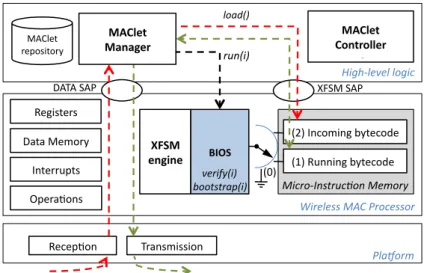
5.1 Architecture for MAClet support: extended WMP and external MAClet Control. . . 29
5.2 Messages of the MAClet Distribution Protocol: an example. . . 30
5.3 MAClet MO-message format . . . 30
6.1 MAClet Control framework and OpenFlow complementary . . . 33
6.2 A simple use case of the MAClet distribution system in a multi-vendor scenario. . . 34
6.3 MAClet Control framework architecture and decoupling between control and data planes . . . 36
6.4 Architecture detail about Policy Control (a) and the Control and Data Planes (b) . . . 39
6.5 MAClet Distribution Protocol: message exchange and MAClet synchro-nization . . . 40
6.6 wmplib for MAClet/WMP interaction . . . 41
6.7 OMF System Architeture . . . 43
7.1 two operators share the same physical Access Point by providing two different access services to their clients (fixed-rate and best-effort). . . 45
7.2 An experimental trace of network virtualization: operator A and opera-tor B use the channel in different time intervals with independent access schemes (TDM and DCF). . . 45
7.3 Resource repartition between two different operators using different access rules (TDM and DCF). . . 47
7.4 Cognitive Loop DirectLink. . . 48
7.5 MAClet Activations . . . 49
7.6 Channel hopping experiment setup . . . 50
7.7 Channel hopping evaluation . . . 51 vi
8.1 802.11p channels . . . 54
8.2 DSRC STACK . . . 55
8.3 Interarrival time - 6Mbps - 10MHz . . . 57
8.4 Coverage Percent - 6Mbps - 10MHz. . . 58
8.5 Busy Channel Monitoring . . . 59
B.1 BCM43xx NICs. . . 70
B.2 Broadcom BCM 43xx Block Diagram. . . 71
B.3 Alix 2D2. . . 72
B.4 USRP1 USRP2 frontend and USRP2 block diagram . . . 73
2.1 OpenFlow Table Entry . . . 11
2.2 OpenFlow Controllers Comparison . . . 13
3.1 MAC programs expressed as Extended Finite State Machines: Wireless MAC Processor . . . 21
5.1 WMP Commands to be locally or remotely invoked. . . 29
6.1 MAClet Controller messages. . . 39
B.1 Broadcom BCM4311 Specifcation . . . 70
AM AggregateManager
EC EsperimentController
ED EsperimentDefinition
FSM Finite State Machine
IFS InterFrameSpace
MC MAClet CController
MLME Media Access Control (MAC) SubLayerManagementEntity
MM MAClet MManager
NIC NetworkInterfaceCard
WMP Wireless MAC Processor
SM State Machine
SDN Software DefinedNetwork
WMPE Wireless MAC Processor Engine
Introduction
In recent years Wireless network for Internet Access has become one of the most impor-tant infrastructure in communication technologies and IT application. The impressive growth of features and bandwidth capabilities in 3G/4G cellular networks and the per-vasive distribution of WiFi access networks for business and home internet access are the proof that Wireless based access network is today the de facto internet access for users. However not all network technologies currently in use are able to scale with a large amount of users and not all medium access schemes can be exploited without a knowledge of the dynamic environment; for that reason the research community and in-dustry try to address the problem of medium access limitations defining new standards and specific solutions pay particular attention to free frequencies wireless local network technologies.
One of the most famous WLAN standard is IEEE 802.11. It was born just for cable replacement in local area networks with limited management functionalities and data rates. The evolution of 802.11 (e.g. 802.11e, 802.11sm 802.11n, 802.11ac, etc.) brought the definition of new standards with highest performance and spectrum usability. The definition of current new standards can clearly address a set of weakness and give more features but very often novel application scenarios or networking topologies require the introduction of updates. Indeed, wireless network networks suffer of a number of issues of channel access and reconfigurability of networks elements, that strictly depend on the operating network conditions and interference. For this reason an interesting research path can be focused on the designing of a new paradigm for network reconfigurability and optimization, according to which nodes can change dynamically not only the modulation and coding schemes, but also their behavior in estabilishing wireless links and accessing the wireless medium. Obviously, such a reconfigurability requires that that all nodes can share information about channel state, are updated in a consistent way and follow some common (global or distributed) optimization algorithms. The programmability of future Internet is a current interest research topic, where the definition of programmable interfaces and abstractions do not only involve the wireless access network. For example, these concepts have been largely debated in the context of switched networks, where Openflow [52] has obtained a large consensus for trading-off reconfiguration capabilities of switching network elements and usability of the interfaces.
The main purpose of this work is to design a dynamic network reconfiguration model and define a cognitive paradigms for Medium access control adaptation. For this scope, a prototype architecture for flexible and programming of MAC protocol called Wireless
MAC Processor[38] has been used. This framework is a powerful element for designing a wireless network where nodes can define, modify and run MAC protocol software based implementations called ”MAC programs”. The final goal is identifying a suitable programming interface and programming language to code the MAC protocol logic in a compact program that can be carried in one control message and configure remotely the MAC layer of the network devices by simply disseminating these special messages. In this way it is possible designing a smart access network that can solve dynamically a number of medium access control issues such as channel quality fluctuations, traffic load, radio spectrum optimizations and cognitive algorithm implementations.
This work starts from the analysis of the most important proposals for software defined network in switched networks studying research contributions and solutions, analyzing the benefit that this improvement give to the network flexibility; after that has been con-ducted an analysis of the design requirements needed to obtain software defined network paradigm for wireless access network, and finally has been developed a prototype of a communication system using IEEE 802.11 commodity devices implementing the WMP API. Finally, we analyzed typical usecases of medium access control reconfigurability in different scenarios and evaluated the results.
1.1
Programmable wireless platforms
Current GNU/Linux network module system are designed using SoftMAC[4] paradigm, with this approach part of MAC Layer Management Entity (MLME) is managed in soft-ware by the Operating System. MLME include Authenticate, Deauthenticate, Associate, Disassociate, Reassociate, Beacon, Probe, Timing Synchronization Function (TSF). All the functions that are non time-critical can be developed by software and leave in the lower levels the implementation of the time-constrained protocol operations, for example the acknowledge signaling. The project Linux Wireless [3] define an implementation on Linux Kernel side of the IEEE 802.11 common management entities that interacts with driver modules of each NIC and implements softMAC paradigm, moreover several low level MAC/PHY parameters such as congestion windows, frequency, antenna selection, bandwidth or rate can be configured by software. However, this level of flexibility is not enough to bring into real world optimization solutions which require a fine parameter tuning for each frame or for control frames such as beacon or acknowledge frames. To overcome this limitation the research community has developed custom programmable wireless platforms, typically revolving around an FPGA or DSP core. Modern platforms, such as WARP [19] are stand-alone software defined radio boards equipped with fast and large FPGAs. These solutions allow the implementing of whole wireless protocol stack, from the level of signals to that of frame payloads, they support full MAC layer customization and cross-layer designs. More recently, custom MAC programmability was made possible also on commodity card, thanks to the disclosure of a (simplified) open source firmware [10] for a brand name card. A complete control of source code of PHY/MAC entities permits any modification, but the main purpose of a dynamic auto-configurable network is that the MAC logic can be defined as a finite state machine that a generic program executor is able to run. The Wireless MAC Processor project [38] proposed a prototype architecture developed with this specific purpose when has been implemented a MAC Engine on firmware level that is able to execute a MAC program in terms of finite state machine. A set of APIs is given to the developer that can compose its MAC and inject into the card enabling the new features on the fly. In dynamic network
reconfiguration this approach allow to design a communication architecture that can move this code throw the network transforming a fixed wireless network into a flexible environment that choose with cognitive paradigm the best medium access scheme.
1.1.1 Code Mobility
Despite the hype in the midst of the nineties [32], the application of active networking principles to the wireless domain has lagged behind. In the vision of [67], adaptations, envisioned in terms of selection of PHY functionalities (spectrum access, modulation, and coding) were expected to leverage software radio technologies. But proposed wire-less active networking frameworks [32] have mainly addressed issues at layers higher than low-MAC/PHY (e.g., QoS, network topology adaptation, mobility, ad hoc network formation, etc). The interest for code mobility, also embedded in in-band data packets (capsules, as per [70]), has more recently emerged in the wireless sensor networks arena. Indeed, in large sensor networks, code mobility may be the only possibility for upgrad-ing the sensors’ behavior, given that physical access to the nodes may not be viable. But, again, programmability has been restricted to higher layers, and for tasks such as changes in the monitoring functionalities or in the application operation [59]. Especially in the sensor network field, several issues concerning code distribution protocols[42,45] and architectures [50] have been considered. Obviously, the programmability require-ments for wireless local networks have some differences from the sensor network ones. Sensor nodes deployed in the same network are usually homogeneous, with the same Tiny OS and hardware. A binary code image can be moved from a node to another in active messages (natively supported by TinyOS). Albeit not strictly necessary, byte-code interpreters[44] may significantly improve efficiency of code distribution, i.e. for giving an high-level virtual code representations which significantly reduces the code length and/or facilitate incremental updates. All the above referred solutions limit pro-grammability to network, transport and application proto- cols, and assume that the lower stack dealing with medium access and single-hop communications is not modifiable [44].
1.2
Work content description
This work is divided the following chapters: Chapter 2 describes the solutions adopted in Internet Network for reconfigurability of its elements such as router, switch, firewall; in chapter3 a discussion about the motivation of a MAC reconfigurability and a design analysis for software flexibility requirements; in chapter4a description of main features of WMP prototype used for protocol code reconfigurability and in chapter5is presented MAClet, a solution designed and implemented for a wireless network architecture that support code mobility; in chapter 6 the study of the MAClet Control Plane design, in chapter 7 a description of the usecases that adopt WMP/MAClet software defined network architecture.
1.2.1 Methodology
The design of MAClets and MAClets Controller started from the decoupling of the requirements of a complex network scenario in terms of physical and network elements,
the defining of a programmable MAC infrastructure, the analysis of the benefits of a MAC layer reconfigurability and the definition of a model for each requirement. The modeling is the most important aspect because it can make the difference between a solution that can be pervasive and one solution that can live only in particular conditions. That’s the hard aspect of this work and in general not all the solution seems to be actually the optimal one, but with a solid background model and with a modular system is easier find the weak element and replace with a stronger one.
Network Programming
2.1
Introduction
This chapter is focused on a conceptual and technical analysis on current solutions for network programmability: we describe the main features of Programmable Networks, the motivations, and the main concepts envisioned to rethink the traditional telecom-munication networks and extend its features in a reliable and flexible context.
The timeline of Programmable network evolution has experienced different steps and contributions. In 1995 OPENSIG [24, 32] was proposed with the purpose of making ATM networks more flexible; GSMP (General Switch Management Protocol)[16] has been standardized to establish connections between the switches, manage switch ports and reserve resources; in 1997 Active Networks[66] have emerged for reconfiguring packet oriented networks by embedding programs in data packets; in 2004 the project 4D proposed a separation between routing logic and routing protocol in network elements [15], while in 2006 was developed Ethane [2], the predecessor of OpenFlow that in 2011 was introduced by ONF foundation[8, 52]. In 2008 With NOX[5], an OpenFlow controller was finally proposed.
In the following sections, we provide a description of the main research work on these technologies and on the impact that these solutions can have for defining programmable mobile access networks.
2.2
Programmable Network
Vendor dependent and hardcoded implementation of control software do not allow a flexible programming of nodes: this is a limitation for innovation because any novel so-lution requires to be standardized, implemented by vendors and accepted by final users (that need to buy novel network nodes) before it can be deployed in real networking ap-plications. Moreover some implemented features are often proprietary and have a poor level of reconfigurability on users side. In [32] the problem has been studied defining a network modeling and a programming model in network environment, examine the number of solution and aim to define a common way to define a network that is pro-grammable and able to react quickly in terms of reconfigurability and flexibility. The
first issue to address is to identify a strategy to separate the hardware data forwarding rules from the control protocol, and define a software-based paradigm for the control protocols. In this way switch, router or any other network component can be described as a general purpose network element that change it control protocol by changing of control protocol software. A new network component can be defined basically writing a new software program, and by the definition of a common set of APIs is possible describe a common language to allow all components to be interoperable. At this point is crucial define a model for this new type of network, a network that is not a fixed environment for a specified protocol but a dynamic system that can involve it features by software changing. The envision of a programmable network is that network behavior can quickly change also in runtime, by the definition of a program distribution logic that allow a fast network reconfiguration.
2.2.1 Programmable Network Model
The modeling of a network has a number of complex requirement and the way to give programmability must go throw an intensive analysis of the problem with an important abstraction modeling. One of the distinctive characteristic of a programmable network is that, starting from a minimal set of APIs, is possible to compose several services. A general way to design a programmable network is based on a model that define data, control and management plane for each layer of internet stack. This general envision can be applicable in every kind telecommunication networks and the separation between transport and control are highlighted in network architectures. Give a fine grained programmability of each plane allows to define a reliable system that is able to implement quickly new features and applications. The Data Plane/Control Plane separation is the first step to delegate decision functions to network elements able to aggregate the network information and takes the right decision for data forwarding.
Data Plane is the part of the network that carries the traffic and refers to the information that is being transported. In general data plane decide what to do with a packet, analyze the header and act following a communication protocol.
Control Plane Define the rules used by Data Plane. In a traditional network each node has made with an implementation of control protocol without basically any neces-sity of modification. This implies predefined network protocol configuration and there’s no models for adaptation or dynamic rules redefinition. This paradigm has a weak part: each evolution must provide a complete per-node network modification, in most case with hardware replacement or low-level code upgrade. A programmable network node does not implement a specific control protocol but define a programming language that allow to implement define in software any kind of protocol starting from a very simple APIs set.
2.3
Active Network
In 1997 [66] introduced the Active Network paradigm, an architecture approach that was born with the main purpose to increase the flexibility of internet networks allowing
a programmability level based on propagation of program code within the packets. This milestone work envisions a network that is able to overcome the issues of a wide area network that suffer of problems for integrating new technologies and standards into the shared network infrastructure, as well as poor performance due to redundant operations at several protocol layers, and difficulties for accommodating new services. Moreover the standardization process of the Internet Protocol can take years to define a new common standard; the new standard must be developed by vendors and after that the entire network must swap from an old technology to the newer one. Changing the protocols means changing the network operations. Several strategies, collectively referred to as active networking, have emerged to address these issues. In the program-based approach, the networking system is a combination of small program elements that give to the network nodes the information for a cognitive decision for several optimizations. The goal is obtaining a network where each new developed feature can be easily downloaded and installed into endpoint nodes and routers. This approach allow a faster pace of innovation bringing a hardcoded network architecture to a Virtualized paradigm.
2.3.1 Framework
Active Network is a network designed with nodes that are able to receive configuration packets and process them using programming directive. Users can send dissecting rules for control packets that can implement new features for each node giving the advantage to modify a traditional hard-coded set of switch and router configuration rules to program-dependent configuration.
2.3.1.1 Programmable switches
A programmable switch is an element that allow dynamic programming of packet dis-section and routing rules definitions and allow to analyze data frames and take decision on it. In this approach users can send program messages that inject the routing rules adapting the behavior of nodes based on the traffic type and the program message sent. Active Networks can be designed in discrete or integrate approach: the first separate the programming messaging phase from the data flow, the second aim to integrate pro-gramming messages and data into each single packet.
Discrete In this approach program and data are separated and it is defined a set of mechanisms for each type of message. When a program message is sent, the pro-grammable node receives and injects the message into its configuration interface. It will dissect the future data packets with the rules included in the program sent previously. The approach is useful in case of large programs or if is necessary a previous control of the program.
Integrate - Capsules A Capsule is a packet with data that is also a network program. In this solution, all the packets exchanged into the network have an embedded program and all nodes in the network have a common set of capabilities for reading and executing the programs: each packet contain the program with the dissection rules to be executed for it. This approach is an example of code mobility concept and shows how a packet
fine programmable network can define a framework for a generalized subset of usecases and applications.
2.3.2 Programming Model
In Active networks arise the important aspect of the network programs requirements: a network program is a communication element that must be a common resource for all nodes of the network, it must define a set of common instructions that can be interpreted by each node and it must define a common description of resources handling. The main requirements of a network program are:
• mobility - the program can be run on different platforms; • safety - handling program resource access;
• efficency - programs must not compromise the network performance.
The network program is defined as a script that can be executed on-the-fly when the packet is received, when the internal logic of active switches is able capture the embedded code and execute it. The important aspect is in term of real time execution with null or at least small compiling time. The scripts use a small and simplified set primitives that are the same for all nodes, so a fundamental element of the framework is the APIs set that define data analysis commands and may include decision rules, condition and events.
2.4
Software Defined Network - SDN
The Software Defined Network paradigm is based on the definition of a network made of nodes with an high level of programmability. A general SDN must define an abstraction model for the programmability requirements arisen from the network analysis. As for Active Networks, the first element to analyze in SDN is the separation between Data Plane and Control Plane; the second element is about the centralization of Control Plane and consequently the abstraction models to be defined. In case of Internet, three fundamentals programming issues have been defined to be solved for control plane design. In traditional networks most control operations (e.g. the routing) are implemented by means of a distributed control protocol and each network element has to implement the same protocol to obtain network interoperability. The main issue is that when a node is programmed the only way to modify, update or improve the network features is reprogram each node from scratch. For these reason it is important to define Control Plane where is possible to keep the control of network nodes and interact with them. To this purpose, it is required to define a reliable model so that each programming command can be forwarded with a standard communication protocol; second the physical network environment must not be a constrain for the network element control and finally each device must be configured in transparent way. Summarizing a software defined network needs the follow control requirements:
2. Operate without communication guarantees - a distributed system with arbitrary delays and drops;
3. Compute the configuration of each physical device - A common way to introduce the programs in networks elements in this way every physical device is consider an equivalent element.
The Control Plane for a network system has several complexity aspects that must be managed, but, if we want to obtain a synergistic implementation we must extract sim-plicity with the right abstractions. For this three requirements the Control plane must define the following abstraction models:
1. Forwarding; 2. Distributed State; 3. Detailed configuration.
Forwarding
This abstraction model must give an interface that shields the upper layers from the embedded low-level implementation of the forwarding mechanisms. Network elements handled by Controller are developed to be able to interpret the same instructions. Open-flow, for example, defines a so calledMatching Table that contain the Control rules; the definition of the Forwarding model depends on the type of SDN designed. For switched networks, adopting a matching table seems to be a good solution but in many other SDNs a forwarding model based on a flowchart or a state machine can be more effective. The motivation is inside the programming level that a Controller gives to the network nodes.
Distributed state
Network must have a global view. The controller gets a global view of the network state and responds with the configuration of each device. The way to obtain a global view of the network is the Network Operating Systems (NOS). NOS is a distribute system that create the network view, communicates with the forwarding element of the network and communicate the control directive to the network elements. Controller is placed on top of NOS and views the network as a graph.
Detailed configuration
The abstraction model for network devices configuration consist of aControl Program: a control program is simply a function that gets inputs from the network view and distributes the configuration for each node.
An interesting overview of these concepts is provided in OpenFlow v1.0.0[11], which describes the programmability approach proposed for software-defining switching nodes. .
!
!
!
!
Network!Operating!System!
CONTROL!PROGRAM!
Figure 2.1: Network Operating System Distributed State Abstraction
2.5
OpenFlow
One of the most important well-know SDN-inspired architectures is OpenFlow[52], whose features are summarized in this section.
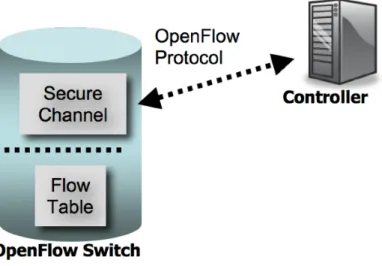
Figure 2.2: OpenFlow switch Controller-Switch connection
The architecture decouples Control and Data Planes and define two network primary elements: theController and theSwitches. The Controller and the Switches exchange information using the so calledOpenFlow protocol which define:
• Controller-to-Switch messages;
• Flow Table structure;
• Flow Match structure;
• Flow Action structures.
Each Switch loads a flow table that defines a rule, an action and a set of statistics information; for each packet received it dissects the packet analyzing the flow table and takes the decision executing the action. In figure 2.3 it is shown the packet matching algorithm for an OpenFlow switch.
Figure 2.3: OpenFlow switch macthing flow
2.5.0.1 Programmability
In OpenFlow the programmability level is driven by the Controller that injects to the Switch the Flow Table. Table inspection logic of OpenFlow is logically assimilable to a state machine that loops in a single state and checks a single event: a packet reception. When a Packet is received, OpenFlow checks throw a list of conditions defined into the flow table and executes one of the actions described. Table2.1shows the description of a single entry of a Flow Table.
Header Fields Counters Actions Table 2.1: OpenFlow Table Entry
Header Fields is a list that contain the header fields value that the switch must check for matching.
Counters Contains the statistics information per-table, per-flow,per-port, per-queue. These information are updated at each packet arrival.
Actions Define how the switch must handle the matching packets. Actions are clas-sified in ”required” or ”optional”; basically each action defines the forward, enqueue, drop, modify-field operation executed for each packet matching.
2.5.0.2 Communication between Controller and Switch
The communication between the Controller and Switch is obtained throw an interface called secure channel. OpenFlow protocol defines three types of messages:
controller-to-switch,asynchronous and symmetric.
Controller-To-Switch These type of messages are initiated by the controller and may or may not require response from the switch.
Asynchronous Message sent from the Switch to the Controller without soliciting. With these types of messages, the Switch updates some information to the Controller.
Symmetric These are bidirectional messages without solicitation.
2.5.1 OpenFlow Components
The OpenFlow compoments are hardware switches and software to assolve OpenFlow protocol implementation and give maintenance, debugging and monitoring tools.
2.5.1.1 OpenFlow Switches
The impressive OpenFlow growth brought an important commercial contribution. In-fact there are a number of business devices able to work with OpenFlow; HP ProCurve, NEC IP8800, Pronto with Indigo or Pica8 firmware are an example of models that im-plements OpenFlow. There are also Software/Test Switches for OpenFlow: NetFPGA, OpenWRT, PCEngine WiFi AP and OpenVSwitch.
2.5.1.2 Controller
Also for controller there are several implementation in different language. The first OpenFlow controller isNOXthat supports OpenFlow v1.0.0. It is written in C++ and define an API. NOX has two separate lines of development:
• NOX-Classic is the well-known line of development that has been available under the GPL since 2009. It contains support for Python and C++ and a bunch of applications. However, this line of development is deprecated.
• NOX only contains support for C++, has fewer applications than NOX-Classic, but it is much faster and has a much cleaner codebase. Today developers are working in this new codebase. For python prototyping, there is also POX. NOX defines the classes for OpenFlow protocol objects, network state consistency man-ager, table sending, table dropping and so on. The main problem of NOX is the difficult to be deployed and a large number of users have trouble for building and running NOX in thier environment.
NOX core only provides very low-level methods for interfacing with the network. All higher-level functions and events are created and provided by network applications (com-ponents). A component is just an encapsulation of controller functionalities. For exam-ple, routing is implemented as a component within NOX. Any function which requires routing must declare it as a dependency to ensure its availability at runtime. Developer recently move to another implementation calledPOX. It is implemented in python and use both interpreter cpython or PyPy. POX give more features and allow an easier prototyping work. POX also define a list components of stock components that define the most important switch implementations. This framework provide a set of APIs to implement customized components. in [14] the wiki page of POX install/setup guide,
the list of the stock components and a guide for developing custom components. NOX and POX are not the only Controller available for OpenFlow, many opensource and non-opensource products have been developed. In table 2.2 a summary of most important OpenFlow Controllers. Control-lers Lang-uages Docs Open-Source Institu-tions Multi-thread Notes NOX C++/ Python
Good Yes Nicira
Networks
Yes Widely
used
Maestro Java Fair Yes Rice
Uni-versity
Yes No Ref.
Trema C/ Ruby Poor Yes • Yes No Ref.
Beacon Java Good Yes Stanford Yes Very
Used
Helios C ? No NEC • No Ref.
BigSwitch* Java ? No BigSwitch • Production
Netowrk SNAC** C++/ Python ? No Nicira Networks • Production Netowrk
POX Python Good Yes Nicira
Networks
NO Under
Develop Table 2.2: OpenFlow Controllers Comparison
2.6
SDN in Wireles Networks
The most critical (and most distinct) aspects of wireless networks are interference/ra-dio resource management and mobility management, which obviously work on different complexity scales when we consider cellular or local access networks. While for cellular networks interference control and mobility are natively provided in standard functions and configuration interfaces available to operators, they are often add-on functionali-ties for WLANs like IEEE 802.11 – a technology born as unmanaged wireless access for small and ad hoc deployments. However, both cellular and WLAN landscapes are evolving faster than standardization [46]. On one hand, femtocells deployments and the flexibility of modern WCDMA/OFDMA technologies make cellular networks less planned. Especially in the content of femtocells, it is impractical – or impossible if the device is installed by the customer!– for the operator to manually tune the installation and soft parameters of all its base stations. On the other hand, dense Access Points do not work well by keeping the network control completely distributed, because it is often impossible to prevent critical interference problems. In both cases, recent literature has shown that enabling or introducing a network-wide resource control can result in a per-formance improvement. Nevertheless, most of these insights have not migrated to real world deployments because they are not natively supported by existing wireless nodes and standards.
2.6.1 Interference management centralization
In LTE an emerging approach for improving the network capacity is centralizing some resource control operations [39] to overcome the limitations of local decisions, which are myopic by necessity, and also obtaining some deployment benefits, mostly from hard-ware resource pooling. Networks based on this architecture are called cloud radio access networks (C-RAN). C-RANS can be seen as an effective implementation of the idea of multi-cell processing or network MIMO because the digitalized I/Q radio signals of different antennas are processed together. On the basis of this processing, the central controller can decide whether the antennas should be used for boosting signals (combin-ing diversity to boost signals for delay-sensitive applications) or for spatial multiplex(combin-ing (multiple parallel transmissions). The promise of such approach includes energy effi-ciency, load balancing, and capacity improvement due to the cooperative processing of the signals received and transmitted by distributed base stations, which in turns require an efficient data sharing strategy between the base stations and the cloud [62]. In [49] a hybrid solution is proposed, where centralized and distributed baseband configuration and processing decisions coexist according to the bandwidth availability between the base stations and the cloud. Indeed, when the capacities of the backhaul links are infinite (or sufficiently large), the uplink joint processing problem becomes that of a multiple-access channel, and the downlink becomes a broadcast channel for which the capacity regions can be easily computed. However, in practical scenarios, the sampled waveforms and the interference measurements need to be carefully compressed for dealing with the finite capacity of the backhauls [60]. Moreover, for scalability reasons, the optimization can work on a cluster of cells rather than on the whole network [62]. Also for WLANs, major vendors, e.g., Cisco, Aruba, and Meru, have realized that a centralized network structure can be exploited for optimizing network performance. For example, DenseAP [55], and Trantor [56], have proposed to centralize various radio control functions, in-cluding rate selection across client-AP links, transmit power settings, interference-aware associations, load balancing, etc., that can significantly improve the utilization of the radio resources. In these solutions, client nodes have a very limited intelligence: they collect measurements describing their local view of the network (e.g. the observed air-time) and act according to the configuration commands sent by a controller to APs and stations (through the serving AP). Some authors have pushed these principles further and propose to centralize the link access control, which has been traditionally considered part of the data plane. For example, [63] shows that the global view of the network can be exploited for avoiding that APs suffer from hidden or exposed transmissions. The idea is to opportunistically schedule the forwarding of downlink data frames to the APs in order to avoid simultaneous transmissions in case of hidden APs, and synchronizing exposed APs by means of pre-determined backoff values. A centralized architecture for simplifying and optimizing the management of network infrastructures with multiple APs has also been standardized by the IETF with the CAPWAP protocol [9], which –in principle—is technology agnostic and requires specific “bindings” for each considered ac-cess standard (so far, there is only the binding for 802.11). Services offered by CAPWAP concern security and registration, but also the centralized control of radio resources and configuration of Wireless Termination Points (i.e. the APs in the CAPWAP terminol-ogy) for improving network performance [43], [26]. Radio configuration is expressed in terms of management information base elements included in the standard, such as the operating channel, the transmission power, and the channel sensing mode, but also the beacon interval, the contention parameters and the retry limits used by the medium access scheme. Device configuration is expressed in terms of hardware (radio interfaces)
and firmware selection. Configuration decisions are taken by a central controller called Access Controller (AC).
2.6.2 Self-Organizing networks
An alternative paradigm to centralization, is dealing with the increased scale, com-plexity and heterogeneity of emerging networks by means of self-configuration. Self-configuration of wireless points of access within a single technology has been heavily investigated within the LTE standard for LTE eNodeB [37], [35] focusing on address and cell identity assignment, and for Wi-Fi APs, focusing, among others, on IP ad-dress configuration [23], channel assignment and AP selection [40], [25]. State of the art self-optimization schemes for LTE networks concentrate mainly on handover threshold optimization [47], the neighbour relation problem [51] and dynamic subcarrier assign-ment [29]. Automatic configuration and self-optimization for heterogeneous networks has not been extensively studied, although some initial proposals appeared in the liter-ature (e.g., VET [65]). Self-organizing networks are already proven to be effective on theoretical basis (e.g., [61], [68]). However, practical realizations under realistic assump-tions, especially under imperfect channel state estimation, constrained communication between base stations, and small cells (which make the distributed solutions complex and less reliable) are largely lacking.
2.6.3 Session and mobility management
Current solutions for session and mobility management in cellular networks centralize some critical functions which introduces scalability problems. For example, monitoring, access control, and quality-of-service functionality are centralized at the packet gateway, which may be a performance and cost bottleneck for the whole system [46], especially when a significant amount of traffic is directed to other nodes within the cellular do-main. Some mechanisms proposed to address this include the possibility to delegate access and service control to a remote controller (external to the gateway); dynamically adapting the traffic paths within the cellular core network and introducing a fine-grained control in the internal routing enables several interesting possibilities for the operators, such as balancing the traffic between different service gateways, differentiating customer services, improving resource utilization (and consequently reducing CAPEX costs). The fine-grained control of per-session resource allocations is especially important for some applications which are expected to become major contributors of the overall traffic, i.e., video streaming [41], or important drivers of the network economics, i.e., Machine Type Communications (MTC) [69]. Optimization for both categories would require flow-based routing, billing, and Quality of Service (QoS) configuration, over both the core and the access network. With the appearance and success of Software Defined Networking [41], [69], and OpenFlow [52] for controlling the traffic flows within a wired network by means of a central controller and simple interfaces for programming the network switches, var-ious research efforts have proposed similar approaches for wireless networks. In this direction, OpenRoads [71] tries to support experimentation on different mobility man-agement solutions by using OpenFlow for configuring the data-path within the core network, SNMP for configuring the network devices (both the switches and the wire-less access points) and signalling critical network events, and an OpenFlow controller
[5,13] for building mobility management applications. The approach enlightens the im-portance of wireless device configuration, because parameters like transmit power can directly impact on the data-path performance, but it limits such a configuration to a few PHY-related parameters.
Medium Access Control
Flexibility
More than 20 years have elapsed since the establishment, in 1990, of the IEEE 802.11 Wireless Local Area Network committee. Initially foreseen as a technology for replacing Ethernet cables with wireless connectivity, IEEE 802.11 has been severely challenged by the highly heterogeneous needs emerged in the last two decades. Indeed, the original 802.11 CSMA/CA Medium Access Control (MAC) has shown significant shortcomings when facing the breakthrough rate improvements made available by the latest PHY enhancements (802.11n, 802.11ac), as well as when applied to scenarios and contexts such as ad hoc and mesh networks, vehicular environments, directional antennas, quality of service support, real time media streaming support, multi-channel operation, dynamic spectrum access, and many others.
Actually, the WLAN research community has found effective and ingenious solutions for adapting the 802.11 MAC operation to these new challenges. However, most of the proposed MAC modifications do not comply with the 802.11 standard MAC operation. In the best case, i.e., when the required MAC amendments are endorsed by some 802.11 standardization task groups, several years may elapse before they become available in commercial cards/devices. More frequently, when the promoted MAC amendments are either deemed out of the standard task groups’ scope, or mandate a “way too significant” departure from the native CSMA/CA MAC operation, their real world deployment is very unlikely, especially when they require changes in time-critical operations natively implemented in the network interface card.[38].
3.1
Programmable WLAN systems
The ability to modify the operation of commodity WLAN systems goes along with the availability of public-domain open-source 802.11 MAC protocol code. Besides the significant expertise required to modify existing code, a further deployment barrier for many appealing MAC extensions consists in the limited extent to which software changes may affect the device operation. Indeed, early 802.11 devices were designed according
to afull-MAC approach. The MAC layer was almost entirely implemented in the card
hardware/firmware, and programmability of the relevant drivers (when provided as open 17
FULL-MAC
SOFT-MAC
MAC SAP MLME SAP
MAC Data service MAC Manag.
service MPDU Generation MLME Upper MAC Lower MAC Protocol Control Transmission Reception
PHY SAP TX MLME-PLME SAP PHY SAP RX Lower MAC
PHY
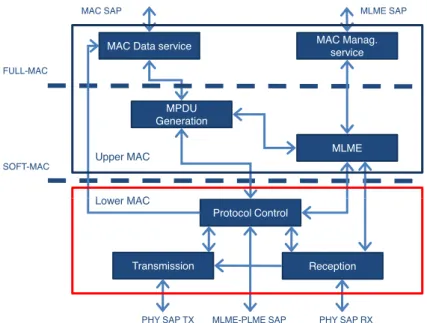
Figure 3.1: WLAN MAC architectures: full-MAC vs soft-MAC.
source) involved a marginal set of functionalities. The flexibility of commodity WLAN cards has significantly improved since a number of vendors (including Intel, Ralink, Realtek, Atheros, Broadcom), started to exploit an innovative soft-MAC [20] design, transferring to the host processor non-time-critical MAC layer functionalities (figure 3.1). Still, even in the soft-MAC case, the “Lower MAC”, comprising crucial sub-systems such as transmission, reception and protocol control, remains hard-coded in the card. Although some chipsets (e.g. from Atheros and Broadcom) permit the tuning of selected MAC parameters (such as contention windows) via registers, more substantial MAC operation changes require access to the firmware code.
Newest GNU/Linux System implements mac80211, a framework which driver developers can use to write drivers for SoftMAC wireless devices. SoftMAC devices allow for a finer control of the hardware, allowing for 802.11 frame management to be done in software for them, for both parsing and generation of 802.11 wireless frames. Most 802.11 devices today tend to be of this type, FullMAC devices have become scarce. mac80211 [4] implements the cfg80211 callbacks for SoftMAC devices, mac80211 then depends on cfg80211 for both registration to the networking subsystem and for configuration. Configuration is handled by cfg80211 both through nl80211 and wireless extensions. In mac80211 the MLME is done in the kernel for station mode (STA) and in userspace for AP mode (hostapd). If you have new userspace utilities which support nl80211 you do not need wireless-extensions to support a mac80211 device. In figure 3.2 the stack description of a recent network modules stack for GNU/Linux Operating Systems. Up to now, no vendor has to date released an open source firmware, and the only available public-domain code is OpenFWWF [10], a recently released simplified DCF firmware implementation for Broadcom/AirForce chipsets. However, OpenFWWF ex-tensions require reimplementation of large portions of assembly code, thus making it usable only by experts.
! USERSPACE! mac80211! driver! cfg80211! nl80211! cfg80211_ops! ieee80211_ops! firmware! hardware! Registers/memory! Register/memory!
Figure 3.2: Userspace kernel firmware interaciont in GNU/Linux system
3.2
Overlay Solutions
A significant effort has been spent on the development of overlay software modules. Solutions such as the Overlay MAC Project [7], MultiMAC [31], FlexMAC [48], Soft-TDMAC [58], etc, do exploit firmware configuration registers and some driver hacks for building quite advanced MAC programming interface (for instance, MultiMAC permits to override the frame format, disable ACKs, RTS/CTS, virtual carrier sense, disable transmission backoff, etc). Even if notable implementations of custom MAC protocols, including TDMA-like ones, have been demonstrated, overlay approaches cannot get rid of some intrinsic limitations. Their scalability may be impaired by the need to overlap and duplicate similar functionalities at different layers; they remain constrained by the basic programming interface made available by the driver; and their limited ability to accurately control the card’s timing prevents to deploy features such as programmable management of frame replies and handshakes, precise scheduling of medium access times, fine-grained radio tuning control, etc.
3.3
Dedicated Platforms
The shift from commodity wireless cards to dedicated wireless platforms permits to push programmability much farther, although the beneficiaries remain mainly confined within the research community - real world deployment of costly and/or bulky platforms being unlikely.
Early platforms such as RUNIC [21] and CalRadio [1] re-implemented the 802.11 MAC protocol stack on, respectively, a Xilinx FPGA and a Texas DSP, interfaced to a com-mercial PHY-only Intersil 802.11b chip. As such, they permitted arbitrary MAC mod-ifications, but protocol reconfiguration required a deep knowledge of the platforms and could only be done offline by recompiling the modified C code.
Software defined radio (SDR) platforms, such as GNURadio [17] and USRP [18], over-come the dependency on a specific PHY interface and permit to develop full-custom MAC/PHY cross-layer protocols. A large amount of work focuses on means to im-prove the slow SDR performance. On one side, solutions such as SORA [64] achieve a throughput comparable to commodity 802.11 hardware by distributing computation on multiple cores and by relying on sophisticated optimizations, as well as on an efficient radio control board. However, the software complexity makes protocol stack modifica-tions not easy, as any update implies a redesign of the software block repartimodifica-tions to multiple CPU cores. On the other side, platforms such as WARP [19] and AirBlue [57] improve performance by delegating most processing functions to the FPGA Hardware, meanwhile retaining the ability to closely control such functions via, e.g., registration of interrupt handlers, hardware triggers, read/write of hardware registers, etc. In the case of AirBlue, a modular organization coupled with careful design choices permits relatively easy modifications, changes in a module not affecting the others.
3.4
MAC programmability with Finite State Machine
Despite the above discussed advances in programmable wireless systems, the belief that wireless access programmability should go well beyond the ability to just ”hack” firmware/software code implementing a pre-established MAC protocol stack, and should rather bedesigned into the MAC stack architecture.
MAC protocols are well suited to be described in terms of Finite State Machines. Indeed, they are used in the formal appendices of the 802.11 (and many other) standard. In par-ticular, eXtended Finite State Machines (XFSM) are a generalization of the finite state machine model and permit to conveniently control theactions performed by the MAC protocol as a consequence of the occurrence ofeventsandconditionson configuration reg-isters. An XFSM is formally specified through an abstract 7-tuple (S, I, O, D, F, U, T): the meaning of such symbolic states and the correspondence with the MAC terminology above introduced is summarized in Table 3.1 (configuration commands being a special case of actions, devised to update registry status). Thus, a MAC program can be sim-ply considered as a table listing all possible state transition relations. Note that the number and meaning of the set of protocol states is specified by the programmer. By formally describing, per each protocol state, which events and conditions do trigger a state transition, and by associating actions and configuration commands to each state transition, the programmer may access the available hardware primitives, and enforce a desired MAC behavior within the radio hardware. Since the configuration memory is not explicitly represented in the state space, XFSMs allow to model complex protocols with relatively simple transitions and limited state space. A generic Architecture able to interprets this paradigm can execute not one but several MAC protocol starting from a common set of commands. In figure 3.3an example of a MAC state machine.
The Wireless MAC Protocol Architecture[38] is a prototype architecture that supports a set of Medium Access Control “commands” which can be run-time composed (pro-grammed) through software-defined state machines, thus providing the desired MAC protocol operation. An architectural description of WMP and a discussion about the features on code mobility will be explainend in chatper4.
XFSM formal notation meaning
S symbolic states MAC protocol states
I input symbols Events
O output symbols MAC actions
D n-dimensional
linear space
D1× · · · ×Dn
all possible settings ofn
configuration registers F set of enabling
func-tions fi : D →
{0,1}
Conditions to be veri-fied on the configuration registers
U set of update func-tionsui:D→D
Configuration
com-mands, update regis-ters’ content
T transition relation
T : S ×F ×I →
S×U×O
Target state, actions and configuration com-mands associated to each transition
Table 3.1: MAC programs expressed as Extended Finite State Machines: Wireless
MAC Processor END_TIMER [(backoff == 0) && (HOL == HP)] END_TIMER [(backoff == 0) && (HOL == LP)] set_backoff() END_TIMER OR RCV_OTHER update_cw() END_TIMER switch_TX() TX_start() QUEUE_OUT_UP [medium != busy] set_timer(DIFS) CH_UP freeze_bk() QUEUE_OUT_UP [medium == busy] WAIT_MED IDLE END_TIMER [backoff != 0] resume_backoff() WAIT_DIFS_BK BACKOFF MED_DATA_CONF Switch_RX set_timer(ACK_TIMEOUT) WAIT_ACK TX END_BK [queue != empty] REC_ACK END_BK [queue == empty] CH_UP stop_timer() CH_DOWN set_timer(DIFS) WAIT_DIFS_NO_B CH_UP stop_timer()
Wireless MAC Processor
4.1
Introduction
In what follows we briefly review the WMP main concepts [38] and anticipate some discussion on extensions for supporting code switching. Indeed, a pre-requirement of
anywireless active MAC framework is the ability to support customized MAC operation on general-purpose wireless devices, and the possibility to switch to a desired MAC protocol logic described through suitably formal languages and application programming interfaces.
The Wireless MAC Processor (WMP) is an architecture platform devised to run a wireless MAC program defined in terms of aFinite State Machine (FSM). It has been shown, in fact, that MAC protocols can be described in terms of state machines made of three main elements: actions, events and conditions. In the WMP case, actions are commands for the radio hardware, such as transmit a frame, set a timer, and switch to a different frequency channel. Events include hardware interrupts such as channel up/down signals, indication of reception of specific frame types, expiration of timers and so on. Conditions are boolean expressions evaluated on internal configuration registers that can either explicitly updated by actions, or implicitly updated by events. Some registers are store general MAC layer information (like the current radio channel or the power level), or more specific MAC variables (like the contention window value and the backoff parameter). Starting from an initial (default) state, the WMP waits for events which trigger state transitions. The actual transition can be enabled or disabled by verifying a boolean condition, while an action on the hardware system (i.e. on the transreceiver) can be performed before completing the transition to the new state. For these reasons, the WMP differs from off-the-shelf wireless NICs powered with their “vanilla” code: while the latter are tied to a specific MAC protocol (i.e., IEEE 802.11), the WMP architecture can run generic FSM, hence it can implement users’ designed MAC programs. On the basis of a pre-defined (hardware-dependent) set of actions, events and conditions which represent the platform API, a MAC programmer can easily compose different channel operations into a MAC program and execute it on the WMP.
4.2
Architecture
The Wireless MAC Processor architecture somewhat mimics the organization of ordi-nary computing systems, where programmability is accomplished by specifying i) an adequate instruction set which permit to perform elementary tasks on a machine; ii) a
programming language which conveys multiple instructions (suitably assembled to
im-plement a desired behavior or algorithm) to the machine, and iii) a Central Processing Unit (CPU), which executes such program inside the machine, by fetching and invoking instructions, updating relevant registers, and so on.
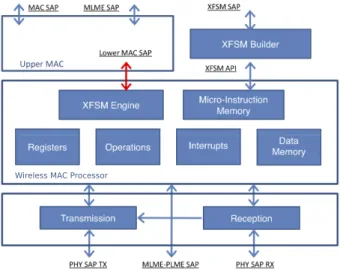
The wireless MAC processor has been conceived as a CPU specialized for handling hard-ware/PHY events and actions by executing Extended Finite State Machines (XFSMs). State machines are very effective in modeling the behavior of sequential control opera-tions, and most MAC protocols are formally described in terms of state machines. Figure 4.1shows the internal architecture of the WMP, which includes five main components:
• an execution engine, running the provided XFSMs;
• a memory block including both data and program memory space;
• an interruption block passing the signals coming from the hardware to the execu-tion engine;
• a set of operations which can be invoked by the execution engine, which include logic, arithmetic and flow control operations plus specialized MAC operations; • a set of registers for saving system state parameters.
Figure 4.1: Internal architecture of the Wireless MAC processor
4.2.1 MAC Engine
The MAC Engine, analogous to the control unit of a microprocessor, is the core of the architecture. It performs the tasks of fetching the MAC program, translating it into logical operations and basic actions and scheduling actions on the hardware.
The engine is in charge to execute theMAC program, written by the developer as an FSM, and (dynamically) loaded in the WMP micro-instruction memory from the host PC. Starting from the current state, the engine waits forevents (input signals), then it verifies whether optional triggeringconditions are verified, in which case it executes the
action and the state change.
4.2.1.1 Instruction set: Actions, Events, Conditions
A breakdown analysis of MAC protocols reveals that they are well described in terms of three types of elementary building blocks: actions,events and conditions.
Actionsare commands acting on the radio hardware. In addition to ordinary arithmetic,
logic, and memory related operations, dedicated actions implement atomic MAC func-tions such as transmit a frame, set a timer, build an header field, switch to a different frequency channel, etc. Actions arenot meant to be programmable. As the instruction set of an ordinary CPU, they are provided by the hardware vendor. The set of actions may be extended at will by the device vendor, and complex actions may be consid-ered, so as actions not necessarily restricting to MAC primitives (e.g. perform a PHY encoding/decoding).
Events include hardware interrupts such as channel up/down signals, indication of
re-ception of specific frame types, expiration of timers, signals conveyed from the higher layers such as a queued packet, and so on. As in the case of actions, also the list of supported events is a-priori provided by the hardware design.
Conditions are boolean expressions evaluated on internalconfiguration registers. These
registers are either explicitly updated by actions, or implicitly updated by events. Some registers are dedicated to store general MAC layer information (such as channel used, power level, queue length), frame related information (source or destination address, frame size, etc), or more specific MAC parameters (contention window, backoff param-eters, etc - used to achieve a more compact protocol description in case of specific MAC designs such as CSMA-based ones).
Actions, events, and registers on which conditions may be set, form the application pro-gramming interface exposed to third party programmers. This API is implemented (in principle) once-for-all, meaning that programs mayusesuch building blocks to compose a desired operation, but have no mean to modify them. However, this API was not envisioned for supporting code mobility. For instance, we could not enforce conditions to control the switching between a previously running MAC code and a newly uploaded one. Thus, we needed to extend the WMP internals to implement an extended API accounting for new actions, events and registers, tailored to dynamic code management.
4.2.1.2 MAC abstraction layers
MACs defined for the WMP can be considered following two abstraction layers: a textual one, where everything is described using text expressions, and a graphical one, where the state machine is described through a practical graph based approach. The former representation is theBytecode, a text file that can be either written at hand by users, or automatically generated by the WMP-Editor, a graphical tool that can be used
to build the latter representaion. This tool helps users composing new FSM, elements can be, in fact, connected together thanks to a straightforward drag and grop interface. At this point a compiler converts it into a binary format, the Binary Bytecode, so that the resulting file can be executed by the WMP. The Binary Bytecode is ready to be pushed inside the WMP executing memory area. Bytecode Manager is the management tool used to interface users to WMP.
4.2.2 MAC Program
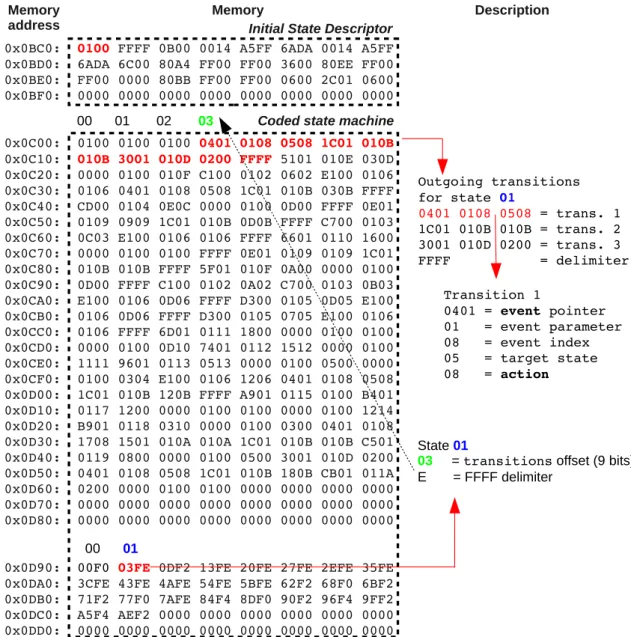
Figure 4.2 shows an example WMP bytecode where we can recognize the initial state descriptor and the transition table. The table is coded by: i) a list of transition lists, and ii) a list of states represented by the pointer to the relative transition list. When the length of the transition list of a given state is higher than 8 transitions, an explicit list delimiter is used (namely, FFFF). Otherwise, the list length is specified by the last 3 bits of the pointer. For example, the state in the second position of the list (whose symbolic label 01 corresponds to the position index) points to the transition list coded from the third byte of the table and ends at the occurrence of the firstF F F F delimiter. As evident from the figure, the code is very compact (only 544 bytes). Each Transition is composed by the follows elements:
• State address: give the physical address of the actual state.
• Event/Condition Parameter, and a Action Parameter, these are parameter useful for extended functionalities of each Event/Condition/Action.
• Event/condition identificator: is the address of the event that must be verfied. • Action idetificator: is the address of teh condition that must be verified • Next state identificator: is the address of the next state
bytecode Injectinion and activation are performed by an application software called Bytecode Manager. This tool has been developed to obtain an interface between users and MAC Engine. The main operations of bytecode manager consist of loading/injectin of bytecode. Bytecode Manager loads loaded a file with a text-based XFSM description and injects it into the memory of the NIC. The other operation consist of the Bytecode activation, while the bytecode is loaded it can be activated by a direct communication to the MAC Engine. In current implementation WMP define two memory areas for bytecode fetching.
4.3
WMP-Editor
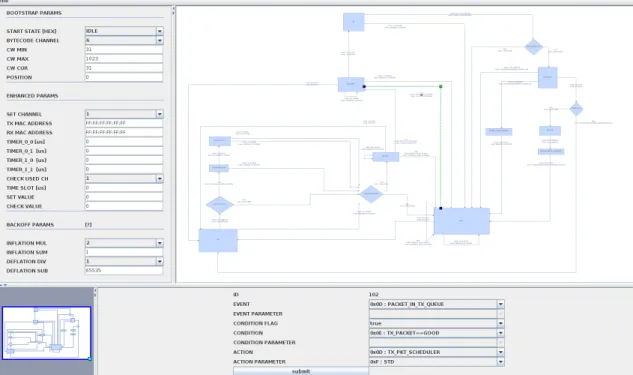
(WMP-Editor) is a graphical tool that represents state machine programs as transition graphs. Users can edit WMP graphically, adding new states and transitions and cus-tomizing the WMP behavior working on its atomic elements, namely conditions, actions and events as introduced in section4.2.1.1. The same tool can be used as a compiler to translate the transition graph into a Bytecode.
![Table 3.1: MAC programs expressed as Extended Finite State Machines: Wireless MAC Processor END_TIMER [(backoff == 0) && (HOL == HP)] END_TIMER [(backoff == 0) && (HOL == LP)] set_backoff()END_TIMERORRCV_OTHERupdate_cw() END_TIMER switch_](https://thumb-us.123doks.com/thumbv2/123dok_us/10980723.2985973/31.893.301.647.193.489/programs-expressed-extended-machines-wireless-processor-timerorrcv-otherupdate.webp)