A CONCEPTUAL MODEL FOR FACILITATING LEARNING FROM PHYSICS TASKS USING VISUAL CUEING AND OUTCOME FEEDBACK: THEORY AND EXPERIMENTS
by
ELISE STACEY GARASI AGRA
B.S., University of the Philippines, 2005 M.S., West Virginia University, 2012
AN ABSTRACT OF A DISSERTATION
submitted in partial fulfillment of the requirements for the degree
DOCTOR OF PHILOSOPHY
Department of Physics College of Arts and Sciences
KANSAS STATE UNIVERSITY Manhattan, Kansas
Abstract
This dissertation investigates the effects of visual cueing and outcome feedback on students’ performance, confidence, and visual attention as they solve conceptual physics problems that contain diagrams.
The research investigation had two parts. In the first part of the study, participants solved four sets of conceptual physics problems that contain diagrams; each set contained an initial problem, four isomorphic training problems, a near transfer problem (with a slightly different surface feature as the training problems), and a far transfer problem (with considerably different surface feature as the training problems). Participants in the cued conditions saw visual cues overlaid on the training problem diagrams, while those in the feedback conditions were told if their responses were correct or incorrect. In the second part of the study, the same students solved the near and far transfer problems from the first study two weeks later.
We found that the combination of visual cueing and outcome feedback improved performance on the near transfer and delayed near transfer problems compared to the initial problem, with no significant difference between them. Thus, the combination of visual cueing and outcome feedback can promote immediate learning and retention.
For students who demonstrated immediate learning and retention on the near and far transfer problems, visual cues improved the automaticity of extracting relevant information from the transfer and delayed transfer problem diagrams, while outcome feedback helped automatize the extraction of problem-relevant information on the delayed far transfer problem diagram only. We also showed that students’ reported confidence in solving a problem is positively related to their correctness on the problem, and their visual attention to the relevant information on the problem diagram.
The most interesting thing was how changes in confidence occurred due to outcome feedback, which were also related to changes in accuracy and visual attention. The changes in confidence included both reductions in confidence and increases in confidence due to feedback when the student was wrong (first) and right (later). This seems to have led to learning (change in accuracy), and also changes in attentional allocation (more attention to the thematically relevant area).
A CONCEPTUAL MODEL FOR FACILITATING LEARNING FROM PHYSICS TASKS USING VISUAL CUEING AND OUTCOME FEEDBACK: THEORY AND EXPERIMENTS
by
ELISE STACEY GARASI AGRA
B.S., University of the Philippines, 2005 M.S., West Virginia University, 2012
A DISSERTATION
submitted in partial fulfillment of the requirements for the degree
DOCTOR OF PHILOSOPHY
Department of Physics College of Arts and Sciences
KANSAS STATE UNIVERSITY Manhattan, Kansas
2015
Approved by: Major Professor N. Sanjay Rebello
Copyright
ELISE STACEY GARASI AGRA 2015
Abstract
This dissertation investigates the effects of visual cueing and outcome feedback on students’ performance, confidence, and visual attention as they solve conceptual physics problems that contain diagrams.
The research investigation had two parts. In the first part of the study, participants solved four sets of conceptual physics problems that contain diagrams; each set contained an initial problem, four isomorphic training problems, a near transfer problem (with a slightly different surface feature as the training problems), and a far transfer problem (with considerably different surface feature as the training problems). Participants in the cued conditions saw visual cues overlaid on the training problem diagrams, while those in the feedback conditions were told if their responses were correct or incorrect. In the second part of the study, the same students solved the near and far transfer problems from the first study two weeks later.
We found that the combination of visual cueing and outcome feedback improved performance on the near transfer and delayed near transfer problems compared to the initial problem, with no significant difference between them. Thus, the combination of visual cueing and outcome feedback can promote immediate learning and retention.
For students who demonstrated immediate learning and retention on the near and far transfer problems, visual cues improved the automaticity of extracting relevant information from the transfer and delayed transfer problem diagrams, while outcome feedback helped automatize the extraction of problem-relevant information on the delayed far transfer problem diagram only. We also showed that students’ reported confidence in solving a problem is positively related to their correctness on the problem, and their visual attention to the relevant information on the problem diagram.
The most interesting thing was how changes in confidence occurred due to outcome feedback, which were also related to changes in accuracy and visual attention. The changes in confidence included both reductions in confidence and increases in confidence due to feedback when the student was wrong (first) and right (later). This seems to have led to learning (change in accuracy), and also changes in attentional allocation (more attention to the thematically relevant area).
Table of Contents
List of Figures ... xii
List of Tables ... xv Acknowledgements ... xix Dedication ... xxi Chapter 1 - Introduction ... 1 Motivation ... 2 Previous Work ... 3 Research Questions ... 6 Overview of Dissertation ... 8
Chapter 2 - Review of Relevant Literature ... 10
Insight Problem Solving ... 11
Eye Movements and Visual Attention ... 12
Bottom-up and Top-down Processes ... 14
Influence of Bottom-up and Top-down Processes in Physics Problem Solving ... 17
Influence of Visual Attention on Cognitive Processes ... 18
Influence of Cognitive Processes on Visual Attention ... 25
Research on Visual Attention in Physics Problem Solving ... 26
Automaticity ... 32
Chapter 3 - Theoretical Background ... 35
Introduction ... 35
Representational Change Theory ... 35
Theory of Insight ... 35
Problem Solving Principles ... 36
Overcoming Impasse ... 36
Elaboration ... 36
Re-Encoding ... 37
Active Processing Assumption ... 38
Selection ... 38
Organization ... 39
Integration ... 39
Framework for Attentional Cueing ... 39
Guiding Attention ... 40
Emphasizing Organization ... 40
Integrating Elements ... 40
Outcome Feedback ... 41
Feedback as a Means to Calibrate Confidence ... 42
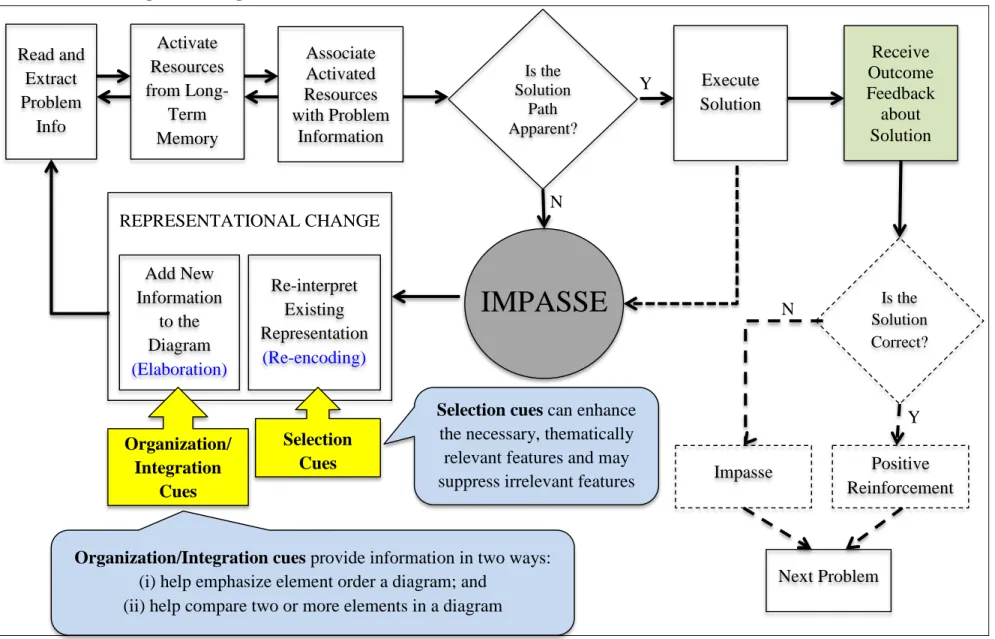
Conceptual Model ... 44
Chapter 4 - Research Methodology ... 47
Experiment Design ... 47 Participants ... 47 Materials ... 48 Problem Design ... 48 Problem Sequence ... 48 Cue Design ... 53
Design and Procedure ... 56
Interview Set-up ... 57
Eye Tracking Technology ... 59
Chapter 5 - Influence of Visual Cueing and Outcome Feedback on Transfer, Delayed Transfer, and Confidence in Think-Aloud Conceptual Physics Problem Solving ... 60
Introduction ... 60
Number of Times the Cue was Played ... 61
Correctness Results ... 61
Overall Problem Solving Performance ... 61
Performance on Training Problems ... 74
Performance on Transfer and Delayed Transfer Problems ... 76
Performance on Near and Far Transfer Problems... 76
Performance on the Near and Delayed Near Transfer Problems ... 80
Performance on the Far and Delayed Far Transfer Problems ... 86
Confidence Results ... 88
Summary and Discussion ... 97
Chapter 6 - Influence of Visual Cueing and Outcome Feedback on Visual Attention in Transfer and Delayed Transfer in Conceptual Physics Problem Solving ... 99
Introduction ... 99
Methodology ... 100
Overall Visual Attention ... 101
Visual Attention on the Training Problems ... 104
Difference in Visual Attention Between Correct and Incorrect Solvers ... 106
Visual Attention of Participants who Demonstrated Immediate Learning and Retention ... 112
Visual Attention of Participants who Demonstrated Immediate Learning and Retention on the Near Transfer Problem ... 112
Visual Attention of Participants who Demonstrated Immediate Learning and Retention on the Far Transfer Problem ... 116
Relationship between Visual Attention and Confidence ... 119
Relationship between Performance, Visual Attention, and Confidence ... 121
Summary and Discussion ... 126
Chapter 7 - Conclusions ... 129
Overview of Research ... 129
Answers to Research Questions ... 130
Research Question 1 ... 130 Research Question 2 ... 131 Research Question 3 ... 131 Research Question 4 ... 132 Research Question 5 ... 132 Research Question 6 ... 133 Research Question 7 ... 134 Research Question 8 ... 135
Limitations and Future Work ... 139
References ... 140
Appendix A - Informed Consent Form ... 149
Appendix B - Problems Investigated ... 151
Appendix C - Results of the Mixed Factorial ANOVA on the Visual Attention of Participants who Demonstrated Immediate Learning and Retention on the Near Transfer Problems .... 171
Appendix D - Probing the Cue*Feedback*Problem Interaction for Participants who Demonstrated Immediate Learning and Retention on the Near Transfer Problems ... 172
Appendix E - Results of the Mixed Factorial ANOVA on the Visual Attention of Participants who Demonstrated Immediate Learning and Retention on the Far Transfer Problems ... 173
List of Figures
Figure 2.1 A depiction of the diagram that the participants viewed while working on Duncker’s radiation problem, as adapted from Grant and Spivey (2003). The labels were not shown, but were presented verbally. ... 19 Figure 3.1 Conceptual model which integrates elements of Representational Change Theory
(Ohlsson, 1992), Framework of Attentional Cueing (de Koning, et al., 2009), and Outcome Feedback (Butler & Winne, 1995). ... 46 Figure 4.1 An example of an initial (top left), training (top right), near transfer (bottom left), and
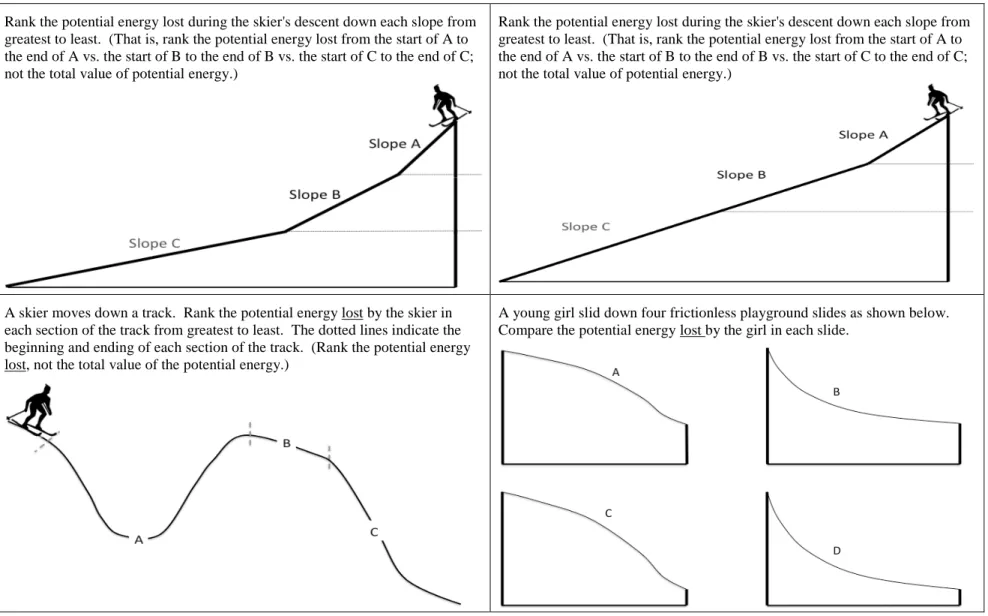
far transfer (bottom right) problem from the Skier problem set. ... 52 Figure 4.2 Examples of training problems with the cues superimposed from the Ball (top left),
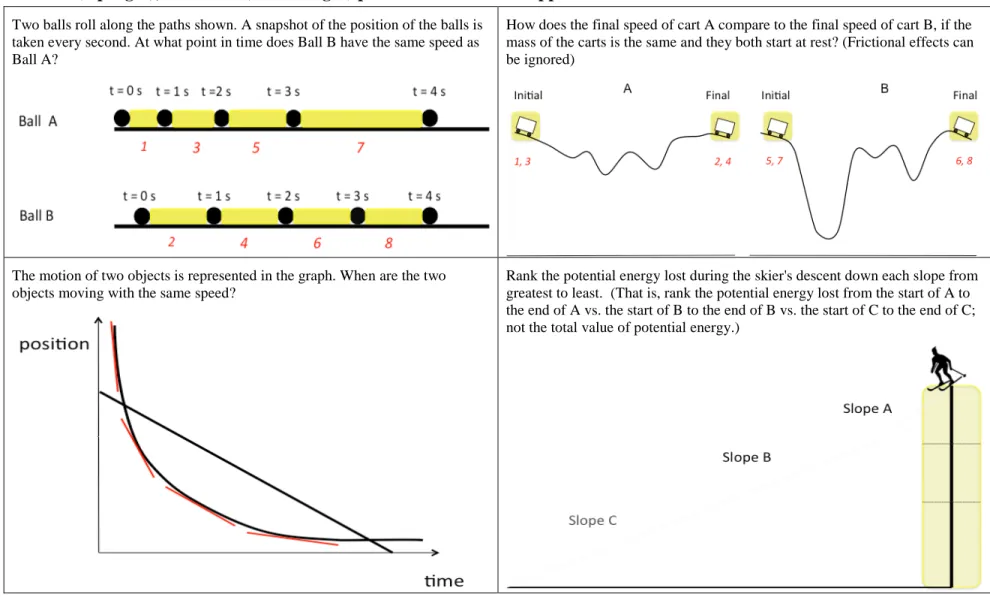
Graph (bottom left), Roller Coaster (top right), and Skier (bottom right) problem sets. All cues appeared on screen for a total of 8s at a time. ... 55 Figure 4.3 Interview setup. The participant is using a chin and forehead rest, and is in front of the
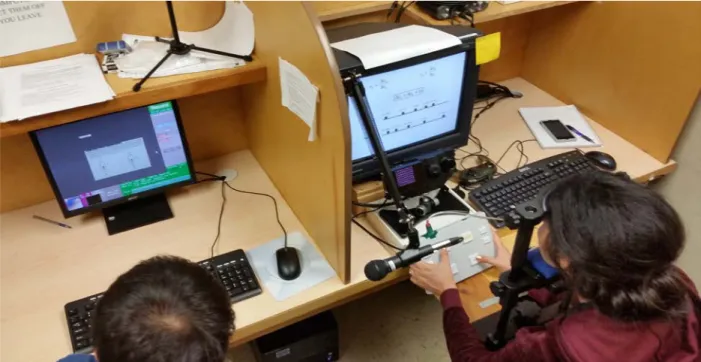
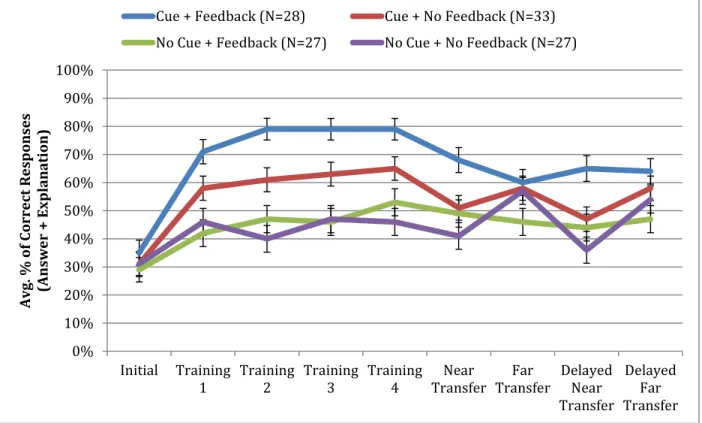
monitor. An EyeLink 1000 desktop eye tracker is used to record eye movements, and a Cedrus RB-844 response pad is used to record participant’s button presses. The interviewer is seated in front of another monitor, which mirrors the participant’s display monitor. ... 58 Figure 5.1 Average overall performance across all problem sets. Error bars represent ±1 std.
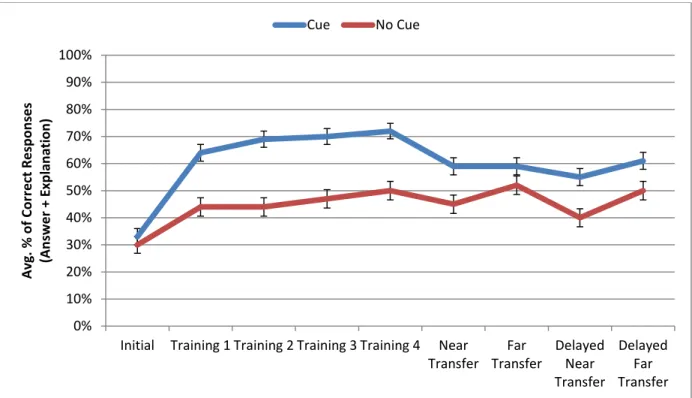
error of the mean. ... 62 Figure 5.2 Average overall performance across all problem sets for the Cue and No Cue
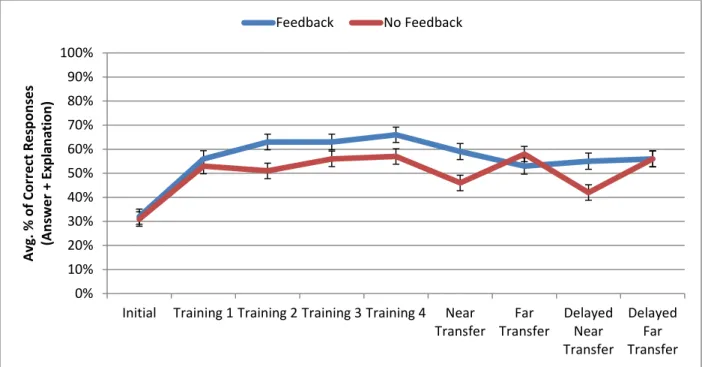
conditions. Error bars represent ±1 std. error of the mean. ... 68 Figure 5.3 Average overall performance across all problem sets for the Feedback and No
Feedback conditions. Error bars represent ±1 std. error of the mean. ... 71 Figure 5.4 Average performance on the training problems of cued and non-cued students
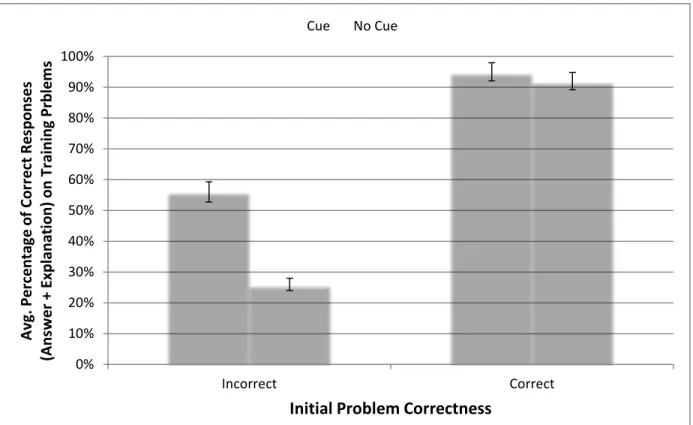
moderated by their correctness on the initial problem. Error bars represent ±1 std. error of the mean. ... 76 Figure 5.5 Average performance on the initial, near transfer, and delayed near transfer problems
in the four conditions. Error bars represent ±1 std. error of the mean. ... 81 Figure 5.6 Average performance on the initial, near transfer, and delayed near transfer problems
Figure 5.7 Average performance on the initial, near transfer, and delayed near transfer problems in the Feedback and No Feedback conditions. Error bars represent ±1 std. error of the mean. ... 85 Figure 5.8 Average performance on the initial, far transfer, and delayed far transfer problems in
all four conditions. Error bars represent ±1 std. error of the mean. ... 87 Figure 5.9 Graph probing the interaction between Cue and Feedback. Error bars denote ±1
standard error of the mean. ... 95 Figure 5.10 Graph probing the interaction between Feedback and Previous Problem Correctness. Error bars denote ±1 standard error of the mean. ... 96 Figure 6.1 Mean PT/PA of participants on the thematically relevant area of the diagram on the
initial, training, transfer, and delayed transfer problems. Error bars denote ±1 standard error of the mean. ... 102 Figure 6.2 An example of eye fixations made by a participant who solved a Graph problem
correctly. The eye fixations on the problem statement were removed for ease of reading. 106 Figure 6.3 An example of eye fixations made by a participant who solved a Graph problem
incorrectly. The eye fixations on the problem statement were removed for ease of reading. ... 107 Figure 6.4 Difference in visual attention on the thematically relevant area of the diagram
between correct and incorrect solvers. Error bars denote ±1 standard error of the mean. .. 109 Figure 6.5 Difference in visual attention on the novice-like area of the diagram between correct
and incorrect solvers. Error bars denote ±1 standard error of the mean. ... 110 Figure 6.6 Comparison between the Cue and No Cue conditions with respect to the visual
attention on the thematically relevant area of the diagram on the initial, training, near transfer, and delayed near transfer problems for the subset of participants who incorrectly solved the initial problem and then correctly solved the near transfer problem (top), and for the subset of participants who incorrectly solved the initial problem and then correctly solved both the near transfer and delayed near transfer problems (bottom). Error bars denote
±1 standard error of the mean. ... 114 Figure 6.7 Comparison between the Cue and No Cue conditions with respect to the visual
attention on the thematically relevant area of the diagram on the initial, training, far transfer, and delayed far transfer problems for the subset of participants who incorrectly solved the
initial problem and then correctly solved the far transfer problem (top), and for the subset of participants who incorrectly solved the initial problem and then correctly solved both the far transfer and delayed far transfer problems (bottom). Error bars denote ±1 standard error of
the mean. ... 118
Figure 6.8 Comparison between the Cue + Feedback and Cue + No Feedback conditions with respect to problem performance (top), average confidence (middle), and visual attention on the thematically relevant area of the diagram (bottom) on the initial, first training, and second training problems problems for participants who incorrectly solved the initial problem. Error bars denote ±1 standard error of the mean. ... 125
Figure A.1 Informed consent form used in both the main and delayed transfer experiments. ... 149
Figure B.1 Ball problem set presented in the study. ... 151
Figure B.2 Graph problem set presented in the study. ... 156
Figure B.3 Roller Coaster problem set presented in the study. ... 161
Figure B.4 Skier problem set presented in the study. ... 166
Figure D.1 Comparison between the Cue and No Cue conditions with respect to the visual attention on the thematically relevant area of the diagram on the initial, training, and far transfer problems for the Feedback (top) and No Feedback (bottom) conditions for the subset of participants who incorrectly solved the initial problem and then correctly solved the far transfer problem. Error bars denote ±1 standard error of the mean. ... 172
List of Tables
Table 5.1 Summary of the results of a Chi-square test comparing the number of problems solved correctly by participants in the four conditions. The significance level is α = .05. Cells marked with * have adjusted residuals that represent lack of independence. ... 64 Table 5.2 Summary of the results of a mixed factorial ANOVA comparing the effects of visual
cueing and outcome feedback on participants’ performance from the initial problem to the far transfer problem in the main experiment, then the delayed near and far transfer problems in the delayed transfer experiment. The Greenhouse-Geisser correction was applied to the degrees of freedom because Mauchly’s assumption of sphericity was violated. The
significance level is α = .05. ... 66 Table 5.3 Summary of the results of a mixed factorial ANOVA probing the Cue*Problem
Interaction. The significance level is α = .003 after applying a Bonferroni correction for the 15 comparisons made below. Cells marked with * are statistically significant using the Bonferroni correction. Mauchly’s assumption of sphericity was violated, so a Greenhouse-Geisser correction has been applied to the degrees of freedom for the simple main effects. 70 Table 5.4 Summary of the results of a mixed factorial ANOVA probing the Feedback*Problem
Interaction. The significance level is α = .003 after applying a Bonferroni correction for the 15 comparisons made below. Cells marked with * are statistically significant using the Bonferroni correction. Mauchly’s assumption of sphericity was violated, so a Greenhouse-Geisser correction has been applied to the degrees of freedom for the simple main effects. 73 Table 5.5 Summary of the results of a two-way ANOVA comparing the effects of cue, feedback,
and initial problem correctness on the average training problem performance. The
significance level is α = .05. ... 74 Table 5.6 Summary of the results of a Chi-square test comparing the numbers of students who
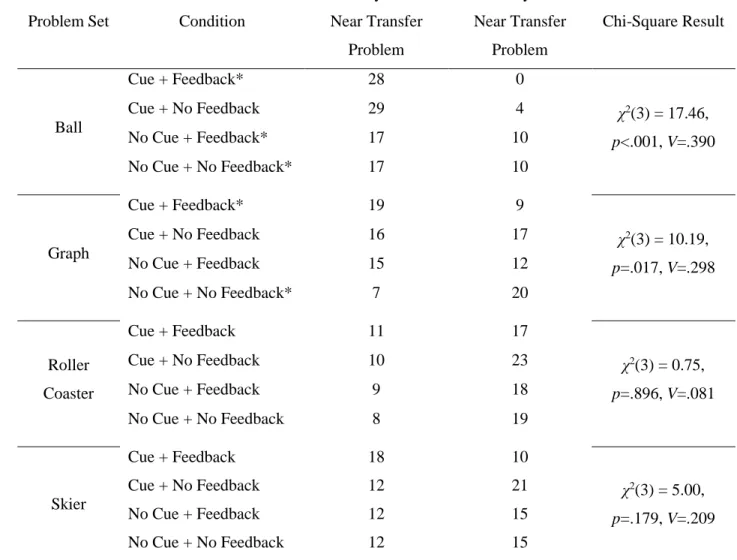
did and did not correctly solve each near transfer problem set in the four conditions. The significance level is α = .05. Cells contributing to the significant difference, as determined by the adjusted residuals, are marked with *. ... 78 Table 5.7 Summary of the results of a Chi-square test comparing the numbers of students who
The significance level is α = .05. Cells contributing to the significant difference, as
determined by the adjusted residuals, are marked with *. ... 80 Table 5.8 Summary of the results of a mixed factorial ANOVA comparing the effects of cue and feedback on participants’ performance on the initial, near transfer, and delayed near transfer problems. The Greenhouse-Geisser correction was applied to the degrees of freedom
because Mauchly’s assumption of sphericity was violated. The significance level is α = .05. ... 82 Table 5.9 Summary of the results of a mixed factorial ANOVA probing the Cue*Problem
Interaction. The significance level is α = .017 after applying a Bonferroni correction for the 3 comparisons made below. Cells marked with * are statistically significant using the Bonferroni correction. Mauchly’s assumption of sphericity was violated for the cells marked with †, so a Greenhouse-Geisser correction has been applied to the degrees of freedom for the simple main effects. ... 84 Table 5.10 Summary of the results of a mixed factorial ANOVA probing the Cue*Problem
Interaction. The significance level is α = .017 after applying a Bonferroni correction for the 3 comparisons made below. Cells marked with * are statistically significant using the Bonferroni correction. Mauchly’s assumption of sphericity was violated, so a Greenhouse-Geisser correction has been applied to the degrees of freedom for the simple main effects. 86 Table 5.11 Summary of the results of a mixed factorial ANOVA comparing the effects of cue
and feedback on participants’ performance on the initial, far transfer, and delayed far transfer problems. The Greenhouse-Geisser correction was applied to the degrees of
freedom because Mauchly’s assumption of sphericity was violated. The significance level is α = .05. ... 88 Table 5.12 Median and Inter-Quartile Range of answer and reasoning confidence ratings on the
initial, training, transfer, and delayed transfer problems in the four conditions. ... 90 Table 5.13 Summary of the results of a Chi-square test comparing the number of problems
solved correctly by participants with different levels of confidence. The significance level is
α = .05. ... 92 Table 5.14 Results of the three-way ANOVA comparing the effects of visual cueing, outcome
feedback, and previous problem correctness on the average confidence. Significance level is
Table 6.1 Results of the mixed factorial ANOVA comparing the effects of cue and feedback on participants’ visual attention on the thematically relevant area of diagram on the initial, training, transfer, and delayed transfer problems. The Greenhouse-Geisser correction was applied to the degrees of freedom because Mauchly’s assumption of sphericity was violated. The significance level is α = .05. ... 103 Table 6.2 Summary of the results of a mixed factorial ANOVA probing the main effect of
Problem on the thematically relevant PT/PA. The significance level is α = .003 after applying a Bonferroni correction for the 15 comparisons made below. Cells marked with * are statistically significant using the Bonferroni correction. Mauchly’s assumption of sphericity was violated, so a Greenhouse-Geisser correction has been applied to the degrees of freedom for the simple main effects. ... 104 Table 6.3 Results of one-way ANOVA for the thematically relevant and novice-like areas of
interest for participants who solved the problem correctly and incorrectly. An asterisk indicates a significant difference at the α=.05 level. ... 111 Table 6.4 Results of the ANOVA for the PT/PA on the thematically relevant area of the diagram as a function of the answer confidence subgroups. The significance level is α = .05. ... 120 Table 6.5 Results of the ANOVA for the PT/PA on the thematically relevant area of the diagram as a function of the reasoning confidence subgroups. The significance level is α = .05. ... 121 Table C.1 Results of the mixed factorial ANOVA comparing the effects of cue and feedback on
participants’ visual attention on the thematically relevant area of diagram on the initial, training, near transfer, and delayed near transfer problems for the subset of participants who solved the initial problem incorrectly and then solved both the near transfer and delayed near transfer problems correctly. The Greenhouse-Geisser correction was applied to the degrees of freedom because Mauchly’s assumption of sphericity was violated. The
significance level is α = .05. ... 171 Table E.1 Results of the mixed factorial ANOVA comparing the effects of cue and feedback on
participants’ visual attention on the thematically relevant area of diagram on the initial, training, far transfer, and delayed far transfer problems for the subset of participants who solved the initial problem incorrectly and then solved both the near transfer and delayed far transfer problems correctly. The Greenhouse-Geisser correction was applied to the degrees
of freedom because Mauchly’s assumption of sphericity was violated. The significance level is α = .05. ... 173
Acknowledgements
I am very fortunate to have the support of many people during my time at K-State. I am grateful to my advisor, Dr. N. Sanjay Rebello, for his tremendous support and guidance during the course of this research study. He provided me with lots of encouragement and sound advice whenever I needed them. I could not have chosen a better advisor.
I am also grateful to Dr. Lester Loschky for his mentorship in the visual cognitive aspects of this research. His contribution to this work is invaluable. I would also like to thank the other members of my committee: Dr. Andrew Bennett, Dr. Brett DePaola, and Dr. Stephen Dyer.
Several people have made this work possible. I would like to thank John Hutson for programming the experiment. Many thanks to Bahar Modir, Tianlong Zu, Drew Johnson and Mitchell Burkett for all the hours spent doing the interviews. My sincere thank you to Dr. Jeremy Schmit, Dr. Vinod Kumarappan, Dr. Omer Farooq, Dr. Deepak Shrestha, and Dr. Richard Zajac, who very generously gave me access to their classes for my interviews.
It was a privilege to work with the KSU Physics Education Research group. I would like to thank Dr. Amy Rouinfar for her mentorship and encouragement. Thanks to Xian Wu for the insightful discussions about the project. I have been fortunate to work with amazing people in the group including Claudia Fracchiolla, Nandana Liyanage, Bahar Modir, Tianlong Zu, and Jeffrey Murray. I also want to thank our administrative assistant Kim Coy for all her help. She has done an amazing job keeping the group sane.
The KSU Philippine Student Association has given me incredible support during my time at K-State. Special thanks to Dr. Ronaldo Maghirang and Elizabeth Maghirang who have been extremely generous in offering me their home when I was writing my dissertation. I would like
to thank all the members and affiliates for the dance lessons, the food, and for introducing me to Adopt-a-School. Maraming salamat Barangay PhilSA!
To Mama Pamie and Daddy Boy, my cousins Mg Maila, Mg Ador, Elaine and Gene, my niece Carmela, and my nephews Alex and Eli, thank you for providing me a home away from home. I always look forward to the yearly shopping trips and amusement park visits. Thanks, Mg Ador, for always cooking authentic Ilokano food whenever I visit. Naimpusuan a panagyaman ko iti panagayat ken panangsuporta yo kanyak!
Finally, I would like to thank my sisters, Karla and Elysse, for always being there for me. To my niece Cione, thanks for never failing to cheer me up. Most importantly, I would like to thank my parents, Carlo and Elisa Agra for all their love and support. Thank you for always believing in me. What I have achieved wouldn’t have been possible without you in my life.
Financial support was provided in part by the National Science Foundation under awards 1138697and 1348857.
Dedication
To my parents.
In memory of my grandparents:
Trinidad Aglugob Garasi (June 4, 1916 – April 16, 1980) Presentacion Racho Garasi (November 21, 1921 – April 11, 2009)
Solferino Pascua Agra, Sr. (November 1, 1919 – June 29, 2013) Victorina Agbayani Agra (November 1, 1926 – May 25, 2013)
Chapter 1 - Introduction
Problem solving has been a considered as an essential part in learning physics (Hsu, et al., 2004; Maloney, 1993). Jonassen (2011) defines a problem as a “question or issue that is uncertain and so must be examined and solved.” Traditionally, problem solvers are categorized as experts and novices, although the distinction between them is not absolute (Singh, 2002). Experts usually solve problems faster and more successfully than novices (Chi, Feltovich & Glaser, 1981; Larkin, McDermott, Simon, & Simon, 1980). Novices tend to categorize problems based on the entities contained in the problem statement, and solve problems using surface features of the problem. Experts on the other hand categorize and solve problems based upon physics principles that will be used in the solution.
Problems in physics make extensive use of diagrams such as kinematics graphs and free-body diagrams. Problems that contain diagrams allow problem solvers to make inferences (Larkin & Simon, 1987). However, it is not guaranteed that these inferences are useful for successful problem solving. Research (Chi, Feltovich & Glaser, 1981; Rosengrant, et al., 2009; Madsen, et al., 2012) has demonstrated that on physics problems that contain diagrams, correct problem solvers focus on the feature of the diagram that is relevant to getting the correct answer, and then apply the correct physics principles to successfully solve the problem. Incorrect solvers focus on the salient but irrelevant features and then associate those features to common naïve conceptions physics problem solving (McCloskey, 1983).
In this chapter of the dissertation I first present the motivation for my research project. The next section discusses the previous studies that were conducted, and how the context of the current study is situated within the NSF project that supports this work. The chapter concludes
with the research questions that the research study seeks to address, and a roadmap for the rest of the dissertation.
Motivation
Our research is motivated by the three research studies on problem solving and visual attention (Grant & Spivey, 2003; Thomas & Lleras, 2007; 2009). Grant and Spivey (2003) investigates how eye movements determine the attentional and perceptual processes that
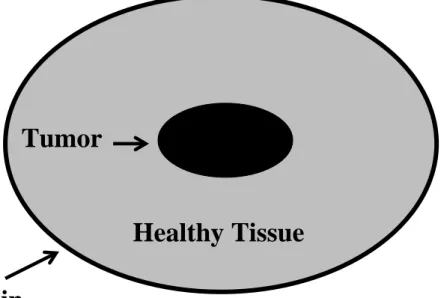
accompany Karl Duncker’s (1945) radiation problem. Duncker’s radiation problem asks solvers how to destroy an inoperable stomach tumor using lasers, if, at sufficient intensity, the lasers can also destroy the healthy organic tissue that surround the tumor (lasers were not invented until the 1960s; Duncker (1945) used “ray” instead of “laser” in the original statement of the problem). The solution to Duncker’s radiation problem involves firing multiple low intensity lasers from different angles outside the healthy tissue, which then converge at the tumor with sufficient intensity to destroy it. The results of Grant and Spivey’s (2003) study showed that just before successful participants solved the problem, they were spending more time focusing on the skin that separates the healthy tissue (which surrounds the tumor) and the space outside the diagram. Solvers who solved the problem correctly also made more skin-crossing saccades than solvers who solved the problem incorectly; the saccades followed a path from a point outside the skin, inwards to the tumor, and back towards the skin, simulating multiple converging lasers from outside the body.
In a follow-up study, Thomas and Lleras (2007) investigated the hypothesis that guiding the eye movements in in such a way that they embody the solution of the problem can lead to solving the problem successfully. Visual cues were overlaid on the diagram for Duncker’s radiation problem, which participants were asked to solve. They found that participants who
were moved their eyes in a way that embodied multiple lasers crossing the skin area at different locations and converging at the tumor had a higher success rate in solving the problem than any other groups, including one where participants’ eye movements crossed the skin area multiple times but at the same location. The result demonstrated that in spatial reasoning tasks, eye movements could influence thinking. It also supports Grant and Spivey’s (2003) proposal that embodied eye movement patterns can guide participants toward the correct solution.
Thomas and Lleras (2009) also investigated whether the triggering of insight comes from the physical movement of the eyes or from an attentional shift in a pattern that also embodies the solution. They found that participants who overtly moved their eyes in an embodied pattern and participants who covertly attended to the stimuli without physically moving their eyes had no significant difference in problem solving performance. This result suggests that solving the problem was not due to the participants physically moving their eyes, but in the shift in participants’ attention that occured before they moved their eyes.
Previous Work
In physics problem solving, it may not be possible for embodied eye movement patterns to be applied to a diverse set of problems. Problems in which it is possible to embody the correct answer are ones that contain a diagram. The diagrams contain regions that are related to the correct answer, as well as regions that are associated with well-documented incorrect answers in physics education research literature. In our studies, we use such problems.
Madsen et al. (2012) showed in their study that students who looked more closely at the relevant area of the problem diagram tended to correctly solve the problem, while students who attended to the areas that are associated with misconceptions incorrectly solved the problem, with their answers related to those misconceptions. To investigate if directing the students’ visual
attention to embody the solution could improve problem solving, Madsen et al. (2013a; 2013b) used a computational model to modify the saliency of the relevant and irrelevant areas of the diagrams. The way the modified the saliency was by varying the luminance contrast of the diagram elements. They found that correct students’ visual attention was directed by their prior knowledge, which often overwhelmed the saliency of the diagram (Madsen, et al., 2013a; 2013b).
To direct students’ attention towards the relevant areas of problem diagrams, Madsen et al. (2013a; 2013b) provided visual cues on the problems. The visual cues were eye movements of students who solved the problem correctly. They found that in one problem set, students who were cued with the correct eye movements significantly outperformed students who were not cued. Students who were cued also significantly outperformed students who were not cued on a transfer problem, which was presented without cues. Madsen et al. (2013a) suggested that the cues be described to the students as to their purpose, and to redesign the cues to be simpler and thus more easily interpreted.
In a follow-up study, we extended the work the work completed in Madsen et al. (2013a; 2013b) in two ways. First, visual cues were described to students in the cue conditions as hints that were designed to help them correctly solve the problems. Second, it is possible that students are not aware that they solved a problem incorrectly, so students were given feedback in which they are told whether their response (answer and reasoning) correct or incorrect. Thus, the research condition was similar to an online learning environment in which students may be provided hints to help them solve problems correctly, and feedback to indicate whether their answers are correct or incorrect.
Students solved four sets of related problems covering the areas of speed and
conservation of energy. There were eight open-ended problems in each set: an initial problem, six isomorphic training problems, and a transfer problem. In comparing the students’ training problem performances, we found that those who received visual cues and feedback were the highest performing, and students who did not receive visual cues or feedback were the lowest performing. Students who saw visual cues but did not receive feedback were more successful than students who received feedback but not visual cues (Rouinfar, 2014a; Rouinfar et al., 2014b). We also found that on the transfer problems, students in the Cue + Feedback condition were the significantly highest performing on three problem sets, while students in the No Cue + No Feedback condition were the significantly lowest performing. Thus, the combination of visual cueing and outcome feedback is effective in helping students solve training and transfer problems.
We also investigated how the students’ visual attention changed as a result of being cued on training problems (Rouinfar, 2014a; Rouinfar et al., 2014c). We found that for participants who got the initial problem wrong and then got the transfer problem right, participants in the non-cued group attended to the relevant information of the transfer problem significantly longer than the cued participants. Being cued made the students more efficient in extracting the relevant information, leading to a shorter time looking at the relevant information on the on the transfer problem. This shows that visual cues help in the automatization of extracting problem-relevant information from transfer problem diagrams.
One limitation of the study was that the transfer problems were considered as “near” transfer problems such that the surface features are not changed very much and the problems still looked similar to the initial and training problems. To determine whether visual cues and
outcome feedback also influenced performance on problems that have a considerably different surface feature from the training problems, we recommended that far transfer problems be
investigated as well. Moreover, to investigate if visual cueing and feedback influence retention, it was also recommended that the students be tested on the transfer problems a few weeks after their initial participation.
Research Questions
In a broad sense, the study investigated the influence of visual cueing and outcome feedback on students’ accuracy, confidence, and eye movements as they solved conceptual physics problems. First, I focus on investigating performance as students solve physics problems while they verbalize their reasoning. Second, I study how visual cueing and outcome feedback shift students’ visual attention as they solve these problems. Finally, I investigate the effects of visual cueing and outcome feedback on students’ reported confidence, and how changes in confidence are related to students’ accuracy and visual attention. Specifically, I address the following research questions:
1. What is the effect of training that uses visual cues, outcome feedback, or their combination, on students’ performance, after they solved an initial isomorphic problem?
2. After being trained with visual cues and/or outcome feedback on a set of isomorphic training problems, does performance improve on problems …
• …that are somewhat similar to the initial and training problems (near transfer)?
• …that test the same concept but that have considerably different features as the initial and training problems (far transfer)?
3. How does the combination of training with visual cues and/or outcome feedback affect performance on somewhat similar and considerably different problems two weeks after training?
• Is there a difference in students’ performance on near transfer problems presented immediately after training, and near transfer problems that are presented two weeks after training (delayed near transfer)?
• Is there a difference in students’ performance on far transfer problems presented immediately after training, and far transfer problems that are presented two weeks after training (delayed far transfer)?
4. What is the effect of training that uses visual cues and/or outcome feedback on students’ confidence in solving a problem, after they solved an initial isomorphic problem?
5. How do visual cueing, outcome feedback, and their combination thereof affect visual attention on the thematically relevant area of a problem diagram? Is there a
difference …
• …between correct and incorrect solvers with respect to their visual attention on the thematically relevant area of a diagram?
• …on the thematically relevant area of the diagram between students who receive and do not receive visual cues on the training problems? For students who received and did not receive outcome feedback?
6. What is the effect of visual cueing and/or outcome feedback on the automaticity of extracting relevant information from a problem diagram?
• For students who incorrectly solve the initial problem and then correctly solve the near/far transfer problem, do those who see visual cues on the training problems spend less time attending to the thematically relevant area of the near/far transfer problem diagrams?
• For students who incorrectly solve the initial problem and then correctly solve the near/far transfer problem, do those who receive outcome
feedback spend less time attending to the thematically relevant area of the near/far transfer problem diagrams?
7. Does the automaticity of extracting relevant information from a problem diagram persist?
• For students who are incorrect on the initial problem but are correct on both the transfer and delayed transfer problems, does the visual attention on the thematically relevant area decrease for students who see visual cues?
• For students who are incorrect on the initial problem but are correct on both the transfer and delayed transfer problems, does the visual attention on the thematically relevant area decrease for students who receive outcome feedback?
8. Does a student’s confidence in solving a problem relate to his visual attention on the thematically relevant information on the problem diagram?
Overview of Dissertation
Chapter 2 provides a review of relevant studies and literature, which include previous research on problem solving and the cognitive processes involved, and the use of visual cueing
and its influence on visual attention. The chapter concludes with a discussion of prior research on visual attention in physics problem solving.
Chapter 3 is focused on a review of the relevant frameworks used in the study –
Representational Change Theory and Framework for Attentional Cueing, including a description of how those frameworks are extended and integrated in this research. The role of outcome feedback on learning is also discussed. Chapter 4 discusses the context of this research study, the student population, and data collection processes used in the study. The chapter concludes with a description of the eye tracking technology used in the study. Chapter 5 focuses on the
quantitative results describing the influence of visual cueing and outcome feedback on students’ problem solving performance. The first four research questions are answered in this chapter. Chapter 6 describes analyses of the eye movement data to address the next four research questions. Chapter 7 provides a summary of the results of the previous chapters, and how the results have addressed the research questions. The chapter concludes with a discussion of the implications of the study, as well as the direction of future research.
Chapter 2 - Review of Relevant Literature
Understanding the processes of learning and problem solving is of great interest to educational researchers. In this chapter, I present a review of studies on problem solving and the cognitive processes involved in problem solving. The problems that we study are physics
problems with diagrams that have two distinct features: one associated with the correct answer, and one associated with common incorrect answers. In order to solve the problems correctly, students should pay attention to the relevant information and relate it to physics concepts. The problems are also conceptual and do not require algorithmic calculations. Thus, they are similar to insight problems.
Visual attention has been a relevant topic in contemporary cognitive science. The influence of cognitive processes on visual attention has been studied for a long time. More recently, researchers have been studying the inverse – the influence of eye movements on cognition. In this literature review, I will discuss studies that investigate both the influence of cognitive processes on eye movements and the influence of eye movements on cognition. First, I will discuss insight problem solving. Then, I will discuss visual attention in eye movements, and how visual attention is related to cognitive processing. Next, two different sources of information –bottom-up and top-down information – that guide our visual system, will be studied. Their influence in physics problem solving will be discussed. Previous research on the effect of eye movements on cognitive processing and the effects of cognitive processing on eye movements will also be discussed. Finally, previous studies regarding visual attention in physics problem solving will be presented.
Insight Problem Solving
In problem solving, insight refers to the experience of an “Aha!” moment, which occurs when the correct answer to a problem springs unexpectedly to mind. In insight problem solving, a solver first attempts to solve the problem. Then, after the initial failure to solve the problem, the solver reaches an impasse. During impasse, the solver believes that he has explored all the options, and yet is still not able to correctly solve the problem. Then suddenly, the solution comes to mind in a flash of insight.
An example of an insight problem is Duncker’s (1945) radiation problem, which posed the following question (adapted by Grant & Spivey, 2003):
“Given a human being with an inoperable stomach tumor, and lasers which destroy organic tissue at sufficient intensity, how can one cure the person with these lasers and, at the same time, avoid harming the healthy tissue that surrounds the tumor?”
The solution relies on the concept of convergence – using multiple laser beams of lower intensity from different directions to converge on the tumor at a sufficient intensity to destroy it without damaging the tissue through which each laser beam travels. The insight required to solve this problem is to realize that multiple lasers may be employed, as long as their intensity is low enough to not damage the surrounding tissue. Upon seeing the solution, most insight problems appear to be fairly simple, and certainly well within the intellectual capability of an average person.
The problems we investigate in the current study are analogous to insight problems. Attending to the areas of the problem diagram that are associated with correct answers allows the solver to retrieve and apply the correct resources and solve the problem correctly. Of course,
physics problems are more complex such that solving one may involve several steps. Thus, the problems that we study may require more that one instance of insight.
Eye Movements and Visual Attention
Eye movement methodology has been demonstrated to be useful in the investigation of insight problem solving (Grant & Spivey, 2003; Knoblich, Ohlsson, & Raney, 2001; Litchfield & Ball, 2011; Thomas & Lleras, 2007, 2009). In these studies, an eye tracker recorded fixations (when the eyes are stationary at a single spatial location) and saccades (when the eyes are moving), which were then analyzed to understand the problem solving process.
In reading, adult readers fixate most on nouns, adjectives, verbs, etc. (“content” words) and tend to skip “function” words (articles, conjunctions, etc.) (Just & Carpenter, 1980). Just and Carpenter (1980) suggested that readers fixate on each word until processing has been
completed. This was referred to as the “eye-mind assumption.” According to the study, the time it takes to fixate on a word is directly related to the processing of the word. Therefore, the fixation duration provides a useful measure of the cognitive mechanisms that are involved in reading.
There are two types of visual attention. Overt visual attention involves a change in the orientation of our eyes to concentrate on areas of interest. They are called overt because they are visible to other people. On the other hand, covert visual attention is not visible to other people. This allows us to pay attention without changing the location of our gaze.
Studies have demonstrated that overt visual attention can explain the cognitive
mechanism of problem solving (Bilalić et al., 2008; Eivazi & Bednarik, 2010, 2011; Epelboim & Suppes, 2001; Grant & Spivey, 2003; Jones, 2003; Knoblich et al., 2001; Knoblich et al., 2005; Lin & Lin, 2014; Madsen et al., 2012, 2013a, 2013b; Susac et al., 2014; Thomas & Lleras, 2007,
2009). Top-down processes, which are based on prior knowledge, have also been shown to direct solvers’ attention towards the relevant information (Epelboim & Suppes, 2001; Madsen et al., 2012).
Zhao, Gersch, Schnitzer, Dosher, and Kowler (2012) investigated the effect of pre-saccadic shift of attention on eye movements. In one experiment, participants moved their eyes in a ‘V' pattern between two corners of a screen. In between the two saccades, the letter ‘T' appeared in different orientations on four corners of the screen. The participants were then asked about the orientation of the ‘T' in one specific corner. This was done with and without visual noise or mean luminance. As expected, they found that the participants were most successful in reporting the orientation when the “T” was located where their gaze ended.
In another experiment, participants visually followed a path and then reported the presence or absence of the target at a specific location. They found that the performance was better when the target was at the goal than at a location opposite the goal. They concluded that the increase in performance when the target was at located at the goal of the saccade was not only due the features of the target.
The result of the investigations by Zhao, et al. (2012) parallels those of Hoffman and Subramaniam (1995), who found that covert and overt visual attention are closely linked in guiding behavior. In their study, they showed that eye movements directed to a specific spatial location are preceded by a covert shift of visual attention to the same spatial location (Hoffman & Subramaniam, 1995).
In contrast, Hein and Moore (2009) investigated how explicit (overt) eye movements influenced the precision of covert shifts of attention during an “attentional walk” – the shift in attention from one item to another within an array of items as a response to a series of tones. Eye
movements of six participants were recorded as they performed an attentional walk task. At the end of the task, participants reported the color of the last disc in the walk. Twenty percent of the walks were zero-step (only the cued disc was shown), while the majority was multiple-step (in between six and nine discs were shown in addition to the cued disc). Three different densities were used for the display (12, 24 and 36 discs). Two conditions were investigated – fixation condition in which the participants remained fixated on the central fixation dot when the cued disk started blinking, and the saccade condition in which the participants made explicit eye movements to the cued disc.
The researchers found that for the zero step walk type, the performance decreased as the density increases for both conditions, and that at the highest density of 36 discs, the saccade condition performed better than the fixation condition. Interestingly, they found no significant difference in performance between the fixation and saccade conditions in the multiple-step walk type. This contradicted their hypothesis that the explicit eye movement to the initial position of the attentional walk would increase the precision with which subsequent steps of attention could be performed.
In the current study, we investigate the overt visual attention of students as they solve conceptual physics problems that contain diagrams. Specifically, we investigate how students’ visual attention shifts as they transition from an incorrect solution to a problem to a correct solution in the next problem.
Bottom-up and Top-down Processes
Our visual attention is guided by two information processes. Bottom-up processing is data-driven in that current stimuli influence what is perceived. That is, bottom-up processing involves the detection of features such as color, orientation, and luminance contrast. Studies have
shown that saliency plays an important role in determining the location eyes fixations (Irwin et al., 2000; Itti & Koch, 2000; Mital et al., 2010).
Theeuwes, Kramer, Hahn, and Irwin (1998) investigated the effect of the appearance of a new object on goal-oriented eye movements. They used a visual search task of a color-singleton target, and an irrelevant object appeared abruptly somewhere in the display at the same time as the target. Initially, the screen displayed six equally spaced gray circles in an imaginary circle containing a figure-eight premask. After one second, all the circles except one turned red, and, at the same time, all the premasks changed to letters. The observers made a saccade to the
remaining gray circle, and determined whether the letter inside was a ‘c.’ In half the trials, at the same time the colors changed, another red circle appeared at one of four possible locations. The study found that the reaction time to identify the letter was longer with the onset of a new object. Moreover, observers’ eyes tended to move toward the new object, irrespective of where it
appeared, paused briefly, then moved to the singleton target. Thus, a new object captures the eyes. The result of this study demonstrates bottom-up processing.
Top-down processing is knowledge-driven such that a person’s prior knowledge influence what is perceived. Top-down processing can be involuntary and automatic, or voluntary and effortful based on prior experience and learning (Baluch & Itti, 2011)
Studies have shown that automatic top-down processes influence overt attentional scene selection (Theeuwes & Godthelp, 1995; Shinoda et al., 2001). In general, mandatory top-down processes have a greater effect (Einhauser et al., 2008; Foulsham & Underwood, 2007;
Henderson et al., 2007), and volitional top-down processes have weaker effects (Guitton et al., 1985; Mitchell et al., 2002) than bottom-up saliency. In research done by Madsen, Larson, Loschky, and Rebello (2012), the saccades and fixations were measured as participants solved
different conceptual physics problems with diagrams to determine what parts of diagrams are attended to. They showed that participants’ physics knowledge directed their knowledge to either the relevant information or the irrelevant information of a problem, depending on how correct their prior knowledge was.
Hegarty, Canham, and Fabrikant (2010) investigated how the saliency of information that is either relevant or irrelevant to a task influenced participants’ comprehension and eye fixations. In the first experiment, a weather map of North America with pressure and temperature
information was presented to participants, after which they were asked to determine whether an arrow in the map showed the actual direction that the wind would blow in that region. The perceptual salience of the task-irrelevant (temperature) and task-relevant (pressure) information was varied in two conditions, and the participants did the tasks before and after a tutorial on meteorology. They found that after instruction, participants performed significantly better when pressure was the salient information on the map than when temperature was the salient
information on the map. They also found that the eye fixations of both groups showed similar patterns after instruction, but the eye fixations of the participants in the pressure-salient group was more accurate. They replicated the methodology in a second experiment in which they redesigned the pressure-salient map to make the centers of the pressure systems more salient. They found that increasing the relative visual salience of the relevant information led to more eye fixations on the task-relevant regions but made did not make a more accurate performance. In the third experiment, the researchers added two conditions to the previous experiment. In addition to getting the same type of weather map before and after the tutorial, participants were also presented with a weather map after the tutorial that is different from the one given before the tutorial. Result showed that while there was no significant effect of the type of map viewed
before instruction on the accuracy, performance was significantly better with pressure-salient maps after instruction. This was consistent with the previous experiments and demonstrated that domain knowledge reduced the influence saliency on where learners looked.
Influence of Bottom-up and Top-down Processes in Physics Problem Solving
A consistent pattern of incorrect answers in physics can be described using top-down and
bottom-up processes (Heckler, 2011). For example, we have notions about how the physical
world works even without instruction (Halloun & Hestenes, 1985; McDermott & Redish, 1999; McCloskey, 1983). These ideas can result in deep-seated stable cognitive structures (called misconceptions) that interfere with the acquisition of scientifically accurate understanding (Docktor & Mestre, 2014). It is also suggested that the patterns of incorrect answers are a result of misappropriation of conceptual resources (Hammer, 2000), which are small pieces of
knowledge that a learner may activate alone or in clusters depending on context. Incorrect
answers to physics questions occur when inappropriate resources are applied to a given situation. Other research has shown that students systematically answer problems incorrectly because they miscategorize knowledge into inappropriate ontological categories, for example thinking of force as a thing instead of an interaction (Chi, 1992).
Heckler (2011) suggested an alternative bottom-up explanation for students’ consistent incorrect answers to simple physics questions. Instead of being primarily concerned with students’ knowledge, he suggested that processes inherent to our visual system might be contributing to systematically incorrect answers. Heckler suggested that, “salient yet
scientifically irrelevant features of a question compete for attention with less salient yet relevant features.” The most salient feature tends to capture attention easily. Thus, bottom-up processes inherent in students’ visual system automatically direct their attention to the most perceptually
salient problem elements. Then, as long as the elements suggest a plausible and relevant answer, students’ base their answer choices on them. This occurs even if these elements suggest an answer choice that is contrary to the scientifically correct answer, as students have not
considered other less salient elements. Heckler provided evidence for his explanation in the form of student response patterns to a set of similar questions in which areas in the problem diagram relevant to the incorrect answer were presumed to have high levels of salience, but he pointed out that eye tracking is needed to observe the allocation of attention and confirm his conjecture.
In the current study, visual hints, in the form of colored shapes that are overlaid on the problem diagrams, are presented. The hints are designed such that they highlight the relevant information in the problem, and suppress the irrelevant but salient information. We investigate whether top-down or bottom-up processing dominates during students’ problem solving performance when they are presented with visual hints.
Influence of Visual Attention on Cognitive Processes
Grant and Spivey (2003) were the first to study the effects of eye movements on cognitive processes by attempting to influence problem solvers’ visual attention while they solved Duncker’s radiation problem. In addition to a verbal description of the problem, a visual schematic of the problem was also presented to the participants (see Figure 2.1). Grant and Spivey (2003) tracked the eye movements of the participants and found that just before successful participants solved the problem, they spent a significant amount of time fixating on the skin area of the diagram. Thus, the relevant feature to solving the problem correctly is the skin area, and directing attention to the skin by increasing its salience might help in correctly solving the problem.
Figure 2.1 A depiction of the diagram that the participants viewed while working on Duncker’s radiation problem, as adapted from Grant and Spivey (2003). The labels were not shown, but were presented verbally.
In a second experiment, the diagram was manipulated such that the relevant area (skin) or an irrelevant area (tumor) pulsated, or the diagram remained static. They found that participants who were in the condition in which the skin pulsated performed significantly better than
participants in the “animated-tumor” or the static condition. Analysis of the eye movement data also revealed that those who were successful in solving the problem made more skin-crossing saccades than those who were not. They showed that the eye movements started from a point outside the skin, then a saccade towards the tumor, and then back towards the skin, simulating multiple lasers from outside the body converging on the tumor.
In a research study conducted to follow up on Grant and Spivey’s (2003) results, Thomas and Lleras (2007) demonstrated that directing participants’ eye movements to embody the solution leads to solving Duncker’s radiation problem successfully. In their study, they divided their 10-minute experiment into twenty 30-second intervals consisting of a 26-second free
Tumor
Healthy Tissue
Outside of Body
Skin
diagram for Duncker’s radiation problem, which the participants were also asked to solve. During the free-viewing period, there were no instructions on how participants should move their eyes; in the digit-tracking task, the participants were asked to find a digit when it is embedded in a string of 7 letters.
For one group, the eight items were presented sequentially at different points inside and outside the skin boundary, therefore requiring many skin-crossing saccades and embodying multiple lasers converging on the tumor. For the second group, the eight items were presented in the same eight locations, but in an order that minimized the number of skin- crossing saccades. For a third group of participants, the eight items were once again alternately presented inside and outside the skin boundary, but always in the same location so the saccades did not converge towards the tumor. In the final group of control participants, all eight items were presented on the “tumor,” thus requiring no eye movements at all during the digit identification task.
Thomas and Lleras (2007) found that the embodied-solution group was more successful in solving the problem than the other groups. This is consistent with their hypothesis in that eye movements were able to influence problem solving. This result also supports Grant and Spivey’s (2003) proposal that embodied eye movements can help participants arrive at the correct
solution.
Interestingly, while the number of skin-crossing saccades made by the different groups were very different during the identification task, these differences did not carry over to the free viewing periods of problem solving, during which participants from all groups had the same number of skin crossing saccades. A post-task questionnaire revealed that participants did not suspect that the digit identification task was related to the problem-solving task, instead believing the identification task to be a distraction. Thus, while physical behaviors embodying the solution
seem to induce problem-solving success, it appears that the effect of this phenomenon is implicit in nature.
Thomas and Lleras (2009) examined whether the triggering of insight comes from the physical movement of the eyes or an attentional shift in a pattern that also embodies the solution. They replicated the experiment in their previous (Thomas & Lleras, 2007) study, and had four conditions. The embodied-solution group from the previous paper was retained, and was
renamed the eye-movement group. A second group of participants (“attention-shift group”) were told to covertly attend to the stimulus without physically moving their eyes. The third group of participants (“tumor-fixation group”) remained fixated on the tumor during the tracking task, but were allowed to look anywhere on the screen during the free-viewing period. The last group of participants (“no-eye-movement group”) kept their attention on the tumor the entire duration of the session.
As with their previous result, the frequency of skin-crossing saccades made by all groups during the free-viewing period was the same except for the no-eye-movement group, who kept their attention on the display during this time. They also found no significant difference between the performances of participants who were overtly attending to the stimuli and participants who were covertly attending to the stimuli. This suggests that solving the problem correctly was not due to the physical movement of the eyes but in the shift in attention that occurs before eye movements.
Litchfield and Ball (2011) investigated how looking at someone’s eye movement patterns influenced accuracy and visual attention. Participants solved Duncker’s radiation problem (see Fig. 2.1), and the diagram was initially overlaid with another person’s eye movements. The three eye movements shown were: (a) eye movements that focused only on the central tumor; (b) eye
movements naturally making skin-crossing saccades from different angles; and (c) didactic eye movements based on the “embodied-solution” in Thomas and Lleras’ (2007) study. Then the scanpaths were removed, and the participants were asked to solve the problem. Participants were given two chances to solve the problem within a given time period, and they were allowed to see scanpaths in between the two attempts. In order to be considered correct, participants should be able to explain that multiple low-intensity lasers coming from different locations in the outside area converge at the tumor.
The authors were able to demonstrate that following the eye movements of a correct solver enabled participants to solve the problem correctly, as participants who saw both embodied eye movements (both natural and didactic) made more skin-crossing saccades
significantly more than participants who saw eye movements fixating on the tumor. They found no significant difference in performance between participants in the natural condition and participants in the didactic condition.
In a similar study, van Gog, Jarodzka, Scheiter, Gerjets, and Paas, (2009) investigated the effect of showing an expert’s problem-solving process and eye movements to students’ learning. The problem is known as “frog leap.” At the starting position, three frogs on the right side of an empty stone are facing left, and three frogs on the left side of the empty stone are facing right. The goal is to switch the frogs, that is, the ending position is of three frogs on the left of the empty stone facing left and three frogs on the right of the empty stone facing right. The correct solution to this problem consists of 15 steps, and any error made cannot be corrected.
There are four conditions that the researchers tested – product-oriented example with and without attention guidance, and process-oriented example with and without attention guidance. In the product-oriented example, only the actions of the expert model were shown while in the
process-oriented example, this was accompanied by a narration of the thought-process behind the actions. In addition to these example conditions, a problem-solving condition was also
implemented to determine if the example study is more effective than problem solving. For the examples conditions, two worked-out examples were shown, both with the solution starting on the right side. Participants in the problem-solving condition were given two attempts to solve the problem. After viewing the examples or attempting to solve the problems, the participants solved the problem themselves; the first one starting on the right side as in the example, and the second one starting on the left side. Performance was scored as either correct or incorrect.
The results showed that when experts’ eye movements were not shown, students in the process-oriented condition significantly outperformed students in the product-oriented condition the first problem. A larger percentage of the process-oriented students were correct on the second problem as well. On the other hand, when experts’ eye movements were shown, more students in the product-oriented condition than in the process-oriented condition that were correct on the first problem were also correct on the second problem. Thus, the authors suggested that attention guidance only become apparent on transfer tasks. They also concluded that the expert’s didactic eye movements as well as the narration that accompanied the process-oriented example might have interfered with the investigation.
The previous studies presented in this section were all on insight problem solving – the subjective experience of an “Aha!” moment. In insight problem solving, the solution to a problem suddenly and unexpectedly springs to mind. A study by Ellis, Glaholt, and Reingold (2011) investigated the acquisition of knowledge in insight problem solving by applying eye movement measurements during an anagram problem-solving task. Specifically, the study
determined whether the knowledge is gradually accumulating prior to insight or suddenly increased at the arrival of insight.
Thirty-two undergraduates were provided with an anagram problem that consisted of a four-word solution (three consonants and a vowel) and a consonant distractor. The addition of the distractor was introduced as a visual baseline of the knowledge of the solution. Two experiments were conducted, which were similar except for the subjects' reporting of their classification of their experience in solving the anagram problem in one experiment.
They found no significant difference between the experiments with respect to the success rates in solving the anagram problems. There were also no significant differences in response times, number of dwells, and dwell duration for both experiments (a dwell is defined as
consecutive fixations occurring in the same area). This suggests that the retrospective subjective reports in the second experiment did not influence performance of the anagram task.
The researchers compared the viewing times spent on the consonants at the start of the trials to the viewing times prior to the arrival of insight. They showed that participants were looking at the solution and distractor consonants equivalently at the start of the trials, but they spent a significantly longer time at the solution consonants than the distractor consonant at the end of the trials. This indicates solution knowledge just prior to insight.
In the current study, we investigate students’ problem solving performance when they are presented with visual hints. Specifically, we are interested in whether we can improve problem solving by redirecting students’ visual attention from the salient but irrelevant information towards the relevant information of the problem diagram.