Edit Distance for Pushdown Automata
? Krishnendu Chatterjee, Thomas A. Henzinger, Rasmus Ibsen-Jensen, and Jan OtopIST Austria
Abstract. The edit distance between two wordsw1, w2 is the minimal number of word operations (letter insertions, deletions, and substitutions) necessary to transform w1tow2. The edit distance generalizes to languagesL1,L2, where the edit distance is the minimal numberksuch that for every word fromL1there exists a word inL2 with edit distance at mostk. We study the edit distance computation problem between pushdown automata and their subclasses. The problem of computing edit distance to a pushdown automaton is undecidable, and in practice, the interesting question is to compute the edit distance from a pushdown automaton (the implementation, a stan-dard model for programs with recursion) to a regular language (the specification). In this work, we present a complete picture of decidability and complexity for deciding whether, for a given thresholdk, the edit distance from a pushdown automaton to a finite automaton is at mostk.
1
Introduction
Edit distance. The edit distance [14] between two words is a well-studied metric, which is the minimum number of edit operations (insertion, deletion, or substitution of one letter by another) that transforms one word to another. The edit distance between a wordwand a languageLis the minimal edit distance betweenwand words inL. The edit distance between two languagesL1 andL2 is the supremum over all wordswinL1 of the edit
distance betweenwandL2.
Significance of edit distance.The notion ofedit distanceprovides a quantitative measure of “how far” are (a) two words, (b) words from a language, and (c) two languages. It forms the basis for quantitatively comparing sequences, a problem that arises in many different areas, such as error-correcting codes, natural language processing, and computational biol-ogy. The notion of edit distance between languages forms the foundations of a quantitative approach to verification. The traditional qualitative verification (model-checking) question is thelanguage inclusionproblem: given an implementation (source language) defined by an automatonAIand a specification (target language) defined by an automatonAS, decide whether the languageL(AI)is included in the languageL(AS)(i.e.,L(AI)⊆ L(AS)). Thethreshold edit distance(TED) problem is a generalization of the language inclusion problem, which for a given integer thresholdk≥0asks whether every word in the source languageL(AI)has edit distance at mostkto the target languageL(AS)(withk= 0we have the traditional language inclusion problem). For example, in simulation-based veri-fication of an implementation against a speciveri-fication automaton, the measured trace may differ slightly from the specification due to inaccuracies in the implementation. Thus, a trace of the implementation may not be in the specification. However, instead of reject-ing the implementation, one can quantify the distance between a measured trace and the
?
This research was funded in part by the European Research Council (ERC) under grant agreement 267989 (QUAREM), by the Austrian Science Fund (FWF) project S11402-N23 (RiSE), FWF Grant No P23499- N23, FWF NFN Grant No S11407-N23 (RiSE), ERC Start grant (279307: Graph Games), and Microsoft faculty fellows award.
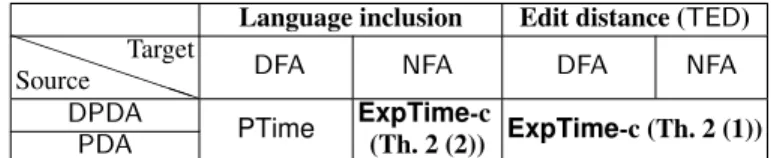
Language inclusion Edit distance (TED) P P P P P PP Source Target
DFA NFA DFA NFA
DPDA
PTime ExpTime-c ExpTime-c (Th. 2 (1))
PDA (Th. 2 (2))
Table 1.Complexity of language inclusion and edit distance. Our contributions are boldfaced.
specification. Among all implementations that violate a specification, the closer the imple-mentation traces are to the specification, the better [6, 7, 11]. The edit distance problem is also the basis forrepairingspecifications [2, 3].
Our models.In this work we consider the edit distance computation problem between two automataA1andA2, whereA1andA2can be (non)deterministic finite automata or
push-down automata. Pushpush-down automata are the standard models for programs with recursion, and regular languages are canonical to express the basic properties of systems that arise in verification. We denote by DPDA (resp., PDA) deterministic (resp., nondeterministic) pushdown automata, and DFA (resp., NFA) deterministic (resp., nondeterministic) finite automata. We consider source and target languages defined by DFA, NFA, DPDA, and PDA. We first present the known results and then our contributions.
Previous results.The main results for the classical language inclusion problem are as fol-lows [12]: (i) if the target language is a DFA, then it can be solved in polynomial time; (ii) if either the target language is a PDA or both source and target languages are DPDA, then it is undecidable; (iii) if the target language is an NFA, then (a) if the source language is a DFA or NFA, then it isPSpace-complete, and (b) if the source language is a DPDA or PDA, then it isPSpace-hard and can be solved inExpTime(to the best of our knowledge, there is a complexity gap where the upper bound isExpTimeand the lower bound isPSpace). The edit inclusion problem was studied for DFA and NFA, and it is PSpace-complete, when the source and target languages are given by DFA or NFA [2, 3].
Our contributions.Our main contributions are as follows.
1. We show that theTEDproblem isExpTime-complete, when the source language is given by a DPDA or a PDA, and the target language is given by a DFA or NFA. We present a hardness result which shows that theTED problem is ExpTime-hard for source languages given as DPDA and target languages given as DFA. We present a matching upper bound by showing that for source languages given as PDA and target languages given as NFA the problem can be solved inExpTime. As a consequence of our lower bound we obtain that the language inclusion problem for source languages given by DPDA (or PDA) and target languages given by DFA (or NFA) isExpTime -complete. Thus we present a complete picture of the complexity of theTEDproblem, and in addition we close a complexity gap in the classical language inclusion prob-lem. In contrast, if the target language is given by a DPDA, then theTEDproblem is undecidable even for source languages given as DFA. Note that the more interest-ing verification question is when the implementation (source language) is a DPDA (or PDA) and the specification (target language) is given as DFA (or NFA), for which we present decidability results with optimal complexity.
2. We also consider the finite edit distance (FED) problem, which asks whether there existsk ≥ 0such that the answer to theTEDproblem with thresholdkis YES. For finite automata, it was shown in [2, 3] that if the answer to theFEDproblem is YES, then a polynomial bound onkexists. In contrast, we show that for a source language DPDA and target language DFA, there is an exponential lower bound onk, even if the answer toFEDproblem is YES (see Example 16). We present a matching exponential
C2=DFA C2=NFA C2=DPDA C2=PDA C1∈ {DFA,NFA} coNP-c [3] PSpace-c [3] open (Conj. 18)
C1∈ {DPDA,PDA} coNP-hard [3] ExpTime-c undecidable (Prop. 19) inExpTime(Th. 11) (Th. 11)
Table 2.Complexity ofFED(C1,C2). Our results are boldfaced. See Conjecture 23 for the open complexity problem.
upper bound onkfor theFEDproblem from PDA to NFA. Finally, we also show that theFEDproblem isExpTime-complete when the source language is given as a DPDA or PDA, and the target language is an NFA.
Our results are summarized in Table 1 and Table 2.
Related work.Algorithms for edit distance have been studied extensively for words [14, 1, 17, 18, 13, 16]. The edit distance between regular languages was studied in [2, 3], between timed automata in [8], and between straight line programs in [15, 10]. A near-linear time al-gorithm to approximate the edit distance for a word to a DYCKlanguage has been presented in [19].
2
Preliminaries
2.1 Words, languages and automata
Words.Given a finite alphabetΣof letters, awordwis a finite sequence of letters. For a wordw, we definew[i]as thei-th letter ofwand|w|as its length. We denote the set of all words overΣbyΣ∗. We useto denote the empty word.
Pushdown automata. A (non-deterministic) pushdown automaton (PDA) is a tuple
(Σ, Γ, Q, S, δ, F), whereΣis the input alphabet,Γ is a finite stack alphabet,Qis a finite set of states,S ⊆Qis a set of initial states,δ⊆Q×Σ×(Γ ∪ {⊥})×Q×Γ∗is a finite transition relation andF ⊆Qis a set of final (accepting) states. A PDA(Σ, Γ, Q, S, δ, F)
is adeterministic pushdown automaton(DPDA) if|S|= 1andδis a function. We denote the class of all PDA (resp., DPDA) byPDA(resp.,DPDA). We define the size of a PDA
A= (Σ, Γ, Q, S, δ, F), denoted by|A|, as|Q|+|δ|.
Runs of pushdown automata.Given a PDA Aand a wordw = w[1]. . . w[k]overΣ, a runπof Aon wis a sequence of elements from Q×Γ∗ of length k+ 1such that
π[0]∈S× {}and for everyi∈ {1, . . . , k}either (1)π[i−1] = (q, ),π[i] = (q0, u0)and
(q, w[i],⊥, q0, u0)∈δ, or (2)π[i−1] = (q, ua),π[i] = (q0, uu0)and(q, w[i], a, q0, u0)∈δ. A runπof lengthk+ 1isacceptingifπ[k+ 1] ∈F × {}, i.e., the automaton is in the accepting state and the stack is empty.
Language recognized by a PDA.Given a PDAA, we define thelanguage recognized (or accepted) byA, denotedL(A), as{w∈Σ∗:Ahas an accepting run onw}.
Finite automata.Anon-deterministic finite automaton(NFA) is a pushdown automaton with empty stack alphabet. We will omitΓ while referring to NFA, i.e., we will consider them as tuples (Σ, Q, S, δ, F). We denote the class of all NFA by NFA. Analogously to DPDA we definedeterministic finite automata(DFA).
Language inclusion.LetC1,C2be subclasses ofPDA. Theinclusion problem fromC1in
C2asks, givenA1∈ C1,A2∈ C2, whetherL(A1)⊆ L(A2).
Edit distance between words.Given two wordsw1, w2, the edit distance betweenw1, w2,
denoted byed(w1, w2), is the minimal number of single letter operations: insertions,
dele-tions, and substitudele-tions, necessary to transformw1intow2.
Edit distance between languages.LetL1,L2 be languages. We define the edit distance
between languages is not a distance function. In particular, it is not symmetric. For exam-ple: ed({a}∗,{a, b}∗) = 0, whileed({a, b}∗,{a}∗) = ∞because for everyn, we have ed({bn},{a}∗) =n.
2.2 Problem statement
In this section we define the problems of interest. Then, we recall the previous results and succinctly state our results.
Definition 1. ForC1,C2∈ {DFA,NFA,DPDA,PDA}we define the following questions:
1. The threshold edit distance problem from C1 to C2 (denoted TED(C1,C2)): Given
automata A1 ∈ C1, A2 ∈ C2 and an integer threshold k ≥ 0, decide whether ed(L(A1),L(A2))≤k.
2. The finite edit distance problem fromC1toC2(denotedFED(C1,C2)):Given automata
A1∈ C1,A2∈ C2, decide whethered(L(A1),L(A2))<∞.
3. Computation of edit distance fromC1 to C2: Given automataA1 ∈ C1,A2 ∈ C2,
computeed(L(A1),L(A2)).
We establish the complete complexity picture for theTEDproblem for all combinations of source and target languages given byDFA,NFA,DPDAandPDA:
1. TEDfor regular languages has been studied in [2], wherePSpace-completeness of
TED(C1,C2)forC1,C2∈ {DFA,NFA}has been established.
2. In Section 3, we study theTED problem for source languages given by pushdown automata and target languages given by finite automata. We establish ExpTime -completeness ofTED(C1,C2)forC1∈ {DPDA,PDA}andC2∈ {DFA,NFA}.
3. In Section 5, we study theTEDproblem for target languages given by pushdown au-tomata. We show thatTED(C1,C2)is undecidable forC1∈ {DFA,NFA,DPDA,PDA}
andC2∈ {DPDA,PDA}.
TheFED for regular languages has been studied in [3]. It has been showed that for
C1 ∈ {DFA,NFA}, the problem FED(C1,DFA) is coNP-complete, while the problem FED(C1,NFA)isPSpace-complete. We show in Section 4 that forC1 ∈ {DPDA,PDA},
the problem FED(C1,NFA) is ExpTime-complete. Finally, we show in Section 5 that
(1) forC1 ∈ {DFA,NFA,DPDA,PDA}, the problemFED(C1,PDA)is undecidable, and
(2) the problemFED(DPDA,DPDA)is undecidable.
3
Threshold edit distance from pushdown to regular languages
In this section we establish the complexity of theTEDproblem from pushdown to finite automata.
Theorem 2. (1) ForC1 ∈ {DPDA,PDA}andC2 ∈ {DFA,NFA}, theTED(C1,C2)
prob-lem isExpTime-complete. (2) ForC1∈ {DPDA,PDA}, the inclusion of automata fromC1
inNFAisExpTime-complete.
We establish the above theorem as follows: In Section 3.1, we present an exponen-tial time algorithm for TED(PDA,NFA) (for the upper bound of (1)). Then, in Sec-tion 3.2 we show (2), in a slightly stronger form, an reduce it (that stronger problem), toTED(DPDA,DFA), which shows theExpTime-hardness part of (1). We conclude this section with a brief discussion on parametrized complexity ofTEDin Section 3.3.
3.1 Upper bound
We present anExpTimealgorithm that, given (1) a PDAAP; (2) an NFAAN; and (3) a thresholdtgiven in binary, decides whether the edit distance fromAP toAN is abovet. The algorithm extends a construction of Benedikt, Puppis and Riveros [2] for NFA. Intuition. The construction uses the idea that for a given wordw and an NFA AN the following are equivalent: (i) ed(w,AN) > t, and (ii) for each accepting state s ofAN and for every wordw0, ifAN can reachsfrom some initial state upon readingw0, then
ed(w, w0) > t. We construct a PDAAI which simulates the PDA AP and stores in its states all states of the NFA AN reachable with at mosttedits. More precisely, the PDA
AI remembers in its states, for every statesof the NFAAN, the minimal number of edit operations necessary to transform the currently read prefixwpof the input word into a word
w0p, upon whichAN can reachsfrom some initial state. If for some state the number of edit operations exceedst, then we associate with this state a special symbol# to denote this. Then, we show that a wordwaccepted by the PDAAP hased(w,AN) > tiff the automatonAI has a run onwthat ends (1) in an accepting state of simulatedAP, (2) with the simulated stack ofAP empty, and (3) the symbol#is associated with every accepting state ofAN.
Lemma 3. Given (1) a PDAAP; (2) an NFAAN; and (3) a thresholdtgiven in binary, the decision problem of whethered(AP,AN)≤tcan be reduced to the emptiness problem for a PDA of sizeO(|AP| ·(t+ 2)|AN|).
Proof. LetQN (resp.,FN) be the set of states (resp., accepting states) ofAN. Fori ∈N and a wordw, we defineTwi ={s∈QN :there existsw0withed(w, w0) =isuch thatAN has a run on the wordw0ending ins}. For a pair of statess, s0 ∈ QN andα∈Σ∪ {}, we definem(s, s0, α)as the minimum number of edits needed to apply toαso thatAN has a run on the resulting word froms0 tos. For all s, s0 ∈ QN andα ∈ Σ∪ {}, we can computem(s, s0, α)in polynomial time in|AN|. For a states∈QN and a wordwlet
ds
w= min{i≥0|s∈Twi}, i.e.,dswis the minimal number of edits necessary to apply tow such thatAN reachessupon reading the resulting word. We will argue that the following condition (*) holds: (*)dswa = mins0∈Q
N(d
s0
w +m(s, s0, a)). Consider a run witnessing
ds
wa. As shown by [20] we can split the run into two parts, one sub-run acceptingwending ins0, for somes0, and one sub-run acceptingastarting ins0. Clearly, the sub-run accepting
whas useddsw0 edits and the one acceptingahas usedm(s, s0, a)edits.
LetQP (resp.,FP) be the set of states (resp., accepting states) of the PDAAP. For all word w and state q ∈ QP such that there is a run on w ending in q, we define
Impact(w, q,AP,AN, t)as a pair(q, λ)inQP× {0,1, . . . , t,#}|QN|, whereλis defined as follows: for everys ∈ QN we haveλ(s) = dws ifdsw ≤t, andλ(s) = #otherwise. Clearly, the edit distance fromAP toAN exceedstif there is a wordwand an accepting stateqofAP such thatImpact(w, q,AP,AN, t)is a pair(q, λ)and for everys∈FN we haveλ(s) = #(i.e., the wordwis inL(AP)but any run ofAN ending inFN has distance exceedingt).
We can now construct an impact automaton, a PDA AI, with state space
QP × {0,1, . . . , t,#}QN and the transition relation defined as follows: A tuple
(hq, λ1i, a, γ,hq0, λ2i, u)is a transition ofAIiff the following conditions hold:
1. the tuple projected to the first component of its state (i.e., the tuple(q, a, γ, q0, u)) is a transition ofAP, and
2. the second componentλ2is computed fromλ1using the condition (*), i.e., for every s∈QN we haveλ2(s) = mins0∈Q
N(λ1(s
The initial states ofAIareSP× {λ0}, whereSP are initial states ofAP andλ0is defined
as follows. For everys∈QN we haveλ0(s) = mins0∈S
Nm(s, s
0, ), whereS
N are initial states of AN (i.e., a start state of AI is a pair of a start state of AP together with the vector where the entry describingsis the minimum number of edits needed to get to the stateson the empty word). Also, the accepting states are{hq, λi |q ∈FP and for every
s∈FN we haveλ(s) = #}. Observe that for a run ofAIonwending in(s, λ), the vector
Impact(w, s,AP,AN, t)is precisely(s, λ). Thus, the PDAAI accepts a wordwiff the edit distance betweenAPandAN is abovet. Since the size ofAIisO(|AP| ·(t+ 2)|AN|)
we obtain the desired result. ut
Lemma 4. TED(PDA,NFA)is inExpTime.
Proof. LetAP,AN andtbe an instance ofTED(PDA,NFA), whereAP is a PDA,AN is an NFA, andtis a threshold given in binary. By Lemma 3, we can reduceTEDto the emptiness question of a PDA of the sizeO(|AP| ·(t+ 2)|AN|). Since|AP| ·(t+ 2)|AN| is exponential in|AP|+|AN|+tand the emptiness problem for PDA can be decided in time polynomial in their size [12], the result follows. ut
3.2 Lower bound
OurExpTime-hardness proof ofTED(DPDA,DFA)extends the idea from [2] that shows
PSpace-hardness of the edit distance for DFA. In the standard proof ofPSpace-hardness of the universality problem for NFA [12], the NFA recognizes a language of all words that do not encode valid computation of a given Turing machineM working on the tape bounded by a given (in unary) n. Observe that such an NFA checks the following three conditions: (1) the given word is a sequence of configurations, (2) the state of the Turing machine and the adjunct letters follow from transitions ofM, and (3) the tape’s cells are changed only byM, i.e., they do not change values spontaneously. While conditions (1) and (2) can be checked by a DFA of polynomial size, condition (3) can be encoded by a polynomial NFA but not polynomial DFA. However, to check (3) the automaton has to make only a single non-deterministic choice to pick a position in the encoding of the com-putation, which violates (3), i.e., the value at that position is different than the valuen+ 1
letters further, which corresponds to the same memory cell in the successive configuration, and the head of M does not change it. We can transform a non-deterministic automaton
AN checking (3) into a deterministic automatonADby encoding such a non-deterministic pick using an external letter. Since we need only at most one external symbol, we can show thatL(AN) =Σ∗iffed(Σ∗,L(AD)) = 1. This suggests the following definition:
Definition 5. An NFAA = (Σ, Q, S, δ, F) isnearly-deterministic if |S| = 1andδ = δ1∪δ2, whereδ1is a function and in every accepting run the automaton takes a transition
fromδ2exactly once.
Lemma 6. There exists a DPDAAP such that the problem, given a nearly-deterministic NFAAN, decide whetherL(AP)⊆ L(AN), isExpTime-hard.
Proof. We show theExpTime-hardness of the above problem by reduction from the halting problem of a fixed alternating Turing machine M in linear space on a given input. The halting problem of a fixed alternating Turing machineM working on a tape bounded byn, wherenis the length of the input, isExpTime-complete [5].
We w.l.o.g. assume that existential and universal transitions ofM alternate. The main idea is to construct a language L of words that encode valid terminating computation
trees of M. We encode configurations of M as words of length n + 3 of the form
#{0,1}iq{0,1}n−i#, where qis a state ofM. We use brackets to encode computation tree in the following way. Consider a computation in which the first transition is existen-tial fromC1 toC2and the second transition is universal from C2 toC3,0andC3,1. The
computation is encoded as follows, where the superscriptRdenotes reversal of a word:
#C1#C2R# (C3,0. . .$) (C3,1. . .$).
We define automataAN andAP. The automatonAN is a nearly deterministic NFA that recognizes only (but not all) words not encoding valid computation trees ofM. More precisely,ANaccepts in four cases: (1)AN accepts if the word does not encode a tree (the parentheses may not match as the automaton cannot check it) of computation as presented above. (2)AN accepts if the initial configuration is different than the intended input. (3)AN checks that the successive configurations, i.e., those that result from existential transitions or left-branch universal transitions (likeC2toC3,0), are valid. The right-branch universal
transitions, which are preceded by the word “)(”, are not checked byAN. E.g. the configu-rationC3,1does not have a preceding configuration forAN. Finally, (4)AN accepts words in which at least one final configuration, a configuration followed by$, is not final forM.
Next, we defineAPas a pushdown automaton that accepts words in which parentheses match and right-branch universal transitions are consistent. E.g. it checks consistency of transitionC2toC3,1. Observe that the automaton can put on the stackC2Rand pull from
the stack the configurationC2(not reversed) letter-by-letter to compare it withC3,1. While
the automaton processes the subword(C3,0. . .$), it can use its stack to check consistency
of universal transitions in that word. We assumed thatM does not have consecutive uni-versal transitions, thereforeAP does not need to check consistency ofC3,1its successive
configuration. By the construction, we haveL = L(AP)∩ L(AN)c andM halts on the given input if and only ifL(AP)⊆ L(AN)fails. ut
Now, the following lemma, which is (2) of Theorem 2, follows from Lemma 6.
Lemma 7. The inclusion problem ofDPDAinNFAisExpTime-complete.
Proof. TheExpTime upper bound is immediate (basically, an exponential determiniza-tion of the NFA, followed by complementadeterminiza-tion, product construcdeterminiza-tion with the PDA, and the emptiness check of the product PDA in polynomial-time in the size of the product).
ExpTime-hardness of the problem follows from Lemma 6. ut
Now, we show that the inclusion problem of DPDA in nearly-deterministic NFA re-duces toTED(DPDA,DFA).
Lemma 8. TED(DPDA,DFA)isExpTime-hard.
Proof. To showExpTime-hardness ofTED(DPDA,DFA), we reduce the inclusion prob-lem ofDPDAin nearly-deterministic NFA toTED(DPDA,DFA). Consider a DPDAAP and a nearly-deterministic NFAAN over an alphabetΣ. Without loss of generality we as-sume that letters on even positions are$ ∈ Σand$ do not appear on the odd positions. Letδ=δ1∪δ2be the transition relation ofAN, whereδ1is a function and along each
ac-cepting run,AN takes exactly one transition fromδ2. We transform the NFAAN to a DFA
ADby extending the alphabetΣwith external letters{1, . . . ,|δ2|}. On letters fromΣ, the
automatonADtakes transitions fromδ1. On a letteri∈ {1, . . . ,|δ2|}, the automatonAD takes thei-th transition fromδ2.
We claim that L(AP) ⊆ L(AN) iff ed(L(AP),L(AD)) = 1. Every word w ∈
L(AD) contains a letter i ∈ {1, . . . ,|δ2|}, which does not belong to Σ. Therefore, ed(L(AP),L(AD))≥1. But, if we substitute letteriby the letter in thei-th transition of
δ2, we get a word fromL(AN). If we simply delete the letteri, we get a word which does not belong toL(AN)as it has letter$on an odd position. Therefore,ed(L(AP),L(AD))≤
1impliesL(AP)⊆ L(AN). Finally, consider a wordw0 ∈ L(AN). The automatonAN has an accepting run onw0, which takes exactly once a transition fromδ2. Say the taken
transition is the i-th transition and the position in w0 is p. Then, the word w, obtained fromw0 by substituting the letter at positionpby letteri, is accepted byAD. Therefore,
L(AP)⊆ L(AN)impliesed(L(AP),L(AD))≤1. Thus we haveL(AP) ⊆ L(AN)iff
ed(L(AP),L(AD)) = 1. ut
3.3 Parameterized complexity
Problems of high complexity can be practically viable if the complexity is caused by a parameter, which tends to be small in the applications. In this section we discuss the de-pendence of the complexity ofTEDbased on its input values.
Proposition 9. (1) There exist a thresholdt >0and aDPDAAP such that the variant of
TED(DPDA,DFA), in which the threshold is fixed totand DPDA is fixed toAP, is still
ExpTime-complete. (2) The variant ofTED(PDA,NFA), in which the threshold is given
in unary andNFAis fixed, is inPTime.
Proof. (1): The inclusion problem of DPDA in nearly-deterministic NFA is ExpTime -complete even if a DPDA is fixed (Lemma 6). Therefore, the reduction in Lemma 8 works for threshold1and fixed DPDA.
(2):In the reduction from Lemma 3, the resulting PDA has size|AP| ·(t+ 2)|AN|, where
APis a PDA,ANis an NFA andtis a threshold. IfAN is fixed andtis given in unary, then
|AP|·(t+ 2)|AN|is polynomial in the size of the input and we can decide its non-emptiness
in polynomial time. ut
Conjecture 10 completes the study of the parameterized complexity ofTED.
Conjecture 10. The variant ofTED(PDA,NFA), in which the threshold is given in binary andNFAis fixed, is inPTime.
4
Finite edit distance from pushdown to regular languages
In this section we study the complexity of the problemFEDfrom pushdown automata to finite automata.
Theorem 11. (1) ForC1∈ {DPDA,PDA}andC2 ∈ {DFA,NFA}we have the following
dichotomy: for allA1 ∈ C1,A2 ∈ C2eithered(L(A1),L(A2))is exponentially bounded
in|A1|+|A2|ored(L(A1),L(A2))is infinite. Conversely, for everynthere exist a DPDA
AP and a DFAAD, both of the size O(n), such thated(L(AP),L(AD))is finite and exponential inn(i.e., the dichotomy is asymptotically tight). (2) ForC1 ∈ {DPDA,PDA}
we haveFED(C1,NFA)isExpTime-complete. (3) Given a PDAAP and an NFAAN, we can compute the edit distanceed(L(AP),L(AN))in time exponential in|AP|+|AN|.
First, we show in Section 4.1 the exponential upper bound for (1), which together with Theorem 2, implies theExpTimeupper bound for (2). Next, in Section 4.2, we show that
FED(DPDA,NFA)isExpTime-hard. We also present the exponential lower bound for (1). Finally, (1), (2), and Theorem 2 imply (3) (by iteratively testing with increasing thresholds upto exponential bounds along with the decision procedure from Theorem 2).
4.1 Upper bound
In this section we consider the problem of deciding whether the edit distance from a PDA to an NFA is finite. We start with a reduction for the problem. Given a languageL, we define
prefix(L) = {u: uis a prefix of some word fromL}. We call an automatonAsafetyif every state ofAis accepting. Note that for every NFAAN, the languageprefix(L(AN))is the language of a safety NFA. We show thatFED(PDA,NFA)reduces toFEDfromPDA
to safety NFA.
Lemma 12. LetAP be a PDA andAN an NFA. Then the following inequalities hold:
ed(L(AP),L(AN))≥ed(L(AP),prefix(L(AN)))≥ed(L(AP),L(AN))− |AN|
Proof. SinceL(AN)⊆prefix(L(AN)), we have
ed(L(AP),L(AN))≥ed(L(AP),prefix(L(AN))) as the latter is the minimum over a larger set by definition.
Hence, we only need to show the other inequality. First observe that for everyw ∈
prefix(L(AN)), upon readingw, the automatonAN can reach a state from which an ac-cepting state is reachable and thus, an acac-cepting state can be reached in at most|AN|steps. Therefore, for everyw∈prefix(L(AN))there existsw0of length bounded by|AN|such thatww0 ∈ L(AN). It follows thated(L(AP),prefix(L(AN)))≥ed(L(AP),L(AN))−
|AN|. ut
Remark 13. Consider an NFAAN recognizing a language such thatprefix(L(AN)) =Σ∗. For every PDAAP, the edit distanceed(L(AP),L(AN))is bounded by|AN|.
Let us recall the pumping lemma for context-free languages [12]. It states that for a given PDAAP, there is a constantηsuch that every wordw∈ L(AP)of length greater thanηcan be partitioned intov1·u1·v2·u2·v3with|v1v2v3| ≤ηsuch that for every`
we havev1·u`1·v2·u`2·v3∈ L(AP). The minimum such constantηforAPis called the pumping constantforAP.
Lemma 14. LetAP be a PDA,AN be a safety NFA and letηbe the pumping constant for
AP. If the edit distanceed(L(AP),L(AN))> η+2·|AN|, thened(L(AP),L(AN)) =∞. Proof. LetQN be the set of states ofAN. For a wordwand a set of statesQ0 ⊆QN we defineR(w, Q0)⊆QNas the set of states that are reachable from the states reachable from
Q0upon readingw. We will use the following property (*) of safety NFA: (*) ifR(w, QN) is empty, then for any wordw00containingcoccurrences ofwas disjoint sub-words (for instancewc),ed(w00,A
N)≥c. Let`=η+ 2· |AN| −2. Consider a wordw∈ L(AP) such thated(w,L(AN))> `. By the pumping lemma, we can writewasv1·u1·v2·u2·v3,
such that|v1v2v3| ≤η. For convenience of notation, we will consider that the state space
of AN is pruned in the sense that all states can be reached in some way from some start state (other states can simply be removed without affecting the language).
Our proof will proceed as follows: First we will show that at least one ofR(u1, QN) andR(u2, R(u1, QN))must be empty, and then use that together with the property (*) to show that for everyc >1, the wordv1·uc1·v2·uc2·v3(which is inAP by the pumping lemma) has edit distance toL(AN)at leastc.
We first argue that one of the setsR(u1, QN)andR(u2, R(u1, QN))is empty. Assume towards contradiction that they are both non-empty. Thenwcould be accepted byAN with
at most`edits by a run as follows: Starting from a start states1ofAN go to a states2that
has an accepting run onu1. Letv01be any shortest word on whichAN can go from state
s1to states2. Next, follow a run froms2acceptingu1ending in some states3. Then go to
a states4from which there exists an accepting run onu2. Letv20 be any shortest word on
whichAN can go from states3to states4. Then follow the run acceptingu2. Because both R(u1, QN)andR(u2, R(u1, QN))are non-empty, this can be done in some way. Hence, the wordw0=v01u1v20u2is inL(AN). We can then editw0intowusing`edits, by editing (1)v10 intov1; and (2)v20 intov2; and (3) the empty word at the end ofw0 intov3. In the
worst case (i)|v1|=|v2|= 0; and (ii)|v01|=|v20|=|AN| −1; and (iii)|v3|=ηand the
edit distance is`.
Next consider the wordv1·uc1·v2·u2c·v3, for some numberc >1, which is inL(AP) by the pumping lemma. We will argue that the edit distance from that word toL(AN)is at leastc. Towards contradiction, assume thated(v1·uc1·v2·uc2·v3,L(AN)) < cand consider a run ofAN witnessing that inequality. Consider first the prefixv1·uc1. Either
there arecedits, one for each repetition ofu1, or the run has ended up inR(u1, QN)after some repetition ofu1(and thus stayed there). In the first case, we get a contradiction and
thus only need to consider the second case. Note thatR(u1, QN)is then non-empty in this case and thusR(u2, R(u1, QN))is empty. The run is still inR(u1, QN)afterv1·uc1·v2, but
then it needs to make at least 1 edit to each of thecrepetitions of the wordsu2, because of
the emptiness ofR(u2, R(u1, QN)). Hence, the run needscedits, which is a contradiction.
This completes the proof. ut
The following lemma follows from Lemmas 12 and 14 and the fact, that the pumping constant is exponentially bounded in the size of the PDA [12].
Lemma 15. For all C1 ∈ {DPDA,PDA},C2 ∈ {DFA,NFA} the following conditions
hold: (1) For allA1∈ C1,A2∈ C2, ifed(A1,A2)is finite, then it is exponentially bounded
inA1and linearly bounded inA2. (2)FED(C1,C2)is inExpTime.
Given a PDA AP and an NFA AN, we can compute the edit distance
ed(L(AP),L(AN))in time exponential in|AP|+|AN|.
4.2 Lower bound
We have shown the exponential upper bound on the edit distance if it is finite. Example 16 shows that the exponential bound is asymptotically tight, which is in contrast to the edit distance from an NFA to another NFA, where the edit distance, if finite, is polynomially bounded [2]. Finally, in Lemma 17 we show that for the target language given by NFA, the problemFEDis as hard asTED.
Example 16 (The edit distance of a DPDA to a DFA can be exponential.).Givenn > 0, consider a context free grammarGn= ({S, A1, . . . , An},{S →An, A1→a} ∪ {Ai+1→ AiAi:i= 1, . . . , n−1}). The grammarGnderives a single worda2
n
. LetARbe a DFA that recognizes the languageb∗. Now, the size of grammarGnis polynomial innand there exists a DPDAAn equivalent toGn such that the size ofAn isO(n). The edit distance
ed(L(An),L(AR))is2n. Hence, the edit distance of a DPDA to a DFA can be exponential in the size of the DPDA.
Proof. We show that the inclusion problem ofDPDAinNFA, which is ExpTime-hard by Lemma 6 reduces toFED(DPDA,NFA). Consider a DPDAAP and an NFAAN. We defineLb={#w1#. . .#wk# :k∈ N, w1, . . . , wk ∈ L}. Observe that eitherLc1 ⊆Lc2
or ed(Lc1,Lc2) = ∞. Therefore,ed(Lc1,Lc2) < ∞iffL1 ⊆ L2. In particular,L(AP) ⊆
L(AN)iffed(L\(AP),L\(AN))<∞. Observe that in polynomial time we can transform
AP (resp.,AN) to a DPDAdAP (resp., an NFAAdN) recognizingL\(AP)(resp.,L\(AP)). It suffices to add transitions from all final states to all initial states with the letter#, i.e.,
{(q,#, s) :q∈F, s∈S}. ut
Conjecture 18. FED(DPDA,DFA)isExpTime-hard.
5
Edit distance to PDA
Observe that the threshold distance problem fromDFAtoPDAwith the fixed threshold0
and a fixed DFA recognizingΣ∗coincides with the universality problem forPDA. Hence, the universality problem forPDA, which is undecidable, reduces toTED(DFA,PDA). The universality problem forPDAreduces toFED(DFA,PDA)as well by the same argument as in Theorem 17. Finally, we can reduce the inclusion problem ofDPDAinDPDA, which is undecidable, toTED(DPDA,DPDA)(resp.,FED(DPDA,DPDA)). Again, we can use the same construction as in Theorem 17. In conclusion, we have the following proposition.
Proposition 19. (1) For every class C ∈ {DFA,NFA,DPDA,PDA}, the problems
TED(C,PDA)andFED(C,PDA)are undecidable. (2) For every classC ∈ {DPDA,PDA}, the problemFED(C,DPDA)is undecidable.
The results in (1) of Proposition 19 are obtained by reduction from the universality problem for PDA. However, the universality problem forDPDA is decidable. Still we show thatTED(DFA,DPDA)is undecidable. The overall argument is similar to the one in Section 3.2. First, we define deterministic PDA, a pushdown counterpart of nearly-deterministic NFA.
Definition 20. A PDAA= (Σ, Γ, Q, S, δ, F)isnearly-deterministicif|S| = 1andδ = δ1∪δ2, whereδ1is a function and for every accepting run, the automaton takes a transition
fromδ2exactly once.
By carefully reviewing the standard reduction of the halting problem for Turing ma-chines to the universality problem for pushdown automata [12], we observe that the PDA that appear as the product of the reduction are nearly-deterministic.
Lemma 21. The problem, given a nearly-deterministic PDA AP, decide whether
L(AP) =Σ∗, is undecidable.
Using the same construction as in Theorem 8 we can show a reduction of the universal-ity problem for nearly-deterministic PDA toTED(DFA,DPDA).
Proposition 22. For every class C ∈ {DFA,NFA,DPDA,PDA}, the problem
TED(C,DPDA)is undecidable.
Proof. We show thatTED(DFA,DPDA)(resp.,FED(DFA,PDA)) is undecidable as it im-plies undecidability of the rest of the problems. The same construction as in the proof of Theorem 8 shows a reduction of the universality problem for nearly-deterministic DPDA
We presented the complete decidability picture for the problemsTED(C1,C2), forC1∈
{DFA,NFA,DPDA,PDA}andC2 ∈ {DPDA,PDA}To complete the characterization of
the problems FED(C1,C2), with respect to their decidability, we still need to settle the
decidability (and complexity) status ofFED(DFA,DPDA). We leave it as an open problem, which is likely to be undecidable.
Conjecture 23. FED(DFA,DPDA)is undecidable.
6
Conclusions
In this work we consider the edit distance problem for PDA and its subclasses and present a complete decidability and complexity picture for theTEDproblem. We leave some open conjectures about the parametrized complexity of theTEDproblem, and the complexity of
FEDproblem when the target is a DPDA or a DFA. While in this work we count the number of edit operations, a different notion is to measure the average number of edit operations. The average-based measure is undecidable in many cases even for finite automata, and in cases when it is decidable reduces to mean-payoff games on graphs [4]. Since mean-payoff games on pushdown graphs are undecidable [9], most of the problems related to the edit distance question for average measure for DPDA and PDA are likely to be undecidable.
References
1. Aho, A., Peterson, T.: A minimum distance error-correcting parser for context-free languages. SIAM J. of Computing 1, 305–312 (1972)
2. Benedikt, M., Puppis, G., Riveros, C.: Regular repair of specifications. In: LICS’11. pp. 335–344 (2011)
3. Benedikt, M., Puppis, G., Riveros, C.: Bounded repairability of word languages. J. Comput. Syst. Sci. 79(8), 1302–1321 (2013)
4. Benedikt, M., Puppis, G., Riveros, C.: The per-character cost of repairing word languages. Theor. Comput. Sci. 539, 38–67 (2014), http://dx.doi.org/10.1016/j.tcs.2014.04.021
5. Chandra, A.K., Kozen, D.C., Stockmeyer, L.J.: Alternation. J. ACM 28(1), 114–133 (Jan 1981), http://doi.acm.org/10.1145/322234.322243
6. Chatterjee, K., Doyen, L., Henzinger, T.A.: Quantitative languages. ACM Trans. Comput. Log. 11(4) (2010)
7. Chatterjee, K., Henzinger, T.A., Otop, J.: Nested weighted automata (2014), http://repository.ist.ac.at/170/
8. Chatterjee, K., Ibsen-Jensen, R., Majumdar, R.: Edit distance for timed automata. In: HSCC’14. pp. 303–312 (2014)
9. Chatterjee, K., Velner, Y.: Mean-payoff pushdown games. In: LICS. pp. 195–204 (2012) 10. Gawrychowski, P.: Faster algorithm for computing the edit distance between slp-compressed
strings. In: SPIRE’12. pp. 229–236 (2012)
11. Henzinger, T.A., Otop, J.: From model checking to model measuring. In: CONCUR’13. pp. 273– 287 (2013)
12. Hopcroft, J.E., Ullman, J.D.: Introduction to Automata Theory, Languages, and Computation. Adison-Wesley Publishing Company, Reading, Massachusets, USA (1979)
13. Karp, R.: Mapping the genome: some combinatorial problems arising in molecular biology. In: STOC 93. pp. 278–285. ACM (1993)
14. Levenshtein, V.I.: Binary codes capable of correcting deletions, insertions, and reversals. In: Soviet physics doklady. vol. 10, pp. 707–710 (1966)
15. Lifshits, Y.: Processing compressed texts: A tractability border. In: Combinatorial Pattern Match-ing. pp. 228–240. Springer (2007)
16. Mohri, M.: Edit-distance of weighted automata: general definitions and algorithms. Intl. J. of Foundations of Comp. Sci. 14, 957–982 (2003)
17. Okuda, T., Tanaka, E., Kasai, T.: A method for the correction of garbled words based on the levenshtein metric. IEEE Trans. Comput. 25, 172–178 (1976)
18. Pighizzini, G.: How hard is computing the edit distance? Information and Computation 165, 1–13 (2001)
19. Saha, B.: The dyck language edit distance problem in near-linear time. In: FOCS’14. pp. 611– 620 (2014)
20. Wagner, R.A., Fischer, M.J.: The string-to-string correction problem. J. ACM pp. 168–173 (1974)