Full Terms & Conditions of access and use can be found at
https://www.tandfonline.com/action/journalInformation?journalCode=zgha20
Global Health Action
ISSN: (Print) (Online) Journal homepage: https://www.tandfonline.com/loi/zgha20
Implementing effective eLearning for scaling
up global capacity building: findings from the
malnutrition elearning course evaluation in Ghana
Reginald Adjetey Annan , Linda Nana Esi Aduku , Samuel Kyei-Boateng ,
Ho Ming Yuen , Trevor Pickup , Andy Pulman , Michele Monroy-Valle , Ann
Ashworth , Alan A. Jackson & Sunhea Choi
To cite this article: Reginald Adjetey Annan , Linda Nana Esi Aduku , Samuel Kyei-Boateng , Ho Ming Yuen , Trevor Pickup , Andy Pulman , Michele Monroy-Valle , Ann Ashworth , Alan A. Jackson & Sunhea Choi (2020) Implementing effective eLearning for scaling up global capacity building: findings from the malnutrition elearning course evaluation in Ghana, Global Health Action, 13:1, 1831794, DOI: 10.1080/16549716.2020.1831794
To link to this article: https://doi.org/10.1080/16549716.2020.1831794
© 2020 The Author(s). Published by Informa UK Limited, trading as Taylor & Francis Group.
View supplementary material
Published online: 22 Oct 2020. Submit your article to this journal
Article views: 498 View related articles
ORIGINAL ARTICLE
Implementing effective eLearning for scaling up global capacity building:
findings from the malnutrition elearning course evaluation in Ghana
Reginald Adjetey Annan a, Linda Nana Esi Aduku a, Samuel Kyei-Boateng a, Ho Ming Yuen b, Trevor Pickup b, Andy Pulman b, Michele Monroy-Valle c, Ann Ashworth d, Alan A. Jackson b and Sunhea Choi eaDepartment of Biochemistry and Biotechnology, Kwame Nkrumah University of Science and Technology (KNUST), PMB University Post Office, Kumasi, Ghana; bFaculty of Medicine, University of Southampton, Level B, South Academic Block, Southampton General Hospital, Southampton, UK; cFacultad de Ciencias de la Salud, Universidad Rafael Landívar, Ciudad de Guatemala, Guatemala; dDepartment of Population Health, London School of Hygiene and Tropical Medicine, London, UK; eHuman Development and Health, Faculty of Medicine, University of Southampton, Southampton, UK
ABSTRACT
Background: Global demand for capacity building has increased interest for eLearning. As eLearning resources become more common, effective implementation is required to scale up utilization in Low- and Middle-Income Countries (LMICs).
Objective: This paper describes the process of implementing a malnutrition eLearning course, effectiveness of course delivery models devised, factors affecting course completion, and cost comparison between the models and face-to-face training at healthcare and aca-demic institutions in Ghana.
Methods: Four delivery models: Mobile Training Centre (MTC), Online Delivery (OD), Institutional Computer Workstation (ICW) and Mixed Delivery (MD) – a combination of OD and ICW – were determined. Participants were enabled to access the course using one of the four models where contextually appropriate. Pre and post-assessments and questionnaires were administered to compare participants’ course completion status and knowledge gain between delivery models. The effect of access to computer and Internet at home and relevance of course to job and academic progression on course completion were further investigated. Comparison of delivery model costs against face-to-face training was also undertaken.
Results: Of 7 academic and 9 healthcare institutions involving 915 people, 9 used MTC (34.8%), 3 OD (18.8%), 3 ICW (34.2%) and 1 MD (12.2%). Course completion was higher among institutions where the course was relevant to job or implemented as part of required curriculum activities. Knowledge gain was significant among most participants, but higher among those who found the course relevant to job or academic progression. The implemen-tation costs per participant for training with MTC were £51.0, OD £2.2, ICW £1.2 and MD £1.1, compared with a face-to-face training estimate of £105.0 (1 GHS = 0.14 GBP).
Conclusion: The malnutrition eLearning course makes global capacity building in malnutri-tion management achievable. Adopting contextually appropriate delivery models and ensur-ing trainensur-ing is relevant to job/academic progression can enhance eLearnensur-ing effectiveness in LMICs.
ARTICLE HISTORY
Received 16 May 2020 Accepted 29 September 2020
RESPONSIBLE EDITOR
Stig Wall, Umeå University, Sweden
KEYWORDS
Global capacity building; challenges and
opportunities; severe acute malnutrition; eLearning delivery
Background
The global demand for capacity building has increased interest in, and demand for, non- traditional training modalities, such as eLearning, to increase training coverage and to improve the effi-ciency of training delivery [1]. This demand, coupled with improved access to internet globally and the fast-advancing digital technologies, has increased the development of technology-enhanced/enabled learn-ing/training interventions, also known as eLearning [2,3]. As such interventions become more available, it is important to explore their effective implementation and utilization to ensure optimal benefits [4]. Durlak and DuPre, in their systematic review of over 500
prevention and health promotion programmes, reported that implementation factors affected out-comes [5]. Making eLearning interventions available to target users does not of itself ensure they will make use of them. There is therefore a great need to sup-port effective implementation of available eLearning interventions to enable global capacity building [6,7].
An eLearning intervention is a means to achieve a goal [8]. Such a goal could be to deliver a curriculum, facilitate flexible learning, widen access to learning/training opportunities or offer continuous professional development (CPD) and in-service train-ing. In order for the goal to be achieved, the eLearning intervention must be implemented
CONTACT Reginald Adjetey Annan [email protected] Department of Biochemistry and Biotechnology, College of Science, Kwame Nkrumah University of Science and Technology (KNUST), Private Mail Bag, University Post Office, Kumasi, Ghana
Supplemental data for this article can be accessed here. 2020, VOL. 13, 1831794
https://doi.org/10.1080/16549716.2020.1831794
© 2020 The Author(s). Published by Informa UK Limited, trading as Taylor & Francis Group.
This is an Open Access article distributed under the terms of the Creative Commons Attribution License (http://creativecommons.org/licenses/by/4.0/), which permits unrestricted use, distribution, and reproduction in any medium, provided the original work is properly cited.
appropriately to help realize its intended benefit. Factors, which have been identified to make eLearning implementation and utilization successful, can be summarized into four broad categories [8]. The first is infrastructural support, including hard-ware, software and information technology (IT) sup-port. In the LMIC setting this also includes availability of electricity. The second is institutional capability and resources, including financial and human, availability of trainers/educators and institu-tional reorientation from face-to-face to eLearning. The third category is an inbuilt capability to follow up and measure success of eLearning as a means of training. This includes eLearning utilization and mea-surable achieved outcomes or impacts purposed by the eLearning. The fourth is recognition for eLearning, which involves eLearning integration into curricula and/or recognition as CPD [9,10].
Recent analysis of trends reveals significant reduc-tions in malnutrition globally. But this is not the case in many countries in sub-Saharan Africa (SSA) where the magnitude of wasted children remains unchanged [11]. In 2019, there were 47 million wasted (acutely malnourished) children globally, of which 14.3 million were severely wasted [12]. The SSA region accounted for 23% of the global wasting bur-den in 2016 [13]. In Ghana, the prevalence of mod-erate or severe wasting was 9% in 2008, 6% in 2011 and 4.7% in 2014, according to the Demographic and Health Survey [14]. SSA as a region is not on course towards achieving a wasting target of less than 5% by 2025 which was set by the World Health Assembly [13] and Covid-19 is expected to worsen the situation as it is adversely affecting food security [15].
Appropriate management of acutely malnourished children is critical for child survival as these children face immediate risk of death if not properly managed [16]. The World Health Organisation (WHO) has provided guidelines on the management of children with severe acute malnutrition (SAM) – more com-monly known as WHO ‘Ten steps’ for management of SAM [17]. The guidelines are effective in treating severely malnourished children and, if scaled up, are expected to reduce deaths substantially [18–21]. The management of SAM is among the list of effective nutrition interventions [21] and is considered a key component of the United Nation’s Scaling Up Nutrition (SUN) framework. The challenge is how to ensure appropriate management of these children, since it requires effective training/capacity building interventions and implementation of these interven-tions at scale [22].
In countries most affected by SAM, lack of opera-tional capacity for scaling up SAM management has been reported [23,24]. Training and curricula are outdated, non-existent [25] or misaligned with national guidelines, resulting in healthcare systems
with a workforce unable to effectively identify and treat malnourished children [26]. There have been several global calls to make the identification and treatment of SAM a core competency for health pro-fessionals [27,28] and appeals for global scale-up of SAM management. These are important for achieving Sustainable Development Goal number 2 [29].
In response to these calls, the University of Southampton and International Malnutrition Task Force of the International Union of Nutritional Sciences jointly developed an eLearning course, called ‘Caring for infants and children with severe acute malnutrition’ [30,31]. The course has 3 modules with each taking 2–3 hours to complete. The course is based on the WHO guidelines for the management of SAM and provides learning on: how to differenti-ate between chronic and acute malnutrition; patho-physiological changes in malnutrition and consequences for treatment; how to assess and screen children for malnutrition and interpret the results for action; how to manage malnourished children using the WHO Ten Steps; hospital compared with com-munity management; the importance of an integrated approach between hospital and community; and how to support mothers and carers to prevent the recur-rence of malnutrition. The course is interactive, sce-nario-based and designed around a hypothetical nutrition community in which children and their care are the focus for learning. The content structure and design support apprehending structure, integra-tion, application and reflection. The content is set at a level suitable for in-service and pre-service health professionals who are, or will be, working with undernourished children. Further details are described elsewhere [30–33]. Following the develop-ment of the malnutrition eLearning course, various dissemination approaches, including institutional grants and best practice awards for curriculum imple-mentation, social media campaigns, exhibitions and regular release of newsletters, were used to encourage and scale up its utilization. These activities led to over 16,000 people across 120 countries using the course by 2016 [30].
With support from the UK Department for International Development, as part of the Nutrition Embedding Evaluation Programme, an impact eva-luation study was carried out from 2014 to 2017. This investigated firstly whether the malnutrition eLearning course improved knowledge and skills of in-service and pre-service health professionals in managing children with SAM and enabled them to apply their gained knowledge and skills in patient care; secondly, if it led to improved diagnosis, clinical management and survival of children with SAM. The study showed that the course improved knowledge, understanding and skills of health professionals in the diagnosis and management of children with
SAM, and led to changes in clinical practice and improved confidence [32]. The course also led to improvement in the identification of SAM, improve-ments in almost all aspects of the WHO ‘Ten Steps’ of case-management, and a reduction in case-fatality [33].
This paper describes the process of implementing the malnutrition eLearning course in Ghana, effec-tiveness of delivery models devised, factors that affected course completion and benefits gained from the course, and cost comparison between the delivery models implemented at study institutions and face-to -face training. Findings from the study provide opportunities for scaling up capacity building for malnutrition management and other health-related training in LMICs.
Methods
The malnutrition eLearning evaluation (MeLE) was a prospective, longitudinal, cross-country, inter-rupted time-series study that took place in Ghana, Guatemala, El Salvador and Colombia. The outcomes and impact of the malnutrition eLearning course on knowledge gain, changes in practice and clinical out-comes were measured and details of the methods and findings have been published [32,33]. As part of the study, we devised, implemented and evaluated differ-ent delivery models to overcome contextual IT infra-structure challenges in Ghana. In this paper we report the process evaluation and associated findings.
Participants
Students of health training academic institutions (pre-service) and healthcare professionals (in- service) were the target study participants. Of 9 aca-demic and 10 healthcare institutions invited, 7 and 9 participated in the study, respectively. Academic institutions that participated were from 3 universities across Ghana, 3 nursing and midwifery training col-leges in the Ashanti Region and 1 Health Training College. The healthcare institutions that participated were 1 regional hospital, 7 district hospitals and 1 specialised children’s hospital and their linked health community centres. Full details of the study partici-pants are reported elsewhere [32,33].
Research questions
The research questions investigated for this part of the study were: 1) what factors affected completion of the malnutrition eLearning course; 2) how did the different delivery models, relevance to job and curri-culum integration affect course completion and knowledge gain; and 3) what were the
implementation costs of the different models com-pared with face-to-face training delivery.
Different delivery models design and implementation
A four-step process was used for designing and implementing different delivery models for the mal-nutrition eLearning course (see Supplementary file 1).
Step 1. Identifying factors that would influence course implementation in the study contexts
A preliminary investigation was conducted to deter-mine key factors that were to be addressed at partici-pating institutions. This was done through literature review, institutional surveys and visits to participating institutions. Factors that influence eLearning imple-mentation were identified through literature review in four categories: 1) IT infrastructure; 2) institutional capability; 3) inbuilt capability for assessment; and 4) recognition. Next, surveys and visits to participating institutions were conducted to assess these factors at each institution. Teaching on malnutrition and its management in the health science programs at partici-pating academic institutions and in-service training available at healthcare institutions, and institutional capability to provide teaching/training on malnutrition and its management were assessed through surveys. The research team visited participating institutions to assess IT infrastructure for eLearning delivery, includ-ing availability of computer workstations with workinclud-ing computers and Internet connectivity. The likelihood of individual participants having access to computer and Internet at home was considered. Discussions with staff managing the workstations were held to determine challenges for eLearning delivery relevant to their institution.
Step 2. Determining solutions to address the challenging factors identified in Step 1
The findings from step 1 suggested that we needed to address 1) IT infrastructure to deliver the course at the participating institutions and 2) integration of the course into curricula. For these we developed two mitigating solutions: a) different delivery models to overcome IT infrastructure challenges and b) a capacity building workshop for educators/trainers to facilitate curriculum review and integration of the malnutrition course into curricula and its effective utilization for curriculum/in-training delivery. The workshop was implemented and evaluated, details of which will be reported separately.
Step 3. Devising and mapping suitable delivery models
Four delivery models were devised to suit different institutional contexts: Online Delivery (OD),
Institutional Computer Workstation (ICW), Mobile Training Centre (MTC) and Mixed Delivery (MD) – Supplement file 2. Where computers and internet access were available, the online course was intro-duced – OD. If an institution had a workstation with computers but no or poor internet connectivity, an offline version of the course was installed onto workstation computers for participants to use – ICW. For institutions with no workstations or internet con-nectivity and some individuals having access to per-sonal computers, a temporary training facility was devised – MTC. This involved gathering participants at one location where laptop computers were pro-vided by the research team with the course pre- installed onto them. Those who had personal com-puters were asked to bring their own comcom-puters and the course was installed onto their computers. If an institution had workstations but were limited in capa-city, we used a mixed model of workstation and individual computers – MD. This involved making an offline version of the course available on partici-pants’ computers and introducing the online course.
Step 4. Implementing the different delivery models
The research team and each participating institution agreed on the most suitable delivery model for the course. Each academic institution decided how and where to integrate the course into their health science curriculum, and whether to consider it as additional or assessed learning. Healthcare institutions identi-fied the staff whose job responsibilities included car-ing for malnourished children and who would benefit from the training. Study participation was voluntary. This was followed by testing access to the online course from institutional workstation computers or, if needed, installing the offline course onto worksta-tion computers. For MTC and MD, it was agreed that the research team would install the offline course during the course introduction session.
On the agreed date the research team gave a one hour introduction session and afterwards the participants in the MTC group were given 2–3 day scheduled, self- directed, training sessions and those in OD, ICW and MD groups were given 3 weeks to complete the course. Two institutions in OD, ICW and MD groups, which integrated the eLearning course as their required curri-culum activities, timetabled self-directed learning ses-sions, and the other institutions recommended their students to take the course in their own time.
Data collection
Pre and post-assessments and questionnaires were admi-nistered. Two sets of comparable assessments were pre-pared to measure knowledge gain from the course (see Supplementary file 3). Each assessment consisted of 32 questions on key topics identified from the course, and
the questions were prepared to assess comprehension, application and integration of knowledge. Participants ranged from medical doctors to students (pre-service) and community health workers, and differences in exist-ing knowledge between professional groups as well as within each group were anticipated. Further details of assessment setting are described elsewhere [32]. The pre- questionnaire was used to collect data on participants’ access to computer and Internet at home, and the post- questionnaire asked about course completion.
Course completion
The post-questionnaire included a question about the extent to which participants completed the course and this was categorized as Completed, In progress or Not completed. The data were analyzed descriptively by institution. The effect of the different delivery models, participants’ access to computers and Internet at home and relevance of the course to job/academic progression on course completion was investigated.
We considered the participants from the health-care institutions homogeneous and treated them as a single group. This was based on the participants’ reason for attending the training – ‘relevant to their job’ and also because they chose to participate in the training. Academic institutions were categorized into 2 groups based on relevance of the course to their academic progression. Two academic institutions integrated the course into their curricula as required/assessed learning. We grouped these partici-pants with those from the healthcare institutions into ‘Relevant to job/academic progression’. Three aca-demic institutions introduced the course as additional learning, and these participants were classified as ‘Not relevant to job/academic progression’. Chi-square tests were performed to investigate the relationships between the extent of course completion and the relevance of the course to job/academic progression and access to computers and Internet at home.
Knowledge gain
The relationships between the extent of course comple-tion, type of delivery model and relevance of the course to job/academic progression on knowledge gained from the course were investigated. Excel macros were prepared to automate the marking of assessments. Questions with no answers were treated as incorrect answers. Descriptive statistics were used to summarize the pre and post- assessment scores. Paired t tests were performed to assess the pre and post-assessment scores 1) by course comple-tion and institucomple-tion, and 2) by course complecomple-tion and relevance to job/academic progression. Independent samples t tests were performed comparing the post-pre assessment differences between the relevance to job/aca-demic progress subgroups by course completion. Mean
difference with 95% CIs were presented. Statistical sig-nificance was set at the 5% level.
Determination of implementation costs for the different delivery models vs. face-to-face training
To determine the cost for course delivery, itemized, unit and total costs spent for the execution of the different models were calculated. Costs included in the calcula-tion were limited to those directly relevant for course delivery: trainers/facilitators, transportation of trainers/ facilitators and trainees/participants, refreshment and hiring of training venue. The same analysis was done for delivering an equivalent face-to-face training on SAM management. Costs for equipment and develop-ment of face-to-face training and the malnutrition eLearning course were excluded from the analysis. This is because facility setup and intervention develop-ment costs are course-specific (for example customized vs template-based, fidelity of technology and level of interactivity used) and are made at one point in time. Supplementary file 4 explains the malnutrition eLearning development cost in context.
Results
Delivery models mapped and implemented
Supplementary file 2 shows the process of mapping 4 delivery models to 16 participating institutions based on their IT infrastructure resulted in 9 healthcare
institutions adopting MTC, while in 7 academic insti-tutions, 3 adopting OD, 3 ICW, and 1 MD.
Participants and course delivery
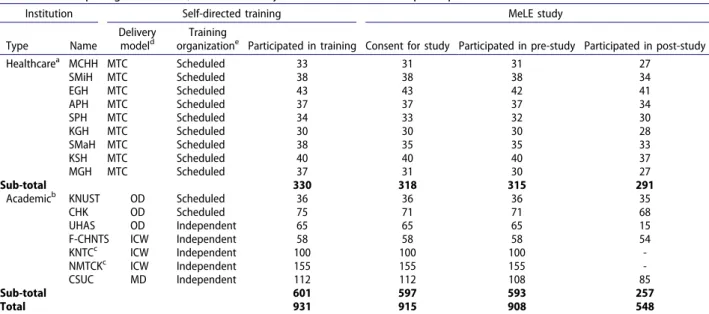
Table 1 summarizes the institutions and individuals who participated in MeLE. In Ghana, 931 pre-service and in-service health professionals participated in the self-directed training with the malnutrition eLearning course. Of 915 who consented to MeLE, about a third of the participants accessed the course through MTC (318, 34.8%), OD (172, 18.8%), ICW (313, 34.2%) and MD (112, 12.2%). Of the 548 who participated in the post study, 291 were through MTC, 118 OD, 54 ICW and 85 MD. Two academic institutions were unable to facilitate access to the course during the study period and missed the post-study data collection. They were excluded from the analysis.
Course completion
Table 2 summarizes the course completion status reported by participants post-training in relation to delivery models and relevance of the course to job/ academic progression. Overall, 354 (66.0%) reported to have completed the course, 100 (18.7%) reported they were in progress with the course and 82 (15.3%) stated they did not complete it. The percentage of participants completing the course at each institution varied widely, ranging from 100% to 25.3%.
Table 1. Participating institutions, course delivery models and individual participants.
Institution Self-directed training MeLE study
Type Name
Delivery modeld
Training
organizatione Participated in training Consent for study Participated in pre-study Participated in post-study
Healthcarea MCHH MTC Scheduled 33 31 31 27 SMiH MTC Scheduled 38 38 38 34 EGH MTC Scheduled 43 43 42 41 APH MTC Scheduled 37 37 37 34 SPH MTC Scheduled 34 33 32 30 KGH MTC Scheduled 30 30 30 28 SMaH MTC Scheduled 38 35 35 33 KSH MTC Scheduled 40 40 40 37 MGH MTC Scheduled 37 31 30 27 Sub-total 330 318 315 291
Academicb KNUST OD Scheduled 36 36 36 35
CHK OD Scheduled 75 71 71 68 UHAS OD Independent 65 65 65 15 F-CHNTS ICW Independent 58 58 58 54 KNTCc ICW Independent 100 100 100 -NMTCKc ICW Independent 155 155 155 -CSUC MD Independent 112 112 108 85 Sub-total 601 597 593 257 Total 931 915 908 548 a
Nine hospitals and their linked community centres. MCHH: Maternal and Child Health Hospital, SMiH: St Michael’s Hospital, EGH: Ejura Government Hospital, APH: Agogo Presbyterian Hospital, SPH: St Patrick’s Hospital, KGH: Kogongo Government Hospital, SMaH: St Martin’s Hospital, KSH, Kumasi South Hospital, MGH: Mankranso Government Hospital.
bThree universities and 4 health and nursing/midwifery training colleges. KNUST: Kwame Nkrumah University of Science and Technology, CHK: College
of Health Kintampo, UHAS: University of Health and Allied Sciences, F-CHNTS: Community Health Nurses Training School – Fomena, KNTC: Kokofu Nurses’ Training College, NMTCK: Nursing and Midwifery Training College Kumasi, CSUC: Christian Services University College.
c
Did not participate in the post-study and excluded from the analysis.
dDelivery models. MTC: Mobile Training Centre, OD: Online Delivery, ICW: Institutional Computer Workstation and MD: Mixed Delivery. e
Scheduling of self-directed training: scheduled – self-directed training sessions were organized by institutions, independent – participants were recommended to take the eLearning course on their own time.
Delivery models and course completion
The course completion rates in MTC (75.2%) and OD (83.0%) groups were higher than ICW (39.2%) and MD (25.3%); however, a subgroup analysis revealed a variation within the OD group with the course completion at one institution being 26.7%, which was similar to ICW and MD groups.
Relevance to job/academic progression and course completion
The course completion rates at the healthcare institu-tions (75.2%), and at KNUST (79.4%) and CHK (100%) where the course was implemented as part of their required curricula activities, were much higher than the three other academic institutions (UHAS, F-CHNTS and CSUC) where the course was introduced as additional learning in the MeLE study period, ranging from 25.3% to 39.2%.
Access to computer/Internet at home and course completion
Course completion was not associated with access to computer (P = 0.398) or Internet at home (P = 0.134) (Supplementary file 5).
Access to computer/Internet at home, relevance to job/academic progression and course completion
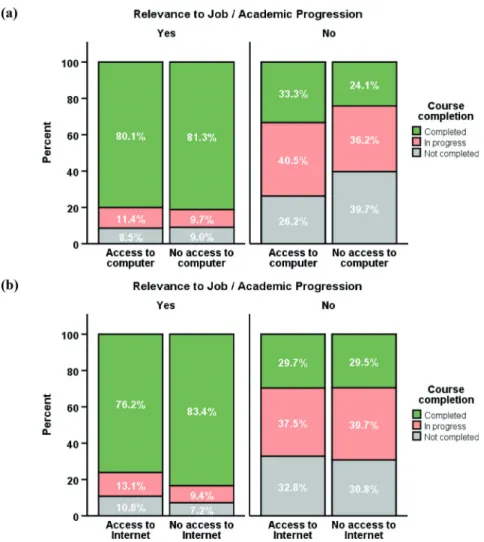
Regardless of having access to computer at home, the course completion rate was almost 3 times higher in the ‘relevant to job/academic progression’ group than those in the ‘not relevant’ group (Figure 1(a)). Similar results were found regarding access to Internet at home (Figure 1(b)).
Course completion rate of the ‘not relevant to job/ academic progression’ group was significantly lower than the ‘relevant to job/academic progression’ group irrespective of home access to computer (33.3% vs 80.1%) or not (24.1% vs 81.3%), and Internet (29.7%
vs 76.2%) or not (29.5% vs 83.4%), P < 0.001 (Supplementary file 6).
Knowledge gain
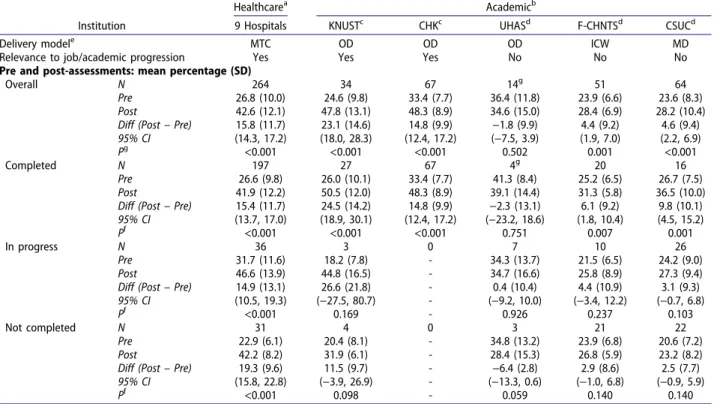
Overall, most institutions showed a significant knowledge gain from the course (difference between pre and post-assessments), ranging from 4.4% to 23.1% (Table 3). However, the mean score of the post-assessment from one institution, UHAS, was lower than the pre-assessment.
Knowledge gains between delivery models
When grouped knowledge gain by delivery models, the MTC group, KNUST and CHK in OD group obtained a significant knowledge gain from the course regardless of whether participants had completed the course, were in progress or did not complete it (Table 3). The partici-pants in the MTC group, KNUST and CHK had sched-uled self-directed training sessions with the course and, therefore, these participants’ learning time on the course was similar. Majority completed the course within the scheduled sessions. For those who did not complete the course, except two participants at KNUST who reported Internet issues, the rest reached nearly the end of the course. The differences between pre and post- assessments in the MTC group by completion status were: Completed 15.4%, In progress 14.9% and Not completed 19.3%. The differences in KNUST were: Completed 24.5%, In progress 26.6% and Not completed 11.5%; while that for CHK is Completed 14.8%. However, there was no significant increase in post- assessment score among the participants at UHAS in OD group.
For F-CHNTS in ICW and CSUC in MD groups, significant differences in knowledge gains were observed only for those who completed the course but not for those who were in progress or did not
Table 2. Course completion in relation to delivery models and relevance to job/academic progression.
Healthcarea Academicb
Institution 9 Hospitals KNUSTc CHKc UHASd F-CHNTSd CSUCd
Delivery modele MTC OD OD OD ICW MD
Relevance to job/academic progressionf Yes Yes Yes No No No
Post-study course completion, N (%)
Total N 291 35 68 15 54 85
Completed, N (%) 215 (75.2%) 27 (79.4%) 67 (100%) 4 (26.7%) 20 (39.2%) 21 (25.3%)
In progress, N (%) 39 (13.6%) 3 (8.8%) 0 (0.0%) 8 (53.3%) 10 (19.6%) 40 (48.2%)
Not completed, N (%) 32 (11.2%) 4 (11.8%) 0 (0.0%) 3 (20.0%) 21 (41.2%) 22 (26.5%)
Missing, N 5 1 1 0 3 2
aNine hospitals and their linked community centres. MCHH: Maternal and Child Health Hospital, SMiH: St Michael’s Hospital, EGH: Ejura Government
Hospital, APH: Agogo Presbyterian Hospital, SPH: St Patrick’s Hospital, KGH: Kogongo Government Hospital, SMaH: St Martin’s Hospital, KSH, Kumasi South Hospital, MGH: Mankranso Government Hospital.
bThree universities and 2 health and nursing/midwifery training colleges. KNUST: Kwame Nkrumah University of Science and Technology, CHK: College
of Health Kintampo, UHAS: University of Health and Allied Sciences, F-CHNTS: Community Health Nurses Training School – Fomena, CSUC: Christian Services University College.
c
The eLearning course formed part of formal curriculum activities and timetabled in the MeLE study period.
dThe eLearning course was introduced as an additional learning resource in the MeLE study period.
eDelivery models. MTC: Mobile Training Centre, OD: Online Delivery, ICW: Institutional Computer Workstation and MD: Mixed Delivery. fThe eLearning course content was relevant to participants’ jobs (in-service) or assessed for academic progression (pre-service).
complete it. This differing response compared with the MTC group may be due to the latter in the MTC group and at KNUST and CHG in the OD group approaching learning more thoroughly and reaching nearly the end of the course while ICW and MD groups did not. In addition, the differences between the pre and post-assessments among those who com-pleted the course at UHAS, F-CHNTS and CSUC were lower, ranging from −2.3% to 9.8%, than the MTC group or KNUST and CHK in OD group, which were from 14.8% to 24.5%.
Relevance to job/academic progression and knowledge gain
Regardless of course completion status, the “relevant to job/academic progression” group performed sig-nificantly better in the post-assessment than pre- assessment by 16.3% (95% CI 15.1, 17.5; P < 0.001). In the ‘not relevant’ group, only those who completed the course did significantly better in the post- assessment but the difference is limited to 6.8% (95% CI 3.5, 10.1; P < 0.001). Relevance of the course
to job/academic progression affected knowledge gain significantly irrespective of course completion (P < 0.001) (Figure 2 and Supplementary file 7).
Delivery costs of MTC, OD, ICW and MD with malnutrition eLearning course vs. face-to-face training
Costs for training with the malnutrition eLearning course through the different delivery models are compared in Table 4, and with comparable face-to- face training. The OD and ICW models eliminated the costs for venue hire, trainee travel and refresh-ments. MTC incurred many of the costs associated to face-to-face training but saved on trainer cost and venue hire. The unit costs per participant for training with the malnutrition eLearning course through MTC, OD, ICW and MD were: £51.0, £2.2, £1.2 and £1.1, respectively. Although higher than other models, the unit cost for MTC is about half that of delivering face-to-face training in this setting, which amounts to £105.0 (1 GHS = 0.14 GBP).
Table 3. Course delivery models, relevance to job/academic progression, course completion and knowledge gain.
Healthcarea Academicb
Institution 9 Hospitals KNUSTc CHKc UHASd F-CHNTSd CSUCd
Delivery modele MTC OD OD OD ICW MD
Relevance to job/academic progression Yes Yes Yes No No No
Pre and post-assessments: mean percentage (SD)
Overall N 264 34 67 14g 51 64
Pre 26.8 (10.0) 24.6 (9.8) 33.4 (7.7) 36.4 (11.8) 23.9 (6.6) 23.6 (8.3) Post 42.6 (12.1) 47.8 (13.1) 48.3 (8.9) 34.6 (15.0) 28.4 (6.9) 28.2 (10.4) Diff (Post – Pre) 15.8 (11.7) 23.1 (14.6) 14.8 (9.9) −1.8 (9.9) 4.4 (9.2) 4.6 (9.4) 95% CI (14.3, 17.2) (18.0, 28.3) (12.4, 17.2) (−7.5, 3.9) (1.9, 7.0) (2.2, 6.9)
Pg <0.001 <0.001 <0.001 0.502 0.001 <0.001
Completed N 197 27 67 4g 20 16
Pre 26.6 (9.8) 26.0 (10.1) 33.4 (7.7) 41.3 (8.4) 25.2 (6.5) 26.7 (7.5) Post 41.9 (12.2) 50.5 (12.0) 48.3 (8.9) 39.1 (14.4) 31.3 (5.8) 36.5 (10.0) Diff (Post – Pre) 15.4 (11.7) 24.5 (14.2) 14.8 (9.9) −2.3 (13.1) 6.1 (9.2) 9.8 (10.1) 95% CI (13.7, 17.0) (18.9, 30.1) (12.4, 17.2) (−23.2, 18.6) (1.8, 10.4) (4.5, 15.2)
Pf <0.001 <0.001 <0.001 0.751 0.007 0.001
In progress N 36 3 0 7 10 26
Pre 31.7 (11.6) 18.2 (7.8) - 34.3 (13.7) 21.5 (6.5) 24.2 (9.0) Post 46.6 (13.9) 44.8 (16.5) - 34.7 (16.6) 25.8 (8.9) 27.3 (9.4)
Diff (Post – Pre) 14.9 (13.1) 26.6 (21.8) - 0.4 (10.4) 4.4 (10.9) 3.1 (9.3)
95% CI (10.5, 19.3) (−27.5, 80.7) - (−9.2, 10.0) (−3.4, 12.2) (−0.7, 6.8)
Pf <0.001 0.169 - 0.926 0.237 0.103
Not completed N 31 4 0 3 21 22
Pre 22.9 (6.1) 20.4 (8.1) - 34.8 (13.2) 23.9 (6.8) 20.6 (7.2) Post 42.2 (8.2) 31.9 (6.1) - 28.4 (15.3) 26.8 (5.9) 23.2 (8.2)
Diff (Post – Pre) 19.3 (9.6) 11.5 (9.7) - −6.4 (2.8) 2.9 (8.6) 2.5 (7.7)
95% CI (15.8, 22.8) (−3.9, 26.9) - (−13.3, 0.6) (−1.0, 6.8) (−0.9, 5.9)
Pf <0.001 0.098 - 0.059 0.140 0.140
aNine hospitals and their linked community centres. MCHH: Maternal and Child Health Hospital, SMiH: St Michael’s Hospital, EGH: Ejura Government
Hospital, APH: Agogo Presbyterian Hospital, SPH: St Patrick’s Hospital, KGH: Kogongo Government Hospital, SMaH: St Martin’s Hospital, KSH, Kumasi South Hospital, MGH: Mankranso Government Hospital.
b
Three public universities and 2 health and nursing/midwifery training colleges. KNUST: Kwame Nkrumah University of Science and Technology, CHK: College of Health Kintampo, UHAS: University of Health and Allied Sciences, F-CHNTS: Community Health Nurses Training School – Fomena, CSUC: Christian Services University College.
cThe eLearning course formed part of formal curriculum activities and timetabled in the MeLE study period. d
The eLearning course was introduced as an additional learning resource in the MeLE study period.
eDelivery models. MTC: Mobile Training Centre, OD: Online Delivery, ICW: Institutional Computer Workstation and MD: Mixed Delivery. fPaired t test was performed.
gIncludes one participant whose post-assessment score was much lower than pre-assessment score (−13.3), due to partially completing the post-
assessment. After excluding this, overall: N = 13, Mean (SD) Pre = 35.8 (12.1), Mean (SD) Post = 35.5 (15.2), Diff (SD) = −0.3 (8.4), 95% CI = (−5.4, 4.8), P = 0.903; completed: N = 3, Mean (SD) Pre = 40.1 (9.9), Mean (SD) Post = 44.4 (11.9), Diff (SD) = 4.2 (2.1), 95% CI = (−0.9, 9.4), P = 0.072.
Figure 1. (a) Course completion and access to computer at home – no statistically significant association was found in the ‘relevant to job/academic progression’ group (P = 0.880) and ‘not relevant to job/academic progression’ group (P = 0.212); (b) Course completion and access to Internet at home – no statistically significant association was found in the ‘relevant to job/ academic progression’ group (P = 0.246) and ‘not relevant to job/academic progression’ group (P = 0.955).
Figure 2. Differences in knowledge gains (post-pre assessments) by relevance to job/academic progression (Yes: relevant to job/ academic progression – MTC group, KNUST and CHK in OD group; No: not relevant to academic progression – UHAS in OD, F-CHNTS in ICW and CSUC in MD groups). In the ‘relevant to job/academic progression’ group, (i) Completed: Mean difference = 16.1%, 95% CI (14.7, 17.5), P < 0.001; (ii) In progress: Mean difference = 15.8%, 95% CI (11.3, 20.3), P < 0.001; (iii) Not completed: Mean difference = 18.4%, 95% CI (15.0, 21.8), P < 0.001; (iv) Overall: Mean difference = 16.3%, 95% CI (15.1, 17.5), P < 0.001. In the ‘not relevant to job/academic progression’ group, (i) Completed: Mean difference = 6.8%, 95% CI (3.5, 10.1), P < 0.001; (ii) In progress: Mean difference = 2.9%, 95% CI (−0.04, 5.9), P = 0.053; (iii) Not completed: Mean difference = 2.1%, 95% CI (−0.3, 4.5), P = 0.086; (iv) Overall: Mean difference = 3.8%, 95% CI (2.2, 5.5), P < 0.001.).
Discussion
We have previously demonstrated that the malnutri-tion eLearning course improved knowledge, under-standing and skills of health professionals in the diagnosis and management of children with SAM, leading to changes in clinical practice and improved confidence, and improved identification of SAM and almost all aspects of the WHO ‘Ten Steps’ of case- management, and reduced case-fatality [32,33]. This study further demonstrates that scaling up capacity/ training in malnutrition management, a recognised challenge in most LMICs [22–26], is possible through eLearning if it is supported by contextually appropri-ate delivery and implemented as part of curriculum development or in-service training. Key strategies outlined by UNICEF to expand access to quality treatment of SAM include building national capaci-ties and strengthening systems to support SAM man-agement scale-up for which a well-trained workforce is essential [27]. Despite many calls for capacity building among health professionals in the manage-ment of malnutrition [28,34], taking the necessary steps to make this happen has not been easy. During MeLE in Ghana, the eLearning course was offered to 938 in-service and pre-service health
professionals at 9 healthcare and 7 academic institu-tions. The numbers of institutions involved and par-ticipants trained in this study demonstrate the potential of the course as a scalable training solution for SAM management. The implementation process for the malnutrition eLearning course and findings from the evaluation also offer a practical guide for implementing available eLearning in general to increase access to training and to support its effective utilization in LMICs [1].
Online delivery is ideal for eLearning but this is only possible where Internet is accessible. In Ghana Internet limitations are common [35] and going online can be problematic [36]. Only 3 of the 16 institutions in MeLE had sufficient Internet capacity for online delivery. Limited computer and Internet access however can be overcome. The 9 healthcare institutions in the study had neither workstations nor Internet access. Through setting up a temporary training facility (MTC) using the offline malnutrition eLearning course on the research team’s and participants’ own computers, the parti-cipants were able to take the course. And so were the participants at 4 academic institutions through ICW and MD. The results showed that participants’ completion of the course was not determined by
Table 4. Cost comparison between face-to-face training delivery and different delivery models used for the malnutrition eLearning coursea.
Delivery modelb
Unit cost (GHS) Items of money spent actually
on Unit Cost Face-to-face 3-day training3 MTC (9 institutions) OD (3 institutions) ICW (3 institutions) MD (1 institution)
Number trained4 N/A 30 318 172 313 112
Staff coste Per diem 1000 9,000 40,500 1,800 1,800 600
Trainer travel costf Daily per
person
100 300 8,100 900 900 300
Trainees travel costg Daily per
person
20 1800 19,080 0 0 0
Refreshmenth Daily per
person
100 9900 48,150 0 0 0
Venue hirei Per training 1500 1500 0 0 0 0
Total in GHS 22,500 115,830 2,700 2,700 900
Total in GBPj £3,150.0 £16,216.2 £378.0 £378.0 £126.0
Unit cost for training per person (GHS/GBP) 750/£105.0 364.2/£51.0 15.7/£2.2 8.6/£1.2 8.0/£1.1 a
The costs for developing eLearning and face-to-face training have not been included.
bDelivery models. MTC: Mobile Training Centre, OD: Online Delivery, ICW: Institutional Computer Workstation and MD: Mixed Delivery. c
The cost was calculated on the assumption that the training will be delivered by external trainers.
dNumber of participants trained, as the basis of unit cost. e
Per diem for OD and ICW (1 hour) = 200, MTC (0.5 day) = 500. Staff cost = unit cost x no of trainers/resource persons x number of days x number of institutions: face-to-face training: daily unit cost (1000) x 3 trainers x 3 days x 1 = 9000, MTC = half day unit cost (500) x 3 persons x 3 days x 9 institutions = 40,500, OD = 1 hour unit cost (200) x 3 persons x 1 day x 4 institutions = 1800, ICW = 1 hour unit cost (200) x 3 persons x 1 day x 3 institutions = 1800, MD = 1 hour unit cost (200) x 3 persons x 1 day x 1 institutions = 600.
f
Trainer travel cost = unit travel cost x number of individuals x number of visits x number of institutions. Travel costs for: face-to-face training = 100 x 3 × 1 x 1 = 300, MTC = 100 x 3 × 3 x 9 = 8100. OD, ICW MD = 100 x 3 × 1 x 3 = 900 for OD, 900 ICW and 300 MD. The calculation of travel cost for MTC is made based on 3 days.
gTrainee travel cost = unit cost for travel x number of days x number of individuals. Trainee travel costs for: face-to-face training = 20 x 3 × 30 = 1800,
MTC = 20 x 3 × 318 = 19,080.
Reimbursing trainees’ travel cost was relevant as participants came from different health centres to the district hospitals for the training.
h
Refreshment cost = unit cost for refreshment x number of days x number of persons invited to training plus trainers. The refreshment cost for face-to- face raining = 100 x 3 × 33 = 9900, MTC = 50 x 3 × 321 (Unit cost for refreshment for MTC is different from face-to-face because training takes half a day).
iVenue cost may be 0 GHS if institutions have venue for training. Otherwise, cost will apply. For the MTC, a room/venue appropriate for self-directed
learning (not suitable for face-to-face training) was made available by each participating healthcare institution.
delivery models nor access to computer (P = 0.398) and/or Internet (P = 0.134) at home. This indicates that the four delivery models implemented in this study were different but offered equivalent learning/ training opportunities to the participants. Hospitals/ health centres in Ghana organize periodic in-service training, and nationally there is a drive for academic institutions to have workstations equipped with computers [37]. Therefore, this result is important as it offers a way forward for the management of malnutrition and other areas requiring scalable training solutions in Ghana and other LMICs.
Previous studies suggested that recognition of eLearning, integrated into curricula and/or recognized as CPD, influences its completion and benefits gained from it [9,10], and this was confirmed by the study. The benefits derived from the malnutrition eLearning course were determined by relevance of the course to job and how it was integrated into academic curricula. Two academic institutions in the OD group, CHK and KNUST where the course was integrated as required curriculum activities in the evaluation period, had course completion rates of 100% and 79.4%, respec-tively. However, only 26.7% of UHAS participants in the OD group where the course was offered as addi-tional learning completed the course.
Course completion was much higher among par-ticipants in ‘Relevant to job/academic progression’ group (P < 0.001), irrespective of computer access (yes 80.1%, no 81.3%) or internet access (yes 76.2%, no 83.4%) at home than those in ‘Not relevant’ (com-puter access: yes 33.3%, no 24.1%; Internet access: yes 29.7%, no 29.5%). Knowledge gained from the course was also affected by relevance of the course to parti-cipant jobs or academic progression. The gained knowledge in the ‘Relevant to job/academic progres-sion’ group was 12.5% higher than the ‘Not relevant’ group (95% CI 10.2, 14.7; P < 0.001).
Two academic institutions, KNMTC and KNTC, implemented the course as extra, optional, learning. Both took part in the pre-assessment but, according to staff, the students complained of having no readily accessible internet access. We surmise that timetabled activities were prioritised for workstations and, as it was optional learning, it was difficult for the students to access computer and Internet during study hours and they also had less motivation to complete the course. The study team subsequently organised an offline version for the institutions but it was then too late for the students to complete the training in the study period. We excluded these institutions from the analysis as no post-assessment scores were avail-able. These observations perhaps underscore the importance of timetabling learning sessions with any eLearning to ensure participants have time to access and take part, as well as the need to strengthen
capacity for independent learning, if eLearning is to be effective.
Major obstacles to in-service training of health-care workforce are the delivery cost of centralized tutor-based training, shortage of experienced trai-ners, inadequate supply of training materials, poor follow-up and supportive supervision, the difficulty of releasing essential staff for off-site training and costs of per diem travel and accommodation [38,39]. The cost analysis undertaken suggests that imple-menting the malnutrition eLearning can reduce the training cost on SAM management as well as increase access to training opportunities. OD, ICW, MD are most cost-effective, needing a minimal staff time for eLearning introduction. MTC incurs a higher cost requiring scheduled ses-sions even if the training is self-directed. However, it still is less than half the cost of delivering face-to- face onsite training. For eLearning that is proven to be effective, these different models should be con-sidered, especially in LMICs, to scale up training of healthcare workforce. The eLearning course was developed in the UK and the initial cost for devel-oping the course was high (£40,000 for a 6–9 hour highly interactive, media-rich eLearning), and devel-opment costs may limit the potential of eLearning. However, the main rationale for this paper is to show the feasibility of utilizing available eLearning for scalable capacity building. Furthermore, with many eLearning courses, including massive open online courses (MOOCs), freely available for insti-tutions and individuals to take advantage of, new eLearning development should be considered only if there is no available eLearning. If new eLearning is to be developed, then the initial development costs will have to be addressed. Costs for computers were not included as our aim was to utilize existing resources, which proved possible. Hiring or pur-chasing computers would increase implementation costs.
This study has limitations. Course completion was self-reported by participants, and some may have misreported. Online course completion was tracked in a database but not for the offline version. Participation in MeLE was voluntary and kept con-fidential; therefore, we consider participants reported their completion status correctly. The post- assessment score for those who completed the course at UHAS was lower than their pre- assessment score. UHAS post-study participation rate was low (15/65, 23.1%) and only 4 completed the course. We do not know the reasons for their low study participation but it is likely that the low participation rate, low course completion and no significant improvement between pre and post- assessments are associated.
Conclusion
The malnutrition eLearning course makes global capa-city building in malnutrition management achievable and effective. Our experience in implementing the course in Ghana suggests that available eLearning can be utilized successfully to scale up in-service and pre- service training in LMICs if contextually appropriate delivery is considered and implemented to suit institu-tional IT readiness and is introduced as a core part of curricula or is implemented within in-service training for those with relevant job responsibilities.
Acknowledgments
The authors sincerely thank the 9 hospitals, and 7 academic institutions, and individual in-service and pre-service health professionals who participated in the Malnutrition eLearning Evaluation (MeLE) study in Ghana. The participating institu-tions were Maternal and Child Health Hospital, St Michael’s Hospital, Ejura Government Hospital, Konongo Government Hospital, Kumasi South Hospital, Agogo Presby Hospital, St Martin’s Hospital, St Patrick’s Hospital, and Mankranso Hospital; Pokukrom and Sabronum Community Health Centres, and the University of Health and Allied Sciences, Kwame Nkrumah University of Science and Technology, Christian Services University College, Kokofu Nurses’ Training College, Community Health Nurses Training College, Nursing and Midwifery Training College, and College of Health and Well-being in Ashanti Region, Ghana. The authors greatly value the contributions of those in the UK who enabled and supported the malnutrition eLearning project and its evaluation.
This report was produced through the support provided by PATH under a grant by the UK Aid from the UK government; however, the views expressed do not necessarily reflect the UK government’s official policies. The funder was not involved in the study design; the collection, analysis, and interpretation of data; the writing of the report; and in the decision to submit the article for publication.
Author contributions
SC and TP conceived and designed the overall MeLE study. RA, MMV, AA and HMY contributed to the study design. RA identified the study sites in Ghana and led the design and implementation of 4 different eLearning delivery models. RA, LNEA and SKB conducted the study in Ghana. SC, HMY and RA analysed the data and interpreted the results. RA led the preparation of the manuscript and SC, HMY, LNEA and SKB contributed to the manuscript preparation. SC, HMY, MMV, AP, TP, AAJ and AA critically reviewed and revised the manu-script. All authors participated in the final approval of the manuscript. All authors had full access to all of the data (including statistical reports and tables) in the study and can take responsibility for the integrity of the data and the accuracy of the data analysis.
Disclosure statement
Conflict of interest and funding: AA, RAA, AAJ and SC were part of the malnutrition eLearning development team but accepted no financial support.
Funding information
This malnutrition eLearning evaluation was undertaken through the support provided by the PATH under a grant by the UK Aid from the UK government under Grant number DFI.1836-554999-1.GRT.
Data availability statement
The dataset from which the analyses have been made will be made available upon request.
Ethics and consent
This study was reviewed and approved by the ethics committees of the University of Southampton, UK (Ethics ID:12872) and Komfo Anokye Teaching Hospital and Kwame Nkrumah University of Science and Technology, Ghana. Informed consent was obtained from participants and institutions before the commence-ment of the study.
Paper context
Building capacity for malnutrition management is a recognised global challenge. eLearning can offer scalable training at low cost. In LMICs this requires effective imple-mentation to overcome infrastructure challenges and ensure utilization. This study reports training of health professionals at 16 healthcare and academic institutions in Ghana using the malnutrition eLearning course through implementing four different delivery models. Course com-pletion rates and benefits realized were significant, demon-strating effective eLearning implementation for capacity building at scale.
ORCID
Reginald Adjetey Annan http://orcid.org/0000-0002- 6559-1636
Linda Nana Esi Aduku http://orcid.org/0000-0002-8768- 442X
Samuel Kyei-Boateng http://orcid.org/0000-0001-8874- 5696
Ho Ming Yuen http://orcid.org/0000-0002-3424-7410 Trevor Pickup http://orcid.org/0000-0001-5364-7922 Andy Pulman http://orcid.org/0000-0001-7506-6897 Michele Monroy-Valle http://orcid.org/0000-0002-4588- 145X
Ann Ashworth http://orcid.org/0000-0002-2948-0699 Alan A. Jackson http://orcid.org/0000-0001-8075-3667 Sunhea Choi http://orcid.org/0000-0001-6288-3142
References
[1] Tinio VL. ICT in education. Proceedings of the World Summit on the Information Society. [cited 2003 Dec 10–12]. Geneva, Switzerland; 2003.
[2] Van der Wende MC. Globalisation and access to higher education. J Stud Int Educ. 2003;7:193–206. [3] Power T, Gater R, Grant C, et al. Educational
Education Advice & Resource Team (HEART); 2014.
[4] Schutte L, Fraukje EFM, Meijer S, et al. Effect evalua-tion of a web-based coaching intervenevalua-tion to support implementation of sex education among secondary school teachers: randomized controlled trial. J Med Internet Res. 2018;20:1–96.
[5] Durlak JA, DuPre EP. Implementation matters: a review of research on the influence of implementa-tion on program outcomes and the factors affecting implementation. Am J Comm Psyc. 2008;3:327–350. [6] Little MA, Riggs NR, Shin HS, et al. The effects of
teacher fidelity of implementation of pathways to health on student outcomes. Eval Health Prof. 2015;38:21–41.
[7] Lendrum A, Humphrey N. The importance of study-ing the implementation of interventions in school settings. Oxf Rev Educ. 2012;38:635–652.
[8] Frehywot S, Vovides Y, Talib Z, et al. E-learning in medical education in resource constrained low- and middle-income countries. Hum Resour Manag J. 2013;11:2–15.
[9] Gutierrez K. Seven factors or ensuring a successful eLearning implementation. Shift disruptive E-learning [internet]. 2018 Dec 04 [cited 2019 Feb 26] Available from: https://www.shiftelearning.com/ blog/bid/210351/7-key-factors-to-ensure-a-successful- elearning-program
[10] Gupta M, Marsden S, Oluka T, et al. Lessons learned from implementing E-Learning for the education of health professionals in resource-constrained countries. Electron J e-Learn. 2017;15:144–155.
[11] Akombi BJ, Agho KE, Merom D, et al. Child malnu-trition in sub-Saharan Africa: a meta-analysis of demographic and health surveys (2006-2016). PLoS One. 2017;12:e0177338.
[12] Malnutrition in children. UNICEF/WHO/World Bank Joint Child Malnutrition Estimates, March 2020 edition. Available from: www://data.unicef.org/topic/ nutrition/malnutrition
[13] FAO. Regional overview of food security and nutrition in Africa 2016: the challenges of building resilience to shocks and stresses. Accra: Food and Agriculture Organisation; 2017.
[14] Ghana Statistical Service (GSS), Ghana Health Service (GHS), and ICF International. Ghana Demographic and Health Survey 2014. Rockville, Maryland, USA: GSS, GHS, and ICF International; 2015.
[15] Fore HH, Dongyu Q, Beasley DM, et al. Child mal-nutrition and COVID-19: the time to act is now. Lancet. 2020;396:517–518.
[16] Black RE, Laxminarayan R, Temmerman M, et al. Reproductive, maternal, new-born, and child health. Disease control priorities. Washington (DC): World Bank; 2016.
[17] WHO. Guideline: updates on the management of severe acute malnutrition in infants and children. Geneva: World Health Organization; 2013.
[18] Hossain M, Chisti MJ, Hossain MI, et al. Efficacy of World Health Organization guideline in facility-based reduction of mortality in severely malnourished chil-dren from low and middle income countries: a systematic review and meta-analysis. J Paediatr Child H. 2017;53:474–479.
[19] Karaolis N, Jackson D, Ashworth A, et al. WHO guidelines for severe malnutrition: are they feasible
in rural African hospitals? Arch Dis Child. 2007;92:198–204.
[20] Landi M, Swakin E, Minijihau C, et al. Severe malnutrition in children in Papua New Guinea: effect of a multi-faceted intervention to improve quality of care and nutritional outcomes. Paediatr Int Child H. 2017;37:21–28.
[21] Bhutta ZA, Das JK, Rizvi A, et al. Lancet nutrition interventions review group‚ the maternal and child nutrition study group evidence-based interventions for improvement of maternal and child nutrition: what can be done and at what cost? Lancet. 2013;382:452–477.
[22] Tewoldeberhan D, Tarig M, Hanaa G, et al. Scaling up CMAM in protracted emergencies and low resource set-tings: experiences from Sudan. Field Exch. 2017;55:74. [23] Jackson AA, Ashworth A, Khanum S. Improving
child survival: malnutrition task force and the pae-diatrician’s responsibility. Arch Dis Child. 2006;91:706–710.
[24] Jackson AA, Ashworth A, Mokhtar N, et al. Severe malnutrition: building on the past for a brighter future. Food Nutr Bull. 2014;35:3–9.
[25] Gillespie S, Haddad L, Mannar V, et al. Maternal and Child Nutrition Study Group: the politics of reducing malnutrition: building commitment and accelerating progress. Lancet. 2013;382:552–569.
[26] Ahmed T, Hossain M, Mahfuz M, et al. Severe acute malnutrition in Asia. Food Nutr Bull. 2014;35:14–26. [27] UNICEF. Programme guidance management of severe
acute malnutrition in children. New York (NY): United Nations International Children Emergency Fund; 2008.
[28] African Nutrition and Epidemiology Conference, 4 Nairobi Declaration. Malnutrition Forum. [cited 2019 Feb 26]. Available from: http://www.imtf.org/ anec-4-nairobi-declaration
[29] Ellahi B, Annan R, Sarkar S, et al. Building systemic capacity for nutrition: training towards a professionalised workforce for Africa. Proc Nutr Soc. 2015;74:496–504.
[30] Pickup T, Annan R, Choi S. Malnutrition eLearning course. Afr Nutr Matters. 2014;2:13–14.
[31] Malnutrition eLearning course. Available from: https://www.med.soton.ac.uk/nutrition/index. html
[32] Choi S, Yuen HM, Annan R, et al. Effectiveness of the malnutrition eLearning course for global capacity building in the management of malnutrition: cross-country interrupted time-series study. J Med Internet Res. 2018;20:e10396.
[33] Choi S, Yuen HM, Annan R, et al. Improved care and survival in severe malnutrition through eLearning. Arch Dis Child. 2020;105:32–39.
[34] Schofield C, Ashworth A, Annan RA, et al. Malnutrition treatment to become a core competency. Arch Dis Child. 2012;97:10–15.
[35] Farrell G, Isaacs S, Trucano M. Survey of ICT and education in Africa: country reports. Washington (DC): World Bank; 2007.
[36] Mfum-Mensah O. Computers in Ghanaian Secondary Schools: where does equality come in? Curr Issues Comp Educ. 2003;6:40–49.
[37] Frempong GK. 2007 Ghana telecommunications sec-tor performance review: a supply side analysis of pol-icy outcomes. Accra: Science and Technology Polpol-icy Research Institute; 2007.
[38] Mormina M, Pinder S. A conceptual framework for training of trainers (ToT) interventions in global health. Global Health. 2018;14:100.
[39] Abebe AM, Kassaw MW, Mengistu FA. Assessment of factors affecting the implementation of integrated
management of neonatal and childhood illness for treatment of under five children by health profes-sional in health care facilities in Yifat Cluster in North Shewa Zone, Amhara Region, Ethiopia. Int J Pediatr. 2019;2019:9474612.