MODERN SOLUTIONS FOR ECONOMIC HIGHER EDUCATION
IN THE KNOWLEDGE-BASED SOCIETY
Paul Pocatilu1∗ and Cristian Ciurea2
1) 2) Academy of Economic Studies, Bucharest, Romania
Abstract
The use of modern solutions specific to contemporary society, together with stakeholders’ involvement, will lead to a substantial increase in the practice-oriented approach of the teaching process. The objective of this paper is to present directions for the implementation of modern teaching solutions in the economic higher education. It highlights the implications that knowledge-based economy brings for the economic higher education. It analyzes the virtual campus as a modern solution for collaborative higher education and the level of knowledge in the use of mobile devices and technologies in the learning process of students from three faculties of the Academy of Economic Studies. The analysis is based on a survey conducted among students enrolled in three faculties of the Bucharest Academy of Economic Studies. A series of indicators is proposed to assess the efficiency of human resources training activities, developed in order to enhance the relevance of economic higher education for the labor market and knowledge-based society. The research results consist in identifying modern solutions for the use of mobile technologies by students in the educational process.
Keywords: knowledge society, higher education, e-learning, m-learning, information technology
JEL Classification: D83, I21
Introduction
In the recent years, the economic higher education has become more interdisciplinary, sophisticated and, all the same, knowledge-based. In this complex educational environment, where universities operate, the e-learning process managed, by different tools of interaction, to provide ample opportunities for students to collaborate with teachers, experts in the field, professionals or other students (Delcea, Dascalu and Ciurea, 2010).
The e-learning activity has an essential role in educating and training the new generation of teachers, as well as developing the capabilities of the existing teachers to use the latest tools and technologies in the teaching - learning process (Guanying, 2010).
The evolution of the knowledge-based society involves the development of economic higher education through a collaborative learning environment with mobile devices and wireless technologies used to motivate students learning in different contexts and in a proactive manner. European Union funded and continues to fund projects dedicated to the development and implementation of m-learning solutions. For example, the COLLAGE project (Collaborative Learning Platform Using Game-like Enhancements) seeks to define a tool that will contribute to an innovative approach of the learning process, The tool, more flexible, allows the definition of integration models of formal and informal learning sources by a combination of technologies, in a single environment for the promotion and improvement of the learning environment (Sotiriou et al., 2008).
In the knowledge-based society, the concept of m-learning is combined with the traditional educational process in order to create the concept of blended learning, where students learn in classrooms or laboratories, but also perform various educational activities outside such facilities (Martin and Carro, 2009).
The paper aims at the following objectives:
• analysis of the main educational solutions in the economic academic environment;
• presentation of the advantages of using modern educational solutions which would
increase the future economists’ practical knowledge level;
• identification of students’ preparedness degree regarding the use of mobile technologies; • ways to evaluate efficiency of training activities in the educational process.
The paper is comprised of six sections, as follows:
Section 1 presents the context of this paper to the readers, establishing the link between knowledge-based economy and economic higher education.
Section 2 analyzes the e-learning system implemented in the Academy of Economic Studies through the virtual campus.
Section 3 focuses on a complementary solution: the m-learning. It presents the architecture of such a system, it analyzes the entities, competences and their roles, and the components involved. It also establishes the necessary steps for the implementation of this solution in the Academy of Economic Studies.
Section 4 presents a model for assessing the efficiency of training activities of human resources involved in the education process based on modern solutions, specific to the digital economy.
Section 5 presents the results of a case study applied in the Academy of Economic Studies, regarding the use of mobile technologies in the students training process.
Section 6, presents and analyses the results achieved.
The final section presents conclusions and future directions for research in the field of modern solutions in economic higher education.
1. Knowledge-based economy and economic higher education
In the knowledge-based economy (Leydesdorff, 2006), the universities have a key role in preparing future specialists on the labor market and in the creation of knowledge. In Kefela (2010), knowledge and technologies are considered the heart and brain of the global economy. Knowledge-based economy is one in which ideas and technologies are considered the ingredients of innovation. The importance placed on education and human capital in a country’s economic growth represents the key element for the implementation of knowledge-based society. In the knowledge society, the processes of creating, sharing and use of knowledge have the single objective of increasing the welfare and prosperity of mankind. In (Pîrciog, et al., 2010) it is stated that a good quality of educational services would help provide important advantages to beneficiaries, to their families and to society as a whole.
In the context of the transition to the knowledge-based society, organizations have undergone various changes, depending on their nature. Whilst a company, such as a bank, does not justify its existence without making a profit, in an institution of economic higher education the main objective is to fulfill the educational needs of its members. In recent years, a trend of increasing the number, weight and importance of institutions has manifested, however the company remains the most important organization.
The knowledge-based society and economy require lowering the barriers between categories of specialists, between the work at the office and the work at home, between the individual and the organization (Nicolescu and Verboncu, 2008). The teaching activity requires that the preparation of courses and seminars to take place at home, so that their presentation to be carried out within the institution.
The knowledge society has evolved with the advent of computers and informatics development; changes have taken place in the training level of people, producing an intellectualization of work processes.
As the transition to knowledge-based economy is realized, the organization becomes aware of the following functions:
• the information function, meaning that information within the organization start to all
members so that each person involved to know the activities and processes taking place within the organization and to obtain exactly the information of interest to it;
• the transformation function, meaning that in an organization enter raw data, as it will
summarize those data and transform them into meaningful data, with a certain importance;
• the education function, which refers to the cultivation of human resources on the
generation, sale, storage, development, sharing and protection of knowledge that have become essential to achieve economic performances and to generate competitive advantage (Nicolescu and Verboncu, 2008).
The economic higher education is moving towards a new stage in its development, stage enhanced in the knowledge-based society and completed in the consciousness society (Drăgănescu, 2007). In this new stage, a high level of social responsibility of universities is shown, with the purpose of providing high level specialists to the business environment. The corporate social responsibility (Dinu, 2011) contributes to financing the educational
programs from the universities, and the social responsibility of universities contributes to increasing the quality of human resources inside corporations. It produces a chain of responsibilities with benefic effect on the development of economic higher education. 2. The virtual campus – solution for collaborative higher education
By type of application criterion, collaborative systems are classified into several categories, one of them being collaborative educational systems. Such systems are applied in the educational field and have as objective the assessment and the improvement of educational process performances.
A virtual campus is a virtual organization with a collaborative structure that facilitates and encourages learning and social interaction among students.
The e-learning platform of a virtual campus allow distribution of courses in text format, graphics and multimedia, contains elements of synchronous and asynchronous communication and advanced testing systems of these elements.
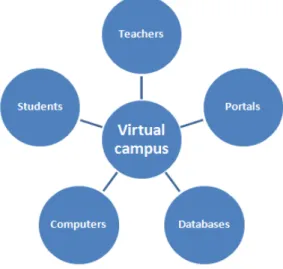
The virtual campus has internal and external components, such as teachers, students, computers, databases and portals. Implementing the architecture of virtual campus is a long term aspiration, requiring the solutions of numerous research problems, both in the field of education and the technological one.
Figure no. 1 presents the simplified architecture of the virtual campus from the Academy of Economic Studies.
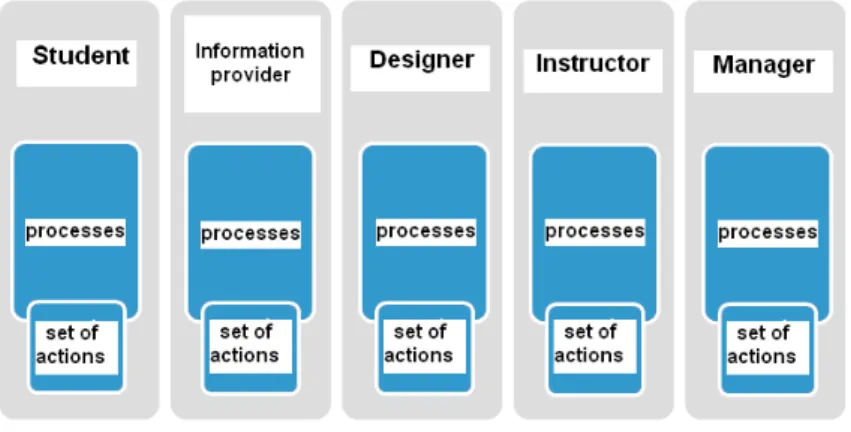
Figure no. 1: Components of virtual campus from the Academy of Economic Studies An agent from the virtual campus represent any entity that interact or exchange data in the collaborative system, be it people or software applications. In the act of collaborative learning, using e-learning or m-learning, there are five categories of agents (The Journal, 2001):
• an information provider and three agents that facilitate the conversion of information; • a designer that makes the information easily to be absorbed;
• an instructor, who assist the student in the conversion process; • a manager, which provides a context easy for the process.
Figure no. 2 presents the agents of collaborative learning process in the virtual campus.
Figure no. 2: Categories of agents in a mobile virtual campus
Every agent role is seen as a group of processes that the agent is able to execute. Each process is a set of actions that a user performs during the interaction in the virtual campus. A process is a way to use the collaborative system. The full set of available processes defines the scope for which the collaborative system is used and requires a specific configuration.
The main objectives of the virtual campus are the development and diversification of online education for all forms of education, activity that takes place on the e-learning platform of a university, providing logistical support, monitoring the e-learning activity, training of participants and development of online guide for students and teachers.
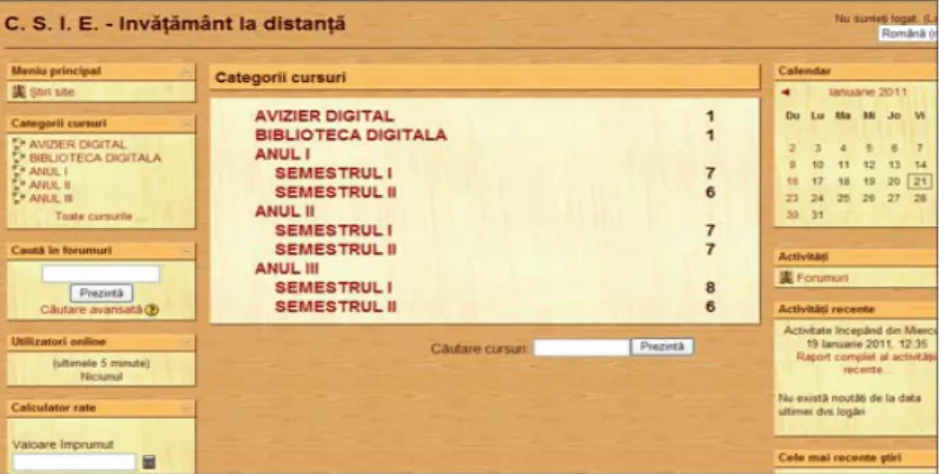
The platform interfaces that support the activity from the virtual campus are natural and users friendly. Figure no. 3 shows the platform interface associated to the virtual campus from the Academy of Economic Studies.
The e-learning platform of the virtual campus from the Academy of Economic Studies allows simultaneous pursuit of many online masters’ and distance learning programs. For each educational program there is a database of courses and a database of users. The access of students to a particular course is conducted on the basis of a registration key.
The virtual campus provides a complete learning environment. The campus includes a personalized portal through which each student monitor the remaining hours, the status of his student account, the courses schedule, notes and tasks to accomplish. The home page of student includes daily news in its field of study and general notices from the campus.
Figure no. 3: Platform interface associated to the virtual campus Source: Platform CSIE-ID, 2011
3. Mobile educational solutions
Using mobile technologies in the learning process requires access to educational resources through mobile devices and dedicated mobile applications. The information content must be adapted to the restrictions imposed by the mobile device and applications.
According to Visoiu (2010), the m-learning applications are likely to become widespread, since the number of devices that have significant processing capacities is increasing. The main advantages of m-learning applications are as follows:
• high mobility of devices;
• permanent access to the mobile device; • any time access to the educational platform; • the students contact with new technologies;
• students motivation through practical and creative approach of the educational process; • the ability to solve practical problems on the spot and immediate transmission of results. Mobile technologies can be used in the educational process both in daily education, but especially in distance learning. The m-learning solutions represent a complementary system of currently used methods (the classical system and virtual campus).
In Figure no. 4 are presented the components of an m-learning system and the main entities involved.
Figure no. 4: Components and entities involved in a flexible m-learning system Educational content Mobile device M-learning platform Content management Student Teacher
The teacher develops the educational content, tests, homework and projects. Also, the teacher assesses students and keep in touch with them using a variety of ways (forum, email, SMS, etc.).
The students have access to educational content via a mobile device and a mobile application. The used mobile devices are mobile phones, smart phones or tablet PC. Students access the content of courses and seminars, send themes and projects, solve tests via the mobile device and the m-learning platform.
The m-learning platform is the component that provides the functionality of m-learning system. This includes both software and hardware. It is possible to use the existing infrastructure of virtual campus (if there is support for mobile devices).
The educational content should be presented in a form that can easily be represented on the mobile device. This includes text, graphics, audio, video and animation. Unlike virtual campus, the presentation manner must be adapted to the specific limitations of mobile devices (e.g. screen size, processing power).
In some implementations, the software component and the educational content (in whole or in part) can be found on the mobile device, not being necessary the permanent interaction of student, through mobile technology, with the system, but only when it is necessary to update the content.
The content management is done by the teacher or by specialized technical staff. Can be used the existing m-learning platform or a standalone application.
In order to use an m-learning system, the following steps are necessary:
• the teacher develop the educational content;
• information content is distributed on the m-learning platform; • the students access the educational content via mobile devices;
• students and teachers interact through the m-learning platform.
To implement an m-learning system in the academic environment it is necessary the existence of an adequate infrastructure and its acceptance by students and teachers.
In order to implement an m-learning system in the Academy of Economic Studies, there are identified the following requirements:
• the existence of a hardware and software platform;
• the development of educational content specific for mobile devices or adaptation of the
existing one;
• the development of mobile applications for students access; the applications are
realized starting from the analysis of technologies available for students; • the training of teachers and students regarding the use of m-learning platform.
An important part of these requirements is met: the hardware and software support, the studies conducted, the experience of teachers in using e-learning platforms. It is necessary to develop an m-learning platform, preparing the course materials and promoting this technology. At the outset, a pilot project is tested to assess the impact and weaknesses of the system.
4. Assessment of the training level of human resources involved in the educational process
In the knowledge-based economy, human resources are considered a significant factor in the development of the organization and maximization of its profit. The training of human resources is done both in the universities and at the workplace through training programs. The training of employees at workplace must be performed at least every five years. In this period of time, a person performs one or more qualifications courses. An indicator for evaluating the level of staff training is the efficiency of training activities.
The efficiency of staff training activities, EAFP, is determined based on the relation:
100 × = NP NT EAFP (1) where:
NT – the total number of training courses or qualifications supported by the organization in five years.
NP – the number of qualified people in five years.
The investment in training courses have begun to be redirected to external human resource of the organization, used by it to replace the staff who are not progressing. The financial results of an economic organization depend largely on the quality of its staff and the efforts realized by every employee. For each position in an organization, the human resources department seeks individuals with a higher degree of training than that required by the job description. The purpose of this recruitment is to eliminate situations where an employee fails to meet certain requirements or to solve certain problems related to his activity. The indicator for evaluating the preparedness efficiency of a student in the virtual campus,
EPS, is calculated as follows:
TOE TPE NSE EPS + = (2) where:
TPE – the average time spent on preparing an examination in the virtual campus;
TOE – the average time of rest between two examinations in the virtual campus;
NSE – the average of notes obtained by a student to undertaken examinations in the virtual campus.
For example, in the virtual campus of the Academy of Economic Studies, the experimental results from Table no. 1 were obtained for indicators TPE, TOE and NSE in the case of 10 students participating at the survey.
Table no. 1: Experimental values for the EPS indicator calculation 1 2 3 4 5 6 7 8 9 10 TPE 5 6 5.5 3.5 4 6.5 3 5 4.5 5.5 TOE 10 9 8.5 9.5 11 10.5 10 7.5 11.5 9.5
From Table no. 1 was determined the average time spent on preparing an examination TPE = 4.85 hours, the average time of rest between two examinations TOE = 9.7 hours and the average of notes obtained by a student to undertaken examinations NSE = 8.75. It results that the indicator for evaluating the preparedness efficiency of a student in the virtual campus, EPS, has the value EPS = 0.60, which means that the efficiency of student training in the virtual campus is 60%.
The education should not be treated only as an opportunity for development and progress of society, a better education is an opportunity for personal development of everyone. The knowledge-based society and economy should not only focus on the high level of education, but also on high technology research.
The mission of universities in the knowledge society is oriented towards scientific research activities and on developing and maintaining partnerships with the private sector.
In the knowledge-based economy, the educational process takes place both in classical way and in the virtual campus. The virtual campus is a collaborative educational system whose role is to develop processes in which teachers post lessons and courses, realizes tests bases, organize the schedule of evaluations. In a virtual campus, a student enrolls in certain courses, takes exams and receives notes.
In the virtual campus should be taken into account the rigorous elements related to schedule, especially those periods in which each resource is available. A course is posted on the platform in a certain period of time. Before and after this period, the course is not available. Also, uploading homework and projects made by students is done until a certain date and time. The projects uploaded onto the platform after the closing date and time are not taken into account.
An important role is played by security elements, namely the possibility of accessing the users’ accounts or email addresses by unauthorized persons. The platform associated to the virtual campus must support simultaneous access for a large number of users. The database containing the user authentication data, their contact data and the results obtained after the assessments should not be accessed by other persons than those authorized.
In order to analyze the level of knowledge within a virtual campus, the following indicators are defined, based on (Pocatilu, Doinea and Ciurea, 2010):
KC – the indicator that reflects the knowledge created in the virtual campus;
KA – the indicator that reflects the knowledge accumulated in the virtual campus;
KS – the indicator that reflects the knowledge shared in the virtual campus;
KU – the indicator that reflects the knowledge used in the virtual campus;
KI – the indicator that reflects the knowledge internalized in the virtual campus.
The e-learning platform of the virtual campus contains a knowledge base that is constantly updated with the help of participants to various educational activities, and respectively by teachers and students. As the information submitted by the teachers turns into knowledge for students, the knowledge base from the virtual campus is updated. The indicator that reflects the knowledge created, KC, aims to quantify the amount of knowledge added to the knowledge base. The start time for measurements is the beginning a new academic year. At the beginning of the academic year, it is analyzed the amount of knowledge accumulated in the knowledge base up to that point, by determining the indicator KA. At the time t, it is
determined the level of knowledge created by the calculation of KC indicator. The shared knowledge is those which can be accessed from outside the virtual campus by persons that do not participate in educational programs from the campus. The volume of shared knowledge is analyzed using the indicator KS. The knowledge from knowledge base that are accessed and used by students to produce other knowledge is quantified using the KU indicator, representing the amount of knowledge used. A part of the knowledge created and accumulated must not be shared with other users, but must be internalized within the virtual campus as their value is immeasurable and represent the know-how within that virtual campus. The volume of internalized knowledge is approximated by determining the indicator KI.
Measuring the level of knowledge is made based on the results obtained by students, the questions and answers posted on the forum, their efficiency and effectiveness in teaching activities and through other mechanisms for knowledge quantification.
The indicators that reflect the level of knowledge in the virtual campus are determined
initially at the beginning of the academic year, at the moment t0 and at the end of the
semester or academic year, depending on the context. By comparison of indicators values, at the moments t0 and t1, it is analyzed the performance of the educational process.
5. Study on the use of mobile technologies by students of the Academy of Economic Studies
In order to establish all the conditions for the development and implementation of a mobile learning system, all the participants are required to express an opinion on this. The study is done through surveys and data analysis, the objective being to determine the level of use of mobile technologies, by students, in the educational process. One such survey was conducted among students of the Academy of Economic Studies (Pocatilu et al, 2010). The study was carried out on 380 students, from both types of education, day (60%) and distance (40%), from the Academy of Economic Studies, the faculties of Cybernetics, Statistics and Economic Informatics, Commerce and Marketing. The selection criterion of faculties was the existence of the mobile applications course in the academic syllabus and the collaboration between the authors and the students from these faculties. The sampling method has consisted in selecting around 125 students from each faculty, which have participated at the mobile applications course and economic informatics course.
The size of the total population (N) for the three faculties combined is of 8500 first cycle students. For a 5% error margin and a confidence interval of 95%, the representative sample is of 368 students. In these circumstances, it is considered that the sample used for this study is representative for the faculties from which the students were surveyed.
20 questions were elaborated, grouped as follows:
• general questions;
• questions related to hardware and software characteristics of the mobile device owned
by the student;
• the use of mobile services by each student;
The weight of non-responses was below 5%. After data processing and analysis a number of conclusions resulted, of which the most relevant are presented.
Gender distribution of students surveyed is as follows: female 61.26%, male 38.74%, as seen in Figure no. 5.
Figure no. 5: Gender distribution of population
It is necessary to identify a mobile device profile when designing mobile learning applications. The idea is for the majority of the students to be able to access such basic applications on the equipment available.
As regards the possibilities for connecting to a computer network (personal, local or wide area) the following values resulted:
• 30.03% of the devices can connect to local wireless networks (Wi-Fi), but 26.73% of
them do not use it;
• 44.44% from devices allow 3G mobile network connection, but 28.38% of the students
that own them do not use these services;
• 92.19% of the devices have Bluetooth.
It can be observed the high potential of mobile devices owned by students in terms of possibilities for connecting to a network and thus for access to m-learning infrastructure. It was found that almost half of the number of students surveyed (48.65%) were not informed regarding the operating system of the device held.
Students were asked to identify the advantages and disadvantages of using mobile devices in the educational process. In terms of advantages:
• 73.87% of them responded that a major advantage is the access of applications anytime
and from anywhere;
• 26.13% responded that the efficiency is a major advantage;
• 8.71% said that they did not know the advantages at that time;
• 2.40% said that there are no advantages.
In terms of disadvantages:
• 45.95% emphasized the small size of the screen;
• 31.53% consider the higher costs related to the use of mobile devices;
• 25.83% said that the low processing power of mobile devices is a disadvantage;
• 11.41% did not know whether there are disadvantages;
• 7.51% said that there are no disadvantages;
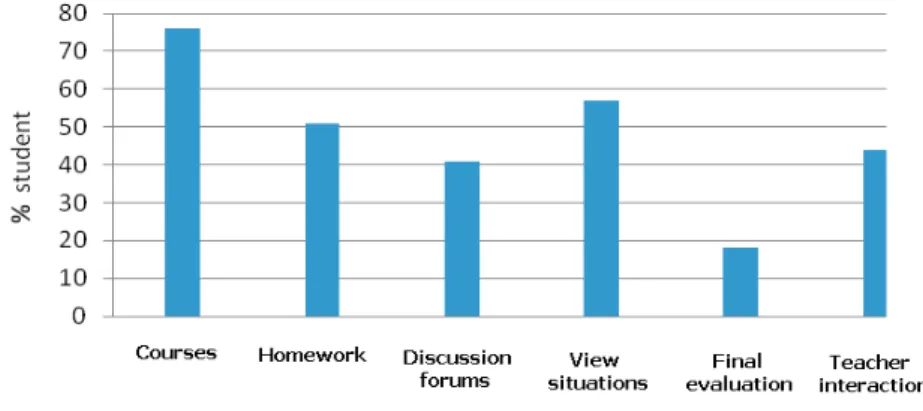
A series of m-learning services have been identified, and students had to choose those that they considered useful in their study process. In Figure no. 6 is represented the manner in which students want to use the m-learning services.
Figure no. 6: Students options regarding the use of m-learning services
From Figure no. 6 can be seen that most students want to access the courses material through the m-learning technologies and few of them want to use these tools for evaluation. 6. Discussions
Increasing the quality of educational process conducted inside the virtual campus is achieved through diversification (Xiangkui and Wanmei, 2010). This means that the method of assessment should not be the same for all the courses. A modern solution for assessing the knowledge level of students is undertaking the examinations on online testing platforms, such as Sakai or Moodle. The Sakai platform is already used for examinations at the Faculty of Cybernetics, Statistics and Economic Informatics from the Academy of Economic Studies. Tests supported on the platform are with multiple choices, the questions are randomly selected, so that two students may not respond to the same question at the same time, and the test results are displayed immediately after closing the session of the examination.
Diversification is also achieved through the use of smart books, where the student is tested before and, depending on the points he get, he will receive simple or complex study material.
Table no. 2 shows, centralized, the characteristics identified for each educational solution, these arising from the research undertaken.
Table no. 2: Comparison of teaching methods
Classical method Virtual campus M-learning
Face to face YES NO NO
Access anywhere NO NO YES
Access anytime NO YES YES
It is necessary to use information technologies NO YES YES
Quickly verification of the partners identity YES NO NO
Table no. 2 summarizes the comparison of knowledge teaching methods used in higher economic. From here results the advantages and disadvantages of using each system. It is shown that these systems are complementary, their combination leads to improving the student results.
In the case of projects and homework, the teacher is easily able to check their degree of originality. In addition, the feedback sent by the teacher to the student remains archived; it constitutes a reference for subsequent discussions.
The amplification of the pragmatic dimension of the training realized in the virtual campus requires the possibility that students can access electronic resources provided by some private sector organizations. In order to realize a case study, students can access certain documents, reports, situations of certain organizations, freely available only from the virtual campus. This leads to an easier integration of students and graduates on the labor market.
Teachers can upload on the platform the support materials that can not be used in the classic way of teaching and contributes to students' creativity, which is useful for real situations in which the students will be placed after graduation.
From the analysis of results is shown that the implementation of a mobile learning system can be achieved with ease in the Academy of Economic Studies. When using the survey as statistical method were took into account the limits determined by the sampling representativeness in total population and accuracy of responses, so that the research results to be representative for the collectivity of students from the Academy of Economic Studies. The study reveals the students' interest for m-learning and their willingness to use mobile technologies in learning, but also the fact that mobile devices and technologies are not fully exploited.
The results of using such a system are beneficial for students, they having the possibility to interact with the m-learning platform at any time, from the economic organizations in which they can contact directly the activities specific to economic agents, implementing the theoretical knowledge assimilated.
Conclusions
The high level of use of modern solutions specific to knowledge economy can be observed in the educational process from the Academy of Economic Studies. An example is given by the virtual campus used by a large number of teachers and students.
In terms of mobile technology, it is noted that the students of Academy of Economic Studies are trained to use them in the educational process, but it is necessary to inform them about the potential use.
The future directions of study in the field of modern educational solutions consider the economic higher education as the key element that contributed to the development of knowledge-based society and its passage to the consciousness society.
Collaborative educational systems from the consciousness society follows the collaborative educational systems from the information society and the knowledge society, being ordered systems, meaning that includes a set of uniform procedures governing relations between
components. In the knowledge-based society and in the consciousness society, the human component plays a significant role over the behavior of any collaborative educational system.
Future research aimed designing and implementing a modern learning solution, using mobile technologies, in the faculties surveyed. As the solution proves its applicability among students, is follows at promoting and expanding in all faculties of the Academy of Economic Studies.
Acknowledgement
This work was supported by CNCSIS –UEFISCSU, project number PNII – IDEI
2637/2008, project title: Project management methodologies for the development of mobile
applications in the educational system.
References
1. Delcea, C., Dascalu, M. and Ciurea, C., 2010. A Model for Improving Enterprise’s
Performance based on Collaborative E-learning. In: Joaquim Filipe and José Cordeiro (Eds.), 12th International Conference on Enterprise Information Systems, ICEIS 2010. Funchal, Madeira, Portugal, 8 - 12 June 2010. Funchal: SciTePress.
2. Dinu, V., 2011. Corporate Social Responsibility – Opportunity for Reconciliation
between Economical Interests and Social and Environmental Interests. Amfiteatru
Economic, XIII(29), pp. 6-7.
3. Drăgănescu, M., 2007. Societatea conştiinţei. Bucureşti: Editura Academiei.
4. Guanying, Y., 2010. The Effect of E-learning for the Teacher in Information Society.
In: IEEE Computer Society, 2010 Second International Workshop on Education
Technology and Computer Science (ETCS). Wuhan, 6-7 March 2010. Wuhan: IEEE Computer Society Press.
5. Kefela, G., 2010. Knowledge-based economy and society has become a vital
commodity to countries. International NGO Journal, 5(7), pp. 160-166.
6. Leydesdorff, L., 2006. The Knowledge-Based Economy: Modeled, Measured,
Simulated. Florida: Universal Publishers.
7. Martin, E. and Carro, R., 2009. Supporting the Development of Mobile Adaptive
Learning Environments: A Case Study. IEEE Transactions on Learning Technologies,
2(1), pp. 23-36.
8. Nicolescu, O. and Verboncu, I., 2008. Managementul organizaţiilor. Bucureşti:
Editura Economică.
9. Pîrciog, S., Matei, A., Sănduleasa, B. and Ghenţa, M., 2010. Consumption of Public
Childcare and Educational Services: An End-User Perspective. Amfiteatru Economic,
XII (28), pp. 546-557.
10.Platforma CSIE-ID, 2011. CSIE-Invatamant la Distanta. [online] Available at:
<http://www.csie-id.ase.ro> [Accessed 21 January 2011].
11.Pocatilu, P. et al., 2010. Studiu privind metodologiile elaborate pentru managementul proiectelor de realizare a aplicaţiilor mobile pentru sistemul educaţional, Report of the project PNII – IDEI 2637/2008.
12.Pocatilu, P., Doinea, M. and Ciurea, C., 2010. Development of Distributed Mobile
Learning Systems. In: WSEAS, 9th WSEAS International Conference on Circuits,
Systems, Electronics, Control & Signal Processing (CSECS '10).Vouliagmeni, Athens, Greece, 29-31 December 2010. Vouliagmeni: WSEAS Press.
13.Sotiriou, S. et al., 2008. The COLLAGE project: Guide of good practice on mobile and game based learning. Athens: EPINOIA Ed.
14.The Journal, 2001. Virtual Campus Offers Complete Learning Environment. [online]
Available at: <http://thejournal.com/Articles/2001/09/01/Virtual-Campus-Offers-Complete-Learning-Environment.aspx> [Accessed 10 January 2011].
15.Vişoiu, A., 2010. Project Management Methodology for the Development of
M-Learning Web Based Applications. Informatica Economica, 14(3), pp. 75-85.
16.Xiangkui, G. and Wanmei, H., 2010. Human Resource Development and Management
in Government from the Perspective of Knowledge Economy. In: IEEE Computer
Society, 2010 International Conference on E-Business and E-Government (ICEE).