The Relationship Between Practicing Makes Perfect and
Game-based Learning in Mobile Device.
Ming-Hung Lin
1
, Chien-Hung Lai
2
, Wei-Ting Tseng
3
, Bin-Shyan Jong
4
1
[email protected]
,
2
[email protected]
,
3
[email protected],
4
[email protected],
Chung Yuan Christian University
SYSTEM MODELING AND RESULTS
ABSTRACT
FUTURE WORK
CONCLUSIONS
ACKNOWLEDGEMENT
REFERENCES
RESEARCH DESIGN AND METHODOLOGY
The stage of FCFS process
After finish Gantt chart
In this experiment, by observing the
usage and learning effect, mobile
phones can break space limitations,
and can more successfully attract
students to participate in game
learning, as compared to PC. With
mobile phones, students can utilize
their spare time for learning. This can
make students more familiar with
course contents, and improve their
learning effect.
[1] F. Cornillie, G. Clarebout, P. Desmet(2012).. Procedia – Social and
Behavioral Sciences, 34, 49-53.
[2] N.A. Gromik(2012). Computers & Education, 58(1), 223–230
[3] J. Huizenga, W. Admiraal, S. Akkerman, G.T. Dam(2009) 25(4), 332–344
[4] G.J. Hwang, C.C Tsai, S.J.H. Yang(2008) Journal of Educational Technology
& Society, 11(2), 81-91.
[5] G.J Hwang, C.H. Wu, J.C.R. Tseng, I. Huang(2011). British Journal of
Educational Technology, 42(6), 992–1002
[6] G.J. Hwang, T.C. Yang, C.C. Tsai, S.J.H. Yang(2009) Computers & Education,
53(2), 402–413.
[7] C.H. Lai, J.C Yang, F.C. Chen, C.W. Ho, T.W. Chan(2007). 23(4), 326–337.
[8] S.S. Liaw, M. Hatala, H.M. Huang(2010) Computers & Education, 54(2),
446-454
[9] T.C. Liu, H.Y. Wang, J.K. Liang, T.W. Chan, H.W. Ko, J.C. Yang(2003).
[10] T.Y. Liu, Y.L. Chu(2010) Computers & Education, 55(2), 630–643.
[11] T. Muller-Kalthoff and J. Moller(2003). 12(2), 117-134.
[12] D.H. Robinson(2010). Reading Research and Instruction, (37)2, 85-105
•
Participants
132 students from Chung Yuan Christian
University
•
Mobile Game-Based Learning System
Development of mobile devices promotes mobile
learning, and students can overcome the
restrictio-ns of the traditional classroom. Students will not
need to sit in classroom and passively learn the
pictures on the book.
In this study, the Operation System course
cont-ents are converted into game pictures plus
imple-mentation can deepen student's impression.
Through this experiment, we compared usage rate
of the game learning on mobile devices with that
on desktop computers and the learning effect after
use.
Personal record and online ranking
Trend chart of level completion times
Level completion times and score in the smart
phone group and the PC
Correlation between level completion times and
score of Gantt chart in mobile phone group
Correlation between level completion times
and score of Gantt chart
IN
PC
GROUP
Trend chart of total time
Process
Improve the timer
Enhance the entertainment
Add Practice Stage
Cross-platform ( iOS )
Ming-Hung Lin
Chien-Hung Lai
Bin-Shyan Jong
Yen-Te Hsia
The Relationship Between Practicing Makes Perfect
and Game-based Learning in Mobile Device
Ming-Hung Lin /1st
Department of Information & Computer Engineering Chung Yuan Christian University
Taoyuan, Taiwan [email protected]
Chien-Hung Lai/2nd
Department of Electronic Engineering Chung Yuan Christian University
Taoyuan, Taiwan [email protected]
Wei-Ting Tseng /3rd
Department of Information & Computer Engineering Chung Yuan Christian University
Taoyuan, Taiwan [email protected]
Bin-Shyan Jong /4th
Department of Information & Computer Engineering Chung Yuan Christian University
Taoyuan, Taiwan [email protected]
Abstract—Now we can do things from anywhere with smart phones which needed to be done through desktop computers in the past. With fast advancement of mobile devices, many entertainment functions such as video recording, photographing and games have been proposed. Many people play game on mobile devices to kill time. Development of mobile devices also promotes mobile learning, and students can overcome the restrictions of the traditional classroom, embed the course contents into mobile phones and learn them at any time. For example, the Natural course contents are embedded into the mobile devices, and students can observe field while using mobile device for learning. In this way, students can directly receive information of the thing they see, and have better experience which can deepen impression. Students will not need to sit in classroom and passively learn the pictures on the book. Practice makes perfect. Things can be done easily if a knack is found. For occupational skills and sports skills, practice makes perfect. This is the same for learning. It is well known the talent is 1% inspirations add on 99% sweat. Success cannot be achieved without hard work. In this study, the Operation System course contents are converted into game pictures plus implementation can deepen student's impression. Through this experiment, we compared usage rate of the game learning on mobile devices with that on desktop computers and the learning effect after use.
Keywords—Game learning; mobile learning; practice makes perfect
I. INTRODUCTION
The mobile device boom not only ushers in progress of times but also affects the teaching strategies of educators. In recent years, with fast development of smart phones, mobile device has been focused on powerful and portable mobile phones related to daily life, instead of PDA. Besides basic communication function, camera, game, communities app and other functions of smart phones are increasingly sophisticated. Smart phones almost replace the traditional phones. Thus, smart phones enable learners to get access to ubiquitous learning, without limitation of space and time. As compared to the learning before computers, mobile learning is more real-time and
convenient. Textbooks can be embedded into mobile phones, and without carrying textbooks, learns can get access to learning at anytime and anywhere.
Learning is boring for most learners, and thus game learning has become an issue discussed by many researchers. Abstract course contents displayed through game [19] can be well understood by students and stimulate student’s learning motivation [10]. This can be used as a factor for forecasting learning achievements [16]. As development and convenience of mobile devices, scholars have started to establish game learning on mobile devices. For example, Huizenga designed “Frequency 1550” which combines game tasks with actual contexts. Students can understand more about history of Amsterdam by exploring the context with mobile devices [3]. In this study, the course contents are displayed on game to attract use by students. Because of popularity and convenience of smart phones, the system is established on the phone platform. Learning effect can be achieved by playing game with mobile phones.
In this study, the chapter of “CPU Scheduling” of the Operation System course is selected as design contents of
game. This chapter should not be memorized
mechanically, and scheduling algorithm should be understood thoroughly. Mobile phones can be used without limitations of space and time. The game is established on the mobile phones to attract frequent use by students, and practice makes perfect. Students can digest the knowledge by playing game to improve learning achievements and achieve goal of this experiment.
II. LITERATURE REVIEW
A. Mobile-Learning
Mobile learning has developed for many years, and there are many applied courses, such as: Pupils can use mobile devices to learn English in zoo [14]; in class teachers use electronic whiteboard, and students use handheld devices to interact with teachers [9], and hazardous job training can be provided in virtual
learning motivation or learning efficacy is better.
Some studies also found mobile devices can promote and assist users in knowledge management, and have five applications in education: knowledge transmission, suitable learning, interactive teaching, personalization and cooperative education [8]. Besides, mobile phones have high portability. Mobile phones have the functions such as cameras, video recording, and notepad, and can record things anytime [7].
Some past studies indicated mobile devices are not suitable for learning tool because the mobile devices have too small screen and inconvenient keyboard input [15]; some other studies suggested mobile devices can be a good teaching aid tool if there is any good teaching strategy [2].
B. Ubiquitous Learning
Ubiquitous learning is equivalent to some form of simple mobile learning, e.g. that learning environments can be accessed in various contexts and situations. As compared to mobile learning, ubiquitous learning can provide more surrounding environment states for the system, and this can make the system provide the best textbook or information for learners [4]. In establishing ubiquitous learning environment, many experiments use QR code, RFID and WiFi to obtain the surrounding environment states of users [20] so as to provide suitable learning context.
In ubiquitous learning, users can use mobile phones for learning anywhere. In 2009, Hwang pasted the RFID TAG on the single-chip X-ray diffract meter and relevant experimental apparatus in the university laboratory, and students can get operation information of the apparatus with RFID TAG [6]. Besides application of RFID to learning, scanning QR code is also used. In 2011, Hwang suggested PC components (motherboard, display cards and so on) can be affixed with QR Code. After students scan QR Code of a component with mobile devices, assembly information of the component can be displayed on the screen, and students can learn PC assembly by using the displayed information [5]. However, in the above studies the experiments were conducted at specific time and place. If the students leave the laboratory, learning cannot be continued, and the learning effect cannot be maintained.
C. Game-Based Learning
In game-based learning, students can learn while playing game. The course contents can be displayed in a different way, and the learning process would become interesting [21]. Many studies apply game to teaching, such as role play [1], serious game [13]… Serious game is designed to simulate a real situation through equipment, and learners can learn in the situation. The applied range is wide, such as medical science, religion and politics. Combination of game and course contents can change traditional uninteresting learning process and improve learning motivation through game learning [10]. When game players enter Flow States, their concentration is higher than usual [18]. The goal of game learning is to make students enter Flow States by playing game, and concentrate more on course contents.
In this study, we have found that students often visualize text contents when learning abstract concept because pure text description are not easily understood. Kalthoff also discussed graphics concept. If participants have prior knowledge and self-control, graphic can help achieve better learning effect [11]; Robinson also discussed influence of construct graphic organizers (GOs) on textbooks which only have text description. Besides text description, graphic illustration can help students further understand the course contents [12].
First Come First Served
Non-Preemptive Shortest Job First
Preemptive Shortest Job First
Preemptive Priority
Round Robin
The above five scheduling algorithms have their principles. The game level is designed according to the scheduling algorithm. Students should click the scheduling to finish game level according to Gantt chart. In the course of game, the time spent in completing each game level is recorded, and online ranking list is provided. The students can upload their final time, and this can stimulate competition among students.
In order to ensure each student can play the game and observe usage and impact of different devices, the game can run on mobile phones and PC. Thus, the students who have Android smart phones can use phones to play the game, and the students who have no smart phones can use PC to play the game.
It is hoped the students can calculate correct sequence using Gantt chart with an aim to get the best final time, and clink Process according to scheduling sequence to achieve repeated practice. In order to prevent the students from getting the answer through try error, the system has punishment mechanism for wrong click. If students click wrong process, the time counter will add five seconds as punishment.
The five game scheduling algorithms have their separate principles. Regardless of which game level students choose, the Process is randomly generated when entering into game. Thus, result of each calculation is different. Through repeated calculation, the learning effect can be improved.
Fig 1. FCFS stage PROCESS page Fig 2. FCF stage Gantt finished
Fig 3. Personal record Fig 4. Online Ranking
IV. EXPERIMENTAL PARTICIPANTS
The experiment investigated the students from Chung Yuan Christian University who learn operation system course in the second semester of 2013, and number of the students is 132. The students with phones are phone group, and those without smart phones are PC group.
V. EXPERIMENTAL PROCEDURE
This research experiment lasted two weeks. Before the experiment, all the students are gathered in the computer classroom in which the game operation method and instructions are told to them, including installation of the game on the Android smart phones and PC.
Next, the students can make operation arbitrarily after class. The phone group can play the game from anywhere at any time, without limitation of time and space. The PC group has to play the game through PC. During the experiment period, the students can upload their game records, and check the online ranking list and game records of others. This may stimulate competition among the students. After the experiment, Gantt chart test was conducted for the five kinds of scheduling to judge whether the students learn course concept in the experiment.
VI. RESULT AND DISCUSSION
After the experiment, five kinds of scheduling were tested. First Come First Served and Non-Preemptive Shortest Job First accounted for 10%, and Preemptive Shortest Job First and Preemptive Priority accounted for
20% and Round Robin accounted for 40%. The Round Robin is the most difficult scheduling and needs the longest time. Thus, the score percentage is higher. As shown in Table I ANOVA table using Gantt chart, the result shows there is no significant difference, and p = 0.746 > 0.05. The two groups use the same game learning, and the difference is operation platform. Thus, the learning effect in the five scheduling tests has no significant difference, and this can be accepted.
TABLE I. ANOVA USING GANTT CHART
SS df NS F Sig. SSB 97.778 1 97.778 .106 .746
SSW 89680.000 97 924.536
SUM 89777.778 98
Thus, this study conducted another analysis. Impact of level times and total time on the learning effect is reserved. Fig. 5 shows the level completion times and distribution diagram and trend line of Gantt chart test. Although the slope of the trend line of the phone group and the PC group is the same, R square value of the phone group is close to 1 (R square value is between 0 and 1; when the value is closer to 1, the forecasting accuracy is higher). Thus, the phone group has the higher accuracy of forecasting the student distribution than the PC group. In the smart phone group, the score in the Gantt chart is between 0 and 90; score in the PC group is between 0 and 50. This indicates distribution in the PC group is regular. The more the level completion times is, the greater probability of high score of Gantt chart is.
In each game level, the level completion time is set to 500 seconds, there are 25 game levels, and total time is 12,500 seconds. If a student does not play the game, his/her total time is 12,500 seconds on the ranking list. When a student enters into one game level, his/her level completion time would be lower than 500 seconds. The current level completion time replaces original time. The total time can be obtained by adding up all the level time. Fig. 6 shows the linear trend analysis using total time and score in the Gantt chart. The trend line difference between the phone group and the PC group is not great. For the PC group, the longer the time is, the lower the test score is. R square value of the PC group is higher, and this reveals the forecasting accuracy is better.
Fig 6. Trend chart of total time
Fig 7. Trend chart of level completion times (after adjustment of samples)
TABLE II. CORRELATION ANALYSIS BETWEEN LEVEL COMPLETION TIMES AND SCORE OF GANTT CHART IN MOBILE PHONE GROUP
Mobile phone group Score of Gantt chart
Level completion times Score of Gantt chart 1
Level completion times 0.419672146 1
During the experiment, it has been found that many students have not completed all game level. Thus, number of samples is adjusted for further analysis. The game records of the students whose final time is lower than 1,000 seconds are used as analysis basis. The second linear regression analysis is conducted, as shown in Fig. 7 and 8. Based on the trend line of Fig. 7, the more level completion times are, the higher score of the Gantt chart is; the PC group is average. R square value of the PC group is 0.1761; R square value of the PC group is 0.00005, and close to 0. This indicates the level completion times cannot be used to forecast test result of Gantt chart in PC group. In analysis of Pearson correlation between level completion times and test score of Gantt chart in the mobile phone group and the PC group, it has been found the correlation coefficient of smart phone group is between 0.3 and 0.7, and the correlation is medium; the correlation coefficient of PC group is between 0 and 0.3, and close to 0, and there is no correlation, as shown in Tables II and III.
TABLE III. CORRELATION ANALYSIS BETWEEN LEVEL COMPLETION TIMES AND GANTT CHART IN PC GROUP
PC group Score of Gantt chart
Level completion times Score of Gantt chart 1
Level completion times 0.007087249 1
The total time and test score of Gantt chart are shown in Fig. 4. The shorter the total time is, the more familiar with the concept is, and the higher the score is. R square
is 0.0967. Based on the linear prediction trend line, the smart phone group has higher accuracy than the PC group. In the correlation analysis between total time and score of Gantt chart, correlation coefficient of the phone group shows high correlation; correlation coefficient of the control group shows medium correlation, as shown in Tables IV and V.
Fig 8. Trend chart of total time
TABLE IV. CORRELATION ANALYSIS BETWEEN TOTAL TIME AND SCORE OF GANTT CHART IN SMART PHONE GROUP
Smart phone group Total time Score of Gantt chart Total time 1
Score of Gantt chart -0.717399735 1
TABLE V. CORRELATION ANALYSIS BETWEEN TOTAL TIME AND SCORE OF GANTT CHART IN PC GROUP
PC group Total time Score of Gantt chart Total time 1
Score of Gantt chart -0.310916304 1
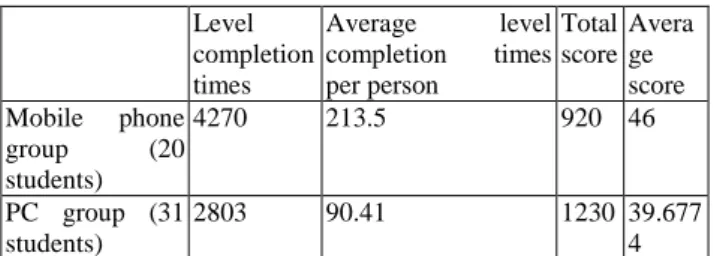
Each level of Mobile Game is preset to 500 seconds, and the time can be updated after entering the game and completing the level. The game has 25 levels, and accordingly the total time is 12,500 seconds. Table VII shows the level completion times of the students whose total time is lower than 1000 seconds; as shown in Tables VI and VII, after deletion of the student whose total time exceeds 1,000 seconds. The use frequency is increased in the phone group and PC group. In the phone group, average completion times for each level exceed 200 times/person. It can be seen that the students in the smart phone group use more spare time to play Mobile Game as compared to the PC group. Through the repeated practice, the students can learn equal knowledge and get desired test score.
TABLE VI. LEVEL COMPLETION TIMES AND SCORE IN THE SMART PHONE GROUP AND THE PC GROUP BEFORE ADJUSTMENT
Level completion times Average level completion times per person Total score Avera ge scor e Mobile phone group (44 students) 5172 117.5455 1320 30.697 6 PC group (55 students) 3309 60.16364 1760 32.592 5
TABLE VII. LEVEL COMPLETION TIMES AND SCORE IN THE SMART PHONE GROUP AND THE PC GROUP AFTER ADJUSTMENT
Level completion times Average level completion times per person Total score Avera ge score Mobile phone group (20 students) 4270 213.5 920 46 PC group (31 students) 2803 90.41 1230 39.677 4
After use of Process two weeks, the students participated in the test of five scheduling algorithms. The test results of the phone group and the PC group have no significant difference. However, by observing the relationship between the level completion times and the test score, the more the times is, the higher the score is. After adjustment of the samples, level completion times and average score of the mobile phone group are higher than that of PC group. From this, mobile devices can attract students to use more spare time to play Mobile Game than PC, and the game frequency can be increased. Thus, students would be more familiar with the course contents. After the experiment, the Gantt chart shows the score of the mobile phone group is higher than that of PC group.
VII. CONCLUSION
With evolution of technologies, smart phones can finish more and more work and tasks. Mobile learning has been widely applied. This study has demonstrated that combination of game learning and mobile learning can attract students to utilize spare time for learning.
In this experiment, by observing the usage and learning effect, mobile phones can break space limitations, and can more successfully attract students to participate in game learning, as compared to PC. With mobile phones, students can utilize their spare time for learning. This can make students more familiar with course contents, and improve their learning effect.
Development of smart phones has become faster and faster, and is useful for mobile learning. In this study, we prevent mobile learning problems mentioned in the past studies, such as: too small screen and inconvenient input. The input is replaced by click, and the students can play the game after clicking Process sequence. This overcomes input inconvenience. The too small screen is not a trouble anymore because there is no need to input more contents. With fast evolution of smart phones, mobile learning will have different development tendency.
REFERENCE
[1] F. Cornillie, G. Clarebout, P. Desmet(2012). The role of feedback in foreign language learning through digital role playing games. Procedia – Social and Behavioral Sciences, 34, 49-53.
[2] N.A. Gromik(2012). Cell phone video recording
feature as a language learning tool: A case study. Computers & Education, 58(1), 223–230.
[3] J. Huizenga, W. Admiraal, S. Akkerman, G.T.
Dam(2009). Mobile game-based learning in secondary education: engagement, motivation and learning in a mobile city game. Journal of
Computer Assisted Learning, 25(4), 332–344.
[4] G.J. Hwang, C.C Tsai, S.J.H. Yang(2008). Criteria,
Strategies and Research Issues of Context-Aware Ubiquitous Learning. Journal of Educational Technology & Society, 11(2), 81-91.
[5] G.J Hwang, C.H. Wu, J.C.R. Tseng, I. Huang(2011).
Development of a ubiquitous learning platform based on a real-time help-seeking mechanism. British Journal of Educational Technology, 42(6), 992–1002.
[6] G.J. Hwang, T.C. Yang, C.C. Tsai, S.J.H.
Yang(2009). A context-aware ubiquitous learning environment for conducting complex science experiments. Computers & Education, 53(2), 402–413.
[7] C.H. Lai, J.C Yang, F.C. Chen, C.W. Ho, T.W.
Chan(2007). Affordances of mobile technologies
for experiential learning: the interplay of
technology and pedagogical practices. Journal of Computer Assisted Learning, 23(4), 326–337.
[8] S.S. Liaw, M. Hatala, H.M. Huang(2010),
Investigating acceptance toward mobile learning to assist individual knowledge management: Based on activity theory approach. Computers & Education, 54(2), 446-454.
[9] T.C. Liu, H.Y. Wang, J.K. Liang, T.W. Chan, H.W.
Ko, J.C. Yang(2003). Wireless and mobile technologies to enhance teaching and learning. Journal of Computer Assisted Learning, 19(3), 371-382.
[10] T.Y. Liu, Y.L. Chu(2010). Using ubiquitous games in an English listening and speaking course: Impact on learning outcomes and motivation. Computers & Education, 55(2), 630–643.
[11] T. Muller-Kalthoff and J. Moller(2003). The Effects
of Graphical Overviews, Prior Knowledge, and Self-Concept on Hypertext Disorientation and Learning Achievement. Journal of Educational Multimedia and Hypermedia, 12(2), 117-134.
[12] D.H. Robinson(2010). Graphic organizers as aids to
text learning. Reading Research and Instruction, (37)2, 85-105.
[13] J. Sanchez, R. Olivares(2011). Problem solving and
collaboration using mobile serious games.
Computers & Education, 57(3), 1943–1952. [14] J. Sandberg, M. Maris, K.D. Geus(2011). Mobile
English learning: An evidence-based study with fifth graders. Computers & Education, 57(1), 1334– 1347.
[15] R. Shen, M. Wang, W. Gao, D. Novak, L.
Tang(2009). Mobile Learning in a Large Blended Computer Science Classroom: System Function, Pedagogies, and Their Impact on Learning. IEEE Transactions on Education, 52(4), 538-546.
[16] C.C. Shih, J. Gamon(2001). Web-based learning:
Relationships among students motivation, attitude, learning styles and achievement. Journal of Agricultural Education, 42(4), 12-20.
[17] N. Smets, G.T. Brake, T. Buurman, M. Neerincx, H.V. Oostendorp(2011). Effects of mobile support on situation awareness and navigation in a field and game environment. Entertainment Computing, 2(1),
[18] K. Squire(2003). Video Games in Education. International Journal of Intelligent Games and Simulation, 2(1).
[19] R.L. Wang, R. Wiesemes, C. Gibbons(2012).
Developing digital fluency through ubiquitous mobile devices: Findings from a small-scale study. Computers & Education, 58(1), 570–578.
[20] M.J. Weal, D.T. Michaelides, K. Page, D.C.D
Roure(2012). Semantic Annotation of Ubiquitous Learning Environments. IEEE Transactions on Learning Technologies, 5(2), 143-156.
[21] J.P. Gee(2003). What video games have to teach us
about learning and literacy. Computers in Entertainment, 1(1), 20-20.