AUTHOR(S):
TITLE:
YEAR:
Publisher citation:
OpenAIR citation:
Publisher copyright statement:
OpenAIR takedown statement:
This publication is made freely available under ________ open access.
This is the ___________________ version of proceedings originally published by _____________________________
and presented at ________________________________________________________________________________
(ISBN __________________; eISBN __________________; ISSN __________).
This publication is distributed under a CC ____________ license. ____________________________________________________
Section 6 of the “Repository policy for OpenAIR @ RGU” (available from
http://www.rgu.ac.uk/staff-and-current-students/library/library-policies/repository-policies
) provides guidance on the criteria under which RGU will
consider withdrawing material from OpenAIR. If you believe that this item is subject to any of these criteria, or for
any other reason should not be held on OpenAIR, then please contact
[email protected]
with the details of
the item and the nature of your complaint.
GREEN
BOUVIER, D., LOVELLETTE, E., MATTA, J., ALSHAIGY, B., BECKER, B.A., CRAIG, M.,
JACKOVA, J., MCCARTNEY, R., SANDERS, K. and ZARB, M.
Novice programmers and the problem description effect.
2016
BOUVIER, D., LOVELLETTE, E., MATTA, J., ALSHAIGY, B., BECKER, B.A., CRAIG, M., JACKOVA, J., MCCARTNEY, R., SANDERS, K. and ZARB, M. 2016. Novice programmers and the problem description effect. In
Proceedings of the Innovation and technology in computer science education on working group reports (ITiCSE-WGR '16), 9 - 13 July 2016, Arequipa, Peru. New York: ACM [online], pages 103-118. Available from: https://doi.org/10.1145/3024906.3024912.
BOUVIER, D., LOVELLETTE, E., MATTA, J., ALSHAIGY, B., BECKER, B.A., CRAIG, M., JACKOVA, J., MCCARTNEY, R., SANDERS, K. and ZARB, M. 2016. Novice programmers and the problem description effect. In
Proceedings of the Innovation and technology in computer science education on working group reports (ITiCSE-WGR '16), 9 - 13 July 2016, Arequipa, Peru. New York: ACM, pages 103-118. Held on OpenAIR [online]. Available from: https://openair.rgu.ac.uk.
AUTHOR ACCEPTED
ACMInnovation and technology in computer science education on working group reports (ITiCSE-WGR '16), 9 - 13 July 2016, Arequipa, Peru. 9781450348829
© ACM 2016. This is the author's version of the work. It is posted here for your personal use. Not for redistribution. The
definitive Version of Record was published in ITiCSE '16, http://dx.doi.org/10.1145/3024906.3024912.
BY-NC 4.0 https://creativecommons.org/licenses/by-nc/4.0
OpenAIR at RGUDigitally signed by OpenAIR at RGU DN: cn=OpenAIR at RGU, o=Robert Gordon University, ou=Library, [email protected], c=GB Date: 2017.04.14 14:13:46 +01'00'
Novice Programmers and the Problem Description Effect
Dennis Bouvier
Southern Illinois University Edwardsville Edwardsville, IL, USA
[email protected]
Ellie Lovellette
Southern Illinois University Edwardsville Edwardsville, IL, USA
[email protected]
John Matta
Southern Illinois University Edwardsville Edwardsville, IL, USA
[email protected]
Bedour Alshaigy
Oxford Brookes University Oxford, England
[email protected]
Brett A. Becker
University College Dublin Belfield, Dublin 4, Ireland
[email protected]
Michelle Craig
University of Toronto Toronto, Ontario, Canada
[email protected]
Jana Jackova
Matej Bel University Banska Bystrica, Slovakia
[email protected]
Robert McCartney
University of Connecticut Storrs, CT, USA[email protected]
Kate Sanders
Rhode Island College Providence, RI, USA
[email protected]
Mark Zarb
Robert Gordon University Aberdeen, Scotland
[email protected]
ABSTRACT
It is often debated whether a problem presented in a straight-forward minimalist fashion is better, or worse, for learn-ing than the same problem presented with a “real-life” or “concrete” context. The presentation, contextualization, or “problem description” has been well studied over several decades in disciplines such as mathematics education and psychology; however, little has been published in the field of computing education. In psychology it has been found that not only the presence of context, but the type of context can have dramatic results on problem success. In mathe-matics education it has been demonstrated that there are non-mathematical factors in problem presentation that can affect success in solving the problem and learning. The con-textual background of a problem can also impact cognitive load, which should be considered when evaluating the effects of context. Further, it has been found that regarding cogni-tive load, computer science has unique characteristics com-pared to other disciplines, with the consequence that results from other disciplines may not apply to computer science, thus requiring investigation within computer science.
Permission to make digital or hard copies of all or part of this work for personal or classroom use is granted without fee provided that copies are not made or distributed for profit or commercial advantage and that copies bear this notice and the full citation on the first page. To copy otherwise, to republish, to post on servers or to redistribute to lists, requires prior specific permission and/or a fee. Request permissions from [email protected].
ITiCSE ’16 Working Group Reports,July 09-13, 2016, Arequipa, Peru Copyright 2016 ACM 978-1-4503-4882-9/16/07 ...$15.00
DOI: http://dx.doi.org/0.1145/3024906.3024912
This paper presents a multi-national, multi-institutional study of the effects of problem contextualization on novice programmer success in a typical CS1 exercise.
Categories and Subject Descriptors
K.3.2 [Computers and Education]: Computer and Infor-mation Science Education—Computer Science Education
Keywords
context, novice programmers, CS1
1.
INTRODUCTION
Elliot Soloway, one of the earliest computing education researchers, tested novice programmers’ ability to problem solve and write programs using the Rainfall Problem [48]. The Rainfall Problem asks students to write a program that calculates the average of a set of daily rainfall measurements (hence the name of the problem). The Rainfall Problem is still attractive to programming instructors as a novice pro-gramming assignment because it is well written, and seems to be of appropriate difficulty. Nevertheless, as discussed in Section 2, Soloway’s experimental results show that few students were able to successfully write a program to solve this problem.
One author of this paper used the Rainfall Problem in an introductory course. One particular detail of the Rainfall Problem stumped a novice programmer, who asked: “What does a daily rainfall value of zero represent?” The answer to the question is that it is a day without rainfall. However awkwardly, this student was trying to make a connection between the numerical problem and the context. Had it not been for the problem description, the student wouldn’t have
questioned a value of zero. That question inspired this in-vestigation into the role of context, or “problem description” in the success of novice programmers.
On one hand, context might be motivating to students. Computing an average that corresponds to something real is likely more interesting than just crunching the numbers. On the other hand, understanding the background story, determining which details are relevant and which are not, and what the implications are (for example, that a rain-fall amount is never negative), all impose cognitive load on novices, particularly if the language of instruction is not their first language.
Novice programmers are challenged by the combination of problem understanding, finding a solution to the problem, expressing the solution in a programming language, and the environment (development tools, operating system, etc.) in which this is all taking place. The description of the problem could be a significant factor in student success, or failure.
The research question posed here is:
Does providing context for a programming as-signment help novice programmers to solve it? where “novice programmers” means students in a CS1 class, and “context” means more than a minimal description of input and output – some kind of “real-world” story.
Note the research focus is on the design of individual programming assignments. Adding context and real-world applications to the design of an entire CS1 course (for ex-ample, the media computation approach [22]) raises much larger issues such as effect on drop-out rates, effect on under-represented groups, etc. These are interesting and impor-tant questions, but outside the scope of this work. More-over, with the research question isolated from the course design, the result could have broader implications for com-puting instructors; that is, an instructor can choose to use real world problem descriptions in assignments relatively in-dependently of other course design issues.
Section 2 presents earlier work on context, from both in-side and outin-side of computing education research. Sections 3 and 4 give the details of this experiment and how the data are analyzed. Sections 5 and 6 describe and discuss the results of the experiment. Finally, Section 7 presents con-clusions and suggestions for future work.
2.
RELATED WORK
A significant number of publications in various disciplines address the question of context; some research indicates con-text is helpful, and some points in the opposite direction. A summary of the closely related literature follows.
2.1
Psychology: the Wason Selection Task
The psychology literature suggests that context helps (or in their terms, there is a “thematic facilitation effect”). A well-known problem illustrating this effect, the Wason Selec-tion Task, is the most intensively researched problem in the history of the psychology of reasoning [15, 20, 50]. In the original Wason study, participants were given a no-context version:[T]he subject might be presented with four cards showing, respectively, A, 4, D, and 7, and the rule “If there is a vowel on one side of a card, then there is an even number on the other side”. The
subject is told that each card has a letter on one side and a number on the other side and asked to select just those cards which it is necessary to turn over in order to find out whether the rule is true or false.
The answer is the card with “A” on it – to see if there’s an even number on the other side – and the card with “7” on it – to make sure there isnota vowel on the other side. In this version of the problem, which has been replicated numerous times, typically less than 10% of the participants give the correct answer [20, p. 407]. This is consistent with work in computing education research that has found that even students who have completed a digital logic course still have misconceptions about logical implication [23].
Later replications added different kinds of context to the Wason rules, for example: “If it rains, the street is wet”; “If I travel to Manchester, I go by car”; “If a letter is sealed, then it has a 50 lire stamp on it”; “If there is L.B.MILL on one side of the envelope, then there is PRINTED PAPER RE-DUCED RATE ON THE OTHER SIDE”; and “If a person is drinking legally, then the person must be over 19 years of age”. [20] Some of these studies found that context made a significant difference, some studies found a small difference, and some found none. Some replication studies arrived at non-confirmatory results (for example, traveling to Manch-ester).
Griggs and Cox [20] hypothesized that context worksifit’s related to the participant’s own experience: “Performance on the selection task is significantly facilitated when the presen-tation of the task allows the subject to recall past experience with the content of the problem, the relationship expressed, and a counter-example to the rule governing the relation-ship.” [20, p. 417] Thus, a completely arbitrary rule like “If someone is wearing purple, they must be over 18” would not help; a rule such as “If it’s winter, it’s cold out” would be most helpful for participants who have lived in a place where it’s generally true but not always; and a rule about the drinking age would help the large majority of college stu-dents. (In the United States, where much of this experiment was run, the drinking age is generally 21, so some students can drink legally and some cannot.) Griggs and Cox ran a carefully-designed experiment with three different rules, in-cluding the drinking-age rule, that convincingly supported their hypothesis.
2.2
Education: Cognitive Load Theory
Cognitive load can be defined as “the load imposed on an individual’s working memory by a particular (learning) task” [40]. The widely accepted assumption is that working memory only possesses limited capacity and can only deal with a very limited number of information elements at a time [34]. For novices of a domain who have not committed knowledge to long-term memory, working memory is used for fundamental knowledge, reasoning, and problem solv-ing. Thus, it is especially important that learning materials do not overload the available working memory. According to Cognitive Load Theory there are three components of cognitive load - intrinsic, extraneous, and germane [52, 53]. Intrinsic cognitive load is determined by the inherent nature of the learning tasks themselves, while extraneous cognitive load is determined by the manner in which the tasks are presented.Intrinsic cognitive load cannot be altered by instructional interventions because it is determined by the interaction be-tween the nature of the materials being learned, and the expertise of the learner [53]. Extraneous cognitive load, on the other hand, depends on the format of instruction and can be manipulated with the appropriate instructional de-sign [4]. When dede-signing instructional material, care should be given to eliminate any possible extraneous load [28]. Ger-mane cognitive load is conscious processing using domain schemas guided by instructional design that can take place when both intrinsic and extraneous cognitive load levels are low enough so that some working memory capacity remains unused [52].
Adding context gives students learning to program more to read, requires them to abstract the relevant information from the problem description, and then requires them to translate the relevant information into code. This is a nec-essary skill for professional programmers, but for novices it may be “extraneous cognitive load”.
Computer science has a significant intrinsic cognitive load [19, 35], related to the programming languages used and to understanding and controlling an external computational agent. This kind of problem does not occur frequently in other disciplines, but occurs from the beginning in computer science. As a result, it may be even more important to avoid extraneous cognitive load.
On the other hand, the combination of this intrinsic load and the difference between computer science and other disci-plines means that findings from studies in other discidisci-plines might not apply in computer science [35, 36]. Therefore, studies within computing education are warranted [35].
2.3
Math Education: word problems
Mathematical word problems are “presented in the form of a short narrative rather than in mathematical notation” [9]. Compared to numerical computation problems, word problems have “context” in the sense used in this paper.
Word problems are notoriously difficult for students [8]. Language complexity, the use of unfamiliar words, and even the placement of the question (before or after the narrative) all contribute to that difficulty [9]. Wording and semantic factors have been demonstrated to heavily influence problem difficulty. Wording factors refer to the linguistic surface or presentational structure of problems [42]. Even minor vari-ations in the use of specific linguistic elements may have a significant impact on problem difficulty that is not explained by the logico-mathematical structures [41]. Semantic factors include non-mathematical action or situational structure un-derlying word problems. Studies have shown that problem difficulty varies with this structure which can be static or dy-namic, realistic or artificial, intuitively meaningful or more abstract, and familiar or unfamiliar [42].
2.4
Computing Education: context
In computing education, many have argued that context helps. For this purpose, Guzdial [21, p.4] defines “context” broadly, as “the use of a consistent application or domain area, which effectively covers the core areas of a computer science course, provides a source for explanations and a basis for student projects”. As examples, he cites media compu-tation and robotics. Esper’s magical “code spells” metaphor might also be an example, if used throughout a course [14].
A variety of reasons are given in support of context, in-cluding student motivation [12, 18]; enabling students to engage with subjects and concepts they may otherwise have found uninteresting [54]; allowing students to better perceive the relevancy of the material being taught [21, 24, 43]; re-cruitment and retention of women [43]; retention more gen-erally [21]; connecting students with practitioners [12]; show-ing students their efforts can positively impact a broader user community [3]; and enabling students to explore broader social and ethical issues [12].
Guzdial [21] has argued that both contextualized and de-contextualized courses have value. Contextualized courses help with retention, but students, particularly weak stu-dents, can be distracted by the contextual information. Fur-ther, de-contextualized information is important for trans-fer. Few novices can perceive the underlying structural sim-ilarity between two problems presented with different con-texts. Students eventually need de-contextualized material, except in the unlikely event they can count on spending their whole careers working in the same domain. Thus, Guzdial argued for a contextualized CS1, followed by later de-contextualized courses.
This is a broader definition of context than the one used here, but it is quite plausible that some of these arguments, particularly those involving student motivation, also apply at the level of an individual assignment. Esper et al. [14] presented results on some individual contextualized assign-ments using CodeSpells, an IDE designed for Java novices. The CodeSpells programs allow students to write “spells” – Java methods that allow the programmer’s avatar to do magical things such as levitate or set things on fire. This is a more immersive form of context than simply changing the wording of an assignment. In a small pilot study, stu-dents showed high motivation and notable achievement in a 45-minute lesson.
The arguments for and against context raised by Guz-dial are echoed in the response to Lister et al. [29]. This paper addressed the question of whether students can read code. Like this study, Lister et al.’s project involved specific questions, but all of their questions were deliberately de-contextualized. For example, students were asked to read the following code and identify the contents of arrayxafter execution. int[] x = {0, 1, 2, 3}; int temp; int i = 0; int j = x.length - 1; while(i < j) { temp = x[i]; x[i] = x[j]; x[j] = 2*temp; i++; j--; }
The author(s) of this code avoided using meaningful variable names, etc., in order to control for linguistic issues and focus narrowly on students’ abilities to read and trace code.
Parsons et al. [37] argue that students’ failure to correctly answer questions such as this one is not the students’ fault:
“Not being able to answer this question doesn’t necessar-ily demonstrate that one is unable to write code to iterate over and modify the contents of an array, it merely indicates that this abstract and tortuous piece of code is difficult to understand.” [37, p. 120] They did not address the issue of transfer, however, or the possibility that students might be distracted or hindered by the added difficulty of processing a program’s context.
McCracken et al. [33] raised the question of whether con-text might make a difference to an individual programming assignment. They asked over 200 students from four institu-tions in three different countries to write a simple calculator. While they provided three variations on the calculator task, all had context.
After finding that the students did much worse than ex-pected, they conjectured that the context might be a partial explanation [33, p. 136]:
The specifications of the exercises in this study included details that were not relevant to the solution, which made it difficult for many stu-dents to achieve the first learning objective in our framework (abstracting the problem from the description)... [M]any students [...] did not get seem to get [sic] past that point in the problem-solving process.
2.5
Computing Education: Rainfall
Rather than looking at context, Soloway wanted students to be able to see through the context and identify problems with a similar structure. He focused on the underlying pat-terns in code and how students could learn to recognize and use them.
Soloway viewed student learning through an idea rooted in cognitive theory [31]. In cognitive theory a schema is a chunk of information that has been successfully learned and is contained in memory. Essentially, it is basic knowledge that a student or programmer can recall and use in a con-structive way. Once attained by the learner, a schema acts as a single information element in working memory incorporat-ing symbols and relations between them [38]. Recognizincorporat-ing a schema thus temporarily eliminates the need for immediate understanding of the context. Processing a schema actively reduces intrinsic cognitive load and allows the application of relevant knowledge across contexts. In order to recog-nize a schema, the learner must first be able to abstract it from worked examples, resulting in germane cognitive load which has to be kept low to ensure success [19]. As com-puter science has inherently high and hard to reduce intrin-sic cognitive load, care should be taken to not additionally overburden novices’ working memory. Schemas committed to long term memory by appropriate and timely application of germane cognitive load during instruction with carefully chosen materials can result in reduction of extraneous cog-nitive load. Enhancing schema construction in instructional design reduces learners’ overall cognitive load [4].
Soloway’s schemas are called plans and goals. A program-mer’s job is to know how to combine the appropriate plans and goals into working programs. For example, students who learned the plan for finding the average of a generic list of numbers could apply that plan to any problem in which one of the goals is to find the average of some numbers re-gardless of the problem’s context.
In an empirical study, Soloway et al. [49, p.854] explored the relationship between the choices and decisions that novices make to solve a problem and programming language struc-ture. Specifically, they examined the looping strategies that students employ in code submissions. The study involved asking the students to solve the Averaging Problem:
Write a program that repeatedly reads in inte-gers, until it reads the integer 99999. After see-ing 99999, it should print out the correct average. That is, it should not count the final 99999.
Although this problem seemed to be easy, students did “sur-prisingly poorly on this and related problems” [49, p. 854].
Soloway later introduced a version of the Averaging Prob-lem with context:
Read in integers that represent daily rainfall, and print out the average daily rainfall; if the input value of rainfall is less than zero, prompt the user for a new rainfall. [48, p. 853]
This was a simple version of what has come to be known as the Rainfall Problem, simpler than the one used in this work.
Ebrahimi [13] conducted an experiment in which he, like Soloway, looked at the way students combine plans to solve problems. In his experiment, he used a more complicated version of Soloway’s Rainfall Problem:
Write a program that will read the amount of rainfall for each day. A negative value of rain-fall should be rejected, since this is invalid and inadmissible. The program should print out the number of valid recorded days, the number of rainy days, the rainfall average over the period, and the maximum amount of rain that fell on one day. Use a sentinel value of 9999 to terminate the program. [13, p. 470].
This is essentially the same as the first task studied in this work (the Satellite Program, see Section 3.1): it asks for the number of positive data items (the rainy days), the average, and the maximum.
Sepp¨al¨a et al. [45] provided a useful survey of previous Rainfall Problem literature. Recent projects have used vari-ants of the Rainfall Problem in a functional programming language [17], in C# [47], and examined the role of test writ-ing in solvwrit-ing the problem [26]. However, none of these have focused on the role of context in solving the problem.
2.6
Computing Education: problem-solving
Novices lack many rudimentary problem-solving strate-gies needed to write programs, like the identification of basic problem elements, the relationship between them, and the steps necessary to construct a solution (appropriately rep-resenting information describing the problem and designing algorithms to transform that information from one represen-tation to another). When successful in solving one problem, they frequently fail to apply the same solution techniques to similar problems [46]. These weaknesses are commonly recognized as one of the barriers or difficulties students face while learning to program [2, 25, 44].
Lavonen et al. [27] argue that context helps students with problem-solving: when students create solutions while solv-ing real-world problems, the products created dursolv-ing the
development process become original and appropriate. In light of these findings, several institutions are trying to in-still and develop these skills in students implicitly [1, 10, 16] by requiring them to observe “worked examples” and apply them to new but similar problems.
However, the context associated with worked examples may also cause difficulties. Context increases the cognitive load on students, as learners must comprehend all of the secondary information described in the context even if it is not essential to the main problem [51]. This drawback has recently led to a line of work that revisits Soloway’s idea of teaching the underlying subgoals and task structure of programs [5, 6, 7, 11, 30, 36, 39].
3.
METHODOLOGY
Given the lack of consensus across scientific domains re-garding the effect of problem context on performance and the possible non-transferability of results to the field of Com-puter Science education, we arrive at the research ques-tion of whether the context of a programming assignment helps students solve the assignment. We thus postulate the null hypothesis: the contextualization of an individual programming task assignment in a non-themed course will have no significant impact on the performance of novice pro-grammers. The alternate hypothesis is that the context of the programming problem assignment has an effect on stu-dents’ performance. Our hypothesis testing, therefore, will be based on two-tailed tests, comparing the alternatives of no effect versus some effect: either the mean (or median) performance measures are equal, or they are not equal. This section describes the experiment used to test the hypothesis.
3.1
The Two Tasks
In order to determine the differences in student perfor-mance that might result from contextualization of a prob-lem, two tasks were designed. The first task, the Satellite Problem, is essentially Soloway’s Rainfall Problem expressed in the context of astronomy. This task requires students to accept a series of inputs, reject negative numbers, stop in-put on a sentinel value, and report five values – the count of satellites, the sum of all satellites, the average satellites per planet, the maximum number of satellites orbiting a planet, and the number of planets with at least one satellite. The exact English wording of the Satellite Problem is shown in Figure 1.
The Satellite Problem is different from the simple version of Soloway’s Rainfall Problem in significant ways. First, it requires the student to calculate more than just the average rainfall. Similar to Ebrahimi’s Plan Composition experi-ment [13], this problem also asks for the maximum value input and the number of values that are greater than zero, which requires the student to collect more information – and combine more goals and plans (using Soloway’s terminology) while designing a solution. Second, the Rainfall Problem measures rainfall over a month, which implies the number of rainfall values will never exceed 31 (the maximum number of days in a month). As a result, a student could solve the problem using an array of size 31, resulting in a less general solution. The Satellite Problem doesn’t present a limit on the length of the list of input data values. Third, the Rain-fall Problem is open to different interpretations: for exam-ple, the amount of rainfall per hour, instead of per day. The number of satellites orbiting a planet has an unambiguous
You are writing a program for use by an astronomer studying a distant galaxy. The astronomer will look through a telescope at each planet in a solar system, and will use the keyboard to enter the number of nat-ural satellites (or moons) that are observed orbiting that planet. The number of satellites is an integer and cannot be negative, although it can be zero. If a negative number is entered, your program should display an error message and ask for a new number. When the astronomer has finished entering the data for a solar system, she will signify the end of the data by entering 9999. At this point, your program should print its results. The number 9999 should not be included in the calculations. When your program finishes, it should print the following results to the screen:
(a) The total number of planets in the solar system (b) The total number of satellites observed (for all
planets)
(c) Average number of satellites per planet
(d) The number of satellites orbiting the planet with the most satellites
(e) The number of planets that have at least one satellite.
Figure 1: The Satellite Problem.
meaning. Fourth, the number of satellites is always an inte-ger, unlike the measurements in the Rainfall Problem, which were all floating-point numbers. Thus, our students, unlike those attempting the Rainfall Problem, needed to avoid in-teger division errors.
The second task, as shown in Figure 2, is identical to the Satellite Problem, except that all references to context – astronomy, satellites, etc. – have been stripped out. This task is referred to as the “Just the Numbers” Problem (JTN). Like Soloway’s original problem, the instructions for the tasks in this experiment included hints for the participants. Soloway provided basic loop code; the two tasks of this ex-periment included samplewhile,foreach andfor loops, and code for reading data from a keyboard. An example of the hints given to participants programming in Python is shown in Figure 3. Hints for other programming languages were similar. In addition, the Visual Basic participants were given code for the GUI input/output form. They were asked to write a separate file that contained the program data and logic, which was comparable to the work asked of the C, Java, and Python participants.
In addition to instructions and hints, the tasks included two sample runs of the program. The sample runs provided the desired output of the program for two example input datasets; one in which all of the values entered were positive, and a case where two negative numbers were entered along with positive values. The output examples in English are shown in Figure 4.
Students from six different institutions in four countries: China, Slovakia, the United Kingdom, and the United States, participated in this experiment. English was the language of instruction in China, the United Kingdom, and the United
Your program should read a succession of positive in-tegers from the keyboard. If a negative number is entered, your program should display an error mes-sage and ask for a new number. When 9999 is en-tered, your program should end and print its results. The number 9999 will signify the end of data entry – this number should not be included in the calcu-lations. When your program finishes, it should print the following results to the screen:
(a) How many numbers have been read
(b) The sum of the numbers that have been read (c) The average value of the numbers that have been
read
(d) The largest value that was read
(e) The number of values that are greater than zero
Figure 2: The Just the Numbers Problem.
Hints:
Using input() to read from the keyboard:
name = input("Please enter name: ") age = int(input("Please enter age: "))
Loops in Python:
while(condition): # do something for w in word:
# iterate over word for i in range(5):
# do something 5 times
Figure 3: Hints given to participants programming in Python.
States. American and British students represent about 60% of participants, Chinese students receiving instruction in En-glish represent another 26%. In Slovakia, the language of instruction was Slovakian. The instructions for the exper-iment were given in the language of instruction: the tasks shown here in English in Figure 1 and Figure 2 were trans-lated into Slovakian for the Slovakian participants.
The Flesch-Kincaid Grade Level score for the JTN Prob-lem description is 5.3, representing a U.S. Grade 5 level of reading difficulty. The corresponding score for the Satel-lite Problem description is 6.8 due, in part, to the presence of multi-syllable words likeastronomer and satellite. The Satellite Problem description contained words used to scribe the context not necessary in the JTN Problem de-scription. Because of this, the Satellite Problem description contained 235 words, while the JTN Problem description contained only 167. The Satellite Problem description is therefore (68 words, 41%) longer and more difficult to read than the JTN Problem description, but the reading ability required in both cases should be well within the abilities of a collegiate student.
3.2
Protocol and Participants
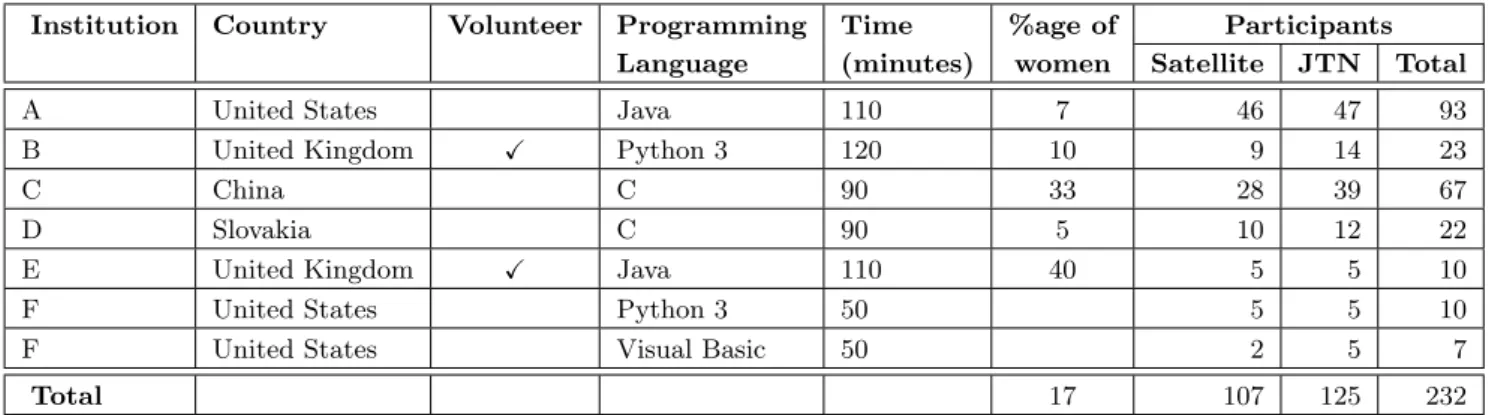
As detailed in Table 1, students from six different institu-tions participated in the study, which have been labeled A through F for convenience of reference. The programming language of instruction varied by institution. Institution F gave the task in both Python and Visual Basic to two dif-ferent sets of participants. Participants at institutions A to E were given the instructions of their appropriate task on paper and all copies of the paper instructions were collected after the session. Participants from institution F received the instructions online. Participants were not allowed to use any outside resources such as the text, notes, previous lab assignment solutions, or the Internet. They were not allowed to discuss the problem with each other.
Submitted programs were collected from participants elec-tronically and anonymized before analysis. Each researcher obtained the appropriate Institutional Review Board ap-proval from his or her institution, as required.
Table 1 gives the number of participants in each treat-ment group for each institution. It also includes the maxi-mum time allowed for the task, the percentage of women,1 and whether or not the participants were volunteering to do the programming activity or received course credit for their submission.
3.3
Institution and Course Descriptions
3.3.1
Institution A
Institution A is a fully accredited Master’s level public university with a high undergraduate enrollment profile.
Introduction to Computing is a 4 US credit-hour (equiv-alent to 6.68 ECTS hours - European credit transfer and accumulation system) Java CS1 course taught in English. The course is structured as 150 minutes per week of lec-tures augmented by a weekly 110 minute lab section, for 15 academic weeks. In the semester in which the experiment was conducted, there were three lecture sections of approxi-mately 40 students each taught by two different instructors. The lecture sections varied in format from extemporaneous lecture, to prepared lectures, to peer instruction with elec-tronic response devices. In most lab sessions, students solved programming problems in pairs using an IDE. Topics were organized in a fundamentals-first or objects-last approach in Java.
The experiment was conducted during the 15th, and last, lab session as an individual assignment. Students seated next to each other were to be given different tasks, with the goal that the two versions would be distributed approx-imately evenly in each lab section and overall. Students had 110 minutes to complete their assigned task. Teaching assistants supervised, but did not answer questions or give programming help. The finished programs were submitted electronically.
All participants in the experiment were enrolled in the course. 29 (31%) of the 94 participants majored in Com-puter Science or ComCom-puter Engineering, 27 (29%) majored in Electrical or Mechanical Engineering, 31 (33%) hadn’t yet declared a major, and the remaining 7 had majors in various other disciplines.
1IRB restrictions did not allow the collection of this
Sample output:
The red text in the examples below indicate user input
Enter number of satellites (9999 to quit): 5 Enter number of satellites (9999 to quit): 15 Enter number of satellites (9999 to quit): 3 Enter number of satellites (9999 to quit): 2 Enter number of satellites (9999 to quit): 14 Enter number of satellites (9999 to quit): 7 Enter number of satellites (9999 to quit): 9999 Number of planets in solar system: 6 Total satellites observed: 46
Average satellites per planet: 7.666666666666667 Satellites orbiting planet with most satellites: 15 Number of planets with at least one satellite: 6
Enter number of satellites (9999 to quit): -5 Negative numbers not allowed!
Enter number of satellites (9999 to quit): 10 Enter number of satellites (9999 to quit): 3 Enter number of satellites (9999 to quit): 2 Enter number of satellites (9999 to quit): 0 Enter number of satellites (9999 to quit): 0 Enter number of satellites (9999 to quit): -6 Negative numbers not allowed!
Enter number of satellites (9999 to quit): 1 Enter number of satellites (9999 to quit): 9999 Number of planets in solar system: 6 Total satellites observed: 16
Average satellites per planet: 2.6666666666666665 Satellites orbiting planet with most satellites: 10 Number of planets with at least one satellite: 4
Figure 4: Example Input and Output Given in Satellite Task. (Note: Text originally displayed in red is shown in italics.)
Institution Country Volunteer Programming Time %age of Participants Language (minutes) women Satellite JTN Total
A United States Java 110 7 46 47 93
B United Kingdom X Python 3 120 10 9 14 23
C China C 90 33 28 39 67
D Slovakia C 90 5 10 12 22
E United Kingdom X Java 110 40 5 5 10
F United States Python 3 50 5 5 10
F United States Visual Basic 50 2 5 7
Total 17 107 125 232
Table 1: Participants in the Study by Institution
3.3.2
Institution B
Institution B is a new public university offering courses ranging from foundation to postgraduate courses.
Foundations of Computer Programming is an introduc-tion to the design and implementaintroduc-tion of programs using a high-level computer programming language (Python). The module lasts for one academic semester and is intended for foundation students enrolled in a one year course designed to improve their general skills in computing, mathematics and information technology. Upon successful completion, the students can progress directly to their choice of an under-graduate degree in Computer Science, Engineering, Digital media Production or Information Technology Management for Business.
Student volunteers were recruited via email. They were randomly divided into two groups and asked to complete a programming task depending on the group they belong to within an allocated time (two hours). The instructions were
in English and no further questions or explanations were allowed during the experiment. Most of the participants finished within an hour and the solutions were electronically submitted to the instructors.
3.3.3
Institution C
Institution C offers programs which draw from Electri-cal and Communications Engineering, MathematiElectri-cal Science and Statistics, Computer Science and Electronics, and Busi-ness.
Introduction to Programming 2 is a 5 ECTS credit course that follows on from the 5-credit course Introduction to Computer Programming 1. The language of instruction is English and the programming language is C. The course is structured as 90 minutes per week of lecture augmented by a weekly 90 minute lab for 16 academic weeks. In the semester in which the experiment was conducted, there was one lecture section of approximately 150 students and 2 lab sections of approximately 75 students each supervised by
graduate students, who assisted students by answering pro-gramming questions. The lecture sections consisted of pre-pared lectures. In each lab session, students were tasked with programming problems which reflected lecture topics.
The experiment was conducted during the last lab session of a 16 week semester as an individual assignment. Teaching assistants supervised, but did not answer questions or give programming help.
All participants in the experiment were enrolled in the course. 28 (36%) of the 77 participants are first-year Soft-ware Engineering majors and 49 (64%) are first-year Internet of Things Engineering majors.
3.3.4
Institution D
Institution D is a fully accredited Master’s level public university.
Programming 1 is a 6 ECTS credit CS1 course taught in the Faculty of Natural Sciences in the first year of the Applied Computer Science program. The language of in-struction is Slovak, the programming language is C. The course includes 80 minutes per week of lecture and a weekly 80-minute lab for 13 academic weeks. In the semester in which the experiment took place, there was one lecture sec-tion of approximately 40 students and 2 lab secsec-tions of ap-proximately 20 students. The whole course was taught and supervised by one teacher (T1). In each lab session, students were tasked with programming problems and developed pro-grams using an IDE. The experiment was conducted by an-other teacher (T2) who taught the same students, within the subject “Semestral Project 1”. This second course prepares students for academic writing in computer science topics.
For the experiment, task instructions were translated by T2 to the Slovak language and printed. The experiment was conducted during the last lab session as an individual assignment for which students did not receive any kind of help. The finished programs were submitted electronically.
All participants in the experiment were enrolled in the course “Programming 1” (and “Semestral Project 1”). All 22 (100%) of the participants majored in Applied Computer Science.
3.3.5
Institution E
Institution E is a large public university awarding degrees ranging from Bachelor’s to PhD level.
Software Design and Development (first-year) and Object Oriented Software Design (second-year) are both 30-credit (15 ECTS) courses which are taught subsequently over the first two years at the School of Computing Science and Digi-tal Media. Each course lasts a year across the Computer Sci-ence and Computing Graphics and Animation BSc degrees. The language of instruction is English, with JavaScript used as the introductory language, and Java used as the main programming language.
An e-mail was circulated to students from both modules, asking for voluntary participation for the experiment. Stu-dents were invited to an empty lab were they were randomly allocated tasks. Teaching assistants supervised, but did not answer questions or give programming help. The submitted programs were e-mailed to the lecturer in charge.
All participants in the experiment were enrolled in one of the two degrees described above.
3.3.6
Institution F
Institution F is a fully accredited Master’s level urban public college.
Data were gathered from two different courses, Algorith-mic Thinking and Introduction to Visual Basic in Business, both taught in English. The two courses had two different instructors, both full-time faculty. Neither was a researcher on this project.
Algorithmic Thinking is a 4 US credit-hour Python CS1 course for CS majors in the Faculty of Arts and Sciences, designed for students who have not had any previous pro-gramming experience. While it is intended for CS majors, some of the students are Mathematics Education majors, for whom it is a requirement.
The course is structured as 200 minutes per week of lec-ture, which varies in form during the semester from lecture to group work to lab sessions, at the instructor’s discretion. In the lab sessions, students are assigned problems to solve using an IDE. The course lasts 14 academic weeks. In the semester in which the experiment was conducted there was one section of approximately 24 students.
Introduction to Visual Basic in Business is a 3 US credit-hour introductory programming course for Computer and Information Systems majors in the School of Management. The course is structured as 150 minutes per week of lecture and lasts 14 academic weeks. In the semester in which the experiment took place, there was one section of 15 students. The Python experiment was conducted during the 13th week of classes; the Visual Basic experiment was conducted during the 14th and final week of classes. In each class, half of the students were given one task and half were given the other. Following the requirements of the local Institutional Review Board (IRB), each student was given a consent form outlining the experiment, and data were collected only from those students who consented. Instructors supervised, but did not answer questions. Neither instructor gave program-ming help.
All participants in the experiment were enrolled in the course from which their data were gathered. The researcher at institution F was not authorized by the local IRB to col-lect demographic information. It is highly likely, however, that the Visual Basic students intended to major in Com-puting and Information Systems, and the Python students intended to major in either Computer Science or Mathemat-ics Education.
4.
ANALYSIS
The data collected include 246 submitted files and demo-graphic information about their authors (where permitted by the IRB), identified by institution and task version. Of these 246 submissions, 14 were excluded: two where the stu-dent submitted the wrong file (one from Institution A and one from Institution D) and 12 for suspected plagiarism (10 from Institution C and two from Institution F).
This left a total of 232 programs in our final dataset. As shown in Table 2, slightly more than half (54.3%) of these programs were Just the Numbers programs, and slightly less than half (45.7%) were Satellite Problem programs. In each group, there were some programs that compiled (the “com-piles”), and some that did not (the “non-compiles”).
Two different analyses of this dataset were performed. First, the compiles were analyzed by using grey-box
test-Treatment Compile Non-Compile Total
Satellite 91 15 (14.2%) 106
JTN 109 17 (13.5%) 126
Table 2: Numbers of submissions that compile and do not compile by treatment group (Satellite Prob-lem or Just The Numbers)
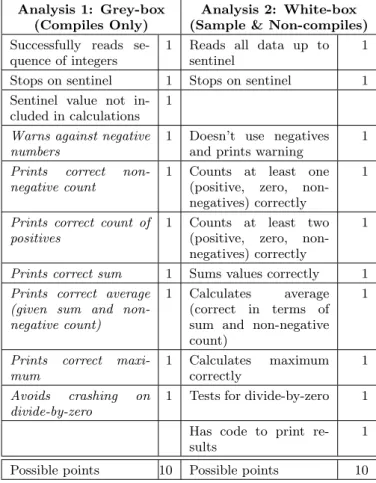
Analysis 1: Grey-box Analysis 2: White-box (Compiles Only) (Sample & Non-compiles)
Successfully reads se-quence of integers
1 Reads all data up to sentinel
1 Stops on sentinel 1 Stops on sentinel 1 Sentinel value not
in-cluded in calculations 1
Warns against negative numbers
1 Doesn’t use negatives and prints warning
1
Prints correct non-negative count
1 Counts at least one (positive, zero, non-negatives) correctly
1
Prints correct count of positives
1 Counts at least two (positive, zero, non-negatives) correctly
1
Prints correct sum 1 Sums values correctly 1
Prints correct average (given sum and non-negative count)
1 Calculates average (correct in terms of sum and non-negative count)
1
Prints correct maxi-mum 1 Calculates maximum correctly 1 Avoids crashing on divide-by-zero
1 Tests for divide-by-zero 1 Has code to print re-sults
1 Possible points 10 Possible points 10
Table 3: Point assignments for scoring. (Note: ital-ics indicate a black-box test.)
ing: as shown in Table 3, most items were black-box tested, but for some features, white-box testing was used. Second, a sample of 25% of the programs, including both compiles and non-compiles, was tested using a more extensive white-box testing scheme.
These complementary analyses triangulate the results, as in McCracken et al. [33] and McCartney et al. [32] The remainder of this section describes each of these analyses in more detail.
4.1
Analysis 1: Grey-box Testing of Compiles
Analysis 1 used grey-box testing as shown in Table 3. White-box tests were used for successfully reading in a se-quence of integers, which would normally involve the cre-ation of a loop; stopping the reading of input when the sen-tinel value was entered, with (for example) an appropriate loop condition or selection statement; and excluding the sen-tinel value from the calculations.Black-box tests were performed using two test sequences. The first test sequence included several positive numbers, a negative number, a zero, and the sentinel value. For this test sequence, the submission received one point each for correctly calculating the number of values entered (excluding the sentinel), their sum, their average, the largest number and the number of values entered that were greater than zero.
In the case of the average, the point was awarded if the program divided the sum by the count regardless of whether or not those two values were themselves correct.
The absence of typecasting to avoid integer division was not considered an error and did not affect the score since the problem is not present in all of the programming languages used in the study.
The second test sequence was an edge case which included only negative numbers and the sentinel. The calculation of the average would run into a division by zero problem, which could cause abnormal termination (in some languages). If the code guarded against division by zero, either implicitly or explicitly, and avoided a crash or invalid result, it was awarded one point.
We continued the analysis in two ways. First, we assigned a score of 0 to the non-compiling solutions and included them in the sample. Second, we re-ran the analysis including only the compiling programs in the data set.
4.2
Analysis 2: White-box testing of a sample
The Grey-box analysis approach, depending on black-box testing, assigned the same zero score to all non-compiling submissions regardless of the completeness or correctness of the submission. In order to be able to consider the cor-rectness of the submissions that did not compile, a strictly white-box analysis methodology was developed to score the structural features in the programs, as in McCartney et al. [32]. The abstract (language independent) structure of a successful solution to these tasks involves iterating over a number of inputs until the sentinel value is read; during the iterations the program skips negative values, and keeps running totals for the sum of values, the number of values read, and the number of zero (alternatively positive) val-ues, as well as a running maximum value. Once the sentinel is read, the program prints out the required outputs, some stored (sum, number read, maximum) and some calculated (average).Adding some control information, this can be expanded to:
loop: read in number (1)
if (read in sentinel) (2)
exit loop (3)
else if (number < 0) (4)
print error message (5)
else (6)
count = count + 1 (7)
sum = sum + number (8)
if (number > max) (9) max = number (10) if (number > 0) (11) posCount = posCount + 1 (12) if (count > 0) (13) average = sum/count (14) print stats (15)
Programs would optimally check errors, particularly when reporting the average and the maximum when the count of numbers read is zero.
Given this structure, one can extract a number of different structural features:
• Code to iterate through all of the data (the loop struc-ture with enclosed read statement (lines 1-12),
• Code that checks for the end of data (lines 2-3),
• Code that processes each data item within the loop, including code to process negative inputs (line 4-5), non-negative inputs (lines 7-10), and positive inputs (lines 11-12),
• Code to check for no data (line 13),
• Code to calculate results (line 14),
• Code to print out the desired stats (line 15), and
• Code to print out “No data” message (line 16). The arrangement of these features can vary – there may be a read and sentinel test preceding the loop and at the end of the loop, e.g., but the overall features define what needs to be done within the task. These features also describe an alternative structure for this problem: first read all of the data into a data structure, such as an array or list, then process the data items from the data structure.
To capture these features, two researchers agreed on a set of eleven structural elements to tag in each program. They individually tagged a sample of 29 programs from the com-plete dataset for presence/absence of each attribute, then resolved their differences through discussion; these discus-sions helped identify and remove ambiguities from the tag definitions, including an identification of near-miss condi-tions – logically incorrect versions of attributes that should still be accepted.
The resulting list of attributes is as follows:
Reads Input A program has the potential to read in and use all the data entered by the user. A near miss may fail to use one of the data items in calculations, gen-erally the first one. A program that reads data into a fixed size array counts as correctonlyif the array can store at least 400 values.
Stops on Sentinel The program will always recognize the sentinel value (9999) and stop accepting inputs. Near miss if the program tests whether numbers are greater than or equal to 9999 instead of equal to 9999.
Deals with Negatives For every non-sentinel input, the program must check whether it is negative, and if so print a message and exclude it from the computations. Near miss when the program correctly handles indi-vidual negative numbers but not more than one in a row.
Counts Zeros The program counts the number of zeroes entered.
Counts Positives The program counts the number of pos-itive inputs entered.
Counts Non-negatives The program counts the number of non-negative inputs entered.
Sums values The program correctly calculates the sum of the non-negative numbers, which requires adding up all of the positive or non-negative inputs.
Calculates average The program correctly calculates the average of the non-negative numbers based on the sum and non-negative count (which do not have to be cor-rect). Near miss if the program does integer division or divides by zero if the sentinel is the first input.
Calculates maximum The program correctly calculates the maximum value entered (excluding the sentinel). Near miss if it reports a maximum of zero for empty sets of numbers.
Prints results Te program displays the results calculated (regardless of whether or not the results themselves are correct) using labels from the problem description. Near miss if the program either does not print or prints label only for values that were not calculated.
Checks for Divide-by-zero The program avoids dividing by zero when the sentinel is the only number entered, and does not attempt to compute the average in this case.
The different count tags correspond to different ways the program might obtain the necessary information for the re-sults: the number of numbers greater than or equal to zero and the number greater than zero. Counting any two of ze-roes, positives, or non-negatives is sufficient to obtain the necessary results.
Given these tags, a point assignment was developed to enable comparison of this analysis with the Analysis 1 scor-ing. One point was given per attribute except for the three counts – for the three counts a maximum of two points were awarded, since the third count can be obtained from the other two. This assignment maps a set of tags to a value between 0 and 10, the same range as the Analysis 1 scores. The Analysis 1 and Analysis 2 schemes are comparable, as shown in Table 3.
After finalizing the white-box tagging scheme, a sample of 58 programs were selected, 25% of the entire dataset, for tagging. The sample was created by selecting from among the randomized file names assigned to submissions when the programs were anonymized. An equal number of Satellite and Just the Numbers programs were chosen from each of the institutions. The tagging was done by three researchers, two for each program; differences were resolved through dis-cussion.
The number of items by institution and problem type in the resulting sample is given in Table 4. The sample also included both compiles and non-compiles: 14 of the 58 pro-grams in the sample were non-compiles, with at least one non-compile from each institution except E (which had no non-compiling submissions).
5.
RESULTS
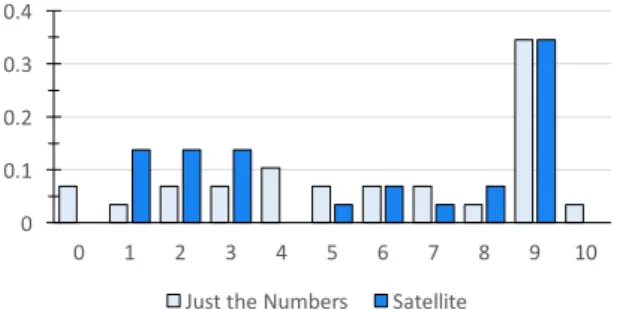
Figure 5 presents the distribution of the grey-box testing scores from Analysis 1. Figure 6 presents the distribution of the white-box testing scores from Analysis 2. Recall that the grey-box testing was applied to the 200 submissions that compiled without error; the 32 non-compiles were given a score of -1, so they are represented by the left-most bars of
Institution Just the Satellite Sample Population
Numbers Size Size
A 8 12 20 93 B 3 4 7 23 C 5 5 10 67 D 5 3 8 22 E 3 3 6 10 F 2 1 3 10 F 3 1 4 7 Total 29 29 58 232
Table 4: Our sample, by program type and by insti-tution. 0 0.1 0.2 0.3 0.4 -1 0 1 2 3 4 5 6 7 8 9 10
Grey-box Test Score Frequencies
Just the Numbers Satellite
Figure 5: Distribution of Grey-box Testing Scores by Treatment Group. All programs, n = 232.
the graph. The white-box testing was applied to our sam-ple of 25% (58) of the programs; the same test was applied to both compiles and non-compiles. Both distributions are clearly not normal – approximately a third of each group has a score of 9.
In the following sections, we will discuss the analyses done using these data.
5.1
Results 1: Compiled Programs
We compared the distributions of the grey-box scores in two ways. First, non-compiling programs were included with a score of zero. In this case, we ran a t-test on the scores. The mean score for the Satellite treatment group was 5.44 (out of 10) and for the Just the Numbers group was 5.31. A
0 0.1 0.2 0.3 0.4 0 1 2 3 4 5 6 7 8 9 10
White-box Test Score Frequencies
Just the Numbers Satellite
Figure 6: Distribution of White-box Testing Scores by Treatment Group. Sample of programs, n = 58.
t-test confirms that these are not statistically significantly different (p= 0.798).
Second, we ran the same analysis on the compiling sub-missions only. This gave analogous results with mean scores of 6.33 for Satellite and 6.15 for Just the Numbers, which are not statistically significantly different (p= 0.707).
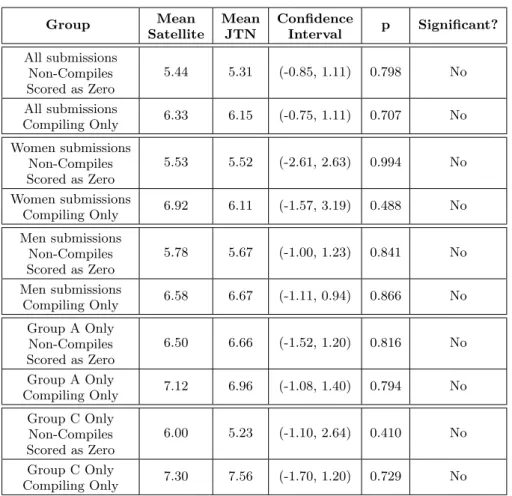
In both cases, the students in the Satellite group per-formed marginally better, but the difference is not statisti-cally significant. In addition, the score distributions of the two institutions with the most submissions (Institutions A and C) showed no statistically significant difference in per-formance between the Satellite and the Just the Numbers groups. (See Table 5 for details.)
5.2
Results 2: White-box Testing of a Sample
The distributions of white-box testing scores for the sam-ple programs look remarkably similar for the Satellite and Just the Numbers submissions, as can be seen in Figure 6. Indeed, in a comparison of the 29 Satellite programs and the 29 Just-The-Numbers programs in the sample, both a two-tailed Mann-Whitney test (U = 389, p = 0.62) and t-test (t(56) = 0.49, p= 0.63) find no statistically significant differences.A Shapiro-Wilk test verifies that neither the distribution of the Just the Numbers group nor the distribution of the Satellite group is normal, with a 9.89 variance for Just the Numbers and 10.89 for Satellite.
5.3
Comparing the White-Box and Grey-Box
Score Distributions
The grey-box and white-box testing can be used to tri-angulate the analysis. A comparison of Figures 5 and 6 shows the score distributions are very similar for the two measures. Considering the 58 programs in the 25% sample where both scores exist, the average grey-box score is 4.74, while the average white-box score is 5.83. A significant cause of that difference is due to the 14 non-compiling programs that grey-box analysis scores as zero; their average white-box score is 2.71. The average grey-white-box and white-white-box scores for the 44 compiling programs are much closer in value: 6.82 and 6.25, respectively. A one-tailed paired t-test for the compiling programs resulted in an insignificant difference: t(43) = 1.68, p = 0.091. Given the non-normality of the distributions, we ran a Wilcoxon paired test on the compil-ing program scores as well; the results were consistent with the t-test: insignificant difference,V = 201, p= 0.141. Not surprisingly, including the non-compiling program scores in this analysis finds a significant difference.
A Pearson’s correlation test on the grey-box and white-box scores for the 44 compiling submissions shows the scores are highly correlated (cor(42) = 0.77, p <0.001).
5.4
Results 3: Combining the Analyses
Given the lack of statistically significant difference be-tween the white-box and grey-box testing (as discussed above in Section 5.3), we did a third, combined analysis in which the grey-box scores were used for the compiled programs and the white-box scores were used for the non-compiles. We will call this thecombined score.
Analyzing the combined score is equivalent to rerunning our original tests from Results 1 except that instead of either omitting or assigning zero to each non-compiling submission,
we use its white-box testing score. The thought was that by assigning a more meaningful score to the non-compiling submissions in the larger data set, we would expose any real difference that was previously masked by the lack of data from the non-compiles.
In order to do this, we required white-box testing (Anal-ysis 2) scores for all of the non-compiles. Using the same process, the three researchers who did the 25% sample also tagged the remaining 18 non-compiling submissions that were not included in that sample.
Again, we found no statistically significant difference be-tween the treatment groups. The means of the combined scores (out of 10) were 5.91 (Just the Numbers) and 5.78 (Satellite). This small difference is not statistically signifi-cant (t(230) = 0.30, p= 0.76). Given that the data are not normally distributed, it can be argued that a non-parametric test would be more appropriate. A Wilcoxon rank sum also finds the difference not to be statistically significant (W = 6582, p= 0.83).
5.5
Results: Gender
Table 1 includes percentages of women within each insti-tution. In total there were 36 females, 175 males and 21 par-ticipants for whom the gender was unspecified. Of those who identified as females, 15 were assigned to the Satellite Prob-lem group and 21 were assigned to the Just the Numbers group. A chi-squared test (χ= 0.1486, df = 1, p= 0.6999) confirmed that the random assignment to treatment group was not biased by gender.
Table 5 includes the results comparing performance of only the women and only the men. As with the entire pop-ulation, no significant differences were found in the perfor-mances on the different tasks.
5.6
Results: Proportion of Non-Compiles
The numbers of submissions which did and did not com-pile for the Satellite and Just the Numbers programs are shown in Table 2. Here again there is no statistically signif-icant difference between the two groups. A chi-squared test (χ(1) = 0.021, p= 0.885) confirms the distributions between the two groups are not statistically significantly different.5.7
Results: Summary
All of the above analyses agree: there is no statistically significant difference between student performance on the Just the Numbers programs and on the Satellite programs. Thus, we failed to reject the null hypothesis. It is our belief that the data show that novice programmers exhibit equiva-lent rates of success on contextualized and generic problems.
6.
DISCUSSION
6.1
A Multi-Institutional Global Study
Students participating in this study spanned six institu-tions in four countries from three continents. This strength-ens the negative result of the study because the outcome – no difference between the Satellite Problem and Just the Numbers treatment groups – was observed in several differ-ent situations: differdiffer-ent classrooms, differdiffer-ent types of CS1 courses, different types of students and different cultural backgrounds.
6.1.1
Different CS1 Courses and Student Populations
The CS1 courses included in the study differed in many facets including schedule, programming language, and course content – for instance, some of the participating CS1 courses may have introduced more advanced data structures than others. All students were completing a CS1 course, but not all students were enrolled specifically in a Computer Science degree – some were enrolled in related degrees such as Soft-ware Engineering, Internet of Things Engineering, Mathe-matics Education or Digital Media. The motivation for in-cluding such a diverse set of institutions and students was to give a representative sample of CS1 courses offered globally, but whether the students and institutions who participated in this study are, in fact, representative of students in gen-eral is difficult to determine.
Not only did the majors of the students vary across insti-tutions, their skill level was different as well. Some of the students were true novices and the CS1 course they were enrolled in at the time was their first. Others were in their second year of instruction. It is difficult to find a measure to accurately rank students across institutions. In addi-tion, the courses themselves differed significantly – from the course structure and focus, through the programming lan-guage to the credit weight. Also, the gender balance varied drastically, ranging from 5% to 40% for the five institutions reporting (for one institution these statistics could not be reported).
In two institutions students were non-native English speak-ers. In one of these the language of instruction was English, while in the other the language of instruction was the stu-dents’ native language. This is discussed in more detail later in this section.
6.1.2
Different computer languages
The observed performance varied across computer lan-guages. In terms of the percent of programs that did not compile, Java (4.9%) was much lower than C (20.2%) and Python (24.2%) (all of the Visual Basic programs compiled, but there were only 7 of them). These differences are hard to isolate to language, however: they also correspond to the institutions that use those languages, and they may be a function of the development environments used. There was no apparent difference for the two tasks.
The difficulty of white-box testing did seem to vary with language as well – the C programs were often more difficult to analyze than the Java or Python programs. It may be that C programs are just harder to read, especially when written by novices who can write correct code that violates convention, such as using a stack to store data, using push
to store the input data, then accessing the data of the stack as an array when processing the input set. The difficulty of reading the code seemed unrelated to the task, however.
6.1.3
Challenges of a Multi-institutional Study
Multi-institutional, multi-national studies have inherent challenges. While they do have advantages – a larger pool of students from a variety of institutions, making the results potentially more generalizable – they introduce significant problems of coordination and communication. As one of the first multi-national, multi-institutional studies in computing education, McCracken et al. [33] encountered these issues head-on and discussed them in their report. The researchers in their group were allowed to choose any or all of three
Group Mean Satellite Mean JTN Confidence Interval p Significant? All submissions Non-Compiles Scored as Zero 5.44 5.31 (-0.85, 1.11) 0.798 No All submissions Compiling Only 6.33 6.15 (-0.75, 1.11) 0.707 No Women submissions Non-Compiles Scored as Zero 5.53 5.52 (-2.61, 2.63) 0.994 No Women submissions Compiling Only 6.92 6.11 (-1.57, 3.19) 0.488 No Men submissions Non-Compiles Scored as Zero 5.78 5.67 (-1.00, 1.23) 0.841 No Men submissions Compiling Only 6.58 6.67 (-1.11, 0.94) 0.866 No Group A Only Non-Compiles Scored as Zero 6.50 6.66 (-1.52, 1.20) 0.816 No Group A Only Compiling Only 7.12 6.96 (-1.08, 1.40) 0.794 No Group C Only Non-Compiles Scored as Zero 6.00 5.23 (-1.10, 2.64) 0.410 No Group C Only Compiling Only 7.30 7.56 (-1.70, 1.20) 0.729 No
Table 5: Mean scores and confidence intervals for different groups of participants
variations on the calculator problem; some students did the problem voluntarily, some didn’t; whether students had help from the instructor, textbooks, or other resources may have varied; there was no centralized approval for translations of the instructions into other languages; and the problem was significantly harder in Java than in other programming languages. (Java did not yet have aScannerclass.)
We have tried to avoid these problems as much as possi-ble. As McCracken et al. [33] recommended, we had a single coordinator for the project, the working group leader. The leader had run pilot versions of the experiment before dis-tributing it to the group. All the student programs were anonymized and kept in a single online repository, accessi-ble to all the members of the group. In addition, we took steps to ensure that the problem was comparable in differ-ent languages (for example, giving the Visual Basic studdiffer-ents the GUI code they needed). All institutions used the same instructions, with only the modifications necessary to trans-late the instructions into the students’ language of instruc-tion or to fit the assignment to a particular programming language. All students completed the task in a supervised setting, without any resources or assistance. We tested the programs for evidence of student collaboration, and where we found suspected plagiarism, we excluded those programs from the data, as previously noted.
Nevertheless, there were still some unavoidable variations. Some students were volunteers; some were not. They wrote the program in the context of different courses, taught by
different instructors, using different books, emphasizing dif-ferent topics, and – due to local constraints – they had differ-ent amounts of time to solve the problem. Even though we believed that it would be interesting to capture how much time individual students spent working on their solution, not all of the institutions were able to collect that data. Most of the students did the English-language version of the prob-lem; for many of them, English was not their first language.
6.2
Threats to Validity
While a number of threats to validity such as dependence on a particular institutional situation, are partially miti-gated by the inclusion of a number of varied situations, other threats are inherent to the study design itself and present regardless of the classroom setting.
6.2.1
Are students giving their best?
The performance of students on either task can be strongly influenced by their motivation. Some of the students in our population received course credit, while others were volun-teers. Regardless of their situation, the question of whether their effort was representative of their actual skill remains. As the experiment took place at the end of the semester, it is possible that students who had already achieved the desired grade in the course did not strain to deliver their best per-formance. Volunteers, on the other hand, might have lacked the motivation of course credit to do their best.