ZRENJANIN REPUBLIC OF SERBIA
IX INTERNATIONAL CONFERENCE OF
INFORMATION TECHNOLOGY AND
DEVELOPMENT OF EDUCATION
ITRO 2018
PROCEEDINGS OF PAPERS
IX MEĐUNARODNA KONFERENCIJA
INFORMACIONE TEHNOLOGIJE I
RAZVOJ OBRAZOVANJA
ITRO 2018
ZBORNIK RADOVA
ZRENJANIN, JUNE 2018II
University of Novi Sad, Technical faculty „Mihajlo Pupin”, Zrenjanin, Republic of Serbia
For publisher:
Dragica Radosav, Ph. D, Professor, Dean of the Technical faculty „Mihajlo Pupin”, Zrenjanin, Republic of Serbia
Editor in Cheaf - President of OC ITRO 2018: Vesna Makitan, Ph. D, Assistant Professor, Proceedings editor:
Marjana Pardanjac, Ph. D, Professor Technical design:
Ivan Tasic, Ph. D, Professor; Dusanka Milanov MSc, Assistant Lecturer:
Erika Tobolka, Ph. D, Professor Circulation: 50
ISBN: 978-86-7672-310-2
By the resolution no. 142-451-607/2018-01/02, Autonomous Province of Vojvodina, Provincial Secretariat For Science and Technological Development donated financial means for printing this Conference Proceedings.
The Conference is supported by the Autonomous Province of Vojvodina
CIP - Каталогизација у публикацији Библиотека Матице српске, Нови Сад 37.01:004(082)
37.02(082)
INTERNATIONAL Conference on Information Technology and Development of Education ITRO (9 ; 2018 ; Zrenjanin)
Proceedings of papers [Elektronski izvor] / IX International Conference on Information Technology and Development of Education ITRO 2018 = Zbornik radova / IX međunarodna konferencija Informacione tehnologije i razvoj obrazovanja ITRO 2018, Zrenjanin, June 2018. - Zrenjanin : Technical Faculty "Mihajlo Pupin", 2018. - 1 elektronski optički disk (CD-ROM) : ilustr. ; 12 cm
Nasl. sa naslovnog ekrana. - Tiraž 50. - Bibliografija uz svaki rad. ISBN 978-86-7672-310-2
I. Međunarodna konferencija Informacione tehnologije i razvoj obrazovanja ITRO (9 ; 2018 ; Zrenjanin) International Conference on Information Technology and Development of
Education ITRO (9 ; 2018 ; Zrenjanin)
a) Информационe технологијe - Образовање - Зборници b) Образовна технологија - Зборници
III
PARTNERS INTERNATIONAL CONFERENCE
South-West University „Neofit Rilski”
Faculty of Education, Blagoevgrad,
Republic of Bulgaria
Faculty of Electrical Engineering and Informatics
Department of Computers and Informatics of Kosice
Slovak Republic
University Goce Delcev Stip
Republic of Macedonia
IV
THE SCIENCE COMMITTEE:
Dragoslav Herceg, Ph.D, Professor, Faculty of Science, Novi Sad, Serbia – Chairman Marina Čičin Šain, Ph.D, Professor, University of Rijeka, Croatia
Anton Vukelić, Ph.D, Professor, Faculty of Philosophy, Croatia
Ion Dzitac, Ph.D, Professor, Department of Mathematics-Informatics, Aurel Vlaicu University of Arad, Romania
Sashko Plachkov, Ph.D, Professor, South-West University "Neofit Rilski" /Department of Education, Blagoevgrad, Republic of Bulgaria
Sulejman Meta, Ph.D, Professor, Faculty of Applied Sciences, Tetovo, Macedonia
Márta Takács, Ph.D, Professor, Óbuda University, John von Neumann Faculty of Informatics, Budapest, Hungary
Nina Bijedić, Ph.D, Professor, Applied mathematics, Bosnia and Herzegovina
Viorel Negru, Ph.D, Professor, Department of Computer Science, West University, Timisoara, Romania
Mirjana Segedinac, Ph.D, Professor, Faculty of Science, Novi Sad, Serbia Milka Oljača, Ph.D, Professor, Faculty of Philosophy, Novi Sad, Serbia
Dušan Starčević, Ph.D, Professor, Faculty of Organizational Sciences, Belgrade, Serbia Dobrivoje Mihajlović, Ph.D, Professor, Faculty of Organizational Sciences, Belgrade, Serbia Kosta Voskresenski, Ph.D, Professor, Technical Faculty "Mihajlo Pupin" Zrenjanin, Serbia Josip Ivanović, PhD, Professor, Hungarian Language Teacher Training Faculty, Subotica, Serbia Ivanka Georgieva, Ph.D, South-West University "Neofit Rilski", Faculty of Engineering,
Blagoevgrad, Republic of Bulgaria
Miodrag Ivković, Ph.D, Professor, Technical Faculty "Mihajlo Pupin" Zrenjanin, Serbia Momčilo Bjelica, Ph.D, Professor, Technical Faculty "Mihajlo Pupin" Zrenjanin, Serbia Dragica Radosav, Ph.D, Professor, Technical Faculty "Mihajlo Pupin" Zrenjanin, Serbia Dragana Glušac, Ph.D, Professor, Technical Faculty "Mihajlo Pupin" Zrenjanin, Serbia Dijana Karuović, Ph.D, Professor, Technical Faculty "Mihajlo Pupin" Zrenjanin, Serbia Ivan Tasić, Ph.D, Professor, Technical Faculty "Mihajlo Pupin" Zrenjanin, Serbia
Vesna Makitan, Ph.D, Assistant Professor, Technical Faculty "Mihajlo Pupin" Zrenjanin, Serbia Marjana Pardanjac, Ph.D, Professor, Technical Faculty "Mihajlo Pupin" Zrenjanin, Serbia Snežana Babić Kekez, Ph.D, Professor,Technical Faculty "Mihajlo Pupin" Zrenjanin, Serbia Erika Tobolka, Ph.D, Professor, Technical Faculty "Mihajlo Pupin" Zrenjanin, Serbia Stojanov Željko, Ph.D, Professor, Technical Faculty "Mihajlo Pupin" Zrenjanin, Serbia Brtka Vladimir, Ph.D, Professor, Technical Faculty "Mihajlo Pupin" Zrenjanin, Serbia
Kazi Ljubica, Ph.D, Assistant Professor, Technical Faculty "Mihajlo Pupin" Zrenjanin, Serbia Berković Ivana, Ph.D, Professor, Technical Faculty "Mihajlo Pupin" Zrenjanin, Serbia
Nikolić Milan, Ph.D, Professor, Technical Faculty "Mihajlo Pupin" Zrenjanin, Serbia
V
THE ORGANIZING COMMITTEE:
Vesna Makitan, Ph.D, Ass. Professor, Technical Faculty “Mihajlo Pupin” Zrenjanin, R. of Serbia - Chairman of the Conference ITRO 2018
Dragica Radosav, Ph.D, Professor, Technical Faculty “Mihajlo Pupin” Zrenjanin, R. of Serbia Dijana Karuovic, Ph.D, Professor, Technical Faculty “Mihajlo Pupin” Zrenjanin, R. of Serbia Marjana Pardanjac, Ph.D, Professor, Technical Faculty “Mihajlo Pupin” Zrenjanin, R. of Serbia Ivan Tasic, Ph.D, Professor, Technical Faculty “Mihajlo Pupin” Zrenjanin, R. of Serbia
Dragana Glusac, Ph.D, Professor, Technical Faculty “Mihajlo Pupin” Zrenjanin, R. of Serbia Erika Tobolka, Ph.D, Professor, Technical Faculty “Mihajlo Pupin” Zrenjanin, R. of Serbia Dusanka Milanov, MSc, Assistant, Technical Faculty “Mihajlo Pupin” Zrenjanin, R. of Serbia Vladimir Karuović, Technical Faculty “Mihajlo Pupin” Zrenjanin, R. of Serbia
All rights reserved. No part of this Proceeding may be reproduced in any form without written permission from the publisher.
The editor and the publisher are not responsible either for the statements made or for the opinion expressed in this publication.
The authors are solely responsible for the content of the papers and any copyrights, which are related to the content of the papers.
With this publication, the CD with all papers from the International Conference on Information Technology and Development of Education, ITRO 2018 is also published.
VI
INTRODUCTION
Technical Faculty "Mihajlo Pupin" organized, now the traditional, IX International Conference on Information Technology and Education Development (ITRO 2018), which was held on June 29, 2018.
This year we managed to gather our colleagues, scientists, researchers and students from 10 countries (Serbia, Macedonia, Bulgaria, Bosnia and Herzegovina, Romania, USA, Great Britain, Albania, Montenegro, Slovakia). Many of them have been participating in the work of the Conference for many years and practically they are making an ITRO family. With their papers they managed to present and promote the results of research and scientific work in the field of information technology in education. More than 40 papers have been collected, which will be published in the Proceedings of the Conference website too (http://www.tfzr.rs/itro/index.html). The main course in the work of the Conference was set up with introductory lectures in which the significance of following topics could be seen:
- Education for modern business and education from the perspective of employers nowadays when every company is directly or indirectly IT company – lecture with the topic "Digital transformation of the society – the role of education" was held by Goran Đorđević, director of the company Consulteer;
- Scientific research work in the field of information technology in education, whose results were published in one of the world's leading magazines – this novelty at the ITRO Conference was introduced by PhD Dragana Glušac with a lecture on "School without walls";
- The latest forms of education and practice of IT experts in the country and abroad – a lecture on the topic "Finding a space for "making" and digital fabrication in the education of Serbia" was held by PhD Dalibor Dobrilović.
The other presented papers have cast light on various aspects of contemporary education in our country and abroad, as well as on the experiences, problems, questions, etc. which are related to them.
The conference was an opportunity to connect again with researchers and scientists from other institutions and countries and ask questions about new forms of cooperation and projects that are relevant to all of us.
The conference was held thanks to the sponsorship of the Provincial Secretariat for Higher Education and Scientific Research, which also traditionally supports ITRO, as well as the Faculty, which provided the necessary technical conditions.
We thank everyone for participating and creating the ITRO tradition. See you at the next ITRO Conference,
Chairman of the Organizing Committee PhD Vesna Makitan
VII
We are very grateful to:
Autonomous Province of Vojvodina
for donated financial means which supported printing of the
Conference Proceedings and organizing of the Conference.
VIII
CONTENTS
INIVITED LECTURE
D. Dobrilović
FINDING SPACE FOR “MAKING” AND DIGITAL FABRICATION IN SERBIAN
EDUCATION ... 3
SCIENTIFIC PAPERS
A. Velinov, C. Martinovska Bande
CLASSIFICATION WITH ID3 AND SMO USING WEKA ... 11
N. Petrović, E. Terek, D. Sajfert, M. Mjedenjak, S. Mitić
THE IMPACT OF MANAGEMENT ON THE DEVELOPMENT OF
EDUCATION ... 18
M. Kocaleva, B. Zlatanovska, N. Stojkovikj, A. Stojanova
APPLICATION OF RUNGE - KUTTA AND EULER METHODS FOR ODE
THROUGH EXAMPLES ... 21
A. Krstev, L. Beqiri, D. Zlatev, D. Krstev, B. Krstev, A. Donev
APPLICATION OF MACHINE LEARNING IN SOFTWARE ENGINEERING ... 26
S. Ric, D. Grajić, D. Karuović, Cs. Szabo
QTQUICK MOBILE APPLICATION DEVELOPMENT ... 32
D. Čabarkapa, D. Rančić, I. Grujić, M. Mijić
TOWARDS
SOFTWARE-DEFINED
VEHICULAR
NETWORKS:
RECENT
ACHIEVEMENTS ... 37
M. Mijatović, I. Tasić, M. Pardanjac, D.Milanov
THE IMPORTANCE OF THE PARTNERSHIP BETWEEN SCHOOL AND
FAMILIES ... 43
Z. Ereiz, E. Mešić, M. Vujadinović, M. Čorluka, N. Bijedić
PRESERVATION AND TRANSFER OF WOODCARVING KNOWLEDGE ... 51
A. Krstev, D. Krstev, R. Polenakovik, B. Krstev
DECISION MAKING USING SEQUENTIAL EQUATION MODELLING APPLIED
FOR PELLET PRODUCTION ... 59
IX
N. Stojkovikj, K. Grezova, B. Zlatanovska, M. Kocaleva, A. Stojanova, R. Golubovski
EULER’S NUMBER AND CALCULATION OF COMPOUND INTEREST ... 63
S. Sudar, Z. Ivanković, B. Markoski, A. Kostic Zobenica, S. Stanisavljev
ADVANTAGES OF WPF .NET TECHNOLOGY IN THE CREATION OF THE USER
INTERFACES IN C# APPLICATION ... 69
M. Bakator, D. Radosav
DISTANCE LEARNING MODELS AND CERTIFICATION ... 73
M. Mijić, I. Grujić, D. Čabarkapa, J. Jevtić, Lj. Mijić, A. Matić
USING NOTE-TAKING APPLICATIONS IN HIGHER EDUCATION ... 77
B. Zlatanovska, M. Ljubenovska, M. Kocaleva, L. Koceva Lazarova, N. Stojkovic,
A. Stojanova
DYNAMICAL ANALYSIS OF TWO CUBIC DISCRETE DYNAMICAL
SYSTEMS ... 82
A. Felbab, D. Radosav, J. Bushati
KNOWLEDGE OF KNOWLEDGE AND IT
′
S IMPACT ON BUSINESS FAILURE OF
ENTERPRISES BASED ON INNOVATIVE BUSINESS ... 87
O. Mladenović, V. Nikolić, S. Vlačić, N. Simić, M. Mijić
APPLIED EUROPEAN AND NATIONAL INTEROPERABILITY FRAMEWORK IN
THE DEVELOPMENT OF EGOVERNMENT TO THE REPUBLIC OF SERBIA .... 92
B. Vukmanović, V. Makitan
INFORMAL LEARNING OF IT STUDENTS ... 96
S. Sudar, Z. Ivanković, B. Markoski, A. Kostic Zobenica, D. Glušac
REALIZATION OF MULTILAYERED SOFTWARE ARCHITECTURE IN
COMPLEX INFORMATIONAL SYSTEM ... 99
N. Ljubojev, D. Radosav, D. Karuović
THE RISKS OF PUPILS ON THE SOCIAL NETWORKS ... 103
S. Mihajlović, D. Radosav, Lj. Kazi, N. Simić, V. Premčevski
ON-LINE SOCIAL NETWORKS INFLUENCING YOUNG PEOPLE: A CASE
STUDY WITH FACEBOOK IN BANAT REGION OF SERBIA ... 109
M. Stojčić, V. Brtka, G. Jotanović, G. Jauševac
ANALYSIS AND RECORDING VEHICLE SOUND USING A SMARTPHONE ... 113
M. Mijatović, I. Tasić, N. Tasić, M. Ćoćkalo Hronjec
X
COMPARATIVE ANALYSIS OF IT SUBJECTS’ TEACHING QUALITY IN
HIGHSCHOOLS ... 121
V. Petrović, D. Glušac, D. Radosav, V. Premčevski, D. Krstić
MODEL OF EARLY WARNING AND RESPONSE TO THE THREATS OF
POPULATION DUE TO COMMUNICABLE DISEASES... 122
Z. Stojanov, J. Stojanov, T. Zorić, D. Dobrilović
TECHNICAL
ASPECTS
OF
TASK
COMPLEXITY
IN
CORRECTIVE
MAINTENANCE: A MODEL AND IMPLEMENTATION ... 127
I. Tasić, N. Ljubojev, M. Ćoćkalo-Hronjec, A. Lunjić
PROFESSIONALISM AND ROLE OF TEACHERS IN ACHIEVING THE MODERN
OBJECTIVES OF EDUCATION ... 133
E. Tosheva
CLOUD SOLUTIONS FOR CREATING MIND MAPS USED IN TECHNOLOGICAL
EDUCATION ... 138
Ž. Josić, N. Tasić
THE POWER OF MEDIA AS A TOOL IN CREATING ETHNIC CONFLICTS ... 139
I. Tasić, D. Glušac, M. Kovačević, J. Jankov
COMPETENCIES OF PRINCIPLES OF EDUCATIONAL INSTITUTIONS FOR NEW
PARADIGM OF ADMINISTRATION ... 145
G. Škondrić, I. Hamulić
IMPACT OF CHANGES IN THE CURRICULUM ON SUCCESSFUL ACQUIRING
AND FOLLOWING OF THE CONTENT IN THE COURSE COMPUTER
NETWORKS ... 153
M. Kavalić, D. Ivin, S. Vlačić, S. Stanisavljev
ACCESSING STUDENTS ACCORDING TO THEIR LOCUS OF CONTROL ... 154
M. Kovačević, I. Tasić, J. Pekez, D. Milanov
EDUCATION IN THE LOGISTICS SECTOR IN AP VOJVODINA ... 159
Z. Zeljkovic, D. Musulin Kolarov, J. Stojanov
ENTREPRENEURSHIP IN MATH AND VICE VERSA ... 165
D. Milanov, I. Palinkaš, E. Terek
XI
I. Tasić, D. Glušac, D. Karuović, J. Avramović
MENTORSHIP IN THE PROCESS OF INTRODUCING THE TEACHER PRENTICE
IN THE PRIMARY AND SECONDARY SCHOOLS ... 170
S. Simić, V. Brtka, V. Ognjenović, I. Berković, E. Brtka
A* SEARCH ALGORITHM AND COMPARISON OF HEURISTICS ... 171
M. Filipović, M. Pardanjac, S. Morača, N. Ljubojev, S. Vranješ, J. Barbarić
PROFESSIONAL DEVELOPMENT OF TEACHERS ... 176
N. Simić, B. Markoski, S. Mihajlović , V. Premčevski, A. Kostic-Zobenica
CREATING VIDEO GAMES WEBSITE „GAMES SQUERE“ USING MODERN
TECHNOLOGIES ... 177
V. Makitan, K. M. Sisak
LEARNING AND EDUCATION IN SMART CITIES ... 181
M. Radovanović, V. Nikolić, S. Vlačić, S. Stanisavljev, V. Premčevski
APPLIED STRATEGIES IN THE DEVELOPMENT OF EGOVERNMENT TO THE
REPUBLIC OF SERBIA ... 184
59
Decision Making Using Sequential Equation
Modelling Applied for Pellet Production
A. Krstev*, D. Krstev **, R. Polenakovik** and B. Krstev***
* Faculty of Computer Science - Goce Delchev University, Stip, Republic of Macedonia ** Faculty of Mechanical Engineering - Saints Cyril and Methodius University, Skopje, Republic of
Macedonia
*** Faculty of Natural and Technical Sciences - Goce Delchev University, Stip, Republic of Macedonia [email protected], [email protected]
Abstract - By means of learning experiences, students are expected to know, understand, and be able to demonstrate certain skills, behaviors, and attitudes. These learning experiences have been defined and described by several different learning theories. The 21th century the most common learning theories have been behavioral and cognitive learning theories. Behavioral learning theorists explain learning as relatively permanent change in “hierarchical, observable, and measurable behaviors” whereas cognitive learning theorists explain learning “as an internal change in mental associations”. The pellet production (PP) has the potential to improve the social, economic and environmental elements of the local community, as well as to expand the development of state economy growth. Work study examines community support for that development in the context of sustainable development. This topic is interesting for processing because it deals with specific and so far in Macedonia untreated problems and aspects arising from the relationship between the local community and the state efforts for better conditions for development and higher standard.
Key words: SEM, attitude, pellet production, sustainable development
I. INTRODUCTION
Pellet production (PP) or financial funds are constantly faced with the discontinuance of resource exploitation, which eventually leads to comprehensive social change and economic crisis. The possibility of providing development by means of foreign capitals for facilities and industrial plants become ruins leading to the decisive rejection in symbolic and material terms, but the area and its population look for other symbols and alternative economic activities. Therefore, it is necessary to provide viable alternatives that could be compared to the benefits generated faster development and better standard.
The industry heritage in the broader context of studying the development of dealing activities, buildings and landscapes that come from earlier periods of intensive industrialization. The local
economy is part of a broader category, which deals with the history of settlements. The sense of pride and wonder of the engineering achievements of the industrial revolution, creates a special feeling with economics which is especially important in educational terms. Sustainable development in the context of the development of economy and new technologies as an activity does not call into question the long-term economic feasibility of extraction of resources, but focuses on the protection of the negative social and environmental consequences.
The aim of this paper is to examine the extent to which the local population agrees with the sentence and determine whether their perception of various aspects of sustainability affects support overall sustainability of the economy and industrial development.
A. Social, environmental and economic sustainability
In the social context of economy is associated with an uncompromising exploitation of workers and the hard life of their families according to the post communism period. For the development of the industry and economy it is important to provide support and political factors, which should feel like a part of the project and to ensure the political and economic certainty of its further development. In this process, it is essential that local people participate in the decision-making process with the ability to selflessly share their experience, skills and knowledge. Many companies have interests that are accountable to local people and become aware of the need to reduce conflict with key stakeholders. Limited regeneration of the natural environment is achieved publicity about the wider social engagement, promoting space that is radically changed as a result of human activities,
60 and today again contains a visually attractive landscape that are completely contrast.
Economy with pellet production (PP),, different industry and different advanced technologies provided higher employment, providing an alternative to living on welfare. The development of industry leads to the creation of a new image of local towns, villages, but the places in which it can achieve a higher quality of life, higher employment and active protection of natural and cultural values in service all kinds of development.
Since the development of communities must be based on diversification of the economy based on the development of economy projects to promote domestic industry. Local community planning and use tourism as an alternative means of stimulating economic development needs to develop sustainable tourism which can meet the needs and demands of its citizens.
B. Methodology and research results - Data collection and sample
The research was conducted in order to identify key aspects of sustainability of the pellet production (PP) is perceived by locals. The questionnaire/survey includes statements that measure aspects of sustainability of the pellet
production (PP) social, economic and
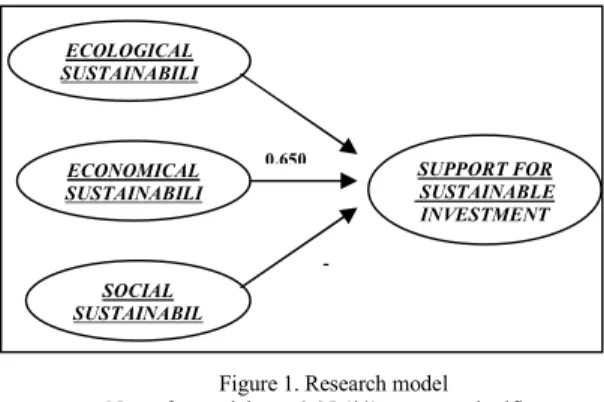
environmental sustainability. The research model (Figure 1) that was used for the realization of empirical research includes four variables: social sustainability, economic viability and environmental sustainability and support for sustainable pellet production (PP) and development of the economy and industry heritage. The independent variables are social, economic and environmental sustainability, and the dependent variable is to support sustainable development.
The research was conducted on a sample of 600 respondents who makes the local population of the pellet production (PP) of Stip and Kavadarci, The Republic of Macedonia. When formulating a sampling strategy, was taken into account that the sample covers approximately equal number of men and women in the mentioned towns, with different education and different occupations, and that includes individuals of different age groups ranging from 18 to 60 years.
The structure of the sample makes 45.0% of male respondents and 55.0% of female respondents. The largest proportion of respondents in the age group of 21-25 years (35.0%), and
respondents between 36-45 years (25.0%) and respondents between 26-35 (25%). The least numerous are those in the age group 46-50 years (7.0%), and less 20 years (4.0%) and over 60 (4.0%). If we analyze the level of education, 40.0% of respondents had completed high school, 30.0% have a college degree, and 30.0% of examinees had education at the primary level. When it comes to employment, the sample includes 55% of employees and 45% of the unemployed. Regarding marital status, 55.0% were married / married, and 45.0% were unmarried / unmarried. The sample mainly consists of respondents in various ways involved in pellet production (PP) as an activity (15%), while respondents who were not involved in pellet production (PP) accounted for 85%.
Figure 1. Research model
Notes for model: p < 0.05 (**), ns – not significant
TABLEI.DEMOGRAPHIC STRUCTURE OF THE SAMPLE (N =150) Number of sample (%) Male 65 (45,0%) Female 75 (55,0%) Age <20 6 (4,0%) 21-25 53 (35,0%) 26-35 37 (25,0%) 36-45 37 (25,0%) 46-60 10 (7,0%) >60 7 (4,0%) Education Elementary school 30 (20,0%) High school 60 (40,0%) College 15 (10,0%) Faculty 45 (30,0%) Marital status Married/Married 65(55,0%) Not married/Unmarried 75 (45,0%) Employment Employed 75 (55,0%) Unemployed 65 (45,0%) Involment in PP On 20 (15,0%) Off 130 (85,0%)
To create a clear and concise questionnaire, organized focus groups (different towns - each one with 75 respondents). For ease of use of the questionnaire/survey consisted of a printed page. After making questions, the survey pre-tested on a small sample of 20 randomly selected respondents. The results of this pilot survey we found that the
ECOLOGICAL SUSTAINABILI ECONOMICAL SUSTAINABILI SOCIAL SUSTAINABIL SUPPORT FOR SUSTAINABLE INVESTMENT - 0.650 -
61 understand and there was no need for any additional changes. Respondents who agreed to participate in the study provided sufficient time to consider their responses. It was agreed that interviewers contact respondents and collect questionnaires after three days. Of the 150 respondents, 150 of them returned the completed questionnaire interviewers. Subsequently, questionnaires were tested, and 10 of them were excluded from further analysis due to the fact that they are not adequately filled.
C. Measures
Claims are chosen reviewing relevant literature. Social sustainability is measured by six statements which were selected based on the study of Chen and Chen (2010), Dyer et. al., (2007), Kuvan and Akan (2005), Vargas-Sánchez, et. al., (2009)., Oviedo-Garcia et. al, (2008) and Choi and Sirakaya (2005). Economic viability is measured by two statements which were selected on the basis of studies, Chen and Chen (2010), Vargas-Sánchez, et. al., (2009), Kuvan and Akan (2005), Dyer et. al., (2007), Oviedo-Garcia et. al, (2008) and Choi and Sirakaya (2005). Four arguments are used for ecological sustainability and designed on the basis of allegations that use Kuvan and Akan (2005) and Choi and Sirakaya (2005). Support sustainable DFI of the economy heritage which is measured via two assertions on studies Lee (2013) and Dyer et. al., (2007). All claims are additionally adjusted for the purposes of this study. The research model is shown in Figure 1. All statements were measured by Likert scale of five points (1-I fully agree, 5-I completely agree).
D. Data analysis
Data analysis was performed through the Statistical Package for Social Sciences (version 12.0) and the AMOS (version 18.0). The following statistical analyzes: correlation analysis, confirmative factor (CFA) and structural equation modeling (SEM).
Cronbach's alpha
Cronbach’s alpha is a measure of internal consistency, that is, how closely related a set of items re as a group. It is considered to be a measure of scale reliability. A "high" value for alpha does not imply that the measure is unidimensional. If, in addition to measuring internal consistency, you wish to provide evidence that the scale in question is unidimensional,
factor analysis is one method of checking dimensionality. Technically speaking, Cronbach’s alpha is not a statistical test – it is a coefficient of reliability (or consistency). Cronbach’s alpha can be written as a function of the number of test items and the average inter-correlation among the items. Below, for conceptual purposes, we show the formula for the standardized Cronbach’s alpha:
(1) Here N is equal to the number of items, c-bar is the average inter-item covariance among the items and v-bar equals the average variance. One can see from this formula that if you increase the number
of items, you increase Cronbach’s
alpha. Additionally, if the average inter-item correlation is low, alpha will be low. As the average inter-item correlation increases, Cronbach’s alpha increases as well (holding the number of items constant).
E. Results
In the first step, based on the value of the coefficient Cronbach's alpha was estimated reliability and internal consistency of the statements through which the measured latent variable models (Table 1). All variables have an adequate level of reliability, as the coefficient of Cronbach's alpha over the required threshold is 0.6. The results show that the highest degree of reliability is reflected in variables Environmental sustainability (Cronbach's alpha = 0.896), whereas in the case of variable support sustainable DFI present a slightly lower level of internal consistency of the statements which have been used for its measurement (Cronbach's alpha = 0.615). The condition of convergent validity was met by the fact that the AVE of all constructions was greater than the minimal threshold of 0.5. Through comparison of AVE and squared correlations between constructs, discriminant validity was also analyzed. Given that the value of AVE for each individual construct is greater than the squared correlations between the given construct and other constructs, discriminatory validity was assured for model variables. Composite reliabilities (CR) of all variables were 40.8 suggested that composite reliability should be great than 0.6.
In order to test the influence of the independent variable on the dependent model, we used SEM (structural equation modeling). We looked at the
62 impacts of social, environmental and economic sustainability in support of sustainable development. In this case, the only variable is the economic viability showed a statistically significant effect on the support that the local population has when it comes to sustainable PP
development of the PP heritage (β = 0.647, p> 0.05). The other two variables do not show a statistically significant effect on the local population support the sustainable development of DFI. The above research findings clearly indicate that the local population believes that the economic benefits of DFI development provide their full support for the sustainable development of the PP heritage, especially if took into account that the municipalities (above mentioned towns) one of underdeveloped in Macedonia.
TABLEII.CONSTRUCT INTER-CORRELATION MATRIX,AVE,CR AND
CRONBACH’S ALPHA Economical sustainability Environmental sustainability Social sustainability Support for PP sustainability development Economical sustainability 1.00 Environmental sustainability 0.50*** 1.00 Social sustainability 0.75*** 0.65*** 1.00 Support for PP sustainability development 0.65*** 0.20*** 0.45** 1.00 AVE 0.75 0.70 0.50 0.50 CR 0.85 0.85 0.85 0.70 Cronbach’s alpha 0.85 0.90 0.85 0.60
TABLEIII.FIT INDICES
Fit indices Χ²/df CFI TLI IFI RMSEA
Recommended values < 3 > 0.90 > 0.90 > 0.90 < 0.1 Model values 1.75 0.95 0.95 0.95 0.08
TABLEIV.RESULTS OF SEM ANALYSIS
Parameter Β p
Social sustainability → Support for PP sustainability development
-0.041ns 0.85
Environmental sustainability→Support
for PP sustainability development
-0.041 ns 0.75 Economical sustainability → Support for
PP sustainability development
0.650** 0.01
**
Correlation is significant at the 0.05 level
II. CONCLUSION
By encouraging a lifestyle that is characteristic of the industrial and economical community will keep a written record of their existence and attributes that otherwise may have disappeared. One of the ways that industrial and economical
communities benefit from their PP heritage, and also by the protection and the development of
economy. Achieving sustainability is possible if the local industrial and economical community is
involved in the formation of the image of the local places, because only in this way can ensure the authenticity of the PP heritage. Given the specific and unique challenges of development of the PP
heritage, it is recommended to cooperation at national and international level in order to identify good practices and utilize their experience to achieve sustainability.
The research provides a significant contribution to the existing literature by highlighting the links between various aspects of sustainability and support the sustainable development of PP heritage in the specific environment of the local industrial and economical community. Similar studies were implemented in a very small number of studies in the field of industry and economy, so in that sense, the proposed research model has a certain amount of innovation, primarily because of its specific composition. The resulting research findings confirm that there is a significant correlation between perceptions of economic sustainability and support the sustainable development, primarily as a result of the high expectations of the potential benefits when it comes to the future economic development of local communities that could potentially arise from the development of the industry and economy.
REFERENCES
[1] Streiner, (2003), “Starting at the Beginning: An Introduction to Coefficient Alpha and Internal Consistency” (J. of Personality Assessment v. 80 no. 1 p. 99-103)
[2] Alfrcy, J, and Putnam, T. (1992) The Industrial Heritage: Managing Resources and Uses, London.
[3] Black, L. D. (2006). Corporate social responsibility as capability: the case of BHP Billiton. The Journal of Corporate Citizenship, 23, 25–38.
[4] Dicks, B. (2000). Heritage, place and community. Cardiff: University of Wales Press.
[5] Dicks, B. (2003) Heritage, governance and marketization: A case-study from Wales. Museum and Soelely 1 (1), 30-44 [6] European Route of Industrial Heritage (2001a) European Route
of Industrial Heritage:The master plan.
[7] European Route of Industrial Heritage (2001b) Our common heritage. Executive Summary.
[8] Leary, T.E. and Sholes, E.C. (2000) Authenticity of place and voice: Examples of industrial heritage preservation and Interpretation in the US and Europe. Public Historian 22 (3), 49-66.
[9] Kuder & Richardson, (1937), “Theory of the Estimation of Test Reliability” (Psychometrika v.2 no. 3)
[10] Cronbach, (1951), “Coefficient Alpha and the Internal Structure of Tests” (Psychometrika v. 16 no. 3)
[11] Cortina, (1993), “What is coefficient alpha? An examination of theory and applications” (J. of Applied Psych. v. 78 no. 1 p. 98-104)