Henry Obit, Joe (2010) Developing novel meta-heuristic,
hyper-heuristic and cooperative search for course
timetabling problems. PhD thesis, University of
Nottingham.
Access from the University of Nottingham repository: http://eprints.nottingham.ac.uk/13581/1/537629.pdf
Copyright and reuse:
The Nottingham ePrints service makes this work by researchers of the University of Nottingham available open access under the following conditions.
· Copyright and all moral rights to the version of the paper presented here belong to
the individual author(s) and/or other copyright owners.
· To the extent reasonable and practicable the material made available in Nottingham
ePrints has been checked for eligibility before being made available.
· Copies of full items can be used for personal research or study, educational, or
not-for-profit purposes without prior permission or charge provided that the authors, title and full bibliographic details are credited, a hyperlink and/or URL is given for the original metadata page and the content is not changed in any way.
· Quotations or similar reproductions must be sufficiently acknowledged.
Please see our full end user licence at:
http://eprints.nottingham.ac.uk/end_user_agreement.pdf A note on versions:
The version presented here may differ from the published version or from the version of record. If you wish to cite this item you are advised to consult the publisher’s version. Please see the repository url above for details on accessing the published version and note that access may require a subscription.
Developing Novel Meta-heuristic, Hyper-heuristic
and Cooperative Search for Course Timetabling
Problems
by
Joe Henry Obit, MSc
GEORGE GREEN uBRARY O~
SCIENCE AND ENGINEERING
A thesis submitted to the School of Graduate Studies in partial fulfilment of the requirements for the degree of
Doctor of Philosophy
School of Computer Science University of Nottingham
Abstract
The research presented in this PhD thesis focuses on the problem of university course timetabling, and examines the various ways in which metaheuristics, hyper-heuristics and cooperative heuristic search techniques might be applied to this sort of problem. The university course timetabling problem is an NP-hard and also highly constrained combinatorial problem. Various techniques have been developed in the literature to tackle this problem. The research work presented in this thesis ap-proaches this problem in two stages. For the first stage, the construction of initial solutions or timetables, we propose four hybrid heuristics that combine graph colour-ing techniques with a well-known local search method, tabu search, to generate initial feasible solutions. Then, in the second stage of the solution process, we explore dif-ferent methods to improve upon the initial solutions. We investigate techniques such as single-solution metaheuristics, evolutionary algorithms, hyper-heuristics with rein-forcement learning, cooperative low-level heuristics and cooperative hyper-heuristics. In the experiments throughout this thesis, we mainly use a popular set of bench-mark instances of the university course timetabling problem, proposed by Socha et al. [152], to assess the performance of the methods proposed in this thesis. Then, this research work proposes algorithms for each of the two stages, construction of ini-tial solutions and solution improvement, and analyses the proposed methods in detail.
For the first stage, we examine the performance of the hybrid heuristics on con-structing feasible solutions. In our analysis of these algorithms we discovered that these hybrid approaches are capable of generating good quality feasible solutions in reasonable computation time for the 11 benchmark instances of Socha et al. [152]. Just for this first stage, we conducted a second set of experiments, testing the pro-posed hybrid heuristics on another set of benchmark instances corresponding to the international timetabling competition 2002 [91J. Our hybrid construction heuristics were also capable of producing feasible solutions for the 20 instances of the
competi-tion in reasonable computacompeti-tion time. It should be noted however, that most of the research presented here was focused on the 11 problem instances of Socha et al. [152].
For the second stage, we propose new metaheuristic algorithms and cooperative hyper-heuristics, namely a linear great deluge algorithm, an evolutionary non-linear great deluge algorithm (with a number of new specialised evolutionary oper-ators), a hyper-heuristic with a learning mechanism approach, an asynchronous co-operative low-level heuristic and an asynchronous coco-operative hyper-heuristic. These two last algorithms were inspired by the particle swarm optimisation technique. De-tailed analyses of the proposed algorithms are presented and their relative benefits discussed. Finally, we give our suggestions as to how our best performing algorithms might be modified in order to deal with a wide range of problem domains including more real-world constraints. We also discuss the drawbacks of our algorithms in the final section of this thesis.
Acknowledgements
Thanks God for giving me the strength to start and finish this challenging journey. When I was down and tired you were always there for me no matter it were difficult or wonderful times, you always were holding me.
I would like to take this opportunity to express my sincere gratitude to my ex-ceptional academic supervisor, Dr. Dario Landa-Silva for his trust, guidance, encour-agement and constant support throughout this PhD journey. My thanks also go to EPSRC for funding this research project (Next Generation Decision Support- Infor-mation Sharing Mechanisms for Hyper-heuristics: Automating the Heuristic Design Process (EP /0061571/1) ) and UMS who were responsible for funding this project.
Many thanks to Dr. Djamila Ouelhadj and Dr. Rong Qu for their advice and encouragement. To my mother, sisters and brothers, thanks to all of you for giving me indirect support in finishing this challenging task. To my wife, Sue and my little Dansih who always bring joy and laughter, thanks for being with me.
Last but not least, my thanks go to ASAP research group, especially Dr. Jason Atkin, Dr. Tim Curtois, Dr Peer-Olaf Siebers, Dr Jan Feyereisl,Dr Yuri Bykov, Juan Pedro, Sven, Khoi, Bob, Rupa Jagannathan, Abdullah and his wife Azura and many others for your help.
Declaration
I hereby declare that this thesis has not been submitted, either in the same or different form, to this or any other university for a degree.
Contents
Abstract ii Acknowledgements iv Declaration v List of Tables xi List of Figures xv 1 Introd uction1.1 Background and Motivation 1.2 Summary of Contributions. 1.3 Scientific Publications Resulting
From This Thesis 1.4 Thesis Guide . 1 1 5 7 8 2 Literature Review 2.1 Introduction. 2.2 Tirnetabling.
2.3 Graph Colouring Model for University Course Tirnetabling 2.4 Overview of Approaches for University Course Timetabling .
2.4.1 Introduction... 11 11 11 14 17 17
2.4.1.1 Review of Meta-heuristics 2.4.1.2 Review of Hyper-heuristic
2.4.1.3 Review of Distributed Hyper-heuristics. 2.5 Important Papers
2.6 Conclusions ...
3 University Course Timetabling Benchmark Problems 3.1 Introduction...
3.2 The University Course Timetabling Problem 3.3 Constraints in University Course Timetabling
3.3.1 Hard Constraints 3.3.2 Soft Constraints. 3.4 Problem Formulation 3.5 Data Input 3.6 Conclusions 17 43 45 48 50
51
51 52 54 54 55 55 56 62 4 Constructing Feasible Solutions for UCTTP Using HybridHeuris-tics
4.1 Introduction...
4.2 Literature Review of Initialisation Methods. 4.3 Hybrid Initialisation Heuristics
4.3.1 Largest Degree, Local Search and Tabu Search (IHl) 4.3.2 Saturation Degree, Local Search and Tabu Search (IH2) 4.3.3 Largest Degree, Saturation Degree, Local Search and
Search (IH3) .
4.3.4 Constraint Relaxation Approach (IH4)
4.3.4.1 Improvement of the Dummy Soft Constraint . 4.4 Experimental Results and Analysis
4.5 Discussion and Summary .
64 64 65 72 72 77 Tabu 80 82 82 85 93
5 An Investigation of the Great Deluge Algorithm 5.1 Introduction...
5.2 Great Deluge With Non-Linear Decay Rate Approach. 5.2.1
5.2.2
Initial Feasible Timetables and Neighbourhood Structures Non-linear and Floating Water Level Decay
95 95 99
100
100
105
116 121 5.3 Experiments and Results .5.4 Effect of the Non-linear Decay Rate. 5.5 Conclusion .
6 An Evolutionary Non-Linear Great Deluge Algorithm 6.1 Introduction .
6.2 Overview of Evolutionary Algorithm 6.3 Evolutionary Non-Linear Great Deluge
6.3.1
6.3.2
6.3.3
6.3.4
Solution Representation . . . . Initialisation of the Population.
The Evolutionary Operator: Mutation Non-linear Great Deluge Search
123 123 124 126 128 129 129 130 132 138 147 6.4 Experiments and Results .
6.4.1 Statistical Analysis 6.5 Conclusions . . . .
7 Non-Linear Great Deluge with Modified Choice Function
7.1 Introduction .
7.2 The Non-linear Great Deluge Hyper-heuristic 7.2.1 Learning Mechanism . . . ...
7.2.1.1 MCF with Static Memory Length .
148
148 149 151 152 7.2.1.2 MCF with Randomly Change Learning Rate. 153 7.2.2 Illustration of the Weights Adaptation
7.3 Experiments and Results .
155
7.3.1 Static vs. Random Change in Learning Rate 7.3.2 Comparison to Previous Great Deluge 7.3.3 Comparison to Other Hyper-heuristics
7.3.4 Experiments With Different Memory Lengths 7.3.5 Further Statistical Analysis ... . 7.3.6 Comparison with Best Known Results
7.4 Conclusions . 160 166 166 168
171
176 178 8 Developing Asynchronous Cooperative Multi-agent Search 179 8.1 Introduction . . . 179 8.2 Hyper-heuristics and ParallelCooperative Search . . . . 8.3 Asynchronous Cooperative Search 8.4 Particle Swarm Optimisation. . 8.5 The Asynchronous Cooperative
180 181 182
Multi-agent Algorithms ... 184 8.5.1 Asynchronous Cooperative Multi-agent
Search Framework . 8.5.2 Low-Level heuristics 8.5.3 Acceptance Criteria.
8.5.4 Asynchronous Cooperative Multi-heuristic Algorithm (ACMHA) . 8.5.5 Asynchronous Cooperative Multi-hyperheuristic
185 187 188
189
Algorithm (ACMHHA) 189
8.6 Experiments and Results. 190 8.6.1 Statistical Analysis 195
8.7 Conclusions
...
2039.1 Research Work Summary. 9.1.1 Contributions... 9.2 Discussion and Future Work
References
205 208
209
List of Tables
3.1 The parameter values for the course timetabling problem categories in the Socha et al. instances. . . .. 53 3.2 The 20 instances in the set of International Timetabling Competition
2002. The last three columns give some indication about the structure of the instances. Details of the competition algorithms are available at: http://www.idsia.ch/Files/ttcomp2002/results.htm. 53 3.3 Student Event matrix. . 57
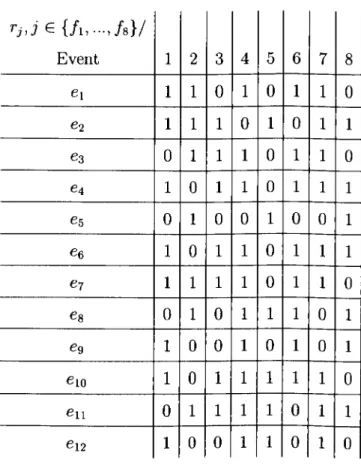
3.4 EventsConflict matrix. 58
3.5 RoomFeatures matrix. . 59
3.6 EventsFeatures matrix. 60
3.7 SuitableRoom matrix. . 61
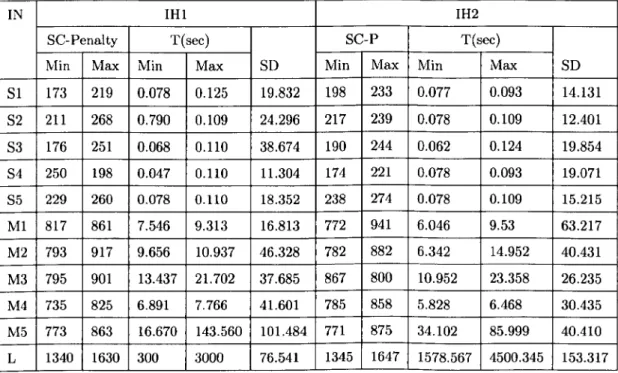
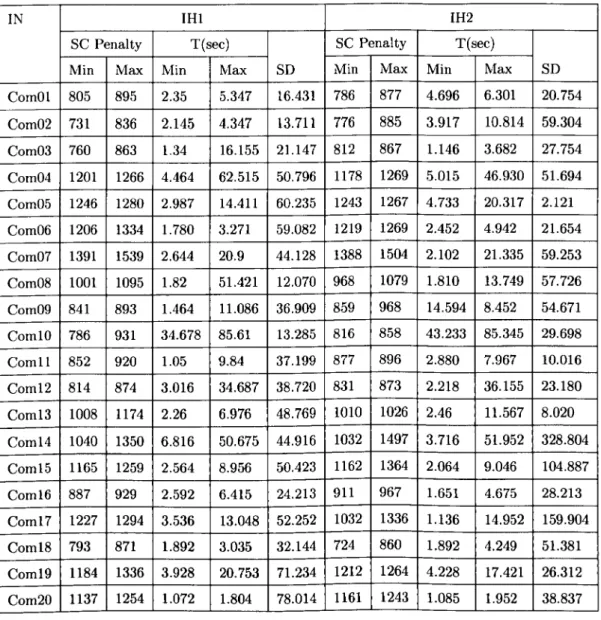
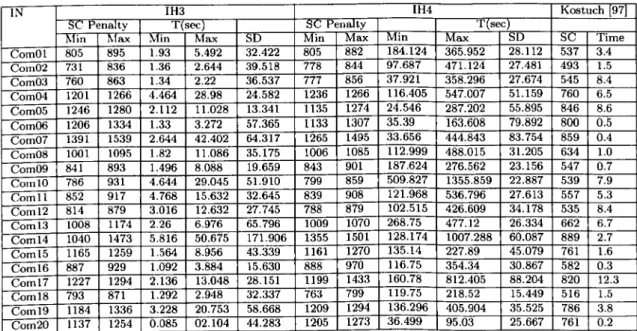
3.8 An Example of a vector of timeslots. 62 3.9 An Example of a vector of rooms. . . 62 4.1 Results Obtained by IH1 and IH2 on the 11 Socha et al. Instances. 88 4.2 Results Obtained by IH3 and IH4 on the 11 Socha et al. Instances. 88 4.3 Results Obtained by IH1 and IH2 on the ITC 2002 Instances. ... 89 4.4 Results Obtained by IH3, IH4 and Kostuch on the ITC 2002 Instances. 90 4.5 Results Obtained by the Sequential Heuristic on the Socha et al.
In-stances. 91
5.1 Comparison of Results Obtained by the Non-Linear Great Deluge (NLGD) Proposed in this Chapter Against the Best Known Results from the Literature for the 11 Socha et al. Problem Instances. .. . . .. 107 5.2 Comparison of Results Obtained by the Non-linear Great Deluge (NLGD)
Proposed in this Paper Against the Best Known Results from the Lit-erature for the 11 Socha et al. Problem Instances. . . .. 110 5.3 Comparison of results obtained by the non-linear Great Deluge (NLGD )with
other approaches for the International Timetabling Competition on the 20 instances. Details of the competition algorithms are available at: http://www.idsia.ch/Files/ttcomp2002/results.htm. . . .. 112 6.1 Parameter Settings for the Three Variants of the Proposed
Evolution-ary Non-linear Great Deluge Algorithm. 131 6.2 Comparison of NLGD, ENLGD-M, ENLGD-1 and ENLGD-2 on the
Socha et al. UCTTP Instances. . . " 133 6.3 Comparison ofresults obtained by the Evolutionary Non-Linear Great
Deluge (ENLGD) proposed in this chapter against the best known results from the literature for the 11 Socha et al. UCTTP instances.. 137 6.4 Average Penalty Cost of ENLGD-2 and ENLGD-1 Across the 11 Socha
et al. Instances. . . " 142 6.5 Average Penalty Cost of ENLGD-M and NLGD Across the 11 Socha
et al. Instances. . . . 6.6 Post Hoc Tests - Small Instances 6.7 Post Hoc Tests - Medium Instances 6.8 Post Hoc Tests - Large Instance ..
143 144 144 144 7.1 Comparison of the Proposed Great Deluge Based Hyper-heuristic and
7.2 Comparison of NLGDHH-SM, NLGDHH-RCLR and all types of Hyper-heuristic Algorithms Reported in the Literature , 168 7.3 Comparison of the NLGDHH-SM with Different Learning Period Length
lp. .. . . .. 169 7.4 Average Penalty Cost ofNLGDHH-SM(lp=2500), NLGDHH-SM(lp=5000)
and NLGDHH-RCLR Across the 11 Socha et al. Instances , 173 7.5 Average Penalty Cost of ENLGD-1 and NLGD Across the 11 Socha et
al. Instances. . 7.6 Post Hoc Tests - Small Instances. 7.7 Post Hoc Tests - Medium Instances .. 7.8 Post Hoc Tests - Large Instance ....
7.9 Comparison of the Proposed Great Deluge Based Hyper-heuristic to the Best Results Reported in the Literature for the Socha et al. UCTTP
Instances. .. . . .. 177 174 174 174 174
8.1 Comparison of Results Obtained by the Asynchronous Cooperative Multi-agent Algorithms Proposed in this Chapter Against the Best Known Results from the Literature for the 11 Socha et al. Problem Instances. .. . . .. 192 8.2 Comparison of ACMH(6), ACMHHA(2), ACMHHA(4) and ACMHHA(6).193 8.3 Comparison of the Results Obtained by the Asynchronous Cooperative
Multi-agent Algorithms Proposed in this Chapter Against the Best Results Reported in the Literature. . . .. 194 8.4 Average Penalty Cost of ACMHA(6), ACMHHA(2) and ACMHHA(4)
Across the 11 Socha et al. Instances. . . .. 197 8.5 Average Penalty Cost of ACMHHA(6), NLGDHH-SM (LP=2500) and
NLGDHH-SM (LP=5000)) Across the 11 Socha et al. Instances. . .. 197 8.6 Average Penalty Cost of NLGDHH-RCLR , ENLGD-2 and NLGD
8.7 Post Hoc Tests - Small Instances. . . 8.8 Post Hoc Tests - Medium Instances .. 8.9 Post Hoc Tests - Large Instance ....
199 199
List of Figures
2.1 Graph Colouring Model for a Simple Course Timetabling Problem. 16 5.1 Linear Great Deluge Behaviour . . . 97 5.2 Behaviour of Non-Linear Great Deluge With Non-linear and Floating
Water Level Decay Rate. . . .. 104 5.3 Comparison Between Linear (Eq. 5.1) and Non-linear (Eq. 5.2) Decay
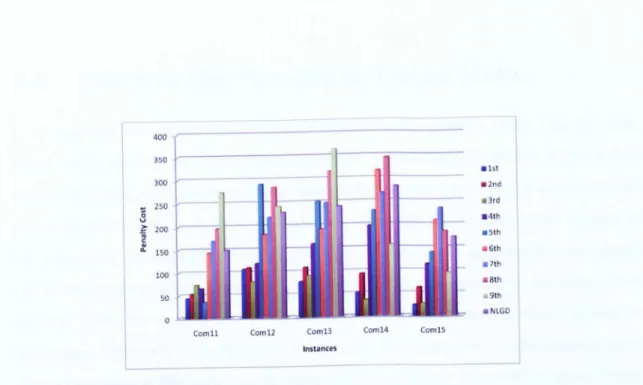
Rates and Illustration of the Effect of Parameters {3, 8, min and max on the Shape of the Non-linear Decay Rate in the Great Deluge Algorithm.105 5.4 Detailed comparison of non-linear great deluge against other
algo-rithms for small instances. . . 113 5.5 Detailed comparison of non-linear great deluge against other
algo-rithms for medium instances. .
. . .
. ·. · .
· .· .
· .
113 5.6 Detailed comparison of non-linear great deluge against otheralgo-rithms for comOl-com05 instances.
·
. ·.
·.
· .
114 5.7 Detailed comparison of non-linear great deluge against otheralgo-rithms for com06-comlO instances.
· .
· ..
· .
114 5.8 Detailed comparison of non-linear great deluge against otheralgo-rithms for comll-com15 instances.
.
.. · . ·
. ·.
· .
· . 115 5.9 Detailed comparison of non-linear great deluge against otheralgo-rithms for com16-com20 instances.
.
.· . · .
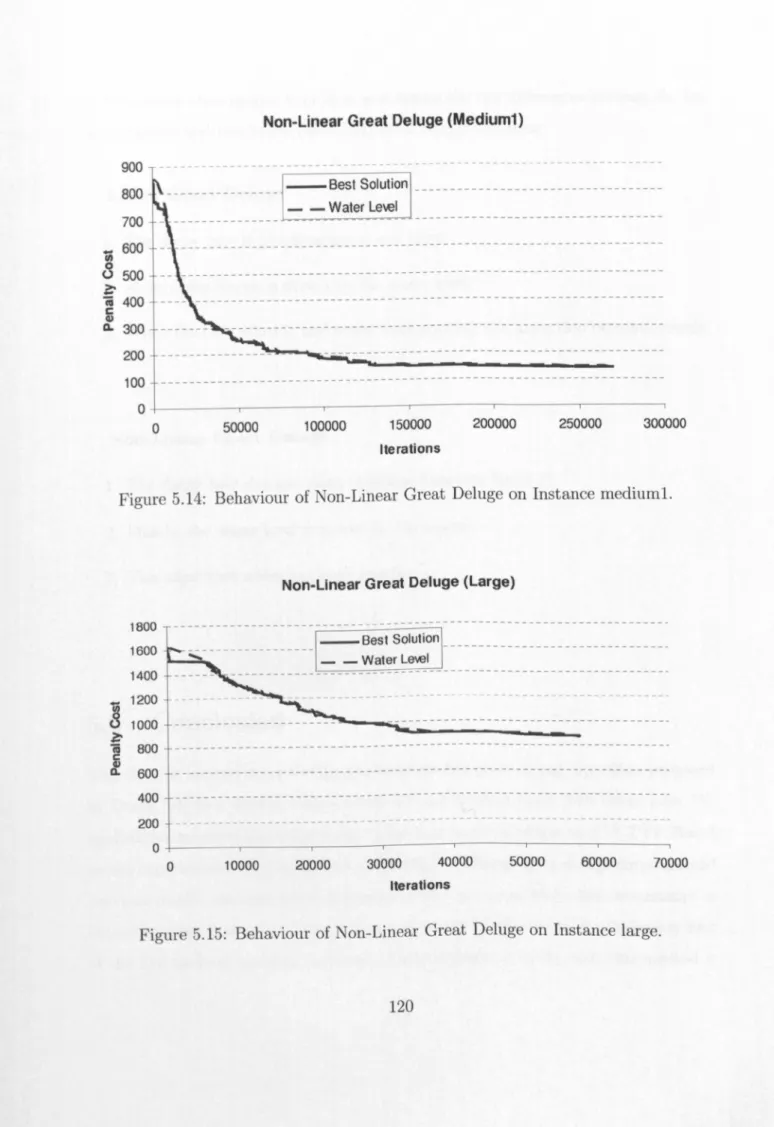
115 5.10 Behaviour of Linear Great Deluge on Instance sma1l5. 118 5.11 Behaviour of Linear Great Deluge on Instance mediuml. 1185.12 Behaviour of Linear Great Deluge on Instance large. . . 119 5.13 Behaviour of Non-Linear Great Deluge on Instance small5. 119 5.14 Behaviour of Non-Linear Great Deluge on Instance mediuml. 120 5.15 Behaviour of Non-Linear Great Deluge on Instance large. . . . 120 6.1 Flow Chart Showing the General Procedure of an Evolutionary
Algo-rithm. . .
6.2 The Evolutionary Non-linear Great Deluge Algorithm.
6.3 Solution Representation (direct encoding) of a Timetable where Events are Assigned to Pairs timeslot-room. . .
6.4 Best Results Obtained by the Proposed Algorithm Variants.
6.5 Average Results Obtained by the Proposed Algorithm Variants on Small Instances. . . .. 135
125 127
129 134
6.6 Average Results Obtained by the Proposed Algorithm Variants on Medium and Large Instances. 135 6.7 ANOVA Results. . . 144 6.8 Mean Plot and LSD Intervals (Small Instances). 145 6.9 Mean Plot and LSD Intervals (Medium Instances). 145 6.10 Mean Plot and LSD Intervals (Large Instance). .. 146 7.1 Non-Linear Great Deluge Hyper-heuristic Approach. 151 7.2 Adaptation of Weights
(Wi)
During a Run of NLGDHH-SM on smalllInstance. . . .. 155 7.3 Adaptation of Weights
(Wi)
During a Run of NLGDHH-SM on small2Instance. . . .. 156 7.4 Adaptation of Weights
(Wi)
During a Run of NLGDHH-SM on sma1l3Instance. . . .. 156 7.5 Adaptation of Weights
(Wi)
During a Run of NLGDHH-SM on sma1l47.6 Adaptation of Weights
(Wi)
During a Run of NLGDHH-SM on sma1l5 Instance. . . .. 157 7.7 Adaptation of Weights (wd During a Run ofNLGDHH-SM on medium IInstance. . . .. 157 7.8 Adaptation of Weights
(Wi)
During a Run of NLGDHH-SM on medium2Instance. . . .. 157 7.9 Adaptation of Weights
(Wi)
During a Run of NLGDHH-SM on medium3Instance. . . .. 158 7.10 Adaptation of Weights
(Wi)
During a Run of NLGDHH-SM on medium4Instance. . . .. 158 7.11 Adaptation of Weights
(Wi)
During a Run ofNLGDHH-SM on medium5Instance. . . .. 158 7.12 Adaptation of Weights
(Wi)
During a Run of NLGDHH-SM on largeInstance. . . 159 7.13 Best Results Obtained by NLGDHH-SM and NLGDHH-RCLR. 161 7.14 Average Results Obtained by NLGDHH-SM and NLGDHH-RCLR on
Small Instances. . . .. 161 7.15 Average Results Obtained by NLGDHH-SM and NLGDHH-RCLR on
Medium and Large Instances. . . 162 7.16 All Results Obtained by NLGDHH-SM on Smalll Instance. . 163 7.17 All Results Obtained by NLGDHH-RCLR on smalll Instance. 163 7.18 All Results Obtained by NLGDHH-SM on medium1 Instance. 163 7.19 All Results Obtained by NLGDHH-RCLR on mediuml Instance. . 164 7.20 All Results Obtained by NLGDHH-SM on large Instance. . . 164 7.21 All Results Obtained by NLGDHH-RCLR on large Instance. 164 7.22 The Best Results Obtained from Different lp Values . . . . 170 7.23 Average Results from Different lp Values - Small instance. 170 7.24 Average Results from Different lp Values - medium and large instances. 170
7.25 ANOVA Results . 7.26 Means Plot and LSD Intervals (Small Instances). 7.27 Means Plot and LSD Intervals (Medium Instances). 7.28 Means plot LSD Intervals (Large Instance) .
173 175 175 176 8.1 Island Model Multi-agent System: Many-to-Many Communication Model.187 8.2 ANOVA Results ... 196 8.3 Min Plot and LSD Interval (Small Instances). 202 8.4 Min Plot and LSD Interval(Medium Instance) 202 8.5 Min Plot and LSD Interval(Large Instance) . . 203
Chapter
1
Introduction
1.1
Background and Motivation
Timetabling is a type of assignment problem, where each problem has its own unique characteristics and variations which differ from one organisation to another.
In
the modern world where it is crucial to avoid time and resources wastage, the timetabling of activities requires that resources are in place at the right time and in the correct quantity in order to operate effectively and efficiently.An example of a timetabling problem which must be solved effectively is train timetabling. The construction of a train timetable must take into account where and when the train starts and ends its journey every day. The availability and drivers' preferences (based on seniority) also need to be considered, including how many hours the drivers are able to work per shift every week.
Bus timetables are also another example, a problem that shares many features with train timetabling. However, there are other features which do not exist in train timetabling but are important attributes of bus timetabling, such as dead mileage and lay-overs. Dead mileage is the travelling distance from the last point of the service
to the depot whilst not in service. Lay-over is the break given to the bus at the end of a trip before it starts operating its reverse route. Without proper bus and train timetables, the entire transportation network system in any city or country would be in turmoil. Hence, the construction of timetables is extremely important, for it usually affects people daily lives.
Examination timetabling is another example of an important timetabling prob-lem. In these problems, each examination activity must be assigned to the right timeslot avoiding clashes between exams that have students in common. Once the clashing problem has been solved, the quality of the timetable is often improved by spreading the exams as much as possible in order to give adequate time for students to revise before sitting the exam, or to have sufficient rest before starting the next exam.
This short overview of some of the different types of timetabling has shown the importance of timetabling in many scenarios. Whilst the focus of this thesis is on the university course timetabling problem, the same objectives are usually involved in many other forms of timetabling problems, where the aim is to ensure that the resources are allocated at the right time and in the right place, avoiding conflicts that can provoke chaos. One objective commonly found in timetabling is to satisfy all people who are directly affected by the timetable, such as examinees and invig-ilators. Another objective in timetabling is usually to control costs. For example, poor quality course timetabling can cause higher cost for educational institutions, since students will not be able to attend all of their lessons when clashes exist and may need to instead take the course next term, extending their study time. From a lecturer's perspective, they might not be able to teach all their courses because all or some of them have been assigned to the same timeslot. Alternatively, lecturers may be unable to deliver their lectures if their courses have been assigned to rooms with unsuitable teaching equipment. In addition, poor quality timetables can also result in
students having to attend more than two consecutive courses without a break. This is known to have a detrimental effect upon student concentration.
The University Course Timetabling Problem (UCTTP) is known to be a very difficult combinatorial problem and it has been extensively studied over the last few decades. The general timetabling problem is known to be NP-hard [42, 75](see the description in section 2.3). Therefore, in general there is no known efficient determin-istic algorithm which will solve all instances in polynomial time. In addition most timetabling problem by nature is highly constrained and complicated. For example, feasible, good and acceptable timetable are very different from one university to the others subject to their own interpretation. Moreover, different universities are likely to have their own set of timetable constraints that need to be satisfied. In spite of various techniques have been proposed by researchers in recent years to automatically generate solutions to benchmark and real-world timetabling problems, unfortunately, in some cases if not often that an algorithmic approach that is successful for one particular problem may not perform well for other problems.
The construction of a course timetable is a very complex problem common to a wide range of educational institutions. Many factors contribute to this complexity. Among them we distinguish the requirements to satisfy various constraints. For ex-ample: each course should be composed of the correct number of lectures, no student can attend more than one lecture at the same time, and one lecture has to be sched-uled in exactly one room, etc. [148, 152]. Furthermore, the introduction in many universities of a modular course structure, where each student is allowed to choose a set of subjects, has made the timetabling process (for both courses and exams) even more complex [35]. Hence, the manual process of preparing the timetable is tedious, time consuming, error prone and not even guaranteed to produce a timetable free of constraint violations. The complex nature of the timetabling problem has attracted
the attention of many researchers and practitioners. It has been observed that local search algorithms might be more efficient in solving timetabling problems if the prob-lem is split into smaller sub-probprob-lems [33J. Carter proposed a decomposition method to break large instances into smaller sub-problems which then can be successfully handled by a local search algorithm [37]. Recently, some researchers have proposed the use of multi-agent systems for timetabling problems. A Multi-agent system is a network of agents that work together to solve problems that are beyond the agent's individual capability [124]. Multi-agent systems are distributed and autonomous sys-tems made up of autonomous agents that support reactivity, and are robust against failures both locally and globally [133]. Multi-agent systems have been applied for a long time to problems in other domains such as production scheduling, employee timetabling, e-commerce, etc., and they have produced good results [46, 132, 162]. In contrast, not much research has been conducted on the application of multi-agent systems to tackle educational timetabling problems. Kaplansky et al. claimed that the distributed nature of the timetabling problem can be tackled by using the multi-agent paradigm [93]. Each multi-agent in their model has a different set of requirements that lead them to finding high quality solutions. In order to coordinate their own timetable, all agents in the distributed environment have to communicate and nego-tiate to avoid conflicts in the process of allocating the shared resources. Kaplansky et al. used mainly a nurse rostering problem to investigate their multi-agent model. In the present thesis, we propose an asynchronous hyper-heuristic that also incor-porates elements of particle swarm optimisation as one of the contributions of this work. Hyper-heuristics are a relatively new type of search methodology with the aim of developing general domain-independent search methods capable of performing well enough, soon enough, and cheap enough across a wide range of optimisation problems [25]. When given a particular problem instance and a number of low-level heuristics, the hyper-heuristic process manages the selection and acceptance of the low-level heuristics to apply at any given time, until a stopping condition is met. A
low-level heuristic is a simple local search operator or domain dependent heuristic.
The work presented by Burke et al. [33] has suggested that advanced algorithms such as evolutionary algorithms will not fully solve the complex timetable problem especially when dealing with large instances. The problem with these algorithms is that to find near-optimal solutions for timetabling is extremely difficult because of the large number of constraints which limit the feasibility of solutions. As a result, Burke et al. [35]later proposed a decomposition method to break a large instance into small sub-problems so that the algorithms were able to handle these smaller problems and find near-optimal solutions. The process of decomposition has also been studied by Carter [37] who used a heuristic method to split large instances into small prob-lems until each sub-problem was small enough to be solved by local search algorithms.
1.2
Summary of Contributions
The focus of this thesis is to investigate meta-heuristic, hyper-heuristic and coop-erative search approaches for tackling the university course timetabling problem (UCTTP). In this work, we investigate the Great Deluge algorithm and how this simple yet effective method can improve the quality of the timetable by extending the algorithm with a non-linear decay and floating water level.
In
recent years, the demand for more general frameworks for decision support systems to aid in the solu-tion of timetabling and other problems has increased. This has driven our work into the development of a general framework for hyper-heuristics. Therefore, it is worth investigating hyper-heuristics and the use of machine learning technique in order to select the low-level heuristics without involving too much parameter tuning. To har-vest the benefit of cooperative search, we inhar-vestigate how beneficial it is when more than one hyper-heuristic cooperate to explore a large region in the search space. Wealso propose here several approaches for generating feasible solutions to the UCTTP as the first stage of a two-stage optimisation strategy. In this approach, we study ex-isting methods such as local search, tabu search and graph colouring and investigate how beneficial it is to hybridise those methods to compensate for the weaknesses of each other. Therefore, in this research, we try to find simple algorithms (reducing the complexity, increasing the robustness and effective) rather than very complex ones for UCTTP. We outline next the scientific contributions of the present PhD thesis:
1. Development of four methods for the construction of feasible solutions for the UCTTP.
2. An investigation of the Great Deluge algorithm originally proposed by Dueck
[68]
• Extension of the great deluge algorithm with a non-linear decay rate and floating water level. Evaluation of the benefit of modifying the water level decay rate from linear to non-linear and floating in the great deluge algorithm. Therefore, the Non-Linear Great Deluge (NLGD) acceptance criterion always accepts improving solutions and non-improving solutions are only accepted if the objective function value is less than or equal to a certain water level.
3. A hybridisation of the non-linear great deluge approach with elements of an evolutionary strategy.
4. Development of a non-linear great deluge hyper-heuristic approach with several variants:
• Non-Linear Great Deluge Hyper-heuristic (NLGDHH-SM) with static mem-ory length.
• Non-Linear Great Deluge Hyper-heuristic (NLGDHH-DM) with dynamic memory length.
• In this chapter we investigate the non-linear great deluge algorithm within a hyper-heuristic framework. The Non-Linear Great Deluge Hyper-Heuristic (NLGDHH) uses a learning mechanism for the selection of low-level heuris-tics, and a NLGD acceptance criterion. The learning mechanism has knowledge about the performance of each heuristic during the search. This knowledge is used to guide the hyper-heuristic in selecting a low-level heuristic at each decision point of the search.
5. Development of a cooperative hyper-heuristic algorithm .
• We investigate the effectiveness of asynchronous cooperative search within a hyper-heuristic approach. In this work, particle swarm optimisation, which is inspired by intelligent social and individual behaviour of swarms, was used as inspiration. Based on the hyper-heuristic and particle swarm optimisation perspective, we then proposed a novel search methodology in which the interaction between cooperative low-level heuristics and cooper-ative hyper-heuristics mimics the particle swarm behaviour.
1.3
Scientific Publications Resulting
From This Thesis
The research work described in this thesis has been disseminated in a number of sci-entific papers already published or under submission. Almost every chapter discusses in this thesis has been published or is in press. The list of papers published or in press is provided bellow in reverse chronological order:
1. Joe Henry Obit, Dario Landa-Silva, Juan P Castro Gutierrez, Djamila Ouelhadj, Rong Qu. A Particle Swarm Optimisation Inspired Asynchronous Cooperative Distributed Hyper-heuristic. Submitted to Journal of Heuristics.
2. Joe Henry Obit, Dario Landa-Silva, Marc Sevaux, Djamila Ouelhadj. Non-Linear Great Deluge with Reinforcement Learning for University Course Timeta-bling. Post-conference Volume of the 2009 Metaheuristics International Confer-ence (MIC 2009).
3. Joe Henry Obit, Dario Landa-Silva. Computational Study of Non-Linear Great Deluge for University Course Timetabling. Intelligent Systems: From Theory to Practice, Sgurev, Vassil and Hadjiski, Mincho and Kacprzyk, Janusz (eds), Studies in Computational Intelligence, Vol. 299, pp. 309-328, Springer-Verlag,
2010.
4. Joe H. Obit, Dario Landa-Silva, Djamilah Ouelhadj, Marc Sevaux. Non-Linear Great Deluge with Learning Mechanism for Solving the Course Timetabling Problem. Proceedings of the 8th Metaheuristics International Conference (MIC
2009), Hamburg Germany, 2009.
5. Dario Landa-Silva, Joe Henry Obit. Evolutionary Non-Linear Great Deluge for University Course Timetabling. Proceedings of the 2009 International Confer-ence on Hybrid Artificial IntelligConfer-ence Systems (HAIS 2009), Hybrid Artificial Intelligent Systems, Lecture Notes in Artificial Intelligence, Vol. 5572, Springer, pp. 269-276, 2009.
6. Dario Landa-Silva, Joe Henry Obit. Great Deluge with Nonlinear Decay Rate for Solving Course Timetabling Problems. Proceedings of the 2008 IEEE Con-ference on Intelligent Systems (IS 2008), IEEE Press, pp. 8.11-8.18, 2008.
1.4
Thesis Guide
This thesis consist of nine chapters. This first chapter explained the background, motivation and main aim of this research. The rest of this thesis is organised in the
following way:
Chapter 2 gives a review of the state-of-the art and an analysis of the works which have been published on the subject of university course timetabling.
Chapter 3 gives a detailed description of the problem domain. This chapter also in-cludes the problem formulation and the description of standard benchmark instances (University Course Timetabling Problem) that we used as the test bed for our pro-posed algorithms.
Chapter 4 is dedicated to the initialisation of timetables. In solving the course timetabling problem, most meta-heuristic approaches fall into one of the following categories: one-stage, two-stage or algorithms that allow relaxations. Our overall solution approach in this thesis falls into the second category, i.e. a two-stage op-timisation strategy. Chapter 4 details how we construct a feasible solution for the UCTTP. In order to examine the effectiveness of our proposed construction methods, we conducted experiments by using standard benchmark problem instances and ob-tained very good results.
Chapter 5 investigates the application of the great deluge algorithm invented by Dueck [68Jto the UCTTP tackled here. The aims of the initial study were to conduct a thorough investigation of this simple but effective algorithm, and study how it could be further extended. We also discuss the proposed modification of the linear decay rate in great deluge to a non-linear decay rate with floating water level. We then tested this modified algorithm on the standard benchmark instances to examine how beneficial it is to modify the decay rate. The experimental results on the UCTTP show that the extended great deluge outperforms some of the best results reported in the literature.
Chapter 6 continues the study of the great deluge algorithm proposed in chapter 5 (non-linear decay rate with floating water level). In that chapter we propose the hybridisation of that algorithm with some evolutionary operators in order to further improve the timetable quality.
Chapter 7 furthers our research of non-linear great deluge by implementing a stochastic selection mechanism as a tool to select low-level heuristics. The result is a proposed non-linear great deluge hyper-heuristic method. The difference between this hyper-heuristic algorithm and the algorithm of chapter 5 is the stochastic se-lection mechanism that takes into account the success rate history of the low-level heuristics. Therefore, the focus of chapter 7 is more on the learning mechanism and how this mechanism selects the low-level heuristic to apply at every decision point. As in the previous chapters, we also use the standard benchmark problem to examine the performance of the proposed learning mechanism.
Chapter 8 incorporates cooperation strategies in our non-linear great deluge hyper-heuristic approach of chapter 7. Asynchronous cooperative search in complex combi-natorial optimisation has been studied in many research papers and such strategies have been demonstrated to produce promising results on other problems. We propose the cooperation of low-level heuristics and cooperation of hyper-heuristics with differ-ent strategies and acceptance criteria such as non-linear great deluge and simulated annealing. The proposed algorithm is then a population-based algorithm and was inspired by Particle Swarm Optimisation.
Last but not least, the overall conclusions of the work presented in this thesis and research directions for future work in this area are presented and discussed in Chapter 9.
Chapter 2
Literature Review
2.1
Introduction
This chapter discusses some of the fundamental aspects of the automated timetabling research area and some of the previous work in the literature covering different optimi-sation techniques to tackle course timetabling problems. This chapter also describes several timetabling problems in addition to the university course timetabling problem which is the focus in this thesis.
The content of this chapter is divided into three sections. Section 2.2 defines various educational timetabling problems. Section 2.3 discusses a course timetabling model based on graph colouring. Section 2.4 provides an overview and discussion of the different approaches used to tackle the university course timetabling problem.
2.2
Timetabling
Timetabling can be defined as the process of allocating, subject to constraints on given resources, a number of events in space and time, in such a way as to satisfy as nearly as possible a set of desirable objectives [163]. As noted by Wren [163],
constructing good quality timetables is a difficult task due to the combinatorial and highly constrained nature of most timetabling problems, which are common prob-lems for all institutions of higher education like universities. The construction of a timetable to ensure all activities are in place accordingly is a very challenging task as many factors contribute to its complexity, for example the need to satisfy a consider-able number of hard and soft constraints.
A timetable is said to be feasible when it can allocate sufficient resources (room space, time, people, etc.) for every event to take place. As in many other com-binatorial problems, the constraints in timetabling can be distinguished into hard constraints and soft constraints. Hard constraints need to be satisfied in all cir-cumstances, whereas soft constraint violations should be minimised to increase the timetable quality, increasing the satisfaction of the people who are affected by the timetable.
Generally, educational timetabling problems can be classified into three main classes according to Schaerf [148]. These classes are:
• School timetabling: a school timetable usually follows a cycle every week for all classes and the objective is to avoid teachers having to attend two classes at the same time. In school timetabling students are normally pre-assigned, only teachers and rooms need to be assigned in the timetabling problem [95]. According to Santos et al. [146],the basic hard constraints that must be satisfied in school timetabling are: (i) no teacher should be assigned to more than one class in the same timeslot; (ii) take into account the teacher's availability for each timeslot; and (iii) allocate the right number of timeslots for each teacher-class pair.
• University course timetabling: university course timetabling is also the weekly scheduling of all lectures of a set of university courses, avoiding lectures that
have students in common being assigned to the same timeslot. Therefore, uni-versity course timetabling is the process of allocating, subject to constraints, limited rooms and timeslots for a set of courses to take place. Usually, in ad-dition to constructing a feasible timetable (all hard constraints satisfied), there are desirable goals like minimising the number of undesirable allocations (e.g. students attend more than two consecutive events on a day). Such desirable goals are usually expressed as soft constraints.
• Examination timetabling: the set of university exams needs to be scheduled into a limited number of timeslots (periods) avoiding cases where students take more than one exam in the same timeslot (the clash free requirement). Each room has a certain capacity which must not be violated when assigning an exam or exams to it. These constraints are known as hard because they are inflexible. Besides the hard constraints there are usually several soft constraints that are considered to be desirable but not compulsory. Obviously, significant differences exist across institutions in what constraints they consider compulsory and which they do not [24J. Examples of commonly occurring soft constraints are where students prefer to spread the exams as much as possible throughout the examination week, or the institution wants to schedule large exams earlier (to give more time for marking), some institution staff-members might also have specific preferences, for example, with respect to invigilation duties.
In reality, these two types of problem (examination and course timetabling) are fairly similar in some characteristics, however, there are some distinct underlying differences between them. For example, in examination timetabling, several exami-nations can be scheduled into one large room at the same time providing that the seating capacity of the room is not exceeded, whilst, this is not possible for course timetabling, where the assignment is generally only allowed one Course per room, per timeslot.
As mentioned earlier, different universities have their own particular set of timetable constraints. A common hard constraint is that no student is assigned to more than one course at the same time. In ideal circumstances, a feasible timetable is only considered feasible if and only if all the hard constraints are not violated. Soft COn-straints, meanwhile, are those that are required to be satisfied as much as possible, in other words, they are desirable but are not compulsory. The quality of the timetable is usually determined by the violation of the soft constraints. In reality, it would usually be impossible to satisfy all of the soft constraints in a given problem. For example, when certain events should occur before certain others or common students should not attend three or more events in successive timeslots occurring in the same day.
In general, although the above timetabling problems share the same basic charac-teristics, significant differences among them still exist. Extensive surveys on timetabling can be found in [24, 95, 146, 148].
2.3
Graph Colouring Model for University Course
Timetabling
Many researchers in the Artificial Intelligent and the Operational Research communi-ties have formulated real world timetabling problems in educational institutions using graph colouring theory. The UCTTP can be modelled as follows. Nodes represent events or courses and edges joining these nodes represent conflicts between the cor-responding events (a conflict occurs when at least one student is registered for two different courses) [55J. Therefore, in a graph coloring formulation, given an undirected graph G
=
(V, E), V=
{VI, V2, V3 ... ,v
n} is the set of nodes with size!VI
=
nandE ={eij
I
3 edge between Vi and Vj} is the set of edges. Therefore, if (Vi, Vj) is an edgeproblem is to determine a k-colouring of V =
{VI,
V2, V3 ... ,vn} in such a way that notwo adjacent vertices are given the same colour. That is, this means not assigning the same times lot to conflicting events in the UCTTP.
To illustrate the connection between the graph colouring problem and the UCTTP, Figure 2.1 shows this relationship between graph colouring and timetabling. Graph (1) in Figure 2.1 shows the undirected graph where nodes represent events and arcs connecting nodes represent conflicts between the events. This means that if two events are in conflict (have students in common), they must not be assigned to the same timeslot. This is similar to the well known problem of graph-colouring [20] in which the vertices of a graph must be assigned a colour such that no two vertices sharing a common edge have the same colour. The problem in Figure 2.1 contains ten courses, labelled A to J together with a set of edges showing the conflicting courses. Graph (2) can easily be seen that no solution can be found using fewer than five timeslots (colours), it also shows a colouring that assigns different colours (timeslots) to the adjacent nodes to avoid conflicts. For example, since courses A, B, C, D, F and G all clash with each other and must therefore all be in different colours (timeslots). while Table(3) in Figure 2.1 illustrates how the graph is translated into a real timetable. In this example courses A and J assigned to green colour (timeslot one), courses B, D and I assigned to purple colour (timeslot two), courses C and E assigned to red colour (timeslot three), course F assigned to black colour (timeslot four ) and finally courses G and H assigned to blue colour (timeslot five).
(1) (2) CoIours/Timesl~ I 2 3 ~ :\ A B C F G J D E H I (3) Events (courses): A, B, C, 0, E, F, G, H, I,J Edges (Constrains): {(A,B), (A,C), (A,D), (A,F), (A,G), (C,D), (C,F), (D,E), (D,G), (D,H), (E,H), (E,G), (E,J), (F,G), (F,I), (G,I), (H,J),(I,J)} Colours (Timeslots) A,J: Green B, 0, I : Purple C, E: Red F: Black G, H: Blue
Figure 2,1: Graph Colouring Model for a Simple Course Timetabling Problem, In the related graph problem, the chromatic number is a term that used to in-dicate minimum number of colours that are needed to colour a particular problem instances. In simple timetabling problem this is equivalent to a course timetabling problem in which the minimum number of timeslots that are needed to construct fea-sible timetable which is a clash-free. Itis said to be that determining the chromatic number is also an NP-hard problem [111].
The identification of cliques is another important feature of graph problems. In the real world timetabling problem instances usually far more complex, sometimes containing up to 1000 courses and will often contain quite large cliques. A clique is a collection of vertices that are mutually adjacent, such as vertices A, C, D, F and G in Figure 2.1. Therefore, when given a graph colouring instance that has a maximum clique size of x, therefore a minimum x colours will be needed to colour the graph. Finding cliques of a given size within a graph is in itself an NP-hard problem. In the example in Figure 2.1, courses/vertices A, C, D, F and G form a clique and hence the minimum number of colours/timeslots required to solve the problem is five. The task of finding cliques of a given size within a graph is also an NP-hard problem [111].
2.4
Overview of Approaches for University Course
Timetabling
2.4.1
Introduction
This section surveys some of the well-known state-of-the-art approaches that have been applied and reported in the literature to solve the UCTTP with different success levels. The aim of this chapter is to provide a brief discussion of some of the stan-dard meta-heuristic, hyper-heuristic and distributed hyper-heuristic methods which are commonly used in many optimisation problems, especially in timetabling optimi-sation problems. Rather than being exhaustive, the main objective of this survey is to give a consistent background on the state-of-the-art research in this area, which underpins the work in this thesis.
This overview section is divided into three subsections as follows. Subsection 2.4.1.1 gives an overview of meta-heuristic approaches applied to the UCTTP including re-sults reported in the literature. Subsection 2.4.1.2 focuses on more recent approaches where algorithms called hyper-heuristics have been applied to solve the UCTTP. Fi-nally, subsection 2.4.1.3 surveys distributed hyper-heuristics which comprise the more recent research direction in this problem domain.
2.4.1.1 Review of Meta-heuristics
• Constraint-based Methods
Constraint programming is the study of computational systems based on con-straints. A constraint can be defined as a restriction on a space of possibility, in other words the restriction of possible values that a variable can take in a given
domain [88]. In this approach, a problem is formulated as a set of variables, each with a finite domain. The objective of this method is to find a consistent set of values which can be assigned to the variables so that the predefined constraints are satisfied. Constraint Satisfaction Problems (CSP) can be formulated as CSP
=
(X,D,C) where X is a finite set of variables X=
XI,X2"",Xn (forexample timeslots or rooms for each course), D is a finite set of domain value, D
=
d, X d2 x, ...,x dn, which the variables can take (for example, possiblestart-ing times or possible rooms); and Cis a finite set of constraints, C
=
Cl, ... ,Cm,where the constraints are the relations over subsets of variables (for example classroom requirements or precedence relations between times). Therefore, the final solution of a CSP is an assignment of values to each variable such that all the constraints are satisfied [57, 158].
Constraint propagation is the process of eliminating all values from the domain variables that do not satisfy predefined constraints. Let's say that there are two variables Xl and X2 from the given finite domain D, where Xl = {I, 2, 3, 4, 5}
and X2 ={I, 2, 3, 4, 5, 6}, and there is a constraint Xl
>
X2+
1. The constraintpropagation technique works as follows: by reducing the domains ofXl and X2
to Xl
=
{3, 4, 5} and X2=
{I, 2, 3}. The elimination of the values 1 and 2 fromXl domain variable happens as they do not satisfy the predefined constraint Xl
>
X2+
1 and the values 4, 5 and 6 from X2 also conflict with the constraints.However, when another constraint is added, let's say Xl
+
X2 =6 we will findthat none of the values can be eliminated from the domain variables. There-fore, in real-world applications, constraints are not always as simple as shown in this example because constraints are often connected with each other. Thus, it will not be practical for this technique to remove all conflict values from the domain variables. In addition, the performance of the constraints propagation technique can be evaluated by assessing the trade-off between the number of
eliminated values from the domain variables and the execution time [105].
esps are usually solved by using Constraint Logic Programming (eLP) [58]. This approach combines logic programming and a constraint solving method. Thus, eLP is a logical axiom based programming method, which uses a con-straint propagation approach in assigning values from the domain to variables. To reduce the search space, a pruning technique is employed to avoid variable in-stantiation that is not consistent with the predefined constraints upon the given problem. A network arc-consistency algorithm is used to perform constraint propagation in order to reduce the domain of the variables by eliminating those values which are inconsistent with the constraints [112, 118, 160, 161]. Many search techniques such as branch and bound and backtracking are integrated into eLP to guide the search towards an optimal solution. Problem solving using a CLP approach is also know as Constraint-based reasoning (CBR), a reasoning method that utilises an arc-consistency algorithm for constraint prop-agation purposes [58].
Constraint based-methods have been extensively studied and applied to course timetabling problems. Zervoudakis and Stamatopolous [165] formulated the course timetabling problem within a constraint programming object-oriented framework and employed the ILOG Solver C++ library for the university course timetabling problem faced by the Department of Informatics and Telecommu-nications at the University of Athens. They implemented several popular and efficient search methods such as Depth First Search (DFS), Iterative Broaden-ing (IB), Limited Discrepancy Search (LDS) and Depth-Bounded Discrepancy Search (DDS). Their problem instances consisted of 68 lectures with five teach-ing days and nine timeslots per day. Based on their experimental results, they found that DFS was capable of finding feasible solutions in a short time but it
was unable to improve the quality of the solutions even when executed for a very long time. LDS was able to improve the solution quality in the long-run but sometimes this search method struggles to find feasible solutions. DDS case, the acceptance criterion is too rigid resulting poor quality of solution. And finally, the authors found that
IB
did not improve DFS's performance significantly.Deris et al. [58J, at first modelled the timetabling problem as a CSP and after that, they formulated it using the CBR technique. The constraint-based rea-soning algorithm was tested using real data from one of the colleges in Malaysia. The instance problem consisted of an I8-weeks timetable for 1673 subject sec-tions, 10 rooms and 21 lecturers. In addition, the authors represented their
timetabling problem using a graph tree representation of the state space in or-der to assist the search for solutions. They also employed variable orderings based on the size of the domain and the number of the constraints of the vari-able to speed up the search process. Their results showed that their algorithm was able to solve the timetabling problem in less than 33 minutes as compared to several weeks when the problem was solved manually.
Deris et al. [59J proposed a hybrid algorithm to solve timetabling planning, in which they incorporated constraint propagation into a genetic algorithm to con-struct feasible solutions as well as finding near optimal solutions. The authors used the constraint-based reasoning method to validate individual solutions, which were generated by the genetic operators. To evaluate the performance of the proposed algorithm, real timetabling problems from the Faculty of Com-puter Science and Information Systems, Universiti Teknologi Malaysia were used as a test bed. The experimental results showed that the algorithm was able to generate faster convergence and most importantly the constraint-based reasoning was able to reduce the search spaces. In addition, the proposed
hy-brid algorithm is capable of finding near-optimal solutions .
• Population-based Meta-heuristic Approaches
Population-based approaches are also called multiple-point [18]approaches and they consist of a collection of individual solutions which are maintained in a population. At each iteration, an appropriate selection mechanism is used to choose how to update solutions in the population and then new solutions are created which may be included in then new current solution [56, 126]. There are many ways in which we could implement the selection mechanism such as the following
[1471:
Delete all: Delete all individual solutions in the current population and replace them with the same number of solutions that have been generated. Steady-state: In this approach,
n
old individual solutions are deleted and replaced with n new individual solutions. Another consideration which needs to be taken into account is which individual solutions need to be re-placed. One common approach is to delete the worst solutions and replace them with solutions of highest fitness. A second approach is to replace individual solutions in the current population at random.- Steady-state-no-duplicates: This selection mechanism is similar to the steady-state approach, however, this method does not allow duplication of individual solutions in the current population. On the other hand, this technique increases the computational cost, since more search space is ex-plored.
Genetic Algorithms
methods, which were derived from Darwin's theory of evolution (survival of the fittest). Bremmermann
[21]
was the first person who proposed and imple-mented the idea of evolution and recombination of solutions for optimisation problems. The important feature of GAs is the notion of population. This al-gorithm generates a set of individual solutions and evolves them over a number of generations (iterations), a process called self-adaptation and recombination. The general GAs procedure is illustrated by Algorithm 1.Algorithm
1: Genetic Algorithm (cited from[103])
Step 1. Generate initial population. Step 2. Evaluate population.
Step 3. Select individuals that will act as parents. Step 4. Apply Recombination to create offspring. Step 5. Apply Mutation to offspring.
Step 6. Select parents and offspring to form the new population for the next generation. Step 7. If stopping condition is met finish, otherwise go to Step 2.
Most metaheuristics employ both intensification and diversification strategies. In order to perform intensification in GAs, a selection mechanism is used to select the parents upon which to impose the Darwinian theory of survival of the fittest. The best quality individuals will be more likely to survive for repro-duction in the next generation. In contrast, the basic operators that perform the self-adaptation and recombination are called mutation and crossover re-spectively. These two operators perform the exploration strategy, where they help to investigate new regions of the search space that could not be reached by the intensification strategy alone. There are many variations of Mutation and Crossover
[142, 147].
One of the common ways of implementing mutation is to select randomly one or more traits in the chromosome (individual) and then change them at random with usually low probability. Recombination isthe process of combining two or more parents to create new solutions, poten-tially of better quality than the parents (this new solution is called offspring). There are many ways of achieving this, and the simplest and most frequently used are single-point and two-point crossover. In both of these, one or two points respectively are selected randomly to split the chromosome of the par-ents into sections. The sections on one side of the split point from one parent are then exchanged with the sections from the other parent. Once the offspring have been created using crossover and mutation, it is essential to decide which individual from the previous generation should be kept in the parental popula-tion. The process of replacing the individual solutions with the new offspring in the population is called the replacement scheme. This approach could be implemented in many ways, and schemes include both non-elitist strategies and elitist strategies. Non-elitist approaches replace all individual solutions in the current population, while an elitist strategy maintains the best individuals in the current population with the hope that the good-quality genetic material can be inherited by the offspring in the next generation [113].
Erben and Kepler in [74] presented a prototype for the automated construction of timetables, employing genetic algorithm techniques. The main aim of the system was to generate feasible solutions while satisfying as many constraints as possible. An initial random population of feasible solutions was generated at the first step. The proposed algorithm must start with a feasible timetable and always stay in the feasible region of the search space. The genetic operators such as mutation and crossover were developed to use the knowledge specific to the particular problem. In other words, these specialised genetic operators only produce feasible solutions. The authors claim that the results generated from the experiments were quite promising, however a number of improvements still need to be done, for instance to find the optimal parameter settings.
Ueada et al. [159] presented a two-phase genetic algorithm and introduced two types of populations, one for class scheduling and another for room allocation. Both populations were evolved independently and each individual fitness was then calculated. The individuals with the lowest cost were selected for crossover and then the resulting cost was calculated. These steps were repeated until the stopping criterion was satisfied. The algorithm was tested on a real-world prob-lem instance, derived from the Faculty of Information Science at Hiroshima City University. Based on the experiments conducted, the algorithm was able to generate feasible solutions. However, the algorithm failed to find a feasible solution when the average room utilisation ratio was high. The room utilisation ratio is the proportion of time that a room is used within a given period of time. Thus, the room utilisation ratio multiplied by the number of periods in a week gives the average frequency of the use of a room per week.
Konstantinow and Coakley [96]presented an investigation of genetic algorithms to course timetabling problems. In their procedure, once the initial solution is generated, the genetic algorithms are applied to repair the schedule in reactive scheduling. In this specific problem domain, two types of schedule perturba-tions were employed. One perturbation called 'surges', consisted in changing the student load that can affect the instructors that need to be assigned. The second perturbation, called 'encroachment', referred to when students have to repeat classes or change their class assignment based on previous year's assign-ment. The results of the experiment clearly showed that the genetic algorithm was a suitable approach under a variety of changes in the student load.
Lewis and Paechter [106]employed four types of crossover operators in their pro-posed evolutionary algorithms. These operators were: sector-based crossover,
day-based crossover, student-based crossover and conflicts-based crossover. The authors also employed a mutation operator which selects two genes
x(a,
b) andx(c,
d) in the chromosome at random such thatx(a,
b) =fx(c,
d), and swaps them. For all operators, whether crossover or mutation, a similar approach of genetic repair function was then applied, to avoid unfeasible solutions and make sure the crossover operators always produce legal offspring. The genetic repair function is responsible for moving events in order to recover feasibility. A steady state population was employed, where the offspring with the best quality in terms of their fitness, will replace the lower quality parent in the population. The replacement of a parent by a higher quality offspring is done once in each generation so the population evolves in a steady-state fashion. To measure the performance of the algorithm, experiments were conducted using the ITC 2002 dataset [91] as a test bed. The results showed that the conflict-based crossover operator is the most effective crossover method and was capable of producingthe best results within the time limit and always outperform the others. Later, Lewis and Paechter in (107]proposed a grouping genetic algorithm (GGAs) and generated their own sixty test instances. GGAs are a class of algorithms that are specialised for grouping problems. According to De Lit et al. (54Jthe group-ing problem involves partitiongroup-ing a set of U of items into a collection of mutual disjoint subsets of U, of U such that UUi = U and Ui
n
U, =0
for alli
=I
j.Therefore, in the timetabling case, the items represent the list of events and the groups represent the available timeslots. Hence, a valid timetable means each event must be in the right timeslot, complying with predefined hard constraints. The instances were separated into three classes: small, medium and large. The algorithm only found 23 feasible solutions out of 60 instances.
Ant Colony Optimisation
meta-heuristics. They were initially proposed by Colorni, Dorigo and Maniezzo in early 1990's [40, 65, 64]. This method was inspired by the observation of the foraging behaviour of real ant colonies and in particular, how ants find the short-est path from a food source to their nshort-est [66]. Normally, real ants are able to find their nest as long as the food source is not too far away from their nest. Initially, ants explore the area surrounding their nest at random and drop a pheromone trail on the ground while walking from their nest to food sources and vice versa. When ants choose their paths, they will first examine the pheromone on the path and turn towards the direction where there is a greater level of concentration of pheromone. The pheromone on the path dropped by the ant dissipates as time passes, therefore the highest concentration of pheromone normally occurs in the shortest path and, obviously, it is more attractive to ants. Besides that, the quantity of pheromone on the path is also determined by quality and the quantity of the food the ants carry back to their nest.
Socha et al. [152Jpresented a
MAX-MIN
ant system for timetabling where they transformed the assignment of each of the events to one of the possible timelots into an optimal path problem which the ants are able to tackle. In order tomake the transformation possible, they first selected a suitable construction graph that the ants can follow easily. Second, they designed the most appro-priate pheromone matrix and heuristic information that was able to guide the ants to choose the right paths in the graph. Therefore, the fundamental ele-ments of the proposed system required the authors to map their problem into a construction graph. The pheromone level within the predefined bound Tmin and
Tmax will influence the assignment of the courses to the timeslots. Then, rooms
are assigned to event-timeslot pairs using the matching algorithm to produce a full timetable, which is then further improved by local search. Socha et al. found that the artificial ants were indeed capable of learning to construct good
timetables. Later. Socha et al. [153] compared their MAX-MIN ant system to an ant colony system but the former algorithm had a better overall performance. The main difference between these two algorithms is on the strategy to update the pheromone.
Mayer et al. [115] applied Ant Colony Optimisation to tackle the post en-rolment course timetabling problem which has been specified in the Interna-tional Timetabling Competition 2007. In that implementation, ants assigned events to rooms and timeslots based on two types of pheromone
I:j
and T[k.These pheromone types represent the probabilities of assigning an event iinto slot j and room k respectively. Based on the results obtained, their experi-ments showed that the proposed algorithm seemed to be very well suited to the timctabling problem. The authors argued that with longer running times better results could be obtained.
Memetic Algorithms
Memetic Algorithms (MAs) include a broad class of metaheuristics that were inspired by models of adaptation in natural systems that combine evolution-ary adaptation of populations of individuals with individual's life-span time scale. Hence, MAs are also known as Evolutionary Algorithms (EAs), Hybrid Genetic Algorithms, Genetic Local Search, Baldwinian GAs, and Lamarckian GAs [85. 98]. The central theme of MAs is the hybridisation of a local search approach with crossover and mutation operators, enabling the algorithm to find solutions with the best fitness value among neighbouring solutions. Therefore, ~IAs are specifically designed to exploit all available knowledge about the prob-lem under study (Moscato [120, 121]). In addition, another mechanism called problem and instance-dependent knowledge was introduced to speed-up the search process [122]. With these new features, MAs have proved to be a type of
EAs that are fast and accurate [98, 150, 129], with the algorithm allowing chro-mosomes (solutions) to improve throughout their life time [150]. The general procedure of memetic algorithm can be shown in Algorithm 2.
Algorithm 2: Memetic Algorithm (cited from [98])
Initialize: Generate an initial population; while ( not some stopping condition do) do
l
matingLocal Search (Parent.Pool :=Select Mating(Parents);Pis); Offsprings :=Cross(mating Pool); Mutate( Offspring);Parents :=Select(Parents, Offsprings);
I3urke and Landa-Silva in [28]gave an account of memetic algorithms for schedul-ing and timetablschedul-ing problems and also gave some design guidelines. In a mernetic algorithm, the genetic or evolutionary part of the memetic algorithm simulates the genetic evolution of individuals through generations and the local search simulates the individual learning [28]. Paechter et al. [136] used various types of mutations in their memetic algorithm, such as blind mutation, selfish mutation and co-operative mutation. Real-world problem instances from the Computer Studies Department at Napier University were used to evaluate the effectiveness of the various mutations. Later, Paechter et al. [137J came out with another version of their memetic algorithm as an extension to their pre-vious approach in [136]. This time they made some improvements on the user interface as well as the timetable engine. In addition, the authors defined two concepts: a feature (a property satisfied by some resources or events) and a container (a resource that can hold other similar resources, including other con-tainers). Their extended memetic algorithm was tested using Napier University science faculty problem instances. From the experimental results Paechter et al. found that their version of memetic algorithm worked well. In addition, the