Ville Puustinen
IMPROVING VISIBILITY AND SALES
CONTROL THROUGH CUSTOMER
RE-LATIONSHIP MANAGEMENT SYSTEM
IMPLEMENTATION
Faculty of Engineering and
Natural Sciences
Master’s Thesis
ABSTRACT
Ville Puustinen: Improving visibility and sales control through customer relationship management system implementation
Master of Science Thesis, 84 pages Tampere University
Degree Programme in Industrial Engineering and Management May 2019
Customer relationship management (CRM) has a variety of different definitions. One widely ac-cepted point of view to CRM is that it is a strategic approach to business focusing on the
im-portance of creating better value for both the customers and the company’s stakeholders through
managing and improving customer relationships. The strategic approach to customer relationship management highlights the role of the whole organization wide participation in the customer-ori-ented business processes. CRM systems are technological solutions that support the processes related to customer relationship management. CRM systems can range from a simple database used for storing customer data to wider systems automating business processes, collecting cus-tomer data from different touch points and refining the data to information that can support deci-sion-making.
The objective of this study is improving sales control and visibility through CRM system
imple-mentation. It consists of literature review of sales management’s challenges and the different
control methods that can be used. Customer relationship management, CRM systems and their
implementation are also reviewed. A framework of CRM system’s effects on demand visibility and sales control is formed. In the empirical part, a CRM system is implemented to a Finnish manu-facturing company.
The study finds out that CRM system implementation can increase demand visibility (1) through improvements in external visibility through improved data gathering and information creation ca-pabilities and (2) through improvements in internal integration by enhancing methods for cross-departmental communication and coordination. CRM system implementation can also improve
sales management’s control methods by giving the management better visibility to sales force’s
actions and outputs during the sales process.
As the result of the study a CRM system is implemented in the case company. As a result of the CRM system implementation sales management gained improved visibility to the sales pipeline
and sales force’s actions. Internal integration regarding the sales opportunities between
depart-ments was also improved. Additional ways of improving both demand visibility and control sys-tems are recognized and suggestions for improvements are made.
Keywords: Customer relationship management, CRM systems, sales management, sales control, visibility
TIIVISTELMÄ
Ville Puustinen: Näkyvyyden ja myynninhallinnan parantaminen CRM-järjestelmän implementoinnin kautta
Diplomityö, 84 sivua Tampereen yliopisto
Tuotantotalouden DI tutkinto-ohjelma Toukokuu 2019
Asiakkuuksienhallinta voidaan määritellä monella eri tavalla. Yksi yleisesti hyväksytty näkökulma asiakkuuksienhallintaan on se, että asiakkuuksienhallinta on strateginen lähestymistapa liiketoi-mintaan, missä keskitytään arvon luomiseen asiakkaalle sekä yritykselle itselleen asiakassuhtei-den kehittämisen ja hallitsemisen kautta. Tämä strateginen lähestymistapa asiakkuuksienhallin-taan korostaa koko organisaation osallistumista asiakaslähtöisiin prosesseihin. Asiakkuuksien-hallintajärjestelmät ovat järjestelmiä, jotka tukevat näiden prosessien suorittamista. Yksinkertai-simmillaan asiakkuuksienhallintajärjestelmät voivat olla vain tietokantoja, joihin asiakasdataa va-rastoidaan. Laajemmat järjestelmät voivat automatisoida liiketoimintaprosesseja, kerätä asiakas-dataa eri kosketuspisteistä ja jalostaa kerätystä datasta päätöksentekoa tukevaa tietoa.
Tämä tutkimus käsittelee myynnin ohjaamisen ja näkyvyyden parantamista asiakkuuksienhallin-tajärjestelmän käyttöönoton avulla. Työ koostuu kirjallisuuskatsauksesta myynnin johtamisen haasteisiin ja erilaisiin tapoihin, joilla myynninjohto voi ohjata myyntiä. Myös asiakkuuksienhallin-taa, asiakkuuksienhallintajärjestelmiä ja niiden käyttöönottoa tarkastellaan kirjallisuuden perus-teella. Kirjallisuuskatsauksen perusteella luotiin malli asiakkuuksienhallintajärjestelmien vaikutuk-sesta myynnin näkyvyyteen ja ohjaamiseen. Empiirisessä osassa tutkimusta asiakkuuksienhal-lintajärjestelmä otetaan käyttöön suomalaisessa teollisuusyrityksessä.
Tutkimuksessa saadaan selville, että asiakkuuksienhallintajärjestelmän käyttöönotto voi lisätä ky-synnän näkyvyyttä (1) ulkoisen näkyvyyden parantamisella datan keräämisen ja tiedon luomisen menetelmien kehittämisen avulla ja (2) parantamalla sisäistä integraatiota osastojen välisen kom-munikaation ja koordinoinnin kehittämisen myötä. CRM-järjestelmän käyttöönotto voi myös pa-rantaa myynnin ohjausmenetelmiä antamalla johdolle paremman näkyvyyden myyntihenkilöstön toimintaan ja tuotoksiin myyntiprosessin aikana.
Kohdeyrityksessä otettiin käyttöön asiakkuuksienhallintajärjestelmä tutkimuksen tuloksena. Käyt-töönoton seurauksena myynnin johdon näkyvyys myyntiputkeen ja myyntihenkilöstön toimiin rani. Myyntimahdollisuuksiin liittyvä osastojen välinen integraatio kehittyi. Lisäksi muita tapoja pa-rantaa kysynnän näkyvyyttä ja myynnin ohjausjärjestelmiä havaitaan ja kehitysehdotuksia esite-tään.
Avainsanat: Asiakkuuksienhallinta, asiakkuuksienhallintajärjestelmät, myynnin johtaminen, myynnin ohjausjärjestelmät, näkyvyys
PREFACE
Finally finishing this thesis has left me feeling like winning 1-0 win against the worst team in the league having been overplayed for 90 minutes and winning by a lucky goal. Even though it’s a victory, you cannot really enjoy the victory because of the performance. Luckily, at the end of the season no one remembers the performances and winning after a good performance or bad performance is worth exactly the same three points.
Writing this thesis was an exciting a frustrating and unpleasant experience. Moments of enthusiasm were few and fleeting. Fortunately, it is over now and hopefully I’ll forget the performance and remember only the result soon.
Tampere, 20 May 2019 Ville Puustinen
CONTENTS
1.INTRODUCTION ... 1
1.1 Background ... 1
1.2 Objective ... 2
1.3 Research methodology and process ... 3
1.4 Structure of thesis ... 7
2.SALES MANAGEMENT ... 10
2.1 Sales role in the organization ... 10
2.2 Sales management ... 12
2.2.1Recruitment and selection ... 13
2.2.2Training and motivation ... 14
2.2.3Organization and compensation ... 16
2.2.4Forecasting and budgeting ... 16
2.2.5Sales force evaluation ... 19
2.3 Sales control systems ... 20
3.CRM SYSTEM IMPLEMENTATION ... 23
3.1 CRM background – Relationship Marketing ... 23
3.2 Customer relationship management as a strategic process ... 26
3.2.1Startegy developement process ... 29
3.2.2Value creation process ... 30
3.2.3Multi-channel integration process ... 32
3.2.4Information management process ... 32
3.2.5Performance assessment process ... 34
3.3 CRM systems ... 35
3.4 CRM system implementation process ... 36
3.4.1Purchase preparation process ... 37
3.4.2System purchase process ... 38
3.4.3System implementation process ... 39
3.4.4Managing and improving the system ... 41
3.5 Success factors in CRM system implementation ... 42
4.CRM SYSTEM AS A SOURCE OF VISIBILITY ... 44
4.1 External visibility and internal integration ... 44
4.1.1CRM system role in creating external visibility ... 48
4.1.2CRM system role in internal integration ... 50
4.2 CRM system role in control creation ... 50
4.3 Framework of CRM system capabilities ... 52
5.CASE COMPANY AND INITIAL SITUATION ... 54
5.1 The case company ... 54
5.2 Project background ... 57
5.3 The implementation process ... 62
6.1 External visibility improvement ... 65
6.2 Sales process changes ... 66
6.3 Summary of the results ... 69
7.DISCUSSION AND LESSONS LEARNED ... 73
7.1 Overview of the problem and framework ... 73
7.2 Reflection of the case in framework ... 74
7.3 Limitations of the research ... 76
7.4 Future development proposals ... 77
8.CONCLUSION ... 80
LIST OF FIGURES
Figure 1. Research onion (Saunders et al. 2009) ... 4
Figure 2. Timeline of the project phases ... 7
Figure 3. Characteristics of modern selling (Jobber and Lancaster 2010) ... 10
Figure 4. Company value chain (Porter 1985) ... 11
Figure 5. Sales management’s tasks (Jobber and Lancaster 2010) ... 13
Figure 6. Motivational mix (Donaldson 2007) ... 15
Figure 7. Sales forecast as the starting point of company’s budgeting process ... 18
Figure 8. Evaluation role in sales organization (Jobber and Lancaster 2010) ... 19
Figure 9. Sales control systems (Malek et al. 2018) ... 21
Figure 10. Focus shift in marketing (Payne 2006) ... 25
Figure 11. CRM continuum (Payne and Frow 2005) ... 27
Figure 12. CRM as a cross-functional activity (Payne 2006) ... 29
Figure 13. Customer value components (Khalifa 2004) ... 31
Figure 14. CRM processes (Payne and Frow 2005) ... 33
Figure 15. CRM system implementation process framework ... 37
Figure 16. Supply chain simplified ... 44
Figure 17. Information sharing leading to organizational benefits ... 45
Figure 18. Internal integration role in supply chain visibility ... 46
Figure 19. Internal integration dimensions... 47
Figure 20. CRM system creating organizational benefits through increased external visibility and internal integration ... 48
Figure 21. CRM knowledge management process (Zablah et al. 2004) ... 49
Figure 22. Framework of CRM systems as a source of demand visibility, internal integration and control ... 52
Figure 23. The main components of a lift ... 55
Figure 24. Complete lift ... 56
Figure 25. Information flows in new business sales (past) ... 61
Figure 26. Issues recognized at the start of the project ... 62
Figure 27. Final decision reasons for different shortlisted options ... 63
Figure 28. Agile method (below) compared to traditional software projects (above) ... 64
Figure 29. New forecasting practice, two dimensions of probabilities ... 66
Figure 30. Sales process phases ... 66
Figure 31. Approval process flow in standard use case ... 67
Figure 32. Sales pipeline and formal gates in the sales process ... 68
Figure 33. Visualization of lost opportunity reasons ... 69
Figure 34. CRM system effects ... 70
Figure 35. Interfaces with back and front office departments ... 71
Figure 36. CRM system implementation process framework ... 73
Figure 37. Framework of CRM as a source of visibility and control ... 74
Figure 38. Issues left unsolved ... 77
1. INTRODUCTION
1.1 Background
Even though there are loads of literature about customer relationship management (CRM), a common and widely-adopted definition of CRM is still missing. For example, Payne (2006) defines CRM as a business strategy with a focus on managing and main-taining profitable customer relationships and Raman et al. (2006) define it as a technol-ogy-enabled business management tool for developing and leveraging customer knowledge – to maintain and strengthen profitable relationships. Most of the literature seem to understand CRM as a combination of customer-centric business processes and an IT system that supports these processes.
CRM systems, or CRM technologies, link the customer facing functions of the company to the back-office functions. CRM systems should integrate all the customer touch points, which often are managed by different information systems according to Chen and Popo-vich (2003). Typically, the CRM systems have three types of uses: operational, collabo-rative or analytical. Payne (2006) describes the difference between systems followingly: an operational CRM system automates or improves some of the customer facing busi-ness processes previously carried out by sales personnel. Collaborative use means that data gathered from different touch points can be accessed, modified and used by differ-ent persons or departmdiffer-ents than the ones that have gathered it. Lastly, an analytical CRM system is designed to analyze the customer data and provide information to sup-port decision-making.
CRM system implementation is the process from realizing the need for a system to spec-ifying the system requirements and ending in the end user adoption management phase. The failure rate of CRM projects is high, especially if they are only regarded as a pur-chase of a technological solution. Successful customer relationship management pro-jects can result in competitive advantage for a company in multiple ways such as elimi-nating manual stages from the sales process, distributing information about the customer more efficiently, leading to better customer experience and providing the decision mak-ers of the company more accurate and up-to-date data about the custommak-ers and sales pipeline.
This thesis intends to find out how to implement a CRM successfully. It tries to further explain how a CRM system can improve sales management’s means of controlling the sales force and sales process and increase company’s visibility of the demand chain.
1.2 Objective
The research problem of the thesis is:
How can a CRM system implementation improve the company’s visibility of the demand
chain and the sales management’s ability to manage the sales force and the sales
pro-cess?
This study is based on a case study in a manufacturing company with most of its manu-facturing and management functions located in Finland but with a worldwide market, sales personnel and distribution network spread out geographically. For some time, there have been problems with rest of the organization not receiving accurate information about customers, sales opportunities and upcoming projects from the front line and dis-tributing this information efficiently internally.
Lack of accurate and timely information to the sales pipeline has made it difficult for management to plan, report and allocate resources for the projects. Management and engineering-, project scheduling-, purchasing- and production departments are often blindsided by new projects, do not have enough information to prepare themselves in advance or in the worst case are provided inaccurate information that causes setbacks in their work. On the contrary, also the information flow from the back office to sales personnel has also been slow and inaccurate at times and sometimes sales personnel do not know all the products they can offer or they have outdated information about the product range.
The company’s owners have also started to demand more defined processes, stricter limitations on acceptable projects and overall more accountability on individual actions. Previously, sales personnel of the company have been allowed to work quite freely, with every sales person developing their own manners of working. The same applies to sup-porting personnel in the sales process. This has led to a kind of an isolation between sales, management and other departments.
There has not been a dedicated sales management system in the company. Instead information has been distributed via emails, excel- and word-files and by word of mouth. These are traditional and useful means, but limited in the sense that they are not the best either for collaboration, accessing the information afterwards or if a person has not been included in the distribution, by intent or by accident. They are also very much
“silo-systems” meaning that the same information needs to be introduced multiple times into different systems. This causes frustration especially in sales personnel who might have to fill out the customer quotation, internal specifications and forecast documents, email communication to different parties, customer purchase order and ERP system inputs for the same sales opportunity.
The organization decided to start tackling the problems described above by purchasing a customer relationship management (CRM) system. For this thesis, the scope of the research was limited to the customer relationship management system implementation and how it could be used to solve the problems in the information flow between sales personnel and back office staff and to improve sales management’s ability to lead and control the sales force.
1.3 Research methodology and process
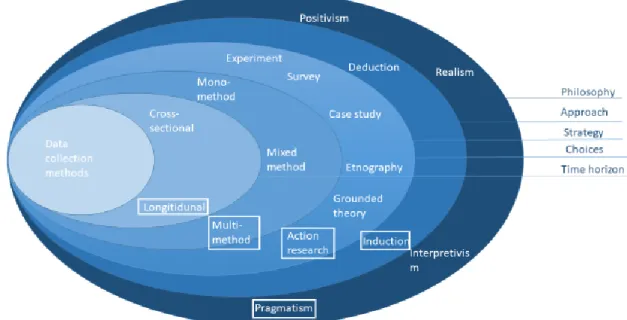
Saunders et al. (2009) describe a tool called research onion that can be used when formulating the methodology for a study. The research onion consists of six layers, with the outer layers guiding the choices made when closing in on the core of the onion - the research methods. This framework can be seen in Figure 1.
On the first layer of the research onion, the research the research philosophy is defined. The philosophy of this research is pragmatism. Saunders et al. (2009) state that re-searches with a pragmatist philosophy are not concerned about the nature of the reality and truth but just focus on answering the research question. This is contradictory to other philosophies, such as positivism, which requires observable data in order to make con-clusions and focuses on creating or discovering objective and generalizable laws about the research subject.
Figure 1. Research onion (Saunders et al. 2009)
The second layer of the research onion describes the theoretical approach to the re-search. According to Saunders et al. (2009) deductive researches aim to create a theory and then test in on the test subjects. This approach is typical for natural sciences and typically utilizes the scientific process, control groups and collecting quantitative data in a structured manner. Saunders et al. (2009) also say that the inductive approach on the other hand moves on the opposite direction. Instead of creating a setting for testing a theory, inductive research intends to understand and explain what is actually happening. Inductive research is more focused on collecting qualitative data and its structure is more flexible. This thesis utilizes an inductive approach.
Different approaches typically suit different strategies for the research. On the deductive-objective end of the spectrum, experimental research is more suitable to be used than case studies or action research. Action research is the strategy utilized in this research. Saunders et al. (2009) describe action research as “research in action, rather than re-search about an action.” Action rere-search is typically concerned with resolving an organ-izational problem and has a focus on action, on changing the way the organization func-tions regarding the research problem.
With action research strategy, it is natural to use multiple methods of information gath-ering according to Saunders et al. (2009). The theoretical section of this thesis draws information from the existing literature. The aim of this literature review is to construct an understanding of the research topic and find ways to answer the real-life research ques-tion. The empirical part of the research utilizes observation and interviews to gather
in-formation about how the organization functions, and what are the problems and require-ments for potential solutions. Also, the impact of the changes resulted from conducting the research are observed and discovered by interviewing the affected parties. Both ob-servation and interviewing produce qualitative data.
This research intends to find out how the organizations management’s capabilities and sales processes have changed and developed since starting the CRM system project. According to the Saunders et al’s (2009) research onion, when researching change over time, the research’s time horizon is longitudinal.
The data for this research was gathered using multiple different methods. The first chap-ters, in which theory of sales management and customer relationship management are discussed draw from reviewing existing literature. In the fourth chapter, where the frame-work of control and visibility creation through CRM systems is based both on literature review and the researcher’s own observations of the phenomenon. In the last part of the thesis, the actual study in the case organization, information has been gathered once again through the researcher’s own actions and observations and through interviewing the company personnel. The interviews were conducted in an unstructured manner and were of qualitative nature.
The research process initially got its kick off in October 2017, when the decision of a CRM system implementation was made in the case organization. The author was em-ployed at the case organization’s sales department at the time and was named in the project team. Officially the project was started in January 2018, when the preparing for purchasing the system phase was started. The author participated in finding out possible solutions and providers and also took part on interviewing them.
After the creation of the shortlist of the system providers that seemed most suitable, the author was named the project manager of the implementation process. He reported to the project’s owner, the sales director of the case organization. The system providers were interviewed during the early spring of 2018 and the shortlist was trimmed down to three options. The author was responsible of organizing these interview sessions and managing both the external communication and internal decision-making regarding the project.
The decision of the system provider and the project scope was made in May 2018 and the contracts were signed and the implementation timeline agreed during the same month. The system design was agreed to be conducted in four weeks during June using a consultation company recommended by the system provider. The author continued as the operational project manager of the system design phase.
The system was designed using agile method recommended by the implementation part-ner consultants, with daily progress updates and weekly reviews what had been done and what was scheduled for the next week. The case company’s project team who was tasked to communicate the needs and requirements to the consultants and daily test and give feedback of the progress made consisted of the project owner, project manager and his assistant and two of the company’s senior salespersonnel.
After four weeks the system was deemed to be viable for the initial roll-out. In the first phase the system was introduced to the company’s sales management and the sales force. The author was responsible for arranging, planning and conducting training ses-sions for them. These sesses-sions were held during July and August 2018. During Septem-ber and OctoSeptem-ber 2018, the sales force and management used the system and the author was working as the main user of the system, providing additional training and help for the users and collecting feedback for mi-nor improvements and for finding out flaws in the system.
After two months of the sales organization using and getting used to the system, the second phase of the roll-out was started. This part included training the engineering and production planning department to use the system and defining the processes with the CRM system that connect sales department with the other departments. Once again, the author was the one responsible for arranging and conducting the training sessions. He was also part of the inter-departmental group that defined the different gates for sales opportunities and how they are monitored using the CRM system.
All the initial milestones set to the CRM system implementation during the system de-signing phase were completed by December 2018. The author continues to be the main user and the one responsible of the system maintenance and development at the time of writing this report, May 2019. The timeline of the project is depicted in Figure 2.
Figure 2. Timeline of the project phases
The information gathering for the thesis was done concurrently with the CRM system implementation project. Observations about the research subject was done during the day-to-day work the author has done with the project. Non-structured interviews about the initial situation and its problems were done during the system provider discovery and evaluation phase and before the system design phase. Literature review was also started during the early phases of the project timeline, but it was done in a very sporadic manner. The writing process was not started before the completion of the system implementation. The majority of the literature review was done between March and May 2019, well over a year after the official start of the project. Author’s notes from the meetings and inter-views from the earlier phases of the study were used for describing the initial situation and the implementation phase for the empirical part of the thesis. The results of the pro-ject were once again collected by interviews doing observations during the everyday actions of the author.
1.4 Structure of thesis
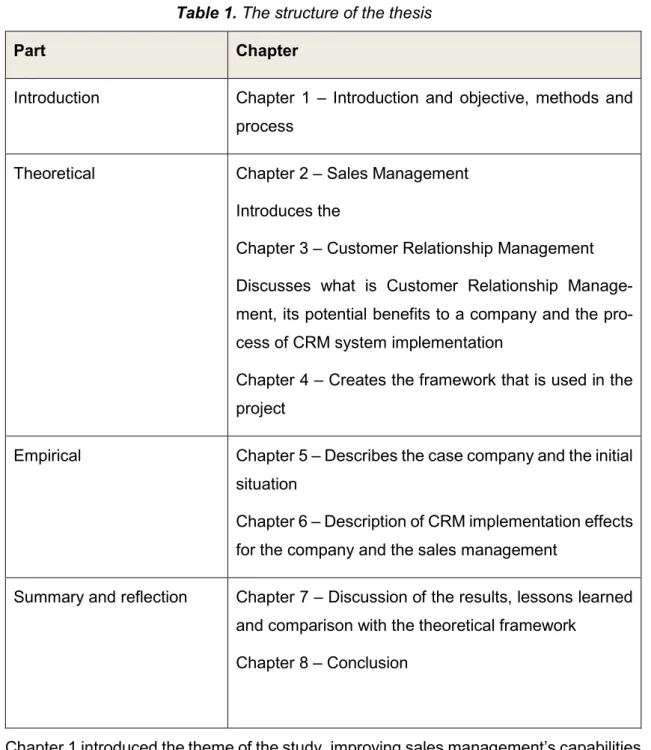
The thesis is divided into four parts: The introduction, the theoretical review of the sub-ject, the empirical part and lastly the summary and reflection of the research. These parts are further divided into eight chapters, each containing one central theme. Table 1 illus-trates the structure of the thesis.
Part Chapter
Introduction Chapter 1 – Introduction and objective, methods and process
Theoretical Chapter 2 – Sales Management Introduces the
Chapter 3 – Customer Relationship Management Discusses what is Customer Relationship Manage-ment, its potential benefits to a company and the pro-cess of CRM system implementation
Chapter 4 – Creates the framework that is used in the project
Empirical Chapter 5 – Describes the case company and the initial situation
Chapter 6 – Description of CRM implementation effects for the company and the sales management
Summary and reflection Chapter 7 – Discussion of the results, lessons learned and comparison with the theoretical framework
Chapter 8 – Conclusion
Chapter 1 introduced the theme of the study, improving sales management’s capabilities by CRM system implementation. It also described the methodology used in the study and the author’s role in the case organization’s CRM system implementation process. The theoretical part starts with chapter 2, which describes the role of sales and sales management in a company and what kind of challenges there are in effectively perform-ing and leadperform-ing company’s sales force. The followperform-ing chapter is about customer relation-ship management. It describes what customer relationrelation-ship management is and goes further into customer relationship management systems, their functions, factors for their success and lastly how to implement one in a company.
The fourth chapter discusses how a CRM system implementation could be utilized by the sales management to increase external and internal information sharing and sales management’s control. A theoretical framework is created.
Chapter five covers the empirical part which starts by introducing the case company and describes the problems faced by different stakeholders in the company. The sixth chap-ter describes the results of the CRM system implementation in the company and its ef-fects on the sales process and level of collaboration in the company.
The seventh chapter compares the empirical part’s results to the theoretical framework, discusses the limitations of the study and points out possible future development targets. And finally, Chapter 8 concludes the thesis.
2. SALES MANAGEMENT
2.1 Sales role in the organization
Donaldson (2007) defines sales as an activity, which creates value for the company at the point of contact with the customers. This value is usually the revenue and profit de-rived from the customer. Donaldson (2007) says that sales is traditionally seen as a part of company’s marketing function, more accurately a part of the promotion part of the marketing mix. However, he notes that the role of sales has changed from before and this traditional view of sales’ role does not reflect reality anymore.
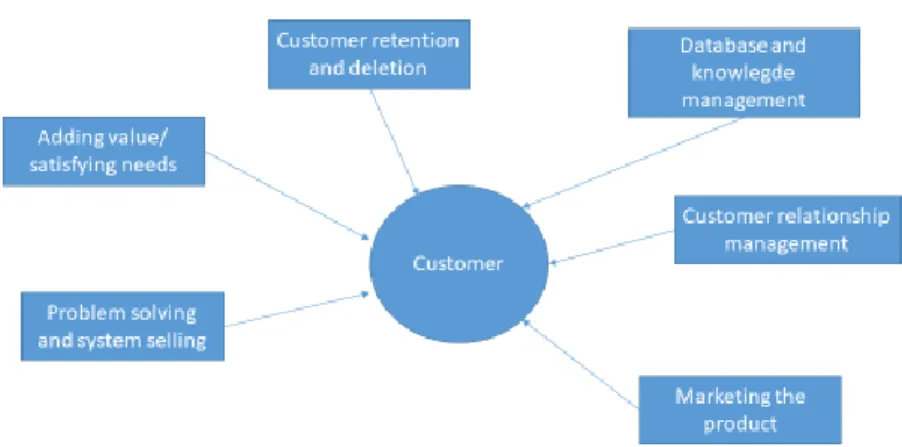
Jobber and Lancaster (2010) note that sales and marketing are closer now than they used to be. They say that as companies have moved from being production oriented to being marketing oriented, sales focus has also moved from just presenting and closing the deal, to a more customer-oriented focus. Figure 3 shows the characteristic of modern selling according to Jobber and Lancaster (2010).
Figure 3. Characteristics of modern selling (Jobber and Lancaster 2010) Jobber and Lancaster (2010) describe customer relationship management and customer retention and deletion dealing with the fact that sales needs to recognize the fact that not all customers are worth the same and the ones that are valuable need to be taken care and managed, and the ones that do not provide value to the company need to be let go or developed to ones that do. Database and knowledge management means that sales is also responsible for gathering market information and being able to access it through
databases. Sales has also changed from just presenting and quoting products to sales people being problem solvers and value providers for their customers. They need to be able recognize customer problems, even if the customers do not know they have ones, and be able to provide them with solutions, instead of just pushing a product from the catalogue to them. In fact, Jobber and Lancaster (2010) note that the sales persons should take on more of a marketing approach and participate in marketing tasks like product development and market segmentation.
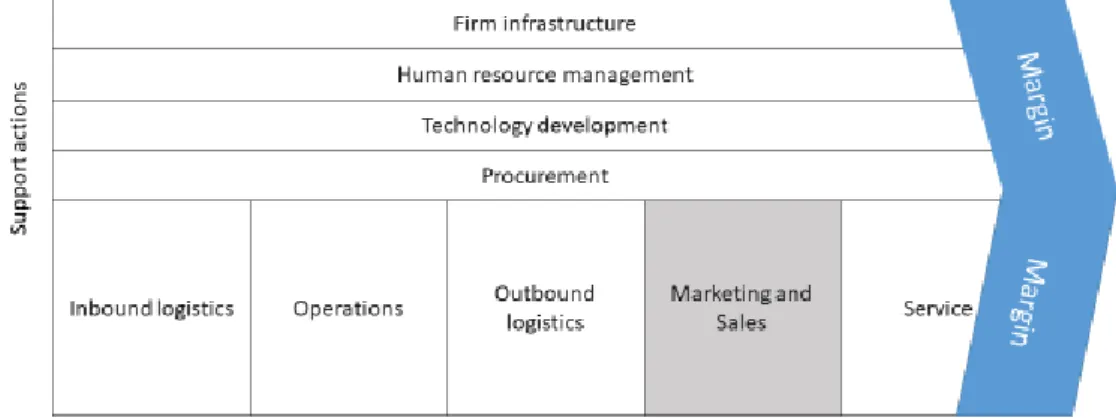
Porter (1985) sees sales and marketing as one of the primary value-creating functions in the value creation chain of the company. The value creation chain consists of primary activities and supporting activities. Primary activities are inbound and outbound logistics, operations, service, and marketing and sales. Also, Porter (1985) considers sales and marketing being so interrelated that they are treated as one function. These primary ac-tivities are supported by supporting acac-tivities, such as finance, procurement and human resources management. The structure of these activities is shown on Figure 4.
Figure 4. Company value chain (Porter 1985)
Porter (1985) sees that these activities are not performed in a vacuum; sales and mar-keting is linked to the logistics, operations, service and all the supporting activities. These linkages between activities can lead to competitive advantage by optimization and coor-dination. For example, a little more effort used in customer order intake can help opera-tions to produce the product more efficiently and reduce quality costs by eliminating er-rors.
It is evident that sales and marketing are strongly linked to each other. That’s why, for this thesis, some tasks that are mentioned in the literature as marketing department’s tasks in the traditional marketing mix -model, such as distribution channel management, product decisions and market segmentation are considered sales responsibilities. Also, because sales and marketing as a function are linked with the other processes of the value creation chain, like Porter (1985) describes, sales also has responsibilities towards other functions.
2.2 Sales management
There is no common definition of sales management. It is the process of planning, or-ganizing, directing, staffing and controlling the sales operations, according to Donaldson (2007). According to Jobber and Lancaster (2010) sales management is the process of managing the sales function. Jobber and Lancaster say that sales management consists of three different parts: planning, organizing and controlling sales.
Jobber and Lancaster (2010) recognize five areas sales managers have to consider: 1. Recruitment and selection
2. Motivation and training
3. Organization and compensation 4. Sales forecasting and budgeting, and 5. Sales force performance evaluation.
Donaldson (2007) divides sales management’s tasks to categories that include sales force organization, sales forecasting and setting targets, recruitment and selection, train-ing, coaching and leading the sales team, motivating and rewardtrain-ing, and lastly, monitor-ing and measurement. Both points of view are quite similar. For the next chapter the Jobber and Lancaster (2010) model of dividing sales management’s tasks as depicted in Figure 5 is utilized.
Figure 5. Sales management’s tasks (Jobber and Lancaster 2010)
Jobber and Lancaster (2010) recognize that these five tasks of sales management can be divided to two levels. Recruitment and selection, motivation and training and sales force organization and compensation deal with management of the sales personnel and the initial premise for the sales process. Forecasting and budgeting and sales force eval-uation on the other hand deal with organizational planning and measuring the sales pro-cess or the outcome of it.
2.2.1 Recruitment and selection
Jobber and Lancaster (2010) emphasize the importance of recruitment and selection of sales force as sales management’s task. They recognize 5 stages in the recruitment and selection process: (1) preparation of job description, (2) identifying the sources of recruit-ment, (3) designing effective application form, (4) interviewing the shortlisted applicants and lastly, (5) using supplementary selection aids to reach a conclusion.
Jobber and Lancaster (2010) highlight the fact that the sales manager is usually in an unfamiliar position when recruiting a new sales person; instead of the usual sales role, they are the buyer in the recruitment situation. They list a number of techniques that the sales manager doing the recruiting can use to find out the sales person most suitable for the position in question. These include different interviewing techniques, psychological tests and role playing.
Finding a sales person that is the best fit for both the role that needs to be filled and for the organization is important as different personalities and sales types do not always suit all the environments according to Jobber and Lancaster (2010). That is why it is critical to have a clear job description and well-designed application process. Jobber and Lan-caster (2010) further point out that sales people induce a higher cost for the company than an average worker and sales person effectiveness is highly variable.
2.2.2 Training and motivation
One of the challenges of sales management and the purpose of training is to improve sales force performance according to Jobber and Lancaster (2010). They state that train-ing can result in that through many ways. It can obviously increase the sales people’s traditional selling skills that will increase their ability to present, negotiate, close deals and manage customer relationships. Training can also improve sales force’s motivation and self-confidence, which have been shown to relate to improved sales performance. It also increases job satisfaction, reduces the amount of complaints from customers, level of staff turnover, and need for management support.
Donaldson (2007) recognizes two different kinds of methods for improving sales people’s abilities and performance: formal training and coaching. Formal training means teaching techniques like classes, training videos or discussion groups. For formal training to be effective, it needs to be specialized and related to the specific job of the recipient. Coach-ing is more informal type of trainCoach-ing, in which sales person is given feedback and encour-agement based on their observed actions.
Donaldson (2007) defines motivation as the amount of effort that sales persons expend on any given task associated with their job. It is a key factor in sales performance and thus keeping the sales force motivated is a key task for sales management. Sales people are usually working in demanding, hostile and competitive environments and can easily be worn down without proper management of their motivation. According to Jobber and Lancaster (2010) high motivation can lead, among other things, to increased use of win-win tactics, greater work rate and using smarter working methods.
How to motivate sales persons and how to balance the costs and benefits gained by the motivational models is a problem for sales management. Jobber and Lancaster (2010) say that sales management’s goal regarding sales force motivation is to minimize the costs incurred to the company while getting the sales persons to do their job well and in a way that the management wants it done. Motivation theories try to answer that problem. According to Donaldson (2007), there are a number of different theories about motiva-tion, ranging from general motivational theories, such as Maslow’s needs theory, to mo-tivational theories specifically about sales person motivation, like Likert’s sales manage-ment theory or Churchill et al’s salesforce motivation model.
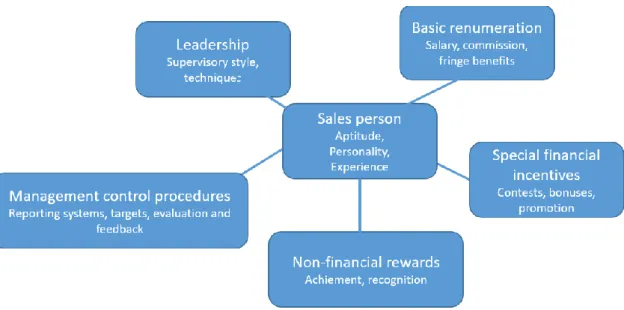
Donaldson (2007) introduces motivational mix, which combines the different sources of motivation. That is illustrated in Figure 6.
Figure 6. Motivational mix (Donaldson 2007)
Donaldson (2007) recognizes that different people have different responses to different situations and have different motivations. Some people are more intrinsically motivated than others are, and others value financial incentives more than others do. Sales man-agement needs to consider the individual sales person’s personalities when trying to motivate them.
According to Donaldson (2007) financial factors in motivation include factors like wage model or commission-based salary. He says that a standard wage can be motivating by creating safety and stability, but commission-based salary creates clear financial incen-tives to perform. In addition to this, he notes that motivation can be derived from other, financial incentives such as bonuses and sales contests. These can also have an ad-verse effect if they encourage the wrong kind of sales behavior, or are not seen as just models and cause dissatisfaction.
Aside from financial rewards, non-financial rewards are also useful for motivating. Jobber and Lancaster (2010) mention, among other motivational theories, Maslow’s hierarchy of needs and Herzberg’s dual factor theory list achievement and recognition as sources of motivation. Conversely, lack of achievement or recognition function as demotivators. Management procedures, such as reporting systems, performance measurement and evaluation and feedback, affect employee motivation through different methods. Setting and measuring targets can be motivational by themselves, without even linking them to a monetary reward according to Jobber and Lancaster (2010). Sufficient feedback in-creases job performance and satisfaction, which are linked to motivation based on Don-aldson (2007).
Leadership is a part of overall management that heavily affects the motivation of employ-ees. Jobber and Lancaster (2010) describe leadership as a process of influencing the behavior of people towards the accomplishment of objectives. They say that in sales environments this usually manifests as advice, training, and as a consideration of sales persons’ challenges. They point out a study done by the Chartered Institute of Marketing, in which factors dealing with the relationship and actions of the superiors, such as ings with them to discuss challenges, and problems and their support during sales meet-ings were among the most significant relating to employee motivation.
2.2.3 Organization and compensation
Organizing and compensation includes the following tasks according to Jobber and Lan-caster (2010): defining the sales organization’s structure, determining the number of sales people, establishing sales territories and forming compensation plans for the sales force. Donaldson (2007) sees sales force organization as an adjacent task to formulating sales force objectives and establishing a corporate and marketing strategy.
There are multiple ways of organizing the sales force. According to Jobber and Lancaster (2010), the traditional model is to divide the salesforce by geographical areas but nowa-days, with customer needs diversifying and technological advances diminishing the sig-nificance of physical distances, other models of division are becoming more common and popular. Donaldson (2007) introduces alternative ways of sales force division meth-ods to the geographical structure, such as product specialization structure, division be-tween different customer types, for example by account size, or a combination of different methods.
Jobber and Lancaster (2010) say that determining the sales force areas or territories and quantity has a direct effect on how much time and resources can be allocated to custom-ers belonging to the respective areas. It also determines the workload of the sales per-sons and has an effect on the formation of different compensation plans. These variables have a great effect on the motivation of the sales force, as was presented in the previous section.
2.2.4 Forecasting and budgeting
Sales forecasting is important because all sales, marketing and company planning are based on the sales forecasts according to Jobber and Lancaster (2010). They note that if forecasts are not correct, the business planning will also be inaccurate. Sales forecasts are used by different functions in the company: finance department uses these as a base
for making the budgets, production can start planning and allocating resources and ad-justing production levels to match sales forecasts, purchasing department can anticipate purchasing crucial and long delivery time materials, HR management can estimate the staffing needs based on the forecasts. Sufficiently accurate sales forecasting is of great worth for the management of a company according to Jobber and Lancaster (2010). According to Jobber and Lancaster (2010) there are three types of forecasting, that are used in planning in different manners: short term, medium term and long-term forecast-ing. Short-term forecasting usually tries to make predictions for the next few months and are used in tactical decision making, such as production planning. The short-term casts are more about fluctuations than trends. Medium-term sales forecasts are fore-casts that start the process of business budgeting. The medium-term forefore-casts cover usually the following year. Long-term forecasts are multi-year forecasts that try to predict the industry trends and take into account macro-economic trends. These are used to support company’s strategic decision-making.
Donaldson (2007) agrees with the forecasting division into three classes depending on the time horizon, but sees that sales forecasts can be divided also into three categories based on which is the starting point of the forecasts. There are more general forecasts that try to anticipate revenue by overall economic conditions, forecasts that are based on the industry’s situation and competitors’ known actions and lastly forecasts made based on company’s marketing plan and efforts.
Donaldson (2007) points out that decreasing forecasting inaccuracy increases forecast-ing costs but reduces costs incurred from the effects of inaccurate forecastforecast-ing, and vice versa. Sales managers’ goals towards forecasting cost should be minimizing the total cost that is the sum of forecasting costs and the costs of inaccuracy.
Forecasting methods can be divided into two types, according to Jobber and Lancaster (2010): qualitative and quantitative forecasts. Qualitative techniques rely on opinions and surveys, whereas quantitative methods are based on mathematical models. Some qual-itative forecasting measures are user surveys, product or marketing tests or sales force composite forecasts. Salesforce composite forecasts mean that each sales person makes a product-by-product forecast for their sales territory. These individual forecasts are then approved by the sales manager and combined to produce a company wide sales forecast.
Quantitative methods can be further divided into two subcategories, as shown by Jobber and Lancaster (2010), time series analysis and causal techniques. Time series analysis take historical data and extrapolate the historical information based on some kind of data
model. Moving averages and seasonal variation methods are examples of this kind of forecasting methods. Causal techniques are models that are more complicated. They intend to form a correlation between some measurable phenomenon and the forecasta-ble object.
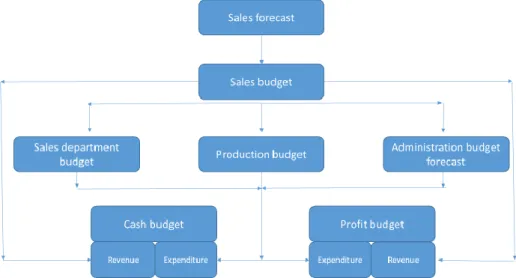
Budgets are used to lead organizations. Like mentioned earlier by Jobber and Lancaster (2010), sales forecasts are used as the base of the budgeting decisions. Sales forecast acts also as the revenue budget for the company, while other budgets are expenditure budgets. It is important that the sales budget is accurate, as if it is too positive, it can cause problems in working capital flow. Figure 6 shows the how the sales forecast is the start of the company’s budgeting process as described by Donaldson (2007).
Figure 7. Sales forecast as the starting point of company’s budgeting process Typically, the medium-term sales forecast revenue is taken as a starting point, and allo-cated to different departments or cost centers. An inaccurate sales forecast leads to cost center budgets to be wrong, cash flow budget to be inaccurate and affect the profit budget accuracy according to Jobber and Lancaster (2010).
Donaldson (2007) says that sales management is usually most interested about the sales budget. According to him, sales budget includes two parts: sales target and sales costs, that include selling expenses, marketing and sales administration costs. Sales targets are usually divided by sales regions or by individual sales person. These targets act not only as a budgeting figure, but also as a base for measuring, evaluating and
rewarding the sales person. Sales targets are commonly set by economic market indi-cators, based on historical figures, like last year’s sales figures, based on the sales man-ager’s or sales person’s judgement or as a target based on market potential.
2.2.5 Sales force evaluation
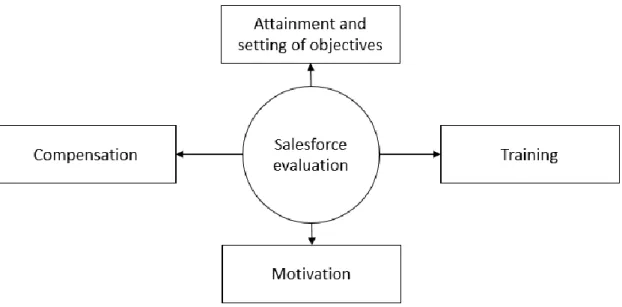
Sales force evaluation is the process of setting sales force objectives, determining strat-egy for reaching those objectives, setting standards of measuring if these objectives are reached, comparing the results with set standards and lastly, putting performance-im-proving actions into practice according to Jobber and Lancaster (2010). They say that the evaluation’s purpose is to help the organization reach its goals. By measuring the actual performance against the set goals, any shortcomings can be seen and eliminated by tackling the problem. Evaluations also provide a chance to recognize the perfor-mances that have exceeded the set standards. Through evaluation it is possible to reach and set objectives, offer compensation for good performances or training where it is needed and it can be a source of motivation. These results of sales force evaluation are shown in Figure 8.
Figure 8. Evaluation role in sales organization (Jobber and Lancaster 2010) Jobber and Lancaster say that there are two types of performance measures: qualitative ones and quantitative ones. According to them quantitative metrics can be further divided to output and input measurements. In sales, output measures are typically related to sales and profit performance. They describe the end result of the sales person’s, group’s or organization’s actions. Typical quantitative output measures are sales revenue, profit margin, profit margin percentage and number of orders. Input measures describe what
has been done in order to achieve the set goals. Typical behavioral quantitative measures in sales are number of sales calls or visits made and number of quotations sent. Jobber and Lancaster (2010) discuss further that combining input and output measures can result in metrics that describe the sales person’s effectiveness, such as strike rate, which is deal won divided by amount of quotations sent.
According to Jobber and Lancaster (2010), these quantitative measures, input, output and hybrid ones, can be further focused on product or customer types, sales areas or sales persons responsible for the figures. These more refined figures can be used to find out more information about the effectiveness or performance of the sales process. Qualitative measures are more subjective and descriptive. Jobber and Lancaster (2010) mention that sales skills, such as quality of sales presentations or ability to close a deal is one common dimension of qualitative measuring. Other dimensions that can be qual-itatively measured are among others customer relationships, self-organization, product knowledge and attitude. Quantitative and qualitative measurements are often somewhat interrelated. For example, if a sales person has poor calls to sales ratio, it might be that his sales skills are poor. This way, areas where more training is needed can be recog-nized.
2.3 Sales control systems
Sales control systems are management policies that try to affect the sales personnel to do their job effectively and in a manner that the organization wants it to be done. They are used to monitor, evaluate, control and develop sales persons’ or organization’s per-formance, according to Jaworski (1988). There are multiple different frameworks for or-ganizational control systems, for example Anderson’s and Oliver’s (1987), Jaworski’s (1988) or Challagalla’s and Shervani’s (1996).
Anderson and Oliver (1987) recognize two types of control: behavioral and output con-trol. Jaworski (1988) found that there are two categories of controls that can be further divided to multiple control methods: (1) informal controls that consist of self-control, peer control and organizational control and (2) formal controls that consist of input control, process control and output control. Challagalla and Shervani (1996) on the other hand recognize three control methods: output control, activity control and capability control.
Malek et al. (2018), in their review of the sales management control systems, point out that even though there are various different models, fundamentally they are quite similar. They summarize the previous research to a conclusion that sales management can con-trol the sales force either through informal concon-trol or formal concon-trol. According to them formal control can be further divided to subcategories: input, output and behavior con-trols. Informal controls can also be divided to three types: self-control, peer control and cultural control. The different forms are summarized in Figure 9.
Figure 9. Sales control systems (Malek et al. 2018)
Jaworski (1988) describes informal controls as unwritten controls in an organization. They are typically based on behavior and manners of the sales force itself rather than management’s involvement. In other words, they are group norms and organizational work culture that are followed by the sales force. They can be divided to three different categories based on their diffusion level in an organization. The types are self-control, peer control and cultural control.
According to Jaworski (1988), self-control means that an individual sets their own tives and monitors and changes their behavior based on the attainment of those objec-tives. Jaworski (1998) says that peer control means the control practiced by the sales force themselves. The sales force monitors that their coworkers are using commonly accepted methods and working towards common. Any deviations are guided to the right track by coworkers. Lastly, cultural control mean that the manners of the whole organi-zation are abided by and internalized by the individuals according to Jaworski (1988). Formal controls, on the other hand, are initiated by management and documented meth-ods of controlling the sales force. Budgets, quotas and official sales plans belong to this group. The framework by Malek et al. (2018) presented in Figure 18, follow the division made by Jaworski (1998) as the formal controls are divided to three categories.
Input controls focus on affecting the starting point of sales process, such as competency improvement or resource allocation by the sales force according to Jaworski (1988). In Challagalla’s and Shervani’s (1996) model has similar control method, capability control.
When utilizing capability control, the managers try to influence sales person’s perfor-mance by affecting the skill sets they possess.
In behavioral control, as defined by Anderson and Oliver (1987), the sales force’s actions and sales processes are used as a base for the monitoring. These include for example sales calls made, following and fulfilling the steps defined in the sales process, or even training sessions attended. Behavior control systems usually require more managerial attention, but also give them more control over the sales force. Anderson and Oliver (1987) point out that advantages caused by this approach is that it is easier to guide the sales force to actions that do not cause immediate rewards for the company, but focuses on more long-term advantages. In Jaworski’s (1998) model, there is similar control method called process control and in Challagalla’s and Shervani’s (1996) model activity control is mentioned.
Lastly, output control is mentioned by all three studies. Output controls focus on the out-puts of sales processes (Jaworski 1988; Anderson and Oliver 1987, Challagalla and Shervani 1996). According to Anderson and Oliver (1987) the managerial effort is lower in output control systems, as the management trust the sales force to be able to adjust and develop their sales approach according to market demand. The metrics used in these kinds of systems are usually quite clear and objective, such as sales volume or gross profit made. Output based monitoring and rewarding can have its downsides also, as the metrics can prompt the sales force to pursue their short-term benefits instead of longer-term value creation for the organization by for example by giving discounts or focusing too much on closing the deals and not paying attention to the customers after the sales, according to Malek et al. (2018).
Malek et al. (2018) say that typically, the sales force is not controlled strictly by their output or by their behavior, but a combination of these systems: if sales management has means of defining and monitoring steps that positively affect the sales force perfor-mance, the behavioral control system elements are used more, and if the management has the ability to track the performance of sales force by tracking outcomes, output measures are more likely to be used. Hybrid systems mix elements of both of these categories, but lean usually on one side or the other. For example, an organization might base their sales bonuses on the sales volume, but only pay them out, once all the defined steps of the sales process are done.
3. CRM SYSTEM IMPLEMENTATION
3.1 CRM background
–
Relationship Marketing
As a term, customer relationship management started emerging in the mid-90s, and a lot has been written about it since. In the academic literature, one commonly accepted definition for the term has not been found. It varies from a simple technological solution for keeping track of customer data to a business strategy with an emphasis to maximize the lifetime profitability of chosen customer relationships. As hard as finding the definition for customer relationship management seems to be, academic literature seems to agree on at least one thing: CRM initiatives are not easy to complete in a satisfactory manner: Chen and Popovich (2003) say that 65% of CRM implementations end up in failure. Reinartz et al. (2004) say that 70% of the initiatives have been either disappointing or not completely satisfactory.
According to Sheth and Parvatiyar (1995) customer relationship management has de-veloped from the concept of relationship marketing. Sheth and Parvatiyar say that mar-keting as a function can be traced back to 7000 BC when producers were selling their own produce in the marketplaces directly to the customers. This kind of direct relation-ship between sellers and buyers continued from the bazaars of the agricultural era up until the early industrial period. Vendors and customers had a personal relationship, which was mutually beneficial: with repetitive purchases, trust between the parties grew and direct contact facilitated the producers to know and tailor their produce to suit the customer needs. The marketing practices were individually focused, and production based on customer demand. Relationship between customers and manufacturers was critical, since there was a mutual dependence: the customers needed the manufacturers to make the goods available and per their specification and manufacturers needed to trust the customers to be able to follow through on their commitments. (Sheth and Par-vatiyar 1995)
With the rise of industrialization and improvement of mass production techniques, the distance between production and consumption, and between producers and consumers, started to increase. With mass production and the economics of scale, the amount of goods produced in factories increased and the producers had to find ways to move the greater amount of inventory. They started to rely on retailers and other types of interme-diaries to find and even increase the markets for the goods and share the risks of carrying
the inventory. However, the intermediaries did not care or try to have individual relation-ships with the customer, unlike the direct-selling producers in the past. Their goal was to move produce as much and at as good price as possible, never what the customer ac-tually needed or wanted. This is how industrialization and the emergence of intermedi-aries created the transactional marketing function. The direct relationship between man-ufacturers and consumers vanished and was replaced by the intermediaries’ role of fa-cilitating and need of maximizing transactions. (Grönroos 1997; Sheth and Parvatiyar 1995)
According to Grönroos (1997), this led to the development of transactional marketing and especially to focus on marketing mix and the four Ps: Price, Product, Promotion and Place. This means that the marketer tries their best to get the customer to make a trans-action that satisfies the value function by making an attempting mix out of these ingredi-ents. Sheth and Parvatiyar (1995) say that the focus of marketing was on short-term goals; maximizing profit today was seen as more important than potential future cash flows. Marketing was also mostly measured by sales figures and market share. This led to aggressive selling techniques and seeking competitive advantage by decreasing prices. This, combined with the increase of professional purchasing departments and competitive bidding processes, drove down sales prices and also increased transactional costs related to sales as companies needed to use resources to fill in and review the documentation in order to participate in and resolve these bidding processes.
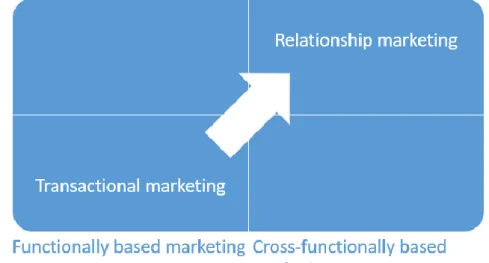
Motivated by these problems, marketers started looking elsewhere according to Sheth and Parvatiyar (1995). They describe the shift towards relationship marketing being aided by two changes: marketers realized the importance of customers’ repeated pur-chases and started focusing on brand creation, brand loyalty and better differentiating themselves from competitors to selected market segments in order to encourage repeat-purchase possibilities. The second change was the development of vertical marketing systems, such as franchising or exclusive distribution channels. This vertical integration was in a way a reversal of the customer-provider segregation that had happened earlier. This start of change in marketing approach is illustrated in Figure 10.
Figure 10. Focus shift in marketing (Payne 2006)
Marketers started noticing that by developing relationships and getting to know the cus-tomer needs better, they could gain advantage by delivering increased cuscus-tomer value. One way of increasing the created value was by including the customers in the marketing and product development processes from early on. Fulfilling the customer needs better made the customers less price sensitive and more likely to return to the provider. Trust and repeat purchases also reduced the marketing costs by eliminating transaction costs as searching, evaluating and negotiating with different providers did not use so much resources anymore. Sheth and Parvatiyar (1995) note that the two cornerstones of trans-actional marketing approach: (1) competition and self-interest as drivers of value creation and (2) independence of each marketing actor as the source of efficiency and value distribution, were replaced by emphasis on mutual cooperation and interdependence. The differences in these two approaches are summarized in Table 2.
Transactional marketing Relationship marketing
Time perspective Short term Long term
Dominating marketing function
Marketing mix Interactive marketing
Price elasticity Customers are more price
sensitive
Customers are less price sensitive
Customer satisfaction measurement
Market share (indirect ap-proach)
Managing the customer base (direct approach)
Customer information system
Ad hoc surveys Real time customer feed-back
Interdependency be-tween marketing, opera-tions and personnel
Interface with no or limited importance
Interface with substantial strategic importance
Grönroos (1997) also notes that some types of businesses are better suited for relation-ship marketing than others. For example, service business is the more suitable for tionship building than industrial goods. Industrial goods in turn are better suited for rela-tionship marketing approach than consumer durables and goods.
3.2 Customer relationship management as a strategic process
Customer relationship management does not have a clear definition. Depending on the source, it can vary between a business strategy and a technological application. Kosto-john et al. (2011) define CRM as “people, processes and technologies a business de-ploys to increase their costumer focus.” Chen and Popovich (2003) also include people, processes and technology in their definition of CRM being an approach of managing customer relationships in a way that focuses on customer retention and developing the relationship. Oksanen (2010) says that depending on the context CRM can be under-stood, among other things, as a set of practices and information systems that an organ-ization uses to manage its customers, as an approach to recognizing, acquiring and re-taining customer or as a business strategy which aims maximizing customer profitability, satisfaction and profits.
Payne and Frow (2005) say that customer relationhip management can be defined at least from three different perspectives. One is that CRM project is only an implementation of a technology solution.The second definition of CRM, by Payne and Frow (2005), is also focused on the technological solutions but with more focus on the customer orientation and integration of these IT solutions. The third approach to CRM is a strategic and more holistic view of CRM that includes the focus on creating customer value through careful management of the relarionships. This deviation is illustrated in Figure 11.
Figure 11. CRM continuum (Payne and Frow 2005)
Even though the definitions for CRM vary in focus and scope, the majority of the CRM definitions are broader than just a mention of an IT system tasked with customer infor-mation handling. They also usually make a distinction between this wider approach as CRM and the technological element that can be called a CRM application (Kostojohn et al. 2011) or a CRM solution (Payne 2006).
Although the definitions of CRM vary, academic literature seems to agree that CRM ori-entation offers a variety of advantages to a company. Richards and Jones (2008) say that even though every CRM project is unique and project types vary a lot from industry to industry, some core benefits caused by CRM adoption do not vary much regardless of industry. These core benefits include, but are not limited to improved ability to target profitable customers, customer experience improvement through better customer infor-mation flow processes, customer-oriented product and service development and individ-ualized marketing efforts according to Richards and Jones (2008). These are similar to the ones mentioned previously in the relationship marketing section. In fact, in academic literature these terms are often used interchangeably, but Payne and Frow (2005) say that, rather than the same thing, CRM should be regarded as information-enabled rela-tionship marketing or as a relative or an offspring of relarela-tionship marketing. The techno-logical perspective of CRM adds to the list of core benefits mentioned earlier factors such as improved sales force efficiency and effectivity through sales force automation tools,
and ability to integrate different communication and distribution channels according to Richards and Jones (2008).
Even though there are loads of potential advantages to be gained by adopting a CRM process, success is not guaranteed. Depending on the source, up to 70% CRM projects fail or do not achieve desired results according to Chen and Popovich (2003). Other sources are not as pessimistic about the success rate, as for example one more recent article on CIO magazine say that 33 per cent of the CRM projects end up in failure (Tareb 2017). That is still a high percentage of failure.
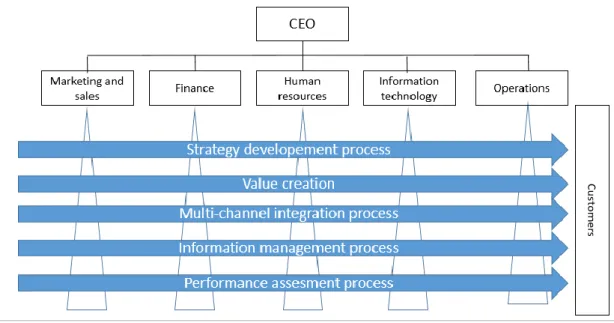
Payne and Frow (2005) note that the wider, more strategic approach usually leads to better resolution on CRM projects. When considering CRM only as a technology solution, the long-term advantages of developing customer relationships and adding customer satisfaction is more likely forgotten and only the short term advantages are pursued. In order to maximise the long term success, a strategic framework, in which CRM is considered to consist of different cross-functional processes, has been developed. Payne (2006) defines these processes as follows:
1. Strategy development process 2. Value creation process
3. Multi-channel integration process 4. Information management process 5. Performance assesment process
These processes should encompass all the functions in a company, not only marketing and sales. This is illustrated in Figure 12.
Figure 12. CRM as a cross-functional activity (Payne 2006)
As Figure 12 shows, strategic CRM connects organization’s different departments with these five processes. The processes cover all the departments and are customer-ori-ented.
3.2.1 Startegy developement process
Strategy development process is the first one any company should focus on when considering CRM, according to Payne (2006). Not only does it affect the four other processes, but it also should provide the organization clear goals for the CRM activities. Strategy development process includes two dimensions, business strategy and customer strategy. These two components lay the base to the rest of the CRM processes. Strategy development process should start by determining a company’s business strategy in order to understand how to build a customer strategy that is in accordance with it. CRM should not be defining business strategy, but to draw attention where it might be wrongly directed. It is crucial for CRM activities to be aligned with business strategy.
Determining the customer strategy deals with the question of which customers to pursue and which to avoid according to Payne (2006). In other words, deciding the target cus-tomer base in order to be able to focus the efforts on the segment that best suits the organization’s abilities. Payne (2006) says that the definition is typically done by the mar-keting department but must be aligned with the overall business strategy. That is why it is important that the business strategy is well defined beforehand. Customer strategy determination includes examining the current and potential customers and the best pos-sible manner of customer segmentation. For segmentation decisions, the organization
needs to be able to group or divide customers in an effective manner and make decisions on how granular or broad the customer segments area according to Payne (2006). The goal of the strategy analysisshould be to ensure that the overall business strategy and the customer strategy are aligned and provide the organization with a clear picture of where they are, and a direction on which it can start building the other CRM processes according to Payne and Frow (2005).
3.2.2 Value creation process
Value creation process translates the business and customer strategies to specific statements what value needs to be delivered and what value is received from the customer, according to Payne (2006). There are three components in the value creation process:
1. value provided to the customer 2. value gained from the customer, and
3. the maximization of lifetime value derived from wanted customer segments by carefully managing this value exchange process.
Customer value is seen as a source of competitive advantage but there is no clear definition of what constitutes as customer value. Khalifa (2004) defines customer value as combination of utility value and psychic value. The experienced net value is the difference between that sum and the total costs incurred to the customer. This cost includes the monetary cost of the acquisition but also the costs incurred during and before the purchasing process. This is illustrated in Figure 13.