Design of low impact development in the
urban context considering hydrological
performance and life-cycle cost
Article
Published Version
Creative Commons: Attribution 4.0 (CC-BY)
Open Access
Li, Y., Huang, J. J., Hu, M., Yang, H. and Tanaka, K. (2020)
Design of low impact development in the urban context
considering hydrological performance and life-cycle cost.
Journal of Flood Risk Management. ISSN 1753-318X doi:
https://doi.org/10.1111/jfr3.12625 Available at
http://centaur.reading.ac.uk/90963/
It is advisable to refer to the publisher’s version if you intend to cite from the
work. See
Guidance on citing
.
To link to this article DOI: http://dx.doi.org/10.1111/jfr3.12625
Publisher: Wiley-Blackwell
All outputs in CentAUR are protected by Intellectual Property Rights law,
including copyright law. Copyright and IPR is retained by the creators or other
copyright holders. Terms and conditions for use of this material are defined in
www.reading.ac.uk/centaur
CentAUR
Central Archive at the University of Reading
Reading’s research outputs online
O R I G I N A L A R T I C L E
Design of low impact development in the urban context
considering hydrological performance and life-cycle cost
Yu Li
1,2|
Jeanne J. Huang
1|
Maochuan Hu
3,4|
Hong Yang
5,6|
Kenji Tanaka
41The College of Environmental Science
and Engineering, Nankai University, Tianjin, China
2Graduate School of Engineering, Kyoto
University, Kyoto, Japan
3School of Civil Engineering, Sun-Yat sen
University, Guangzhou, Guangdong, China
4Disaster Prevention Research Institute,
Kyoto University, Uji, Kyoto, Japan
5Department of Geography and
Environmental Science, University of Reading, Reading, UK
6Chongqing Engineering Research Center
for Remote Sensing Big Data Application, Chongqing Key Laboratory of Karst Environment, School of Geographical Sciences, Southwest University, Chongqing, China
Correspondence
Maochuan Hu, School of Civil Engineering, Sun Yat-sen University, Guangzhou, Guangdong, China. Email: [email protected]
Funding information
China Postdoctoral Science Foundation, Grant/Award Number: 2018M631732; Ministry of Science and Technology of the People's Republic of China, Grant/Award Numbers: 2016YFC0400709,
2017ZX07106001; Priority Academic Program Development of Jiangsu Higher Education Institutions; Jiangsu Key Laboratory of Atmospheric Environment Monitoring and Pollution Control, Grant/ Award Number: KHK1806; National Water Pollution Control and Treatment Science and Technology Major Project of China; National Key Research and Development Program of China
Abstract
The pressures on water system are increasing in cities. Rapid urbanisation cau-sed by booming population leads to more impervious area and less infiltration, with the consequence of larger runoff volume and higher flood risk. Launched in 2014, the low impact development (LID), an important part of Sponge City in China initiative, invests in projects that aim to restore the water cycle in the urban area. A comprehensive understanding of the performance of LID mea-sures at watershed scale under different rainfall scenarios and life cycle costs is necessary. The objectives of this study are to assess the hydrological perfor-mance and to identify the optimal LID design by using SWMM model and life cycle cost (LCC) method. This study found that LID practices, including bio-retention, grass swale, and permeable pavement, showed good performance on urban storm mitigation at watershed scale under different rainfall scenarios. Furthermore, the rates of surface runoff reduction were largely insusceptible to the change of rainfall volume and duration. Regarding the cost-effective-ness, the priority was grass swale > bioretention > permeable pavement in the study area. The optimal LID scenario was the combination of these three types of LID. The proposed approach can help the decision-makers to determine the preferable LID plan suitable for the local communities.
K E Y W O R D S
life cycle cost, optimization, sponge city, SWMM, urban hydrology
DOI: 10.1111/jfr3.12625
This is an open access article under the terms of the Creative Commons Attribution License, which permits use, distribution and reproduction in any medium, provided the original work is properly cited.
© 2020 The Authors.Journal of Flood Risk Managementpublished by Chartered Institution of Water and Environmental Management and John Wiley & Sons Ltd.
J Flood Risk Management.2020;e12625. wileyonlinelibrary.com/journal/jfr3 1 of 15
1
|
I N T R O D U C T I O N
The rapid urban development has increased the percent-age of impervious area and changed original hydrological processes in cities. As a result, pressures on urban water management are intensifying, for example, the increasing urban flood risk (Wheater & Evans, 2009; Yang, Flower, & Thompson, 2013). This situation is very likely to acceler-ate in the near future due to the increase of extreme weather under climate change (Hu et al., 2017; Liu Kattel, Arp, & Yang, 2015; Yi et al., 2006). Since tradi-tional urban rainwater management practices have exhibited the ineffectiveness in some extreme events such as western Japan heavy downpours in 2018, some source control alternative approaches have become popular (Fletcher et al., 2015). In China, a sponge city plan has been proposed to mitigate floods and improve water qual-ity (Xia et al., 2017; Yang, Xie, Ni, & Flower, 2012). This plan has been applied in 30 pilot cities, for example Tian-jin city, with 3–4 years of development. As an important component of this sponge city program, Low Impact Development (LID) is an approach to land development that works with nature to manage stormwater as close to its source as possible (Prince George's County, 1999). It was first proposed in North America, which was described as a land planning and engineering design approach to manage stormwater runoff. Due to its nature of replicating the predevelopment hydrologic regime of watersheds through infiltrating, filtering, storing, evapo-rating, and detaining runoff close to its source, it has gained popularity in urban planning and water resources management in recent years (Davis, 2005; Huang, Li, Niu, & Zhou, 2014; Maniquiz, 2012).
The effects of LID components on the hydrologic pro-cesses are of great interest for planners, designers and decision-makers for their potential to aid in the city sus-tainability (Li, Deng, Li, Li, & Song, 2017). A number of studies have shown that implementation of LID practices are proven to substantially influence flood control and water balance, including the volume of storm runoff (Dietz & Clausen, 2008; Jennings & Jarnagin, 2002), ratio of runoff to precipitation (Rushton, 2001), peak flow rate (Guo & Cheng, 2008), and lag time (Hood, Clausen, & Warner, 2006). In the LID design for the urban catch-ment, grass swale (GS), permeable pavement (PP), bio-retention (BIO) pits and other facilities were widely adopted. Many types of research on these facilities have been done (e.g., Hu et al., 2017; Hu et al., 2018). Ahiablame, Bernard, and Indrajeet (2013) made an assessment of the application of rain barrel/rain harvest and porous pavement as retrofitting technologies in the urban areas. It was found that 50% implementation of either can reduce 2–12% runoff volume. Bioretention has
the ability to diminish the effects of urbanisation by increasing interception and infiltration while reducing 25% overflow volume and mitigating the costs of stormwater management (Brown & Hunt, 2012; Hunt, Jarrett, Smith, & Sharkey, 2006). Porous pavements allow stormwater to drain through them and into a stone reser-voir, where it is infiltrated into the underlying native soil or temporarily detained (Ferguson, 2005). Grassed swales and other vegetative controls, which can remove an aver-age of 69, 46, and 56% of the total loads of total suspended solid (TSS), total phosphorus (TP), and total nitrogen (TN), respectively, have often been mentioned as vital components of any integrated stormwater man-agement programs (Deletic & Fletcher, 2006). Infiltration trenches are used for a single block application, which can be implemented at the ground surface to intercept overland flow and show a higher ability in runoff reduc-tion for small storm events (Maniquiz-Redillas, Geron-imo, & Kim, 2014). The hydrological performance of LIDs varies significantly in various precipitation (Qin, Li, & Fu, 2013). Pyke et al. (2011) proved that runoff volume is most affected by changes in impervious area, followed by changes in total precipitation volume and rainfall intensity.
Although many studies have reported that LIDs could mitigate water-related problems, the flood mitigation capabilities are not well understood in the built-up water-sheds. Are LIDs effective in all storms? What are the impacts of rainfall temporal distribution, duration, and intensity on LIDs performance at watershed scale? More-over, the sponge city is at the infant stage in China and it requires more studies in various cities with different rain-fall characteristics.
In addition, the economic cost is an important factor for the widespread application of LIDs. Different LIDs have different hydrological performance and economic costs. It is significant and necessary to evaluate the cost-effectiveness of LIDs selections in sponge city construc-tion. However, few studies have investigated this issue at the watershed scale (Chui, Liu, & Zhan, 2016). Life cycle cost (LCC) analysis is a method to identify the most cost-effective option by taking all the combined costs that the object will face or can be assumed to face over its lifespan (Curran, 1996). It has been adopted in the field of water supply system inventory (Lee, Shin, Rasheed, & Kong, 2017), evaluation of green and grey combined sewer overflow control strategies (De Sousa, Montalto, & Spatari, 2012) and permeable pavements design (Rehan, Qi, & Werner, 2018). Spatari, Yu, and Montalto (2011) explored the use of sensitivity analysis in traditional LCC approaches. It demonstrated that greenhouse gas (GHG) emissions of different LID plans can relate to the mate-rials used. Wang et al. (2016) identified environmental
tradeoffs for urban low impact development in the term of effectiveness of bioretention and future climate change. In this study, LCC analysis was used to evaluate the economic costs of all LIDs. Then a cost-effectiveness framework for LIDS based on cost analysis results and hydrological performance was proposed.
The research aims of the current study are (a) to eval-uate the hydrological performance of different LID plans under different storms; (b) to estimate the cost-effectiveness of LID scenarios and identify the most suit-able one; (c) to offer a guideline and build a more robust and cost-effectiveness framework for the LID design. The remainder of the paper is organised into four sections: Section 2 describes the methodology. Sections 3 and 4 present the simulation results and discussions. The con-clusion is reported in Section 5.
2
|
S T U D Y A R E A A N D M A T E R I A L S
The study area is the Tianjin Airport Economic Area, located in the Binhai New Area in Tianjin, north China (Figure 1). Tianjin is one of 30 pilot sponge cities in China. The average annual precipitation at Tianjin Station is nearly 550 mm (1981–2010) according to China Meteoro-logical Administration. Total annual renewable waterresource of Tianjin is only 180 m3per capita, less than 1/10 of the national average and less than 1/36 of the world average. However, due to the monsoon climate, the rainfall is unevenly distributed within 1 year. About 78.5% of the annual precipitation falls in the summer from June to August, while about 58.6% of the total annual rainfall occurs in only 1 month, from the second half of July to the first half of August. This has caused large flooding risks. In addition, the change of rainfall pattern, particularly moving forward of peak rainfall, exacerbates the flooding risks. Flooding in Tianjin has become the bottleneck for the sus-tainable development. The study area, one of the experi-mental sites for sponge city constructions in Tianjin, is a typical urbanised area with the total area at 22.78 km2. A detailed land use classification map (10 m×10 m) of the study area and imperviousness of each land use type were provided by Planning and Construction Management Bureau of Tianjin Airport Economic Area (shown in Table 1). There are 30 types with exclusive land use codes from the standard for classification of urban land GB50137-2011 issued by Ministry of Housing and Urban– Rural Development (2011). The multi-functional land uses could be fell into four groups: industrial (55%), commercial (10%), residential (16%) and others (19%). The pipeline data was also provided by Planning and Construction Manage-ment Bureau of Tianjin Airport Economic Area.
3
|
M E T H O D O L O G Y
The study could be divided into three main stages: basic information collection, hydrological performance analy-sis and life cycle cost analyanaly-sis. The schematic diagram is shown in Figure 2. First, according to the local conditions of study sites, hydrological performance of various LID implementation scenarios was evaluated in SWMM model under different rain storms. Then the life cycle costs of various LID plans were calculated based on
construction fee and operation/maintenance fee. Finally, the optimal LID scenario was obtained by taking hydro-logical and life cycle cost into consideration.
3.1
|
Design rainfall scenarios
The performance of each LID varies with rainfall inten-sity and duration (Qin et al., 2013). Thus, various types of rainstorms designed by the intensity-duration-frequency
T A B L E 1 Land use type in the study area in Tianjin, north China
Land
use code Land use type
Impervious rate
Land
use code Land use type
Impervious rate
E1 Water 0 C2 Commercial and financial
area
80
G22 Green space for street 10 M1 First class industrial land 80
G11 Park 25 M2 Second class industrial land 80
G12 Green buffer 25 S2 Square 80
G3 Golf land 25 S31 Parking lot 80
G11 Park 25 S41 Public transportation 80
G12 Green buffer 25 S49 Transportation facility 80
R1 First class residential land 55 T2 Highway 80
R2 Residential land 55 U11 Utility for water supply 80
C6 Education and research land 60 U12 Utility for electricity 80
R21 Second class residential 60 U13 Utility for gas 80
C12 Office building 65 U14 Utility for heat 80
C51 Hospital 70 U2 Fire service land 80
R22 Public service 70 U41 Rainwater and sewage
treatment land
80 RS Middle school, primary school and
kindergarten land
70 Road Road 100
Source: Planning and Construction Management Bureau of Tianjin Airport Economic Area.
Study site LID Design storm SWMM model Construction fee Operation and maintenance fee Life Cycle
Cost Optimal scenario
Study background
Hydrological performance
F I G U R E 2 Flowchart of life cycle cost (LCC)-based low impact development (LID) design
(IDF) curve of Tianjin were used in this study. The IDF curve and corresponding parameters were generated using two data sampling methods. This curve can be presented as (Jun & Yanjuan, 2012):
I=49:586 + 39:846log 10ð TÞ
d+ 25:334
ð Þ1:012 ð1Þ
whereIis rainfall intensity (mm/min),Tis return period (year) anddis rainfall duration (min).
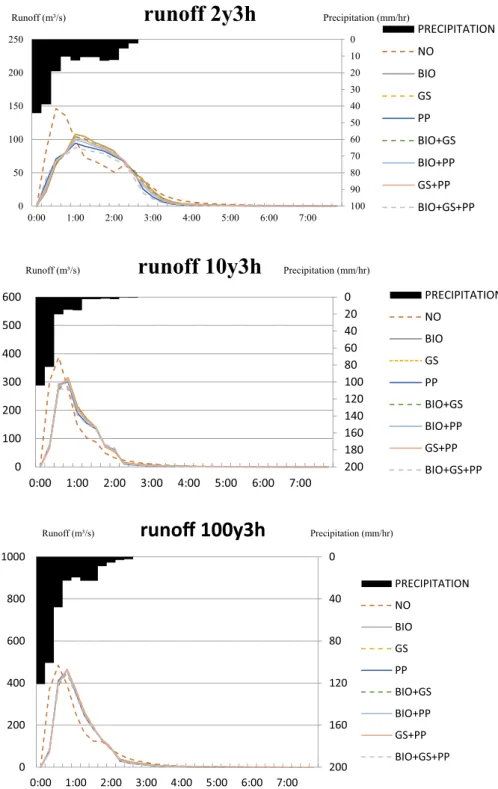
In addition, rainfall temporal distribution is a key issue for urban hydrology. It has a strong influence on the detention of rainfall on site/within a watershed and runoff generation and it also has an impact on the water balance and water budget. According to the previous studies (Fan, 2011; Yin, Xie, Nearing, Guo, & Zhu, 2016), Huff rainfall distribution (Huff, 1967) can present the characteristics of typical rainfall events in Tianjin. Thus, three periods (2-, 10-, and 100-year) and two rainfall durations (3- and 6-hr) were calculated using Equation (1) and Huff rainfall distribution. The rainfall amounts of 3 hr events were 50.6 mm, 73.5 mm and 106.3 mm at 2-, 10-, and 100-year, respectively. The rainfall amounts of 6 hr events were 53.6 mm, 77.8 mm, and 112.5 mm at 2-, 10-, and 100-year. The differences of the rainfall total vol-umes at the same return period between 3 hr event and 6 hr event is relatively small based on formula (1). The hyetograph of all designed storms are shown in Figure 6. Three hours duration design storms are early bursting events and 6 hr duration design storms are relatively centred events in the term of the timing of the precipita-tion burst. Normally an early bursting event which means less response time for the locals to deal with the flood issue may lead to higher peak flow discharge and more critical consequence (Bezak,Šraj, & Mikoš, 2018).
3.2
|
SWMM model and LID scenarios
In this study, Storm Water Management Model
5 (SWMM5) was used to simulate urban hydrological
processes with and without LIDs. SWMM is a
stormwater/wastewater and watershed modelling tool developed by US EPA with hydrology and hydraulics capabilities. It is a distributed model for urban water-sheds that involve run-on flows or cascade runoff flows from the impervious area onto the pervious area (Niazi et al., 2017). More important, it has a LID module with six kinds of LID technical contents which can represent LID facilities (Mogenfelt, 2017). And the LID contents have maximum five layers: surface, soil, pavement, stor-age and underdrain. Each layer has different storstor-age and
functions differently. SWMM can be used to set different LID types and design parameters facilities in the research, so as to make it convenient for the research on the effects of different LID facilities for water balance (Guo, 2017). SWMM model is more suitable for urban water system and LID evaluation compared with other models. And it has been widely used in LID related stud-ies (Lee, Nietch, & Panguluri, 2018). For example, Limos et al. (2018) employed EPA (Environmental Protection Agency)'s SWMM to determine that green roofs signifi-cantly affect rain water in urban areas. Huang et al. (2014) utilised SWMM to study bioretention, porous pavement, grass swales, infiltration trenches, and rain harvest systems.
The study area was delineated into 604 sub-catchments in ArcGIS 10.2 (ESRI, Redlands, CA: ESRI, 2014) based on the information of land use type and pipelines (Figure 3). Depression storage values of various land cover were as follows: 2–8 mm for roof, 2–4 mm for paved area, 5–10 mm for lawn grass, and 6–13 mm for open fields. Manning's roughness values were 0.2 for the pervious surfaces and 0.013 for the impervious surfaces (McCuen, Johnson, & Ragan, 1996).
The Green-Ampt infiltration method was used
(Rossman, 2010). Permeable pavement, bioretention and grass swale were chosen as potential appropriate LID fac-ulties. Some parameters of these three LID controls are shown in Table 2. Three indices of SWMM outputs (out-flow volume, peak (out-flow and flood volume) were used to evaluate the hydrological performance of LID scenarios. The changes in flood volumes indicate the effects of LIDs on flood mitigation. And the variations in peak flow and surface runoff represent the impact on rainfall-runoff processes. The model.
The construction area of different scenarios (each LID and their combination) was decided based on the techni-cal guideline for the sponge city construction (Ministry of Housing and Urban–Rural Development, 2014). The total available LID implementation area is 0.99 km2. There are 0.07 km2available for bioretention (BIO) and permeable pavement (PP), 0.06 km2 available for BIO and grass swale (GS), 0.07 km2 available for GS and PP, and 0.01 km2available for three facilities (shown in Figure 4). The potential maximum implementation areas of BIO, GS and PP are 0.21 km2, 0.32km2, and 0.65km2, respec-tively. Eight scenarios were constructed with different combinations of LID practices (listed as follows). The rea-sonability of LID combination acreage is discussed in “Optimal LID implementation scenario.”
Baseline: no LID
Scenario 1: Implementation of BIO (0.21km2) Scenario 2: Implementation of GS (0.32km2) Scenario 3: Implementation of PP (0.65km2)
Scenario 4: Implementation of BIO (0.15km2) + GS (0.32km2)
Scenario 5: Implementation of BIO (0.21km2) + PP (0.58km2)
Scenario 6: Implementation of GS (0.32km2) + PP (0.58km2)
Scenario 7: Implementation of BIO (0.15km2) + GS (0.32km2) + PP (0.52km2)
3.3
|
Cost-effectiveness analysis
Life cycle cost (LCC) analysis is a widely used analysis technique to estimate the total cost of a system over its life span (Farreny, Gabarrell, & Rieradevall, 2011). It could be presented as follows (ISO, 2008):
E=C−Csv +D ð2Þ
T A B L E 2 Parameters of low impact development (LID) controls
Layer Parameter Bioretention Grass swale Permeable pavement
Surface Berm height (mm) 25 200 10
Vegetative cover fraction 0.1 0.1 0
Surface roughness (Manningn) 0.1 0.3 0.013
Surface slope (%) 2 2.5 3
Soil Thickness (mm) 450–500 — —
Porosity (volume fraction) 0.5 — —
Field capacity (volume fraction) 0.2 — —
Pavement Thickness (mm) — — 120–180
Void ratio (voids/solids) — — 0.15
Clogging factor — — 0
Storage Thickness (mm) 500 — 300
Void ratio (voids/solids) 0.45 — 0.33
Clogging factor 0 — 0
Underdrain Flow coefficient 0.5 — 0.5
Flow exponent 0.5 — 0.5
PV =E+ OMð1 +iÞ n−
1
ið1 +iÞn ð3Þ
where E is economic capita, Cis construction fee, sv is salvage value,Dis design fee, PV is present value of LID, OM is operation and maintenance fee, n is the years of service, andiis discount rate.
The LCC for each LID design is calculated based on Equations (2) and (3). The life span of BIO and GS are assumed to be 20 years (Liu et al., 2018), and the life span of PP is assumed to be 8 years (Ministry of Transport of the People's Republic of China, 2014). Though some stud-ies reported the infiltration rates of PP decline obviously with several years of use due to clogging (Hu et al., 2018; Kumar et al., 2016), maintenance could reclaim part of the lost infiltration rates. Thus, the impact of clogging on life span and performance of PP was neglected in this study. The discount rate (i) and salvage value (sv) are rec-ommended at 5% and 4% in China (Hu, 2012; Mei et al., 2018). The initial and maintenance costs per capita are set according to previous studies (Chui et al., 2016;
Hu, Sayama, & Zhang, 2013; Montalto et al., 2007; Wang et al., 2016; Xie et al., 2017) and project quoted price by technical guideline for the sponge city construction (Ministry of Housing and Urban–Rural Development, 2014). The values are shown in Table 3.
When comparing the three LID practices with respect to their overall performance, the overall performance of LID is defined as the average across percentage of peak flow reduction per million dollars, percentage of outflow volume reduction per million dollars and percentage of flooding volume reduction per million dollars. The for-mula can be expressed as below
Overall cost effectiveness = Pp+Op
=2
PV ð4Þ
wherePPis the percentage of peak flow reduction by LID application,OPis the percentage of runoff volume reduc-tion by LID applicareduc-tion, andPVis present value of LID.
4
|
R E S U L T S
4.1
|
Model calibration and validation
SWMM model was calibrated and validated by compar-ing the simulated and observed surface runoff at the watershed outlet using the index of Nash–Sutcliffe model efficiency coefficient (NSE) (Nash & Sutcliffe, 1970). It is defined as follows: NSE = 1− Pn i = 1 Q obs i −Q sim i 2 Pn i = 1 Qobsi −Qmeani 2 ð5Þ where Qobs
i is the i observed value, Qsimi is the corresponding i simulated value,Qmeani is the mean of all the observed value and n is the total number of the observations. The NSE value can range between−∞and 1 and NSE = 1 means a perfect fit. For the SWMM model, the NSE value larger than 0.5 suggests that the performance of the model is acceptable (Dongquan et al., 2009).
T A B L E 3 Life-cycle costs of low impact development (LID) during the service period
LID
Construction fee Design fee Operation and maintenance fee
Years of service (US$/m2) (US$/m2) (US$/m2)
BIO 102.72 3.39 3.55 20
GS 26.25 0.36 0.26 20
PP 59.00 3.36 1.28 8
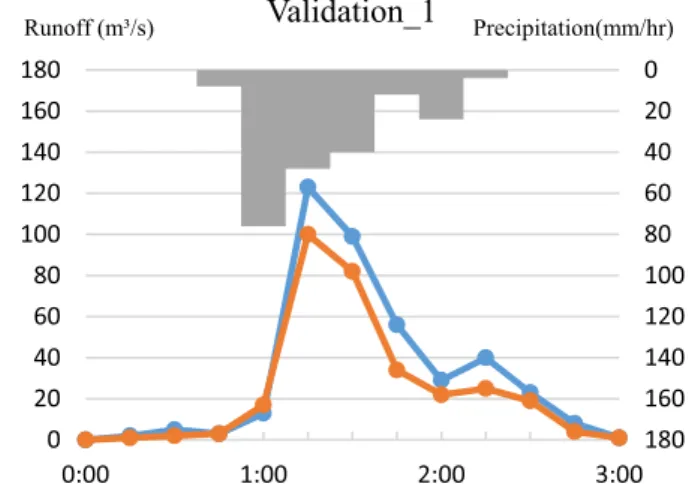
The rainfall event on 25th August 2007 was used for calibration and rainfall events on 16th August 2008 and 26th July 2012 were selected for validation. The rainfall amounts were 46 mm, 53 mm, and 181 mm, respectively. Figure 5 shows the simulated and observed surface runoff at the watershed outlet without any LID placement. The NSE value of calibration is 0.93 and the values of valida-tion were 0.84 and 0.80, respectively. Thus, model perfor-mance is well in the study area.
4.2
|
Hydrological performance of LID
facilities
Figures 6 and 7 indicate hydrological performances of all scenarios in six designed storms. It was found that LID facilities had significant effects on rainfall-runoff pro-cesses. Total surface runoff decreased by 4–23%. And peak flow decreased by 4–39%, also there was time delay
of peak flow observed in some events so that LID facili-ties could effectively mitigate urban flood. For single LID facility, PP had highest hydrological performance, followed by BIO and GS. The application area of different types of LID concentrated in a limited area may explain that theses hydrographs with LID share the similar trend.
4.3
|
Impact of rainfall amounts on LID
performance
In the same rainfall duration, the reduction ratios of flood volume decreased as rainfall amounts increased in all LID scenarios. The runoff coefficient is an index relating the amounts of runoff to the amounts of precipitation received. For example, the runoff coefficients were mini-mum (0.652–0.760) at 2-year, followed by 10-year (0.818–0.879) and 100-year (0.842–0.882) in 3 hours' dura-tion storms (Table 4). There were similar findings in
6 hours' duration storms. Thus, the flood mitigation per-formance decreased with the increase of rainfall amounts.
4.4
|
Cost-effectiveness of LID
Table 5 shows the present costs of each scenario and the reduction values of flood volumes per million dollar in
the storm of 100-year and 6 hours' duration. For single LID facilities, the costs of GS were cheapest (0.461 million dollar) in the study area, followed by BIO (1.536 million dollar) and PP (5.547 million dollar). Figure 8 indicates the overall cost-effectiveness of LID facilitates per million dollar in different storms. In terms of cost-effectiveness, the order is GS > BIO + GS > BIO > PP > PP + BIO + GS > PP + GS > PP + BIO. Overall, LID
facilities had better cost-effectiveness in shorter and smaller rainfall events.
5
|
D I S C U S S I O N
5.1
|
Optimal LID implementation
scenario
At the watershed scale, high hydrological performance does not mean high cost-effectiveness for LID facilities. In this study, PP had highest hydrological performance
but lowest cost-effectiveness among the three single LID facilities. This is because LID hydrological performance is high related with implementation areas and locations. In a built-up watershed, the available locations and areas are always limited. In the study area, the available land for PP was 0.65 km2, much larger than the lands for BIO (0.21km2) and GS (0.32 km2). Cost-effectiveness is the hydrological performance per unit cost, which has excluded the impact of implementation area. Thus, PP had lowest cost-effectiveness but highest hydrological performance. And GS has the highest cost-effectiveness. Similarly, Hu, Sayama, Zhang, et al. (2017) reported PP
has highest performance on flood mitigation by a study in Nanjing, China. Liu, Bralts, and Engel (2015) indicated that grass swale is the most cost-effective way to reduce runoff and pollutants in a highly urbanised area. As men-tioned in“SWMM model and LID scenarios,”there were
some lands with a total area of 0.18 km2suitable for more than one type of LID facility. In these areas, the priority is GS > BIO > PP according to their cost-effectiveness. For example, in the combination of BIO and GS, the both available area of 0.06 km2should be covered by GS. The
F I G U R E 7 Hydrological performance of designate low impact development (LID) scenarios
T A B L E 4 Runoff coefficient of the basin in each LID plan and no LID plan
BIO GS PP BIO + GS BIO + PP GS + PP BIO + GS + PP No
2y3h 0.757 0.760 0.693 0.737 0.715 0.732 0.652 0.857 10y3h 0.878 0.879 0.839 0.866 0.853 0.864 0.818 0.945 1003h 0.882 0.882 0.856 0.874 0.865 0.872 0.842 0.922 2y6h 0.680 0.681 0.630 0.666 0.642 0.664 0.599 0.768 10y6h 0.766 0.767 0.731 0.757 0.738 0.755 0.713 0.827 100y6h 0.809 0.806 0.786 0.802 0.795 0.801 0.774 0.849
combination area should be 0.32km2of GS and 0.15 km2 of BIO. Under this criterion, the combination scenarios were designed in this study (Scenarios 4–7). In addition, one of main purposes of Chinese sponge city construction is to mitigate urban flooding. It is recommended that all available lands are used for LID implementation (Mei et al., 2018). Thus, scenario 7 (PP 0.52km2+ BIO 0.15 km2+ GS 0.32 km2) was the optimal one. Similarly findings has been demonstrated by Mao, Jia, and Shaw (2017) that the multi-types of LID which contain green roofs, biological retention, porous pavements, were the most cost-effective solution to achieve control goals.
5.2
|
Implication of rainfall
characteristics
The changes in the reduction ratio of flood volume under different storms indicate that flood mitigation perfor-mance of LID facilities decreased with the increase of rainfall amounts. Similar findings have been reported by Hu, Zhang, Li, Yang, and Tanaka (2019) that LID facili-ties are less effective in heavier storms. Some studies (Mei et al., 2018; Qin et al., 2013) found that there were significant variations in the reduction ratios of peak flow
and surface runoff in different storms, which was not found among six designed storms in this study. One rea-son is due to the different rainfall distribution pattern in Tianjin. Chicago hyetograph is commonly used in LID related studies in China (Mei et al., 2018; Qin et al., 2013). Here, Huff hyetograph was used, which has early bursting in short rainfall events and centred burst-ing in long rainfall events. The differences in burstburst-ing resulted in different rainfall-runoff process. Another rea-son is the rainfall intensities designed in this study are relatively low compared with the potential drainage capacity of the study area with LID implementation.
6
|
C O N C L U S I O N
Based on SWMM model and life-cycle cost analysis, an integrated LID evaluation system was proposed and applied in the Tianjin Airport Economic Area to estimate the hydrological performance and life cycle cost of LID scenarios under different storms. The main findings can be summarised as follows.
1 Urban flood could be effectively mitigated by the implementation of LID facilities. However, flood
F I G U R E 8 Overall cost-effectiveness of designate LID scenarios
T A B L E 5 Present values of LID scenarios and cost-effectiveness of flood mitigation in the 100-year and 6 hr storm
Scenario 1 Scenario 2 Scenario 3 Scenario 4 Scenario 5 Scenario 6 Scenario 7
Present value (million US dollar)
1.536 0.461 5.547 1.558 6.485 5.411 5.995
Flood reductions (mm/million US dollar)
mitigation performance decreased with the increasing rainfall amounts. LID facilities were more effective in smaller storms.
2 Permeable pavement had the highest hydrological per-formance, while grass swale had the greatest cost-effectiveness for single LID facility. The optimal LID scenario was the combination of PP (0.52 km2), BIO (0.15 km2) and GS (0.32 km2).
3 The proposed integrated LID evaluation framework is useful for the LID design.
As a case study, the findings of LID facilities with highest hydrological performance and lowest costs may not be perfectly applicable in other regions with different characteristics. But the proposed LID evaluation system is useful for identifying the optimal scenario by assessing hydrological performance and life cycle cost of LID facili-ties in sponge city construction. In addition, parameters of LID facilities lacked experimental values, though all the parameters were from the published literature. Thus, future studies including experimental values or filed observations from pilot cities are necessary to improve the accuracy of evaluation of cost-effectiveness of LID facilities. In order to do the cost risk analysis, the benefit curve and the damage curve with resulting flood costs under a large range of return periods of rainfall are also necessary. In this study due to the limitation of informa-tion on damage costs, only the effectiveness on hydrologi-cal performance including rainfall collection under 2-, 10-, 100-year return period with 3-, 6-hr duration by dif-ferent LID plans were discussed. For the future work, simulation under more return period design rainfall will be done and the damage cost information will be col-lected to generate the cost risk analysis.
A C K N O W L E D G E M E N T S
This project was funded by The National Key Research and Development Program of China (2016YFC0400709), National Water Pollution Control and Treatment Science and Technology Major Project of China (2017ZX07106001), China Postdoctoral Science Foun-dation (2018M631732), Open fund by Jiangsu Key Lab-oratory of Atmospheric Environment Monitoring and Pollution Control (KHK1806), and the Priority Aca-demic Program Development of Jiangsu Higher Educa-tion InstituEduca-tions (PAPD). The authors would also like to thank Dr. Qian Zhang and the Tianjin meteorologi-cal bureau for their data and technimeteorologi-cal support and Kyoto University Global COE Program.
D A T A A V A I L A B I L I T Y S T A T E M E N T
The data that support the findings of this study are avail-able from Planning and Construction Management
Bureau of Tianjin Airport Economic Area. Restrictions apply to the availability of these data, which were used under license for this study. Data are available from the authors with the permission of Planning and Construc-tion Management Bureau of Tianjin Airport Eco-nomic Area.
O R C I D
Maochuan Hu https://orcid.org/0000-0002-9485-954X
R E F E R E N C E S
Ahiablame, L. M., Bernard, A. E., & Indrajeet, C. (2013). Effective-ness of low impact development practices in two urbanized watersheds: Retrofitting with rain barrel/cistern and porous pavement. Journal of Environmental Management, 119, 151–161. https://doi.org/10.1016/j.jenvman.2013.01.019 Bezak, N.,Šraj, M., & Mikoš, M. (2018). Design rainfall in
engineer-ing applications with focus on the design discharge. In Engi-neering and mathematical topics in rainfall. London, UK: InTech Press ISBN 978-953-51-5562-1.
Brown, R. A., & Hunt, W. F. (2012). Improving bio-retention/biofiltration performance with restorative mainte-nance. Water Science and Technology, 65(2), 361–367. https:// doi.org/10.2166/wst.2012.860
Chui, T. F. M., Liu, X., & Zhan, W. (2016). Assessing cost-effectiveness of specific LID practice designs in response to large storm events.Journal of Hydrology,533, 353–364. https:// doi.org/10.1016/j.jhydrol.2015.12.011
Curran, M. A. (1996). Environmental life-cycle assessment. Interna-tional Journal of Life Cycle Assessment,1(3), 179–179. https:// doi.org/10.1007/BF02978949
Davis, A. P. (2005). Green engineering principles promote low-impact development. Environmental Science & Technology, 39
(16), 338A–344A. https://doi.org/10.1021/es053327e
De Sousa, M. R., Montalto, F. A., & Spatari, S. (2012). Using life cycle assessment to evaluate green and grey combined sewer overflow control strategies.Journal of Industrial Ecology,16(6), 901–913. https://doi.org/10.1111/j.1530-9290.2012.00534.x Deletic, A., & Fletcher, T. D. (2006). Performance of grass filters
used for stormwater treatment—A field and modelling study.
Journal of Hydrology, 317(3–4), 261–275. https://doi.org/10. 1016/j.jhydrol.2005.05.02
Dietz, M. E., & Clausen, J. C. (2008). Stormwater runoff and export changes with development in a traditional and low impact sub-division. Journal of Environmental Management, 87(4), 560–566. https://doi.org/10.1016/j.jenvman.2007.03.026 Dongquan, Z., Jining, C., Haozheng, W., Qingyuan, T.,
Shangbing, C., & Zheng, S. (2009). GIS-based urban rainfall-runoff modeling using an automatic catchment-discretization approach: A case study in Macau.Environment and Earth Sci-ence,59(2), 465–472. https://doi.org/10.1007/s12665-009-0045-1 ESRI. (2014).ArcGIS desktop: Release 10.2. Redlands, CA:
Environ-mental Systems Research Institute.
Fan, Z. H. (2011). Research on precipitation trend analysis and design storm of Tianjin city (in Chinese). (MS thesis). Tianjin University, Tianjin, China.
Farreny, R., Gabarrell, X., & Rieradevall, J. (2011). Cost-efficiency of rainwater harvesting strategies in dense Mediterranean
neighbourhoods. Resources, Conservation & Recycling, 55(7), 686–694. https://doi.org/10.1016/j.resconrec.2011.01.008 Ferguson, B. K. (2005). Porous pavements. Boca Raton, FL: CRC
Press.
Fletcher, T. D., Shuster, W., Hunt, W. F., Ashley, R., Butler, D., Arthur, S., & Mikkelsen, P. S. (2015). SUDS, LID, BMPs, WSUD and more—The evolution and application of terminology sur-rounding urban drainage.Urban Water Journal,12(7), 525–542. https://doi.org/10.1080/1573062X.2014.916314
Guo, J. C. (2017).Urban flood mitigation and stormwater manage-ment, Boca Raton, FL: CRC Press.
Guo, J. C., & Cheng, J. Y. (2008). Retrofit storm water retention volume for low impact development. Journal of Irrigation & Drainage Engineering,134(6), 872–876. https://doi.org/10.1061/ (ASCE)0733-9437(2008)134:6(872)
Hood, M., Clausen, J. C., & Warner, G. S. (2006). Low impact devel-opment works! This low impact develdevel-opment demonstration shows that best management practices do reduce stormwater runoff.Journal of Soil and Water Conservation,61(2), 58A–61A. Hu, M. (2012).Urban rainwater utilization and its role in reducing of urban waterlogging problems: A case study in Nanjing, China
(in Chinese). (MS thesis). Nanjing University, Nanjing, China. Hu, M., Sayama, T., Duan, W., Takara, K., He, B., & Luo, P. (2017).
Assessment of hydrological extremes in the Kamo River Basin, Japan.Hydrological Sciences Journal,62(8), 1255–1265. https:// doi.org/10.1080/02626667.2017.1319063
Hu, M., Sayama, T., & Zhang, X. (2013). Analysis of optimum rain-water tank size in a multi-building. Disaster Prevention Research Institute Annuals B,56(B), 53–58.
Hu, M., Sayama, T., Zhang, X., Tanaka, K., Takara, K., & Yang, H. (2017). Evaluation of low impact development approach for mitigating flood inundation at a watershed scale in China. Jour-nal of Environmental Management,193, 430–438. https://doi. org/10.1016/j.jenvman.2017.02.020
Hu, M., Zhang, X., Li, Y., Yang, H., & Tanaka, K. (2019). Flood mit-igation performance of low impact development technologies under different storms for retrofitting an urbanized area. Jour-nal of Cleaner Production, 222, 373–380. https://doi.org/10. 1016/j.jclepro.2019.03.044
Hu, M. C., Zhang, X. Q., Siu, Y. L., Li, Y., Tanaka, K., Yang, H., & Xu, Y. P. (2018). Flood mitigation by permeable pavements in Chinese Sponge City construction. Water, 10(2), 172. https:// doi.org/10.3390/W10020172
Huang, J. J., Li, Y., Niu, S., & Zhou, S. H. (2014). Assessing the per-formances of low impact development alternatives by long-term simulation for a semi-arid area in Tianjin, northern China.
Water Science and Technology, 70(11), 1740–1745. https://doi. org/10.2166/wst.2014.228
Huff, F. A. (1967). Time distribution of rainfall in heavy storms.
Water Resources Research, 3(4), 1007–1019. https://doi.org/10. 1029/WR003i004p01007
Hunt, W. F., Jarrett, A. R., Smith, J. T., & Sharkey, L. J. (2006). Evaluating bioretention hydrology and nutrient removal at three field sites in North Carolina. Journal of Irrigation and Drainage Engineering, 132(6), 600–608. https://doi.org/10. 1061/(ASCE)0733-9437(2006)132:6(600)
ISO. (2008).15686-5 Buildings and constructed assets–Service life planning: Part 5, Life-cycle costing. Geneva, Switzerland: Inter-national Organisation for Standardisation ISO 15686.
Jennings, D. B., & Jarnagin, S. T. (2002). Changes in anthropogenic impervious surfaces, precipitation and daily streamflow dis-charge: A historical perspective in a mid-Atlantic sub-watershed.Landscape Ecology,17(5), 471–489. https://doi.org/ 10.1023/A:1021211114125
Jun, R. Y. L. M. G., & Yanjuan, X. M. Y. (2012). The estimation and application of design rainstorm intensity in Tianjin area. Jour-nal of Applied Meteorological Science,3, 016.
Kumar, K., Kozak, J., Hundal, L., Cox, A., Zhang, H., & Granato, T. (2016). In-situ infiltration performance of different permeable pavements in a employee used parking lot—A four-year study.
Journal of Environmental Management,167, 8–14. https://doi. org/10.1016/j.jenvman.2015.11.019
Lee, H., Shin, H., Rasheed, U., & Kong, M. (2017). Establishment of an inventory for the life cycle cost (LCC) analysis of a water supply system. Water, 9(8), 592. https://doi.org/10.3390/ w9080592
Lee, J. G., Nietch, C. T., & Panguluri, S. (2018). Drainage area char-acterization for evaluating green infrastructure using the storm water management model. Hydrology and Earth System Sci-ences, 22(5), 2615–2635. https://doi.org/10.5194/hess-22-2615-2018
Li, J., Deng, C., Li, Y., Li, Y., & Song, J. (2017). Comprehensive ben-efit evaluation system for low-impact development of urban storm water management measures.Water Resources Manage-ment,31(15), 4745–4758.
Limos, A. G., Mallari, K. J. B., Baek, J., Kim, H., Hong, S., & Yoon, J. (2018). Assessing the significance of evapotranspira-tion in green roof modeling by SWMM. Journal of Hydroinformatics, 20(3), 588–596. https://doi.org/10.2166/ hydro.2018.130
Liu, J., Kattel, G., Arp, H. P. H., & Yang, H. (2015). Towards threshold-based management of freshwater ecosystems in the context of climate change.Ecological Modelling,318, 265–274. https://doi.org/10.1016/j.ecolmodel.2014.09.010
Liu, Y., Bralts, V. F., & Engel, B. A. (2015). Evaluating the effective-ness of management practices on hydrology and water quality at watershed scale with a rainfall-runoff model.Science of the Total Environment, 511, 298–308. https://doi.org/10.1016/j. scitotenv.2014.12.077
Liu, Y., Engel, B. A., Flanagan, D. C., Gitau, M. W., McMillan, S. K., Chaubey, I., & Singh, S. (2018). Modeling framework for representing long-term effectiveness of best management practices in addressing hydrology and water qual-ity problems: Framework development and demonstration using a Bayesian method.Journal of Hydrology,560, 530–545. https://doi.org/10.1016/j.jhydrol.2018.03.053
Maniquiz, M. C. (2012).Low impact development (LID) technology for urban stormwater runoff treatment–monitoring, performance and design. (Diss, PhD thesis).
Maniquiz-Redillas, M. C., Geronimo, F. K. F., & Kim, L. H. (2014). Investigation on the effectiveness of pretreatment in stormwater management technologies.Journal of Environmen-tal Sciences-China,26(9), 1824–1830. https://doi.org/10.1016/j. jes.2014.06.018
Mao, X., Jia, H., & Shaw, L. Y. (2017). Assessing the ecological ben-efits of aggregate LID-BMPs through modelling. Ecological Modelling, 353, 139–149. https://doi.org/10.1016/j.ecolmodel. 2016.10.018
McCuen, R., Johnson, P., & Ragan, R. (1996). Hydrology, FHWA-SA-96-067. Washington, DC: Federal Highway Administration. Mei, C., Liu, J., Wang, H., Yang, Z., Ding, X., & Shao, W. (2018).
Integrated assessments of green infrastructure for flood mitiga-tion to support robust decision-making for sponge city con-struction in an urbanized watershed. Science of the Total Environment, 639, 1394–1407. https://doi.org/10.1016/j. scitotenv.2018.05.199
Ministry of Housing and Urban–Rural Development. (2014). Tech-nical guide for the construction of the sponge city. Beijing. Retrieved from http://www.mohurd.gov.cn/wjfb/201411/ W020141102041225.pdf (in Chinese).
Ministry of Transport of the People's Republic of China. (2014).
Technical Standard of Highway Engineering(in Chinese). China Communications Press, Beijing.
Mogenfelt, P. (2017). Modeling LID-units in SWMM. TVVR 17/5022.
Montalto, F., Behr, C., Alfredo, K., Wolf, M., Arye, M., & Walsh, M. (2007). Rapid assessment of the cost-effectiveness of low impact development for CSO control. Landscape Urban Plan, 82(3), 117–131. https://doi.org/10.1016/j.landurbplan.2007.02.004 Nash, J. E., & Sutcliffe, J. V. (1970). River flow forecasting through
conceptual models part I—A discussion of principles. Journal of Hydrology,10(3), 282–290. https://doi.org/10.1016/0022-1694 (70)90255-6
Niazi, M., Nietch, C., Maghrebi, M., Jackson, N., Bennett, B. R., Tryby, M., & Massoudieh, A. (2017). Storm water management model: Performance review and gap analysis.Journal of Sus-tainable Water in the Built Environment,3(2), 04017002. Prince George's County (Md.). (1999). Department of
Environmen-tal Resources. Programs, and Planning Division. Low-impact development hydrologic analysis, Department of Environmen-tal Resources.
Pyke, C., Warren, M. P., Johnson, T., LaGro, J., Jr., Scharfenberg, J., Groth, P., & Main, E. (2011). Assessment of low impact devel-opment for managing stormwater with changing precipitation due to climate change.Landscape and Urban Planning,103(2), 166–173. https://doi.org/10.1016/j.landurbplan.2011.07.006 Qin, H. P., Li, Z. X., & Fu, G. (2013). The effects of low impact
development on urban flooding under different rainfall charac-teristics.Journal of Environmental Management,129, 577–585. https://doi.org/10.1016/j.jenvman.2013.08.026
Rehan, T., Qi, Y., & Werner, A. (2018). Life-cycle cost analysis for traditional and permeable pavements. Construction Research Congress,2018, 422–431.
Rossman, L. A. (2010). Modeling low impact development alterna-tives with SWMM. Journal of Water Management Modeling,
R236–11, 167–182. https://doi.org/10.14796/JWMM.R236-11.
Rushton, B. T. (2001). Low-impact parking lot design reduces runoff and pollutant loads. Journal of Water Resources Planning and Management, 127(3), 172–179. https://doi.org/10.1061/(ASCE) 0733-9496(2001)127:3(172)
Spatari, S., Yu, Z., & Montalto, F. A. (2011). Life cycle implications of urban green infrastructure. Environmental Pollution, 159
(8–9), 2174–2179. https://doi.org/10.1016/j.envpol.2011.01.015 Wang, M., Zhang, D., Adhityan, A., Ng, W. J., Dong, J., & Tan, S. K.
(2016). Assessing cost-effectiveness of bioretention on stormwater in response to climate change and urbanization for future scenarios. Journal of Hydrology, 543, 423–432. https:// doi.org/10.1016/j.jhydrol.2016.10.019
Wheater, H., & Evans, E. (2009). Land use, water management and future flood risk.Land Use Policy,26, S251–S264. https://doi. org/10.1016/j.landusepol.2009.08.019
Xia, J., Zhang, Y., Xiong, L., He, S., Wang, L., & Yu, Z. (2017). Opportunities and challenges of the Sponge City construction related to urban water issues in China.Science China Earth Sci-ences,60(4), 652–658. https://doi.org/10.1007/s11430-016-0111-8 Xie, J., Chen, H., Liao, Z., Gu, X., Zhu, D., & Zhang, J. (2017). An
integrated assessment of urban flooding mitigation strategies for robust decision making.Environmental Modelling and Soft-ware,95, 143–155. https://doi.org/10.1016/j.envsoft.2017.06.027 Yang, H., Flower, R. J., & Thompson, J. R. (2013). Sustaining China's water resources.Science,339, 141–141. https://doi.org/ 10.1126/science.339.6116.141-b
Yang, H., Xie, P., Ni, L., & Flower, R. J. (2012). Pollution in the Yangtze.Science,337, 410–410. https://doi.org/10.1126/science. 337.6093.410-a
Yi, C. L., Liu, H. F., Rose, N. L., Yang, H., Ni, L. Y., & Xie, P. (2006). Sediment sources and the flood record from Wanghu lake, in the middle reaches of the Yangtze River.Journal of Hydrology,
329(3–4), 568–576. https://doi.org/10.1016/j.jhydrol.2006.03.008 Yin, S. Q., Xie, Y., Nearing, M. A., Guo, W. L., & Zhu, Z. Y. (2016). Intra-storm temporal patterns of rainfall in China using Huff curves. Transactions of the ASABE,59(6), 1619–1632. https:// doi.org/10.13031/trans.59.11010
How to cite this article:Li Y, Huang JJ, Hu M, Yang H, Tanaka K. Design of low impact development in the urban context considering hydrological performance and life-cycle cost.
J Flood Risk Management. 2020;e12625.https://doi. org/10.1111/jfr3.12625