FACULTY OF INFORMATION TECHNOLOGY AND ELECTRICAL ENGINEERING
Timo Mattila
INTEGRATION OF ARCTIC NODE
THREAT INTELLIGENCE SHARING
PLATFORM WITH SURICATA
Master’s Thesis
Degree Programme in Computer Science and Engineering
June 2020
Mattila T. (2020) Integration of Arctic Node threat intelligence sharing platform with Suricata. University of Oulu, Degree Programme in Computer Science and Engineering, 59 p.
ABSTRACT
The Internet has connected the modern world. Nowadays anyone can access anything straight from their home computer. Everything and everyone has a presence in the cyber domain, including those who seek to conduct criminal activities. In response to this, the field of cyber security has been born.
Cyber threat intelligence refers to information about cyber threats such as computers with open vulnerabilities and malicious Internet sites. The amount of available information is vast and the only way to handle such a large amount of data is automation. Threat intelligence sharing platforms have been developed for this task. They are used to fetch threat intelligence data from multiple sources, harmonize and analyze the data, and share it further.
One part of the automation process is the integration of threat intelligence sharing platforms with other cyber security applications. The goal of this thesis was to integrate a new intrusion detection and prevention system into the Arctic Node threat intelligence sharing platform. Suricata was chosen as the integrated system. A new integration submodule was created for Arctic Node to convert threat intelligence collected by the platform into Suricata rules and send it automatically to Suricata. One of the prominent features of this new module was the capability to deduplicate the output data.
The new integration submodule was compared to a similar functionality in another threat intelligence sharing platform, MISP. Testing was conducted in a custom virtual environment using real threat intelligence from seven different feeds. The results of these tests indicated that the new submodule was able to notice a greater number of possible threats, and it generated a more diverse set of different types of Suricata rules from the same input data. Deduplication was found to only have a small impact in reducing the size of the generated rule set as the overlap between different threat intelligence feeds was minimal.
Keywords: Cyber security, Cyber threat intelligence, threat intelligence management, intelligence feeds
Mattila T. (2020) Arctic Node -alustan yhdistäminen Suricata-ohjelmaan. Oulun yliopisto, Tietotekniikan tutkinto-ohjelma, 59 s.
TIIVISTELMÄ
Internet on yhdistänyt nykyajan maailman. Kaikilla on pääsy kaikkialle suoraan kotikoneelta. Myös rikolliset ovat havainneet tämän, ja hakkerointi on noussut modernin maailman suureksi riesaksi. Internetissä tapahtuvan rikollisuuden estämiseksi on syntynyt kyberturvallisuuden ala.
Tietoturvatieto käsittää tietoa eri uhkatekijöistä internetissä. Tieto voi koskea esimerkiksi vaarallisia sivustoja tai haavoittuvaisia tietokoneita. Tietoturvatietoa on olemassa valtavasti, eikä kaikkea tätä tietoa voida hallita manuaalisesti, vaan sen hallinta täytyy automatisoida. Tietoturvatiedon hallintaa varten on kehitetty erilaisia tietoturvatiedon hallinta-alustoja, joilla tietoa voidaan kerätä eri lähteistä, rikastaa, analysoida ja jakaa eteenpäin.
Yksi tietoturvatiedon hallinta-alustojen toiminnallisuuden osa-alueista on niiden integraatio toisten tietoturvaohjelmien kanssa. Tämän diplomityön tavoitteena oli yhdistää uusi tietoturvaohjelma Arctic Node -alustaan. Yhdistettäväksi ohjelmaksi valittiin Suricata. Diplomityössä tehtiin toiminnallisuus, joka muuttaa Arctic Node -alustan keräämää tietoturvatietoa Suricata-säännöiksi ja joka kykenee jakamaan säännöt automaattisesti Suricata-ohjelmalle. Yksi tämän toiminnallisuuden tavoitteista oli poistaa toisto luoduista Suricata-säännöistä, jotta jokainen sääntö olisi uniikki.
Arctic Node -alustan uutta toiminnallisuutta testattiin MISP-alustan samanlaista toiminnallisuutta vastaan. Testin tuloksena oli, että uusi toiminnallisuus tuotti jonkin verran enemmän Suricata-sääntöjä kuin MISP-alusta samoilla tietoturvalähteillä, ja säännöt olivat myös monipuolisempia kuin MISP-alustan luomat säännöt. Testeissä Arctic Node -alustan tuottamat säännöt havaitsivat haitallista liikennettä paremmin kuin MISP-alustan tuottamat säännöt. Testeissä ei havaittu Suricata-sääntöjen toiston poistamisen olevan kovinkaan merkittävää, koska tietoturvalähteiden välillä on melko vähän päällekkäisyyksiä.
Avainsanat: tietoturva, kyberturvallisuus, tietoturvatieto, tietoturvatiedon jakaminen
TABLE OF CONTENTS
ABSTRACT TIIVISTELMÄ
TABLE OF CONTENTS FOREWORD
LIST OF ABBREVIATIONS AND SYMBOLS
1. INTRODUCTION 7
1.1. Cyber threat intelligence . . . 8
1.1.1. Categories . . . 9
1.1.2. Indicators of Compromise . . . 11
1.2. Cyber threat intelligence feed . . . 11
1.2.1. Event . . . 12
1.2.2. Sharing . . . 12
1.3. Cyber threat intelligence sharing platform . . . 13
1.3.1. Challenges . . . 14
1.4. Intrusion Detection and Prevention Systems . . . 16
2. STATE OF THE ART 19 2.1. History of intrusion detection and prevention systems . . . 19
2.2. Open source intrusion detection and prevention systems . . . 19
2.3. Suricata. . . 21
2.3.1. Suricata rule system . . . 21
2.4. Threat Intelligence Sharing Platforms . . . 23
2.5. MISP . . . 24
2.6. Arctic Hub and Node . . . 25
2.6.1. Structure and Features . . . 25
3. METHODOLOGY 30 3.1. Suricata rule generation . . . 30
3.1.1. The structure of the generator . . . 31
3.1.2. IP rules . . . 34
3.1.3. URL rules . . . 34
3.1.4. User interface of the generator. . . 35
4. CASE STUDIES 37 4.1. The test setup. . . 37
4.2. The metrics for comparing different rule sets . . . 41
4.3. MISP virtual machine . . . 42
4.4. Feeds . . . 42 4.5. Input Data . . . 45 4.6. Test Cases . . . 46 4.7. Test result . . . 47 4.8. Future Work . . . 51 5. CONCLUSION 53 6. REFERENCES 54 7. APPENDICES 57 7.1. MISP feeds . . . 57
FOREWORD
The goal of this thesis was to integrate the Arctic Node threat intelligence sharing platform with a new intrusion detection and prevention system. Suricata was chosen as the integrated system. This thesis was done at the University of Oulu between 2019 and 2020 for the Arctic Security company. I work at the Arctic Security company, and have been part of the development of Arctic Hub and Arctic Node for several years. Due to my prior experience in the field it was a natural option to write my thesis on the subject of threat intelligence sharing platforms.
I thank everybody who has helped me with my studies, thesis and work. There have been moments when it felt like I was never going to get this done, but your help has kept me on the right path. Special thanks also go to those who have helped me proofread this paper.
Many thanks to my family and friends, who have always been there for me. I want to also thank a young puppy named Vyöti who came into this world and my life during the year and a half I’ve spent working on this thesis. Vyöti has reminded me that there is more to life than graduation and has helped me to take breaks from work.
Oulu, 16th June, 2020
LIST OF ABBREVIATIONS AND SYMBOLS
ASN Autonomous System Number
C2 Command and Control
CTI Cyber Threat Intelligence CTIF Cyber Threat Intelligence Feed DGA Domain Generation Algorithm
HIDS Host based Intrusion Detection System HIPS Host based Intrusion Prevention System IDS Intrusion Detection System
IoC Indicator of Compromise IPS Intrusion Prevention System
NIDS Network based Intrusion Detection System NIPS Host based Intrusion Prevention System IDPS Intrusion Detection and Prevention System SIEM Security Information and Event Management TI Threat Intelligence
TTI Technical Threat Intelligence
TISP Threat Intelligence Sharing Platform QA Quality Assurance
VM Virtual Machine
WIDS Wireless Intrusion Detection System WIPS Wireless Intrusion Prevention System
1. INTRODUCTION
Over the years the world has grown dependent on the Internet. It is used by both individuals and organizations for various purposes such as business, sharing information, shopping, socializing, recreation, and controlling devices. Everything and everyone has a presence in the cyber domain, including those who seek to conduct criminal activities. The possible consequences of these criminal activities range from the simple defacement of websites to the destabilization of the power grid and espionage. With everything connected to the Internet, all facets of modern society can be targeted and hit by malicious actors.
The field of cyber security has risen in response to the cyber criminals. Just like in the security field in the physical word, there are various forms of cyber security. Instead of locks, guards, and walls, the tools of cyber security include encryption, antivirus, and firewalls. These forms of security are all centered around the individual target and its protection. However, fighting off all the threats alone is not the only option; there is also security in numbers. The malicious actors do not hide in the shadows and strike without warning. Their assets can be identified and information about their attacks can be shared with others so the targets can prepare in advance for the possible strike.
Sharing of cyber threat intelligence, or threat information, has become an important part of cyber security. In the past this was done via improvised channels such as emails and phone calls, but nowadays information is spread via specialized cyber threat intelligence sharing platforms and other advanced channels. Various nations and organisations such as NATO are investing into cyber threat intelligence sharing [1]. This intelligence can be used in multiple different ways including both passive and active applications. Communicating threat intelligence to other parties creates a net benefit for the whole community. For example, if a network of infected computers conduct a cyber attack against a company, the victim of the attack can inform other companies and organisations in the cyber threat intelligence sharing community of this new threat. This gives the potential next targets time to patch their systems so that the same exploits cannot be used against them and to block the IP addresses used in the previous attack. Information about the cyber attack could also be forwarded to the Internet providers used by these bot computers in order to cut off their access and inform the owner of the computers that their assets have been infected.
Large quantities of low-level threat intelligence are readily available online, and various cyber threat intelligence feeds generate new information constantly. By using this information, cyber attacks can be detected and stopped before they have time to cause more harm. Forms of active protection against cyber threats include intrusion detection and prevention systems. Some of these systems require rules which describe to the system what types of items are malicious. These rules can be automatically generated from the information of different threat intelligence feeds.
Threat intelligence sharing platforms can be used as a bridge to combine threat intelligence feeds with intrusion detection and prevention systems. These sharing platforms collect information from multiple sources and store it in one central location. They are thus a gathering point for threat intelligence similar to how
books are collected together to form libraries. Where libraries make it possible to search for information from a great number of books at once, threat intelligence sharing platforms make it possible to access information from multiple threat intelligence sources and to act on the information from all of those sources at the same time. Therefore, adding a way to manipulate the data collected by these platforms makes it possible to act on information gained from hundreds of different feeds at once instead of having to go through them one by one.
Using multiple feeds as sources for the automatic rule generation comes with several problems. One of these is overlap between feeds. If two or more feeds happen to report the same source, the generator might produce multiple copies of the same rule. This can be prevented by including some form of deduplication, which ensures that multiple copies of the same rule are not created. Another problem is presented by the fact that the intrusion detection and prevention systems only have limited storage space for rules. While deduplication can help alleviate this problem, there is a need for some form of logic in generating the rules that serves to drop old and inactive entries which are no longer relevant.
The goal of this project was to create a new integration for the Arctic Node threat intelligence sharing platform providing a new intrusion detection and prevention system. The aim of the integration is to resolve the problems associated with using multiple sources of information with large quantities of data.
1.1. Cyber threat intelligence
A threat is the potential for violation of security when there is an entity or event which could cause harm [2]. Cyber threats refer to threats related to computer systems and information technology. The realization of a threat is called a threat action, and the entity that performs this action is called a threat agent or actor [2]. Both intentional and accidental threats exist. Intentional threats require an intelligent threat actor, e.g. a hacker, who can intentionally cause harm, or in other words attack a system. Accidental threats refer to cases where harm can be caused unintentionally by human error, equipment failure, or an act of God.
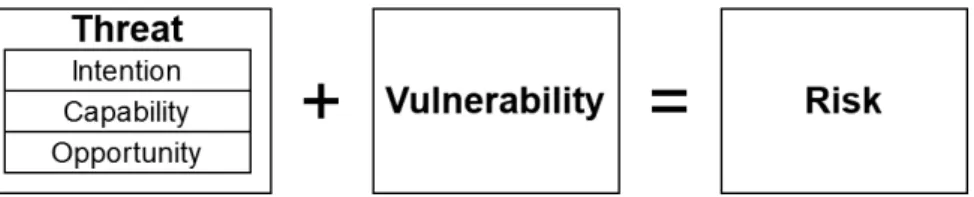
Threats can cause harm by exploiting vulnerabilities of the target system. Vulnerabilities are flaws in the design, operation, implementation and management of a system [2]. As seen in Figure 1, risk is the probability of a threat exploiting a vulnerability to cause a particular harmful event[2]. As threats require vulnerabilities to cause harm, there is little or no risk for a system to be harmed if it has no vulnerabilities, or alternatively if it has no potential threats.
A threat can be seen as an integral whole that consists of three elements: intent, capability, and opportunity [3]. Integral whole means that all three elements are required for a threat to be viable. A threat with less than three elements is called a potential threat. Intent is the goal or motivation behind the threat. Capability is access to the resources and knowledge required to exploit the vulnerability. Opportunity refers to access to the system or target that makes it possible for the threat to carry out an attack.
Figure 1. Threat and vulnerability together form the risk to a particular system. Threat consists of three integral parts, intention, capability and opportunity.
Cyber threat intelligence is data on cyber threats which has been processed or refined through some logical and analytical process to be relevant, actionable, and valuable to the end user [4]. The processing of the data can be done by either human or automated software.
Being relevant means that the intelligence has to relate to the one consuming it; for example, the attacks could potentially target them. For the intelligence to be actionable, there has to be a way to react to the data. One possible action for the end user is the informed decision to not act on the data. Finally, the intelligence must be valuable and have the capability to protect the business interests of the company in some way.
1.1.1. Categories
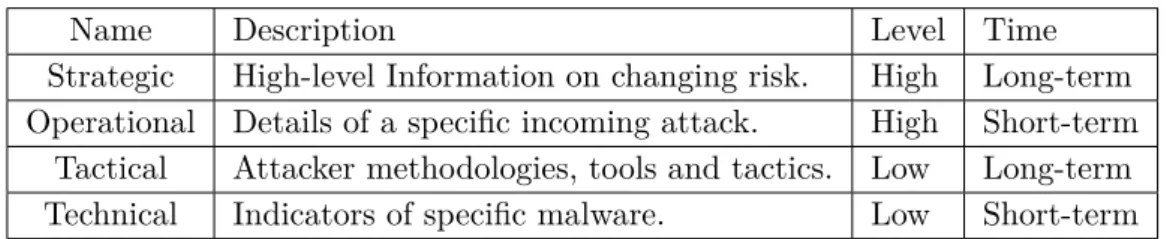
Threat intelligence can be divided into different categories. The UK Centre for the Protection of National Infrastructure divides intelligence into four categories based on the consumer of the data: strategic, operational, tactical, and technical [5]. These four categories can be split along two different axis, time and complexity level, as seen in Table 1.
The time axis describes the timescale on which the information is useful and should be consumed. Long-term threat intelligence yields benefit over time. Short-term threat intelligence gives information on immediate threats, but it also becomes outdated faster than long-term threat intelligence. For example, if a company gets operational threat intelligence that they might get attacked by hackers tomorrow, they must act today before the attack happens. After the attack the next day the threat intelligence is no longer useful. On the other hand, long-term tactical information on specific attack methodologies and tools can prepare a cyber security team to be ready for attacks which might happen within a year, and timing is no longer as crucial. However, the benefit of this preparation is not as immediately apparent as with shorter term information.
The complexity level axis indicates how complex the intelligence is as well as on what level and by whom it should be consumed. More complex intelligence should be consumed by those higher in the organizational hierarchy, as the information is more abstract and gives guidance on how how to act on a bigger scale. Less complex intelligence is to be consumed by those lower in the hierarchy as it gives them greater detail on how to act. For example, tactical intelligence on the type of malware being used at the moment is not useful for the CEO of a company to help make large scale decisions on how to adjust the cyber defence budget. However,
the incident response team can use the same intelligence to build defenses for their systems against this particular malware.
Strategic threat intelligenceis high-level information intended for the board or other senior decision-makers. It can help them allocate resources for cyber defence and make other high-level decisions which affect the company in long-term. Strategic threat intelligence comes in the form of reports, briefings, and conversations.
Operational threat intelligence is high-level information on near-future cyber attacks against the organization. It is intended to be consumed by senior cyber security staff. This can be information on what groups are planning to attack the organization and details on their capabilities and infrastructure.
Tactical threat intelligence is low-level intelligence on attacker tactics, techniques and procedures. It is intended for the defenders and incident response teams. Tactical intelligence can be information on how new attacks are conducted and how other organizations defend against those exploits. This information is meant for long-term use and can be gathered from studying the new vulnerabilities found by the cyber security community or by studying what malicious actors are doing in the wild.
Technical threat intelligence (TTI) is low-level intelligence on threats such as malicious IP addresses, URLs, and malware hashes, which are also called
indicators of compromise (IOC). Technical threat intelligence is intended to be consumed by mechanical means, and the intelligence is only useful in the short term. Technical threat intelligence is spread by various means such as cyber threat intelligence feeds, and it is distributed in forms which are easy for machines to read, such as JSON or CSV.
Table 1. Four threat intelligence categories defined by the UK Centre for the Protection of National Infrastructure.
Name Description Level Time
Strategic High-level Information on changing risk. High Long-term Operational Details of a specific incoming attack. High Short-term
Tactical Attacker methodologies, tools and tactics. Low Long-term Technical Indicators of specific malware. Low Short-term
Technical threat intelligence is on the edge between intelligence and data. While the UK Centre for the Protection of National Infrastructure does include indicators of compromise as one category of threat intelligence, it can be argued that they are not intelligence but rather just information on threats. It can be argued that lists of indicators of compromise, malware hashes and such lack the processing and analysis required to elevate them from information to intelligence. This does not mean that the data is useless, merely that the definition of intelligence in this context is somewhat strict. The ambiguity in the categorization can be resolved by splitting technical threat intelligence into the category of threat information, which is different fromthreat intelligence [6].
1.1.2. Indicators of Compromise
The two most common types of indicators of compromise are malware indicators and network indicators [5]. Malware indicators are information related to the malware used by attackers. Hashes of malware binaries are one common type of shared indicators. These can be used to detect malicious files, as all files with the matching hash are the same. Typical hash forms used by the industry are MD5, SHA-1 and SHA-256. The names of malware files and registry keys used by malware are another example of types of malware indicators. Network indicators are information on different internet resources used to spread and control malware. Common types of network indicators are IP addresses, domain names, URLs, URIs, and network artifacts such as user agent.
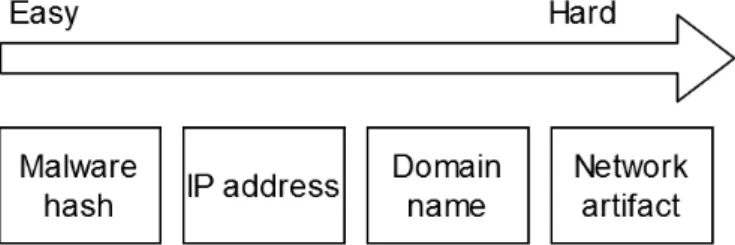
Threat intelligence is used to combat the efforts of threat agents such as hackers. In response to this, threat agents try to counter the efforts of the defenders by changing the resources or procedures used. Attackers can make changes on their end to render indicators of compromise obsolete [5]. Some indicators are harder to change than others, as seen in Figure 2. Changing malware hash values is trivial, as a change to any byte is enough to generate a new hash. Switching IP addresses takes more effort, but an attacker with a botnet of thousands of computers has a wide selection of addresses to use. On the other end of the spectrum, it would be difficult for attackers to craft entirely new malware capable of deceiving detailed intrusion detection system rules such as Yara. Similarly, if tactical threat intelligence is used to thwart the attacker’s tactics, techniques, and procedures, it would require more effort for the attacker to come up with ways to attack the target system.
Figure 2. How difficult it is for attackers to change the indicator of compromise.
1.2. Cyber threat intelligence feed
A cyber threat intelligence feed (CTIF) is a source of threat intelligence or information. These feeds are provided by various organizations and individuals, and can be for profit or non-profit. Feeds can provide information of all different threat intelligence categories. However, technical threat intelligence is the most common, as it is relatively easy to collect compared to other categories. As technical threat intelligence is best suited for automatic consumption, and it has to be consumed within a short period of time, the steady stream of new information from threat intelligence feeds is very suitable for this purpose. This paper will mostly focus on feeds which provide technical threat intelligence.
Technical threat intelligence can be collected in various ways. Some feed providers utilize honeypots to collect information on threat actors [7]. Honeypots are systems which pose as a vulnerable service, e.g. a database which is accessible via the Internet and vulnerable to an SQL injection. Another possible source of information is malware analysis, where malware is analyzed in a sandbox environment in order to find out how it works and what command-and-control (C2) servers it tries to connect to [8]. A host of feeds work on a voluntary basis, collecting reports submitted by individuals whenever they come across a malicious site [9].
1.2.1. Event
The singular item of threat intelligence provided by a feed is called an event. An event is a discrete time-bound activity in which an adversary uses their capabilities and resources against a victim [10]. Several events are required for adversities to achieve their goal.
Events can contain different kinds of information. Events provided by technical threat intelligence feeds typically contain different indicators of compromise such as IP addresses, domain names, and malware hashes. They may contain additional information about these indicators, such as the owner of the domain or what malware families the IP address is connected to. Events may also contain information on the victim or the adversary behind the event. All events must contain information on the time domain, when the event was observed, or, in the case of persistent threats, when it was last observed online. This is because technical threat intelligence is highly time sensitive.
1.2.2. Sharing
Threat intelligence feeds provide their events over the internet by various means. These methods can range from simple text files uploaded to a server or spread via email to elaborate web APIs. Open feeds which are free for anyone to use tend to use relatively simple approaches, while commercial feeds might need to use more complex approaches in order to make the information only accessible to paying customers.
Multiple different standards, ontologies, and taxonomies exists for sharing threat intelligence [11]. As feeds often report their findings using their own notation instead of any of the established ones, they expand the set of different notations used to describe threat intelligence. The variety of different forms of notation pose a challenge in the field of cyber threat intelligence. They make the automation of feed consumption more difficult, as the mapping between different notations has to be done manually and there may be confusion about the exact content of the events. Threat intelligence harmonization, normalization, and consolidation are some of the challenges that cyber threat intelligence sharing platforms aim to solve.
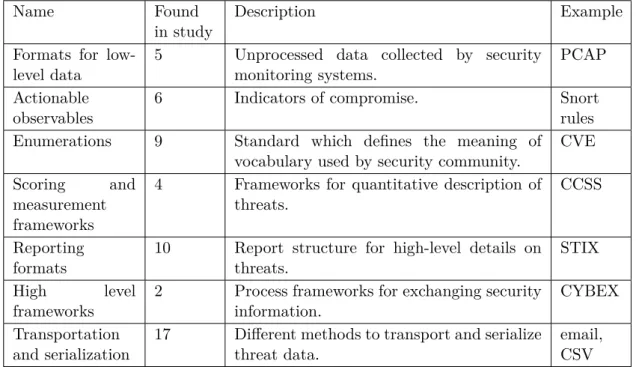
European Union Agency for Network and Information Security, ENISA, conducted a study in 2014 to find out the different standards and tools used to exchange and process threat intelligence [12]. In this study a total of 53 different information sharing standards were found. These were broken down into seven different categories as shown in Table 2. As the study was conducted in 2014, it is reasonable to assume even more standards have been developed since then. Table 2. The seven ENISA categories of information sharing and transportation standards.
Name Found
in study
Description Example
Formats for low-level data
5 Unprocessed data collected by security monitoring systems.
PCAP Actionable
observables
6 Indicators of compromise. Snort
rules Enumerations 9 Standard which defines the meaning of
vocabulary used by security community.
CVE Scoring and
measurement frameworks
4 Frameworks for quantitative description of threats.
CCSS
Reporting formats
10 Report structure for high-level details on threats.
STIX
High level
frameworks
2 Process frameworks for exchanging security information.
CYBEX Transportation
and serialization
17 Different methods to transport and serialize threat data.
email, CSV
1.3. Cyber threat intelligence sharing platform
A cyber threat intelligence sharing platform (TISP) is a service that organizations can use to share and receive information on current cyber threats. These platforms can gather threat intelligence from multiple different threat intelligence feeds and unify the data into one common form. They may also process the data further and add new information, such as automatically adding geolocation data based on the IP address. In other words, threat intelligence sharing platforms help organizations consume existing threat intelligence. Another term used for cyber threat intelligence sharing platforms is threat intelligence management platforms, which underlines the fact that the platforms are used not only to share, but also control, direct, and organize threat intelligence.
NATO’s concept of Cyber Security Data Exchange and Collaboration Infrastructure (CDXI) describes their view on cyber threat intelligence sharing [1]. According to the concept, cyber threat intelligence sharing platforms have three main objectives:
2. enabling automation
3. facilitation of the generation, refinement, and vetting of data
1.3.1. Challenges
Brown has identified eight main challenges cyber threat intelligence sharing platforms need to overcome in order to support current cyber security practices [6]. These high level requirements further break down the functionalities expected from threat intelligence sharing platforms. This is not an exhaustive list of all possible challenges which threat intelligence sharing platforms might need to address. Conversely, a platform does not have to address all eight to be considered a true threat intelligence platform. The challenges are:
1. diversity of intelligence sources 2. normalization and consolidation 3. enrichment
4. relevancy determination 5. complex analysis
6. production and delivery 7. integration
8. analytic management and collaboration
The diversity of intelligence sources is a problem when the various sources have to be combined to serve as the input for a threat intelligence sharing platform. Different sources use different standards and methods of sharing their information, which means no single solution can work for every source. The information quality differs from source to source, and metadata might get lost when information is transported to different systems. One problem related to diversity is simply the challenge of finding all the different sources available on the market.
The challenge of information normalization and consolidation arises from the diversity between sources. Sources might use different names for the same values (e.g. IP address, IP, target IP), which then have to be normalized into one format for automatic consumption. If threat intelligence is written by hand, it might contain spelling errors or different forms of spelling between authors. Sources might lack a specific description of the sort of information they provide or change the naming of the data, which can break automatic normalization. Consolidation is the merging of data, which can then be deduplicated so that only a single copy of each record is left. Consolidating data makes the information more concise, which makes it easier to consume large quantities of information by making them more dense.
Information gathered by threat intelligence sharing platforms can be further enriched with external sources. This could mean fetching additional network data related to different network indicators, adding geolocation data, or providing external links for detailed information on various malware. Enrichment can provide additional context to aid the consumption of the intelligence. Integrating these additional enrichment sources is another challenge faced by threat intelligence sharing platforms.
Users of threat intelligence sharing platforms may want to have a way to determine the relevancy of the data. Determining relevancy can be based on a multitude of different criteria such as the credibility of the information, the severity of the potential risk, and the depth of collection.
Cyber threats are complex problems that require tools for complex analysis. Threat intelligence management platforms are expected to provide tools for the user to search through, filter, and visualize the collected information. These complex tools can also help to facilitate a target-centric approach to threat intelligence [13], where the intelligence collectors, analysts and customers work together and communicate more freely across a network between all involved parties. This approach is a step forward from the more traditional process, where the intelligence life cycle starts from decision makers issuing a request for intelligence to be collected, processed, and analyzed, after which they receive the finished intelligence product. Traditionally, each phase of this cycle is isolated from the others. In the modern day environment this sort of rigid analysis process might not be enough to handle the complex cyber threats organizations face every day.
Different threat intelligence categories have different consumers, from the strategic intelligence consumed by high-level decision makers to the less complex technical threat intelligence meant for incident response teams. Threat intelligence sharing platforms need to be able to facilitate the production and delivery of threat intelligence for all levels of consumers. Fulfilling this need might require the ability for the platforms to automatically produce and deliver time-sensitive intelligence to those who need it. This can be done via emails or other communication channels.
Integration refers to the ability to integrate the threat intelligence sharing platforms into other cyber security technologies, such as various intrusion detection and prevention systems. This makes it possible to get the most benefit out of the technical threat intelligence. The variety of interfaces between different cyber security technologies requires flexibility from the platforms, which need to be able to output various types of information in different formats.
Analytic management and collaboration refers to the threat intelligence process of managing stakeholder needs, resources, tasks, work assignments and other factors. Threat intelligence sharing platforms should facilitate the process of governing threat intelligence analysis. Brown notes that these are often overlooked parts of cyber intelligence technologies, and that they are key components of a successful threat intelligence sharing platform.
1.4. Intrusion Detection and Prevention Systems
Intrusion is defined as deliberate attempts of causing harm to a system. The goal of intrusion may be to gain access to data with no authorization, trying to manipulate data with no authorization, or to disable the system [14]. The term intrusion includes both attempted and successful cases of intrusions against the target system.
Intrusion detection systems (IDS) are software designed to monitor computer activity and detect possible cases of intrusion [14]. The monitored computer activity can be anything, and there is a wide range of different intrusion detection systems which attempt to find evidence of intrusions in various ways. Some potential targets for monitoring are network traffic, files on the computer, and system log files. Intrusion detection systems log their findings and raise an alert if a positive case of intrusion is detected.
Intrusion prevention systems (IPS) are similar to intrusion detection systems, but in addition to detecting intrusions, they try to actively prevent intrusions [14]. Intrusion detection system can be seen as the next step from intrusion detection systems, but they are not a perfect replacement. Intrusion prevention can only work in real time, so these systems are limited to a very immediate timescale, while intrusion detection systems can be used to find evidence of past intrusions. False positives of intrusion prevention systems can be more harmful than false positives of intrusion detection systems, as they can disturb the normal usage of the computer system.
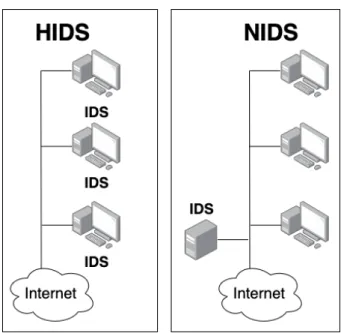
Intrusion detection systems can be categorised in different ways. One way of categorization is dividing them according to where they are deployed. Systems that are deployed on the host computer to directly monitor activity are called host based IDS(HIDS). Systems deployed on the network to monitor the traffic between multiple computers are called network based IDS (NIDS). The wide spread adoption of wireless internet connections has lead to the development of wireless IDS (WIDS) [15], which specifically monitors intrusion attempts over various wireless technologies and protocols, such as IEEE 802.11 b. These categories are also applied to the intrusion prevention systems, i.e. host based IPS (HIPS), network based IPS (NIPS), and wireless IPS (WIPS).
Examples of how network based systems and host based systems are deployed are shown in Figure 3. Host based systems are installed on each host machine and monitor the activity of that host. Network based systems, on the other hand, monitor a network of multiple machines. Network based systems are relatively easy to deploy and are independent of the platform of the host machine [14]. A single network based system can monitor the traffic of multiple host machines in a network. The effort to deploy network based intrusion detection systems decreases as the number of host machines in the monitored network increases.
Host based systems are capable of securing the host machines and have access to the clear text traffic as it is deciphered on the host machine [14]. This is not possible with network based system, as traffic over the network is usually encrypted. One of the drawbacks of host based systems is the additional strain on the host machine’s resources.
Figure 3. Example of the different deployment locations between HID and NID. Host based detection systems monitor each host in the network separately, while network based systems monitor the traffic between the network of connected computers and the internet.
Wireless intrusion detection systems focus on protecting wireless networks from intrusions. Wireless networks can be attacked in various ways, such as masquerading as another wireless access point or jamming the radio frequency [15]. To be able to detect these intrusion attempts, the detection system must be deployed in such a way that it can monitor wireless network activity. One example would be to deploy the system on a device with a wireless network sensor so that it can monitor wireless network traffic [15].
Intrusion detection and prevention systems can also be divided into different categories based on the method which they use to detect the intrusion. There are three categories: anomaly recognition, misuse recognition, and stateful protocol analysis [16]. Intrusion detection systems may also combine different detection methods to form hybrid methods.
Misuse recognition systems try to detect intrusions by trying to match traffic against signatures of known malicious activity [14]. Some examples of these signatures are patterns of malicious software or addresses of known malicious internet sites. Misuse recognition systems are also known as rule-based detection systems, signature detection systems, or pattern matching systems.
Systems based onanomaly recognition create a profile based on the normal traffic or system behaviour. These systems find out intrusions by first building a baseline of what is normal activity, and then analysing ongoing activity in order to find cases that differ from normal behaviour [16]. Aspects that may be monitored include the number of connections or traffic to new sites, processor usage, and whether a user has accessed files which they normally do not. The strength of anomaly recognition systems is that they can react to new, previously unknown threats. On the other hand, anomaly recognition systems have a higher rate of false alarms than other detection methods.
Stateful protocol analysis, also known as specification-based detection, tracks the state of protocols such as TCP. Intrusions are detected by monitoring for cases where the state differs from the specification. This can be a useful way to detect cases where a protocol is being exploited by using it in an unintended way, but the method is incapable of detecting attacks which do not differ from the normal use [16].
19
2. STATE OF THE ART
This section will look briefly into different intrusion detection and prevention systems, as well as the two threat intelligence sharing platforms, MISP and Arctic Node, which were used in the test. Five intrusion detection and prevention systems were considered as candidates for the target system for the generator. They were selected as candidates because all of them were open source and were considered to be of interest at Arctic Security.
After evaluating all options Suricata was chosen as the system to be integrated by the Arctic Security company. This is because Suricata is widely used, open source, and easier to work with than the other candidates. It is described on a more technical level than the rest of the intrusion detection and prevention systems to clarify the capabilities and structure of Suricata rules.
Arctic Node is also described on a more technical level in order to understand how Suricata can be integrated with the threat intelligence sharing platform. The section describing Arctic Node and Hub has been vetted by Arctic Security in order to make sure the level of detail in which the work is described is acceptable.
2.1. History of intrusion detection and prevention systems First intrusion detection systems were developed in the 1980s by the U.S. Air Force. The basis for the idea was a paper written in 1980 called Computer Security Threat Monitoring and Surveillance [17], which described how audit records could be used to identify computer misuse, and how statistical analysis could be used to detect anomalies in user activity.
This theory was put into practice by a research team led by Dr. Dorothy Denning, who developed a prototype intrusion detection system called the intrusion detection expert system (IDES). Dr. Denning published a paper on the real-time intrusion model [18] that described the system in more detail.
Intrusion detection systems continued to develop through the 1980s and 1990s. U.S. Air Force continued to develop different systems, and commercial systems such as the Net Stalker and Network Flight Recorder began to emerge in the 1990s [14]. The first few intrusion detection systems focused on analyzing audit records for signs of intrusions. Subsequent systems soon shifted into monitoring internet traffic as the internet grew more prominent. As the technology matured towards the late 1990s, the first intrusion prevention systems were created.
2.2. Open source intrusion detection and prevention systems Various commercial and open systems have been developed during the 30 year history of intrusion detection systems and the 20 year history of intrusion prevention systems. This section gives a brief review of the intrusion detection and prevention systems which were considered to be used in this thesis.
Zeekis an open-source intrusion detection system designed to monitor network traffic. Its development began in 1995 by Vern Paxson [19], and is nowadays
20
handled by a team of researchers at the International Computer Science Institute in Berkeley [20]. Zeek was developed with seven goals: high speed, no packet drops, real-time notification, mechanism separate from policy, extensibility, avoiding simple mistakes, and the assumption that the monitor will be attacked [19]. Zeek uses a versatile event-driven scripting language. Zeek is licensed under a BSD licence. It was previously known as Bro, but the name was changed to Zeek in 2018 [21].
Yarais a host based intrusion detection system which is designed to be used by malware researchers to identify malware samples. Yara uses a misuse recognition system as the detection method. It has its own rule language that can be used to write patterns, which are then searched for in the scanned files [22]. The rules consist of two logical parts, strings and conditions. Strings can be text, binary, or regular expressions, and the condition part dictates how they should be matched. For example, the string part could define three variables, $A, $B and $C, and if matching one of them was enough to determine the file a match, the condition part would read $A, $B or $C. The conditions can also refer to other rules, enabling the creation of complex rules. A third, non-logical part of the rule is called the meta, where it is possible to give additional information about the the rule, such as the author of said rule.
Sigma is a host based intrusion detection system for log files and security information and event management systems (SIEM). The first version of Sigma was released in 2017, and the full version is not yet finished. Like Yara, Sigma uses a misuse recognition system. The rule language used by Sigma has been developed to be generic for all log events. For example, it can be used to create rules for both Linux and Windows based system logs. The rule language is supposed to be supplemented by a Sigma Converter, which could be used to generate SIEM queries from the Sigma rules. As of 2019, this converter is still under development. [23] Despite being a relatively new addition to the field, Sigma has already caught some outside interest. For example, the MISP project has support for sharing Sigma rules.
Snortis an intrusion detection system created by Martin Roesch in 1998 [24]. Snort was developed as a free, lightweight alternative to the commercial intrusion detection systems of the day. Since then, Snort has grown in popularity, and is now in wide use. Snort can be used to monitor, log, and drop traffic based on rules. The language of these rules is complex, and offers a flexible tool to monitor network traffic in various ways.
In 2001, Martin Roesch founded the Sourcefire company to develop Snort for the commercial market [25]. Sourcefire was bought by Cisco Systems in 2013, and is currently being developed by the Cisco Talos Intelligence group. Snort is developed as a open-source project under the GLPv2 licence. Recently, the developers of Snort have begun to develop a new version of Snort from the ground up, called the Snort3 project [26]. It will boast new features such as multi-threading, better cross platform support, and automatic generation of reference documentation.
21
2.3. Suricata
Suricata is an intrusion detection and prevention system developed by Open Information Security Foundation (OISF) as a open-source project licensed under the GLPv2 license. Suricata has been in development since 2009 [27]. OISF is a non-profit organization funded by the US department of Homeland Security and various private companies in the OISF Consortium.
Suricata shares some similarities with Snort, as its rule system is an extended version of the one used by Snort. However, unlike Snort, Suricata has been developed from the beginning to support multiple threads. Over its development Suricata has managed to surpass Snort in both single-threaded and multi-threaded environments [28]. Suricata drops fewer packets than Snort in five out of six different test cases, with Snort outperforming Suricata only when testing the detection of fragmented package attacks. Suricata has higher utilization rates of system memory and CPU power than Snort. Both Snort and Suricata work better on Linux based machines than on Windows platforms.
Suricata splits the task of detecting alerts into four different thread-modules: • Packet acquisition,
• Decode and stream application layer, • Detection and
• Output.
The packet acquisition module reads packets from the network stream. The
decode and stream application layer module decodes the packets, constructs them into a stream, and reads the application layer data from the packet. The
detection module is responsible for running the detection logic and matching the packets to the rules given to Suricata. There are often multiple instances of the detection module running to speed up the handling of packets. Finally, the detection modules feed their results into the output module, which is responsible for writing the results on disk. Figure 4 shows one possible way to configure a Suricata instance. Three detection modules are running in parallel to speed up the processing of the live network traffic. When monitoring faster networks it is possible to add even more modules to keep up with the increased traffic.
Suricata comes with a rule download and management tool called Suricata-update. This tool can be given new sources from which to download Suricata rules. A new source can be added to Suricata-update by supplying the URL, possible HTTP headers, and user agent. Suricata-update has been written in Python.
2.3.1. Suricata rule system
The structure of the rule system used by Snort and Suricata consists out of the following parts:
22
Figure 4. Example of a possible Suricata thread-module configuration with three detection thread-modules. 1. action 2. protocol 3. source 4. source port 5. direction 6. destination 7. destination port 8. options
Actiondictates what to do when a match to the rule is found. Possible actions include pass, drop, reject, and alert. Passing means no action is performed when a match is found. Drop and reject actively block the package from getting through, and in addition generate an alert message. Alert lets the package pass through, but logs an alert for the system administrator to see.
Protocol dictates which types of packages are scanned by the rule. The possible values include, for example,tcp,udp,ip,dns,http,ftp, andssh. Protocols may also have their protocol-specific options, which can help to create better rules. Source and destination are used to configure the source and destination of traffic. Their values can include either IP addresses or ranges, along with variables. Some of the typical variables are $HOME_NET and
23
$EXTERNAL_NET. These variables can be configured in the Suricata configuration file for better accuracy. Multiple IP addresses can be grouped together, e.g. [1.2.3.4/16, 5.6.7.8].
Direction is used to configure the direction of traffic between the source and destination. The possible symbols are -> and <>. The former (->) is used to denote traffic from one end to the other, but not the other way around. The latter (<>) is used to denote traffic passing in any direction between the two ends.
Source portanddestination portare used to set monitoring for traffic from specific ports. More than one port can be monitored by using ranges ([80:90], [80:]), grouping ([80, 85, 90]), or negation (!80).
Optionsare listed at the end of the rule, enclosed by parentheses and separated by semicolons. Options can be either keywords, e.g. http_header, or key-value pairs ,e.g. content:"google". Some of the keywords are protocol specific, for example the http_header keyword can be used in rules where the protocol is http to guide the content search to the content of http header. Themsg keyword can be used to log additional information when the rule is triggered, e.g. msg:"this connection originated from a known malicious host". Rules also typically contain a signature ID, which can be used to identify each rule. This is usually added as the last or second-to-last option in a rule. The keyword of a signature ID is sid, which is the unique Suricata ID value of the rule.
For example, let us assume that the IP address 1.2.3.4 is known to be a C2 server, and we wish to block any access to it from our home network. The following rule could be crafted to achieve this:
• drop ip $HOME_NET any -> 1.2.3.4 any (msg:"Block access to a known C2 server"; sid: 1000000)
This rule would drop all packages originating from the home network to the IP address 1.2.3.4, as well as raise an alarm with the message "Block access to a known C2 server", which would alert the system administrator. Note that traffic flowing in the opposite direction, from 1.2.3.4 to the home network, is permitted by this rule.
2.4. Threat Intelligence Sharing Platforms
Cyber security professionals agree that threat intelligence sharing is beneficial for organizations [29]. It can help organizations to be more aware of their security breaches and help them to increase their resilience against cyber threats. Setting up the infrastructure required for threat intelligence sharing is expensive upfront but is generally seen to bring down the security costs in the long term. On the other hand, inconsistent terminology, varying quality of data, and redundancy are seen as the main problems of threat intelligence sharing. The lack of training on how to utilize threat intelligence is also seen as a problem in the field by cyber security professionals.
A study was conducted in 2016 [30] where a workshop of cyber security experts evaluated the at the time cutting edge of threat intelligence sharing platforms.
24
They identified and analyzed 22 different threat intelligence sharing platforms on the current market. These platforms were split into four types:
• sharing of threat intelligence, • sharing aggregated data,
• security information repository and • other.
The study had eight key findings. First of all, no common definition was found for threat intelligence sharing platforms. While some platforms focused on sharing threat intelligence between different organizations, others focused on collecting and sharing automated information from various threat intelligence feeds. The majority of platforms seemed to focus on collecting and sharing indicators of compromise, while analysis was given less importance. STIX was the de-facto standard used to describe threat intelligence. From the results of this study it appears only some of the challenges described by Brown [6] are answered by current threat intelligence sharing platforms.
The different threat intelligence sharing platforms answer different needs in the market. There is a need for sharing indicators of compromise and new rules for intrusion detection and prevention systems in the market, and the information is readily available in the Internet. This might explain why several threat intelligence sharing platforms focus mostly on sharing this type of low-level information rather than well analyzed threat intelligence. Such intelligence is simply more difficult to generate. In the strict sense, these sort of platforms are not sharing threat intelligence, yet they are identified as threat intelligence sharing platforms. From this it is evident that the termthreat intelligence sharing platform is being used in a rather loose sense by the community.
2.5. MISP
MISP (Malware Information Sharing Project) is an open source threat intelligence platform. It is used for storing, sharing, and working with indicators of compromise. Christophe Vandeplas started MISP (first called CyDefSIG - Cyber Defence Signatures, later changed to MISP) as his personal project back in 2011, and it soon came to be used by his employer, the Belgian Defence. In 2012, the project caught the attention of NATO, who hired more developers to help Vandeplas with MISP [31]. As of 2019, the MISP project is being funded by CIRCL, Computer Incident Response Center Luxembourg, and the EU [32].
MISP has support for 57 open feeds (full list in appendices) and provides rudimentary tools for integrating additional feeds which can be fetched with a simple HTTP request. MISP is capable of consuming feeds in either CSV or MISP format. Feeds that consist of plain text can be consumed by utilizing regular expressions. These custom feeds can be given headers, and they have support for basic access authentication. Events can be exported from MISP
25
in various different formats. These formats include Snort, Suricata, Bro, CSV, OpenIOC, JSON, MISP XML, STIX and plain text.
MISP has automatic correlation to detect overlapping data between different events. These events can be visualized with an event graph, which shows the relationships in graphical form. MISP also facilitates the collaborative sharing and analysis of threat intelligence. Intelligence can be shared via different channels such as emails or the MISP API, and different MISP instances can communicate with each other.
2.6. Arctic Hub and Node
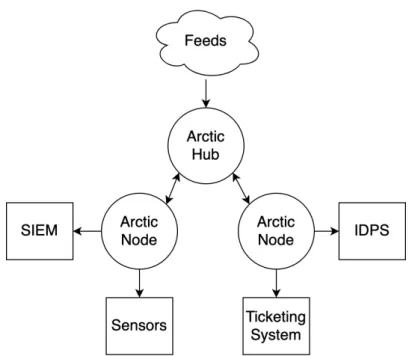
Arctic Hub is a commercial closed source threat intelligence sharing platform developed by Arctic Security. It was launched in 2018, and is based on the earlier AbuseSA product by the same company [33]. Hub is complemented by another product by Arctic Security, Arctic Node [34]. The products share parts of their code base and functionalities, and are intended to work together as a cyber defence cell [35]. These cells consist of organizations from the same interest group, including both threat intelligence providers and consumers. Each cell consists of multiple consumers centered around one threat intelligence producer. Each cell works together to share threat intelligence bidirectionally and strengthen their cyber defence. Cells can also form a larger network of multiple cyber defence cells.
Arctic Hub has been developed as a platform to be used by the cyber defence cell’s threat intelligence provider. It has the capability to collect threat intelligence from multiple sources, enrich it with new external data, analyze the results, and share it onwards. Arctic Node has been developed to serve as the main platform for the consumers in the cyber defence cell. With Node, they can receive threat intelligence from the central Hub and integrate the information into their attached cyber security solutions such as intrusion detection and prevention systems. Both Arctic Hub and Node are threat intelligence sharing platforms, but they do not share all the same responsibilities and capabilities. Using both platforms together in a cyber defence cell brings together all the different functionalities that are expected from threat intelligence sharing platforms. An example of a cyber defence cell formed out of one Arctic Hub and two Arctic Nodes is depicted in Figure 5.
2.6.1. Structure and Features
Arctic Hub and Node consist of two parts, backend and frontend. Both platforms work as a typical web service. They can be deployed on an on-premise or cloud server that meets the hardware requirements. A deployed system can be accessed via a graphical user interface (GUI) on a web browser. The frontend provides the GUI and has the capability of visually depicting the stored data in various different ways. It is also used to configure the system. The backend manages
26
Figure 5. A cyber defence cell which consists out of a single Hub and two Nodes. The Hub fetches new threat intelligence from various feeds, which it shares with the two Nodes. The Nodes move the threat intelligence over to the various security systems, as well as give feedback back to the Hub.
the rest of the systems running on the server. The main parts, i.e. modules, of backend are: • configurations, • authentication, • feeds, • labeling, • storage, • sharing, • analytics and • integrations.
The frontend interacts mainly with the backend via configurations, authentication and storage. Configurations stores the configurations of other parts of the backend, such as feed and integrations configurations. Configurations can be changed via the graphical user interface. The frontend also interacts with the Authentication module, as it authenticates all connections which originate from the outside.
Feeds handles the different feed integrations of Arctic Hub and Node. They both have support for over a hundred different public, restricted, and commercial
27
feeds [33]. These feed integrations are actively maintained to keep up with possible changes to the data or delivery methods. Data gathered from various feeds is harmonized according to data harmonization ontology, which has been developed in collaboration between CERT-EU, CERT-AT, CERT-FI, CERT.PT and Arctic Security [36]. The goal of data harmonization is consistency across all sources. The data harmonization ontology allows using keywords outside of the core language. It does not define the limited set of keywords allowed to be used in harmonization.
Information gathered from the various feeds is enriched with additional data such as the geographical location of the IP address and DNS records of the domain. Events are also given additional metadata such as information that helps to track the source, when the event was created, and a human readable description. Finally, the events can be enriched with user specified information. Users of Arctic Hub and Node can use thelabelingto add additional data to the events if the event matches a filter written by the user. Once events have been fetched, parsed, harmonized, augmented (the term for enrichment used by Arctic Security), and labeled, they are saved tostorage, which is a MongoDB database. Other parts of the system can then retrieve the events from this database. Events are fetched from storage using Arctic Node rule language. The rule language can be used, for example, to fetch events from the same country.
The following public feeds and feeders are supported by Arctic Hub and Node: • Abuse.ch,
• Bambenek Consulting feeds, • Brute Force Blocker,
• Malware Domain List, • VxVault,
• Zone-h and • Phishtank.
The rest of the feeds supported by Arctic Hub and Node are either commercial or restricted to certain customers. These feeds are not listed here.
As the central point of a cyber defence cell, Arctic Hub is intended to be used by organizations which monitor the cyber security of their stakeholders. One of the main features of Arctic Hub is improving the situational awareness by automatically mapping indicators of compromise against the assets of the stakeholders. The Hub user can add the different IP ranges and domains used by their stakeholders to the Hub. When Arctic Hub receives new events with IP addresses of domain names belonging to the stakeholder, it can automatically notify them via email, API, or Arctic Node if they are using it. This way stakeholders receive actionable threat intelligence which is relevant to their usage, i.e. indicators of compromise which are directly related to their assets. The mapping of assets is done by labeling, and sharing takes care of delivering the information to the customers.
28
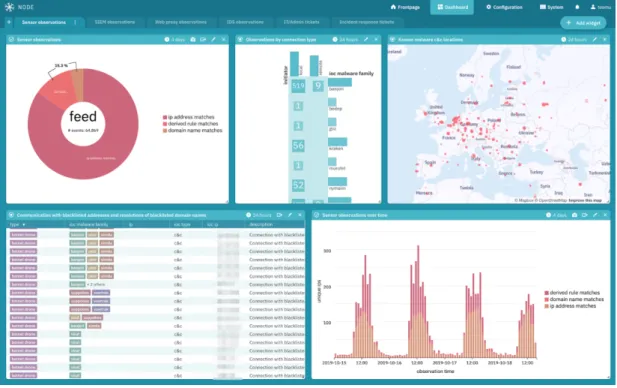
Analytics calculates various different metrics from the stored data, such as how many events have been recorded per day. Users can define filters for what events should be included in the analysis. For example, users may wish to show events from certain countries or only C2 infrastructure. These metrics can be visualized in various forms such as lists or bar charts. Metrics can be grouped together on one page to form a dashboard. An example of the dashboard view on Arctic Node can be seen in Figure 6.
Figure 6. Arctic Node dashboard. IP addresses have been blurred due to privacy reasons.
Figure 7. Arctic Node’s integration module works as the interface between Node and different cyber security solutions. Information can flow both ways, with the module working as the translator between different data forms.
Arctic Node can be integrated with various cyber security solutions. These solutions include intrusion detection and prevention systems, SIEMs, ticketing systems and network sensors. These integrations are handled by theintegrations module. Integrations are configured through the Arctic Node GUI. Arctic Node
29
can communicate with integrated systems over the internet in both directions, either by automatically sending new information to the integrated system, or fetching information from the integrated system. The exact details can differ between integrations. Figure 7 depicts how the integration module acts as the interface between Arctic Node and different cyber security solutions. The integration module turns the events stored in the database into a form that is suitable for the cyber security solutions and vice versa. Each Arctic Node integration runs as a separate process. This means that one Arctic Node instance can have multiple copies of the same integration running at the same time.
30
3. METHODOLOGY
A key functionality of threat intelligence sharing platforms is their integration with other existing cyber threat security applications. This allows threat intelligence to be automatically consumed by various means without the need for human interaction.
In this project, a new integration between the Arctic Node threat intelligence sharing platform and the Suricata intrusion detection and prevention system was created. This integration is called the Suricata rule generator. The goals of this integration were to turn threat intelligence stored in Arctic Node into Suricata rules and to serve them in such a way that they can be downloaded automatically by Suricata. It should also be possible to control which feeds are turned into Suricata rules, and the size of the generated rule set should be kept small enough for Suricata to handle.
As different feeds collect threat intelligence individually, their findings might contain overlapping data. This overlap might be useful for a researcher to notice relatively active pieces of criminal infrastructure, but with automatic generation of intrusion detection or prevention rules, this might lead to multiple copies of the same rule. These redundant rules take up space and computational power, as the system has to check the same rule multiple times during runtime. The Suricata rule generator was developed with this issue in mind, and will not produce redundant copies of rules.
The performance of the submodule is measured by testing it against a similar feature in MISP. Both MISP and the submodule are run through a similar test setup, after which their results are compared. First, both a MISP instance and a Hub instance are used to fetch same feeds. This threat intelligence is exported from both of the instances as Suricata rules. These Suricata rule sets are tested in a test setup with two virtual machines, one of which runs an instance of Suricata. The other machine is used to create internet traffic between these two machines that the Suricata instance monitors. This setup is used to measure the performance of the different rule sets.
3.1. Suricata rule generation
Any traffic or contact attempt between the host machine and the C2 server can be deemed as malicious, and should raise an alert. They might be a sign that the host machine has been compromised, or that the user of that machine has accessed a malicious site. The events collected by Arctic Security Node have three network indicators which can be used to determine network traffic: IP address, URL, and domain name. These indicators are used by the Suricata rule generator to create the Suricata rules.
All Suricata rules have to be numbered with a sid, Suricata identity number. The number range starts from 1, with the range from 1000000 to 1999999 reserved for custom sids. Other sid ranges before the custom sid range have been reserved for different vendors and threat intelligence feeds. The rule generator starts the numbering of rules from sid 1000000. This means that two sets of rules created
31
by the module start from the same number. To avoid errors with identical sids, new rulesets should be used to replace the old ruleset rather than using them simultaneously.
The rule generator can be given a list of threat intelligence feeds it uses to download events and turn them into Suricata rules. The Suricata rule generator removes any duplicate indicators of compromise it sees in the input data. Only unique URLs, domains, and IP addresses are used to generate rules. This saves space and memory, as there are no redundant Suricata rules in the output.
The Suricata rule generator can be integrated with Suricata by supplying the URL of the web API to the Suricata-update tool. This way Suricata will automatically download the new rules from Arctic Node. The rules are served as a simple text file, with one rule per line.
3.1.1. The structure of the generator
The Suricata rule generator is a new integration added to the integration module of Arctic Node. The generator consists of two parts: a worker thread which generates the Suricata rule list, and an API which serves the rule list. The worker thread creates the rules periodically, and saves them into a text file. The API reads and returns this file whenever it is called with a GET request.
The reason for creating rules periodically was improving the performance and speed of the submodule. The alternative for the periodic generation of rules would be to create the rules on demand. This would lower the constant computational demand at the cost of increased time required to fetch the new rules, as the process of creating rules can take a few minutes. In addition, generating the rules on demand could open a possibility to abuse the submodule by requesting rule creation multiple times.
The time period between generating new rules was chosen as 15 minutes. This is because the feed module of Arctic Hub and Node fetches most feeds on an hourly basis, and due to the short lived nature of technical threat intelligence it should be utilized in a timely manner. The processing of new events can take varying lengths of time depending on the exact size and nature of the feed. The process may also be delayed due to network or other external errors. Therefore, it is not possibly to pinpoint a set time each hour when the new events are ready. As new events are coming in roughly on a hourly basis, it is sensible to utilize them within the hour. Creating rules from the most recent data several times an hour ensures that when the new events get processed, they are available for use as soon as possible. As a result, 15 minutes was chosen as the most efficient time period. This choice is not a final one, and the period can be adjusted to be longer or shorter.
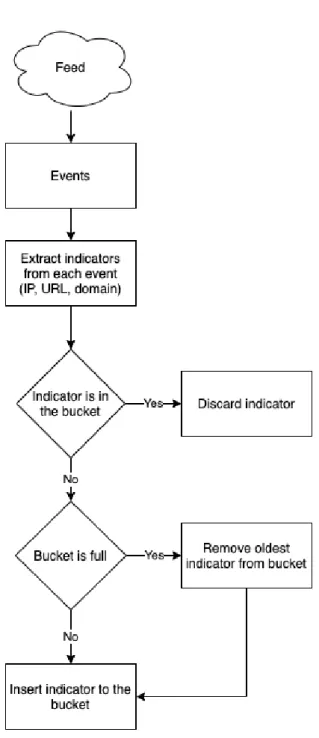
The rule generation consists of the following steps: 1. Fetch the events of a feed from Arctic Node. 2. Create a bucket for the events.
32
4. Repeat this process for each feed.
5. When all feeds are done, create a new master bucket.
6. Add all the indicators from the feed buckets to the master bucket. 7. Create Suricata rules from the indicators in the master bucket. 8. Write the Suricata rules into a file on the disk.
Figure 8. Steps 1-4 of rule generation. The submodule extracts indicators from each feed, and places them into feed specific buckets.
33
Figure 9. Steps 5-8 of rule generation. Buckets are combined into a master bucket, and the indicators are deduplicated. Finally, Suricata rules are generated and saved on disk.
A bucket is a set of unique values with a maximum size. They work on a first in, first out principle. This means that when a new value is added to a full bucket, the oldest value is discarded. The master bucket is set to have maximum size equal to the number of feeds times the maximum size of buckets. Therefore, it can hold all the values from the other buckets. The maximum size for buckets was chosen to be 100000, but the size is not final. If and when the Suricata generator is tested and used more extensively, the bucket size can be adjusted as needed.
The reason for using buckets with limited size is the fact that feeds constantly produce new events, and Arctic Node stores vast amounts of threat intelligence. There has be a limiting factor for how many events are being used to create the rules. Otherwise, the rule generator would create more rules than Suricata can handle. One possible solution would be to limit the events to a specific time range, but even that would not be enough to ensure that the number of events