∼Justin Khoo∼ Forthcoming,Synthese
Abstract
Disjunctive antecedent conditionals (DACs)—conditionals of the formif A or B, C—sometimes seem to entail both of their simplifications (if A, C;if B, C) and sometimes seem not to. I argue that this behavior reveals a genuine am-biguity in DACs. Along the way, I discuss a new observation about the role of focal stress in distinguishing the two interpretations of DACs. I propose a new theory, according to which the surface form of a DAC underdetermines its logical form: on one possible logical form,if A or B, Cdoes entail both of its simplifications, while on the other, it does not.
An outstanding issue in the logic of conditionals concerns the status of the principle of simplification of disjunctive antecedents:
simplification of disjunctive antecedents (SDA): if A or B, Centailsif A, Candif B, C.
The controversy over SDA stems from the fact that there is evidence both for its validity and for its non-validity. On the one hand, assertions of simple disjunctive antecedent conditionals (DACs) suggest that SDA is valid:
(1) If Amy or Beth comes to the party, it will be fun. a. If Amy comes to the party, it will be fun. b. If Beth comes to the party, it will be fun.
There is a strong intuition that(1)entails both(1-a)and(1-b). Someone endorsing(1) seems to commit themselves to endorsing both(1-a)and(1-b). For instance, compare A’s two responses to B in the following dialogue:
A: If Amy or Beth comes to the party, it will be fun.
B: I disagree. If Beth comes, it will be horrible – Beth always ruins parties. A: Oh I did not know that. I guess I was wrong! / #Oh I did not know that.
It is natural for someone who has assertively uttered (1)to retract her claim after accepting that one of its simplifications is false. By contrast, would be very odd for that person to stand by her claim in such circumstances. This is evidence that(1) entails both(1-a)and(1-b), and thus evidence that SDA is valid.
On the other hand, assertions of specificational DACs like(2)(which state which of their antecedent disjuncts will obtain) seem to suggest that SDA is not valid: (2) If the US spends more than half its budget on defense or education, it will
spend more than half its budget on defense.
a. If the US spends more than half its budget on defense, it will spend more than half its budget on defense.
b. If the US spends more than half its budget on education, it will spend more than half its budget on defense.
In contrast with(1),(2)seems not to entail both of its simplifications—in particular, it seems not to entail the obviously false(2-b), since the falsity of(2-b)does not seem sufficient for the falsity of (2). Put differently, someone may endorse (2) without thereby being committed to(2-b).
How should we reconcile these conflicting considerations? One strategy is to hold that SDA is valid, and then account for the apparent counterexamples by appeal-ing to pragmatic shifts in context (this strategy is endorsed byFine 2012a,b,Willer 2015). Alternatively, we might hold that SDA is invalid, and try to account for the evidence supporting it by appealing to implicatures (see Bennett 2003, Klinedinst 2007,van Rooij 2010,Franke 2011). Or, we might hold that DACs are genuinely am-biguous between an SDA-valid interpretation and an SDA-invalid interpretation (see Alonso-Ovalle 2009,Santorio forthcoming).
Given the possibility of a univocal theory, it may seem that positing an ambiguity in DACs should be our last resort. However, in this paper, I argue that there are actually reasons to favor an ambiguity theory of DACs. In particular, I propose a theory of DACs on which their surface forms underdetermine their logical forms:if A or B, Ccan have as its logical form either of the following:1
1A brief note about my choice of notation for what follows. I useitalicsto denote expressions of English (if,or, etc) and uppercase italic letters for variables over sentences (A, B, C, . . . ). I usesans
serifto denote the logical forms of English expressions (if,or, etc) and uppercase sans serif letters
for variables over the logical forms of English sentences (A, B, C, . . . ). Finally, I use uppercase
boldfaceletters to denote the propositional contents of the corresponding sentences (A, B, C, . . . ) at
the relevant contexts. I also assume that propositions are just sets of possible worlds. Combinations of particular expressions and variables are to be read as having invisible corner quotes: these are sentence schemas whose instances are particular sentences of English, replacing the sentence variables with English sentences. So,if A, Cis a sentence schema whose instances include:
▸ [ [ if A or B ] C ]
▸ [ [ if A or if B ] C ]
Thus, SDA can be divided into two distinct logical principles, one for each of these logical forms:
(SDA1):
[ [ if A or B ] C ]entails[ [ if A ] C ]and[ [ if B ] C ]. (SDA2):
[ [ if A or if B ] C ]entails[ [ if A ] C ]and[ [ if B ] C ]. My claim is then that (SDA1) is invalid and (SDA2) is valid.2
The paper is structured as follows. In §1, I provide new independent evidence that DACs are ambiguous between a strong interpretation (that entails both simpli-fications), and a weak interpretation (that only entails the disjunction of their sim-plifications). Then, in §2, I discuss a new observation that focal stress can be used to disambiguate DACs. I relate this observation to an observation of Will Starr’s (Starr 2014) about DACs coordinating twoif-clauses—sentences like:
(3) If John draws a gold coin or if John draws a silver coin, he will win. (i) a. If John comes to the party, Sue will come to the party.
b. If Amy or Beth comes to the party, it will be fun.
I will generally be loose regarding the instances of the scope of disjunction when talking about DACs. So among the instances ofif A or B, Cwill include:
(ii) If Amy comes to the party or Beth comes to the party, it will be fun. as well as
(iii) If Amy or Beth comes to the party, it will be fun.
Finally, I will be restricting attention to indicative conditionals throughout. Historically, the discus-sion of disjunctive antecedents has focused on subjunctive conditionals. However, to simplify the dis-cussion and to sidestep some complications arising from the probabilities of subjunctive conditionals, I will focus on indicative conditionals. Since indicative and subjunctive DACs behave analogously, the reader is welcome to import my conclusions to the subjunctive domain.
2Strictly speaking, my theory predicts that SDA is invalid, since it quantifies over every instance of the sentence schemaif A or B, C(in every context) and my theory predicts that some instances of that schema will, in some contexts, be an instance of (SDA1). But I think it is helpful to think about the upshot of my theory in terms of the bifurcated SDA-principles.
I connect these two data points by proposing a new hypothesis about focal stress (The Focus Hypothesis). In §3, I state my theory of DACs and show how it predicts the data discussed in §1-2. Finally, I conclude in §4with remarks on future research.
1 New data for DACs
Existing theories of DACs can be classified broadly into three kinds: Univocal Strong
if A or B, Centails bothif A, Candif B, C.
. (Fine 2012a,b,Willer 2015,Forthcoming)
Univocal Weak
if A or B, Cdoes not entail bothif A, Candif B, C.
. (Loewer 1976,Bennett 2003,Klinedinst 2007,van Rooij 2010,Franke 2011) Ambiguity
if A or B, Cis ambiguous between two readings:
(i) Strong:if A or B, Centails bothif A, Candif B, C..
(ii) Weak:if A or B, Cdoes not entail bothif A, Candif B, C..
. (van Rooij 2005,Alonso-Ovalle 2009,Santorio forthcoming) Versions of all three kinds of theories are positioned to account for the observations about DACs discussed in the introduction, despite reaching different conclusions about the status of SDA. Start with Univocal Strong theories, which entail that SDA is valid. Such theories easily account for the observation that DACs like(1) seem to entail both of their simplifications.
(1) If Amy or Beth comes to the party, it will be fun.
We now turn to see how one particular Univocal Strong theory, due toFine 2012a,b, Willer 2015, accounts for the intuitions surrounding specificational DACs like (2). Roughly, according to this kind of theory, although(2)entails (2-b), this does not prevent(2)from being true as uttered in certain contexts.
(2) If the US spends more than half its budget on defense or education, it will spend more than half its budget on defense.
a. If the US spends more than half its budget on defense, it will spend more than half its budget on defense.
b. If the US spends more than half its budget on education, it will spend more than half its budget on defense.
The strategy holds that(2)is true as uttered in a context in which it is not epistemi-cally possible that the US will spend more than half its budget on education—indeed, asserting(2)is a way of indicating this. In that same context,(2-b)is predicted to be trivially true. But(2-b)is not assertable in a context in which it is not epistemically possible that the US will spend more than half its budget on education—therefore, uttering(2-b) tends to change the context by accommodation, which expands the space of epistemic possibilities to include ones in which the US spends more than half its budget on education. Then, in this new context,(2-b)is false. Thus, according to this strategy,(2)seems true and(2-b)seems false because they are most naturally evaluated in different contexts.
Next, turn to Univocal Weak theories, which, by contrast, easily account for the behavior of specificational DACs like(2), since they predict that SDA is invalid. However, to account for the behavior of DACs like(1), whichdoseem to entail both of their simplifications, Univocal Weak theorists typically offer a pragmatic story. I will focus on a theory inspired by ideas inBennett 2003, Klinedinst 2007. This theory begins with a variably strict theory of conditionals (?Lewis 1973). On such a theory,if A, Cis true iff all of the closestA-worlds areC-worlds. This kind of theory predicts that DACs do not entail both of their simplifications. Suppose that all of the closestA∪B-worlds areA-worlds, and all of these areC-worlds, so thatif A or B, C is predicted to be true. This may be the case even if none of the closestB-worlds are C-worlds, in which caseif B, Cis predicted to be false.
However, there is also an interpretation ofif A or B, C(given this semantics) on which it is true only if both of its simplifications are true. For any worldwat which there are bothA-worlds andB-worlds among the closestA∪B-worlds tow,if A or B, Cwill be true atwonly if bothif A, Candif B, Care true atw.3So, given the extra premise that the set of closestA∪B-worlds contains bothA- andB-worlds,if A or B, Cwill entail both of its simplifications (on this kind of semantics). This fact opens up space for the Univocal Weak theorist to account for the simplifying behavior of ordinary DACs. The idea is that for certain reasons we, by default, interpret the closeness relation underlying if A or B, C in such a way that it entails both of its
3
Here is the derivation. Supposewis such that (i) there are bothA-worlds andB-worlds among the closestA∪B-worlds tow, and (ii)if A or B, Cis true atw. From (i), it follows that the closest
A/B-worlds toware a subset of the closestA∪B-worlds tow. And from (ii) it follows that all of the closestA∪B-worlds towareC-worlds. But then all of the closestA-worlds towareC-worlds, in which caseif A, Cis true atw; and likewise all of the closestB-worlds towareC-worlds, in which caseif B, Cis true atw.
simplifications.4
Finally, Ambiguity theories can account for the behavior of both (1)and (2): these theories predict that DACs are ambiguous between an SDA-valid reading and an SDA-invalid reading. However, ambiguity theories face the threat of overgen-eration: they predict that(1)has an SDA-invalid reading and that(2) has an SDA-valid reading, contrary to how things seem. To avoid the threat of overgeneration, Alonso-Ovalle 2009 holds that DACs have their strong interpretation by default, and their weak interpretation arises only as a “last resort strategy to avoid interpret-ing examples like [specificational DACs, e.g,(2)] as contradictions” (Alonso-Ovalle 2009: 239). This predicts that the weak interpretation of a DAC is available only if its strong interpretation is necessarily false (given the relevant background assump-tions). Since(1)is not necessarily false, it is predicted to only have the strong reading. And since (assuming it is epistemically possible that the US will spend more than half of its budget on education)(2-b)is necessarily false, this means that(2)would also be necessarily false on the strong interpretation, so it is predicted to have only the weak interpretation.
Thus, existing versions of each kind of theory of DACs have strategies for han-dling the behavior of DACs like(1)and(2). To advance the dialectic, we will have to look at a broader range of data. In the rest of this section, I aim to do this by looking at data about the probabilities of DACs.5
1.1 Probabilities of DACs Start with the following case:
4
For some representatives of this strategy, seeBennett 2003,Klinedinst 2007,Franke 2011. 5An alternative avenue to pursue would be to look at different kinds of simplifying condition-als. The first are free-choice antecedent conditionals, which clearly only carry the strong, entailing, reading:
(i) If John draws any metal coin, he will win.
The second are negated conjunctive antecedent conditionals. By DeMorgan’s Law,A∨Bis equivalent to¬(¬A∧ ¬B). So, the antecedent of the following conditional is epistemically equivalent to the antecedent of(4):
(ii) If it is not the case that John both does not draw gold and does not draw silver, he will win. Unlike(4),(ii)is very difficult to evaluate, so it is hard to say whether it has a strong (simplifying) reading. Using more natural examples,Ciardelliet al. forthcomingfind that ordinary speaker in-tuitions suggest that conditionals like(ii)behave differently from DACs like(4). I set aside further discussion of these issues for future work.
Coins.There are 100 coins in an urn: 90 gold, 9 silver, and 1 plastic. The gold coins are all winners, while the silver and plastic coins are losers. Given this information, how probable is the following DAC?
(4) If John draws a gold coin or a silver coin, he will win.
It seems to me that there are two equally good answers to this question:
▸ Answer 1:(4)is highly probable.
▸ Answer 2:(4)is certainly false.
There are precedents for both of these answers in the conditionals literature. We have already seen the precedent forAnswer 2: non-specificational DACs seem to entail both of their simplifications, but since one of(4)’s simplifications,(5-b), is certainly false, we may thus conclude that(4)must be certainly false (since a sentence cannot be more probable than something it entails).
(5) a. If John draws a gold coin, he will win. b. If John draws a silver coin, he will win.
Indeed, additional evidence thatAnswer 2is a reasonable conclusion to draw about the probability of(4)is that it is natural to reason from the falsity of one of its sim-plifications to the falsity of(4):
(6) This much is certain: if John draws a silver coin, he will lose. So, we may conclude that it is certainly false that if John draws a gold coin or a silver coin, he will win.
A precedent forAnswer 1comes from The Thesis:6 The Thesis
The probability ofif A, Cis equal to the probability ofCgivenA.
Suppose I roll a fair die and ask you how probable it is that if the die landed on a prime, it landed on an odd; it seems that the correct answer is two-thirds. But this
6
An early incarnation of The Thesis appeared inRamsey 1931, but the modern version of the claim is due toStalnaker 1970. There is a great deal of empirical support for The Thesis (see for instanceDouven & Verbrugge 2013), and most theorists think that some version of The Thesis is correct (perhaps a restricted version, or one about assertability or degrees of belief): seeAdams 1975,
just is the conditional probability that the die landed on an odd, given that it landed on a prime. Examples like this provide evidence supporting The Thesis. Given The Thesis, we predict that the probability of(4)should equal the probability that John will win, given that he draws a gold or silver coin. And this probability is high; in fact, it is approximately equal to .91.7
Is it plausible that The Thesis should apply to DACs like(4)? I think it is. The following reasoning about(4), which is an informal version of the calculation of(4)’s probability given The Thesis, seems quite natural:
(7) If John draws gold or silver, he will very probably draw gold; then, since all the gold coins are winners, he will win. So, we may conclude that it is likely that if John draws a gold coin or a silver coin, he will win.
So, we have some reason to think that there are two, equally reasonable but incom-patible, answers to the question how probable(4)is. If this is right, this is evidence that(4)has two distinct interpretations: a weak interpretation on which it is highly probable and a strong interpretation on which is certainly false. To explore whether these judgments are shared by native speakers of English, I conducted an experiment. 1.1.1 Experiment 1: Probabilities
Participants for this experiment were recruited through Amazon Mechanical Turk.8 Each participant was presented with a second person version of theCoinsscenario, and then was told to keep in mind one of the following primes:
Weak: Since there are mostly gold coins, if you draw one of the gold or silver coins, you will very likely draw a gold coin, and hence win.
Strong: If you draw a gold, you will win; if you draw a silver coin, you will lose.
7Here is the calculation: P(W∣G∪S)
= P(W∣G) ⋅P(G∣G∪S) +P(W∣S) ⋅P(S∣G∪S) = 1⋅9099+0⋅999
≈ .91 8
119 participants were recruited using Amazon’s Mechanical Turk. Sample was 61 percent male, mean age 36. Only answers from participants who self-reported as native speakers of English were used. Raw data files for this experiment and the others discussed below can be found at
The primes are a way of recreating the kind of reasoning discussed above, in sup-port ofAnswer 1/Answer 2respectively. After reading their prime, participants were asked whether they agreed or disagreed with one of following statements, answering on a scale from 1 (“Completely Disagree”) to 7 (“Completely Agree”):
(D1) It is likely that: if you draw a gold coin or silver coin, you will win. (I1) It is likely that: if you draw a metal coin, you will win.
(D1) and (I1) constitute a reasonable minimal pair—one is a DAC and one isn’t, but given the background information, their antecedents are equivalent: to draw a gold or silver coin just is to draw a metal coin (the fact that gold and silver are metals and plastic is not a metal was stated explicitly in the prompt). Therefore, if we find that participants agree more with (D1) inStrong than inWeak, but we don’t find this pattern with (I1), this would be evidence that ordinary English speakers do find bothAnswer 1andAnswer 2plausible judgments about probability of(4), and hence evidence that DACs have both a strong and weak interpretation.
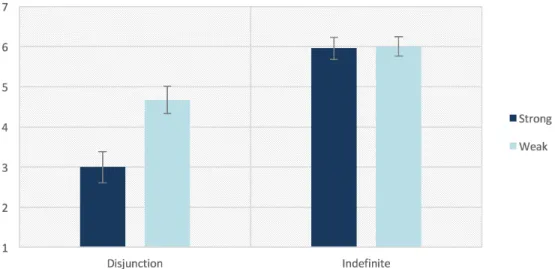
The results of the experiment are shown in the following graph:
Figure 1: Mean responses for Experiment 2. Error bars show standard error of the mean. We can see from the graph that the results of the experiment do show what we expect if there really are two compelling answers to the question of how probable DACs like (4)are. The crucial result is that, while the difference in mean agreement with (D1) is significant between theStrongandWeakconditions,9there is no difference in mean
9
agreement with (I1) between theStrongandWeakconditions.10 This suggests that there really are two interpretations of (D1): one on which it is likely true and one on which it is not likely true.11
1.1.2 Discussion
We have seen both armchair reasoning and experimental evidence in support of the conclusion that both Answer 1 and Answer 2 are plausible answers to the ques-tion how probable(4)is, given the information inCoins. Thus, we now have two sources of evidence supporting the observation that DACs like(4)have two distinct interpretations—a strong interpretation on which they entail both of their simplifi-cations and a weak interpretation on which they entail only the disjunction of their simplifications. How does this observation bear on the three kinds of theories dis-cussed above?
Start with Univocal Strong theories. Such theories predict thatAnswer 2 is correct andAnswer 1is incorrect: they predict that(4)is certainly false because it entails something (that if John draws a silver coin, he will win) that is certainly false. Thus, such theories must find some way to explain why Answer 1 seems appeal-ing, even though it is incorrect. As with specificational DACs like(2), a Univocal Strong theorist might appeal to context shifting here to explain why we are some-times led to think that(4)is more likely than its simplification(5-b).
However, unlike with specificational DACs, it seems that context-shifting will not help the Univocal Strong theory explain the appeal ofAnswer 1. With spec-ificational DACs, there is a reasonable motivation for context-shifting. Recall that, on that strategy, the univocal strong theory predicts that(2)is true because the US spending more than half its budget on education is not an epistemic possibility in that context—in effect, that is what the conditional says according to this theory. As such, the theory still predicts that(2-b)is true—just trivially so. However, when we (M=3.00,S D=2.2) with agreement that (D1) is likely in theWeakcondition (M=4.67,S D=1.9), t(59) =3.2,p<.01,d=.836.
10
A planned comparison was used to compare agreement that (I1) is likely in theStrongcondition (M=5.96,S D=1.5) with agreement that (I1) is likely in theWeakcondition (M =6.00,S D=1.3), t(56) = −0.1,p=.92.
11Speakers do show more resistance to the weak reading of DACs than indefinite antecedent con-ditionals: in theWeakcondition, the mean agreement with (D1) (M=4.67,S D=1.9) is significantly lower than mean agreement with (I1) (M=6.00,S D=1.3),t(58) =3.2,p<.05. However, we expect this result, given that we expect that our attempts to contextually prime the weak reading will not lead every participant to interpret (D1) in that way. As such, we expect that some participants will access the strong interpretation of (D1) even in the context where we tried to prime its weak interpre-tation (Weak); those participants should then judge (D1) to be false, even in theWeakcondition. By contrast, we expect nothing similar from (I1), since it has only one interpretation, on which it is true.
come to assert(2-b), we expand the domain of possibilities in the context to include some where the US spends more than half of its budget on education. Then,(2-b) will be false, as evaluated in this new context. However, this strategy will not pre-dict that the truth of (4)is more likely than the truth of (5-b). The reason is that the context in which we evaluate(4)is already one in which it is epistemically pos-sible that John will draw a silver coin—(4)is judged to be probable despite it being possible that John might draw silver (if there were no silver possibilities,(4)would have probability 1 on its weak reading, but that is clearly incorrect). So, no context shift should occur when we move from evaluating(4)to(5-b). Therefore, it is un-clear how the same context-shifting strategy invoked byFine 2012a,b,Willer 2015to handle specificational DACs will help the univocal strong theory make sense of the observation that(4)seems to have a weak interpretation on which it is probable.
This is by itself not a knockdown objection to every Univocal Strong theory. It remains to be seen whether an alternative strategy might be able to help such a theory account for the observation about the probability of DACs. But the foregoing discussion does cast doubt on the future success of such theories.
Turn next to Univocal Weak theories. Since they predict thatif A or B, Cdoes not entail both of its simplifications, such theories are in a position to predict that Answer 1is correct. But how, then, do they account for the intuitions underlying An-swer 2? It turns out that the strategy used to account for specificational DACs can also predict these conflicting intuitions about the probabilities of DACs. Given the Lewisian Univocal Weak semantics from above, we can distinguish between an-tecedent underspecification and anan-tecedent indeterminacy.If A or B, Cis antecedent underspecified atw just if either all of the closestA∪B-worlds tow areA-worlds or all of the closest A∪B-worlds to w areB-worlds. By contrast, if A or B, C is antecedent indeterminate at w just if the closest A∪B-worlds tow contain some A-worlds and someB-worlds.
How can we appeal to this difference in interpretation of the closeness relation to account for the intuitions underlying bothAnswer 1andAnswer 2? Suppose first thatif A or B, Cis antecedent underspecified at each epistemically possible world and that the probability that all of the closestA∪B-worlds areA-worlds just is the prob-ability ofAgivenA∪B(and likewise for the probability that all the closestA∪B -worlds areB-worlds). Then, this theory will predict that the probability of(4)is .91.12
12Here is the calculation: (i) P(if G or S, W)
= P(if G or S, W∣if G or S, G)⋅P(if G or S, G) +P(if G or S, W∣if G or S, S)⋅P(if G or
S, S)
Next, suppose instead thatif A or B, Cis antecedent indeterminate at each epistem-ically possible world. Then,if A or B, Cwill be true at any such world only if both if A, Candif B, Care both true at that world. Thus, ifif A or B, Cis antecedent in-determinate at each epistemically possible world, then the theory predicts that the probability of(4)is 0.13 Thus, a Univocal Weak theory is in a position to account for the intuitions underlying both Answer 1and Answer 2. To be clear, the the-ory achieves this result without positing ambiguity: rather, the thethe-ory does so by appealing to underdetermination of a context-dependent parameter—the closeness relation governing conditionals.
Finally, turn to Ambiguity theories. Such theories predict that there is an in-terpretation ofif A or B, C—its weak interpretation—whose probability may exceed the probability of one of its simplifications. So, it is open to the Ambiguity theory to account for the intuitions underlyingAnswer 1in exactly the way the Univocal Weak theory does above: on one interpretation of(4), its probability just is .91. But Ambiguity theories account for the intuitions underlyingAnswer 2differently, by appealing to the strong interpretation ofif A or B, C. On its strong interpretation, the probability of(4)is 0, because on that interpretation(4) entails(5-b), and the probability of(5-b)is 0.
Let us recap what has been covered so far. By looking at the probability of(4), rather than judgments about its truth value, we found evidence that DACs have both weak and strong interpretations. We also saw that the intuitions supporting this ob-servation are hard to account for given Univocal Strong. Finally, we saw how both a Univocal Weak theory and an Ambiguity theory can predict this observation. Therefore, we will have to look to other data to distinguish Univocal Weak theories from Ambiguity theories.
1.2 Probabilified DACs
In the previous section, we looked at intuitions about the probabilities of DACs. In this section, we will look at intuitions aboutprobabilified DACs. These are instances of the schemaif A or B, probably C, such as:
(8) If John draws a gold coin or a silver coin, he will probably win. = 1⋅9099+0⋅999
≈ .91
13Notice that this assumption is incompatible with strong centering: the principle that states that ifAis true atw, then the closestA-world toware just{w}. Thus, someone adopting this kind of strategy to defend a Univocal Weak theory must deny strong centering.
Before we get to the predictions, it will be helpful to make two independently mo-tivated assumptions about probabilified conditionals. The first assumption is about the semantics ofprobably(cf.Yalcin 2010):
(9) Probably Ais true iff the probability ofAis greater than 0.5.
The second assumption is about probabilified conditionals: it is that the if-clause of a probabilified conditional updates the domain of the probability operator in its scope (cf. Kratzer 1986, 2012,Yalcin 2010), yielding the following truth conditions for probabilified conditionals without disjunctive antecedents:
(10) If A, probably Cis true iff the probability ofCgivenAis greater than 0.5. These two assumptions are motivated by reflection on the behavior of probabilified conditionals. Consider, for instance, the following case fromKratzer 1986:
Yog and Zog played 100 games of chess last night. There were no draws. Yog had white for 90 of the games. Yog won 80 of the 90 games he played as white. But Yog lost 10 of the 10 games he had as black.
Focus on the last game Yog and Zog played, and consider the following two proba-bilified conditionals, both about this game:
(11) If Yog was playing white, he probably won. (12) If Yog lost, he was probably playing black.
Intuitively,(11)is true while(12)is false. Why? A plausible explanation appeals to our two assumptions above. (11)is true because the probability that Yog won given that he was playing white is greater than 0.5—indeed, this conditional probability value is around .89. And(12)seems false because the probability that Yog was playing black given that he lost is not greater than 0.5—in fact, this conditional probability value is equal to 0.5. Thus, given those assumptions, we account for the intuition that(11) is true and(12)is false; as such, these intuitions are evidence for those assumptions. With our two assumptions in hand, we turn next to consider probabilified DACs like(8). In particular, notice that the Univocal Weak theory discussed in the pre-vious section predicts that such probabilified DACs should only have one interpre-tation:
Probabilified Weak:if A or B, probably Cis true iff the probability ofCgiven A∪Bis greater than 0.5.
By contrast, an Ambiguity theory predicts that probabilified DACs are ambiguous between a probabilified weak interpretation and a probabilified strong interpreta-tion:
Probabilified Strong:if A or B, probably Cis true iffif A, probably Candif B, probably Care both true (i.e., iff the probability ofCgivenAis greater than 0.5 and the probability ofCgivenBis greater than 0.5).
But wait, shouldn’t also Univocal Weak theories predict that probabilified DACs can be interpreted in a way equivalent to the probabilified strong interpretation? Above, we showed how the semantically encoded weak truth conditions were some-times strengthened—in particular, whenif A or B, Cis antecedent indeterminate at w, it is true atw only if bothif A, Candif B, Care true atw. Does the same move yield similar results for probabilified DACs? It turns out, it does not.14
To see why, suppose the following:
▸ The probability ofCgivenA∪Bis greater than 0.5,
▸ The probability ofAgivenA∪Bis nonzero, and
▸ The probability ofBgivenA∪Bis nonzero.
The first supposition ensuresif A or B, probably Cis true on its probabilified weak interpretation, while the second and third ensure that the conditional is antecedent indeterminate—that there are someA-worlds and someB-worlds among the closest A∪B-worlds. Recall that it was the assumption that the conditional was antecedent indeterminate that allowed us to predict the strong (simplification-entailing) inter-pretation of a non-probabilified DAC within our Lewisian Univocal Weak theory. However, even given these suppositions, it may be thatif B, probably Cis false, be-cause it may still be the case that the probability ofCgivenBis less than 0.5. This is because it is possible that the probability ofCgivenA∪Bis high because the prob-ability ofCgivenAis high, and because the probability ofAgivenA∪Bis high.15
14A similar point is observed inAlonso-Ovalle 2009,Santorio forthcoming.
15Coinsis a situation with these properties. Here, we haveG/S= that John draws gold / that John draws silver andW= that John wins.
▸ P(G∣G∪S) =.91 ▸ P(S∣G∪S) =.09 ▸ P(W
¯∣G) =1 ▸ P(W∣S) =0.
Therefore,if A or B, probably Cbeing antecedent indeterminate at each epistemically possible world is not sufficient to predict the probabilified strong reading of proba-bilified DACs on a Lewisian Univocal Weak semantics. Thus, probaproba-bilified con-ditionals provide a point at which the predictions of our Lewisian Univocal Weak theory diverge from those of Ambiguity theories. It remains to be seen, though, what kinds of readings probabilified DACs really do have. To explore this issue, I conducted an experiment modeled along the same lines as Experiment 1 above. 1.2.1 Experiment 2: Probabilified DACs
Participants for this experiment were recruited through Amazon Mechanical Turk.16 As with Experiment 1, each participant was presented with a second personal version of theCoinsscenario, and then was told to keep in mind one of the following primes: Weak: Since there are mostly gold coins, if you draw one of the gold or silver coins, you will very likely draw a gold coin, and hence win.
Strong: If you draw a gold, you will win; if you draw a silver coin, you will lose.
Then, participants were again divided into two groups. Those in the DAC group were asked whether they agreed or disagree with the following probabilified DAC, as before answering on a scale from 1 (“Completely Disagree”) to 4 (“In Between”) to 7 (“Completely Agree”):
(D2) If you draw a gold coin or silver coin, you will likely win.
Those in the Indefinite group were asked whether they agreed or disagreed with the following probabilified non-DAC:
(I2) If you draw a metal coin, you will likely win.
Given the information presented, on the probabilified weak interpretation, (D2) is true (since it is likely that you will win given that you draw one of the gold or sil-ver coins), while on the probabilified strong interpretation, (D2) is false (since it is not likely that you will win given that you draw a silver coin). Thus, if we find that
▸ ThenP(W∣G∪S) =P(W∣G) ´¹¹¹¹¹¹¹¹¹¹¹¹¸¹¹¹¹¹¹¹¹¹¹¹¹¶ 1 ⋅P(G∣G∪S) ´¹¹¹¹¹¹¹¹¹¹¹¹¹¹¹¹¹¹¹¹¹¹¹¹¸¹¹¹¹¹¹¹¹¹¹¹¹¹¹¹¹¹¹¹¹¹¹¹¶ 0.91 +P(W∣S) ´¹¹¹¹¹¹¹¹¹¹¸¹¹¹¹¹¹¹¹¹¹¶ 0 ⋅P(S∣G∪S) ´¹¹¹¹¹¹¹¹¹¹¹¹¹¹¹¹¹¹¹¹¹¹¸¹¹¹¹¹¹¹¹¹¹¹¹¹¹¹¹¹¹¹¹¹¶ 0.09 =.91+0=.91
16137 participants were recruited using Amazon’s Mechanical Turk. Sample was 57 percent male, mean age 34. Only responses from participants who self-reported as native speakers of English were used.
participants agreed more with (D2) inStrong than inWeak, but do not find this pattern for (I2), this would be evidence that probabilified DACs have both a proba-bilified weak and a probaproba-bilified strong reading. By contrast, if we find instead that participants agree to the same degree with (D2) across theStrong/Weakconditions, this would be evidence that probabilified DACs have only either the probabilified weak or the probabilified strong reading (depending on whether they overall agree or overall disagree with (D2)).
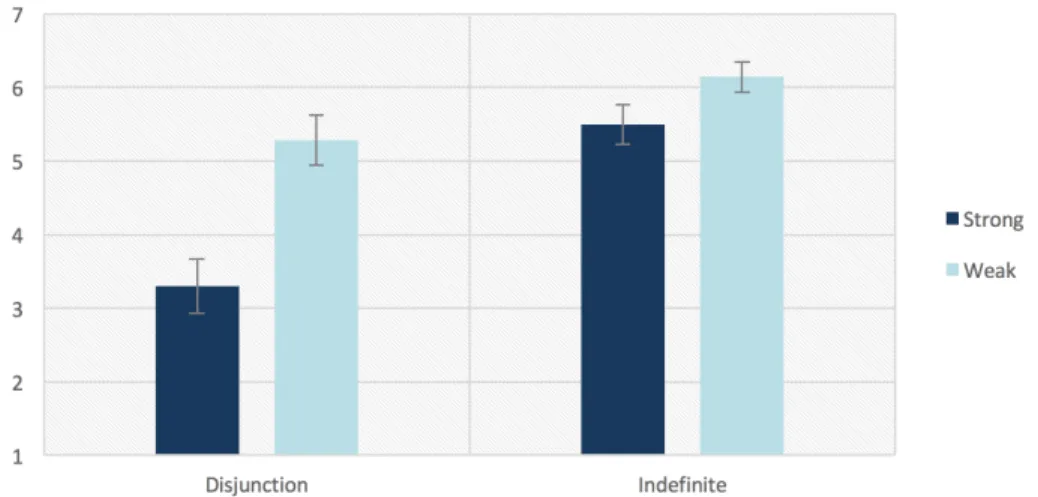
The results of the experiment are shown in the following graph:
Figure 2: Mean responses for Experiment 2. Error bars show standard error of the mean. We can see from the graph that the results of the experiment are evidence that prob-abilified DACs do have both probprob-abilified weak and probprob-abilified strong readings. The crucial result is that, while the difference in mean agreement with (D2) is sig-nificant between theStrongandWeakconditions and crosses the midpoint,17there is no significant difference in mean agreement with (I2) between the Strong and Weakconditions.18Thus, the results of Experiment 2 are evidence that probabilified DACs do have both probabilified strong and probabilified weak interpretations, in line with the predictions of Ambiguity but not our Lewisian Univocal Weak the-ory (or Univocal Strong theories for that matter).
17
A planned comparison was used to compare agreement with (D2) in theStrongcondition (M= 3.30,S D = 2.1) with agreement with (D2) in theWeakcondition (M = 5.28,S D = 1.9),t(63) =
−4.0,p<.001,d= −.99. 18
A planned comparison was used to compare agreement with (I2) in theStrongcondition (M= 5.49,S D = 1.6) with agreement with (I2) in theWeakcondition (M = 6.14,S D = 1.2), t(70) =
Summary
Here is where things stand. In §2.1, we found evidence that DACs like(4)have both a strong and a weak interpretation. This observation made trouble for Univocal Strong theories, but was compatible with our Lewisian Univocal Weak theory and Ambiguity theories. In §1.2, we found evidence that probabilified DACs like (8)have both a probabilified strong and probabilified weak interpretation, an obser-vation that is not predicted by our Lewisian Univocal Weak theory, but which is predicted by an Ambiguity theory. Thus, Ambiguity theories seem to be in the best shape, given the foregoing evidence. Of course, the discussion here is still preliminary—it could turn out that a more sophisticated univocality theory may of-fer a better explanation for the foregoing data, and more evidence may surface which pushes against Ambiguity in favor of some kind of univocality theory. Rather than attempt to anticipate every possible response on behalf of Univocal Strong/Univocal Weak theories, in the rest of the paper, I precede under the assumption that DACs are indeed ambiguous between a weak and strong interpretation. In what follows, I will explore the question of what kind of ambiguity theory of DACs is correct.
2 The role of focus
In this section, I discuss a new observation about DACs, which is that focal stress onortends to disambiguate in favor of the strong interpretation, in contrast with pronouncing the disjunctive antecedent “as a block,” running the two disjuncts to-gether with flat intonation. For quasi-prosodic notation, let capital letters indicate focal stress and ‘x-y-z’ indicate pronouncing ‘x,’ ‘y,’ ‘z’ without pauses or intonational differentiation:
(13) a. If John draws a gold coin OR a silver coin, he will win.
. [Or-emphasis]
b. If John draws a gold-coin-or-a-silver-coin, he will win.
. [Flat intonation]
My intuition is that uttering(13-a)most naturally has the strong interpretation, in contrast with uttering(13-b). Call this theFocus Observation:
Focus Observation: Uttering a DAC while emphasizing theorin its antecedent tends to bias its strong interpretation.
Another piece of evidence supporting theFocus Observationcomes from compar-ing specificational DACs with and withoutor-emphasis:
(14) a. #If John draws a gold coin OR a silver coin, he will draw a gold coin. b. If John draws a gold-coin-or-a-silver-coin, he will draw a gold coin. Given that John will only draw one coin, my intuition is that(14-a)is quite odd, in contrast with(14-b), which is fine. This is further evidence supporting theFocus Observation.
I pause to note that my statement of the Focus Observation is purposefully vague. Focal stress has many uses. Below, I suggest that focal stress plays a role in mediating transformations between surface and logical form, but focal stress is also used to indicate focus marking (F-marking), or contrast (contrastive focus). Given these other uses of focal stress, it is not surprising that differential focal stress onor may be interpreted in a variety of ways. My claim is not that every utterance of(4) withor-emphasis will result in its being read with the strong interpretation; rather, my claim is that there is a use of focal stress that has this effect.19
Before we move on to thinking about what might account for theFocus Obser-vation, I want to provide some additional empirical support for it. I turn to this support in the next section.
2.1 Experiment 3: Focal stress
As before, participants for this experiment were recruited through Amazon Mechan-ical Turk.20 Participants were divided into two groups: Emphasis and Flat. Each participant read theCoinsvignette, and then the weak prime:
Weak: Since there are mostly gold coins, if you draw one of the gold or silver coins, you will very likely draw a gold coin, and hence win.
Those in the Emphasis group then listened to a recording of someone saying (E), with the indicatedor-emphasis:
19For instance, DACs with contrastive focus onordo not fall into the generalization reported in theFocus Observation. Here is an example:
(i) I’m not sure if John will draw a gold coin or a silver coin, or a gold coin AND a silver coin. But even if he draws a gold coin OR a silver coin, he’ll win (since he’ll draw a gold coin). Here,oris stressed, but the stress is used to indicate a contrast betweenorandand(appearing in the previous sentence). Although this contrastive use of focal stress is definitely possible, it requires prior linguistic material to be contrasted with. Therefore, I will set aside such cases in our discussion of theFocus Observation. Thanks to an anonymous reviewer for bringing this kind of example to my attention.
2081 participants were recruited; the sample was 47 percent male, mean age 34. Only answers from participants who self-reported as native speakers of English were used.
(E) It is likely that: if John draws a gold coin OR a silver coin, he will win. Those in the Flat group listened to a recording of someone saying (F), with the indi-cated flat intonation:
(F) It is likely that: if John draws a gold-coin-or-a-silver-coin, he will win. Each participant was then asked whether they agreed or disagreed with the state-ment, rating their answers on a scale from 1 (“Completely disagree”) to 7 (“Com-pletely agree”).
Given that each participant read the weak prime, we expect that participants will tend to agree with (F), in line with the results of previous experiments. But if the Focus Observationis correct, we expect participants to tend to disagree with (E). In particular, we expect there to be significantly less agreement with (E) than (F), in line with the previous experiments.21
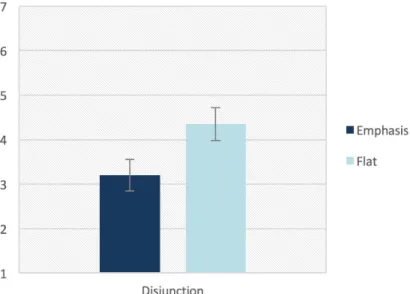
Indeed, the pattern of responses matches the previous experiments: participants were more inclined to disagree with (E) (M = 3.20,S D = 2.3) than with (F) (M = 4.35,S D=2.3),t(79) =2.3,p=.026,d=.5.
Figure 3: Mean responses for Experiment 3. Error bars show standard error of the mean.
21Why do I compare flat vs.or-emphasis across conditions biasing the weak interpretation? The reason is that I think that the default interpretation of DACs is the strong interpretation (I discuss this below on page 33). So, without the weak prime, we would expect strong interpretations of the DACs in both conditions (flat vs.or-emphasis). So, the ideal way to test theFocus Observationis to see whether, in a context in which we would otherwise expect the weak interpretation of some DAC to be salient, emphasis onorbiases its strong interpretation.
Thus, I conclude that the results of this experiment are evidence that focal stress on orbiases the strong reading of DACs.
2.2 The focus hypothesis
Existing ambiguity theories of DACs do not predict theFocus Observation. I will briefly discuss two such theories.Alonso-Ovalle 2009proposes that the weak read-ing of DACs is due to the presence of a covert existential closure operator which is posited as a last resort strategy to avoid interpreting the DAC as necessarily false, whileSantorio forthcomingproposes that the strong reading of DACs is due to the presence of a covert distributivity operator (similar to one often posited to account for distributed readings of plural descriptions).
However, neither of these accounts naturally predicts theFocus Observation. To do so, Alonso-Ovalle would have to say that focal stress onorindicates the absence of a covert existential closure operator; but there is no independent motivation for this kind of proposal. And Santorio would have to say that focal stress onorindicates the presence of a distributivity operator, but I cannot think of any independent evidence for this claim, either. For instance, Santorio appeals to an analogy between plural definites and conditional antecedents, so we might try to look for evidence there. Take a disjunctive plural definite that most naturally has the collective reading: (15) The boys or girls carried a piano.
Does adding focal stress to orchange this to a distributive reading (one in which each boy or each girl carried a piano)?
(16) The boys OR girls carried a piano.
It seems it does not. To my ear,(15)and(16)sound equivalent.22
A more promising strategy, I think, is to connect theFocus Observationwith another observation about doubled disjunctive antecedent conditionals (DDACs)— instances of the schemaif A or if B, C—due toStarr 2014. Notice first that the most 22Here is another way to make this point. Notice that we can force a distributive reading for(15) by addingeach:
(i) The boys or girls each carried a piano.
This means that either each of the boys carried a piano or each of the girls carried a piano. However, notice that merely adding focal stress tooris not sufficient to yield this interpretation:(16)does not mean the same thing as(i). Thanks to an anonymous reviewer for suggesting this strategy.
natural interpretation of the following DDAC is that it entails both of its simplifica-tions:
(17) If John draws a gold coin or if John draws a silver coin, he will win. Secondly, notice that specificational DDACs like(18)are infelicitous:
(18) #If John draws a gold coin or if John draws a silver coin, he will draw a gold coin.
This conditional seems infelicitous because it seems to entail something we know to be false (given the information in Coins): that if John draws a silver coin, he will draw a gold coin. So, it seems that DDACs lack the weak reading on which specificational DACs are felicitous. This suggests the possibility of accounting for the ambiguity in DACs as a syntactic ambiguity: when the conditional’s LF contains twoif-clauses coordinated byor, it has the strong reading, and when its LF contains a single, disjunctive,if-clause, it has the weak reading. Call the former the Double-if LF and the latter the Single-ifLF:
▸ Double-if: [ [if A or if B]C]
▸ Single-if: [ [if A or B]C]
The semantic claim is that the two LFs are assigned different interpretations, as fol-lows:
Strong Double-if
Disjunctive conditionals with a Double-if logical form univocally have the strong (simplification-entailing) interpretation.
Weak Single-if
Disjunctive conditionals with a Single-iflogical form univocally have the weak interpretation.
On this explanatory strategy, DDACs are most naturally read as simplifying because they are most naturally interpreted as having a Double-ifLF (whether they univo-cally have such an LF is a question we’ll return to shortly). This strategy also promises a way of accounting for theFocus Observation, by appealing to the following hy-pothesis:
The Focus Hypothesis
under the scope of an operator ‘O’ can indicate the presence (at LF) of two oc-currences of that operator taking narrow scope with respect to the connective. The hypothesis states that when you have a sentence with the following surface form: (19) O(ϕ∗ψ)
in which the connective receives focal stress, this can indicate that the logical form of the sentence is in fact:
(20) Oϕ∗Oψ
How does this hypothesis connect our two observations above? Well, for DACs, the operator isif(understood not as a two-place operator as in standard logic textbooks, but as a one-place operator that maps a clause to a clause) and the connective isor. The Focus Hypothesis predicts that focal stress on the mainorof its antecedent can be used to indicate that the DAC has the Double-ifLF. Then, by Strong Double-if, we predict that it would then have the strong interpretation. Thus, adopting The Focus Hypothesis, Strong Double-If, and Weak Single-If has the potential to open up space for a new kind of ambiguity theory of DACs, one which can account for all of the data discussed so far in this paper.
However, is The Focus Hypothesis even plausible? Start with the following example:
(21) Everyone was inside or outside.
There is an interpretation of(21)in which it is trivially true: of course, everyone has the property of being inside or outside. However, notice that when you emphasize or, you get a different interpretation:
(22) Everyone was inside OR outside.
The natural reading of(22)is non-trivial—it is equivalent to:23 (23) Everyone was inside or everyone was outside.
This pattern supports The Focus Hypothesis: here, the operator iseveryoneand the connective isor.
Consider another example. Suppose you know that a particular die is weighted, but you cannot remember how it is weighted: either it is weighted to land only on ‘5’, 23Just as with DACs,(21)has both the trivial and non-trivial interpretation. My claim is that em-phasis onorhelps to bias the non-trivial interpretation.
or it is weighted to only land on ‘6’. Now consider: (24) The die always lands on ‘5’ OR on ‘6’.
This sentence seems equivalent to “the die always lands on ‘5’ or always lands on ‘6’.” Notice, though, that if you were to say:
(25) The die always lands on ‘5’ or on ‘6’.
this has the interpretation that is true if on every roll, the die lands either ‘5’ or ‘6’. Thus, (25)is weaker than (24); (25)is compatible with the possibility that the die sometimes lands ‘5’ and sometimes lands ‘6’. Since you know this is not the case, you shouldn’t utter(25); to do so risks misleading your audience. This example also supports The Focus Hypothesis: in this case, the operator isalways.
Turn finally to a case involving epistemic modals. Since epistemic modals and disjunction lead to free choice effects which I want to control for, I use the connective and. Start with:
(26) John might be inside and outside.
Supposing that no one can be both inside and outside, this sentence is prominently read as trivially false. However, pausing slightly between the conjuncts and empha-sizingandbrings out a non-trivial reading:24
(27) John might be inside . . . AND outside. This sentence is naturally read as equivalent to:
(28) John might be inside and John might be outside.
This final example also supports The Focus Hypothesis: here, the operator ismight and the connective isand.25
24Why does pausing slightly help to bring out the non-trivial reading here? One hypothesis is that this helps to distinguish the use of focal stress from its contrastive use, which we find in:
(i) A: The disease might be infectious but it is not harmful. B: No, the disease might be infectious AND harmful.
25Szabolcsi & Haddican 2004observes a related effect of focus and conjunction: (i) Mary didn’t take English and Algebra.
The most natural reading of(i)is that Mary took neither English nor Algebra. But whenandis fo-cused, the natural interpretation is that Mary didn’t take both:
But what exactlyisthis phenomenon—why are these readings triggered by focal stress on the main connective? I do not yet have a settled answer to this question. Perhaps the phenomena is an instance of across-the-board (ATB) movement of the modals/quantifiers out of their clauses,26or perhaps it is the result of eliding the dou-bled material at LF. My goal in this section is not to explain The Focus Hypothesis, but rather merely argue that it is a plausible generalization.27Regardless of what ac-counts for these focus effects, the fact that modals and quantifiers exhibit analogous behavior with respect to focus is, I think, a compelling reason to adopt The Focus Hypothesis and pursue a unified explanation of theFocus Observation and our observation about strong DDACs, in line with the Double-if and Single-if con-jectures.
2.3 Ignorance and specificational DDACs
I close this section with a brief discussion about some tricky data surrounding DDACs, which I draw on to motivate my syntactic approach to the ambiguity in DACs.28 We saw above that, unlike DACs, DDACs seem to lack a felicitous specificational read-ing, as seen by the contrast between(29)and(18):
(ii) Mary didn’t take English AND Algebra.
This data may initially seem to be a counterexample to The Focus Hypothesis, since here things seem to go in the opposite direction to what the hypothesis predicts. In response, let me point out that this data merely reveals a new complication in the dialectic: in addition to explaining the data supporting The Focus Hypothesis, we must also now account for the negation data here that tells against it. This suggests that there is a more explanatory generalization which we have yet to un-cover. Unfortunately, I do not know what that generalization is. Following a conjecture ofSzabolcsi & Haddican 2004, I suspect that a promising account of these cases will appeal to a homogeneity presupposition in conjunctive clauses which is suspended (for some reason) by focal stress.
26ATB movement (see alsoRoss 1967,Williams 1978,Postal 1974) happens when a constituent moves out of several places of a coordinate structure at once, as in:
(i) The person whoi[Mary lovesti] and [John hatesti] was present.
According to this explanation, in the cases above, we are seeing two occurrences of the quanti-fier/modal moving out of low scope position to occupy a single position above the connective at surface form:
(22) ≈[Everyone]i[tiis inside] or [ti(is) outside].
27
I concede that a full defense of The Focus Hypothesis would involve experimental work testing a wide range of cases. I lack the space to fully defend the hypothesis here.
(29) If John draws a gold coin or a silver coin, he will draw a gold coin.
(18) #If John draws a gold coin or if John draws a silver coin, he will draw a gold coin.
However, it is also true that both DACs and DDACs have felicitousignorance inter-pretations, as seen by the fact that both of the following are felicitous:
(30) John will win if he draws a gold coin, or a silver coin; I am not sure which, though.
(31) John will win if he draws a gold coin, or if he draws a silver coin; I am not sure which, though.
The fact that there are felicitous ignorance DDACs is evidence that DDACs do not always have the strong interpretation. Yet, the fact that there are not felicitous spec-ificational DDACs is evidence that DDACs lack the weak interpretation of DACs. I think a version of my syntactic strategy for DACs can be extended to account for this difference between DACs and DDACs. In particular, my proposal is that DACs and DDACs differ in the range of LFs they are ambiguous between. DACs are ambigu-ous between a Double-if and Single-if LF, while DDACs are ambiguous between a Double-ifand Disjoined LF:
▸ Disjoined: [ [if A]C]or[ [if B]C]
Roughly, on its Disjoined LF, the second consequent of(31)is elided:
(32) John will win if he draws a gold coin, or John will win if he draws a silver coin.
It should be clear why, if it has a Disjoined LF, an ignorance DDAC like(31)would be felicitous. But it may be less clear why a specificational DDAC with a Disjoined LF should be infelicitous. To show that it would be infelicitous, suppose that the specificational DDAC(18)has a disjoined logical form, making it equivalent to(33): (18) #If John draws a gold coin or if John draws a silver coin, he will draw a gold
coin.
(33) If John draws a gold coin, he will draw a gold coin or if John draws a silver coin, he will draw a gold coin.
namely, that if John draws a gold coin, he will draw a gold coin.29 And, in general, it is infelicitous to assert trivialities.30Thus, given that DDACs can have only Double-If or Disjoined LFs, we expect specificational DDACs to be infelicitous: they are false if interpreted with a Double-if LF (since, by Strong Double-If they would then have the strong interpretation), and they are trivial if interpreted with a Disjoined LF. By contrast, interpreted with the Single-ifLF, a specificational DAC should have the weak interpretation (by Weak Single-If) and hence be possibly non-trivially true.
Let’s pause to summarize the results of this section. I have argued that we should explain the ambiguity of DACs by the fact that their surface forms underdetermine their logical forms in the following ways:
LF-Ambiguity:
a. DACs can have either a Double-ifor Single-iflogical form.31
29Theorin(33)is intended to be truth functional disjunction.Geurts 2004, drawing on an example fromJohnson-Laird & Savary 1999observes data suggesting that certain conditionals coordinated byor behave like conjunctions of conditionals. In particular, when it’s common ground that the antecedents of the disjoined conditionals are disjoint and exhaustive, their disjunction has a reading in which it entails both disjuncts:
(i) Either he will stay in America if he is offered tenure or he will return to Europe if he isn’t.
Geurts 2004extends his modal analysis of disjunction to handle this kind of case. My theory does not generate this prediction without additional supplementation.
30Consider the oddity of:
(i) #If John draws a gold coin, he will draw a gold coin.
where antecedent and consequent describe the same coin draw. There are, of course, exceptions to this generalization:
(ii) If he lied, he lied.
But(ii)seems to be acceptable because there is a plausible alternative reason someone might assert it: perhaps as a concession, or to implicate that lying is inexcusable. Once we have that use in mind,
(i)is more felicitous. But notice that this doesn’t rescue(18)from infelicity. Why? The reason seems to be that felicitous concessive trivial conditionals are limited to those of the formif A, A. Notice, for instance, that(iii)is almost impossible to hear as a concession, even though it is equivalent to(ii)
(which can be heard concessively).
(iii) #If he lied, he either lied or danced.
I think something similar is happening with(18): it is trivial, but cannot be heard as a concession (and thus as felicitous) because of its form.
b. DDACs can have either a Double-ifor Disjoined logical form.
I combined this syntactic conjecture with two semantic hypotheses: Strong Double-If, which states that Double-ifconditionals univocally have the strong interpretation, and Weak Single-If, which states that Single-if conditionals univocally have the weak interpretation. Together, these principles promise a reasonable explanation of theFocus Observation(that focal stress onorbiases the strong interpretation of a DAC), by appealing to the independently motivated Focus Hypothesis (which pre-dicts that focal stress onorin a DAC indicates that it has a Double-ifLF). The princi-ples also account for the complex data surrounding DDACs, in particular that there are no felicitous specificational DDACs but there are felicitous ignorance DDACs.
I should emphasize that, although I have narrowed down a strategy for how one might build a theory of disjunctive antecedent conditionals, I have not yet pro-vided such a theory. For one, I have not offered a syntactic theory that predicts LF-Ambiguity or the Focus Hypothesis. And secondly, I have not offered a semantic theory that predicts Strong Double-If and Weak Single-If. In the next and fi-nal section, I aim to fill the latter lacuna by offering a semantic theory that predicts Strong Double-If and Weak Single-If. I set aside filling the syntactic lacuna for future work.
3 The semantics of DACs
In the previous section, I provided an independent reason to adopt The Focus Hy-pothesis, which proposes that focal stress onorin an DAC defeasibly indicates the presence of twoif-clauses coordinated by that connective at LF. Now, I state a seman-tic theory that predicts the Double-if and Single-if hypotheses (restated here):
Strong Double-if
Disjunctive conditionals with a Double-if logical form univocally have the strong (simplification-entailing) interpretation.
Weak Single-if
Disjunctive conditionals with a Single-iflogical form univocally have the weak interpretation.
To do this, the semantics must allowif-clauses to be coordinated by connectives like or. But it is not obvious how such a semantics might work. For instance, existing operator and restrictor theories do not allow such coordination. According to oper-ator theories,ifdenotes a two-place connective which maps pairs of propositions to propositions (standard representatives of such theories include?Lewis 1973,Gillies
2010). According to restrictor theories,ifmerely marks the restriction of a local op-erator (as inLewis 1975,Farkas & Sugioka 1983,Kratzer 1986,von Fintel 1997,2004). Neither of these theories allowif-clauses to be coordinated by sentential connectives likeor, at least not in any straightforward way.
An alternative theory that could account for coordinated if-clauses is one that treats them instead as one-place operators, that map clauses to clauses (cf.Schlenker 2004,Santorio forthcoming). My theory is of this kind. Very roughly, the idea is that ifmaps a proposition to its singleton, which is the argument of a modal operator beneath it.32 Interpretation on my theory happens in two stages. First, the natural language expression is translated into a formal language that states its logical form. Second, an evaluation function ⟦ ⟧ applies to logical form expressions, assigning them an extension relative to a context c and world w. Abstracting on the world parameter gives us the intension of the logical form of the expression, which is a function from worlds to extensions:
The intension ofeatc=⟦e⟧c=λw.⟦e⟧c,w
On my semantics,ifdenotes a function from propositions to the singleton set con-taining that proposition:
⟦if A⟧c,w
={A}; whereA= λw.⟦A⟧c,w
To streamline the presentation of the theory, I will ignorewillin our target sentences. For now, I will focus on bare indicative conditionals like:
(34) If John came to the party, Sue came to the party.
Following Kratzer 1986, I propose that bare consequent clauses contain a covert modal element ◻ in their logical forms, and that this modal’s domain is updated by if-clauses via restriction. We will model this by letting f be a function from a world and a proposition to a set of worlds (intuitively, the domain of the modal).
So, on my semantics, the extension of a modal operator maps a proposition to a function from a set of propositionsRto a truth value, as follows:33,34
32
My theory is similar toStarr 2014, on whichifhighlights its complement, and then clauses sub-ordinated to anif-clause test to see whether every highlighted proposition contextually entails that clause. However, I implement my theory in a very different semantic framework than Starr’s. I set aside a full comparison between our theories for another day.
33I use subscripts on lambda expressions to indicate the type of variable: tis the type of truth value,eof individual,sof possible world.⟨st⟩is the type of a function from worlds to truth values (or possible worlds proposition), and⟨⟨st⟩,t⟩is the type of a set of possible-worlds propositions.
⟦◻f C⟧c,w=λR⟨⟨st⟩,t⟩.∀X∈ R ∶ ∀w
′∈ f
c(X,w):⟦C⟧c,w
′ = 1.
Notice that there are two layers of quantification here: one over the propositions inR and one over each modal domain generated (pointwise) by each proposition inR. I assume that every modal has these two layers of quantification.35If-clauses will pro-vide the value forR, but when the modal appears unembedded, I will suppose that context supplies the set containing the universal proposition (true at every world): {W}. This ensures that the quantification overRbecomes vacuous, and thus ensures that bare modals have their usual semantics.36
Putting theif- and consequent clauses together yields the following truth condi-tions for simple conditionalsif A, C:
⟦[ if A ]◻f C⟧c,w = 1 iff∀X∈ {A} ∶ ∀w′∈ fc(X,w):⟦C⟧c,w
′ = 1
This reduces to the condition that every world in fc(A,w)is aC-world; I submit that
these are reasonable truth conditions for simple conditionals, modulo the provisions set aside in footnote34.
By dividing up the compositional details of conditionals in this way, our seman-tics can now, in principle, handle coordinatedif-clauses. However, when we think about natural candidates for the semantic value of or, we run into an immediate problem:
⟦or⟧c,w
=λutλvt .u=1∨v=1
This natural semantic value forormaps pairs of truth values (the extensions of sen-tences) to 1 iff either input truth value is 1, and to 0 otherwise. This works well for coordinating simple sentences, but not forif-clauses, whose extensions are not truth values, but sets of propositions. In response to this type-clash, I propose that or strict conditional semantics that allows for violations of Conditional Excluded Middle. For reasons I do not motivate in this paper, I prefer an epistemic variably strict conditional semantics that validates Conditional Excluded Middle, as in?Stalnaker 1980. We could achieve this result by letting the covert modal be a selection function modal, as inCariani & Santorio forthcoming.
35
For independent support that modals have two layers of quantification, seeMandelkernet al. 2017.
36
In effect,Ris a variable, which can be bound byif-clauses, and when left unbound defaults to the value assigned to it by an assignment function initialized by context (which, as above, I suppose is the set containing the universal proposition). I am suppressing this extra complication to streamline the presentation of the theory. I also want to allow for the possibility of “long distance” binding of this value across sentences (cf.Groenendijk & Stokhof 1991,Kratzer 2012):
type-shifts to a function from pairs of sets of propositions to a set of propositions as follows:37
Type-shifting Disjunction:⟦or↑⟧c,w
=λP⟨⟨st⟩,t⟩λQ⟨⟨st⟩,t⟩.P ∪ Q
This corresponds to generalized disjunction (cf. Partee & Rooth 1983). Combining
if A,if Bandoryields the following: ⟦if A or↑if B⟧c,w
={A,B}
Then, as desired, our semantics predicts both the Double-if and Single-if hy-potheses: Double-if ⟦[if A or↑if B ]◻f C⟧c,w = 1 iff∀X∈ {A,B} ∶ ∀w′∈ fc(X,w):⟦C⟧c,w ′ = 1. . . . iff∀w′∈ f c(A,w):⟦C⟧c,w ′ = 1 and∀w′∈ f c(B,w):⟦C⟧c,w ′ = 1 Single-if ⟦[if A or B]◻f C⟧ c,w = 1 iff∀X∈ {A∪B} ∶ ∀w′∈ f c(X,w):⟦C⟧ c,w′ = 1. . . . iff∀w′∈ f c(A∪B,w):⟦C⟧c,w ′ = 1 This is the main prediction of the account. In the rest of the section, I review how the theory, together with other motivated assumptions, predicts the rest of the data discussed above. Recall that our syntactic assumptions are:
Ambiguous LF:
a. DACs can have either a Double-ifor Single-iflogical form. b. DDACs can have either a Double-ifor Disjoined logical form. and
The Focus Hypothesis
Differential focal stress on a sentential connective ‘∗’ appearing in surface form under the scope of an operator ‘O’ can indicate the presence (at LF) of two oc-currences of that operator taking narrow scope with respect to the connective. These, together with Double-If and Single-If, predict the following:
Prediction 1: Simple DACs are ambiguous between weak and strong readings. 37
I want to remain neutral for now about whether this type-shifting is carried out by a covert type shifting operator, flexible types, or a distinct rule of interpretation.
On its Double-iflogical form,if A or B, Chas the strong (simplification-entailing) interpretation, while on its Single-iflogical form, it has the weak interpretation.
Prediction 2: Uttering a DAC while emphasizing theorin its antecedent tends to bias its strong interpretation. (Focus Observation) Given The Focus Hypothesis, focal stress onorcan signal thatif A or B, Chas a Double-iflogical form, and hence (we predict) a strong interpretation.
Prediction 3: There will be felicitous ignorance DDACs but not felicitous spec-ificational DDACs.
This is because we predict that DDACs lack the Single-if LF, and instead are only ambiguous between a Double-IfLF or a Disjoined LF (recall the reasoning in §2.3).
Prediction 4: Probabilified DACs are ambiguous between a probabilified weak and probabilified strong interpretation.
Probabilified Weak:if A or B, probably Cis true iff the probability ofC givenA∪Bis greater than 0.5.
Probabilified Strong: if A or B, probably Cis true iff if A, probably C andif B, probably Care both true (i.e., iff the probability ofCgivenAis greater than 0.5 and the probability ofCgivenBis greater than 0.5). The probabilified weak interpretation arises from the possibility of interpretingif A or B, probably Cas having the following logical form:
▸ Single-if:[ [ if A or B ] probably C ]
while the probabilified strong interpretation arises from interpreting the probabili-fied DAC as having the following LF:
▸ Double-if:[ [ if A or↑ if B ] probably C ]
I end with a response to a worry. Since my view is an ambiguity theory, I face a concern about overgenerating readings of conditionals. I hope to have partially mitigated that concern here in my discussion of the empirical data in §1, where we found evidence that DACs do seem to have two distinct interpretations, which can be brought out in different contexts. Nonetheless, two questions remain.
The first is why many people gravitate towards the strong interpretation of DACs by default. Here, I appeal to the fact that the strong interpretation is logically stronger