Generalized loopy 2U: A new algorithm for approximate inference in
credal networks
Alessandro Antonucci
*, Yi Sun, Cassio P. de Campos, Marco Zaffalon
IDSIA, Istituto Dalle Molle di Studi sull’Intelligenza Artificiale, Galleria 2, CH-6928 Manno (Lugano), Switzerland
a r t i c l e
i n f o
Article history:
Received 11 December 2008 Accepted 20 April 2009 Available online 28 January 2010 Keywords: Credal networks Credal sets Inference algorithms 2U Imprecise probability Bayesian networks Loopy belief propagation
a b s t r a c t
Credal networks generalize Bayesian networks by relaxing the requirement of precision of probabilities. Credal networks are considerably more expressive than Bayesian networks, but this makes belief updating NP-hard even on polytrees. We develop a new efficient algo-rithm for approximate belief updating in credal networks. The algoalgo-rithm is based on an important representation result we prove for general credal networks: that any credal net-work can be equivalently reformulated as a credal netnet-work with binary variables; more-over, the transformation, which is considerably more complex than in the Bayesian case, can be implemented in polynomial time. The equivalent binary credal network is then updated by L2U, a loopy approximate algorithm for binary credal networks. Overall, we generalize L2U to non-binary credal networks, obtaining a scalable algorithm for the gen-eral case, which is approximate only because of its loopy nature. The accuracy of the infer-ences with respect to other state-of-the-art algorithms is evaluated by extensive numerical tests.
Ó2010 Elsevier Inc. All rights reserved.
1. Introduction
Bayesian networks (Section2.1) are probabilistic graphical models based on precise assessments for the conditional prob-ability mass functions of the network variables given the values of their parents. As a relaxation of such precise assessments,
credal networks(Section2.2) only require the conditional probability mass functions to belong to convex sets of mass
func-tions, i.e.,credal sets. Credal networks (CNs) are considerably more expressive than Bayesian networks (BNs),1and the price is
an increased complexity of inference:belief updatingin CNs is NP-hard even on polytrees[1]. The only known exception to this situation is the2U algorithm[2], which computes exact posterior beliefs onbinary(i.e., with binary variables) polytree-shaped CNs in time linear in the size of the network. Aloopyversion of 2U (L2U) has been proposed for multiply connected binary CNs by Ide and Cozman[3]. Inferences based on L2U are approximate, but a good accuracy is typically observed after few iterations (Section3).
In this paper we develop an efficient algorithm for approximate belief updating of general CNs (any topology and number of states per variable). The algorithm, which invokes L2U in its final step, is calledgeneralized loopy 2U(GL2U). The GL2U algorithm is based on an important representation result that we prove inAppendix A: that any CN can be equivalently refor-mulated as one with binary variables. The corresponding transformation, which is considerably more complex than in the Bayesian case, is based on two distinct transformations: adecision-theoretic specification[4], which augments the CN with
0888-613X/$ - see front matterÓ2010 Elsevier Inc. All rights reserved. doi:10.1016/j.ijar.2010.01.007
* Corresponding author.
E-mail addresses:[email protected](A. Antonucci),[email protected](Y. Sun),[email protected](C.P. de Campos),[email protected](M. Zaffalon). 1 Greater expressiveness is a consequence of the fact that Bayesian networks are a subset of credal networks. Expressiveness should not be confused with informativeness: for example, it is thanks to the greater expressiveness that credal networks can model much less informative states of knowledge (including lack of knowledge) than those that Bayesian networks can model.
Contents lists available atScienceDirect
International Journal of Approximate Reasoning
control variables enumerating the multiple mass functions owned by the nodes of the network (Section4.2); abinarization procedure[5]that transforms each variable into a cluster of binary variables (Section4.1).
We prove that the sequential application of these two transformations, originally developed for independent reasons, re-turns an equivalent binary representation of the initial CN (Section5.1). Such equivalent binary CN can be finally updated by L2U. Overall, this is the generalization of the loopy version of 2U that we propose for the updating in general CNs, whose only source of approximation is the loopy propagation (Section5.2). The algorithm, which is proved to take only polynomial time (Section6), has been implemented in a free software. Experimental tests (Section7) show that GL2U is comparable to that of state-of-the-art approximate methods for large CNs in terms of accuracy, being considerably faster from a computational point of view.
2. Bayesian and credal networks
In this section we review the basics of Bayesian networks (BNs) and their extension to convex sets of probabilities, i.e., credal networks (CNs). Both the models are based on a collection of random variables, structured as a vector X:¼ ðX1;. . .;XnÞ,2and a directed acyclic graph (DAG)G, whose nodes are associated with the variables ofX. In our assumptions
the variables inXtake values in finite sets. For both models, we assume theMarkov conditionto makeGrepresent probabilistic independence relations between the variables inX: every variable is independent of its non-descendant conditional on its par-ents. What makes BNs and CNs different is a different notion of independence and a different characterization of the conditional mass functions for each variable given the values of the parents, which will be detailed later.
Regarding notation, for eachXi2X;XXi¼ fxi0;xi1;. . .;xiðdi1Þgdenotes the possibility space ofXi;PðXiÞis a mass function
forXiandPðxiÞthe probability thatXi¼xi, wherexiis a generic element ofXXi. A similar notation with uppercase subscripts
(e.g.,XE) denotes vectors (and sets) of variables inX. Regarding the parents and the children ofXiwith respect to the
topol-ogy ofG, they are denoted respectively byPiandCi. Finally, for each
p
i2XPi;PðXijp
iÞis the probability mass function forXiconditional onPi¼
p
i.2.1. Bayesian networks
For BNs, a conditional mass functionPðXij
p
iÞfor eachXi2Xandp
i2XPi must be defined; and the standard notion ofprobabilistic independence is assumed in the Markov condition. A BN can therefore be regarded as a joint probability mass function overXthat, according to the Markov condition, factorizes as follows:
PðxÞ ¼Y n
i¼1
Pðxij
p
iÞ; ð1Þfor all the possible valuesx2XX, with the values ofxiand
p
iconsistent withx. In the following, we represent a BN as a pairhG;PðXÞi. Posterior beliefs about a queried variableXq, given evidenceXE¼xE, are defined by the expression
PðxqjxEÞ ¼ P xM Qn i¼1Pðxij
p
iÞ P xM;xq Qn i¼1Pðxijp
iÞ ; ð2ÞwhereXM:¼Xn ðfXqg [XEÞ, the domains of the arguments of the sums are left implicit and the values ofxiand
p
iare thoseconsistent withx¼ ðxq;xM;xEÞ. Evaluating Eq.(2)is an NP-hard task, but for polytrees Pearl’s belief propagation allows for
efficient updating[6].
2.2. Credal sets and credal networks
CNs relax BNs by allowing forimprecise probabilitystatements: in our assumptions, the conditional mass functions of a CN are required to belong to afinitely generatedcredal set, i.e., the convex hull of a finite number of mass functions for a certain variable. Geometrically, a credal set is apolytope. A credal set contains an infinite number of mass functions, but only a finite number of extreme mass functions corresponding to theverticesof the polytope. Updating based on a credal set is equivalent to that based only on its vertices[7]. A credal set overXwill be denoted asKðXÞand the set of its vertices as ext½KðXÞ. Given a non-emptyXX#XX, an important credal set for our purposes is thevacuous credal setrelative toXX, i.e., the set of all the
mass functions forXassigning probability one toXX. We denote this set byKX
XðXÞ. In the following we will use the
well-known fact that the vertices ofKX
XðXÞare the 3jX
Xjdegenerate mass functions assigning probability one to the single elements
ofXX. Marginalization generalizes to credal sets as follows: the marginalizationKðXÞof a joint credal setKðX;YÞtoXis the
con-vex hull of the mass functionsPðXÞobtained from the marginalization ofPðX;YÞtoXfor eachPðX;YÞ 2KðX;YÞ.
In order to specify a CN over the variables inXbased onG, a collection of conditional credal setsKðXij
p
iÞ, one for eachp
i2XPi, should be provided separately for eachXi2X; regarding the Markov condition, we assumestrong independence [8], i.e., standard stochastic independence to be satisfied by every vertex. A CN associated with these local specifications is said to be withseparately specifiedcredal sets.2The symbol ‘‘:
¼” is used for definitions. 3
Fig. 1 reports a CN, whose specification requires the (separate) assessment of an unconditional credal set forX1, and
respectively two and eight conditional credal sets forX2andX3.
The specification becomes global considering thestrong extension KðXÞof the CN, i.e., the convex hull of the following col-lection of joint mass functions:
PðXÞ: PðxÞ ¼Y n i¼1 Pðxij
p
iÞ8
x2X
X;PðXijp
iÞ 2KðXijp
iÞ8
p
i2XPi
( ) : ð3ÞWe represent a CN as a pairhG;PðXÞi, withPðXÞ:¼ fPkðXÞgnk¼1v :¼ext½KðXÞ. Clearly, for eachk¼1;. . .;nv;hG;PkðXÞiis a BN.
For this reason a CN can be regarded as a finite set of BNs. For CNsupdatingis intended as the computation of tight bounds of the posterior probabilities of a queried variable given some evidence, i.e., Eq.(2)generalizes as4:
PðxqjxEÞ ¼ min k¼1;...;nv P xM Qn i¼1Pkðxij
p
iÞ P xM;xq Qn i¼1Pkðxijp
iÞ ; ð4Þand similarly for the upper probabilitiesPðxqjxEÞ. Exact updating in CNs displays high complexity. Updating in
polytree-shaped CNs is NP-hard, and NPPP-hard in general CNs[1]. The only known exact linear-time algorithm for updating a specific class of CNs is the 2U algorithm, which is reviewed in the next section.
3. 2U and its loopy extension
Pearl’s belief propagation scheme for updating polytree-shaped BNs has been extended to polytree-shaped binary CNs in [2]. The resulting algorithm, called2-Updating(2U), is the only known exact procedure for efficient CNs updating.
Here we briefly review some features of this algorithm by assuming the reader familiar with the main ideas of belief prop-agation. Let us therefore consider a polytree-shaped binary CNhG;PðXÞi. To eachXi2Xassociate thelower messages
l
ðXiÞandKi, which are received respectively from the parentsPiand the childrenCiofXi. Given an evidenceXE¼xE, 2U performs
a distributed calculation of these messages, from which any updated probability as in Eq.(4)can be computed as follows5: PðxqjxEÞ ¼ 1þ 1
l
ðxqÞ1 ! 1K
q !1 : ð5ÞIn order to implement the distributed computation, also the arcs ofGshould be equipped with lower and upper messages. Thus, for each pair of nodesðXj;XiÞsuch thatGhas an arc fromXjtoXi, the lower messages
l
iðXjÞandKijare also provided.The messages associated to the incoming and outgoing arcs ofXiare used to compute those associated toXi, according to the
following equations:
l
ðxiÞ ¼ min j:Xj2Pi liðxjÞ2fliðxjÞ;liðxjÞg X pi2XPi Pðxijp
iÞ Y j:Xj2Pil
iðxjÞ; ð6ÞK
i¼ Y k:Xk2CiK
k i; ð7Þwherexjis the state ofXjconsistent with
p
i. The messages associated to the arcs are indeed computed as follows:l
iðxjÞ ¼ 1þ 1l
ðxjÞ1 ! 1 Q l:Xl2Cj;l–iK
l j !1 ; ð8ÞK
ki ¼ min l:Xl2Pi;l–k liðxlÞ2fliðxlÞ;liðxlÞg min Ki2fKi;Kig ck iðK
iÞ ! ; ð9ÞFig. 1.A separately specified CN overðX1;X2;X3Þ, withjXX1j ¼2,jXX2j ¼ jXX3j ¼4.
4
Some authors call the computation in Eq.(2)basic updatingin order to emphasize that more general expected values can be also considered in that formula. 5
An analogous relation is provided for the upper probabilityPðxqjxEÞby simply replacing the lower with the correspondingupper messageslðXqÞandKq. Similarly, any equation involving lower messages and probabilities has a corresponding upper formulation[2].
where the function to be minimized is ck ið
K
iÞ ¼ 1þðKi1ÞqðxijxkÞ 1þðKi1ÞqðxijxkÞ ifK
iP1 1þðKi1ÞqðxijxkÞ 1þðKi1ÞqðxijxkÞ otherwise 8 < : ; ð10Þ withq
ðxijxkÞ ¼ X l:Xl2Pi;l–k xl2Xl Pðxijp
iÞ Y l:Xl2Pi;l–kl
iðxlÞ: ð11ÞNote that
q
ðxijxkÞ, and hence ckiðKkÞ, are also functions offl
iðxlÞgl:Xl2Pi. This dependence is left implicit for the sake ofnotation.
Overall, Eqs.(5)–(11)define a distributed algorithm that obeys the same principles of Pearl’s belief updating algorithm. The global computation is carried out in discrete steps. At each step, some nodes are sending messages from a certain subset of active nodes, which modifies the set of active nodes for the next step and the procedure is repeated until no node is active. This condition is satisfied when some node has been updated about the global state of the network. In this state, the mes-sages associated to the nodes are the final result of the computation.
Loopybelief propagation is a popular technique for approximate updating that applies Pearl’s algorithm to multiply
con-nected BNs: propagation is iterated until probabilities converge to a fixed value or for a given number of iterations. Similarly, multiply connected binary CNs can be updated by a loopy variant of 2U (called L2U)[3]. Initialization of variables and mes-sages follows the same steps used in the 2U algorithm. Then nodes are repeatedly updated, until convergence is observed. The L2U algorithm, whose performances have been tested in[3], seems to be very accurate and mostly returns good results with low errors after a few iterations.
Finally, let us analyze the computational complexity of 2U (while L2U has clearly the complexity of 2U multiplied by the number of iterations). The computation of the messages inXiis dominated by Eqs.(6) and (9). Letpi:¼ jPijdenote the
inde-greefor the nodeXi. These equations require an optimization over 2pidifferent configurations of the messages
l
iðxjÞ(for eachparentXj, we can choose the upper or lower
l
iðxjÞ). Moreover, the functions to be minimized are sums with 2piterms, and foreach termpimultiplications must be performed (we need to multiply the messages of all the parents). Finally, an additional factorpiarises in Eq.(9), because it is computed for eachk. Overall, this means a time complexityOðp2i2
2piÞlocally toX
i(pi2pi
is the time to compute the function for a fixed configuration of the parent messages, 2pi is the number of combinations of
parent messages andpiis the number of times Eq.(9)needs to be evaluated). However, we have noted that instead of com-puting Eq.(9)separately for eachk, we can reuse the computations that are performed in Eq.(11)for distinctk’s, that is, evaluations of Eq.(11)altogether (for allk) can be computed in timeOðpi2
piÞgiven that a configuration of the messages
is fixed (just note that from axkto another, we can reuse the computations and spend just constant time per term of the
summation instead ofOðpiÞtime). Hence, the final complexity of our 2U implementation isOðpi2piÞtimes the number of
con-figurations of the messages, that is,Oðpi2
2piÞ.6
4. Transformations of credal networks
In this section we review two different transformations of CNs that have been recently proposed for independent reasons. Their sequential application is the basis to obtain an equivalent representation of CNs based on binary variables.
4.1. Binarization algorithm
By definition, L2U (see Section3) cannot be applied to a non-binary CN like the one in the example ofFig. 1. To overcome this limitation, abinarizationthat transforms a CN into a binary CN has been proposed in[5].
First, each variable is equivalently represented by a cluster of binary variables. Assumedi, which is the number of states
forXi, to be an integer power of two, and let~di:¼log2jXXij. 7
An obvious one-to-one correspondence between the states ofXi
and the joint states of a vector of ~di binary variables eXi:¼ eX0i;Xe1i;. . .;eX
~
di1
i
is established if the joint state ~ x0 i;. . .;~x ~ di1 i 2 f0;1g~diis associated withx
il2XXi, wherelis the integer whose~di-bit representation is~x ~
di1
i ~x1i~x0i. Elements
ofXeiare saidbitsofXiand their position in the vector theirorder.
Overall,X~denotes the vector of bits obtainedbinarizingall the elements ofX. We writePðXÞ ¼ePðX~Þ, ifPðxÞ ¼ePðx~Þfor each x2XX, where~x2XX~is the state corresponding tox.
A DAGG~associated to the variablesX~can be obtained fromGas follows: (i) two nodes ofG~corresponding to bits of dif-ferent variables inXare connected by an arc if and only if there is an arc with the same direction between the related vari-ables inX; (ii) an arc connects two nodes ofG~corresponding to bits of the same variable ofXif and only if the order of the bit
6
This is a fast implementation as the belief propagation in standard BNs already takes timeOðpi2piÞto evaluate the functions. 7
This is not a limitation as a number ofdummystates up to the nearest power of two can be always added. Accordingly, from now on we assume for all the variables a number of possible values equal to an integer power of two.
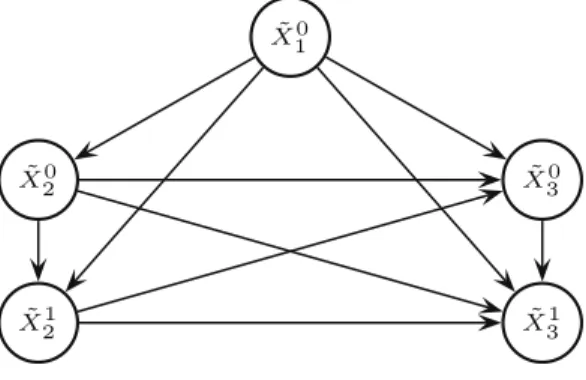
associated to the node from which the arc departs is lower than the order of the bit associated to the remaining node. An example of this transformation is depicted inFig. 2.
Finally, regarding the quantification of the conditional credal sets, we have: ~ Pð~xj ij
p
~ j iÞ:¼kmin ¼1;...;nv e Pk ~xj ijp
~ j i ; ð12Þwhere the indexkis defined like in Eq.(4). Denoting byP~ithe parents ofXejicorresponding to the binarization ofPi, i.e., those
that are not in the same cluster ofXeji, the probabilities to be minimized on the right-hand side are:
e Pk ~xjij~x j1 i ;. . .;~x 0 i;
p
~i /XlPkðxiljp
iÞ; ð13Þwhere the sumPis restricted to the statesxil2XXisuch thatlmod 2
jþ1is the integer whose
ðjþ1Þ-bit representation is ~
xj
i;. . .;~x1i;~x0i;
p
iis the joint state of the parents ofXicorresponding to the joint statep
~ifor the bits of the parents ofXi, symbol/denotes proportionality, and the relations are considered for eachi¼1;. . .;n; j¼0;. . .;d~i1, and
p
i2XPi. For example,from Eq.(13)we haveP Xe0 2¼0j~x01
/ ½Pðx20jx1Þ þPðx22jx1ÞandP eX12¼1jXe02¼0;~x01
/Pðx22jx1Þfor the CN inFig. 2. If both
the states ofXej
iproduce zero in Eq.(13), the corresponding conditional mass functions can be arbitrarily specified (we set a
degenerate mass function). Note that minimization in Eq.(12)can be obtained by simply considering the vertices ofKðXij
p
iÞin Eq.(13).
The overall procedure returns a well-defined CN, which is called thebinarizationof the original CN. Given an updating problem on a CN as in Eq.(4), we can consider the corresponding problem on its binarization. For example, the computation ofPðx33jx10Þfor the CN inFig. 1corresponds toP eX30¼1;Xe13¼1jeX01¼0
. According to Theorem 2 in[5]this is anouter
approximation(i.e., the posterior interval includes that of the original updating problem), which can be approximately
esti-mated by L2U.
This approach entails a twofold approximation: (i) the approximation introduced by the binarization and (ii) that due to the loopy propagation. Approximation (i) can be regarded as originated by replacing each credal set of the original network with an enclosing polytope with a fixed number of vertices.8The latter number cannot be controlled and could be too low to
lead to a satisfactory approximation of the original credal set, which in turns leads approximation (i) to be quite crude. In the next section, we recall an independently developed transformation that will be used to remove approximation (i).
4.2. Decision-theoretic specification
In[4], a general graphical language for CNs based on the so-calleddecision-theoretic specification(DTS) has been proposed. A DTS of a CN is obtained augmenting the original CN by a number ofcontrol nodes, used to enumerate the vertices of the conditional credal sets. That turns the original nodes into precise-probability ones, while the control nodes can be formu-lated as standard chance nodes with vacuous credal sets.
Let us briefly describe this transformation in the case of a CNhG;PðXÞi. First, we obtain fromGa second DAGG0defined over a wider domainX0
:¼ ðX1;. . .;X2nÞ. This is done by iterating, for eachi¼1;. . .;n, the following operations: (i) add a node
Xiþn; (ii) draw an arc from each parent ofXitoXiþn; (iii) delete the arcs connecting the parents ofXiwithXi; (iv) draw an arc
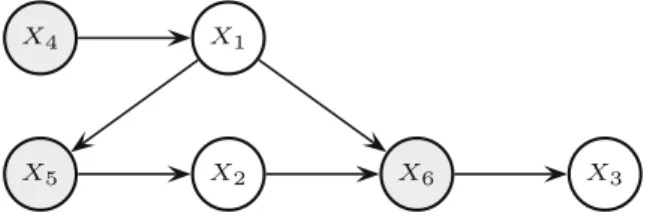
fromXiþntoXi. An example of this transformation is shown inFig. 3.
Note that, for eachi¼1;. . .;n;Pi0þn¼Pi, i.e., the parents ofXiþninG0are the parents ofXiinG, and alsoPi0¼Xiþn, i.e.,Xiþn
is the only parent ofXiinG0and is therefore called thecontrol variableofXi.
We assume a one-to-one correspondence between the possible states of a control variableXiþnand the collection of all the
(distinct) extreme mass functions ofallthe conditional credal sets specified overXi, i.e.,XXiþn:¼ S
pi2XPiext½KðXij
p
iÞ, for eachi¼1;. . .;n. As an example, assuming the number of vertices for the credal sets of the CN inFig. 1equal to the number of
Fig. 2.The binarization of the CN inFig. 1.
8
possible states of the relative variables, we have thatX4inFig. 3is a binary variable, whose states correspond to the two
vertices ofKðX1Þ;X5has eight possible states corresponding to the four vertices ofKðX2jx1Þand the four ofKðX2j:x1Þ;X6
has 32 possible states corresponding to the vertices, four per each set, of the conditional credal sets overX3.
Finally, in order to obtain a well-defined CN overX0associated to
G0, we quantify the conditional credal sets as follows. For eachi¼1;. . .;n, we setK0
ðXijxiþnÞ:¼PðXiÞxiþn, wherePðXiÞxiþnis the element of ext½KðXij
p
iÞcorresponding toxiþn. Regardingthe control nodesfXiþngni¼1, we set insteadK0ðXiþnj
p
0iþnÞ:¼KXpi XiþnðXiÞ, whereXpXiiþn:¼ext½KðXij
p
iÞ#XXiþn.The CN returned by this transformation will be denoted ashG0;P0 ðX0
Þi, and its strong extension asK0 ðX0
Þ. Remarkably, hG0;P0ðX0Þiprovides an equivalent representation ofh
G;PðXÞibeing thatK0ðXÞ ¼KðXÞas stated by Theorem 2 in[4], where
K0
ðXÞis the marginalization ofK0 ðX0
ÞtoX. Note also that, if some nodes in the original CN are quantified by precise proba-bilities, the above results can be derived without introducing the control nodes for these nodes.
Finally let us remark that, by construction, the quantification of the conditional credal sets for the nodes ofhG0;P0ðX0Þiis
either precise (for the nodes of the original CN) or vacuous (for the control nodes). This property will be exploited in the next section in order to obtain a binary equivalent representation of the CN.
5. Exact binarization and GL2U
Now we present the original contributions of this paper, consisting of a general representation result (Section5.1), the definition of the GL2U algorithm (Section5.2), the study of its computational complexity (Section6), and its empirical eval-uation (Section7).
5.1. Exact binarization
Consider the sequential application of the transformations detailed in Section4.2and Section4.1. Thus, given a CN hG;PðXÞi, obtainhG0;P0
ðX0
Þiby a DTS, and hencehG~0;P~0ðX~0Þithrough binarization. The latter CN is said theexact binarization
of the first, a terminology justified by the following result.
Theorem 1. Consider a CNhG;PðXÞiand its exact binarizationhG~0;~P0ðX~0Þi.Let KðXÞandK~0ðX~0Þbe their corresponding strong
extensions. Then:
KðXÞ ¼Ke0ðX~Þ; ð14Þ
withKe0ðX~Þmarginalization ofK~0ðX~0ÞtoX~.
According to Eq.(14),hG~0;P~0ðX~0Þiis an equivalent binary representation ofhG;PðXÞi. It should be pointed out that, even if
we focus on the case of CNs with separately specified credal sets,Theorem 1holds also for so-callednon-separately specified CNs, for which a DTS can be provided as well. Similarly, the algorithm presented in the next section can be applied to any CN, separately or non-separately specified.
5.2. GL2U
Theorem 1is a basis for the solution of general inference problems, as stated by the following straightforward corollary.
Corollary 1. Any inference problem on a CN can be equivalently computed in its exact binarization.
According toCorollary 1, we can consider a so-calledgeneralizedL2U algorithm (GL2U), where given an updating problem on a CN as in Eq.(4), we solve by L2U the corresponding updating problem on the exact binarization of the original CN. The overall procedure is still approximate, but differently from the case without DTS considered in[5], the only source of approx-imation is the loopy component.
It is important to observe that, if the queried nodeXqin the original CNhG;PðXÞiis not binary, the corresponding updating
problem in the exact binarization hG~0;~P0ðX~0Þi requires the multiple query of the binary nodes in the cluster e X0 q;Xe1q;. . .;Xe ~ dq1 q
. This task cannot be directly performed by L2U, which is designed for querying single nodes only. In[5], this task has been solved by augmenting the binarized network with a binarydummy child, which is in the statetrue if and only if its parents, i.e., the elements of the cluster corresponding toXq, are in the joint state corresponding toxq. This
technique makes L2U less accurate because of the problem ofconvergence errordiscussed at the end of this section.
A slightly different binarization can be considered for Xq. The node is transformed into a cluster of dq (instead of
~
dq¼log2dq) binary variables, say eYq0;eY1q;. . .;Ye dq1
q
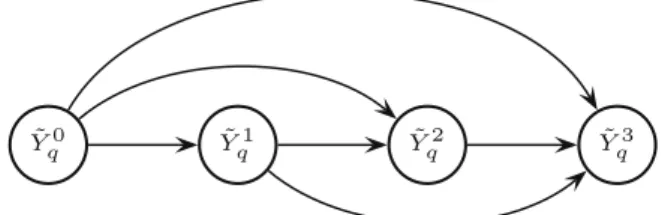
, such that each binary variable corresponds to a different state of Xq. The topology of the cluster is completely connected as for the standard binarization (see Section4.1or the example
in Fig. 4). For the quantification of the conditional probabilities for the binary variables, we assume the following constraint:
P0 eYi
q¼1
¼PðXq¼xqiÞ; ð15Þ
for eachi¼0;1;. . .;di1, whereP0 Yeiq
is obtained taking the product of all the conditional mass functions associated to the nodes of the cluster and then marginalizing overYei
q. Accordingly, the queryXq¼xqiin the original CN corresponds to
queryYei
q¼1 in the exact binarization, a task that can be achieved by L2U.
Finally, let us explain why this approach tends to make the inferences for the first two states ofXq, i.e., those oneY0qandYe1q
more accurate. In fact, according to Eq.(6), 2U assumes mutual independence between the parents ofXi. In general, this
assumption is violated by L2U on multiply connected binary CNs. This originates aconvergence error[9]during the loopy propagation. Consider this error for a queried variableXqwith four possible states, whose special binarization is inFig. 4.
L2U produces a convergence error in the computation of the messages associated toYe2
qby assuming the independence of
e
Y0
q andeY1q, and the situation is even worst forYe3q, while this error is not present in the computation of the messages for
the nodes associated to the first two states ofXq.
Accordingly, we expect GL2U to be more accurate in computing the inferences for the first two states of the queried var-iable. Clearly, if other states ofXqare queried, a simple permutation of the elements ofXqis required before making the
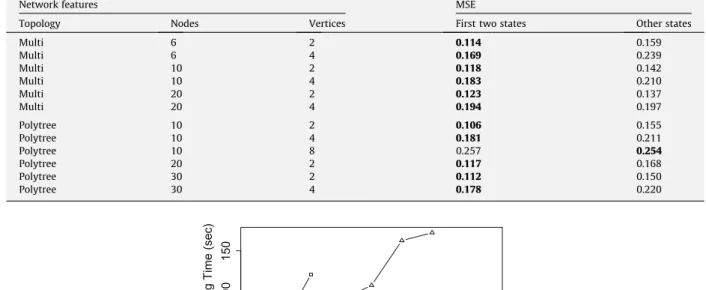
inferences. A numerical analysis of this feature is reported inTable 3.
6. Complexity issues
According to the discussion in the previous section, the computational time required by GL2U to update a CNhG;PðXÞiis basically that required by L2U to updatehG~0;P~0ðX~0Þi. Let us initially consider a single iteration of the algorithm. As noted in
Section3, locally to a nodeX, the complexity isOðp22pÞ, wherepis the indegree ofX. It can be checked thatXedi~i1has the maximum indegree among the~dibinary nodes in the clustereXi; similarly,Xe
~
diþn1
iþn has the maximum indegree among the~diþn
nodes ofeXiþn. Note also that the number of nodes inP~iisPj:Xj2Pi
~
dj. Therefore, the indegrees ofXe
~ di1 i andeX ~ diþn1 iþn are respec-tively~diþd~iþn1 and~diþnþPj:Xj2Pi ~
dj1. Thus, considering that by definition 2
~
di¼d
i, we conclude that, locally to the node
Xi, the complexity of the algorithm can be written as:
O ðdiþndiÞ 2 log2ðdiþndiÞ þ diþn Y j dj !2 log2 diþn Y j dj ! 0 @ 1 A; ð16Þ
where the product overjis intended over all the parents ofXi. Note thatdiandQjdjare, respectively the number of rows and
columns associated to the conditional probability tablePðXijPiÞ, whilediþnis the overall number of vertices associated to the
conditional credal sets specified forXi. Because bothdiþndianddiþnQjdjare smaller thand¼didiþnQjdj, the complexity
of GL2U locally to a node isOðd2log2dÞ.
Note also that any iteration of 2U is linear in the size of the network (if we assume thatddoes not grow as fast as the number of nodes, which is the most natural behavior), and the size of the exact binarization grows of a factor at most equal to 2max2n
i¼1~di with respect to the original network. The factor depends (i) on the decision-theoretic
trans-formation that doubles the number of nodes, and on (ii) the binarization that makes of each node Xi2X0 a cluster of
binary nodesXeiwhose size depends on the logarithm~di of its number of statesdi. We can approximate the global
com-plexity by assuming that the local sizes of the network (that is, the maximum number of states of each variable, the maximum number of vertices of the credal sets associated to these variables, and the maximum number of parents) are not so large (which is in fact a normal situation), and we conclude that any iteration of GL2U is roughly linear in the size of the network.
7. Numerical tests
In order to test the performance of GL2U, we employ a benchmark made of different CNs with random topology, either multiply and singly connected, and two classical (multiply connected) models, namely theAlarmand theInsurancenetworks [10,11]. The maximum indegree for the networks with random topology is limited to 5. The number of states for the Alarm and the Insurance networks is the same as in their original specifications, while for the other networks the number of states is randomly chosen between 2 and 8. All the models are quantified by randomly generated conditional credal sets with a fixed number of vertices, whose number is ranging from 2 to 8 for each network.
We compute both unconditional and conditional inferences on these networks by a Python/C++ implementation of GL2U.9The resulting inferences are compared with the approximateiterated local searchmethod[12](ILS) and the exact
meth-od presented in[13].Tables 1 and 2report these comparisons. The number of inferences over each type of network is shown in the fourth column. Note that such number varies because we only compare inferences where the exact solution can be com-puted. Themean square-error(MSE) is evaluated with respect to the exact solution and the average time of inferences (in sec-onds) is also reported.
The results for the unconditional inferences are inTable 1. Remarkably, for networks with more than 10 nodes, the infer-ences of GL2U are always more accurate, while ILS is more accurate only with small networks. In fact, it seems that the accu-racy of GL2U is not so related to the network size as that of ILS, and this makes GL2U more accurate for larger models.
A similar behavior is observed also for conditional queries (seeTable 2). In these cases, an evidence consisting in the observation of three leaf nodes is randomly generated (for networks with 6 nodes, just one node is observed).
From our tests we also note that the approximated lower (and similarly upper) probability returned by GL2U is equally likely to be greater or smaller than the exact value.
We should also remark that, in some cases, GL2U returns a vacuous posterior interval, even if the exact inference is com-pletely different. This situation has occurred only for conditional queries, in 13% of the cases. A similar behavior is also re-ported to happen in loopy belief propagation for BNs in computing conditional queries[9], but there the number of loops is usually smaller, and such situation is less often observed. A further analysis of the performances of L2U in order to profile
Table 2
Random queries with evidence. The seventh column report the average number of iterations before L2U converge.
Network features # of queries GL2U ILS
Topology Nodes Vertices MSE Time Iter MSE Time
Polytree 10 2 34 0.107 0.09 19.6 0.024 0.19 Polytree 20 2 51 0.112 0.11 26.1 0.218 0.14 Multi 6 2 50 0.173 0.73 26.7 0.024 0.14 Multi 6 4 32 0.170 0.09 12.7 0.050 0.13 Multi 20 2 51 0.144 0.26 28.9 0.191 4.07 Multi 20 4 36 0.204 0.79 5.7 0.271 3.40 9
This software is freely available athttp://www.idsia.ch/~sun/gl2u-ii.htm. Table 1
Random unconditional queries.
Network features # of queries GL2U ILS
Topology Nodes Vertices MSE Time MSE Time
Multi 6 2 167 0.114 0.11 0.016 0.11 Multi 6 4 149 0.169 0.17 0.036 0.15 Multi 10 2 402 0.118 0.14 0.047 1.02 Multi 10 4 205 0.183 0.22 0.052 0.56 Multi 20 2 526 0.123 0.27 0.164 5.93 Multi 20 4 399 0.194 0.36 0.243 12.62 Polytree 10 2 515 0.106 0.11 0.017 0.18 Polytree 10 4 449 0.181 0.11 0.037 0.16 Polytree 10 8 422 0.257 0.32 0.048 0.19 Polytree 20 2 316 0.117 0.07 0.159 0.16 Polytree 30 2 813 0.112 0.17 0.176 0.23 Polytree 30 4 693 0.178 0.31 0.260 0.41 Alarm 37 2 432 0.100 0.07 0.223 0.30 Alarm 37 4 360 0.139 0.09 0.328 0.47 Insurance 27 2 200 0.143 0.09 0.197 42.23 Insurance 27 4 199 0.238 0.20 0.366 65.91
these instances should be therefore considered as a future work. Clearly, algorithms which are not based on loopy techniques like those in[12,14]are not suffering problems of this kind.
As a further remark, let us recall that, according to the discussion reported at the end of Section5.2, we have always per-muted the states of the queried node in order to rank the queried state in one of the first two positions. This makes the con-vergence error smaller; in fact in the tests with non-binary queried variables we have inferences for the first two states 18.1% more accurate than for the other states in the unconditional cases, while the gain is 39.4% in the conditional case.Table 3 reports some detail about this comparison.
Moreover, the running time and the amount of allocated memory for ILS rapidly increases with the size of the net, that makes unfeasible a solution for large nets, which can be instead quickly updated by GL2U (seeFig. 5).
As far as we know other existing algorithms besides ILS are at least exponential in the treewidth of the moralized graph and suffer from the same complexity issues. In fact, comparisons have been done also with thehill climbing(HC) algorithm in [14]. Compared to ILS, HC is slower and run out of memory with smaller networks (see againFig. 5).
8. Conclusions
This paper has proposed a new approximate algorithm for CN updating. This task is achieved augmenting the network by a number of nodes, enumerating the vertices of the credal sets, then transforming the CN in a corresponding network over binary variables, and updating such binary CN by the loopy version of 2U. The procedure applies to any CN, without restric-tions related to the topology or the number of possible states, and the only approximation is due to the loopy propagation. Empirical analysis shows that GL2U is a competitive procedure for approximate inference in CNs both in terms of accuracy and scalability. The algorithm is purely distributed and allows for simultaneous updating of all the variables in the net: these characteristics are usually not shared by optimization algorithms not based on propagation. Moreover, the computational complexity of GL2U makes it possible to solve large nets, which cannot be updated by other algorithms, mainly because of excessive memory consumptions.
Acknowledgments
Work partially supported by the Swiss NSF grants 200021-113820/1 and 200020-116674/1, and Hasler Foundation Grant 2233. Third author thanks also the project ‘‘Ticino in Rete”.
Table 3
Accuracy of GL2U for inference on the first two states and on the other states of the queried variable.
Network features MSE
Topology Nodes Vertices First two states Other states
Multi 6 2 0.114 0.159 Multi 6 4 0.169 0.239 Multi 10 2 0.118 0.142 Multi 10 4 0.183 0.210 Multi 20 2 0.123 0.137 Multi 20 4 0.194 0.197 Polytree 10 2 0.106 0.155 Polytree 10 4 0.181 0.211 Polytree 10 8 0.257 0.254 Polytree 20 2 0.117 0.168 Polytree 30 2 0.112 0.150 Polytree 30 4 0.178 0.220 20 40 60 80 100 50 100 150
Network Size (number of nodes)
Average Running Time (sec)
Fig. 5.Average running time versus network size for HC (squares), ILS (triangles) and GL2U (circles). The HC and ILS sequences are shorter because these algorithms run out of memory for large CNs (8 GB were used).
Appendix A. Proofs
Lemma 1. Consider a CN with a single node X and vacuous KðXÞ:¼KX
XðXÞ, whereX
X#XX. LetKeðXeÞdenote the strong extension
of its binarization (as in Section4.1). Then:
e
KðXeÞ ¼KðXÞ: ð17Þ
Proof (Proof ofLemma 1).
Consider a generic ePðXeÞ 2ext½KeðXeÞ, where eX:¼ ðXe0;. . .;eX ~
d1Þ with ~d:¼log
2jXXj. A corresponding mass function
PðXÞ:¼ePðXeÞcan be therefore defined. Thus:
e Pð~xÞ ¼ Y ~ d1 j¼0 e Pð~xjj~xj1;. . .;~x0Þ; ð18Þ for each~x2Xe Xsuch thatð~x 0;. . .;~xd~1
Þ ¼~x. For eachj¼0;. . .;~d1 and each possible value of their parents, the conditional mass functionsePðXejj~xj1;. . .;~x0Þare vertices of their corresponding conditional credal sets because of Proposition 1 of[4].
Thus, the values of the conditional probabilities on the right-hand side of Eq.(18)are obtained by a minimization as in Eq. (12). The values to be minimized are obtained from Eq.(13), where the conditional probabilities on the right-hand side are the vertices ofKðXÞ, i.e., them:¼ jX
Xjdegenerate extreme mass functions of the vacuous credal setKX
XðXÞ. This means that
there is only a non-zero term in the sum in Eq.(13)and therefore each vertex ofKX
Xproduces a degenerate conditional mass
function for the corresponding binary variable. Consequently, also the extreme values returned by Eq. (12) will be degenerate.
We can therefore conclude that, according to Eq.(18), alsoePðXeÞand hencePðXÞare degenerate mass functions. Let x2XX be the state of X such that PðxÞ ¼1. Considering Eq.(18) for ~x2Xe
X, we conclude that all the conditional
probabilities on the right-hand side are equal to one. Considering the highest order bit, according to Eq.(13)and denoting by PkðXÞa vertex ofXðXÞ, we haveeP ~x ~ d1 j~x ~ d2 ;. . .;~x0
¼PkðxÞ ¼1, that requiresx2XX. Thus,PðXÞ 2ext½KðXÞ, that implies exthKeðeXÞi#ext½KðXÞ, and finallyeKðXeÞ#KðXÞ. On the other side,KeðXeÞ KðXÞbecause of Theorem 2 in[5], and hence the thesis. h
Proof (Proof ofTheorem 1). Given aeP0
ðX~0Þ 2extK~0ðX~0Þ h i
, the following factorization holds:
e P0 x~ 0 ð Þ ¼Y 2n i¼1 Y ~ di1 j¼0 e P0 ð~x j ij
p
~ j iÞ ¼ Y2n i¼1 e P0 ~x 0 i;. . .;~x ~ di1 i jp
~ 0 i ; ð19Þ for each~x02X ~X0, where the values of the other variables are consistent with~x, and the last equality follows from chain rule. Eq.(19)definesP0 ðXij
p
0iÞ:¼Pe0 Xe0i;. . .;eX ~ di1 i jp
~0i .As noted in Section(4.2), for eachi¼1;. . .;nand
pi
2XPi;K0 X
ij
p
0i
is a credal set made of a single point. Thus, as a corollary ofTheorem 1in[5], we haveP0
Xij
p
0i
2extK0 ðXij
p
0iÞ
, being in fact the only element of this credal set. Similarly, for eachi¼1;. . .;n, the credal setK0 Xiþnj
p
0iþn
is vacuous.
Let us regard this credal set as a CN made of a single node. We can invoke Lemma 1 and obtain from
e P0 Xeiþnj
p
~0iþn 2ext Ke0 Xe iþnjp
~0iþn h i thatP0 Xiþnjp
0iþn 2ext½K0ðXiþnj
p
0iþnÞ. Overall, we proved thatP0 ðX
0
Þis a combination of local vertices of the credal sets ofhG0;P0ðX0Þi.
Thus,P0ðX 0
Þ 2ext½K0ðX0Þ, from which ext½K~0ðX~0Þ#ext½K0
ðX0Þ, and finallyK~0ðX~0Þ#K0 ðX0Þ. According to Lemma 1 in[5], e K0ðX~0Þ K0 ðX0 Þ. Thus,K~0ðX~0Þ ¼K0 ðX0
Þ. Marginalizing on both the sides we get eK0ðX~Þ ¼K0
ðXÞ. But Theorem 2 in[4] states KðXÞ ¼K0
ðXÞ, from which the thesis. h References
[1] C.P. de Campos, F.G. Cozman, The inferential complexity of Bayesian and credal networks, in: Proceedings of the International Joint Conference on Artificial Intelligence, Edinburgh, 2005, pp. 1313–1318.
[2] E. Fagiuoli, M. Zaffalon, 2U: an exact interval propagation algorithm for polytrees with binary variables, Artificial Intelligence 106 (1) (1998) 77–107. [3] J.S. Ide, F.G. Cozman, IPE and L2U: approximate algorithms for credal networks, in: Proceedings of the Second Starting AI Researcher Symposium, IOS
Press, Amsterdam, 2004, pp. 118–127.
[4] A. Antonucci, M. Zaffalon, Decision-theoretic specification of credal networks: a unified language for uncertain modeling with sets of Bayesian networks, International Journal of Approximate Reasoning 49 (2) (2008) 345–361.
[5] A. Antonucci, M. Zaffalon, J.S. Ide, F.G. Cozman, Binarization algorithms for approximate updating in credal nets, in: L. Penserini, P. Peppas, A. Perini (Eds.), Proceedings of the third European Starting AI Researcher Symposium, IOS Press, Amsterdam, 2006, pp. 120–131.
[6] J. Pearl, Probabilistic Reasoning in Intelligent Systems: Networks of Plausible Inference, Morgan Kaufman, San Mateo, 1988. [7] P. Walley, Statistical Reasoning with Imprecise Probabilities, Chapman and Hall, New York, 1991.
[8] F.G. Cozman, Graphical models for imprecise probabilities, International Journal of Approximate Reasoning 39 (2–3) (2005) 167–184.
[10] I. Beinlich, H.J. Suermondt, R.M. Chavez, G.F. Cooper, The ALARM monitoring system: A case study with two probabilistic inference techniques for belief networks, in: II European Conference on Artificial Intelligence in Medicine, Springer-Verlag, Berlin, 1989, pp. 247–256.
[11] J. Binder, D. Koller, S. Russell, K. Kanazawa, Adaptive probabilistic networks with hidden variables, Machine Learning 29 (2-3) (1997) 213–244. [12] J.C. da Rocha, F.G. Cozman, C.P. de Campos, Inference in polytrees with sets of probabilities, in: Conference on Uncertainty in Artificial Intelligence,
Acapulco, 2003, pp. 217–224.
[13] C.P. de Campos, F.G. Cozman, Inference in credal networks through integer programming, in: Proceedings of the Fifth International Symposium on Imprecise Probability: Theories and Applications, Action M Agency, Prague, 2007, pp. 145–154.
[14] A. Cano, M. Gómez, S. Moral, J. Abellán, Hill-climbing and branch-and-bound algorithms for exact and approximate inference in credal networks, International Journal of Approximate Reasoning 44 (3) (2007) 261–280.