Open Research Online
The Open University’s repository of research publications
and other research outputs
Learning Analytics for Academic Writing through
Automatic Identification of Meta-discourse
Thesis
How to cite:Bektik, Duygu (2017). Learning Analytics for Academic Writing through Automatic Identification of Meta-discourse. PhD thesis The Open University.
For guidance on citations see FAQs.
c
2016 The Author
Version: Version of Record
Copyright and Moral Rights for the articles on this site are retained by the individual authors and/or other copyright owners. For more information on Open Research Online’s data policy on reuse of materials please consult the policies page.
LEARNING ANALYTICS FOR
ACADEMIC WRITING THROUGH
AUTOMATIC IDENTIFICATION OF
META-DISCOURSE
THESIS SUBMITTED IN PARTIAL FULFILMENT OF THE REQUIREMENTS FOR THE DEGREE OF
DOCTOR OF PHILOSOPHY KNOWLEDGE MEDIA INSTITUTE
THE OPEN UNIVERSITY
Duygu Bektik (née Simsek)
BA & MA (
with 1
stclass Honours Degree
)
in Computer and Instructional Technology Teacher Education
Bilkent University, 2011
MSc. (
with Distinction
)
in Software Engineering
Duygu Bektik: Learning Analytics for Academic Writing Through Automatic Identification of Meta-Discourse.
Submitted in September 2016. Examined in December 2016.
Supervisors:
Prof. Denise Whitelock Dr. Rebecca Ferguson Dr. Anna De Liddo
External Supervisor:
Prof. Simon Buckingham Shum, University of Technology Sydney
Examiners:
Dr. Paul Mulholland, The Open University UK Dr. Gary Wills, University of Southampton UK
ABSTRACT
Effective written communication is an essential skill which promotes educational success for undergraduates. Argumentation is a key requirement of successful writing, which is the most common genre that undergraduates have to write particularly in the social sciences. Therefore, when assessing student writing academic tutors look for students’ ability to present and pursue well-reasoned and strong arguments through scholarly argumentation, which is articulated by meta-discourse.
Today, there are some natural language processing systems which automatically detect authors’ rhetorical moves in scholarly texts. Hence, when assessing their students’ essays,
educators could benefit from the available automated textual analysis which can detect meta-discourse. However, previous work has not shown whether these technologies can be used to analyse student writing reliably. The aim of this thesis therefore has been to
understand how automated analysis of meta-discourse in student writing can be used to support tutors’ essay assessment practices. This thesis evaluates a particular language
analysis tool, the Xerox Incremental Parser (XIP) as an exemplar of this type of automated technology.
The studies presented in this thesis investigates how tutors define the quality of undergraduate writing and suggests key elements that make for good quality student writing in the social sciences, where XIP seems to work best. This thesis also sets out the changes that needs to be made to the XIP and proposes in what ways its output can be delivered to tutors so that they make use of this output to give feedback on student essays. The findings reported also show problems that academic tutors experience in essay
assessment, which potentially could be solved by automated support. However, tutors have preconceptions about the use of automated support. The study revealed that tutors want to
be assured that they retain the ‘power’ themselves in any decision of using automated support to overcome these preconceptions.
ACKNOWLEDGEMENTS
Writing this thesis has been a long learning journey for which I owe several people a debt of gratitude.
First and foremost, I would like to express my sincerest gratitude to my supervisors, Prof. Denise Whitelock, Dr. Rebecca Ferguson, Dr. Anna De Liddo and my external supervisor Prof. Simon Buckingham Shum, for their invaluable guidance, and constant prompt feedback. I would also like to acknowledge Dr. Ágnes Sándor, from Xerox Research Centre Europe, for her collaboration, enthusiasm and willingness to brainstorm and discuss my research ideas and findings.
My deep appreciation and very special thanks go out to Prof. Kevin McConway, for his invaluable statistics advice, mentoring and feedback on all the quantitative aspects of my research; and to Dr. Jackie Tuck, whose excellent help during data collection has made an invaluable contribution towards my PhD. I would also like to thank Dr. Clara Mancini, my third party monitor, for her willingness to help me with anything, any time I needed it. I gratefully acknowledge the financial support and funding received towards my PhD from the Wolfson Open Science Laboratory, and the Knowledge Media Institute. I would also like to thank and appreciate the Institute of Educational Technology for providing an additional work environment for my studies.
I would like to thank my friends who have provided a continual reminder that there are other joys in life besides writing up a thesis. And of course a big thank you to Gillian Çağlayan, who generously gave up her time for helping me enormously with the mammoth
task of proofreading of this thesis, thus improving it.
I believe that I am tremendously fortunate to have the outstanding support of my family, and am deeply appreciative to all of them, for their encouragement, and prayers. Special thanks to my mother, Belgin Özkul, who has supported me throughout this long journey,
and for all of the sacrifices she has made on my behalf. In particular, I have been extremely fortunate in my life to have my grandmother, Nazife Özkul, who has shown me
unconditional love and support in every step of my life, which holds an enormous amount of meaning to me. My dear granny, from now on you no longer need to worry that I will go crazy one day from working too hard; I am done with all my studies.
And finally, but by no means least, I am grateful for the love and tolerance of Mustafa Bektik, the man who has made all the difference in my life. Without his patience and sacrifice, I could not have completed this thesis. To Mustafa, my beloved husband, the cornerstone of my life and the making of me. Thank you for your encouragement, patience, understanding, and support as I snatched moments around family life to write this thesis. I am ready now to live every moment to the fullest!
SHORT CONTENTS
ABSTRACT ... 3 ACKNOWLEDGEMENTS ... 7 SHORT CONTENTS ... 9 GLOSSARY ... 17 PREFACE ... 21 INTRODUCTION ... 23 LITERATURE REVIEW: ... 37 Academic Writing ... 37 LITERATURE REVIEW: ... 63Automated Assessment of Writing ... 63
METHODOLOGY ... 103
THE XIP ANALYSIS OF STUDENT WRITING ... 119
ONE-TO-ONE INTERVIEWS WITH MARKERS ... 173
FOCUS GROUP ... 205
DELIVERING THE XIP OUTPUT ... 249
DISCUSSION AND CONCLUSION ... 279
BIBLIOGRAPHY ... 293
APPENDIX A: Genre families of the BAWE corpus ... 315
APPENDIX C: E000 marking rubric ... 322
APPENDIX D: E000 marking guidelines ... 323
APPENDIX E: E000 tutor recruitment letter... 325
APPENDIX F: E000 semi-structured interview questions ... 326
CONTENTS
ABSTRACT ... 3 ACKNOWLEDGEMENTS ... 7 SHORT CONTENTS ... 9 GLOSSARY ... 17 PREFACE ... 21 INTRODUCTION ... 23 1.1 Writing ... 23 1.2 Undergraduate writing ... 251.3 Role of meta-discourse in argumentation ... 26
1.4 Automatic identification of meta-discourse ... 27
1.4.1 Automated Support ... 28
1.5 Learning analytics ... 30
1.5.1 Discourse-centric learning analytics ... 32
1.6 Structure of this thesis ... 34
LITERATURE REVIEW: ... 37
Academic Writing ... 37
2.1 Introduction ... 37
2.2 Academic writing ... 37
2.2.1 Academic discourse community ... 40
2.3 Academic writing in higher education ... 41
2.4 What really counts in student academic writing? ... 44
2.4.2 What do essay grades tell us? ... 51
2.5 Conventions of academic writing ... 53
2.6 Disciplinary variation in academic writing ... 55
2.7 Chapter Summary ... 61
LITERATURE REVIEW: ... 63
Automated Assessment of Writing ... 63
3.1 Introduction ... 63
3.2 Early history ... 64
3.3 Automated essay scoring and evaluation applications ... 64
3.4 Controversial views on AES: does it really work? ... 66
3.5 How does it work? - Automated text analysis techniques ... 69
3.5.1 The bag of words approach ... 70
3.5.2 Lexical resource-based approaches ... 72
3.5.3 Latent Semantic Analysis (LSA) ... 75
3.6 Automated feedback on student writing ... 77
3.6.1 Summary ... 80
3.7 Argumentative Zoning ... 82
3.8 Xerox Incremental Parser (XIP) ... 86
3.8.1 Background – the XIP syntactic parser ... 86
3.8.2 The XIP rhetorical parser ... 87
3.8.3 The XIP categories ... 88
3.8.4 The XIP algorithm and labelling sentences ... 90
3.8.5 The XIP versioning ... 93
3.9 Gaps in the literature ... 94
3.9.1 Why XIP? ... 97
4.1 Introduction ... 103
4.2 Research aim and questions ... 103
4.3 Research philosophy ... 104
4.4 Research methods ... 109
4.5 Research design ... 113
4.6 Reliability, validity and generalisability ... 114
THE XIP ANALYSIS OF STUDENT WRITING ... 119
5.1 Introduction ... 119 5.2 Study... 120 5.3 BAWE DATASET ... 124 5.3.1 Background ... 124 5.3.2 BAWE study ... 128 5.3.3 Results ... 129
5.3.4 Discussion of the BAWE analysis... 137
5.4 S000 DATASET ... 142
5.4.1 Introduction ... 142
5.4.2 Background ... 143
5.4.3 S000 correlational study ... 146
5.4.4 S000 multiple linear regression study ... 149
5.4.5 Discussion of S000 Analysis ... 151 5.5 E000 DATASET ... 154 5.5.1 Introduction ... 154 5.5.2 Dataset ... 155 5.5.3 E000 assignment ... 155 5.5.4 Assessment ... 156
5.5.6 E000 multiple linear regression ... 159
5.5.7 Discussion of E000 analysis ... 161
5.6 L000 DATASET ... 163
5.6.1 Introduction ... 163
5.6.2 Dataset ... 163
5.6.3 L000 assignments... 164
5.6.4 Assessment ... 165
5.6.5 L000 multiple regression analysis... 165
5.6.6 Discussion of L000 analysis ... 167
5.7 Chapter conclusion ... 169
ONE-TO-ONE INTERVIEWS WITH MARKERS ... 173
6.1 Introduction ... 173
6.2 Study ... 174
6.3 Quantitative analysis of the essay-marking exercise ... 178
6.4 Discussion of the Jaccard analysis results ... 184
6.5 Qualitative analysis of the interviews ... 188
6.6 Themes defining good quality student writing ... 189
6.7 Other themes ... 194
6.8 Discussion ... 200
FOCUS GROUP... 205
7.1 Introduction ... 205
7.2 Study ... 206
7.3 Quantitative analysis of the highlighting activity ... 208
7.3.1 Discussion of the quantitative analysis results ... 213
7.4 Transcription ... 217
7.5 Analysis of the transcribed data ... 219
Theme 1: Quality ... 219
Theme 2: Belief ... 221
Theme 3: Power and politics ... 226
Theme 4: Problems... 229
Theme 5: Changes ... 234
7.6.1 Discussion ... 240
7.7 Conclusion ... 247
DELIVERING THE XIP OUTPUT ... 249
8.1 Introduction ... 249
8.2 Pilot Study ... 249
8.2.1 Motivation ... 249
8.2.2 Visualising the XIP output through the XIP dashboard ... 251
8.2.3 Discussion ... 266
8.3 Main Study ... 267
8.3.1 The user and system requirements ... 268
8.3.2 Specifications ... 270
8.3.3 Prototype ... 272
8.3.4 Discussion ... 277
DISCUSSION AND CONCLUSION ... 279
9.1 Introduction ... 279
9.2 Contributions of this research ... 281
9.2.1 Can automatically identified rhetorical structures predict essay quality? ... 281
9.2.2 How do lecturers judge essay quality? ... 282
9.2.3 Teacher attitudes to automated text analysis ... 284
9.2.4 Proposal for a new marking interface design ... 286
9.4 Agenda for future research ... 288
9.5 Concluding remarks ... 290
BIBLIOGRAPHY ... 293
APPENDIX A: Genre families of the BAWE corpus ... 315
APPENDIX B: E000 learning outcomes ... 320
APPENDIX C: E000 marking rubric ... 322
APPENDIX D: E000 marking guidelines ... 323
APPENDIX E: E000 tutor recruitment letter... 325
APPENDIX F: E000 semi-structured interview questions ... 326
GLOSSARY
The Open University (OU) is a distance learning and research university founded by Royal Charter in the United Kingdom. It has an open entry policy, and nearly all of its courses have no entry requirements, i.e. students’ previous academic achievements are not taken
into account for entry to most undergraduate courses. The OU's undergraduate students study off-campus, undertaking e-learning activities, with the flexibility of deciding when and where to study day-to-day. This glossary is created in order to explain specific terms and definitions used by the OU when referring to courses and job roles.
Course: A programme of study leading to a degree or other qualification.
Module: For each stage of a course, students take a range of modules, which normally involve a specific set of classes on a particular topic, and a specific set of accompanying assignments to complete. Each module has its own code and title, e.g. S288 Practical Science (‘S’ stands for Science and ‘2’ represents a level 2 module).
1st/2nd/3rd levels: At the OU, a level is equivalent to a 1st/2nd/3rd-year course at a bricks and mortar university.
Levels: The modules students take each have a ‘level’, which tells the relative demand,
complexity and depth of the work required. When students complete a Level 1 module, the credit they gain for it is Level 1 credit; a Level 2 module gives Level 2 credit, and so on.
Credit system: The credit system used by the OU is aligned to the national Credit Accumulation and Transfer Scheme (CATS). The CATS system helps students to move the credits they accumulate from one institution to another. If they have completed some previous study at another institution, they may be able to count it towards their OU qualification. The scheme equates one credit (or credit point) with 10 hours of notional learning time (the time, on average, a learner takes to achieve the specified learning outcomes). A module allocated 30 credits or ‘CATS points’ should require students to
commit approximately 300 hours of work to achieving the learning outcomes for the module at a particular level. OU modules carry credits normally ranging from 30 to 60 credits, and will be awarded if students satisfactorily complete a module.
Module team: Module teams oversee the creation and delivery of OU modules. The OU has two types of module team: production and presentation. The production team designs module pedagogy and content, and produces learning materials prior to presentation. The presentation module team maintains a module during its presentation to students. The curriculum manager works collaboratively with the module team chair to ensure that students have a consistent and high quality experience of the module in each presentation. This includes ensuring the learning materials remain up-to-date and accurate, and
maintaining an engaging website for students, managing budgets and contributing to the management of end-of-module examination process.
Module team chairs: The OU module team chairs have the responsibility of providing academic leadership to ensure the coherence, cohesion and quality of the learning experience offered by the module. They have overall responsibility for the work of the module team, and the setting and maintenance of academic standards. Their specific responsibilities are academic leadership, quality assurance and enhancement, research and scholarship, curriculum development, management and administration, and module development and delivery.
Associate lecturers (ALs): Associate lecturers are teaching professionals employed to teach OU students. They are responsible for ensuring the provision of high quality teaching and learning, and support students by making contact at key points in their study, marking and providing feedback on assignments, helping students understand the module material, and helping them prepare for an examination or end of module assessment.
End-of-module assessment(EMA): OU modules usually have two assessment
components: continuous assessment (assignments completed during the module) and an examination or other examinable piece of work such as a project, portfolio or dissertation.
These pieces of examinable work are usually referred to as end-of-module assessments or EMAs.
Tutor-marked assignment (TMA): Continuous assessment can be made up of TMAs or CMAs (computer marked assignments). TMAs are usually essays or short-answer
questions.
Assessment scale: Although some modules use other scales for marking individual assignments, and those will be provided to the students in their assignment material, the overall score for an assignment is recorded and reported using the University Scale, as explained below.
Coordination meetings: On most modules with an EMA, a coordination meeting is held where markers meet with the module team to agree a common interpretation of the marking guide prior to the marking of examinable work. The coordination may be a face-to-face meeting held on the university’s main campus, or may take place online/via telephone. Markers are provided with the marking guide and asked to mark a selection of sample EMAs ahead of the exercise.
PREFACE
The work presented in this thesis has led to the following publications, listed in chronological order.
Simsek, Duygu; Buckingham Shum, Simon; Sandor, Agnes; De Liddo, Anna and Ferguson, Rebecca (2013). XIP Dashboard: visual analytics from
automated rhetorical parsing of scientific metadiscourse. In: 1st International Workshop on Discourse-Centric Learning Analytics, 8 Apr 2013, Leuven, Belgium.
Taibi, Davide; Sandor, Agnes; Simsek, Duygu; Buckingham Shum, Simon; De Liddo, Anna and Ferguson, Rebecca (2013). Visualizing the LAK/EDM literature using combined concept and rhetorical sentence extraction. In: Proceedings of the LAK Data Challenge, 3rd Int. Conf. on Learning Analytics and Knowledge (LAK ’13), 8-12 April 2013, Leuven, Belgium.
Simsek, Duygu; Buckingham Shum, Simon; De Liddo, Anna; Ferguson, Rebecca and Sándor, Ágnes (2014). Visual analytics of academic writing. In: Proceedings of the Fourth International Conference on Learning Analytics and Knowledge - LAK ’14, pp. 265–266.
Simsek, Duygu; Sandor, Agnes; Buckingham Shum, Simon; Ferguson,
Rebecca; De Liddo, Anna and Whitelock, Denise (2015). Correlations between automated rhetorical analysis and tutors’ grades on student essays. In:
Proceedings of the Fifth International Conference on Learning Analytics and Knowledge, ACM, pp. 355–359.
Buckingham Shum, Simon; Knight, Simon; McNamara, Danielle; Allen, Laura; Bektik, Duygu; & Crossley, Scott (2016). Critical perspectives on writing
analytics. In: Proceedings of the Sixth International Conference on Learning Analytics & Knowledge (pp. 481-483). ACM.
The data in the study, as given in Chapter 5.3, come from the British Academic Written English (BAWE) corpus, which was developed at the Universities of Warwick, Reading and Oxford Brookes under the directorship of Hilary Nesi and Sheena Gardner (formerly of the Centre for Applied Linguistics [previously called CELTE], Warwick), Paul
Thompson (formerly of the Department of Applied Linguistics, Reading) and Paul Wickens (Westminster Institute of Education, Oxford Brookes), with funding from the ESRC (RES-000-23-0800).
The design of the rest of the studies presented in this thesis were examined by The Open University’s Human Research Ethics Committee (HREC), and approved as follows:
HREC/2013/1510/Simsek
HREC/2014/1510/Simsek-2
HREC/2014/1510/Simsek-3
Pseudonyms are used for all the Open University module codes and names to ensure the anonymity of participants. The descriptions of the interviewees provided in chapter 6.2 were written in a way that ensured none of the participants were easily identifiable. These descriptions were all checked with the participants themselves.
1
INTRODUCTION
1.1 Writing
he complexity of writing tasks is varied. Depending on the type of writing activity, it can be extremely difficult or quite straightforward. It is fair to say that on a typical day most students and academics perform some sort of writing, some of which is trivial. Although everyday writing tasks often seem to be effortless, such as jotting down a to-do list for the day, or leaving a note to a milkman, when it comes to writing an essay for a university assignment it takes much longer to put ideas down on paper, even though using information technology allows us to write faster than writing by hand.
Typing and writing are not necessarily the same activities, however. They are carried out in different places and with different equipment. Computers produce text in response to dictation, and correct spelling automatically most of the time. Text written by hand using pen and paper can be re-arranged on the page easily and can incorporate little doodles and diagrams. Without getting into the discussion of whether ‘the pen is still mightier than the keyboard’ (Chemin, 2014), when this thesis talks about writing, it actually means talking about the act of writing using a computer.
Writing for an assignment requires more effort than jotting down a to-do list. An obvious reason is that every day scribbling does not require structured writing, sentences or
paragraphs, unlike a university assignment (Sharples, 1999). Most everyday handwriting is unstructured, short, and may be listed in bullets for non-critical readers (such as writing
reminders on a post-it note: 1) money to milkman, 2) grocery shopping, 3) dentist
appointment at 3pm, etc.). Writing such notes requires authors to structure their thoughts, rather than their writing, to make sure everything they want to say or remember is recorded on the paper.
University assignments require more complex structured writing prepared for a critical reader. Such writing is composed for ‘knowledge telling’, restating back what has been already known such as definitions, facts, and theories; and/or for ‘knowledge
transforming’, meaning retelling the knowledge with a new perspective and with a critical eye (Grabe & Kaplan, 1996).
When the knowledge is created and transformed, it requires not only structuring one’s own thoughts but also configuring for the critical reader so that s/he can grasp the meaning. As Vygotsky (1988) observed, writing is not simply writing what has been already known (knowledge telling), but it requires pre-processing what we intend to write through inner speech:
It is no surprise that written speech is the polar opposite of oral speech. The situation that is clear to the interlocutors in oral speech, and the potential for expressive intonation, mimic and gesture, is absent in written speech. The potential for abbreviation is excluded from the outset. Understanding must be produced through words and their proper combination. Written speech facilitates speech as a complex activity. This underlies the use of the rough draft. The path from the rough to the final draft is a complex activity. However, even without the rough draft, the process of reflecting on one's work in written speech is extremely powerful. Frequently, we say what we will write to ourselves before we write. What we have here is a rough draft in thought...this rough draft that is constructed in thought as part of written speech is inner speech. Inner speech acts as an internal rough draft in oral as well as in written speech.
“Writing is analytic, requiring evaluation and problem solving, yet it is also a synthetic, productive process” (Sharples, 1999, p. 10). Although most people know the structure of a
thank you letter, few people can turn out a university assignment, short story, a technical report without preparing the structure in advance (Sharples, 1999). Texts longer than a
couple of paragraphs generally conform to an overall structure that frames the style and content of the text and organises the expectations of the reader.
The difficulty of writing a university assignment could be explained as more than the need for a macro-structure; the writing of such essays is usually a thought-provoking activity that requires particular skills of critical thinking and argumentation which are not ‘a student’s mother tongue’ (Sommers & Saltz, 2004). Accepting Toulmin's (2003)
definition, within the context of this thesis, argument can be defined as an assertion or a claim and its justification (Toulmin, 2003). The term argumentation can be defined as the process of arguing, giving reasons where claims are justified and evidenced through written text. Students, especially those in their first year at university, are unused to this form of writing, and most of them see themselves as novices (Sommers & Saltz, 2004). In order to understand how computers can help with academic writing, it is essential to look at both the literature on academic writing in general as well as what academic writing actually means, particularly in higher education, and what students are required to do to deliver a good essay. This is discussed in the first part of the literature review, in next chapter.
1.2 Undergraduate writing
One of the key requirements of good academic writing in undergraduate higher education courses is that students must develop a critical mind, and learn how to construct sound arguments in their discipline. When assessing student essays, educators look for students’ ability to present and pursue well-reasoned and strong arguments, and for their ability to use examples, and evidence for and against a particular position.
Research investigating the fundamental features of good student writing has found that argumentation is a key requirement. “Argumentation is a key requirement of the essay, which is the most common genre that students have to write” (Wingate, 2012, p. 145).
However, since novice student writers join higher education with partial or incorrect conceptions about argumentation (Wingate, 2012), they are not familiar with what they are expected to produce and they have difficulty in constructing argumentative pieces.
Undergraduate students struggle with argumentation: they are either unaware that they are expected to develop an argument in their essays, or have difficulty in arguing (Bacha, 2010; Davies, 2008), often because they have learned different concepts of argument at secondary school (Andrews, 1995).
Additionally, between students and their academic tutors, there are mismatched views regarding how student academic writing should be carried out and what good student academic writing looks like. The problem is not only that novice student writers come from relatively different backgrounds of school culture, but also because argumentation is often not adequately explained by their academic tutors, who often only vaguely
understand how argumentation is realised in writing in different disciplines and therefore struggle to provide effective feedback which would prompt good examples of
argumentation (Lea & Street, 1998; Mutch, 2003).
1.3 Role of meta-discourse in argumentation
Argumentation is articulated by meta-discourse. Meta-discourse refers to the features of text that provide linguistic cues which engage the readers, and explicitly convey the authors’ intended meaning, expressing their viewpoint, argument and claim, and signaling their stance (Hyland, 2005). Rather than simply defining meta-discourse as ‘discourse about discourse’, Hyland (2005) defined the concept of ‘meta-discourse’ as an important element of the document, that is not only used to organise ideas but also to relate to readers. It is an umbrella term that helps to relate the text to its context, which glues the important parts of a text together but, more significantly, it helps readers to understand existing knowledge and strategies used by other members (authors/researchers) of the subject area, as well as the writer’s stance towards these.
One of the aims of writing is to convince readers of the validity of claims and arguments (de Waard et al., 2009). Therefore, authors put forward their claims to persuade and engage readers that their argument is valid. Since meta-discourse signals the problem, claim, argument, and evidence within writing, it allows readers to clarify the author’s intention, to make meaning of a text (Williams, 2007).
When assessing student writing, academic tutors, as critical readers, look for students’ ability to present and pursue well-reasoned and strong arguments through scholarly
argumentation. Academic tutors will therefore necessarily be examining meta-discourse in students’ writing as signals of the intellectual moves that make their reasoning visible.
1.4 Automatic identification of meta-discourse
Natural language processing (NLP) is the automatic processing of human language, natural language, such as English, rather than a specialised artificial computer language. “NLP is the application of computational methods for the purpose of analysing language-related characteristics of electronic files of text or speech” (Shermis & Burstein, 2013, p. 56). Today, some natural language processing systems exist which automatically detect authors’ rhetorical moves in scholarly/academic texts. One approach to automatic identification of rhetorical moves, meta-discourse, is ‘Argumentative Zoning’ (Teufel, 1999), and another approach is ‘Xerox Incremental Parser’ (Aït-Mokhtar, Chanod, & Roux, 2002), both explained in detail in the next chapter.
The archaic definition of rhetoric is the art and study of the use of language with persuasive effect in any given field (Dawson, 1998); the art of trickery, a way of masquerading and obscuring information (Maynard, 1998). A more contemporary
definition of rhetoric refers to the skill to analyse, evaluate and employ writing strategies in order to respond to the audience and being aware of one’s own ideological stance and the audience’s stance (Cook, 2002). Rhetorical ‘move’ refers to “a discoursal or rhetorical unit
that performs a coherent communicative function in a written or spoken discourse” (Swales, 2004, p. 228).
When assessing their students’ essays, educators could benefit from the available
automated textual analysis which can detect meta-discourse. In this way, academic tutors could also overcome the issue of providing effective practical examples of what
argumentation should look like with readily available automatic machine output. However, the issue of whether these technologies can be used to analyse student writing reliably has not yet been adequately investigated.
This thesis investigates whether computational language technologies can automatically identify the attributes of good academic writing in undergraduate student writing and, if this proves possible, how best to feed back an actionable analysis in order to support educators in their essay assessment processes. In particular, it examines what makes good quality student writing, whether student writing across disciplines can be analysed
automatically in order to detect the presence of good quality writing, and how automated support should be integrated into tutors’ essay assessment practices.
1.4.1 Automated Support
Assessing written texts is a labour-intensive process for academic tutors. Marking and giving detailed feedback, and commenting on essays can be time-consuming, which was the reason for Page (1966) to come up with an idea of using computers to analyse essays automatically back in late 1960s, and to support tutors who spend so much time marking papers and are then burdened with hours of grading them.
Although automated support seems to be useful to overcome the problems stated above, there has been an ongoing tension between the writing teachers, researchers, academic tutors and markers on the one side and the developers of such automated technologies on the other regarding the use of automated essay evaluation. “There is an inherent suspicion that technology can corrupt the essence of a fundamentally human activity” (Elliot &
Williamson, 2013). Since many tutors see automated technology as a threat instead of support, this tension has often appeared in academic literature. For instance, Carl Whithaus, a writing teacher and researcher at the University of California, Davis, opened up his foreword for the Handbook of Automated Essay Evaluation with the following:
When I was invited to write this foreword, I was both delighted and terrified. I was delighted because two of the leading researchers of Automated Essay Evaluation (AEE) software were asking a writing teacher and researcher to weigh in on a collection of essays about “the state of the art” in their field. I was terrified because the drumbeat of criticism about AEE, or “robo-grading” as its critics like to call it, had jumped from relatively obscure academic forums… I was worried because writing this foreword would very publicly place me in the camp of being a proponent of AEE. No matter how guarded and nuanced my position in favour of AEE was, it was certain to be criticised by a wide range of my colleagues and friends in writing studies. I did wonder whether I should write this foreword or not (Shermis & Burstein, 2013, p. vii).
The tension is originated by the awareness of the limitations and dangers of such automated text analysis systems and what such systems cannot do. Critiques in Ericsson and Haswell's (2006, pp. 5-6) collection provide the following reasons for this tension. Writing teachers and researchers are worried because they question
whether such systems can be gamed or fooled, and whether students can break these systems
whether machine analysis programs can fully understand the meaning of texts
how students would react when they find out their work has been evaluated automatically
how closely such software matches the careful evaluation of writing teachers
where automated text analysis leads the teaching profession, would tutors have greater or less control over courses.
Scepticism and criticism have accompanied automated essay analysis over the years (Attali & Burstein, 2006). In 2013, the international journal of Assessing Writing, a referred
journal on the assessment of written language, dedicated a whole special issue to the automated assessment of writing. This special issue described this critique as follows:
Those who have devoted their careers to the study, teaching, and assessment of writing view writing not as a simple behaviour easily evaluated through computer algorithms; rather, writing researchers view composition as a rich and nuanced activity informed by myriad discursive and non-discursive purposes, practices, and perspectives (Elliot & Williamson, 2013, p. 1).
“The past has been marked by an argument rather than dialogue: one side is the researchers and developers of such systems and the other side is the critique of such systems from writing teachers and researchers” (Shermis & Burstein, 2013, p. ix). Since neither side has yet to reach a compromise, this issue will be further discussed in the literature review, as this thesis investigates the use of automated analysis of meta-discourse in student writing to support tutors’ essay assessment practices. Therefore, it is important to acknowledge this tension and unpack it further.
In addition to the technical aspect of this thesis, i.e. automated analysis of meta-discourse in student writing which has been introduced above, the following section introduces the learning aspect of this thesis.
1.5 Learning analytics
The growing number of data sets and the opportunity to study these using computational techniques has led to the development of analytics. The term analytics refers to the
processes of studying such data sets and analysing them to measure, improve, and compare the performance of individuals, programmes, departments, or institutions (Norris, Baer, & Offerman, 2009). Analytics technology aids decision makers to find the best course of action by evaluating large data sets (Brown, 2011). “Analytics is the process of developing actionable insights” (Cooper, 2012, p. 3), and action analytics refers to “analytics
capabilities and practices that are powerful, immediate, and lead to outcomes that are useful to a wide variety of stakeholders” (Norris et al., 2009, p. 1).
Analytics is used in business and science to describe computational support for capturing digital data trails to provide rapid feedback, timely interventions and to help inform decision-making processes. Learning analytics brings this concept into an educational context and considers how learning data should be analysed to improve learning and the environments in which it occurs, based on the assumption that big data and analytics can add value to education by shaping its future (Siemens & Long, 2011).
The Society for Learning Analytics Research defines learning analytics as “the
measurement, collection, analysis and reporting of data about learners and their contexts, for purposes of understanding and optimizing learning and the environments in which it occurs”. Digital data trails produced by learners, such as log-in information, rates of participation in specific activities, the amount of time students spend interacting with online resources, etc. can be used to understand what happens during learning processes and can be useful to find out what kind of improvements should be carried out by educators (Siemens & Long, 2011). Additionally, analysis of learner-produced data can provide detailed information about the potential problems experienced by students who might need additional support (Siemens & Long, 2011). It can help not only learners by showing their own progress and learning habits back to them but also educators to understand the impact of changing various elements in learning processes.
The type of data gathered varies by institution and by application, but in general it includes information about the frequency with which students access online materials or the results of assessments from student exercises and activities conducted online. Since the focus of this thesis is on the automatic identification of discourse elements in students’ writing, learning analytics based on discourse elements will be a main theme for this thesis, which is explained in the next section.
1.5.1 Discourse-centric learning analytics
Most learning analytics applications provide quantitative information about learners, e.g. based on how many times they have logged in to learning platforms, viewed a forum post, and replied to it. However, learning analytics can move beyond reporting these simple quantitative logs, and provide information on the quality of these contributions students made (Buckingham Shum, Knight, & Littleton, 2012). One interest for learning analytics is in its potential for the analysis of discourse data (Buckingham Shum & Ferguson, 2012).
Researchers are beginning to draw on extensive prior work on how tutors mark essays and discussion posts, how spoken and written dialogue shape learning and how computers can recognize good argumentation, in order to design analytics that can assess the quality of text, with the ultimate goal of scaffolding the higher order thinking and writing that we seek to install in students (Buckingham Shum et al., 2012, p. 6).
Discourse-centric learning analytics is a term first defined by De Liddo, Buckingham Shum, Quinto, Bachler, and Cannavacciuolo (2011) in the first Learning Analytics and Knowledge conference (LAK). De Liddo et al. (2011, p. 6) motivated a learning analytics that focuses on “learners’ discourse as a promising site to identify patterns of meaningful learning”. Their work identifies the rhetorical attitude of learners towards discourse contributions, like arguments supported and rejected by learners, the evidence they used for such arguments, and emerging questions.
Following this, the first discourse-centric learning analytics (DCLA) workshop
(Buckingham Shum et al., 2013) held at the third LAK conference proposed a mission statement for DCLA: “to devise and validate analytics that look beyond surface measures in order to quantify linguistic proxies for deeper learning” (Ferguson, De Liddo,
Whitelock, De Laat, & Buckingham Shum, 2014, p. 1). In 2014 as part of the fourth LAK conference, the second DCLA workshop was held with a focus on the intersection of learning analytics research, theory and practice: “once researchers have developed and
validated discourse-centric analytics, how can these be successfully deployed at scale to support learning?” (Ferguson et al., 2014, p. 1).
Learning analytics with a focus on the use of discourse to support learning and teaching are being developed at the intersection of fields such as automated assessment, learning
dynamics, deliberation platforms, and computational linguistics. Ferguson et al. (2014) questioned what steers such developments towards the category of learning analytics, as opposed to research that sits in any of the other categories: their use or potential to generate actionable intelligence specifically in the context of learning, such as helping educators to understand significant discourse patterns.
The definition for this addition to learning analytics came from Knight and Littleton (2015, p. 17): “DCLA focuses on analytics to support high quality discourse for learning contexts; it consists of analysis of discourse data, creation of effective feedback to learners and educators, and the validation and theorising of our analytic techniques”.
The ‘D’ in DCLA stands for discourse coming not only from student writing but also from social interactions, online discussions, forum posts, and exploratory dialogue. As the DCLA workshops had already produced a couple of papers on extended student writing, at the sixth LAK conference a new workshop was held specifically focusing on discourse in student writing, called ‘Critical perspectives on writing analytics’ (Buckingham Shum, Knight, et al., 2016). “Broadly defined, writing analytics involves the measurement and analysis of written texts for the purpose of understanding writing processes and products, in their educational contexts” (Buckingham Shum, Knight, et al., 2016). This workshop therefore focused on analytics that can help to gain a better understanding both of the writing process as well as the final product, and of the pedagogical context in which writing analytics should take place, i.e. how to embed writing analytics meaningfully within a pedagogical context.
DCLA as a sub-area of learning analytics does not only take an interest in computational-analytic techniques for discourse but also in the explicit learning implications of those techniques (Knight & Littleton, 2015); this is why this thesis is part of the field of
discourse-focused learning analytics. The next section sets out the thesis structure for the remaining chapters.
1.6 Structure of this thesis
The current chapter has provided an introduction to the aim, approaches and concerns of this thesis, as well as to three fields, and this thesis sits right at the intersection of those fields: academic writing, automated analysis writing and learning analytics. The rest of the thesis is organised as follows:
Chapters 2 & 3: Literature Review
The next two chapters locate this thesis more firmly within the existing literature, and review the previous theoretical and empirical work on which it is based. The literature review has been divided into two chapters: academic writing and automated assessment of writing. In particular, it investigates what really matters in student academic writing, what educators think good student writing is and how this differs within specific disciplines. It also provides detailed accounts of key approaches to automated text analysis.
Chapter 4: Methodology
The fourth chapter focuses on the research aim, philosophy and datasets used for analysis: their selection, collection and rationale. The mixed-methods approach that is adopted in this PhD research is discussed along with a justification for the choice of the
methodologies. The research methods used in this thesis – together with regression analysis, focus group, and one-to-one interviews – are described and their advantages, disadvantages and ethical concerns are considered.
Chapter 5: The Automated Analysis of StudentWriting
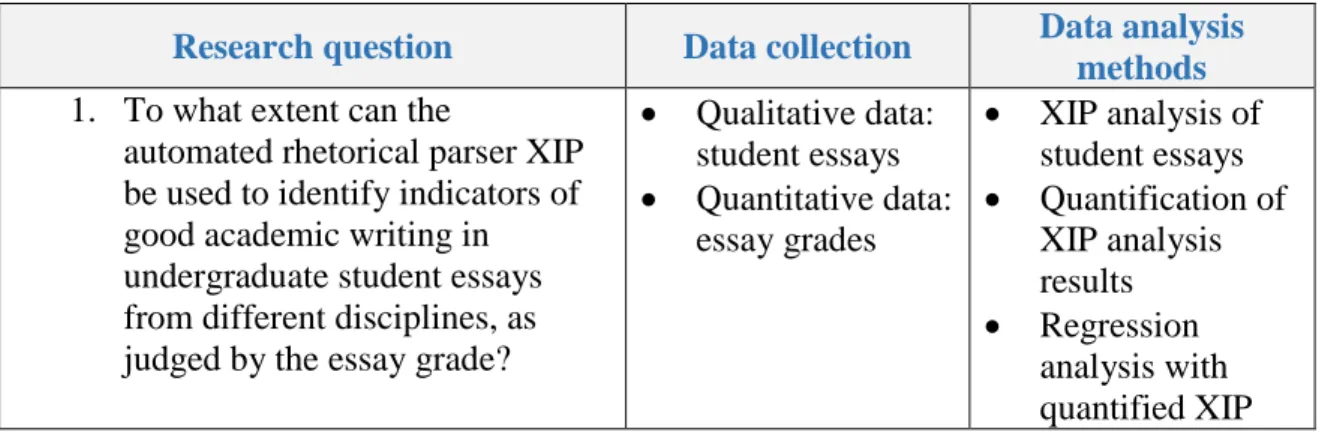
The first analysis chapter addresses the question ‘To what extent can the automated rhetorical parser XIP be used to identify indicators of good academic writing in
undergraduate student essays from different disciplines, as judged by the essay grade?’. It explores how well automated meta-discourse analysis works across disciplines through quantitative regression analysis by using various datasets, student writing and their essay mark, from different disciplines and levels.
Chapter 6: One-to-one Interviews with Markers
The second analysis chapter asks ‘How do educators define the attributes of good student writing and to what degree can the automated rhetorical parser XIP identify the presence of these attributes?’ It investigates how educators define the quality of student writing, what they give credit for when marking a student essay, and to what extent automated rhetorical analysis can capture these.
Chapter 7: Focus Group
The third analysis chapter addresses the question, ‘How congruent is the XIP analysis of student essays with educators’ judgement of quality?’ It explores the possibilities of integrating an automated rhetorical analysis into educators’ essay assessment practices.
Chapter 8: Making use of the output
The final analysis chapter addresses the question, ‘In what ways should the output of the
XIP analysis of student essays be delivered to educators so that they make use of this output to give feedback on student essays?’It explores what educators would require to make use of the output of such automated analysis so that it would support their essay assessment processes. The user and system requirements are investigated through
Chapter 9: Discussion and conclusion
The final chapter employs the findings reported in Chapters 5 to 8 in order to answer the main research question, ‘To what extent can the automated rhetorical parser technology be used to identify indicators of good academic writing in undergraduate student essays and to support educators’ feedback processes?’ It considers how successful the research has been in fulfilling its aims, and goes on to identify its original contributions before outlining an agenda for future research.
2
LITERATURE REVIEW:
Academic Writing
2.1 Introduction
“Writing development is painstakingly slow because academic writing is never a student's mother tongue.” (Sommers & Saltz, 2004, p. 145) his thesis focuses on ‘student academic writing’, which refers to argumentatively written student essays that require students to acknowledge the literature, the debate between researchers and then build on these ideas with a critical eye. The genre of writing is ‘argument writing’ which is the most common genre that undergraduates have to write (Mei, 2006) particularly in the arts, humanities and social sciences (Hewings, 2010). Therefore, ‘student academic writing’ in this thesis does not deal with the other genres of writing that students might engage in during their studies such as creative writing,
interpretive writing, descriptive writing, reflective writing, case study reports, and factual technical reports. Clearly, targeting all kinds of undergraduate student writing would be complex and unsuitable considering the different requirements each of these writing types require. Therefore, this thesis focuses solely on argument writing as a genre.
2.2 Academic writing
In the academy, knowledge is built and produced primarily in written form (Bazerman, 1988). The written text, published in a journal or book, is a definitive form of claims and
arguments, which build on prior work, leading to future claims (Bazerman, 1988). When writing an academic piece, writers make sense of other writers’ points of view and decide
when to attribute an idea to another writer, which is appropriate to the academic
community to which they belong (Hyland, 2002; Ivanič, 1998). Academic writing is an act of self-representation, personal conviction or ‘voice’ in the writing which not only conveys disciplinary content, but also carries a representation of the ‘author identity’ which is the author’s stance towards the subject (Andrews, 2003; Hyland, 2002).
Journal paper writing, book writing or other sorts of experienced research writing is not the same genre as undergraduate writing, as they require different discursive moves. A
discursive move as part of a written discourse contains a set of communicative acts related by a goal or theme. Discursive moves can serve authors to motivate, instruct, explain, compare, or summarise depending on the goals. For instance, in the field of biochemistry, authors can use discursive moves to provide an introduction to their study, stating the purpose, describing the procedures, presenting the findings, and stating the limitations (Kanoksilapatham, 2005). As an illustration, the following sentences are taken from an introduction of a biochemistry journal article, conveying the author’s rhetorical moves as:
making topic generalisation: “Protein export pathways are less well characterized, although...” (Kanoksilapatham, 2005, p. 274).
indicating a gap: “Consequently, how related the serotonin N-acetyltransferase catalytic mechanism will be to that of other superfamily members is unclear” (Kanoksilapatham, 2005, p. 275).
presenting findings: “Our results show that U2snRNP is functionally associated with the E complex and is also required for its assembly” (Kanoksilapatham, 2005, p. 276).
The way in which authors use discourse moves to convey similar meaning might vary in different disciplines. Additionally, the types of discourse moves used might vary between disciplines; in specific disciplines certain moves might not be widely preferred. For
example, in the field of economics authors might not prefer to indicate a gap in their introductions, whereas in medicine they might do so extensively (Ryvitytė, 2003). Although experienced research writing authors are generally expected to present new arguments, indicate gaps in their fields, and present their studies and findings, many of these discursive moves are not expected to be found in undergraduate student writing. The discourse moves introduced above are examples taken from journal papers, but discourse moves are also part of student writing. For instance, Ivanič put the phrase ‘writer identity’ at the centre of undergraduate writing (Ivanič, 1998; Lillis & Turner, 2001). The word identity here explains how student academic writing should be perceived. It needs to move beyond simply reporting findings or expressing others’ ideas, to employing accepted rhetorical resources in a particular genre and social community (Hyland, 2002). This enables students to evaluate, and internalise what has been said in that social community in order to develop their own perspective, ‘voice’ within the community, allowing them to adopt more sophisticated skills (sophisticated writing skills are higher order writing skills such as argumentation or organising ideas coherently, whereas lower order writing skills are things like spelling, punctuation, or grammar).
“Writing encompasses a wide range of skills, from the mechanics of punctuation and spelling to the systematic or even creative development of ideas. The higher order skills of communication necessarily involve critical thinking and problem solving...” (White, 1993, p. 3). Students do not add anything from their identity when the issue is spelling and sentence structure; they do what they should specifically in order to produce grammatically correct sentences. When they develop arguments, conduct research, or solve problems, however, they think of themselves as individuals (White, 1993), and their identity plays the role. The significance of creating one’s personal views and opinions in the making of text has been signalled several times through seminal works on academic writing, see for instance (Bakhtin, 1981; Clark & Ivanič, 1997; Fairclough, 1992).
2.2.1 Academic discourse community
While academic writing allows student writers to develop personal views, opinions and identity in their disciplinary area, it also enables them to adopt the practices and discourses of a community in which they are involved. Academic writing provides a way of
expressing perspectives and ideas in ways similar to other members of this community (Hyland, 2002). As defined by Swales (1990), a discourse community has six defining characteristics:
1) a broadly agreed set of common public goals
2) mechanisms of intercommunication among its members
3) it uses its participatory mechanisms primarily to provide information and feedback 4) it utilises and hence possesses one or more genres in the communicative
furtherance of its aims
5) in addition to owning genres, it has acquired some specific lexis (“the total stock of words in a language; the level of language consisting of vocabulary, as opposed to grammar or syntax” (Oxford English Dictionary, lexis))
6) it has a threshold level of members with a suitable degree of relevant content and discoursal expertise.
What it means to be a member of a specific academic discourse community, constituted by a range of values, assumptions and practices, is generally found challenging by most higher education students embarking on their studies, who need to learn the expectations and norms of academic discourse communities of their disciplines (Ivanič, 1998). Teaching students to write for their undergraduate courses initiates them into the academic discourse community (Bizzell et al., 1982). A discourse community is a group of people who
generally have a shared interest, goals or purposes and use written communication to achieve these goals (Borg, 2003; Swales, 1990).
Students might not be a part of a discourse community that relates solely to argumentative writing; but to position themselves within an academic discourse community, newcomers need to learn the expectations of this community with regard to written texts, and this has implications for the teaching of writing within academic communities (Atkinson, 1997; Borg, 2003; Swales, 1990; Wenger, 1998). “There are different literacies in different contexts, so that students need to learn the specific characteristics of academic writing, and of the disciplinary culture into which they are entering” (Ivanič, 2004, p. 222).
Consequently, educators should be aware of how academic conventions position students, and be sensitive to the struggles of novice writers (Hyland, 2002). That is why there is “an important consciousness raising task to ensure students understand the rhetorical options available to them and the effects of manipulating these options” (Hyland, 2002, p. 1111) so that such understanding will give an insight to the learners about how to control their writing and how to meet the challenges of participating in academic genres. To ensure that students can understand this, various research studies have been conducted, which are outlined in the following sections. These studies range from finding generic conventions for academic writing in general, to defining genre-specific expectations, needs and requirements of different academic communities. Before moving on to differences and similarities between disciplinary discourses, the next section will give an overview of the role of academic writing in higher education, and discuss what really is important in student essays and what the academy requires students to write.
2.3 Academic writing in higher education
While many undergraduates view academic writing as the “acquisition of correct
information and right answers”, it actually requires “analytical or argumentative thinking”
(Bean, 2011). It is a process of joining conversations with people who are disagreeing with each other or who have shared interests in seeking answers to questions (Bean, 2011).
Therefore, academic writing in higher education enables professional advancement for university students as it nurtures thinking and reflection.
However, students’ writing background dates back to school writing, which differs from student academic writing in higher education. “After their long experience with the schoolroom essay, and long contact with rules and pronouncements about good writing, university students suddenly face many examples of expression that contradict the schoolroom tradition” (Giltrow, Gooding, Burgoyne, & Sawatsky, 2014, p. 9).A significant difference between secondary school and university writing is that the university is a research institution that produces new knowledge through observation, experiments and interpretation of the existing world, “…the kind of writing that suits the schoolroom tends not to suit the university classroom” (Giltrow et al., 2014, p. 9).
Although undergraduate students are learners at the university rather than researchers, they are taught by educators who mostly trained as researchers and who read and write research publications. Therefore, undergraduates are expected to adopt higher order writing skills such as argument writing and criticality, which are not taught or necessarily practised in secondary-school years.
Undergraduate students typically specialise in well-established disciplinary areas to become for instance a ‘mathematician’ or an ‘historian’. In England, degree courses usually offer single honours degree to students, specialising through a limited number of courses. Therefore the role of writing in higher education has been limited to subject-specific courses that require this skill and it has not been considered necessary in disciplines such as mathematics (Lea & Street, 1998; Lillis & Turner, 2001). However, writing proficiency in general is an essential skill that higher education students should learn for effective communication; and they should “[…] experiment with different kinds of writing because experimentation forces one to develop new forms of perception and thought, a new and more complex sensibility” (Sommers & Saltz, 2004, p. 128).
A common reason for the lack of academic writing modules in higher education is a belief that students already knew how to write before coming to the university (Ganobcsik-Williams, 2006). In England for instance, many students need a good pass in English language which covers essay writing in order to start a course in most of the traditional universities. Additionally, students who take advanced level (A-Level) courses between the age of 16 and 18 to qualify for university entrance have prepared for their degrees with discipline-specific A-Level courses. A student who wants to study law at university can take A-Level courses such as history, English language and German, including the writing requirements of these subjects. However, undergraduates, especially in their first years, find the university writing difficult which is an activity that takes more time than they expected (Sommers & Saltz, 2004).
No matter how many essays they wrote during their studies before coming to the university, it is essential to bear in mind that school and university essays are different genres, and the latter requires particular advanced skills. Moving from a school culture to an academic culture, when senior students are asked to look back and reflect on their first year, they might define the writing activity as building a house without any tools
(Sommers & Saltz, 2004, p. 131). Therefore, no matter from what school culture they come, every student in higher education needs to acquire the academic writing skills appropriate to their level and discipline.
Lea (1995) suggests that in order to understand more about student writing, it is necessary to consider writing within an institutional or disciplinary context where students actually produce written text, rather than examining frameworks that conceptualise writing in terms of study skills. She also suggests that there is a gap between the expectations of academic staff and student in respect of writing, which needs to be considered when researching academic writing in higher education. Although Lea identified this gap in 1995,
researchers have also identified it in much more recent studies, see for instance (Giltrow et al., 2014; Walvoord, 2014).
The following sections therefore deal with studies of this gap with the aim of gaining a full understanding of what academics really value in student writing, what they care about most, what they expect to see, and how they actually assess undergraduate essays.
2.4 What really counts in student academic writing?
Learning in higher education involves new ways of understanding, interpreting and organising knowledge. Student academic writing is therefore more than punctuation and grammar. Academic literacy practices, which mean the ability to read and write within disciplines (Lea & Street, 2006), are key for university students to learn new subjects and to develop their knowledge about a new area of study.
Almost two decades ago, many academic staff claimed that standards of student literacy were decreasing each year, and that undergraduate students could no longer write (Lea & Street, 1998). Although 17 years have passed since Lea & Street (1998) made this
assertion, academics are still upset about their students’ writing abilities and they often say
their students do not write well and that they really want them to write better (Giltrow et al., 2014; Walvoord, 2014). Even though several research studies have been carried out in the past two decades, this problem has remained. It is important to point out this unsolved problem and look for its underlying reasons. One reason for the problem is given as being the contrasting views between students and academics regarding the expectations and interpretations of written assignments (Norton, 1990; M. Lea & B. V. Street, 1998; Lillis & Turner, 2001; Andrews, 2010). The following sections provide details about studies
designed to understand the views of both students and academic staff regarding academic literacy practices.
2.4.1 Mismatched expectations: students vs. tutors
The distinction between school culture and research culture in higher education discussed above explains why academics complain about their students’ writing abilities (Wingate, 2012). There should be a smooth transition from school culture to research culture that enables student writers to ‘join conversations’ (Bean, 2011; Giltrow et al., 2014) with the academic community they belong to, whose researchers disagree with each other and/or have a shared interest in finding out answers to questions. When they learn to be part of the conversation by acknowledging others’ opinions to develop their own perspective, student
academic writing is more likely to satisfy the tutors. Although most students enter university without this ability, they can gain this skill and become part of the research culture if they are nurtured well (Giltrow et al., 2014). For instance, the four-year
longitudinal study that Sommers and Saltz (2004) carried out with 422 students from the entire Harvard Class of 2001 covering all disciplines and subject areas contributed to the knowledge that students can gain this skill during their studies as they make their way to their final year.
Lillis (2002) shares how, as a tutor, she witnessed the struggles of students whose
difficulties primarily centred on academic writing. She summarises the problem as students trying to ‘write within rules of the game’ without knowing what the rules actually are.
There are various studies showing how these rules differ in the perceptions of tutors and students. Although the Sommers and Saltz (2004) study provides students’ perceptions from the Harvard class of 2001, there are some studies that investigate both sides with the aim of identifying the differences between the views of tutors and students on what university writing is. Lea and Street (1998), for instance, carried out a study within one new and one traditional university in England that involved semi-structured interviews with academics and students, participant observation of students’ study group sessions,
linguistically-based analysis of students’ writing samples, the feedback given to student essays, and hand-outs/guidelines provided to students on essay writing. This showed clearly that students and their tutors have different expectations and, more importantly, perceptions of how student academic writing should be realised. A similar but smaller-scale study was carried out by L. S. Norton (1990) that also shows there is a clear
mismatch between students’ and tutors’ perceptions about the most important criteria for essay assignments. She found that students are more concerned with the content (factual information) whereas tutors are more concerned with the argument
(perspective/viewpoint/stance towards the topic). Similar studies have been conducted on contrasting conceptions of essay writing between students and their tutors (see for instance Hounsell, 1997; McCune, 2004; Levin & Wagner, 2006; Lavelle & Bushrow, 2007; Fairclough, 2014).
Tutors’ views
L. S. Norton (1990) interviewed six tutors with lecturing experience ranging from one year to twenty years and who marked students’ essays. She wanted to understand how they marked these essays, and what they were specifically looking for. New lecturers seemed to have high expectations about student capabilities. Lecturers agreed that when they get more experienced, they become more generous and look for positive things rather than negative things in an essay. When asked what they actually looked for while marking these students’ essays, they listed the key expectations and criteria as follows:
whether students have actually understood what the essay question is about and whether they have actually answered it
whether the essay is referenced properly
whether students include evidence of wider reading rather than just the lecture notes
whether the essay contains constructed arguments which are clearly set out by the student.
Tutors had a general concern regarding the way that essays are constructed, how an argument is formulated, and whether the essay is relevant to the topic. Some answers also showed that there are obvious individual differences in marking, as one of the tutors mentioned the ‘content’ as a major criterion whereas the other tutors did not view it as such. However, Norton’s sample was limited.
Her limited initial study with a sample size of six was later built upon by others. For instance, Lea and Street (1998) carried out research at two universities to investigate the misconceptions between tutors and students. They conducted ten interviews with staff in one university and 21 students. At the other university, 13 members of academic staff and 26 students were interviewed in the same way. Interviews with the academic staff in Lea and Street's (1998) work suggest that tutors actually have fairly defined views regarding the elements of good student writing. These range from generic attention to syntax, punctuation, and layout, to structure, argument and clarity. The interview results showed that the disciplinary background has a clear impact on what academic staff think that the most important elements of student writing are. For instance, in the subject area of history, tutors think the use of evidence is important, whereas in English clarity of expression is the most important element. This difference can also lead to problems especially when
academic staff teach in programmes which integrate various disciplinary approaches. Researchers noted that most of the interviewed staff were mainly influenced by their own subject disciplines when assessing the student essays in any subject area.
As a key element of student writing, most of the academic staff interviewed mentioned ‘structure’ and ‘argument’ in Lea and Street's (1998) study. Staff had a common belief that these are the crucial elements of a successful piece of writing. There was less certainty, however, when it came to describing what makes a well-argued/structured, written piece.