219
16
Citizen science for policy
formulation and implementation
Susana Nascimento1, Jose Miguel Rubio Iglesias2,Roger Owen3, Sven Schade4 and Lea Shanley5
1 European Commission, Joint Research Centre – JRC, Brussels, Belgium 2 European Environment Agency, Copenhagen, Denmark
3 Scottish Environment Protection Agency, Aberdeen, Scotland UK 4 European Commission, Joint Research Centre – JRC, Ispra, Italy 5 University of North Carolina-Chapel Hill, US
corresponding author email: [email protected]
In: Hecker, S., Haklay, M., Bowser, A., Makuch, Z., Vogel, J. & Bonn, A. 2018. Citizen Science:
Innovation in Open Science, Society and Policy. UCL Press, London. https://doi.org/10.14324 /111.9781787352339
Highlights
• Citizen science offers an effective way to connect citizens and pol-icy, bringing societal and economic as well as scientific and political benefits.
• Citizen science has the potential to impact local and national decision-making, empower citizens and lead to better, more trans-parent government.
• Citizens can get involved by taking part in science-related processes and by understanding and guiding the changes taking place around them.
• Consistent with European Citizen Science Association’s Principle 10, current challenges preventing greater take-up of citizen science include diverse legislation, resistance from professional scientists, managing the expectations of participants and data comparability.
Introduction
Citizen science, powered by mobile, online and computing tools, offers an effective way to connect citizens and policymakers. Citizens can get involved by taking part in science-related processes and by understanding
and guiding the changes taking place around them. Consistent with the European Citizen Science Association’s (ECSA) Ten Principles of Citizen Science, such practices have the potential to impact decision-making at different administrative levels, contributing to monitoring and evalua-tion, empowering citizens and leading to more effective and transparent government. It can also help raise awareness and, ultimately, foster behav-ioural change.
Studies in the UK and Germany (Davies et al. 2013; Bramer 2010)
have demonstrated a vast potential that remains largely untapped, despite Europe having been at the forefront of citizen science. Recent publications (Haklay et al. 2014) report on established cases of close collaboration between governments and the public, with benefits for both sides, which range from land management to disaster response. However, while citi-zen science is becoming a valued and useful source of information for governments, adoption is still slow, especially at supranational (e.g., European) level (but see Smallman in this volume).
Successful citizen science experiences at national, regional and local levels, some of which are included in this chapter, can serve as an inspi-ration for a more integrated approach at the supranational level, as called
for in several reports (Serrano et al. 2014; Haklay 2015). These examples
cannot only help re-engage citizens, but also empower them in an era when the bond of trust between civil society, science and policy-making needs to be strengthened (see also Mahr et al. in this volume).
More investigation is needed to understand how citizens’ knowledge and these novel inflows of data can practically enhance policy-making and implementation processes (see also Shirk & Bonney in this volume). This chapter describes the potential contribution of citizen science to policy for-mulation and implementation, and the challenges currently preventing its sustained uptake by public authorities in their routine activities. It dis-cusses issues such as how to reconcile bottom-up, grassroots activities with more top-down, policy-driven initiatives. It also presents relevant exam-ples and recommendations that can guide effective partnerships between policymakers and citizen scientists.
Potential citizen science contributions to policy
The potential benefits citizen science can bring to policy formulation and implementation range from providing evidence for assessments through supporting regulatory compliance to community empowerment and awareness raising. Large numbers of volunteers are increasingly willing
221 citiZEn SciEncE For Policy ForMulAtion And iMPlEMEntAtion
to take part in these activities, while national, regional and international organisations and initiatives are starting to recognise their role and
ben-efits (ECSA 2016b).
Environmental policies and citizen science
The breadth of citizen science activities in the environment sector is immense, covering an extensive range of policy areas and reaching all
cor-ners of the world (Haklay 2015; McKinley et al. 2015; Bowser & Shanley
2013). However, citizen participation in decision-making, especially the
role of citizen science in augmenting data collected through official chan-nels, was first recognised in the context of national and international environmental policies.
In 1998 in the Danish city of Aarhus, the United Nations Economic Commission for Europe (UNECE) adopted the Convention on Access to Information, Public Participation in Decision-Making and Access to Jus-tice in Environmental Matters, establishing a number of rights with regard to the environment. The Convention provides, inter alia, for the right of everyone to receive environmental information held by public authorities
and to participate in environmental decision-making (UNECE 1998). The
EU is party to the Convention since May 2005 (European Council 2005).
While the first two pillars of the Aarhus Convention concern two Directives
adopted in 2003 (European Parliament and Council 2003), provisions
for public participation in environmental decision-making are to be found in a number of subsequent environmental directives, regulations and policy documents, such as the 7th European Union Environment Action
Programme1, the Marine Strategy Framework Directive2, or the Common
Bird Index3, to name but a few.
In addition to increasing legal provisions, international, European and national policy actors have started to recognise the importance of
citi-zen science activities and the way they support policy (Haklay 2015). This
is often linked to understandings of citizen science as a timely, cost-effective source of data, information and knowledge to support evidence-based policy implementation and monitoring, complementing official, authoritative sources.
A growing number of references to the active role of citizen science and crowdsourcing can be found in EU environmental policies and legal
documents (e.g., European Commission 2013; European Parliament and
Council 2013). However, they are yet to be recognised as effective meth-ods to monitor the implementation of EU Directives, with some authors
Haklay 2015). Beyond continental Europe, the Eye on Earth Summit in Dublin (2013) included citizen science as an important source of
knowl-edge within the diversity of knowlknowl-edge communities (Haklay 2015). At
the technical release of UNEP LIVE in January 2014, UNEP highlighted citizen science and crowdsourcing as the most cutting-edge and exciting
tools emerging in the global research arena (ECSA 2016b).
One of the potential benefits of using citizen science to inform envi-ronmental policies is to meet the data collection targets of programmes that need to monitor large geographical areas with high frequency, such
as in the early detection of invasive alien species (Delaney et al. 2008; also
see box 16.1) or monitoring wild birds. In the latter case, networks of observers are using a pan-European Common Bird Monitoring Scheme (University of West of England 2013), contributing to the implementation
of the Birds Directive4 and the generation of the Common Bird Index5.
Box 16.1. Monitoring invasive alien species of European Union concern
The EU Regulation on Invasive Alien Species (European
Parlia-ment and Council 2014) and first list of 37 Invasive Alien Species
of EU Concern (European Commission 2016a) establishes a frame
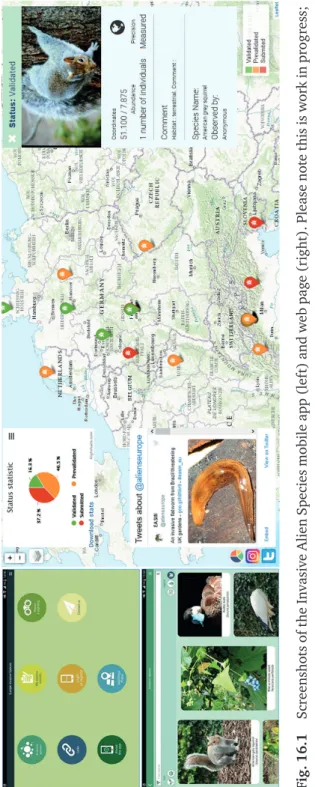
that may benefit from biodiversity-related citizen science at the European scale. A mobile application for monitoring alien species
has been developed by the MYGEOSS project6 (see figure 16.1)
and investigations have begun into the use of the app in the field and the validation processes required to allow it to feed data into
the official European Alien Species Information Network (EASIN7).
Groundwork has been done to allow in-depth dialogue with rele-vant stakeholders in the EU, including member state representa-tives, public servants of the European Commission and scientific networks. This activity is likely to contribute to the process of reporting about invasive alien species to the Commission, which has to be in place by mid-2019. At the national level, in 2012 an initiative launched in the UK to engage citizens in recording data on invasive species so scientists could monitor their spread and
effect on the environment (Siegle 2012); and separately an app
has been developed to involve citizens in observing alien species,
Fig. 16.1 Scr eensho ts of t he In vasiv
e Alien Species mobile app (lef
t) and w eb pag e (r ight). Please no te t his is w or k in pr og ress; all cont ained dat
a has been added f
or t
es
ting pur
poses onl
Some reports confirm the potential of citizen science to serve policymak-ers by providing evidence to support regulatory compliance, and identify
and fill gaps in data and information (University of West of England 2013;
Haklay 2015). Therefore, and within the context of the current Fitness
Check of EU environmental monitoring and reporting (European
Commis-sion 2016b), citizen science has the potential to complement centralised reporting by reducing costs in data collection, validation and verification.
In the UK, there is a long tradition of volunteer naturalists partici-pating in environmental monitoring, with an estimated 100,000
volun-teers contributing to recording schemes and societies in 2005 (The
Parliamentary Office of Science and Technology 2014). Current UK gov-ernment action plans and strategies call for volunteers to assist with monitoring in policy-relevant applications, such as the designation of protected areas, ecological impact assessments, the development of envi-ronmental biodiversity indicators, and the identification of invasive
spe-cies and disease outbreaks (see box 16.1). Data collected by volunteers
enable the UK to meet its obligations to monitor, report and respond to EU environmental legislation.
The Scottish Environment Protection Agency (SEPA) has also explored the potential for citizen science to support its regulatory and
pol-icy efforts (see box 16.2), concluding that it is suitable for assessing
impacts of key environmental pressures identified in the Scottish environ-mental monitoring strategy, such as invasive non-native species, noise and vibration, waste management or greenhouse gas emission
monitor-ing (Pocock et al. 2014a). McKinley et al. (2015) lists a number of citizen
science projects and programmes which are already used in environmen-tal science and decision-making in the United States, in particular in the fields of species management, climate change, ecosystem services man-agement, invasive species control, and pollution detection and enforce-ment. The Irish Environmental Protection Agency (EPA) has developed
a mobile application called See it? Say It!9 to help people report
environ-mental pollution (waste, air, noise) – complaints are directed to the local authority, which then has to provide a response within a short time.
Several studies have demonstrated that citizen science projects are cost-effective, especially in the case of large-scale projects. In the UK, a £7 million government investment in volunteer monitoring schemes
gen-erated data estimated to contribute £20 million in kind (Makechnie et al.
2011). In France, annual savings of €1–4 million have been estimated as
a result of the Citizen Science Biodiversity Monitoring Programme of the
French National Museum for Natural History (Levrel et al. 2010; and see
225 citiZEn SciEncE For Policy ForMulAtion And iMPlEMEntAtion
Box 16.2. Scottish Environment Protection Agency and citizen science
In recent years, SEPA has recognised the need to take a more stra-tegic approach to its involvement in citizen science, partly in response to the challenges of sustaining and growing an increasing number of projects. The strategic approach comprises several ele-ments, including a high-level strategy outlining how citizen sci-ence can help deliver core responsibilities and objectives, published guidance on the types of projects SEPA would support, the co-ordination of SEPA citizen science activities to ensure alignment with its overall strategy and the provision of relevant IT
infrastruc-ture and tools10. The Scottish Environment Protection Agency
now explicitly states the important role of citizen science in engag-ing the public in changengag-ing attitudes and behaviours towards their environment, improving health and well-being, and developing partnerships, in addition to generating valuable data. The strategy recognises that citizen science is often cheaper, though not zero cost, when it comes to generating data or information, even if it is less precise than SEPA’s own professional monitoring. The Scottish Environment Protection Agency has helped communities of inter-est to maximise the quality of their data through training and access to verification tools. There are, however, a number of issues that SEPA still needs to address, such as capacity building, balancing open communication with SEPA’s official policies and messages, improving evaluation, maintaining volunteer motivation and rec-onciling the cost of citizen science activities with increasing con-straints on public resources. The Scottish Environment Protection Agency is working with partners in the UK Environmental Obser-vation Framework Citizen Science Working Group to commission much-needed research on understanding the various motivations for participating in citizen science, and on assessing its costs and benefits for public bodies. There is also a need, as stated elsewhere in this chapter, to provide evidence that engagement in citizen sci-ence effects behavioural change by participants and in society more generally.
analysis of 238 citizen science biodiversity projects around the world esti-mated that the in-kind contributions of 1.3 to 2.3 million volunteers had
an economic value up to $2.5 billion per year (Theobald et al. 2015).
research, science and innovation policies
Speaking more broadly, citizen science is increasingly recognised as instru-mental in fostering open and novel science in research, science and inno-vation strategies, policies and initiatives. For example, in the current EU Research and Innovation policy, it is a key element of one of the five lines of potential policy actions supporting the development of open science in
Europe (European Commission 2016c). In the United States, the 2013
Open Government National Action Plan included the initiative to create an Open Innovation Toolkit to promote innovation in federal agencies, including approaches such as crowdsourcing and citizen science. On 30 September 2014, the White House Office of Science and Technology Policy (OSTP) and the Domestic Policy Council (DPC), in collaboration with the Federal Community of Practice on Crowdsourcing and Citizen Science, co-hosted a forum addressing the links between citizen science and crowdsourcing with open science and innovation (see also Robinson et al. in this volume). In this context, recent reports advocate for change to science and research programmes and funding schemes to facilitate the participation of grassroots initiatives driven by citizen scientists and
guarantee its sustainability (Serrano et al. 2014; Bonn et al. 2016).
Citizen science is also recognised as engaging the public across the research landscape and guiding research agendas towards issues of con-cern to citizens. The ‘Science with and for Society’ programme of Hori-zon 2020, the current EU Framework Programme for Research and
Innovation (see box 16.3), takes an approach called Responsible Research
and Innovation (RRI) (see Smallman in this volume for much more on RRI). Responsible Research and Innovation advocates allowing all soci-etal actors (researchers, citizens, policymakers, business, etc.) to collab-orate to better align both process and outcomes with the values, needs
and expectations of society (European Commission 2015). The
involve-ment of public and civil society stakeholders in processes, outcomes and powerful co-creation is a key component of RRI as a way to build public
acceptance of innovation, while making it more effective (Sutcliffe 2011).
Crowdsourcing initiatives are mentioned as new ways of involving the public in prioritising innovation and its implementation.
227 citiZEn SciEncE For Policy ForMulAtion And iMPlEMEntAtion
Public empowerment and behavioural change
Citizen science is now regarded as a way to empower communities in
driving forward policies (Rowland 2012). Some reports confirm that it
allows citizens to adopt more active roles in society, protect their
envi-ronment and drive a more participatory form of democracy (Ala-Mutka
2009; Mueller et al. 2012) and that it provides opportunities for closer
interactions, especially with local governments (Irwin & Michael 2003).
The potential of local knowledge and citizen science activities has been demonstrated in several cases of environmental justice including citizen-driven initiatives against water drilling and disposal by an oil company in Peru, noise pollution in a scrapyard in London and
hydrau-lic fracturing (‘fracking’) in the United States (University of West of
Eng-land 2013). However, the same report recognises that there are few examples of truly participatory citizen science with evidence that they have influenced decision-making, although this may be related to
diffi-Box 16.3. The EU Research and Innovation policy and citizen science
At a major EU Conference in April 2016 in Amsterdam, the Com-missioner for Research, Science and Innovation, Carlos Moedas, outlined his vision for a common EU approach to open science in Europe. He made a call for citizen scientists to contribute to
Euro-pean science as valid knowledge producers by 2020 (Moedas
2016). Open science is one of three goals of the current EU research
and innovation policy, first set out in 2015 (European Commission
2016c), together with open innovation and being open to the world. Citizen science is mentioned as a key tool to foster open science in education programmes, promote best practices and increase the input of knowledge in one of five potential policy actions identified in a draft European Open Science Policy Agenda, ‘Fostering and creating incentives for Open Science’. It is also one of the eight issues addressed by the recently created Open Science Policy Platform (OSPP), a high-level expert group representing stakeholders, which will propose recommendations for co-design-ing and co-developco-design-ing the Open Science Policy Agenda through with relevant actors in science and research in Europe.
culties in obtaining evidence. Elsewhere, the Environment Agency in Eng-land has direct evidence of biological water quality recording by anglers
leading to the successful prosecutions of polluters (TheRiverfly
Partner-ship 2007).
Overall, though, it appears that many citizen science projects are
not benefiting from the more participatory roles of citizens (Mueller
et al. 2012). Furthermore, if they are to contribute to more participa-tory forms of democracy, such activities should be inclusive and acces-sible to all, not only those who have access to the latest technologies or
are well-educated (Haklay 2013; and see Haklay in this volume; Peltola
& Arpin in this volume). For example, the participation of local com-munities in volunteered geographic information initiatives is
impor-tant in addressing the challenge of building resilient societies (Haklay
et al. 2014).
While difficult to measure, evidence suggests that citizen science can positively affect participants’ attitudes and behaviours towards the
envi-ronment (The Parliamentary Office of Science and Technology 2014).
Strategic environmental policies, such as the EU Biodiversity Strategy (European Commission 2011), recognise that citizen science is a valua-ble means of mobilising citizens in biodiversity conservation, while gath-ering high-quality data. Few studies have analysed changes in attitudes towards the environment and environmental behaviours thanks to
pub-lic participation in science (University of West of England 2013) but
Davies et al. (2013) report that almost half of volunteers recognised a change in the way they thought about the environment and more than
one third would change their behaviour towards it. Stepenuck & Green
(2015) report some changing attitudes and behaviours, although some appeared to be more superficial than desired. More research is needed to better understand attitudinal and behavioural changes, which could impact attempts to address global challenges such as climate change and bio diversity degradation.
Challenges for citizen science–based policy
The proven and potential benefits of citizen science are offset by challenges ranging from data quality and management, institutional resistance or lack of awareness by public bodies, to persistent social inequalities that limit participation. These obstacles, explored more below, demand further discussion and sustained efforts to co-ordinate responses to them.
229 citiZEn SciEncE For Policy ForMulAtion And iMPlEMEntAtion
data quality and management
Data quality, comparability and interoperability are considered essential for both evidence-based policy-making and scientific evidence (see Williams et al. in this volume). At the same time, the capacity of citizen scientists to deliver high-quality and reliable data is one of the most debated issues in citizen science. However, studies attest to the accuracy of citizen science models in providing reliable data, including on
geo-graphical information (Haklay 2010), bird habitat (Nagy et al. 2012), air
pollution (Tregidgo et al. 2013) and ecosystems (Gollan et al. 2012).
Instead, the issue of quality in citizen science is related to project design, which demands adequate data validation protocols or mechanisms (Bonter & Cooper 2012). Successful initiatives combine multiple
meth-ods to ensure data quality (Wiggins et al. 2011) and operate in different
organisational settings beyond more traditionally scientific ones,
requir-ing appropriate quality assurance (Haklay 2017).
Introducing or revising protocols and standards can pose additional challenges for data consistency and its relationship to official and man-datory statistics. This also poses problems for the (re-)use of the data. Consider, for example, air quality monitoring in Europe. Many activities using generally applicable sensor kits are building their own communi-ties, and data is collected and stored in independent information systems. The results neither cover the complete territory of the EU, nor measure in a synchronised or continuous way. Changing this would not only require harmonisation efforts but also sustainability, including long-term storage, curation and archiving of contributions. As a result, citizen science remains largely separate from the knowledge base used to deliver EU policies on environment (but see Volten et al. in this volume).
Data management and interoperability were in fact identified by par-ticipants of the Citizen Science and Smart City Summit as critical to
long-term benefits from citizen engagement (Craglia & Granell 2014). A later
international survey of data management practices revealed that approx-imately 60 per cent of participating projects followed a dedicated data management plan and many applied standards to the data and metadata
generated (Schade & Tsinaraki 2016). Although a majority of projects
claimed to provide access to raw or aggregated data, they did not always apply appropriate use conditions or well-defined licences. The detailed underlying issues are also addressed in Williams et al. in this volume and existing solutions are included in the upcoming book from the COST Action (a European framework supporting transnational co-operation in
science and technology) on citizen science11 (Bastin, Schade & Schill
2017). Related work is taken up at the international level by a Data and
Metadata Working Group chaired by the Citizen Science Association (2015); and the Open Geospatial Consortium (2016) adopted a Citizen Science Domain Working Group in 2016 regarding geolocation data.
Adoption by public institutions
The current political context increasingly calls for civic involvement, rang-ing from conventional mechanisms of consultation to direct integration in multiple stages of the policy cycle. However, the actual adoption and impact of citizen science in policy-making is difficult to demonstrate. For instance, although citizen science is positioned as a key tool to foster open science at the European level, mechanisms are still lacking for citizens to impact evidence-based processes for policy-making. Citizen science’s weight or importance is not visible at all policy stages, nor is it clearly nected with current public engagement mechanisms such as public con-sultations or citizen-initiated policy proposals.
Public institutions wanting to engage in citizen science (see box
16.4) also have to consider the resources required to manage
expecta-tions from actively engaged citizen scientists and participants. Empower-ing individuals and communities with information requires constant feedback and dialogue. There is also a perceived danger that alternative messages on environmental issues can develop from public access to raw data, leading to conflicting interpretations. This can be overcome by careful planning of feedback mechanisms and provision of appropriate contextual information.
Box 16.4. Citizen science in the US federal government
While some US federal agencies have supported citizen science projects in the past, a concerted grassroots effort led by the Federal Community of Practice on Crowdsourcing and Citizen Science
(CCS)12 has helped to dramatically increase the visibility,
credibil-ity and adoption of citizen science within the US government to address societal and scientific challenges. Through a series of interviews, the CCS identified barriers to adoption by government agencies, including trust, data quality, privacy, cybersecurity and
231 citiZEn SciEncE For Policy ForMulAtion And iMPlEMEntAtion
However, some have questioned the effect of the democratisation of
science and technology policy (Wynne 2006; Irwin 2006). Dialogue can
be seen as a way of enhancing trust in science, or avoiding public resistance to issues that are economically and politically important. More critical studies argue that engagement tends to be constrained by official per-spectives, making participation ‘another governance tool among others,
then developed a set of strategies to address these hurdles,
includ-ing assemblinclud-ing success stories (Bowser & Shanley 2013),
consult-ing with legal analysts (Gellman 2015; Scassa & Chung 2015a;
Scassa & Chung 2015b), streamlining the project approval process (Parker 2016), and providing educational briefings to agency exec-utives and inviting them to speak at citizen science-related events (Shanley et al. 2013). The CCS also collaborated with the White
House to build a ‘How-To’ toolkit13 and projects database14 aimed
at reducing barriers to entry and increasing government-wide co-ordination. Lastly, the CCS inspired and informed the White House memo ‘Accelerating Citizen Science and Crowdsourcing to Address Societal and Scientific Challenges’, issued September 2015, and the Sec. 402 of the American Innovation and Competiveness Act, passed January 2017, as well as other policy directives, providing top-level support for government agency use of citizen science (Holdren 2015; see also GAO 2016; US GEO 2014; USGCRP
2014). The White House memo articulated guiding principles for
US federal citizen science and crowdsourcing projects, including (1) applying the principle of ‘fitness for use’ (i.e., ‘ensuring that data have the appropriate level of quality for the purposes of the project’); (2) ensuring that the data, code, applications and tech-nologies generated by federally sponsored citizen science projects are ‘transparent, open, and available to the public’; and (3) engag-ing members of the public in citizen science in meanengag-ingful ways such that their contributions are mutually beneficial and publicly acknowledged. The memo also directs each agency to designate a co-ordinator for citizen science and crowdsourcing, and to cata-logue federally funded and/or co-ordinated citizen science and crowdsourcing projects, building on the work of SciStarter. The leg-islation clarifies the authorisation for federal agencies to support citizen science projects, and addresses some administrative and legal issues such as liability.
e.g., for adjusting, supplementing or enhancing the policy process’ (Levidow 2008, 3).
Furthermore, one of the main challenges at the supranational level comes from the diversity of legislation and cultures. European member states, for example, have disparate regulatory frameworks on data man-agement, official measurements and privacy requirements, along with different levels of readiness and previous engagements with citizens and stakeholders. Questions remain about how these issues are addressed across geographic (and thereby administrative) scales; across different institutions (such as the European Commission and the European
Envi-ronment Agency, see box 16.5); and across supranational agencies,
including governmental (e.g., environment protection, mapping and
Box 16.5. Environmental knowledge community and citizen science
In order to understand the European challenges and to benefit from the richness and diversity of the European citizen science land-scape, five Directorate Generals (DGs) of the European Commis-sion – DG Environment, DG Research and Innovation, DG Joint Research Centre, DG Climate Action and DG Eurostat – together with the European Environment Agency (EEA) agreed to jointly investigate the potentials and limitations when connecting citizen science to European environmental policy-making. A group set up in January 2015 began to consider how data gathered by citizens (using mobile phones, for example) could best be used to comple-ment environcomple-mental monitoring and reporting processes in a cost-effective manner, to review the potential of lay, local and traditional knowledge to fill in knowledge gaps and to examine how the involve-ment of citizens could foster environinvolve-mental behavioural changes. The participants jointly contributed their experiences and diverse roles in policy-making processes in order to address, among others, the questions outlined in this chapter. This initiative includes direct practical experiences by initiating citizen science demonstrators for European policy-making, which includes the work in support of the European Union Regulation on Invasive Alien Species as reported above. EU-funded research activities such as the Citizens’
233 citiZEn SciEncE For Policy ForMulAtion And iMPlEMEntAtion
statistical) agencies as well as non-governmental organisations (NGOs) (e.g., the ECSA).
inequality and power imbalances
Citizen science pushes for more democratic ways of generating, selecting and interpreting high-quality data to inform decision-making. However, citizen science projects are most successful at integrating those citizens who probably already have the most resources to engage in policy in the first place (e.g., time, capital). If one of the main goals of citizen science is to offer more possibilities for citizens to generate knowledge for policy formulation and implementation, underserved communities and unheard voices need to be included in a people-powered science (see Haklay; Novak et al., both in this volume).
Inequalities in the way research findings are taken up by policymak-ers have also been documented in research close to the field of citizen
science. For example, in ‘undone science’ (Frickel et al. 2010; Hess 2015),
community-based participatory research (Bidwell 2009), ‘counterpublics’
(Hess 2011), or in general community-based science, social movements or civil society organisations have done research that has systematically been unfunded, incomplete or ignored by traditional research bodies. This attests to the asymmetries that citizen science needs to address. Public engagement may therefore require ‘control mutuality’ between the par-ties involved, that is, a shared agreement on the influence and control they
have over one another (Grunig & Grunig 2001). This would lead to a
‘shar-ing of power’ (Seifert 2006, 83), where all parties allow the outcomes of
participatory exercises to truly be unpredictable and to have substantial consequences on the processes.
Participatory models to inform policy-making
This section presents an overview of past and present debates around top-down and bottom-up approaches when it comes to the relationship between science and society. From more traditional and one-way connec-tions between experts and non-experts to more recent co-creation mod-els, citizen science remains a contested field of practice, even more so when it moves towards do-it-yourself (DIY) experimentation that places citizens and communities at the centre (Ballard, Phillips & Robinson; Novak et al., both in this volume). These past, present and emerging
approaches offer lessons for dialogue, feedback and, ultimately, the co-creation of science and policy.
From top-down to bottom-up science
The interplay between science and society has moved from the top-down approaches of traditional science communication (one-way, from ‘experts’) towards bottom-up models of public engagement (e.g., two-way dialogue and the co-construction of research agendas and interpre-tation). Giving a privileged role to the public has been at the core of debate on the relationship between science, technology and democracy (Jasanoff 2004; Latour & Weibel 2005), in which a ‘democratic turn’ has
pushed for a more open agenda (Fischer 2000; Leach, Scoones & Wynne
2005). In practical terms, public engagement has been implemented
and tested through consultative and deliberative mechanisms, such as citizen juries, citizen panels, deliberative polls, citizen schools, dialogues,
focus groups and consensus conferences (Burri 2009; Coote &
Lena-ghan 1997; Joss & Durant 1995b), extending to participatory and experimental mechanisms, such as future scenarios, experiential tools,
co-design and digital interventions (Chilvers & Kearnes 2016;
Nasci-mento et al. 2016).
In citizen science, it can be argued that more institutionally led
(top-down) projects remain abundant (Nascimento, Guimarães Pereira
& and Ghezzi 2014). Invitations for collaboration originate from scien-tific organisations, which largely predetermine the research objectives and citizens’ involvement tends to be limited. Even the language can
be one-sided, describing citizens as enlisted (Hochachka et al. 2012),
recruited (Suomela 2014) or, more typically, as a crowd of data
collec-tors (Devictor, Whittaker & Beltrame 2010) or data processors via their
own resources, such as computers and mobile phones (Roy et al. 2012).
However, such passive participation is moving towards more active roles, including as interpreters and creators of data in collaboration with scientists and policymakers. Overall, bottom-up contributions should be supported and top-down policy processes engaged to connect the two perspectives so that policymakers are ready to receive data and findings from participants and take action. Increasing numbers of participants are likely to further legitimate official mandates to actually integrate and use data from citizen science.
235 citiZEn SciEncE For Policy ForMulAtion And iMPlEMEntAtion
citizen science as a contested space
Embracing bottom-up perspectives requires acceptance of a wider range of knowledge co-creation and sharing than traditionally included in evidence-based policy-making. This higher level of participation is focused on citizen empowerment and inclusion in defining the conditions and pur-poses of evidence. In what some call ‘extreme or collaborative science’ (Haklay 2013), citizens are mostly seen as equal to scientists when it
comes to decisions about research questions, methods or processes (
Fun-towicz & Ravetz 1992), which can include data analysis by the communi-ties involved in the projects beyond the provision of data or processing resources.
In this way, citizen science can challenge the ways scientists pro-duce knowledge, including their assumptions and standards about what is valid as scientific knowledge. This does not mean a degradation of data quality if data collection is based on systematic, fit-for-purpose observa-tions and protocols agreed from the beginning. Still, citizen science can unsettle traditional beliefs about the uniqueness and complexity of sci-entific practice if it is then performed by non-professional scientists. In many cases, citizen science participants are experts in their own right as a result of their own professional expertise, or become experts through their voluntary participation (e.g., see Peltola & Arpin in this volume).
Conflicts of interest between parties are a common concern. A recent editorial in Nature raised concern that citizen participants might advance their political objectives, such as when ‘opponents of fracking, for exam-ple, might help track possible pollution because they want to gather
evi-dence of harmful effects’ (Editorial 2015). This editorial sparked debate
in the citizen science community on social media, mailing lists and blogs, where it was positioned in the wider context: bias as a result of asymmet-rical power relations in science and policy; claims of falsification or data fraud outside of citizen science; and the integration of personal motiva-tions, value judgements and social norms in epistemological understand-ings of objectivity. Open discussion is needed between all parties to transform rigid understandings of what constitutes relevant knowledge for science and policy.
towards transdisciplinary and diy trends
It can be argued that the rationale of citizen science in involving diverse groups bring it closer to transdisciplinary frameworks that are visible in different scientific fields. Generally speaking, transdisciplinarity operates
both horizontally, to involve and mix different areas of expertise, and vertically, to include stakeholders from civil society and the private and
public sectors (Klein 2004). Transdisciplinarity strives to generate
com-prehensive knowledge through collaborative platforms with both aca-demic and non-acaaca-demic stakeholders, while also combining frameworks across disciplines. It privileges bringing together all types of knowledge
towards a common and practical goal (Nascimento & Pólvora 2015),
from a global network of makerspaces publishing their work on Github to localised interventions in an urban neighbourhood monitoring air
quality (Balestrini et al. 2016; see box 16.6). It means that inputs for
pol-icy formulation and implementation can come from many different places and social groups, as long as they are relevant and can generate high-quality knowledge.
In its more radical forms, transdisciplinarity does not impose a hier-archy of expertise, connecting to emerging citizen science movements that rely on projects initiated and developed by individuals or groups unaf-filiated to the scientific establishment. Even where these individuals and groups do have a scientific affiliation or background, their initiatives do not align with conventional or prescribed institutional rules. The DIY movement, or what is sometimes called do-it-together (DIT), has been
paving the way for the next steps for citizen science (Nascimento,
Guima-rães Pereira & Ghezzi 2014; and see Novak et al. in this volume). The ‘DIY scientist’ is someone who tinkers, hacks, fixes, recreates and assembles objects and systems in creative and unexpected directions, usually using open-source tools and adhering to open paradigms to share knowledge and outputs with others. Do-it-yourself scientists are doing science out-side conventional university or lab settings, and instead in makerspaces, Fab Labs, Hackerspaces, techshops, innovation and community-based labs, or even in their homes, garages or schools.
These forms of enquiry recognise different ways of knowing and allow for more out-of-the-box thinking and experimentation. Such emerg-ing practices also bremerg-ing forward new and valuable sources of data that can contribute to policy-making processes. A DIY environmental science
com-munity such as Public Lab17 uses low-cost techniques to investigate
envi-ronmental issues, often to improve citizen contributions to decision-making and enable change in the political sphere. Although currently marginal, these practices are likely to grow, along with their challenge to mainstream science and policy-making. Such challenges can be productive and bring about new thinking and practices, not only enriching science and policy but also empowering citizens and communities.
Box 16.6. Citizens and communities building their own sensors
The project Making Sense: Advances and Experiments in Partici-patory Sensing (H2020 Competitive Project 688620) aims to develop participatory frameworks and tools for citizen-driven
innovation16. It will show how open source software, open source
hardware, digital maker practices and open design can be used by local communities to appropriate their own technological sensing tools and address pressing environmental problems in air, water, soil and sound pollution. The project is developing a Making Sense
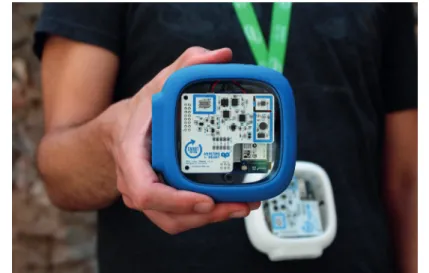
Toolkit, based on the Smart Citizen platform (see figure 16.2) and
in other open source sensors, to be tested in Amsterdam, Barce-lona and Pristina. In the pilots, the team is working with commu-nities of interest, including citizens, local associations and civil society organisations, and communities of practice, such as hard-ware makers and tinkerers (someone who likes to hack, change or repair machines or objects) well-versed in open source technolo-gies and digital fabrication. They meet and collaborate at local Fab Labs and makerspaces to deploy, test and improve readily available open hardware and software tools, and contribute with best prac-tices around community-driven environmental sensing and sense-making. Participants also interact with experts and city officials, collect and share data, visualise and interpret results, and devise responses, either individually or collectively.
Fig. 16.2 The Smart Citizen Kit, a DIY and open source sensor. (Source: Smart Citizen team; Fab Lab Barcelona | IAAC and MID)
Conclusion: strategies and recommendations
This section offers strategies and recommendations for introducing and coordinating citizen science initiatives within and across different levels of governance. It is not an exhaustive overview but contributes a list of priority areas where action is needed for citizen science to become an inte-gral part of future policy and build effective partnerships between governments and their citizens.
Integrating citizen science data: Citizen science has the potential to com-plement, validate and enhance data collected through official channels with broader, timely and cost-effective data sources. This has already been showcased in areas such as biodiversity monitoring (e.g., birds and inva-sive alien species) or compliance assurance (e.g., environmental pollution reporting). Adequate standards and infrastructure are needed to deliver on this potential, including revised data validation protocols, multiple methods for data quality, data interoperability and management, and innovative and robust technologies. To be really effective, this should be complemented by the formulation of more participatory processes, which may imply the review of legislative frameworks.
Developing citizen engagement and empowerment: Citizen science can raise awareness and empower citizens and communities, and poten-tially improve their relationship with government, official bodies, scientists and other actors. To harness this potential, policymakers and implement-ers need to embrace more participatory, citizen-centred, inclusive and bottom-up approaches for knowledge and data production, together with formal mechanisms for citizen participation in decision-making and ultimately, the co-creation of policies.
Coordinating across governance levels: Despite the integration of citizen sci-ence into national and regional policies and programmes, few networks connect emerging citizen science initiatives with each other or with exist-ing knowledge and policy schemes. Furthermore, existexist-ing programmes and policies are mostly linked to environmental monitoring and report-ing activities. Co-ordination, with clear definitions of the opportuni-ties, roles and responsibilities at different levels of governance, would strengthen coherence and expand the application of citizen science to pol-icy areas where it has a strong potential, such as climate monitoring, agriculture and food security, urban planning and smart cities, health and
239 citiZEn SciEncE For Policy ForMulAtion And iMPlEMEntAtion
medical research, humanitarian support and development aid, science awareness and scientific efforts.
Supporting pilots and practical experimentation: Complex interplay between the many stakeholders complicates the further integration of citi-zen science and other emerging trends, such as DIY science, in policy-making. Collaboration can be strengthened with empirical studies and
practical testing such as demonstration projects (see box 16.6), open and
interdisciplinary calls for proposals and projects, or adapted methodolo-gies for community engagement. More needs to be done in terms of mutual learning between such projects and pilots, and pilots can also be appro-priate testbeds of community engagement for further integration with policy processes.
Establishing and strengthening communities of practice inside public admin-istration: Previous and ongoing initiatives have proven the effectiveness of sustained mechanisms for civil servants and policymakers to
incorpo-rate citizen science in their work (see box 16.4). Examples of
mecha-nisms include creating networks of practitioners and champions across departments, units or agencies; developing adequate communication and capacity-building tools such as roundtables, webcasts, blogs or prac-tical training; identifying obstacles preventing citizen science from being used effectively and widely in specific organisational contexts; and pro-ducing best practices which showcase successful projects.
Connecting to current priorities: High-level commitment – from top scien-tists, management, policymakers and institutions – would promote the use of citizen science in policy formulation and implementation. Understand-ing of the policy agenda and its pipeline of initiatives should be coupled, when possible, with demonstrations of the potential citizen science impact on constituencies, and this could increase such commitment. A clear pol-icy strategy for citizen science initiatives would help ensure they are per-ceived as useful for policy, while the wider citizen science community would also benefit from guidance on what policymakers find helpful. The right framework and communication strategy are needed to ensure citi-zens are heard and feel they are part of the solutions that concern them. Even the careful selection of terminology to describe citizen science in a way that is relevant to policymakers can make a difference.
Acknowledgements
The authors would like to acknowledge the European Environment Agency (EEA) and the Citizen Science Interest Group of the European Protection Agency (EPA) network. They would also like to thank the team and part-ners of the project Making Sense: Advances and Experiments in Partici-patory Sensing (H2020 Competitive Project 688620), under the support of the Collective Awareness Platforms for Sustainability and Social Inno-vation (CAPS) programme. Here a special thank you is due to Fabrizio Ses-tini (DG CNECT, European Commission). The authors would also like to thank the Alfred P. Sloan Foundation for their support and encouragement of the US Federal Crowdsourcing and Citizen Science initiative through grants to the Commons Lab of the Woodrow Wilson International Center for Scholars. Finally, the authors are grateful for valuable discussions in the European Commission’s Environmental Knowledge Community, which helped shape this chapter’s recommendations.
Notes
1 Decision No 1386/2013/EU of the European Parliament and of the Council of 20 Novem-ber 2013 on a General Union Environment Action Programme to 2020 ‘Living well, within the limits of our planet’.
2 Directive 2008/56/EC of the European Parliament and of the Council of 17 June 2008 establishing a framework for community action in the field of environmental policy (Marine Strategy Framework Directive).
3 http:// ec . europa . eu / eurostat / web / products - datasets / product ? code=tsdnr100 4 http:// ec . europa . eu / environment / nature / legislation / birdsdirective / index _ en . htm 5 http:// ec . europa . eu / eurostat / web / products - datasets / product ? code=tsdnr100 6 http:// digitalearthlab . jrc . ec . europa . eu / mygeoss/
7 http:// easin . jrc . ec . europa . eu/ 8 http:// planttracker . org . uk/
9 http:// www . epa . ie / enforcement / report / seeit/ 10 http:// www . environment . scotland . gov . uk / get - involved/ 11 https:// www . cs - eu . net/
12 https:// www . citizenscience . gov / community/ 13 https:// crowdsourcing - toolkit . sites . usa . gov/ 14 https:// www . citizenscience . gov/
15 http:// www . citizen - obs . eu/ 16 http:// making - sense . eu/ 17 https:// publiclab . org/