12-336
Research Group:
Industrial Organization
September 2012
“Language, Internet and Platform
Competition: the
case of Search Engine”
Doh-Shin Jeon, Bruno Jullien
and Mikhail Klimenko
Language, Internet and Platform Competition: the
case of Search Engine
Doh-Shin Jeon
y, Bruno Jullien
zand Mikhail Klimenko
xSeptember 14, 2012
Abstract
The World Wide Web was originally a totally English-based medium due to its US origin. Although the presence of other languages has steadily risen, content in English is still dominant, which raises a natural question of how bilingualism of con-sumers of a home country a¤ects production of web content in the home language and domestic welfare? In this paper, we address this question by studying how bilingual-ism a¤ects competition between a foreign search engine and a domestic one within a small country and thereby production of home language content. We …nd that bilingualism unambiguously softens platform competition, which in turn can induce a reduction in home language content and in home country’s welfare. In particular, it is possible that content in the foreign language crowds out so much content in the home language that consumers enjoy less content when they are bilingual than when they are monolingual.
Key words: Language, Bilingualism, Platform, Search Engine, Two-sided Mar-ket, International Trade.
We thank Ramon Casadesus-Masanell, Jacques Crémer, Fabien Curto Millet, Nikrooz Nasr, Martin Peitz, Yossi Spiegel, Dan Spulber, Hal Varian for useful comments and the audience of our presentations at CESifo Area Conference on Applied Microeconomics (2012), Conference on the Economics of Information and Communication Technologies (Paris, 2011), Conference on the Economics of Intellectual Property, Software and the Internet (Toulouse, 2011), Conference on Internet Search and Innovation (Northwestern, 2011), EARIE 2011, IIOC 2011, Naver, OECD (Paris, 2011).
yToulouse School of Economics (GREMAQ, IDEI) and CEPR. [email protected] zToulouse School of Economics (GREMAQ and IDEI). [email protected]
1
Introduction
During its early days, the World Wide Web was almost exclusively an English-based medium due to its origin in the U.S. Although, with the globalization of the Internet, the presence of other languages has steadily risen, the dominance of English does not van-ish. According to a UNESCO publication (Pimienta, Prado and Blanco, 2009), the share of English web pages decreased from 75% in 1998 to 45% in 2007 and the share of English speaking users from 60% in 1998 to 32% in 2007 (see Figure 1). These shares are quite high relative to the share of English speakers in the world population, which is 10.1%. Fur-thermore, the ratio of webpages over users is the highest for English among all languages: it is 1.42 for English while all other European languages have a ratio below 1 except for German which has a ratio of 1.16 (see Figure 4 in the Appendix). This dominance of Eng-lish web content raises a natural question: how bilingualism of a given country (i.e., the ability of the country’s population to speak English as well as its native language) a¤ects the production of content in the home language and domestic welfare?
This question is important from an economic point of view because of the steadily growing share of international online trade in total trade and because linguistic barriers are the main source of frictions and trade costs in crossborder e-commerce.1 The question is also important because of its implication on linguistic and cultural diversity. Actually, there is a wide concern about how globalization and the Internet a¤ects linguistic and cultural diversity:2 for instance, UNESCO (2008) organized a conference on "Globalization and Languages" to discuss the challenges and opportunities from globalization on linguistic diversity.3 As a …rst step to address the issue, this paper considers a small open economy and studies how bilingualism a¤ects competition between online platforms and thereby production of web content of the economy.
Interactions between consumers and content on the Web are mediated by platforms such as search engines, iTunes for music, Amazon for books etc. Although our model can be applied to other platforms as well, in this paper we focus on search engines. One way to see the importance of search engines is to look at the exponential growth of webpages. According to the o¢ cial blog of Google, by 2000 the Google index reached one billion pages
1Based on the consumer survey, Martens and Turlea (2012) estimate that the share of online trade in
total cross-border trade in goods between EU member states is in the range between 6 and 12 percent.
2See for instance the book of David Crystal (2006) entitled "Language and the Internet".
3"Given current trends, experts estimate that within a few generations, more than 50 percent of the
Figure 1: Evolution of percentages of English speaking Internet users and web pages (Pimienta, Prado and Blanco, 2009)
and by 2008 1 trillion unique URL.4 Google’s market shares in almost all national search services markets are astonishing (see the table in the appendix)5: whereas its market share estimates in the U.S. vary between 63% and 72% depending on the research institute that carried out the study, its market shares in Western European countries such as Belgium, Denmark, Finland, France, Germany, Netherlands, Portugal, Spain, U.K. are above 90%. What is equally surprising is that Google’s market shares are below 40% in certain countries such as China, Czech Republic, Japan, South Korea, Russia, Taiwan where the leading search engine is either a domestic one or Yahoo.
In this paper, we consider competition between a foreign search engine and a domes-tic one in a home country6 and study how search engine competition and production of content in the home language are a¤ected by whether consumers of the home country are monolingual or bilingual. Does bilingualism increase the foreign search engine’s market share in the home country? Does bilingualism make platform competition …ercer? How does bilingualism a¤ect production of home language web content and domestic welfare?
4http://googleblog.blogspot.fr/2008/07/we-knew-web-was-big.html
5The market share represents the number of search queries done with Google over the total number of
search queries in a given country.
6The model can be applied to competition between Google and Yahoo (or Bing) with a minor
In our model, there are two countries (Home country and Foreign country) each with its own language. The home language is used only by the Home country domestic content producers and consumers. Foreign content producers use the foreign language. Our focus is on the Home country’s two-sided market where the competing home and foreign platforms bring together content producers and consumers and the latter can be either bilingual or monolingual. If consumers of the Home country are bilingual, they can consume foreign as well as domestic content.
We assume that the platforms (i.e. search engines) o¤er a search service of the same quality. The main di¤erence between the two is that the home search engine o¤ers access only to Home country’s domestic content while the foreign one gives the domestic consumers access to both domestic and foreign content (i.e., the domestic engine can search only the Home country content while the foreign engine can search content of both countries). Since platforms o¤er no content translation and only bilingual domestic consumers can use foreign content, this di¤erence between the platforms does not matter when consumers of the Home country are monolingual. However, the di¤erence creates an advantage for the foreign platform when consumers are bilingual. At the same time, the foreign platform has a certain disadvantage since we assume that the o¤erings of the content producers (CPs) of the Home country have some overlap with the o¤erings of the CPs of the Foreign country. In other words, when consumers are bilingual, our assumptions imply: given that both platforms have the same mass of consumers, a domestic CP prefers joining the domestic platform to joining the foreign platform; given that both platforms have the same mass of domestic CPs, a consumer prefers the foreign platform to the domestic platform. The platforms levy (subscription) prices only on CPs and do not charge any price to consumers. In addition, we assume that consumers single-home and CPs multi-home.
Before analyzing the e¤ect of bilingualism on platform competition, we consider a gen-eral model of platform competition in a closed economy and discover an important result: as one platform becomes more e¢ cient (respectively, less e¢ cient) in matching content producers and consumers, it strengthens (respectively, softens) platform competition. The intuition is based on a multiplier e¤ect in a two-sided market. Suppose some consumers switch from platform 2 to platform 1. This increases the number of CPs subscribed to platform 1 while decreasing the number of CPs subscribed to platform 2, which in turn induces additional consumers to switch from platform 2 to platform 1, and so on. This multiplier e¤ect increases with each platform’s e¢ ciency in terms of creating match value. This is why we obtain the result that as a platform becomes more (less) e¢ cient, platform competition becomes stronger (weaker).
consumer market share in the Home country. On the one hand, having more foreign CPs on board helps the foreign platform to attract bilingual consumers. Bilingualism can even lead to a tipping equilibrium in which all consumers conduct search through the foreign platform. On the other hand, since domestic CPs are worried about competition from foreign CPs, the foreign platform has di¢ culty in attracting domestic CPs, which in turn makes it di¢ cult to attract consumers. The equilibrium market share is determined by a trade-o¤ between these two e¤ects.
Our second result is that bilingualism softens platform competition. Access to foreign CPs comes with the cost of making exchanges between domestic CPs and consumers less valuable in the foreign platform. Because of the overlap between domestic content and foreign content, the ability to consume foreign content reduces the surplus that consumers in the foreign platform obtains from one additional domestic CP and the surplus domestic CPs subscribed to the foreign platform obtains from one additional consumer. In other words, it is as if bilingualism makes the foreign platform less e¢ cient, which softens platform competition for the reasons explained earlier.
Our last result is that bilingualism can increase or decrease production of content in home language and hence domestic welfare. Regarding the e¤ect of bilingualism on content production, there are two opposing forces. On the one hand, bilingualism can promote pro-duction of content in home language by increasing the mass of consumers using the foreign platform. A higher consumer concentration in one platform, all other things being equal, increases the home-language content production due to cross-side network externalities, typical in a two-sided market. On the other hand, bilingualism softens platform competi-tion and thereby induces both platforms to extract a higher surplus from CPs, which can reduce production of content in the home language. In the extreme case in which bilin-gualism does not a¤ect each platform’s consumer market share, we …nd that content in the foreign language crowds out content in the home language so that the total e¤ective mass of content7 available in each platform gets reduced. This implies that bilingualism
reduces domestic welfare if bilingualism does not a¤ect consumer market share. Domestic welfare is reduced because each platform generates smaller surplus and, in addition, the foreign platform captures a larger share of the surplus. Bilingualism reduces world welfare if the reduction in surplus is greater than the saving in …xed cost, which results from the reduction of home language content in the foreign platform.
In general, we show that the welfare result depends on the relative weight of producer
7The e¤ective mass of content in the foreign platform takes into account the overlap between domestic
surplus over consumer surplus.8 For most European and Latin American countries, the overlap is expected to be relatively large. Then, typically, bilingualism would increase consumer surplus at the cost of reducing producer surplus, which then decreases domestic welfare as long as the relative weight of producer surplus is large enough.
The paper is organized as follows. In section 1.1, we review the related literature. In section 2, we present our model of platform competition that includes international trade. In section 3, we consider the same model without international trade to study the multiplier in our two-sided model. In section 4, we analyze the case in which all consumers are monolingual. In section 5, we analyze the case in which all consumers are bilingual. In section 6, we compare the two cases in terms of prices, consumer market shares, mass of domestic CPs and welfare of the home country. Section 7 discusses the robustness of our results to relaxing the assumption of single-homing consumers, draws welfare implications on countries of di¤erent language families and suggests directions for future research.
1.1
Literature review
Our paper builds on the literature on two-sided markets (Rochet and Tirole, 2003, 2006, Caillaud and Jullien, 2001, 2003, Anderson and Coate, 2005, Armstrong 2006, Hagiu 2006, Weyl, 2010).9 Two-sided markets can be roughly de…ned as industries where platforms provide intermediation services between two (or several) kinds of users. Typical examples include dating agencies, payment cards (Rochet and Tirole, 2002), media (Anderson and Coate, 2005), operating systems (Parker and Van Alstyne, 2005), video games (Hagiu 2006), academic journals (Jeon and Rochet, 2010) etc. In such industries, it is vital for platforms to …nd a price structure that attracts su¢ cient numbers of users on each side of the market. Our paper has two novel aspects. First, it is the …rst paper that studies competition among platforms serving as intermediaries in international trade. Second, we examine how platform competition is a¤ected by trade barriers that arise due to linguistic di¤erences between buyers and sellers.
In our model, language-related trade surplus di¤erences are formalized in way that is similar to Lazear (1999) where individuals are randomly matched and a match generates a surplus only if the matched individuals share common language. This generates posi-tive network externalities among individuals using a common language, which is the main feature of the models of bilingualism (Church and King, 1993 and Ortega and Tangeras,
8In section 6.3, we provide a theoretical foundation to why we can have a degree of freedom in terms of
the relative weight of producer surplus over consumer surplus.
9Our model in which we assume single-homing for consumers and multi-homing for CPs is similar to
2008).10 However, our framework is di¤erent from the previous models of language or bilin-gualism in the two following dimensions. First, in our model, matches occur between two sides of a market: consumers and CPs. A surplus is created only if a matched pair of a consumer and a CP’s website share common language. Second, matches are mediated by platforms.
This paper is also related to the international economics literature which emphasizes the role played by information networks in facilitating international trade. While the sig-ni…cance of traditional barriers to trade has been declining over time, barriers and frictions related to incomplete or asymmetric information with regard to trading opportunities in foreign markets remain substantial (see Portes and Rey, 2005). Among the sources of these information-related costs of cross-border transactions are linguistic and cultural di¤erences between the transacting parties. One of the traditional means of overcoming these sort of trade costs have been information sharing networks among internationally dispersed eth-nic diasporas, sharing the same language and databases of business contacts, which can be viewed as a precursor of modern e-commerce platforms.11 The importance of common
language has also been emphasized in the literature which uses gravity models to show that immigrants promote trade with their country of origin (see Gould (1994), Head and Ries (1998), Wagner et al. (2002), and Rauch and Trindade (2002)). One likely reason for this impact of immigrants is their ability to speak their native language.
Despite the lack of o¢ cial and comprehensive statistics on online international trade, a few notable empirical research papers studying the e¤ects of e-commerce on trade have been published over the last few years. Freund and Weinhold (2004) was the …rst paper to provide empirical evidence consistent with a model in which the Internet reduces market-speci…c …xed costs of trade. In particular, using time-series and cross-section regression analysis on the data on bilateral trade from 1995 to 1999 and controlling for the standard determinants of trade growth, they …nd that a 10 percentage point increase in the growth of web hosts in a country leads to about a 0.2 percentage point increase in export growth. They also …nd that on average, the Internet contributed to about a 1 percentage point increase in annual export growth from 1997 to 1999. In a companion paper, Freund and Weinhold (2002) o¤er evidence that the Internet has even stronger impact on services
10Church and King (1993) study each individual’s choice to become bilingual and Ortega and Tangeras
(2008) analyze the politically dominant group’s choice between unilingual and bilingual education.
11Rauch (1996, 1999) have analyzed the trade-facilitating role of these ethnic information-sharing
net-works using a search theory of trade in which such a network expands the number of possible export markets by increasing the number of draws a …rm obtains when it searches for the best match. He showed that trade networks based on family ties, colonial ties or a common language, are important in explaining trade patterns, especially for di¤erentiated goods that do not have reference prices.
trade. In particular, after controlling for GDP and exchange-rate movements, they …nd that a 10-percent increase in Internet penetration in a foreign country is associated with about a 1.7-percentage-point increase in export growth and a 1.1-percentage- point increase in import growth.
Several authors have analyzed cross-border e-commerce using di¤erent versions of the well-known gravity model of international trade which typically includes an explanatory variable capturing trade costs caused by language barriers (e.g., Blum and Glodfarb, 2006, Hortaçsu et al., 2009, Lendl et al., 2012, and Martens and Turlea, 2012). All papers based on the gravity model con…rm that as the importance of geographical distance-related trade costs decreases, other types of transaction costs become more prominent in online trade, in particular costs related to language barriers.
Blum and Goldfarb (2006) apply a gravity model to international internet click-stream data to analyze patterns of trade in non-tangible digital products and services which have negligible transportation costs. They …nd that distance negatively a¤ects trade even in dig-ital products and services that are free of transportation costs as long as their consumption is sensitive to cultural variables such as language (e.g., online music, games, and videos).
Unlike Blum and Goldfard (2006) which focused on trade in purely digital products, Hortaçsu et al. (2009) was the …rst paper to study international online trade in physi-cal goods. It examines the importance of distance in these transactions using a sample of crossborder transactions from MercadoLibre, an online e-commerce platform covering twelve Latin American countries and two languages: Spanish and Portuguese. They con-clude that distance still has an impact on trade, though less so in online than in o- ine transactions. They also provide evidence of a home-country bias in on-line trade patterns, i.e., the tendency of consumers to buy from domestic on-line merchants rather than foreign ones.
Lendl et al. (2012) use a dataset, which includes all crossborder transactions on eBay among 62 countries between 2004 and 2009, and estimate a gravity model of online trade with several explanatory variables, including shipping costs, common language, contiguity, quality of governance and legal environment, level of corruption, and colonial background. They …nd that most of these factors imply lower trade costs for eBay transactions than for their o- ine counterparts, with the notable exceptions of language and the level of corruption in the exporting country.
Martens and Turlea (2012) use a large-scale online consumer survey for 27 EU Member States to compare online trade patterns with o- ine trade patterns for similar goods. Using a standard gravity model they …nd evidence that while distance-related trade costs decline when moving from o- ine to online trade, trade costs associated with crossing language
barriers increase.12 They also estimate home bias in online trade in goods and compare it with estimates for o- ine trade available in economic literature. They …nd that home bias in online markets is considerably higher than in o- ine markets. Martens and Turlea (2012) conclude that strong home bias e¤ect in online trade could be attributed to the high trade costs associated with crossing linguistic borders that considerably reduce the bene…ts of lower distance-related trade costs.
2
Model
There are two languages: home language (H) and foreign language(F). Home language is only spoken by consumers of the home country while foreign language is used abroad and by bilingual consumers of the home country. The home country is assumed to be small; the meaning of this assumption will be clari…ed later on. We view a search engine as an intermediary between consumers and content producers (hereafter CPs) and focus on the competition between two search engines within the home country, indexed by i = 1 or 2. In what follows, we present a simple stylized model.
2.1
Platforms, CPs and consumers
In the home country, there are a mass one of consumers and a continuum of CPs. We assume that CPs multi-home and consumers single-home. CPs will multi-home as long as this gives them a higher bene…t than single-homing. We assume that each CP should incur a …xed cost to join a platform. There is a mass F (k) = f k of CPs whose …xed cost of entry to platformi is belowk, wheref is a positive constant density. We assume that the total mass of CPs is large enough so that there are always CPs who decide not to join any platform.
12As Martens and Turlea (2012) suggest that a possible explanation for the greater importance of
lan-guage barriers in online trade compared to o- ine trade has to do with the structure of trading environ-ment. Traditional o- ine international trade is mostly carried out between businesses (Business-to-business or B2B), with well-established intermediaries such as wholesalers and import/export traders. Business-to-consumer (B2C) trade on the other hand puts …nal Business-to-consumers directly in an exchange relationship with a wide range of anonymous potential suppliers, without any personal relationships. In an o- ine B2B trade environment with established long-term relationships, economies of scale may facilitate the amortization of translation costs, for instance by means of translated catalogues or hiring multilingual sta¤ to deal with foreign clients. This is more di¢ cult in a B2C online trading environment where consumers have direct exchanges with e-merchants. The small scale and short duration of these operations may make it more di¢ cult to overcome linguistic barriers.
Regarding consumers, time constraint and habit formation can induce at least some fraction of consumers to single-home. In the case of search engine platforms, most platforms are portals providing a whole range of services designed to minimize a consumer’s incentive to leave their portals. Hence, many consumers tend to form a habit such that their virtual life is centered around a portal. Therefore, for simplicity, we assume that all consumers home. In Section 7, we discuss the robustness of the results to relaxing this single-homing assumption.
We assume that consumers are uniformly distributed on a line between zero and one. Platform 1 (2) is located at the left (right) extreme point of the line. Platforms are hori-zontally di¤erentiated for two di¤erent reasons. First, they di¤er in terms of the way they generate search results for a given query. For instance, they have di¤erent databases (i.e. indexed webpages), use di¤erent algorithms for search and di¤erent ways to display search results.13 They also di¤er in terms of how much they rely on machines versus human forces.
Second, they o¤er di¤erent services as portals.
In terms of pricing, we assume that platforms do not charge any price to consumers while each platform i = 1;2 charges a subscription fee pi to CPs. Actually, Google’s
advertising fee is per click, which can be captured as a usage fee in our model. However, a usage fee makes it impossible to conduct analysis with closed-form solutions.14 Therefore,
for tractability, we consider subscription fees.
2.2
Language and exchanges
We consider that platform 1 is foreign and multilingual while platform 2 is domestic and monolingual. By monolingual we mean that it provides services to consumers and CPs only in domestic language.15 Consumers of the home country are either bilingual or monolin-gual. Let 2 f0;1g be the fraction of bilingual consumers in the Home country: = 0
(respectively, = 1) means that all the consumers of the home country are monolingual (respectively, bilingual). In addition, we assume that all CPs in the home country and only them have their websites in the home language.
13For instance, Naver (the dominant search engine in South Korea) has a multiple ranking model such
that it displays search results according to di¤erent databases (called, collections) and each collection has its own ranking model.
14In section 3, we de…ne the multiplier of our two-sided model of platform competition. Complexity
arises because each usage fee directly enters into the multiplier, which a¤ects the denominator of the pricing formula.
15Our model and analysis can be easily extended to the case in which both platforms are multilingual but
di¤ers in their coverage of foreign language content (such as Google versus Yahoo or Bing). See footnote 16.
Each consumer’s location in the Hotelling line is uniformly distributed independently of whether he or she is bilingual or monolingual. A consumer derives utility from services (say organic search) and access to subscribed CPs. For simplicity we assume that the value of services u is the same for all platforms and all types of consumers (this is w.l.o.g., see footnote 17 below). We assume that u is large enough such that every consumer ends up using one of the two platforms.
Letni denote the measure of domestic CPs subscribed to platformi. We assume that a
monolingual consumer "located" at distancedi from platformiobtains the following utility
upon joining it:
u+ani tdi
where a > 0 is the expected surplus per domestic CP on the platform and t > 0 is the transportation cost in the Hotelling model. A bilingual consumer obtains the same utility at the domestic platform 2 since it operates only in domestic language.
LetnF >0be the measure of the foreign language CPs who are subscribed to platform 1 and o¤er productsrelevant to consumers of the home country. By "relevant", we mean that consumers of the home country have demand for the products and are able to obtain them at a negligible transaction cost if they are willing to. For instance, if content is paid for and cross-border on-line transaction is subject to heavy tari¤s and/or non-tari¤ trade barriers,
nF is small even if the measure of foreign language CPs on board in platform 1 is large. Similarly, if the home country’s economic and cultural background di¤ers substantially from abroad,nF is small.16 The fact that we consider nF an exogenous parameter is justi…ed by our assumption that the home country is small relative to the foreign language one. The home country is so small that it cannot in‡uence the presence of foreign language CPs on the foreign platform.
Only bilingual consumers of the home country can bene…t from foreign language CPs of platform 1. Furthermore, we assume that platform 1 provides the option to use any single language or both languages. Basically, monolingual consumers can access only home language CPs whereas bilingual consumers can access CPs in any language. Actually, Google provides such options. We assume that the o¤erings of foreign language CPs have some overlap with the o¤erings of the domestic CPs: more precisely, given n1; nF , there
is an overlap of 2 n1nF > 0. Since the overlapping o¤erings cannot be larger than the
total o¤erings of the domestic CPs, we haven1 2 n1nF >0, which implies the following
assumption.
16If platform 2 provides some access to foreign language content, we can de…ne nF
i as each platform’s
mass of "relevant" foreign language CPs and considernF =nF
A1: 1>2 nF:
Hence, a bilingual consumer bene…ts fromn1+nF 2 n1nF CPs instead ofn1+nF. We
assume that when a content is o¤ered both in domestic and foreign language, a consumer interacts with either content with the same probability. Therefore, n1 +nF 2 n1nF
exchanges are divided between n1 n1nF in home language and nF n1nF in foreign
language.
Finally we assume that a domestic CP attaches a valueb >0to each consumer present on the same platform. Without loss of generality, we can normalize(a; b; f)toa=b=f = 1
(see the appendix). Hence, from now on, we consider the normalized model except for section 3 in which we study the multiplier in our model of two-sided market and section 6.3 in which we compare domestic welfare.
Letxi denote platformi’s share of consumers. Given that all consumers use one of the
two platforms, xi is equal to the measure of consumers using platform i. The next table
summarizes our assumptions on the bene…ts of interactions between consumers and CPs:17 Table 1: surplus in each platform
platform 1 platform 2 a monolingual consumer’s surplus u+n1 u+n2
a bilingual consumer’s surplus u+ (n1+nF 2 n1nF) u+n2
a domestic CP’s surplus x1(1 nF) x2
Note that when consumers are bilingual, the exchanges in foreign language makes the exchanges in home language within platform 1 less e¢ cient in the following sense; the (expected) surplus that a domestic CP obtains from an additional consumer decreases from one to (1 nF) and the (expected) surplus that a consumer obtains from an additional
domestic CP decreases from one to(1 2 nF). Actually, A1 guarantees that both the CP’s
marginal surplus and the consumer’s marginal surplus are positive.
Qualitative interpretation of our assumptions is the following. In the case in which consumers are bilingual, if platforms have the same mass of consumers, a domestic CP prefers joining the domestic platform to joining the foreign platform; if both platforms have the same mass of domestic CPs, a bilingual consumer prefers the foreign platform to the domestic platform.
17We point here that this representation is valid also if bilingual consumers obtain a utilityuB
6
=uat platform 1 (due to bilingual service) provided that we rede…nenFand asn~Fand~;wheren~F =uB u+nF
2.3
Timing and assumption
The timing of the game we consider is the following.
1. Each platform i chooses the subscription feepi for domestic CPs.
2. Domestic CPs make decisions to subscribe to platform 1 and/or platform 2 and each consumer forms the habit to use one of the two platforms.
In stage 2, we assume that for a consumer located at x, the cost of forming the habit to use platform1 (2) is tx (t(1 x)).
We assume:
A2: t > abf.
A2 is a stability condition. Precisely, suppose that some consumers switch from platform 2 to platform 1. Then this will increase the mass of CPs subscribed to platform 1 while decreasing the mass of CPs subscribed to platform 2. This in turn induces extra consumers to switch from 2 to 1. If A2 is not satis…ed, the mass of these extra consumers who switch later is larger than the mass of consumers who originally switched, which makes the system explode. More precisely, A2 makes an increase inpi induces a decrease ini’s market share
in consumers and which in turn makesi’s pro…t a concave function of pi. The role played
by A2 becomes clearer in section 3 when we explain the multiplier.
3
Multiplier and spillover in a closed economy
Before we study the speci…c case of monolingual or bilingual consumers, it would be very useful to have a general understanding of what is going on in our model of platform com-petition in a two-sided market. In particular, understanding how the key parameters of the model a¤ect the degree of platform competition through a "multiplier" (that we will identify in this section) is crucial to studying the e¤ect of the change from monolingual consumers to bilingual consumers on the economy of the home country.
For this purpose, we consider a closed economy in which the surplus from the interaction between a consumer and a CP is platform-speci…c as represented byai >0for a consumer
and bi > 0 for a CP with i = 1;2. In addition, we assume that consumer surplus from
organic search is platform-speci…c as well and is represented by ui. We maintain the
normalization of f = 1.
Given (p1; p2), let xdenote the location of the consumer who is indi¤erent between the
two platforms. It is given by
which is equivalent to
x= 1
2 +
u1 u2+a1n1 a2n2
2t : (2)
CPs will join platformiso long as their resulting net surplus,xibi pi, exceeds the …xed
cost of joining the platform. Since the …xed cost of a CP who joins platformiis distributed with a constant densityf = 1, the mass of CPs who join platforms 1 and 2 are determined by:
(xb1 p1) n1 = 0; (3)
[(1 x)b2 p2] n2 = 0: (4)
Given(p1; p2), we determine the allocation(x; n1; n2)from equations (2) to (4): we have
x= 1 2+ 1 2 [ 2(a1p1 a2p2) + 2(u1 u2) +a1b1 a2b2] A ; (5)
where the denominator of the last termA 2t (a1b1+a2b2)>0is assumed to be positive
from A2.18 Let x
i denote the consumer market share of platform i. From (5), we have
dxi
dpi
= ai
A: (6)
1=A represents the multiplier in our two-sided market. To explain (6), suppose that plat-form 1 reduces pi by one unit. Then, from (3), n1 increases by one unit and this in turn
increases its consumer share bya1=2t from (2) (and decreases platform 2’s consumer share
by a1=2t). This in turn increases n1 by a1b1=2t and reduces n2 bya1b2=2t, which induces
an additional increase in its consumer share by a1(a1b1+a2b2)=(2t) 2
etc. At the end, the total increase in xis equal to a1=A; actually, A2 is equivalent toa1=A >0.
Furthermore, we can also considerAas aninverse measure of platform competition. To see it, consider platform i’s maximization of its pro…t given by
i =pini =pi(xibi pi): (7)
From the …rst order condition, we obtain:
pi =
xibi
2 + aibi
A
: (8)
Therefore, all other things being equal, asA decreases, there is more competition between the two platforms and they charge a lower price.
Actually, we can de…ne the "tax rate" on CPs in platform i as
i pi xibi = 1 2 + aibi A : 182t > a 1b1+a2b2 is a generalization of A2 to whena1b16=a2b2.
Basically, CPs’ surplus in platform i is divided between CPs and the platform and i
(respectively, 1 i) represents the platform’s share (respectively, the CPs’ share). In
any shared equilibrium in which each platform has a positive consumer market share, i
is constant and depends only on common factors (A; t) and platform speci…c factor aibi.
In particular, as A decreases, i decreases: the stronger the competition between the two
platforms, the smaller is the share captured by the platforms. What is interesting is that this inverse measure of the degree of competition decreases with each platform’s e¤ectiveness in terms of creating match value(ai; bi) such that if platformibecomes more e¢ cient (i.e. ai
or bi increases), it has a negative spillover on platform j since j decreases. The converse
is also true.
Proposition 1 (measure of platform competition) Consider the model of platform compe-tition in a closed economy in which the surplus from an exchange between a consumer and a CP depends on the identity of platform. Under generalized A2 (i.e. A= 2t (a1b1+a2b2)>
0), in any shared equilibrium,
(i) the tax rate on CPs in platform i is given by
i =
1 2 + aibi
A
; where A is an inverse measure of platform competition.
(ii) If platform i becomes more e¢ cient (i.e. ai orbi increases), it strengthens platform
competition and decreases j: conversely, if platform i becomes less e¢ cient (i.e. ai or bi
decreases), it softens platform competition and increases j:
4
Monolingual consumers
In this section, we study the case in which all consumers are monolingual. As a consequence, there is no international trade except for the "cross-border" provision to the Home country consumers of the search service by the Foreign platform. In this case, the two platforms are symmetric.
We …rst study the shared equilibrium in which each platform has a positive consumer market share. Since the analysis of this case is a particular case of section 3 witha1 =a2 = 1
and b1 =b2 = 1, we just write a few formulae.
Given (p1; p2), the consumer market share for platform 1 is given by
x1 = 1 2 1 2 (p1 p2) t 1 : (9)
From the …rst order conditions of pro…t maximization, we obtain: pi = xib 2 @xi @pib (10) where dxi dpi = 1 2 1 t 1 <0: (11)
The second order derivative is 2 + 2bdxi
dpi <0:Therefore, we have a unique equilibrium,
which is symmetric (x1 =x2 = 1=2).
Under A2, we can show that there is no tipping equilibrium. Suppose that all consumers subscribe to platform 1 for instance. If platform 1 charges zero price, then platform 1 can attract mass one of CPs since a CP’s surplus from subscribing to platform 1 is one. Hence, an upper bound on consumer’s expected gross surplus from joining platform 1 is u+ 1. Under A2, the consumer who is located at the opposite extreme point has an incentive to join platform 2 and obtainurather than to join platform 1 and obtainu+ 1 tsincet >1. Summarizing, we have a unique equilibrium, which is symmetric. We use superscript M to denote equilibrium outcome when all consumers are monolingual:
Proposition 2 (monolingual case) When all consumers are monolingual, under A2, we have a unique equilibrium, which involves two symmetric active platforms:
xMi =xM = 1=2; pMi =pM = t 1 4t 3; n M i =n M = 2t 1 8t 6:
5
Bilingual consumers
We now study the case in which all consumers are bilingual. The model of bilingual consumers where each of a, b, f is normalized at one can be equivalently represented as the model of section 3 with the following parameter speci…cations:
a1 = 1 2 nF; b1 = 1 nF; u1 =u+nF; a2 =b2 = 1; u2 =u:
We …rst de…ne a very important parameter:
De…nition 1 =a2b2 a1b1 = 1 (1 nF)(1 2 nF).
We have = nF 3 2 nF
2 [0;1): measures the reduction in the e¢ ciency of exchanges in home language within platform 1, which is caused by exchanges in foreign lan-guage. More precisely, in the absence of the exchanges in foreign language, the e¢ ciency of
exchanges in home language within each platform can be measured bya b=1. Exchanges in foreign language reduce the (expected) surplus that a domestic CP obtains from having an additional consumer from one to(1 nF)and the (expected) surplus that a consumer obtains from having an additional domestic CP from one to (1 2 nF). Therefore, the e¢ ciency measure of exchanges in home language are reduced by within platform 1. Note alsoA= 2(t 1) + .
5.1
Shared equilibrium
As in the previous section, we …rst study a shared equilibrium. From (5), we have
x= 1 2+ ((1 2 nF)p 1 p2) +nF =2 A (12) From (8), we have p1 = x1(1 nF) 2 + (1 nF)(1 2A nF); (13) p2 = 1 x1 2 + A1 ; (14)
where p1 >0 from A1.
Substituting the prices with the expressions of (13) and (14) in (12) gives
xB1 = t 1 +nF + 2+11 A A+ 2+11 A + 1 2+1A ; (15)
where the superscript B in xB represents the case in which all consumers are bilingual.
xB >0 under A1.
The existence of the shared equilibrium requires that xB
1 1 so that platform 2 is
active, which leads to the existence condition
nF t 1 + + 1
2 + 2(t11)+ n
F: (16)
5.2
Tipping equilibrium
Furthermore, we can have a cornering equilibrium. Under A2, there is no equilibrium in which platform 2 corners. However, there can be an equilibrium in which platform 1 corners.
For instance, we can study the monopoly tipping equilibrium. When x1 = 1, the mass
of CPs on platform 1 should satisfy the following equation:
(1 nF) p1 =n1: Platform 1’s pro…t is 1 =p1((1 nF) p1): Maximizing it leads to pT1 = (1 n F) 2 ; implying nT1 = (1 n F) 2 :
where the superscriptT means tipping. This is an equilibrium if platform 2 cannot attract consumers and therefore CPs by charging p2 = 0: Hence, we have a cornering equilibrium
with a monopoly price, if at price (p1; p2 = 0), platform 2 doesn’t sell orx1 > 1 where x1
is given by equation (12) : t 1 +nF 1 2 nF p 1 A = t 1 +nF 1 2 2 (t 1) + >1 or equivalently nF > 2t 1 + 2 n F: (17)
We have 0< nF < nF. Summarizing, we have:
Proposition 3 (bilingual case) Suppose A1 and A2. When all consumers are bilingual, we have a unique equilibrium.
(i) If the condition nF nF holds, the equilibrium is a shared equilibrium. Then, we
have: xB1 = t 1 +nF + 1 2+A1 A+ 1 2+A1 + 1 2+1A ; pB1 = x B 1(1 nF) 2 + 1A ; p B 2 = 1 xB 1 2 + A1 nB1 = xB1(1 nF) pB1; nB2 = 1 xB1 pB2; where A 2(t 1) + .
(ii) If the condition nF > nF holds, the equilibrium is such that platform 1 corners the
market and charges the monopoly price pT
1 =
(1 nF)
2 .
(iii) For nF < nF < nF, the equilibrium is such that platform 1 corners the market and
6
Comparison
In this section, we compare the two cases: the monolingual case and the bilingual one in terms of market shares, tax rates, domestic content and domestic welfare fora=b =f = 1.
6.1
Market shares and tax rates in a shared equilibrium
In this subsection, we study how bilingualism a¤ects the market shares and tax rates levied by the platforms in the home country.
Platform 1’s consumer market share is given by:
xB1 = 1 2 + nF 1 2 1 (2+A1)(2+1A ) A+ 1 2+A1 + 1 2+1A
WhennF = 0, = 0 from De…nition 1 and we obtainxB = 1=2:Similarly when t becomes in…nite, the termA becomes in…nite and we have
lim t!1x B 1 = 1 2:
For the general case, the market share under bilingualism is higher for the foreign language platform(i.e. xB 1 >1=2)if nF > 1 2 1 2 + A1 2 + 1A ! : (18)
This is clearly the case for a givennF if is small (hence is small). A su¢ cient condition
to make xB > 1=2 for nF > 0 is nF > =2. On the contrary, a su¢ cient condition to
makexB <1=2 isnF =4. As measures the reduction in the e¢ ciency of exchanges in
home language within platform 1 whereas nF measures a consumer’s gain from exchanges
in foreign language within platform 1, it is intuitive that bilingualism decreases the market share of platform 1 ifnF is smaller than a certain fraction of .
Alternatively, we can express platform 1’s market share as follows:
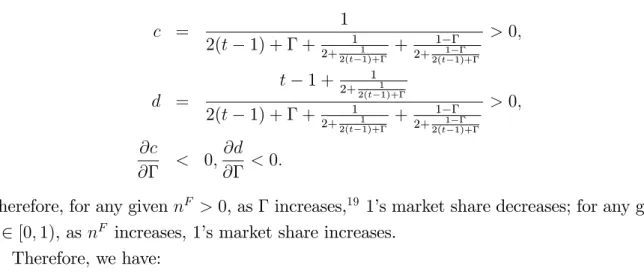
where c = 1 2(t 1) + +2+ 11 2(t 1)+ + 1 2+2(t11)+ >0; d = t 1 + 1 2+2(t 11)+ 2(t 1) + +2+ 11 2(t 1)+ + 1 2+2(t11)+ >0; @c @ < 0; @d @ <0:
Therefore, for any givennF >0, as increases,19 1’s market share decreases; for any given
2[0;1), asnF increases, 1’s market share increases. Therefore, we have:
Proposition 4 (market share) Suppose A1 and A2.
(i) Bilingualism increases the consumer market share of the bilingual platform if nF
(1 + 3 )=2 (1 + ) (1 + 2 ) but reduces it if nF =4: For intermediate values, there
exists ^t such that xB
1 >1=2 if and only if t >t:^
(ii) For any given nF > 0, as increases, the consumer market share of the bilingual
platform decreases; for any given 2[0;1), as nF increases, the consumer market share of
the bilingual platform increases.
Proof. (i) Follows from the fact that the RHS of (18) decreases with t.
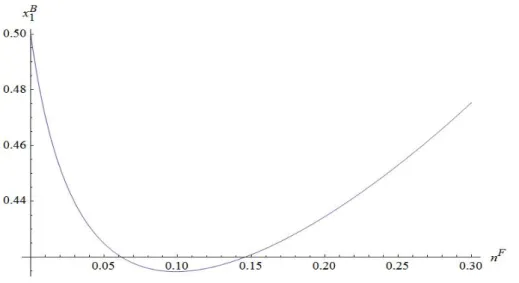
Figure 2 shows that for t= 1;1and = 1:9, platform 1’s market share (represented on the vertical ax) initially decreases and then increases asnF (represented on the horizontal
ax) increases.
We now compare the tax rate of each platform in shared equilibrium. Note …rst that bilingualism increases the inverse measure of platform competition by : A increases from
2 (t 1)to2(t 1)+ . This implies that tax rates are higher when consumers are bilingual than when they are monolingual. Let M
i (respectively, Bi ) denote the tax rate of platform
iwhen consumers are monolingual (respectively, when consumers are bilingual). We have:
Proposition 5 (Competition-softening e¤ect) Suppose A1 and A2. Bilingualism softens platform competition: it increases the inverse measure of platform competition by and
Figure 2: Platform 1’s market share when consumers are bilingual (for t= 1:1, = 1:9)
thereby increases the tax rate of each platform. More precisely, in any shared equilibrium,20 we have: M i = 1 2 + 1 2(t 1) < B2 = 1 2 + 1 2(t 1)+ < B1 = 1 2 + 2(t11)+ for n F >0; M i = B 2 = B 1 for n F = 0.
Note that all the above tax rates are constant and do not depend on the exact market shares. Exchanges in foreign language come with the cost of making exchanges in home lan-guage less valuable in platform 1, which reduces the multiplier (i.e. 1=A). When consumers are monolingual (i.e. ai =bi = 1 for i= 1;2), the multiplier is
1 2(t 1):
When consumers are bilingual, the multiplier is
1
2(t 1) + ;
which is smaller than 1=2(t 1), which explains Mi < Bi for i = 1;2. A part from
this multiplier e¤ect, the fact that exchanges in foreign language make exchanges in home
20It is needless to say that in a cornering equilibrium, the tax rate of platform 1 is even higher than the
language less e¢ cient within platform 1 has a direct e¤ect of increasing the price charged by platform 1, which explains B2 < B1. In real world, the exercise of market power of a
search engine can be done through a high reservation price for keyword auctions.
6.2
Production of domestic content
We now examine how bilingualism a¤ects the amount of domestic content available in the Internet.
Consider …rst the polar case in which bilingualism does not a¤ect each platform’s con-sumer market share (and hence nF >0). First, xM1 =xB1 = 1=2 implies nB1 2 nB1nF + nF =nB2. Furthermore, we know from proposition 5 that bilingualism softens competition, implying that nB2 < nM2 = nM1 . Therefore, in this case, the amount of domestic content crowded out is more than the foreign content available such that bilingualism reduces the total e¤ective amount of content available in each platform.
More generally, in a shared equilibrium, we have
nB1 =xB1(1 nF) pB1 = cnF +d (1 nF) 1 1 2 + 2(t11)+
!
: (19)
Note that since strictly increases with nF for nF 2 [0;1=2), …xing implies …xing
nF. In other words, increasing nF for given implies reducing to keep nF constant. Therefore, for any given 2 [0;1), as nF increases, content in the home language in the bilingual platform increases. For any given nF > 0, as increases, content in the home language in the bilingual platform decreases as1 nF and(1 )=(2(t 1) + )decrease in . For instance, for t large, xB1 is close to 1=2. Then (19) implies that the gross surplus of domestic CPs in platform 1 is smaller under bilingualism than under monolingualism for
nF > 0. Furthermore, from Proposition 4, for nF =4 and t large enough, xB2 < 1=2
and hence the gross surplus of domestic CPs in platform 2 is smaller under bilingualism than under monolingualism as well. Therefore, in this case, bilingualism reduces domestic content in both platforms.
Consider now the monopoly tipping equilibrium (i.e. nF > 2t 21+ nF). First notice that the tax rate is given by:
T 1 = 1 2 > M i = 1 2 + 1 2(t 1) :
So CPs capture a smaller share of surplus under bilingualism. However the mass of con-sumers is also larger under bilingualism. We have 1 nF =2 =nT
nM21 if and only if
nF > 2t 2 4t 3:
Thus when there is little di¤erentiation and large overlap between foreign language and domestic content, the price increase by the foreign platform more than o¤sets the increase in its consumer market share. As a result, bilingualism reduces content in the home language. On the contrary, if there is enough di¤erentiation and little overlap, tipping increases the supply of domestic content. Summarizing, we have:
Proposition 6 (content) Assume A1 and A2. (i) In a shared equilibrium (i.e. nF nF)
(a) For any given 2 [0;1), as nF increases, home language content of the bilingual
platform increases. For any given nF > 0, as increases, home language content of the
bilingual platform decreases.
(b) If bilingualism does not a¤ect each platform’s consumer market share, the amount of domestic content crowded out is more than the foreign content available such that bilin-gualism reduces the total e¤ective amount of content available in each platform.
(c) Suppose nF =4 and nF >0: For t large enough, bilingualism reduces domestic
content available in each platform, nB
i < nM for i= 1;2:
(ii) In a monopoly tipping equilibrium (i.e. when nF > nF), bilingualism reduces
do-mestic content available, i.e. nT
1 < nM if and only if
nF > 2t 2 4t 3:
6.3
Domestic welfare
In this subsection, we study how bilingualism a¤ects the social welfare of the home country. We …rst show that in order to compare welfare in the original model, we can restrict attention, w.l.o.g, to the weighted sum of the consumer surplus and producer surplus in the normalized model. And then, we perform welfare comparison for some special cases analytically and run simulations for a general case.
21ComparingnT
1 withnM is right as long as we assume that a CP’s (platform-speci…c) …xed cost of entry
is the same and does not depend on the identity of the platform. Even if …xed cost of entry is independently distributed across the platforms, the amount of content available toeach consumer in equilibrium is given bynT1 ornM depending on whether consumers are bilingual or monolingual.
6.3.1 Welfare in the original model vs welfare in the normalized model
In the appendix, we show an interesting result about the link between domestic welfare in the original model with any (a; b; f) with a > 0, b >0, f >0 and domestic welfare in the normalized model with a=b=f = 1.
The domestic welfare in the original model when consumers are bilingual is de…ned as:
W(a; b; f; nF; ) = u+a n1+nF 2 n1nF x1 +an2x2 t 2 (x1) 2 + (1 x1)2 + ( n2p2+ (n1) 2 + (n2) 2 2f )
where the term in the …rst bracket represents consumer surplus and the term in the second bracket represents producer surplus (i.e. the sum of the domestic platform’s pro…t and the payo¤s of domestic CPs); (n1)2+(n2)2
2f takes into account both CPs’ net surplus and their
…xed cost. Note that the welfare when consumers are monolingual is simply a particular case of the welfare when consumers are bilingual withnF = 0.
De…neCS(1;1;1; nF; )and (1;1;1; nF; )as consumer surplus and producer surplus
in the normalized model witha =b =f = 1.
W(1;1;1; nF; ) = u+CS(1;1;1; nF; ) + (1;1;1; nF; ); CS(1;1;1; nF; ) = n1+nF 2 n1nF x1+n2x2 t 2 (x1) 2 + (1 x 1)2 ; (1;1;1; nF; ) = n2p2+ (n1) 2 + (n2) 2 2 :
Then, in the appendix, we show
W(a; b; f; nF; ) =u+bf aCS(1;1;1; nF; ) +b (1;1;1; nF; ) :
Therefore, comparingW(a; b; f; nF; )withW(a; b; f;0; )is equivalent to comparingCS(1;1;1; nF; )
+ab (1;1;1; nF; ) with CS(1;1;1;0; ) + ab (1;1;1;0; ) where b=a > 0 is the relative weight of producer surplus in the domestic welfare. In other words, in terms of the com-parison, without loss of generality, we can restrict attention to the weighted sum of the consumer surplus and producer surplus in the normalized model.
6.3.2 When = 0
When = 0, from proposition 3, in a shared equilibrium, we have:
xB1 = 1 2+ n F; xB 2 = 1 2 n F; nB1 = 1 2+ n F (1 ); nB 2 = 1 2 n F (1 );
where = 1 2 1 t 1 + 2+ 11 2(t 1) >0;1 = 1 1 2 + 2(t11) >0:
In the monolingual case, we have
CS(1;1;1;0;0) = 1 2(1
t 2):
We assume 1 2t > 0. It means that consumer surplus (net of the surplus from non-sponsored search) is positive in the monolingual case and it is satis…ed ift is not too large. Then, we have CS(1;1;1; nF;0) = (1 t 2) 1 2+ 2 n F 2 + (1 2 + n F)nF; dCS(1;1;1; nF;0) dnF > 0; d2CS(1;1;1; nF;0) dnF2 >0:
Hence, consumer surplus strictly increases withnF; furthermore, it increases in a increasing
way.
Regarding producer surplus, we have
(1;1;1; nF;0) = 1 2 + n F 2 (1 )2 + 1 2 n F 2 (1 ); d (1;1;1; nF;0) dnF R 0 i¤n F R nF 2 ; d2 (1;1;1; nF;0) dnF2 >0: Actually,nB
1 +nB2 is constant and does not depend on nF. Bilingualism increases platform
1’s consumer market share and decreases that of platform 2, which in turn increases plat-form 1’s CPs and decreases those of platplat-form 2. This in turn increases CPs’total surplus because of economies of scale in the interactions between consumers and CPs; for given total number of consumers and CPs, having asymmetric market share generates a higher surplus from match between the two groups. However, bilingualism reduces platform 2’s pro…t. Hence, the aggregate e¤ect on producer surplus is ambiguous and we …nd that the marginal decrease in platform 2’s pro…t dominates the marginal increase in CPs’ surplus for any nF < nF. Since (1;1;1; nF;0) is convex in nF, this in turn suggests that there
is another cuto¤nbF(> nF)such that bilingualism increases producer surplus if and only if
nF >nbF. Summarizing, we have:
Proposition 7 (welfare when there is no content overlap) Suppose = 0and1 t
2 >0:
When consumers are bilingual, in any shared equilibrium,
(ii) Domestic producer surplus including platform 2’s surplus decreases with nF up to nF 2 and then increases with nF: Hence, when bilingualism decreases producer surplus, there is a threshold weight of producer surplus such that bilingualism decreases (respectively, increases) domestic welfare for any weight (b=a) above the threshold (respectively, below the threshold).
6.3.3 When market share is not a¤ected
Suppose nF > 0 and consider the polar case in which bilingualism does not a¤ect each platform’s consumer market share. We know from Section 6.2nB1 2 nB1nF +nF =nB2 < nM2 =nM1 .
Consider …rst platform 2. The prices paid by CPs to platform 2 are pure transfer and do not a¤ect domestic welfare. For given market share, maximizing domestic social welfare in platform 2 requires subsidizing CPs’subscriptions since CPs generates positive externalities to consumers. Therefore, an increase in the subscription price, which reduces the mass of CPs subscribed to platform 2, reduces domestic welfare generated by platform 2.
Consider now platform 1. Bilingualism reduces consumer surplus in platform 1 since the total "e¤ective" mass of CPs (nB1 2 nB1nF +nF) is smaller than nM1 . Domestic CPs su¤er as well since they pay a higher subscription price whereas the expected number of transactions per CP decreases due to the competition from foreign CPs.
When we make world welfare comparison, the previous discussion shows that bilin-gualism reduces the surplus generated by each platform i from (a +b)nMi =2 = nMi to
nB2 =nB1 2 nB1nF +nF. In platform 2, this reduction in surplus is larger than the saving in the …xed cost of entry from nM2 2=2to nB2 2=2. However, in platform 1, the latter can be larger than the former. Therefore, bilingualism decreases world welfare if the reduction is total surplus is larger than the saving in the entry cost:
2nM1 nM2 2 h 2nB2 nB2 2 i > 1 2 n B 2 2 nB1 2 :
Proposition 8 (welfare when there is no change in the market share) Suppose that bilin-gualism does not a¤ect each platform’s consumer market share.
(i) Bilingualism always reduces domestic welfare because
(a) the total surplus generated by each platform is smaller; and
(b) both consumers and domestic CPs get a smaller share of the reduced surplus in platform 1.
(ii) Bilingualism reduces world welfare if the reduction in the surplus generated by both platforms is larger than the saving in the entry cost of domestic CPs subscribing to platform 1.
6.3.4 General case
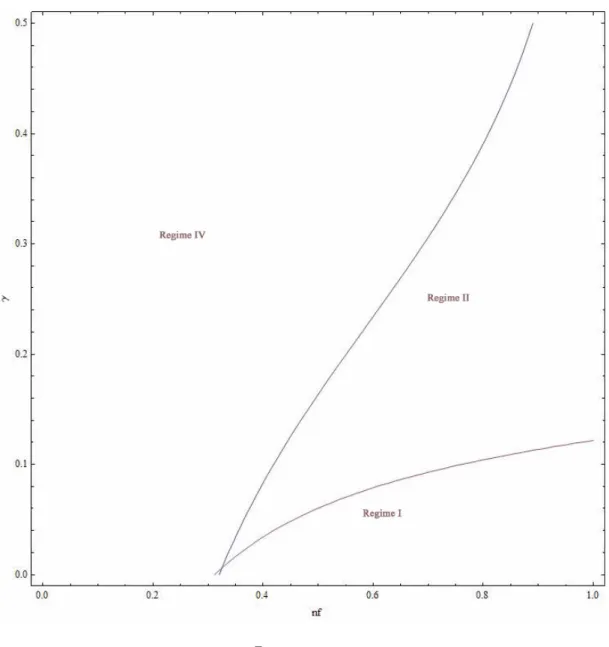
The previous polar cases show that bilingualism can increase or decrease a given domestic group’s payo¤. We here present simulations result for the general case. In general, for given t, there can be four regimes depending on the values of (nF; ):
Regime I:CS(1;1;1; nF; ) CS(1;1;1;0; )and (1;1;1; nF; ) (1;1;1;0; )
Regime II:CS(1;1;1; nF; ) CS(1;1;1;0; )and (1;1;1; nF; )< (1;1;1;0; )
Regime III:CS(1;1;1; nF; )< CS(1;1;1;0; ) and (1;1;1; nF; ) (1;1;1;0; )
Regime IV: CS(1;1;1; nF; )< CS(1;1;1;0; )and (1;1;1; nF; )< (1;1;1;0; )
More generally, …gure 3 shows all possible regimes on a plan of(nF; )for given t= 1:3
in the shared equilibrium. belongs to (0;0:5)and is represented on the vertical axis andnF
belongs to (0,1) and is represented on the horizontal axis (hence A1 is satis…ed and we also verify that there is always a shared equilibrium). Consider any givennF
2[0:35;0:8]:Then, for relatively small, bilingualism increases both consumer surplus and producer surplus. As increases, the con‡ict between the two groups emerges such that bilingualism increases consumer surplus but decreases producer surplus. As further increases and becomes relatively large, bilingualism decreases both consumer surplus and producer surplus. The regime III does not exist for the parameters considered.
In most western European countries and Latin American countries, we expect a high and a high nF and hence these countries are likely to be in Regime II where bilingualism
increases consumer surplus while decreasing producer surplus. As the weight of producer surplus in domestic welfare (i.e. as b=a) increases (respectively, decreases), bilingualism would decrease (respectively, increases) domestic welfare in these countries. On the con-trary, in Asian countries, we expect a low and a low nF. As long as is su¢ ciently
smaller thannF, bilingualism will increase consumer surplus and CP surplus.
7
Concluding remarks
Our main insight is based on the multiplier e¤ect in our two-sided market and therefore should be robust to allowing for multi-homing on consumer side. As long as a positive fraction of consumers single-homes, the multiplier e¤ect remains qualitatively the same: if some single-homing consumers switch from platform 1 to platform 2, it will increase content available in platform 2 and decrease content available in platform 1, which in turn induces
Figure 3: Contour of CS(1;1;1; nF; ) = CS(1;1;1;0; ) (the blue curve) and
additional single-homing consumers to switch from platform 1 to 2 and so on. Then, we still have the result that as one platform becomes less e¢ cient, it reduces the multiplier and thereby softens platform competition. In addition, we also have the result that a positive overlap between foreign content and domestic content has the e¤ect of making the foreign platform less e¢ cient in terms of marginal surplus generated by interactions between domestic consumers and domestic content. Combining the two results implies that bilingualism softens platform competition as long as a positive fraction of consumers single-homes.
In most western European countries and Latin American countries, Google’s market share is above 90% and is larger than its market share in U.S.A. (see the last table in the appendix). Although we did not analyze what is going on outside of the small home country, our results can o¤er an explanation to this fact. Basically, a relatively large fraction of bilingual consumers in home country allows Google to leverage its market share in U.S.A. such that a tipping equilibrium (or a shared equilibrium close to tipping) can prevail in home countries. Our results show that this leverage typically increases consumer surplus at the cost of reducing surplus of domestic CPs. Therefore, when the relative weight of producer surplus over consumer surplus is large enough, bilingualism reduces domestic welfare in these countries. In particular, bilingualism can reduce the production of content in the home language when there is little di¤erentiation of search service and a large overlap between content in English and content in the home language.
For our analysis, cultural factors should also matter as they a¤ect the volume of relevant English content for a given country as well as the degree of substitution between content in the home language and content in English. In particular, our results are consistent with the fact that Google’s market share is often below its market share in U.S.A. in countries whose national languages are not based on Roman alphabet. In these countries, most consumers are monolingual and the overlap between English content and domestic content is smaller than in countries using Roman alphabet. Moreover it is more di¢ cult to conduct the same query in several languages if alphabet are di¤erent. Hence there is little leverage of Google’s market share from U.S.A. to home countries.
Our paper is a …rst step to economic research on languages and platforms in the Internet. There are many interesting issues for future research. One important bene…t of bilingualism that we did not incorporate is that it can increase the number of consumers using the Internet in the beginning when little content is available in the home language. Therefore, at least in the early stage of the Internet, bilingualism promotes production of domestic web content by helping to reach a critical mass of users. It would be interesting to consider a dynamic model and to study the conditions under which the bene…t of bilingualism
eventually remains larger than its cost. Google o¤ers translation service whose quality increases over time as its algorithm gets applied to larger and larger data. It would be interesting to analyze how the increase in the quality of translation service a¤ects platform competition and domestic content production. Finally, it would be great to go beyond the small open economy, which requires to explicitly model platform competition both in the home country (i.e. the bilingual country) and in the foreign country (i.e. the monolingual country).
8
References
Anderson, Simon and Stephen Coate (2005). “Market Provision of Broadcasting: A Welfare Analysis”, Review of Economic Studies, 72: 947-972
Armstrong, Mark (2006). “Competition in Two-Sided Markets”, RAND Journal of Economics, 37: 668-691.
Armstrong, Mark and Julian Wright (2007). “Two-Sided Markets, Competitive Bottle-necks and Exclusive Contracts”, Economic Theory, 32: 353-380
Blum, B and Goldfarb, A. (2006) “Does the internet defy the law of gravity”, Journal of International Economics, 70, pp 384-405.
Caillaud, Bernard and Bruno Jullien (2001). "Competing Cybermediaries", European Economic Review, 45: 797-808.
Caillaud, Bernard and Bruno Jullien (2003). “Chicken and Egg: Competition Among Intermediation Service Providers”, RAND Journal of Economics, 34: 309-329.
Church, J. and I. King (1993). “Bilingualism and Network Externalities”Canadian Journal of Economics 26, 337-345
Crystal, David (2006). Language and the Internet. Cambridge University Press. Freund, C., Weinhold, D., (2002). “The Internet and International Trade in Services”.
American Economic Review, Papers and Proceedings, May, 236-240.
Freund, C., Weinhold, D., (2004). “On the E¤ect of the Internet on International Trade”. Journal of International Economics 62, 171–189
Gould, D., (1994). “Immigrant links to the home country: Empirical implications for US bilateral trade ‡ows”. Review of Economics and Statistics 69, 301–316.
Hagiu, Andrei (2006). “Pricing and Commitment by Two-Sided Platforms”, RAND Journal of Economics, 37(3): 720-737
Hagiu, Andrei (2009). “Two-Sided Platforms: Product Variety and Pricing Structures”
Head, K., Ries, J., (1998). “Immigration and trade creation: Econometric evidence from Canada”. Canadian Journal of Economics 31, 46–62.
Hortaçsu, Ali, F. Asís Martínez-Jerez and Jason Douglas, (2009) “The Geography of Trade in Online Transactions: Evidence from eBay and MercadoLibre,”American Eco-nomic Journal: MicroecoEco-nomics, 1: 53-74
Jeon, Doh-Shin and Jean-Charles Rochet (2010). "The Pricing of Academic Journals: A Two-Sided Market Perspective", American Economic Journal: Microeconomics, 2, 222-255. Lazear, E. (1999), “Culture and Language”,Journal of Political Economy 107, S95-S126 Lendle, Andreas, Marcelo Olarreaga, Simon Schropp and Pierre-Louis Vezina (2012), "There goes gravity: how eBay reduces trade costs", CEPR discussion paper, London.
Martens, Bertin and Turlea, Geomina (2012), “The drivers and impediments for on-line cross-border trade in goods in the EU.” Institute for Prospective Technological Studies, Digital Economy Working Paper 2012/1, July
Melitz, Jacques (2008). “Language and Foreign Trade”,European Economic Review 52 (2008) pp. 667–699
Ortega, Javier and Thomas P. Tangeras (2008). “Unilingual Versus Bilingual Education: A Political Economy Analysis”. Journal of the European Economic Association, 6: 1078-1108.
Parker, Geo¤rey R. and Marshall W. Van Alstyne (2005). "Two-Sided Network E¤ects: A Theory of Information Product Design"Management Science 51: 1494-1504
Pimienta, Prado and Blanco. (2009). “Twelve Years of Measuring Linguistic Diversity in the Internet: Balance and Perspectives”, UNESCO Publications for the World Summit on the Information Society.
Portes, R. and H. Rey (2005). “The Determinants of Cross-Border Equity Flows”,
Journal of International Economics, Vol. 65, No. 2, pp. 269-296
Rauch, J., (1999). “Networks versus markets in international trade”. Journal of Inter-national Economics 48, 7–35.
Rauch, J., Trindade, V., (2002). “Ethnic Chinese networks in international trade”.
Review of Economics and Statistics 84, 116–130.
Rauch, J., Watson, J., (2004). “Network Intermediaries in International Trade”. Jour-nal of Economics & Management Strategy 13, 69-93.
Wagner, D., Head, K., Ries, J., (2002). “Immigration and the trade of provinces”.
Scottish Journal of Political Economy 49, 507–525.
Weyl, Glen (2010). "A Price Theory of Multi-Sided Platforms", American Economic Review, 100(4): 1642-72