Loyola University Chicago
Loyola eCommons
Master's Theses Theses and Dissertations
2010
Comprehensive U.S. Higher Education
Internationalization: Exploring Study Abroad as an
Indicator
Candace Brzoska Matta Loyola University Chicago
This Thesis is brought to you for free and open access by the Theses and Dissertations at Loyola eCommons. It has been accepted for inclusion in Master's Theses by an authorized administrator of Loyola eCommons. For more information, please [email protected].
This work is licensed under aCreative Commons Attribution-Noncommercial-No Derivative Works 3.0 License. Copyright © 2010 Candace Brzoska Matta
Recommended Citation
Matta, Candace Brzoska, "Comprehensive U.S. Higher Education Internationalization: Exploring Study Abroad as an Indicator" (2010).Master's Theses.Paper 515.
LOYOLA UNIVERSITY CHICAGO
COMPREHENSIVE U.S. HIGHER EDUCATION INTERNATIONALIZATION: EXPLORING STUDY ABROAD AS AN INDICATOR
A THESIS SUBMITTED TO
THE FACULTY OF THE GRADUATE SCHOOL IN CANDIDACY FOR THE DEGREE OF
MASTER OF ARTS
PROGRAM IN CULTURAL AND EDUCATIONAL POLICY STUDIES
BY
CANDACE BRZOSKA MATTA CHICAGO, ILLINOIS
Over the past twenty years globalization has put a constant demand on U.S. colleges and universities to internationalize their campuses in order to prepare students for active participation in a global world and marketplace. Data from the American Council of Education (ACE) reveal that most institutions, however, only claim a focus on internationalization or tend to take piecemeal approaches. “Poorly integrated into the core academic activities, international education has largely been a marginal aspect of undergraduate education and often simply equated with study abroad.”1 If the steadily increasing numbers of students being sent abroad over the past ten years are any indication, study abroad indeed seems to have become the singular choice in preparing our young for global citizenry and for demonstrating campus internationalization.2 By nature, study abroad clearly plays a large part, often a major role, in this effort. It has been said that international exchange “is one of the most powerful tools available for internationalizing the curriculum in American colleges and universities.”3 It is also easy
1 American Council on Education (ACE), “Center for International Initiatives,” Information Brochure,
http://www.acenet.edu/Content/NavigationMenu/ProgramsServices/cii/index.htm (accessed February 2009).
2
Yvonne Turner and Sue Robson, Internationalizing the University (New York, NY: Continuum International Publishing Group, 2008), 55.
3 Norman L. Kauffman, Judith N. Martin, and Henry D. Weaver, Study Abroad: Strangers at Home
to measure its success or failure simply by the number of students who are sent abroad each year. The U.S. government’s favorable incorporation of the proposed legislation, The Senator Paul Simon Study Abroad Foundation Act (S.473), into the Foreign Relations Authorization Act for Fiscal Years 2010 and 2011 (H.R.2410),1 fuels such focused
initiatives.
Insular approaches such as increasing the number of students that go abroad or a focus on a language requirement here or an internationally related general education requirement there have each, individually, been historically accepted as a suitable display of internationalization. If a school simply required students to take two semesters of a foreign language during their college career or if campus
internationalization was stated in a mission statement, administrators believed they were successful at campus internationalization. In recent years, though, it has been recognized that the internationalization phenomenon in higher education is far more complex and a lot harder to achieve. Those institutions that are considered successful in campus internationalization have taken the concept of “comprehensive
internationalization” to heart and are not just concerned with rhetoric, but rather with a variety of indicators. Internationalization is in their mission statements as well as
systemically encompassed in institution’s pedagogy, curriculum and learning goals,
1 The Senator Paul Simon Study Abroad Foundation Act would increase study abroad participation levels
and make going abroad a cornerstone of higher education. The Senator Paul Simon Study Abroad Foundation Act (S.473) was approved by the U.S. House of Representatives in July 2009 as part of the Foreign Relations Authorization Act for Fiscal Years 2010 and 2011 (H.R. 2410) by a vote of 235-187. The bill has yet to go to the Senate.
campus life, available funding, institutional policies and practices, as well as in faculty and staff’s level of international competency.
Individual schools cannot be entirely held accountable for their level of internationalization efforts—lackluster, inspiring, misguided, or otherwise. The
responsibility apparently rests on the shoulders of the U.S. government and the higher education field as a whole. First, the nation has historically neglected higher education internationalization as a top priority to the extent that it has been reflected in federal programming. In the past fifty years government support has been few, far between, and modestly funded. To date there has been little movement on high-level policy efforts since President Clinton’s 1999 memorandum on international education policy.2
Second, the U.S. higher educational system has not maintained one commonly accepted definition of internationalization, nor have there been industry-wide
overarching indicators that measure a school’s success or failure at campus
internationalization.3 Only until recently have three main theoretical frameworks been acknowledged as resources to gauge campus internationalization, details of which will be discussed later.4 While such theoretical developments can be applauded, there is no denying that a single entity ceases to be accepted in providing the systematic approach
2 Hans de Wit, “Ten Years of Editorial Policy of the Journal of Studies in International Education: Overview,
Challenges, and Opportunities,” Journal of Studies in International Education 11, no. 34 (2007): 253.
3 Turner and Robson, Internationalizing the University, 11–12. 4
NAFSA: Association of International Educators. “Internationalization of the Campus Criteria,” Best Practices in Internationalization, http://www.nafsa.org/knowledge_community_network.sec/ itc_matrix_intro/itcmatrix_groups/itc_criteria/#nafsa (accessed February 2009).
in measuring internationalization on college campuses resulting in comparative results. Without one, institutions are seemingly picking and choosing what indicators to focus on at will, no matter how intangible and intermittent the venture.5 This method prompts the questions: Can one indicator predict a campus’ entire internationalization efforts? Should one indicator of internationalization carry more weight over others or do all indicators exude equal pressure in making a campus more internationalized? Validating insular or piecemeal approaches to internationalization, such as study abroad, is key in determining their individual worth to the entire process of higher education internationalization.
Literature Review
A review of recent literature on the subject of higher education
internationalization suggests several prevalent factors that account for the lack of schools fully integrating internationalization on to their campuses. They include, but are not limited to: (1) higher education internationalization simply has not been a priority for the U.S. government; (2) the term higher education internationalization has not been clearly and precisely defined; and (3) a common theoretical or conceptual
framework that is universally utilized for higher education internationalization research ceases to exist. Very few research studies have attempted to measure comprehensive higher education internationalization.
5
Not a U.S. National Priority
National rather than international interests have historically nudged their way to the forefront of federal agendas with concerns focused instead on nation building, national economic development, and civic society.6 The literature, as well as a policy review, shows that government policies on higher education and/or international education have been few and far between and only modestly funded throughout the century.
Most literature points to the subsequent years after World War II as pivotal in cementing the financing and establishment of structured acts, activities, projects, programs, and organizations under the collective umbrella of international education.7 Some authors argue, however, that the efforts at this time were marginal.8 Regardless, the significant yet limited government activity that prospered since includes: The Fulbright Program of 1946; the Department of Education’s Sputnik-inspired National Defense Education Act of 1958 later incorporated into the Higher Education Act of 1965;
6
Turner and Robson, Internationalizing the University, 40; Theodore M. Vestal, International Education: Its History and Promise for Today (Westport, CT: Praeger, 1994), 21; Andrew F. Smith, “A Brief History of Pre-collegiate Global and International Studies Education,” in Education for American’s Role in World Affairs, eds. John Fonte and Andre Ryerson (Washington, DC: Office of Educational Research and Improvement, 1994), 16.
7
Smith, “A Brief History,” 2; D. Walker, “The organization and administration of study abroad centers in two institutions,” International Education Journal 29, no. 1 (1999): 6–7. Several authors mention the first major shift having occurred before World War II with the creation of the Institute of International Education (IIE) in 1919 and the International Committee on Intellectual Co-operation in 1921, created under the auspices of the League of Nations (and the predecessor UNESCO). The phenomenon that occurred after WWII is largely contributed to not only the establishment of UNESCO and the Fulbright Act, but more importantly to the political and cultural rationales behind them.
8 Hans de Wit, Internationalization of higher education in the United States of America and Europe: A
The Mutual Educational and Cultural Exchange (Fulbright-Hays) Act of 1961; and President Carter’s 1979’s Commission on Foreign Language and International Studies.
It is well known in the literature that the concept of globalization and that of maintaining competitiveness in the international market was realized by both the U.S. government and post-secondary schools as the new century was ushered in.9 In 2000, the first ever Executive Memorandum on international education was signed by President Clinton. First initiated in 1999 by NAFSA: The Association of International Educators and the Alliance for International Educational and Cultural Exchange the Senate unanimously passed a resolution calling for an international education policy in 2001. Simultaneously, literature written on the subject exploded, reinforcing the magnitude of the topic at hand and higher education institutions took notice.10
A decade into the twenty-first century, only minor progress has been made for a comprehensive international education policy in the United States, but there is hope with the new administration in the White House. Little traction was gained with the 2001 international education policy efforts despite resolution work by House members
9 de Wit, Internationalization of higher education, 17. The concept of higher education
internationalization became a strategic process at a handful of U.S. institutions of higher learning as early as the 1980s, but not to the extent that the new millennium saw.
10
Hans de Wit, “Ten Years of Editorial Policy of the Journal of Studies in International Education:
Overview, Challenges, and Opportunities,” Journal of Studies in International Education 11, no. 34 (2007): 253; International Educator, Article index search, http://www.nafsa.org/publication.sec/
international_educator_1/international_educator_3/ie_index_cumulativesubject (accessed February 2009); The Chronicle of Higher Education, Article index search, http://chronicle.com/cgi2bin/texis/ chronicle/search (accessed February 2009). Basic article index searches of NAFSA’s International Educator and The Chronicle of Higher Education shows the average year of articles written on “internationalization” was in 2001, respectively.
(Con. Res. 100) in July 2001, March 2005, and October 2006.11 Today, Con Res. 100, now with seven co-sponsors, sits in both the Subcommittee on Select Education and the Subcommittee on 21st Century Competitiveness. President Obama’s coming to office in 2009 provides some hope on this front, though. During campaigning, then Senator Obama was asked if he would establish an international education policy for the United States if elected President and he affirmed that the short answer was yes. He stated that international education would have to be a priority and would be a fundamental policy goal that would have to be woven through all of the nation’s policies.12
Long are the days of solely focusing on internationalization in order to expand nation-state influence or to promote peace. Authors agree that the rationale has most certainly shifted from political to economic.13 While some progress has been made in the past twenty years, the United States still does not have a comprehensive policy for marshalling the vital resource of international education for national purposes. Without one, experts in the field believe that the U.S. will not be able to maintain economic competitiveness in the years to come.
11 NAFSA: Association of International Educators. “United States International Education Policy History,”
Public Policy, http://www.nafsa.org/public_policy.sec/united_states_international/ united_states_international_1 (accessed March 2010).
12
NAFSA: Association of International Educators. “Presidential Campaigns United on Need for More International Education.” NAFSA.news 13, no. 21 (June 10, 2008), http://www.nafsa.org/publications/ default.aspx?id=5903 (accessed March 2010).
13
Turner and Robson, Internationalizing the University, 3–4; Peter Ninnes and Meeri Hellsten,
Internationalizing Higher Education: Critical Explorations of Pedagogy and Policy (Hong Kong: Comparative Education Research Centre, 2005).
Problematic and Overlapping Definitions
The concept of globalization, complex and contested in its own right, has most definitely widened the various interpretations of the term internationalization as it is applied to various educational processes and the higher education sector. In reviewing the literature it is essential to point out that a multiplicity of definitions and terms has been used for the concepts international education and higher education
internationalization. In the past few decades alone, as the variety of contexts utilized has evolved, there have been just as many elucidatory attempts at a distinction.14 Sifting through the diversity of terms that have been used is fundamental in understanding the problem at hand. Due to the massive scale of literature on the subject, this specific study will only attempt to review recent literature regarding the aforementioned terms. The term internationalism will be excluded as to narrow the focus.
Globalization & Internationalization
Discourse shows that the terms globalization and internationalization are sometimes used interchangeably, have been confused with one another, or are considered radically different, yet related processes.15 This study will consider the
14 de Wit (2002) points to Sven Groenings 1987’s Economic Competitiveness and International Knowledge
staff paper as first indicating the problematic definition of internationalization.
15 de Wit, Internationalization of higher education, 141–145; Phillip G. Altbach, “Globalisation and the
University: Myths and Realities in an Unequal World,” Tertiary Education and Management 10 (2004): 4– 5; Jane J. Knight, “Internationalization Remodeled: Definition, Approaches, and Rationales,” Journal of Studies in International Education 8, no. 1 (Spring 2004): 6, 8.
definition of the terms as the latter—globalization is the catalyst, while internationalization is a response.
Neither globalization nor internationalization is a new concept in higher education. Most publications on the subject generally trace today’s focus of internationalization back to the original European roots of the university.16 The
“academic pilgrimage”17 can be traced back to the medieval period and further carried through the nineteenth century. There are authors who criticize this notion. Peter Scott’s The Globalization of Higher Education (1998) and Guy Neave’s The European Dimension in Higher Education: An Historical Analysis (1997) call the idea of
international elements stemming from the middle ages as “inaccurate” and “internationalist rhetoric.”18
The knowledge economy of today, however, is unprecedentedly central to twenty-first century development and its reach is now worldwide, which many authors agree upon.19 Altbach and Knight (2007), for example, more recently define
globalization “as the economic, political, and societal forces” pushing higher education today “toward greater international involvement. Global capital has, for the first time,
16 de Wit, Internationalization of higher education, 4–5. 17 Ibid., 5.
18
Ibid., 4–5.
heavily invested in knowledge industries worldwide, including higher education and advanced training.”20
The general range of international/ization related terms, activities, and subject disciplines connected to higher education is extensive. They include, but are not limited to: international affairs, international studies, intercultural studies, global
education/studies, multicultural education, cross-cultural education/studies,
transnational education, peace education, and internationalism.21 Another group of subdivision terms accepted in the literature, and more closely related to this study, include study abroad, academic mobility, international exchange, and international cooperation.22 Each term has a different emphasis, reflects a different approach, and is used by different authors in different ways.
International Education & Higher Education Internationalization
In terms of a specific definition, recent literature shows that two terms—
international education and higher education internationalization or internationalization of higher education—are currently used interchangeably, at least in U.S. discourse.23 The literature review in this section will focus on definitions from well-known authors in the field, as well as from industry organizations.
20
Phillip G. Altbach and Jane J. Knight, “The Internationalization of Higher Education: Motivations and Realities,” Journal of Studies in International Education 11 (2007): 290.
21
Vestal, International Education, 13; de Wit, Internationalization of higher education, 103.
22 de Wit, Internationalization of higher education, 106. 23
de Wit, Internationalization of higher education, 111–116. The term international education is used by more American authors and internationalization of higher education is used by more non-American authors.
Historically, it is important to note that international education was not always synonymous with higher education internationalization but rather associated with comparative education. In fact, many authors carelessly used comparative education and international education as much without distinction as presently is the case with the two terms in discussion. The debate on the relationship between international education and comparative education explicitly manifested itself (again) in the 1990s, likely prompted by Erwin H. Epstein’s editorial appearing in the Comparative Education Review in 1992. Although the intricacies of this debate are not central to this study, there was an explosion of literature that was produced in the last decade of the
twentieth century that attempted to rework through the question of the boundaries of the two fields. Many meaningful contributions emerged, but the debate still
continues.24 More recently, authors such as Rust (2002) believe that as long as articles on international education meet certain academic criteria regarding conceptual framing, methods, and originality then they have a proper place in comparative education
journals.25
With respect to the terms higher education internationalization and/or
internationalization of higher education, it is interesting to note that de Wit (2002), too, wants to stay connected to the field of comparative education. He argues that using the
24
de Wit, Internationalization of higher education, 104–108, 110. In the mid- to late twentieth century, as the field of comparative education strived for rigorous methodology, several authors such as Harold J. Noah and Max A. Eckstein, William W. Brickman, George Z. F. Bereday, C. Arnold Anderson, Erwin H. Epstein, and Irving Epstein were instrumental in challenging and clarifying comparative theory.
25 Val D. Rust, “The Place of International Education,” Comparative Education Review 46, no. 3 (2002): iii–
term internationalization of education is more accurate and more appropriate, especially in the area of educational research. Using one and the same term for different levels of education is characteristic of the subdivisions used under the umbrella of comparative and international education.
The research should be positioned within comparative higher education research, an area that might, in analogy with comparative and
international education, better be called comparative and international higher education, thereby giving recognition to the growing importance of internationalization in higher education.26
The concept of higher education internationalization/internationalization of higher education has evolved over the past several decades. It has gone from being defined in terms of a set of activities in the 1980s to an institutional process approach in the mid-1990s. Prominent scholar, Jane J. Knight, has been instrumental in the dialogue, and her definitions continue to be some of the most frequently cited and accepted definitions to date. Her work is central to this review.
Knight (1994) first defined internationalization as “the process of integrating an international dimension into the research, teaching and services functions of higher education.”27 Only three years later a slightly redefined definition emerged. Essentially, she changed “international” to “international/intercultural” and “higher education” to “institution,” as well as reordered the placement of “research” and “teaching.”28 In the
26 de Wit, Internationalization of higher education, 208. 27
Jane J. Knight and Hans de Wit, eds., Quality and internationalisation in higher education (Paris: Organization for Economic Cooperation & Development, 1999): 16.
28
same year, van der Wende (1997) proposed a broader definition, suggesting that internationalization is “any systematic effort aimed at making higher education
responsive to the requirements and challenges related to the globalization of societies, economy and labour markets.” 29
Scholars such as Romuald E. J. Rudzki, Peter Scott, Stephen Arum and Jack Van de Water, Clark Kerr, Fred Halliday, Dilys Schoorman, and Joseph A. Mestenhauser all had lucid attempts at defining higher education internationalization in the latter part of last century.30 Another author, Söderqvist (2002), introduced a new definition that was similar to Knight’s in that it also focused on the change process at the institutional level. Higher education internationalization is
a change process from a national higher education institution to an international higher education institution leading to the inclusion of an international dimension in all aspects of its holistic management in order to enhance the quality of teaching and learning and to achieve the desired competencies.31
Taking van der Wende’s criticism into consideration regarding the limited scope in which she applied her past definitions—solely to the institution—Knight conceded the
29
Marijk C. van der Wende, “Missing links: The relationship between national policies for internationalisation and those for higher education in general,” in National policies for the
internationalisation of higher education in Europe, eds. Torsten Kälvermark and Marijk C. van der Wende (Stockholm: National Agency for Higher Education, 1997): 18.
30 de Wit, Internationalization of higher education, 111–112. Hans de Wit, a leader in the field, recognized
scholars such as Rudzki (1998), Scott (1998), Arum and Van de Water (1992), Kerr (1994), Halliday (1999), Schoorman (1999), and Mestenhauser (2000) as contributing to the efforts to define internationalization in higher education.
31
Minna Söderqvist, Internationalization and its management at higher-education institutions: Applying conceptual, content and discourse analysis (Helsinki, Finland: Helsinki School of Economics, 2002): 29.
importance and influence the national/sector level had on higher education
internationalization through funding, policy, and programs.32 Yet she still maintained that it was at the institutional level that real process of internationalization took place. “Internationalization at the national, sector, and institutional levels is defined as the process of integrating an international, intercultural, or global dimension into the purpose, functions of delivery of post-secondary education.”33
The twenty-first century brought not only more important dialogue from scholars in the field but industry organizations also began recognizing the need for a clearer definition of internationalization in relationship to education. The American Council on Education (ACE), NAFSA: Association of International Educators, and the Institute for International Exchange (IIE) have all had long-standing relationships with professionals in the field of higher education. They are each actively involved at the collegiate level and internationalization efforts vary from organization to organization.
The American Council on Education (ACE) has had a long standing commitment to internationalization, but it was not until 2000 with funding from the Ford Foundation that progress came more quickly. While a date of the definition could not be located, in describing internationalization ACE respectfully acknowledges the long history the term has had in the U.S. The definition begins by stating internationalization is an ongoing process that includes many different approaches and strategies rather than a stagnant
32 Jane J. Knight, “Internationalization Remodeled,” 9. 33
Jane J. Knight, “Updated definition of internationalization,” International Higher Education 33, nos. 2–3 (2003): 2.
set of activities. Knight’s definition of ten years ago is cited and concludes with their ideal—comprehensive internationalization.
For some, internationalization means adding a few programs or courses, increasing the number of students going abroad, or recruiting additional international students. Such changes generally entail doing more of the same thing, or doing the same things in a slightly different way. But another view of internationalization, one that sees it as pervading the institution and affecting a broad spectrum of people, policies, and programs, leads to deeper and potentially more challenging change. Comprehensive internationalization is the ACE shorthand for this broad, deep, and integrative international practice that enables campuses to become fully internationalized.34
NAFSA: Association of International Educators only recently defined internationalization. Its working definition is
the conscious effort to integrate and infuse international, intercultural, and global dimensions into the ethos and outcomes of postsecondary education. To be fully successful, it must involve active and responsible engagement of the academic community in global networks and partnerships.35
It is also the number two goal in their 2008–2010 strategic plans and specifically
addresses making internationalization an essential component of U.S. higher education. The Institute for International Education (IIE), one of the oldest international education organizations, does not provide a working definition for internationalization despite the fact that it gives out an award for best practices in internationalization. One
34 American Council on Education (ACE). “Comprehensive Internationalization,” Program and Services,
Center for International Initiatives, http://www.acenet.edu/Content/NavigationMenu/ProgramsServices/ cii/Comp_Intz.htm (accessed February 2009).
35
NAFSA: Association of International Educators, “Fostering Global Engagement Through International Education,” Mission, Vision, Values, http://www.nafsa.org/_/File/_/positioning_brochure.pdf (accessed February 2009).
of the four Andrew Heiskell Award categories is titled “Internationalizing the Campus,” but this category is only defined briefly as “advancing curriculum development and creatively integrating international students into university life.” 36 The online article “Twenty Ways to Strengthen International Education on the Campus,” an adaptation from a prior piece which appeared in the IIE membership newsletter several years ago, provides little more insight. The listing is full of self-described ideas and suggestions. In part, it includes
Encourage your president’s office to include internationalization and global education in your institution's mission statement. Why not develop an international mission statement for your office, as well? Recruit foreign students to your campus. Use currently enrolled
students, faculty and staff and overseas alumni to help with this effort.
Establish a partnership with an overseas institution.
Look at your institution’s/office’s brochures, catalogs and website. Is a global message being conveyed?
Offer to make presentations to individual academic divisions about international students programs.
Hold international festivals, such as film/slide shows, folk singers, dancers, theater, food fair, displays. Celebrate international holidays. Promote internships overseas. This could be a joint project with, or
led by, your campus career office.37
Dialogue on the subject has been plentiful but are the definitions of international education and higher education internationalization any closer to specificity? The field in the U.S. seems to have only agreed on the interchangeability of the two terms.
36
Institute of International Education (IIE), “Internationalizing the Campus.” The Andrew Heiskell Awards Categories, http://www.iienetwork.org/?p=27474 (accessed January 2009).
37
Peter R. Kerrigan, “Twenty Ways to Strengthen International Education on the Campus,” Andrew Heiskell Awards for Innovation in International Education, Best Practices, http://www.iienetwork.org/ ?p=39510 (accessed February 2009).
Several prominent authors of higher education internationalization discourse, Hans de Wit and Jane J. Knight, have stated that a precise definition may never be agreed upon, or needed for that matter.38
…as the international dimension of higher education gains more
attention and recognition, people tend to use it in the way that best suits their purpose. While one can understand this happening, it is not helpful for internationalization to become a catchall phrase for everything and anything international. A more focused definition is necessary if it is to be understood and treated with the importance that it deserves. Even if there is not agreement on a precise definition, internationalization needs to have parameters if it is to be assessed and to advance higher
education. This is why the use of a working definition in combination with a conceptual framework for internationalization of higher education is relevant.39
Although it is true (and appropriate) that there will likely never be a true universal definition, it is important to have a common understanding of the term so that when we discuss and analyze the phenomenon we understand one another and also refer to the same phenomenon when advocating for increased attention and support from policy makers and academic leaders.40
Theoretical Frameworks and Research
Despite a dramatic increase in the literature concerned with higher education internationalization the review reveals that research centered on a theoretical framework has only occurred recently. Turner and Robson (2008) asked it best: “If
38
Jane J. Knight and Hans de Wit, “Strategies for Internationalisation of Higher Education: Historical and Conceptual Perspectives,” in Hans de Wit, Strategies of internationalization of higher education. A comparative study of Australia, Canada, Europe and the United States (Amsterdam: European Association for International Education, 1995), 114; Hans de Wit, Internationalization of higher education, 114–115; Jane J. Knight, “Internationalization Remodeled,” 8.
39
Hans de Wit, Internationalization of higher education, 114–115.
internationalization exists as such different phenomenon in different contexts, how is it possible to understand an individual institution’s orientation to it, let alone manage organizational progress towards a desired style or level of engagement?”41
In response to such questions, several scholars have developed organizational models for the internationalization of higher education with varying approaches. They include but are not limited to Guy Neave (1992), John Davies (1992), Romuald E. J. Rudzki (1995, 1998), Jane J. Knight and Hans de Wit (1995), Marijk C. van der Wende (1996), and Hans van Dijk and Kees Meijer (1997).42 The Modern Language Association (MLA) and the Institute of International Education (IIE) have also provided valuable research over the years related to some aspects of internationalization—language study, study abroad, and international students.43 Only as of late, have three main research efforts been acknowledged more than any others as providing a theoretical
41
Turner and Robson, Internationalizing the University, 40.
42
Guy Neave, “Managing Higher Education International Cooperation: Strategies and Solutions”
(unpublished reference document, 3rd UNESCO/NGO Collective Consultation on Higher Education, Paris, France, December 9–11, 1992), 167-168; John L. Davies, “University Strategies for Internationalisation in Different Institutional and Cultural Settings: A Conceptual Framework,” in Policy and Policy
Implementation in Internationalisation of Higher Education (EAIE Occasional Paper 8), ed. P. Blok (Amsterdam: European Association for International Education (EAIE), 1995), 3–8; Romuald E. J. Rudzki, “The Application of a Strategic Management Model to the Internationalization of Higher Education Institutions,” Higher Education 29, no. 4 (1995): 421–441; Knight and de Wit, “Strategies for
Internationalisation,” 5–32; Marijk C. van der Wende, “Internationalising the Curriculum in Dutch Higher Education: An International Comparative Perspective” (PhD dissertation, Utrecht University, 1996); Hans van Dijk and Kees Meijer, “The Internationalisation Cube: A Tentative Model for the Study of
Organisational Designs and the Results of Internationalisation in Higher Education,” Higher Education Management 9, no. 1 (1997): 157–166; Romuald E. J. Rudzki, “The Strategic Management of
Internationalization: Towards a Model of Theory and Practice” (PhD dissertation, University of Newcastle upon Tyne, 1998).
43
Madeline F. Green, Dao Luu, and Beth Burris, Mapping Internationalization on U.S. Campuses: 2008 Edition (Washington, DC: American Council on Education, 2008), 1; Institute of International Education (IIE) Network, Open Doors Online: Report on International Educational Exchange, http://
framework to gauge campus internationalization. They include the American Council on Education’s (ACE) empirical studies in 1988, 1989, 2001, and 2006; Jane J. Knight and Hans de Wit’s 1995 Strategies for Internationalization of Higher Education: Historical and Conceptual Perspectives, and the Association of International Educators’ (NAFSA) 2003–2008 annual reports Internationalizing the Campus: Profiles of Success at Colleges and Universities.
American Council on Education (ACE)
The American Council on Education (ACE) has had a long commitment to
conducting empirical research studies for the purpose of advancing internationalization at U.S. higher education institutions of learning. Their first study, by Charles Andersen, was published in 1988 and was based on a survey of institutional policies and practices at 541 institutions. The survey, titled International studies for undergraduates, 1987: Operations and opinions,44 covered foreign language requirements and course offerings, study abroad opportunities and participation numbers, area studies and other
internationally focused concentrations, the role of library holdings in international studies, and presidential attitudes toward international studies. Another study quickly followed that incorporated data from the previous study, among other national studies,
44
Charles J. Andersen, International studies for undergraduates, 1987: Operations and opinions (Washington, DC: American Council on Education, 1998), 1–56.
campus visits, and transcript analyses. Richard Lambert’s International Studies and the Undergraduate was published by ACE in 1989.45
It was not until 2000 that research work continued. Written by Fred M. Hayward, Internationalization of U.S. Higher Education: Preliminary Status Report 200046 was an update of the work done more than a decade earlier by Lambert. Similar areas that repeated themselves included foreign language requirements and enrollments, study abroad participation, international education requirements, and curricula. New areas measured were students’ awareness of global issues, the presence of international students and faculty, institutional support for internationalization, funding, employment demands, and attitudinal and experiential data. The Mapping Internationalization on U.S. Campuses: Final Report 200347 was the result of three surveys conducted in 2001 to a national sample of 752 U.S. colleges and universities of various institutional types. The first and second surveys focused on undergraduates’ and faculty members’ international experiences and attitudes about internationalization, respectively, and the third on institutional internationalization. The report focused on the usual areas of
internationalization, which they now termed as indicators. These indicators included stated institutional commitment, financial commitment, foreign language requirements
45 Richard C. Lambert, International Studies and the Undergraduate (Washington, DC: American Council on
Education, 1989).
46 Fred M. Hayward. Internationalization of U.S. Higher Education: Preliminary Status Report 2000
(Washington, DC: American Council on Education, 2000), 1–46.
47 L. Siaya, and Fred M. Hayward, Mapping Internationalization on U.S. Campuses: Final Report.
and offerings, international course requirements and offerings, academic programs abroad, and internationally oriented extracurricular activities.
In 2005, a series of publications was published that built upon the 2001 surveys and established an internationalization index for each of the Carnegie classification of institutions–community colleges, comprehensive universities, liberal arts colleges, and research universities.48 The 2001 data were re-examined along six key dimensions— articulated commitment, academic offerings, organization infrastructure, external funding, institutional investment in faculty, and international students and student programs.
The most recent report, Mapping Internationalization on U.S. Campuses: 2008 Edition, is based on a five-year update and comparison done in 2006 that utilizes the 2001 index as a baseline.49 Most but not all of the same questions were asked. ACE surveyed 2,746 of the Basic Carnegie Classification institutions and received a response rate of 39%. The indicators of internationalization were centered on four main areas: institutional support (stated institutional commitment, organizational structure and staffing, and external funding); academic requirements, programs, and extracurricular activities (foreign language requirements and offerings, international/global course requirements, education abroad, use of technology for internationalization, joint degrees, and campus activities); faculty policies and opportunities (funding for faculty
48
Madeline F. Green, Dao Luu, and Beth Burris, Mapping Internationalization on U.S. Campuses: 2008 Edition (Washington, DC: American Council on Education, 2008), 1–120.
49
opportunities and criteria for promotion, tenure, and hiring); and international students (enrollments, recruiting targets and strategies, financial support for international
students, and programs and support services). Comparisons were made against the 2001 data when possible.
Jane J. Knight and Hans de Wit’s Strategies
Jane J. Knight and Hans de Wit’s Strategies for Internationalization of Higher Education: Historical and Conceptual Perspectives (1995) suggests using the term strategies to describe those efforts undertaken by a higher education institution to integrate an international dimension into its research, teaching, and service functions as well as into its management policies and systems. These strategies fall into two broad categories: program strategies and organizational strategies. Program strategies refer to those academic activities and services that are initiated in order to establish an
international dimension at an institution.50 Knight (1999) further clarified the program strategies into six areas—academic programs, research and scholarly collaboration, technical assistance, export of knowledge (inward), export of knowledge (outward), and extracurricular activities.51 Knight and de Wit believe that internationalization needs to be entrenched into the culture, policy, planning, and organizational process of the institution. Without a more permanent organizational commitment the efforts could fail
50
Knight and de Wit, “Strategies for Internationalisation,” 20–22.
and this is where organizational strategies would come into play.52 These strategies are focused on integrating international dimensions into the infrastructure. Knight (1999) also regrouped the organizational strategies into four areas: governance, operations, support services, and human resource development.53
NAFSA: Association of International Educators
NAFSA: Association of International Educators has been publishing an annual report titled Internationalizing the Campus: Profiles of Success at Colleges and Universities since 2003.54 This publication, researched and written by Christopher Connell, profiles colleges and universities and highlights their best practices in various aspects of internationalization. Each year the institutions are determined by a jury panel of five volunteers who apply the following areas of criteria as defined by NAFSA:
administrative support and infrastructure (leadership support, financial support,
established administrative frameworks); community service and outreach (commitment to increasing intercultural awareness in the local, state, regional, and global
communities); curricular initiatives (internationalization is reflected in courses across disciplines and departments and graduation requirements); faculty commitment (faculty support as demonstrated by their participation in curriculum internationalization, through the use of technology, distance learning, participation in education abroad, or
52
Knight and de Wit, “Strategies for Internationalisation,” 20.
53 Hans de Wit, Internationalization of higher education, 122–125. 54
Connell, Christopher, “NAFSA: Association of International Educators, Internationalizing the Campus 2003–2008: Profiles of Success at Colleges and Universities Report,” http://www.nafsa.org/about.sec/ leadership_recognition/senator_simon_award_for_2/#reports (accessed February 2009).
innovative teaching techniques such as language immersion); institutional commitment (mission statements and planning documents contain a commitment to international education and the campus culture echoes this); research and faculty exchange (faculty participate in international interdisciplinary research and international exchange, and international faculty are integrated into the institution); student learning and
participation (international education initiatives positively contribute to student learning and life through development of cross-cultural skills); support for education abroad (students are encouraged to study abroad, support is available throughout the process, alternative intercultural learning options are available, and students are assisted in integrating their experiences into their lives and the campus community); and support for international students and scholars (international students and scholars are welcomed on campus, their and their family’s social and cultural needs are met, and they significantly contribute to the intellectual and cultural fabric of the institution).55
At the same time, NAFSA recognizes that institutions are very different from each other and that the usefulness of certain criteria or pedagogical approaches to internationalization, even their own, may vary according to the situational needs of the individual campus, division, or department. Therefore, each profiled institution in Internationalizing the Campus: Profiles of Success at Colleges and Universities is
categorized and searchable by the following: demographics (size and type of institution
55
NAFSA: Association of International Educators, “Internationalization of the Campus Criteria.” Best Practices in Internationalization, Internationalization of the Campus Matrix, http://www.nafsa.org/ knowledge_community_network.sec/itc_matrix_intro/itcmatrix_groups/itc_criteria/#nafsa (accessed February 2009).
or NAFSA region), strategies from Jane J. Knight and Hans de Wit (1995), as well as internationalization criteria from NAFSA and from ACE’s 2003 Internationalizing the Campus: A User’s Guide.56 NAFSA hopes to expand this resource to include non-U.S. based criteria, as well as more dialogue on the various frameworks, approaches, and theories.
Gaps in Literature
The biggest gap in the literature is the lack of research studies across the three prominent areas I discussed. Although there has been an increase of research in
international education over the last fifty years, a substantial amount of quality research prior to the late 1990s is lacking. This is considered to be a major factor in undermining the seriousness with which academics, most notably those in comparative education, view the field of international education.
My literature review did not find any significant studies that analyzed
government policies and their effects on higher education or their effect on any aspects of internationalization at institutions of higher learning. The phenomenon of higher education internationalization only started coming into its own in the past decade, a time in which higher education was not a priority for President George W. Bush. This could account for this gap. It will be interesting to see what President Obama’s administration does at the national level and how scholars respond empirically in the coming years.
56
Secondly, other than analyzing and critiquing the variety of definitions that have been put forth, no quantitative or qualitative studies have looked more closely at the similarities and differences of what scholars have defined as higher education
internationalization. For example, a content analysis of related journals would prove invaluable to the dialogue on the subject and would assist in scholars coming to a consensus on a commonly accepted definition.
Most importantly, there is a deficit of studies that look at comprehensive internationalization. Of the significant studies discussed, ACE’s work offers the only exhaustive analysis of comprehensive internationalization in the U.S. It, too, has just begun to establish comparative results as demonstrated by its 2008 edition of Mapping Internationalization on U.S. Campuses. One note about ACE’s study is that it is a self-reporting survey and that can lend itself to certain inaccuracies since there is not one person applying the same definition or criteria in the same way across the board.
NAFSA’s work, Internationalizing the Campus: Profiles of Success at Colleges and Universities, while consistent over the past six years, has many theoretical holes. The most obvious and most significant is the committee itself that determines the award winning schools. There is no consistency in the analysis year over year since the
committee is made up of volunteers and the same people do not necessarily serve year over year. While NAFSA has defined indicators in which to review, biasness of the jury cannot be ruled out.
The strategies—program and organization—suggested by Knight and Hans de Wit offer a great theoretical framework, but a review of the literature did not reveal any comprehensive studies that utilized this model.
It is hoped that my study will address many of the gaps that exist by
incorporating many of the key indicators of all three studies. Additionally, researching select aspects of higher education internationalization—have it be study abroad participation, foreign language proficiency, or the number of non-U.S. faculty on a campus—and connecting it to higher education internationalization have not been done in the past. The proposed study hopes to initiate such dialogue on the connectedness or lack thereof of the many facets of internationalization.
Research Question
The core issue at hand is to what degree, if any, a single indicator of higher education internationalization relates to a campus’ overall internationalization level. Is there a correlation between the participation rates of undergraduate students sent abroad and how internationalized a campus truly is? This question needs to be examined against not only a distinct definition of internationalization that outlines specific indicators, but also one that acknowledges both rhetoric and reality.
It is hoped that answering this question will strengthen the theoretical basis of campus internationalization studies and that these understandings will be increasingly applied to policy and implementation issues in higher education.
Procedure
Unit of Analysis
A major goal of this proposed study was to research a specific aspect of higher education internationalization—undergraduate study abroad participation—and select higher education institutions that were the backbone of this effort. The institutions were broken down into three institution types: doctoral/research, master’s, and
baccalaureate. This study examines the level of international activity (as defined below) at institutions that have consistently held the number one and number twenty rankings of study abroad participation over the period of five academic years, 2002/2003– 2006/2007, as reported by IIE’s Open Doors Project. The number one ranking was considered to have a high study abroad participation percentage or SAPP, while the number twenty ranking was considered to have a low SAPP. If consistency across the academic years was not found, institutions that had the higher or lower percentages were chosen for the high level and low level categories, respectively. Additionally, only institutions that met the methodological standards of this study were included. Six institutions in total were analyzed—a school with a high SAPP and a school with a low SAPP from each institution type.Study abroad participation percentage (SAPP) was defined as the percentage of undergraduate students at a given school that studied abroad during the academic year, including during the summer. The length of the program or experience was irrelevant (e.g. semester, year, summer, J-term, Maymester, winter or spring breaks). The Open Doors report defined study abroad as “only those
students who received academic credit from an accredited U.S. institution of higher education after they returned from their study abroad experience.”57 It made no difference whether that experience occurred through a third party provider, directly with a foreign institution, or on a faculty-led program.
Methodology
The conceptual framework that was utilized is based in part upon the research work of the American Council on Education (ACE); the unifying voice of all U.S. accredited colleges and universities. One indicator from each of the main four areas that ACE’s 2008 study used guided this limited study.
Institutional Support—Evidence of stated institutional commitment to internationalization was determined by the frequency of relevant key word groupings in mission statements.
Academic Programs—The number of area studies (i.e. Southeast Asian Studies, Italian Studies, etc.), foreign languages/literatures/linguistics, as well as
international relations/affairs’ bachelor degrees conferred assisted in determining whether students have the opportunity to gain the specific knowledge about international and global issues.
International Students—Enrollment levels as a percentage of the total student body allowed for a possible indication of peer perspective being shared in the classroom, dining hall, and dorm room.
57 Institute of International Education (IIE) Network, Open Doors Online, FAQs on Open Doors,
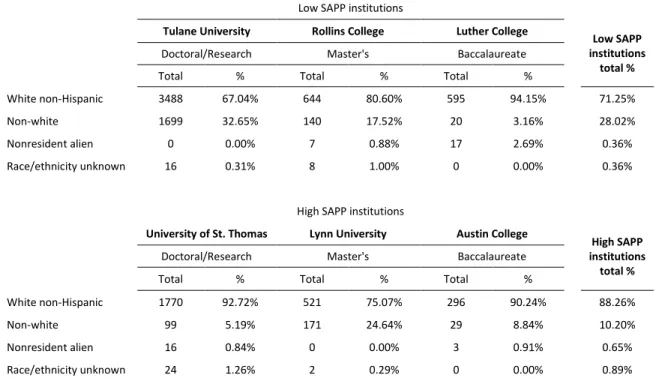
Faculty and Staff Diversity—Ethnicity of full-time and part-time faculty and staff was examined. This finding helped in determining where and from whom influence on students is coming.
The first indicator allowed for examination of the rhetoric, while the remaining three indicators focused on the degree to which internationalization efforts were already in effect on each campus.
The data were collected electronically from the Integrated Postsecondary Education Data System (IPEDS) for academic year 2006/2007. IPEDS is a system of interrelated surveys conducted annually by the U.S. Department’s National Center for Education Statistics (NCES) to all schools that participate in any of the federal student financial aid programs. While the amended Higher Education Act of 1965 requires that all colleges, universities, technical, and vocational institutions—some 6,700 of them— report their data, any institution neglecting to do so was not used in this study. Collecting data from IPEDS for academic year 2006/2007 provided the most current, stable benchmark in which to make comparisons. This academic year is significant to measure as it is before the current economic crisis in the U.S began affecting the country.58
58
In a February 27, 2007 press release the Federal Home Mortgage Loan Corporation (Freddie Mac) announced it would no longer buy the most risky subprime mortgages and mortgage-related securities. This was the beginning of a domino effect of many more banks and mortgage lenders taking similar, if not graver, actions and the economy falling into what many term, the Great Recession.
A final analysis compared and contrasted the four internationalization indicators described above in relation to their respective SAPP. Any correlations were examined in-depth.
Results and Discussion
The averaged high (H) and low (L) SAPP from each of the three main institution types over the period of five academic years was determined with the help of IIE’s Open Doors Project. The six institutions include: doctoral/research institutions University of St. Thomas (Minnesota) and Tulane University (Louisiana); master’s level institutions Lynn University (Florida) and Rollins College (Florida); and finally Austin College (Texas) and Luther College (Iowa) representing the baccalaureate institutions.
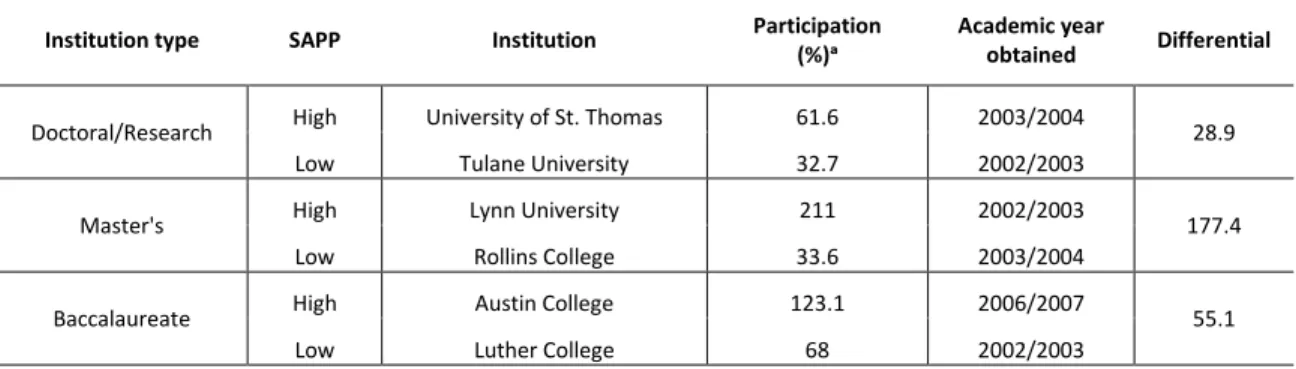
The institutions that were analyzed for this study, their respective SAPP, and the differentials between the high and the low SAPPs are outlined in table 1. It was
important to ensure that there was enough of an empirical difference between the high and low SAPPs before even beginning this study. If there was not a substantive
differential then the entire study would be built on a weak unit of analysis. It is
interesting to note that all institutions were private; four out of the six were located in the southern region of the United States (Florida, Louisiana, and Texas); 12-month unduplicated 2006/2007 undergraduate enrollment ranged from 1,354 students to
7,179 students with a average of 3,818 students; 2006/2007 academic year tuition averaged $27,104; and a third of the institutions had religious ties (Austin and Luther).59
Table 1. Table of selected higher education institutions used for study and their
differentials, by type
Institution type SAPP Institution Participation
(%)ᵃ
Academic year
obtained Differential
Doctoral/Research High University of St. Thomas 61.6 2003/2004 28.9
Low Tulane University 32.7 2002/2003
Master's High Lynn University 211 2002/2003 177.4
Low Rollins College 33.6 2003/2004
Baccalaureate High Austin College 123.1 2006/2007 55.1
Low Luther College 68 2002/2003
Source: Data partially from Institute of International Education (IIE) Network, Open Doors Online. U.S. Study Abroad Data Tables. http://opendoors.iienetwork.org/ (accessed January 2009).
Note: During academic year 2002/2003, Luther College had a tie with Concordia College-Moorhead in the number twenty ranking. Both schools had a participation rate of 68%. Luther College appeared again in the five academic years being analyzed (in 2006/2007) so it was ultimately selected as the unit of analysis for this institution type. Also note that during the course of this study, it was determined that Yeshiva University did not report necessary data to the Integrated Postsecondary Education Data System (IPEDS). Therefore, an accurate analysis could not be determined and doctoral/research institution, the University of St. Thomas, was awarded this privilege instead.
aParticipation percentages over 100 percent can best be described by discussing briefly how the rates are calculated. In addition to the data reported to IIE directly by institutions on their study abroad population through their annual U.S. Study Abroad Survey, IIE also utilizes undergraduate completion data from the U.S. Department of Education’s Integrated Postsecondary Education Data System (IPEDS). The participation rate is calculated by dividing the total number of undergraduates who studied abroad in a given year (as reported in the Study Abroad Survey) by the total number of undergraduate completions (from IPEDS). Due to various factors, such as students studying abroad more than once, students dropping out before graduation (non-completions) and differing cohort sizes from year to year, participation rates may exceed 100 percent.
Institutional Support
Mission statements are a public declaration of an organization’s purpose and commitment to certain issues and values that are of the utmost importance to a particular college or university. Often less descriptive than strategic plans, mission statements generally describe overarching goals of the organization and provide a sense of direction for the decision-making process. To determine stated institutional
commitment to higher education internationalization the mission statements of each of
59 U.S. Department of Education, Institute of Education Sciences’ National Center for Education Statistics,
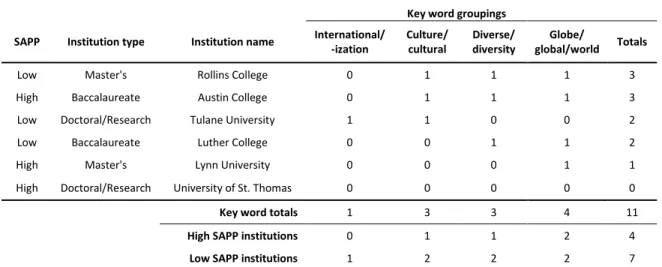
the six universities being examined underwent a content review for frequency of use. Expanding upon ACE’s latest research on the topic at hand references to four key word groupings—international/internationalization, culture/cultural, diverse/diversity, and globe/global/world—were used. While ACE’s approach appropriately sought specificity by searching for the key words internationalization and global education, this researcher felt that was too limiting. Table 2 outlines the results.
Table 2. Frequency of key words in mission statements, by total and by SAPP
Key word groupings
SAPP Institution type Institution name International/
-ization Culture/ cultural Diverse/ diversity Globe/ global/world Totals
Low Master's Rollins College 0 1 1 1 3
High Baccalaureate Austin College 0 1 1 1 3
Low Doctoral/Research Tulane University 1 1 0 0 2
Low Baccalaureate Luther College 0 0 1 1 2
High Master's Lynn University 0 0 0 1 1
High Doctoral/Research University of St. Thomas 0 0 0 0 0
Key word totals 1 3 3 4 11
High SAPP institutions 0 1 1 2 4
Low SAPP institutions 1 2 2 2 7
Source: Data from U.S. Department of Education, Institute of Education Sciences’ National Center for Education Statistics, IPEDS Data Center, http://nces.ed.gov/ipeds/datacenter/ (accessed May 2010). Verified at each institution's website: University of St. Thomas,
http://www.stthomas.edu/mission/; Tulane University, http://tulane.edu/about/mission.cfm; Lynn University, http://www.lynn.edu/about-lynn/mission-and-vision; Rollins College, www.rollins.edu/aboutrollins/mission.shtml; Austin College, http://www.austincollege.edu/info.asp?1346; and Luther College, http://www.luther.edu/about/mission/index.html (accessed May 2010).
Note: See Appendix A for actual mission statements and key words found.
Across all of the institutions, the four key word groupings were mentioned a total of 11 times. The most cited key word grouping used was that of globe/global/world with four occurrences. Both culture/cultural and diverse/diversity quickly followed and each appeared three times. International/internationalization only appeared once and that was in Tulane University’s (L) final sentence. “This mission is pursued in the context of the unique qualities of our location in New Orleans and our continual aspiration to be
a truly distinctive international university."60 The baccalaureate institution type led with five occurrences of the key word groupings. The master’s and doctoral/research
institution types followed with four and two occurrences, respectively.
The low SAPP institutions outnumbered the high SAPP institutions seven to four in total key word groupings. The low SAPP schools—Tulane, Rollins, and Luther—also had more proportion across the key word groupings as each key word grouping was represented. Each occurred twice with the exception of international/
internationalization. Austin College, representing the baccalaureate high SAPP schools, not only tied with Rollins (L) for the most key words, but it also represented three-quarters of the high SAPP institutions’ total. Lynn University (H) and the University of St. Thomas (H) had the two lowest frequency totals overall. The University of St. Thomas actually did not have any key word groupings in its mission statement.
It was felt that a further analysis of key word groupings as compared to the total length of the mission statement would provide an additional perspective. Austin College (H) had the longest mission statement (246 words), while the University of St. Thomas (H) had the shortest (30 words). With a difference like this, a longer statement could possibly account for a higher frequency rate of key words (see table 3).
From this perspective Rollins (L) ranked highest with 2.26%, then Tulane (L) with 1.77%, quickly followed by Lynn (H) with 1.75%. Rounding out the bottom half was Austin (H) (1.22%), Luther (L) (1.08%), and the University of St. Thomas (H) (0.00%).
60
Comparatively, low SAPP institutions had a higher concentration of key words in their mission statements (1.62%) than did high SAPP institutions (1.20%). The master’s
Table 3. Key words in mission statements, as a percentage of the total length of the
statement and by SAPP
Institution type SAPP Institution name Key word
totals
Statement
word count % of total
Master's Low Rollins College 3 133 2.26%
Doctoral/Research Low Tulane University 2 113 1.77%
Master's High Lynn University 1 57 1.75%
Baccalaureate High Austin College 3 246 1.22%
Baccalaureate Low Luther College 2 186 1.08%
Doctoral/Research High University of St. Thomas 0 30 0.00%
High SAPP institutions 4 333 1.20%
Low SAPP institutions 7 432 1.62%
Totals 11 765 1.44%
Source: Data from U.S. Department of Education, Institute of Education Sciences’ National Center for Education Statistics, IPEDS Data Center, http://nces.ed.gov/ipeds/datacenter/ (accessed May 2010). Verified at each institution's website: University of St. Thomas,
http://www.stthomas.edu/mission/; Tulane University, http://tulane.edu/about/mission.cfm; Lynn University, http://www.lynn.edu/about-lynn/mission-and-vision; Rollins College, www.rollins.edu/aboutrollins/mission.shtml; Austin College, http://www.austincollege.edu/info.asp?1346; and Luther College, http://www.luther.edu/about/mission/index.html (accessed May 2010).
institution type (2.11%) took over the lead from the baccalaureate type (1.16%) when it came to key word groupings as a percentage of the total. Doctoral/research institutions Tulane University and the University of St. Thomas fell in the middle with 1.40%.
Having looked at both key word frequency and key words as a percentage of the total length of a mission statement provided an interesting perspective, one that has not been undertaken before. Low SAPP schools edged out their competition in this analysis. Although it is important to remember that mission statements can only express the intent of a school’s efforts towards internationalization and it is essential to view both the rhetoric and the reality.
Academic Programs
international relations/affairs’ bachelor degrees conferred in the 2006/2007 academic year will assist in determining whether students have the opportunity to gain the specific knowledge about international and global issues. It is recognized that other criteria may be more ideal to analyze for this indicator, but it is simply out of the scope of this research project and the data that IPEDS provide. The international content or perspective of individual courses and degrees, nor any relevant requirements for admissions, specific degrees, or graduation will be examined.
In total, of the three academic areas, conferred degrees in international relations/affairs (119) far surpassed area studies (79) and foreign languages/ literatures/linguistics (40). See table 4. Degree distribution favored the low SAPP institutions of Tulane, Rollins, and Luther (199 degrees versus 39). They held 100% of the 79 area studies degrees, 83.19% of the 119 international relations/affairs degrees, Table 4. Bachelor degrees conferred by program and by percentage of total degrees awarded, academic year 2006/2007
Academic areas of conferred degrees
Institution type SAPP Institution Area
studies Foreign languages, literatures, & linguistics International relations & affairs Total % of degrees awarded
Master's Low Rollins College 16 0 45 61 9.23%
Doctoral/Research Low Tulane University 63 18 54 135 6.68%
Baccalaureate High Austin College 0 3 14 17 6.09%
Doctoral/Research High University of St. Thomas 0 16 4 20 1.73%
Master's High Lynn University 0 0 2 2 0.79%
Baccalaureate Low Luther College 0 3 0 3 0.53%
High SAPP institutions 0 19 20 39 2.31%
Low SAPP institutions 79 21 99 199 6.12%
Totals 79 40 119 238 4.82%
Source: Data from U.S. Department of Education, Institute of Education Sciences’ National Center for Education Statistics, IPEDS Data Center, Completions: Awards/degrees conferred by program (2000 CIP classification), award level, race/ethnicity, and gender: Academic years 2002-03 and 2006-07, http://nces.ed.gov/ipeds/datacenter/ (accessed May 2010).
Note: Awards/degrees conferred by program are according to the 2000 CIP classification. Area studies included 30 variables and included such degrees as African Studies, East Asian Studies, etc. Foreign languages, literatures, and linguistics included 15 sub-areas encompassing a total of 75 variables. International relations and affairs fell under the social sciences category and included two variables.