U.S. Department of Justice
Office of Community Oriented Policing Services
www.cops.usdoj.gov
Identity Theft
by Graeme R. Newman
Problem-Oriented Guides for Police
Problem-Specific Guides Series
www.PopCenter.org
Got a Problem? We’ve got answers!
Log onto the Center for Problem-Oriented Policing website at www.popcenter.org for a wealth of information to help you deal more effectively with crime and disorder in your community, including:
• Web-enhanced versions of all currently available Guides • Interactive training exercises
• On-line access to research and police practices
Designed for police and those who work with them to address community problems, www.popcenter.org is a great resource in problem-oriented policing.
Supported by the Office of Community Oriented Policing Services, U.S. Department of Justice.
Identity Theft
Graeme R. Newman
This project was supported by cooperative agreement
#2002CKWX0003 by the Office of Community Oriented Policing Services, U.S. Department of Justice. The opinions contained herein are those of the author(s) and do not necessarily represent the official position of the U.S. Department of Justice.
www.cops.usdoj.gov ISBN: 1-932582-35-5 June 2004
Problem-Oriented Guides for Police
Problem-Specific Guides Series
Guide No. 25
i About the Problem-Specific Guides Series
About the Problem-Specific Guides Series
The Problem-Specific Guides summarize knowledge about how police can reduce the harm caused by specific crime and disorder problems. They are guides to prevention and to improving the overall response to incidents, not to investigating offenses or handling specific incidents. The guides are written for police–of whatever rank or assignment–who must address the specific problem the guides cover. The guides will be most useful to officers who• Understand basic problem-oriented policing
principles and methods. The guides are not primers in problem-oriented policing. They deal only briefly with the initial decision to focus on a particular problem, methods to analyze the problem, and means to assess the results of a problem-oriented policing project. They are designed to help police decide how best to analyze and address a problem they have already identified. (An assessment guide has been produced as a companion to this series and the COPS Office has also published an introductory guide to problem analysis. For those who want to learn more about the principles and methods of problem-oriented policing, the assessment and analysis guides, along with other recommended readings, are listed at the back of this guide.)
• Can look at a problem in depth.Depending on the complexity of the problem, you should be prepared to spend perhaps weeks, or even months, analyzing and responding to it. Carefully studying a problem before responding helps you design the right strategy, one that is most likely to work in your community. You should not blindly adopt the responses others have used; you must decide whether they are appropriate to your local situation. What is true in one place may not be true
elsewhere; what works in one place may not work everywhere.
• Are willing to consider new ways of doing police business.The guides describe responses that other police departments have used or that researchers have tested. While not all of these responses will be
appropriate to your particular problem, they should help give a broader view of the kinds of things you could do. You may think you cannot implement some of these responses in your jurisdiction, but perhaps you can. In many places, when police have discovered a more effective response, they have succeeded in having laws and policies changed, improving the response to the problem.
• Understand the value and the limits of research knowledge.For some types of problems, a lot of useful research is available to the police; for other problems, little is available. Accordingly, some guides in this series
summarize existing research whereas other guides illustrate the need for more research on that particular problem. Regardless, research has not provided definitive answers to all the questions you might have about the problem. The research may help get you started in designing your own responses, but it cannot tell you exactly what to do. This will depend greatly on the particular nature of your local problem. In the interest of keeping the guides readable, not every piece of relevant research has been cited, nor has every point been attributed to its sources. To have done so would have overwhelmed and distracted the reader. The references listed at the end of each guide are those drawn on most heavily; they are not a complete bibliography of research on the subject.
iii About the Problem-Specific Guides Series
• Are willing to work with other community agencies to find effective solutions to the problem.The police alone cannot implement many of the responses
discussed in the guides. They must frequently implement them in partnership with other responsible private and public entities. An effective problem-solver must know how to forge genuine partnerships with others and be prepared to invest considerable effort in making these partnerships work.
These guides have drawn on research findings and police practices in the United States, the United Kingdom, Canada, Australia, New Zealand, the Netherlands, and Scandinavia. Even though laws, customs and police practices vary from country to country, it is apparent that the police everywhere experience common problems. In a world that is becoming increasingly interconnected, it is important that police be aware of research and successful practices beyond the borders of their own countries. The COPS Office and the authors encourage you to provide feedback on this guide and to report on your own agency's experiences dealing with a similar problem. Your agency may have effectively addressed a problem using responses not considered in these guides and your experiences and knowledge could benefit others. This information will be used to update the guides. If you wish to provide feedback and share your experiences it should be sent via e-mail to [email protected].
For more information about problem-oriented policing, visit the Center for Problem-Oriented Policing online at www.popcenter.org or via the COPS website at
www.cops.usdoj.gov. This website offers free online access to: • the Problem-Specific Guidesseries,
• the companion Response Guidesand Problem-Solving Tools
series,
• instructional information about problem-oriented policing and related topics,
• an interactive training exercise, and
v Acknowledgments
Acknowledgments
The Problem-Oriented Guides for Policeare very much a collaborative effort. While each guide has a primary author, other project team members, COPS Office staff and anonymous peer reviewers contributed to each guide by proposing text, recommending research and offering suggestions on matters of format and style.
The principal project team developing the guide series comprised Herman Goldstein, professor emeritus, University of Wisconsin Law School; Ronald V. Clarke, professor of criminal justice, Rutgers University; John E. Eck, associate professor of criminal justice, University of Cincinnati; Michael S. Scott, clinical assistant professor, University of Wisconsin Law School; Rana Sampson, police consultant, San Diego; and Deborah Lamm Weisel, director of police research, North Carolina State
University.
Karin Schmerler, Rita Varano and Nancy Leach oversaw the project for the COPS Office. Suzanne Fregly edited the guides. Research for the guides was conducted at the Criminal Justice Library at Rutgers University under the direction of Phyllis Schultze.
The project team also wishes to acknowledge the members of the San Diego, National City and Savannah police departments who provided feedback on the guides' format and style in the early stages of the project, as well as the line police officers, police executives and researchers who peer reviewed each guide.
Contents
About the Problem-Specific Guides Series . . . i
Acknowledgments . . . v
The Problem of Identity Theft . . . 1
Related Problems . . . 3
Harms Caused by Identity Theft . . . 4
Sources of Identity Theft Data . . . 5
Factors Contributing to Identity Theft . . . 7
Place . . . 9
Guardianship . . . 9
Personal Guardianship . . . 9
Agency Guardianship . . . 10
How Offenders Steal Identities . . . 11
How Offenders Use Stolen Identities . . . 13
Types of Identity Theft . . . 14
High Commitment, for Financial Gain . . . 15
Opportunistic, for Financial Gain . . . 17
High Commitment, for Concealment . . . 17
Opportunistic, for Concealment . . . 19
Understanding Your Local Problem . . . 21
Asking the Right Questions . . . 21
Incidents . . . 21
Offenders . . . 22
Victims . . . 23
Locations/Times . . . 24
Current Practices . . . 24
Measuring Your Effectiveness . . . 26
vii Contents
Responses to the Problem of Identity Theft . . . 29
General Considerations for an Effective Response Strategy . . . 30
Specific Responses to Identity Theft . . . 32
Prevention . . . 32
Victim Assistance . . . 38
Appendix A: Summary of Responses to Identity Theft . . . 43
Appendix B: Selected Identity Theft Resources . . . 47
Endnotes . . . 49
References . . . 51
About the Author . . . 55
Recommended Readings . . . 57
1 The Problem of Identity Theft
The Problem of Identity Theft
This guide addresses identity theft, describing the problem and reviewing factors that increase the risks of it.†It then identifies a series of questions to help you analyze your local problem. Finally, it reviews responses to the problem, and what is known about them from evaluative research and police practice.
Identity theft is a new crime, facilitated through established, underlying crimes such as forgery, counterfeiting, check and credit card fraud, computer fraud, impersonation, pickpocketing, and even terrorism. It became a federal crime in the United States in 1998, with the passage of the Identity Theft Assumption and Deterrence Act.1This act identifies offenders as anyone
who
…knowingly transfers or uses, without lawful authority, any name or number that may be used, alone or in conjunction with any other information, to identify a specific individual with the intent to commit, or to aid or abet, any unlawful activity that constitutes a violation of Federal law, or that constitutes a felony under any applicable State or local law.
A significant feature of identity theft is the offender's repeated victimization of a single person. This may include repeatedly using a stolen credit card, taking over a card account, or using stolen personal information to open new accounts.††
† The term identity fraud is sometimes used to include the whole range of identity theft related crimes (Economic Crime Institute 2003). †† A victimization survey conducted by the Federal Trade Commission (FTC) found that 16 percent of victims whose credit cards were misused said the people responsible had also tried to "take over" the accounts by doing such things as changing the billing address or adding themselves to the card as an authorized user (Federal Trade Commission 2003a).
Congressional hearings on identity theft in the 1990s revealed that police generally did not regard those whose identities had been stolen as the true victims, since the credit card companies took the financial loss. In addition, the companies typically did not report their losses to local police (or to anyone else, for that matter). Studies also showed that victims rarely reported the loss or theft of a card to the police, since they believed that the card company would cover the loss. However, because the repeated use of a victim's identity caused serious
disruption and emotional damage, more victims began to report the offense.
It is likely that your initial exposure to identity theft will be the request of a victim for a police report about the incident. Credit-reporting agencies now require that victims do so as part of the an "identity theft affidavit." Until recently, victims had a hard time getting such reports from the police. However, in response to growing media coverage and congressional testimony concerning identity theft, the International Association of Chiefs of Police (IACP) adopted a resolution in 2000 urging all police departments to provide incident reports and other assistance to identity theft victims.†It is also possible that people you have stopped or questioned have given you a fake ID–or a legitimate ID acquired with a false or forged document.
It is difficult, though not impossible, for local police to influence some important factors that contribute to identity theft. These concern:
† "WHEREAS, reports of identity theft to local law enforcement agencies are often handled with the response 'please contact your credit card company,' and often no official report is created or maintained, causing great difficulty in accounting for and tracing these crimes, and leaving the public with the impression their local police department does not care…. RESOLVED, that the International Association of Chiefs of Police calls upon all law enforcement agencies in the United States to take more positive actions in recording all incidents of identity theft and referring the victims to the Federal Trade Commission…" (International Association of Chiefs of Police 2000).
3 The Problem of Identity Theft
• the ways that businesses and government agencies manage clients' personal information (for example, the procedures your motor vehicle department uses to authenticate driver's license applications); and • the policies and practices of financial institutions in
dealing with fraud (for example, the ease with which they provide applicants with credit cards and
convenience checks).
That said, this guide will help you determine what you can
do to prevent identity theft and help victims in your jurisdiction.
Related Problems
The following problems are closely related to identity theft, but not specifically addressed in this guide: • Financial crimes against the elderly.†
• Various telemarketing and Internet scams.22
• Theft of autos and auto parts aided by fraudulent documentation. As the effectiveness of car security has increased in recent years, making cars more difficult to steal, offenders have exploited weaknesses in
documentation systems that link cars to their owners, including registration and owner's certificates, license plates, and vehicle identification numbers.3
• Thefts from autos. Offenders commonly target wallets and purses, and dispose of their contents for profit. • Burglary. Burglaries of residences or businesses may reward offenders with a wide range of personal and business records that can be converted into loans or bank accounts, or provide access to existing accounts.
† See the POP Guide on Financial Crimes Against the Elderly.
• Pickpocketing. Even if there is no credit card in a wallet, or even if the victim notifies the credit card issuer that a card has been stolen, the offender can use the victim's driver's license or other personal
information to obtain a new card, or even establish credit with banks. Health insurance cards commonly list the holder's social security number as an identifier. • Street robbery. Personal information and credit cards
are an important target of muggers, who may sell such information and cards on the street.
• Counterfeiting and forgery. Offenders use the latest technologies to reproduce credit cards, checks, driver's licenses, passports, and other means of identification. • Trafficking in human beings. Studies have found that
stolen identities and false documentation are essential to successful international trafficking in prostitution and other illegal labor markets.4
Harms Caused by Identity Theft
• The FTC states that nearly 5 percent of respondents to its 2003 survey reported that they had been victims of identity theft in the past year.5This amounts to almost
15 million victims a year in the United States.
• The FTC reports that identity theft is the major subject of consumer complaints it receives–42 percent of all those received in 2003. Such complaints numbered 214,905, up 33 percent from the previous year, although the FTC does not believe this is a true measure of the increase in identity theft.6
• Identity theft victims experience long-term and well-documented pain and suffering,7such as harassment
from debt collectors, banking problems, loan rejection, utility cutoffs, and even arrest for the identity thief's other crimes. In fact, since federal and state laws often protect victims against financial loss resulting from
5 The Problem of Identity Theft
identity theft, it is the disruption of their lives and the psychological damage suffered that are probably the worst aspects of their victimization. Victims spend, on average, 600 hours trying to clear damaged credit or even criminal records caused by the thief.8
• People fear having their identities stolen. In a recent poll, only one fear topped respondents' fear of having personal data stolen: that of another attack like the one on the World Trade Center.9
• The financial losses to consumers and businesses are enormous. The U.S. Secret Service estimated in 1997 that of the 9,455 cases investigated, consumers lost more than $745 million due to identity theft.10 The 2003
FTC survey found that the total annual cost of identity theft to its victims was about $5 billion. Businesses, including financial institutions, lost another $47 billion in identity theft-related costs.11
• The cost to law enforcement ranges from $15,000 to $25,000 to investigate each case.12
Sources of Identity Theft Data
Data sources vary in quality and often provide conflicting or different estimates, especially concerning the extent and cost of identity theft. A recent problem is the tendency of businesses to exaggerate the threat of identity theft to sell products tailored to prevent it, such as insurance or software. Several sources supply data on identity theft: • Government sources. The FTC was assigned the
responsibility of collecting data as a result of the Identity Theft Act of 1998. Other data sources include the U.S. General Accounting Office, Social Security Administration, Postal Service, Department of Homeland Security, FBI, Secret Service, Sentencing
Commission, and congressional hearings on identity theft and fraud.
• Popular and trade media reports. These provide mostly anecdotal information and reinterpret reports from government sources.
• Credit reporting agencies.
The FTC's 2003 victimization survey provides the most reliable information to date.13
Factors Contributing to Identity Theft
Understanding the factors that contribute to your problem will help you frame your own local analysis questions, determine good effectiveness measures, recognize key intervention points, and select appropriate responses. There are few scientific studies on identity theft victims,
offenders, or incidents, though there are studies on some identity theft-related crimes such as check and credit card fraud.†
Regarding victims, the most important findings concern the time taken to discover the theft:
• The longer it takes to discover the theft, the greater the victim's loss and suffering.14
• Low-income, less-educated victims take longer to discover or report the crime, resulting in greater
suffering, especially from harassment by debt collectors, utility cutoffs, and banking problems.15
Victim characteristics are probably not related to identity theft vulnerability, though more research is needed in this area. The average age of victims is 42. They most often live in a large metropolitan area, and typically don't notice the crime for 14 months. Evidence suggests that seniors are less victimized by identity theft than the rest of the
population, though they can be targeted in specific financial scams that may or may not involve identity theft.††African
Americans may suffer more from non-credit card identity theft, especially theft of telephone and other utility services, and check fraud.16
7 Factors Contributing to Identity Theft
† See the POP Guide on Check and Card Fraud.
†† See the POP Guide on Financial Crimes Against the Elderly.
Regarding offenders, data from the above sources suggest they are attracted to identity theft for two important reasons:
• It is easy to commit because of the ready availability of personal information on the Internet, or contained in business files accessible to dishonest employees or burglars. Many people are not vigilant in protecting their personal information, and businesses are rarely held accountable for customer information accessed by those unauthorized to do so. Opportunities are legion. There are even websites that offer guides on how to create alternative IDs and to access other people's personal identifying information.†
• Victims don't typically discover the crime until some time after it has occurred–in some cases, years. If a retailer has lax security, and an offender gets away with using a stolen credit card, the legitimate cardholder may not realize it until receiving the next card statement. Familiarity between victim and offender provides
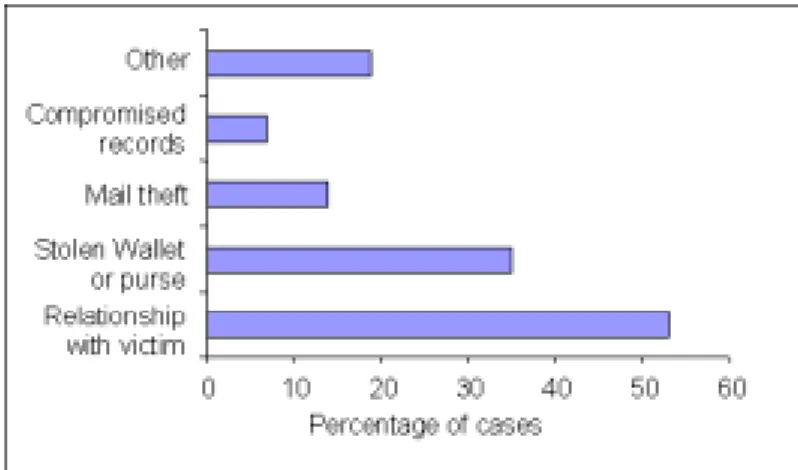
opportunities for identity theft because of the availability of personal information among relatives, coworkers, and others. According to the 1999-2001 FTC complaint files (see Figure 1), close to 11 percent of the complainants knew the offender. The FTC's 2003 survey found that 86 percent of victims had no relationship with the thief.17
However, other sources claim closer to 60 percent of victims knew or had some information about the offender.18
Offenders' opportunities to commit identity theft may be classified under two broad categories:placeand guardianship. The trouble is that committed offenders know very well where to find personal information, and the guardianship is not too effective.
† You can find out anyone's social security number for a small fee. Just visit
http://www.docusearch.com/overtu re_ssn.html, or check out
Undercover Press at
http://www.aaffordable.com/best-sellers.html, which promotes itself as the "no questions asked source for Birth certificates, social security cards, city ID's, press cards, Diplomas, credentials of almost any kind including badges and police ID's."
9 The Problem of Identity Theft
Place
Offenders can generally find people's personal information in three places:
• in wallets or purses;
• in homes, cars, or other designated "safe" places (e.g., a safe deposit box, gym locker, office drawer); and • at businesses or institutions that maintain customer,
employee, patient, or student records.
Guardianship
Personal Guardianship
People are generally casual about protecting their personal information, even though they indicate in opinion polls that they are very concerned about doing so.19
• People carry personal information on them, which offenders may obtain via pickpocketing, mugging, or, if it is lost, simply finding it. People also leave personal information in cars or other places where experienced thieves know to look.
• Burglars can get information from victims' homes, and "Internet burglars," or hackers, can obtain personal identifying data from people's home computers. • People's trash can serve as another source of
information. People often throw away credit card statements, bank statements, and other documents containing personal information. Offenders may go through people's trash looking for such information.† • People routinely give out personal information during
business transactions, such as in shops and restaurants. Businesses that fail to use modern technology to protect customers' personal information create abundant opportunities for dishonest employees to steal customers' identities.
Agency Guardianship
There is an enormous amount of personal information available, and it is incredibly easy to obtain. Government agencies and businesses keep computerized records of their clients. They may sell or freely provide that information to other organizations.††Often, all that is needed is one form of identification, such as a driver's license, and an offender can obtain the victim's mother's maiden name, social security number, etc.†††Many identity theft crimes are committed by employees of organizations that maintain client databases. For example, a widely publicized Detroit case involved an identity theft ring in which employees of a major credit card company stole
† In a study of 400 households in Nottingham, England, 40 percent of trashcans contained documents listing full credit and debit card numbers, as well as names, addresses, and expiration dates (Davis 2002).
†† U.S. residents do not own personal information contained in agency databases, so they have little control over how that information is used. Recent "opt-out" laws allow people to prevent their information from being provided to others, but these laws are not widely publicized. ††† Social security numbers are not so secure. A recent study estimated that 4.2 million people have managed to acquire alternative numbers (Finch 2003).
11 The Problem of Identity Theft
customer information.20 Procedures for authenticating individual identities are often inadequate. Establishing a given person's "true identity" is a complex task. It requires the careful assessment of
• the person's biological identity (physical features, DNA, fingerprints, etc.);
• the person's historical identity (date of birth, marriage, etc.); and
• the link between those identities.21
Many agencies and businesses make only a cursory attempt–if any–to assess these.
How Offenders Steal Identities
The notoriety of identity theft rose with media coverage of the dangers of buying and selling on the Internet.† However, the ways offenders steal identities are decidedly low-tech. Computer hackers aren't necessarily geniuses; sometimes they simply obtain a password by trickery or from a dishonest insider. Some methods are more popular than others, as is clear from Figure 1, which is based on data collected by the FTC and reported by the General Accounting Office. In general, these data indicate that offenders make the most of the easiest available opportunities:
• They steal wallets or purses from shopping bags, from cars, or by pickpocketing.
• They steal mail, by several means. They may simply take it from insecure mailboxes, submit a false change-of-address form to the post office to direct someone's mail to themselves, or collude with a postal employee to steal mail that contains personal information. Mail
† Available data indicate that Internet-related identity theft constitutes a small proportion of all identity theft, probably less than 20 percent. However, there are many definitional problems here. For example, just one act of hacking into a database may reap thousands of credit card numbers and other personal data. These are then used to commit thousands of identity thefts offline. So it is wise to reserve judgment on this issue for now.
that is useful to offenders includes preapproved credit card applications, energy or telephone bills, bank or credit card statements, and convenience checks.
• They rummage through residential trashcans or through business dumpsters ("dumpster diving").
• They obtain people's credit reports by posing as someone who is legally permitted to do so, such as a landlord or employer.
• They collude with or bribe employees of businesses, government agencies, or service organizations, such as hospitals and HMOs, to obtain personnel or client records, or if they are employees, they access the information themselves.
• They break into homes to find personal information on paper or on personal computers.
• They hack into corporate computers and steal customer and employee databases, then sell them on the black market or extort money from the database owners for their return.
• They call credit card issuers and change the billing address for an account. The offender immediately runs up charges on the account, knowing that the victim will not receive the bill for some time, if ever.
• They buy identities on the street for the going rate (about $25), or buy credit cards that may be either counterfeit or stolen.
• They buy counterfeit documents such as birth certificates, visas, or passports. In 2001, the U.S. Immigration and Naturalization Service intercepted over 100,000 fraudulent passports, visas, alien registration cards, and entry permits.
• They buy false or counterfeit IDs on the Internet for as little as $50.
13 The Problem of Identity Theft
• They counterfeit checks and credit or debit cards, using another person's name. All the technology for
reproducing plastic cards, including their holograms and magnetic strips, can be bought on the Internet. • They steal PINS and user IDs, using software available
on the Internet; trick Internet users into giving their passwords and other personal information; or watch users punch in their PINs on telephones or at ATMs. • They use a single stolen ID to obtain legitimate IDs
they can use for a wide variety of additional frauds. • They gain entry into ID-issuing agencies, such as motor
vehicle departments, by using bribery or extortion, or posing as employees.
How Offenders Use Stolen Identities
Offenders use victims' personal information in countless ways. Some of the most common examples follow: • They open a new credit card account using the victim's
name. All this requires, apart from the applicant's address, is usually a few pieces of information: the victim's mother's maiden name, the victim's birth date, and, sometimes, the victim's social security number. • They open a landline or cell phone account in the
victim's name.
• They open a bank account in the victim's name. They often open multiple accounts in multiple places, and write bad checks on each.
• They file for bankruptcy under the victim's name, to avoid paying their own debts or to avoid eviction. • They steal the victim's identity, take over his or her
insurance policies, and make false claims for "pain and suffering" suffered from auto accidents.22
• They take out auto loans or mortgages under the victim's name and residence.
• They submit fraudulent tax returns using the victim's identity, and collect the refunds.
• They submit applications for social security using others' identities (often those of people who have died), and receive social security payments.
Types of Identity Theft
Classifying identity theft into types is difficult, as it involves a wide variety of crimes and related problems. However, the acknowledged motives for identity theft can be used to construct a simple typology. Research indicates that the two dominant motives for identity theft are financial gain and concealment (either of true identity or of a crime).†These motives are mediated by the
offenders' level of commitment to the task and the extent to which offenders are simply opportunists taking
advantage of the moment.
Professionals who seek out targets and create their own opportunities–usually in gangs–have a high level of commitment. A lot of planning and organization is involved. Some lone offenders also display considerable commitment and planning, especially in regard to concealing personal history. Offenders with low
commitment take advantage of opportunities in which ID theft appears to solve an immediate problem; thus their identity thefts are "opportunistic."
† The FTC survey reported that 15 percent of ID theft victims in the past five years had their personal information misused in nonfinancial ways. The most common such misuse was for the offender to give the victim's name and
identifying information when stopped by law enforcement or charged with a crime (Federal Trade Commission 2003a).
15 The Problem of Identity Theft
As seen in Table 1, there are four types of identity theft, based on the combinations of commitment and motive. Of course, any single case could reflect aspects of more than one type.
Table 1
The Four Types of Identity Theft
High Commitment, for Financial Gain
Organized. In this type of identity theft, a group or gang carefully plans and orchestrates the crimes. Indeed, while it is widely believed that committing identity theft is easy because of the numerous opportunities described above, carrying out a truly successful identity theft requires considerable organization and preparation:
• searching for an easy target,
• locating sources of personal information for that target,
† An Algerian national facing U.S. charges of identity theft allegedly stole the identities of 21 members of a Cambridge, Mass., health club and transferred the identities to one of the people convicted in the failed 1999 plot to bomb Los Angeles International Airport (Willox 2002).
Financial gain Concealment
High commitment (lots of planning)
Opportunistic (low commitment)
Organized.A fraud ring systematically steals personal information and uses it to generate bank accounts, obtain credit cards, etc. (See box below.)
Individual.The offender sets up a look-alike Internet website for a major company; spams consumers, luring them to the site by saying their account information is needed to clear up a serious problem; steals the personal/financial information the consumer provides; and uses it to commit identity theft.
An apartment manager uses personal information from rental applications to open credit card accounts.
Organized. Terrorists obtain false visas and passports to avoid being traced after committing terrorist acts.†
Individual. The offender assumes another's name to cover up past crimes and avoid capture over many years.
The offender uses another's name and ID when stopped or arrested by police.
• obtaining the necessary documents (legal or counterfeit) to establish legitimacy,
• choosing how to use the identity to obtain money, • convincing officials that one is the person named in
identity documents, and
• anticipating how long one can exploit the identity before the victim discovers the losses.
Research has shown that organized criminal gangs in Southeast Asia manufacture plastic cards using stolen identities. These are then marketed on the street in large U.S. and European cities. Street fraudsters tend to specialize in particular types of card fraud. They use highly sophisticated techniques to avoid detection either when using the card in a retail store or when converting purchased goods into cash. They tend to work in small gangs, deal in high volume, and operate in high-population areas, usually 50 miles or more away from where they live.
A Classic Case of Organized Identity Theft for Financial Gain
Jane Sprayberry handed over her driver's license to an American Express customer service representative who had asked for it in order to replace Jane's lost credit card. True to the Amex promise, she received the replacement card without delay. The only trouble was that the recipient was not the real Jane Sprayberry. The driver's license had her name on it, but the photograph was not of her. In no time, the imposter ran up a big bill on high-priced jewelry, clothing, and appliances. Just a week before, Jane's husband's bank account had been emptied and his credit card cloned. A coincidence? Not at all. A ring of fraudsters in Detroit had gotten jobs at large businesses and had collected reams of personal
information: personnel records, credit records, old rental-car agreements. Those offenders who were eventually caught had bags and books full of such records–records they had used over several years. They had run up an average of $18,000 in credit card charges per victim. And they had sold identities on the street for around $25 each. It took the real Jane Sprayberry and her husband more than six months to clean up the mess.23
17 The Problem of Identity Theft Individual.Individuals may become strongly committed
to the crime once they discover, after casually using someone's identity, how easy it is to get away with doing so. For example, someone with a drug habit may regularly buy stolen credit cards on the street (stolen cards are cheaper if others have used them), to raise money to buy drugs.
Opportunistic, for Financial Gain
The second type of identity theft occurs when the offender takes advantage of the access he or she has to the personal information of friends, family, or others. Examples include the following:
• A college student uses his or her roommate's personal information to apply for a preapproved credit card, which comes in the mail to which they both have access.
• A restaurant worker processes a customer's credit card payment and notices that the complete card number is printed out on the receipt, along with the expiration date. The worker copies the information and later makes several large purchases over the Internet, where he or she does not need to show the card or verify his or her identity.
High Commitment, for Concealment
Organized. Terrorism is the most recently cited instance of organized groups' stealing identities to conceal illegal activities, and to make tracking their true identities much more difficult after they've committed crimes. Authorities claim that all 19 of the September 11 terrorists were
involved in identity theft in some way.24This resulted in
the mistaken arrest of people whose identities had been stolen.
Individual.Covering up past crimes is a major reason for individuals to steal or assume another identity. Kathleen Soliah, wanted for various bombings and attempted murder in relation to her activities in the Symblonese Liberation Front in the late 1960s, assumed the identity of Sara Jones Olson (a common Scandinavian surname in Minnesota). She evaded capture for 23 years, and in the meantime became a doctor's wife, mother of three, community volunteer, veteran of charity work in Africa, and practicing Methodist living in an upscale
neighborhood in St. Paul, Minn.
19 The Problem of Identity Theft
Opportunistic, for Concealment
The most common type of opportunistic identity theft for concealment occurs when an offender gives the name of an acquaintance, friend, or family member when stopped, questioned, or arrested by police. Examples include the following:
• Jefferey Williams was jailed for 10 days without bail on a warrant for drug possession and resisting arrest. The Orange County (Fla.) Sheriff's Department had issued the warrant in Orlando. Williams insisted that he was not the person the police were looking for. The trouble was that Florida authorities were seeking a relative of Williams who had passed himself off as Jefferey, giving Jefferey's name, birth date, and old home address.25
• Lisa Sims (alias Elisa McNabney) assumed the name of her cellmate from a prior prison term to cover up her extensive criminal past and avoid arrest on suspicion of murdering her husband. Investigation revealed that she had multiple social security numbers and other forms of identity.26
21 Understanding Your Local Problem
Understanding Your Local Problem
The information provided above is only a generalized description of identity theft. You must combine the basic facts with a more specific understanding of your local problem. Analyzing the local problem carefully will help you design a more effective response strategy.Asking the Right Questions
The following are some critical questions you should ask in analyzing your particular problem of identity theft, even if the answers are not always readily available. Your
answers to these and other questions will help you choose the most appropriate set of responses later on. In some cases, the questions you should ask will be similar to those recommended regarding check and credit card fraud. If you find that such fraud figures heavily in the identity thefts you confront, you should also consult Check and Card Fraud, Guide No. 21 in this series.
Incidents
• Have checks, cards, or other forms of identity been targeted in crimes such as burglaries of homes and offices, pickpocketing in shopping malls, muggings, and thefts from cars?†
• What do reported cases of identity fraud usually entail: check or card fraud, Internet fraud, forged documents, false drivers' licenses, theft from cars?
• Who typically reports the crimes: individual victims, retailers, banks, or credit card issuers?
† A study issued by the U.S. Sentencing Commission that analyzed data on identity theft related cases from 1998 found that fewer than 10 types of ID were stolen or used, the most common being credit cards, driver's licenses, social security numbers, birth certificates, checks, and alien registration cards. The majority of the cases involved a single ID use (U.S. Sentencing Commission 1999).
• Is online fraud (from credit card sales) a problem in your area? Such fraud may become apparent when offenders order online but arrange to pick up merchandise at the store. Do merchants report any such instances?
• Are there any cases of parcels stolen or "lost" during delivery of items ordered online?
• Are there known fencing operations in or near your area? If so, what kinds of items are most commonly fenced, and are they traceable to any local stores? Do new items frequently appear in pawnshops?
• Are there increases in incidents such as car repossessions or collection agency activities?
• What is the local incidence of lost mail, mail diversions, and false filings of changes of address with the post office?
• If your jurisdiction is near a national border or entry point, what data are available on attempts at illegal entry using stolen or false documents?†
Offenders
• Do identity thieves work alone, or in groups? How many work alone? How many work with others? How and where do they get together? How do they offend together? Why do they offend together?
• What are offenders' demographic characteristics, such as age and gender? Is there an ethnic component? • Where do they live, work, or hang out?
• Do they know, or have they studied, their victims? • How active are they? Do particular offenders account
for a few identity thefts, or for many? Do they specialize in one particular method of committing identity theft?
† In one study, fraudsters had worked out over 100 different ways of committing credit card fraud (Jackson 1994). In another, offenders displayed considerable innovation in switching from one technique of check forgery to another (Jackson 1994; Lacoste and Tremblay 2003).
23 Understanding Your Local Problem
• What, specifically, motivates them? Do they need quick cash to party or to support a family? Do they have any expensive addictions? Are they recently jobless, or are they long-term offenders?
• Do they show evidence of planning their crimes, or do they take advantage of easy opportunities?
• What special skills and techniques do they use to commit their crimes?
Victims
• How do victims respond to identity theft?
• Are particular people repeatedly victimized? If so, why? • What do victims expect when they contact the police?
How long do they wait before reporting the crime to the police?
• How long does it take for victims to discover that their identity has been stolen? Do they also report the theft to their credit card issuer and bank?
• How do businesses respond to their victimization? Do they routinely report check and card fraud to the police? (Some may be unwilling to do so for fear that police attention will drive business away, or, in the case of card fraud, because they do not have to bear the loss.) What kinds of businesses report identity fraud: small family stores, large retail chains, supermarkets, local or regional banks, etc.? Why do they report it? • What are merchant attitudes regarding police
involvement in dealing with identity theft?
• What procedures do merchants have for detecting or preventing identity theft?
• Are particular businesses repeatedly victimized? If so, why? (They may have inadequate security procedures in place.)
• Have any local businesses reported theft or loss of company records?
Locations/Times
• Do any of the crimes related to identity theft–wallet thefts, check and card fraud, account takeovers, use of fake driver's licenses–occur in a specific area, on a particular day, and/or at a particular time?
• Can cases of identity theft be traced back to particular supermarkets, electronics stores, retail chains,
restaurants, online stores, or even car dealerships? • Do muggings or thefts from cars that entail theft of
credit cards and other personal documents occur in neighborhoods where drug dealing is common? • Does fraud occur at checkout in local stores?
• Do thieves use methods that require them to travel to and from specific places? (Some identity thieves, once they have the necessary information, may open several bank accounts in a short period of time, write several large checks, then quickly leave the area).
• Do thieves use the telephone or Internet to convert their stolen identities into cash? Do they call stores from home, or from public phones? Do they access online stores from home computers, or from those available in public places (e.g., college campuses, public libraries, Internet cafes)?
Current Practices
• What databases are available to help you prevent or reduce identity theft? You may have access to a number of useful databases, or you may need to construct your own–given, of course, the resources to do it:
25 Understanding Your Local Problem
a. The Privacy Rights Clearinghouse recommends establishing a central database of lost or stolen driver's licenses, so that local police officers can check IDs against it. While this may seem obvious, information-sharing among agencies continues to be difficult. If your state does not already have such a database, clearly it will require considerable collaboration with law enforcement bodies and state agencies to create one.
b. The FTC's Identity Theft Data Clearinghouse is the central national repository of identity theft complaints. All local, state, and federal law
enforcement officers can have free Internet access to this secure database. After your organization signs a confidentiality agreement with the FTC, you will be provided with a user ID and password. You can search the database for complaints relating to investigations you are working on, or find clusters of reports detailing suspicious activity regarding locations or people in your community. You can also receive e-mail notifications each time a complaint that relates to your interests hits the database. To learn more about Consumer Sentinel, go to http://www.ftc.gov/sentinel/. To join Consumer Sentinel, go to
http://www.ftc.gov/sentinel/cs_signup.pdf. c. Credit-issuing and reporting companies such as
Visa and MasterCard also maintain databases of lost or stolen cards. You should establish ways of accessing these databases, which will require working with local banks and businesses with ties to those companies.
• Does your crime analyst (if your department has one) track crimes that relate to and facilitate identity theft? When victims report burglaries or thefts, tracking the use of stolen identity related items such as credit cards may provide clues concerning offenders' activities, such as which stores prefer. You may then work with the stores to improve security, if it is lax, and also to identify the thieves.
• Does your department have an established procedure for verifying and recording the identities offenders give when they are stopped, questioned, or arrested? Do officers receive training in ID authentication?
• Does your department have a crime reporting system that facilitates making a police report for identity theft or fraud?
• How do local agencies respond to ID theft? Do they have established reporting procedures?
Measuring Your Effectiveness
Measurement allows you to determine to what degree your efforts have succeeded, and suggests how you might modify your responses if they are not producing the intended results. You should take measures of your
problem before you implement responses, to determine how serious the problem is, and afteryou implement them, to determine whether they have been effective. All measures should be taken in both the target area and the
surrounding area. (For more detailed guidance on measuring effectiveness, see the companion guide to this series,Assessing Responses to Problems: An Introductory Guide for Police Problem-Solvers.)
27 Understanding Your Local Problem
The following are potentially useful measures of the effectiveness of responses to identity theft:
• Increases in incident reports (if you have raised awareness of identity theft in your community, including in your police department).
• Decreases in incident reports and fewer repeat offenders (if your prevention efforts have been effective).
• Increases in favorable media coverage (resulting from your efforts to raise awareness and sensitivity to the crime, and to publicize your department's responses to it).
• Increases in interdepartmental collaborations (resulting from your efforts to coordinate prevention and
enforcement activities among relevant government agencies).
• Decreases in retail losses attributed to identity theft, especially check and card fraud. Retailers may use the number of transactions, or the total amount of sales, as the base against which they compute losses.
• Increases in measures businesses take to protect
employee and client records and privacy (resulting from your work with them to increase security).
• Differences in reported frauds between stores or banks where you focus your activities and those where you do not (keeping in mind that changes may be due to other factors, and that reported crime does not always reflect actual crime).
• Reductions in related crimes such as burglaries, thefts from cars, or robberies at ATMs,†where credit cards, bankcards, or other forms of identity may be prime targets (keeping in mind that changes may be due to other factors related to those crimes).
† See the POP Guide on Robbery at Automated Teller Machines.
• Increases in related crimes when fraudsters' efforts are thwarted and they shift to easier targets (displacement). One study has suggested that acquisitive crime may increase as credit card fraud decreases.27Other studies
have found that fraudsters tend not to switch easily between different types of credit card fraud,28though
they are resourceful in shifting between different types of check fraud, or at least in inventing new ways to commit it.29
• Reductions in the number of new products fenced or available in pawnshops.
29 Responses to the Problem of Identity Theft
Responses to the Problem of Identity
Theft
Your analysis of your local problem should give you a better understanding of the factors contributing to it. Once you have analyzed your local problem and established a baseline for measuring effectiveness, you should consider possible responses to address the
problem. As noted at the beginning of this guide, some of the risk factors relating to identity theft may lie beyond the immediate influence of local police, or they may appear to lie beyond the usual scope of local police responsibility. These include:
• preventive measures businesses should take to
safeguard their records from employee misuse or from outside intrusion;
• marketing or authentication practices of credit card or retail companies that make it easier for identity thieves to open card accounts or make fraudulent purchases; • preventive measures government agencies should take
to safeguard their records from employee misuse or from outside intrusion;
• technologies that make counterfeiting cards, checks, or other forms of identity easier for offenders;
• preventive measures people should take to safeguard their personal information;
• opportunities the Internet provides for purchase or theft of personal information; and
• actions credit-reporting agencies take in response to victims' requests for help in repairing their credit records.
However, studies of successful interventions to reduce or prevent check and credit card fraud have shown that there
arethings local police can do to impact some of the above factors. It requires the development of various
partnerships with local and state government agencies and with businesses.†
The following response strategies provide a foundation of ideas for addressing your particular problem. These strategies are drawn from a variety of research studies and police reports. Several of these strategies may apply to your community's problem. It is critical that you tailor responses to local circumstances, and that you can justify each response based on reliable analysis. In most cases, an effective strategy will involve implementing several different responses. Law enforcement responses alone are seldom effective in reducing or solving the problem. Do not limit yourself to considering what police can do: give careful consideration to who else in your community shares responsibility for the problem and can help police better respond to it. In the case of identity theft, there are clear implications for businesses, other government agencies, and consumer advocacy groups.
General Considerations for an Effective Response
Strategy
As we have seen, identity theft is a complex crime, composed of many sub-crimes and related to many other problems. Thus, identity theft crimes fall under the authority of many different agencies, including the local police, Secret Service, Postal Inspection Service, FBI, Homeland Security, local government offices, and motor vehicle departments, to name just a few. Regional and state law enforcement agencies may have established
† See the POP Guide on Check and Card Fraud.
31 Responses to the Problem of Identity Theft
multiagency task forces to combat identity fraud. For example, the Financial Crimes Task Force of Southwestern Pennsylvania consists of local law enforcement, Secret Service agents, and postal inspectors. At a minimum, multiagency task forces should include motor vehicle departments and local and state government agencies that keep public records. These multiagency task forces fulfill an important need because, at present, the Secret Service, which has primary responsibility for investigating identity theft, does not accept cases unless there is a financial loss of over $200,000 and a multistate fraud ring is involved. This leaves many victims in the lurch.
Thus, it will be important for you to work with local agencies to coordinate responses, so that you can participate more fully in designing and implementing preventive strategies. In addition, if local police have the first official contact with the victim, they can be an important investigative resource. FTC data indicate that the victim often knows who the offender is, or has significant amounts of information about the offender. In 2003, 62 percent of the complaints in the FTC identity theft database contained information about the offender. However, because of the complexity–and expense–of developing multiagency task forces, your initial efforts should focus on local factors that will help reduce or prevent identity theft and mitigate the harm done to victims. Thus, the responses listed below are divided into two sections:
• Prevention: What to do to prevent identity theft from occurring in your jurisdiction.
• Victim assistance: How to respond to victims who come to you for help.
It should be emphasized that these two stages are closely related, and that collecting information in one stage helps in addressing the other. For example, obtaining
information in the victim assistance stage will help you develop prevention strategies.†
Finally, since identity theft occurs in conjunction with a variety of other crimes, and given the limited resources that may be available to you, it may not be feasible to address all such crimes at once. It may be more effective to be on the lookout for rashes of specific types of identity theft, such as credit card fraud or immigration fraud (if your jurisdiction is near an entry point). Focusing on a specific crime will make it easier to collect relevant information and to measure response effectiveness.
Specific Responses to Identity Theft
Prevention
1. Raising businesses' awareness of their
responsibility to protect employee and client records.
Offenders steal many identities from inadequately protected business records. There are many common-sense, low-tech ways to protect databases. You may work through local business associations, or establish working relationships with local businesses. Do not assume that all, or even most, businesses are aware of the opportunities afforded identity thieves by poor protection of their records. Many businesses do not institute security procedures because they do not consider them cost-effective. Mindful of businesses' reasonable concern for
† The costs to the victim–in terms of both out-of-pocket expense and time spent resolving problems–are substantially smaller if the misuse is discovered quickly. No out-of-pocket expenses were incurred by 67 percent of those who discovered misuse of their personal information within five months (Federal Trade Commission 2003b).
33 Responses to the Problem of Identity Theft
profits, you should try to convince businesses that the costs of losing data, in terms of both their reputation with clients and possible lawsuits by victims, are much higher than those of following the many simple
procedures to protect private information. State and/or federal laws such as GLB (Gramm-Leach-Bliley Act), HIPAA (HealthInsurance Portability and Accountability Act of 1996), and FACTA (Fair and Accurate Credit Transactions Act) require certain businesses or institutions to protect information better. The Internet provides considerable information on how businesses should protect their records. The Privacy Rights Clearinghouse recommends the following practices:
• Develop a comprehensive privacy policy that includes responsible information-handling procedures. Use a shredder or similar document-disposal method. • Conduct regular staff training, new-employee
orientations, and spot checks on proper information care.
• Support and participate in multiagency financial-crimes task forces.
• Limit data collection to the minimum of information needed; for example, limit requests for social security numbers.
• Put limits on data disclosure. For example, must social security numbers be printed on paychecks, parking permits, staff badges, time sheets, training program rosters, staff promotion lists, monthly account statements, client reports, etc.?
• Restrict data access to only those employees with a legitimate need to know. Audit electronic trails. Impose strict penalties for browsing and illegitimate access.
• Conduct employee background checks. Screen cleaning services, temp services, etc.
• Include responsible information-handling practices in business school courses, and even in elementary schools, if children have access to computers.
2. Educating people about protecting their personal information.The Internet has an enormous amount of information on how to avoid becoming an identity theft victim (see Appendix B for a selection of the main
sources). Some police departments include special sections on identity theft on their websites, all with information on how to protect one's identity. To get the message out, you need to work through the community's main support organizations: schools, consumer advocacy groups, seniors' community centers and organizations, neighborhood watch meetings, and other community service groups. If your police department has a website, include information sources on protecting identity on the site. If budget permits, print out information brochures to hand out at meetings. The best publication on preventing identity theft is available free on the Internet or from the Federal Trade Commission:Identity Theft: When Bad Things Happen to Your Good Name. It should be emphasized, however, that there have been no scientific evaluations of the effectiveness of the advice given in this document and on many websites. Much of the advice is "common sense" (for example, don't leave personal information such as credit card statements in your trashcan).
3. Collaborating with government and other service organizations to protect private information.Social security numbers and driver's licenses are the two most common forms of identification used in the United States.
35 Responses to the Problem of Identity Theft
While identity theft awareness has increased considerably since the Identity Theft Act of 1998, agencies still need support in efforts to reduce the use of social security numbers as identifiers (very common on health insurance cards, for example), and local agency personnel may need to be constantly reminded of the risks involved in lax use of private information. Although some of the following recommendations are probably beyond the scope of local police, it is important that you work with agencies
concerned about these issues, since it helps solidify your relationship with those whose help you may need to investigate identity theft cases or help victims resolve the problems they face, such as getting a new driver's license. The Privacy Rights Clearinghouse recommends the following practices:
• Keep social security numbers out of general circulation.
• Prohibit the use of social security numbers to obtain a driver's license, health insurance ID, or other forms of identification.
• Prohibit the sale of social security numbers, available now on information-broker websites.
• Maintain central clearinghouses in each state for lost and stolen driver's licenses.
• Conduct better photo- and ID-checking for new, duplicate, and replacement IDs.
• Restrict access to birth certificates in states where they are now publicly accessible.
• Remove social security numbers and other sensitive information from public records, especially when accessible on the Internet.
4. Working with local banks to encourage credit card issuers to adopt improved security practices.The major credit card companies have national and
international reach, so it is unlikely that your local efforts will directly influence their security policies. It is also clear that their marketing policies sometimes contribute to identity theft–such as the massive number of preapproved offers of credit they mail to consumers. However, local banks often have agreements with the major credit card companies, especially as many ATM (or debit) cards also serve as credit cards. Thus, local banks, as customers of credit card companies, may have some influence on their card-issuing policies. In addition, by working closely with local banks, you may make it easier to establish procedures for local identity theft victims to repair the damage done, and get their accounts operating again. Bear in mind that some financial institutions won't give investigators
information about their clients' accounts unless through a court order or similar legal process (the new Fair and Accurate Credit Transactions Act removes this
requirement as of June 2004). However, they will give the information to their client–the victim. Thus, working closely with the victim is vital (see response #6). You should urge your local banks and businesses to pressure credit card companies to do the following:
• Conduct better identity verification, especially when the person's address is reported as changed or differs from what his or her credit report indicates.
• Conduct better identity verification for those using preapproved credit cards. Don't rely solely on social security numbers. Have the person provide his or her utility bills, tax record address, etc.
37 Responses to the Problem of Identity Theft
• Improve identity checking procedures for "instant" credit, favored by identity thieves.
• Put photographs on credit cards, or other
authentication indicators such as smart chips or PINS. • Request additional ID when verifying credit card
purchases at the point of sale.
• Enable customers to put passwords on credit accounts. • Truncate digits on account numbers printed on receipts
at the point of sale.
• Use account-profiling systems to detect unusual activity. Notify the consumer of possible fraud. • Check if there is an existing account in the applicant's
name.
• Check the social security master-death index.
• Reduce the number of preapproved credit applications mailed to consumers. Don't mail such offers to anyone under 18. Print an opt-out phone number prominently on all such offers (1.888.5OPTOUT).
• Prohibit convenience checks, or at least provide an opt-out to credit card and bank customers.
5. Tracking delivery. Much of identity theft depends on the delivery of documents and products. Vacant houses or apartments are prime locations for delivery of products or diverted mail. Credit applications or driver's license renewal forms are at risk in mailboxes; products bought with stolen credit cards on the Internet are delivered to such addresses. Maintaining a close relationship with local postal inspectors and delivery companies such as UPS or FedEx may help you track items back to thieves. You can work with the local post office and delivery companies to train employees to:
• take note of deliveries to houses that are vacant or up for sale;
• spot driver's license renewals and credit card statements that go to unfamiliar addresses; and
• maintain records of applications to forward mail or packages (the Postal Service now requires people to show ID to submit a change-of-address or mail-forwarding application).
Victim Assistance
6. Working with the victim.Victims have many
protections under federal and state law that prevent them from being liable for unauthorized charges, withdrawals, or other unlawful activities of identity thieves. They also have rights regarding the accuracy of their credit reports. Police need to understand how consumers are protected, and provide victims with educational resources that explain their rights and the steps they need to take to assert them. The FTC's comprehensive guide,When Bad Things Happen to Your Good Name, and its website,
www.consumer.gov/idtheft, provide consumers with the information they need to deal with fraudulent debts and any negative credit-report information resulting from identity theft.
Communicating with victims is important, as well. The most frequent complaint the Identity Theft Resource Center receives is that "the police just don't care." It is important to let victims know that the police do care and do understand. Remember that identity theft victims have been repeatedly victimized. Identity theft is an emotionally harmful crime. Furthermore, you should be aware that
39 Responses to the Problem of Identity Theft
victims typically uncover more evidence in a case than do investigators, and more rapidly. Thus you should quickly develop a close working relationship with the victim. The steps you can take to do so are as follows:31
• Assure the victim that you will take a police or incident report and give him or her a copy. This is important because many, if not all, identity theft crimes fall under several jurisdictions. For example, the offender steals the credit card in one state and uses it in another; the card company is located in yet a different state; and the victim lives elsewhere. Even though there may be many cross-jurisdictional issues involved, you should
immediately respond to the victim by preparing a police or incident report. Without one, the victim will have difficulty filing an identity theft affidavit. At a minimum, file a report with the FTC Consumer Sentinel database.
• Have available the Identity Theft Victim Guide, which outlines what steps a victim should take, and how the victim should prepare for the investigator's phone call or visit. It should be mailed to the victim, as well as available on your department's website. The guide should list what steps your department takes after receiving a complaint, and exactly what information and documentation the victim needs to provide when interviewed.
• Recommend that, for the initial meeting, the victim prepare a rough written draft of the case. The victim should provide his or her name and contact details; state when he or she discovered the fraud; list any fraudulent activity to date, in chronological order; list the affected accounts; and provide facts about the imposter, if any are known.