-The Case of e-Government Interoperability in Palestine
Mustafa Jarrar1, Anton Deik2, Bilal Farraj21 Birzeit University, Palestine
2 Ministry of Telecommunication and Information Technology, Palestine
{adeik, bfarraj}@mtit.pna.ps
Abstract. The major challenge when integrating information systems in any domain such as e-Government is the challenge of Interoperability. One can distinguish between three aspects of Interoperability; technical, semantic, and organizational. The technical aspect has been widely tackled especially after the ubiquity of internet technologies. The semantic and organizational aspects deal with sharing the same understanding (semantics) of exchanged information among all applications and services, in addition to modeling and re-engineering governmental processes to facilitate process cooperation that provision seamless e-government services. In this paper, we present the case of the Palestinian Interoperability Framework ‘Zinnar’, which is a use case of using ontology in e-government (i.e., data and process governance) to tackle the issues of semantic and organizational interoperability. The followed methodology resulted in a success story within a very short time and has produced a framework that is intuitive, elegant, and easy to understand and implement.
Keywords: Interoperability, Data Integration, e-Government, Ontology, Data Governance, Process Governance, Business Process Modeling.
1
Introduction and Motivation
During the last several decades, corporations, governmental institutions, universities, health institutions, financial institutions, etc, have developed an enormous number of heterogeneous and often autonomous information systems. Meanwhile, a growing demand to integrate these information systems in order to exchange data and provide more seamless services has emerged. However, the interoperation of heterogeneous Information Systems residing in autonomous organizational structures is a major challenge. The issue is even more challenging when a government is concerned (to construct an e-government) because of the complexity, diversity, and multiplicity of public sector institutions. For instance, often, each institution in the government forms a ‘government’ by its own and, most of the time, interoperation among the departments of one institution is not found. In fact, the organizational complexity of the government and its institutions results in more heterogeneous ‘islands’ of information systems each of which is not interoperable.
Building an E-government is not a problem of automation of governmental processes. It is rather a problem of orchestration of governmental services and registries to
provision seamless services to citizens, private sector (corporate sector), and public sector (governmental institutions). This orchestration means that the information systems must have the ability to interoperate in order to exchange information and that their interoperation must be conducted securely, legally, in line with
organizational and national policy, and using a suitable infrastructure. This raises
five major challenges to realize e-government:
(i) Interoperability, which is concerned with the problem of exchanging
data between heterogeneous information systems.
(ii) Security; which is concerned with the security of the data exchanged.
(iii) Legal; concerned with the legal coverage of all transactions and
information exchanged between Information Systems,
(iv) Policy; which is concerned with aligning e-government services with
organizational and national policies.
(v) Infrastructure; which is concerned with establishing a physical
connectivity infrastructure (i.e., networks, cables, computer systems, servers, etc) that connects different governmental institutions.
This paper focuses on the interoperability challenges and solutions, which is the essence of e-government. This is because governmental processes usually depend on data and processes from other governmental institutions, and in order to transform these often-complex processes into seamless and transparent e-government services, information systems owned by autonomous governmental institutions must have the ability to exchange data (i.e., Interoperability). Generally, Interoperability can be viewed as a chain that allows information systems to be joined up both within organizations and then across organizational boundaries with other organizations. Interoperability has three aspects [1, 2]:
(i) Technical Interoperability, which is concerned with the technical
standards, specifications, and protocols necessary for the communication of Information Systems.
(ii) Semantic Interoperability, which assures that all applications and
services share the same understanding of exchanged information.
(iii) Organizational Interoperability, which is concerned with the modeling
and re-engineering of business processes and helping business processes in different organizations cooperate.
Technical interoperability is often –especially in the eGovernment domain- tackled using a standard service-oriented architecture using well-known protocols such as SOAP and WSDL, which we also adopt in Palestine. The second and third aspects of interoperability (semantic and organizational interoperability) have indeed formed the main challenge for researchers and practitioners in the areas of system integration and interoperability, especially in the e-government domain. These challenges were tackled using different approaches with different cases (see section 8: related work). In this paper, we present the case of the Palestinian E-government Interoperability Framework, “Zinnar” which is a use case of using ontology in e-government (i.e., data and process governance) to tackle the issues of semantic and organizational
interoperability. The followed methodology in developing ‘Zinnar’ resulted in a success story within a very short time and has produced a framework that is intuitive, elegant, and easy to understand and implement. It is worth noting that ‘Zinnar’ was not implemented anywhere else except in Palestine.
Although the authors are the architects of the framework, Zinnar is being implemented through a collaborative effort by the Palestinian e-Government
Interoperability Working Group which includes several Palestinian Ministries and
governmental institutions and is lead by the Ministry of Telecommunication and Information Technology as part of its e-Government program.
The remainder of this article is organized as follows. Section 2 discusses some of the Interoperability challenges in Palestine and gives a thorough overview of the Palestinian Interoperability Framework Zinnar. In sections 3 to 7, we discuss in more depth each of the five components of Zinnar. Section 8 (related work), presents three cases of Government Interoperability Frameworks in other countries and compares them to Zinnar. In section 9, we discuss conclusions and future work.
2
Interoperability in the Palestinian Government
As discussed earlier, one can distinguish between three aspects of interoperability [1,2]; the technical aspect, the semantic aspect, and the organizational aspect. Fortunately, the problem of technical Interoperability is relatively straight forward [3] (but still requires a large amount of work) because it has been tackled widely, especially after the ubiquity and development of internet technologies, protocols, and open standards [2, 3]. However, using the technical interoperability framework alone is not sufficient for the interoperation of heterogeneous Information Systems; such a framework alone does not allow for meaningful processing of data from different Information Systems or for coordinating autonomous business processes, which is indeed the essence of e-government.
2.1 The problem of Interoperability in the Palestinian Government
The situation of the government in Palestine is not different than any other government in the world. In Palestine, there is no agreement between the different governmental institutions that owns and operates the state registries and information systems on, for example, the precise semantics of the data they own, the vocabulary they use to describe the data, the business rules and constraints controlling the data, or the structure of the data. There is even no agreement on the used standards and classifications. For example, different institutions in Palestine use different coding and naming schemes to identify same entities (e.g., countries, nationalities, localities, currencies, etc). Developing seamless e-governmental services without reaching consensus on these matters is cumbersome and not scalable; agreements then need to be reached in an ad-hoc manner which is not scalable especially if hundreds of databases and information systems are concerned.
Establishing e-government services also gives rise to organizational issues. The Palestinian governmental institutions follow complex and often chaotic hierarchal organizational structures that result in governmental processes that resemble these organizational structures and in Information Systems that are closed, vertical, unscalable and frequently proprietary systems where sharing information across their internal structures is difficult, let alone with other organizations.
In order to allow Information Systems to combine and process data originating from other information systems, shared and agreed-upon understanding of the exchanged data must be achieved. In particular, different governmental institutions must reach a shared understanding and agreement on the vocabulary, meaning, structure, codes, and business rules pertaining to the exchanged data (semantic interoperability). Also, governmental processes scattered in the different governmental institutions must be precisely identified, modeled, and classified in order to allow for effective coordination of the different processes to produce seamless e-governmental services for the citizen, private sector, and public sector (organizational interoperability). 2.2 Zinnar Interoperability Framework
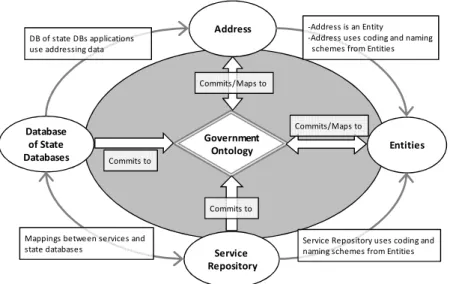
Fig. 1. The Palestinian Interoperability Framework - Zinnar
To tackle the semantic and organizational interoperability issues in the case of e-government in Palestine, an interoperability framework called ‘Zinnar’ (depicted in Fig. 1) has been developed from scratch. Zinnar (http://zinnar.pna.ps) serves as an organizational and semantic mediator between heterogeneous information systems and is also seen a framework (national standards and methodology) upon which seamless e-government services are implemented. Zinnar Interoperability Framework is composed of five components: Entities Government Ontology Address Database of State Databases Service Repository -Address is an Entity -Address uses coding and naming
schemes from Entities
Service Repository uses coding and naming schemes from Entities Mappings between services and
state databases Commits/Maps to Commits to Commits/Maps to Commits to DB of state DBs applications use addressing data
(i) Government Ontology, where a meaningful, precise and agreed-upon description
of concepts of the Palestinian Government exists.
(ii) Entities, which contains agreed-upon national classifications and coding and
naming schemes.
(iii) Address (Geo-Entities), where unified addressing data in Palestine is kept.
(iv) Service Repository, where all governmental services (i.e., business processes) are
identified and their as-is and to-be models are specified formally and informally. The repository is also used to publish web services
(v) Database of State Databases, which contains information and metadata about all
state registries and databases.
At the heart of this framework lies the ontology. This Ontology is not only developed for
e-government applications, it is rather an ontology for the Palestinian government in
general where concepts of the Palestinian government and their relationships are precisely defined, based on the Palestinian laws, internal organizational decrees, national resolutions, and formal procedures, among many other sources. These concepts include both concepts of ‘static’ nature (such as the concept of land, vehicle, company, association, citizen, etc) and ‘dynamic’ concepts (such as governmental processes and procedures).
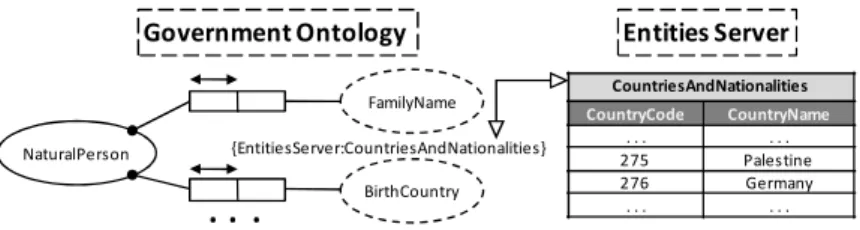
Every element in Zinnar’s components is precisely defined in or mapped to the Ontology. In particular, the Entities component contains the agreed-upon values of value-type concepts defined in the ontology. In the Ontology itself, every value-type concept is annotated with the name of the entity in the Entities component that contains the list of instances of that concept. For example, one of the value-type concepts that is related to the concept of ‘Natural Person’ is the concept of ‘Birth Country’ (in a has/isOF relationship). As can be seen in Fig. 2 below, the ‘Birth Country’ concept is annotated with the name of the table containing all countries, which represent the values that this concept may take.
Fig. 2. Part of the relation between the Government Ontology and the Entities
Zinnar’s Address component is an Entity, but, because of the complexity of this entity, it
is viewed as a distinct component in the framework. The address entity is a necessity in the Palestinian case and requires special attention because until the date of the writing of this article, no unified addressing system exists in the Palestinian Territories. So, including such a component in Zinnar not only is necessary for e-government interoperability purposes but will also pave the way to establish an infrastructure for a modern addressing system in Palestine. The Address component is related to the Ontology the same way as
NaturalPerson BirthCountry {EntitiesServer:CountriesAndNationalities} FamilyName CountriesAndNationalities CountryCode CountryName . . . . 275 Palestine 276 Germany . . . .
. . .
Entities Server Government OntologyLegalPerson HasOfficialAddress Address HasContactAddress
Government Ontology Address Server
BDG.No. . . . PostCode . . . . 14 W119 15 W119 . . . . {AddressServer} Non-NaturalPerson NaturalPerson
the Entities Component. For example, each ‘Legal Person’ has an ‘Address’. This is represented in the ontology, as shown in Fig. 3 by two relations; ‘HasOfficialAddress’ and ‘HasContactAddress’, between the concept of ‘Legal Person’ and the concept of ‘Address’ whose instances are found in the Address Component.
Fig. 3. Part of the relation between the Government Ontology and the Address In Zinnar’s Service Repository, governmental processes are identified with their ‘as-is’ and ‘to-be’ models. Each process in the repository is precisely classified and described in the Ontology and its relationship and dependencies with other processes are clearly identified. Also, services are related to the ontology in another manner; every concept in the service description is also mapped to the Ontology and is used in the as-is and to-be models of the process using the same terminology and semantics agreed-upon in the ontology. In addition, the legal entities that are involved in the governmental process (as service providers or consumers) are also mapped to the Ontology. For example (see Fig. 4), the service of ‘acquiring a citizen profile’ used in different governmental processes is classified and precisely defined in the ontology (as a dynamic concept). Also, this service uses the concepts of ‘Natural Person’, ‘Citizen’, ‘Address’, etc, all of which commits to [4] the terminology, semantics, and business rules described in the Ontology. The legal entities that produce and consume this process are also defined in the Ontology (ministries and other governmental institutions).
Fig. 4. Part of the relations between the Government Ontology, the Service Repository, and the
Database of State Databases
The Database of State Databases component is a repository that contains information about all state databases in Palestine. Among the most important pieces of
. . .
. . .
. . .
<?xml version="1.0" encoding="UTF-8"?> <definitions xmlns="http://xmlsoap.org/wsdl/"> . . . <element name=“Citizen“> . . .<service name=“CitizenProfileService">. . .</service> </definitions> Citizen CitizenProfile Service S e rv ic e S p e c if ic a ti o n W S D L G o v e rn m e n t O n to lo g y D a ta b a s e o f S ta te D a ta b a s e s FirstName Citizens Registry
Registered Data FirstName, …
. . . .
Provided Services Citizen Profile Service, …
information it contains is the data fields a state database registers and by which governmental agency (registrar). Recording where each piece of data is registered in Palestine ease the process of administrating, monitoring, and developing the state databases. Each of these data fields registered in the Database of State Databases is defined as a concept in the Ontology where its relationships with other government concepts are identified. In addition, the Database of State Databases registers the services each state database provides. These services are also described in the ontology. Fig. 4 depicts the relations between the Government Ontology, the Database of State Databases, and the Service Repository components.
By making the Ontology the heart of the framework to which all components are mapped, data and process governance is achieved. Through the ontology, data pertaining to different Information Systems is precisely described and how it is related to the governmental processes is clearly identified. Also, relationships between governmental processes and how they are related to different state registries become clear and unambiguous.
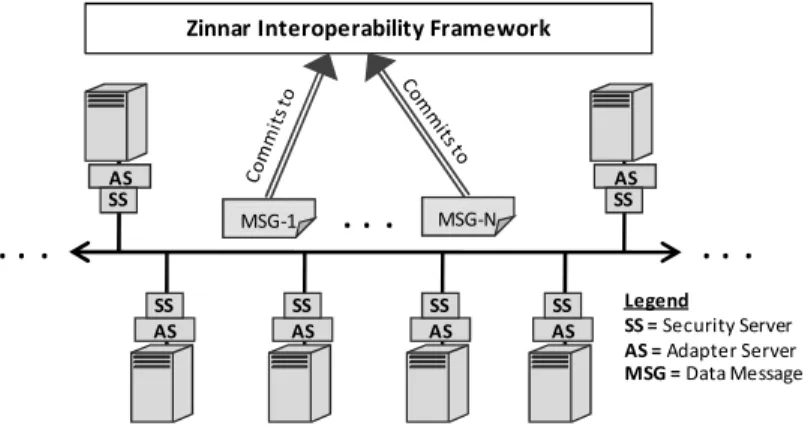
The Palestinian Interoperability Framework ‘Zinnar’, as a whole, forms the basis upon which e-government services are being implemented in Palestine. The Palestinian e-government follows a Service Oriented Architecture where the technology of Web Services is being used to implement processes identified and modeled in the Service Repository. Web Services represent adapters that adapt Information systems in the governmental agencies to the specifications and standards agreed upon in Zinnar. For instance, the Government Ontology, Entities, and Address components of Zinnar form the basis upon which the XML Schemas of the exchanged messages are determined such that all exchanged messages in e-government services must ‘respect’ the terminology, semantics, business rules, data structures, and coding and naming schemes agreed upon in Zinnar in order to process the exchanged data in a meaningful manner. Fig. 5 depicts part of the Palestinian e-government architecture and how it builds on Zinnar Interoperability Framework.
Fig. 5. The e-Government Architecture and how it commits to Zinnar
Zinnar Interoperability Framework
. . .
MSG-1. . .
AS SS AS SS AS SS AS SS AS SS AS SS. . .
Legend SS = Security Server AS = Adapter Server MSG =Data Message MSG-NIn the following sections, we elaborate in more details on the individual components of Zinnar and how each of them is being developed in Palestine. Then, related work is presented after which conclusion and future work is discussed.
3
Government Ontology
An ontology in general, is a shared understanding (i.e. semantics) of a certain domain, axiomatized and represented formally -as logical theory- in a computer resource [4]. By sharing an ontology, autonomous and distributed information systems can meaningfully communicate to exchange data and make transactions interoperate independently of their internal technologies. In this way, heterogeneous and distributed information resources can be integrated [4,5,6]. Accordingly, a government Ontology is a shared understanding of the government domain that is achieved by precisely and formally presenting all concepts and their relationships in the government domain. The government ontology might also be considered as a framework that facilitates reaching consensus on: vocabulary (terminology), meaning (semantics), structure, and business rules pertaining to the government data and processes.
The Palestinian government ontology identifies and describes two types of knowledge; static knowledge (i.e., data) and dynamic knowledge (i.e., processes). This gives rise to two main types of interrelated concepts in the government ontology; static and dynamic. Static concepts capture the semantics of government data whereas dynamic concepts capture the semantics of government services and processes. The Palestinian government ontology is engineered using two well-established principles of Ontology Engineering; and (i) the principle of Ontology Modularization [4,7] (ii) the principle of Ontology Double Articulation [4,8]. ORM (Object-Role Modeling) graphical notation and modeling approach was chosen to model the ontology because of its expressive, methodological, and graphical capabilities in addition to its simplicity, intuitiveness, stability, and verbalization capabilities [4,9,10,11].
The main idea of Ontology Modularization [4,7], is to decompose the complex government ontology into a set of smaller interrelated modules which: i) makes the ontology easier to build, maintain, and replace, ii) allows easier reuse of specific modules of the ontology, iii) enables distributed development of modules over different locations and expertise, and iv) enables the effective management and browsing of modules (the reader is encouraged to visit http://zinnar.pna.ps/ ontologyServer).
Each module in the government ontology contains concepts of a particular subject in the Government domain and their relations and constraints. In particular, every module is composed of three components: (i) the ORM model which describes the
relevant concepts and their relations, (ii) A glossary, and (iii) business rules. Because the formal specifications and semantics of ORM are well defined [9,10,11], ORM precisely captures the semantics of the government domain including most of its business rules. Nevertheless, following the principle of double articulation, we have developed a glossary for the Ontology. The glossary is composed of glosses each of which is intended to provide an auxiliary informal account for the commonsense perception of humans of the intended meaning of a linguistic term [4,8]. The purpose of including a glossary written in natural language to the ontology is not to provide or catalogue general information and comments about concepts, as conventional dictionaries and encyclopedias do [12]. A gloss, for formal ontology engineering purposes, renders factual knowledge that is critical to understanding a concept, but that is unreasonable or very difficult to formalize and/or articulate explicitly (using ORM) [4]. The third component of the Ontology module (i.e., Business Rules) is a verbalization of all business rules in that module, which facilitates easy understanding by domain experts who might not be familiar with ORM.
4
Entities
Zinnar’s Entities (http://www.zinnar.pna.ps/entityServer/) are instantiations of concepts specified in the Ontology. Concepts whose instantiations are specified in the Entities Component of Zinnar are those whose instantiations form standard classifications or can be standardized nationally. Examples of such entities include: nationalities, countries, religions, banks, university degrees, certificates, professions, measurements, etc. Each classification is assigned a coding scheme such that every instance has its own unique code.
The Entities component of Zinnar has been proposed as a solution to a problem that the Palestinian governmental institutions suffer from; institutions use different classifications with different coding and naming schemes to describe the same entity. For example, the Information Systems of the Ministry of Interior (MOI) uses a different coding scheme to represent nationalities than that used in the information systems of the Ministry of National Economy (MNE). This problem doesn’t allow for meaningful exchange of data between the two ministries as each ministry has its own coding and scheme for the same entities. To tackle this problem, Zinnar provides agreed-upon classifications for all entities. And, in order to exchange data meaningfully, the information systems which are to exchange data, are required to respect these agreed-upon classifications. This does not mean that each institution changes its internally-used classifications and coding schemes, but that it conforms to the nationally-agreed-upon classifications when exchanging data. Zinnar’s Entities are developed with the cooperation of several ministries and governmental agencies among which is the Palestinian Central Bureau of Statistics (PCBS). If available, national classifications are used, otherwise, the team develops the classifications using international and/or regional Standards and locally-used classifications in the ‘lookup tables’ of different governmental databases. Each developed
classification is then mapped to several ‘lookup tables’ pertaining to different governmental institutions in order to check its coverage of all instances. The results of such examinations are ‘mapping tables’ that are used by each government institution to map their internally-used ‘lookup tables’ and coding schemes to the nationally agreed-upon standards, such that whenever data is exchanged, these mappings are used, thus guaranteeing meaningful interoperation without forcing the different institutions to change their Information Systems (preserving the autonomy of the governmental institutions).
5
Address (Geo-Entities)
One of the problems that face the Palestinian governmental institutions when exchanging data is the inconsistency of addressing information across the different institutions (e.g., different institutions register different names/numbers for the same building/street/area/region). In order to interoperate, different governmental agencies must use the same address for the same legal person. The existence of such a problem in Palestine is due to the lack of an established addressing system.
To tackle this problem, the Address component (http://zinnar.pna.ps/addressServer) is introduced to the Palestinian Interoperability Framework. The Address is an entity, but, as was discussed previously, because of the complexity of the address entity, it has been presented as a separate component in the Interoperability Framework (not among the
Entities). The Address component, however, is used in a way similar to the Entities: when
exchanging addressing data in e-government services, different governmental institutions must comply with the addressing data provided by the Address Component. This is done either by changing the addressing data used internally in the institutions or mapping it to the addressing data in Zinnar’s Address Component.
Zinnar’s Address Component, in fact, forms an infrastructure for a modern addressing system in Palestine that serves not only e-government purposes but is also necessary for any application area where addressing information is needed (such as the Palestine Post). The Address component of Zinnar is implemented is what we call the ‘Address
Server’, which is a GIS-based address registry in which all addressing data in
Palestine is stored and tagged with geographic attributes. The Palestinian Address server is built using GIS technologies (Geographic Information Systems) which allows the addressing data to be rendered on an interactive web-based digital map providing intuitive means for navigating and searching addressing information.
6
Service Repository
Zinnar’s Service repository (http://zinnar.pna.ps/serviceRepository/) is a repository where government services and processes are identified and modeled ‘as-is’ and ‘to-be’. The as-is model of a process captures process ‘as is’, i.e., models it as it currently is, while the to-be model is a model of the re-engineered process that aims to elevate the efficiency and effectiveness of the governmental process and allows it to be
coordinated with other processes that span organizational boundaries to provision seamless and transparent e-government services.
E-government is defined in [13], as a way for governments to use the most innovative information and communication technologies to provide governmental agencies, businesses and citizens with more convenient access to government information and services, and to improve the quality of the services. Thus, e-government revolves around providing enhanced services to three sectors of society, namely, the public
(government) sector, private sector, and the citizens. Consequently, Zinnar’s Service
Repository roughly categorizes governmental services and processes to three different categories; Government-to-Government (G2G), Government-to-Business (G2B), and Government-to-Citizen (G2C). G2G services and processes determine the relationship between the central government and local governments, between the government and its employees, and among different governmental institutions. G2B services and processes determine the relationship between government and the markets and between government and the private sector. G2C services and processes determine the relationship between government and citizen, i.e., between service delivery and citizen’s needs [13].
The methodology we use to identify and model governmental services can be informally described as follows: A form that complies with Zinnar’s government ontology (in the used vocabulary and intended meaning) was designed carefully to cover all aspects of a governmental process. Then, using this form as a guide, interviews are conducted with government officials in order to identify processes pertaining to a certain governmental institution and gather their specifications. The collected specifications are then analyzed and the as-is and to-be models are specified. It is worth mentioning here that the methodology we use is iterative, that is; the as-is models, the to-be models, and even the form are built iteratively; in each iteration more interviews are conducted and models are enhanced.
Zinnar’s Service Repository will also contain the technical specifications of the governmental processes. That is, the WSDL (Web Service Description Language) descriptions of all services will be provided. In this way, the service repository may evolve to serve also as a UDDI for the Palestinian e-government services.
7
Database of State Databases
Zinnar’s fifth component is the Database of State Databases
(http://zinnar.pna.ps/databaseofdatabases/). This component is a registry that contains information about all databases and registries in the Palestinian government. Information gathered and registered in this component contains meta-data and statistics about state databases in Palestine such as; Owner of the state database (registrar), year established, number of records, estimation of number of records added per month, degree of coverage of the domain (for example; whether all
companies are included in the companies registry), percentage of digitalized data, type (format) of digitized data, and condition of data (preciseness and correctness of the registered data). Also, the database of databases records the data fields registered in the state databases and by which registrar, in addition to the services that are provided by each registry. All of these data fields and services are precisely defined in the government ontology with their relations with other concepts.
The Database of State Databases provides a solution to some organizational problems and issues in the Palestinian governmental institutions, especially as no law exists in Palestine to regulate who register what data. That is, databases and registries belonging to different Palestinian governmental institutions suffer from the problem of data redundancy, that is; many governmental institutions re-register information already registered in the databases of other institutions. For example, the ministry of Justice, the ministry of Transportation, and the ministry of Telecommunication and Information Technology among many others, re-registers citizen profiles in their databases, whereas the official registrar of citizens in Palestine is the Ministry of Interior. Also, the Palestinian chamber of commerce re-registers Palestinian companies whereas the Ministry of National Economy owns the official registry of companies. The problem becomes severe when institutions use their redundant data to provide electronic services in an uncontrolled manner in a peer-to-peer fashion. The database of state databases will eventually function as a central control registry of state databases where no registry or database in Palestine will operate without being registered in it, thus guaranteeing controlled operation of the Palestinian e-government. In addition, this component facilitates decision making; statistical data is collected about different registries which can be used as indicators of the importance of the registries and thus helps prioritize the development process of e-government services. Many e-government applications can also be built on this registry. For example, a service can be built to retrieve which registry in which institution registers a particular data field (specified in the Ontology).
8
Related Work
In this section, we discuss three e-Government Interoperability frameworks in different countries, namely, Italy, Estonia, and the UK. These frameworks are among the most relevant to our work in Zinnar. In the following sub-sections we present the three frameworks and compare them with Zinnar.
8.1 The Italian e-Government Architecture (SPCoop)
Part of the Italian Public Connectivity System initiated in 2005 is what is known as SPCoop Enterprise Architecture [14,15]. SPCoop follows a Service Oriented Architecture (SOA). In this architecture, a public administration provides services through the ‘Domain Gateway’ component. Each Information System has its own
‘Domain Gateway’. This component plays the role of the Adapter Server in our model
that adapts the legacy information system with what is agreed upon between the service provider and consumer in what is known as a ‘Service Agreement’. Each e-government service works on the basis of a Service Agreement, between at least two subjects (provider and consumer). The SPCoop framework includes a set of infrastructural components to be used to simplify mediating between different subjects cooperating for service supply/use [15]. Those components are: (i)
Agreements Repository used to register and maintain the cooperation/service
agreements; (ii) Schemas/Ontologies Repository that deals with service and information semantics in order to find out services that are more suitable to provide required functionalities; (iii) Federated Identity Management, used to authorize and control the access to application services over SPCoop; (iv) Monitoring Service that is in charge of monitoring that the different services do respect the Service Agreements.
Zinnar differs than SPCoop in that not only does it serve as an organizational/
semantic mediator between heterogeneous information systems, but also is a framework which is used to design and implement e-government services. In particular, the Service Repository contains the specifications and as-is models of governmental processes in addition to the re-engineered (to-be) specifications and models. This indeed significantly facilitates the implementation process of e-government services (using Web Service technology for example). Zinnar conveys also a scalable methodology for reaching agreements and consensus between different parties in that it contains the agreed-upon models and specifications of governmental processes and services in addition to the agreed-upon business rules, terminology and semantics of the exchanged data. Also, Zinnar’s Ontology is built using ORM notation and paradigm and baring in mind the principles of double articulation and ontology modularization. This methodology of engineering the ontology indeed results in a useable but also highly re-usable ontology as discussed before in section 3.
8.2 The Estonian Semantic Interoperability Architecture
The Semantic Interoperability Architecture of Estonia has been built as an extension to the Estonian e-government architecture (known as X-Road) for the purpose of including Semantic Interoperability support to it. The Administration System for the State Information System (RIHA) is the central tool in Estonia's semantic interoperability architecture. RIHA hosts and publishes ontologies as well as infoware's metadata including semantics. It also serves as a search engine for semantic assets (resources) [16]. Among the most important components of the architecture is the ontology which describes objects including web service operations, business processes, and data-structures and is being built using a non-monolithic paradigm that divides the government ontology into several domains.
The difference between the Estonian case and other cases (especially Zinnar) is that its semantic and organizational Interoperability framework was built after Estonia has established a fully-fledged e-government [16]. That is; Estonia did not rely on an
organizational and semantic Interoperability framework in building its e-government services. However, its success was due to several factors among which are the harmony of its public sector organizational structures and the e-government-centric national policies since its independence. On the other hand, because of the ‘chaos’ that the Palestinian governmental institutions often suffer from, Zinnar is considered a necessity in the Palestinian case. Zinnar plays a central role in coordinating different parties to reach consensus about fundamental interoperability issues and also serves as an infrastructure upon which the Palestinian e-government is being built.
8.3 UK e-Government Interoperability Framework (e-GIF).
UK’s e-Government Interoperability Framework (e-GIF) consists of the following basic components [17]:
- E-Government Metadata Standard (e-GMS), which lays down the elements,
refinements and encoding schemes to be used by government officers when creating metadata for their information resources or designing search interfaces for information systems. The e-GMS is needed to ensure maximum consistency of metadata across public sector organizations.
o Integrated Public Sector Vocabulary (IPSV/GCL), which is a vocabulary
and encoding scheme for the e-Government Metadata Standard (e-GMS).
- The Government Data Standards Catalogue (GDSC) includes the agreed set of
core Government Data Standards to be used in the schemas and other interchange processes (such as, address, identifiers, temporal, etc).
- XML schemas, where data exchanged in e-government services is described.
- Technical Standards Catalogue (TSC), which defines the technical standards and
protocols to be used in different applications.
UK’s e-Government Interoperability Framework is a set of repositories that contain agreed-upon vocabulary and encoding schemes, data structures, XML schemes, and technical specifications and standards necessary to build e-government services. E-GIF does not include any formal semantic framework or ontologies as other Interopeability Frameworks (especially Zinnar), but instead uses schemas to describe data exchanged in electronic services, in particular, XML schemas. Also, it does not contain any repository of services where service specifications and/or models can be stored.
9
Conclusion and Future work
In this paper, we presented the case of the Palestinian e-Government Interoperability Framework ‘Zinnar’ which uses an ontology-based approach to tackle the problems of organizational and semantic interoperability in the e-government domain. At the heart of
Zinnar lies the Government Ontology which harmonizes the four other components,
Future directions of Zinnar project include developing an ontology-based methodology to manage change and evolution of data and governmental processes, annotating the Entities with RDFa tags as a concrete step into Web 3.0, enhancing and extending our service discovery search engine, and completing the ontology of government processes and services.
Acknowledgment. We would like to express our sincere thanks and gratitude to Dr. Mashhoor Abu Dakka, minister of Telecom and IT and Mr. Sulaiman Al-Zuhairi, deputy minister of Telecom and IT for their never-ending encouragement and support. We also thank all members of the Interoperability Working Group; Omar Maslamani, Fadi Morjanh, Mohammad Tamimi, Bader Nofal, Sulaiman Amarneh, Dhafer Yadak, Muhammad Hasan, Anwar Jabr, Bilal Kamel, Khalid Hasan, and Amjad Harb, Ala’ Hawash, Ibraheem Abu Baker, Tamara Bakeer, and Yousef Irtahi. We also would like to thank Jumana Abed Rabo and Bilal Kamal for the legal consultation they provided. Although the majority of this research was supported by the ministry of Telecom and IT, part of this work was supported by the GovSeer Project (Italian Cooperlink Program), as well as the Palestinian e-Government Academy (PalGov Project) which is funded by EU Tempus Program (Project Number: 511159-TEMPUS-1-2010-1-PS-TEMPUS-JPHES).
References
1. Kubicek, H., Cimander, R.: The dimensions of organizational interoperability: Insights from recent studies for improving interoperability frame-works. In: European Jounral of ePractice www.epracticejournal.eu NO 6. ISSN: 1988-625X (2009)
2. Commission of the European Communities Staff Working Paper: Linking up Europe: the importance of interoperability for e-government services. Brussels (2003)
3. Szigeti, S., Semantic Interoperability in Hungarian eGovernment Development. SEMIC.EU publications.
4. Jarrar, M.,: Towards methodological principles for ontology engineering. PhD Thesis. Vrije Universiteit Brussel (May 2005)
5. Tzitzikas, Y., Spyratos, N., Constantopoulos, P.: Mediators over Ontology-based Information Sources. Proceedings of the Second International Conference on Web Information Systems Engineering (WISE’01). (2001)
6. Spyns, P., Oberle, D., Volz, R., Zheng, J., Jarrar, M., Sure, Y., Studer, R., Meersman, R.: OntoWeb - a Semantic Web Community Portal. In: Karagiannis, D., Reimer, U., (eds.): Proceedings of the Fourth International Conference on Practical Aspects of Knowledge Management (PAKM’02), LNAI 2569, Springer Verlag. (2002) pp. 189–200
7. Jarrar, M.: Modularization and automatic composition of Object-Role Modeling (ORM) Schemes.OTM 2005 Workshops: Proceedings of the Object-Role Modeling (ORM'05). Pages (613-625). LNCS 3762, Springer. Larnaca, Cyprus. ISBN: 3540297391. (2005).
8. Jarrar, M.: Towards the notion of gloss, and the adoption of linguistic resources in formal ontology engineering. In proceedings of the 15th International World Wide Web Conference (WWW2006). Edinburgh, Scotland. Pages 497-503. ACM Press. ISBN: 1595933239. (2006).
9. Jarrar, M: Towards Automated Reasoning on ORM Schemes. -Mapping ORM into the DLR_idf description logic. In proceedings of the 26th International Conference on Conceptual Modeling (ER 2007). Pages (181-197). LNCS 4801, Springer. Auckland, New Zealand. ISBN 9783540755623. (2007)
10. Jarrar, M: Mapping ORM into the SHOIN/OWL Description Logic- Towards a Methodological and Expressive Graphical Notation for Ontology Engineering. In OTM 2007 workshops: Proceedings of the International Workshop on Object-Role Modeling (ORM'07). Pages (729-741), LNCS 4805, Springer. ISBN: 9783540768890. Portogal. (2007)
11. Halpin, T.: Information Modeling and Relational Databases. 1st Edition. Morgan-Kaufmann. (2001)
12. Miller, G. Beckwith, R., Fellbaum, F., Gross, D., Miller, K.: Introduction to wordnet: an on-line lexical database. International Journal of Lexicography, 3(4). (1990) pp. 235–244
13. Fang, Z.: E-Government in Digital Era: Concept, Practice, and Development. International Journal of the Computer, The Internet and Management, Vol. 10. No. 2. pp. 1-22 (2002)
14. Vetere, G.: SPCoop: Semantic Integration of Italian eGovernment Services. INFINT Workshop, Bertinoro (2007)
15. Baldoni, R., Fuligni, S., Mecella, M., Tortorelli, F.: The Italian e-Government Enterprise Architecture: A Comprehensive Introduction with Focus on the SLA Issue. 5th International Service Availability Symposium, ISAS 2008, Tokyo, Japan, May 19-21. LNC 5017. Springer, pp. 1–12. (2008)
16. Luts, M., Estonian Semantic Interoperability Initiative. SEMIC.EU publications. 17. e-Government Interoperability Framework Version 6.1, UK GovTalk