University of Huddersfield Repository
Amhalhal, Abdallah Mohammed AA Contingency-Based Investigation of the Effectiveness of the Use of Multiple Performance Measures in a Libyan Context
Original Citation
Amhalhal, Abdallah Mohammed A (2013) A Contingency-Based Investigation of the Effectiveness of the Use of Multiple Performance Measures in a Libyan Context. Doctoral thesis, University of Huddersfield.
This version is available at http://eprints.hud.ac.uk/19031/
The University Repository is a digital collection of the research output of the University, available on Open Access. Copyright and Moral Rights for the items on this site are retained by the individual author and/or other copyright owners. Users may access full items free of charge; copies of full text items generally can be reproduced, displayed or performed and given to third parties in any format or medium for personal research or study, educational or not-for-profit purposes without prior permission or charge, provided:
• The authors, title and full bibliographic details is credited in any copy;
• A hyperlink and/or URL is included for the original metadata page; and
• The content is not changed in any way.
For more information, including our policy and submission procedure, please contact the Repository Team at: [email protected].
A Contingency-Based Investigation of the
Effectiveness of the Use of Multiple Performance
Measures in a Libyan Context
Abdallah Mohammed A Amhalhal
A Thesis Submitted to the University of Huddersfield in Partial
Fulfilment of the Requirements for the Degree of Doctor of
Philosophy
University of Huddersfield Business School
i
Abstract
Lack of knowledge of the effective use of measurement diversity-based systems, especially in developing countries (e.g. Libya), was the core rationale and motivation for this research. Therefore, the key focus of this study is the investigation of the effectiveness of a performance measurement alignment approach which claims that multiple performance measures (MPMs) should be aligned with environmental and organisational contingencies (i.e. business strategy, environmental uncertainty, market competition, decentralisation, formalisation, information technology, company size), in order to improve organisational performance (OP). To capture these relationships in sufficient depth, the theoretical framework of this research was developed based on contingency theory and a wide review of the relevant literature. This framework adopts both selection and mediation-based interaction approaches to contingency fit in order to investigate these contingency relationships. The current study aims to provide an empirical investigation of the effectiveness of MPMs in light of the contingency perspective in a Libyan context.
The results of this study were based on cross-sectional questionnaire survey data from 132 Libyan companies (response rate of 61%) and data from face-to-face interviews with financial managers in 10 companies. The research used descriptive statistics, regression analysis, mediation regression analysis via Preacher & Hayes’ (9224) macro, and content analysis. The descriptive analysis indicated that MPMs are commonly used by many Libyan companies, whether manufacturing or non-manufacturing. However, these companies still rely heavily on financial performance measures. The statistical findings revealed that the relationship between FPMs and OP was positive but not significant, whilst relationships between NFPMs and OP, and MPMs and OP were positive and highly significant. They found that, except for “formalisation and market competition”, the remaining contextual factors studied have a significant positive impact on the extent of MPMs usage. The results also reported that MPMs have a core mediating/intervening role in most relationships between the identified contingencies and performance (except for formalisation, market competition and company size). By contrast, the interview-based qualitative results were consistent with most questionnaire-interview-based quantitative results, and they also suggested other reasons for using or non-using MPMs.
Overall, both qualitative and quantitative findings are mostly in line with the logic and importance of the context-structure fit, which is regarded as the central proposition of contingency theory. This implies that those contingency factors (e.g. strategy, PEU) are considered as important antecedents of MPMs’ usage, and MPMs’ information is considered as an important antecedent of organisational performance. This thesis introduces a better understanding and explanation of how to use MPMs effectively. It also contributes to the current body of knowledge by providing empirical evidence from an emerging context (i.e. Libya) to support the central proposition of contingency theory claiming that, in this case, enhanced organisational performance requires alignment of the structure with the context. The research concludes that Libyan companies should pay greater attention to environmental and organisational characteristics when adopting and designing measurement diversity-based systems.
ii
Acknowledgements
First of all, I would like to present my sincere thanks to Allah the Almighty for his guidance, which resulted in the accomplishment of this thesis. It is then a great pleasure to thank everyone who helped me in different ways to make this thesis possible.
I would like to express my heartfelt thanks to all my supervisors. I owe special thanks to Dr. Evgeny Polyakov (the former main supervisor) for valuable advice and suggestions during the first phase (the first year) that played a central role in shaping the focus of this research. My very special thanks go to my main supervisor Dr. Shabbir Dastgir for his commitment, supportive advice, invaluable guidance and constructive criticism which played a core role in the production of this thesis. I would like also to express my enormous warmest gratitude to my second supervisor Dr. John Anchor for his care, support, worthy comments and excellent remarks provided during my this research journey. Their professional support has guided and motivated me through my research work.
My deepest gratitude is due to all members of the professional staff of Huddersfield University Business School; in particular the Research & Enterprise Administrator and the School Manager for their help and generous support. Many thanks to the University of Huddersfield Library for providing me with the advice and required academic sources; IT Services for their excellent support in maintaining and updating my computer, and also to all academic staff and research students, specifically M. Abugalia and A. Haedr, for their assistance and support in particular during the data analysis phase. I am largely grateful to both: the Emerging Markets Research Group and Staff Development Admin Team for the useful information I received during the seminars, sessions and workshops I attended throughout my study. Additionally, I am thankful to the financial directors and executives in Libyan companies for their co-operation, time and participation in the field study. I hope that the results of my research contribute to the relevant knowledge and are of use to the Libyan Government, academics and practitioners.
Lastly, my sincere appreciation goes to all members of my dear family (beloved mother, father, wonderful brothers and sisters, dearest wife, lovely daughters and son) and my best friends. This thesis would not have been possible without their unlimited moral support and encouragement throughout this intense research journey. I am also greatly indebted to my home (Libyan Government and Cultural Affairs Office in London) for all their effort and financial support throughout the years of my study.
Abdallah Amhalhal April, 2013
iii
Table of Contents
Abstract... i
Acknowledgment... ii
Table of Contents... iii
List of Tables... vii
List of Figures... ix
List of Abbreviations... x
Chapter One: Introduction and Overview 1.1 Introduction... 1
1.2 Background and Focus of Research... 1
1.3 Research Rationale and Motivation... 6
1.4 Research Aim, Objectives and Questions... 10
1.5 Research Methodology... 11
1.6 Research Context and Scope... 13
1.7 Thesis Structure... 17
Chapter Two: Performance Measures and Contingency Theory 2.1 Introduction... 19
2.2 An overview of Performance Measurement... 20
2.3 Financial and Non-Financial Performance Measures... 24
2.4 Characteristics of Multiple Performance Measures... 29
2.5 Measurement Diversity and Measurement Alignment... 32
2.6 Organisational Performance... 35
2.7 Contingency Theory of Performance Measurement... 37
2.8 The Concept of Fit in Contingency Theory... 41
2.8.1 The Selection Approach... 44
2.8.2 The Interaction Approach... 44
2.8.3 The Systems Approach... 45
2.9 An overview of the Selected Contingency Factors in this Study... 46
2.9.1 The Influence of Business Strategy... 48
2.9.2 The Influence of External Environment (PEU and MC)... 50
2.9.3 The Influence of Organisational Structure (FORM and DECE)... 52
2.9.4 The Influence of Information Technology... 53
2.9.5 The Influence of Company Size... 55
2.10 Chapter Summary... 56
Chapter Three: Literature Review 3.1 Introduction... 58
3.2 Performance Measurement Diversity and Organisational Performance... 59
3.3 Contingency Factors, Measurement Diversity and Organisational performance 67 3.3.1 Business Strategy, MPMs and Organisational Performance... 71
3.3.2 External Environment, MPMs and Organisational Performance... 78
3.3.3 Organisational Structure, MPMs and Organisational Performance... 84
3.3.4 Information Technology, MPMs and Organisational performance... 88
3.3.5 Company Size, MPMs and Organisational Performance... 92
3.4 Limitations of Previous Research... 95
iv
Chapter Four: Research Framework and Methodology
4.1 Introduction... 102
4.2 Research Theoretical Model Justification... 103
4.3 Operationalisation of the Research Variables... 108
4.3.1 Main Independent Variables - Contingency Factors... 108
4.3.2 Independent Meditating Variable - Multiple Performance Measures... 114
4.3.3 Dependent Variable - Organisational Performance... 116
4.4 Research Objectives versus Research Hypotheses... 117
4.5 Choosing Research Design, Methodology and Methods... 122
4.5.1 Research Design... 124
4.5.2 Research Methodology... 126
4.5.3 Research Methods... 130
4.6 Research Population, Sample and Targeted Respondents... 132
4.7 Data Collection Sources and Methods... 135
4.7.1 Questionnaire Design... 137
4.7.2 Questionnaire Contents... 141
4.7.3 Semi-structured Interview Guide Design and Contents... 145
4.7.4 Pre-testing and Piloting of the Data Collection Instruments... 147
4.8 Fieldwork Procedures and Process... 149
4.9 Assessment of Validity and Reliability... 151
4.9.1 Validity... 152
4.9.2 Reliability... 153
4.10 Data analysis Methods... 154
4.11 Moderation versus Mediation Models... 156
4.12 Chapter Summary... 161
Chapter Five: Research Results Description (Descriptive Analysis) 5.1 Introduction... 162
5.2 Responses Profile... 162
5.3 Check for Non-response Bias... 164
5.4 Part One: Descriptive Analysis of the Demographic Profiles of Respondents and Organisations... 166
5.4.1 General Profile of the Respondents... 166
5.4.2 General Profile of the Characteristics of Respondent Companies... 168
5.5 Part Two: Descriptive Analysis of the Multiple Performance Measures... 170
5.5.1 The Extent of MPMs Usage in a Libyan Context... 171
5.5.2 Characteristics of Multiple Performance Measures... 179
5.5.3 Importance of Multiple Performance Measures... 180
5.5.4 Purposes of Multiple Performance Measures... 181
5.5.5 Satisfaction Level with Multiple Performance Measures... 183
5.6 Part Three: Descriptive Analysis of the Contextual Factors... 184
5.6.1 Business Strategy... 184
5.6.2 External Environment... 185
5.6.3 Organisational Structure... 187
5.6.4 Information Technology... 189
5.7 Part Four: Descriptive Analysis of Organisational Performance... 190
5.8 Further Discussion... 192
v
Chapter Six: Survey Findings and Discussion
6.1 Introduction... 195
6.2 Checking the Methodological Assumptions of Regression Analysis... 195
6.2.1 Assessing Normality... 196
6.2.2 Assessing Multicollinearity... 198
6.3 Pearson's correlation analysis... 200
6.4 Testing the First Set of Research Hypotheses (the Direct Relationship between MPMs’ Usage and Organisational Performance)... 201
6.5 Testing the Second Set of Hypotheses (the Direct Relationship between Contingency Factors and MPMs’ Usage)... 207
6.5.1 The Impact of Business Strategy on MPMs... 207
6.5.2 The Impact of Perceived Environmental Uncertainty on MPMs... 211
6.5.3 The Impact of Market Competition on MPMs... 215
6.5.4 The Impact of Decentralisation on MPMs... 218
6.5.5 The Impact of Formalisation on MPMs... 221
6.5.6 The Impact of Information Technology on MPMs... 224
6.5.7 The Impact of Company Size on MPMs... 228
6.6 Testing the Third Set of Research Hypotheses (the Indirect Relationship between Contingency Factors and Organisational Performance via MPMs)... 232
6.6.1 Preacher and Hayes’ (9224) Macro... 233
6.6.2 The Indirect Relationship between Business Strategy and Organisational Performance through MPMs... 236
6.6.3 The Indirect Relationship between Environmental Uncertainty and Organisational Performance through MPMs... 242
6.6.4 The Indirect Relationship between Market Competition and Organisational Performance through MPMs... 246
6.6.5 The Indirect Relationship between Decentralization and Organisational Performance through MPM... 250
6.6.6 The Indirect Relationship between Formalisation and Organisational Performance through MPMs... 255
6.6.7 The Indirect relationship between Information Technology and Organisational Performance through MPMs... 258
6.6.8 The Indirect Relationship between Company Size and Organisational Performance through MPMs... 263
6.7 Chapter Summary... 266
Chapter Seven: Interview Results and Discussion 7.1 Introduction... 268
7.2 Interviews Analysis... 268
7.2.1 Demographic Profiles of Interviewed Respondents and Companies... 269
7.2.2 Comments on Measurement Diversity Approach and its Direct Relationship to Performance... 270
7.2.3 Comments on the Direct Relationship between Contingency Factors and Measurement Diversity... 277
7.2.4 Comments on the Indirect Relationship between Contingency Factors and Performance through Measurement Diversity Approach... 291
7.2.5 Additional Analysis... 295
7.3 Chapter Summary... 302
vi
Chapter Eight: Conclusions
8.1 Introduction... 304
8.2 Summary of the Key Survey Findings... 306
8.2.1 The Descriptive Analysis Results Relating to the First Question / Objective... 306
8.2.2 The Result of Hypotheses Tests Relating to the Second Question / Objective... 310
8.2.3 The Result of Hypotheses Tests Relating to the Third Question / Objective... 311
8.2.4 The Result of Hypotheses Tests Relating to the Fourth Question / Objective... 313
8.3 Summary of the Key Interview Results... 315
8.4 Contributions to Knowledge... 317
8.5 Implications for Practitioners... 324
8.6 Research Limitations and Directions for Further Research... 326
8.7 Conclusion... 329
References... 330
Appendices Appendix A Questionnaire Covering Letter... 343
Appendix B Research Questionnaire... 344
vii
List of Tables
No Statement Page
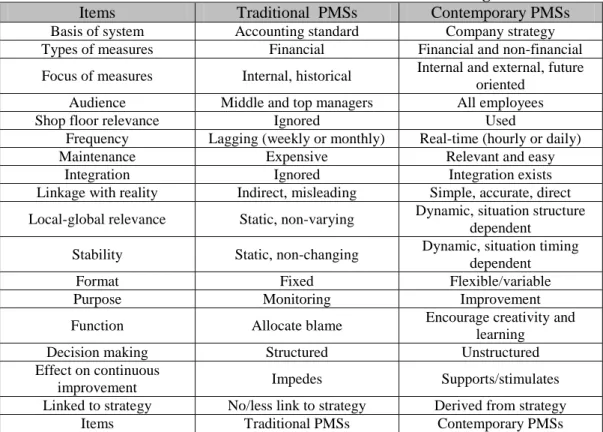
2.1 The Main Differences between Traditional PMSs and Integrated PMSs... 25
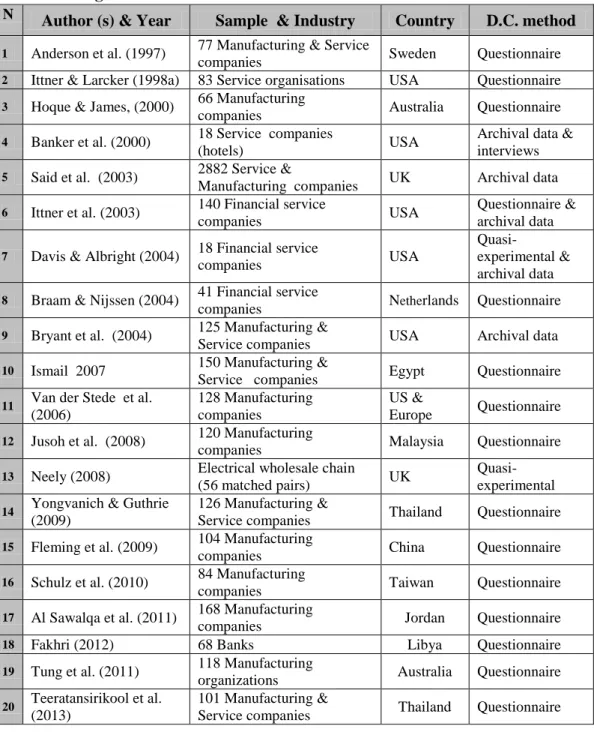
3.1 Summary of Previous Studies focusing on the Relationship between Multiple Performance Measures and Performance... 61
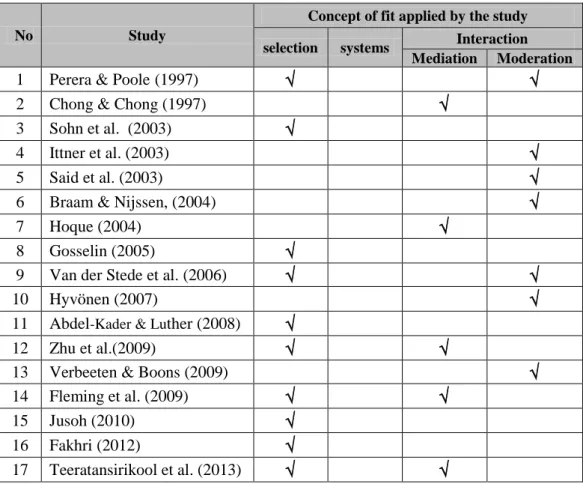
3.2 Synopsis of Previous Studies focusing on the Relationship between Contingency Factors, MPMs and Performance... 69
3.3 Summary of Prior Studies of the Relationship between BS and MPMs... 76
3.4 Summary of Prior Research into Contingency Application with BS... 77
3.5 Summary of Prior Studies of the Relationship between EE and MPMs... 82
3.6 Summary of Prior Research into Contingency Application with EE... 83
3.7 Summary of Prior Studies of the Relationship between OS and PMSs... 87
3.8 Summary of Prior Research into Contingency Application with OS... 87
3.9 Summary of Prior Studies of the Relationship between IT and MPMs... 90
3.10 Summary of Prior Research into Contingency Application with IT... 90
3.11 Summary of Prior Studies of the Relationship between CS and MPMs... 94
3.12 Summary of Prior Research into Contingency Application with CS... 95
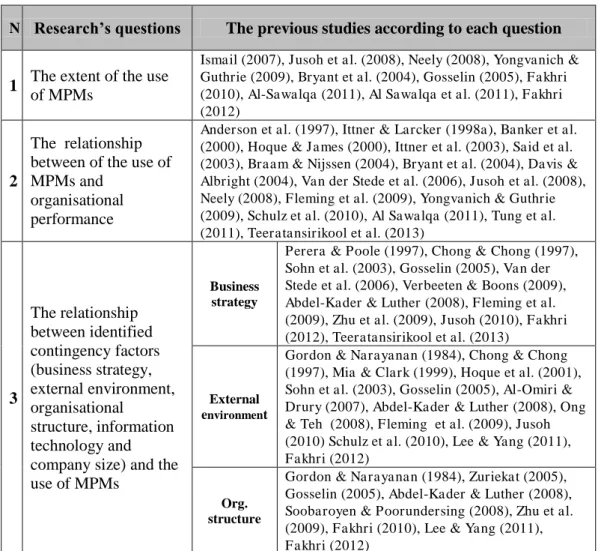
3.13 Summary of Prior Studies according to the Study’s Questions... 99
4.1 The Main Features of the Positivist and Phenomenological Research... 129
4.2 Summary of Research Sample and Sampling Results... 134
4.3 How to Measure the Research Variables and their Sources... 142
4.4 Reliability Coefficients (Cronbach Alpha) for Research Variables... 154
5.1 Survey Response Results... 163
5.2 Early and Late Response: Independent T-test Results... 165
5.3 Early and Late Response: Chi-Square Test of Relatedness/Independence... 165
5.4 Frequency Distribution of Characteristics of Respondents... 167
5.5 Frequency Distribution of Characteristics of Respondent Companies... 169
5.6 Descriptive Analysis of MPMs’ Usage in Libyan Companies... 172
5.7 Levels of Performance Measures’ Usage within Libyan Companies... 178
5.8 Descriptive Analysis of the Characteristics of MPMs... 179
5.9 Descriptive Analysis of the Importance of MPMs... 180
5.10 Descriptive Analysis of the Extent to which MPMs are Used for Different Purposes... 182
5.11 Descriptive Analysis of the Level of Satisfaction with MPMs... 183
5.12 Descriptive Analysis of Business Strategy... 185
5.13 Descriptive Analysis of Environmental Uncertainty... 186
5.14 Descriptive Analysis of Market Competition... 187
5.15 Descriptive Analysis of Decentralisation... 188
5.16 Descriptive Analysis of Formalisation... 189
5.17 Descriptive Analysis of Information Technology... 190
5.18 Descriptive Analysis of Organisational Performance... 191
5.19 Summary of Descriptive Analysis of the Independent Mediating Variable and Other Relevant Aspects... 193
5.20 Summary of Descriptive Analysis of the Independent and Dependent Variables... 193
6.1 Normality Distribution of the dependent Variable... 197
6.2 Normality Distribution of all the Research Variables... 198
6.3 Correlation Matrix (Pearson's) of Independent Variables... 199
6.4 Collinearity Statistics of Independent Variables... 199
6.5 Correlation Matrix (Pearson's) of all the Research Variables... 200
viii
6.7 Relationship between MPMs’ Usage and Organisational Performance according to the Type of Business... 206 6.8 Relationship between business Strategy and MPMs’ Usage... 208 6.9 Relationship between BS and MPMs’ Usage according to Type of
Business... 211 6.10 Relationship between Environmental Uncertainty and MPMs’ Usage... 212 6.11 Relationship between PEU and MPMs’ Usage according to Type of
Business... 214 6.12 Relationship between Market Competition and MPMs’ Usage... 216 6.13 Relationship between MC and MPMs’ Usage according to Type of
Business... 217 6.14 Relationship between Decentralisation and MPMs’ Usage... 219 6.15 Relationship between DECE and MPMs’ Usage according to Type of
Business... 221 6.16 Relationship between Formalisation and MPMs’ usage... 222 6.17 Relationship between FORM and MPMs’ Usage according to Type of
Business... 224 6.18 Relationship between Information Technology and MPMs’ Usage... 226 6.19 Relationship between IT and MPMs’ Usage according to Type of
Business... 227 6.20 Relationship between Company Size and MPMs’ Usage... 229 6.21 Relationship between CS and MPMs’ Usage according to Type of
Business... 231 6.22 Indirect Relationship between Business Strategy and Organisational
Performance through MPMs... 237 6.23 Indirect Relationship between BS and Organisational Performance through
MPMs according to Type of Business... 241 6.24 Indirect Relationship between Environmental Uncertainty and
Organisational Performance through MPMs... 243 6.25 Indirect Relationship between PEU and Organisational Performance
through MPMs according to Type of Business... 246 6.26 Indirect Relationship between Market Competition and Organisational
Performance through MPMs... 248 6.27 Indirect Relationship between MC and Organisational Performance
through MPMs according to Type of Business... 249 6.28 Indirect Relationship between Decentralisation and Organisational
Performance through MPMs... 251 6.29 Indirect Relationship between DECE and Organisational Performance
through MPMs according to Type of Business... 254 6.30 Indirect Relationship between Formalisation and Organisational
Performance through MPMs... 256 6.31 Indirect Relationship between FORM and Organisational Performance
through MPMs according to Type of Business... 258 6.32 Indirect Relationship between Information Technology and Organisational
Performance through MPMs... 259 6.33 Indirect Relationship between IT and Organisational Performance through
MPMs according to Type of Business... 262 6.34 Indirect Relationship between Company Size and Organisational
Performance through MPMs... 264 6.35 Indirect Relationship between CS and Organisational Performance through
MPMs according to Type of Business... 265 7.1 Summary of Companies Participating in the Interviews... 270
ix
7.2 Descriptive Analysis of Interviewees’ Perceptions of the Influence of
MPMs on Organisational performance... 295
7.3 Descriptive Analysis of Interviewees’ Perceptions of the Influence of Identified Contingency Factors on the Extent of MPMs Usage... 296
7.4 Descriptive Analysis of Interviewees’ Perceptions of the Influence of Fit (CFs & MPMs) on Organisational Performance... 299
8.1 Summary of Descriptive Analysis of MPMs’ Usage in Libyan Companies.. 308
8.2 Summary of Descriptive Analysis of Some Aspects Relating to MPMs... 309
8.3 Summary of the Results of the First Set of Research Hypotheses (the Relationship between MPMs and Organisational Performance)... 311
8.4 Summary of the Results of the Second Set of Research Hypotheses (the Relationship between Contextual Factors and MPMs)... 312
8.5 Summary of the Results of the Third Set of Research Hypotheses (the Relationship between Contextual Factors and Organisational Performance via MPMs)... 314
8.6 Summary of Descriptive Analysis of Interviewees’ Perceptions about the Second, Third and Fourth Research Questions... 317
8.7 Summary of Main Contributions to Knowledge about MPMs... 318
List of Figures
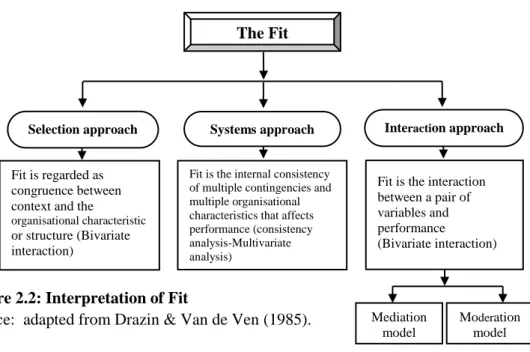
No Statement Page 2.1 Domain of Organisational Performance... 362.2 Interpretation of Fit... 43
3.1 Relationship between MPMs and Organisational Performance (Measurement Diversity Approach)... 60
3.2 Relationship between Contingency Factors, MPMs’ usage and Performance (Measurement Alignment Approach)... 71
4.1 Theoretical Model (Framework) of the Study... 106
4.2 Mediation Form to Contingency Fit... 106
4.3 Relationship between Design, Methodology and Method... 122
4.4 Map of the Current Research... 123
4.5 The Research Process ‘Onion’... 127
4.6 Triangulation Design of Data Collection... 131
4.7 Methods of Data Collection in Business Research... 136
4.8 Models of Moderated and Mediated Effects... 158
4.9 Plan of the Mediation Model... 160
6.1 The Histogram and Normal P-Plot of MPMs’ Usage... 197
6.2 The Histogram and Normal P-Plot of Organisational Performance... 197
6.3 The Mediation Relationship (A - The Total Effect, B - The Direct effect).... 235
6.4 Intervening Role of MPMs in the Relationship between BS and OP... 237
6.5 Intervening Role of MPMs in the Relationship between PEU and OP... 243
6.6 Intervening Role of MPMs in the Relationship between MC and OP... 248
6.7 Intervening Role of MPMs in the Relationship between DECE and OP... 251
6.8 Intervening Role of MPMs in the Relationship between FORM and OP... 256
6.9 Intervening Role of MPMs in the Relationship between IT and OP... 259
x
Abbreviations
ABC ... Activity-Based Costing AR ... Annual Revenue BSC ... Balance Scorecard
BS ... Business Strategy BU ... Business unit
SBU ... Strategic Busmess Unit CFOI ... Cash flow on Investment
CS ... Company Size CFs ... Contingency Factors DECE ... Decentralisation
EPS ... Earnings Per Share EVA ... Economic Value Added
EE ... External Environment
FPMs ... Financial Performance Measures FORM ... Formalisation
IT ... Information Technology JIT ... Just-In-Time
MAPs ... Management Accounting Practices MASs ... Management Accounting Systems MCSs ... Management Control Systems
MC ... Market Competition MVA ... Market Value Added
MPMs ... Multiple Performance Measures NFPMs ... Non-Financial Performance Measures
NOE ... Number of employees OP ... Organisational Performance OS ... Organisational Structure PA ... Path analysis
PEU ... Perceived Environmental Uncertainty PM ... Performance Measurement
PMS ... Performance Measurement System PMSs ... Performance Measurement Systems
PMs ... Performance Measures PP ... Performance Prism PT ... Production technology R&D ... Research and Development ROA ... Return On Assets
ROE ... Return On Equity ROI ... Return On Investment ROS ... Return On Sale
SPMSs ... Strategic Performance Measurement Systems SEM ... Structural Equation Modelling
1
CHAPTER ONE
1 Introduction and Overview
1.1 Introduction
This chapter aims, as an introduction to the whole thesis, to produce a general outline of this research. It is organised into seven sections: The theoretical background of the study is presented in section 1.2. Section 1.3 addresses the rationale and motivation for the research. The aim and objectives of this research are presented in section 1.4. Section 1.5 presents a concise overview of the theoretical model and research methodology. Attention is also paid to the research context and scope in section 1.6. The final section is dedicated to outlining the structure of the thesis.
1.2 Background and Focus of Research
Performance measurement (PM) is a subject which has been much discussed sincethe early 1990s. It is considered to be an issue of growing importance among academicians and practitioners; however, “it still remains a critical and much debated issue” (Jusoh et al., 2008, p.119). Although most scholars and researchers in the management and accounting knowledge fields agree on the importance of performance measurement for all organisations and industries, they are still unable to concur about an obvious and specific concept of PM. Marr & Schiuma (2003) suggest that the domain of performance measurement lacks a consistent body of knowledge or generally accepted theoretical background. This may be explained by the reality that a very diverse mixture of researchers and scholars are contributing to this field (Franco-Santos et al., 2007), leading to differences of opinions about the criteria and standards adopted in identifying and defining performance which has resulted in fragmented and disparate findings. Nevertheless, it can be suggested that a successful performance measurement system (PMS) should cover all of a company’s activities; which can present relevant, accurate, complete and timely information to help top management in managing, planning and controlling the activities undertaken in the company (Tangen, 2005). “A good and powerful PMS should be more dynamic, flexible
2
and address several and different requirements and perspectives of stakeholders not only the shareholders’ interests” (Zeglat et al., 2012, p.444).
The slogans “what gets measured gets done” and “you cannot manage what you cannot measure” indicate the relevance of performance measurement (PM) in the success of organisations (Cho et al., 2005). A performance measurement system (PMS) typically comprises systematic methods of setting business goals together with periodic feedback reports that indicate progress against those goals (Simons, 2000). Performance measurement can be seen as a fundamental part of the monitoring and control of all activities within the organisation (Simons, 2000). It is also considered a control sub-system of an overall organisational control package. Therefore, PMS is considered to be an essential part of feedback control that produces information for top management to assess how successfully the organisation’s strategies are being implemented. Neely et al. (1995, p.81) suggest that PMS represents “a set of metrics used to quantify both the efficiency and
effectiveness of actions” and these metrics can be financial or non-financial, short
or long term, internal or external. Thus, the literature contends that PMSs can play a major role in maintaining companies (Garengo & Bititci, 2007). Many organisations are now substituting their accounting-based PMSs for more sophisticated mechanisms that incorporate multi-criteria performance measures encompassing financial as well as non-financial indicators.
Performance measurement practices were, traditionally, based on financial performance measures (FPMs) (Tung et al., 2011; Zeglat et al., 2012), which have been criticised by many researchers and scholars during the late twentieth century (e.g. Kaplan, 1983; Johnson & Kaplan, 1987; Dixon et al., 1990; Eccles, 1991; Ghalayini & Noble, 1996; Neely, 1999; Al Sawalqa, 2011; Tung et al., 2011). Ittner et al. (2003, p.717) argue that accounting-based measures are “too historical and backward-looking, lack predictive ability to explain future performance, reward short-term or incorrect behaviour, provide little information on root causes or solutions to problems, and give inadequate consideration to
difficult to quantify intangible assets such as intellectual capital”. These
3
longer appropriate and valid for decision-making, controlling and planning operations in today’s speedily changing and hyper-competitive environment (Johnson & Kaplan, 1987; Jusoh et al., 2008; Al Sawalqa, 2011). In this respect, many researchers suggest that the changes and subsequent developments in the contemporary environment have shown the shortcomings of traditional measures; improving these techniques has therefore become an urgent issue for organisational success (e.g. Neely, 1999; Hoque et al., 2001; Hussain & Hoque, 2002; Burgess et al. 2007; Jusoh & Parnell, 2008; Verbeeten & Boons, 2009). Consequently, organisations have been forced to seek out and develop new systems to overcome their frustrations with these conventional systems (Verbeeten & Boons, 2009; Tung et al., 2011). A further emphasis has been given to the adoption of non-financial performance measures (NFPMs) such as quality, market share and customer and employee satisfaction etc (Fakhri, 2012). Jusoh & Parnell (2008, p.8) comment on these innovative measures: “Viewing performance through a non-financial lens can provide insight into organisational processes and outcomes that cannot be seen via financial measures”. NFPMs are considered as indicators of intangible assets and major performance drivers which may be supportive in predicting future financial performance (Jusoh & Parnell, 2008), and as leading indicators for issues that will eventually influence the financial performance of organisations (Ittner & Larcker, 1998b; Banker et al., 2000). As a result, many organisations have begun applying NFPMs in conjunction with FPMs, creating a single system in order to obtain better information on strategic progress and success (Ittner et al., 2003). Later, several research studies addressed how NFPMs can be most successfully combined with FPMs to obtain the best performance measurement system (Hoque & James, 2000; Jusoh et al., 2008). Among the most interesting integrated systems and frameworks based on integrating the NFPMs and FPMs in one model of performance measurement were, for example, the Performance Pyramid (Lynch & Cross, 1991), the Balanced Scorecard (Kaplan & Norton, 1992), the Performance Prism (Neely & Adams, 2001).
Accordingly, it is apparent that there exist two approaches to performance measurement; namely, the traditional approach (which represents financial or
4
accounting-based performance measures) and the innovative approach (which is also known as measurement diversity approach). The latter, which will be the focus of this research, represents multiple performance measures (MPMs) which encompass a diverse range of financial and non-financial measures (operational and strategic). However, increasing developments in the innovative approach have resulted in two general views emerging about how to design and use innovative approach to performance effectively: the measurement diversity approach and the measurement alignment approach (Ittner et al., 2003; Said et al., 2003; Henri, 2006a; Van der Stede et al., 2006). The first approach, which is the simplest one, proposes that improving organisational performance depends on the diversity of performance measures (regardless of context or contingencies). This means that organisations achieve superior performance when they can place greater emphasis on a broad set of financial and non-financial performance measures (Ittner et al., 2003; Van der Stede et al., 2006). By contrast, the second approach, which looks more interesting, suggests that improving organisational performance does not depend only on variety; instead, better performance can be achieved when MPMs align with other organisational and environmental characteristics; thereby in this case, it suggests that the effectiveness of PMS depends on the context-structure fit (Fisher, 1995; Langfield-Smith, 1997; Chenhall, 2003).
Accordingly, this argument seems to be consistent with the assumption of contingency theory which suggests that performance measurement systems cannot be universally appropriate. “Each organization needs to design its own system
according to its circumstances to avoid loss of performance” (Franco-Santos et
al., 2012, p.98). Tillema (2005) states that “the appropriateness of using sophisticated techniques may depend on the circumstances in which these techniques are being used (and this)...gives rise to the need to adopt a contingency theory perspective” (p.102). Therefore, advocates of this approach suggest that contingencies1 (e.g. strategy, size, PEU) are important antecedents of MPMs’ design and use, and MPMs’ information is an important antecedent of
1
They are also known contingency/contextual factors which encompass some specific dimensions related to the external and internal environment of organisations (environmental and organisational characteristics); such as strategy, company size, technology, environmental uncertainty, etc.
5
organisational performance (Fisher, 1995; Chenhall & Langfield-Smith, 2003). In this respect, Bititci et al. (1997, p.525) argue that “the performance measurement system, to be effective in achieving its objectives, should take account of the strategic and environmental factors relating to the business as well as considering the structure of the organization, its processes, functions, and their relationships”. In the same vein, Kattan et al. (2007, p.229) state that “The greater the ability to match the correct combination of external variables and internal organisational characteristics such as the organisational structure, leadership style, size, age, type of information systems used, and planning and control processes, the better the outcome is expected to be”. Similarly, Speckbacher et al. (2003, p.374) argue that: “Besides size, there is a myriad of other possible contextual variables that may affect the design and the effectiveness of strategic performance measurement systems. Important contextual factors are environment, technology, organizational structure or strategy”. Several researchers and scholars have thereby indicated that the varied and often contradicted findings regarding the MPMs-organisational performance relationship can be attributed to the omission of the potential effect of contingency factors (e.g. strategy, environment) (e.g. Ittner & Larcker, 2001; Braam & Nijssen, 2004; Hoque, 2005). Consequently many researchers have concluded that there is an urgent need to investigate the influence of these contingencies on the effectiveness of measurement diversity techniques (e.g. Haldma & Lääts, 2002; Said et al., 2003; Braam & Nijssen, 2004; Gerdin & Greve, 2004; Gosselin, 2005; Hyvönen, 2007; Teeratansirikool et al., 2013).
In this context, several studies have reported that the association between MPMs and organisational performance is unclear because the preceding research produced varied and inconclusive results (Henri, 2004, 2006a; Jusoh et al., 2008; Abushaiba & Zainuddin, 2012). On the other hand, other empirical studies have not found strong support for the relationship between contextual factors and MPMs and their subsequent influence on organisational performance; rather, their results were mixed and relatively conflicting (e.g. Perera & Poole, 1997; Ittner et al., 2003; Hoque, 2004; Van der Stede et al., 2006; Hyvönen, 2007; Verbeeten & Boons, 2009; Teeratansirikool et al., (2013). Therefore, the PM literature has
6
concluded that the relationship between contingency variables, measurement diversity approach and performance is still ambiguous because of a controversy about determining the appropriate dimensions of each contingency factor and their impact on MPMs (e.g. Ittner et al., 1997; Hoque, 2004; Hyvönen, 2007).
Based on these varied and conflicting findings, this research argument seems to be a critical and much debated topic. The current research seeks, therefore, to document whether the effectiveness of MPMs is related to other environmental and organisational contingencies. In other words, the current research tries to contribute to the relevant literature by providing a contingency-based empirical investigation of the effectiveness of the measurement alignment approach2, in an emerging market context (i.e. Libya), that suggests that superior performance requires alignment of MPMs with environmental and organisational characteristics of the organisation. Stated more specifically, the problem of this study can be divided into four major parts. The first part is concerned with the extent of MPMs usage in Libyan settings. The second part is concerned with the direct relationship between MPMs and organisational performance. The third part is related to the relationship between the identified contextual factors (including
business strategy, environmental uncertainty, market competition,
decentralisation, formalisation, information technology and company size) and MPMs. The fourth part is concerned with the indirect impact of the identified contingencies and organisational performance through MPMs.
1.3 Research Rationale and Motivation
The growing emphasis on the use of a combination of financial and non-financial performance measures has been widely discussed in the contingency-based performance measurement literature (Said et al., 2003). However, Ittner & Larcker (2001, p.375) comment that “performance effects of the Balanced
Scorecard and other value driver techniques remain open issues”. As mentioned
earlier, in an attempt to overcome the limitation of traditional performance measures, many integrated and balanced performance measurement approaches
7
(e.g. BSC, PP) have been proposed (Tung et al., 2011) by numerous scholars (e.g. Kaplan & Norton, 1992; Neely & Adams, 2001). Some of these integrated systems have received worldwide acceptance and have been adopted by many companies. This has made these measurements diversity-based approaches appear to be an important and attractive issue for many researchers over the past two decades (e.g. Hoque & James, 2000; Ittner et al., 2003; Gosselin, 2005; Jusoh et al., 2008). Therefore, several studies have found support for these innovative techniques and systems (e.g Banker et al., 2000; Davis & Albright, 2004; Bryant et al., 2004; Jusoh et al., 2008). Other empirical research; by contrast, has provided little evidence as to whether these initiatives yield significant economic benefits. For example, some literature has reported that the use of MPMs (e.g. BSC) does not make any difference to business performance (e.g. Ittner & Larcker, 1998a; Braam & Nijssen, 2004; Neely, 2008; Schulz et al., 2010). On the other hand, a number of researchers and scholars have suggested that these mixed and conflicting results may be attributed to the omission of other organisational and environmental characteristics (e.g. strategy, structure, size, uncertainty) (e.g. Ittner & Larcker, 2001; Braam & Nijssen, 2004; Hoque, 2005). They consequently suggested that these innovative measures should be aligned with these environmental and organisational characteristics, which in turn results in a positive effect on organisational performance. This means that contextual factors have an influence on the adoption and effectiveness of these innovative systems (e.g. Ittner et al., 2003; Fleming et al., 2009).
In this context, the previous studies found support for this view (e.g. Chong & Chong, 1997; Mia & Clark, 1999; Said et al., 2003; Braam & Nijssen, 2004; Hoque, 2005; Fleming et al., 2009). They concluded that contingency factors play a key role in MPMs’ effectiveness. However, this issue seems to be an inconclusive and much debated question (see Chapter 3), where much research found support for the hypothesised association between the use of MPMs and performance; however, this relationship does not depend significantly on those contextual factors (e.g. strategy, uncertainty) (e.g. Perera & Poole, 1997; Hoque & James, 2000), and others have found that the fit between performance measurement diversity and context does not help to enhance organisational
8
performance (e.g. Ittner et al., 2003; Hyvönen, 2007; Verbeeten & Boons, 2009; Teeratansirikool et al., 2013). Furthermore, other previous studies investigated only the contingencies-MPMs relationship (i.e. they did not consider the impact of this interaction on organisational performance); however, their results were insignificant (e.g. Jusoh, 2010; Mohammed & Hussain, 2010). Based on these inconsistent findings, many researchers called to examine the influence of these contingencies on the effectiveness of measurement diversity techniques (e.g. Haldma & Lääts, 2002; Said et al., 2003; Braam & Nijssen, 2004; Gerdin & Greve, 2004; Gosselin, 2005; Hyvönen, 2007). Several researchers indicated that despite increasing research interest in performance measurement in developed countries over recent years, an interaction between contingencies (e.g. environmental and organisational characteristics), measurement diversity approach and organisational performance has not been largely theorized (Banker et al., 2000; Gosselin, 2005; Hyvönen, 2007). As a result, by responding to and covering the limitations of previous research (see Section 3.4), this study will focus on investigating empirically the impact of contingencies on the effectiveness of MPMs to explore and extend the results of those previous empirical studies.
Furthermore, much of the literature has investigated the measurement diversity approach of performance using data for a single organisation or industry, which was mostly manufacturing (e.g. Gosselin, 2005; Hoque, 2005; Van der Stede et al., 2006; Garengo & Bititci, 2007; Hyvönen, 2007; Jusoh & Parnell, 2008; Fleming et al., 2009) with very little research on the non-manufacturing sector (Kald & Nilsson, 2000; Evans, 2004; Hussain, 2005; Jääskeläinen et al., 2012; Fakhri, 2012). This reflects that there is far less PM research in non-manufacturing organisations than in non-manufacturing (Hussain & Hoque, 2002; Zhu et al., 2009). Consequently, several studies have called for re-investigating this phenomenon in the service sector (e.g. Fitzgerald et al., 1991; Hussain, 2005; Jusoh et al., 2008; Ong & Teh, 2008; Zhu et al., 2009). In this regard, Hussain & Hoque (2002) argue that although the service sector contributes a significant portion of gross domestic product and employment in advanced economies such as the US, UK, Australia and Japan, less is known about determinants of the
9
effectiveness of performance measurement systems in this sector. Boulianne (2007) suggests that very little research has focused on parallel studies of control systems and performance measurement in both manufacturing and non-manufacturing sectors. As a consquence, the current study does not focus on a single industry; rather it concentrates on both manufacturing and services industries simultaneously. This may make the results more generalisable, making it easier to conduct a concise comparison between these hypothesised contingency relationships among the different sectors.
Additionally, a key motivation for conducting this current study in Libya is that the vast majority of empirical studies on the contingency relationship between performance measurement diversity and organisational performance have been examined in the West, most notably in the UK and US (Jusoh & Parnell, 2008) where these diverse performance measurement models have been developed. This has resulted in lack of knowledge and understanding about these modern trends of performance measurement in developing countries. In this regard, many researchers have argued that PM research in developing countries is relatively limited (e.g. Haldma & Lääts, 2002; Hutaibat, 2005; Soobaroyen & Poorundersing, 2008). This therefore allows for exploring the effect of the context/setting on the results of the study. On the other hand, the few prior studies conducted in Libya (e.g. Abugalia, 2011; Fakhri, 2012) have pointed out that Libyan companies use MPMs (i.e. financial and non-financial measures); however, these companies suffer from limited knowledge about the effectiveness of the measurement diversity approach. As a result, Libya and other developing countries are in need of further research on this theme. As a consequence, the researcher intends to use the Libyan setting (manufacturing and non-manufacturing companies), as being representative of emerging contexts in the region of the north of Africa, to conduct this research. He believes that the study would be helpful for these companies in creating a better understanding of the effective use of multiple performance measurement techniques. Furthermore, as a Libyan national, it is relatively easy for the researcher to obtain the required data for this research. The author’s personal access and insight into Libya, particularly with regard to the collection, analysis and dissemination of primary data is a
10
unique advantage. Therefore, this research contributes to the development of knowledge in the area of PMSs in Libya as a developing country by providing a contingency-based empirical investigation of the influence of the identified contextual factors on the effectiveness of the use of MPMs.
1.4 Research Aim, Objectives and Questions
Based on the theoretical background of the research shown in Section 1.2, the study endeavours to investigate the effectiveness of the measurement diversity approach (i.e. MPMs) through the contingency perspective in a Libyan context over the period 2010-2013. Therefore, the key purpose of this study is to investigate the relationship between the identified contingency factors (business strategy, environmental uncertainty, market competition, decentralisation,
formalisation, information technology and company size), MPMs and
organisational performance3(organisationaleffectiveness). This study is thus a significant addition to existing understanding of these issues, particularly in Libya. To achieve this major aim, the following five objectives have been developed for this study:
1. To ascertain the state and extent of MPMs’ usage within Libyan companies operating in both manufacturing and non-manufacturing sectors, defining their key characteristics, their importance, their different purposes and the level of satisfaction with them.
2. To investigate the direct relationship between MPMs’ usage and organisational performance.
3. To examine whether the identified contextual factors (business strategy, environmental uncertainty, market competition,decentralisation, formalisation, information technology and company size) have an influence on use of MPMs.
4. To investigate the indirect relationship between the identified contextual factors and organisational performance through MPMs, (i.e. the mediating role of MPMs in the relationship between identified contingencies and organisational performance).
3 The concepts of “business performance”,“organisational performance” and “organisational effectiveness”
11
5. To explore financial directors’ perceptions in a Libyan context about the hypothesised relationships between contingency factors, MPMs and organisational performance.
These objectives will be met through seeking to answer the following five questions.
1) To what extent do Libyan companies operating in all industry sectors use MPMs, and what are the key characteristics of these measures, their importance in meeting company’s needs, their different purposes and level of satisfaction?
2) What is the nature and type of the direct relationship between MPMs’ usage and organisational performance?
3) What is the nature and type of the direct relationship between identified contextual factors (business strategy, environmental uncertainty, market competition, decentralisation, formalisation, information technology and company size) and MPMs’ usage?
4) What is the nature and type of the indirect relationship between the identified contextual variables and organisational performance via MPMs?
5) How do financial directors perceive the relationships among contingency factors, MPMs and organisational performance in a Libyan context?
1.5 Research Methodology
The theoretical framework of this research has been based on the contingency approach. This approach hypothesises that organisation structure (i.e. MPMs) is a function of context (i.e. contingency/contextual factors) (Ittner & Larcker, 2001). A number of authors (e.g. Haldma & Lääts, 2002; Chenhall, 2003; Hoque, 2005) argue that contingency theory is a suitable framework for management accounting and performance measurement studies. Much previous research relied on a contingency approach in designing frameworks (e.g. Chenhall, 2003; Sohn et al., 2003; Gosselin, 2005; Hoque, 2005, 2004; Van der Stede et al., 2006; Fleming et al., 2009; Jusoh, 2010). Tillema (2005, p.102) state that “the appropriateness of using sophisticated techniques may depend on the circumstances in which these techniques are being used (and this)...gives rise to the need to adopt a
12
contingency theory perspective”. Otley (1980) further suggests that adopting a contingency theory of management accounting emerged as a necessary means of interpreting the results of empirical control research. Accordingly, two approaches to contingency fit, namely the selection approach and the mediation-based interaction approach, have been employed in order to develop the research hypotheses and interpreting of empirical findings.
For the study design and methods, it can be argued that since the framework of this research is based on the literature of an existing theory (contingency) and it seeks to examine causal relationships through exploring specific responses to particular questions and hypotheses, this research is based on a deductive paradigm; therefore, it is conducted under a positivist design. Also, a mixed method, or what is known as triangulation, was applied as an approach to primary data collection and analysis. Triangulation was achieved in this research by using two methods in data collection and analysis; specifically, a questionnaire survey as the main data collection instrument and semi-structured interview protocol as the second instrument. The rationale behind this combination is that the limitations of one instrument would be compensated for by the strengths of the other instrument Creswell (2003, p.15-16). The questionnaire was administered to 226 Libyan manufacturing and non-manufacturing companies during the period February-May 2012. A total of 132 useable questionnaires (60.8%) were received. Ten face-to-face interviews were conducted with the respondents after obtaining initial results of the survey (July-August 2012). The key goal from this additional instrument was to explore answers in depth and support the findings of the questionnaire survey in order to build a clear image of MPMs in a Libyan context. These instruments were checked by a pilot study and reliability and validity tests. Lastly, the data was analysed through a number of appropriate statistical methods (e.g. descriptive statistics, regression analysis and mediation analysis via the SPSS statistical package) and content analysis. It is worth noting that during the preparation of measures and constructs for the research variables, any terms or measures which were specific to a particular sector were excluded in order to make the questionnaire applicable to all sectors (manufacturing and non-manufacturing). By way of additional explanation, in order to examine whether
13
the results of proposed relationships vary depending on the type of business, all findings were presented both jointly and separately for each sector.
1.6 Research Context and Scope
Libyan businesses represent the context of this study. Libya is a developing country with an emerging economy. This country is located in North Africa. Libya has an area of approximately 1,759,541 sq. km, and a population of about 6.5 m (2010). The Libyan political and economic system has seen several dramatic changes:
Throughout the period 1951-1969, the Libyan economic system was mainly capitalist (Fakhri, 2012). Private ownership existed with minimum governmental interference. Public ownership was in sectors that required large scale investment such as health, education and security (Sharif, 2000). From Libya's independence (1950s), until the discovery of oil (1960), Libya was classified as one of the poorest countries in the world, with an economy basically dependent on agriculture and pasturage, and few industrial establishments. After discovering oil, the State attempted to establish several development projects aiming at economic reform, creating new jobs, improving education, improving the health and daily life of people, and contributing to the gross national income (e.g. real estate projects, encouraging domestic business actives, opening and supporting a number of small enterprises and banks).
After 1969 and at the beginning of the 1970s, several steps were taken by the revolutionary government in the direction of changing from a capitalist to a socialist economy (Fakhri, 2012). Consequently, from the late 1970s up to 1991 the Libyan economy was centrally planned and the State controlled all manufacturing activities, foreign and domestic business activities, banking and insurance, as well as other services (Fakhri, 2012). Over this period, the Libyan government commenced the establishment of several development plans and projects, but most of the objectives of these plans have not been met. This might be attributed to a lack of skilled manpower, lack of availability of adequate economic and technical studies, a lack of attention to cost accounting systems, or centralisation of management (Sharif, 2000). These results were not surprising
14
because it is common that state-owned sectors in developing and developed countries alike often suffer from poor performance due to the misuse of economic resources and weak state control over different economic activities (Badi, 1997).
At the beginning of the 1990s, these administrative and economic problems prompted the Libyan government to issue a number of laws, resolutions and a set of modified policies to open the door to the private sector and start the process of transforming the Libyan economy from a centrally controlled system dominated by the state-owned sector to a market-based economy (Bait-Elmal, 1999; Sharif, 2000; Fakhri, 2012). More specifically, the government launched a policy of privatising a large number of state-owned companies and reducing the role of the state. This transformation involved fundamental change in the regulatory context, encouraging the private ownership of economic activities, reducing the role of the state to be limited to selected public activities such as health, education and security (Alfarsi, 2003). These changes have partially terminated the domination of the state-owned sector over the Libyan market, which proved to be responsible for many deficiencies obstructing the growth of the economy (Sharif, 2000; Fakhri, 2012). Therefore, since the late 1990s private companies have emerged and started to operate in Libya. The Libyan government, like other oil countries, has invested huge amounts of money in both industry and service sectors in order to reduce its dependence on crude oil exports and create a variation in the income resources (Alfarsi, 2003). However, the concurrent UN and US sanctions (during the 1990s) and reduction of oil prices and other internal problems forced the business sectors to perform below their designed capacities (Fakhri, 2012). As a result, these new initiatives and enterprises have not achieved their goals and the Libyan economy still depends heavily on the oil industry as a main source of foreign currency (Sharif, 2000). Overall, the former dictatorial government did not succeed over the last two decades (at least) in reviving the national economy of Libya. However, this phase ended by a massive popular revolution - the 17th February Revolution (2011) - which swept across the whole of Libya and led to the overthrow of the existing dictatorial regime; Libya ushered in a new era, whose slogans were lifting injustice, achieving social justice and freedom of expression.
15
Accordingly, it seems that Libya, as with other developing countries, gave high priority to economic and social problems, more so than to organisational and managerial issues, which have had a key influence on the performance of development enterprises and plans. However, this country is, today, competing with neighbouring countries for a growing share of international markets. Libya recently witnessed a real opening for international businesses; there are now many international companies with huge capital investments in Libya. The Libyan government placed greater emphasis on management control, training and development programmes, which has aimed to transfer the knowledge and skills needed for organisational development. In this context, during the last decade, accounting and management education has received reasonable attention, with several management development and accounting centres in Libya. However, it is known that each country has unique accounting application and practices. This means that the development of accounting practice are affected by different factors such as regulations, political systems, economic conditions and cultural factors, because these factors can affect organisations and people’s behaviour and choices in different ways. Briston (1990, p.215) states that “each country is different and has different needs. The purpose of accounting is to serve society. As a consequence, accounting is likely to be influenced by the different political, economic, social and religious environments in which it operates”. In the same context, Al-Akra et al. (2009) argue that there are several environmental factors, such as political and economic conditions, culture, religion, and the educational system of a country, that seem to contribute to the differences in accounting systems. They suggest that religion, as a cultural input, plays a very vital role in certain economies. For example, Islam “has a major impact on how Muslims do
business and hence on the accounting systems chosen” (p.176). Similarly,
(Haider, 2010; Labardin, 2012) found that cultural factors provide a possible explanation for many of the differences in financial reporting practices; thus, accounting can’t be isolated from culture and like other human beings and social institutions it is culturally determined, so cultural customs, beliefs, and
institutions influence it (Haider, 2010, p.6). Kraal et al. (2012, p.14) conclude that
16
and the unique characteristics of accounting problems facing each country”.
Consequently, it is not suprising that diverse accounting practices and systems, including performance measurement techniques, were not uniform, particulary among developed and developing contexts.
Based on the existing literature, except for Fahkri, (2012), the researcher could not find a research paper - about PMSs in a Libyan context - published in any international academic journals. However, he found a few doctoral dissertations exploring PMs (e.g. El-Shukri, 2007; Fahkri, 2010) and MAPs (e.g. Alkizza, 2006; Abugalia, 2011) in a Libyan setting. The first research group, which is focused on PMs, indicated that most Libyan companies (manufacturing or non-manufacturing) use a mixture of performance measurement systems that include a combination of financial and non-financial measures. However, they are still relying on financial measures (e.g. budgets practices) more than non-financial measures information in evaluating business performance and for various other purposes. They also concluded that the limitations of FPMs are one of the major motives leading to Libyan companies’ use of MPMs. Fahkri, (2012) found that the extent of the use of MPMs (e.g. BSC) are affected by several contextual factors such as strategy, external environment and organisational structure.
Concerning the second research group, which focuses on MAPs, the researcher found that there has been an increase in the range of management accounting practices used by Libyan companies, and indicated that budgeting practices were the most popularly used. However, in general, the results concluded that the adoption rates of most MAPs (i.e. cost, budgets and PMSs) in Libyan companies were low compared to those found in other developed countries as reported in the literature. This can be attributed to lack of sufficient knowledge about MAPs, shortage of financial resources required to adopt innovative accounting systems and absence of the culture of using MAP information (Abugalia, 2011).
Accordingly, the current study failed to find any empirical research on contingency-based investigations of the measurement diversity approach. This infers that there are very few PM studies in this country, especially those relating to the effects of contingency factors on the effectiveness of MPMs. To conduct
17
this research, all Libyan organisations working in manufacturing and non-manufacturing industries have been chosen as the population of this study. Therefore, the scope of the research was focused on investigating the effectiveness of the measurement diversity approach in the light of contingency theory in Libyan manufacturing and non-manufacturing companies over the period (2010-2013). Consequently, three key areas were investigated in depth in this study: the relationship between MPMs and organisational performance, the relationship between several environmental and organisational contingencies and MPMs, and the relationships between contingencies, MPMs and organisational performance according to the mediation-based interaction approach to contingency fit. These research boundaries were established to pinpoint the scope of this study in order to guarantee that the results were comparable, coherent and of practical value to the target audience, whether researchers or practitioners.
1.7 Thesis Structure
The purpose of each chapter is described as follows:
Chapter One: Introduction and Overview
This introductory chapter provides the outlines of the thesis: theoretical background, rationale and motivation, research objectives and questions, research methodology, and research context and scope.
Chapter Two: Performance Measures and Contingency Theory
This chapter sheds light upon performance measurement literature such as concepts, financial and non-financial measures, limitations, characteristics of MPMs, performance measurement diversity and alignment, and organisational performance. Furthermore, it reviews the relevant literature of contingency theory, its limitations and different concepts of contingency fit in addition to offering a brief review of the contextual factors studied in this research.
Chapter Three: Literature Review
This intends to explore and review relevant empirical literature pertaining to the supposed associations among the main research’s variables; namely, identified contingencies, MP Ms and organisational performance, in order to identify gaps in the body of extant knowledge.
18
Chapter F our: Research F ramework and Methodology
This chapter explores the theoretical model of the study and variables measurement and hypotheses development. Furthermore, it presents a detailed description of research methodologies to identify the appropriate strategy, data collection and analysis methods for this study. It also addresses on validity and reliability evaluation.
Chapter F ive: Research Results Description
This chapter aims to provide profiles of characteristics of respondent companies
and respondents, and findings of the descriptive analysis which mainly aim to
serve the first objective of the research.
Chapter Six: Survey F indings and Discussion
The objective of this chapter is to explain how the quantitative research data has been analysed and how the hypotheses of the research have been tested, and to discuss the findings of this research to respond to the research questions.
Chapter Seven: Interview Results and Discussion
This chapter seeks to identify respondents’ perceptions about the hypothesised
direct and indirect associations between (MPMs and OP, CFs and MPMs, and CFs and OP via MP Ms) according to qualitative data derived from semi-structured interviews.
Chapter Eight: Conclusions
The chapter aims to report a summary of key quantitative and qualitative findings of the research, contributions and implications, research limitations, and directions for future research.