1
Logistics service providers (LSPs) evaluation and selection: Literature review and framework development
Purpose: Since the economic recession of 2008, logistics outsourcing decisions have become more prominent to avoid high fixed costs and heavy investment requirements and to achieve competitive advantages. The purpose of this paper is to provide an insight to the outsourcing decision-making through investigating if the old evaluation/selection criteria and methods still fit with current business priorities or not and therefore to identify the appropriate criteria and methods to develop a new selection framework.
Methodology: This is a focused literature review prepared after analyzing 56 articles related to the LSP evaluation and selection methods and criteria during 2008-2013. The academic articles are analyzed based on research focus/area, evaluation and selection methodology/methods and evaluation and selection criteria. Then review result compared with previous literature studies for the periods (1991-2008) to identify any possible shifts.
Findings: The review reveals that: several problems in current LSPs literature have been identified; the reviewed papers can be categorized into seven groups, the usage and importance of evaluation and selection criteria fluctuate during different periods; twelve crucial criteria have been identified, increasing the importance of specific selection methods and the integrated models and fuzzy logic in logistics literature. Then, a comprehensive LSPs’ evaluation and selection framework has been developed.
Originality: To the best of our knowledge, this is the first focused logistics outsourcing study that review the 2008-2013 period in details, comparing results with previous literature studies, identify current LSPs literature problems/gaps, new trends and shifts in the way that LSPs are evaluated and selected, identify crucial selection criteria and proposes a new holistic LSPs evaluation and selection framework. In addition, it identifies important issues for future research.
Keywords: Logistics outsourcing, Logistics Service Provider, Evaluation and Selection Methods and Criteria, LSP framework
2
Introduction
Evaluation and selection of Logistics Service Providers (LSPs) is an important element in the logistics outsourcing process. Logistics activities are considered among the main activities that no longer need to be managed by firms themselves as they can be outsourced to a professional external party (Ho et al., 2012; Ciravegna et al., 2013) and many alternatives now exist for logistics provision. Firms seek to outsource logistics activities in order to avoid high fixed costs and heavy investment requirements associated with logistics and to focus more on their own basic activities. Logistics outsourcing has proven to be an effective strategy helping logistics services users (LSUs) to achieve competitive advantages, improve customers’ service-levels and reduce overall logistics costs (Boyson et al., 1999).
Logistics industry has its own challenges that affect the level and attractiveness of logistics outsourcing. The levels of the global economic activity are driving demand for outsourced logistics services (Capgemini, 2015). Moreover, marketplace threats, such as the effects of globalization, economic recession and sustainability issues, increase the levels of uncertainty and motivate firms to rethink the way they evaluate and select their external partners. This trend of rethinking ways of selecting external logistics providers has become even more prominent since the economic recession of 2008. Given this new trend, one can raise three questions: First, whether the old classical evaluation/selection criteria and methods still fit with current business priorities. Second, if they do not, then what are the appropriate criteria and methods? Third, based on the most used selection criteria and methods, how can we develop a new selection framework, which accommodate the new criteria/methods, for businesses? Answering these three questions is very important since it will help businesses making better selection decisions to have a competitive edge. However, most of the logistics outsourcing studies are empirical in nature, focus on specific area or country, not comparative and weakly
3
theoretical. Therefore, there is a crucial need for a comprehensive comparative study considers related criteria to build a comprehensive framework (Aguezzoul 2014).
This research contributes to answering the questions above. It will study existing articles about LSPs evaluation and selection since 2008 when the economic downturn occurred to identify any possible shift in the way LSPs are evaluated and selected. Then it will propose an advanced comprehensive LSPs’ evaluation and selection framework based on the study outcomes.
The purpose of the framework is to assist the research community in providing better decision support tools to meet the logistics industry needs. To the best of our knowledge, this is the first study that conducts a comparative logistics literature review to identify gaps, problems and research areas of logistics outsourcing literature. Moreover, this is the first study to provide a comprehensive framework to evaluate and select LSPs based on the comparative literature outcomes.
This paper is organized as follows: Part 2 provides a summary of previous evaluation and selection literature review work for the 1991-2008 period. Part 3 analyses current trends and the most used criteria and methods and compares findings with other literature review work. Part 4 provides a new LSPs evaluation and selection framework. Part 5 concludes this paper.
Summary of previous literature review work
Different research used different terminologies to refer to external logistics partners of business, such as: third-party logistics (3PL), LSPs, supplier and service provider. The evaluation and selection process, however, follows the same general approach regardless of the name of the external partner. The “supplier” and “3PL” or “LSP” concepts have been used interchangeably in different studies such as that of Li et al. (2012) and Xiu and Chen (2012). While Aguezzoul (2012), conducted a comparative study in terms of criteria and methods between the selection of suppliers of goods and that of suppliers of logistics services (such as 3PL). She found that
4
both processes use almost the same criteria, but the importance order of these criteria is not the same.
In 1966, Dickson et al. provided 23 selection criteria that could be used to evaluate and select an appropriate supplier (Dickson et al., 1966). Since then a large number of studies have been carried out based on Dickson’s selection criteria. After Dickson’s (1966) study, a number of literature review studies were conducted (Weber et al., 1991; Degraeve et al., 2000; Boer et al.,
2001; Zhang et al., 2004; and Ho et al., 2010), where each study extended the work of others. Weber et al. (1991) conducted a literature review for the period 1966 -1991 to discover the main criteria used during this period to determine their relevance to supplier selection decisions. After reviewing 74 articles in this field, they found that: Net price, delivery and quality were the most used criteria. Degraeve et al. (2000) provided a systematic approach to compare the relative efficiency of supplier selection models in Dickson (1966), Weber et al. (1991) and other studies in the period 1991-2000, using the concept of Total Cost of Ownership (TCO) as a basis for comparing supplier selection models.
Boer et al. (2001) reviewed the decision methods used in the supplier selection literature. They extended previous reviews by classifying existing models into a framework. They identified several operational research methods such as: Technique for Order Preference by Similarity to an Ideal Solution (TOPSIS) and distance from target (Hwang and Yoon, 1981), Maxi-min and Linear assignment (Chen and Hwang, 1992), Step Method (STEM) (Vincke 1986) and Even Swaps (Hammond et al., 1998).
Zhang et al. (2004) reviewed supplier selection articles during the period of 1992-2003. Forty-nine articles were analyzed to summarize the shared selection criteria. A numerical example was presented to illustrate the different selection criteria and methods and to compare the advantages and disadvantages of these selection methods.
Benyoucef et al. (2003) summarized various problems of supplier selection (such as selection criteria and methods) and the existing methods to solve these problems. They used three
5
dimensions to evaluate and select suppliers; Performance, Quality and Business Structure/Manufacturing Capability with a number of sub-criteria under each dimension.
To find the most common methods to evaluate and select external suppliers, Ho et al. (2010) reviewed the literature from 2000 to 2008. This study analyzed used approaches, discussed popular evaluating criteria and categorized articles about multi-criteria decision-making (MCDM) approaches into two groups: individual approaches, which use one method or technique and integrated approaches, which integrate two or more models. The individual approaches such as: Data Envelopment Analysis (DEA) Mathematical Programming, Integer linear and non-linear programming, Goal programming (GP), Analytic Hierarchy Process (AHP), Analytic Network Process (ANP) and Fuzzy theory, DEA was the most popular approach. The integrated approaches consist of Integrated AHP approaches, integrated fuzzy Approaches and other integrated approaches. Most of the integrated approaches adopted AHP technique. As already mentioned, Ho et al.’s paper was published in 2010 and covered the
period 2000-2008; thus, the findings regarding selection methods give some indicators about the shift in the used methods during that period and highlight the increasing role of MCDM methods.
To find how Malaysian manufacturing firms select their suppliers, Sim et al. (2010) reviewed certain literature and classified the criteria into three main groups: Qualifying Criteria (Cost, Quality and Delivery), Selection Criteria: (Services, Supplier Relationship and Management and Organization) and Additional Criteria: (Good Reputation, Financial Statues and Geographical Location).
The studies of Weber et al. (1991), Degraeve et al. (2000), Boer et al. (2001), Zhang et al.
(2004) and Ho et al. (2010) show some fluctuation in the scope and methods used in the evaluation and selection studies. The later studies reviewed by Ho et al. (2010) are more comprehensive, deal with problems from different points of view, use more relevant criteria and apply some of the MCDM methods. In contrast, the earlier studies reviewed by Weber et
6
al. (1991) used a large number of selection criteria in a fragmented way. At a later stage of this study, Aguezzoul (2014) reviewed (67) 3PL articles published within 1994-2013 in term of criteria and methods. The number of reviewed papers is inadequate for this long period. Only 27 articles for the period 2007-2013 are reviewed, and therefore, some of the results are related to the 1990’s period more than current one.
The review of existing literature above shows that there is no existing research that actually covers the period from 2008 until 2013. Moreover, there is no existing study that compares previous logistics literature reviews to identify any possible shift in the logistics outsourcing criteria and methods. This creates an important gap in current research, given that the year 2008, as a turning point when the economic recession started, might have affected the way LSPs are normally evaluated and selected. This study attempts to close this gap by reviewing 56 logistics-related studies during 2008-2013.
A literature review of LSPs studies during 2008-2013
This section provides a literature review of LSPs evaluation and selection studies during the period 2008-2013. First, current trends in the MCDM methods and their potential uses in the logistics sector are presented. Then, 56 evaluation and selection articles are reviewed.
New trends in the MCDM methods
The LSPs’ evaluation and selection process is multi-dimensional. The DMs’ subjective evaluations and feelings toward evaluation dimensions/criteria directly affect the process. Therefore, a number of evaluation and selection studies deal with this problem by using different Fuzzy-MCDM integrated methods.
Boer et al. (2001) wrote one of the earliest articles that suggested some MCDM methods for use in logistics studies. They clustered evaluation and selection methods into three main groups:
7
decision methods for problem definition and formulation of criteria, decision methods for pre-qualification of suitable alternatives, decision models for the final choice phase.
Years later and through historical reviews, Liou and Tzeng (2012) and Zavadskas and Turskis (2011) presented the main MCDM methods and illustrated their primary steps. Zavadskas and Turskis summarized the most important results and applications over the last five years, while Liou and Tzeng (2012) addressed the importance of new methods and current trends in the MCDM methods. For example, Tzeng and Huang (2011) developed a Decision-making trial and evaluation laboratory (DEMATEL) based ANP (DANP) method that can generate an Influential Network Relation Map (INRM) to analyze different degrees of influence. Yang et al.
(2009) proposed a new technique obtained from The VlseKriterijumska Optimizacija I Kompromisno Resenje (VIKOR), based on DEMATEL Influential relation maps to reduce gaps between current performance and Aspiration Level.
These points complement the findings of Ho et al. (2010), which argued that there is a clear trend to apply integrated hybrid methods to obtain the advantages of each individual technique. The benefit of such hybrid methods is that they can be customized according to the problem’s features and/or research requirements.
MCDM methods and logistics literature
MCDM methods have been integrated to study supply chain management (SCM) efficiency and effectiveness, LSPs evaluation and selection, supply chain collaboration and integration and logistics performance. Appendix 1 provides a brief descriptive summary of selective MCDM methods that have good potentials in logistics studies.
In addition to the MCDM methods, there are a number of other methods used to evaluate different firms’ performance, such as: balanced scorecards (BSC), total quality management (TQM), activity based costing (ABC) and economic value-added analysis (EVA). BSC recognized as the most comprehensive, commonly used approach in most sectors (Alvandi et
8
al., 2012). BSC have been integrated with MCDM methods to provide different hybrid models.
Wu et al. (2011), Tseng (2010) and Jassbi et al. (2011) integrated the BSC with DEMATEL,
ANP and/or VIKOR in different performance studies. Huang et al. (2011) and Huang (2009) used the AHP method with the BSC concept to measure the firms’ strategic performance. These findings support what was mentioned earlier about the increasing use of the integrated MCDM methods and fuzzy logic in logistics studies. In the following section, studies undertaken during the period 2008-early 2013 in the domain of LSPs evaluation and selection are described.
LSPs evaluation and selection studies (2008-2013)
An intensive literature review about evaluation and selection criteria and methods in the logistics industry has been conducted. A number of related journals from common accessible international databases such as Web of Science, Science Direct (Elsevier), web of knowledge and Emerald have been interrogated in searching for keywords such as: logistics; LSP/3PL; LSPs evaluation and selection; LSPs' selection methods; LSPs' selection criteria; supplier selection; and Fuzzy/MCDM methods.
At the beginning, a large number of articles were found. A careful review of the papers' abstract and keywords helped to screen out these articles based on logistics based decision-making and
MCDM methods as inclusion criteria. Each article’s title, abstract and key words have been checked against these inclusion criteria. Therefore, fifty-six evaluation and selection articles related to the research questions were selected to be reviewed.
Each article has been reviewed with a focus on interest and purpose, evaluation and selection method(s) and evaluation and selection criteria being used. A summary of the articles’ purposes, methods and selection criteria are available in Appendix 2. Meanwhile Appendices 3 and 4 show the articles distribution based on their journals and publishing years respectively. These articles appear in 40 international journals. The Expert Systems with Application and Journal of
9
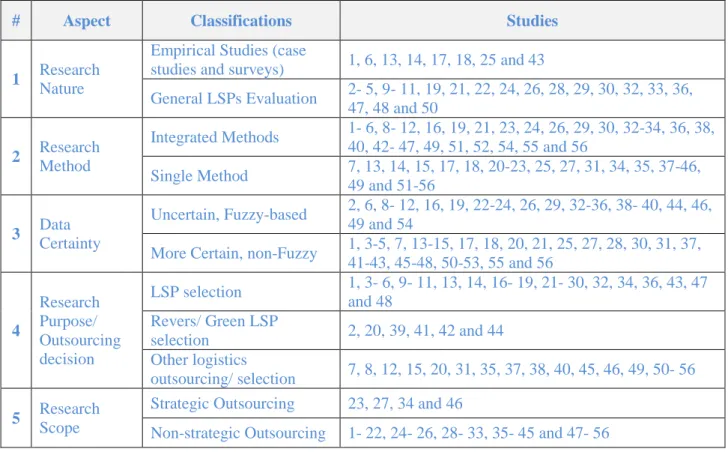
the Operational Research Society have the biggest number of articles. Year 2012 comes first with total number of published studies. It is expected to have more studies about this important issue in the coming years. In addition to the supplementary appendices, Table 1 summarizes the main aspects of the reviewed articles.
Table 1: Main Aspects of the Reviewed Articles
# Aspect Classifications Studies
1 Research Nature
Empirical Studies (case
studies and surveys) 1, 6, 13, 14, 17, 18, 25 and 43
General LSPs Evaluation 2- 5, 9- 11, 19, 21, 22, 24, 26, 28, 29, 30, 32, 33, 36, 47, 48 and 50 2 Research Method Integrated Methods 1- 6, 8- 12, 16, 19, 21, 23, 24, 26, 29, 30, 32-34, 36, 38, 40, 42- 47, 49, 51, 52, 54, 55 and 56 Single Method 7, 13, 14, 15, 17, 18, 20-23, 25, 27, 31, 34, 35, 37-46, 49 and 51-56 3 Data Certainty Uncertain, Fuzzy-based 2, 6, 8- 12, 16, 19, 22-24, 26, 29, 32-36, 38- 40, 44, 46, 49 and 54
More Certain, non-Fuzzy 1, 3-5, 7, 13-15, 17, 18, 20, 21, 25, 27, 28, 30, 31, 37, 41-43, 45-48, 50-53, 55 and 56 4 Research Purpose/ Outsourcing decision LSP selection 1, 3- 6, 9- 11, 13, 14, 16- 19, 21- 30, 32, 34, 36, 43, 47 and 48 Revers/ Green LSP selection 2, 20, 39, 41, 42 and 44 Other logistics outsourcing/ selection 7, 8, 12, 15, 20, 31, 35, 37, 38, 40, 45, 46, 49, 50- 56 5 Research Scope
Strategic Outsourcing 23, 27, 34 and 46
Non-strategic Outsourcing 1- 22, 24- 26, 28- 33, 35- 45 and 47- 56
Literature review findings and discussion
Based on the articles’ purposes, methods, criteria and other aspects, they could be classified into seven groups: LSPs evaluation and selection Case-study for specific firm, industry, or country, General LSP evaluation and selection, Integrated models for LSPs evaluation and selection, Strategic logistics outsourcing, Reverse LSPs (RLSPs) evaluation and selection, LSPs evaluation and selection decision under vagueness and Other logistic-based evaluation and selection decisions.
Evaluation & Selection methods: an analysis of these studies gives a clear picture about the current trends in logistics literature: 37 articles out of 56 used integrated models to solve
10
evaluation and selection problems. Twenty four studies out of the 37 studies integrated MCDM methods with Fuzzy sets in order to deal with data uncertainty problems. These integrations reflect the complexity and difficulties inherent with these kinds of decisions and the high levels of uncertainties that facing DMs.
Returning to Ho et al. (2010), DEA was the most used method among all the MCDM methods during 2003-2008. For the recent period of 2008-2013, however, this research shows that DEA was only used twice. The decreasing in frequency of use of DEA is probably due to the strong presence of other techniques such as FAHP, FANP, DEMATEL and TOPSIS. During the 2008-2013, AHP and ANP are the most used methods (33 studies). Some studies used AHP or ANP alone (Studies 7, 14, 18, 25, 28 and 41) and other studies integrated them with other methods such as DEA, ANN, QFD, DEMATEL and TOPSIS to overcome the interdependency and uncertainty aspects.
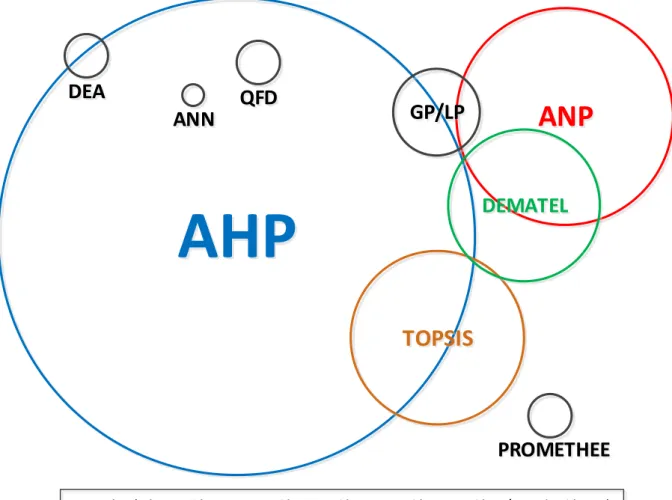
DEMATEL and TOPSIS represent a good mix to solve complex problems; especially if they are integrated with Fuzzy sets to reflect the different preferences of DMs under uncertainty and vagueness environments (Dalalah et al., 2011 and Baykasoğlu et al., 2013). The DEMATEL technique can represent DMs preferences and reflects the cause-effect relationships among evaluation criteria. This technique was used in the studies 40, 51, 52, 53, 54, 55 and 56. While TOPSIS is the highest ranking technique integrated with other MCDM methods to evaluate and select LSPs. TOPSIS was used with DEMATEL (study 54), with FAHP (studies 8, 9, 22, 26, 30, 34 and 47) and with ISM (study 44). Meanwhile, there was a limited presence of the PROMETHEE method (studies 6 and 24). Based on the number of studies that used these methods, Figure 1 summarizes the relative size of the most used methods and their integrations. The size of the circles represents how often these methods were used; meanwhile circles meets represent integrated methods.
11
AHP
TOPSIS
ANP
GP/LP
AHP: total 22 (9alone, 2with DEMATEL, 1with DEA, 5with TOPSIS, 2with QFD, 2 with GP/LP, and 1with ANN)
ANP: total 10 (6alone, 3withDEMATEL, and 1with GP/LP)
DEMATEL total 7; TOPSIS total 8; DEA total 2; QFD total 2, GP/LP total 4, PROMETHEE 2, and 1 ANN. 61% of the integrated methods use Fuzzy logic.
DEMATEL
DEA
ANN
QFD
PROMETHEE
Figure 1: Distribution of the most selection methods used in the 56 studies
Sustainability and Logistics: Sustainability is among the top global concerns and it has an increasing importance in logistics and SCM fields. The logistics industry includes different activities with different sustainable impacts, such as: transportation, inventory and warehousing, packaging, reverse logistics and waste management. According to Mao (2012), transportation has the biggest environmental impact. The number of logistics and SCM studies that use sustainability and environmental issues is increasing significantly and the call to integrate sustainability within a firm’s strategy has also increased. Fifteen studies out of the 56 studies reviewed and analyzed within this research used sustainability measures to evaluate and select the appropriate LSP (studies 1, 2, 5, 12, 16, 19, 21, 23, 32, 34, 35, 46, 50, 54 and 56). These measures cover different sustainability issues such as environmental safeguards (CO2 and waste
12
volume), social measures (social responsibility, health and safety and donations) and economics (best use of resource and resources productivity).
Evaluation & Selection criteria: Different evaluation and selection criteria have been used to evaluate and select the best LSP. Based on this literature review, Cost/price in addition to quality, flexibility and services are the most used ones. Appendix 5 summarizes the presence of the most used criteria in the 2008-2013 logistics studies.
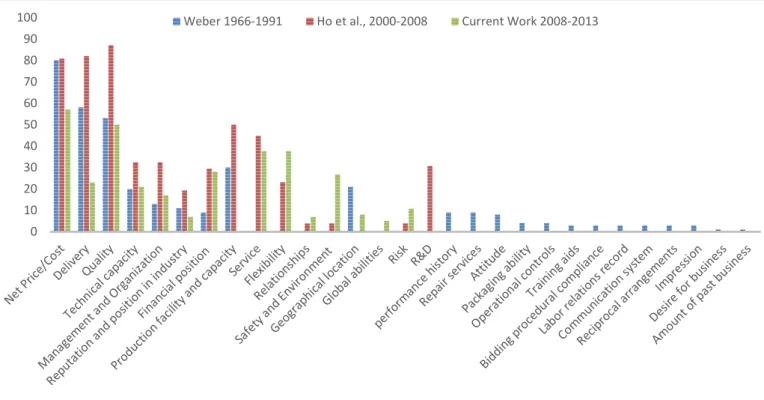
To identify any possible shift in the way LSPs are evaluated and selected, Appendix 6 and Figure 2 compare the evaluation and selection criteria during different periods. Due to the differences in the studies’ durations and/or the attractiveness of the logistics topic over these periods, there is a significant difference between the articles number in each period. Although these studies used different terminologies, the metrics chosen in these studies have been used to measure the same dimensions. For example: net price, price, cost, cost of service, etc., were used to evaluate the service cost dimension. In term of used criteria, there is a clear consensus about cost, quality, flexibility, services, financial measures, sustainability and delivery with a 76.83% accumulated percentage. Other criteria are representing different DMs’ preferences and points of views such as the IT, management & organization, risk, geographical location, reputation and status, relationships and global abilities factors with 23% accumulated percentage.
13
Figure 2: Comparative chart of the selection criteria percentage during different periods
These data are related to three independent literature review studies. So, they are not assumed to reflect a normal distribution. Therefore, to test the hypothesis of independence and to confirm the existence of significant difference the Kruskal-Wallis non-parametric test was applied. Kruskal-Wallis test compares the factors’ ranks among three or more independent groups. In this case there are 29 criteria, each criterion has three ranks (87 total ranks) (Appendix 6). For example, the ranks of Net price/cost are 84, 85 and 79 respectively. Based on the Chi-square table, with 28 degrees of freedom (df) and 0.05 Alpha, the decision rule for this case is (41.33). The Kruskal-Wallis value (H) could be calculated based on:
𝑯 =𝑵(𝑵+𝟏)𝟏𝟐 ∗ (∑𝑻𝒊𝟐
𝒏 ) − 𝟑(𝑵 + 𝟏), (Source: Corder and Foreman, 2009: pp.100) Where (N) is the total number of criteria (87), (n) is the number of values from the corresponding rank sum (3), (Ti) is the sum of the ranks from a particular group, (df = k-1) k is the number of groups (29). In this case, calculated H= 47.129 is greater than the decision rule (41.33), which confirm that, there is a significant difference among the three literature review studies in terms of the 29 criteria [H= 47.129 (28, N=87), p>0.05].
0 10 20 30 40 50 60 70 80 90
14
Literature review conclusions:
Based on the literature review’s analysis we can arrive at the following conclusions:
1- The work and contribution of the reviewed studies could be classified into seven groups: specific LSP case-study, general LSP evaluation and selection, integrated selection models for LSPs evaluation and selection, strategic logistics outsourcing, reverse LSPs, logistics-based decisions under vagueness and other logistics-logistics-based decisions.
2- There is increasing importance of the integrated models and fuzzy logic in evaluation and selection studies. Integrated models and evaluation and selection decisions under vagueness are the most explored areas, while strategic logistics outsourcing and reverse LSPs are the least explored ones.
3- On average, the number of logistics studies per year is increasing during the research periods. Meanwhile, the number of main evaluation criteria/dimensions is decreasing (see Appendix 6). Earlier studies have a large number of criteria with wide importance levels in a fragmented way, while later studies have a lower number of criteria with relatively close importance levels. This suggests that later studies were more balanced and used more relevant criteria than earlier studies. Some of the low-ranking criteria, -which appeared in less than 10% of the studied articles in Weber et al.’s study, have become some of the main
criteria used in the 2008-2013 period. For example, financial position, performance history, amount of past performance, operational control, communication systems, etc., are clustered into more holistic and balanced dimensions. Therefore, some of Dickson et al.’s 1966
criteria did not appear in the later literature with the same terminologies. This could be due to either that they are more relevant to the supplier selection than LSPs selection, or that they could be clustered into new dimensions, such as (i) Performance history, labor relations record and amount of past business could be clustered into the logistics performance dimension. (ii) Packaging abilities and production facilities could be clustered into the
15
logistics services dimension. (iii) Communication systems in addition to some of Weber et al.’s criteria such as R&D could be clustered into the logistics resources and capabilities
dimensions.
4- Cost, Quality, flexibility, services, financial measures, sustainability and Delivery represent 76.83% of the used criteria during the 2008-2013. The relative importance of these criteria is not the same during different periods. For example: Cost and Delivery were more important than Quality during the period of 1966 to 1990, while Quality became more important during the 1990s through to 2008. After 2008, Cost and Price returned to being the most important criteria, which could be explained by the economic situation in this period. Moreover, evaluation and selection criteria presented in Appendix 5 can be categorized into three main dimensions: Performance (financial, customer and operational), Resources (tangible and intangible) and Services.
5- Logistics outsourcing risk has not been used in the 1966-1991 studies, while it has been used in a limited manner in the 2000-2008 period. The importance of logistics outsourcing risk increased in the 2008-2013 studies (9, 23, 35, 46, 47 and 56). Currently, logistics risk (assessment and management) is an important research topic in the logistics literature (Tsai
et al., 2012) and it is expected to be one of the important issues in the logistics international
agenda.
6- In terms of selection methods, although AHP and ANP are the most used methods, but the DEMATEL and TOPSIS methods integrated with Fuzzy logics seems to be a good choice to evaluate, rank and select best LSPs. Their ability to analyse impact relationships among criteria, identifying independent factors and to evaluate and select the best LSP effectively and efficiently increase their potentials in the logistic-based decisions.
16
Current problems in the LSPs’ literature
The findings of this study clearly highlight a number of problems in the LSPs evaluation and selection literature. Most of current studies are empirical, not comparative nor comprehensive and weakly theoretical. A number of evaluation approaches are unbalanced. There are a large number of criteria and metrics that are presented in fragmented ways, making it difficult to identify the critical success factors (CSFs) among them. In addition, existing frameworks focus only on costs, financial and/or operational metrics. Moreover, there is an ignorance of logistics sustainability, logistics resources, logistics-outsourcing risks and logistics value-added services factors -this potentially affects the completeness of the evaluation process-. So far there is no analysis on the causal relationships of critical success factors and how they may affect each other’s. Finally, Current investigation of the strategic nature of the logistics outsourcing decision is inadequate.
Based on the previous findings, current studies have not yet provided an appropriate, holistic and balanced tool to evaluate and select LSPs. There is a crucial need for a well theoretical, comprehensive and balanced LSPs framework. This study contributes to solving this problem by proposing a new LSPs evaluation and selection framework. This framework aggregates the most relevant and critical factors that have been found fragmentally in different logistics studies. Based on the literature review conclusions, this framework covers the main three competitiveness dimensions: (i) logistics performance, (ii) logistics resources and capabilities and (iii) logistics services. Next section provides more details about this framework.
LSPs evaluation and selection framework
LSPs evaluation and selection is a very important process. By selecting the right LSP, logistics services, suppliers’ and customers’ values can be significantly improved (Mentzer et al., 2004; Mangan et al., 2012; Daim et al., 2013). Given the emergence of new selection/evaluation criteria and a lack of appropriate tools for selecting and evaluating LSPs as identified in the
17
above section, this section attempts to close this gap by proposing a new framework based on the idea that the appropriate LSP should have a superior competitive position through providing:
- Excellent performance records (operational, financial and non-financial metrics)
- Distinguished logistics resources and capabilities and
- A wide range of value-added logistics services
The aim of this framework is to provide the basis for new research to develop new logistics outsourcing decision-support tools (DSTs). The three main dimensions should provide more balanced evaluations and reduce the likelihood of selecting inappropriate LSPs. Therefore, it gives DMs the opportunity to be more confident about their logistics-based decisions. For each dimension, a well-known theory has been used to define the dimension’s factors, sub-factors and metrics. The following sections summarize the main factors, sub-factors and metrics that could be used under each dimension.
LSPs performance
Background: LSPs performance is a basic part of any evaluation and selection process. LSUs select LSPs based on their past performance records. A number of approaches have been used to measure and evaluate logistics performance as a part of the supply chain performance, such as Activity-Based Costing (ABC) (Wang and Li, 2013; Chen, 2012; and Walton, 1996) and Economic Value Analysis (EVA) (Sainz et al., 2013; Lin and Zhilin, 2008; and Liu and Lyons, 2011). These approaches were not initially designed for SCM or the logistics industry, being based heavily on financial metrics which are driven by historical data and thus present unbalanced approaches. In addition, there is a problem in deciding the number of measures/metrics to be used in performance measure tools. In certain cases, a few effective metrics may be better than a large number of complex measures (Papakiriakopoulos and Pramatari 2010; Forslund 2014). Another problem is related to the performance metrics at the
18
strategic, tactical and operational levels. Some studies provided performance metrics classifications that could be used for these three levels (Gunasekaran et al., 2001; Gunasekaran
et al., 2004; and Stadtler and Kilger 2008). The Balanced Scorecard (BSC) approach is
considered among the most commonly used approaches to manage and measure firms’ performance (Chen et al., 2011; Alvandi et al., 2012). BSC helps firms to achieve long-term objectives while keeping in mind the traditional financial measures.
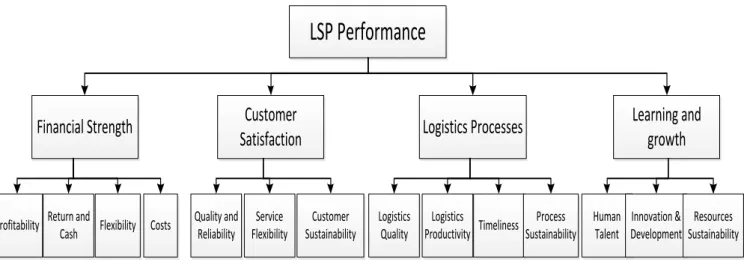
Current work: The review above shows that the selection of the best measures depends on the circumstances. This study does not aim to determine specific measures to be used by LSUs and LSPs under all situations. Instead it aims to assist logistics researchers and DMs to select measures that fit with their situations and match their preferences. To serve this purpose, sustainable balanced scorecard (SBSC) and logistics key performance indicators (LKPIs) have been used to develop the LSPs performance dimension. The new framework has been developed to link LSUs’ strategic objectives, evaluation and selection dimensions (SBSC perspectives) and the most used LKPIs in a hierarchical structure to facilitate the decision-making process. To do so, the BSC perspectives have been revisited to fit LSPs case, as follows:
Financial strength perspective: represents the financial performance levels (costs and revenues) that a LSP needs to provide to support the achievement of the customers’ strategic objectives. LKPIs are: Profitability, Return and cash, Costs and Flexibility.
Customer satisfaction perspective: represents the performance indicators that satisfy the LSPs’
customers. LKPIs are: Service quality and reliability, Service flexibility and Customer sustainability.
Logistics processes perspective: represents the internal performance indicators that support the strategic objectives for both LSPs and their customers. LKPIs are: Logistics quality, Logistics productivity, Timeliness and Process sustainability.
Learning and growth perspective: represents the sustainability, learning, growth and improvement indicators that support other BSC perspectives and help LSPs to achieve their
19
strategic objectives. LKPIs are: Human talent, Innovation and development and Resources sustainability.
Based on the level of the analysis and/or availability of the data, for each LKPI under each perspective, different performance measures could be used. Figure 3 summarizes the hierarchy of the LSPs performance.
LSP Performance
Customer
Satisfaction
Learning and
growth
Logistics Processes
Financial Strength
Profitability Return and
Cash Flexibility Costs
Quality and Reliability Service Flexibility Customer Sustainability Logistics Quality Logistics Productivity Timeliness Process Sustainability Human Talent Innovation & Development Resources Sustainability
Figure 3: LSPs performance dimension
LSPs resources and capabilities
Background: Distinguish logistics resources and capabilities are important core competences that support the LSPs competitiveness. According to Karia and Wong (2013), LSPs have to gain the right capabilities to transform their distinguish logistics resources into superior logistics performance levels. Historically, Mentzer et al. (2004) divided logistics resources into tangible and intangible resources. Logistics resources, either tangible or intangible must be managed in the right way to gain distinctive logistics capabilities, which in turn help to build and sustain strong logistics competitive advantages. Karia and Wong (2013) based on Mentzer
et al. (2004) and the resources-based view (RBV) theory to develop the resources-based
logistics (RBL) theory, which argues that logistics resources and capabilities are the determinants of the LSPs performance.
Current work: This study uses the general Mentzer et al.’s (2004) resource classification and
20
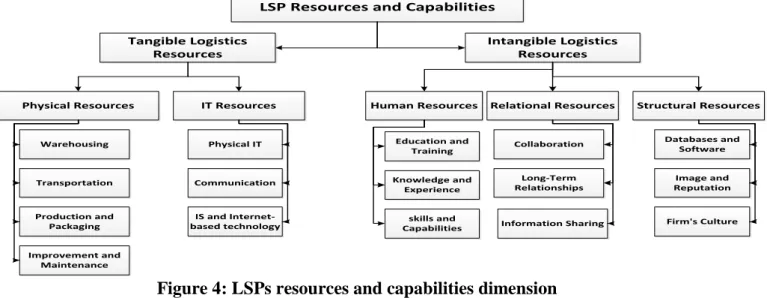
capabilities dimension in the LSPs evaluation and selection framework. This study bases on the RBL to structure the logistics resources dimensions. However, this study classifies physical logistics resources into four categorizes based on the logistics activities: Warehousing (storage area, handling equipment, cranes and winch, etc.); Transportation (trucks, trains, planes, ships, etc.); Production and packaging; and Improvements and maintenance of these resources. Interim of information technology (IT) resources, this study classifies IT resources into three categories: Physical IT resources, Communication tools and IS and internet-based technology. Moreover, this study uses the intellectual capital concept to classify intangible logistics resources and capabilities. Intellectual capital is the amount by which the market value of a LSP exceeds its tangible (physical and financial) assets less liabilities (Mehri et al., 2013). Normally, intellectual capital is classified into three main categories: human, structural and relational. Therefore, intangible logistics resources and capabilities sub-dimension consists of: Human Resources, Structural Resources and Relational Resources. Figure 4 clarifies the hierarchy of the tangible and intangible logistics resources. Different quantitative and qualitative measures could be used to evaluate each resources dimension.
LSP Resources and Capabilities
Tangible Logistics Resources
Intangible Logistics Resources
Physical Resources IT Resources Human Resources Relational Resources Structural Resources
Physical IT Communication IS and Internet-based technology Warehousing Transportation Production and Packaging Improvement and Maintenance Education and Training Knowledge and Experience skills and Capabilities Collaboration Long-Term Relationships Information Sharing Databases and Software Image and Reputation Firm's Culture
Figure 4: LSPs resources and capabilities dimension
LSPs services
Background: There is increasing demand for logistics services. Adding logistics services dimension to the LSPs evaluation and selection framework improves the evaluation quality. To
21
the best of our knowledge, this study is among the first studies that integrate the logistics services with logistics performance and logistics resources in one evaluation and selection framework. Historically, Hsiao et al. (2010) classified logistics services into four groups: inventory and logistics services, warehousing services, transportation services and customer services with large number of different logistics services and activities. Sink and Langley (1997) and Rajesh et al. (2011) classified them into: Inventory and Warehousing Services; Transportation Services; Production and Packaging Services; and Customer Services. Daim et al. (2013) and Mangan et al. (2012) presented long lists of fragmented logistics services/activities.
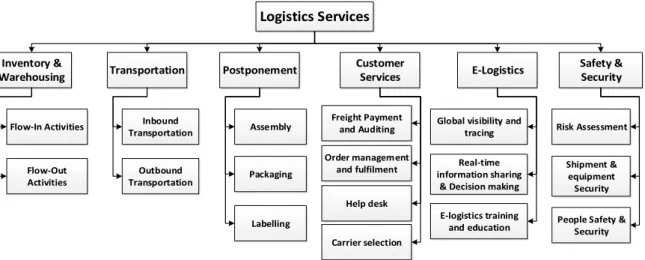
Current work: Previous classifications on the one hand underestimate the importance of electronic logistics services and logistics risks as main trends in today’s logistics industry and literature. On the other hand they used a large number of logistics services and activities in a defragmented way. This study contributes to solving this problem by using six main logistics services dimensions: inventory & warehousing, transportation, postponement, customer services, e-logistics services and Safety & security, as shown in Figure 5.
Logistics Services
Transportation Customer E-Logistics Services Inventory & Warehousing Postponement Flow-In Activities Flow-Out Activities Inbound Transportation Outbound Transportation Assembly Packaging Labelling Freight Payment and Auditing Order management and fulfilment Help desk Carrier selection
Global visibility and tracing
Real-time information sharing
& Decision making
E-logistics training and education Safety & Security Risk Assessment Shipment & equipment Security
People Safety & Security
Figure 5: LSPs services dimension
Integrating the three dimensions: The LSPs evaluation and selection process is multi-dimensional. This study is considered among the first studies that integrate the three
22
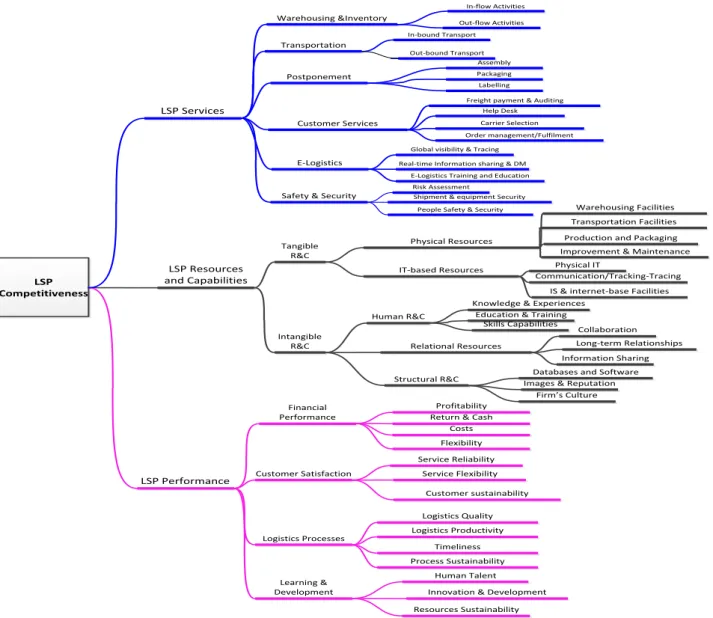
dimensions into one comprehensive framework. This integration enables managers and DMs to be more confident about their decisions and to reduce the risk of selecting inappropriate LSPs by providing more holistic and balanced evaluations. Integrating the performance, resources and services dimensions helps to identify crucial logistics information that could be used for different purposes. In addition to LSP evaluation/selection, these logistics information could be used in different logistics-based decisions and processes, such as: logistics performance management, logistics improvement and development and benchmarking. Figure 6 shows the overall hierarchy of the integrated framework.
LSP Competitiveness LSP Resources and Capabilities LSP Performance LSP Services Postponement Transportation Warehousing &Inventory Customer Services E-Logistics Intangible R&C Tangible R&C Financial Performance Customer Satisfaction Logistics Processes Learning & Development In-flow Activities Out-flow Activities Out-bound Transport In-bound Transport Packaging Labelling Assembly Help Desk Carrier Selection Order management/Fulfilment Freight payment & Auditing
Global visibility & Tracing Real-time Information sharing & DM
E-Logistics Training and Education
IT-based Resources Physical Resources Structural R&C Human R&C Relational Resources Warehousing Facilities Transportation Facilities Production and Packaging Improvement & Maintenance Physical IT
Communication/Tracking-Tracing IS & internet-base Facilities Education & Training
Knowledge & Experiences Skills Capabilities
Collaboration Long-term Relationships Information Sharing Databases and Software Images & Reputation
Firm’s Culture Return & Cash
Profitability Costs Flexibility Service Flexibility Customer sustainability Service Reliability Logistics Productivity Timeliness Process Sustainability Logistics Quality Human Talent Innovation & Development Resources Sustainability Safety & Security
Risk Assessment
Shipment & equipment Security People Safety & Security
23
Conclusions, suggestion applications and Future work
The selection of a suitable LSP for strategic purposes is not an easy decision and is associated with complexity and uncertainty. To identify any possible shift in the way LSPs are evaluated and selected, a comparative literature review was conducted. The review studied existing articles about LSPs evaluation and selection since 2008 and compared results with previous literature studies.
In terms of results, several problems in current LSPs literature have been identified. Literature review results reveal that the usage and importance of evaluation and selection criteria fluctuate during different periods. Review results show an increase in (a) the importance of some specific selection criteria (b) the importance of some specific selection methods and (c) the importance of integrated models and fuzzy logic in logistics literature. The results also identify the need for more research in specific logistics outsourcing areas. Based on the literature review findings, a new LSPs’ integrated framework has been developed.
In terms of applications, this framework highlights crucial dimensions that should be considered in any logistics-based decision and forms a base for future logistics research to develop new logistics decision-support tool (DST). The new DST can help in term of automation of calculation, dynamic criteria weights and real-team supply chain collaboration. In addition to the LSPs evaluation/selection, logistics DSTs could be used to provide on-going feedback about the LSP’s performance, resources and services. These feedbacks help the LSUs to evaluate, manage and benchmark their LSP partners.
In terms of future research, this study integrates the three main dimensions into one LSPs framework. More research is needed to evaluate and prioritize the relative importance of the framework elements, to analyze causal relationships and to determine suitable metrics to be used for each factor under each dimension. The MCDM methods, such as DEMATEL and DANP are good suggestions for the evaluation, causal relations and prioritization research. Different ranking models could be used to evaluate and rank LSPs such as TOPSIS and
24
VIKOR while case-studies based on real logistics data are reasonable choices to determine suitable metrics to be used in specific situations. Due to the difficulties in these complex decision-making processes and because of the subjective considerations relevant to this kind of decisions; fuzzy logic integrated with the MCDM methods is a helpful approach to collect experts’ opinions and judgments. Moreover, conducting a real cast study to test the new framework feasibility and effectiveness and to identify suitable measures to be used under each LKPIs are crucial research areas. Moreover, these cases can help to provide more empirical findings support the framework robustness.
Using the new LSPs framework in future research is expected to provide managers and DMs with crucial information about logistics outsourcing best practices. At the same time using the framework helps LSPs to have a better understanding about themselves (strengths and weaknesses) in order to improve their competitiveness.
Appendix A: Supplementary Data (Available upon request from the authors) Acknowledgments
The authors acknowledge the contribution of anonymous reviewers and thank them for their valuable comments and constructive suggestions to improve the manuscript. This study is supported by Yarmouk University.
References
1 Aguezzoul, A. (2014). “Third-party logistics problem: A literature review on criteria and methods”. Omega: International Journal of Management Science, 49, pp. 69-78.
2 Aguezzoul, A. (2012), “Overview on supplier selection of goods versus 3PL selection”. Journal of Logistics Management, 1 (3), pp. 18-23.
3 Aloini, D., Dulmin, R. and Mininno, V. (2010), “A hybrid fuzzy-PROMETHEE method for logistics service selection: Design of a decision support tool”. International Journal of Uncertainty, Fuzziness and Knowledge-Based Systems, (18), pp. 345-369.
4 Alvandi, M., Fazli, S., Yazdani, L. and Aghaee, M. (2012), “An integrated MCDM method in ranking BSC perspectives and key performance indicators (KPIs)”. Management Science Letters, 2, pp. 995-1004.
5 Amiri, M., Sadaghiyani, S., Payani, J. and Shafieezadeh, M. (2011), “Developing a DEMATEL method to prioritize distribution centers in supply chain”. Management Science Letters, 1 (3), pp. 279-288.
6 Banomyong, R. and Supatn, N. (2011), “Selecting logistics providers in Thailand: A shippers' perspective”.
25
7 Bansal, M., Karimi, I. A. and Srinivasan, R. (2008), “Selection of third-party service contractor for chemical logistics”. Industrial and Engineering Chemistry Research, 47 (21), pp. 8301-8316.
8 Barbarosoglu, M and Yazgac, T. (1997), “An application of the analytic hierarchy process to the supplier selection problem”. Production and Inventory Management Journal, First Quarter, pp. 14-21
9 Baykasoğlu, A., Kaplanoğlu, V., Durmuşoğlu, Z. D. U. and Şahin, C. (2013), “Integrating fuzzy DEMATEL and fuzzy hierarchical TOPSIS methods for truck selection”. Expert Systems with Applications, 40 (3), pp. 899-907.
10 Benayoun, R., Roy, B. and Sussman, N. (1966), "Manual de référence du programme Electre. Note De Synthese et Formaton, No. 25 », Direction Scientifique SEMA, Paris, France.
11 Benyoucef, L., Ding, H. and Xie, X. (2003), Supplier selection problem: selection criteria and methods. Institut National De Recherche En Informatique Et Automatique (INRIA) Lorraine, ISSN 0249-6399.
12 Bhatti, R. S., Kumar, P. and Kumar, D. (2010), “Analytical modeling of third party service provider selection in lead logistics provider environments”. Journal of Modelling in Management, 5 (3), pp. 275-286.
13 Boer, L.D, Labro, E. and Morlacchi, P. (2001), “A review of methods supporting supplier selection”. European Journal of Purchasing & Supply Chain Management, 7 (2), pp. 75-89.
14 Boyson, S., Corsi, T., Dresner, M. and Rabinovich, E. (1999), “Managing effective third party logistics partnership: What does it take?”. Journal of Business Logistics, 20 (1), pp. 73-100.
15 Brans, J. P. (1982), “L'ingénièrie de la décision; Elaboration d'instruments d'aide à la décision. La méthode PROMETHEE “. In R. Nadeau and M. Landry, editors, L'aide à la décision: Nature, Instruments et Perspectives d'Avenir, pp. 183-213.
16 Brans, J. P., Mareschal, B., Vincke, Ph. (1984), “PROMETHEE: a new family of outranking methods in multi criteria analysis2. Operational Research IFORS, pp. 477-490.
17 Brans, J.P. and Ph. Vincke. (1985). “A preference ranking organization method (The PROMETHEE method for MCDM)”. Management Science 31 (6), pp. 647–56.
18 Büyüközkan, G., Feyzioğlu, O. and Nebol, E. (2008), “Selection of the strategic alliance partner in logistics value chain”. International Journal of Production Economics, 113 (1), pp. 148-158.
19 Büyüközkan, G., Feyzioğlu, O. and Şakir Ersoy, M. (2009), “Evaluation of 4PL operating models: A decision making approach based on 2-additive Choquet integral”. International Journal of Production Economics, 121 (1), pp. 112-120.
20 Chang, A.-Y. (2011), “Analysing critical factors of introducing RFID into an enterprise: An application of AHP and DEMATEL method”. International Journal of Industrial Engineering: Theory, Applications and Practice, 18 (7), pp. 323-334.
21 Chang, B., Chang, C.-W. and Wu, C.-H. (2011), “Fuzzy DEMATEL method for developing supplier selection criteria”.
Expert Systems with Applications, 38 (3), pp. 1850-1858.
22 Chang, Y.-T., Lee, S.-Y. and Tongzon, J. L. (2008), “Port selection factors by shipping lines: Different perspectives between trunk liners and feeder service providers”. Marine Policy, 32 (6), pp. 877-885.
23 Chen, K.-Y. and Wu, W.-T. (2011), “Applying analytic network process in logistics service provider selection - A case study of the industry investing in Southeast Asia”. International Journal of Electronic Business Management, 9 (1), pp. 24-36.
24 Chen, S. G. (2012), “Fuzzy-scorecard based logistics management in robust SCM”. Computer & Industrial Engineering, 62, pp. 740-745.
25 Chen, S.J. and Hwang, C. L. (1992), Fuzzy multiple attribute decision making-methods and applications. New York: Springer-Verlag.
26 Chen, Y. M., Goan, M-J. and Huang, P-N. (2011), “Selection process in logistics outsourcing - A view from third party logistics provider”. Production Planning and Control, 22 (3), pp. 308-324.
27 Cheng, Y.-H. and Lee, F. (2010), “Outsourcing reverse logistics of high-tech manufacturing firms by using a systematic decision-making approach: TFT-LCD sector in Taiwan”. Industrial Marketing Management, 39 (7), pp. 1111-1119.
28 Ciravegna, L., Romano, P. and Pilkington, A. (2013), “Outsourcing practices in automotive supply networks: An exploratory study of full service vehicle suppliers”. International Journal of Production Research, (51), pp. 2478-2490.
29 Cooper, O., Tadikamalla, P. and Shang, J. (2012), “Selection of a third-party logistics provider: Capturing the interaction and influence of performance metrics with the analytical network process”. Journal of Multi-Criteria Decision Analysis, 19 (3-4), pp. 115-128.
30 Corder, G. w. and Foreman, D. I. (2009), Nonparametric statistics for non-statisticians: A step-by-step approach. Wiley & Sons, New Jersey-USA and Canada.
31 Daim, T. U., Udbye, A. and Balasubramanian, A. (2013), “Use of analytic hierarchy process (AHP) for selection of 3PL providers”. Journal of Manufacturing Technology Management, 24 (1), pp. 28-51.
26
32 Dalalah, D., Yayajneh, M. and Batieha, F. (2011), “A fuzzy multi-criteria decision making model for supplier selection”. Expert Systems with Applications, 38, pp. 8384-8391.
33 Degraeve, Z., Labro, E. and Roodhooft, F. (2000), “An evaluation of vendor selection models from a total cost of ownership perspective”. European Journal of Operational Research. 125 (1), pp. 34-58.
34 Dickson, G.W. (1966), “An analysis of vendor selection systems and decisions”. Journal of Purchasing, 2 (1), pp. 5-17.
35 Dubey, P. K. and Shah, J. (2010), “Moving up the value chain: Impact of strategic attributes and value added services on logistics service provider in India”. International Journal of Business Information Technology, 3 (2), pp. 79-91.
36 Efendigil, T., Önüt, S. and Kongar, E. (2008), “A holistic approach for selecting a third-party reverse logistics provider in the presence of vagueness”. Computers and Industrial Engineering, 54 (2), pp. 269-287.
37 Fachao, L., Ling, L., Chenxia, J., Ruijiang, W., Hong, W. and Lili, Y. (2012), “A 3PL supplier selection model based on fuzzy sets”. Computers and Operations Research, 39 (8), pp. 1879-1884.
38 Falsini, D., Fondi, F. and Schiraldi, M. M. (2012), “A logistics provider evaluation and selection methodology based on AHP, DEA and linear programming integration”. International Journal of Production Research, 50 (17), pp. 4822-4829.
39 Forslund, H. (2010), “Exploring logistics performance management in supplier/retailer dyads”. International Journal of Retail and Distribution Management, 42(3), pp. 205-218.
40 Gabus, A. and Fontela, E. (1973), Perceptions of the world problematique: Communication procedure, communicating with those bearing collective responsibility (DEMATEL report No.1), Battelle Genevea Research Center, Geneva, Switzerland.
41 Gadde, L.-E. and Hulthén, K. (2009), “Improving logistics outsourcing through increasing buyer–provider interaction”. Industrial Marketing Management, 38 (6), pp. 633-640.
42 Gotzamani, K., Longinidis, P. and Vouzas, F. (2010), “The logistics services outsourcing dilemma: Quality management and financial performance perspectives”. Supply Chain Management: An International Journal, 15 (6), pp. 438-453.
43 Govindan, K. and Murugesan, P. (2011), “Selection of third-party reverse logistics provider using fuzzy extent analysis”. Benchmarking: An International Journal, 18 (1), pp. 149-167.
44 Govindan, K., Palaniappan, M., Zhu, Q. and Kannan, D. (2012), “Analysis of third party reverse logistics provider using interpretive structural modelling”. International Journal of Production Economics, 140 (1), pp. 204-211. 45 Gunasekaran, A. (2004), “Supply chain management: Theory and applications”. European Journal of Operational
Research, 159, pp. 265-268.
46 Gunasekaran, A., Patel, C. and Tirtiroglu E. (2001), “Performance measures and metrics in a supply chain environment”. International Journal of Operations & Production Management, 21(1-2), pp. 71 – 87.
47 Guoyi, X. and Xiaohua, C. (2012), “The third party logistics supplier selection and evaluation”. Journal of Software, 7 (8), pp. 1783-1790.
48 Hammond, J., Keeney, R., Raiffa, H. (1998). “Even swaps: A rational method for making trade-offs2. Harvard Business Review, 76 (2), pp. 137-152.
49 Ho, W., He, T., Lee, C. K. M. and Emrouznejad, A. (2012), “Strategic logistics outsourcing: An integrated QFD and fuzzy AHP approach”. Expert Systems with Applications, 39 (12), pp. 10841-10850.
50 Ho, W., Xu, X. and Dey, P. K. (2010), “Multi-criteria decision making approaches for supplier evaluation and selection: A literature review”. European Journal of Operational Research, 202 (1), pp. 16-24.
51 Hsiao H.I., van der Vorst J.G.A.J., Kemp R.G.M, (Onno) Omta S.W.F. (2010), “Developing a decision-making framework for levels of logistics outsourcing in food supply chain networks”. International Journal of Physical Distribution & Logistics Management, 40 (5), pp. 395–414.
52 Hsu, C. H., Wang, F.-K. and Tzeng, G.-H. (2012), “The best vendor selection for conducting the recycled material based on a hybrid MCDM model combining DANP with VIKOR”. Resources, Conservation and Recycling, 66, pp. 95-111.
53 Huang, H. C. (2009). “Designing a knowledge-based system for strategic planning: A balanced scorecard perspective”. Expert Systems with Applications, 36, pp. 209–218.
54 Huang, H. C., Lai, M.C. and Lin, L. H. (2011), “Developing strategic measurement and improvement for the biopharmaceutical firm: Using the BSC hierarchy”. Expert Systems with Applications, 38 (5), pp. 4875-4881. 55 Hwang, C.L., Yoon, K. (1981), Multi attribute decision making. Springer, New York.
56 Jassbi, J., Mohamadnejad, F. and Nasrollahzadeh, H. (2011), “A Fuzzy DEMATEL framework for modeling cause and effect relationships of strategy map”. Expert systems with applications, 38 (5), 5967-5973
57 Kabir, G. (2012), “Third party logistics service provider selection using fuzzy AHP and TOPSIS method”.
27
58 Kahraman, C. (2008), Fuzzy multi-criteria decision-making: Theory and applications with recent developments. Springer Science + Business Media, NY-USA.
59 Kannan, G., Murugesan, P. and Haq, A. N. (2009a), “3PRLP's selection using an integrated analytic hierarchy process and linear programming”. International Journal of Services Technology and Management, 12 (1), pp. 61-80.
60 Kannan, G., Pokharel, S. and Sasi Kumar, P. (2009b), “A hybrid approach using ISM and fuzzy TOPSIS for the selection of reverse logistics provider”. Resources, Conservation and Recycling, 54, pp. 28-36.
61 Karia, N. and Wong, C.Y. (2013), “The impact of logistics resources on the performance of Malaysian logistics service providers”. The Management of Perations24, (7), pp. 589-606. DOI: 10.1080/09537287.2012.659871. 62 Kasture, S., Qureshi, M., Kumar, P. and Gupta, I. (2008), “FAHP sensitivity analysis for selection of third party
logistics (3PL) service providers”. The ICFAI University Press. Journal of Supply Chain Management, 5 (4), pp. 41-60.
63 Kuan, M.-J., Tzeng, G.H. and Hsiang, C.C. (2012), “Exploring the quality assessment system for new product development process by combining DANP with MCDM model”. International Journal of Innovative Computing, Information and Control (Special issue), 8 (8), pp. 5745-5762
64 Kumar, R., Singh, H. and Dureja, J. S. (2012), “An approach to analyse logistic outsourcing problem in medium-scale organization by CFPR and VIKOR”. Journal of Manufacturing Technology Management, 23 (7), pp. 885-898. 65 Capgemini (2015), “2015 Third-party logistics study: The state of logistics outsourcing, results and findings of the
19th annual study”. Retrieved from [Available Online]
66 Lapide, L. (2000), “What about measuring supply chain performance. Achieving Supply Chain Excellence through Technology”. San Francisco, CA: Montgomery Research, pp. 287-297.
67 Larbani, M., Huang, C. Y. and Tzeng, G. H. (2011), “A novel method for fuzzy measure identification”.
International Journal of Fuzzy Systems 13 (1), pp. 24-34.
68 Li, F., Li, L., Jin, C., Wang, R., Wang, H. and Yang, L. (2012), “A 3PL supplier selection model based on fuzzy sets”.
Computers and Operations Research, 39 (8), pp. 1879-1884.
69 Lin, C. and Zhilin, Q. (2008), “Empirical study of integrated EVA performance measurement in China”. Canadian Social Science, 4(2), pp. 41-48.
70 Liou, J. J. H. and Tzeng, G.-H. (2012), “Comments on “Multiple criteria decision making (MCDM) methods in economics: An overview”. Technological and Economic Development of Economy, 18 (4), pp. 672-695.
71 Liou, J. J. H., Wang, H. S., Hsu, C. C. and Yin, S. L. (2011), “A hybrid model for selection of an outsourcing provider”. Applied Mathematical Modelling, 35 (10), pp. 5121-5133.
72 Liu, C. H., Tzeng, G. H. and Lee, M. H. (2012), “Improving tourism policy implementation-the use of hybrid MCDM models”. Tourism Management, 33 (2), pp. 239-488.
73 Liu, C.-L. and Lyons, A.C. (2011), “An analysis of third-party logistics performance and service provision”.
Transportation Research Part E: Logistics and Transportation Review, 47 (4), pp. 547-570.
74 Liu, H.-T. and Wang, W.-K. (2009), “An integrated fuzzy approach for provider evaluation and selection in third-party logistics”. Expert Systems with Applications, 36 (3), pp. 4387-4398.
75 Lucien Duckstein and Serafim Opricovic (1980), “Multiobjective optimization in river basin development”. Water Resources Research, 16 (1), pp. 14-20.
76 Mangan, J., Lalwani, C., Butcher, T. and Javadpour, R. (2012), Global logistics and supply chain management. Wiltshire-Great Britain, Antony Rowe.
77 Mao, J. (2012), Sustainable development for the logistics industry in the UK. PhD, University of Westminster. 78 Mehri, M., Umar, M.S., Saeidi, P., Hekmat, P.K. and Naslmosavi, S.H. (2013), “Intellectual capital and firm
performance of high intangible intensive industry: Malaysia evidence”. Asian Social Science, 9 (9), pp. 146-155. 79 Mentzer, J. T., Min, S. and Bobbitt, L. M. (2004), “Toward a unified theory of logistics”. International Journal of
Physical Distribution and Logistics Management, 34 (8), pp. 606-627.
80 Najmi, A. and Makui, A. (2010), “Providing hierarchical approach for measuring supply chain performance using AHP and DEMATEL methodologies”. International Journal of Industrial Engineering Computations, 1 (2), pp. 199-212.
81 Onut, S., Tuzkaya, U. R. and Torun, E. (2011), “Selecting container port via a fuzzy ANP-based approach: A case study in the Marmara Region, Turkey”. Transport Policy, 18 (1), pp. 182-193.
82 Papakiriakopoulos, D. and Pramatari, K. (2010), “Collaborative performance measurement in supply chain”.
Industrial Management and Data Systems, 110(9), pp. 1297-1318.
83 Perçin, S. (2009), “Evaluation of third-party logistics (3PL) providers by using a two-phase AHP and TOPSIS methodology”. Benchmarking: An International Journal, 16 (5), pp. 588-604.