*Email: [email protected]
Peer reviewed under reponsibility of Universitas Muhammadiyah Sidoarjo.
© Authors, All right reserved, This is an open access article under the CC BY license (http://creativecommons.org/licenses/by/4.0/)
67 Original Research Article
The Unique Characteristic of Teacher Development in Mu’adalah
Pesantren of East Java
Imron Fauzi1*
1 Institut Agama Islam Negeri (IAIN) Jember, Indonesia
Article history: Received 9 September 2019; Accepted 20 September 2019; Published 30 October 2019
ABSTRACT
The community needs, the demands for policy, the education system in pesantren have undergone many changes over time. However, it was a fact that the community has acknowledged the quality of pesantren graduates. The underlying assumption for this was that pesantren graduates had proven sufficient quality because qualified teachers educated them. This article examined Teacher Development in Islamic boarding schools (pesantren), including the model of Teacher Development implementation, the barriers, and their impacts. This study applied a phenomenological approach. This study used a qualitative method by applying the Multi-Site Study at Al-Amien Islamic Boarding School Sumenep, Sidogiri Pasuruan Islamic Boarding School, and Baitul Arqom Islamic Boarding School of Jember, East Java. This study found that the focus of Teacher Development in Islamic boarding schools was unique and more effective than that of the theory of formal teacher development management and legal education institutions, which tended to underlined the administrative, bureaucratic, and formalistic aspects. The implementation of the management in mu’adalah pesantren was started from planning, recruitment, and selection stages, development, and coaching comprehensively covered by spiritual and substantial elements.
Keywords: Teacher Development, Management, Mu’adalah Pesantren
HOW TO CITE: Fauzi, Imron. (2019). “The Unique Characteristic of Teacher Development in Mu’adalah Pesantren of East Java”, Madrosatuna: Journal of Islamic Elementary School, Vol. 3 (2). 67 - 81. doi: 10.21070/madrosatuna.v3i2.2668
INTRODUCTION
The issuance of Minister of Religious Affairs (PMA) Regulation No. 18 of 2014 concerning mu'adalah education unit in Islamic Boarding Schools indicated the government's acknowledgment of Islamic boarding school education graduates. However, the pesantren has currently dealt with a new problem: its readiness to be an alternative and competitive Islamic education in Indonesia to the existing formal education institutions. The involvement of the government certainly should be supported by the willingness of the pesantren to improve their management and innovation of education per the regulations and governance of education regulated by the government.
It is undeniable that the quality of mu'adalah pesantren graduates has been recognized by the community, and even a number of educational institutions abroad have given the same
68
recognition to a number of mu'adalah pesantren graduates (Yusuf, 2009). Therefore, by paying attention to Law Number 20 Year 2003 concerning the National Education System, Government Regulation No. 32 of 2013 (in lieu of Government Regulation No. 19 of 2005) concerning National Education Standards, Government Regulation No. 55 of 2007 concerning Religious Education and Religious Education, and PMA No. 13 of 2014 concerning Islamic Religious Education, the government began to recognize (mu'adalah) pesantren which is equivalent to Madrasah Aliyah / High School through PMA No. 18 of 2014. Therefore, many boarding school graduates are also legally recognized and can continue their studies at several public and private universities, both domestic and abroad.
The quality of mu’adalah pesantren alumni was not only limited to the acquisition of learning achievements through numerical values obtained through class ranking but also their output could be beneficial for the community based on their qualification as scholars or Islamic preachers. There were a number of Islamic boarding school graduates who were continuing their education to the doctorate level. Meanwhile, some of them have become lecturers, teachers, writers, and similar professions. Further, some of them played their role in the community as the head of the region.
Thus, some of the indicators have indicated that mu’adalah graduates had proven to possess qualified competence as they have been received in well-known universities, comprehensive understanding of the religious sciences, and being able to serve and practice their knowledge in the community. The basic assumption for this was that their qualification has resulted from their qualified teachers. The teacher was the most decisive component of the quality of learning because in the hands of the teacher, the curriculum, facilities, and infrastructure, as well as the learning climate, become meaningful for students and santri (Mulyasa, 2007). Therefore, qualified teachers were needed because their role in the intellectual, emotional and spiritual development of the santri was very fundamental (Hamond and Bransford, 2006). So, teacher competence was a major component of the success of education in mu’adalah pesantren.
As part of the SNP (Government Regulation No. 19 of 2005), the role of the teacher occupies an essential position in educational institutions as expressed in some words such as the man behind the gun; the right person is in the right place. The available resources are useless if unprofessional and non-binding Government Regulations manage them. Therefore, plans to
69 identify human resource needs, to select, manage, build, and develop teacher competencies must be taken seriously to produce effective and competitive teachers (Khusnuridlo, 2013).
If the potential and uniqueness of mu’adalah pesantren were well managed, it can produce qualified outputs and outcomes. Teacher competence development was formulated in the initial patterns of objective, transparent, and accountable recruitment and selection. The development and empowerment of teachers in mu’adalah pesantren must also consider the principle governed by Islamic Boarding School: sincerity, simplicity, ukhuwah Islamiyah, independence, and freedom (Tolkhah and Barizi, 2004).
Teacher development is one of the functions of Human Resource Management (HRM). Rebore (2004) states, “the goals of human resources are to hire, retain, develop, and motivate personnel to achieve the objectives of the school district, to assist individual members of the staff in reaching the highest possible levels of achievement and in maximizing the career development of personnel. These goals must be implemented through the following of the human resources function: recruitment, selection, placement, staff development, evaluation, and compensation of personnel.”
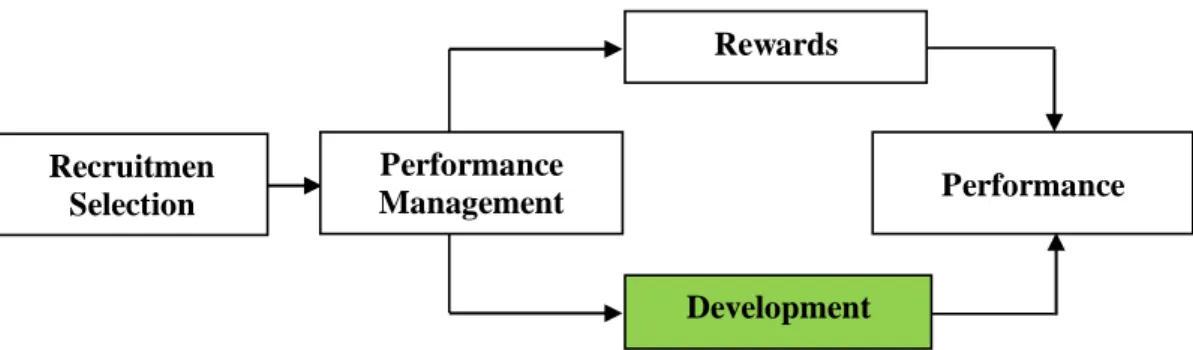
The Michigan School made one of the first explicit statements of the HRM concept. They argued that the HR system and organizational structure must be managed in ways that were by the organization's strategy. The HRM cycle consisted of four generic processes or functions performed in an organization: (1) recruitment and selection (matching the available human resources for a job); (2) appraisal (performance management); (3) rewards (appreciation for the achievement of the short and long term); and (4) development (quality development of employees or employees).
Figure 1. The Human Resource Cycle, Michigan Model (Armstrong, 2006)
Rewards Performance Performance Management Development Recruitmen Selection
70
Thus, it could be concluded that teacher resource management was defined as the overall management process for educators so that they could have competencies and qualifications that were by their professional work demands. Management of teacher resources was an activity that must be carried out, starting from the teacher’s enrollment to his quit. These activities included the process of human resource planning, recruitment, selection, training and development, compensation, work appraisal, and termination of employment (Flippo’s, 1984; Dessler, 1997; Simamora, 1999; Mangkunegara, 2002; Gomes, 2003; Rebore, 2004; Handoko, 2008; Sofyandi, 2009; Sadili, 2010; and Khusnuridlo, 2013).
Specifically, Rebore (2004) argues, “a staff development program for instructional staff focus on updating subject area skills and knowledge to improve instruction; outlining societal demands and changes; presenting the findings of research on teaching methods and practices, and updating teachers on the advances in instructional materials and equipment. In assessing the needs of teachers, four sources of information may be helpful: (1) the teacher needs assessment survey; (2) community surveys; (3) certification information coupled with the human resources master plan; and (4) research and curricular studies.”
Depend on the researcher's opinion, the teacher development in this research refers to a unique program that is designed and implemented by mu'adalah pesantren committee. This program aims to help teachers in improving their competencies, including pedagogic, professional, personal, and social competencies. The various activities carried out by mu'adalah pesantren committee can be in the form of coaching, training, and education, job rotation, delegation, and counseling. The steps in developing this program conduct three stages: the assessment, the development, and the development evaluation stage.
Teacher management was a term often used in the corporate context. However, it would be referred to as the management of teacher resources in the context of this educational institution. It concerned with the development process based on the management function of the teacher. Furthermore, western and Islamic management was different. Western management was commonly applied to manage the company to optimize resources and generate maximum profits. It was intended to meet the physical needs of workers without considering their spiritual needs. Neglecting this spiritual aspect could make workers depressed because they were always
71 forced to meet the determined target. The ignorance of this spirituality frequently led to irresponsible disrupting the operations of the company (Ansari, 2016).
This teacher management aimed to facilitate the actualization and competence development of the teachers through development and empowerment programs intended to improve their competence, quality, capacity, and commitment. Therefore, the institution had the power not only to survive but also to become productive and competitive. Thus, an adaptable and self-capable educational institution could be realized in responding to global demands (Khusnuridlo, 2013).
The pesantren chosen as the object of this study were three Islamic boarding schools in East Java which were quite representative and had their peculiarities in their management of teacher resources: Al-Amien Islamic Boarding School Prenduan Sumenep, Islamic Boarding School Sidogiri Pasuruan, and Baitul Arqom Islamic Boarding School Balung.
However, the government's recognition of the existence of this Islamic boarding school in Indonesia's national education system still has various problems such as the lack of competency standards and teacher qualifications, as well as the lack of technical guidance in the recruitment system, competency development, and providing pocket money. It is clear that teacher standardization policies always favor informal teachers, for example, Government Regulation No. 32 of 2013 (replacing Government Regulation No. 19 of 2005) concerning National Education Standards, especially in Articles 28-32 concerning Standards for teachers. Educators and Educational Personnel; Government Regulation No. 19 of 2017 (replacing PP No. 74 of 2008) concerning Teachers; Minister of National Education Regulation No. 16 of 2007 concerning Teacher Qualifications and Competencies; and Minister of Education and Culture Regulation No. 46 of 2016 concerning Teacher Linearity. All of these policies do not mention the competency standards of teachers who teach in pesantren.
Teacher competence in mu’adalah pesantren has been proven to have more distinctiveness and superiority than in other formal institutions because the indicators for the professional teachers in those two institutions were quite different. The professional teachers in Islamic boarding schools were oriented towards teaching commitment and understanding of material substantially, while in other formal institutions they were more oriented to fulfill legal government regulation demands. Also, the teacher's professional competence in mu’adalah pesantren was determined by the degree of mastery and understanding in reading the kitab kuning, while it was more administrative informal institutions: mastery in preparing the Annual
72
Program, Semester Program, RPP, Syllabus, material development, to exam question analysis. Thus, it was a necessity to standardize teacher competencies in Islamic boarding schools, to maintain the distinctiveness of mu’adalah pesantren and to avoid misunderstandings about the certification award and provision of teacher benefits (PMA No. 18 of 2014).
The research conducted by the Center for Research and Development and the Indonesian Ministry of Religious Research and Development in 2016 on the aspects of education in mu’adalah pesantren also found that Islamic religious educators have actually fulfilled their competencies. Still, they were graduated from various kinds and levels of educational institutions such as pesantren, high school/Madrasah Aliyah, and college. Educators of general subjects were still not fulfilled, both from the aspect of competence and qualifications, such as the teacher of mismatch. They had not yet obtained the same rights to get teacher certification, improvement of education and training, teacher distribution programs through scholarship programs for teachers, and NUPTK has not, however, been made such as teachers in general. Therefore, this article analyzed and perfected the existing formal teacher development to create mu’adalah pesantren's model. The pesantren model of the teacher resource management was able to produce professional teachers so that they could produce output and outcomes of qualified alumni since the basic purpose of applying the management of teacher resources was to obtain, maintain, and develop professional, trustworthy, and highly motivated educators outlined by the organization (Sedarmayanti, 2013). Thus, the teacher, as a central point in improving the quality of education, could be realized. The position of teachers in Islamic boarding schools, both salafiyah, and khalafiyah, was urgent because the learning process depended on them. So, this article was intended to study it under the title of "The Unique Characteristic of Teacher Development in Mu’adalah Pesantren of East Java."
METHODS
This study uses a qualitative method. Qualitative research is conducted to understand phenomena to meanings that occur in the object of research. The author chose three Islamic boarding schools that have implemented educator resource management that is unique compared to other institutions.
73 he locations of the research are: (1) Tarbiyatul Mu'allimien al-Islamiyah (TMI) Al-Amien Sumenep, because the representative as the mu’adalah pesantren is ashriyah and includes the first in East Java besides the Gontor pesantren; (2) Madrasah Miftahul Ulum (MMU) Sidogiri pesantren Pasuruan, because as a mu’adalah pesantren is characterized by salafiyah in East Java and it was unique compared to other pesantren; (3) Madrasatul Mu'allimin (MMI) Baitul Arqom Pesantren as a mu’adalah pesantren is characterized by khalafiyah in Jember, East Java.
Data analysis uses three concurrent flows of activity: (1) data condensation, (2) data display, and (3) conclusion drawing/verification (Miles, 2014). Data condensation is not something separate from analysis. It is a part of analysis. The researcher’s decisions, which data chunks to code and which to pull out, which category labels best summarize a number of chunks, which evolving story to tell, are all analytic choices. Data condensation is a form of analysis that sharpens, sorts, focuses, discards, and organizes data in such a way that final conclusions can be drawn and verified. As with data condensation, the creation and use of displays is not separate from analysis. Designing displays, deciding on the rows and columns of a matrix for qualitative data and deciding which data, in which form, should be entered in the cells. The coding of data, leads to new ideas on what should go into a matrix. Entering the data requires further data condensation. As the matrix fills up, preliminary conclusions are drawn, but they lead to the decision, for example, to add another column to the matrix to test the conclusion.
FINDINGS AND DISCUSSION
Historically, the pesantren mu'adalah was originally pioneered by the recognition of the Director-General of the Development of Islamic Religion, which is stated in government regulation No. E. IV / PP.032 / KEP / 64 and 80/98 dated 9 December 1998 were given to Pondok Modern Gontor Ponorogo and Pondok Pesantren Al-Amien Prenduan Sumenep. The implication of this recognition is that over three years (starting from 1998-2000), these two institutions were permitted to hold a final exam equivalent to the National Examination (UN), which is referred to as the Extranie Exam. This recognition was continued by Minister of Education Decree No. 105 and 106/0/2000 dated 29 June 2000. Furthermore, in 2005, based on decision No. 2282 / C.C4 / MN / 2005 dated May 3, 2005, 17 Islamic boarding schools have obtained the same status. Some pesantren, both modern and salaf, have run mu'adalah programs in 48 pesantren in Indonesia (Bukhory, 2011).
74
In general, the type of educational unit in mu’adalah pesantren was composed of salafiyah and mu'allimin. Salafiyah education unit was based on Kitab Kuning. Meanwhile, the mu'allimin unit was based on dirasah Islamiyah by apllying mu’allimin educational patterns. The institutional names for mu’adalah education unit could be listed like: Salafiyah Madrasah, Mu'allimin Madrasah, Kulliyat Mu'allimin Islamiyah (KMI), Tarbiyat Mu'allimin Islamiyah (TMI), Madrasah Mu 'allimin Islamiyah (MMI), Madrasah Tarbiyah al-Islamiyah (MTI), or other names proposed by the proposing institution and determined by the Ministry of Religious Affairs of the Republic of Indonesia (Bukhory, 2011).
Tarbiyatul Mu'allimien al-Islamiyah (TMI) Al-Amien Prenduan Sumenep, Madura, was chosen as the object of this study because it was representative to represent 'modern' mu’adalah pesantren and it was the first mu’adalah institution in East Java (in addition to the Gontor Modern Islamic Boarding School), and it had a distinctive characteristic in managing their teaching staff, namely developing teacher competencies in a continuous and integrative manner to master their respective fields of study through special guidance carried out by the 'master teachers' in Master Teacher Coordinator division (KGM). The task of the master teacher was to streamline the daily learning process, foster teachers in the fields of education, curriculum development, control and evaluate the learning process carried out by the teacher (http://al-amien.ac.id/).
Madrasah Miftahul Ulum (MMU) Sidogiri Pasuruan, East Java, proposed some conditions for its initial acceptance of status as mua’adalah that they would not change their pesantren educational system. Even though it was salafic, the teachers at this institution were obliged to master English, Arabic, or computer skills. Even various types of courses were provided to train the skills of the teachers and santri so that they would not be technologically illiterate.
Meanwhile, Baitul Arqom Balung Pesantren in Jember, East Java, was unique, especially in the process of recruiting teachers in its Madrasah al-Mu'allimin al-Islamiyyah (MMI). The teachers were not required to have S-1 and diploma qualification and they preferred to prioritize their own alumni. The main requirements stipulated by the caregivers were that the candidates were sincere and willing to serve and had competence or expertise in accordance with their job as a teacher. Further, this pesantren applied the philosophy of al-ustadzuaikatun ala suratin nas.
75 It meant that to educate santri to be good teacher candidates, it should be done by a qualified teacher.
Based on the research, it was found that there were obstacles in the implementation of teacher resource management in those three pesantren, including the lack of standardization of the teachers 'competence, the continuous discrimination against mu’adalah pesantren' specifically related to the transfer of teachers and students to formal schools, and the lack of column to fill the teachers’ database in the online database. Therefore, teacher data collection should be listed manually.
As stated by Mudzir Marhalah Aliyah, TMI Al-Amien, the most dominant obstacle was the existing discrimination against mu’adalah pesantren. It was indicated by the absence of column for inputting teacher data in Simpatik online data both in the Ministry of Religious Affairs and Ministry of Education and Culture websites which hampered the administrative process of mu'adalah pesantren. In addition, the formal madrasah often rejected the transfer students from mu’adalah and they did not have access to take national examinations, even though they have fulfilled all administrative requirements.
The Salafiyah Aliyah Madrasah of Sidogiri Management also added that mu’adalah teacher competency standards and special qualifications for Islamic boarding school teachers have not been regulated in the national law, Government Regulations and Ministerial Regulations, which made it possible for anyone from any diplomas to be a teacher as long as they were permitted by the clerics.
A similar statement was also expressed by Baitul Arqom boarding school caregiver, that even though PMA No. 18 of 2014 had explained that the qualified teachers had a right to get a certification allowance, some teachers who have had certification, they have not had their allowance for more than two years due to the administrative problems in the Ministry of Religious affairs of Jember.
In addition, it was found that the management of teacher resources in Islamic boarding schools was unique and different from that of formal institutions. It was indicated in its planning which covered three categories of teachers: permanent, temporary, and dedicated teachers. The permanent teacher was the teacher who dedicated himself, totally served and lived in pesantren. The temporary and non-permanent teachers were the teachers from outside the pesantren. The dedicating teachers were the pesantren 'alumni (not yet graduated from the
76
undergraduate program) who devoted themselves to teaching in their pesantren, even though they have not met the academic qualifications.
The process of recruitment and selection in mu’adalah pesantren preferred to prioritize their alumni themselves who have had the competence, commitment and loyalty based on their track record as santri. They were obliged to read and understand Kitab Kuning. The selection process for dedicating teacher was characteristically unique. First, the manager submitted written recommendations from musyrif (tutor teacher), Organizational Advisory Council (MPO), the class advisors, and the final class committee, about the eligible names and their reasons. It was selected to find the eligible name based on the recommendations made by each representative. The selected teacher candidates were called by the director and mudzir to carry out the interview (without written tests). The name selected from the interview then would be submitted to the clerics. So, the pattern of teacher recruitment and selection in mu’adalah pesantren was likely to use internal sources and methods.
Thus, it was different from the procedure stated in formal theory confirming that recruitment was a series of activities seeking and attracting job applicants needed to cover the shortcomings identified in HR planning (Simamora, 1999), through the HR planning process, analysis of available job vacancies, analysis of job information, job requirements, determination of sources and methods of recruitment internally and externally, through written and interview tests (Handoko, 2008; Sinambela, 2017).
Teacher development in Islamic boarding schools is inseparable from its philosophical principles. It was triple functions of teacher which included teachers as educators, managers, and thalabul ilmi. As educators, they must be responsible for their teaching assignments through the guidance of ‘master teachers’ in each field of study. The master teacher was the senior teacher who has been appointed by kiai or director of the institution in accordance with the field of education/subject matter. One field of education had 1 master teacher. His role was very significant in order to develop and improve the professionalism of the teaching staff and the quality of education in pesantren. Teachers as managers must foster their subordinates in their unit (for example: as the class teacher, musyrif, etc.), as well as being prepared to be fostered by their superiors in their respective units. The teacher as thalabul ilmi was obliged to continuously study and improve their skills and knowledge. These philosophical principles
77 were carried out holistically, integratively throughout 24 hours formally and informally, because the participants lived in one pesantren.
The process of teacher training in mu’adalah pesantren was performed on two levels, institutional and instructional. At the institutional level, it was done by the clerics and mudzir in the form of guidance to all teachers every week (usually Thursday). They made discussions related to the learning process that has been carried out and the targeted quality development. Further, the provision of reward and punishment was given in this session. The reward was given to the teachers having achievements. Whereas the punishment would be given for the teachers judged to have committed violations or were underachieved. The decision to award the reward and punishment was based on collective consultation and suggestions collected through a ‘white box’ provided by the clerics. At the instructional level, all teachers were required to informally consult to their 'master teacher' every week privately, which was usually done anywhere. This model of guidance carried out by the master teachers was a hallmark of the education program in Islamic boarding schools.
The process of teacher training in mu’adalah pesantren was unique and different from formal schools/madrasah, for example, Subject Teacher Association or Teacher Working Group which was carried out in groups and focused on the administrative aspects (Soetjipto and Kosasi, 2009; Wahyudin, 1995). Likewise, formal human resources management theory was more bureaucratic and formalistic in its process: analysis of organizational needs, task requirements and employees, developing of goals, evaluation criteria, designing coaching procedures, implementation of coaching, and measurement of coaching results (Handoko, 2008).
Concerning the welfare of the teachers in mu’adalah pesantren, the permanent teacher's daily needs were guaranteed by the kiai himself. It was done by giving them the responsibility to manage the dormitory (pondok) and the meal of the santri. Al-Amien and Sidogiri Islamic boarding schools further guaranteed the health of their teachers by providing Polyclinic. Meanwhile, the salary standard for non-permanent teachers and the dedicating teacher was varied among pesantren and teachers. It depended on their frequency of teaching, their teaching duration, and their house distance. The compensation was not only in the form of money but also of hajj or umrah gifts and land lots around the pesantren. This Hajj or Umrah was given to the teacher achieving the best performance and it was financed by the kiai himself. The
78
permanent teachers who had totally devoted themselves to the pesantren were also given land to live nearby pesantren.
Meanwhile the teachers of Baitul Arqom boarding school, Balung, only got a bisyarah, for example, toiletries like soap, toothbrushes, shampoo and the like. It was because the operational costs of the institution were from independent funds, without any assistance from the government. However, these obstacles did not reduce the performance of the teachers, but it was understood as an embodiment of sincerity. The principle of sincerity planted to the teachers by the kiai in those pesantren was articulated in various terms, for example, Al-Amien boarding school translated it into: “do the best, give the best, and take the best”. The doctrine in the Sidogiri boarding school was: “wherever and whenever service is the main priority”. And in Baitul Arqom boarding school, it became: “al-ustadzuaikatun ala suratin nas (the teacher is like an angel - who has no fault - in human form)”.
Frederick Herzberg's 'Two Factor' Motivation Theory stated that job satisfaction was influenced by two factors: the first was maintaining factors (hygiene factors, dissatisfiers, maintenance factors, job context, or extrinsic factors) and the second was motivating factors (motivator factors, satisfiers, motivators, job content, or intrinsic factors). Herzberg said that maintaining factors included: salary, working conditions, policy and company policies, supervision, job security, interpersonal relations with colleagues, and interpersonal relations with superiors. While motivating factors included: achievement, recognition, development of potential (advancement), work itself, and responsibility (Siagian, 2012). Herzberg further stated that maintaining factors caused a lot of dissatisfaction if they did not exist, but they motivated if they live. Conversely, the real motivating factors led to strong motivation and satisfaction, but they did not cause dissatisfaction if they did not exist. However, the teachers working in pesantren was somewhat different. They felt satisfied and motivated at work even though the standard salary was varied and less than their expectations.
So, it appeared that the process of managing education staff in mu’adalah pesantren was different from the existing formal theory. HRM considered management of human resources as a main resource or asset, through the application of management functions and operational functions, so that the organizational goals that have been set can be achieved properly (Sinambela, 2017). The management of teacher resources could be grouped into two functions:
79 managerial and operational functions. Managerial functions were: planning, organizing, leading, and controlling (Sergiovanni, 1987). The operational functions were needed to carry out operational functions, including HR planning; job analysis; employee recruitment; employee selection; orientation, placement, and assignment; compensation; performance assessment; career development; employee training and development; creation of work-life quality; staff negotiations; employee research; and retirement and dismissal of employees. Although it was different from the formal HRM theory, it was undeniable that the quality of Islamic boarding school graduates has been acknowledged not only by the public but also by some of the educational institutions abroad.
CONCLUSION
The teacher development in Islamic boarding schools was unique compared to formal theory and general formal education institutions that focused on administrative, bureaucratic and formalistic aspects. Meanwhile, the management process appllied in mu’adalah pesantren was innitiated from the planning, recruitment and selection stages, development and coaching, to the provision of compensation for spiritual and substantial elements.
The planning was adjusted to the types of teacher categories: permanent, temporary, and dedicated teacher. The recruitment and selection process were prioritized to test the alumni to show their competence, commitment, and loyalty based on their track record as santri, and they were obliged to read and understand Kitab Kuning, despite their lack of diploma qualifications. Teacher development in Islamic boarding schools was inseparable from the institutional philosophy, Teacher's Triple functions: as educators, managers, and thalabul ilmi. Concerning the amount of the compensation, the teachers’ daily needs were guaranteed by the kiai by giving them responsibility to manage dormitory, so they did not need to worry about their basic needs.
The implementation of teacher development in mu’adalah pesantren also had to dealt with internal obstacles, such as the lack of standardization of teachers' competence, the occurring discrimination against the status of mu’adalah pesantren particularly related to the process of transferring teachers and students to formal schools / madrasas, as well as the absence of columns to input teacher data on the online database in the Ministry of Religious Affairs and the Ministry of Education and Culture websites. Therefore, the teacher data collection was done manually.
80
REFERENCES
Ansari, Adi, (2016). Manajemen Guru dan Kendidikan Perspektif Al-Qur’an. Jurnal
Ijtima’iyya, 9, (1), 24
Armstrong, Michael. (2006). A Handbook of Human Resource Management Practice. London and Philadelphia: Kogan Page dan Cambridge University Press
Bukhory, Umar. (2011). Status Pesantren Mu’adalah: Antara Pembebasan dan Pengebirian Jati diri Pendidikan Pesantren. Jurnal KARSA, 91, (1), 49
Darling, Hamond, L., and Bransford, J. (2006). Preparing Teachers for a Changing World, San Francisco: John Wiley and Sons
Dessler, Gary. (2000). Human Resources Management. New Jersey: Prentice Hall, Inc. Faustion, Cardoso Gomes. (2003). Manajemen Sumber Daya Manusia, Yogyakarta: Penerbit
Andi
Handoko, (2008). Manajemen Personalia dan Sumber Daya Manusia. Yogyakarta: BPFE Khusnuridlo, Moh. (2013). Standar Nasional Pendidikan: Manajemen Guru dan
Kependidikan. Jember: STAIN Jember Press
Mulyasa. (2007). Menjadi Guru Profesional Menciptakan Pembelajaran Kreatif dan Menyenangkan. Bandung: PT. Remaja Rosdakarya
Naji, A. Saifulloh. (2012). TAMASSYA: Laporan Pengurus Pondok Pesantren Sidogiri, Pasuruan: Sekretariat Pondok Pesantren Sidogiri
Peraturan Menteri Agama No. 18 tahun 2014 tentang Satuan Pendidikan Mu’adalah di Pondok Pesantren
Peraturan Pemerintah No. 19 Tahun 2005 tentang Standar Nasional Pendidikan (SNP)
Peraturan Pemerintah No. 32 Tahun 2013 tentang Perubahan Peraturan Pemerintah No. 19 Tahun 2005.
Sedarmayanti. (2013). Manajemen Sumber Daya Manusia: Reformasi Birokrasi, Bandung: Rafika Aditama
Sergiovanni, Thomas J. (1984). Leadership and Excellent Scholling. Educational Leadership, 41, (5), 5
Sergiovanni, Thomas T., Martin Burlingame, Fred S. Coombs, and Paul W. Thurston. (1987).
Educational Governance and Administration, New Jersey: Prentice-Hall Inc
Siagian, Sondang P. (2012). Teori Motivasi dan Aplikasinya, Jakarta: Rineka Cipta
Sikula, A.E., (1981), Personnel Administration and Human Resources Management, Santa Barbara: Jhon Wiled and Sons Inc.
Simamora, Henry, (1999). Manajemen Sumber Daya Manusia. Yogyakarta: STIE YKPN Sinambela, Lijan Poltak. (2017). Manajemen Sumber Daya Manusia: Membangun Tim Kerja
81 Soetjipto dan Kosasi, (2009). Profesi Keguruan, Jakarta: Rineka Cipta
Tolkhah, Imam dan Barizi. (2004). Membuka Jendela Pendidikan, Mengurai Akar Tradisi. Jakarta: PT. Raja Grafindo Persada
Wahyudin, Din, (1995). Monitoring dan Petunjuk KKG, Jakarta: PEQIP
Wilson, John P (ed). (2004), Human Resource Development: Learning and Organizations. London:Kogan Pege Limited
Yusuf, Choirul Fuad. (2009). Pedoman Pesantren Mu’adalah. Jakarta: Direktur Jenderal, Direktur Pendidikan Diniyah dan Pondok Pesantren