Query Rewriting for Rule Mining in Databases
Brice Chardin1,2, Emmanuel Coquery1,3, Benjamin Gouriou4, Marie Pailloux4, and Jean-Marc Petit1,2
1
Universit´e de Lyon, CNRS LIRIS, UMR 5205, France
2
INSA Lyon, France 3
Universit´e Claude Bernard Lyon 1 4 Universit´e Blaise Pascal, CNRS LIMOS, UMR 6158, Clermont-Ferrand, France
Abstract. Promoting declarative approaches in data mining is a long
standing theme. This paper goes into this direction by proposing a well-founded logical query language, Saf eRL, allowing the expression of a wide variety of “rules” to be discovered against the data.Saf eRL ex-tends and generalizes functional dependencies in databases to new and unexpected rules easily expressed with a SQL-like language. In this set-ting, every rule mining problem turns out to be seen as a query process-ing problem. We provide a query rewritprocess-ing technique and a construc-tive proof of the main query equivalence theorem, leading to an efficient query processing technique. Based on a concrete SQL-like grammar for Saf eRL, we show how a tight integration can be performed on top of any DBMS. The approach has been implemented and experimented on sensor network data. This contribution is an attempt to bridge the gap between pattern mining and databases and facilitates the use of data mining techniques by SQL-aware analysts.
Keywords: Pattern mining, databases, query languages, query processing
1
Introduction
The relational database management systems (DBMS) market is already huge and continues to grow since it is expected to nearly double by 2016 [1]. As a trivial consequence for the data mining community, it makes sense – more than ever – to query the data where they are by using state of the art database technologies.
While a lot of techniques have been proposed over the last 20 years for pattern mining, only a few of them are tightly coupled with a DBMS. Most of the time, some pre-processing has to be performed before the use of pattern mining techniques and the data have to be formatted and exchanged between different systems, turning round-trip engineering into a nightmare.
In this paper, we provide a logical view for a certain class of pattern mining problems. More precisely, we propose a well-founded logical query language,
EMPEmpno Lastname Work dept
Job Educ
level
Sex Sal Bonus Comm Mgrno
10 SPEN C01 FINANCE 18 F 52750 500 4220 20 20 THOMP B01 MANAGER 18 M 41250 800 3300 30 KWAN C01 FINANCE 20 F 38250 500 3060 10 50 GEYER B01 MANAGER 16 M 40175 800 3214 20 60 STERN D21 SALE 14 M 32250 500 2580 30 70 PULASKI D21 SALE 16 F 36170 700 2893 100 90 HENDER D21 SALE 17 F 29750 500 2380 10
DEPTDeptno Deptname Mgrno Admrdept Loc
A00 SPIFFY CS DIV. - A00
-B01 PLANNING 20 A00 501
C01 INF. CENTER 30 A00 403
D01 DEV. CENTER 60 A00
-D11 MANUFACTURING SYSTEMS - D01
-D21 ADMIN. SYSTEMS 70 D01 501
Fig. 1.Running example
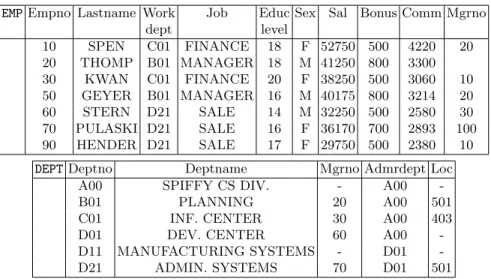
Saf eRL, based on tuple relational calculus (TRC), allowing the expression of a wide variety of “rules” to be discovered against the data. Saf eRLextends and generalizes functional dependencies (FDs) in databases to new and unexpected rules easily expressed with a practical SQL-like language derived fromSaf eRL, calledRQL. To start with, let us consider the running example given in Figure 1 with two relationsEmp andDept.Educlevel represents the number of years of formal education,Sal the yearly salary,Bonus the yearly bonus andComm the yearly commission. This example will be used throughout the paper.
Intuitively, aRQL query is defined by the FINDRULES clause and gener-ates rules of the formX →Y with X andY disjoint attribute sets taken from the OVER clause. The SCOPE clause defines tuple-variables over some rela-tions obtained by classical SQL queries and the CONDITION clause defines the predicate to be evaluated on each attribute occurring inX∪Y.
Example 1. To make things concrete, we give some examples ofRQLqueries.
Q1: F I N D R U L E S
O V E R Empno , L a s t n a m e , W o r k d e p t , Job , Sex , B o n u s
S C O P E t1 , t2 Emp
C O N D I T I O N ON A IS t1 . A = t2 . A ;
Q01: F I N D R U L E S
O V E R Empno , L a s t n a m e , W o r k d e p t , Job , Sex , B o n u s
S C O P E t1 , t2 (S E L E C T * F R O M Emp W H E R E E d u c l e v e l > 1 6 ) C O N D I T I O N ON A IS t1 . A = t2 . A ; Q001: F I N D R U L E S O V E R E d u c l e v e l , Sal , Bonus , C o m m S C O P E t1 , t2 Emp C O N D I T I O N ON A IS 2* ABS ( t1 . A - t2 . A ) /( t1 . A + t2 . A ) <0.1;
Q1discovers FDs fromEmpover a subset of attributes. Recall that a FDX →Y holds in a relationrif for all tuplest1, t2∈r, and for allA∈Xsuch thatt1[A] =
t2[A] then for allA∈Y,t1[A] =t2[A]. As shown in Q1, RQLcan express the discovery of FDs with a natural syntax. For example, Empno → Lastname,
W orkdept→J obhold inEmp.
We can easily restrict FDs to some subset of tuples as shown withQ01which discovers rules comparable to conditional functional dependencies [2] by con-sidering only employees with a level of qualification above 16. For instance,
Sex →Bonus holds, meaning that above a certain level of qualification (16), the gender determines the bonus. This rule was not elicited by Q1 because of employees 60 and 70.
Q001 is an approximation of FD for numeric values, where strict equality is discarded to take into account variations under 10%. For instance, salaries 41250 and 38250 are considered close (7.5% difference), but not salaries 41250 and 36170 (13.1% difference). Sal → Comm then holds, meaning that employees earning similar salaries receive similar commissions.
Nevertheless,RQLcan do much more and is not restricted to FD at all.
Example 2. null values in Dept.
Q2: F I N D R U L E S
O V E R D e p t n a m e , Mgrno , A d m r d e p t , Loc
S C O P E t1 D e p t
C O N D I T I O N ON A IS t1 . A IS N U L L;
This query discovers rules between null values of the relationDept. In dirty databases, null values can be a nightmare and knowing relationships between attributes with respect to null values could definitely be useful. For instance,
M grno→Locholds inDept.
In this setting, every rule mining problem can be easily specified and turns out to be seen as a query processing problem. We provide a query rewriting technique and a constructive proof of the main query equivalence theorem, leading to an efficient query processing technique. Based on a concrete SQL-like grammar for
Saf eRL, we have shown how a tight integration can be performed on top of any DBMS. The approach has been implemented and experimented on sensor network data, showing that our approach allows the discovery of meaningful rules and scales well. This contribution is an attempt to bridge the gap between pattern mining and databases to facilitate the use of data mining techniques by SQL-aware analysts. The ultimate goal of this work is to integrate pattern mining techniques into core DBMS technologies.
Related works Defining specific languages for pattern mining is a long standing goal and poses several challenges to first specify the data of interest and second, to pose pattern mining queries against these data. A survey of data mining query languages has been done in [3]. Recently, constraint programming appears to be convenient and useful since it allows addressing both issues with a unique declarative language [4, 5].
Nevertheless, we argue that pattern mining languages should benefit from direct extensions of SQL languages as done in [6], since data are most of the time stored in DBMSs. Practical approaches, as close as possible of DBMSs, have been proposed for example in [7–9] to interact more directly with DBMSs query engines. The Saf eRLlanguage proposed in this paper goes into this di-rection by providing a formal semantic based on the TRC language, its practical counterpartRQLturning out to be easily implemented on top of every DBMS. FDs, association rules with 100% confidence, ad-hoc language proposed in [10] are special cases of ourSaf eRLlanguage but none of them has a logical query language foundation.
With respect to [11], we consider a database instead of a single relation in
Saf eRL, we provide a SQL-like syntaxRQLand we focus on query processing techniques that can be reused to efficiently execute RQL queries. Theoretical results on decidability problems on variant of Saf eRL languages are given in [11]. From a technical point of view, this paper is a generalization of the approach taking into account FD only [12] to compute agree sets from database relations using SQL. FDs, CFDs in databases and implications in formal concept analysis have been studied in e.g. [12–15].
Paper organization Section 2 introduces some notations and recalls important
notions on relational calculus and closure systems. Section 3 presents the syntax and semantics of the Saf eRL language, while section 4 presents some results used for computing the answer to Saf eRL queries. Section 5 presents exper-imental results and section 6 concludes. Due to space constraints, proofs are omitted.
2
Preliminaries
This section introduces main definitions and notations used throughout the pa-per for the relational model, safe TRC, rules and closure systems.
2.1 Relational model
We use the named perspective of the relational model in which tuples are func-tions.
Fix a finite universeUofattributes(denoted byA,B, . . .), a countably infinite domainDofconstants(denoted byc,c0, . . .) and a finite setRofrelation symbols (denoted byR,S, . . .).U,D,Rare pairwise disjoints. Each relation symbolRhas a schema, a subset ofU, denoted by the symbol itself, i.e.R⊆U. Conveniently, we will sometimes omit to refer to the relation symbol when dealing with a subset of attributes, i.e. a schema. Atuple toverRis a total functiont:R→D. Arelation roverRis a finite set of tuples overR. Adatabase schema Ris a set of relation symbols, e.g. R ={R1, . . . ,Rn}. A database instance (or simply a database) is a function dfrom R to the set of possible relations such that d(Ri) = ri,ri a relation overRi, fori= 1..n.
2.2 Variables and assignments
Saf eRLhas different formal variables for attributes, tuples and schemata: a set Aof attribute-variables (A, B, . . .), a setTof tuple-variables (s, t, . . .) and a set Sof schema-variables (X, Y, . . .).A,T,S,U,D,Rare pairwise disjoints.
An attribute-assignmentρ(resp. a schema-assignmentΣ) is a function that maps an attribute-variableA(resp. a schema-variableX) to an attributeρ(A)∈ U(resp. a subset of attributesΣ(X)⊆U). A tuple-assignmentσis also a func-tion from a tuple-variabletto a tupletdefined over some schema. Conveniently, a tuple-variable t can be explicitly defined over some schema X, noted by t :X and we will use the notationsch(t) =X.
For an attribute-assignmentρ(as well as for tuple-assignments and schema-assignments) we denote byρA7→A the assignment defined by:
ρA7→A(B) = (
A ifB =A ρ(B) ifB 6=A
2.3 Safe TRC
For the sake of clarity, we recall here the syntax and semantics of the TRC in its simplest form. TRC formulas noted ψ, ψ1, ψ2, . . . are defined inductively as usual, where A,B∈U,X⊆U,c∈D,R∈R,t, t1, t2∈T:
R(t)|t1.A=t2.B|t.A=c| ¬ψ|ψ1∧ψ2| ∃t:X(ψ)
Given a databased over Rand a tuple assignment σ, the satisfaction of a TRC formulaψis inductively defined as follows:
– hd, σi |=R(t) ifσ(t)∈d(R),R∈R
– hd, σi |=t1.A=t2.Bifσ(t1)(A) =σ(t2)(B) – hd, σi |=t.A=cifσ(t)(A) =c
– hd, σi |=¬ψifhd, σi 6|=ψ
– hd, σi |=ψ1∧ψ2 ifhd, σi |=ψ1 andhd, σi |=ψ2
– hd, σi |=∃t:X(ψ) if there exists a tupletoverXsuch thathd, σt7→ti |=ψ A TRC query is an expression of the form
q={t:X|ψ}
where ψ is a TRC formula with exactly one free variablet. The set of answers
ans(q, d) ofqw.r.t. a databasedis
ans(q, d) ={σ(t)| hd, σi |=ψ}
In the sequel, we will consider a restriction of the TRC, equivalent to the relational algebra in order to be compatible with SQL, known assafe TRC [16].
2.4 Rules and closure systems
Rules or implications, closure systems and closure operators have been widely studied in many branches of applied mathematics and computer sciences, with many applications in databases with functional dependencies [17] and in formal concept analysis with implications [18]. The interested reader should refer to [19] for a comprehensive survey. We summarize the main results that are useful for the rest of the paper.
LetU ⊆U. A closure systemConUis such thatU ∈Cand for allX, Y ∈C,
X∩Y ∈C [18]. LetF be a set of rules on U. A closure system can be defined for F, noted CL(F) ={X ⊆U|X =XF+} where XF+ is the closure of X with respect toF. LetIRR(F) be the set of meet-irreducible elements ofCL(F). The notion ofbaseof a closure system is defined as follows:
Definition 1. Let CL(F)be a closure system. A baseB ofCL(F)is such that IRR(F)⊆ B ⊆CL(F)
A base is called a context in FCA terminology [18]. From a functional dependency inference point of view, we quote the following approach [20, 12] to discover the so-called canonical basis from a relationr:
1. Compute a base of the closure system associated to FDs fromr (known as
agree sets),
2. From the base, compute the unique canonical cover for exact FDs and Got-tlob and Libkin cover for approximate FDs [21, 20, 22].
The rest of this paper proposes a generalization of this approach. Indeed, each Saf eRL query defines a closure system and therefore, in order to reuse previous results, the problem turns out to be on the computation of a base with respect to a query from the database [12]. Due to space constraints, we will focus on this first stage, the second stage will be omitted.
3
A Query Language for Rule Mining
In the introduction, we have illustrated RQL – a SQL-like friendly language – through examples. This section formally defines the syntax and semantics of
Saf eRLfrom whichRQLis derived. We have introduced safe TRC for express-ing SQL like queries. Before definexpress-ingSaf eRL, it remains to precisely define (cf. previous examples of RQL queries) theCONDITIONclause, through the notion ofmining formulas:
C O N D I T I O N ON A IS d e l t a _ c o n d ( A , t1 , ... , tn ) ;
3.1 Mining Formulas
Mining formulas, denoted by δ, δ1, δ2, . . ., are defined over tuple-variables T, attribute-variables A and constants D only. Their syntax and their semantics are defined as follows.
Definition 2. Let t, t1, t2∈T,A, B∈Aandc∈D. A mining formula is of the
form: t1.A=t2.B |t.A=c| ¬δ|δ1∧δ2
The satisfaction of a mining formula δ w.r.t. a tuple-assignment σ and an attribute-assignmentρ, denoted byhσ, ρi |=δ, is inductively defined as follows:
– hσ, ρi |=t1.A=t2.B iffσ(t1)(ρ(A)) =σ(t2)(ρ(B)) – hσ, ρi |=t.A=ciffσ(t)(ρ(A)) =c
– hσ, ρi |=¬δ iffhσ, ρi 6|=δ
– hσ, ρi |=δ1∧δ2 iffhσ, ρi |=δ1 and hσ, ρi |=δ2
Such formulas are very simple and restrictive: given one attribute and several tuples, it allows to tell whether or not a mining formula holds.
3.2 Saf eRL queries
The Saf eRL query language can now be defined. A Saf eRL query over a database schemaRis an expression of the form:
Q={X →Y | ∀t1. . .∀tn(ψ(t1, . . . , tn)∧(∀A∈X(δ(A, t1, . . . , tn))→ ∀A∈
Y(δ(A, t1, . . . , tn))))}, where: – X, Y are schema-variables
– ψis a TRC-formula overRwithnfree tuple-variablest1, . . . , tn
– δis a mining formula witht1, . . . , tnfree tuple-variables andAa free attribute-variable
When clear from context, aSaf eRL queryQ may also be simply denoted byQ=hψ(t1, . . . , tn), δ(A, t1, . . . , tn)ior evenQ=hψ, δi.
Example 3. The mining of FDs overEMPis expressed as the queryQ=hEMP(t1)∧ EMP(t2),(t1.A=t2.A)i.
The attributes ofψare equal to Sn
i=1sch(ti) whereas the schema of Q, de-noted bysch(Q), is defined by: sch(Q) =Tn
i=1sch(ti): only common attributes of tuple-variables are meaningful to discover rules.
To specify the result of the evaluation of aSaf eRLquery against a database, we define the notion of satisfaction.
A Saf eRL query hψ, δi is satisfied in a database d and w.r.t. a schema-assignmentΣ, denoted byhd, Σi |=hψ, δiif the following holds:
For all tuple-assignmentσsuch thathd, σi |=ψ: (1) if for allA∈Σ(X),hσ, ρA7→Ai |=δ (2) then for allA∈Σ(Y),hσ, ρA7→Ai |=δ (3) Intuitively, this definition generalizes the definition of FD satisfaction in a relation: instead of only 2 tuples, we may have n tuples from many relations and verifying a certain condition (1); and instead of the condition “for all A∈
R, t1[A] =t2[A]”, we may have any mining formula (2), (3).
The answer of aSaf eRLqueryQ=hψ, δiin a databasedoverR, denoted by
ans(Q, d), is defined as: ans(Q, d) ={Σ(X)→Σ(Y)| hd, Σi |=hψ, δi, Σ(X)∪
3.3 RQL: A practical language for Saf eRL
RQL is a practical SQL-like declarative language to express Saf eRLqueries. Let us consider a Saf eRL query Q = hψ(t1, . . . , tn), δ(A, t1, . . . , tn)i and its associatedRQLquery: F I N D R U L E S O V E R A1 , ... , An S C O P E t1 ( S Q L 1 ) , ... , tn ( S Q L n ) W H E R E c o n d i t i o n ( t1 , , ... , tn ) C O N D I T I O N ON A IS d e l t a _ c o n d ( A , t1 , ... , tn ) ;
The clause FINDRULES identifiesRQLqueries. The clause SCOPE specifies every tuple to be used to discover the rules and corresponds to the tuple-variables of ψ, a safe TRC formula. The clause CONDITION gives the condition to be observed against the data, the so-called mining formulaδ. The clause OVER al-lows restrictions of rules to a particular set of attributes, typically the attributes ofsch(Q). The WHERE clause is defined as usual. We have already given many examples ofRQL, other details are omitted. Note thatRQLallows much more flexibility thanSaf eRLsince syntactic sugars available in SQL can be used for free, as in queryQ001 of Example 1.
4
Theoretical results
In [11], a slightly different language for rule mining has been proposed. One of the main results was to point out that every query is “Armstrong-compliant”, meaning basically that Armstrong axioms are sound and that each query defines a closure system. The same result holds forSaf eRLqueries.
Given a databasedand aSaf eRLqueryQ, the basic idea is to compute a base of the closure system associated withQfromd. Let us start by introducing the closure system associated with Q.
An appendix provides the proofs of all propositions, lemmas and theorems.
4.1 Closure system and bases for Saf eRL queries
Given a query Q against a database d, the definitions of a base and a closure system given in Section 2.4 are extended toans(Q, d).
We say that Z ⊆U satisfies ans(Q, d) if for all X → Y ∈ ans(Q, d), X6⊆ Z or Y ⊆ Z. The closure system of Q in d, denoted by CLQ(d), is defined by:
CLQ(d) ={Z⊆sch(Q)| Zsatisfiesans(Q, d)}. In our setting, the definition of the base is:
Definition 3. Let Q = hψ, δi be a Saf eRL query over R and d a database overR. The baseof Qind, denoted byBQ(d), is defined by:
BQ(d) = [ σs.t. hd,σi|=ψ n {A∈sch(Q) | hσ, ρA7→Ai |=δ} o
That is,BQ(d) is the set of allZ⊆sch(Q) for which there existsσsuch that hd, σi |=ψ and hσ, ρA7→Ai |=δ for all A∈Z. Note that since A is the only free attribute variable inδ, usingρA7→Afully determines the attribute assignment in the evaluation ofδ.
Proposition 1. BQ(d)is a base of the closure system CLQ(d).
4.2 Computing the base of a Saf eRLquery using query rewriting The naive approach consists in executing n SQL queries against the database, to cache all intermediary results, to keep only the right combination of tuples with respect to the WHERE clause and then to compute the base of the closure system. We can do much better: the basic idea is to decompose the query in order to push as much as possible the processing into the SQL query engine.
For every RQL query Q = hψ, δi involving n tuple-variables, there exists another query Q0 = hψ0, δ0i with a unique tuple-variable . The practical con-sequence of this remark is that the computation of the base can be done in a unique SQL query, i.e. the base of hψ0, δ0i can be delegated to the SQL query engine which was not the case in the former formulation. By means of a rewriting functionrw, we transformQ=hψ, δiinto Q0 =hψ0, δ0i. The idea of rw is that the unique tuple-variablet appearing inQ0 takes its values in the schema built from the disjoint union of sch(ti), i= 1..nand is essentially the concatenation of the initialti’s.
Let R be the new schema built from the disjoint union of the ti’s, i.e.R=S
i∈1..n{hA, ii |A∈sch(ti)}.
The function rw is defined on mining formulae inductively, with t a fresh tuple-variable. Each fresh attribute-variableAi replacesA inδ0, notedrw(δ) in the sequel, for the correspondingti part oft:
rw(δ) = ¬rw(δ0) ifδis¬δ0 rw(δ1)∧rw(δ2) ifδisδ1∧δ2 t.Ai=t.Aj ifδis (ti.A=tj.A) t.Ai=c ifδis (ti.A=c)
We also overloadrwto transform tuple-assignmentσand attribute-assignment
ρinto respective assignments.rw(σ) =σ0 is defined byσ0(t) =tandt(hA, ii) =
σ(ti)(A).rw(ρ) =ρ0 is defined byρ0(Ai) =hρ(A), ii.
Given a mining formula and the previous rewritingrw(), we have the following lemma.
Lemma 1. hσ, ρi |=δiffhrw(σ),rw(ρ)i |=rw(δ)
Finally, it remains to rewrite TRC formulaψwithrw(ψ) by forcingtto have eachti as one of its components:
rw(ψ) =∃t1:sch(t1), . . . , tn:sch(tn)(ψ∧ ^ A∈sch(Q) n ^ i=1 t.Ai=ti.A)
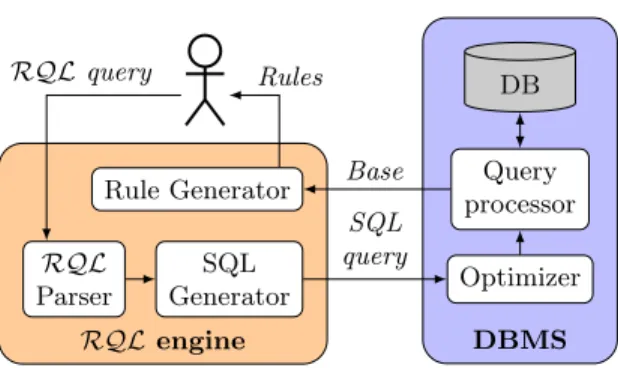
RQL Parser SQL Generator Rule Generator Optimizer Query processor DB RQLengine DBMS SQL query Base RQLquery Rules
Fig. 2.Query processing overview
Given a safe TRC formula and the previous rewriting rw(), we have the following result.
Lemma 2. hd, σi |=ψiffhd,rw(σ)i |=rw(ψ)
ThereforeBQ(d) is computable by running only one SQL query, correspond-ing to the safe TRC query{t|rw(ψ)}, except for the SELECT part that consists in evaluating, for eachA∈sch(Q), the satisfaction ofrw(δ).
Theorem 1. BQ(d) = [ rw(σ) s.t. hd,rw(σ)i|=rw(ψ) n {A∈sch(Q)| ∃ρ:ρ(A) =A∧ hrw(σ),rw(ρ)i |=rw(δ)}o
The previous theorem allows pushing query processing as much as possible into the DBMS to compute the base of the closure system associated to every
Saf eRLquery.
5
Implementation and experiments
Given aRQL query Q, the query processing engine consists of a Java/JavaCC application to:
1. Compute the base of the closure system of Q using the generated SQL query provided by Theorem 1.
2. Compute the canonical cover for exact rules and a Gottlob and Libkin cover for approximate rules [21]. Details are out of the scope of this paper, note just that we have reused the code of T. Uno [23] for the most expensive part of the rule generation process.
samples id DECIMAL(20,0) timestamp TIMESTAMP type DECIMAL(3,0) value DECIMAL(10,0) descriptions id DECIMAL(20,0) type VARCHAR(12) location VARCHAR(18) description VARCHAR(78)
Fig. 3.PlaceLab database schema
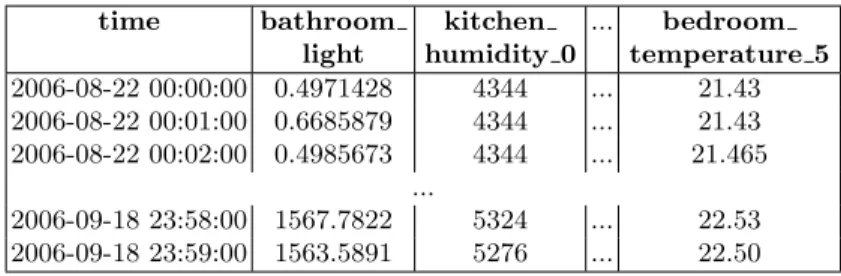
time bathroom light kitchen humidity 0 ... bedroom temperature 5 2006-08-22 00:00:00 0.4971428 4344 ... 21.43 2006-08-22 00:01:00 0.6685879 4344 ... 21.43 2006-08-22 00:02:00 0.4985673 4344 ... 21.465 ... 2006-09-18 23:58:00 1567.7822 5324 ... 22.53 2006-09-18 23:59:00 1563.5891 5276 ... 22.50
Fig. 4.Sensors data
5.1 Sensor Data
We experimented our RQL processing engine using the PlaceLab dataset pro-vided by the MIT House n Consortium and Microsoft Research [24].
The PlaceLab is a 93 m2 apartment instrumented with several hundred sen-sors. During the experiment, interior conditions (temperature, humidity, light, pressure, current, gas and water flow) were captured by 106 sensors, along with 92 reed switches installed on doors, drawers and windows to detect open-closed events. 277 wireless motion sensors were placed on nearly all objects that might be manipulated. Two participants used the PlaceLab as a temporary home for 10 weeks.
The available data is a subset of about a month from the original 2.5 months experiment, from August 22, 2006 to September 18. Raw data is extracted from binary files, where each reading contains a sensor id, a timestamp and a value (the measurement). Sensors meta-data include, for each sensor id, type, location and a short textual description, along with other meta-data of little interest for our experiments, such as installation date, etc. This data is stored in an Oracle database whose schema is depicted in figure 3.
For data mining queries, we focused on variations of the physical properties of the environment, such as temperature, light, etc., which amount to more than 100 million tuples. A view, easily expressed with SQL, has been created to synchronize and resample every sensor with a common sampling interval (one minute). This view, illustrated in figure 4, has 165 attributes and 32543 tuples. Except for the time, each attribute is associated either with one of the 106 physical properties sensors or one of the 58 selected switches.
0 100 200 300 400 500 600 700 800 20 40 60 80 100 Cum ulativ e execution time (in s) Number of attributes Rules generation SQL query
(a) Rule generation
0 0.1 0.2 0.3 0.4 0.5 20 40 60 80 100 Cum ulativ e execution time (in s) Number of attributes
(b) Zoom on SQL queries durations
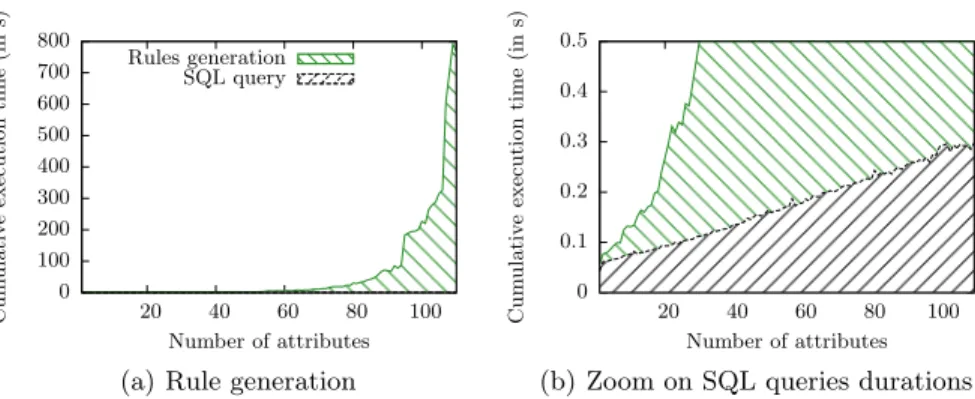
Fig. 5.Execution time for null rules
5.2 Experimental Results
The server used for these experiments is a virtual machine running on VMware 4.1 with 2×Intel Xeon X5650 and 7.2K disks in RAID 5. This virtual machine, running Debian 6.0, disposes of 16 GB of RAM and 4 CPU cores. The DBMS is Oracle Database 11g Release 2.
In these experiments, we consider three families ofRQLqueries.
Q1: rules for null values The first set of queries mine rules between sensors for null values. Such queries can be used to identify groups of sensors which are unavailable simultaneously, due, for example, to a shared acquisition system.
F I N D R U L E S
O V E R < l i s t of a t t r i b u t e s >
S C O P E t1 s e n s o r s
C O N D I T I O N ON A IS t1 . A IS N U L L;
For example, if we consider all temperature sensors as the list of attributes, we can group sensors dining room temperature 1 (A), dining room tempera-ture 2 (B), dining room temperature 3 (C), dining room temperature 4 (D), hall temperature 0 (E) and hall temperature 3 (F) according to rules (F →C,
A→CF,AD→E,BE →D,EF →A,AB →DE, CE→AF,DF →AE,
BF →ADE, CD→AEF, BC →ADEF). Similarly, we can group four sen-sors from the living room, two sensen-sors from the office, two sensen-sors from the hall with three sensors from the kitchen, etc.
Figure 5 gives the cumulative execution time for various number of attributes in the OVER clause of Q1. As expected, rule generation is by far the most expensive part when the query runs over a large set of attributes. The SQL query however lasts less than a second and increases linearly: computation of the base by the DBMS is efficient.
Q2: Functional dependencies The second set of queries finds functional depen-dencies within a time window. This time window is specified using SQL condi-tions on the timestamp.
0 1000 2000 3000 4000 5000 6000 10 20 30 40 50 60 Cum ulativ e execution time (in s) Number of attributes Rules generation SQL query
(a) Rule generation
0 2 4 6 8 10 12 14 10 20 30 40 50 60 Cum ulativ e execution time (in s) Number of attributes
(b) Zoom on SQL queries durations
Fig. 6.Execution time for functional dependencies
F I N D R U L E S O V E R < l i s t of a t t r i b u t e s > S C O P E t1 , t2 ( S E L E C T * F R O M s e n s o r s W H E R E t i m e B E T W E E N ’ 2006 -08 -31 0 0 : 0 0 : 0 0 ’ AND ’ 2006 -08 -31 2 3 : 5 9 : 5 9 ’ ) W H E R E t1 . r o w i d < t2 . r o w i d C O N D I T I O N ON A IS t1 . A = t2 . A ;
To generate the base, the corresponding SQL query performs a Cartesian product (more precisely, a theta self-join on t1.rowid < t2.rowid, which gives half as many tuples). Consequently, the SQL part is significantly more costly compared with the previous family ofRQLqueries. Figure 6 gives the cumulative execution time for various number of attributes in theOVERclause of Q2.
Q3: rules for local maximums RQLqueries can express a wide range of
condi-tions for rules. For example, the following query finds rules for local maximums of measurements (i.e. X →A is interpreted as: if all sensors in X have a local maximum at time T, then sensor A has a local maximum at time T).
F I N D R U L E S O V E R < l i s t of a t t r i b u t e s > S C O P E t1 , t2 , t3 s e n s o r s W H E R E t2 . t i m e = t1 . t i m e + i n t e r v a l ’ 1 ’ m i n u t e AND t3 . t i m e = t2 . t i m e + i n t e r v a l ’ 1 ’ m i n u t e C O N D I T I O N ON A IS t1 . A < t2 . A AND t2 . A > t3 . A ;
Even though this query has three tuple-variables, all three are bound by a 1:1 relationship. Consequently, this query is computed efficiently. Figure 7 shows performances similar to Q1.
0 200 400 600 800 1000 1200 1400 1600 1800 20 40 60 80 100 Cum ulativ e execution time (in s) Number of attributes Rules generation SQL query
(a) Rule generation
0 0.2 0.4 0.6 0.8 1 1.2 1.4 20 40 60 80 100 Cum ulativ e execution time (in s) Number of attributes
(b) Zoom on SQL queries durations
Fig. 7.Execution time for local maximums rules
6
Conclusion
In this paper, we have introduced Saf eRL, a logical query language based on TRC and devoted to rule discovery in databases. The rule mining problem is seen as a query processing problem, for which we have proposed a query rewrit-ing technique allowrewrit-ing the delegation of as much processrewrit-ing as possible to the underlying DBMS engine.RQL, the concrete language ofSaf eRL, is a SQL-like pattern mining language which allows SQL developers to extract precise infor-mation without specific knowledge in data mining. A system has been developed and tested against a real-life database provided by the MIT House n Consortium and Microsoft Research [24]. These experiments show both the feasibility and the efficiency of the proposed language. A web prototype for RQL has been released and is available for teaching and research: http://rql.insa-lyon.fr
References
1. MarketResearch.com: Worldwide relational database management systems 2012-2016 forecast (Aug 2012)
2. Bohannon, P., Fan, W., Geerts, F., Jia, X., Kementsietsidis, A.: Conditional func-tional dependencies for data cleaning. In: Proceedings of the 23rd Internafunc-tional Conference on Data Engineering. ICDE ’07 (2007) 746–755
3. Blockeel, H., Calders, T., Fromont, E., Goethals, B., Prado, A., , Robardet, C.: A practical comparative study of data mining query languages. In Springer, ed.: In-ductive Databases and Constraint-Based Data Mining. Sao Deroski, Bart Goethals, Pane Panov (2010) 59–77
4. Guns, T., Nijssen, S., Raedt, L.D.: Itemset mining: A constraint programming perspective. Artif. Intell.175(12-13) (2011) 1951–1983
5. M´etivier, J.P., Boizumault, P., Cr´emilleux, B., Khiari, M., Loudni, S.: A constraint-based language for declarative pattern discovery. In: Declarative Pattern Mining Workshop, ICDM 2011. (2011) 1112–1119
6. Calders, T., Wijsen, J.: On monotone data mining languages. In: Proceedings of the 8th International Workshop on Database Programming Languages. DBPL ’01 (2001) 119–132
7. Fang, L., LeFevre, K.: Splash: ad-hoc querying of data and statistical models. In: Proceedings of the 13th International Conference on Extending Database Technol-ogy. EDBT ’10 (2010) 275–286
8. Ordonez, C., Pitchaimalai, S.K.: One-pass data mining algorithms in a DBMS
withUDFs. In: SIGMOD Conference. (2011) 1217–1220
9. Blockeel, H., Calders, T., Fromont, ´E., Goethals, B., Prado, A., Robardet, C.: An inductive database system based on virtual mining views. Data Min. Knowl. Discov.24(1) (2012) 247–287
10. Agier, M., Petit, J.M., Suzuki, E.: Unifying framework for rule semantics: Appli-cation to gene expression data. Fundam. Inform.78(4) (2007) 543–559
11. Agier, M., Froidevaux, C., Petit, J.M., Renaud, Y., Wijsen, J.: On Armstrong-compliant logical query languages. In: Proceedings of the 4th International Work-shop on Logic in Databases. LID ’11 (2011) 33–40
12. Lopes, S., Petit, J.M., Lakhal, L.: Functional and approximate dependency mining: database andFCApoints of view. J. Exp. Theor. Artif. Intell.14(2-3) (2002) 93– 114
13. Medina, R., Nourine, L.: A unified hierarchy for functional dependencies, condi-tional funccondi-tional dependencies and association rules. In: ICFCA. Volume 5548 of LNCS., Springer (2009) 98–113
14. Medina, R., Nourine, L.: Conditional functional dependencies: AnFCApoint of view. In: ICFCA. (2010) 161–176
15. Babin, M.A., Kuznetsov, S.O.: Computing premises of a minimal cover of func-tional dependencies is intractable. Discrete Applied Mathematics161(6) (2013) 742–749
16. Abiteboul, S., Hull, R., Vianu, V.: Foundations of Databases. Addison-Wesley (1995)
17. Armstrong, W.W.: Dependency structures of data base relationships. In: Proceed-ings of the IFIP Congress. (1974) 580–583
18. Ganter, B., Wille, R.: Formal Concept Analysis. Springer (1999)
19. Caspard, N., Monjardet, B.: The lattices of closure systems, closure operators, and implicational systems on a finite set: A survey. Discrete Applied Mathematics
127(2) (2003) 241–269
20. Mannila, H., R¨aih¨a, K.J.: Algorithms for inferring functional dependencies from relations. Data and Knowldege Engineering12(1) (1994) 83–99
21. Gottlob, G., Libkin, L.: Investigations on Armstrong relations, dependency infer-ence, and excluded functional dependencies. Acta Cybernetica9(4) (1990) 385–402 22. Demetrovics, J., Thi, V.D.: Some remarks on generating Armstrong and inferring
functional dependencies relation. Acta Cybernetica12(2) (1995) 167–180 23. Murakami, K., Uno, T.: Efficient algorithms for dualizing large-scale hypergraphs.
CoRR1102.3813(2011)
24. Intille, S.S., Larson, K., Tapia, E.M., Beaudin, J.S., Kaushik, P., Nawyn, J., Rock-inson, R.: Using a live-in laboratory for ubiquitous computing research. In: PER-VASIVE ’06. (2006) 349–365