Journal of Finance and Accountancy
Pro forma versus GAAP, Page 1
Pro forma versus GAAP reporting: an examination of differences in
investor perceptions
KEVIN L. JAMES
MIDDLE TENNESSEE STATE UNIVERSITY FRANKLIN A. MICHELLO
MIDDLE TENNESSEE STATE UNIVERSITY ABSTRACT
Many companies report profitability using pro forma earnings along with GAAP earnings. However, strong debate exists on the use of pro forma earnings reports. Proponents say that managers use such reports to help stockholders focus on the most salient details of the financial statements, while critics believe they are misused by managers to cast a positive light on undesirable financial results. The purpose of this exploratory study is to directly examine investor perceptions of pro forma earnings and to investigate whether differences exist between professional and non-professional investors in their perceptions of pro forma earnings compared to GAAP earnings reports.
Results indicate that both professional and non-professional investors perceive pro forma earnings reports as less useful than GAAP reports. This finding contradicts previous research based on stock return data. Overall, results also indicate that non-professional investors may fail to adequately adjust for potential management bias in pro forma reports which could lead to suboptimal decision-making and poor or negative returns. Both groups of respondents agreed that standards should be developed for pro forma reports and those pro forma earnings releases should be reviewed by a certified public accountant prior to public release.
INTRODUCTION
Since the 1980s, there has been a dramatic increase in the number of companies reporting profitability using pro forma earnings (Alpert 2000) along with generally accepted accounting principles (GAAP) earnings. Pro forma earnings statements differ from GAAP earnings by eliminating certain items, typically expenses, required under GAAP from the calculation of net income that the reporting company’s management regards as transitory in nature or unrelated to “core earnings” (e.g., Bhattacharya et al. 2003). Such expenses may include, for example, restructuring charges, goodwill impairment, and costs related to acquisitions. Because companies have no regulations on the wording, format, or even what metrics to include in the earnings release, there are wide variations in the ways companies calculate pro forma earnings within and across companies in the same industry (Alpert 2000; Robinson 2001; Weil 2001).
The purpose of this paper is to examine how the use of pro forma disclosures in earnings releases affects investor perceptions among different classes of investors. Specifically, we investigate whether differences exist between professional and non-professional investors in their perceptions of pro forma and GAAP earnings reports. In contrast to previous studies that examine market reaction to pro forma earnings disclosures (e.g., Bhattacharya et al. 2003) or emphasis placed on pro forma earnings reporting (e.g., Bowen et al. 2005), we directly measure investors’ perceptions of pro forma reporting compared to GAAP reporting.
We examine investor perceptions of financial reporting in four ways. First, we ask investors how useful they perceive pro forma statements compared to GAAP financial statements. Second, we ask investors to rate the extent to which they perceive pro forma earnings and GAAP earnings reports meet the nine qualities of decision usefulness noted in FASB Concept Statement 2 (FASB 2005). Third, we ask investors to rate the extent to which they believe that certain required charges under GAAP reporting should be omitted from pro forma earnings calculations. Fourth, we ask investors to rate the extent to which they agree that certain restrictions should be placed on the use of pro forma earnings.
Our key finding is that both professional and non-professional investors perceive pro forma earnings reporting as less useful than GAAP reporting. Between group comparisons indicate that professional investors and non-professional investors have similar perceptions of GAAP usefulness. However, professionals perceive pro forma reports as significantly less useful than non-professionals with respect to representational faithfulness, verifiability, neutrality and comparability. The results also show that non-professionals may discount the overall usefulness of pro forma reports somewhat, but that the extent of their adjustment may be inadequate. Thus, lesser familiarity with pro forma reports may lead non-professional investors to over rely on these reports. Considering prior evidence that managers may at times use pro forma earnings to mislead investors, a failure by non-professional investors to make appropriate adjustments for potential management bias could lead to suboptimal decision-making and poor or negative returns.
This paper contributes to the literature in two respects. First, we contribute to the current debate about the impact of pro forma disclosures on investors. Contrary to previous studies, we provide direct evidence that both professional and non-professional investors perceive pro forma earnings reports as less useful than GAAP reports. Second, prior studies measure perceptions and usefulness of pro forma earnings using stock return data. In other words, how investors perceive pro forma earnings is inferred from the stock market response to pro forma releases. Stock market response is largely driven by professional investors, but individual investors may have
different perceptions that lead to differences in decision-making and ultimate impact. The current study achieves a more direct measure of investor perceptions of the usefulness of pro forma earnings by applying a survey method that examines key characteristics used in financial reporting.
The remainder of the paper is divided as follows. Section II provides a review of the literature and research questions. Section III describes the sample, the survey procedures, and the response rate. Section IV describes the data analyses and presents the results. Section V presents Conclusions and limitations of the paper.
BACKGROUND AND RESEARCH QUESTIONS
Proponents of pro forma earnings reports argue they provide current, simplified and comprehensible financial information and that managers may use such earnings reports to help stockholders focus on the most salient details of the financial statements (e.g., Pitt 2001). Prior research has found that investors may rely more on pro forma earnings than GAAP earnings, especially when the informativeness of GAAP earnings is low (Bhattacharya et al. 2003; Lougee and Marquardt 2004). Brown and Sivakumar (2003) also provide evidence suggesting that investors may perceive pro forma earnings as more relevant than GAAP earnings.
Critics on the other hand argue that companies often use pro forma earnings disclosures to cast a positive light on undesirable financial results (e.g., Liesman and Weil 2001). In particular, regulators, congress, and the financial press have voiced concern that pro forma earnings disclosures often confuse and mislead investors (Alpert 2000; Burns 2001b; Dreman 2001; Henry 2001), especially less sophisticated, non-professional investors (Burns 2001; Robinson 2001; Weil 2001). Prior research also suggests a strong bias toward reporting of pro forma earnings that are greater than GAAP earnings (Bhattacharya et al. 2004; Bradshaw and Sloan 2002). Bhattacharya, et al, (2004) also find that pro forma earnings announcers tend to be firms that are significantly less profitable and have higher debt ratios than other firms in their own industries. Several previous studies have examined company use of pro forma earnings disclosures in order to meet various reporting goals. These findings suggest that pro forma earnings may be less useful to investors. Our first research question compares the perceived usefulness for pro forma and GAAP earnings.
Research Question 1:
a. Do professional investors perceive a difference in the usefulness of pro forma earnings reports and GAAP earnings reports?
b. Do non-professional investors perceive a difference in the usefulness of pro forma earnings reports and GAAP earnings reports?
Frederickson and Miller (2004) find that non-professional investors (MBA students) predict higher future stock prices than professional investors (security analysts) when they see a press release containing a pro forma earnings number that exceeds the GAAP earnings number. Elliot (2006) finds that when the pro forma earnings number is emphasized in the press earnings report relative to the GAAP earnings number, non-professional investors (MBA students) increase their expectations about future earnings, while professional investors (analysts) are unaffected by this manipulation. Doyle et. al (2003) find that non-professional investors fail to
fully understand the implications of expenses excluded from analysts’ “street earnings” for future firm performance and that a trading strategy based on excluded expenses generates significant abnormal returns in the future periods even after controlling for risk. Lougee and Marquardt (2004) also provide preliminary evidence that investors misprice management-issued pro forma numbers. Finally, Bowen et. al (2005) provide results that suggest that manager’s placement of pro forma vs. GAAP earnings metrics in earnings press releases is opportunistically motivated and focuses on the metric that provides the most favorable story. The findings from these studies suggest that non-professional investors will perceive pro forma earnings reports vs. GAAP earnings reports differently from professional investors, perhaps because they lack the necessary sophistication and experience to fully understand the precision and reliability of the information set provided in the reports. Our second research question investigates whether differences exist between professional and non-professional investors in their perception of pro forma reports and GAAP reports.
Research Question 2:
a. Do professional investors perceive the usefulness of pro forma earnings reports differently from non-professional investors?
b. Do professional investors perceive the usefulness of GAAP earnings reports differently from non-professional investors.
Our third research question investigates whether investors believe that formal protections should be established to protect against the possible misuse of pro forma earnings reports. Research by Bhattacharya et al. (2004), and Bradshaw and Sloan (2002) suggest a strong bias toward reporting of pro forma earnings that are greater than GAAP earnings. For example, Bhattacharya, et al, (2004) finds that 68 percent of firms in their sample that issued multiple pro forma reports between 1998 and 2000 applied different adjustments each time, thereby altering their own definitions of pro forma earnings from year to year. Bhattacharya, et al, (2004) also find that pro forma earnings announcers tend to be firms that are significantly less profitable and have higher debt ratios than other firms in their own industries. Lougee and Marquardt (2004) find that firms that miss earnings benchmark are more likely than other firms to provide pro forma earnings in their press releases. Doyle et al. (2003) and Gu and Chen (2004) show that items excluded from core earnings have future implications for earnings, cash flows, and abnormal returns, which suggest that these expenses were in fact recurring items. Other research shows that pro forma earnings are used to meet benchmarks (Bhattacharya et al. 2003; and, Doyle and Soliman, 2005). These studies suggest that firms may use pro forma earnings reports to mislead investors. The following research question investigates investors’ perceived need for formal protection against such behavior.
Research Question 3:
Do investors believe that formal protections should be installed to protect against the possible misuse of pro forma earnings reports?
SAMPLE SELECTION AND DATA
We gather evidence on how professional and non-professional investors differ in their perceptions of pro forma and GAAP financial reporting. To obtain the sample data on
non-professional investors, we administered surveys to MBA students enrolled in a financial analysis course at a comprehensive university in the southeastern U.S. We administered 109 surveys to MBA students during the fall 2003, summer 2004 and fall 2004 semesters. Students were asked to complete surveys on a voluntary basis. Sixty-five surveys were returned usable for a response rate of 59.6 percent. Of this number, 33 students reported having personal and/or professional investing experience.
With regard to the professionals, 500 survey packets were mailed in fall 2003 to professional fund managers, portfolio managers and pension fund managers using a commercial mailing list. Each packet consisted of a cover letter, the questionnaire and a postage-paid return envelope. A few weeks later, second requests were mailed including a revised cover letter, questionnaire and return envelope. Of the 500 surveys sent out, 75 were returned undeliverable. Of the remaining surveys, 32 were returned in usable form for a usable response rate of 7.5 percent. To test for non-response bias, we ran multiple tests for differences between early and late responders. No significant differences were found.
A central concern surrounding the survey method of data collection is low response rate. Several studies (Abranovic, 1997; Roscoe 1975; and Alreck and Settle, 1995) suggest that although high response rates are preferable, low response rates may not necessarily imply biased data. The most important strategy used to increase the response rate in survey studies is repeat mailing, a strategy we followed as noted above. We addressed the issue of low response rate by invoking the central limit theorem which ensures that if a random sample of n observations is selected from any population, when the sample size is sufficiently large (n≥30), the sampling distribution of the mean tends to approximate the normal distribution. Since our smallest usable sample size is 32, we analyzed the data and made inferences using the normal distribution. We also tested for non-response bias (Martin & Bateson, (1986)) by running multiple tests for differences between early and late responders. Both sets of data generated the same conclusions and no significant differences were found. Demographics for both professional and non-professional respondents are presented in Table 1. For non-non-professional investors, statistical analyses were performed first using only those with investing experience to obtain the most relevant results. All analyses were also performed on the full sample of non-professionals as a supplemental analysis.
(Insert Table 1 about here)
DATA ANALYSIS AND SURVEY RESULTS Research Question 1
Our first research question asks whether there are perceived differences between the usefulness of pro forma and GAAP reporting. This question is posed to both professional investors and non-professional investors. We addressed this research question first by asking a global question regarding the relative decision usefulness of pro-forma versus GAAP reporting, then by breaking down decision usefulness into component parts and asking participants to rank the usefulness of each form of reporting on each criterion. For the global question, subjects were asked how they would compare the usefulness of pro forma earnings statements to the usefulness of earnings prepared in accordance with GAAP in making financial decisions. Responses were gathered on a five point scale ranging from (1= much less useful to 5 = much more useful).
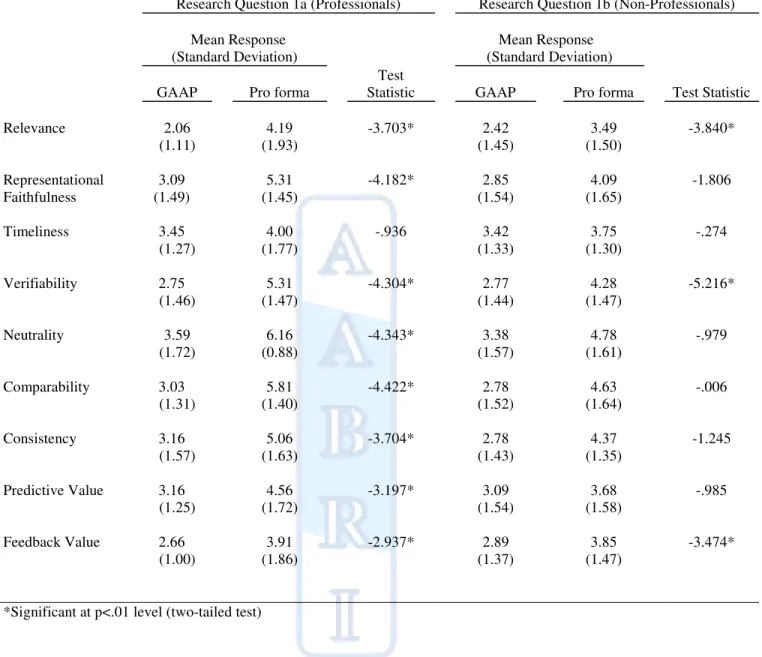
The mean score for professional investors was 2.16 indicating that, on the whole, they perceive pro forma reporting as less useful than GAAP reporting (p=.000). Sixty-nine percent of professional investors indicated that pro forma reporting was less useful than GAAP reporting while only 16% indicated pro forma reporting was more useful. This finding is not consistent with previous studies based on stock return data that suggest pro forma earnings reports are considered more useful than GAAP by professional investors.
The mean response for non-professional investors was 2.63 indicating that on average these investors also saw pro forma reports as less useful than GAAP reports (p=.03), but this effect was less evident than for professional investors.1 Only 48% of non-professional investors perceived pro forma reports as less useful than GAAP compared to 69% of professionals. Forty-nine percent of non-professional investors perceived pro forma reports as more useful. This result indicates that non-professionals view less difference between the usefulness of pro forma and GAAP reports than professionals.
To divide decision usefulness into component parts, we used the nine qualities of decision usefulness noted in FASB Concept Statement 2 (FASB 2005). These nine qualities are listed and defined in Table 2. For each quality, respondents were asked to rate the extent to which they agreed that each reporting method met the stated quality. Responses were gathered on a seven point scale ranging from (1 = strongly agree to 7 = strongly disagree). Since the data are not continuous, we use the Wilcoxon Matched Pairs Signed Ranks test, a non-parametric method, to test each research question. Results are shown in Table 3.
(Insert Tables 2 and 3 about here)
Statistically significant differences were noted for professional investors whereby GAAP reporting was rated as more useful than pro forma reporting on all criteria except timeliness. Again, this result contradicts previous studies that suggest professional investors find pro forma reports to be more useful than GAAP. The lack of a significant result for timeliness is expected due to the release of Regulation G by the Securities and Exchange Commission (SEC) which requires companies that report pro forma earnings to report GAAP earnings simultaneously and include a reconciliation between the two.
Non-professional investors also rated GAAP reports as more useful than pro forma reports on all nine qualities of decision usefulness. However, only differences for relevance, verifiability and feedback value were significant at p=.01. No additional items were significant at p=.05. This result is consistent with the results of the overall question in that GAAP appears to be perceived as more useful, but the differences are less significant for non-professional investors than for professional investors. Analysis using all non-professionals showed significance in the following additional criteria: representational faithfulness, neutrality, comparability and predictive value. These findings suggest that students with no investing experience have a greater discomfort with pro forma earnings than those with some experience. Thus, limited familiarity with pro forma earnings among non-professional investors may lead to overconfidence in such reports compared to those with no familiarity.
Research Question 2
Research question two asks whether there are differences in perception between professional and non-professional investors. While research question one compared perceptions of GAAP and pro forma reporting within groups, research question two requires direct
1
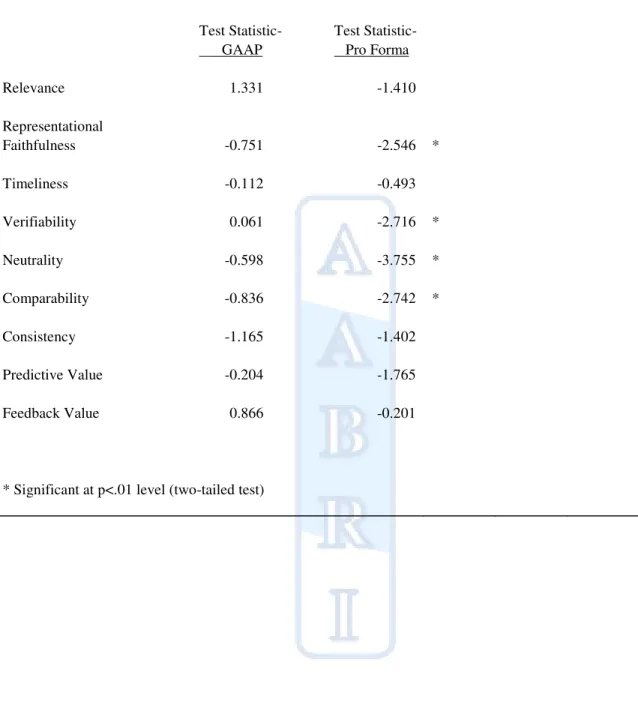
comparisons between the surveyed groups. We examine between group differences in perception with respect to GAAP and pro-forma reporting separately. These results are shown in Table 4. Comparisons of professional to non-professional investors for GAAP earnings reports revealed no significant differences suggesting that the two groups perceive the usefulness of GAAP reporting similarly. In contrast, comparisons between professional and non-professional investors on the usefulness of pro forma earnings reports revealed highly significant differences in four characteristics including representational faithfulness, verifiability, neutrality and comparability. In all cases professional investors perceived pro forma reporting as less able to fulfill the characteristic than non-professionals did.
(Insert Table 4 about here)
Interestingly, differences in perception exist in all three characteristics that comprise “reliability” in FASB’s Hierarchy of Accounting Qualities (FASB 2005). This result suggests that non-professional investors perceive pro forma information as more reliable than professionals and are likely to rely more heavily on pro forma information in their decision making. In other words, while professional investors may view pro forma earnings as relevant, they may discount the reliability of pro forma reports because they understand the potential for management bias. Non-professionals, on the other hand, may not make the same adjustment. This difference may be due to a lesser familiarity with pro forma reports by non-professionals. When participants were asked to rate the extent of their familiarity with the use of pro forma earnings reports by public companies on a five point scale ranging from (1 = not familiar at all to 5 = extremely familiar), the average response of non-professionals was 2.42 compared to an average response for professionals of 3.88. This difference is statistically significant at p < .01.
In addition to reliability factors, comparability showed significant perception differences. As noted above, prior research shows that the definition of pro forma earnings often varies from company to company meaning this measure is not comparable by definition. Non-professional investors showed some awareness of this fact as noted by an average response of 4.41. However, professionals showed much more awareness of the lack of comparability as shown in an average response of 5.81. When all non-professionals were included in the analysis, significant differences were also noted in consistency and predictive value at p<.05. These differences further illustrate an apparent deficit of knowledge about pro forma reports by non-professional investors that may lead to greater reliance for decision-making purposes.2
Research Question 3
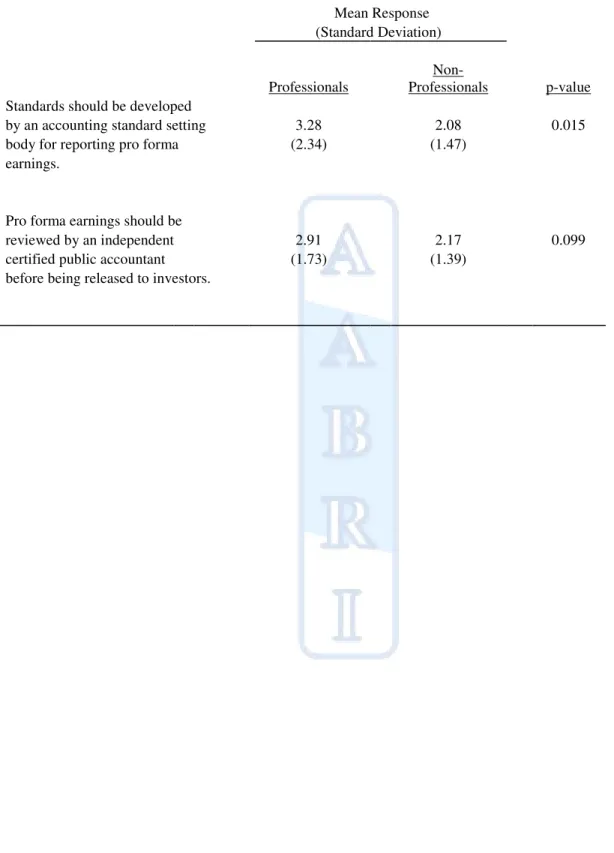
Our final research question asks whether professional and non-professional investors believe that formal protections should be installed to protect against the possible misuse of pro forma earnings reports. We posed two survey questions to provide information on this issue. First, we asked each participant to respond to whether they believe that standards should be developed by an accounting standard-setting body for reporting pro forma earnings. Responses were gathered on a seven-point scale ranging from (1 = strongly agree to 7 = strongly disagree).
2
To investigate the effect of differences in demographic variables on results, all analyses were performed using ANCOVA with demographic variables as covariates. Years of professional investing experience was omitted from each analysis because such a difference is inherent in the two populations. Using non-professional investors only, all significant items remained significant at p<.05 except representational faithfulness (p=.08). Using all
non-professionals, verifiability, neutrality and comparability remained significant at p<.05 while representational faithfulness remained marginally significant at p=.07.
Results using non-parametric tests for categorical data are reported in Table 5. The average response for professionals was 3.42 while the average response for non-professionals was 2.08. This difference is significant at p=.015 with non-professionals showing a stronger desire for such protection. The difference was also significant in analysis using all non-professionals (p=.019). While the desire for protection was stronger for non-professional investors, evidence shows considerable support for pro forma standards from both groups with 61.3% of professionals desiring such standards compared to 81.5% of non-professionals.
(Insert Table 5 about here)
Next, we asked whether pro forma earnings should be reviewed by an independent certified public accountant before being released to investors. Responses were marginally significant for non-professional investors only (p=.099) and significant for all non-professionals (p=.028). Both groups strongly favored independent CPA review with 67.7% of professionals and 84.6% of non-professionals agreeing that such a review should be performed.3
CONCLUSIONS AND LIMITATIONS
This study examines investor perceptions of pro forma earnings and whether differences exist between professional and non-professional investors in their perceptions of pro forma earnings and GAAP earnings reports. Results indicate that both professional and non-professional investors perceive pro forma earnings reports to be less useful than GAAP reports, with professionals perceiving significantly less usefulness than non-professionals. This finding contradicts previous research which uses stock return data to assess usefulness and suggests that professional investors find pro forma earnings more useful than GAAP earnings. Further research should be performed to resolve this conflict.
Between group comparisons indicate that professional investors and non-professional investors have similar perceptions of GAAP usefulness. However, professionals perceive pro forma reports as significantly less useful than non-professionals with respect to representational faithfulness, verifiability, neutrality and comparability. Comparability differences suggest a greater awareness on the part of professional investors that pro forma measures often vary from company to company within an industry and, at times, from year to year in the same company. Representational faithfulness, verifiability and neutrality comprise reliability as defined by the FASB in Concept Statement No. 2 (FASB 2005). The difference here suggests that non-professionals also perceive pro forma reports as more reliable than non-professionals. Overall results suggest that non-professionals may be less familiar with pro forma reports which may lead them to over rely on (or fail to properly discount) pro forma information.
Additional written comments by professional respondents support the conclusion that they selectively discount the usefulness of pro forma reports based on potential management bias. For example, one respondent wrote, “As a professional investor, I find that some pro forma results can be useful. These results, though, must be taken in the context of reported GAAP earnings, an understanding of management credibility and general industry knowledge.” Another professional investor wrote, “I would not say that all pro forma earnings are created equal. I am much more likely to pay attention to pro forma earnings for a company that uses charge-offs sparsely.” Bhattacharya et al. (2003) also found evidence consistent with professional investors
3
For research question three, no items were statistically significant at p<.05 when demographic variables were included as covariates in ANCOVA analyses.
attaching less weight to certain pro forma reports. No non-professional respondents made comments consistent with such discounting.
Evidence from the current study suggests non-professionals may discount the overall usefulness of pro forma reports somewhat, but that the extent of their adjustment may be inadequate. Thus, lesser familiarity with pro forma reports may lead non-professionals to over rely on these reports. Considering prior evidence that managers may at times use pro forma earnings to mislead investors, a failure by non-professional investors to make appropriate adjustments for potential management bias could lead to suboptimal decision-making and poor or negative returns. This finding suggests a need to better educate individual investors about the nature of pro forma earnings reports. A primary mechanism for doing so might be national investor organizations like the American Association of Individual Investors or the National Association of Investors Corporation.
Non-professional investors may also be benefited by establishing additional regulation to protect them from misuse of pro forma earnings reports. Both professional and non-professional investors in our survey favored having greater protection. Specifically, a majority of both groups agreed that standards should be developed for pro forma reports and that pro forma earnings releases should be reviewed by a certified public accountant prior to public release.
The current study surveys student investors and only certain types of professional investors. It is possible that results might vary if participants with different characteristics were sampled. Also, our sample size is fairly small. However, statistical tests show no indication of non-response bias.
Table 1: Demographic Information on Study Participants Professionals All Non-professionals Non-professional Investors Number of subjects 32 65 33 Average age 44.0 27.3 28.4 Male 90.6% 67.7% 72.7%
Highest educational degree attained:
High School 3.0% 0.0% 0.0%
Bachelor’s degree 37.5% 81.5% 84.8%
Master’s degree 56.5% 18.5% 15.2%
Other 3.0% 0.0% 0.0%
Number of years of professional experience
19.59 3.86 5.73
Number of years of professional stock investing experience
15.84 0.61 1.19
Number of years of personal stock investing experience
Table 2: Definitions of Accounting Qualities Relevance Representational Faithfulness Timeliness Verifiability Neutrality Comparability Consistency Predictive Value Feedback Value
The capacity of information to make a difference in a decision by helping users to form predictions about the outcomes of past, present, and future events or to confirm prior expectations.
Correspondence or agreement between a measure or description and the phenomenon that it purports to represent.
Having information available to a decision maker before it loses its capacity to influence decisions.
The ability through consensus among measurers to ensure that information represents what it purports to represent or that the chosen method of measurement has been used without error or bias.
Absence in reported information of bias intended to attain a predetermined result or to induce a particular mode of behavior.
The quality of information that enables users to identify similarities in and differences between two sets of economic phenomena.
Conformity from period to period with unchanging policies and procedures. The quality of information that helps users to increase the likelihood of correctly forecasting the outcome of past or present events.
The quality of information that enables users to confirm or correct prior expectations.
Pro forma versus GAAP, Page 0 Table 3: Results for Research Question One: Comparison of GAAP to Pro Forma Perceptions
Research Question 1a (Professionals) Research Question 1b (Non-Professionals)
Mean Response Mean Response
(Standard Deviation) (Standard Deviation)
GAAP Pro forma
Test
Statistic GAAP Pro forma Test Statistic
Relevance 2.06 4.19 -3.703* 2.42 3.49 -3.840* (1.11) (1.93) (1.45) (1.50) Representational 3.09 5.31 -4.182* 2.85 4.09 -1.806 Faithfulness (1.49) (1.45) (1.54) (1.65) Timeliness 3.45 4.00 -.936 3.42 3.75 -.274 (1.27) (1.77) (1.33) (1.30) Verifiability 2.75 5.31 -4.304* 2.77 4.28 -5.216* (1.46) (1.47) (1.44) (1.47) Neutrality 3.59 6.16 -4.343* 3.38 4.78 -.979 (1.72) (0.88) (1.57) (1.61) Comparability 3.03 5.81 -4.422* 2.78 4.63 -.006 (1.31) (1.40) (1.52) (1.64) Consistency 3.16 5.06 -3.704* 2.78 4.37 -1.245 (1.57) (1.63) (1.43) (1.35) Predictive Value 3.16 4.56 -3.197* 3.09 3.68 -.985 (1.25) (1.72) (1.54) (1.58) Feedback Value 2.66 3.91 -2.937* 2.89 3.85 -3.474* (1.00) (1.86) (1.37) (1.47)
*Significant at p<.01 level (two-tailed test)
Pro forma versus GAAP, Page 0 Table 4: Results for Research Question Two:
Comparisons of Professional Investors to Non-professional Investors.
Test Statistic- Test Statistic- GAAP Pro Forma
Relevance 1.331 -1.410 Representational Faithfulness -0.751 -2.546 * Timeliness -0.112 -0.493 Verifiability 0.061 -2.716 * Neutrality -0.598 -3.755 * Comparability -0.836 -2.742 * Consistency -1.165 -1.402 Predictive Value -0.204 -1.765 Feedback Value 0.866 -0.201
Table 5: Results for Research Question Three Mean Response (Standard Deviation) Professionals Non-Professionals p-value Standards should be developed
by an accounting standard setting 3.28 2.08 0.015
body for reporting pro forma (2.34) (1.47)
earnings.
Pro forma earnings should be
reviewed by an independent 2.91 2.17 0.099
certified public accountant (1.73) (1.39)
before being released to investors.
REFERENCES
Abranovic, W.A. (1997) Statistical Thinking and data Analysis for Managers, Reading, MA: Addison-Wesley.
Allen, K. D., Bhattacharya, N., Black, E.L., & Christensen T.E. (2007). Pro Forma Disclosure and Investor Sophistication: External Validation of Experimental Evidence Using Archival Data. Accounting, Organizations and Society (32), 201-222.
Alreck, P.L. & Settle,R.B. (1995) The Survey Researck Handbook, 2nd edition, Chicago: Irwin. Alpert, B. (2000). The numbers game [reporting of pro forma earnings is rising]. Barron's
(Chicopee, Mass.) v. 80 no. 37, p. 22-4.
Bhattacharya, N., Black, E. L., Christensen, T. E., & Larson, C. R. (2003). Assessing the Relative Informativeness and Permanence of Pro Forma Earnings and GAAP Operating Earnings. Journal of Accounting and Economics, (36), 285-319.
Bhattacharya, N., Black, E. L., Christensen, T. E., & Larson, C. R. (2004). Empirical Evidence on Recent Trends in Pro Forma Reporting. Accounting Horizons, (March), 27-43. Bhattacharya, N., Black, E.L., Christensen T.E., & Mergenthaler, R.D. (2007). Who Trades on
Pro Forma Earnings Information? The Accounting Review (82), 581-619.
Bowen, R. M., et. al.. (2005). Emphasis on Pro Forma versus GAAP Earnings in Quarterly Press Releases: Determinants, SEC Intervention, and Market Reactions. The Accounting
Review v. 80 no. 4, 1011-38.
Bradshaw, M. T., & Sloan, R. G. (2002). GAAP Versus the Street: An Empirical Assessment of Two Alternative Definitions of Earnings. Journal of Accounting Research, (40), 41-66. Brown, L. D., & Sivakumar, K. (2003). Comparing the Value of Two Operating Income
Measures. Review of Accounting Studies, (8), 561-572.
Burns, J. (2001). SEC Official Reveals Probe Into "Pro Forma" Earnings Cases. Dow Jones Business News (June 18).
Doyle, J., R. Lundholm, and M. Soliman. (2003). The Predictive Value of Expenses Excluded from "pro forma" Earnings. Review of Accounting Studies,145-174.
Dreman, D. (2001). Fantasy Earnings [pro forma financial fluffery by Amazon and Yahoo]. Forbes, v. 168 no. 8, 134
Elliott, W. B. (2006). Are Investors Influenced by Pro Forma Emphasis and Reconciliations in Earnings Announcements? The Accounting Review v. 81 no. 1, 113-33.
Entwistle, G.M., Feltham, G.D., and Mbagwu C. (2006). Financial Reporting Regulation and the Reporting of Pro Forma Earnings. Accounting Horizons (20), no.1, 39-55.
Entwistle, G.M., Feltham, G.D., and Mbagwu C. (2006). Misleading Disclosure of Pro Forma Earnings: An Empirical Examination. Journal of Business Ethics (69), 355-372. Financial Accounting Standards Board. (2005). Original Pronouncements. New York: John
Wiley & Sons.
Frederickson, J. R., et. al. (2004) The Effects of Pro Forma Earnings Disclosures on Analysts' and Nonprofessional Investors' Equity Valuation Judgments. The Accounting Review, v. 79 no. 3, 667-86.
Gu, Z., and Chen T. (2004). Analysts' Treatment of Nonrecurring Items in Street Earnings. Journal of Accounting and Economics 38, 129-170.
Henry, D. (2001) The Numbers Game [pumping earnings with pro forma accounting; cover story]. Business Week, no. 3732, 100-10.
Liesman, S., & Weil, J. (2001). Different Views of “Special Items” Lead to Various Figures for S&P 500 profit. Wall Street Journal (August 24).
Lougee, B. A., & Marquardt, C. A. (2004). Earnings Informativeness and Strategic Disclosure: An Empirical Examination of “Pro Forma” Earnings. The Accounting Review, (July), 769-795.
Martin, P. & Bateson, P (1986). Measurement Behavior: An Introductory Guide. Cambridge: Cambridge University Press
Pitt, H. (2001). Remarks before the AICPA Governing Council. Miami Beach, FL. Available at www.sec.gov/news/speech/spch516.htm.
Robison, P. (2001). How Much Do Companies Really Earn? Bloomberg.com (August 3). Rosce, J.T. (1975) Fundamental Research Statistics for the Behavioural Sciences, 2nd edition.
New York: Holt Rinehart & Winston.
Weil, Hazy J. (2001). Earnings Prompt Move for Standards. Wall Street Journal (Eastern Edition), C1-2.