Case study
Developing biosafety risk hypotheses for invertebrates
exposed to GM plants using conceptual food webs: A case
study with elevated triacylglyceride levels in ryegrass
Barbara I.P. B
arratt
1*, Jacqui H. Todd
2, Elisabeth P.J. Burgess
2and Louise A. Malone
21 AgResearch, Invermay Agricultural Centre, Private Bag 50034, Mosgiel, New Zealand
2 Plant and Food Research, Mt Albert, Private Bag 92169, Auckland Mail Centre, Auckland 1142, New Zealand
Regulators are acutely aware of the need for meaningful risk assessments to support decisions on the safety of GM crops to non-target invertebrates in determining their suitability for field release. We describe a process for developing appropriate, testable risk hypotheses for invertebrates in agroecosystems that might be exposed to plants developed by GM and future novel technologies. An existing model (PRONTI) generates a ranked list of invertebrate species for biosafety testing by accessing a database of biological, ecological and food web infor-mation about species which occur in cropping environments and their potential interactions with a particular stressor (Eco Invertebase). Our objective in this contribution is to explore and further utilise these resources to assist in the process of problem formulation by identifying potentially significant effects of the stressor on the invertebrate community and the ecosystem services they provide. We propose that for high ranking species, a conceptual food web using information in Eco Invertebase is constructed, and using an accepted regulatory risk analysis framework, the likelihood of risk, and magnitude of impact for each link in the food web is evaluated. Using as filters only those risks evaluated as likely to extremely likely, and the magnitude of an effect being con-sidered as moderate to massive, the most significant potential effects can be identified. A stepwise approach is suggested to develop a sequence of appropriate tests. The GM ryegrass plant used as the “stressor” in this study has been modified to increase triacylglyceride levels in foliage by 100% to increase the metabolisable en-ergy content of forage for grazing animals. The high-ranking “test” species chosen to illustrate the concept are New Zealand native speciesWiseana cervinata (Walker) (Lepidoptera: Hepialidae), Persectania aversa (Walker) (Lepidoptera: Noctuidae), and the self-introduced grey field slug,Deroceras reticulatum (Müller).
Keywords: risk analysis/biosafety/genetically modified plants/food webs/non-target species
INTRODUCTION
Crops produced by genetic modification (GM) or by other novel technologies which confer pest or disease resistance, drought tolerance or have other characteris-tics which improve product quality or productivity have the potential to play an important role in crop produc-tion in the future. In many countries, the introducproduc-tion of such crops into agricultural systems requires regula-tory approval. In New Zealand, GM plants are consid-ered “new organisms” and are subject to approval under the Hazardous Substances and New Organisms Act 1996 (HSNO). The Environmental Risk Management Author-* Corresponding author:
ity (ERMA New Zealand) has responsibility to consider applications under HSNO and applicants need to carry out a risk assessment to demonstrate that the new plants are unlikely to displace any native species within its nat-ural habitat, cause deterioration of natnat-ural habitats, or ad-versely affect New Zealand’s inherent genetic diversity. Adverse impacts on beneficial species which carry out important functions in agroecosystems must also be con-sidered. These are amongst the public policy goals that applicants need to address so that the regulator is able to make informed decisions on the biosafety of the plants.
Measuring non-target impacts is an essential part of the risk assessment process for any GM crop. It can be challenging to decide which non-target species should be tested, and what tests to carry out in order to produce
a meaningful risk assessment that is useful to regulators. Raybould (2006) suggested a procedure by which assess-ment endpoints, such as valued species, processes, etc., that might be at risk are evaluated against the new tech-nology to determine how they could be subject to harm by developing a testable risk hypothesis. Determination of the most relevant risk hypotheses and a plan to test them are known as problem formulation. Following this ratio-nale, the likelihood of collecting information which does not inform decision-making is reduced. Clearly problem formulation requires case-by-case consideration depend-ing upon the nature of the plant modification, the scale of production and characteristics of the crop itself, the likelihood that the plants will move out of the agricul-tural environment into naagricul-tural ecosystems, etc., Romeis et al. (2008a) noted that problem formulation should re-sult in a research plan that determines the relationship between the stressor and the ecological impacts of con-cern, taking into account ecological considerations that might affect the nature and extent of possible environ-mental impacts, including the intended scale of cultiva-tion of the GM crop. This approach accords with that of the U.S. Environmental Protection Agency’s ecolog-ical risk assessment framework which is partitioned into problem formulation, analysis and risk characterization (USEPA, 1998). The output from problem formulation is an analysis plan. The analysis phase investigates as-pects of exposure to, and impact from, the stressor and provides the information required to predict ecological consequences. Risk characterisation culminates in infor-mation which facilitates decision making, noting assump-tions and areas of scientific uncertainty (USEPA,1998). The EPA guidelines also point out that once a risk assess-ment is complete, risk manageassess-ment/mitigation measures and risk communication need to be considered.
Todd et al. (2008) have developed a screening method to identify and prioritize non-target invertebrates for risk analysis with GM plants. The method uses a compre-hensive body of published information on biological and ecological information, trophic relationships of individ-ual invertebrate species known to be found in the tar-get environment, and information about the transgenic plant being considered, which is entered into a database (Eco Invertebase). This database includes information on the potential hazards posed by the plant, the exposure of each species to the plant, as well as environmental aspects of risk, economic, cultural and social values of species at risk, and the ability to carry out tests with the species. This information is then scored against each of the criteria being measured such that information for a species that is positively correlated with a particular cri-terion receives a high score for that cricri-terion (e.g. rare native species receive high scores for the value criterion, species likely to be susceptible to a toxin expressed by
a GM plant receive high scores for the hazard criterion, etc.). A mathematical model (PRONTI – priority rank-ing of non-target invertebrates) combines the criterion scores to produce an overall score for each species, al-lowing the species to be more objectively and transpar-ently prioritized for risk assessment testing according to a set of pre-determined selection criteria. The GM plant we have used as a case study is ryegrass (Lolium perenne
L.), a forage plant which has been modified to produce higher levels of the lipid triacylglyceride (TAG). TAG, consisting of three fatty acids and one glycerol molecule, is a relatively minor lipid in plant leaves and the inten-tion is to increase the normal level of about 3.5% dry weight to 8–9%. The “high-lipid ryegrass” (HLR) plants are currently being developed viainsertion of the gene controlling the diacylglycerol O-acyltransferase (DGAT) enzyme fromArabidopsis, the enzyme involved in the fi-nal step in the TAG biosynthesis pathway where DAG (di-acylglyceride) is converted to TAG. The transgenic plants will be homozygous, and have increased lipid levels re-stricted to foliage by means of encapsulation of the TAG by polyoleosins (Roberts et al., 2008). The application of this technology is to increase expression of DGAT in ryegrass leaves and hence to elevate lipid content which will serve to increase the metabolisable energy content of forage for grazing animals. Grazing animals would consequently need to consume less to achieve the same live-weight gains, with associated environmental bene-fits. Furthermore, encapsulation of lipids would provide consumer health benefits by increasing the proportion of unsaturated fats in dairy and meat products.
Gilbert and Chino (1974) made the observation “To a great extent, the obvious success of insects on this planet has been their ability to utilize lipids efficiently as substrates for reproduction, embryogenesis, metamor-phosis and flight”. The fat body, an organ which is unique to insects, plays a major role in storage and release of energy in response to demands of the insect. Mobilisa-tion of lipid reserves from the fat body is essential to supply energy for metabolism, growth, activity, flight, embryogenesis (lipids are the main component of in-sect oocytes and energy source for the developing em-bryo) and immune response (lipids are mobilised to the haemolymph in response to challenges to the immune system). The fat body also serves as an endocrine organ producing antimicrobial peptides and assists in detoxi-fication during nitrogen metabolism. Fat body cells are known as adipocytes and they contain lipid droplets com-posed mainly of TAG. Herbivorous insects consuming foliage hydrolyse the TAG by means of midgut lipases (Turunen and Crailsheim,1996). The products of diges-tion are absorbed by the midgut epithelium and used for synthesis of TAGs, DAGs and phospholipids. Insect lipid metabolism and fat body function in insects has been
reviewed by Gilby (1965), Gilbert and Chino (1974), Canovoso et al. (2001), Van der Horst (1983), and Arrese and Soulages (2010). While most research on invertebrate TAG metabolism has been carried out on insects, Garin et al. (1996) found significant quantities of TAG in the eggs of the snailPomacea canaliculataLamm.
Intuitively, of the invertebrates including insects, the herbivores are likely to be impacted most by an increase in plant lipid levels. However, parasitoids, especially koinobiont endoparasitoids have a close physiological re-lationship with their host, and host quality influences par-asitoid development and survival. Parasitism has been shown to enhance metabolism of fatbody TAGs and in-crease the level of fatty acids in the haemolymph (Visser and Ellers,2008). Early instar parasitoids usually feed on haemolymph of the host, but later stages often feed on fat body directly, or on teratocytes which are derived from epithelial cells surrounding the parasitoid egg. These dis-sociate once the egg hatches and absorb hydrolysed host lipids from the fat body. Some parasitoid venoms disrupt the host fat body and release lipid to the haemolymph ele-vating lipid levels. These various mechanisms allow para-sitoid larvae to manipulate the lipid reserves of the host so that they do not need to independently synthesise lipids. This is thought to have led to a loss of the ability of many parasitoids to synthesise lipids, a trait that has transferred to the adult stage in the orders Hymenoptera and Diptera which do not synthesise or store fatty acids (Visser and Ellers,2008). Many adult parasitoids are therefore de-pendent for their survival and reproduction upon the fat reserves accumulated from the host by the larval stage and are hence influenced by host quality.
While parasitoids are likely to be exposed to a sin-gle host throughout their larval development, predators that generally feed on a number of prey organisms also have the opportunity to accumulate TAGs. Mayntz and Toft (2001) showed that the nutrient composition of the food of a prey species can have a beneficial impact on the predator. This was tested in a study using spiders feeding on fruit flies that showed that the main nutrient groups, amino acids and lipids, transferred benefits through two trophic levels. Mayntz et al. (2005) found that predators were able to “balance” their diet to compensate for previ-ous imbalance. Beetles and spiders pre-fed with a lipid-rich diet tended to select more protein-lipid-rich food andvice versa. This study also demonstrated that, contrary to gen-eral belief prey animals were consistent in body compo-sition despite a variable diet, they do in fact vary in their body composition when provided with variable diets.
Ecosystems are extremely complex, and our under-standing of the myriad interactions between organisms in even relatively “simplified” agricultural systems is rudi-mentary. Consequently, uncertainty in predicting risk will inevitably remain, and the limitations arising from this
need to be clearly acknowledged in a risk assessment. However, in an attempt to develop more realistic, testable risk hypotheses for GM plants, as called for by Raybould (2006) and others, it is helpful to understand some of the most significant interactions that occur within the biotic community of which the GM plant in question will be-come a member. In the case of transgenic pasture species such as HLR, clearly the intention is for the GM plant to become a dominant and durable component of the sward. Hagvar and Aasen (2004) presented a number of possible mechanisms by which Bt plants might impact on insects from a range of food web levels, noting examples where evidence is available for such effects. Mulder and Lotz (2009), also with reference to Bt plants, noted the paucity of published research on the impact of Bt corn (Zea mays
(L.)) on “ecological networks” and impacts on ecosystem services.
Our aim in this paper is to contribute to the theory and process of meaningful risk hypothesis development and problem formulation to better meet the information requirements of GM biosafety regulation by identifying what may be the most significant effects of a proposed GM plant on the invertebrate community and potentially on ecosystem services. Specifically this contributes to the “problem formulation” aspect of the risk assessment framework as defined by the EPA (USEPA,1998), where risk hypotheses are developed, assessment endpoints identified and risk analysis plans are made. The process employs a stepwise analysis of the trophic relationships within the community, informed by a risk assessment pro-cess employed by many regulatory agencies, to define the species within the community that might be most at risk. To illustrate our process, we used three invertebrate species that had scored highly as potential assessment endpoints when Todd et al.’s (2008) PRONTI method was applied to the case of HLR in New Zealand pastures (see Methods for details): Wiseana cervinata (Walker) (Lepidoptera: Hepialidae), a New Zealand native species which has become a pest following the introduction of exotic pasture species;Persectania aversa(Walker) (Lep-idoptera: Noctuidae), the Southern Armyworm, another native species which has become a minor pest in cereals and corn; and the grey field slug,Deroceras reticulatum
(Müller), an introduced slug which damages seedlings and established plants of a wide range of plant species. Unlike most studies on risk assessment for GM plants, where the stressor is likely to represent an obvious hazard to non-target invertebrates, the transgenic perennial HLR crop used as a stressor in this case study might provide an individual or population benefit to some herbivorous in-vertebrates, while possibly being a hazard to others, pre-senting a novel challenge to the process of risk hypothesis development and problem formulation.
Table 1.Risk hypotheses developed forWiseana cervinaandPersectania aversalarvae feeding on HLR. Level 1: Larvae feeding on HLR exhibit some/all of the following characteristics:
Physical/physiological change Improved survival Larvae grow more rapidly Larvae have increased biomass Larvae have increased TAG levels Pupae have higher biomass Adults have higher biomass
Adult females have higher fecundity, produce more eggs Phenological change Larvae develop more rapidly through larval instars
Larvae pupate earlier
Adults emerge earlier in season Eggs produced earlier in season More generations per year
Behavioural change Larger larvae consume more vegetation Adults have increased mobility Level 2: Some/all of the Level 1 effects are demonstrated, so consider:
Population effect Species has increased fitness, density, competitive ability, resistance to starvation Species becomes more dominant in the pastoral invertebrate community Tritrophic effect Natural enemies experience increased fitness, density, competitive ability
Natural enemies benefit/disadvantaged by changes in host phenology Effect on vegetation Food plants under increased pressure from herbivores
Level 3: Some/all of the Level 2 effects are demonstrated, so consider:
Trophic cascade effect Other hosts of parasitoids/predators at increased risk from fitter and more abundant natural enemies
Reduced impact on plants from herbivores which are under increased natural enemy pressure
RESULTS AND DISCUSSION
The potential impact of HLR onW. cervinata,P. aversa
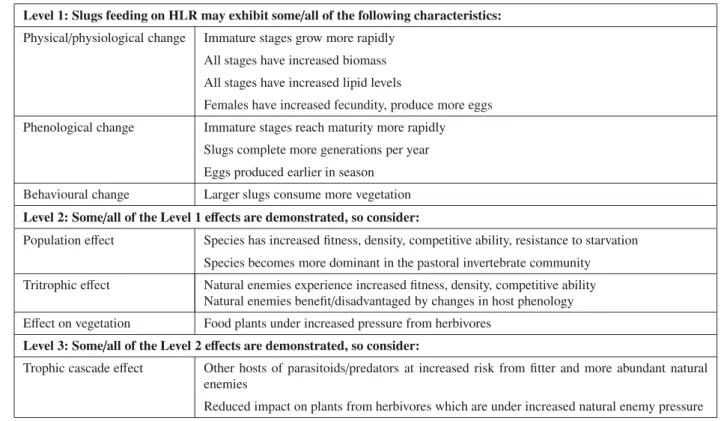
andD. reticulatum(Müller) is shown in Tables1and2. The direct effects of the stressor on herbivores can be divided into aspects of increased growth rates, biomass, and TAG level; changes in developmental rate, genera-tion time and seasonality; and changes in feeding and ac-tivity (dispersal capability, etc.). If some or all of these potential effects are demonstrated in laboratory feeding tests that compare HLR with an equivalent control then the impacts of these changes at Level 2 could be consid-ered. These could include population effects which could be predicted from increased survival and fitness of indi-viduals, increased ability to compete, resist diseases and avoid starvation, and tritrophic effects on natural enemies. The magnitude of population effects that would be of con-cern would be easy to determine for pest species where damage thresholds are well known. Further trophic
cas-cade effects that could be considered are indicated in Ta-bles 2 and3 if evidence for Level 2 effects is demon-strated. While Tables1and2list measurements that can be made in order to accept or reject the hypothesis that a stressor with enhanced nutrient qualities will be bene-ficial to aspects of invertebrate growth and development, if experimental data suggested a detrimental effect, then a new hypothesis would need to be constructed.
Wiseana cervinata
Using information from Eco Invertebase, a food web for
W. cervinata is shown in Figure 1. This New Zealand native species has exploited exotic pasture species in-troduced for pastoral farming and become a major pas-ture pest in New Zealand. Considerable research has been carried out on this species and hence information on food plants and natural enemies is readily available (e.g.
Table 2.Risk hypotheses developed forDeroceras reticulatumfeeding on HLR.
Level 1: Slugs feeding on HLR may exhibit some/all of the following characteristics: Physical/physiological change Immature stages grow more rapidly
All stages have increased biomass All stages have increased lipid levels
Females have increased fecundity, produce more eggs Phenological change Immature stages reach maturity more rapidly
Slugs complete more generations per year Eggs produced earlier in season
Behavioural change Larger slugs consume more vegetation Level 2: Some/all of the Level 1 effects are demonstrated, so consider:
Population effect Species has increased fitness, density, competitive ability, resistance to starvation Species becomes more dominant in the pastoral invertebrate community Tritrophic effect Natural enemies experience increased fitness, density, competitive ability
Natural enemies benefit/disadvantaged by changes in host phenology Effect on vegetation Food plants under increased pressure from herbivores
Level 3: Some/all of the Level 2 effects are demonstrated, so consider:
Trophic cascade effect Other hosts of parasitoids/predators at increased risk from fitter and more abundant natural enemies
Reduced impact on plants from herbivores which are under increased natural enemy pressure
Cameron et al.,1989; Eyles,1966), although no biologi-cal control agents specifibiologi-cally forW. cervinatahave suc-cessfully established in New Zealand (Ferguson et al., 2007). Several vertebrate predators are listed in Eco In-vertebase such as birds, rat, cat and hedgehog, all of which are large, mobile and general feeders. These were considered unlikely to be affected by a change in the nutritional status of a single prey item (Tab. 3). How-everThyrocephalus chloropterus(Erichson) (Coleoptera: Staphylinidae) is a predator feeding on a range of inver-tebrates which is more likely to remain in the HLR pas-ture and feed on Lepidoptera larvae. Eyles (1973) showed thatWiseanaspp. are consumed byT. chloropterusand that consumption rates are potentially high. Thus, an increase in the nutritional value of W. cervinata could have a significant effect onT. chloropteruspopulations. Parasitoids with a wide host range such asPlagiomyia
sp. andLissopimpla excelsa(Costa), which were likely to benefit from potentially larger, more abundant and energy-rich hosts, were therefore considered to poten-tially pose a greater threat to populations of other species in the environment as opposed to more host-specific nat-ural enemies (Tab.3; Fig.1). In contrast, generalist her-bivors exposed to GM plants, such as insect resistant plants, would be expected to be less affected because they could switch to alternative hosts (Romeis et al.,2008b).
Wiseana cervinatafeeds on a wide range of plant species (Fig.1), which would be disadvantaged by higher densi-ties of larger, fitter herbivores in the environment. Those plants likely to be in pastures with HLR, such as other grasses and clover, were considered to be most at risk (Fig.1).
Persectania aversa
As for W. cervinata, a food web was constructed for
P. aversa (Fig.2). A similar logic to that outlined for
W. cervinataabove was followed for this species. Birds known to feed on P. aversa such as magpies, gulls and starlings were not considered to be susceptible to a change in the nutritional status of herbivores in a pasture because of their mobility and wide food range (Tab. 4). In this case impacts of increased fitness of
P. aversapopulations in pasture were considered most significant for two predatory Hemiptera and three par-asitoids. Nabis kinbergii Reuter (Hemiptera: Nabidae) is a polyphagous predator of invertebrates, capable of consuming large numbers of lepidopteran larvae (Ma et al.,2005). A population of this species was consid-ered likely to benefit from the presence of a higher den-sity of nutritionally enhanced prey. Similarly,Cermatulus
Ta b le 3 . Le v el 2 p re d ic te d risk asse ssme n t fo r W iseana cervi nat a feedi n g o n H L R .S haded ro w s ar e those w her e ri sks ar e consi d er ed li k el y (or mor e) to o ccur w it h moder at e (o r h igher ) magni tude.
F igu re 1. Food w eb for W iseana cervi nat a in cl udi ng al l records in E co In v ert ebase. Box es w it h th ic k borde rs cont ai n the te st speci es and st ressor; speci es fol lo wed b y an ast er isk ar e exot ic to N ew Z eal and. S h aded box es indi cat e speci es fo r w hi ch th e ri sk assessment suggest ed th at th e st ressor w oul d h av e a “l ik el y” or hi gher impact w it h “moder at e” o r h igher se v er it y of im pact (s ee T ab . 4 ).
F igu re 2. Food w eb for P er sect ani a a ver sa in cl udi ng al l records in E co In v ert ebase. Box es w it h th ic k borde rs cont ai n the te st speci es and st ressor; speci es fol lo wed b y an ast er isk ar e exot ic to N ew Z eal and. S h aded box es indi cat e speci es fo r w hi ch th e ri sk assessment suggest ed th at th e st ressor w oul d h av e a “l ik el y” or hi gher impact w it h “moder at e” o r h igher se v er it y of im pact (s ee T ab . 5 ).
Ta b le 4 . Le v el 2 p re d ic te d risk asse ssme n t fo r P er sect ani a a ver sa feedi n g o n H L R .S haded ro w s ar e those w her e ri sks ar e consi d er ed li k el y (or mor e) to o ccur w it h moder at e (o r h igher ) magni tude.
nasalis (Westwood) (Hemiptera: Pentatomidae), is an-other polyphagous predator. Edwards and Suckling (1980) found that when provided with coleopteran lar-vae, higher feeding levels of C. nasalis resulted in larger, heavier adults with shorter developmental times. The parasitoidMacrocentrus rubromaculatus(Cameron) (Hymenoptera: Braconidae) is gregarious and known to parasitise a number of noctuid species (Parrott, 1954). An improved nutritional resource could result in higher numbers of parasitoids per host.Netelia producta(Brulle) is a solitary ichneumonid, with a wide lepidopteran host range, andPales nyctemerianaHudson is a tachinid par-asitoid also known from a number of hosts in the lepi-dopteran families Noctuidae and Geometridae (Valentine, 1967). AlthoughP. aversawas considered likely to feed on the grassesPhleum pratenseandPoa annua, these are less productive species in pasture and hence the magni-tude of impact on these species was considered minor and minimal, respectively.
Deroceras reticulatum
The food web for D. reticulatum constructed using in-formation in Eco Invertebase is shown in Figure3. This species has a very wide host plant range including pas-ture, cereals, vegetable and ornamental crops (Fig. 3). In contrast to the two Lepidoptera, it can also be preda-tory (and cannibalistic) under some circumstances. Nat-ural enemies ofD. reticulatumrecorded in the literature are mainly generalist vertebrates which were not consid-ered likely to be significantly advantaged by energy-rich prey items. However, invertebrate predators such as Cara-bidae, for which there are some data on slug predation, but which also feed on a wide range of prey were con-sidered likely to experience benefits, and hence poten-tially impact negatively on other invertebrates. Because of the limited mobility of slugs, widespread impacts on crops outside of the pasture environment were not consid-ered likely. As for the previous case studies, avian preda-tors were not considered likely to be subject to anything more than a minor impact from an increase in the abun-dance or nutritional status of slugs (Tab. 5). However, species of Carabidae, includingMegadromus antarcticus
(Chaudoir), which would be more restricted to feeding within a pasture have been reported feeding onD. retic-ulatum.Megadromus antarcticus, while not widely dis-tributed in New Zealand pastures, was found to consume 0.55 slugs/beetle per day (Chapman et al.,1997), which might be indicative of consumption rates for other species in the genus. Carabidae usually feed nocturnally, which coincides with the main activity period for slugs and so it was considered likely that if slugs benefited from feed-ing on HLR, then there would be a moderate impact on these predators.Deroceras reticulatumis known to feed
on pasture grasses and legumes, and an increase in popu-lation density and growth rates was considered extremely likely to impact on these species with potentially major magnitude.
It should be taken into account that the information used to construct the food webs was only that which has been entered into Eco Invertebase. Clearly there are other trophic relationships that could be added with cur-rent knowledge, both published and unpublished. Conse-quently the more comprehensive the database becomes, the more complex and hence informative the food webs can become, and the more relevant the risk hypotheses developed from them. In addition, it is likely that it will always be necessary to consult literature further to find more detailed information about natural enemies in order to make judgements about the likelihood and magnitude of potential impacts. Needless to say, high quality infor-mation is not always available.
GM plants such as HLR present a novel challenge for risk assessment. Consideration of comparative risk from alternative management strategies is vital in pre-senting a balanced assessment of risk (e.g.use of pesti-cides cf.insect resistant GM plants). In this case study there is no equivalent non-GM technology for elevat-ing ryegrass lipids, although environmental benefits from changed farm management practices (e.g.reduced appli-cation of fertilisers) are likely to accrue from the use of HLR for grazing stock, and these could be brought into the risk assessment equation. A plant which might benefit invertebrate herbivores in the environment, at face-value, might be dismissed as of no consequence. However, given the complexity of ecosystems, a benefit to one species may represent a hazard to another species within the same community. Clearly an understanding of the potential im-pact of the modified plant on the pest status of its herbi-vores is desirable. Furthermore, the danger of an innocu-ous herbivore or minor pest acquiring pest prominence in a crop with altered nutritional status would also represent an undesirable outcome. Eco Invertebase and PRONTI are well equipped to identify such (often non-intuitive) potential, and to serve as a repository for food web infor-mation that can be utilised to develop risk hypotheses.
Several studies have recommended methods for risk hypothesis development and test species selection for GM plants (e.g.Romeis et al.,2008a,2011; Wolt et al., 2010) largely based on principles and guidelines of USEPA (1998) and EFSA (2010). Our approach employs a database of published information on species in the receiving environment encompassing hazard, exposure, cultural, economic and environmental values as well as biological, phenological and ecological information. This allows trophic interactions between invertebrates present in the environment to be identified and significant po-tential impacts from the stressor recognized. Hence the
F igu re 3. Food w eb for D er o cer as re ti cul at um in cl udi ng al l records in E co In v ert ebase. Box es w it h th ic k bor ders cont ai n the te st speci es and st ressor; speci es fol lo wed by an ast er isk ar e exot ic to N ew Z eal and, an ast er isk in br ack et s sho w s gr oups in w h ic h some speci es mi ght be exot ic . S haded box es indi cat e speci es fo r w h ic h th e risk assessment suggest ed th at th e st ressor w oul d h av e a “l ik el y” or hi gher impact w it h “moder at e” o r h igher se v er it y of im pact (s ee T ab . 6 ).
Ta b le 5 . Le v el 2 p re d ic te d risk asse ssme n t fo r D er o cer as re ti cul at um feedi n g o n H L R . S haded ro w s ar e those w her e ri sks ar e consi d er ed li k el y (or mor e) to o ccur w it h moder at e (o r h igher ) magni tude.
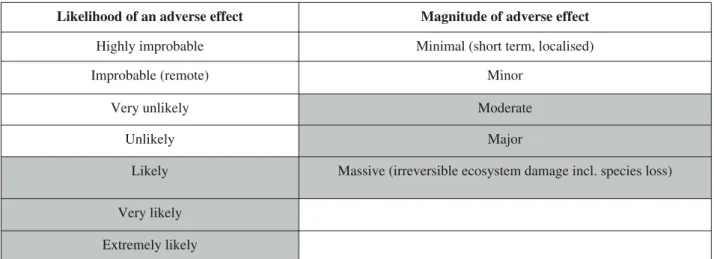
Table 6.Risk framework: for each risk identified, the likelihood of occurrence, and if it did occur, the magnitude of the adverse effect are estimated. The shaded areas represent the threshold used to determine significant risk in the case study examples.
methodology has the ability to incorporate and synthesise a large body of information about the particular ecosys-tem into the process of risk hypothesis development.
METHODS
The information in Eco Invertebase was used to con-struct a conceptual trophic food web for three pasture-dwelling invertebrates which ranked highly in PRONTI. The PRONTI model (Todd et al.,2006) had been modi-fied to allow for stressors that might represent a benefit to potential test species rather than a hazard. The model used was essentially the same as that described by Todd et al. (2008) except for two changes. Firstly, the interac-tion between each receptor species and the stressor was assessed for the likelihood of the receptor benefiting from the stressor (either directly from feeding on the stressor or indirectly through an intermediary species) rather than assessing the potential hazard posed by the stressor. Sec-ondly, a new resilience parameter (replacing parameter I4 in Todd et al. (2008)) was calculated using a mea-sure of the receptor’s attributes that could either constrain its ability to benefit from the stressor or reduce its level of exposure to the stressor (e.g., low reproductive rate, large number of predators, presence of disease, other re-source limitations, low receptor density in the stressor’s target ecosystem, stressor forms only a small portion of the diet). These new benefit and resilience measures di-rectly replaced the hazard and resilience parameters in the PRONTI model, which was otherwise unchanged.
The two Lepidoptera species, W. cervinata and
P. aversa were chosen because they were two of the species considered to be at greatest risk from the stres-sor according to the output from the PRONTI model.
As pests they are important in this situation where the stressor may be of benefit to the assessment endpoints.
Deroceras reticulatum, the introduced slug (also a pest) ranked less highly by the PRONTI model, was chosen as a contrasting example of a non-arthropod invertebrate, which can also be predatory. The food web was con-structed not only using species recorded as natural en-emies or host plants of the test species, but also the trophic relationships of the natural enemies themselves, their hosts, food plants, etc.
For each of the three test species chosen for this case study, all predators, parasitoids and food plants recorded in Eco Invertebase were listed, and for each trophic link in the food web an assessment was made of the likelihood of an effect, and the potential magnitude of an effect if it was to occur. The method used to assess risk at each level was based on the framework used by ERMA New Zealand (Tab.6) to assess each risk identified by the applicant to develop or introduce a new organism and those submit-ting views on such applications (ERMA New Zealand, 1998).
Risk hypotheses were constructed at three levels for which tests could be carried out sequentially. Firstly, the potential impact(s) of the stressor on the test species ranked by PRONTI were considered (Level 1). Labora-tory tests would need to be carried out to test these hy-potheses. The assumption was then made that some or all of these impacts were realised, and Level 2 risk hy-potheses were then constructed around potential impact at lower and higher trophic levels. Each of these was cat-egorised using the risk framework rankings (Tab.1) and justifiable reasons for the ranking given, using informa-tion available about the species concerned from refer-ences recorded in Eco Invertebase, and other information
available in the literature. Those species considered to be at “moderate” risk (or above), with a likelihood of “likely” (or above), were then used to construct a “main effects” food web.
This simplified food web could then be used both to guide the design of experiments to test the Level 2 hypotheses and to support decisions on further testing that could be carried out if some or all of the Level 1 risk hypotheses were proven. Based on the results from Level 2 testing, impacts beyond this could be consid-ered (Level 3), however, comprehensive data for this would probably not be available from Eco Invertebase, but would have to come from further literature searching or experimentation. If the Level 1 risk hypotheses were not or only partially proven, then it may not be necessary to proceed to Level 2, or the rationale for Level 2 risk hypotheses could be modified.
For an application to ERMA NZ, risk hypotheses ap-propriate to the type of application (e.g.application for field trialvs.application for release) would need to be de-veloped. Those which can be tested in the laboratory are clearly unlikely to provide information on population im-pacts and changes in community species composition. In an application for a field trial, decisions would be made on the basis of laboratory containment tests, and would need to express the intention to examine population ef-fects of the stressor in the field trial. An application for a field release would require that such data are available.
CONCLUSION
The number of invertebrate species that potentially could be exposed to transgenic or “novel” pasture plants is vast. Clearly they cannot all be included in biosafety testing. However, selection of species from a ranked list achieved using the PRONTI ranking system is likely to be attrac-tive to regulators because it is relaattrac-tively objecattrac-tive, trans-parent, and based on a comprehensive body of informa-tion derived from published sources. The case studies in this paper have illustrated the potential for Eco Inverte-base to be further used to construct simple trophic food webs, and we have demonstrated how food webs can be used to generate testable hypotheses relating to indirect interactions between invertebrates and transgenic plants. We need to acknowledge that the food webs are limited to three trophic levels and at this stage do not incorpo-rate decomposers and soil micro-organisms, which are also major drivers of ecosystem function and services, and should be incorporated to advance this approach fur-ther. We have demonstrated a process which has a tiered structure so that if, after exposing a test insect to the stres-sor in robust laboratory tests, Level 1 risk hypotheses are rejected, then higher tier tests (Levels 2 and 3) would in
most cases be unnecessary. The process allows for assess-ment endpoints to be specifically identified in advance of tests being conducted using a conventional risk assess-ment approach, such as that outlined in the U.S. Environ-mental Protection Agency Guidelines (USEPA, 1998), that is meaningful to regulators. Determining when suffi -cient information has been collected in order for regula-tors to make a robust decision will always be challenging, especially in the face of uncertainty that will inevitably remain. Clearly, long-term impacts and the potential for irreversible ecological change also need to be considered.
ACKNOWLEDGEMENTS
This research was funded by the Foundation for Re-search Science and Technology contract C06X0801; we thank Drs Greg Bryan and Kim Richardson (AgResearch Grasslands) for information on high-lipid ryegrass; Kim Crook, Colin Ferguson (AgResearch Invermay) for enter-ing data into Eco Invertebase.
Received December 12, 2010; accepted June 8, 2011.
REFERENCES
Arrese EL, Soulages JL (2010) Insect fat body: energy, metabolism, and regulation.Ann. Rev. Entomol.55: 207–225 Cameron PJ, Hill RL, Bain J, Thomas WP(1989) A Review
of Biological Control of Invertebrate Pests and Weeds in New Zealand 1874 to 1987. CAB International and DSIR, Oxford, UK
Canovoso LE, Joune ZE, Karnas KJ, Pennington JE, Wells MA(2001) Fat metabolism in insects.Ann. Rev. Nutr.21: 23– 46
Chapman RB, Simeonidis AS, Smith JT(1997) Evaluation of metallic green ground beetle as a predator of slugs. Proceedings of the NZ Plant Protection Conference50: 51– 55
Edwards PB, Suckling DM (1980) Cermatulus nasalis and Oechalia schellembergii(Hemiptera: Pentatomidae) as preda-tors of Eucalyptus tortoise beetle larvae,Paropsis charybdis (Coleoptera: Chrysomelidae), in New Zealand.N. Z. Entomol. 7: 158–164
EFSA(2010) Scientific opinion on the assessment of environ-mental impacts of genetically modified plants on non-target organisms.EFSA Journal8: 1–72
ERMA New Zealand (1998) Annotated methodology for the consideration of applications for hazardous substances and new organisms under the HSNO Act 1996. ERMA New Zealand, Wellington, New Zealand
Eyles AC(1966) A predator onWiseana (Lep.: Hepialidae). N. Z. J. Agric. Res.9: 699–703
Eyles AC (1973) Prey of the staphylinid Thyreocephalus chloropterus(Coleoptera).N. Z. Entomol.5: 341–342
Ferguson CM, Moeed A, Barratt BIP, Hill RL, Kean JM (2007) BCANZ – Biological Control Agents introduced to New Zealand. http://www.b3nz.org/bcanz
Garin CF, Heras H, Pollero RJ(1996) Lipoproteins of the egg perivitelline fluid ofPomacea canaliculatasnails (Mollusca: Gastropoda).J. Exp. Zool.276: 307–314
Gilbert LI, Chino H(1974) Transport of lipids in insects. J. Lipid Res.15: 439–456
Gilby AR(1965) Lipids and their metabolism in insects.Ann. Rev. Entomol.10: 141–160
Hagvar EB, Aasen S(2004) Possible effects of genetically modified plants on insects in the plant food web. Latvijas Entomologs41: 111–117
Ma J, Li Y-Z, Keller M, Ren S-X(2005) Functional response and predation of Nabis kinbergii (Hemiptera: Nabidae) to Plutella xylostella(Lepidoptera: Plutellidae).Insect Science 12: 281–286
Mayntz D, Toft S(2001) Nutrient composition of the prey’s diet affects growthy and survivorship of a generalist predator. Oecologia127: 207–213
Mayntz D, Raubenheimer D, Salomon M, Toft S, Simpson SJ(2005) Nutrient-specific foraging in invertebrate predators. Science307: 111–113
Mulder C, Lotz LAP (2009) Biotechnology, environmental forcing, and unintended trophic cascades.Arthropod - Plant Interactions3: 131–139
Parrott AW (1952) New Zealand Ichneumonidae. II Tribe Echthromorphini (Pimplinae).Transactions and Proceedings of the Royal Society of New Zealand80: 155–170
Parrott AW(1954) Records of some important braconid para-sites in New Zealand.N. Z. Entomol.1: 16–22
Raybould AF(2006) Problem formulation and hypothesis test-ing for environmental risk assessments of genetically modi-fied crops.Env. Biosafety Res.5: 119–125
Roberts NJ, Scott RW, Tzen JTC(2008) Recent biotechno-logical applications using oleosins.The Open Biotechnology Journal2: 13–21
Romeis J, Bartsch D, Bigler F, Candolfi MP, Gielkens MM, Hartley SE, Hellmich RL, Huesing JE, Jepson PC, Layton R, Quemada H, Raybould A, Rose RI, Schiemann J, Sears MK, Shelton AM, Sweet J, Vaituzis Z, Wolt JD (2008a) Assessment of risk of insect-resistant transgenic crops to non-target arthropods.Nat. Biotechnol.26: 203–208
Romeis J, Van Driesche RG, Barratt BIP, Bigler F(2008b) Insect resistant transgenic crops and biological control. In Romeis J, Shelton AM, Kennedy GG, eds, Integration of insect-resistant genetically modified crops within IPM pro-grams, Springer, Dordrecht
Romeis J, Hellmich RL, Candolfi MP, Carstens K, De Schrijver A, Gatehouse AMR, Herman RA, Huesing JE, McLean MA, Raybould A, Shelton AM, Waggoner A (2011) Recommendations for the design of laboratory stud-ies on non-target arthropods for risk assessment of genetically engineered plants.Transgenic Res.20: 1–22
Todd J, Ramankutty P, Malone LA (2006) A method for selecting non-target organisms for testing the biosafety of GM plants. 9th International Symposium on Biosafety of Genetically Modified Organisms, Jeju Island, Korea, 24–29 Sept. 2006
Todd JH, Ramankutty P, Barraclough EI, Malone LA (2008) A screening method for prioritizing non-target inverte-brates for improved biosafety testing of transgenic crops.Env. Biosafety Res.7: 35–56
Turunen S, Crailsheim K(1996) Lipid and sugar absorption. In Lehane MJ, Billingsley PF, eds, Biology of the Insect Midgut, Chapman and Hall, London
USEPA (1998) Guidelines for ecological risk assessment. Report for U.S. Environmental Protection Agency, Washington, DC.Federal Register63 (93): 26846–26924 Valentine EW(1967) A list of the hosts of entomophagous
in-sects in New Zealand.New Zeal. J. Sci.10: 1100–1209 Van der Horst DJ(1983) Lipid transport in insects. In Mittler
TE, Dadd RH, eds, Metabolic aspects of lipid nutrition in in-sects, Westview Press, Boulder, Colorado
Visser B, Ellers J(2008) Lack of lipogenesis in parasitoids: A review of physiological mechanisms and evolutionary impli-cations.J. Insect Physiol.54: 15–22
Wolt JD, Keese P, Raybould A, Fitzpatrick JW, Burachik M, Gray A, Olin SS, Schiemann J, Sears MK, Wu F(2010) Problem formulation in the environmental risk assessment for genetically modified plants.Transgenic Res.19: 425–436