NBER WORKING PAPER SERIES
MEASURING DISCRIMINATION IN EDUCATION Rema Hanna
Leigh Linden Working Paper 15057
http://www.nber.org/papers/w15057
NATIONAL BUREAU OF ECONOMIC RESEARCH 1050 Massachusetts Avenue
Cambridge, MA 02138 June 2009
¸˛This project was funded in part by University Research Challenge Fund at New York University. We thank Payal Hathi for outstanding research assistance. We thank Abhijit Banerjee, Asim Khwaja, Sendhil Mullainathan, Rohini Pande, and Jonah Rockoff for helpful comments. The views expressed herein are those of the author(s) and do not necessarily reflect the views of the National Bureau of Economic Research.
NBER working papers are circulated for discussion and comment purposes. They have not been peer-reviewed or been subject to the review by the NBER Board of Directors that accompanies official NBER publications.
© 2009 by Rema Hanna and Leigh Linden. All rights reserved. Short sections of text, not to exceed two paragraphs, may be quoted without explicit permission provided that full credit, including © notice, is given to the source.
Measuring Discrimination in Education Rema Hanna and Leigh Linden
NBER Working Paper No. 15057 June 2009
JEL No. I2,J16
ABSTRACT
In this paper, we illustrate a methodology to measure discrimination in educational contexts. In India, we ran an exam competition through which children compete for a large financial prize. We recruited teachers to grade the exams. We then randomly assigned child “characteristics” (age, gender, and caste) to the cover sheets of the exams to ensure that there is no systematic relationship between the characteristics observed by the teachers and the quality of the exams. We find that teachers give exams that are assigned to be lower caste scores that are about 0.03 to 0.09 standard deviations lower than exams that are assigned to be high caste. The effect is small relative to the real differences in scores between the high and lower caste children. Low-performing, low caste children and top-performing females tend to lose out the most due to discrimination. Interestingly, we find that the discrimination against low caste students is driven by low caste teachers, while teachers who belong to higher caste groups do not appear to discriminate at all. This result runs counter to the previous literature, which tends to find that individuals discriminate in favor of members of their own groups.
Rema Hanna
Kennedy School of Government Harvard University 79 JFK Street Cambridge, MA 02138 and NBER [email protected] Leigh Linden
1306 International Affairs Building 420 West 118th Street, Mail Code 3323 New York, NY 10027
1 I. Introduction
Teachers’ expectations seem to affect students’ behavior. Numerous studies have documented what is known as the Pygmalion effect, through which students perform better (or worse) simply because they are expected to do so. For example, the seminal paper in the literature, Rosenthal and Jacobson (1968), has shown that individual students outperformed other students in school after their teachers were told at the start of the school year that they had excelled on a standardized test (even though they were randomly picked as “excelling”). Although this effect has been well documented, we do not yet understand the factors that teachers use to formulate prior opinions about students’ abilities. Of particular concern is whether or not teachers base their beliefs on students’ affiliations with a minority group. If this type of discrimination does exist, it can have long lasting effects, both reinforcing erroneous beliefs of inferiority (Steele and Aronson 1995, 1998; Hoff and Pandey, 2006) and discouraging children from making human capital investments (Mechtenberg, 2008; Taijel, 1970; Arrow 1972; Coate and Loury, 1993). Discrimination would, thus, hinder the effectiveness of education in leveling the playing field across children from different backgrounds.
Unfortunately, it is difficult to empirically test whether discrimination exists in the classroom. By definition, children from disadvantaged backgrounds exhibit many characteristics that are associated with poor academic performance—few educational resources in schools, low levels of parental education, families with little human or social capital, and even high rates of child labor. Thus, it is hard to understand whether children who belong to these minority groups perform worse in school, on average, due to discrimination or due to these other characteristics that may be associated with a disadvantaged background. Moreover, as Anderson, Fryer and Holt (2006) discuss, “uncovering mechanisms behind discrimination is difficult because the
2 attitudes about race, gender, and other characteristics that serve as a basis for differential treatment are not easily observed or measured.”
We address this question through an experiment built around a prize exam competition. The method we illustrate can be used to measure discrimination in many educational contexts and locations; however, we demonstrate it in the Indian context, where discrimination based on caste is a potentially serious problem. Specifically, we designed an exam competition in which we recruited children to compete for a large financial prize. We, then, recruited local teachers and provided each teacher with a set of exams. We randomly assigned child “characteristics” (age, gender, and caste) to the cover sheets of the individual exams graded by the teachers to ensure that there would be no systematic relationship between the characteristics observed by the teachers and the quality of the exams.
This design has several key advantages. First, the random assignment allows us to overcome one of the major obstacles in measuring discrimination. Specifically, we can attribute any differences in the exam scores across different types of children to discrimination and not to other characteristics associated with belonging to a disadvantaged group. Second, the richness of the data available in the experiment allows us to investigate the structure of the observed discrimination and to understand how teachers discriminate, when they discriminate, and against which types of students.
Within the education literature, our work is closely related to a rich body of work in the United States that uses laboratory experiments to evaluate teachers’ perceptions of African American students relative to Caucasian students. While the employed techniques range from evaluations of actual tests to video tapes of student performance and to measurements of teachers reactions to different students (see Furgeson (2003) for a thorough literature review), the basic
3 strategy is to hold students’ performance constant while varying the race of the student so that any variation in the experimental subjects’ reaction to the student is due only to the students’ race. Most of these studies find evidence of lower expectations of the performance of African American students and evidence of discrimination in evaluations. Our work is also very much also related to Lavy (2004), which uses a natural experiment to measure discrimination in grading by gender in Israel.
However, our methods are most analogous to the types of field experiments that have been used to measure racial discrimination in labor market settings. These experiments typically measure discrimination in the hiring of actual applicants. The researchers either have actual individuals apply for jobs (Fix and Struyk, 1994) or they may submit fictitious job applications to actual job openings (Bertrand and Mullainathan, 2004; Banerjee, Bertrand, Mullainathan, and Datta, 2009; Siddique, 2008); in both cases, the “applicants” are statistically identical in all respects, except for race or caste group. Unlike pure laboratory experiments, in which individuals are asked to perform assessments in a consequence-less environment, a major advantage of these experiments is that they are able to measure the behavior of actual employers making real employment decisions.
In our study, we break the correlation between observed characteristics and student quality by randomly assigning characteristics to an exam cover sheet before it is graded. We then place teachers in an environment in which their behavior affects the wellbeing of the child, In particular, teachers know that the results of their grading will result in a substantial prize to the winning child (58 USD or 55.5 percent of the parents’ monthly income). Thus, we are able to mimic the incentives faced by teachers in the classroom.
4 We find evidence of discrimination against lower caste children. Specifically, we find that teachers give exams that are assigned to be “lower caste” scores that are about 0.03 to 0.09 standard deviations lower than those that are assigned to be “high caste.” We do not find any overall evidence of discrimination by gender or age. Disaggregating the results by the quality of the exam, the low-performing, low caste children and top-performing females tend to lose out the most due to discrimination. Interestingly, we find that the discrimination against low caste children is driven by low caste teachers, while teachers from the high caste groups do not appear to discriminate at all. Finally, we find that teachers tend to discriminate more towards children who are graded early in the evaluation process, suggesting that teachers use demographic characteristics to help grade when they are not yet confident with a testing instrument.
The rest of the paper proceeds as follows. Section II provides some background on caste discrimination and education in India. Section III describes the methodology, while Section IV describes our data. Our findings are presented in Section V. Section VI provides a discussion of the key results, while Section VII concludes.
II. Background
In India, individuals in the majority Hindu religion were traditionally divided into hereditary caste groups that denoted both a family’s place within the social hierarchy and their professional occupation. In order of prestige, these castes were the Brahmin, Kshatriya, Vaishya, and Shudra denoting respectively, priests, warriors/nobility, traders/farmers, and manual laborers. Within each main caste, many subcastes exist that also have varying levels of prestige.
In principle, individuals are now free to choose occupations regardless of caste, but like race in the United States, the historical distinctions have created inequities that still exert
5 powerful social and economic influence.1
In this section, we first describe the methodology that we designed to understand whether discrimination exists in grading. We then discuss the data and lay out our empirical methodology.
Given the large gap in family income and labor market opportunities between children from lower and high caste groups, it is not that unsurprising that children from traditionally more disadvantaged caste groups tend to have worse educational outcomes than those from the more advantaged groups. For example, Bertrand, Hanna, and Mullainathan (2008) show large differences in entrance exam scores across caste groups entering engineering colleges, while Holla (2008) shows similar differences in final high school exams.
While it is difficult to identify the influence of caste separately from poverty and low socio-economic status, the potential for discrimination in schools is significant. Both urban and rural schools maintain detailed records of their students’ caste and religion, along with other demographic information such as their age, gender, and various information on their parents (see, for example, He, Linden, and MacLeod, 2008). Anecdotal evidence suggests that teachers may take this information into account. For example, the Probe Report of India (1999) cites cases of teachers banning lower caste students from joining school. Shastry and Linden (2008) show that caste is correlated with the degree to which teachers are willing to exaggerate the attendance of students enrolled in an educational program that provides grain to high attending students.
III. Methodology
1 Banerjee and Knight (1985); Lakshmanasamy and Madheswaran (1995); Unni (2002) give evidence of inequality across groups by earnings, while Rao (1992), Chandra (1997), and Munshi and Rosenzweig (2005) show evidence of inequality in social and economic mobility. Deshpande and Newman (2007) and Madeshwaran and Attewell (2007) provide some evidence of discrimination in earnings, while Siddique (2008) and Jodhka and Newman (2007) for discrimination in hiring practices.
6 A. Research Design
We designed an experiment that comprises of three components: child testing sessions, the creation of grading packets, and teacher grading sessions. We first recruited children to participate in a prized exam competition. After the competition, we copied the tests that the children completed and compiled them into grading packets. Each test copy in the grading packet was assigned an information sheet that included randomly assigned demographic characteristics. We then recruited local teachers to participate in a grading session, during which the teachers graded the exams that displayed the randomly assigned characteristics.
Child Testing Sessions
In April 2007, we ran exam tournaments for children aged seven to fourteen years of age. Our project team went door to door to invite parents to allow their children to attend a testing session to compete for a Rs 2500 prize (about $US 58).2
Over a two week period, sixty-eight children attended four testing sessions. The testing sessions were held in various places, such as community halls, empty homes, or temples, The project team informed the families that prizes would be distributed to the highest scoring child in each of the two age groups (7 to 10 years of age, and 11 to 14 years of age), that the exams would be graded by local teachers after the testing sessions, and that the prize would be distributed after the grading was complete. The prize is a significant sum of money, given that the parents reported earning an average of 4,500 Rs per month ($US 104) in the parent survey that we administered.
2 For recruitment, our project team mapped the city: they collected demographic information about each community and also identified community leaders who they might be able to work with later in the project. To ensure that children of varying castes would be present at each session, the team tried to either recruit from neighborhoods where the children were of diverse caste groups or to recruit from several uniform caste neighborhoods.
7 centrally located to the communities from which the children were selected. They were held on weekends to ensure that they did not conflict with the school day and that parents would be able to accompany the children to the sessions. During the testing sessions, the survey team first obtained informed consent from the parents for both their participation in the parent survey and their child’s participation in the tournament. Next, the survey team administered a short survey to the children’s parents to collect information on the child (gender, age) and to also collect basic demographic characteristics of the family (income background, employment status of the father, and caste information).
After the survey, the project team obtained written assent from each participating child and began the actual exam. To vary the subjectivity of the exam questions, we included questions that tested the basic math and language skills contained in the standard Indian curriculum, as well as an art section in which the children were asked to display their creativity. The exam took approximately 1.5 hours. All children who participated in the testing session received a reading workbook at the time of the sessions and were told that they would be contacted with information about the prize when grading was complete.
Randomizing Child Characteristics
The key to our experimental design is to break the correlation between the children’s actual performance on an exam and the child characteristics perceived by the teacher when grading the exam. In a typical classroom setting, one can only access data on the actual grades teachers assign to students whose characteristics the teachers know. This makes it impossible to identify what grade the teacher would have assigned had another child, with different socio-economic characteristics, completed the exam in an identical manner. Our experimental design allows us
8 to ensure the independence of the exams’ quality and the characteristics observed by the teachers.
Specifically, we randomized the demographic characteristics observed by teachers on each exam. Each teacher was asked to grade a packet containing 25 exams. To form these packets, each test completed by a student was stripped of identifying information, assigned an ID number, and photocopied. Twenty-five copies were then randomly selected to form each packet, without replacement, to ensure that the same teacher did not grade the same photocopied test more than once. Each exam in the packet was then assigned a socio-demographic coversheet, which contained the basic demographic information for the “child.” This included a child’s first name, last name, gender, caste information, and age.3 However, these child characteristics were randomly assigned from the characteristics of children sitting for the exams. By teacher, we stratified the assignment of the characteristics to ensure that each teacher observed coversheets with the same proportion of characteristics of each type of child, avoiding the possibility that a teacher was assigned to grade children of a single sex or caste. Since most Indian first names are gender specific, the first name and gender were always randomized together. Similarly, many last names are also caste specific and, therefore, we randomized the last name and the caste together.4
Caste, age, and gender were each drawn from an independent distribution. We randomly selected the ages of the students from a uniform distribution between eight and fourteen. We ensured that gender was equally distributed among the males and females. Caste was assigned For each teacher, we sampled the name of the child without replacement so that the teacher would not be grading two different exams from the same child.
3 We also include caste categories (General, Other Backward Caste, Scheduled Caste, and Scheduled Tribe), which are groupings of the caste categories.
4
While this strategy has the advantage of consistently conveying the caste information to teachers, it does prevent us from identifying the specific channel through which teachers are getting the information. It may be possible, for example, that the name alone is enough to convey the caste of the child.
9 according to the following distribution. Twelve and a half percent of the exams were assigned each to the highest caste (Brahmin) and the next caste (Kshatriya). Fifty percent of the exams were assigned to the Vaishya Caste and twenty-five percent were assigned to the Shudra Caste.5
The recruitment proceeded as follows. First, the project team talked with the headmaster of the school to obtain permission to recruit teachers from the school. Once permission was obtained, the project team explained to the teachers that they would like to invite them to participate in a study to understand grading practices. The teachers were told that they would grade the exams of twenty-five children and that they would be compensated for their work with a Rs 250 (about $US 5.80) payment. The project team also informed the teachers that the child who obtained the highest score based on the grading would receive a prize worth Rs 2500 (about Each exam was graded by an average of forty-three teachers. Since the “observed” characteristics of the child were randomly assigned, we would expect that these characteristics would be uncorrelated with the exam grade in a world with no discrimination. Any correlation between the “observed” characteristics and exam scores is, thus, evidence of discrimination.
Teacher Grading Sessions
After creating the packets, we recruited teachers to grade the exams. We obtained a listing of schools in the city from the local government, and we divided the schools into government and private schools. For each category, we ranked the schools using a random number generator. The project team began recruitment at the schools at the top of the list, and went down the list until they obtained the desired number of teachers. In total, the project team visited about 167 schools to recruit 120 teachers, 67 from government schools and 53 from private schools.
5
The purpose of this distribution was originally to ensure variation in both caste and the caste categories to which children could be assigned. These classifications are restricted to the lowest two classes and ensure equal distribution among each category, resulting in 75 percent of the exams being assigned to these castes.
10 $US 58). This prize was designed to establish incentives for the teachers’ grading by ensuring that the grades received on the exam have real effects on the well-being of the children, thereby mimicking the incentives faced by teachers in school.
On average, a grading session lasted about two hours for each teacher. At the sessions, the project team first obtained consent. Next, the project team provided the teachers with a complete set of answers for the math and language sections of the test, and the point system per question for all three sections of the test. The project team went through the answer set question by question with the teachers. Teachers were told that partial credit was allowed, but the project team did not describe how partial credit should be allocated. Thus, the teachers had the discretion to allocate partial credit points as they felt appropriate.
Next, the grading portion of the session began. The teacher received twenty-five randomly selected exams—with the randomly assigned cover sheets—to grade as well as a “testing roster” to fill out. To ensure that teachers viewed the demographic information, we asked them to copy the information from the cover sheet onto the grade roster. They were then asked to grade the exam and input the total score and the individual grades for each section of the exam—math, language, and art—onto the testing roster.
When a teacher finished grading his or her packet of exams, the project team administered a short survey to the teacher. The survey consisted of questions designed to gauge the demographic characteristics and teaching philosophy of each teacher.
11 After all the grading sessions were complete, we computed the average grade for each child across all teachers who graded his or her exam. We then awarded the prize to the highest scoring child in each of the age categories, based on these average grades.6
6
As the tests were equally likely to be assigned the characteristics described any negative (or positive effects) received from being assigned particular characteristics should be equal across individual tests, making the overall average a fair assessment of student performance.
B. Data Description
We compiled three sets of data: exam scores, parent surveys, and teacher surveys. We collected two sets of exam scores. The first set includes the test scores generated by each teacher. In addition, a member of the research staff graded each exam using the same grading procedures as the teacher, but on a “blind” basis in which they had no access to the original characteristics of the students taking the exam or any assigned characteristics. This was done to provide an “objective” assessment of the quality of the individual exam. The set of exam scores includes the total score and a score on each subject (math, hindi, and art).
Each subject was chosen to provide variation in the objectivity with which the individual sections could be evaluated. Math was chosen to be the most objective section and questions covered counting, greater than/less than, number sequences, addition, subtraction, basic multiplication, basic addition, and simple word problems among a few other basic competencies. Language, which was chosen to be the intermediately objective section, included questions covering basic vocabulary, spelling, synonyms, antonyms, and basic reading comprehension, and so forth. Finally, the art section was designed to be the most subjective. In this section, we asked the children to draw a picture of their family doing their favorite activity and then to explain the activity.
12 We normalized the exam scores of each section and the overall total scores in the analysis that follows, to facilitate comparisons with other studies in the literature. To do so, we pool all of the grades assigned to each test copy by the teachers, and for each exam, subtract the overall mean and divide by the standard deviation of the scores. Each section and the overall exam score are normalized relative to the distribution of the individual scores for the respective measure.7
The random assignment of tests to teachers and children’s characteristics to the coversheets should ensure that there is no systematic correlation between the quality of the graded tests, the
In addition to the test data, we have data from the two surveys we administered. First, we have data from a survey of the children’s parents that was conducted in order to collect information on the socio-demographic background of the children. Most importantly for the experiment, this included information on the family’s caste, the age of the child, and the child’s gender. Second, we have data from the teacher survey, which included basic demographic information as well as questions regarding the types of students that the teachers normally teach. The demographic information included the teachers’ religion, caste, the type of school at which they taught (public or private), their educational background, age, and gender. In addition, we also collected information on the characteristics of teachers’ students. Note that there was almost no variation in teachers’ responses to these questions – all of the teachers taught low income students like those in our sample, either in a local public or private school.
C. Empirical Strategy
7
In results not presented in this draft, we have also estimated the results normalizing relative to the distribution of blind test scores. Since this is a linear transformation of the dependent variable, it does not affect the hypothesis tests, nor does it affect the magnitude of the estimated results.
13 characteristics of the grader, and the characteristics on the coversheet. We check this assumption using the following model:
ij ij
ij v
z =β +ε (1)
In this equation, zij is the original characteristic of the exam that was taken by child i and was graded by teacher j. vij is a vector that is comprised of the randomly assigned characteristics (gender, age, and caste). We use two different specifications for vij. For our main specification, we include an indicator variable for whether the test was assigned to one of the lower caste groups, allowing us to contrast the treatment of children in the lower caste groups to that of the high. In the specification shown in Appendix Table 2, we use a series of indicator variables for the specific caste groups (Brahmin, Kshatriya, Vaishya, or Shudra) that were assigned.
Using a model similar to Equation 1, we can, then, estimate the effect of the assigned characteristics on teacher test scores:
ij ij
ij v
y =β +ε (2)
where the variable yij is the test score assigned to test i by the teacher j. While the random assignment eliminates the systematic correlation between the true child characteristics and those observed by the teachers, it is possible that small differences in the types of tests assigned to each category will exist in any finite sample. To ensure that our estimates are robust to these small differences, we estimated two additional specifications. First, we include a difference estimator that controls for child characteristics. The difference estimator takes the following form:
ij ij ij
ij v z
14 The vector of randomly assigned characteristics is given by vij as in equation (1), and zij is a linear control function that includes the true characteristics of the child taking test i. Second, we include a fixed-effects estimator, which takes the following form:
ij j j ij ij ij v z w y =β +δ +τ +ε (4)
where wjis the grader fixed effects. This specification allows us to control for fixed differences in grading practices across teachers.
IV. DESCRIPTIVE STATISTICS AND INTERNAL VALIDITY
In this section, we first provide descriptive statistics on the characteristics of the children who sat for the exam and the teachers who graded it. Next, we explore whether the original characteristics of the child predicts the exam score. Finally, we provide a check on the randomization.
A. Baseline Data
In Table 1, we provide descriptive statistics on the 120 teachers who participated in the exam competition. Panel A provides information on the demographic characteristics of the teachers, while Panel B provides sample statistics on their caste identity and beliefs. In Column 1, we provide the summary statistics for the full sample. In the subsequent columns, we disaggregate the data by their basic demographic characteristics: in Columns 2 and 3, we divide the sample by the teachers’ caste. In Columns 4 and 5, we disaggregate the sample by the teachers’ gender, and finally, we divide the sample by the teachers’ education level in Columns 6 and 7.
Reflecting the fact that teaching (especially at a public school) is a well-paid and desirable occupation, sixty-eight percent of the teachers identify themselves as belonging to the
15 upper caste groups (Panel A, Column 1). Teachers tend to be relatively young (an average age of thirty five) and female (seventy-three percent). We made a point to recruit at both public and private schools. The effort was successful in that we recruited a fairly equal number of teachers across the two groups into the sample. Forty-four percent of the teachers work in public schools, while fifty-six percent work in private schools. About half the sample holds a master’s degree.
As Panel B demonstrates, caste identity is high among the teachers. Sixty-four percent report that their closest friend is of the same caste grouping and forty-one percent report that they belong to a caste association. Interestingly, even the teachers themselves tend to report that they believe that “teachers favor some students over others in their grading for reasons unrelated to educational performance.” Eighty-one percent of the teachers agreed with this statement.
Comparing the characteristics of teachers across Columns 2 through 7, the relationships between the various characteristics generally follows the expected patterns. Low caste teachers are more represented in the comparatively less desirable private school teaching positions, less likely to have a master’s degree, more likely to be male, and more likely to belong to a caste association (Columns 2 – 3). Female teachers tend to belong to the high caste groups (75 percent for versus 48 percent for men) and are also more likely to have a master’s degree (Columns 4 – 5). The somewhat surprising pattern lies in the relationship between education and beliefs (Panel B, Columns 6 – 7). We do not observe a difference in caste identity or beliefs across those with and without a master’s degree.
In Table 2, we provide summary statistics for the children who participated in the exam competition and the characteristics observed by the teachers. We describe the original characteristics of the children and the characteristics of the children observed by the teacher in Columns 1 and 2, respectively. Column 1 contains averages for the actual sixty-nine children,
16 while Column 2 contains averages for the 3,000 exam copies graded by the teachers. Standard deviations are provided in parentheses below each average.
Panel A provides the percentage of children who belong to the high caste group, while Panel B disaggregates the lower caste group by specific caste. In our sample, eighteen percent of the children originally belonged to the high caste group, while only twelve percent were assigned to the lowest caste group. Despite an effort to recruit children from the lowest caste, only six percent originally come from the Shudra group. As we were interested in the effects on this specific subgroup, we increased the observed in this category to twenty-five percent. In Panel C, we show the average age and gender of the children. The mean observed age of the children (11 years) is approximately the same as the mean age of children in the sample (10.9 years). To maximize power, we elected to have equal sized gender groups, and therefore, there are more females in the observed sample (50 percent) as compared to the actual sample (43 percent).
Table 3 provides a description of the average quality of the tests taken by the children. Rather than the normalized scores used in the rest of our analysis, we provide the test score measures as the fraction of total possible points, for easy interpretation. On average, students scored a total of 63 percent on the exam. Students scored the lowest in art (47 percent) and the highest in math (68 percent).
The data suggest that the grading of the exam’s art section may have been more subjective than the grading of the math or language sections. The means of the teachers’ test scores for the math and language exams are very similar to those of the blind graders (Panel B of Table 3). In addition, the variance on the math and language sections of the exams are almost equal at 0.23 and 0.16 percentage points, respectively, on both the teacher and the blind test scores. On the other hand, the average art scores given by the teacher are much lower, with a
17 mean of 47 percent for the teachers compared with 64 percent for the blind graders. Moreover, the larger variance for the art section (0.32) provides confirming evidence that, as intended, the art section may have been more subjective than the other sections of the exam.
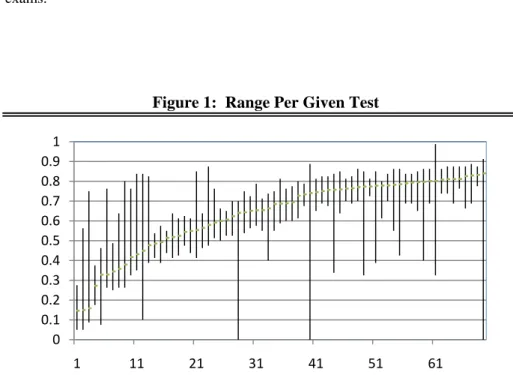
Moving away from the differences in subjectivity across tests, the data indicate that regardless of the subject, teachers do exhibit a fair amount of discretion in grading overall. Figure 1 provides a description of the total test score range (in percentages) per test. The score ranges per exam are quite large, particularly at the lower portion of the test quality distribution. This indicates that the teachers assign partial credit very differently.
Who won the exam competition? In reality, low caste females won both age categories. The two winning exams each displayed the low caste characteristics about 80 percent of the time. About half the time, the winning exams were assigned as female and the average age on the winning exams was eleven years old. Thus, the winning exam was, on average, assigned the mean characteristics in our sample, as we would predict given the randomization.
B. Do Actual Characteristics Predict Exam Scores?
We next investigate the relationship between the actual characteristics of the children in our sample and their exam scores. In the first column of Table 4, we present the simple correlation between the total test scores that the teachers assigned to the exams and the true underlying characteristics of the children. In Column 2, we add the blind test score as an additional control. In Columns 3 -5, we disaggregate the test scores by individual subjects. All scores have been normalized relative to the overall distribution of scores for each respective section.
The children’s original demographic characteristics strongly predict the exam scores. Children from the lower caste group score about 0.41 standard deviations worse on the exam
18 than the high caste group (Column 1).8
8Appendix Table 1 replicates the table including disaggregated caste groups. Recall that the caste groups in terms of descending order of prestige are the Brahmin, Kshatriya, Vaishya, and Shudra castes. Children who belong to Kshatriya caste perform worse (-0.17 standard deviations) than the students who belong to Brahman caste, which is the omitted category in the regressions (Column 1). Children from the Vaishya caste then score worse than the students from the Kshatriya caste by 0.35 standard deviations, and children who belong to the Shudra group score the worst (-1.17 standard deviations lower than the children from the Brahman caste).
Females, on average, score 0.18 standard deviations higher on the exam than males. Finally, one additional year of age is associated with an additional 0.85 standard deviations in score, although this effect is declining with years of age.
In Column 2, we replicate the specification in Column 1, adding the score that our blind grader awarded to each exam as an additional control variable. The blind score provides us with a measure of performance on the exam that reflects only the underlying quality of the exam. Any difference between the test scores from the teachers and the scores from the blind grading can be attributed partially to discrimination, but also to the natural variation in grading practices. The total blind score awarded to the test is highly correlated with the score that the teachers assigned to the tests. On average, a one standard deviation increase in the blind scores results in a 0.93 standard deviations increase in the total test score. When we include the blind test score, the coefficients on the low caste and female indicator variables more closer to zero, but the age variable still is a significant predictor of the final score.
We, next, disaggregate the test score data by subject in Columns 3 – 5 of Table 4. The results suggest that the different sections of the exam do provide variation in subjectivity, with the art section being much more subjective than the other sections. The correlation between the blind score and the teacher’s score for the math and language sections is the same as for the overall score (about 0.93). The art section, however, has a coefficient that is only 0.63. Even when including the blind test score, the original caste status significantly predicts the math and art scores and the child’s original age still predicts the test scores in all three subjects.
19 C. Internal Validity
In order to determine whether discrimination exists, we must first confirm that the average characteristics assigned to each test during the randomization process are effectively the same. We can test for this in two ways. First, we can verify this by regressing the actual characteristics of the children on each exam on the characteristics assigned to the exams by the random assignment process (Table 5, Column 1 – 3). Second, we can regress the test scores from the blind grading of the exam on the characteristics assigned to the exams (Columns 4 – 7). For each specification, we present the coefficients on each observed characteristic, as well as the F-statistic from the joint hypothesis test of the F-statistical significance of all the observed characteristics. For convenience, we also provide the p-value of the joint test.
The results described in Table 5 demonstrate that the random assignment process succeeded in assigning characteristics to the cover sheets that are, on average, uncorrelated with the actual characteristics or performance of the children. With the exception of the fact that tests from actual females are more likely to be assigned to a lower age group, none of the other coefficients are significant. In terms of magnitude, all of the coefficients are practically small; almost every coefficient is less than 1/10 of a standard deviation. The chi-square estimates provide further evidence that the assigned characteristics are uncorrelated with the actual exams. Of the seven estimated equations, none are statistically significant at the 10 percent level. In particular, as shown in Column 4, we find little correlation between all of the assigned characteristics and the quality of the exam, as measured by the blind test score (p-value of .64).9
9
In Appendix Table 2, we disaggregate the exam data by individual caste group. The table further confirms that the randomization was successful, as the individual castes are uncorrelated with the actual characteristics and the blind test score.
20 V. Results
We now turn to our experimental results. In Section A, we test for the overall levels of discrimination and we also measure the discrimination effects by place within the test score distribution. In Section B, we study whether the parameters we set for the test—grading order and test type— affect how teachers grade. Finally, in Section C, we compare the relative degree of discrimination both across the children’s specific caste groups and across teachers who possess different demographic characteristics.
A. Overall Results
In Table 6, we present the results of the regression of the exam scores on observed caste. In Column 1, we provide the overall effects of the observed caste on the test scores assigned by the teachers. Given the randomization, we do not necessarily need to include control variables for the characteristics of the child and the teacher. However, doing so may provide us with greater precision. Therefore, in Column 2, we present the results of specifications in which we control for the actual child’s baseline characteristics. In Column 3, we present the results of the specification that includes the grader fixed effect. As a robustness check, we additionally control for the blind test score in Column 4. The blind test score can be viewed as another measure of the underlying characteristics of the child who took the exam.
We first examine the results on caste. Looking at Column 1, we find that the teachers gave, on average, the exams assigned as “low caste” test scores that were 0.09 standard deviations lower than an exam that was assigned to be from the “high caste” group (significant at the ten percent level).10
10
It is important to note that in what follows, we can only measure the relative treatment of children in the highest caste to lower caste children. In all specifications, the highest caste children are the omitted category and the
21 effects (Column 3) does not significantly affect the estimate on the lower caste indicator variable, but the addition of the controls improves the precision of the estimates, which are now statistically significant at the five percent level. The addition of the blind test score causes the point estimate to fall to -0.027 (Column 3). The estimate, however, remains statistically significant at the ten percent level.
Our results suggest that while discrimination may be present, the magnitude of the overall effect is relatively small when compared to the actual differences in test scores across the caste groups. The caste gap due to discrimination from our preferred specification in Column 3 (including teacher fixed effects and original characteristics control variables) is -0.086, which is much smaller than the actual 0.41 standard deviation gap described in Table 3.11
Interestingly, we do not find any effect of assigned gender or age on total test scores, regardless of specification (Table 6). Note that in addition to not being significant, the
The effect size falls within the lower tail of the distribution of the impacts of various education interventions in the developing world that have been evaluated by randomized experiments. Successful interventions have typically fallen within a 0.07 to 0.24 standard deviation range; this range includes evaluations of programs that provide additional teachers (Banerjee, Cole, Duflo, and Linden, 2007), teacher monitoring and incentive programs (Duflo, Hanna, and Ryan, 2007; Glewwe, Illias, and Kremer, 2003), tracking programs (Duflo, Dupas, and Kremer, 2008), scholarships for girls (Kremer, Miguel, and Thornton, 2007), and contract teachers (Muralidharan and Sundararaman, 2008).
indicator variable for the lower castes measures the difference between the lower castes and the highest caste. We cannot assess, for example, whether teachers are biased in favor of high caste children or against lower caste children.
11
The finding that discrimination accounts for only a small percentage of the difference between groups has been documented in other settings, such as Levitt (2004), who finds that, when discrimination is present, it is not the leading factor of how people vote in the game show the weakest link.
22 magnitudes of the effects are very small. For example, being labeled with an additional year of age provides between a 0.001 – 0.003 increase in score.
In Table 7, we test whether the underlying exam quality influences the teacher’s actions. In Column 1, we interact the blind test score with the observed characteristics and control for the blind test score, using the following equation:
ij j j ij i ij i ij ij v q v q z w y =β +λ +η * +δ +τ +ε (5) where qiis the blind test score for test i. We find that the teachers grade the low caste exams down by 0.029 standard deviations. However, possessing a higher quality exam mitigates this effect. Specifically, a one standard deviation increase in the blind test score leads to a 0.03 standard deviation increase in the difference between the low caste and high caste groups (statistically significant at the ten percent level).
We next create a variable that indicates whether an exam possesses a high underlying quality. Specifically, the variable equals 1 if the blind test score is above average and equals zero otherwise. We then estimate a specification that includes the interactions of this variable with each of the assigned demographic characteristics. We find that teachers grade the below average exams that were assigned to be low caste down by -0.108 standard deviations (statistically significant at the 5 percent level). However, they grade the exams that are high quality up by 0.083; however, it is important to note that this effect is only statistically significant at the 20 percent level. Thus, there is some evidence that teachers help low caste children who show some promise, but hurt low caste children that match perceived stereotypes. Interestingly, we also see that teachers grade low quality exams that were assigned to be female up by 0.107 standard deviations (significant at the 1 percent level), but then grade the high quality exams down by the almost the same magnitude (significant at the 1 percent level). Thus,
23 while on average girls do not appear to be discriminated against, top performing girls tend to be assigned lower grades than high performing boys for similar quality work.
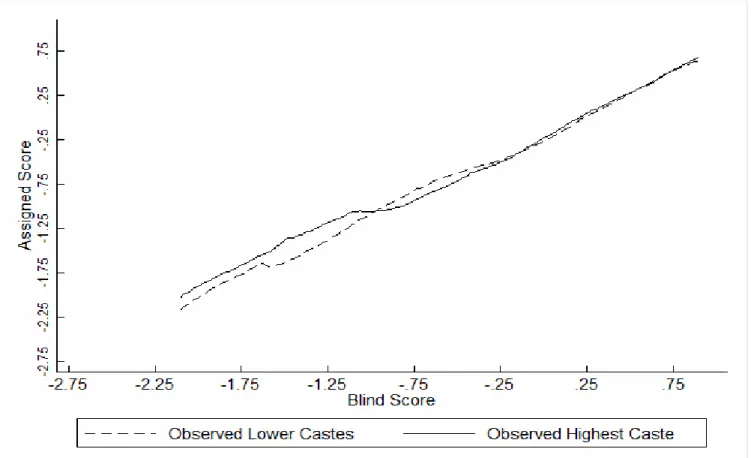
To provide additional detail on the relationship between caste discrimination and test quality, we construct a non-parametric estimate of the relationship between the score assigned to the exam and the score from the blind grading. The estimates are constructed using a local linear polynomial estimator (bandwidth of 0.4) and are presented in Figure 2. The solid line represents the scores assigned to tests labeled as high caste and the dashed line represents the scores assigned to the tests labeled as lower caste. There is a clear break that emerges in the data at about -1.1 standard deviations, in which the high caste children are consistently scored higher than the lower caste children. To estimate this directly, we interact the lower caste indicator with an indicator for having a blindly graded score below -1.1 standard deviations (Column 3 of Table 7). Consistent with Figure 2, lower caste children with a blind test score below -1.1 standard deviations score, on average, -0.15 standard deviations lower than their high caste peers.
B. Parameters of the Exam
In addition to discriminating for (or against) particular types of children, it is also possible that teachers may be more likely to discriminate in particular types of situations. To explore these types of issues, we incorporated two features into the exam: the random ordering of grading and exam sections with varying levels of subjectivity.
For each teacher, we created a packet in which we specified the order in which teachers should grade the exam. Therefore, for each teacher, we know which exams were graded first and which exams were graded towards the end. Using this knowledge, we can test whether teachers discriminate more at the start of the packet, when they were first getting used to the format of the
24 particular test. In Column 1 of Table 8, we show the results between the interaction of the observed characteristics and the place in the grading order (which varies by teacher from 1 to 25), controlling for the place in the grading order in which the exam was graded. In Column 2, we show the results of the interaction between the observed characteristics and a variable that indicates that the exam was graded in the first half of the teacher’s pile. All regressions include the original test characteristics and the grader fixed effect.
We find that the grading order matters. Teachers mark exams that are assigned to be low caste 0.23 standard deviations lower (significant at the 5 percent level; Column 1). However, as grading order increases, the difference is mitigated. As shown in Column 2, being graded in the first half of the packet implies a 0.12 standard deviation gap between the exams that were assigned to be low and high caste (although this is only significant at about the 20 percent level) and a 0.10 gap between the exams that were assigned to be female and male (significant at the 1 percent level). Figure 3 illustrates this low versus high caste comparison graphically. The x-axis is the order in which the exams were graded. The dotted line signifies the assigned scores for the low caste group, while the straight line signifies this for the high caste group. As in the regression analysis, we find a gap in test scores between the low and high caste groups at the start of the grading order, but this effect fades as the place in the grading order increases.
Taken together, these results start to suggest that when teachers are not confident with a testing instrument, discrimination is most likely to occur. It appears that when grading students early in the process, when the overall distribution of scores is unknown, teachers may use the caste of a student not as a signal of performance, but rather as a signal of where the child will eventually land in the overall distribution of tests. This also suggests that programs that improve teacher skills and comfort level with testing instruments, may also potentially reduce the
25 discrimination seen in the classroom. While this is not something we can fully verify in the context of this particular experiment, it provides guidance for future work.
The second feature we attempted to incorporate into the exam was the level of subjectivity of the exam questions. It is possible, for example, that the effects may be small if the teachers have little leeway in assigning points to the exam questions. We specifically included sections on the exam that had different levels of subjectivity. And as demonstrated in Table 2, the relative subjectivity of these sections is borne out by the significantly lower correlations between blind and non-blind scores on the exam’s art section relative to the other sections. In Table 9, we present the results disaggregated by subject. All specifications include the original test characteristics and grader fixed effects as controls. Interestingly, we do not see significant differences across the three subjects. Even on the art section, the observed reduction in test scores for lower caste students is similar to the estimates for the math section.
To better understand these results, we took a closer look at the points assigned for each question on the exam. We did not give the teachers advice about how to assign points for each question; we only provided guidance on the maximum number of possible points per question. Despite the fact that the questions on the test were relatively simple, the graders still made an effort to assign students partial credit for the questions on the Hindi section (and also, to a lesser degree, the math section). Therefore, even though the art exam was the most subjective, in the end, all exams provided the teachers with some level of discretion.
C. Specific Characteristics of the Child and Teacher
We, next, explore whether the results differ by the specific caste group of the child and whether different types of teachers exhibit different degrees of discrimination.
26 In Table 10, we show the results by disaggregated caste groups. While observed gender and age are still included in the specification, the results are near identical to Table 6 and, therefore, we omit them from the tables for conciseness. All specifications also include the original test characteristics and grader fixed effects. In Column 1, we show the main effects of each caste. In Columns 2 and 3, we provide the results of specifications that include the interaction of the caste variable with the blind test score and an indicator variable for an above average score on the blind test, respectively. Recall that the caste groups in terms of descending order of prestige are the Kshatriya, Vaishya, and Shudra.
We find significant differences between the exams that were assigned as belonging to the high caste groups and exams that were assigned as belonging to either the Kshatiya and Shudra groups (Column 1); the effect on exams that were assigned as belonging to the Vaishya group, while negative, is not significant at conventional levels (significant at 15% level). We cannot reject the hypothesis that the coefficients on the three observed caste variables are significantly different from one another. The results from Column 2 and Column 3 are consistent with those from Table 7. Having an above average test scores increases the average scores for individuals labeled as the lower caste groups, relative to those labeled as high caste. This effect is particularly strong for the highest of the low caste groups (Kshatriya).
Finally, we explore whether teachers differ in the degree to which they use students’ observed characteristics as proxies for actual performance. We focus on the four key characteristics that are the most theoretically relevant. First, we explore whether the caste and gender of the teacher affects the observed levels of discrimination. For example, teachers’ beliefs on the average characteristics of children from a particular caste may be influenced by their own caste. Lower caste teachers, for example, may be less likely to use caste as a proxy for
27 performance given their intimate experience with low caste status or may feel partial towards helping someone from their own social group (in-group bias). On the other hand, such teachers may have internalized a belief in the difference in ability as a means of rationalizing historical experience. Thus, low caste teachers may discriminate more against very low status children.12
We do not find evidence of in-group bias. In fact, we observe the opposite. We do not see any difference in test scores between exams assigned as belonging to the lower caste and We test for the presence of in-group bias among the teachers in our sample in regards to caste and gender. In addition, we estimate whether the degree of discrimination varies by the teachers’ education levels or age. More educated teachers may be more aware of and more tolerable of diversity, whereas older teachers may have more experience with individuals of different backgrounds or more experience with children of various backgrounds through more teaching experience.
We present the results of our analysis in Table 11. We present the results by caste, gender, master’s degree completion, and age in Panels A through D, respectively. In Column 1, we show the results for the sample that is listed in the panel title, while in Column 2, we show the results for the remaining teachers. In Column 3, we present the difference between the coefficients. In Column 4, we present results of a specification that includes the interactions between the observed caste variables and all four teacher demographic variables. All regressions include both original test characteristics and grader fixed effects.
12 Previous studies exploring how belonging to a group impacts a person’s treatment of others in that group have found, for the most part, evidence of in-group bias (positive discrimination towards members of your own group). A series of experiments in the psychology literature have found that individuals presented in-group bias in even in artificially constructed groups (Vaughn, Tajfel, and Williams, 1981) or groups that were randomly assigned (Billig and Tajfel, 1973). Turner and Brown (1978) studied “in-group bias” when “status” is conferred to the groups, and found that while all subjects were biased in favor of their own group, the groups identified as superior exhibited more in-group bias. More recently, Klein and Azzi (2001) also find that both “inferior” and “superior” groups gave higher scores to people in their own group. Using data from the game show “The Weakest Link,” Levitt (2004) find that some evidence that men vote more for men and women vote more for women. For a good description of theory and literature of in-group bias the work of Anderson, Fryer, and Holt (2006).
28 those assigned as belonging to the high caste for teachers of the high caste (Column 1, Panel A). However, low caste teachers (Column 2) seem to have discriminated significantly against members of their own group. The difference between low and high caste teachers is large –about 0.2 standard deviations—and significant at the 10 percent level (Column 3). Of course, as described in Table 1, lower caste teachers tend to come from a different socio-economic background than upper caste teachers (more likely to be male, less likely to have a master’s degree, etc), and these characteristics may account for the results we find, rather than caste. To control for these possible confounds, in Column 4, we control for both the main characteristics and the interactions of the characteristics with the observed low caste status. The results remain the same: lower caste teachers significantly downgrade exams that are assigned to be lower caste, relative to the high caste teachers.
Turning to gender, we also do not observe in-group bias. We do not see a significant difference in the way female and male teachers grade exams that are randomly assigned to be male versus female. In terms of caste, we observe that female teachers significantly grade down low caste exams, while male teachers do not. However, the coefficient of the effects for male teachers is not significantly different than the coefficient for female teachers. Moreover, while the coefficients are similar, the sample size of the male teachers is much smaller (33 male teachers versus 87 female teachers), which may account for the higher variance in the estimates for the male teachers.
While we find no significant difference in caste discrimination by teachers’ education or age, we find that more educated teachers and older teachers are more likely to give higher grades to exams that were assigned to be female.
29 VI. DISCUSSION
We find that teachers provide exams that are assigned to be “lower caste” scores that are about 0.03 to 0.09 standard deviations lower than those that are assigned to be “high caste.” What is the underlying model that drives these results? Economic theories of discrimination fall into two main categories. The first type of models falls under the category of taste-based discrimination, in which teachers may have particular preferences for individuals of a particular group or characteristic. The second class of theories encompasses statistical discrimination, in which teachers may use observable characteristics to proxy for unobservable skills.
The empirical design should eliminate the possibility of statistical discrimination, as teachers observe a measure of skill for the child: the actual performance on the exam. However, one can imagine a series of situations where the teacher may statistically discriminate. First, the teacher may be lazy, and may not be invested in carefully studying the exam to determine the skill level for each child. Thus, they may use the demographic variables to instead proxy for skill. While we cannot fully rule out this story, the fact that the teachers knew that a fairly large prize was at stake increased the seriousness of the exercise When they were confused, the teachers asked the project team questions on the grading and all of the teachers seemed to spend a fair bit of time grading each exam. Moreover, if teachers were lazy, we may expect them to mark wrong answers as “0” right away, and not spend time thinking through the answer to determine the correct level of partial credit. In fact, we observe the opposite: teachers gave a considerable amount of partial credit for wrong answers. Thus, it does not appear as though the teachers were slacking.
Second, teachers may statistically discriminate if they are not confident about the testing instrument. In particular, teacher may be unsure about what is the right level of partial credit to
30 give per question and they may be also unsure about what the final distribution of grades will look like. Thus, teachers may use the characteristics of a child, not as a signal of performance, but rather as a signal of where the child will end up in the distribution. The data lends some credence to this theory: discrimination tends to occur at the start of the grading order and fades over time.
On the other hand, there is also considerable evidence that the discrimination is taste-based. First, if we expected the teachers to be statistically discriminating, we would expect them to use observed age to make predictions on the skills of the child, as the age variable has much more predictive power on test scores than caste. However, they tend to discriminate on caste, but not age. Thus, these results can imply taste-based discrimination, rather than just statistical discrimination. Note, however, that we cannot rule out the fact that teachers have incomplete information, or are just bad at making statistical predictions of how children of particular groups will fare on the exams.
Second, the gap in scores based on demographics varies by the quality of the exam: low caste children are hurt when their exam quality is low to begin with and females are hurt when their exams are of high quality. If the teachers were conducting statistical discrimination, we may not expect quality to matter as much.
VII. CONCLUSION
While education has the power to transform the lives of the poor, children who belong to traditionally disadvantaged groups may not reap the full benefits of education if teachers systematically discriminate against them. Through an experimental design, we find evidence that teachers discriminate against low caste children in grading exams. For example, we find
31 teachers give exams that are assigned to be upper caste test scores that are, on average, 0.03 to 0.09 standard deviations higher than those assigned a lower caste classification. We do not find any overall evidence of discrimination by gender or age. Disaggregating the results by the quality of the exam, the low-performing low caste children and top-performing females tend to lose out the most due to discrimination. Quite interestingly, we find that the discrimination against low caste students is driven by low caste teachers, while those teachers from the higher caste do not appear to discriminate at all.
It is important to note that our study only reflects upon one element of discrimination within the classroom. Discrimination may also exist in other forms: calling on students of particular groups but not others, discouraging those of certain groups from furthering their education, and so forth. If, as we show, discrimination exists in the subtle grading of an exam, other more blatant types of discrimination may exist as well. Therefore, our results provide additional motivation for research to investigate how the treatment of children within the classroom differs by race, ethnicity, and gender.
VIII. WORKS CITED
Anderson, Lisa, Roland Fryer and Charles Holt (2006) “Discrimination: Experimental Evidence from Psychology and Economics,” in William M. Rogers, ed. Handbook on the Economics of Discrimination. Northampton, MA: Edward Elgar.
Arrow, Kenneth (1972) “Models of Job Discrimination,” in A. H. Pascal, ed. Racial Discrimination in Economic Life. Lexington, MA: D. C. Health, 83-102.
Banerjee, Abhijit and Marianne Bertrand, Saugato Datta, and Sendhil Mullainathan (2009) “Labor Market Discrimination in Delhi: Evidence from a Field Experiment,” Journal of Comparative Economics. 37(1): 14-27.
Banerjee, Abhijit, Shawn Cole, Esther Duflo, and Leigh Linden (2007)
32 Banerjee, Biswajit and J.B. Knight (1985) “Caste Discrimination in the Indian Urban Labour Market,” Journal of Development Economics. 17(3): 277-307.
Bertrand, Marianne, Rema Hanna, and Sendhil Mullainathan (2008) “Affirmative Action in Education: Evidence from Engineering College Admissions in India,” NBER Working Papers. No 13926.
Bertrand, Marianne and Sendhil Mullainathan (2004) “Are Emily and Greg More Employable than Lakisha and Jamal? A Field Experiment on Labor Market Discrimination,” American Economic Review. 94(4): 991-1013.
Billig, Michael and Tajfel, Henri (2009) “Social Categorization and Similarity in Intergroup Behavior,” European Journal of Social Psychology. 3(1): 27-52.
Chandra, V.P. (1997) “Remigration: Return of the Prodigals: An Analysis of the Impact of the Cycles of Migration and Remigration on Caste Mobility,” International Migration Review. 31(1): 1220-1240.
Coate, Steven and Glenn Loury (1993) “Will Affirmative Action Eliminate Negative Stereotypes?” American Economic Review. 83(5): 1220-1240.
Deshpande, Ashwini and Katherine Newman (2007) “Where the Path Leads: The Role of Caste in Post-University Employment Expectations,” Economic and Political Weekly. 42(41): 4133-4140.
Duflo, Esther, Pascaline Dupas and Michael Kremer (2008) “Peer Effects and the Impact of Tracking: Evidence from a Randomized Evaluation in Kenya,” CEPR Discussion Paper Series, No DP7043.
Duflo, Esther, Rema Hanna, and Stephen Ryan (2008) “Monitoring Works: Getting Teachers to Come to School,” CEPR Discussion Paper Series, No. DP6682.
Ferguson, Ronald (2003) “Teachers’ Perceptions and Expectations and the Black-White Test Score Gap,” Urban Education. 38(4): 460-507.
Fix, M. and R. Struyk (1994) Clear and Convincing Evidence. Washington, DC: The Urban Institute.
Glewwe, Paul, Nauman Ilias, and Michael Kremer (2003) “Teacher Incentives,” NBER Working Paper Series, No. 9671.
He, Fang, Leigh Linden, and Margaret MacLeod (2008) “How to Teach English in India: Testing the Relative Productivity of Instruction Methods within the Pratham English Language Education Program,” Working Paper. Columbia University Department of Economics.
33 Hoff, Karla and Priyanka Pandey (2006) “Discrimination, Social Identity, and Durable Inequalities,” American Economic Review, Papers and Proceedings. 96(2): 206-211.
Holla, Alaka (2007) “Caste Discrimination in School Admissions: Evidence from Test Scores,” Working paper, Innovations for Poverty Action.
Jodhka, Surinder S. and Katherine Newman (2007) “In the Name of Globalisation: Meritocracy, Productivity and the Hidden Language of Caste,” Economic and Political Weekly. 42(41): 4125- 4132.
Klein, Oliver and Assad Azzi (2001) “Do High Status Groups Discriminate More? Differentiation Between Social Identity and Equity Concerns,” Social Behavior & Personality. 29(3): 209-221.
Kremer, Michael, Edward Miguel, and Rebecca Thornton (2009) “Incentives to Learn,” Forthcoming. Review of Economics and Statistics.
Lakshmanasamy, T. and S. Madeshwaran (1995) “Discrimination by Community: Evidence from Indian Scientific and Technical Labour Market,” Indian Journal of Social Science. 8(1): 59-77.
Lavy, Victor (2008) “Do Gender Stereotypes Reduce Girls’ or Boys’ Human Capital Outcomes? Evidence from a Natural Experiment,” Journal of Public Economics. 92(10-11): 2083-2105. Levitt, Steven (2004) “Testing Theories Of Discrimination: Evidence From Weakest Link,” Journal of Law and Economics. 47(2): 431-452.
Madheshwaran, S. and Paul Attewell (2007) “Caste Discrimination in the Indian Urban Labour Market: Evidence from the National Sample Survey,” Economic and Political Weekly. 42(41): 4146-4153.
Mechtenberg, Lydia (2008) “Cheap Talk in the Classroom: How Biased Grading at School Explains Gender Differences in Achievements, Career Choices, and Wages,” Forthcoming Review of Economic Studies.
Munshi, Kaivan and Mark Rosenzweig (2006) “Traditional Institutions Meet the Modern World: Caste, Gender, and Schooling Choice in a Globalizing Economy,” American Economic Review. 96(4): 1225-1252.
Muralidharan, Karthik and Venkatesh Sundararaman (2008) "Contract Teachers: Experimental Evidence from India" Working Paper, University of California at San Diego Department of Economics.
The PROBE Report (1999) Public Report on Basic Education in India. New Delhi, India: Oxford University Press.
34 Rao, V. (1992) “Does Prestige Matter? Compensating Differential for Social Mobility in the Indian Caste System,” University of Chicago Economics Research Center Working Paper Series, No. 92-6.
Shastry, Gauri Kartini and Leigh Linden (2008) “Identifying Agent Discretion: Exaggerating Student Attendance in Response to a Conditional School Nutrition Program,” Working paper, Columbia University Department of Economics.
Siddique, Zahra (2008) “Caste Based Discrimination: Evidence and Policy,” IZA Discussion Paper Series. No 3737.
Steele, Claude and Joshua Aronson (1998) “Stereotype Threat and the Intellectual Test Performance of African-Americans,” Journal of Personality and Social Psychology. 69(5): 797-811.
Taijel, Henri (1970) “Experiments in Inter-Group Discrimination,” Scientific American. 223(5): 96-102.
Unni, Jeemol (2002) “Earnings and Education among Ethnic Groups in India,” Gujarat Institute of Development Research Working Paper Series, No. 124.
Vaughan, G. M., Tajfel, H., and Williams, J. (1981). “Bias in reward allocation in an intergroup and an interpersonal context,” Social Psychology Quarterly, 44(1), 37-42.