Counselor Education Capstone Counselor Education
Spring 5-2015
Mentoring Middle School Students: A Program
Evaluation
Dianne Maerz
The College at Brockport, [email protected]
Follow this and additional works at:http://digitalcommons.brockport.edu/edc_capstone
Part of theCounselor Education Commons
This Capstone is brought to you for free and open access by the Counselor Education at Digital Commons @Brockport. It has been accepted for inclusion in Counselor Education Capstone by an authorized administrator of Digital Commons @Brockport. For more information, please contact
[email protected]. Repository Citation
Maerz, Dianne, "Mentoring Middle School Students: A Program Evaluation" (2015).Counselor Education Capstone. 7.
Mentoring Middle School Students: A Program Evaluation Dianne Maerz
Abstract
This work examined the effectiveness of a first year middle-school-based mentoring program on improving the overall achievement of at-risk students. The literature on school-based mentoring was reviewed to determine variables used to examine the effectiveness of school-based
mentoring programs. Following a quasi-experimental design, three sets of pre- and post-test quantitative data was collected and analyzed regarding students’ academic performance, attendance, and behavior referrals and compared against those of a control group. Mentoring was found to have differential effects on students’ GPA, total and unexcused absences, and behavior referrals. Implications for future research are discussed.
Mentoring Middle School Students: A Program Evaluation
Over the past two decades, mentoring programs in the United States have experienced significant growth. Specifically, school-based mentoring (SBM) is the fastest growing form of mentoring in the country, accounting for nearly half of all youth mentoring programs and reaching approximately 2.5 million at-risk youths annually (MENTOR, 2006; Nunez, Rosario, Vallejo & Gonzalez-Pienda, 2013; Schwartz, Rhodes, Chan & Herrera, 2011). This new momentum for mentoring programs has expanded SBM programming efforts nationwide; however, it has also preceded evidence of the effectiveness of SBM (Kolar & McBride, 2011; McQuillin, Smith & Strait, 2011). This increase in SBM programs coupled with the lack of research is particularly surprising within the school setting because of the strong emphasis on evidence-based practices within schools. Lack of research also presents as a problem for the implementation and evaluation of SBM programs as consistent evaluation measures cannot be clearly determined by the research that has been conducted. Randolph and Johnson (2008) raised questions about “the extent to which [SBM] programs are being evaluated and whether the findings are being disseminated” (p. 184). Ultimately, it is important that more research is conducted to fully understand the impact of SBM on at-risk youths. The purpose of this study is to continue research on SBM programs by evaluating the effectiveness of a first-year school-based mentoring program in improving the overall achievement of at-risk middle school
students. It was hypothesized that students who participated in the mentor program, compared to students in a control group, would have increased overall achievement demonstrated by
increased academic performance, increased attendance, and decreased behavior referrals. Specifically four hypotheses were drawn and tested:
1. Students in the mentor program would have a statistically significant increase in GPA after the intervention compared to the control group.
2. Students in the mentor program would have statistically significant lower total absences after the intervention compared to the control group.
3. Students in the mentor program would have statistically significant lower unexcused absences after the intervention compared to the control group.
4. Students in the mentor program would have statistically significant lower behavior referrals after the intervention compared to the control group.
Review of the Literature
The purpose of this literature review is to define SBM, recognize limitations of SBM programs, examine the results of current research on the effectiveness of SBM programs, and identify implications for future research.
School-Based Mentoring Defined
The concept of mentoring stems from Homer’s epic “The Odyssey” in which Ulysses leaves his son and wife in the care of Mentor as he leaves on his journey (Nunez et al., 2013). Rhodes (2002) defines mentoring as a “relationship between an older, more experienced adult and an unrelated, younger protégé—a relationship in which the adult provides ongoing guidance, instruction, and encouragement aimed at developing the competence and character of the
protégé” (p. 3). Mentoring as an intervention for at-risk youth is based in this idea that the development of a trusting and supportive adult relationship will foster resilience and feelings of connectedness that will carry into other areas of the youth’s life (Komosa-Hawkins, 2011; Schwartz et al., 2011). Unlike other forms of mentoring (community-based mentoring,
year. SBM mentors are typically educators who meet with mentees during the school day, on school property, for one hour each week (Karcher, 2008; Nunez et al., 2013).
The goals of SBM are also different than other forms of mentoring. Converse and Lignugaris/Kraft (2008) found that chronic academic struggle, absenteeism, and behavior problems are predictors of school failure, delinquency, and dropout. For this reason, selected mentees are primarily students at-risk for academic failure and SBM goals are academically focused with expected outcomes including decreasing a student’s risk of academic failure (Kolar & McBride, 2011). Specifically, typical SBM goals include improving academic performance, adjusting to academic life, decreasing truancy, and improving school-related behaviors
(Grossman et al., 2012; McQuillin et al., 2011; Nunez et al., 2013; Wheeler et al., 2010). Limitations of School-Based Mentoring Programs
SBM activities are limited by the time and physical constraints of the school setting (Karcher, 2008; McQuillin, Smith & Strait, 2011; Schwartz et al., 2011; Wheeler, Keller & DuBois, 2010). Specifically, researchers have found that the length of time of the mentoring relationship impacts the outcomes of SBM. Grossman and Rhodes (2002) found that SBM effects became stronger as relationships lasted longer. Relationships lasting less than 3 months showed no positive impacts. Mentees experienced the most benefits after a SBM relationship of at least 6 months. Those relationships that lasted beyond the academic year and longer than one full year had the strongest positive impact. Time for a SBM program is limited within the school setting and could present a reason for the mixed results on SBM effectiveness as the average SBM relationship lasts for only 5 months (Grossman et al., 2012). Despite this limitation, SBM programs have increased due to the relatively low costs and convenience of utilizing the school setting (Portwood, Ayers, Kinison, Waris, & Wise, 2005).
The termination process of a SBM program is another important aspect that can affect the program’s overall effectiveness. Grossman and Rhodes (2002) concluded that the negative effects found for SBM relationships that lasted 3 months were a result of early termination of the mentoring relationship, as students expected the relationship to last for the full academic year. Kolar & McBride (2011) also found that mentees whose SBM relationship ended prematurely showed no impact. Additionally, mentees who were matched with a new mentor after the first relationship ended actually showed negative impacts. Since SBM is a primarily relationship-based intervention, it is important that the termination process is clear for both the mentor and the mentee to ensure a SBM program’s effectiveness. It is important that these limitations are taken into account when implementing and examining the effectiveness of SBM programs. Effectiveness of School-Based Mentoring Programs
Following the primary goals of SBM programs, the majority of research on this topic has examined the impact of SBM on the same three variables: academic performance, attendance, and behavior. Research studies were examined to determine whether or not these variables are the primary outcomes of SBM and if they are appropriate to use in the evaluation of a SBM program.
Impact on academic performance. Wheeler et al. (2010) suggest that “the rise of school-based mentoring has been somewhat contingent on its perceived promise to improve academic outcomes” (p. 5); however, the results of current research on the effectiveness of SBM programs on academic performance are mixed and inconsistent as some studies show SBM to have a positive impact on increasing academic performance, others show positive impacts only under certain conditions, and other studies show no impact and even negative impacts in this area. Two studies showed either no impact or negative impacts on mentees. McQuillin et al.
(2011) found SBM to have negative effects on academic performance as students who were mentored presented lower reading, English and Language Arts (ELA), and Math scores. Another study by Kolar & McBride (2011) found SBM to have no impact on mentees’ Grade Point Average (GPA).
Other studies found that SBM positively impacted academic performance under certain conditions. Two studies found positive academic effects to be dependent on certain features of the mentee. For example, Portwood et al. (2005) found that only students who started the SBM program YouthFriends with a GPA below 2.0 saw an increase in academic performance.
Schwartz et al. (2011) examined the impact of SBM on students with different relational profiles and found that only those who had moderately supportive relationships, as opposed to strong relationship or weak relationships, with parents, teachers, and peers found academic benefits from SBM. Another study by Grossman et al. (2012) noted that academic performance was affected by features of the mentor-mentee relationship and found positive impacts only when the SBM relationship lasted at least 12 weeks.
Other researchers suggest that increased academic performance may be a more distal effect of SBM. For example, Nunez et al. (2013) found SBM to increase students’ self-regulated learning (SRL) skills that would help them better meet school demands and eventually lead to increased academic performance. Several researchers agree that the psychosocial outcomes related to SBM, such as increased school connectedness and self-esteem, are interrelated to academic outcomes and over time will positively influence academic performance (Karcher, Kupermine, Portwood, Sipe & Taylor, 2006; Karcher, 2008; Komosa-Hawkins, 2012). Additionally, in their meta-analysis of three randomized trials of SBM, Wheeler et al. (2010), found no impact on students’ actual math performance, but did find favorable overall effects on
students’ perceptions of academic performance. The positive effects of SBM on academic performance likely result from the more direct psychosocial outcomes of increased school connectedness, self-perception, and self-esteem (Karcher et al., 2006; Karcher, 2008; Komosa-Hawkins, 2012).
Impact on attendance. Most studies found that SBM results in increased student attendance. Specifically, the following three studies showed SBM to positively impact student attendance in some way. DeSocio, VanCura, Nelson, Hewitt, Kitzman, and Cole (2007) found that students in an urban high school setting who participated in SBM had significantly fewer absences from all classes. Another broader study found mentored students to be less likely to have unexcused absences than non-mentored students (Grossman et al., 2012). Finally, a meta-analysis of three SBM trials found a positive impact on absenteeism and truancy (Wheeler et al., 2010). While most of the research on SBM and attendance found favorable results, one
additional study found SBM to have no impact on unexcused absences (Converse & Lignugaris/Kraft, 2008).
Impact on behavior. The majority of research suggests that SBM has a positive influence on student behavior (Randolph & Johnson, 2008). Schwartz et al. (2011) found that SBM increased positive behaviors as mentored students showed improved pro-social behaviors towards their peers such as comforting a peer when s/he is upset. Other studies found SBM decreased negative school-related behaviors. In a meta-analysis, Wheeler et al. (2010) concluded that SBM favorably impacts school-related misconduct. SBM also results in fewer behavior referrals to administrators (Converse & Lignugaris/Kraft, 2008). Mentored students also
presented with improved self-perceptions of classroom behavior (Kolar & McBride, 2011). Only one study found SBM to have no effect on student behavior (McQuillin et al., 2011).
Conclusion and Implications
Continuing research on the effectiveness of SBM program is needed to fully understand the impact of SBM, particularly as mentoring programs continue to grow and change. McQuillin et al. (2011) suggest that SBM programs need to be rigorously evaluated to “establish safety and efficacy” (p. 855). It is already clear that the length of the mentoring relationship and
termination procedures influence SBM effectiveness; therefore, part of this rigorous evaluation should include examining the effectiveness of additional components of the mentoring
relationship. Research is also needed to assess student outcomes after their SBM participation has ended. As the primary goal of SBM is to prevent academic failure, it would be beneficial to examine the impact of SBM on eventual graduation rates. It is also important that the results of all future research are shared to update the already widespread SBM community.
This literature review defined SBM and identified its limitations, examined the results of current research on the effectiveness of SBM, and presented recommendations for future
research. Research efforts have struggled to keep pace with the proliferation of SBM
programming over the past 20 years, yet SBM programs have been increasingly used in schools as an intervention for students at-risk for academic failure. This growth is a result of the
perceived impact of SBM on academic performance; however, the research is not always consistent with this perception. While the majority of research found SBM to have a positive influence on student attendance and behavior, the results of research on SBM and academic performance are mixed. Effectiveness of SBM on academic performance is dependent on characteristics of the mentee and of the mentor-mentee relationship. Additionally, academic performance is likely a primarily indirect result of SBM. SBM directly impacts psychosocial outcomes such as self-esteem, self-perceptions, and school connectedness which in turn
influence the student’s academic performance. With this information, researchers should consider using these more direct psychosocial outcomes as an evaluation measure of SBM programs rather than increased academic performance.
Method
This study follows a quantitative, quasi-experimental design to test the hypotheses that following participation in this school-based mentoring program, students will have (a) increased academic performance, (b) increased attendance, and (c) decreased behavior referrals. Pre- and post-test data were collected regarding students’ GPA, total absences, unexcused absences, and behavior referrals. Changes in pre- and post-test data for mentees were calculated and compared against those of a control group.
Setting
The middle school selected for this study is located in a rural-suburban school district in the northeastern United States. The middle school included 739 total students in grades 7 and 8 and serves a primarily White population. Of this population, 52% of students were male and 48% were female. Student ethnicity was represented by 90% White, 5% Hispanic/Latino, 2% African American, 2% Asian, and 1% American Indian/Alaska Native. Additionally, 26% of students receive free and reduced lunch.
Participants
Mentees. A pool of 46 students were identified as at-risk based on course failure in the previous academic year, high numbers of unexcused absences and/or recommendation from the School Counselors. School Counselors, along with the Director of Student Services, then reviewed the pool of eligible students and selected 14 students to participate in the mentor program. These students were selected from the original pool of 46 students and matched with
an available mentor based on the counselors’ understanding of the student, counselors’ belief that the student could benefit from the program, and whether or not support services were already being received by the student. Students were then interviewed by two School Counselor Interns and the Director of Student Services and asked to participate. Once students provided assent, they were also given a permission slip to participate in the mentor program that was signed by the student’s parent/guardian.
An additional 14 students with similar demographics and at-risk identifiers to those of the mentees were selected by the researcher to serve as a control group. Ethnicity of mentees was represented by 64% White, 21% African American, and 15% Hispanic, whereas the control group was composed of 86% White, 7% African American, and 7% Hispanic. The mentor group was 57% male and 43% female, and the control group was 64% male and 36% female.
Additionally, in both the mentee group and the control group there were 12 students in grade 8 and two students in grade 7.
Mentors. Individuals from within the school district and school community were invited by the Director of Student Services to participate in the program as mentors. A total of 14 mentors volunteered and included the Superintendent of Schools, three district administrators, three building principals, two assistant principals, one teacher, one librarian, two high school students, and one recent high school graduate. There were nine female mentors (64%) and five male mentors (36%).
Mentor Program Procedure
This mentor program was started by the school district’s Director of Student Services with the primary goal of improving the overall achievement of at-risk middle school students. Mentors and mentees were expected to meet for 45-60 minutes once each week for a total of 16
weeks between December and April, during the second and third marking periods. Meetings took place on school property either during the school day or directly after school and were scheduled by an on-campus faculty coordinator. The role of the mentor in these meetings is to create a caring mentoring relationship with the mentee. Prior to the start of the mentor program, mentors were provided a list of mentor duties including (a) commit to regular schedule, (b) keep regular appointments, (c) show up as the student’s advocate/cheerleader, (d) listen and understand student barriers to learning, (e) listen and understand teacher’s perceptions of student needs, (f) liberally use positive affirmations, (g) assist academically, (h) assist with organizational needs, (i) listen to students, and (j) maintain some confidentiality while also informing student of need to report safety concerns.
Data Collection and Analysis
Data points were collected for the first, second, and third grading quarters for the 2013-2014 and the 2013-2014-2015 school years to represent pre- and post-test information. These quarters will henceforth be referred to as follows: first quarter of 2013-2014 = “Q1”, second quarter of 2013-2014 = “Q2”, third quarter of 2013-2014 = “Q3”, first quarter of 2014-2015 = “Q4”, second quarter of 2014-2015 = “Q5”, and third quarter of 2014-2015 = “Q6”. Data points included student GPA, total and unexcused absences, and behavior referrals. Four sets of pre- and post-test data were utilized in each area (GPA, total and unexcused absences, and behavior referrals) and are represented in Table 1. Test 1 looks at the difference between the student’s average GPA, absences, and behavior referrals from Q5 and Q6 and his/her average GPA, absences, and behavior referrals from Q1, Q2, Q3, and Q4. Test 2 compares the student’s GPA, absences, and behavior referrals after the mentor program (Q6) to the same data points at the same time last year (Q3). Finally, Test 3 compares the student’s GPA, absences, and behavior
referrals after the mentor program (Q6) to the same data points before the mentor program this year (Q4).
Pre- and Post-Test Data Points
Pre-Test Post-Test
Test 1 Average of Q1, Q2, Q3, Q4 Average of Q5, Q6
Test 2 Q3 Q6
Test 3 Q4 Q6
For each test the difference between the pre- and post-test data was calculated. These calculations were then run through independent samples t-tests to compare mean changes in
GPA, total and unexcused absences, and behavior referrals between mentor students and students in the control group.
Results GPA
Test 1. This test examined the hypothesis that students in the mentor program would have a statistically significant higher average GPA during and after the mentor program (average Q5 and Q6) than average GPA before the mentor program (average Q1, Q2, Q3, and Q4). The control group (n = 11) was associated with a change in average GPA M = .72 (SD = 6.75). By
comparison, the mentor group (n = 7) was associated with a numerically smaller change in average GPA M = -.73 (SD = 6.66). An independent samples t-test was performed to test the
hypothesis. The assumption of equal variances was tested and satisfied with Levene’s F test,
F(16) = .16, p = .691. As seen in Table 2, the independent samples t-test was not associated with
a statistically significant effect, t(16)= -.45, p = .662, 95% CI [-8.33, 5.44]. Further, Cohen’s
effect size value (d = -.22) suggested a low practical significance. For this test, mentor students’
fact, the average of mentor students’ GPA during and following the intervention slightly decreased whereas the average GPA of students in the control group slightly increased. Graphical representation of the means can be seen in Figure 1.
Test 2. This test used an independent samples t-test to investigate the hypothesis that
students in the mentor program would have a statistically significant higher GPA after the mentor program (Q6) than at the same time during the previous year with no mentor program (Q3). The control group (n = 11) was associated with a change in GPA from the third quarter from the previous year to the third quarter following the mentor program M = 1.29 (SD = 6.75).
The mentor group (n = 7) was associated with a numerically greater change in GPA M = 4.5 (SD
= 8.95). The assumption of equal variances was tested and satisfied with Levene’s F test, F(16)
= .23, p = .638. The independent samples t-test did not have statistically significant results, t(16)
= .69, p = .503, 95% CI [-6.72, 13.14] (Table 2). Additionally, Cohen’s effect size value (d =
.34) suggested a low to moderate practical significance. While not statistically or practically significant, the mentor student’s GPA compared to the same grading quarter of last year did increase more than the GPA of the student’s in the control group (Figure 1).
Test 3. In this test, the control group (n = 13) was associated with a mean change in GPA from the first quarter of 2014-2015 (Q4) to the third quarter of 2014-2015 (Q6) M = -1.49
(SD = 8.85). The mentor group (n = 10) was associated with a mean change in GPA M = -1.19
(SD = 5.40). The independent samples t-test was conducted to test the hypothesis that mentor
students would have a statistically significant higher GPA immediately after the mentor program than immediately before the intervention. The assumption of equal variances was tested and satisfied with Levene’s F test, F(21) = 1.6, p = .227. As seen in Table 2, the test was not
associated with statistically significant results, t(21) = .10, p = .925, 95% CI [-6.31, 6.93] nor
practically significant results (d = .02). In this test, both groups GPA’s decreased (Figure 1).
Table 2
Change in GPA after Mentor Program
Mentor Students Control Students 95% CI Cohen’s
d n M SD n M SD t df p LL UL
Test 1 7 -.72 6.66 11 .72 6.75 -.45 16 .662 -8.33 5.44 -.22
Test 2 7 4.50 8.95 11 1.29 10.11 .69 16 .503 -6.72 13.14 .34
Test 3 10 -1.19 5.40 13 -1.49 8.85 .10 21 .925 -6.31 6.93 .02
Figure 1. Graphical representation of mean change in GPA from pre-test to post-test for students
in the mentor program and students in the control group. Total Absences -1.19 4.5 -0.73 -1.49 1.29 0.72 -2 -1 0 1 2 3 4 5 Test 3 Test 2 Test 1
Figure 1. Change in GPA
Test 1. Test 1 used an independent samples t-test to examine the hypothesis that
students in the mentor program will have statistically significant decrease in average total absences during and after the intervention. The control group (n = 11) was associated with a mean change in average total absences M = .73 (SD = 2.06). The mentor group (n = 8) was
associated with a mean change in average total absences M = .63 (SD = 6.44). Levene’s F test
satisfied the assumption of equal variances, F(17) = 2.1, p = .168. The independent samples t
-test was not associated with statistically significant results, t(17) = .88, p = .392, 95% CI [-1.70,
4.12] (Table 3). Further, Cohen’s effect size value (d = .39) suggested a low to moderate
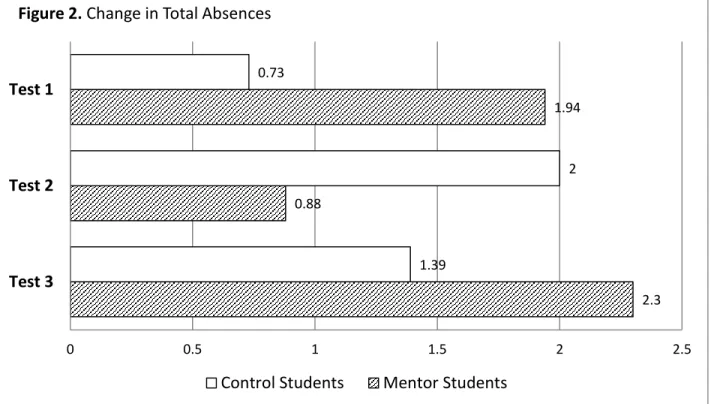
practical significance. As seen in Figure 2, average total absences for both groups increased. Additionally, average total absences for students in the mentor program increased more than for students in the control group.
Test 2. This test examines the hypothesis that students in the mentor program would have statistically significant lower total absences after the mentor program (Q6) than at the same time during the last school year (Q3) when compared to students in the control group. The control group (n = 11) had an average change in total absences M = 2.00 (SD = 2.93). The
mentor group (n = 8) had a lower average change in total absences M = .88 (SD = 5.25). An
independent samples t-test was conducted to test the hypothesis and the assumption of equal variances was tested and satisfied by Levene’s F test, F(17) = .77, p = .393. As seen in Table 3,
the results of the test were not statistically significant t(17) = -.60, p = .558, d = -.26, 95% CI
[-5.10, 2.85] and had a low practical significance (d = -.26). For this test, while both groups’ total absences increased, the mentor student’s total absences increased less than the control group students (Figure 2).
Test 3. In this test, the control group (n = 13) had a mean change in total absences M =
1.38 (SD = 3.28) and the mentor group (n = 10) had a mean change in total absences M = 2.30
(SD = 4.42). The hypothesis that the mentor group would have statistically significant lower
total absences after the mentor program (Q6) than immediately before the intervention (Q4) when compared to the control group was tested with an independent samples t-test. Equal variances were assumed based on the results of Levene’s F test, F(21) = .25, p = .626.
Statistically significant results were not found t(21) = .57, p = .571, 95% CI [-2.42, 4.25]. Cohen’s effect size value (d = .24) also suggested a low practical significance. The results show
that both groups’ total absences increased (Table 3, Figure 2). In fact, the total absences of students in the mentor program increased more than those of the control group.
Table 3
Change in Total Absences after Mentor Program
Mentor Students Control Students 95% CI Cohen’s
d n M SD n M SD t df p LL UL
Test 1 8 1.94 3.91 11 .73 2.06 .88 17 .392 -1.70 4.12 .39
Test 2 8 .88 5.25 11 2.00 2.93 -.60 17 .558 -5.10 2.85 -.26
Figure 2. Graphical representation of change in number of total absences from pre-test to
post-test for students in the mentor program and students in the control group. Unexcused Absences
Test 1. For Test 1, an independent samples t-test was conducted to test the hypothesis that a student’s average unexcused absences during and after participation in the mentor program (Q5 and Q6) would have a statistically significant decrease from his/her average unexcused absences in the quarters before the mentor program (Q1, Q2, Q3, and Q4) when compared against a control group. The control group (n = 11) had a mean change in average unexcused absences M = .57 (SD = 1.44). The mentor group (n = 7) had a change in average unexcused
absences M = .43 (SD = 1.97). Equal variances between groups was assumed based on Levene’s F test F(16) = .21, p = .655. This test was not associated with statistically significant
results t(16) = -.17, p = .864, 95% CI [-1.84, 1.56] nor practically significant results (d = -.08).
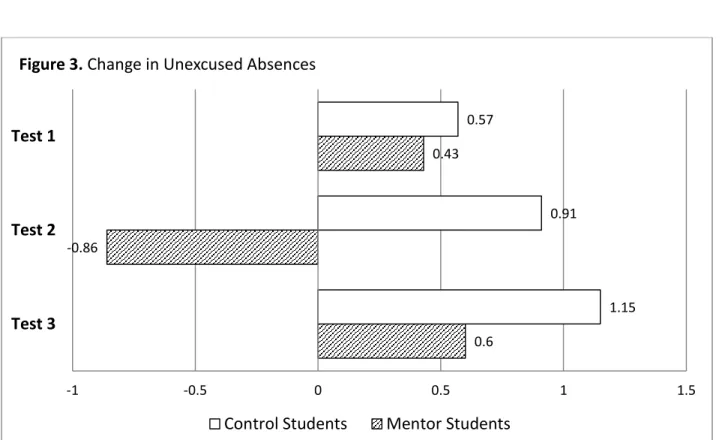
These results show that both groups’ average unexcused absences increased (Figure 3). 2.3 0.88 1.94 1.39 2 0.73 0 0.5 1 1.5 2 2.5 Test 3 Test 2 Test 1
Figure 2. Change in Total Absences
Test 2. In Test 2, the control group (n = 11) was associated with a mean change in unexcused absences M = .91 (SD = 2.17) whereas the mentor group (n = 7) was associated with a
change in unexcused absences M = -.86 (SD = 3.08). An independent samples t-test was
conducted to test the hypothesis that mentor students would have statistically significant lower absences after the mentor program (Q6) than the same grading quarter of the previous academic year (Q3) when compared against a control group. The assumption of equal variances was tested and satisfied with Levene’s F test F(16) = .10, p = .752. The results of this test were not
statistically significant t(16) = -1.43, p = .558, 95% CI [-5.10, 2.85] (Table 4). However, Cohen’s effect size value (d = -.66) suggested a moderate to high practical significance. These
results illustrate that both groups’ unexcused absences increased after the mentor program, but that the unexcused absences of students in the mentor program increased less than those of the control group (Figure 3).
Test 3. This test examines the hypothesis that students’ unexcused absences immediately after the mentor program (Q6) will have a statistically significant decrease from immediately before (Q4) the intervention when compared to a control group. The control group (n = 13) was associated with a mean change in unexcused absences M = 1.15 (SD = 1.57) and the mentor
group (n = 10) was associated with a mean change in unexcused absences M = .60 (SD = 1.78). Equal variances between groups was assumed based on the results of Levene’s F test F(21) =
.07, p = .794. While the results of this test were not statistically nor practically significant, t(21)
= -.79, p = .437, 95% CI [-2.01, .90], (d = -.33), they do indicate that the unexcused absences of
mentor students decreased where the unexcused absences of students in the control group actually increased (Table 4, Figure 3).
Change in Unexcused Absences after Mentor Program
Mentor Students Control Students 95% CI Cohen’s
d n M SD n M SD t df p LL UL
Test 1 7 .43 1.97 11 .57 1.44 -.17 16 .864 -1.84 1.56 -.08
Test 2 7 -.86 3.08 11 .91 2.17 -1.43 16 .558 -5.10 2.85 -.66
Test 3 10 .60 1.78 13 1.15 1.57 -.79 21 .437 -2.01 .90 -.33
Figure 3. Graphical representation of number of unexcused absences from pre-test to post-test
for students in the mentor program and students in the control group. Behavior Referrals
Test 1. For this test, an independent samples t-test was used to test the hypothesis that
students would have statistically significant lower average behavior referrals during and after the mentor program (average Q5 and Q6) than average behavior referrals before the intervention (average Q1, Q2, Q3, and Q4) as compared to a control group. The control group (n =12) was
0.6 -0.86 0.43 1.15 0.91 0.57 -1 -0.5 0 0.5 1 1.5 Test 3 Test 2 Test 1
Figure 3. Change in Unexcused Absences
associated with mean change in average behavior referrals M = .44 (SD = .73). The mentor
group (n = 9) had a mean change in average behavior referrals M = .14 (SD = .31). The assumption of equal variances was tested and accepted with Levene’s F test F(19) = 2.4, p =
.141. This test was not associated with statistically significant results t(19) = -1.14, p = .267,
95% CI [-.84, .25] (Table 5). Cohen’s effect size value (d = .52) suggested a moderate practical
significance. For this test, the behavior referrals for both groups increased, but the behavior referrals of the mentor group increased less than those of the control group (Figure 4).
Test 2. Test 2 examines the hypothesis that students’ behavior referrals after the mentor program (Q6) would have a statistically significant decline from behavior referrals from the third grading quarter of the previous year (Q3) compared to a control group. The control group (n = 12) had a mean change in behavior referrals M = .58 (SD = .69) and the mentor group (n = 9) had
a mean change in behavior referrals M = .22 (SD = 1.30). An independent samples t-test was
conducted to test the hypothesis. Equal variances for both group was assumed based on Levene’s F test F(19) = .48, p = .498. As seen in Table 5, statistically significant results were
not found t(19) = -.83, p = .417, 95% CI [-1.27, .55]. Further, Cohen’s effect size value (d =
-.35) suggested a low to moderate practical significance. The results indicate that behavior referrals for both groups increased, but again, the behavior referrals of students in the mentor program increased less than those of the control group (Figure 4).
Test 3. The control group (n = 13) was associated with a mean change in behavior referrals M = .15 (SD = .90) and the mentor group (n = 10) was associated with a mean change in
behavior referrals M = -.10 (SD = .32). An independent samples t-test was used to test the
hypothesis that students in the mentor program would have statistically significant lower behavior referrals immediately after the intervention (Q6) than immediately before the program
began (Q4) as compared to the control group. For this test, the assumption of equal variances was tested with Levene’s F test F(21) = 6.67, p = .017. As a result, the null hypothesis was
accepted and equal variances were not assumed. While the results of this test were not statistically nor practically significant t(21) = -.85, p = .405, 95% CI [-.88, .37], d = -.38, they
show that where behavior referrals over the course of the year for students in the control group increased, behavior referrals for students in the mentor program decreased (Table 5, Figure 4). Table 5
Change in Behavior Referrals after Mentor Program
Mentor Students Control Students 95% CI Cohen’s
d n M SD n M SD t df p LL UL Test 1 9 .14 .31 12 .44 .73 -1.14 19 .267 -.84 .25 .52 Test 2 9 .22 1.30 12 .58 .69 -.83 19 .417 -1.27 .55 -.35 Test 3 10 -.10 .32 13 .15 .90 -.85 21 .405 -.88 .37 -.38 -0.1 0.22 0.14 0.15 0.58 0.44 -0.2 -0.1 0 0.1 0.2 0.3 0.4 0.5 0.6 0.7 Test 3 Test 2 Test 1
Figure 4. Change in Behavior Referrals
Figure 4. Graphical representation of change in number of behavior referrals from pre-test to
post-test for students in the mentor program and students in the control group. Discussion
The purpose of this study was to evaluate a first-year middle school based mentoring program in improving overall student achievement. The results of this study suggest that this pilot mentoring program produced no significant effect with regards to academic performance, attendance and behavior referrals. Additionally, the test trends within each subsection (GPA, total absences, unexcused absences, and behavior referrals) are all mixed and cannot be used to fully support the hypotheses that students in the mentor program experienced improvement in those areas. Therefore, the null hypothesis that there is no difference in the academic
performance, attendance, and behavior referrals between the mentor students and the control students cannot be rejected. These findings are consistent with previous research which has shown that SBM programs can vary considerably in their effectiveness (Converse &
Lignugaris/Kraft, 2008; Nunez et al., 2013; Schwartz et al., 2011). Academic Performance
The mixed findings between mentored and non-mentored students’ change in GPA is similar to the findings of previous research. Most studies found mentoring to have a direct impact on GPA only under certain conditions such as starting GPA, mentor-mentee match length, and relational profiles of mentees (Grossman et al., 2012; Portwood et al., 2005;
Schwartz et al., 2011). Those studies that found mentoring to have positive effects on academic performance determined that those effects were a primarily indirect result and could be attributed to the primary psychosocial benefits of mentoring (Karcher, et al., 2006; Karcher, 2008;
students’ GPA only increased from the previous school year. It is important to note that, in this test, the control students’ GPA also increased, although not as much. In the other two tests, the GPA of mentored students’ actually decreased; whereas in one case, the GPA of the control students’ increased slightly. While none of these results were statistically or practically
significant, the test trends indicate inconsistent findings regarding the benefits mentoring has on academic performance.
Attendance
The findings of this study, while not statistically significant, indicate that total absences increased for both mentored and non-mentored students. Additionally, in two of the tests which included all absences from the current school year, unexcused absences for both groups
increased. These findings are consistent with those of Converse & Lignugaris/Kraft (2008); however, these results are dissimilar to those of the majority of previous research which links mentoring to have a positive impact on attendance (DeSocio et al., 2007; Grossman et al., 2012; Wheeler et al., 2010). Only when comparing attendance to that of the previous school year was there a trend of decreased unexcused absences for mentored students and increased unexcused absences for the control group.
Behavior Referrals
In this study, behavior referrals was the one subgroup in this study that consistently performed better compared the control group. However, behavior referrals only actually
decreased for mentor students in one test, when comparing behavior referrals within the context of the same school year. In the other two tests, mentored students behavior referrals simply did not increase as much as those of the control group. The trends of this study are inconsistent with the findings of the majority of previous research which primarily found mentoring to decrease
behavior referrals to administrators (Converse & Lignugaris/Kraft, 2008). Similarly to academic performance, it is possible that decrease behavior referrals may be a more distal effect, where the primary effect is increasing pro-social behaviors and self-perception of classroom behavior (Kolar & McBride, 2011; Schwartz et al., 2011).
Limitations
Several limitations related to this study should be noted. First, this study included only a small number of mentored students from one rural-suburban middle school in one state. Mentor-mentee match length before evaluation is another limitation. For this study, mentors and
mentees lasted for a total of 16 weeks between December and April. The mixed results follow the findings of previous literature which found that positive effects are mostly found with mentor relationships lasting less than 6 months (Grossman & Rhodes, 2002; Grossman et al., 2012).
Additionally, some student information could not be obtained and was not included in the study. Two students in the mentor program and two students in the control group were in 7th grade. Data for these students from the 2013-2014 school year could not be obtained for GPA and total and unexcused absences. These students were only included in Test 2 for these areas. Another student in the mentor program was new to the district and data from the 2013-2014 school year on unexcused absences, behavior referrals, GPA, and core class grades were not available. This student’s data was included in all tests for total absences and only in Test 2 for the other there areas. Finally, the grades of one of the students in the mentor program for the 2013-2014 school year was unavailable. This student was only included in Test 2 for GPA.
Finally, during data analysis, some students were removed from the sample during the study for not fully completing the mentor program. Two students in the mentor program moved out of district during the study, one student in the control group moved out of district during the
study, one student in the mentor program consistently missed mentor meetings and the mentor relationship was terminated 3 weeks prior to the end of the study, and one student in the mentor program met with the mentor only once.
Implications for Future Research
The mixed findings of this study reinforce the need to continue research on the effectiveness of SBM programs. Replication of this study in different settings is needed to evaluate any generalizable effects mentoring on overall student achievement. Future research should also consider whether academic performance, attendance, and behavior are valid measures for testing the efficacy of SBM. According to the previous research, other possible measures could include psychosocial outcomes such as increased self-esteem, self-perception and feelings of school connectedness (Karcher, Kupermine, Portwood, Sipe & Taylor, 2006; Karcher, 2008; Komosa-Hawkins, 2012). These psychosocial measures could then improve academic performance, attendance, and school behavior over time. Therefore, future research may look at the impact of mentoring on academic performance, attendance, and school behavior as a more distal effect over a longitudinal study. Ultimately it is important that, due consistent mixed findings, SBM programs should be evaluated on a case-by-case basis until sufficient, replicable mentoring procedures are known.
References
Converse, N. & Lignugaris/Kraft, B. (2008). Evaluation of a school-based mentoring program for at-risk middle school youth. Remedial and Special Education, 30(1), p. 33-46.
DeSocio, J., VanCura, M., Nelson, L. A., Hewitt, G., Kitzman, H., & Cole, R. (2007). Engaging truant adolescents: Results from a multifaceted intervention pilot. Preventing School
Failure, 51(3), p. 3-11.
Grossman, J. B., Chan, C. S., Schwartz, S. E. O., & Rhodes, J. E. (2012). The test of time in school-based mentoring: The role of relationship duration and re-matching on academic outcomes. American Journal of Community Psychology, 49, p. 43-54.
Grossman, J. B., & Rhodes, J. E. (2002). The test of time: Predictors and effects of duration in youth mentoring programs. American Journal of Community Psychology, 30, 199-219.
Karcher, M. J., Kupermine, G., Portwood, S., Sipe, C., & Taylor, A. Mentoring programs: A framework to inform program development, research, and evaluation. Journal of
Community Psychology, 34, p. 709-725.
Karcher, M. J. (2008). The study of mentoring in the learning environment (SMILE): A randomized evaluation of the effectiveness of school-based mentoring. Prevention
Science, 9, p. 99-113.
Kolar, D. W., & McBride, C. A. (2011). Mentoring at-risk youth in schools: Can small doses make a big change? Mentoring & Tutoring: Partnership in Learning, 19(2), p. 125-138.
Komosa-Hawkins, K. (2012). The impact of school-based mentoring on adolescents’ social-emotional health. Mentoring & Tutoring: Partnership in Learning, 20(3), p. 393-408.
McQuillin, S., Smith, B., & Strait, G. (2011). Randomized evaluation of a single semester transitional mentoring program for first year middle school students: A cautionary result
for brief, school-based mentoring programs. Journal of Community Psychology, 39(7), p.
844-859.
MENTOR/National Mentoring Partnership. (2006). Mentoring in America 2005: A snapshot of the current state of mentoring. Alexandria, VA: Author.
Nunez, J. C., Rosario, P., Vallejo, G., & Gonzalez-Pienda, J. A. (2013). A longitudinal
assessment of the effectiveness of a school-based mentoring program in middle school.
Contemporary Educational Psychology, 38, p. 11-21.
Portwood, S. G., Ayers, P. M., Kinnison, K. E., Waris, R. G., & Wise, D. L. (2005). YouthFriends: Outcomes from a school-based mentoring program. The Journal of
Primary Prevention, 26(2), p. 129-145.
Randolph, K. A. & Johnson, J. L. (2008). School-based mentoring programs: A review of the research. Children & Schools 30(3), p. 177-185.
Rhodes, J. (2002). Stand by me: The risks and rewards of mentoring today’s youth. Cambridge,
MA: Harvard University Press.
Schwartz, S. E. O., Rhodes, J. E., Chan, C. S., & Herrera, C. (2011). The impact of school-based mentoring on youths with different relational profiles. Developmental Psychology, 47(2),
p. 450-462.
Wheeler, M. E., Keller, T. E., & DuBois, D. L. (2010). Review of three recent randomized trials of school-based mentoring: Making sense of mixed findings. Society for Research in