Teacher agency in the reform of curriculum under Universal Primary
Education in Uganda and its implications for emerging practices
Tom Henry Ogwang
A thesis submitted for the award of degree of Doctor of Philosophy in
Education
UNIVERSITY OF STIRLING
Abstract
This thesis deals with the role of teacher agency in the reform of curriculum under Universal Primary Education (UPE) in Uganda. It draws on empirical research conducted in two UPE case study schools in Uganda. The study was conducted in order to highlight the role of teacher agency in teachers’ professional practice and to analyse the ecological factors that contribute in shaping it, as well as its effects.
The thesis begins with a description of the UPE curriculum in its global dimensions. It subsequently reviews the theoretical and empirical literature dealing with the role of teacher agency in the reform of curriculum under UPE, under the themes of ‘globalisation’, ‘teacher/biographical barriers to UPE reforms’, ‘contextual challenges of the reforms on teachers’, ‘teachers’ mediation of the reform challenges’ and ‘effects of the teachers’ mediation of reforms’.
The study’s theoretical position draws on the critical realist philosophy of Roy Bhaskar and Margaret Archer, which guided the development a two-phased study design comprising of secondary document analysis using retroduction (Elder-Vass 2010; Edwards et al. 2014) in phase one and field work within the framework of Priestley et al.’s (2015b) ecological approach to teacher agency in phase two. The field work involved semi-structured interviews, observation and primary document analysis.
The study established that the globalisation of UPE was driven by Education for All (EFA) under a neo-liberal agenda, which involved both structural and cultural reform. The structural reform has impacted UPE’s ecology through the evolution of a new ‘governance’ structure underpinned by partnership, decentralisation and performativity. Furthermore, it has involved access and inputs reform, which has been characterised by universalisation and the adoption of a partnership funding approach. Cultural reform has focused on curriculum and pedagogy. However, at the micro level of school/classroom practice, most of the reforms have resulted in ‘first order’ changes (Cuban 1998; Priestley 2011a), which are currently manifested by only partial success in absorbing the curriculum and pedagogy reforms, coupled with the continued lack of inputs. This is attributed, among others, to the responses of the teachers, or teacher agency.
The study analysed the role of teacher agency in the case studies and concluded that it is widely manifested and is primarily driven by the practical-evaluative dimension, followed by the projective and iterational dimensions respectively. Furthermore, it has significant effects, which are both positive and negative. It therefore plays a significant role in the teachers’ professional practice, which needs to be acknowledged in educational planning. Finally, the study offered some recommendations and suggestions for further research.
Acknowledgements
My journey as a PhD student has been both a rewarding and challenging experience, for which I give God the praise and glory! It has enabled me to learn much but has also demanded sacrifices from me and from many people who have contributed to the successful completion of this project. First, I wish to express my deepest gratitude to my supervisor Professor Mark Priestley for his insightful and professional guidance, which enabled this study to progress smoothly, with all the support that I required. My heartfelt thanks also go to my second supervisor Dr Ben Williamson for his intuitive guidance and encouragement, which enabled me to always keep sight of the study’s destination.
I also wish to extend my sincere appreciation to the staff of the Faculty of Social Science, particularly Professor Tara Fenwick, whose training workshops proved an invaluable resource into understanding research methods. My thanks also go to Dr Greg Mannion and Dr Christine Stephens for their generous support and advice. My special appreciation goes to my fellow doctoral students and friends for the inspiration and support. You have been like a family to me!
I owe a huge debt of gratitude to the Commonwealth Scholarship Commission in the UK, for awarding me the scholarship which enabled me to pursue doctoral studies at the University of Stirling. This gratitude also extends to the Ministry of Education and Sports Uganda, particularly the staff at the Directorate of Higher Education. I also wish to thank the administration of Gulu University for their support and encouragement.
My appreciation also goes to my parents for their prayers and encouragement. My final words of thanks go to my dear wife Stellah Aguti and my four children. I thank you for your patience and unwavering emotional support, which has enabled me to pursue this PhD journey to its completion.
Dedication
Table of Contents
1 INTRODUCTION AND BACKGROUND TO THE STUDY ... 1
1.1 Introduction ... 1
1.2 Background to the study ... 4
1.3 Problem statement ... 8
1.4 Research aims ... 9
1.5 Research questions ... 9
1.6 Purpose of the Study ... 10
1.7 Significance of the study ... 10
1.8 Overview of the thesis ... 11
2 THE UPE CURRICULUM ... 13
2.1 Introduction ... 13
2.2 The international context ... 13
2.2.1 Global education discourses ... 13
2.3 The national context ... 15
2.3.1 Central government mechanisms ... 15
2.3.1.1 The Government White Paper on Education (GWPE) 1992 ... 16
2.3.1.2 Education Sector Investment Plan (ESIP) 1998 – 2003 ... 16
2.3.1.3 Teacher Development Management System (TDMS) ... 17
2.3.1.4 Instructional Materials Unit ... 17
2.4 The local government context ... 18
2.4.1 Decentralisation mechanisms ... 18
2.4.1.1 UPE capitation grant ... 19
2.4.1.2 School facilities grant (SFG) ... 19
2.5 The school context ... 19
2.5.1.1 Thematic curriculum ... 21
2.5.1.2 Local language teaching ... 21
2.5.1.3 Automatic promotion ... 22
2.5.1.4 Child rights policy... 22
2.5.1.5 School/entry age intervention ... 22
2.5.1.6 School feeding policy ... 23
2.5.1.7 Customised performance targets (CPT) ... 23
2.6 Conclusion ... 23
3 LITERATURE REVIEW ... 25
3.1 Introduction ... 25
3.2 Universal Primary Education ... 25
3.3 Teacher agency ... 26
3.4 Curriculum ... 28
3.5 Curriculum reform ... 29
3.6 Globalisation ... 32
3.7 Teacher/biographical barriers to UPE reforms ... 36
3.8 Contextual challenges of the reforms on teachers ... 39
3.9 Teachers’ mediation of the reform challenges ... 42
3.10 Effects of the teachers’ mediation of reforms ... 44
3.11 Conclusion ... 45 4 METHODOLOGY ... 47 4.1 Introduction ... 47 4.2 Theoretical framework ... 47 4.2.1 Critical realism ... 48 4.2.1.1 Entities ... 51 4.2.1.2 Emergence... 52 4.2.1.3 Causal power ... 53
4.2.1.4 Causal mechanisms ... 53
4.2.2 Agency ... 55
4.2.3 The chordal triad of agency ... 57
4.2.4 Social Structure ... 58
4.2.5 Culture ... 60
4.3 Methodology ... 61
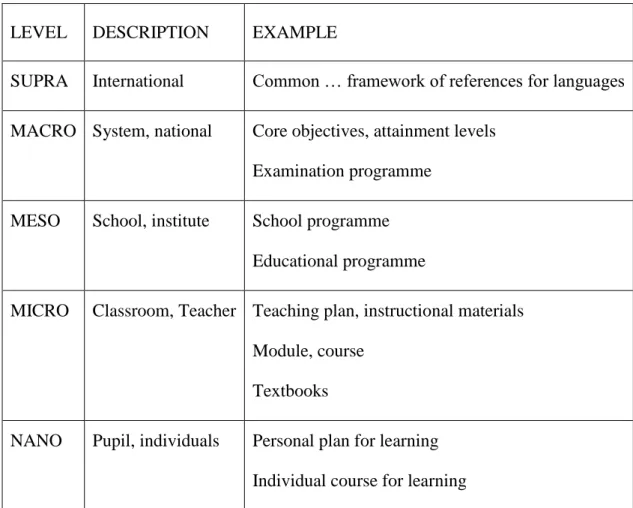
4.3.1 Thijs and Van den Akker’s layers of curriculum making ... 63
4.3.2 Retroduction ... 66
4.3.3 Teacher agency - ecological approach ... 67
4.4 Integrated analytical framework ... 69
4.5 Study design ... 71
4.5.1 Phase one – secondary document analysis ... 71
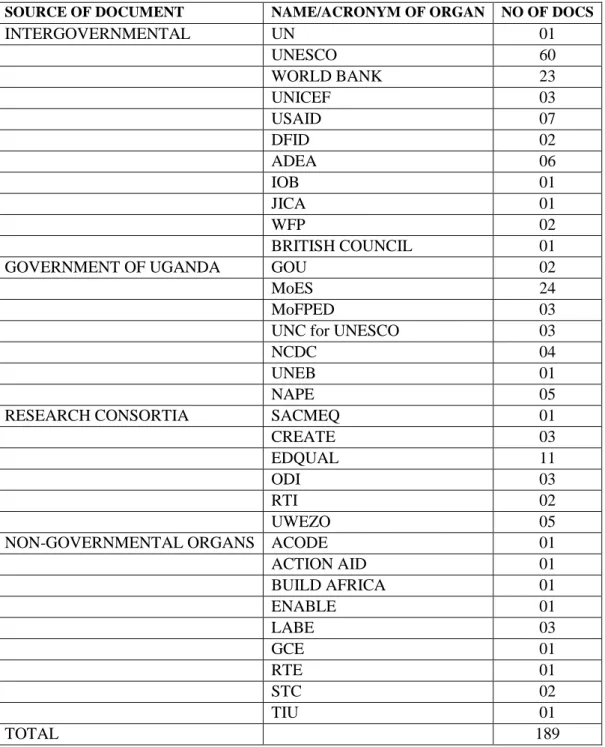
4.5.1.1 Secondary document collection ... 71
4.5.1.2 Analysis using retroduction ... 73
4.5.2 Phase two – field work ... 73
4.5.2.1 Sampling procedure ... 74 4.5.2.2 Sample selection ... 75 4.5.2.3 Data collection ... 75 4.5.2.3.1 Interviews ... 76 4.5.2.3.2 Observation ... 77 4.5.2.3.3 Documents ... 77 4.6 Triangulation ... 77
4.7 Analysis of the field work data ... 78
4.8 Ethical considerations ... 78
4.8.1 Ethical approval ... 79
4.8.2 Informed consent ... 79
4.9 Conclusion ... 80
5 THE GLOBALISATION OF UPE ... 81
5.1 Introduction ... 81
5.2 Background to the globalisation of UPE ... 81
5.3 Structure ... 84 5.3.1 Governance reform ... 84 5.3.2 Access reform ... 86 5.3.2.1 Age-in-grade access ... 88 5.3.3 Inputs reform ... 88 5.4 Culture... 91 5.4.1 Curriculum reform ... 91 5.4.2 ‘Rights’ reform... 93 5.5 Conclusion ... 94
6 THE CONTEMPORARY REFORM CONTEXT OF UPE ... 95
6.1 Introduction ... 95
6.2 Macro layer ... 95
6.2.1 The continuing ‘struggle’ with structure... 95
6.2.2 Culture – the dissemination gap ... 97
6.3 The meso layer ... 98
6.3.1 Emerging new structures... 98
6.3.2 ‘First order’ changes in culture ... 103
6.3.3 Conclusion ... 111
7 ECOLOGY OF MIREMBE ... 113
7.1 Introduction ... 113
7.2 Profile of Mirembe Primary School ... 113
7.3 Context of Mirembe ... 116
7.3.2 Culture ... 122
7.4 Biographies of the participant teachers ... 126
7.4.1 Christine ... 126 7.4.2 Aisha ... 130 7.4.3 David ... 134 7.5 Conclusion ... 137 8 ECOLOGY OF ELGONIA ... 139 8.1 Introduction ... 139
8.2 Profile of Elgonia Primary School ... 139
8.3 Context of Elgonia ... 141
8.3.1 Structure ... 141
8.3.2 Culture ... 146
8.4 Biographies of the participant teachers ... 149
8.4.1 Juliet ... 149
8.4.2 Robert ... 152
8.4.3 Charles ... 154
8.5 Conclusion ... 158
9 TEACHER AGENCY UNDER UPE ... 159
9.1 Introduction ... 159
9.2 Analytical objectives ... 159
9.3 Outline of teacher agency in the case studies ... 160
9.4 Iterational dimension ... 161
9.5 Projective dimension ... 162
9.6 Practical-evaluative dimension ... 168
9.7 Effects of the teachers’ agency on UPE ... 173
9.8 Conclusion ... 174
10. 1 Introduction ... 177
10.2 Summary of findings... 177
10.2.1 The globalisation of UPE ... 177
10.2.2 ‘First order’ changes in the contemporary context ... 178
10.2.3 Teachers’ responses to the changes ... 179
10.2.4 Teacher agency ... 179
10.3 Recommendations ... 180
10.3.1 Biographical factors ... 180
10.3.2 Contextual factors ... 181
10.4 Limitations of the study ... 182
10.5 Proposed areas for future research ... 183
10.6 Final remarks ... 183 Endnotes ... 185 REFERENCES ... 187 APPENDIX ONE... 207 APPENDIX TWO ... 208 APPENDIX THREE ... 210
List of Tables
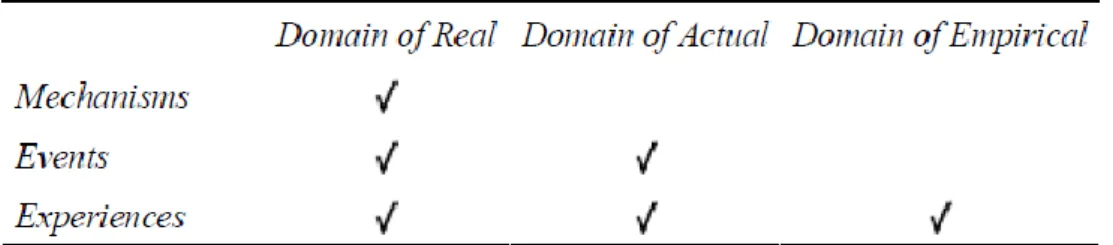
Table 1: Bhaskar’s domains of reality (Source: Bhaskar 2008, p. 47) ... 50
Table 2: Curriculum levels and curriculum products (Source: Thijs and Van den Akker 2009, p.9) ... 63
Table 3: Secondary documents for global basic education/UPE ... 72
List of Figures Figure 1: An iceberg metaphor for critical realism ontology (Source: Fletcher 2016, p. 3) ... 51
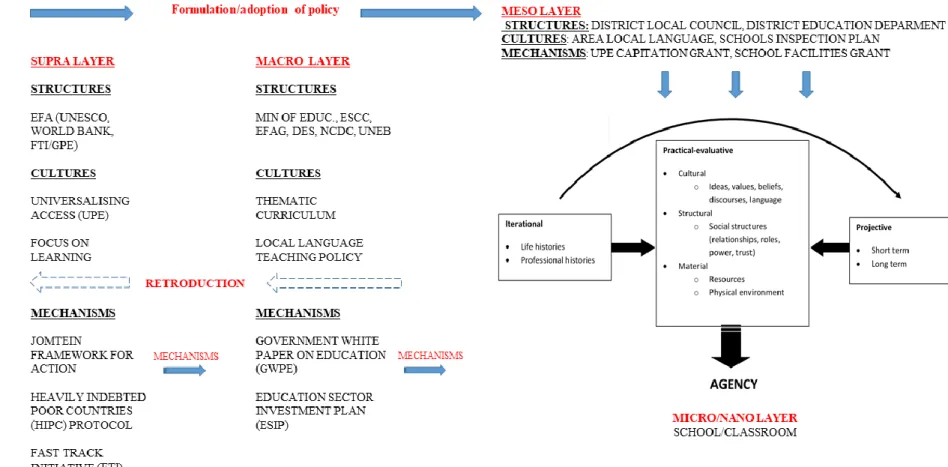
Figure 2: Global context of UPE ... 65
Figure 3: Teacher agency (Source Priestley et al. 2015, p. 30) ... 68
List of abbreviations
ACODE Advocates Coalition for Development and Environment ADEA Association for the Development of Education in Africa CAO Chief Administrative Officer
CCT Centre Coordinating Tutor
CREATE Consortium for Research on Educational Access, Transitions and Equity DANIDA Danish International Development Agency
DED District Education Department DEO District Education officer
DES Directorate of Education Standards
DFID Department for International Development DIS District Inspector of Schools
DLB District Language Board DSC District Service Commission EFA Education for All
EFAG Education Funding Agencies Group ESCC Education Sector Consultative Committee ESIP Education Sector Investment Plan
ESSP Education Sector Strategic Plan EVAC End Violence Against Children
FTI Fast Track Initiative (now Global Partnership for Education – GPE) GCE Global Campaign for Education
GOU Government of Uganda
GPE Global Partnership for Education GTZ German Technical Cooperation Agency HIPC Heavily Indebted Poor countries
IOB Policy and Operation Evaluation Department - Netherlands IMU Instructional Materials Unit
JICA Japan International Cooperation Agency LABE Literacy and Adult Basic Education
LARA Literacy Achievement and Retention Activity LOI Language of Instruction
MoES Ministry of Education and Sports
MoFPED Ministry of Finance Planning and Economic Development NAPE National Assessment of Progress in Education
NCDC National Curriculum Development Centre NGO Non-Governmental Organisation
NRM National Resistance Movement ODI Overseas Development Institute
PETDP Primary Education and Teacher Development Plan PGM Parents’ General Meeting
PLE Primary Leaving Examinations PTA Parents Teachers Association PTC Primary Teachers College
PTDMP Primary Teacher Development and Management Plan RDC Resident District Commissioner
RTE Right to Education
RTI Research Triangle Institute
SACCO Saving and Credit Cooperative Organisation
SACMEQ Southern and Eastern Africa Consortium for Monitoring and Education Quality
SHARP School Health and Reading Program SWAP Sector Wide Approach
SMC School Management Committee STC Save the Children
TDMS Teacher Development Management System TIU Transparency International – Uganda
UN United Nation
UNATU Uganda National Teachers Union
UNC for UNESCO Uganda National Commission for UNESCO UNEB Uganda National Examination Board
UNESCO United Nations Educational Scientific and Cultural Organisation UNICEF United Nations Children’s Fund
UPE Universal Primary Education
USAID United States Agency for International Development WFP World Food Programme
1 INTRODUCTION AND BACKGROUND TO THE STUDY
1.1 Introduction
Teacher agency is an integral part of teacher professionalism that is increasingly gaining recognition in the field of education (Priestley et al. 2015; Pyhältö et al. 2014; Pantić 2015). Biesta et al. (2015, p 624) contend that it is ‘important to understand the dynamics of teacher agency and the factors that contribute to its promotion and enhancement’. This study seeks to explore the role of teacher agency in the reform of curriculum under Universal Primary Education (UPE) in Uganda using the ecological approach (Priestley et al. 2015). UPE has been defined as ‘a system of universal, compulsory and free primary education for all’ (UNESCO 2014). It was launched in Uganda in 1997 under the framework of the Education Sector Investment Plan (1998 – 2003), which involved governance, access, inputs and curriculum reform (see chapters 2 and 5 for a detailed discussion).
The ecological approach conceptualises teacher agency as a ‘situated achievement’, which is ‘the outcome of the interplay of iterational, practical-evaluative and projective dimensions’ (ibid., p. 29). In other words, teacher agency is what teachers achieve in the temporal-relational contexts-of-practice of their schools through the interplay of their professional/life histories and aspirations with its contextual properties, leading either to the transformation or reproduction of its ‘problematic’ aspects. Despite the growing acknowledgement of its importance (Priestley 2013; Priestley et al. 2015; Pantić 2015; Biesta et al. 2015), teacher agency has not received the wide scholarly attention that it deserves. Thus, Vongalis-Macrow (2007, p 425) earlier argued that it ‘stands largely unexamined in educational policy’, while Lipponen and Kumpulainen (2011, p 813) noted that ‘few empirical studies have been conducted on agency, and only a few focused explicitly on teacher education and agency’. However, this anomaly is now being redressed through studies such as Priestley et al.’s (2015) ecological approach, Pyhalto et al.’s (2014) study on teachers’ professional agency and Vaughn’s (2013) study on vision in teacher agency. Thus, Priestley et al. (2015, p. 1) suggest that ‘there is an emerging tendency in educational policy … to acknowledge the importance of teachers’ agency’.
However, it is generally acknowledged that the worldwide study of teacher agency remains ‘vague’ (Priestley et al. 2015; Pyhalto et al. 2014), most especially in the global south. In Uganda, in particular, Abiria et al. (2013, p. 582) noted following their study of plurilingual practices that ‘teachers are exercising agency and creating innovative possibilities for the students to become more successful learners’, and yet a concerted study of teacher agency has never been attempted. By interrogating its role under UPE, this study therefore seeks to contribute in highlighting the importance of teachers’ agency in their professional practice, as well as towards the progress being made in its study. This is intended to contribute towards a better understanding of this crucial aspect of teacher professionalism, as well as towards its literature.
The ecological approach (Priestley et al. 2015) contends that teacher agency is shaped by means of contextual and biographical factors. Under UPE the contextual factors include culture (Elder-Vass 2008) for example, policies such as thematic curriculum and artefacts such as administrative documents, while structure (Porpora 1989) includes roles, relationships and resources. Biographical factors (Priestley et al. 2015) include teachers’ attributes such as qualifications, skill, beliefs and attitude. As a preliminary step in elucidating the role of teacher agency, this study aims to interrogate and highlight the contextual and biographical factors that are involved in shaping it. This will contribute to a better understanding of what shapes teacher agency under UPE and thus provide data towards interrogating its implications.
The UPE environment in Uganda has ‘changed significantly’ over the last two decades (Altinyelken 2010a; Penny et al. 2008), akin to what has occurred the world over, which has been termed an ‘epidemic’ of change (Levin 1998). Some scholars have attributed such changes to globalisation (Chisholm and Leyendecker 2008; Higgins and Rwanyange 2005; Priestley 2002; Ball et al. 2012). In Uganda this has involved among others, structural and cultural reforms such as a governance based on partnership, inputs reform and curriculum reforms such as local language teaching and automatic promotion (see sections 2.5.1.2 and 2.5.1.3, and chapter 5) (MoES 1999; Ward et al. 2006; World Bank 2002a; Kayabwe 2014; Penny et al. 2008). UPE teachers have undoubtedly played a significant role in these reforms. The role of teachers as ‘agents of change’ in mediating reforms has been noted in several studies (Priestley 2013; Priestley et al. 2012; Ball et al.
2012; Osborn et al. 1997; Ketelaar et al. 2012; Pyhältö et al. 2014; Higgins and Rwanyange 2005). Osborn et al (1997, pp. 53 - 54) suggest that:
the ability to mediate is a feature of teaching as a profession ... When confronted with change, and in particular with reform imposed from above, a proportion of teachers in many countries, even those working in highly prescriptive, centrally controlled systems, will respond by subverting, mediating, reinventing or developing an innovative response.
Similarly, Ketelaar et al. (2012, p. 273) observe that:
it is not a matter of simply accepting or rejecting what has been imposed: teachers actively position themselves in relation to an innovation. They make deliberate choices and compare their personal beliefs, desires and values in work with the characteristics and demands of the proposed changes.
In a similar vein, some studies have highlighted the responses of UPE teachers’ in mediating reforms. For instance, Lewin (2009), echoing several Ugandan government reports (MoES 2014a; MoES 2014b; MoES 2015) notes that teachers are maintaining the practice of repetition, despite the automatic promotion policy (see section 2.5.1.3). Similarly, Piper (2010) notes that some teachers in rural areas are reverting to teaching lower primary in English, despite the local language teaching policy (see section 2.5.1.2). However, these are isolated studies and a sustained investigation has never been done. The responses of teachers in mediating reforms therefore constitutes an important dimension that this study aims to interrogate.
The effects of UPE teachers’ mediation of reforms have been significant. For example, from a negative perspective, the practice of repetition is estimated to cost at least 57 percent of the scarce education resources in Uganda (MoES 2014a; CREATE 2011; Lewin 2009). Similarly, the teachers’ practice of increasing the duration of some subject lessons to allow for learner participation has been noted to undermine wholesome delivery of the curriculum (Nakabugo et al. 2008; Altinyelken 2010a). On the other hand, the teachers’ initiatives in making their own teaching materials has been noted to reduce
their dependency on materials provided by schools (Nakabugo et al. 2008). However, these constitute isolated studies and an in-depth research has never been done, which this study aims to redress.
1.2 Background to the study
UPE in Uganda constitutes the focus of this study. Its establishment has been attributed to globalisation (Higgins and Rwanyange 2005; Chisholm and Leyendecker 2008; UNESCO 1990a) (see chapter 5 for a detailed discussion). This was accomplished by Education for All (EFA) in partnership with the Ugandan government. In this pursuit, EFA relied on its discourses which include building partnerships; universalisation and equity; a focus on learning; broadening the scope and methods of basic education; and enhancing the learning environment (UNESCO 1990a; see also Altinyelken unpublished).
EFA embraced two strategies with regard to ‘building partnerships’; 1] building partnerships among countries at international level and 2] building multi-sectoral partnerships within countries (Draxler 2008; UNESCO 1990a; UNESCO 1990b). It subsequently built a partnership with the Ugandan government, which was vested in the Education Sector Consultative Committee (ESCC) and the Education Funding Agencies Group (EFAG) (Eilor 2004; Ward et al. 2006). These organs formulated and implemented Uganda’s Education Strategic Investment Plan (ESIP) (1998 – 2003) and the Education Sector Strategic Plan (ESSP) (2004 – 2015; 2007 – 2010 & 2010 - 2015) (MoES 1998; MoES 2004a; MoES 2008b; MoES 2010; Ward et al. 2006). The Ugandan government, in turn, built a partnership with its local governments through the decentralisation of UPE (MoES 1999; Kayabwe 2014; Suzuki 2002; Ward et al. 2006).
However, the process has involved several challenges. For example, EFA adopted conditionalities in its partnership with the Ugandan government such as the World Bank’s ‘Poverty Reduction Strategy Paper’ (PRSP), Fast Track Initiative’s (FTI) ‘indicative benchmarks’ and the Sector Wide Approach (SWAP), which did not take full account of local realities (World Bank 2004; Bermingham 2011; Rose 2005; Penny et al. 2008).
Ward et al. (2003) note that due to UPE’s governance challenges, agreements were made on unfeasible and impractical education reforms including some ESIP targets and curriculum reforms. Furthermore, the reforms were driven by EFA and the central government and failed to meaningfully integrate all stakeholders. Thus, Higgins and Rwanyangye (2005, p. 19) note that teachers ‘feel marginalised from shaping of the reform process and feel that they are seen as implementers rather than co-shapers of policy’, which has undermined their ownership and motivation (MoES 2014a; MoES 2014b; Altinyelken unpublished). Decentralisation, in turn, experienced challenges such as corruption and delays in transmitting funds, which has undermined the delivery of school inputs (Kayabwe 2014; Penny et al. 2008; Ward et al. 2006). Thus, teachers are responding in agentic ways such as lobbying through their union (MoES 2014a).
As regards ‘universalisation and equity’, EFA aimed to ensure that basic education of quality is provided to all. However, due to the modalities of its implementation, universalisation has engendered significant challenges. For example, under its ‘big bang’ approach (World Bank 2002b; Zuze and Leibbrandt 2011), UPE was launched with a policy of four children per household due to insufficient infrastructure, trained teachers and scholastic materials (MoES 1999; Ward et al. 2006). However, this was abandoned in 2003, when government opened access for all children (Nishimura et al. 2009). Furthermore, UPE’s enrolment system is blamed for its failure to ensure ‘age-in-grade access’ or ‘admission and progression at an appropriate age’ (CREATE 2011, p. 10) (see Grogan unpublished; Lewin 2009).
This has led to a massive increase in enrolment from approximately 3 million pupils in 1996 to approximately 7 million in 2004, to 8.3 million in 2016, which has overwhelmed the available facilities (MoES 2004b; Ward et al. 2006; MoES 2015). This has led, in turn, to overcrowding and a sharp decline in quality, which is undermining teaching and learning (Byamugisha and Ogawa 2010; Altinyelken 2010b). This has elicited agentic responses from teachers who are adopting strategies such as ‘whole-class’ teaching and ‘co-teaching’ (Nakabugo et al. 2008; O'Sullivan 2006).
With regard to its ‘focus on learning’ discourse, EFA adopted four benchmarks, namely to 1] improve the preparation and motivation of teachers; 2] define the acceptable levels
of learning acquisition; 3] improve the process and conditions for learning; and 4] improve and apply systems of assessing learning achievement (UNESCO 1990a; UNESCO 1990b). In pursuit of improving the preparation and motivation of teachers, EFA launched the Teacher Development Management System (TDMS) in Uganda (USAID 2003), which aimed at transforming the training and management of teachers. However, Uganda continues to face a severe shortage of teachers (Deininger 2003; Oonyu 2012; MoES 2014b). Furthermore, teacher training has not adequately addressed new pedagogical requirements, which has left many teachers ill-equipped to implement UPE (Altinyelken 2010a; 2010b; Abiria et al. 2013; Penny et al. 2008). However, they are currently responding in agentic ways, for example by adopting ‘translating’ and ‘translanguaging’ for local language teaching (Abiria et al. 2013).
Pertaining to the goal of improving the process and conditions for learning, EFA advocated for curriculum reform in its partner countries. Thus, Uganda adopted the outcomes-based thematic curriculum in 2007, with a bias towards large class teaching (Altinyelken 2010a; Ward et al. 2006; Altinyelken unpublished; Penny et al. 2008). However, teachers have criticised the curriculum’s shortcomings especially its heavy workload, which requires them to teach eight learning areas per day, practise child-centred pedagogy and continuous assessment (Altinyelken unpublished). Consequently, they are responding largely by ignoring continuous assessment, which is hard to practise in their large classes (Altinyelken unpublished). Furthermore, they are increasing the lesson duration of some key subjects to allow for learner participation and skipping others considered less important such as news and physical education (Altinyelken 2010a; 2010b; Nakabugo 2008).
With respect to the provision of essential school inputs (UNESCO 1990b), EFA developed mechanisms for UPE such as the instructional materials unit (IMU) to supply instructional materials, the school facilities grant (SFG) for infrastructure construction and the UPE capitation grant for operational expenditure (Ward et al. 2006; Oonyu 2012). However, due to the shortage of funding, the majority of UPE schools remain under-resourced and are characterised by shortages of classrooms, teachers’ accommodation, furniture and instructional materials (Penny et al. 2008; Ward et al. 2003). This has created significant difficulties for teachers who are exercising agency, for example, by
walking the long distances from their homes to school daily due to the lack of school accommodation (MoES 2009).
As regards assessing learning achievement, EFA established mechanisms such as SACMEQ (The Southern and Eastern Africa Consortium for Monitoring and Education Quality), UWEZO and NAPE (National Assessment of Progress in Education) (Byamugisha and Ssenabulya 2005; NAPE 2012; UWEZO Uganda 2012). Thus, Uganda conducts periodic assessments under these organs, in addition to its high stakes primary leaving exams (PLE) (MoES 2014a; NAPE 2012). However, the excessive performativity has created significant stress for UPE teachers (Altinyelken 2010b; Lewin 2009). Thus, they are responding in various ways, for example, by advising pupils to repeat classes when they consider them unlikely to do well (Lewin 2009).
Furthermore, in pursuing its aim of enhancing the right to education (UNESCO 1990a; 2007), EFA partnered with the Ugandan government through its Child Friendly Basic Education and Learning programme (CFBEL) and The Right of All Children to Education (TRACE) programme, which attempted to redress discrimination and harassment in schools. This culminated in the ban on corporal punishment in 2006 (UNICEF 2010; UNESCO 2003/4). However, a recent study indicates that there is still widespread use of abusive punishment by teachers, which includes caning, forcing pupils to stare at the sun, carrying big stones and pinching (MoES 2015).
In pursuit of its language of instruction (LOI) goal, EFA further advocated for Uganda’s adoption of mother tongue teaching (UNESCO 1951; UNESCO 1953; UNESCO 1961; Abadzi 2006; Ball 2011). Thus, it was recommended by Uganda’s Education Policy Review Commission 1987 (EPRC) and subsequently passed in 1999 (GOU 1992; Ward et al. 2006). However, it has engendered significant challenges due to Uganda’s high number of local languages, most of which lack written orthographies and supportive literature (Ward et al. 2006; see also Piper 2010; Altinyelken unpublished; Penny 2008). In addition, most teachers have not been trained to teach in these languages (Abiria et al. 2013; Altinyelken unpublished). However, they are currently responding in agentic ways, for example, through ‘translanguaging’ and ‘translating’ as highlighted earlier.
As regards enhancing the learning environment, EFA aims at fostering conducive health and environmental conditions in order to improve pupil readiness, progression and learning outcomes. Consequently, it partnered with the Ugandan government through programmes such as Food for Education (FFE) and The Right of All Children to Education (TRACE), which have contributed in raising awareness among stakeholders (World Bank 2013a; Adelman et al. unpublished; UNICEF 2010). However, many parents are not yet complying fully with their responsibilities such as providing school meals for their children (Kayabwe and Nabacwa 2014; Nishimura et al. 2009). Thus, teachers are responding, for example, by mobilising them to fulfil their responsibility (World Bank 2013a).
Despite the significant evidence of agency by UPE teachers in response to EFA’s reforms highlighted above, it has never been subjected to any comprehensive research. It is therefore the goal of this study to interrogate the teachers’ agency further.
1.3 Problem statement
Uganda launched Universal Primary Education (UPE) in 1997, marking her inclusion in Education for All’s (EFA) globalisation programme for basic education, which commenced in Jomtein in 1990 (UNESCO 1990a; MoES 1999; Ward et al. 2006). UPE has subsequently undergone reform through the Education Sector Investment Plan (ESIP) and the Education Sector Strategic Plan (ESSP). However, in many cases, the wide-ranging reforms have not met the expected outcomes (Ward et al. 2003; Lewin 2009; Nakabugo et al. 2008; Altinyelken 2010a; Higgins and Rwanyange 2005), culminating mainly in ‘first order’ changes (Priestley 2011a; Cuban 1998). This has partly been attributed to their mediation by teachers (Lewin 2009; Altinyelken 2010a), or in other words ‘teacher agency’ (Priestley et al. 2015).
Despite being well-known, teacher agency has not received the wide attention that it deserves (Priestley 2013; Priestley et al. 2015; Pantic 2015; Biesta et al. 2015). Thus, neither was it considered in the process of implementing UPE reforms. However, based on its prevalence, as well as significant effects on UPE (Altinyelken 2010a; 2010b; Abiria
et al. 2013; Nakabugo 2008; Lewin 2009; O’Sullivan 2006), this study deemed it important to interrogate its role in teachers’ professional practice under UPE, particularly in the context of reform. The findings are expected to enhance understanding of teacher agency as a phenomenon, elucidate its role on UPE reform and contribute towards its literature, all of which may further help in informing policy making and implementation.
1.4 Research aims
The study was guided by the following aims:
1. To analyse the emerging changes in the curriculum under UPE reform in Uganda. 2. To analyse how teachers are responding to the curriculum changes
3. To analyse the emerging features of teacher agency as manifested in their responses to curriculum reform
4. To establish the factors that are shaping teacher agency under UPE 5. To establish the effects of teacher agency on the UPE reforms
1.5 Research questions
The study was guided by the following questions:
1. What are the emerging changes in the curriculum under UPE reform in Uganda? 2. How are teachers responding to the curriculum changes?
3. What are the emerging features of teacher agency as manifested in their responses to curriculum reform?
4. What factors are shaping teacher agency under UPE? 5. What are the effects of teacher agency on UPE?
1.6 Purpose of the Study
The purpose of this study was to explore the role of teacher agency in the reform of curriculum under UPE in Uganda. I did this through exploring the role of UPE teachers in mediating the reforms in two case study schools. I drew on a sample of six UPE teachers, as well as twelve other participants representing each of the other curriculum layers. I conducted the study in two phases. In phase one, I commenced by undertaking secondary document analysis using retroduction (Elder-Vass 2010; Edwards et al. 2014) in order to establish the contextual changes which have occurred under UPE due to EFA’s reforms. In phase two, I conducted field work within the framework of the ecological approach to teacher agency (Priestley et al. 2015) in order to establish how UPE teachers are responding to the contextual challenges in their school, thus achieving agency. My aim was to identify the manifestations of teacher agency in the case studies, factors that are shaping it, as well as its effects.
1.7 Significance of the study
There are currently no studies which focus specifically on teacher agency in the global south, let alone Uganda. Thus, this study constitutes a pioneer effort. By focusing on the role of teacher agency in the reform of curriculum under UPE, this study may contribute to the following:
1. Improved understanding of teacher agency as a phenomenon.
2. Improved understanding and management of teachers’ enactment of reforms and therefore to improved practices.
3. In the light of the above contributions, it may further lead to the improvement of quality and achievement under UPE, in line with global development commitments such as United Nations Sustainable Development Goal (SDG) number four.
It is therefore anticipated that this study may be beneficial to the following sets of stakeholders:
1. Policy makers at the international and national levels for example Global Partnership for Education (GPE) and Ministry of Education and Sports (MoES) Uganda.
2. Policy implementers at the local government level for example district education officers (DEOs) and school management committees (SMCs).
3. Policy practitioners for example teachers 4. Academics, researchers and UPE students.
1.8 Overview of the thesis
Chapter 1 introduces and contextualises the study. Chapter 2 describes the UPE curriculum in its global dimensions, commencing with its international context, through the national, local government, down to the school context. Chapter 3 reviews the theoretical and empirical literature dealing with the role of teacher agency in the reform of curriculum under UPE in Uganda. The key debates are addressed under the themes of ‘globalisation’, ‘teacher/biographical barriers to UPE reforms’, ‘contextual challenges of the reforms on teachers’, ‘teachers’ mediation of the reform challenges’ and ‘effects of the teachers’ mediation of reforms’.
Chapter 4 explores the study’s methodology including its theoretical framework, methodology, study design and ethical considerations. It commences by explicating the study’s theoretical framework and thereafter explains how this guides the development of its other methodological components. It further examines the study’s ethical considerations.
Chapter 5 undertakes a retrospective analysis of UPE reform in order to establish its ecological properties. It commences by stratifying the curriculum using Thijs and Van den Akker’s typology (Thijs and Van den Akker 2009) to enable a more focused inquiry into each layer. It subsequently employs retroduction to interrogate the secondary data about global basic education, in order to establish the antecedent properties of UPE and its role in shaping teacher agency.
Chapter 6 analyses the contemporary ecology of UPE as elicited by the field work data. It draws on the data regarding the macro and meso layers in order to establish the changes which have occurred under UPE. Chapters 7 and 8, in turn, interrogate the ecology of each case study i.e. their contextual, as well as biographical properties, as established from the field work data. Furthermore, they each attempt to highlight the role of teacher agency in each case study.
Chapter 9 turns to analysing teacher agency in the case studies using the ecological approach. It draws on the broader findings of UPE’s ecology in the supra, macro and meso layers, established in the earlier chapters. Against that rich background, it focuses on identifying the manifestations of teacher agency in the case studies, the factors that are shaping it, as well as its effects. Finally, in chapter 10, I present the conclusions, recommendations and suggestions for further research.
2 THE UPE CURRICULUM
2.1 Introduction
In this chapter, I describe the UPE curriculum in its global dimensions. I commence by explicating its international context, through the national, local government, down to the school context. My goal is to highlights its global, multi-layered structure and thus enable its better understanding. This detailed description aims at supporting the discussion of its globalisation in chapter five, as well as the analysis of its influence on teacher agency in the subsequent chapters, all of which are undertaken within the framework of Thijs and Van den Akker’s typology (Thijs and Van den Akker 2009) (see section 4.3.1).
2.2 The international context
The international/intergovernmental context of UPE is constituted by EFA, which was formed at the World Conference on Education for All (WCEFA) at Jomtein in 1990 (UNESCO 1990a). At its formation, EFA comprised of its core sponsors which included UNESCO, World Bank, UNICEF, UNDP, nineteen-member states, the E-9 Initiative, the OECD, civil society and private sector organisations. It was originally called EFA High Level Group but was subsequently renamed the EFA Steering Committee (UNESCO 2008; UNESCO 2015a). Its principal role lies in policy formulation, dissemination, monitoring and support. Its role is currently being led by Global Partnership for Education (UNESCO 2015a)
2.2.1 Global education discourses
In its role, EFA is guided by its discourses which include universalising access and equity; building partnerships and alliances to work towards meeting basic learning needs of all; a focus on learning; enhancing the learning environment; and broadening the scope and method of basic education (UNESCO 1990a; Altinyelken unpublished).
‘Universalising access and equity’ has been articulated as EFA’s overriding discourse. It originates from both EFA’s human capital development discourse, as well as the ‘right to education’ discourse (Lockheed and Verspoor 1991; UNESCO 1990b; Birdsall and Levine 2005; UNESCO 2007; UNICEF 2010). It advocates that basic education of quality should be provided to all and measures must be taken to reduce disparities, especially those which arise from the discrimination against females and minorities (UNESCO 1990a; 1990b). It is therefore underpinned by economic imperatives such as productivity, income and life expectancy (UNESCO 1990a; UNESCO 1990b; Lockheed and Verspoor 1991), as well as the rights imperatives implicated in the Universal Declaration of Human Rights 1948 and the Convention on the Rights of the Child 1989 (UNESCO 2007; UNICEF 2010; Right to Education Project 2012).
With regard to ‘building partnerships’, EFA focuses on governance under two strategies; 1] building partnerships among countries at international level and 2] building multi-sectoral partnerships within countries (UNESCO 1990a; UNESCO 1990b; UNESCO 2008). EFA’s international partnerships are targeted at the exchange of information, innovations and collaborations, as well as providing technical and financial support (UNESCO 1990a; UNESCO 2008). National partnerships aim to involve all sub-sectors and forms of education, family and community organisations, non-governmental organisations, teachers’ unions, the media, political parties, higher education and religious bodies in order to harmonise activities, mobilise and utilise resources more effectively (UNESCO 1990a).
The aim of EFA’s ‘focus on learning’ discourse is to promote education quality. It is underpinned by four benchmarks, namely, to 1] improve the preparation and motivation of teachers, 2] define the acceptable levels of learning acquisition, 3] improve and apply systems of assessing learning achievement and 4] improve the process and conditions for learning. Under the latter, EFA aims at enhancing the availability of educational inputs and promoting active, participatory learning approaches (UNESCO 1990a; 1990b). Pertaining to its ‘enhancing the learning environment’ discourse, EFA aims at fostering conducive health and environmental conditions in order to improve readiness, progression and learning outcomes (UNESCO 1990a; World Bank 2013a; Jukes 2006).
EFA pursues this through promoting early childhood care and education (ECCE), nutrition, health and community education programmes.
Finally, EFA’s ‘broadening the means and scope of basic education’ discourse represents the venture to deliver basic education through ‘supplementary’ channels such as learning activities in clubs, libraries, the mass media, youth and adult programmes (UNESCO 1990b). It is based on the growing needs and challenges of access to education.
2.3 The national context
The national context of UPE is constituted by the line Ministry of Education and Sports and its sub-agencies; National Curriculum Development Centre (NCDC), Uganda National Examinations Board (UNEB) and the Directorate of Education Standards (DES). NCDC is responsible for curriculum and instructional materials development. UNEB is responsible for conducting national assessments and DES is responsible for schools’ inspection. The national context is overseen by ESCC and EFAG, which were formed out of EFA’s partnership with the Ugandan government. ESCC comprises of EFA’s representatives, parliament, president’s office, office of the prime minister, Ministry of Education and Sports, Ministry of Finance Planning and Economic Development, district officers, teachers and religious institutions, among others. EFAG, in turn, comprises of representatives of UNESCO, the World Bank, USAID, DFID, DANIDA, Ireland AID, GTZ, JICA, Plan International, Save the Children and World Education (Eilor 2004; Ward et al. 2006). The principal role of the national context lies in policy adoption, dissemination and monitoring.
2.3.1 Central government mechanisms
Education functions nationally are set out in mechanisms such as the Government White Paper on Education 1992 (GWPE), the Education Sector Investment Plan (ESIP)/Education Sector Strategic Plan (ESSP), Teacher Development Management System (TDMS) and the Instructional Materials Unit (IMU), among others. These are briefly discussed below.
2.3.1.1 The Government White Paper on Education (GWPE) 1992
The Government White Paper on Education (GWPE) (GOU 1992) was derived from the recommendations of the Education Policy Review Commission (EPRC) 1987. It has guided extensive reforms to the legal framework of education, as well as to curriculum reform. This includes enacting the law which embedded the ‘right to education’ in the 1995 Constitution, the Local Government Act 1997 and the revised School Management Committee Regulations 2000 (MoES 2001). Furthermore, it ratified curriculum reforms such as mother tongue teaching and a vocation-oriented curriculum. However, the process of its adaptation has been criticised for failing to integrate all stakeholders. Higgins and Rwanyange (2005) note that key players such as teachers, parents, head teachers and pupils have had few channels through which to influence policy. Abiria et al (2013, p. 583) note a teacher’s complaint that:
next time … they have to come first to the classroom level to the resource people so that they can get the real information rather than making policy there … so that they don’t leave it to those at the grassroots to suffer.
Mbabazi et al (unpublished, p. 10) note that the white paper was never debated nationally or locally. There was ‘limited community consultation’, as the reforms were mainly a top-down affair.
2.3.1.2 Education Sector Investment Plan (ESIP) 1998 – 2003
The Education Sector Investment Plan (ESIP) 1998 – 2003 was launched at the outset of UPE (MoES 1998; Ward et al. 2006; Eilor 2004). Its priorities were synchronised with EFA’s, which included expanding access and equity, quality improvements, delivery of educational services and capacity development, among others. It adopted the Sector Wide Approach (SWAP) and decentralisation as its governance strategies (MoES 1998; 1999; Eilor 2004; Ward et al. 2006; Kayabwe 2014a). It was revised in 2004 and renamed the Education Sector Strategic Plan (ESSP) and its duration adjusted to 2015. The new ESSP has given priority to ‘meet[ing] the broad requirements of the Millennium Development
Goals, Education for All and the Ministry’s mission’ (MoES 2004a, p. 6). It has subsequently undergone revisions in 2007 and 2010, aimed at aligning its financial projections with EFA and MDG goals and incorporating the local language and thematic curriculum policies (MoES 2010).
2.3.1.3 Teacher Development Management System (TDMS)
The Teacher Development Management System (TDMS) was launched in 1994 with the aim of transforming the training and management of teachers ahead of the launch of UPE (World Bank 2002a; USAID 2003; Ward et al. 2006). It was jointly funded by the Primary Education and Teacher Development Project (PETDP) run by the World Bank and the Support for Uganda Primary Education Reform (SUPER) project run by USAID (USAID 2000; World Bank 2002a). It commenced with four programmes which included a Grade 3 in-service certificate course, a basic management skills certificate course for head teachers, in-service refresher courses and school-based volunteer community mobilisation (Ward et al. 2006). It has subsequently developed into the official channel for providing both pre-service and in-service teacher education, professional guidance, school level support and community mobilisation. It is currently implemented through a decentralised network of 570 coordinating centres (CCs) served by Centre Coordinating Tutors (CCTs) from 23 Core Primary Teacher Colleges (PTCs) who cover the entire country (MoES 2014a). It has been succeeded by the Primary Teacher Development and Management Plan (PTDMP) (World Bank 2002a; Ward et al. 2006; USAID 2003).
2.3.1.4 Instructional Materials Unit
The instructional materials unit (IMU) was established in the Ministry of Education to manage procurement, following the launch of the instructional materials reform programme in 2000 (Ward et al. 2006; Penny et al. 2008). This followed a study which found that there is poor textbook usage under UPE. The study revealed that textbooks are often locked in cupboards and not issued to users, especially when in short supply. Furthermore, it revealed that textbook life is low and that they are more highly priced in Uganda than in the neighbouring countries (Ward et al. 2006; Penny et al. 2008). The
reform adopted a ‘competitive’ procurement system, whilst attempting to improve distribution, storage and use within schools.
2.4 The local government context
The local government constitutes the decentralisation context of UPE. The main responsibility for coordinating its function lies with the district education department (DED) under the leadership of the district education officer (DEO). Its role includes linking the central authorities with the local authorities and schools, staff management, management of financial resources, quality monitoring and registration of pupils (MoES 1999; Kayabwe 2014a; Suzuki 2002). The highest district body, the district council, plays a role in developing policies and bylaws, while its sub-organs, the district service commission (DSC) and the district language board (DLB) are responsible for the management of teachers and the area local language respectively (Kayabwe 2014a; Suzuki 2002; USAID 2003). School management committees (SMC) are responsible for managing schools in conjunction with head teachers (Kayabwe 2014a; Suzuki (2002).
The role of Core PTCs is mainly executed through centre coordinating tutors (CCTs) (USAID 2003; Kayabwe 2014; World Bank 2012). This includes training head teachers, conducting teachers’ professional development workshops, in-service training and mobilising parents and communities. Furthermore, it includes linking national agencies like NCDC and UNEB to schools, as well as participating in joint schools’ inspections with DEDs (USAID 2003; Kayabwe 2014a). Resident district commissioners (RDCs) play a role in monitoring the implementation of policies on behalf of the president’s office (Kayabwe 2014a).
2.4.1 Decentralisation mechanisms
The local government operates through decentralisation mechanisms such as the UPE capitation grant and the school facilities grant (SFG). Below, I examine each of them in turn.
2.4.1.1 UPE capitation grant
The government pays a capitation grant to schools to cover the cost of tuition and basic operational expenses, which is channelled through the local government (Kayabwe and Nabacwa 2014; Ward et al. 2006; Penny et al. 2008). It is paid at an annual rate of 10,000 shilling per pupil (approx. 2.5 U.S dollars) in quarterly instalments (MoES 2015; Nishimura 2009). The grant is targeted for expenditure on extra instructional materials, co-curricular activities and school management, in accordance with Ministry of Finance, Planning and Economic Development (MoFPED) guidelines (Kayabwe and Nabacwa 2014; Ward et al. 2006; Penny et al. 2008). The Ministry of Education, local government and schools are required to publicise its remittances.
2.4.1.2 School facilities grant (SFG)
The school facilities grant is intended to assist school communities construct and complete unfinished classrooms, a head teacher’s office, teachers’ accommodation, latrines, as well as purchase furniture (Ward et al. 2006; Penny et al. 2008; Kayabwe and Nabacwa 2014). It is channelled to the districts as a conditional grant to be used in accordance with Ministry of Finance, Planning and Economic Development (MoFPED) guidelines, under the supervision of the Ministry of Education (Ward et al. 2006; Penny et al. 2008). SMCs are responsible for preparing the grant applications, contracting and supervision on behalf of the schools. The Ministry of Education is required to publicise the details of SFG transfers to the districts.
2.5 The school context
The school context is characterised the teachers’ body and student body. The teachers’ body is represented by their subject departments and associations, while the student body is represented by their grades, clubs and prefecture.
According to a recent government report (MoES 2015) the number of qualified teachers stands at 192,566, while the pupil-teacher ratio stands at 53:1. Moreover, a survey (NAPE
2015) found considerable gaps in teacher proficiency. Overall literacy stood at 66.4 percent, while proficiency in grammar was measured at 67.1 percent. Furthermore, teacher absenteeism is rampant, which has been measured as high as 30 percent (Okurut 2012; MoES 2014a; Ward et al. 2006; ADEA n.d). In another recent study (MoES 2014a), 47 per cent of teachers expressed poor job satisfaction, with only 16 percent aspiring to remain in the profession over the next two years. However, teacher remuneration has improved following a 25 percent pay raise granted by the government in 2014 (MoES 2014a). In addition, the government is taking measures to improve teacher welfare and working conditions through providing housing and incentives for those in hard to reach areas (MoES 2014a).
With regard to pupils, a recent report (MoES 2015) puts the enrolment at 8.26 million, while the gross enrolment ratio (GER)1 stands at 109 percent, which indicates a high proportion of both underage and overage pupils. Another report (MoES 2014a) indicates that only 24 percent of pupils enrol at the stipulated age of 6 years (see GOU 1992; MoES 2014b; CREATE 2011; Nishimura 2009; Lewin 2009). This poses significant challenges since overage pupils tend to drop out, while underage pupils experience difficulties in coping with the curriculum (Nishimura 2009; Lewin 2009; MoES 2014a; CREATE 2011). The pupil-classroom ratio currently stands at 63:1, while the pupil-course book ratio stands at 4:1 (MoES 2015).
Several studies (Byamugisha and Ssenabulya 2005; NAPE 2012; 2015; World Bank 2013b) have noted the persistent failure of pupils to develop the required proficiency in literacy and numeracy. The latest survey (NAPE 2015) rates 60.2 percent of primary three pupils and 51.9 percent of primary six pupils as proficient in literacy at their grade level. This deficiency creates a vicious circle, whereby pupils fail to improve because they lack basic literacy in the first place. A high proportion of pupils also go hungry at school, despite the school feeding policy (see section 2.5.1.6) (Education (Pre-primary, Primary and Post primary) act, 2008). 92 percent of rural UPE pupils go without breakfast and 7 in 10 spend the day without lunch, which affects their ability to learn (World Bank 2013a; see also O’Sullivan 2006; Nishimura 2009). The causes most often cited are poverty and the reluctance of some parents (Oonyu 2012; MoES 2009; Nishimura 2009).
2.5.1 UPE policies
The implementation of UPE has been accomplished through curriculum reforms recommended by the Government White Paper on Education (GWPE) 1992, as well as others that followed later. These include thematic curriculum, local language teaching, automatic promotion, child rights policy, school/entry age intervention and the school feeding policy. In the following sections, I examine some of the key policies.
2.5.1.1 Thematic curriculum
The thematic curriculum originates from EFA’s ‘quality’ discourse, particularly the goal of improving the process and conditions for learning (UNESCO 1990a). Uganda adopted it in 2007, following the unsatisfactory performance of her 2000 vocation-driven curriculum (Altinyelken 2010a; Penny 2008; O’Sullivan 2006; Muyanda-Mutebi 1996). It aims to foster the rapid development of ‘literacy’, ‘numeracy’ and ‘life-skills’ (NCDC 2006). It comprises of learning ‘outcomes’ derived from the general aims of education, which are expressed as competencies and adopts a thematic approach to instruction. Furthermore, it incorporates local language teaching, child-centred pedagogy and continuous assessment (NCDC 2006; Altinyelken unpublished).
2.5.1.2 Local language teaching
The local language teaching policy is a product of EFA’s access and quality discourses (UNESCO 1990b). It was adopted in 1999 based on the recommendations of the EPRC, and the GWPE 1992 (GOU 1992; Ward et al. 2006). It prescribes that ‘in rural areas the medium of instruction from P.1 to P.4 will be the relevant local languages; and from P.5 to P.8 English will be the medium of instruction’ (GOU 1992, p. 19). It adopted the phrase ‘relevant local languages’ to avoid the difficulties and cost implications of sectarianism and the fragmentation of languages that the narrower interpretation of mother tongue implies.
2.5.1.3 Automatic promotion
The automatic promotion policy prescribes ‘no repetition’, or automatic progression by pupils from one grade to the next (Okuni 2003). It prescribes that pupils should be promoted irrespective of their performance (MoES 2013; 2014a; 2014b; 2015). It was passed based on the ‘education efficiency’ paradigm advocated by the World Bank (MoES 2008a). It is supported by research from the Consortium for Research on Educational Access, Transitions and Equity (CREATE), which advocates for age-in-grade access (CREATE 2011). Its goal is to promote access and completion by enabling the efficient progression of learners and to avoid clogging of the education system (MoES 2008a; CREATE 2011; UNESCO 2003/4).
2.5.1.4 Child rights policy
The child rights policy originates from the Universal Declaration of Human Rights of 1948 and the Convention on the Rights of the Child 1989 (UNESCO 2007), both of which have been ratified by Uganda. Furthermore, these protocols have been enshrined into all major Ugandan legislations, including the 1995 Constitution, GWPE 1992 and the Education Act 2008 (GOU 1992; Education (Pre-primary, Primary and Post primary) act, 2008; Right to Education Project 2012; TI Uganda n.d).
The rights implicated with respect to education are ‘the right of access to education’, ‘the right to quality education’ and ‘the right to respect in the learning environment’ (UNESCO 2007). In regard to the latter, government passed a ban on corporal punishment in schools in 2006, noting that it violates children’s ‘right to respect in the learning environment’ and discourages school attendance.
2.5.1.5 School/entry age intervention
The school/entry age for UPE is stated by the GWPE 1992 as 6 years, which government aimed to achieve by 2000 (GOU 1992). However, this goal is yet to be realised, despite government’s interventions (MoES 2005; World Bank 2013b). However, the Consortium
for Research on Educational Access, Transitions and Equity (CREATE) has conducted research and sensitisation towards promoting compliance with it in partner countries (CREATE 2011; see also Lewin 2009).
2.5.1.6 School feeding policy
UPE does not make primary education completely free. The school feeding policy places the responsibility for providing school meals on parents, while district councils and SMCs play an oversight role (Education (Pre-primary, Primary and Post primary) act, 2008; GOU 2016; World Bank 2013a). The policy makes the taking of mid-day meals at school voluntary. It states that ‘the taking of mid-day meals at school and the payment for such meals shall be voluntary and no pupil who has opted not to pay for or take mid-day meals at school shall be excluded from school for non-payment for such meals’ (Education (Pre-primary, Primary and Post primary) act, 2008, p. 56).
2.5.1.7 Customised performance targets (CPT)
The use of customised performance targets (CPT) for head teachers and their deputies was adopted in 2008. Its goal is to enhance accountability and quality assurance by measuring the performance and compliance of head teachers and deputy head teachers against set learning achievement targets (GOU 2010; MoES 2010).
2.6 Conclusion
In this chapter, I examined the features of the UPE curriculum. My discussion highlighted its global and multi-layered aspect, which is characterised by its international context, national context, local government context and school context, which overlap and are mutually influential. This stratification reflects Thijs and Van den Akker’s typology (Thijs and Van den Akker 2009), which I adopt for my discussion in subsequent chapters. This detailed explication is aimed at improving understanding of the curriculum.
3 LITERATURE REVIEW
3.1 Introduction
This chapter is concerned with exploring the theoretical and empirical literature dealing with teacher agency in the reform of curriculum under UPE in Uganda. The review has been approached in terms of themes in order to render a more systematic analysis. The key debates which emerge are addressed under the themes of ‘globalisation’, ‘teacher/biographical barriers to UPE reforms’, ‘contextual challenges of the reforms on teachers’, ‘teachers’ mediation of the reform challenges’ and ‘effects of the teachers’ mediation of reforms’.
In the following sections, I commence by interrogating the literature on the key concepts, which include UPE, teacher agency, curriculum and curriculum reform, followed by a comprehensive review under the above themes. This chapter interrogates the existing knowledge in the literature about teacher agency under UPE in order to expose the research gap.
3.2 Universal Primary Education
Universal Primary Education (UPE) constitutes the focus of this study. While major studies have explored its empirical aspects, it is much harder to find literature which makes a detailed interrogation of the concept itself. However, as a starting point, I commence by exploring some technical definitions offered by its founding body UNESCO, as well as the Ugandan government, before examining the available critical perspectives. UPE was originally conceived by UNESCO as “a system of universal, compulsory and free primary education for all” (UNESCO 2014, n.p). Furthermore, UNESCO explains the goal of universalisation as “the integration of primary education into the framework of global educational planning” (UNESCO 2014, n.p). UNESCO’s definition underlines its view of universalisation as synonymous with globalisation. Meanwhile, the Ugandan government (Education (Pre-primary, Primary and Post primary) act, 2008, p. 9) offers a legal(istic) definition of UPE as:
the state funded universal primary education programme where tuition fees are paid by government where the principle of equitable access to conducive, quality, relevant and affordable education is emphasised for all children.
This definition highlights the role of the state in funding UPE and underscores its emphasis on universality and equity.
Conversely, within a critical perspective, several studies (Ekaju 2011; Nishimura et al. 2009; Nishimura et al. 2008; Stasavage 2005) all define UPE as a policy of fee abolition and underscore the importance of its financial dimension. Furthermore, Nishimura et al. (2009, p. 145) elaborate on UPE as the ‘provision of primary education for all children’, thus underscoring its universalisation aspect. However, these studies tend to overlook other important aspects such as equity and compulsoriness. Byamugisha and Ogawa (2010) conceive UPE from the perspective of reform. They suggest that UPE is part of the reform program by the government to increase access, equity and the quality of primary education. Their view resonates with the official government definition. On the other hand, Ssewamala et al. (2011) conceptualise UPE within the framework of the United Nations Millennium Development Goals (MDGs). They note that Goal number 2 is to ‘achieve Universal Primary Education by 2015’ (ibid., p. 472). However, they do not elucidate what universalisation entails. Despite these differences, the common themes include universalisation/globalisation, fees abolition and equity.
3.3 Teacher agency
Teacher agency is the main concept informing this study. It is still undergoing debate, thus an exploration of its various conceptualisations may help to shed some light. It is worth noting that ‘teacher agency’, referring here to ‘agency theorised specifically in respect of the activities of teachers in schools’ (Priestley et al. 2015, p. 26) is currently informed mainly by the ecological approach to agency (Emirbayer and Mische 1998) and to a lesser extent by a more traditional sociological approach (Archer 1995) (see section 4.2.2 for a more detailed discussion).
For example, key studies from the ecological perspective (Priestley 2013; Priestley et al. 2015) conceptualise teacher agency as a ‘situated achievement’, which is ‘the outcome of the interplay of iterational, practical-evaluative and projective dimensions’ (ibid., 2013, p. 190). Priestley et al. (2015, p. 45) expand this conceptualisation further, which is worth examining in full:
the achievement of agency is always informed by past experience – and in the particular case of teacher agency this concerns both professional and personal experience. [It] is orientated towards the future in some combination of short(er) term and long(er) term objectives, values and aspirations and … is always enacted in a concrete situation, therefore both being constrained and supported by discursive, material and relational resources available to actors.
Their conceptualisation underscores the essence of the ecological approach to teacher agency, which is its recognition of teacher agency as ‘something that is achieved’, in the context of its temporal-relational aspects.
A similar socio-cultural perspective has been offered by Lasky (2005). In this view, Lasky (2005, p. 900) defines teacher agency as ‘part of a complex dynamic [that] shapes and is shaped by the structural and cultural features of society and school cultures’. She suggests that each decision teachers make, or action they take, is simultaneously a consequence of past action and present context and a condition shaping the context for further action. Her emphasis of socio-cultural factors resonates with both the ecological and sociological approaches, while its temporal dimension resonates with the ecological approach. As Priestley et al. (2015, p. 28) acknowledge, it seems to ‘chime with the ecological approach’.
Furthermore, Vongalis-Macrow (2007) and Pyhalto et al. (2014) offer conceptualisations that complement this understanding of teacher agency. For example, Vongalis-Macrow (2007, p. 425) conceives teacher agency within a globalised sociological perspective as an ‘interplay’:
where teachers are not only engaging in the reproduction of structural change aligning globalisation-driven reforms to their work and practices, but also, in adapting and reacting to new structural conditions, they are transformed through their actions.
Thus, she espouses a morphogenetic view of agency similar to Archer (1995), which is underlined by agency’s interaction with structure, through which they are either mutually transformed or reproduced.
Pyhalto et al. (2014, p. 306) draw on the relational perspective of agency following Edwards (Edwards 2007). They conceptualise teachers’ professional agency as:
a capacity that … includes using others intentionally as a resource for learning and equally, serving as a support for them. [It] is not a fixed disposition of an individual teacher, but is highly relational and thus embedded in … professional interactions.
Thus, they tend to perceive teacher agency as an innate capacity and emphasise teachers’ capacity to use relational resources.
3.4 Curriculum
Curriculum is the main aspect of UPE, which this study interrogates, thus, it is worth examining some of its key conceptualisations. It is worth starting with Jackson’s (1996, p. 10) caveat regarding the variability of curriculum’s definitions. He notes that ‘there is no definition of curriculum that will endure for all time … every definition serves the interest of the person or group putting it forward, and … it is always appropriate to ask what the local consequences of adopting this or that definition might be’. I therefore begin by examining the roots of the concept. Egan (1978, p. 10) traces it to a Latin origin, where it originally meant ‘a course’ or ‘race course’. However, he notes that it changed meaning so rapidly that by the nineteenth century in England, it simply meant ‘content’. However, he notes the influence of French scholars, who introduced the dimension of methodology