THE INFLUENCE OF PRACTICAL WORK ASSESSMENT METHOD IN DEVELOPING PRACTICAL WORK SKILLS OF ADVANCED LEVEL PHYSICS STUDENTS IN
ZIMBABWE
by
NICHOLAS ZEZEKWA
submitted in accordance with requirements
for the degree of
DOCTOR OF EDUCATION
In the subject
DIDACTICS
at the
UNIVERSITY OF SOUTH AFRICA
SUPERVISOR: PROF. NKOPODI NKOPODI
JUNE 2016
i
DECLARATION
I declare that the thesis with the title:
The influence of practical work assessment
method in developing practical work skills of Advanced Level physics
students in Zimbabwe,
is my own work and that all the sources used or quoted have been cited and acknowledged by means of complete references.Student Number:50860585
03 May 2016
SIGNATURE DATE
ii
DEDICATION
iii
ACKNOWLEDGEMENTS
This thesis was as a result of many people who played their part. I am highly indebted to these people who offered financial, moral, technical and intellectual support throughout. It is however absolutely impossible to mention all of these great individuals by name. I would like however to thank the Almighty God who guided and supported me throughout this academic journey by giving me good health and inspiration.
It has been my single honour and privilege to have worked with this profound professional Prof Nkopodi Nkopodi as my supervisor. I would like to express my deepest gratitude for his encouragement, expertise and support he offered at every stage of my research journey. I also wish to register my deepest appreciation to my wife Gladys, sons Paul and Blessing and my wonderful daughter Moreblessing who supported me in every way possible to complete this study. My heartfelt appreciation goes to my family members especially my mother, brothers and my only sister Varaidzo who encouraged me to soldier on during the hard times of my academic journey.
I wish to thank the late Prof Lovemore Nyaumwe who assisted me during the initial stages of drafting my research proposal. I would also like to thank members of the comparative study research team for taking time to shape my research proposal during the period I was involved in collaborative research study on the comparison of the Zimbabwean and South African teacher education training programmes.
My sincere thanks and appreciation are directed to all the students and teachers who participated during the study including the Ministry of Primary and Secondary Education as well as school heads and parents who allowed me the opportunity to interact with subjects of the study.
iv TABLE OF CONTENTS
DECLARATION... i
DEDICATION... ii
ACKNOWLEDGEMENTS ... iii
LIST OF FIGURES ... viii
LIST OF TABLES ... ix
LIST OF ABBREVIATIONS ... x
LIST OF APPENDICES ... xi
LIST OF EXCERPTS... xii
ABSTRACT ... xiii
KEY TERMS ... xiv
CHAPTER 1- INTRODUCTION ... 1
1 1.1 Purpose of the study ... 1
1.2 Context of the study ... 4
1.2.1The context of the ‘A’ Level Physics curriculum (Syllabus 9188) ... 5
1.2.2Practical Work Assessment: Major marking points on an ‘A’ level physics practical work report ... 6
1.3 Statement of the problem ... 9
1.4 Aims of the study ... 9
1.5 Research questions ... 9
1.5.1Main Research Question ... 9
1.5.2Sub-Research Question ... 10
1.6 Significance of the study ... 10
1.7 Delimitations of the study ... 11
1.8 Definition of terms ... 11
1.9 Assumptions ... 13
1.10 Structure of the study……….13
1.11 Chapter Summary ... 14
CHAPTER 2 -LITERATURE REVIEW ... 16
2 2.1 Introduction ... 16
2.2 Theoretical Framework ... 17
2.3 Formative Assessment ... 21
2.4 Assessment in constructivism………....24
2.5 Assessment of Advanced Level physics practical work skills... 25
2.6 Some perspectives on the assessment of practical work ... 29
2.7 Assessment of practical work in other subjects and qualifications: Towards an alternative model ... 34
v
CHAPTER 3 - RESEARCH METHODOLOGY ... 42
3 3.1 Introduction ... 42
3.2 Methodology ... 42
3.2.1 The mixed methods approach ... 43
3.2.2 Convergent - Parallel Mixed Method Approach ... 44
3.2.3 Research Paradigm: Qualitative aspect of the mixed methods approach ... 45
3.3 Research Design ... 46
3.4 Population and Sample ... 48
3.4.1 The research instrument ... 49
3.4.2 Observation Schedule ... 50
3.4.3 Interview schedule ... 53
3.4.4 Focus Group Discussions ... 56
3.5 Procedure for data collection ... 58
3.6 Data analysis and interpretation ... 59
3.7 Limitations of the study ... 60
3.7.1 Validity and Reliability ... 60
3.7.2 External Validity ... 63 3.7.3 Internal Validity... 63 3.8 Ethical issues ... 65 3.8.1 Informed consent ... 66 3.8.2 Confidentiality ... 66 3.8.3 Harm ... 66
3.8.4 Ethics Review Committee ... 67
3.9 Chapter summary... 68
CHAPTER FOUR - ASSESSMENT OF OBSERVED PRACTICAL WORK SKILLS AND SUBMITTED PRACTICAL WORK REPORTS ... 69
4 4.1 Introduction ... 69
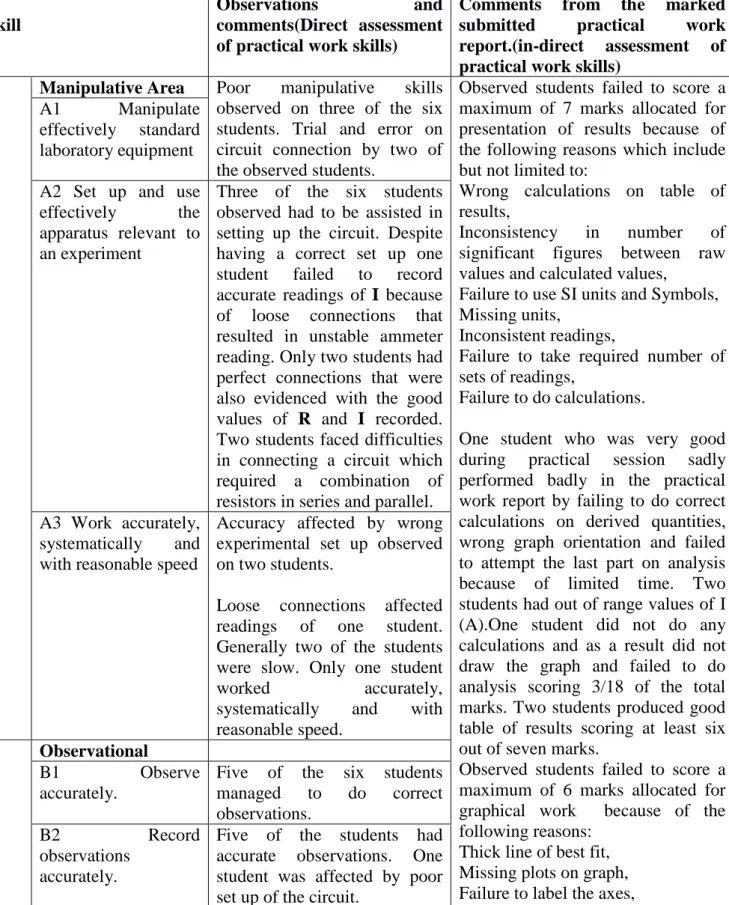
4.2 Observations made during practical work session and comments from the marked report for experiment 1 ... 70
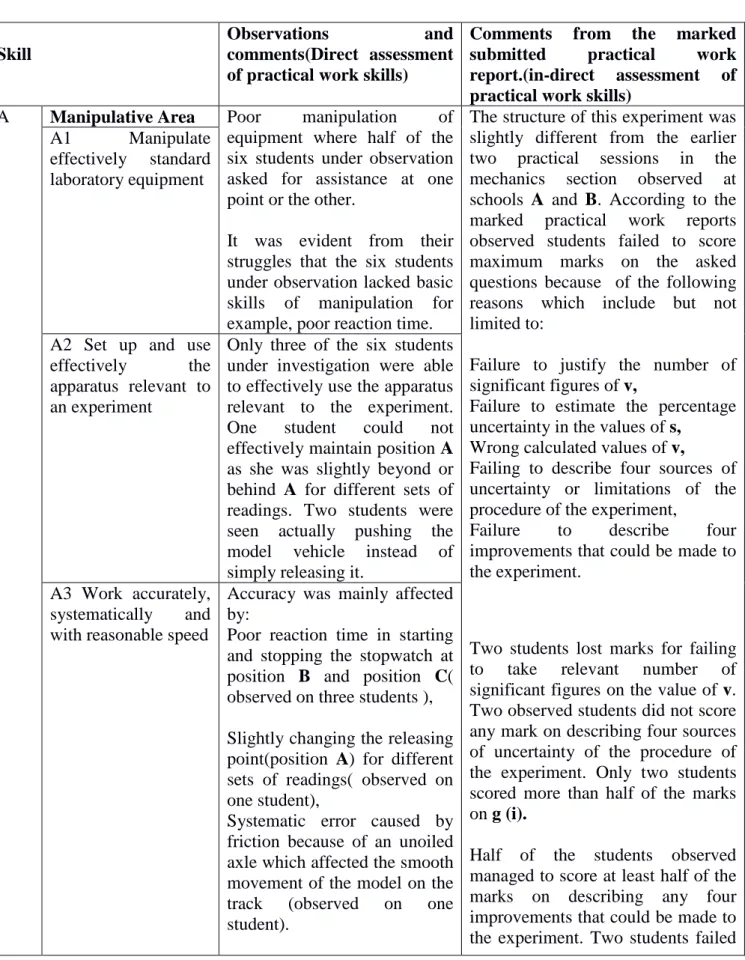
4.3 Observations made during practical work session and comments from the marked submitted report for experiment 2... 76
4.4 Observations made during practical work session and comments from the marked submitted report for experiment 3... 82
4.5 Observations made during practical work session and comments from the marked submitted report for experiment 4... 87
4.6 Observations made during practical work session and comments from the marked submitted report for experiment 5... 92
vi
4.7 Observations made during practical work session and comments from the marked
submitted report for experiment 6... 98
4.8 Rating of practical work skill mastery during observations against obtained mark from the submitted marked report... 102
4.8.1 Correlations: Percentage rating as observed by the researcher against obtained mark from the submitted practical work report ... 104
4.9 Comment on observational results: Relevance of the assessment practices on students’ practical work skills development ... 106
CHAPTER FIVE- TEACHERS’ VIEWS AND PRACTICES ON THE ASSESSMENT OF PHYSICS PRACTICAL WORK ... 109
5 5.1 Introduction ... 109
5.2 Assessment of practical work skills by physics teachers ... 111
5.2.1 School A: Teacher A1 ... 111 5.2.2 School A: Teacher A2 ... 112 5.2.3 School B: Teacher B1 ... 113 5.2.4 School B: Teacher B2 ... 113 5.2.5 School C: Teacher C1 ... 114 5.2.6 School C: Teacher C2 ... 115
5.3 Teachers’ views on the relevance of the assessment practices on students’ practical work skill development ... 116
5.3.1 School A: Teacher A1 ... 116 5.3.2 School A: Teacher A2 ... 118 5.3.3 School B: Teacher B1 ... 120 5.3.4 School B: Teacher B2 ... 121 5.3.5 School C: Teacher C1 ... 124 5.3.6 School C: Teacher C2 ... 126
5.4 Teachers’ views on possible alternatives to physics practical work examinations ... 129
5.4.1 School A: Teacher A1 ... 130 5.4.2 School A: Teacher A2 ... 130 5.4.3 School B: Teacher B1 ... 131 5.4.4 School B: Teacher B2 ... 132 5.4.5 School C: Teacher C1 ... 133 5.4.6 School C: Teacher C2 ... 134
5.5 Emerging themes from interview data ………135
5.6Comment on teachers’ views on the assessment of physics practical work ... 137
CHAPTER SIX - STUDENTS’ VIEWS ON THE ASSESSMENT OF PHYSICS PRACTICAL WORK ... 143
6 6.1 Introduction ... 143
6.2 Assessment of students’ practical work skills ... 144
vii
6.2.2 School B: Group 2 ... 146
6.2.3 School C: Group 3 ... 147
6.3 Students’ views on the relevance of practical work assessment method ... 149
6.3.1 School A: Group 1 ... 150
6.3.2 School B: Group 2 ... 154
6.3.3 School C: Group 3 ... 156
6.4 Students’ views on possible alternatives to current physics practical work assessment method... 158
6.5 Comment on students’ views on the assessment of physics practical work ... 160
CHAPTER SEVEN- TOWARDS AN ALTERNATIVE MODEL OF PRACTICAL WORK ASSESSMENT... 165
7 7.1 Introduction ... 165
7.2 An overview of ‘A’ level physics practical work assessment ... 165
7.3 The proposed model of ‘A’ level physics practical work assessment ... 169
7.4 Justification of the model ... 172
7.5 Anticipated challenges and proposed solutions ... 173
CHAPTER EIGHT - CONCLUSION AND RECOMMENDATIONS ... 176
8 8.1 Introduction ... 176
8.2 Summary and conclusions ... 176
8.3 Recommendations ... 181
REFERENCES ... 183
viii
LIST OF FIGURES
Figure 4.1 Scatter diagram showing the comparison of grades obtained by the student from DAPS and IAPS………....104 Figure 7.1 An incomplete graph work with a score of 0 out 5 because of limited time……166 Figure 7.2 Graph sheet with a score of 0 out 5 which the student never attempted to draw a
graph on because of limited time……….167 Figure 7.3 A proposed model of practical work assessment……….170 Figure 8.1 Schematic diagram of the research study……….179
ix
LIST OF TABLES
Table 1.1 Paper structure………5
Table 1.2 Skill weighting and distribution……….6
Table 2.1 Comparison of DAPS and IAPS………27
Table 3.1 A sample of multiple case studies………..49
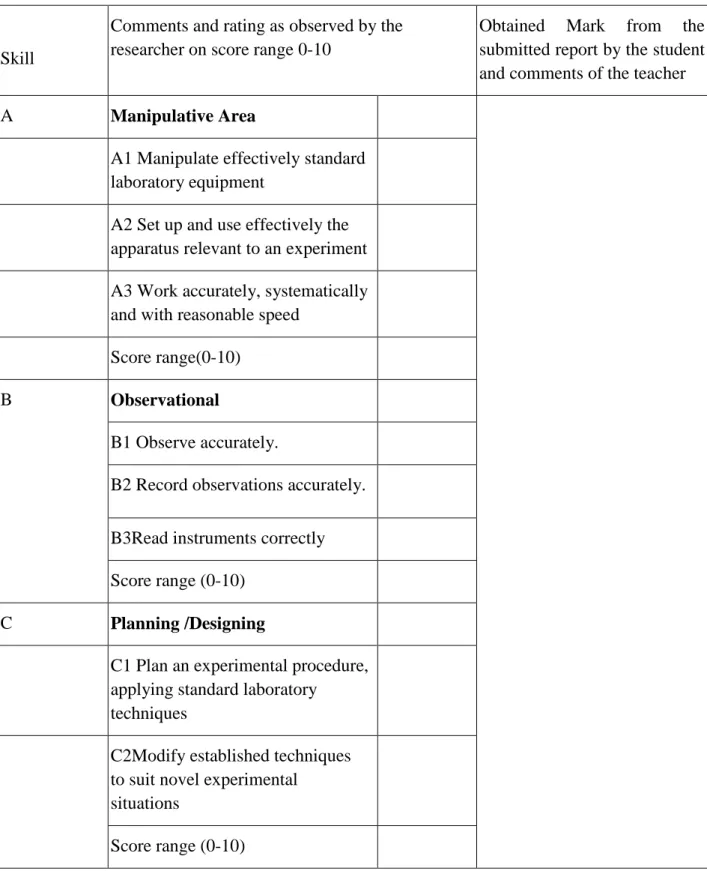
Table 3.2 Mastery of practical skills as observed by the researcher(s) during practical session and grade obtained from the submitted report……….50
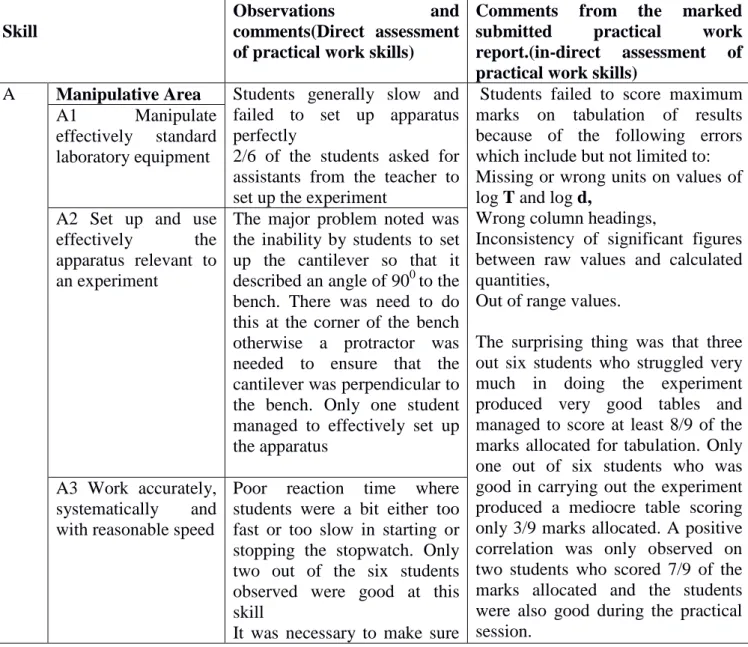
Table 4.1 Comments on practical work skills assessment using the direct and in direct methods for experiment 1………..72
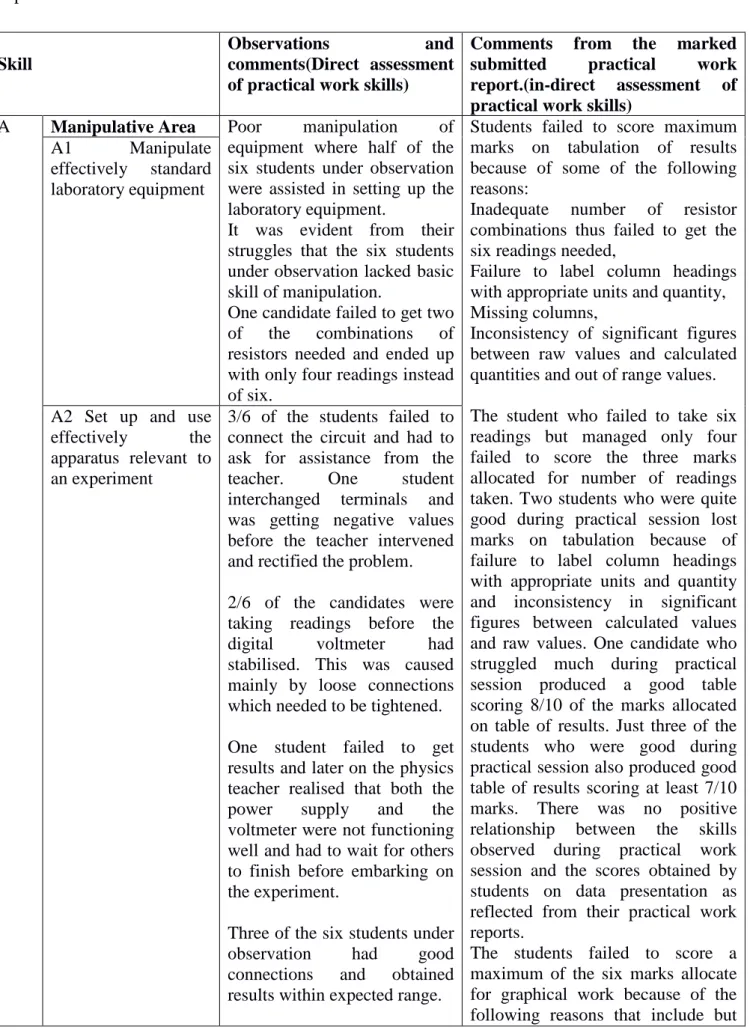
Table 4.2 Comments on practical work skills assessment using the direct and in direct methods for experiment 2………..78
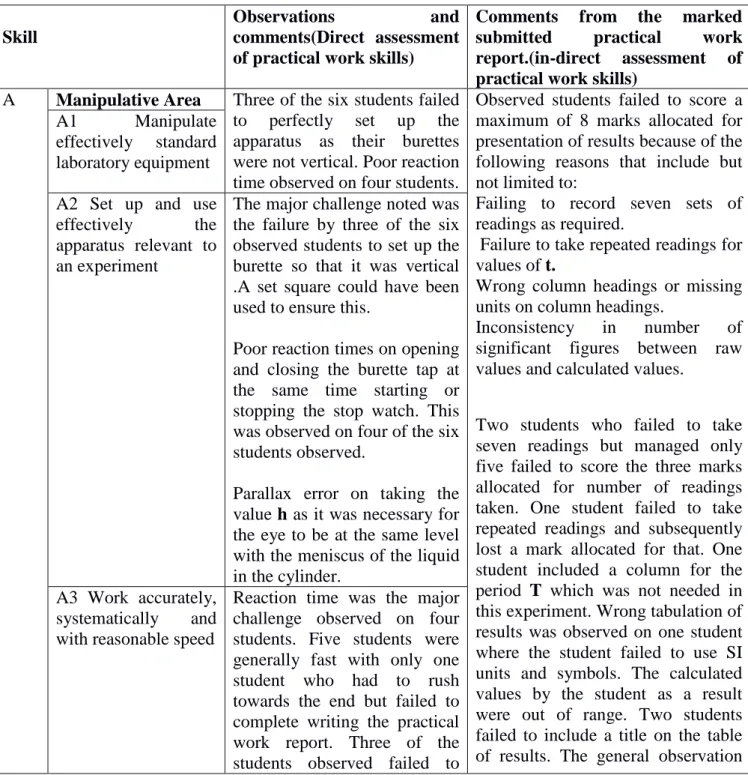
Table 4.3 Comments on practical work skills assessment using the direct and in direct methods for experiment 3………..84
Table 4.4 Comments on practical work skills assessment using the direct and in direct methods for experiment 4………..89
Table 4.5 Comments on practical work skills assessment using the direct and in direct methods for experiment 5………..95
Table 4.6 Comments on practical work skills assessment using the direct and in direct methods for experiment 6………..99
Table 4.7 Grades obtained by students from DAPS and IAPS……….102
Table 4.8 Statistical Comparison of scores from DAPS and IAPS………...105
Table 5.1 Bio data of teachers who participated in the interviews………....109
x
LIST OF ABBREVIATIONS
A level Advanced level
AQA Assessment and Qualification Alliance
BEAR Berkley Evaluation and Assessment Research Centre CFA Classroom Formative Assessment
DAPS Direct Assessment of Practical Work skills EDXCEL Education and Excellence
FGD Focus Group Discussion
GCE General Certificate in Education
GCSE General Certificate in Secondary Education IAPS Indirect Assessment of Practical Work Skills IFA Interactive Formative Assessment
MOE Ministry of Education
OCR Oxford, Cambridge and RSA Examination Board PSV Practical Skills Verification
PWA Practical Work Assessment SBA School Based Assessment
SCORE Science Community Representing Education STEM Science Technology Engineering and Mathematics TAPS Techniques for Assessment of Practical Skills in Science UNICEF United Nations International Children’s Emergency Fund UNISA University of South Africa
xi
LIST OF APPENDICES
Appendix1 Structured observation schedule………..189
Appendix2 Interview schedule for Advanced Level Physics Teachers………...191
Appendix3 Focus Group Discussion Schedule for Advanced Level Physics Students….192 Appendix 4 A letter to the Ministry of Primary and Secondary Education requesting permission to conduct research at schools in Harare and Mashonaland Provinces in Zimbabwe……….193
Appendix 5 A letter to the secondary school heads in Harare and Mashonaland central provinces requesting permission to conduct research………...195
Appendix 6 An information-letter to the prospective participant……….197
Appendix 7 Consent to participate in this study………...200
Appendix 8 A letter requesting parental consent for participation of minors in research project………....201
Appendix 9 A letter requesting assent from learners in secondary school to participate in research project……….203
Appendix 10 A letter requesting adult to participate in an interview……….205
Appendix 11 Consent Form………207
xii
LIST OF EXCERPTS
Excerpt 4.1 An investigation of the oscillatory motion of a loaded metre rule……….71
Excerpt 4.2 The variation of potential difference with resistance………..76
Excerpt 4.3 Investigating the rise of water in a graduated measuring cylinder………..83
Excerpt 4.4 Determining the resistance Rv of a voltmeter………..88
Excerpt 4.5 Investigating how the stopping distance of a model vehicle depends on its mass...93
xiii
ABSTRACT
Practical work plays an important role in the teaching and learning of science. This study was conducted to determine whether the methods and practices employed by physics teachers in Zimbabwe - as required by the Zimbabwe School Examination Council (Zimsec) ‘A’ Level Physics Syllabus (9188) on the assessment of practical work skills assist the students in developing other crucial practical skills like manipulation, observational, planning and designing apart from presentation and analysis skills. The convergent parallel mixed methods approach of Creswell (2014) was used to collect, present and analyse data. Quantitative data were collected using the structured observation schedule to get assessment marks for a student using both methods of indirect assessment of practical work skills (IAPS) and direct assessment of practical work skills DAPS for the same practical work activity. Qualitative data were obtained from interviews with the physics teachers and Focus Group Discussion (FGD) with the ‘A’ level physics students.
Pearson’s correlation coefficient (r) of the percentage rating of marks obtained by the student as observed during practical work sessions compared to the obtained mark from the submitted practical work report for the same practical work activity was calculated and found to be 0.135 with a P- value of 0.432. Both the narrative approach (Creswell, 2007) and conservation analyses (Gray, 2011) were used to present and analyse data from focus group discussions with ‘A’ level physics students and interviews with the physics teachers.
The major finding from the analysis of quantitative data was that there was no association between the grades obtained by the student from DAPS as compared to IAPS for the same practical work activity as the value of r was found to be very low. This implied that passing practical work through the assessment of practical work report did not necessarily mean that the student could have mastered the basic skills of manipulation, designing, observation and planning. The views of physics teachers and students who participated in the study were that, the current method of practical work assessment used by Zimsec is not relevant in encouraging students to develop a variety of practical work skills as students concentrated on mastering presentation and analysis skills in order to pass practical work examinations. The study recommends that an alternative model of practical work assessment that integrates both DAPS and IAPS should be used to ensure valid and reliable assessment of practical work skills of ‘A’ level physics students.
xiv
KEY TERMS
Advanced Level Assessment
Direct Assessment of Practical Work Skills Examination Boards
Indirect Assessment of Practical Work Skills Mixed Methods Approach
Physics Curriculum Physics Practical Work Practical Work Skills
1
CHAPTER ONE
INTRODUCTION 1.1 Purpose of the study
The purpose of this study is to get insight on practical work skills that are developed by Advanced Level (‘A’- Level) physics students in Zimbabwe during their two year high school course before such students could be enrolled for tertiary education. This study is based on the assumption that, the way in which ‘A’ level physics practical work is being assessed in Zimbabwe has had influence on the type of practical work skills that are developed and mastered by students. It is the assessment method that influences how practical work in science is taught and done (Abrahams and Millar, 2008; Abrahams and Saglam, 2010 and Abrahams and Reiss, 2012). The thrust is to observe whether the methods and practices that are employed by physics teachers as dictated by the Zimbabwe School Examination Council (Zimsec) ‘A’ Level Physics Syllabus (9188) on the assessment of practical work of students will assist the students in developing other crucial practical skills like manipulation, observational and designing apart from presentation and analysis skills. Notwithstanding the importance of presentation and analysis skills, other practical skills are crucial to an ‘A’ level physics student at destinations beyond the ‘A’ level physics laboratory.
Practical work plays an important role in the teaching and learning of science. As Millar (2004:4) postulates, practical work helps students to understand how scientists work. Learning needs to be contextualised to produce desirable results. If, and when well planned and effectively implemented, practical work situates students’ learning in varying levels of inquiry where the students are both mentally and physically engaged (Lunetta, Hofstein and Clough, 2007:394). The rationale for practical work according to Dillon (2008:30) includes cognitive development of learners, skills development (manipulation, observation, measurement, prediction and inference), motivating learners, and promoting scientific methods of thought and to elucidate theoretical work so as to aid learner comprehension. In addition, practical work also provides a training tool for students – especially in problem solving. This assertion could be corroborated by the postulation made by Stacey and Spielman (2014:8) who argued that experiments were in fact the essence of science, for studying science without practical work would be tantamount to studying literature without books. These are but some of the highlights on the importance of practical work in science teaching and learning – especially in physics; hence the need to assess practical work in a way that will bring the best results of students’ capabilities.
2
The way in which practical work is assessed in high schools has a major bearing on the development of practical skills such as equipment manipulation, observation and designing. Mathews and McKenna (2005) and Kennedy and Bennett (2005) submit that assessment of practical work in physics has continuously been a problem. It is important to determine useful skills relevant for real life which students would have to acquire. Reiss, Abrahams and Sharpe (2012:4) argue that whilst practical skills in science are clearly valued and often referred to within literature, what has become evident is that there is lack of clarity as to what these skills actually are and how they might, most effectively, be validly assessed. Practical work is an important aspect of physics and its assessment should reflect this importance.
Buick (2010:13) emphasises that when assessing practical work, it is important to assess skills rather than knowledge. The assessment of students’ practical work tends to narrow the number of skills which students are assessed on, from the observations by Dillon (2008:42). This scenario is often observed if summative assessment of practical work is employed. Dillon (2008:42) furthermore notes that the other challenge facing physics teachers is the difficulty in assessing the impact of practical work on students. In fact, it is widely affirmed that the assessment of students’ practical work in science has always been problematic. A review on the assessment of practical work found that some countries that are counted as high performing, particularly in science make use of substantial portion of direct assessment of practical skills when compared to countries such as Australia, England and Scotland for instance who rely mainly on indirect assessment (Abrahams, Reiss and Sharpe, 2013:224).
Post-independence and liberation from British rule, the new Zimbabwean government adopted the British education system. It is a known fact that the British education system in pre-independence and liberation Zimbabwe was highly academic. This suggests therefore that the education system of the British in pre-independence and liberation Zimbabwe had little emphasis on real life skills. Therefore, the newly adopted ‘A’ level post-independence Zimbabwe physics syllabus was no different from the pre-independence and liberation Zimbabwean syllabus. The Zimsec ‘A’- level Physics syllabus adopted an Indirect Assessment of Practical Work Skills (IAPS) where at the end of a two year course students would sit for a two and half hour practical work examination. The assessment is based on the submitted practical work report where other skills are inferred from the accuracy of the obtained values by the candidate. Zimsec mainly tests how well students have planned a practical investigation and analysed results but students’ abilities to manipulate equipment are not directly observed or assessed. Assessment is considered one of the most powerful influences on what and how teachers taught and what and how learners learnt (Gopal and Stears, 2007:16).
3
Assessment drives teaching and learning so much such that science educators need to find ways of improving the current methods of conducting it. It is therefore imperative and necessary to design assessment techniques that would strike a balance between the affective and cognitive domains. There is variation among awarding boards in their approach to assessing practical work in science with arguments mainly centred between whether practical work should be assessed directly or indirectly. According to Reiss, Abrahams and Sharpe (2012:4), practical skills can be assessed by the Direct Assessment of Practical Skills (DAPS) - say when a teacher observes and assesses a student carrying out an experiment, or the Indirect Assessment of Practical Skills (IAPS), for example when a teacher assesses a report written by a student who has done the experiment.
It has been widely observed and concluded that some teachers – especially in science only teach to prepare the students for examinations. Suggestively, such teachers failed to develop their pupils’ real-life skills. Students from this kind of teaching and learning environment would lack proper attitudinal preparation which would assist them when confronted with real-life challenges – for example, livelihood generation among others. Gopal and Stears (2007:17) argue that all learning outcomes cannot readily be tapped through tests alone as a means of assessment. Roberts and Gott (2004:20) affirmed this assertion. In fact, Roberts and Gott (2004:20) noted that students have to be engaged in the process that scientists use to construct and apply knowledge. Based on this postulation, student assessment has therefore to be consequently designed and conducted on activities done by the students than report. Practical work test reports cannot completely be used to assess the complex competencies expected of a pupil when carrying out practical work activities in a practical examination as observed by Shay and Jawitz (2005:105). This argument is supported by Sentamu-Namubiru (2010:311) who opined that learner diversity requires the implementation of various assessment strategies as different learners may demonstrate the achievement of different outcomes in a variety of ways. Awarding bodies and stakeholders should consider carefully the optimum balance between the direct and indirect assessment of practical work in science from the observations by Reiss, Abrahams and Sharpe (2012:5).
This study thus thrives at finding out the influence of practical work assessment method in developing practical work skills of Advanced Level physics students in Zimbabwe. This is done at the hindsight that such assessment is based on the submitted practical work report where skills such as designing, observation and manipulation among many others are inferred from the correctness of the values obtained by the candidate during practical work examination. The study therefore wants to test the assumption by examiners that if a student obtains correct practical work results, it means that such student might have mastered all the important practical work skills expected of an ‘A’ –level physics
4
graduate. Basing on the obtained results of the study an alternative model of assessing ‘A’ –level physics practical work will be proposed.
1.2 Context of the study
In Zimbabwe, students who pursue a two year advanced level (‘A’-Level) physics curriculum are expected to write a two and half hour practical work examination at the end of the study. This examination is in fact in addition to similar examination on theory which takes approximately four hours. This examination is set by the Zimbabwe School Examination Council (Zimsec) - a board responsible for examining candidates at both primary and secondary school levels. According to the requirements of the ‘A’ level physics syllabus (9188), the students should sit for practical work examination. At the end of the examination, the students are expected to produce a practical work report. The assessment is based on the submitted practical work report. During this examination, students are expected to do a total of three practical work activities. The activities are in mechanics, electricity and one design practical developed from any other section of the syllabus. As a way of preparing students for the final practical work examination during the two year course, students are normally exposed to do practical tests every week or fortnightly. The practical sessions are done under the guidance of a technician with minimum help from the physics teacher. The physics teacher normally will be interested in marking the submitted final report without much to do with the processes of doing the practical work. It is against this background that the researcher would like to find out the implications of such a system in developing other practical work skills to ‘A' level physics students apart from presentation skills. For the purpose of this study the other skills which students are expected to develop will be broadly categorised under manipulation, observation and designing.
Those involved in determining how school science practical work is assessed in any country should learn lessons from how it is assessed in other countries as well as how it is assessed from other subjects. Observations by the researcher during the period of teaching ‘A’ level physics indicate to the fact that, students often are cornered to concentrate on developing and mastering their presentation skills. These are skills which are necessary for the students to pass the final external examination. Sadly, students cannot ignore to concentrate on such skills as dictated by the requirements of the system. The art of carrying out practical work activities is also important as this may translate to the development of other important skills such as designing, manipulation and observation. This study is motivated by the realization that most of the ‘A’ level physics graduates lack such skills as setting up circuits, taking an accurate reading or designing a practical when they enter university or other destinations beyond the ‘A’ level physics laboratory, despite passing ‘A’ level physics practical examination. An examination board must design a qualification which gives a reliable indication of knowledge, skills and understanding of the person on which it confers its qualification. During
post-5
independence and liberation Zimbabwe, alternative assessment strategies have become an important part of the debate regarding the reform and restructuring of the science education system.
1.2.1 The context of the ‘A’ Level Physics curriculum (Syllabus 9188)
According to the syllabus (9188) document produced by Zimsec, the major aims of the Advanced level physics curriculum are to:
• Provide, through well designed studies of experimental and practical science, a worthwhile educational experience for all students to recognise the usefulness and limitations of scientific method and appreciate its applicability,
• develop abilities and skills that are relevant and practice of science beyond ‘A’ level physics, and
• Finally develop attitudes relevant to science such as objectivity and skills inquiry among physics students.
The assessment objectives as outlined in the physics syllabus cover broad areas on:
• Knowledge and understanding of phenomena, scientific and technological applications, laws, definitions and theories,
• Handling, applying and evaluating information to include manipulation of numerical and other data, and
• Experimental skills and investigations to include interpretation and evaluation of observations and experimental data accurately and precisely, measurement methods and techniques.
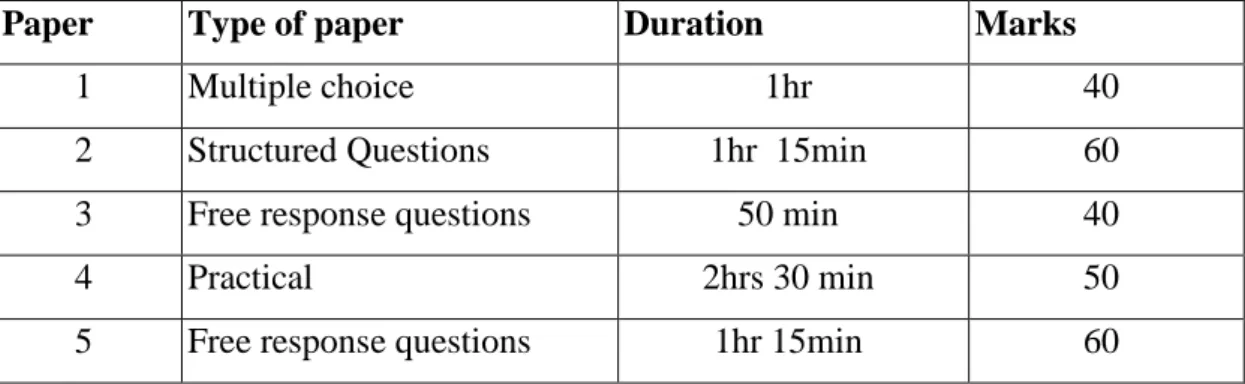
To achieve these objectives candidates will be expected to sit for five papers as indicated in table 1.1.
Table 1.1 Paper Structure
Paper Type of paper Duration Marks
1 Multiple choice 1hr 40
2 Structured Questions 1hr 15min 60
3 Free response questions 50 min 40
4 Practical 2hrs 30 min 50
6
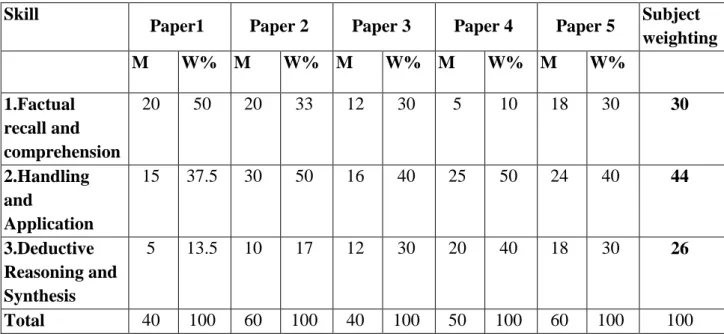
The skill weighting and distribution is also indicated in table 1.2.
Table 1.2 Skill weighting and distribution Skill
Paper1 Paper 2 Paper 3 Paper 4 Paper 5 Subject weighting M W% M W% M W% M W% M W% 1.Factual recall and comprehension 20 50 20 33 12 30 5 10 18 30 30 2.Handling and Application 15 37.5 30 50 16 40 25 50 24 40 44 3.Deductive Reasoning and Synthesis 5 13.5 10 17 12 30 20 40 18 30 26 Total 40 100 60 100 40 100 50 100 60 100 100
Legend: M- Mark allocated W- Skill weighting per paper
Practical work only contributes less than twenty percent of the total marks as indicated in tables 1.1 and 1.2 respectively. Downs (2013:1) however warns that practical work is a core skill in science such that proposals which would allow pupils to fail their practical assessment and still achieve excellent grades in science are unacceptable. Though the issue of weighting is not necessarily the focus of this study, it is difficult to ignore such an observation considering the structure of the physics examination papers in particular and those of Advanced Level sciences in general pertaining percentage weighting of practical work in the final assessment.
1.2.2 Practical Work Assessment: Major marking points on an ‘A’ level physics practical work report
According to the ‘A’ level physics syllabus (9188) on page 35, marks are awarded basically for correct tabulation of results, graphical work and analysis of results at the expense of skills such as planning, manipulation and observation among many others. The researcher would like to explain in detail how practical work is marked guided by the requirements and expectations from the Zimsec ‘A’ level physics syllabus (9188). This is critically important and fundamental to determine whether the basis of practical work assessment as outlined in the syllabus will assist students to develop other practical work skills that are required by students in environments beyond the ‘A ‘level’ physics laboratory apart from the presentation and analysis skills. Three areas of presentation of results, graphical work and analysis of results will be considered. Expectations on the necessary skills
7
required to tackle the design question will also be explained as guided by the ‘A’ level physics syllabus (9188).
According to the syllabus about eight out of twenty marks normally allocated for a practical in either mechanics or electricity are awarded for correct presentation of data. The actual number of marks will vary from paper to paper with normally a variation of not more than two marks. Candidates are expected to take a suitable number of readings over a specified range. Marks are awarded for taking repeated readings for example in timing of oscillations. Where candidates are expected to do some calculations from raw data, calculations derived from raw readings should be correct and given to appropriate number of significant figures governed by the number of significant figures in the raw data. In other words, the number of significant figures in the calculated values should equal the number of significant figures in the raw data. Marks are also awarded for this ability to maintain the number of significant figures in calculated values as with the raw data.
Neat presentation of data is expected if candidates are to score high marks according to the Zimsec physics syllabus (9188). Numerical data and values should be presented in a single table. Marks are awarded for including columns for raw data and values calculated from them with the correct quantity and unit. An example given in the syllabus is that on current measurement where the column heading should be I/mA or I (A) depending on the scale range of the measured quantity. Candidates are expected to use conventional symbols or abbreviations without further explanations. Candidates are also expected to give all recorded raw readings of a quantity to the same degree of accuracy if they are to score some marks on data presentation. Candidates are normally penalised if the degree of precision used is incompatible with the instrument used according to the requirements from the Zimsec physics syllabus (9188) as outlined on page 36. Marks are also given if candidates are able to give calculated quantities the same number of significant figures as the measured quantity of least accuracy.
It is interesting to note that if a candidate is able to meet the above requirements on data presentation as per Zimsec physics syllabus (9188) prescription even if the raw data obtained were not accurate, the candidate will still be in a position to score some marks. Thus from the marking scheme it follows that with good presentation skills a candidate can possibly pass without having mastered skills like observation, measuring and planning but through good reporting. Zimsec however argues that the mastery of other skills is inferred from the correctness of the results obtained. This however is not reflected on the marking guidelines of practical work report as outlined in the Zimsec physics syllabus (9188). This study will therefore want to establish whether the claim is true so that alternative methods of assessing practical work could be suggested in addition to those of the practical work tests.
8
Another section where candidates get about six marks out of twenty on an experiment in either mechanics or electricity is on graphical work. Candidates are expected to rearrange expressions in cases where straight line graphs are to be plotted. It is imperative therefore that candidates need to be familiar with appropriate mathematical processes for taking logarithms and dealing with exponential functions according to the requirements outlined in the Zimsec physics syllabus (9188). Marks are scored for clearly labelling graph axes with quantity and unit. The graph is expected to occupy at least half the grid in both y- and x-directions. Candidates are also expected to use convenient scales (for example 1, 2, 4 or 5 units to a 2 cm square) and have clear numerical labels at 2 cm interval on either axes. Candidates are credited for plotting correctly points on the grid and penalised for doing so on the white margin to the grid. Candidates are credited for plotting points to an accuracy of better than half a small (2mm) square finely plotted with a sharp pencil and are penalised for thick pencil dots. The line of best fit should show an even distribution of points on either side of the line along its whole length for a candidate to be credited. Candidates are penalised for drawing thick or kinked lines. Straight lines drawn where curves are expected will not gain any marks. When measuring gradient, the assessor should give credit to the learner if points on the line chosen for the calculation are sufficiently separated and accurately read. It is expected that the hypotenuse of the triangle for gradient calculations should be at least half the lengths of the candidate’s line. Credit will be given to candidates if they are able to read the intercept to better than half a small square. Candidates should also be able to determine the intercept from a graph with a false origin.
Again, if candidates are able to do graphical work as per Zimsec prescription above even using in accurate data, it is possible for the candidate to score some marks out of the about six allocated for this section. It means that without mastering skills like planning, measuring, observation and manipulation among many others but with good reporting skills, one may scratch a pass mark.
Another section where candidates get about six marks out of twenty on an experiment in either mechanics or electricity is on analysis of results using the results from the graph. Credit will be given for using the correct number of significant figures and the correct units where appropriate as outlined in the Zimsec physics syllabus (9188). Sadly only about four marks out of six in this section are awarded for accurately obtaining the values of the unknown from the gradient and intercept. Candidates are penalised for getting values which are out of range from those expected by the examiner. It must be noted at this point that only four marks out of a possible twenty for a particular experiment are awarded for accurately carrying out the experiment from a close analysis of marking points of an ‘A’ level physics practical work report in either mechanics or electricity. It remains to be seen from the results of this study whether the current methods which are being employed by Zimsec to assess physics practical work will assist students in developing other crucial practical work skills in
9
addition to good reporting as dictated by the requirements of the current Zimsec physics syllabus. It appears as if students’ mastery of practical skills are greatly influenced by the method which is used to assess such skills then students are forced to perfect their presentation skills in order to pass examination at the expense of other crucial skills expected of them in environments beyond the ‘A’-level physics laboratory.
1.3 Statement of the problem
If students fail to develop key practical skills such as designing, equipment manipulation and investigation at high schools because of the current system of practical work assessment, then these students are likely to face problems when they enter university and other environments beyond the ‘A’ Level Physics Laboratory. The practical work skills exhibited by ‘A’ level physics graduates are poor and there are reasons for believing that inadequate assessment practices are one of the main contributory factor for this. This mismatch raises eyebrows as to whether the skills assessed in the ‘A’ Level Physics curriculum are adequately developed or that the focus is on presentation skills that are easy to assess. The research is based on the hypotheses that, development of practical work skills in physics is largely influenced by the way in which practical work is assessed.
1.4 Aims of the study
The focus of this study is on two main issues, which are:
• To evaluate the influence of current physics practical work assessment method on skills development of ‘A’ level physics students.
• To come up with suggestions on alternative ways of assessing Physics Practical Work activities to enhance the development of other key skills such as manipulation, observation and designing.
1.5 Research questions
This study is guided by the following research questions.
1.5.1 Research question 1
• How does practical work assessment method influence the development of practical work skills of ‘A’ -level physics students?
10 1.5.2 Sub-research questions
• How do ‘A’- level physics teachers assess practical work skills of students during the course of their programme?
• How relevant are the assessment practices on students’ practical skills development? 1.5.3 Research Question 2
• What are the possible alternatives to physics practical work examinations? 1.6 Significance of the study
This study is quite significant to a number of stakeholders. Stakeholders such as tertiary institutions and industry expected to absorb these students after their high school studies are some of the potential beneficiaries. The study is also significant in the sense that it emphasises acquisition of practical experiences by the students than mere theoretical presentations of subject content. This will go a long way on how an improvement on the assessment of practical work can be realised instead of the current method which is highly summative. In light of the above study aim and research questions, this study proposes an adoption of a holistic approach to assessment of learner practical work based on an alternative model of scientific approach. In developing any model of assessment important questions need to be asked about the abilities that might be assessed, the best ways to assess these abilities and who should carry out the assessment (Kennedy and Bennett, 2005).
The study is guided by the conceptual framework of formative assessment of practical work as opposed to summative assessment as dictated by practical work tests. It tries to expose the benefits of formative assessment despite the problems of scarcity human resource, objectivity of the assessment and high costs .These are some of the reasons that are always cited by advocates of summative assessment of practical work as a basis for not practising formative assessment of practical work. Dufresene and Gerace (2004)’s argument that the rationale for formative assessment is to effectively monitor and influence development of students’ thinking process, inquiry skills, attitudes towards science and learning behaviours cannot be overlooked. Formative assessment of practical work maybe a panacea to the problem of lack of other skills like observation, manipulation and designing that are often exhibited by ‘A’ level graduands in environments beyond the ‘A’ level physics laboratory.
The study sought to focus on the competencies of ‘A’ level students on mastery of skills like observation, manipulation and designing as they carry out practical work activities and rated against the obtained mark on the submitted report as a way of finding out the value of practical tests in developing practical work skills by ‘A’ level physics students. Black and William (2004) and William
11
and Leahy (2007) concur that the major significance of formative assessment is to improve learning. This study in conclusion, will provide guidance on alternative ways of assessing practical work than the current administered practical work tests in Zimbabwe and beyond.
1.7 Delimitations of the study
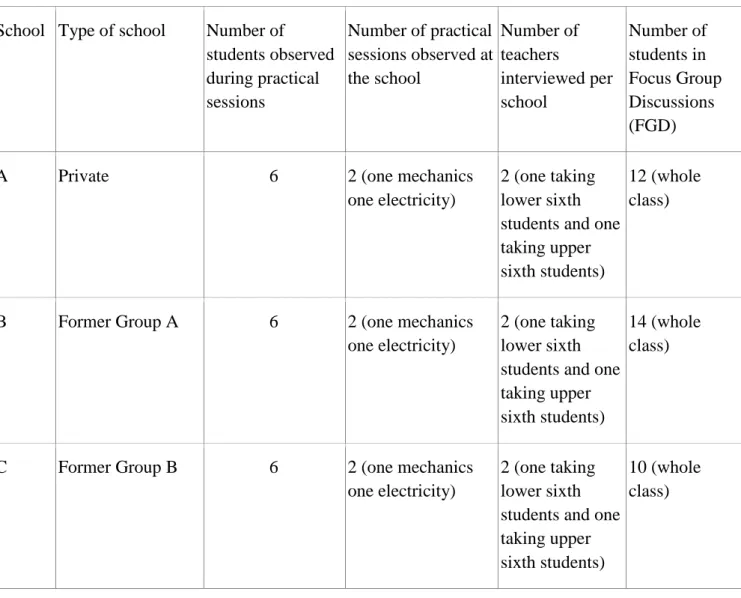
The research employed a case study approach. The subjects of the study were sixth form physics students and six physics teachers sampled from three high schools in Harare province in Zimbabwe. The study sought to focus on the competencies of ‘A’ level physics students on mastery of skills such as observation, manipulation and designing as they carry out practical work activities and rated against the obtained mark on the submitted report as a way of finding out the value of practical tests in developing practical work skills by ‘A’ level physics students.
Correlation analyses was used in data analysis where correlation coefficients obtained between marks awarded by physics teachers on the submitted practical report and an observational scale used by the researcher during practical sessions were compared. Open ended interviews were administered on the physics teachers to solicit their views on the way the physics practicals are assessed as per Zimsec requirements. Focus Group Discussions (FGD) were also employed on the ‘A’ level physics students to source for their views on the assessment of physics practical work. It was unnecessary to include school heads and heads of science departments in the study as they may not be experts in the field of study under observation.
1.8 Definition of terms • Practical Work
Practical work refers to tasks in which students observe or manipulate real objects or materials. These are learning experiences in which students interact with materials to observe and understand the natural world.
• Practical skills
Skills necessary for undertaking a non-written task, for example, reading an oscilloscope. Practical skills include individual’s competency in the manipulation of a particular piece of apparatus/equipment.
• Practical Tests
In this study practical tests refer to the practical work activities performed by ‘A’- Level physics students normally once per fortnight under examination conditions during the course of their two year
12
study. The practical work activities are often supervised by laboratory assistants. At the end of each practical session, the candidate is expected to produce a practical work report which is then marked by the physics teacher from which other practical skills of the candidate are inferred.
• Assessment
Assessment is a multifaceted term with varying dimensions such as, formative assessment which looks at progress, summative assessment which sums student’s achievements and criterion referenced where students are assessed on the extent to which they have achieved set tasks without reference being made to achievement of other students. Assessment should also show some degree of reliability and validity. Whereas assessment entails provision of information (usually through testing), evaluation involves the making of judgements. Assessment in the context of this study refers to a variety of ways information is gathered, synthesised and interpreted on the practical work skills gained by students.
• Zimbabwe Schools Examination Council (Zimsec)
The board responsible for examining candidates at both primary and secondary school levels in Zimbabwe.
• Advanced Level (‘A’-Level)
This means a two year high school course for students who would have successfully compl eted the Ordinary Level before such students could be enrolled for tertiary education in general and university education in particular. In their first year of ‘A’ level study the students will be in lower sixth form also referred to as Form Five and in their second year, the students will be doing upper sixth also referred to as Form Six. It is an academic qualification offered by Zimsec to students completing high school or pre-university education. In Zimbabwe this qualification require students to study any three subjects in science, arts or commercials. To be admitted for university education, one must have passed at least two ‘A’ level subjects.
• Former Group A schools
Before Zimbabwe gained independence in 1980 the education system was divided along racial lines and Group A schools were those schools reserved for white students with basically all resources for the teaching and learning process.
13
Group B schools were those schools which catered for the education of the black majority usually with limited resources for learning.
• Private school
A school run by a board of trustees and normally caters for children from the elite class of the Zimbabwean society. The fees at these schools are high and resources for learning are found in abundance.
1.9 Assumptions
The researcher assumed the following:
• Physics teachers mark practical work consistently and objectively.
• ‘A’ Level Physics teachers and students give honest answers during interviews. • Research assistants are competent and professional.
1.10 Structure of the study.
The study is divided into eight chapters as explained below:
• Chapter1 outlines the background to the study including its purpose, context, significance, delimitation and assumptions. The statement of the problem as well as research questions are stated.
• Chapter 2 is about literature review. The study was guided by a theoretical framework on constructivism. Literature on the assessment of ‘A’ level physics practical work was reviewed. Literature on the assessment of practical work in other subjects was also considered. The chapter concludes by looking at lessons drawn from literature review.
• Chapter 3 is about the research methodology. The mixed methods approach was employed in this study. The convergent parallel mixed methods approach of Creswell (2014) was used to collect, present and analyse data. Data were collected using the observation schedule, interviews and focus group discussions. Issues on validity, reliability and ethics are also addressed.
• Chapter 4 is about the assessment of practical work skills of students from DAPS and IAPS. Chapter 4 presents and analyse quantitative data obtained from the assessment of students’ practical work skills using DAPS and IAPS.
14
• Chapter 5 is about teachers’ views and practices on the assessment physics practical work skills. Chapter 5 deals with the qualitative aspects of this study with regards to data presentation, analysis and discussion.
• Chapter 6 is about students’ views on the assessment of physics practical work skills. Chapter 6 deals with the qualitative aspects of this study with regards to data presentation, analysis and discussion.
• Chapter 7 is about an alternative model of practical work assessment. It outlines the model, its justification, challenges and proposed solutions.
• Chapter 8 looks at the conclusion and recommendations of the research study. 1.11 Chapter Summary
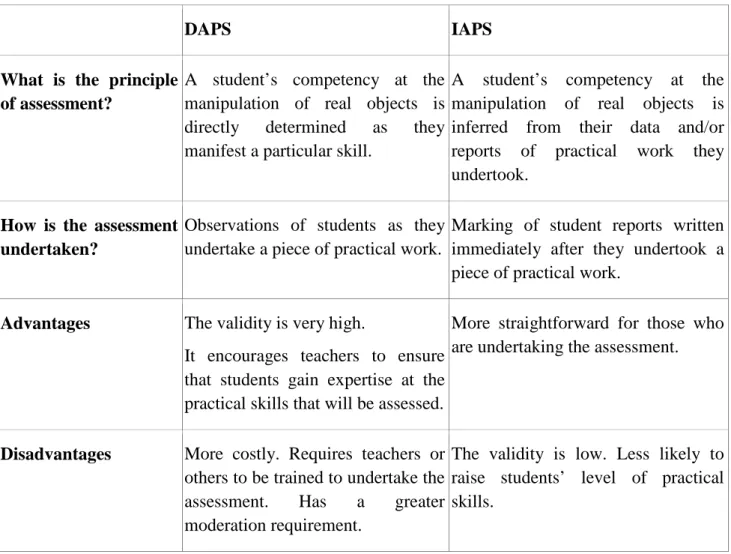
This chapter basically shows the basis for carrying out this research, providing background information on the assessment of ‘A’ level physics practical work and how this assessment method influences the mastery of certain practical work skills by ‘A’ level physics students at the expense of others. The chapter starts by outlining the importance of practical work in science education in general and physics education in particular. It is necessary at this juncture to re-emphasise the assertion by Buick (2010:13) that when assessing practical work it is important to assess skills rather than acquired knowledge. The chapter also highlights why formative assessment of practical work is more important than summative assessment. This assertion is achieved by showing some advantages of Direct Assessment of Practical Work Skills (DAPS) as opposed to Indirect Assessment of Practical Work Skills (IAPS).
The second section of the chapter looks at the context of the study, highlighting the structure of the ‘A’ level physics curriculum in Zimbabwe. Practical work contributes about twenty percent of the total assessment. Aims and objectives of the ‘A’ level physics syllabus are also briefly stated. This chapter also details the current method of assessment of practical work as per Zimsec guidelines.
The third section of the chapter looks at the major marking points on an ‘A’ level physics practical work report in the three areas of data presentation, graphical work and analysis of results. From the analysis of the marking guide as outlined in the physics syllabus (9188), it is sad to note that only about a fifth of the total marks allocated for the assessment of practical work are on obtaining accurate values. Accurate values are values that are within the range of those that are expected by the examiner. A staggering four fifths of the marks are allocated for good data presentation and graphical work.
15
Firstly, this chapter outlines the statement of the problem, and later discusses the aims and research questions guiding the study. The research is being guided by the main research question: How does practical work assessment method influence the development of practical work skills of ‘A’ level physics students? This chapter also describes the significance of the study especially as it concerns the institutions that are expected to absorb the high school physics graduates this study refers to. In any study, the delimitation is important section in order to show the focus of a particular study as all problems that require investigation cannot be solved by one study. Key terms as used in this particular study were defined.
In conclusion this study thrives to find out whether the current methods used by Zimsec in the assessment of physics practical work will assist students to develop crucial practical work skills or only force them to concentrate on perfecting their presentation skills in order to produce a good report and eventually pass examination.
16
CHAPTER TWO
2
LITERATURE REVIEW 2.1 Introduction.
This chapter presents the reviewed literature used for the purpose of this study. Literature review assists the researcher in understanding the problem, its context and its major components as well as stimulating the researcher to generalise own ideas based on other researchers’ experiences. In addition, the review helps to identify and understand the theoretical perspective of the problem that is putting the research topic into its proper perspective. In the context of this study in particular, the purpose of the literature review was to get a global idea on the current assessment strategies employed by examination boards. Different forms and kinds of assessment including those related to formative and summative assessments are considered in this chapter in terms of Direct Assessment of Practical Work Skills (DAPS) and In-direct Assessment of Practical Work skills (IAPS) respectively. Emphasis on the assessment of practical work in England in this literature review was motivated by the fact that Zimbabwe adopted the Cambridge Advanced Level physics syllabus when she localised her examination which are now managed by Zimsec.
In this study on the influence of practical tests in developing practical work skills of ‘A’ level physics students, the assumption is that if practical work is done and assessed effectively, then students will be in a position to develop practical skills such as designing, equipment manipulation, observation and investigation in addition to presentation skills. It is therefore, important to assess these skills during practical sessions than relying on practical reports at the end of practical session ignoring the process of doing the practical work. The researcher wanted to find out whether ‘A’ level physics students develop important practical skills like manipulation, observation, designing and investigation if only practical reports are assessed in a summative way than formative assessment of such skills during practical sessions. These skills are crucial in environments beyond the ‘A’ level physics laboratory hence the need to make sure that students have developed them whilst they are still doing ‘A’ level.
In this section on literature review, the researcher will start by looking at the theoretical framework guiding the research study. The research is guided by the theoretical framework of constructivism. Issues on formative assessment and assessment in constructivism are also considered. This will be followed by literature on the assessment of ‘A’ level physics practical work and some perspectives on the assessment of practical work in science. This section will be concluded by considering literature on possible alternatives to physics practical examinations and lessons drawn from literature review.
17 2.2 Theoretical Framework
The study is guided basically by the theoretical framework of constructivism. Thereafter formative assessment and assessment in constructivism will also be considered.
Constructivism
Constructivism is seen as a theoretical framework on which most research into student thinking and learning is based. This is the reason why it is important to consider it when looking at the influence of practical work assessment method in developing practical work skills of ‘A’ level physics students. According to Jonassen and Landin (2002), constructivism is a theory of learning based on the idea that, knowledge is constructed by the knower based on mental activity. Porta and Keating (2008:81) present a different argument by purporting that things we perceive are rather a product of our conceptualisation thus constructivism is not a theory or an approach but a perspective. Human learning is constructed; it’s active rather than passive. Treagust and Duit (2008) argue that constructivist view primarily concerns a particular way of conceptualising knowledge and knowledge acquisition based on certain epistemology. The argument here is that, human knowledge is a process of personal cognitive construction or invention. Constructivism is more of a philosophy than a strategy. Treagust and Duit (2008) argue that constructivism has its roots in philosophy, sociology, psychology and education. Both psychological and epistemological principles of constructivism emphasise that knowledge cannot be separated from knowing the subject. The psychological principle emphasises the fact that students do not passively receive knowledge but built it. The epistemological principle asserts that the function of cognition is adaptive and enables students to construct viable explanations of experiences of the world. Both psychological and epistemological principles of constructivism emphasise that students need to be actively involved in building up their knowledge. To fully appreciate the importance of constructivism as a learning theory, it is important to briefly consider the works of the originators of the theory of constructivism and its development to modern times. According to Driscoll (2005), the originators of the learning theory of constructivism are:
• John Dewey(1859-1952)
• Lev Semyonovich Vygotsky(1896-1934) • Jean Piaget(1896-1980)
• Jerome Seymour Bruner (1915-2016)
According to Driscoll (2005), John Dewey is cited as the philosophical founder of constructivism. Dewey rejected the notion that schools should focus on repetitive, rote memorisation and proposed a method of learning where students would engage in real world, practical workshops in which they would demonstrate their knowledge through creativity and collaboration, Dewey (1916).Dewey
18
advocates for an active learner where students think for themselves and articulate their thoughts. According to Dewey (2016), progressive education should recognise the social aspect of learning and uses conservation and interaction with others. Dewey (1916) proposes a pragmatic approach to learning where the learner takes an active part. Constructivism was born from Dewey’s theory of progressivism. Dewey argues that inquiry is a key part of constructive learning. Learning therefore consists of constructing meaning and constructing systems of meaning. Learning as a social activity also involves language.
Another founder of the constructivist learning theory is Vygotsky who proposes the social development theory. According Vygotsky (1980) social development theory argues that social interaction precedes development. Consciousness and cognition are the end products of socialisation and social behaviour. According to Vygotsky(1980), the theory is based on three themes that include, social interaction, the more knowledgeable other and the zone of proximal development. On social interaction, Vygotsky emphasizes the importance of language and culture in cognitive development. Vygotsky rejected the assumption made by Piaget that it was possible to separate learning from social context. Vygotsky(1980) demonstrated the importance of language in learning by demonstrating that in infants communication is a pre-requisite to the child’s acquisition of concepts and language. According to Vygotsky(1980), during the process of learning, students participants begin a task with different understandings until they arrive at the shared understanding thereby creating a common ground for communication. Vogytosky used the term ‘scaffolding’ to refer to the support that is given to the learner during the learning process to fit the child’s current level of performance through a shared endeavour between the expert and the less expert participant. According to Vygotsky the last level is the zone of proximal development where learners are given the opportunity to solve problems beyond their actual development level under adult guidance or in collaboration with more capable peers. Vygotsky’s theory promotes learning contexts in which students play an active role in learning according to Driscoll (2005).
Jean Piaget proposed the theory of cognitive development. According to Piaget (1978), cognitive development has four distinct stages in children which are sensori motor, pre operational, concrete and formal. The sensori motor stage starts from birth up to the age of two years. At this stage Piaget (1978) argues that the infant is able to distinguish between itself and other objects. Learning at this stage takes place via assimilation. During the pre-operational stage of between two and four years, the child is not able to conceptualise abstractly and needs concrete physical situation. The third stage of concrete operation is reached at the age of between seven and eleven years. At this stage, the child begins to think abstractly and is able to conceptualise and create logical structures that explain physical experiences. The last stage according to Piaget (1978) is called the formal operations where the learner is capable of deductive and hypothetical reasoning.
19
According to Driscoll (2005), Piaget explained how new knowledge is shaped in order to fit with the learner’s existing knowledge and how the existing knowledge can be modified to accommodate knew knowledge. The major concepts in this cognitive process include assimilation, accommodation and equilibration. According to Driscoll (2005), Piaget explains that assimilation occurs when the learner perceives new objects or events in terms of existing schemas or operations. Accommodation occurs when existing schemas are modified to account for new experiences. Equilibration is the mastering stage that encompasses both accommodation and assimilation. Piaget argues for active learning that forms the basis of constructivism.
Jerome Brunner according to Driscoll (2005) proposed discovery learning theory. This is a method of inquiry based learning. Influenced by Vygotsky, Brunner emphasised that learning must be a process of discovery where learners built new knowledge from the existing. Learning is an active social process. Brunner argues that it is best for learners to discover facts by themselves. Discovery learning takes place in problem solving situations where learners draw from past experiences to discover facts and relationships and new truths to be learnt through object manipulation according to Brunner (2009).Discovery learning helps to develop creativity and problem solving skills on part of the learner. Opponents of the theory according to Driscoll (2005) argue that it creates cognitive overload which may result in potential misconceptions.
According to Driscoll (2005), constructivists believe that assessment should be used as a tool to enhance both the student’s learning and the teacher’s understanding of the student’s progress instead of an accountability tool. Types of assessment aligned to this epistemological position include the use of portfolios, group based projects, debates and role play.
The assessment method becomes crucial in determining whether students have developed the necessary practical work skills to suit environments beyond the ‘A’ level physics laboratory. Cakir (2008) notes that constructivism is based on three cognitive theories by Piaget, Ausubel and Vygotsky. In order to learn students must carry out cognitive processes that construct relations among the elements of information in the concept. Cakir (2008) further notes that Vygotsky’s zone of proximal development is a distance between the actual development level as determined through problem solving and level of potential development as determined through problem solving under adult guidance or collaboration with more capable peers. Ausubel and Piaget argue of existing schemata for a learner to meaningfully acquire new information or concepts according to Cakir (2008). Treagust and Duit (2008) argue that according to radical constructivism, knowledge is seen as tentative human construction on the basis of already existing knowledge. Some profound scholars (Treagust and Duit, 2008; Cakir, 2008; Trowbridge and Bybee, 2004) postulate that the basic tenets of constructivism are:
20
• Knowledge is actively built from within by a thinking person and not passively received through senses.
• Social interactions between, and among learners are central to the building of knowledge by individuals.
• Humans rely on shared or negotiated meaning.
• Children’s alternative concepts are wrongly referred to as misconceptions.
• Emphasis on authentic tasks in meaningful context rather than abstract instruction out of context.
• Encourages thoughtful reflections on experiences.
This section briefly describes constructivism in science education. The constructivist approach accepts and encourages students’ initiation of ideas. The argument here is that, students’ prior knowledge, expectations and perceptions are important in the learning process. Treagust and Duit (2009:89) note that constructivist teaching approaches consider students’ beliefs and conceptions towards student centred pedagogy in science instruction with the focus on students’ interest, their learning skills and their needs in actively constructing their knowledge. According to Cakir (2008) science teachers should call attention to the process of science rather than just content. In other words, constructivist approaches must promote conceptual changes and development through use of activities. It is important therefore that in assessing practical work in science education, we need to consider the practical skills that students exhibit as they do practical work and assess them. When students are involved in the construction of their own learning through formative assessment, they develop the ability to monitor and regulate their learning. According to Trowbridge and Bybee (2004), what learners actually construct from a given learning experience varies from student to student as there is no conduit from one brain to another. Treagust and Duit (2008) argue that constructivist science education is humanistic in nature and it aims at supporting the development of individuals’ personality. Students must be empowered to deal with challenges of their future lives. Cakir (2008) concurs by saying that students come into the classroom with an established worldview formed by years of prior experience and learning to such an extent that they are emotionally attached to their worldviews and would not easily give up.
The constructivists’ views of science education are basically that; all knowledge is constructed as a result of cognitive process within human mind, prior knowledge impacts the learning process and that constructivism provides no specific answers but rather frames the questions and acceptable forms of answers. On assessment, constructivism calls for the elimination of grades and standardised testing as assessment becomes part of learning process so that students play a larger role in judging their own progress. However the role of assessment among other supporting conditions of conceptual change is given key importance. It must be noted in conclusion that, the pathway from students’
pre-21
instructional conceptions to science conceptions is evolutionary according to arguments of Treagust and Duit (2008).
2.3 Formative Assessment
Assessment can be seen as the process of collecting, synthesising and interpreting information to aid decision making processes. It basically takes two main forms of formative and summative assessments. Literature however reveals that there are now some off shoots of terms referring to some kinds of both formative and summative assessments. Examples on formative assessment of practical work include direct assessment of practical work skills (DAPS) as defined by Reiss, Abrahams and Sharpe (2012:6) which McMillan (2004) refers to as authentic assessment. McMillan (2004:16) defines authentic assessment as assessment in which students are asked to perform real world tasks that demonstrate meaningful application of essential knowledge and skills. An authentic assessment usually includes a task for students to perform and a rubric by which their performance is assessed. Pedder (2006) refers to this as performance assessment in which students are assessed during tasks. According to Shepard (2008:81), formative assessment is defined as “an assessment carried out during instructional process for the purpose of improving teaching or learning…making adjustments so as to inform new learning”. William and Leahy (2007) note that, an assessment is formative to the extent that information from assessment is fed back within the system and actually used to improve the performance of the system in some way. Black et al. (2003) see formative assessment as a process in which information about learning is evolved and then used to improve the teaching and learning activities.
Formative assessment takes different forms and ways. Bell and Cowie (2001) talk of Interactive Formative Assessment (IFA). Dufresne and Gerace (2004) write about Classroom Formative Assessment (CFA). Interactive Formative Assessment (IFA), according to Bell and Cowie (2001) takes place during teacher student interaction. The process involves the teachers noticing, recognising and responding to students’ thinking and it has more to do with teacher-student interaction than influenced by the curriculum. From the observations by Bell and Cowie (2001), it appears this kind of assessment generates information that is ephemeral as it involves the teacher’s reaction after noticing sections where the learner may need his help. This idea is supported by Fairbrother (2008:70) as he asserts that “only teachers can see students in action and assess their objectives, which are directly connected with their practical work and this is where they should be directing their time and effort”. Ideally, assessment should provide short term feedback so that obstacles can be identified and tackled very early within the process of learning. This is important as information from assessment affects subsequent teaching and learning activities.