Understanding the Relationship Between K-12 Teachers’ Perceptions of Their Levels of Teaching Innovation and Their Experiences with
Technology-Driven Professional Development
A Dissertation Submitted to the Faculty
of
Drexel University by
Vincent Day
in partial fulfillment of the requirements for the degree
of
Doctor of Education,
Educational Leadership and Management May 2017
© Copyright 2017
Dedications
I dedicate this dissertation to the three angels in my life who have guided me to a place I never envisioned.
To the angel by my side––my wife, Mary Ellen: You have been my biggest supporter and advocate. You are my rock and my inspiration. You drive me to always achieve my goals. You put your life on hold when I needed “time for schoolwork” at night, on
weekends, and even on vacations. I love you. I will spend the rest of my days grateful for all that you have done for me.
To the angel on her way––Charlotte (Charlie):
Everything that I do is for you and Mommy. While you have yet to arrive, I am wrapped around your finger even now. I am here for you, now and always. When you are happy, sad, scared or just want to talk to “Daddy,” I will never be far away. I will hear you calling me and I will always come to you.
To the angel above me––Mom (Charlie’s Angel)
Not a day goes by that I do not think about you. When I was down, you picked me up. When I was headed down the wrong path, you set me straight. When I was alone, you were with me. I hope I made you proud.
This dissertation is also dedicated to my Dad.
Dad, I have never heard you ask anybody for anything, yet you have always been the first person to provide for others. You are the hardest working person I know, and you taught me to never lose sight of the work ethic that is part of who we are as a family. When I finished graduate school, I wrote about your white guitar and your devotion to the band, Rush. I am finishing school again, and cannot help but be reminded of the song,
“Working Man.” I am proud to be your son.
It seems to me I could live my life A lot better than I think I am I guess that's why they call me They call me the working man
Acknowledgements
After completing a master's degree, I thought about what was next in my academic life and my personal life. I had earned a degree beyond my expectations, but I still felt that I was not finished. I felt good about my achievements at that time, but there was more that I wanted to accomplish in my academic life.
My girlfriend at the time, Mary Ellen, who I was fortunate enough to marry, asked me if I had thought of earning a doctoral degree. My response was quick and easy––an
emphatic, NO. I did not believe that I could do it, that I belonged in the academic arena of everyone who had been a mentor to me. I was wrong. Those mentors demanded of me that I be wrong. I thank them, my professors and colleagues who guided me through #DrexelEdDCH5.
I thank, from deep in my heart, my fellow Northeast Philly kid, Alicia Drelick. On the first day of our first executive weekend, she asked me to join her group and there began the bond of two Northeast Philly wannabe scholars who dropped the wannabe forever. We pushed each other, critiqued one another in ways that neither one of us would have accepted from anybody else. Although Mayfair and Pollock were Northeast Philly rivals, we came together and made it happen and we will again, two kids from the Northeast who will #grabtheday.
I thank my supervising professor, Dr. Toni Sondergeld, who instilled confidence in me while navigating me through nearly three years of reading, writing and revisions. You encouraged me to think, and to trust in myself. I am truly grateful for the wisdom, knowledge and kindness you gave me. I would also like to thank my other committee members, Dr. Joy Phillips, and Dr. Sally Maxwell for their time and guidance.
To my family and friends, it has been a long journey. You have been an amazing support system, offering me advice and words of encouragement that have inspired me to achieve my goal of achieving something great in my life—academics.
Finally, I would like to thank each of the participants of this study. You trusted me with your experiences. This research would not have been possible without your willingness to share with me. I honor your practice and hope that I captured your authentic voices. I am humbled to be a part such a thoughtful and brilliant community. Thank you.
Table of Contents
Chapter 1: Introduction to the Research ...14
Introduction to the Problem ...14
Statement of the Problem to be Researched ...16
Purpose and Significance of the Problem ...16
Research Questions ...17
Conceptual Framework ...17
Definition of Terms...23
Assumptions and Limitations ...24
Summary ...26
Chapter 2: Literature Review ...28
Literature Review...29
Summary ...57
Chapter 3: Methods and Procedures ...59
Purpose and Research Questions ...59
Research Design...60
Site Description ...63
Methodology ...65
Data Analysis ...74
Ethical Considerations ...76
Chapter 4: Results and Interpretations ...79
Quantitative Results ...79
Qualitative Results ...84
Teaching and Learning with Technology ...85
Professional Development ...91
Chapter 5: Conclusions, Implications, and Recommendations ...106
Summary of the Study ...106
Summary of the Findings ...107
Conclusions ...109
Implications...118
Recommendations for Future Research ...125
References ...127
Appendix A: LoTi Digital Age Survey for Teachers ...138
Appendix B: Level of Teaching Innovation (LoTi) Framework ...142
Appendix C: Current Instructional Practices (CIP) Framework ...146
Appendix D: Personal Computer Use (PCU) Framework ...151
Appendix E: Interview Protocol ...155
List of Figures
1.1. Conceptual framework model ...20 4.1. LoTi results including the number of teacher participants and the percentage of
teachers that fall into the three LoTi categories ...81 4.2. CIP results including the number of teacher participants and the percentage of
teachers that fall into the three LoTi categories ...82 4.3. PCU results including the number of teacher participants and the percentage of
List of Tables
3.1 The Academy Faculty Statistics...69 3.2 The Academy Quantitative Participation ...70 3.3 The Academy Qualitative Participation ...73
Abstract
Understanding the Relationship Between K-12 Teachers’ Perceptions of Their Levels of Teaching Innovation and Their Experiences with Technology-Driven Professional
Development Vincent Day
Chairperson: Toni A. Sondergeld, Ph.D.
Students today are expected to develop real-world thinking and digital literacy skills to succeed in a globally connected and technology-infused world. Accordingly, teachers are tasked with implementing innovative levels of teaching to meet the needs of today’s digital learners. As technology becomes increasingly ubiquitous and accessible in K-12 schools, learning will continue to take place in digital spaces. However, current research suggests that teachers lack the technological proficiencies required to develop the engaging and innovative classroom experiences that students crave. Despite
significant investments in professional development in K-12 schools, many teachers are failing to effectively transfer learning from these experiences into innovative levels of teaching.
A rapid influx of technology into K-12 schools presents significant potential for educators to leverage digital resources to pursue professional development opportunities that are relevant to their practice—in any place, at any time. However, it is unclear how teachers’ use of innovative, technology-driven pedagogy in their classrooms relates to their perceptions and experiences with technology-driven professional development. The purpose of this study was to examine K-12 teachers’ perceptions and experiences with technology-driven professional development and how they relate to their level of
innovative teaching. To shed light on the research problem, this mixed-methods study sought to answer the following research questions:
1. What are K-12 teachers’ LoTi based on the Levels of Teaching Innovation Digital Age Survey for Teachers?
2. How do K-12 teachers with varying LoTi describe their experiences with technology-driven professional development?
● Why do teachers choose to participate in professional development? ● How do teachers feel about technology-driven professional
development?
● Who participates in technology-driven professional development? ● How is teachers’ participation in technology-driven professional
development related to their LoTi?
This study utilized both the LoTi Digital Age Survey for Teachers to gather quantitative data on teachers’ levels of innovative teaching and a qualitative component consisting of semi-structured interviews. Analysis of the quantitative component resulted in a descriptive analysis in the form of categorical variables pertaining to teachers’ levels of teaching innovation to explain outcome variance. The qualitative component sought to develop an understanding of K-12 teachers’ perceptions and lived experiences with technology, professional development, and levels of teaching innovation. The themes and subthemes that emerged from this study are grouped into two primary categories: (1) Teaching and Learning with Technology, and (2) Professional
Development. Furthermore, answers to the study’s research questions are interwoven into a discussion based on reached conclusions. Finally, based on the study’s results and
conclusions, along with current research in K-12 education, recommendations are made for improving professional development practices toward elevated levels of innovative teaching.
Chapter 1: Introduction to the Research Introduction to the Problem
This study sought to explore the experiences of K-12 teachers in an independent school setting regarding their perceived levels of teaching innovation (LoTi).
Furthermore, this research aims to understand and identify relationships between these perceptions and teacher experiences with technology-driven professional development. As stated by the Partnership for 21st Century Learning (2009), students today are expected to develop key learning and innovation skills to achieve success in a globally connected and technology-infused world, including creativity and innovation, critical thinking and problem-solving, and communication and collaboration. Accordingly, teachers play an integral role in deciding what students will learn and how it will be taught.
Meanwhile, the use of technology in a teacher’s development of innovative classroom learning experiences is becoming an increasingly important consideration for today’s educators. While teachers are encouraged to use tools such as Bloom’s level of thinking taxonomy to address cognitive skills, integrating innovative teaching practices to meet the needs of today’s digital learners has become a perpetual challenge for K-12 educators (Douce, 2016; Koehler, Mishra, Kereluik, Shin, & Graham, 2014; Krathwohl & Anderson, 2010). Current research suggests that many K-12 teachers lack the technological proficiencies that enable them to develop innovative levels of teaching (Koehler et al., 2014; Moersch, 2016). Despite significant investments in both time and money on traditional professional development, many K-12 teachers are failing to
effectively transfer learning from these experiences into innovative classroom experiences (The New Teacher Project [TNTP], 2015).
As information and communication technologies become more accessible and ubiquitous in K-12 schools, both professional development and pedagogical practices need to be redesigned. While schools struggle to implement effective professional development programs per traditional expectations, a progressive, more technology-driven, flexible, and constructivist approach is emerging in K-12 schools (Hixon & Buckenmeyer, 2009; Plair, 2008; Sparks, 2009; Stewart, 2014).
Due to an extensive list of school responsibilities, including planning, organizing, and implementing instruction; managing and organizing the classroom; conducting assessments; and managing parent relationships, many K-12 teachers find themselves in a position where scheduling conflicts and other barriers prevent participation in
professional development (Stronge, 2007). Meanwhile, as schools continue to embrace technology, learning will increasingly take place in digital spaces. These online learning options present significant potential for educators to leverage technology resources to pursue professional development opportunities that are relevant to their teaching and learning practice—in any place, at any time.
In a nationwide survey conducted in 2015, The International Society for
Technology in Education (ISTE) reported that 60% of teachers felt inadequately prepared to teach innovatively using technology. Furthermore, 90% of those surveyed believe technology training is critical for success in achieving higher LoTi. Based on barriers preventing participation in professional development and the opportunity to increase LoTi using digital resources, technology-driven professional development offers teachers
opportunities to engage in both individual and collaborative professional development that suits their needs.
Various individualized approaches to technology-driven professional
development include synchronous and asynchronous learning options, such as online courses, massive open online courses (MOOC), online workshops and seminars, and Internet research. More collaborative experiences often involve professional learning communities (PLCs), multi-user virtual environments, and social networking. Each of these technology-driven professional development efforts offers teachers a flexible, collaborative, relevant, personalized, and constructivist opportunity to increase their LoTi using technology (Cowan, 2009; Dede, Ketelhut, Whitehouse, Breit, & McCloskey, 2009; Fishman et al., 2013; Freeman, 2011).
Statement of the Problem to be Researched
It is unclear how teachers’ use of innovative, technology-driven pedagogy in their classrooms relates to their perceptions and experiences with technology-driven
professional development.
Purpose and Significance of the Problem Purpose
The purpose of this study was to examine K-12 teachers’ perceptions and experiences with technology-driven professional development and how they relate to their self-reported LoTi.
Significance of the Problem
This study is important because it has the potential to offer insights to K-12 teachers and school leaders on how to increase LoTi through technology-driven
professional development. Analyzing the data from this study may help school leaders uncover the relationship between teachers who report low, moderate, and high LoTi and their perceptions and experiences with technology-driven professional development. While significant research is dedicated to increasing LoTi and professional development in K-12 schools, very little research combines these two phenomena, which involves a shift in professional development practices to a technology-driven model. To shed light on the research problem, the following research questions are addressed.
Research Questions
1. What are K-12 teachers’ LoTi based on the LoTi Digital Age Survey for Teachers?
2. How do K-12 teachers with varying LoTi describe their experiences with technology-driven professional development?
● Why do teachers choose to participate in professional development? ● How do teachers feel about technology-driven professional development? ● Who participates in technology-driven professional development?
● How is teachers’ participation in technology-driven professional development related to their LoTi?
Conceptual Framework Researcher’s Stances
The researcher’s stance guiding this study is an epistemological, social
constructivist approach. From an epistemological perspective, there is no single reality for K-12 teachers regarding their experiences and perceptions pertaining to professional development and innovative teaching. In contrast, multiple interpretations of these
important elements of a teacher’s practice exist (Creswell, 2012; Merriam, 2009). To that end, the researcher hopes the outcomes of this study will culminate in further insights, as well as a deeper understanding of the studied phenomena.
A social constructivist approach focuses on extrapolating and understanding to what degree people describe and understand the world in which they live (Gergen, 1985). As a social constructivist, the researcher sought to co-construct reality with research participants from the field, shaped by individual experiences (Creswell, 2012).
Therefore, this research utilized open-ended questions as a vital element of the qualitative component of the mixed-methods study to cultivate meaning from the authentic voices of participants’ lived experiences.
With this research, it was critical for the researcher to foster a safe and open environment to encourage a high level of transparency and honesty from the teachers being studied and develop an understanding of how they experience reality through a subjective lens. As such, the researcher conducted a case study to understand the relationship between teachers’ perceived LoTi and their experiences with technology-driven professional development. Ultimately, a vital objective of this mixed-methods research was for the researcher to gain an understanding of teachers’ perceptions, experiences, and values by spending extensive time in the field to generate detailed meanings (Creswell, 2014).
When conducting this study, the researcher was involved in backyard research. He has worked in the studied school community for over 15 years in various roles involving technology, academics, and professional development (Glesne, 2011). Therefore, the researcher brought to the inquiry process a theoretical and practical
understanding of the interrelationship between education, instruction, and technology, recognizing a critical gap between the use of technology and professional development toward teachers’ cultivation of high LoTi. The researcher’s premise for conducting this research emanated from the unique perspective of having spent a decade primarily focused on the back end of technology without much thought given to pedagogy. Subsequently, the researcher transitioned to more academic roles in the school with various assignments involving academic technology, innovative teaching, computer science instruction, and professional development facilitation. The researcher shifted from a “technology first” perspective to a “technology as a tool in support of teaching innovation” vantage point during his 15 years of experience.
Creswell (2012) postulates, “Whether we are aware of it or not, we always bring certain beliefs and philosophical assumptions to our research” (p. 15). The researcher acknowledges the experiences that have been beneficial in developing insights could also become a liability, biasing preconceptions pertaining to the integration of technology into professional development and LoTi based on academic, professional, and personal
preferences. The ability to suspend judgement while learning to bracket experiences was essential to clearly understand participants’ lived experiences in order to conduct a successful, valid, and credible study (Moustakis, 1994). Additionally, several actions were taken to mitigate subjectivity while strengthening the study’s credibility, including member checking and triangulation of data sources and methods (Bloomberg & Volpe, 2016; Creswell, 2014).
Conceptual Framework
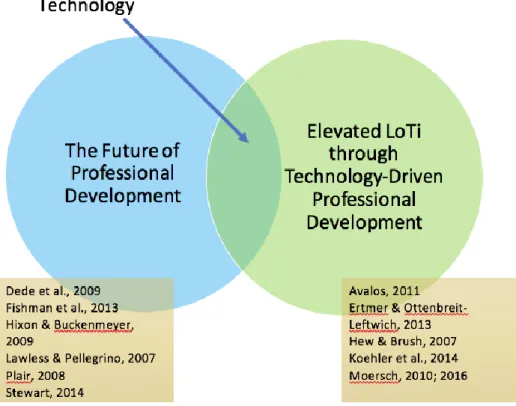
Two primary streams emerged from the literature to provide a conceptual
framework informing this study: (1) The Future of Professional Development, including sub-streams devoted to a paradigm shift from traditional professional development to a more technology-driven approach, and professional learning communities; and (2) Elevated LoTi through Technology-Driven Professional Development, including sub-streams focusing on barriers preventing innovative levels of teaching, and connecting pedagogy, content, and technology (see Figure 1.1).
The Future of Professional Development
The literature on the future of professional development explores the current state of professional development in K-12 schools, highlighting the uniformity coinciding with the traditional one-size-fits-all approach. Furthermore, this stream includes a sub-stream examining a paradigm shift from the traditional model of professional development to an increasingly technology-driven approach, the effectiveness of this digital modality, and teachers’ perceptions and experiences pertaining to this shift. Also included in the first stream is a sub-stream focusing on the development of PLCs, exploring the impact of digital and face-to-face collaboration through various social media outlets and group professional development supported or facilitated by technology.
Professional development in K-12 schools is currently undergoing a paradigm shift, as schools continue to integrate technology into teaching and learning practices (Plair, 2008). Stewart (2014) asserts the traditional model of professional development is passive and intermittent, comprised of workshops, seminars, and in-service days. This model lacks the continuity and collaborative effort that teachers need to develop the digital proficiencies required to cultivate personalized, technology-rich student learning experiences (Plair, 2008; Stewart, 2014). In this stream, the research focuses on teachers’ perceptions, experiences, and value placed on the use of technology in faculty
professional development, while exploring the relationship between technology-driven professional development and LoTi.
Current literature reveals that K-12 schools implement professional development to provide teachers with the necessary skills and knowledge to redefine student learning experiences (Avalos, 2011). Unfortunately, despite evidence that may suggest a positive
impact, many of these activities are irrelevant to teachers with a mind toward increased LoTi (Avalos, 2011; Fishman et al., 2013; Hixon & Buckenmeyer, 2009). This stream analyzes the need for a flexible, personalized, technology-driven approach to professional development that allows educators to experiment, reflect on, and collaborate with like-minded peers towards engaging, individualized, and innovative student learning
experiences (Avalos, 2011; Battersby & Verdi, 2015; Carpenter & Krutka, 2014; Mishra, Koehler, & Kereluik, 2009; Plair, 2008; Sparks, 2009; Stewart, 2014).
Elevated LoTi through Technology-Driven Professional Development
Next is an analysis of the literature exploring the potential to increase LoTi through technology-driven professional development. Also included in this stream are sub-streams examining barriers that teachers perceive as impediments hindering their participation in technology-driven professional development, and the process involved in connecting pedagogy, content, and technology.
Based on the presumption that many professional development programs are designed to support student learning, teachers play a vital role in determining what educational materials and tasks are presented to students and how they are delivered. Therefore, building teacher capacity to deliver innovative and engaging curricula through professional development becomes a crucial element toward achieving increased LoTi (Hawley & Valli, 1999). The traditional face-to-face approach to professional
development “often focuses on generalized instructional practices, such as collaborative learning” (Fishman et al., 2013, p. 427). A notable challenge with this type of generic learning is the individual teacher’s responsibility to interpret the content and
least 123 barriers have been identified in past empirical studies analyzing technology integration into the teaching and learning process (Hew & Brush, 2007). Such barriers have resulted in a gap between the ubiquity and access to technology in K-12 schools and LoTi (Ertmer & Ottenbreit-Leftwich, 2013; Hew & Brush, 2007; Hixon & Buckenmeyer, 2009; Kopcha, 2012).
Notwithstanding, technology presents an opportunity to redefine education beyond conventional standards; its integration into the teaching and learning process has become a perpetual challenge for K-12 educators (Okojie, Olinzock, & Okojie-Boulder, 2006). Despite existing barriers obstructing enhanced LoTi, teachers have the
opportunity to use technology as tool to connect pedagogy with content, with a chance to redesign the current landscape of teaching and learning, as well as professional
development (Dornisch, 2013; Koehler et al., 2014). Research in this stream investigates a broader view of LoTi through the lens of various academic standards, frameworks, models, and theories that have been developed to guide K-12 teachers' instructional and professional development practices toward higher LoTi involving the use of technology.
Definition of Terms
For this research, the following terms will be defined as stated:
Innovation: An advancement, novel idea, or improved device or process (Ertmer & Ottenbreit-Leftwich, 2013).
Pedagogy: Academic discipline that concentrates on the theory and practice of education, focusing on the study and process of teaching and learning (Okojie et al., 2006).
Professional development: A comprehensive, sustained, and intensive approach to improving teachers’ and principals’ effectiveness in raising student achievement (Standards for Professional Learning, 2010).
Professional learning community (PLC): “Educators committed to working collaboratively in ongoing processes of collective inquiry and action research to achieve better results for the students they serve. Professional learning communities operate under the assumption that the key to improved learning for students is continuous, job-embedded learning for educators” (DuFour, DuFour, Eaker, & Many, 2006, p. 217).
Self-efficacy: The belief in one’s ability to organize and execute actions required to manage prospective situations (Bandura, 1997).
Teacher self-efficacy: Teachers’ beliefs about their individual capacities to encourage and support learning (Wheatley, 2005).
Technology-driven professional development: Teacher professional
development experiences delivered partially or completely over the Internet (Fishman et al., 2013).
Assumptions and Limitations Assumptions
Based on life experiences involving education, work, and personal values, the researcher brought certain assumptions to the study. The first assumption was that K-12 teachers desire to enhance their LoTi. Due to a pursuit of lifelong learning, a desire to transform student learning experiences, or contractual obligations, the researcher is working under the assumption that teachers will elect to pursue technology-driven professional development to increase LoTi.
The second assumption was that the site’s administration would value the study enough to use its results to improve conditions relating to professional development and classroom pedagogy. The third assumption underlying the research was that teachers would be willing to participate in the study. Furthermore, participants would be truthful and forthcoming with both the quantitative and qualitative components of the study. Teachers were presumed to want to share their perceptions and experiences in the spirit of improving professional development, as well as their LoTi. The last assumption was that faculty members were currently dissatisfied with the model of professional
development currently implemented at the school, and that the site had a desire to improve current conditions with regards to phenomena being studied.
Limitations
Creswell (2012) suggests that limitations identify potential weaknesses within the study pertaining to data collection and analysis, per the researcher. The first limitation of this study relates to available research. Although many studies exist involving
professional development efforts in K-12 schools, there is a lack of empirical evidence offering examples of what helps teachers increase LoTi through technology-driven professional development. Furthermore, while significant research is available pertaining to the traditional model of professional development, few studies exist involving
technology-driven professional development programs.
This study is intended to capture insights into the perceptions and experiences of K-12 teachers concerning their everyday practices. As such, this study was limited by the idea that surveys and interviews were dependent on a teacher’s willingness to be
of their own practices; therefore, a lack of understanding as to what constitutes teaching innovation and technology-driven professional development may have influenced the way teachers responded to survey and interview questions.
Another limitation underlying the research involved a limited sample size. While the site employs approximately 150 faculty members, only 67 teachers participated (45%). According to Creswell (2014), a typical high response rate is above 50% for a six-week data-collection period. Although 45% represents an acceptable response rate for a two-week data-collection period, a larger research sample would present an
opportunity for more comprehensive insights concerning the studied phenomena. Lastly, results of the study could be perceived as biased because the researcher is a member of the academic community.
Summary
Technology has become ubiquitous in in K-12 schools in recent years. Students are born into a world where mobile devices, social media, games, e-commerce, and countless other technology-driven activities guide their existence. Conversely, many of today’s teachers were educated in classrooms devoid of technology, with instructors acting as content and knowledge experts as they prepare students for jobs in an industrial-based economy. Historically, K-12 teachers have focused on instructing rather than facilitating learning through innovative classroom experiences with technology. Thus, change in education at all levels has become difficult to initiate and sustain.
Professional development programs are widely used in K-12 schools to help teachers increase their LoTi. However, research suggests that despite substantial contributions of time and money on professional development, most teachers are failing
to show improvements, as teacher evaluation ratings have either remained constant or declined over the past few years (TNTP, 2015). Many K-12 schools heavily invest in professional development, yet teachers fail to transfer learning from professional development experiences to innovative teaching and learning.
Albeit, some teachers are beginning to use technology toward an individualized learning path to increased LoTi, K-12 education lacks a systematic, technology-driven model that will help guide teachers toward pedagogical innovations. While many teachers recognize they can improve their LoTi, they ultimately do not perceive this area as a weakness. Fundamentally, teachers need feedback on the strengths and weaknesses of their practice to learn how to improve their LoTi; however, most do not receive these assessments (Desimone, 2009; TNTP, 2015). These current realities demonstrate a need for more research examining technology-driven professional development and LoTi in K-12 schools.
Chapter 2: Literature Review
The purpose of this study was to examine K-12 teachers’ perceptions and experiences with technology-driven professional development and how they relate to their self-reported LoTi. In a time of school reform, many consider professional development to be the foundation of academic improvement. Thus, numerous teacher professional development programs have been initiated in K-12 schools to build teachers’ capacity for learning, but they have become costly in terms of time and resources.
Historically, K-12 professional development has been comprised of uniform in-service days, workshops, and conferences. This traditional model has largely failed to meet teachers’ needs in terms of quality and support as they attempt to develop their LoTi (Dede et al., 2009; Fishman et al., 2013; Freeman, 2011; Stewart, 2014). Challenges with this approach to professional development are further exacerbated as school
administrators seek classroom achievement results based on teachers’ transference of skills and knowledge to the classroom, which research shows has been a challenge
(TNTP, 2015). Because of enduring obstacles, frustration sets in, self-efficacy decreases, and teachers may miss opportunities to learn how to increase their LoTi.
The need for high-quality and real-time professional development that aligns with teachers’ hectic schedules has precipitated a need for change in K-12 school professional development programs. However, it is unclear how the shift to a more technology-driven model of professional development will help teachers utilize digital resources toward increased LoTi. The two primary streams and their associated sub-streams of this literature review examine K-12 teachers’ perceptions and experiences with professional
development, as well as the value placed on the use of technology coinciding with these experiences as they seek to develop innovative learning experiences for their students.
Literature Review The Future of Professional Development
This stream of research examines the current state of professional development in K-12 schools, including the traditional face-to-face model, as well as an emerging
paradigm shift to an increasingly technology-driven approach. Additionally, a sub-stream is devoted to the development of PLCs that examines the impact of both digital and face-to-face collaboration through various social media outlets and group
professional development opportunities supported or facilitated by technology. Lawless and Pellegrino (2007) assert, “Improving the depth and breadth of teacher qualifications and student learning are major national goals” (p. 575). A review of the research on K-12 education reveals a consensus that professional development programs are designed to enhance teacher knowledge and pedagogical practice while supporting student learning outcomes (Darling-Hammond, Wei, & Andree, 2010;
Desimone, 2009; Garet, Porter, Desimone, Birman, & Yoon, 2001; Lawless & Pellegrino, 2007; Mizell, 2010; TNTP, 2015). Mizell (2010) comments,
In education, research has shown that teaching quality and school leadership are the most important factors in raising student achievement. For teachers and schools and district leaders to be as effective as possible, they continually expand their knowledge and skills to implement the best educational practices (p. 3). Appropriately, federal legislation and various K-12 funding initiatives have focused on professional development to enhance both teacher practice and student learning (Lawless & Pellegrino, 2007). However, while the research reveals little doubt that professional development is essential to increasing LoTi in K-12 schools, the
literature also indicates that many researchers and practitioners believe the current professional development system is broken (Tweed, 2013). Hill (2009) argues, “Despite evidence that specific programs can improve teacher knowledge and practice and student outcomes, these programs seldom reach real teachers on a large scale” (p. 470). Despite contradicting perspectives, there is an overall recognition of the importance of
professional development in K-12 education. Specifically, the research indicates that it is critical for teachers to keep up to date with emerging technologies, new pedagogical approaches, student performance standards, and diverse student populations (Jenkins, 2013; Lawless & Pellegrino, 2007; McNamara, 2010).
Evidence also reveals that teachers play an integral role in determining what educational materials and tasks are presented to students and how they are delivered (Fishman et al., 2013). As such, building teacher capacity to deliver enhanced LoTi through professional development has become a crucial element toward achieving
teaching and learning goals in K-12 schools (Hawley & Valli, 1999). However, while the number of professional development opportunities has increased in recent years, there is a gap in the research concerning what constitutes quality professional development, what teachers learn from it, and how that learning translates to increased LoTi (Lawless & Pellegrino, 2007; Fishman et al., 2013).
Rasmussen (2008) claims that while professional development is "often heralded as one of the most effective ways to impact teacher practice, inferior professional
development programs consist of teacher-centered experiences where passive learners receive limited engagement and find little relevance in the topic” (p. 10). Traditionally, professional development has been comprised of mandatory, predetermined
administrative directives occurring during pre-planned “sit and get” (McNamara, 2010, p. 150) professional development days (Maldanado, 2002). This common approach to professional development is often led by external content experts or consultants with limited knowledge of the participating school’s culture and generally lacking input from local teachers (Freeman, 2011; Rasmussen, 2008; Wilson & Berne, 1999). Traditional professional development typically involves one-time activities, devoid of relevance to a teacher’s practice. Meanwhile, flexibility with teacher schedules and delivery modality is often limited. Evidence shows that this form of instruction leaves teachers with negative feelings concerning their experiences with conventional professional development (Freeman, 2011; Gordon, 2004; Rasmussen, 2008). Rasumssen (2008) agrees with Gordon’s (2004) contention that professional development can be an effective tool for teacher growth when it is built to empower teachers. Furthermore, Terehoff (2002) cites an increased demand for ongoing, job-embedded professional development within schools led by local experts.
In an era of rapid, dynamic change in education, teachers are expected to continually improve their LoTi (Lawless & Pellegrino, 2007; Moersch, 2010, 2016; TNTP, 2015). However, significant empirical evidence illustrates a deficient state of professional development in K-12 schools (Ansell & Park, 2003; Lawless & Pellegrino, 2007). Lawless and Pellegrino (2007) comment, “Many have purported that this
deficiency can be attributed to an insufficient number of hours of professional
development” (p. 575). Therefore, many schools have started to implement professional development programs with a minimum number of hours required for all teachers (Freeman, 2011). Considering that most professional development in K-12 schools is
delivered in a traditional face-to-face environment, a significant challenge identified by Freeman (2011) emphasizes a limited amount of data linking this form of professional development to the development of elevated LoTi.
Evaluating and measuring professional development effectiveness is a complex challenge in K-12 education. Research from Lawless and Pellegrino (2007), as well as Wilson and Berne (1999), attributes the intricacies of this challenge to a lack of
understanding related to how to measure the impact on pedagogy and student
achievement. Professional development success is customarily assessed by measuring participant satisfaction using tools such as Kirkpatrick’s (1959) Four Levels of
Evaluation. Though participant reactions can be helpful when judging professional development, such metrics rarely help determine the effect on pedagogical change or student learning (Lawless & Pellegrino, 2007). Smylie (1989) states that “much of what is known about the effectiveness of sources of teachers’ learning comes from a limited range of studies that report teachers’ opinions about a specific source or group of related sources of learning” (p. 544). In support of this contention, Showers, Joyce, and Bennett (1987) theorize that professional development evaluations only consider how
participating teachers react to a particular activity. On the other hand, along with the emergence of technology-driven professional development, designers and instructors have attempted to develop a method of quality assessment by using self-efficacy measures because empirical evidence demonstrates that self-efficacy effects student performance in face-to-face classes (Bandura, 2007). Ultimately, the K-12 academic community has difficulty determining what teachers learn from professional development and how it affects their practice. Lawless and Pellegrino (2007) argue that we only know
what teachers think about their professional development experiences. More research is needed to determine if teachers’ perceptions and experiences are linked to the
development of heightened LoTi.
Pritchett, White, and Skinner (2006) note that effective professional development involves adequate technology, data-driven goals, teacher support, equitable opportunities, and learning communities on an ongoing schedule. However, essential questions have arisen in K-12 schools about what type of professional development is most effective to aid teachers with their development of innovative teaching. Consequently, Freeman (2011), building on research from Tschannen-Moran and Woolfolk Hoy (2001), recommends utilizing a teacher self-efficacy scale to determine the effectiveness of professional development based on its connection to student academic achievement.
K-12 school leaders have a variety of professional development options from which to choose to help cultivate a culture of learning within their academic
communities. Conventional professional development comprised of in-person experiences continues to be the norm. Yet, more innovative options have become
increasingly available, coinciding with expansive growth in technology and innovation in academia (Fishman et al., 2013). A noteworthy development in recent K-12 academic research reveals that technology-driven professional development is as effective as the traditional approach—assuming quality instruction is provided (Clary & Wandersee, 2009; Freeman, 2011; Tallent-Runnels et al., 2006). Fishman et al. (2013) recognize limitations with traditional professional development, including a focus on generalized pedagogical practices and “the individual teacher’s responsibility to interpret content, often irrelevant to their practice, and translate into classroom instruction” (p. 247).
O’Dwyer, Carey, and Kleinman (2007) support Fishman et al.’s (2013)
hypotheses that rapid technology growth, along with increased teacher interest, has made technology-driven professional development an attractive choice in K-12 schools. This form of professional development offers teachers a variety of benefits including schedule flexibility, a vast repository of resources not locally available to teachers, pedagogical relevance, and optionality (Cowan, 2009; Dede et al., 2009). Conflicting research outlines K-12 schools’ concerns with technology-driven professional development, including a lack of synergy, collaboration and action-oriented experiences, and the limits of teachers’ effectiveness using technology in their classrooms (Garet et al., 2001; Fishman et al., 2013; Kao & Tsai, 2009).
Current literature indicates that questions pertaining to quality professional development, how it is delivered, what teachers learn from it, and its effect on student learning need to be addressed in K-12 schools (Dede et al., 2009; Fishman et al., 2009; Lawless & Pellegrino, 2007). Nye, Konstantopolous, & Hedges (2004) argue that the ways teachers elect to teach their students, including their use of technology, has a tremendous effect on learning and achievement. Consequently, there is a need for high quality, technology-driven professional development in K-12 schools that will help teachers effectively elevate their LoTi (Freeman, 2011; Lawless & Pellegrino, 2007).
While many researchers have offered suggestions and recommendations to address the challenges with professional development in K-12 schools, the literature agrees that these experiences need to be more collaborative, flexible, relevant,
personalized, and socially constructed to meet the needs of today’s teachers (Garet et al., 2001; Hill, 2009; Sparks, 2009; Stewart, 2014). Although technology-driven professional
development has the potential to provide high-quality professional development experiences, there is a lack of research in K-12 education dedicated to the decision-making process between traditional and technology-driven professional development (Fishman et al., 2013).
Shifting the paradigm. A new approach to teacher professional development is emerging in K-12 education, prompting a paradigm shift from the traditional model to a more progressive, technology-driven approach. Hixon and Buckenmeyer (2009) recommend a transformation that addresses “how-to” technical skills while focusing on the symbiotic relationship between technology and pedagogy. Stewart (2014) describes a need for professional development to shift from passive and discontinuous to professional development that is active, consistent, and embedded into the teaching environment. The traditional model of professional development archetype is uniform, passive, and
intermittent. This model lacks the continuity and collaborative effort teachers need to develop the digital proficiencies required to cultivate personalized, technology-rich student learning experiences (Plair, 2008; Stewart, 2014). Sparks (2009) agrees with McNamara (2010) who argues that effective professional development does not consist of “sit and get sessions” (McNamara, 2010, p. 516). Sparks (2009) further agrees with Stewart’s (2014) contention that effective professional development is embedded into teachers’ daily routines. Both Stewart (2014) and Sparks (2009) recommend a constructivist approach to professional development that engages teachers by
encouraging them to learn by doing in learning environments relevant to their practice. Hixon and Buckenmeyer (2009) assert it is fundamentally necessary to position professional development that is meaningfully relevant to teacher circumstances. They
cite evidence emphasizing that professional development must be relevant to teachers’ pedagogical practices and interests regardless of the technology used or where teachers reside on the technology integration continuum. Correspondingly, Hew and Brush (2007) recognize three attributes of effective professional development, claiming successful teacher improvement focuses on content, offers opportunities for active and collaborative work, and is eminently unified with teachers’ needs.
Technology-driven professional development affords teachers opportunities to mitigate challenges associated with teacher education programs (Dede et al., 2009). Fishman et al. (2013) argue that online professional development offers numerous advantages toward the development of quality learning experiences. McNamara (2010) also values online professional development because of its self-paced nature,
convenience, ease of access, and differentiated learning options. While the U.S. Department of Education (USDOE; 2010) National Educational Technology Plan
advocates strongly for online teacher learning, Fishman et al. (2013) report a lack of data supporting the idea that this modality positively affects learning outcomes. In contrast, Dede et al. (2009) postulate online professional development has many potential advantages, including schedule accommodation, access to unlimited Internet resources, and the opportunity for “real-time, ongoing, work embedded support” (p. 9).
Notwithstanding, while teachers are not geographically isolated when engaged in online professional development, much of the current research alludes to the potential of
decreased collaboration and collegiality because of less hands-on experience (Garet et al., 2001; Fishman et al., 2013; Kao & Tsai, 2009).
Although significant literature is available related to traditional professional development, evidence involving the effectiveness of online professional development is “often lacking, anecdotal, or based on participant surveys completed immediately after the professional development experience” (Dede et al., 2009, p. 9). This gap in the research suggests that until more extensive research regarding technology-driven professional development is conducted, educators will remain uninformed about which modality of professional development best supports teachers in the adoption of
innovative pedagogies.
Professional learning communities. A great deal of research points to professional development standards shifting from individual to more collaborative practices to better prepare teachers for elevated LoTi in K-12 schools (Stewart, 2014). As DuFour and Eaker (1998) capture in their research, PLCs possess the potential to fundamentally transform teacher learning by developing communities of practice within schools. Servage (2008) characterizes a PLC by outlining the following three core beliefs:
(1) that staff professional development is critical to improved student learning, (2) that professional development is most effective when it is collaborative and collegial, and (3) that this collaborative work should involve inquiry and problem solving in authentic contexts of daily teaching practices. (p. 63)
According to Stewart (2014), PLCs have demonstrated success in producing the environment and conditions that support networks of teachers in an active, collaborative, and peer-supported ecosystem that leads to pedagogical advancements. Similarly, McLaughlin and Talbert (2006) stress the importance of collaboration and reflection as educators use PLCs to examine the relationship between LoTi and student learning outcomes. Based on such analysis, teachers develop the capacity to advance their
pedagogical practice to improve learning for their instructional circumstances (Servage, 2008). Battersby and Verdi (2015) further argue that PLCs go beyond teacher
professional development, as they address teacher silos, student achievement, and innovative change in schools.
As Crow (2008) states, “a professional learning community requires intention, a focus on learning, a focus on results, a commitment of collegiality and a willingness to reshape a school’s culture” (p. 4). To achieve this type of collaborative culture, teachers in K-12 schools must demonstrate a willingness to share successes and failures, accept feedback, and set goals to improve LoTi and student achievement (Battersby & Verdi, 2015; Marzano & Toth, 2013). In accordance with Sparks (2009), Stewart (2014), and Terehoff (2002), Voelkel (2011) outlines the necessary conditions for a PLC’s success, suggesting that teachers must meet frequently as a part of a job-embedded professional development program. These circumstances are in stark contrast to the “one-size-fits-all” model outlined by Hixon and Buckenmeyer (2009), in which personal learning styles and preferences are not considered.
Recent academic research indicates that PLCs have evolved since DuFour and Eaker (1998) introduced their framework several decades ago. More recent frameworks that have become popular in K-12 education include Danielson’s (2013) and Marzano and Toth’s (2013), which focus on teacher growth and evaluation. Each of these models requires teachers to participate in a type of learning community:
The level at which a teacher participates in a PLC determines a portion of that teacher’s performance rating. The level at which a teacher actively pursues professional development opportunities and the degree to which he or she assumes a leadership role in their school or district’s PLC are rated using a teacher effectiveness rubric. (Battersby & Verdi, 2015, p. 23)
Using the Danielson framework as an example, a teacher who chooses not to participate in a PLC would receive a low evaluation rating, while a teacher who leads a PLC would receive a positive evaluation rating (Danielson, 2013). Based on a case study tracing factors associated with the implementation of PLCs, non-voluntary PLCs can help push forward organizational goals involving elevated LoTi (Mindich & Lieberman, 2012). Mindich and Lieberman (2012) contend that required PLCs initiate a new type of conversation that can help organize professional development while creating new connections for teachers. Despite some reluctance involved in forced PLCs, many teachers expressed positive sentiments because it freed up time from normal teaching responsibilities to focus on professional development.
As Battersby and Verdi (2015) explain, educators are presented with an
opportunity to enhance their professional development efforts through online professional learning communities (OPLCs). As technology has emerged as a methodology for
teachers to collaborate and communicate with colleagues in a flexible and efficient way, teachers have started to utilize computer-mediated communication (CMC) to digitally communicate and reflect on their LoTi (Battersby & Verdi, 2015). In support of this modality of professional development, Hough, Smithey, and Evertson (2004) argue OLPCs should become a widely-used strategy for reflective teacher learning in K-12 schools. Abeles, Conway, and Custodero (2010) further embrace this contention, stating that CMC including chat rooms, wikis, and discussion boards help facilitate ongoing dialogue between teachers, initiating collaborative opportunities between teachers that might not have the opportunity to do so without technology.
In K-12 education, a variety of learning environments supported by technology exist in support of the collaborative efforts associated with PLCs. According to Ferriter and Provenzano (2013), teachers are replacing traditional professional development activities with increasingly social interactions through Twitter and Edcamps. Social media interactions form PLCs by harnessing the power of connections—Twitter is used for sharing information and learning from like-minded peers. However, many K-12 educators and administrators subscribe to a mental model whereby Twitter is a platform for self-promotion, advertisement, and communicating with celebrities. Anderson (2011) refutes this mental model, however, arguing that Twitter is a viable means of learning and professional development—the powerful social media outlet has become a valuable part of his PLC. He writes, “Alone I am smart but together we are brilliant, and I see, feel, and experience this every day” (p. 27). Corresponding with the emergence of PLCs in K-12 education, Twitter PLCs are connecting like-minded educators across the world as they share resources and ask questions pertaining to their practice, while maintaining dialogue that would not be possible without the support of technology.
In contrast to research acknowledging the benefits of social media in K-12 education with regard to professional development, a number of researchers argue that the increased use of social media has fostered new challenges for educators (Sie et al., 2013). The overwhelming abundance of available information has changed “the way learners learn and from whom” (Sie et al., 2013, p. 59). This shift suggests that teachers should consider new sources of information, aside from traditional textbooks and
software applications. With the evolution of the Internet and social media sources, educators now have new ways to share and disseminate resources. However, they must
ensure validity of the resources used for research and other classroom content. Li, Thelwall, and Giustini (2012) highlight Web citation analysis as an emerging trend in academic circles; however, K-12 educators are less likely to use such advanced tools to assess the legitimacy of their sources. As such, continued research is required to help teachers understand how to better validate sources obtained through social media.
Currently, the relationship between social media and formal education systems is complicated because of administrative ambivalence and questions of academic relevance. Despite these circumstances, many educators value this form of technology-driven
professional development. Recent literature reflects a paradigm shift to this new model of social interaction where Twitter and other forms of social media are used for rich educational dialogue, classroom activities, and professional development (Carpenter & Krutka, 2014). Carpenter and Krutka (2014) share compelling results from a survey of 755 K-12 teachers, reporting that educators value the peer collaboration and personalized learning opportunities coinciding with their PLCs. These results demonstrate a
collaborative model of professional learning that many teachers consider superior to the traditional one-size-fits-all, passive model of professional development.
Despite growing interest in the circumstances supporting virtual communication in K-12 education, very few studies have explored teachers’ perceptions and experiences regarding their participation in these digitally supported communities (Hsu, Ju, Yen, & Chang, 2007). Research indicates that one of the biggest challenges associated with fostering OPLCs is participants’ willingness to share with other members. Dixon (2000) states that two of the most significant misconceptions about virtual communities are “build it and they will come” and “technology can replace face-to-face interaction” (p.
153). Furthermore, as Hsu et al. (2007) identify, two issues are involved with understanding a person’s willingness to participate in a virtual learning
community: “personal cognition and social influence; personal cognition is based on self-efficacy and outcome expectations and social influence is based on trust” (p. 153). Although teacher self-efficacy with technology has been widely studied in K-12
education, there is a lack of research pertaining to a teacher’s self-efficacy and motivation to share knowledge within a virtual community.
Though many K-12 educators participate in OPLCs, researchers have identified trust and self-efficacy as perpetual constraints for those who have not made the transition to this form of technology-driven professional development (Hsu et al., 2007). The lack of face-to-face communication and collegiality presents challenges for teachers that are used to the traditional model of professional development (Garet et al., 2001; Fishman et al., 2013; Kao & Tsai, 2009). As such, Edcamps present opportunities for those
educators unwilling to participate in OPLCs, as well as those seeking to extend relationships beyond virtual communities to connect on a more personal level.
According to Carpenter and Linton (2016), “Edcamps can be understood from a social constructivist perspective” (p. 98), where learning is cultivated through group interactions rather than through individual experiences. From the social constructivist perspective, the effectiveness of traditional professional development would come into question because of the resulting isolated teacher silos (Adelman et al., 2002; Sparks, 2009; Stewart, 2014). Contrarily, the social constructivist approach emphasizes the social construction of knowledge resulting from the experiences coinciding with PLCs cultivated through Edcamps (Carpenter & Linton, 2016; Vygotsky, 1978).
Edcamps offer teachers a chance to collaborate in person in an unconference format. Unlike traditional workshops or conferences with set schedules led by one expert, participants create Edcamps workshops on the day of the event. Edcamps are comprised of a group of educators encouraged to participate in hands-on activities and discussion with no set agenda (Ferriter & Provenzano, 2013). This type of collaborative learning is shifting the landscape of professional development by providing teachers with autonomy in their learning, as well as a new platform to engage in the active,
collaborative learning experiences from which they can transfer learning to innovative teaching. Colbert, Brown, Choi, and Thomas (2008) indicate that while professional development is a necessary requirement to improve teacher quality, teachers often lack involvement in the selection and decision-making process involved with the learning activities. Consequently, teacher training is misaligned with pedagogical practice. Research indicates that educators need a level of autonomy with their learning—
prescribed professional development stifles teacher learning and creativity (Colbert et al., 2008).
Antithetical research pertaining to Edcamps and PLCs argues “educators hold beliefs associated with autonomy that must be broken down for PD to be truly
collaborative” (Carpenter & Linton, 2016, p. 99). Furthermore, a long list of school responsibilities may prevent teachers from participating in Edcamps. Despite the numerous outlined benefits of teacher collaboration in professional development activities, setting up collaborative opportunities for teachers outside of a school’s four walls can be challenging. Therefore, most teachers participating in Edcamps are those willing to give up a Saturday to attend the learning event (Carpenter & Linton, 2016).
While virtual Edcamps are beginning to mitigate such challenges, very little research is dedicated to teachers’ perceptions and experiences with this form of professional development.
Based Carpenter and Krutka’s (2014) study of Edcamps, the majority of respondents gave positive evaluations of their collaborative experiences. However, barriers were also outlined, leading to participants’ partial participation because of problems with technology and the number of novices attending. On the other hand, Carpenter and Linton (2016) offer a key benefit of this form of professional development involving the cultivation of both face and online PLCs. Participation in face-to-face Edcamps encourages teachers to initiate academic conversations that are often extended to virtual forms of communication and collaboration. Moreover, virtual Edcamps utilize a variety of digital tools, including “video conferencing tools,
collaborative Google documents, Twitter, and other technologies” (Carpenter & Linton, 2016, p. 98) to enhance the PLC experience.
Existing literature reveals that educators learn primarily from colleagues, friends, and research collaborators (Sie et al., 2013). As technology becomes increasingly ubiquitous, shifting learning to more online environments, utilizing Twitter and other social media tools as social strategies, and using PLC-supported professional
development such as Edcamps present a tremendous opportunity for teachers to utilize technology to develop heightened LoTi. Teachers aspiring to remain relevant in a dynamic educational landscape are turning to networks of colleagues, supported by Web 2.0 resources to acquire the knowledge and digital fluencies to diminish the gap between technology integration and classroom instruction (Corbeil & Corbeil, 2012).
Elevated LoTi through Technology-Driven Professional Development
Technology has become an integral element of K-12 education in the U.S., as access and ubiquity of digital resources have become the standard in many schools. Unfortunately, the rapid rate of technological development has the potential to negatively impact teachers’ self-efficacy with technology as they attempt to increase their LoTi. Consequently, Watson (2006) illustrates an academic landscape in which educators feel unprepared and unsupported in their efforts to develop innovative student learning experiences. Correspondingly, there is an evident need to develop a new approach to teacher learning that prepares teachers to effectively use technology toward higher LoTi (Watson, 2006). This stream of research explores the various changes in teaching and learning resulting from technology-driven professional development programs.
Furthermore, this stream explores current barriers to effective professional development in K-12 schools.
Eteokleous-Grigoriou (2009) describes the advancement of computer technology in education in four phases, beginning in the 1970s. Early in the adoption of technology in schools, computers were initially used for administrative purposes only. The second wave, “learning from computers,” coincided with the advent of the desktop computer. Subsequently, “learning about computers” focused on teaching students word processing and other hardware- and software-related uses. According to Eteokleous-Grigoriou (2009), K-12 schools are currently transitioning to the “learning with computers” phase, which represents a pedagogical shift wherein schools have transitioned away from teaching traditional computer classes to cultivating a culture of collaboration and innovation supported by digital resources. Furthermore, this paradigm shift involves
curriculum development with consideration of technology—an innovative pedagogical approach that is supported and enhanced by digital resources.
In agreement with much of the literature in K-12 education, Avalos (2011) contends that at its core, professional development is dedicated to teacher education. Through various modalities of learning, including workshops, in-service days, and online learning, professional development is meant to encourage educators to cultivate new and innovative ways to acquire knowledge for pedagogical purposes (Darling-Hammond et al., 2010; Desimone, 2009; Garet et al., 2001; Lawless & Pellegrino, 2007; Mizell, 2010; TNTP, 2015). Unfortunately, despite evidence that may suggest a positive impact, not all professional development is relevant to teachers (Avalos, 2011).
A frequently cited characteristic related to implementing innovative teaching involves a teacher’s willingness and ability to learn new technologies and pedagogical styles (Becker, 2000; Smith et al., 2007). However, many teachers lack the digital proficiencies required to participate in more modern, technology-driven professional development (Koehler et al., 2014). This lack of alignment between teacher learning, technology, and classroom pedagogy negatively affects the value teachers place on professional development. According to Watson (2006), technology-driven professional development will help overcome teacher digital deficiencies and low efficacy with technology: “Research clearly indicates training teachers to use technology lowers anxiety and increase efficacy while improving their skills” (p. 154).
Current literature in K-12 education suggests that while technology presents opportunities to transform education into an environment where digital resources enhance and support teaching and learning, strong concerns exist pertaining to the value teachers
place on technology for learning (Cuban, 2001; Frank, Zhao, Penuel, Ellefson, & Porter, 2011). Consequently, K-12 schools need professional development experiences that support elevated LoTi. Accordingly, Avalos (2011) argues for an individualized approach to professional development that allows educators to collaborate with like-minded peers toward higher LoTi. Moreover, Frank et al. (2011) recommend aligning professional development activities with teacher circumstances, arguing that programs aligning with specific teaching practice often result in increased integration of that practice into the classroom. Adelman et al. (2002), Sparks (2009), and Stewart (2014) emphasize the need for professional development on practices requiring teachers to apply more constructivist methods because they require teachers to adopt new pedagogies, while learning how to use various technological tools. Contrarily, in describing ineffective professional development, Buczynski and Hansen (2010) contend that
traditional practices involving a top-down focus become isolated from classroom reality. Frank et al. (2011) build on this concept, suggesting that teachers accumulate “some knowledge of core curricular subjects and how to teach them” (p. 139) as a part of the conventional professional development. Fundamentally, research indicates that teachers are more inclined to adopt and integrate innovative instructional practices because of active and collaborative learning aligned with teachers’ needs and passions (Frank et al., 2011; Hew & Brush, 2007).
Barriers preventing effective professional development. A review of the literature in K-12 education supports the idea that technology can enhance learning among and between teachers and students. However, Petko (2012) explains that despite the increasing availability of technology in schools, rarely is such technology used for