TECHNOLOGY IN ALASKA’S RURAL ONE TO ONE DIGITAL CLASSROOMS.
By Larry S. LeDoux
RECOMMENDED:
rt n
O'
T f r - l _______________________________________________________ Dr. Ra$0|arnhardt, Department Chair, Cross Cultural StudiesAPPROVED:
Dr. Anita H artm ann^cting Dean, College of Liberal Arts Dr. Lj^fence K. Duffy, Dean of the^jradriate School
____________ 3 / , Z J O / z
TEACHING STYLE AND THE APPLICATION OF TECHNOLOGY IN ALASKA’S RURAL ONE TO ONE DIGITAL CLASSROOMS.
A
DISSERTATION
Presented to the Faculty of the University of Alaska Fairbanks
in Partial Fulfillment of the Requirements for the Degree of
DOCTOR OF PHILOSOPHY By
Larry S. LeDoux, BS, MAT, EdS
Fairbanks, Alaska August 2012
All rights reserved
INFORMATION TO ALL USERS
The quality of this reproduction is dependent upon the quality of the copy submitted. In the unlikely event that the author did not send a complete manuscript and there are missing pages, these will be noted. Also, if material had to be removed,
a note will indicate the deletion.
UMI 3534191
Published by ProQuest LLC 2012. Copyright in the Dissertation held by the Author. Microform Edition © ProQuest LLC.
All rights reserved. This w ork is protected against unauthorized copying under Title 17, United States Code.
ProQuest LLC
789 East Eisenhower Parkway P.O. Box 1346
teaching styles and the depth of classroom-based technology applications used by teachers participating in 1:1 digitally enhanced classrooms in thirteen of Alaska’s rural school districts.
The promise of technology to catalyze the transformation of schools into learner centric environments preparing students to be 21st century learners has not been realized. Significant first order barriers have limited the digital learning resources necessary to systemically affect pedagogical change. During the last six years, various entities have sponsored digitally enhanced learning environments to stimulate the process o f education reform. These initiatives, labeled as one-to-one (1:1), brought teachers face-to-face with the challenges related to second order education reform while creating an opportunity to study changes in instructional philosophy and practice as a result of teaching in an environment rich in technology.
This study explored three questions formulated to probe the relationship between pedagogical philosophy and the application o f 1:1 technology to support learning:
• “What is the relationship between instructional philosophy and the way teachers use technology to support learning in Alaskan high school 1:1 laptop programs?”
• “How does access to a 1:1 classroom affect a teacher’s instructional philosophy or practice?”
• “Does access to a 1:1 digitally enhanced teaching environment facilitate the use o f instructional practices consistent with Alaska Native and 21st century learner outcomes?”
Ninety-four rural high school teachers responded to a survey that assessed teaching styles on a continuum from transmission to constructivist. The level of technology adoption was examined using three indices that respectively measure the professional, personal and classroom use of technology by teachers. Information derived
from open ended questions was triangulated with quantitative data to develop a meaningful understanding of the study questions.
Quantitative and qualitative data suggested that the majority of responding teachers identified with constructivist beliefs over traditional transmission. Teachers noted a strong positive relationship between teaching and the application of technology, yet analysis showed that constructivist beliefs were attenuated by several challenges related to management of technology. While teachers were generally aware of the potential for digital learning technologies to support Alaska Native and 21st century methods, they were outweighed by operational concerns related to the integration of technology.
These study questions are significant. Digitally enhanced instructional practices help to equip students with the skills expected of 21st century learners. Perhaps even more significant is the congruence between the teaching styles traditionally used by Alaska Natives and the digitally enhanced constructivist practices made possible when using technology to augment processes for acquiring knowledge.
Signature Page... i
Title Page... ii
Abstract...iii
Table of Contents...v
List of Figures... viii
List of Tables...ix
List of Appendices...xi
Biographical Information... xii
Dedication... xiii
Acknowledgements... xiv
Chapter 1: Introduction... 1
1.1 Statement of Problem... 1
1.2 Background... 8
1.3 Significance of the Study...11
1.4 Purpose of the Study...12
1.5 Research Questions...12
1.6 Alaska Native Cultures...13
1.7 Respecting Cultural Knowledge... 14
1.8 Limitations of the Study...15
Chapter 2: Literature Review...16
2.1 Twenty-First Century Skills...18
2.2 Alaska’s Native Cultures... 20
2.2.1 Western intervention...22
2.2.2 Education...24
2.2.3 Impact of Western education policies...26
2.2.7 Culturally consistent framework for education... 34
2.2.8 Culture-based education... 38
2.3 Learning...44
2.4 Theories of Learning... 45
2.5 Mind, Brain and Education Research... 50
2.6 Learning Styles...54
2.7 Teaching Styles...60
2.8 Technology...65
2.9 Technology and Learning... 68
2.10 The Evolution of Education Technology...73
2.11 Change and Education Reform... 76
2.12 One-to-One Initiatives... 77
Chapter 3: Methodology...85
3.1 Study Questions...85
3.2 Theory... 86
3.3 Controls for Bias...88
3.4 Context of the Researcher... 89
3.5 Parameters of the Research Population... 89
3.5.1 Population sample...91
3.6 Research Methods...92
3.7 Expert Review...93
3.8 IRB Approval...93
3.9 Alaska Native Code of Research Ethics... 93
3.10 Web-Based Survey Development... 94
3.11 Pilot Study... 100
3.12 Survey Administration...100
Chapter 4: Analysis of Data... 105
4.1 Demographics of Population Sample... 105
4.2 Quantitative Analysis—Evaluating a Theory... 112
4.3 Teacher Beliefs and Practices...115
4.3.1 Index 1—beliefs vs. practices...116
4.3.2 Index 2—learning environment... 118
4.3.3 Index 3—teaching style...121
4.4 Levels of Technology U se...122
4.5 Correlations... 123
4.6 Survey Comparisons— 1998 TLC and 2011 TFS... 128
4.7 Qualitative Review: Identifying a Grounded Theory...128
4.7.1 Question 1—beliefs, teaching style and technology...129
4.7.2 Question 2—relationship between teaching and technology...133
4.7.3 Question 3—21st century learning: Old methods— new technologies 136 Chapter 5: Conclusions... 140
5.1 Summary of Findings... 140
5.1.1 Research question 1—philosophy, practice and DLT...141
5.1.2 Research question 2—teaching and technology: emerging relationships . 144 5.1.3 Research question 3—hidden opportunities... 145
5.2 Emerging Themes... 146
5.3 Limitations of the Study... 148
5.4 Implications for Further Study...148
5.5 Conclusions... 149
References... 152
Figure 2. Map of 1:1 districts in Alaska with 1:1 laptop programs...10
Figure 3. The research landscape...17
Figure 4. Map of Alaska's major cultural regions...21
Figure 5. Yupiaq universe: Unity with the natural, human and spiritual realms...30
Figure 6. Evolution of Western and Alaska Native education policy...40
Figure 7. “Human Beings are Living Systems: Twelve Mind Brain Principles”...52
Figure 8. ISTE National Technology Standards for the next century... 70
Figure 9. Mixed methods research design...87
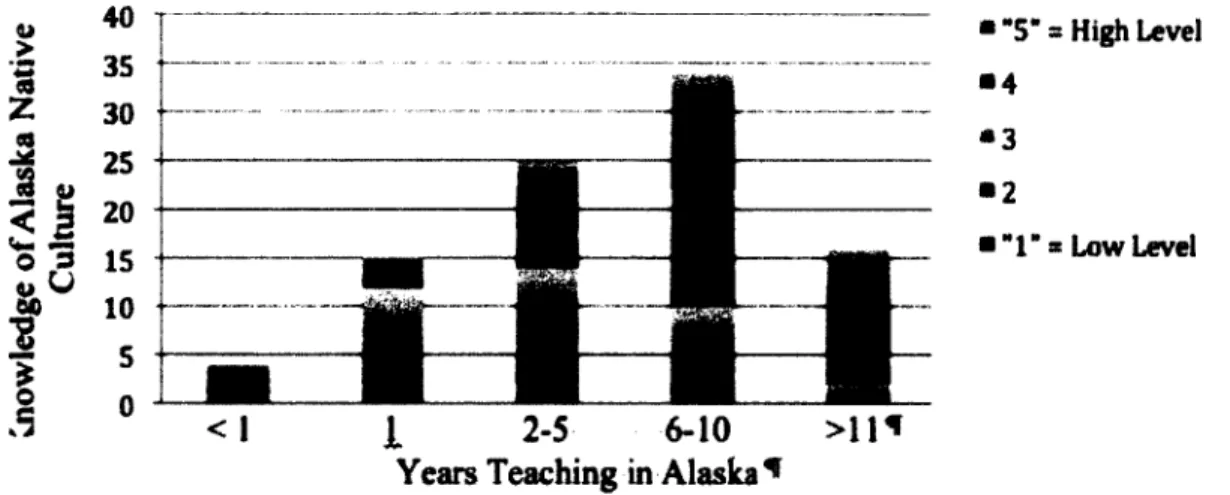
Figure 10. Alaska Native cultural knowledge and teaching experience...112
Figure 11. Levels of support for digital learning technology... 113
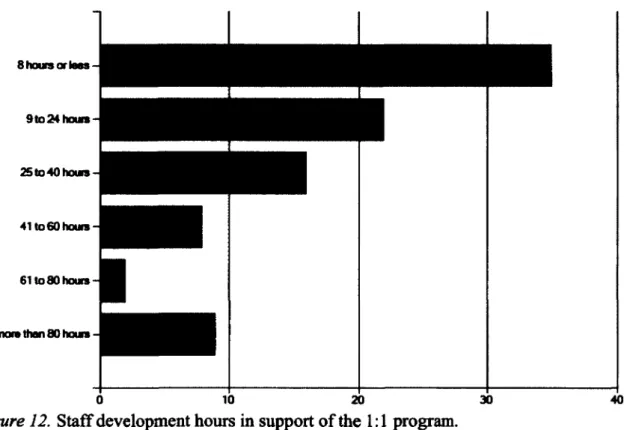
Figure 12. Staff development hours in support of the 1:1 program... 114
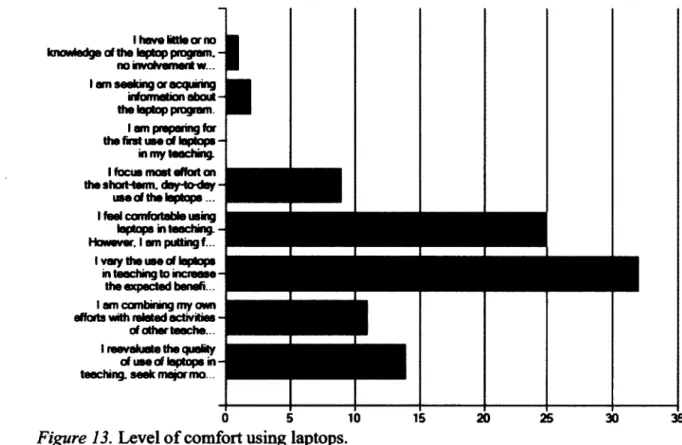
Figure 13. Level of comfort using laptops... 115
Figure 14. Index 1—contrasting beliefs and practices... 117
Figure 15. Index 2—learning environment... 120
Figure 16. Scatter plot: Teaching style and the LoA for classroom use... 125
Figure 17. Scatter plot: Teaching style and the LoA for professional practice... 126
Figure 18. Scatter plot: Teaching style and the LoA for personal use of technology.... 127
Figure 19. Comparison 1998 TLC and 2011 TFS... 128
Table 2: Shared Values Among Alaska Natives...22
Table 3: Contrasts Between Alaska Native and Western Worldviews... 31
Table 4: Common Ground—Connecting Alaska Native and Western Worldviews 39 Table 5: Major Learning Theories... 47
Table 6: Essential Conditions for Technology Integration...78
Table 7: Four Major Worldviews of Scientific Inquiry...86
Table 8: School Districts Participating in the Study...91
Table 9: Survey Instruments Used in Cohort Study...95
Table 10: Technology Frameworks Survey... 96
Table 11: Teacher Teaching Style Index... 98
Table 12: Roles Teachers Assume When Using Technology... 99
Table 13: Reliability Index for Teaching Styles and Technology Roles... 103
Table 14: Confidence Level for Population Sample... 103
Table 15: Gender of 1:1 Teachers in the Study Sample...105
Table 16: Racial Make-up o f 1:1 Teachers in the Study Sample... 106
Table 17: Age Groupings of 1:1 Teachers in the Study Sample...106
Table 18: Teaching Experience Among 1:1 Teachers in the Study Sample... 107
Table 19: Alaska Teaching Experience Among 1:1 Teachers in the Study Sample 107 Table 20: Years Spent at Current School by Teachers in the Study Sample... 108
Table 21: Years Experience Teaching in a Laptop Classroom in Study Sample 108 Table 22: Digital Teaching and Learning Proficiency... 109
Table 23: Spearman Rho Coefficient for Classroom, Professional and Personal U se... 110
Table 24: Self-Perception of Alaska Native Knowledge and Culture...I l l Table 25: Beliefs and Teaching Style Index... 116
Table 26: Survey Response Data for Index 1—Beliefs and Practices...117
Table 28: Survey Response Data for Index 3—Teaching Style...121
Table 29: Descriptive Data for TPU, TPP and TCU Index...123
Table 30: Pearson's (r) for Teaching Style and the LoA for TPU, TPP and TCU 124 Table 31: Relationship Between Philosophy and the Application of Technology 130 Table 32: Reasons for Pursuing a Laptop Program... 132
Table 33: Digital Classrooms and Pedagogical Practices... 133
Table 34: Changes in Philosophy and Beliefs in 1:1 Classrooms... 134
Table 35: Teacher Insights from Participation in the 1:1 Laptop Program...135
Table 36: Technology and Academic Performance... 136
List of Appendices
Appendix A: Cohort Experiences...191
Appendix B: Glossary of Terms... 197
Appendix C: Statistical Analysis... 202
where he was the third son in a family that included seven boys and one girl. Larry’s parents believed both in a strong work ethic and that education was the key to success. Larry earned a B.S. in Biology from the University o f Alaska in Fairbanks. Summertime work as a camp counselor while in college drew him away from further scientific pursuits and influenced him to become a teacher. In the fall o f 1978, he began teaching
electronics, general math and biology at Kodiak High School during the day and chemistry, computer programming and biology at the local college in the evening.
The lessons from experience, an MAT in Biology and an Ed. Specialist degree in Alaska Native Studies opened the door to a variety o f administrative responsibilities that included 22 years as an elementary, secondary and rural principal in the Kodiak School District. Larry also served as the district’s Director o f Technology, Career and Technical Education and Strategic Planning. While Director of Technology, he initiated innovative distance education programs that enhanced student learning in the district’s six rural schools. During his tenure as principal of the rural Chiniak School, Chiniak teacher Elaine Griffin served as the National Teacher of the Year. Larry became a student as he observed Elaine work her instructional magic with her students. Over the years, he has been appointed to serve on a variety of state and professional boards including the presidency of the Alaska Association of Secondary Principals. Larry served as the superintendent of schools for the Kodiak School District prior to his appointment as the state education commissioner.
The appointment as Commissioner of Education afforded Larry the opportunity to meet with thousands of educators, students, parents and community members throughout the State of Alaska. The highlights of his tenure include the development and
implementation of a State Education Plan, new options for digitally enhanced distance learning, a merit scholarship program and closer relationships with early learning and postsecondary institutions.
I wish to dedicate this dissertation to three individuals who have inspired and encouraged me to pursue my goals.
My father was one of the most intelligent individuals I have every met. While a World War II disability prevented his dream of attending college, he passed on his love of learning and respect for education to his children. He refused to allow me to consider any permanent occupation that did not begin with a college education.
My mother shared a quiet passion for learning that encouraged each of her eight children to pursue further learning. Mom carried a vision for me until I had the courage, confidence and will to carry it for myself. Her wit, wisdom and discourse always kept me on my toes.
Finally, I wish to dedicate this dissertation to my wife Jeannie. Over the last 30 years, Jeannie has relentlessly encouraged me to pursue a doctorate while I have
steadfastly resisted. I lost. If not for her absolute refusal to consider any task that would take time from her personal and professional children, she would be writing a dedication for her own dissertation. The smile on her face as she receives the smiles, hugs and hello's from her music students evidences her professional priorities. She has been my anchor, encourager and friend during all of my professional pursuits.
Acknowledgements
It has been my practice when achieving any academic or personal milestone to take a silent moment to remember and thank the many dedicated teachers who protected and nurtured my curiosity. Those teachers who patiently listened to my questions yet never surrendered an answer without provoking a new question. They helped me understand that knowledge is simply the fuel, curiosity the engine and questions the vehicle of life long learning. It is time to recognize a few.
Mr. Spessard, my high school biology teacher who freed me from the tyranny o f the textbook to discover the joy that comes from personal exploration.
Mr. Nuttall who promised me an "A" in algebra and no homework if I could draw a regular pentagon with only a straight edge and a compass. I never did solve the
challenge but the thousands of hours trying created a love for math that continues today. Dr. Bamhardt has been inspiring and guiding my career since I decided to become a teacher over 35 years ago. He has always been there to ask an evocative question, share insight or offer support. While his published legacy as a researcher will certainly stand the test of time, the hundreds of students mentored and inspired through the years will amplify and extend his work for generations
I owe many others for their contribution to this dissertation.
Dr. John Monahan invited and encouraged me to initiate a doctoral program. He has been there every step of the way. His professionalism and sense of personal and professional sacrifice are a tribute to his profession. Thank you John.
Dr. Barbara Adams created a positive yet challenging learning environment. Her patience, clarity and laughter as my old mind learned to stretch again was appreciated.
Dr. Scott Smiley, who reminded me how wonderful it is to be the student of a master. His honesty, wit and incredible knowledge-base set an example for professional research and ethics that I will certainly endeavor to follow.
I extend a special thanks to the other three members of the technology research cohort, Dr. Pam Lloyd, Dr. Bob Whicker and Dr. Mark Standley. Their help, support and honesty gave hope, laughter and inspiration. They were always there. Thank you to all.
Chapter 1: Introduction
This sequential mixed method study examined the relationship between teaching style and applications of technology within the cross-cultural environment of Alaska’s 1:1 high school digital learning programs. According to R. Johnson, Onwuegbuzie and Turner, (2007) “Mixed methods research combines elements o f qualitative and
quantitative research approaches for the broad purposes of breadth and depth of
understanding and corroboration” (p. 123). This methodology provides a more complete understanding of the relationship between teaching style and digital learning technology (DLT) than any single approach. One-to-one classrooms are technology rich learning environments specifically designed to overcome the barriers that are reported to limit the use of digital learning technologies; i.e., bandwidth, software, hardware, technical
support and staff development (Groff & Mouza, 2008). In 1:1 classrooms, every student is provided a laptop computer for school and home use.
High school teachers in thirteen of twenty-two rural Alaska school districts with 1:1 classrooms were invited to participate in the study by completing an online survey. The survey was designed to collect data relevant to the relationship between a teacher’s style of instruction and the application of digital learning technologies to support learning. Information gleaned from the initial survey was used to design a follow-up survey to qualitatively probe this relationship by asking teachers to reflect on the role teaching style and DLT play in developing learner environments that support both Alaska Native and 21st century learners.
1.1 Statement of Problem
The late Dr. William Demmert Jr. (2011) lists teachers as “one of the most important aspects of Atuarfitsialak' (p. 3). Atuarfitsialak is an Inuit word for schools “that are able to help motivate students to achieve academically” as well as culturally (Demmert, 2011, p. 3). Atuarfitsialak infers unity and harmony between school and home. Traditional Alaskan indigenous education enjoyed a consistency of worldview, practice and ownership (Ongtooguk, 2000). In those days, the entire community took responsibility for helping children acquire knowledge and find meaning within their
culture. Dr. Soboleff, a Tlingit Elder, described traditional instruction as follows: “Learning was by observing, hearing, and hands-on methods. Each day was a time of learning without sitting at a desk with book, pencil, paper, and a teacher standing before the class taking roll” (Soboleff, 1998, p. 4). The unity suggested by Atuarfitsialak ended when a dominant Western culture contested with parents and communities for the authority to educate Alaska’s Native youth.
Early Western attempts to use schools as a vehicle to assimilate Alaska’s Native cultures produced a legacy of distrust that continues to underline the differences between Alaska Native and Western traditions of education. Away from school, Alaska Native students leam from members of the community using methods of instruction honed by thousands of years of practiced application (Roderick, 2010). The subjects and methods of instruction are consistent with their cultural worldview (Cannon, 2010; Kawagley, 2006; Ongtooguk, 2000). Immersed within this learning environment, children develop a style of learning that mirrors the instructional methods used to pass on their culture (Appleton & King, 2002; Hughes & More, 1997; Swisher, 1991). Alaska Native children who enter the schoolhouse for the first time generally encounter a learning environment with a new set of rules. While in school, students leam according to Western pedagogical practices. This Western influence is shaped by past practice, disregard for indigenous pedagogy, and the belief that educational methods should reflect Western values. Unless there is reconciliation between these epistemologies in schools and homes, students will be disadvantaged in both cultures.
All students pay a price when there is education dissonance between the school and home. Ignoring a child’s culturally engendered learning style may drive student alienation that could ultimately lead to scholastic failure. Kumar-Singh (2011) describes this pathway to failure:
When students perceive that the school setting is hostile and incongruous, or when there is a cultural mismatch or cultural incompatibility between students and their school, there inevitably occurs miscommunication; confrontations between the student, the teacher, and the home, leading to hostility, alienation,
diminished self-esteem, and eventual school failure, (p. 14)
Concerns regarding these issues are of major significance; Alaska Native students score significantly lower on state assessments and drop out of school at twice the rate o f Caucasian students (Faircloth & Tippeconnic, 2010; Mackety, 2011; McCormick, 2009). See Figure 1 for dropout comparisons among ethnic and racial groups.
! Alaska Dropouts (7-12) by Race and Parctnt of Racial Enrolment
! 60% j 50% ! I 40% | | 30% I O. 20% 10% 0%
Write Alaska Native AstwVPadftc Black Hispanic Mixed raca Islander
Ethnicity
* "Dropouts by Percent of Total Enrollment “ “Dropouts by Percent of Racial Enrolment
Figure 1. Comparison of dropout rates by population and by percent of enrollment. Despite considerable effort to close this achievement divide, it remains an unfortunate truth in Alaskan education (Arenas, Reyes, & Wyman, 2007; R. Bamhardt, 2005a; DeVoe & Darling-Churchill, 2008). The teacher will be a key determinant in strategies to help Alaska Native students find success in the classroom (R. Bamhardt & Kushman, 2001; Marzano, 2003; Rhodes, 1994).
Teachers must be equipped with the cultural knowledge necessary to institute a coherent program of instruction integrating both Alaska Native and Western educational traditions. However, it is challenging for teachers trained in the Western traditions to carry out what (Berry, 2003) describes as their responsibility to “teach their lessons in ways assuring that diverse students can leam; and to know both how and why their students leam” (p. 2). An integrated program requires teachers who are knowledgeable in both cultures. This is challenging when only six percent of Alaska’s teachers are
themselves Alaska Natives. Additionally, a turnover rate for teachers that averages a quarter for rural Alaska, compared to a rate o f 12% statewide, limits what cultural knowledge can be accumulated through experience (Hirshberg & Hill, 2006).
Teachers who wish to deliver an instructional program involving both traditions are often constrained by forces external to the classroom. Limitations related to cultural knowledge can thwart the best of intentions. A fear o f governmental knowledge-based accountability systems discourages teachers from practices that may affect assessments. Consequently, teachers may feel compelled to surrender to pragmatic compromises while just maintaining the status quo. This may explain the lack of congruency between the respect for Alaska Native teaching methodologies and observed classroom practice.
There is hope. The calls for education reform voiced by the Alaska Native community have been joined by national leaders who are concerned that graduates will soon be competing in a technologically accelerating global economy. Educational
methods and performance standards, designed to feed the industrial workforce of the last century, are not sufficient to meet emerging challenges created by the “Information Age.” This new age will not only require new educational outcomes but also new methods to achieve them.
Digitally enhanced communication technologies have equipped the world with a complex and competitive global economy that is evolving so fast it is challenging to predict what students will need to know to be effectively prepared. Robinson (2009) emphasizes this point: “This dynamic combination of a global economy and rapidly changing technology leads to one inescapable conclusion: we can not predict what the future will be” (p. 22). Graduation outcomes must no longer be based on specific skills that promise to quickly become irrelevant. Graduates must have both the knowledge and intellectual poise to flex with the accelerating pace of change (H. Adams, 1983).
Employment value for the next century will be based on the use of higher order thinking to adapt to ongoing change (King, Goodson, & Rohani, 1998; Partnership for 21st Century Schools, 2008).
logical, reflective, metacognitive, and creative thinking. They are activated when
individuals encounter unfamiliar problems, uncertainties, questions, or dilemmas” (p. 1). These cognitive skills are suited to an unpredictable 21st century as well as the
subsistence lifestyle that has been practiced by Alaska Natives for thousands of years. These skills have been proven not to be achieved through the current system of education with its emphasis on the acquisition of static knowledge and applied learning strategies. The skills sufficient for an industrial society represent the starting point for educational restructuring. Schools must be transformed into learner centric environments provoking students to act in innovative ways. Meaning and understanding are best learned through activities related to interest and place (R. Bamhardt, 2005a).
Educational strategies designed to develop high order thinking are not new or innovative to Alaska Native traditions of instruction (Kawagley, 2006). Alaska Native teaching methods emphasize problem-solving, decision-making and critical thinking, along with respect for the wisdom of Elders, place-based knowledge and responsibility to the community (R. Bamhardt & Kawagley, 2005; Hild, 1994; Kawagley, 2006). The challenge for educators is to create a learning environment that will help instill in students the willingness to engage in a wide range of learning activities.
A shift in Western educational practice to a more holistic, student-centric model will reduce the separation between Western and traditional Alaska Native teaching methods (R. Bamhardt, 2005a). Such a shift will also provide an opportunity to develop an integrated model faithful to both Alaska Native and Western worldviews. Alaska Native communities will enjoy a school-based teaching environment consistent with their traditional methods while students from Western traditions will benefit from a learning environment that encourages engagement and problem-solving. Instructional congruence will provide all youth with the prerequisites needed to effectively engage in 21st century life while supporting a cultural foundation connected to Alaska Native traditions
(Jennings, 2004). It is a bit ironic that the same indigenous teaching traditions that have resisted assimilation for over 250 years may provide a model to guide the transformation of Western education into a 21st century model.
Digital teaching assets can help mediate between Western and Alaska Native education. Digital learning applications can bring Alaska Native culture directly into the classroom. Specially designed software can help students become immersed in virtual simulations that emulate cultural activities, some no longer possible to experience in real life. Social networking applications connect Alaska Natives, separated by geography and distance, to virtual communities defined by common interests. Modem communications technology does not limit the wisdom of Elders or first language speakers to a specific location. Effective distance learning applications provide new opportunities for students to access qualified instructors, specialized courses and age-level peers. Technology can connect teachers - only marginally familiar with Alaska Native teaching and learning strategies - with the resources to integrate such strategies into the daily instruction.
The promise of technology to create a digitally enhanced learning environment facilitating instruction has not been realized due to barriers, both internal and external (Hew & Brush, 2007). Resource limitations continue to dog effective application of new instructional technologies (Norton & Hathaway, 2011). These challenges have made it difficult for technology to transition from the instructional sidelines to center stage in learning methodologies (Bingimlas, 2009). Teachers are resistant to instructional
innovations that are unproven as instruments of student growth. As a result, technology’s role remains secondary, on the periphery of education, rather than as a potent catalyst at the center of restructuring. The value of a tool is not vested in its potential but on how it is actually used (Cuban, 2006).
During the last six years, various state, corporate and district initiatives have addressed these concerns by sponsoring 1:1 digital classrooms in a number of rural Alaskan schools whose students are predominantly Alaska Native. One-to-one
classrooms provide 24-hour access to a personal laptop for every student, while at the same time the program increases bandwidth, integrates staff training, along with technical support and access to a variety o f educational software applications (CDL, 2006; Ohler, 2011). The intent of these initiatives is to stimulate changes related to academic
However, preliminary achievement data from 1:1 programs across the United States and in Alaska shows only marginal gains in student performance (Cuban, 2006; Weston & Bain, 2010). Clearly, other factors are influencing the integration of these programs as instruments of student achievement. What are these other factors and how do they influence the creation of a digitally enhanced, culturally congruent learning
environment? The removal of the common barriers to technology implementation in these classrooms forms a basis from which to study the relationship between a teacher’s pedagogical philosophy and the use of technology in support o f learning. Acting
consistently with their individual styles of instruction, teachers make all decisions related to the frequency, purpose and application of technology within a 1:1 classroom.
Instructional or teaching style is defined as the operational philosophy used by a teacher to design, deliver and assess instruction. It is the sum o f the social, personal and professional compromises negotiated between philosophy and external constraints that affect practice. A deeper understanding of the role DLT plays in supporting a student- centered learning environment must begin with an exploration of the relationship between teaching style and the software applications selected by the teacher to support learning.
The potential of DLT to increase student achievement is enhanced by teachers who practice from a constructivist philosophical foundation (Matusevich, 1995). Constructivism is a learning theory suggesting that learning is an individual process of constructing knowledge and finding meaning through negotiating between what is known and what is observed. Vygotsky (1978) emphasized the importance of peer relationships and “more able adults” as significant factors in the development of cognitive meaning and understanding among children (Vygotsky, 1978). The teaching portfolio o f a constructivist teacher includes opportunities for students to engage in collaborative studies especially those that have contextual relevance for the learner. Teaching styles based on constructivist theories are consistent with Alaska Native teaching
methodologies (Hughes & More, 1997).
stimulation of the previously described higher order skills (King et al., 1998) demanded of a 21st century workforce (Partnership for 21st Century Schools, 2008). Students must be fluent in cognitive skills that transform data into meaningful information. A
constructivist learning environment encourages students to use critical thinking, problem solving, collaboration and communication as tools to develop ideas and realize new understandings. Small group, project-based learning, experimentation, out-of-classroom experiences and reflective writing are all seminal characteristics of a constructivist learning environment. Graduates will not be able to incorporate these skills into a comprehensive learning portfolio if they do not hone them through meaningful, contextual learning. Conversely, student engagement in active learning can be stifled without a broad knowledge base on which to draw.
Hannafin and Hill (2002) view constructivism and technology as “mutually reinforcing concepts in the design of engaged, student-led instruction in pursuit of goals and problem-solving activities” (p. 77). However, education related reform cannot move faster than allowed by the classroom teacher who can “close the classroom door” to any change that conflicts with teaching style or a preference for the status quo. The choice of a teaching style consistent with 21st century skills and Alaska Native learning is
determined by the teacher, as are all decisions related to the use of technology in support of learning (Dalgamo, 2009). Among the most promising educational initiatives are those that have never crossed the threshold separating conception from practice—and expired.
Clearly, a teacher is the captain of the classroom instructional ship and the final arbiter of efforts to implement change. Beyond the factors that may influence the learning of any individual child, the effectiveness of the classroom teacher is the primary
determinant (Rice, 2003). Given this, it is important to understand those factors that influence instructional decision-making before undertaking reform.
1.2 Background
Classroom-based digital technology as an instrument o f reform continues to be an active area of research (Cuban, 2006; Duncan, 2010; Polly, 2011). However, almost forty years after the invention of the desktop computer, educators continue to debate the merit
of digitally-assisted instruction. While technology is primarily used to support the didactic instruction used by the majority of teachers, the literature clearly supports the potential for digital learning technology to be used constructively by students engaged in modeling, simulations and social networking.
Recently, initiatives have been implemented in select schools to provide every child with 24-hour access to a laptop computer. These 1:1 initiatives have been designed to address barriers identified as hindering the integration o f technology into mainstream education (A. Barron, Kemker, Harmes, & Kalaydjian, 2003; Becker, Ravitz, & Wong, 2000; Harwood & Asal, 2007; Howard, 1994; Sandholtz & Reilly, 2004). Initial studies addressed questions relating to student achievement, cost effectiveness and learner attitudes. Several more recent studies investigated the relationship between teaching style and the ways in which technology was used to support instruction (Becker & Ravitz,
1999; Ohler, 2011).
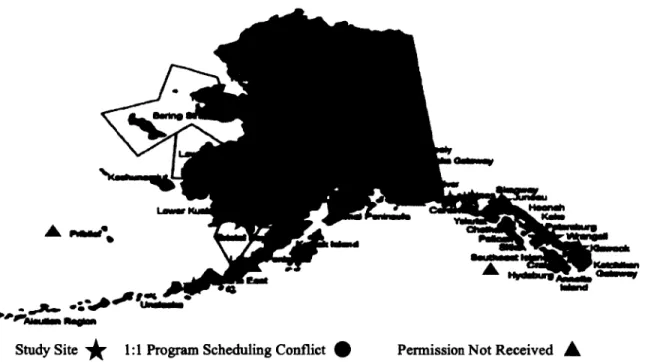
This present study was constructed to examine the relationship between the application of technology and pedagogical style within the cross-cultural environment o f Alaska’s 1:1 digital learning programs in thirteen Alaska school districts. A review of Alaska Native cultures and the history related to education provided the cultural context to guide the study, including design, methods and conclusions. Other elements include a review of the literature relevant to Western and Alaska Native teaching practices; the process of learning; teaching styles; 21st century skills and 1:1 initiatives in Alaska’s rural high schools. Figure 2 is a map of participating Alaska school sites participating in the survey.
Instructional philosophy and pedagogy are common research topics in education. A number of researchers have compared and contrasted Western and contemporary Alaska Native approaches to instruction (R. Bamhardt & Kawagley, 2005; Grubiss, 1992; Kawagley, 2006; Kleinfeld, McDiarmid, & Parrett, 1992; Morgan, 2010). Collectively these studies demonstrate a wide divergence between the dominant Western pedagogic traditions emphasizing reductionist, teacher-centric models and the holistic, student- centric models that characterize traditional Alaska Native teaching methods. This
Study S i t e 1:1 Program Scheduling Conflict 0 Permission Not Received JL.
Figure 2. Map of 1:1 districts in Alaska with 1:1 laptop programs.
Districts included in the study as determined by (a) the study definition of a 1:1 laptop program, (b) district scheduling conflicts and (c) permission to conduct the survey. dichotomy may change as both Alaska Native and Western education traditions confront a new world order in the 21st century likely to challenge the survival o f both. However, it is from the chaos at the interface o f change (R. Bamhardt & Kawagley, 2006), that arises the potential to craft an education program honoring both cultures.
The phrase “21st century skills” is a catch-phrase for those skills futurists believe will be necessary for workers in the 21st century (Magner, 2011; Wagner, 2008).
However, as technologically inspired change accelerates, futurists find it challenging to define a single emerging skill set - much less predict the suite of sets necessary for the remainder of the 21st century. Our brave new age of uncertainty can be a particularly challenging time for Alaska Native youth as they search for an identity between a cultural past that is slowly slipping away and a future inspired in unpredictable directions. They are not alone. Australian researcher Krai (2010) noted that Australian Aboriginal youth are:
Seeking new ways of expressing a contemporary indigenous identity: they are change agents, drawing on existing knowledge and skills from the local
community, but also seeking to know more about the outside world. And m any,... are successfully mediating between old knowledge and new technologies to create new forms of cultural production, (p. 10)
Digital applications are allowing students to construct an identity uniquely suited to the challenges they face rather than navigating a philosophical gauntlet laid between conflicting cultural traditions largely irrelevant to the challenges of the 21st century. Krai (2010) goes on to conclude:
This generation cannot replicate the traditional template set by their elders; instead they are seeking new ways of expressing a contemporary indigenous identity. The research shows that they are forming the understandings, skills and competencies they require to enter young adulthood as bilingual, bicultural beings, drawing on the language and culture transmitted by their elders, but also transforming it. (p. 10)
1.3 Significance of the Study
The conclusions derived from this study may represent additions to the body of knowledge related to effective application of digital learning technologies (DLT) to the development of skills expected from 21st century learners: collaboration, communication, creativity, problem solving and critical thinking. If this study shows a strong correlation between teaching style and the way technology is used to support learning, professional development programs may be expanded to include instructional methods that encourage students to use the full power of technology to extend their learning. Acquiring an
appropriate philosophical foundation and teaching style—one that facilitates a student- centric learning environment—may be just as important in assisting teachers to become more effective, as helping teachers use the tools of technology.
There is a significant discrepancy between the teachers who report their teaching style as constructivist and those who actually implement constructivist methods in the classroom (Becker et al., 2000). While there are many possible explanations for this, some data suggests that access to the resources available in a 1:1 classroom can positively influence constructivist pedagogy (Becker & Ravitz, 1999; Wideman, 2005). If
information from the present study is consistent with this research, it would tend to support an initiative to provide all students and teachers with the digital learning resources currently available only in the 1:1 classrooms.
Perhaps even more significant is the potential to connect the Alaska Native and Western pedagogical traditions together into an integrated plan involving technology supported constructivist teaching methods. Further, linkages between the acquisition of 21st century skills and technology-mediated constructive teaching may hold the key to educational reform by transforming education into an effective, culturally integrated 21st model mirroring natural learning strategies.
1.4 Purpose of the Study
The purpose of this research is to use a sequential, mixed method strategy of inquiry to study the relationship between teaching style and the depth of classroom-based technology used to support student learning among high school teachers participating in Alaska’s 1:1 high school laptop programs. The selection of a mixed methods research design is appropriate given the complexity o f the study. Quantitative strategies can deal with data relevant to the relationship between teaching style and philosophy but the study questions also require qualitative strategies to fully explore the many determinants that affect instructional decision-making.
During the quantitative phase, survey data was collected from 1:1 high school teachers in thirteen of Alaska’s twenty-two rural districts to test the relationship between teaching style (independent variable) and the use of technology to support learning (dependent variable). Open-ended questions included in the first survey queried this relationship. Incomplete responses from this initial survey instigated a brief follow-up survey that used four open-ended questions to further inquire on the respondents philosophy, teaching style and sensitivity to Alaska Native and 21st century instruction. 1.5 Research Questions
The mixed method design integrates quantitative and qualitative strategies into an approach that is more than simply a merger of separate research designs. Each contributes information necessary to build a deeper, more complete explanation of the relationship
between teaching style and the use of technology (Creswell, 2009). The power of a mixed methods design arises from integrating data generated from both methods.
In the first phase of the study, a survey instrument was designed to gather data relevant to the primary quantitative study question:
• “What is the relationship between instructional philosophy and the way teachers use technology to support learning within Alaskan high school 1:1 laptop programs?”
An analysis of the survey data will test the null hypotheses relevant to the study question: • “There is no relationship between instructional philosophy and the way
teachers use technology to support learning within Alaskan high school 1:1 laptop programs.”
Open-ended questions embedded within the primary and follow-up surveys, as well as information derived from related research, provided a solid foundation of qualitative data to support the development of a grounded theory. The grounded theory will help elucidate the relationships between teaching philosophy, the use of technology, culturally based instruction and teaching strategies for 21st century skills. The qualitative questions were broad enough to allow the development of theory to proceed with
minimal bias while still being focused enough to collect data relevant to further research questions:
• “How does access to a 1:1 classroom affect a teacher’s instructional philosophy or practice?”
• “Does access to a 1:1 digitally enhanced teaching environment facilitate the use of instructional practices consistent with Alaska Native and 21st century learner outcomes?”
1.6 Alaska Native Cultures
The phrase “Alaska Native” will often be used to refer to Alaska’s indigenous cultures. This designation is used for literary convenience rather than as an inference that the diverse cultures of Alaska’s Native people can be generalized into a single voice. When appropriate, specific cultural names will be used to identify cultural groups. While
each culture in Alaska has distinct histories, languages, traditions, worldviews and knowledge systems, they do share common values that unite them. Athabaskan leader Will Mayo expanded on this theme as he recognized a shared set of values that
supersedes the visible differences between Alaska’s Native cultures:
As an Athabascan child, I became aware of the differences between the various Native peoples and did not realize that there were far more instances of shared values and beliefs... The similarities are easily matched by the ways in which the tribes differ. These differences are seen in any number of striking examples, such as language, dance styles, clothing styles and art, to name a few. Still these are to me just different manifestations of the same core values that bind together
Alaska’s native peoples. (Corral & Mayo, 2002, p. 13)
The use of the term Alaska Native also recognizes the difference and variation within a culture. Reyhner (2006a) writes:
Native students today vary from traditional to assimilated. Some are bicultural, capable of moving back and forth from white to traditional Indian culture. Because of the tremendous variation among Indians of different tribes and different degrees of assimilation, it is impossible to study "the Indian" and determine what is the best instructional approach for them. (p. 21)
The references to Alaska’s rural schools are equally general. Rural schools are diverse in history, demographics, philosophy, and academic performance. Each has a unique character. However, rural schools face many common challenges and opportunities. 1.7 Respecting Cultural Knowledge
The “Guidelines for Respecting Cultural Knowledge” (Alaska Native Knowledge Network, 2000) were approved by a representative group of Alaska Natives to guide researchers exploring topics related to Alaska Native culture. Because the present study asks questions relevant to the interests of Alaska’s Native community, it was considered necessary to evaluate the survey design to ensure that it conformed to both the word and the spirit of the code. The data-collection methodology for this study will not seek to collect cultural knowledge by interview or survey. Further, collection o f Alaska Native
historical or cultural knowledge that is collated in this study will come from previously published sources. Therefore under the Alaska Native Knowledge Network guidelines, it was not necessary to seek a formal memorandum of research for this project. However, in the spirit of respect, recognized Alaska Natives and educators were consulted during the design of this research program.
1.8 Limitations of the Study
The goal of the study is to construct meaningful and accurate conclusions from the data (Creswell, 2007). In pursuit of this goal, every decision has been influenced by the question, “How will this decision affect the validity and reliability of the
conclusions?” Careful adherence to accepted standards of both ethics and research protocols is a major objective of scientific research.
It is important to avoid projecting conclusions beyond what the scope of the study design and the data can support. The response to the survey represents a sample of the population of 1:1 high school teachers in thirteen rural districts and an even smaller sample when compared to the entire population of Alaska’s high school teachers. While the study conclusions may invite connections to the broader population, it will be prudent to limit these to the population being sampled. It is more important to define conclusions that are strongly supported by the data than to make broad generalizations that weaken the construct validity o f the entire study. A comprehensive literature review embeds the study within the framework of Alaska educational research, particularly as it applies to Alaska Native education.
Chapter 2: Literature Review
The literature review explores the complex relationship between teaching style and the applications of technology selected by a teacher to encourage learning in Alaska’s 1:1 classrooms. Five major themes guided the scale and scope of the research: 21st century skills, Alaska Native education history - practices and outcomes, learning, teaching and digital learning technology. The extensive literature foundation was necessary to embed the study questions and conclusions within the context of contemporary issues in education reform.
While the study questions explore the simple relationship between teaching style and the use of technology for learning, the nature of this relationship will ultimately determine the quality, pace and efficacy of efforts to transform education into a 21st century model. Digital learning technologies (DLT) are well suited to connect Alaska Native and Western systems of education into a model that treats Alaska Native cultures as a senior partner in a new relationship (R. Bamhardt, 2005a). Digital learning
technologies also have the potential to revitalize Western educational practices - to develop student-centric constructivist classrooms that build on a rigorous body of knowledge that students will need to prosper in the unpredictable world of the 21st century (Bentley, 2003; Collins & Halverson, 2009). The key to unlocking this
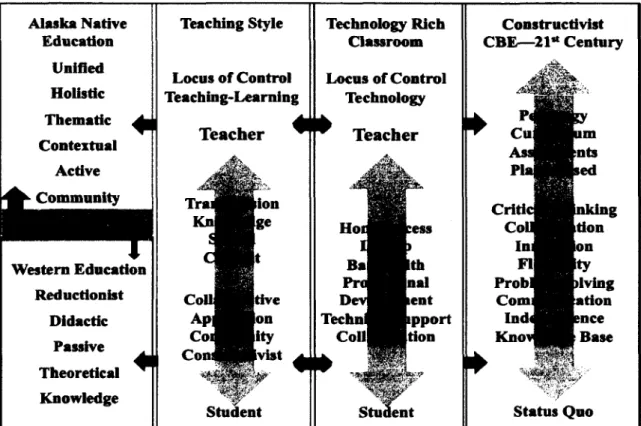
technology in education is held by the classroom teacher who can (a) invite technology into the classroom, (b) ignore DLT, or (c) refuse entry and slam the classroom door. Teaching style is the gatekeeper of this critical pathway to reform. Research is devalued if it is not contextually anchored to relevant issues. The extensive review of Alaska Native education is necessary to contextually embed this study in the contemporary education challenges in Alaska. Figure 3 provides a graphical representation of the research landscape that hosts the study.
Alaska Native Education Unified Holistic Thematic , Contextual Active Community Western Education Reductionist Didactic Passive Theoretical Knowledge Teaching Style Locus of Control Teaching-Learning Teacher V Student Technology Rich Classroom Locus of Control Technology Constructivist CBE—21“ Century Status Quo
Figure 3. The research landscape. The relationship between a 1:1, technology rich
classroom and teaching style is graphically embedded within broader efforts to transform education into a model sufficient to meet the needs o f all 21st century learners. Culture- based education is represented by the acronym "CBE".
This literature review focuses on the philosophies and the methods appropriate to both quantitative and qualitative research; research relevant to the causal correlation between teaching styles and the use of DLT. This provided a foundation for examining the relationship between IT moderated, student-centric instructional practices as well as the knowledge, skills and attitudes expected of both Alaska Native and non-Native students.
The review was of sufficient scope and depth to support the formulation of a phenomenological theory and yet specific enough to guide the direction of the study and to inform decisions related to the transformation o f research data into information relevant to the study questions. Over 700 studies, peer reviewed papers, reports, books and other documents were reviewed and evaluated over the course of the study. The review begins with an analysis of 21st century skills and outcomes.
2.1 Twenty-First Century Skills
Twenty-first century skills will require a renewed emphasis on the application and processing of knowledge. Burkhardt et al., (2003) suggest that technology is both an agent of change and a tool to manage it: “Technology changes the way the world works. As technology evolves, so must the skill sets of those who use it. In order to remain competitive tomorrow, today’s students need to develop techniques that readily adapt to changes as they occur” (p.l). The phrases “twenty-first century” and “high order” refer to
those competencies necessary for students to become self-motivated learners (Casner- Lotto & Benner, 2006; Jerald, 2009). The Partnership for 21st Century Skills (2008) groups these skills into three categories: "(a) creativity and innovation; (b) critical thinking and problem solving; (c) communication and collaboration (p. 2).
The Partnership for 21st Century Skills (2008) argues that: “The nation needs to do a much better job teaching and measuring advanced, 21st century skills that are the indispensible currency for participation, achievement and competitiveness in the global economy” (p. 10). Dede (2007) describes them as the: “core capabilities people will need in the first part of the 21st century - say fifteen to thirty years hence - to qualify for an attractive, prosperous job and lifestyle” (p. 3). Casner-Lotto and Benner (2006) compares the basic knowledge emphasized in current education practice with the applied skills prioritized as 21st century outcomes in Table 1.
Twenty-first century skills are not the result of a high tech recalibration of contemporary standards, a new advance in cognitive research or the ascension of a new epistemological framework. They represent the reconciliation of knowledge with the cognitive attributes transforming them into action. Creativity, innovation, critical thinking, problem solving, communication and collaboration— long side-lined by a knowledge-focused industrial era educational system—must be reintroduced into
education to bring meaning to the highly competitive workforce of the 21st century. High order skills are not the endpoint of education; they represent cognitive mechanisms. It is understanding that provides the capability to prosper in the future. Dede (2007) argues: “Categorizing what students need for the 21st century as understandings based on
Table 1
News Skills for the 21s' Century.
. / B asic K uow ledfie , A m M S I t B I s
English Language Critical thinking/Problem Solving
Reading Comprehension Oral Communication
Writing in English Written Communication
Mathematics T eamwork/Collaboration
Science Appreciation of Diversity
Government/Economics Information Technology Application
Humanities/Arts Leadership
Foreign Languages Creativity/Innovation
History/Geography Lifelong Leaming/Self-Direction
Professionalism/Work Ethic Ethics/Social Responsibility Note: Adapted from Casner-Lotto and Benner, (2006)
interwoven content knowledge and process skills is a more accurate depiction o f how the mind works than the separation between these that current frameworks typically impose, and how students actualize those understandings in practice or performances” (p. 4).
The education system envisioned for the 21st century is not a new vision. Alaska Natives and other indigenous cultures have been effectively teaching for thousands of years. These skills not only informed the decisions necessary to survive in dangerous environments, they affirmed the connections between knowledge and meaning that defined their culture’s worldview. Retooling Western educational practices and outcomes to reflect a new emphasis on understanding will help to heal the schism that has divided Western and Alaska Native systems of education. “Our challenge now is to devise a system of education for all people that respects the epistemological and pedagogical foundations provided by both indigenous and Western cultural traditions” (R. Bamhardt & Kawagley, 2005, p. 9).
Schools are ill-equipped to facilitate the transformation from a knowledge-centric, theoretical environment to a learning atmosphere providing opportunities to practice the high order cognitive skills. These skills are not learned from books or from teachers; they
are acquired through direct experience. The introduction of complex software allowing students maximum control over the application provides a venue mimicking real-life experiences. These constructivist digital applications are of particular use to Alaska Native students because their cultural values can be integrated into the learning experience.
The integration of digital learning technology (DLT) into instruction is a key element in strategies to reform education. DLT can provide the opportunity for teachers to create a student-centric learning environment with the freedom to engage in higher order skills such as creativity, innovation, critical thinking, problem solving,
communication and collaboration. Teachers will integrate DLT into teaching styles while students will integrate DLT into their individual learning styles.
In the past, the potential for information technology to assist in educational reform has been limited by access to the basic IT infrastructure and staff resources necessary, as well as the beliefs and teaching styles of teachers. One-to-one laptop computer programs eliminated access and resource barriers, leaving teaching style identified as the keystone to effective information technology-based education reform. The chance to take advantage of what R. Bamhardt and Kawagley (2006) describe as opportunities at the edge of chaos, to create an information technology assisted, student centric learning environment, is primarily dependent on each teacher’s willingness to integrate technology into instruction and the adoption by students of information technology into their learning styles. The research questions will explore this relationship.
2.2 Alaska’s Native Cultures
The history of Alaska’s indigenous cultures did not begin when German naturalist George Steller stepped ashore on Kayak Island near Mount St. Elias on July 20, 1741. It began perhaps as much as 16,000 years earlier as bands of emigrants from Asia moved through the vast plain known as Beringia, the land bridge that connected Asia with North America (Goebel, Waters, and O'Rourke, 2008). While the exact origin and timing of this migration remains a subject of debate, archaeological, linguistic and molecular evidence
increasingly supports a southward migration into North and then South America reaching back almost 16,000 years ago (Alaska History and Cultural Studies, 2012). Figure 4
shows the geography of the major cultural traditions resident in Alaska.
Most scientists believe this migration eventually resulted in the population of both American continents. A number o f anthropologists believe that subsequent Asian
migrations into Alaska brought the ancestors of the Athabaskan/Tlingkit and the Aleut/Eskimo peoples. Goebel et al. (2008) suggest that the Aleut and Eskimo
populations o f Alaska, based upon genetic sampling and archaeological evidence, are the result of a separate late-Pleistocene migration from northeast Siberia. The recent
discovery in central Alaska of the remains o f a child estimated to be 11,500 years old may provide more information related to the cultural heritage and geographic origin o f these early Alaskans (Potter, Irish, Reuther, Gelvin-Reymiller, & Holliday, 2011).
As these first Alaskans spread throughout the state they learned to adapt to the specific environments that they settled in (Naske & Slotnick, 1987). Over time, distinct cultures emerged with varied languages, knowledge systems, traditions and beliefs. The Alaska Native Heritage Center (2010) has identified five major indigenous cultures in Alaska: (a) Athabaskin, (b) Yup'ik and Cup'ik Eskimo culture, (c) the Inupiaq and St.
Lawrence Island Yupik culture, (d) the Aleut and Alutiiq culture, and the (e) Eyak, Tlingit, Haida and Tsimshian culture.
Each Alaskan Native culture enjoys a number of unique characteristics: language, dialect, geography and history; yet they also share many analogous values, technologies, skills and beliefs (Kawagley, 2006). There is substantial historical evidence that there were active social and economic interactions between cultures (Alaska History and Cultural Studies, 2012; Alaska Native Knowledge Network, 2006; Townsend, 1970). This is the explanation of their common beliefs related to spirituality, technology and natural history (Alaska Native Science Commission, 2012). The Alaska Native Knowledge Network (ANKN) has identified ten values in Table 2 that are shared by multiple Alaska Native cultures (Alaska Native Knowledge Network, 2005).
Table 2
Shared Values Among Alaska Natives
Shared Values
Show respect to others Each person has a special gift
Share what you have Giving makes you richer
Know who you are You are a reflection on your family
Accepts what life brings You cannot control many things
Have patience Some things cannot be rushed
Live carefully What you do will come back to you
Take care o f others You cannot live without them
Honor your Elders They show you the way in life
Pray for guidance Many things are not known
See connections All things are related
Note: Adapted from Alaska Native Knowledge Network, (2005 , p. 1).
2.2.1 Western intervention. During Steller’s brief exploration of Kayak Island in Island in 1741, he found evidence of a resident indigenous population (R. Bamhardt & Kawagley, 2006; Ford, 1966; Langdon, 1993). Even though he did not make contact with the resident population, Steller accurately linked tools to those used by Eskimo cultures in Kamchatka (Ford, 1966). The design o f their tools, the craftsmanship of structures, the technology used with food, and the knowledgeable use of the local flora and fauna all
impressed Steller, who wrote in his journal:
Under a tree I found an old piece of a log hollowed out in the shape o f a trough, in which, a couple of hours before, the savages, for lack o f pots and vessels, had cooked their meat by means of red-hot stones, just as the Kamchadals did formerly. I discovered further, not far from the fireplace ... a wooden apparatus for making fire. It was so cleanly and well prepared that I have never seen it as good in Kamchatka, (as cited in Ford, 1966, p. 77)
After further exploration, Steller came upon a cache hidden along a forest trail: Utensils made of bark, one and a half ells high, filled with smoked fish...; A quantity of sweet grass from which liquor is distilled; three different kinds of plants, whose outer skin had been removed like hemp...; the dried inner bark from the larch or spruce tree done up in rolls and dried; large bales of thongs made of seaweed which, by making a test, we found to be uncommon strength. Under these I found also some arrows in size greatly exceeding those in
Kamchatka... scraped very smooth and painted black, so that one might well conjecture that the natives possessed iron instruments and knives, (p. 79) The artistry of the artifacts noted by Steller during his ten-hour exploration did not stop him from referring to the indigenous population as “savages” or plundering their food and supply cache. This was an unfortunate but prophetic beginning of an ongoing conflict between powerful Western industrial and Alaska Native hunter-gatherer cultures (R. Bamhardt & Kawagley, 2005; Gaffney, 2011; Kawagley, 2006, 2009; Kawagley, Norris-Tull, & Norris-Tull, 1998).
Steller’s use of the word “savages” is consistent with the prevailing idea of “civilizing missions” as moral justification for the colonial exploitation of indigenous populations (Kohn, 2011). By definition, “civilizing missions” assumes that indigenous cultures are less civilized and would benefit from Western cultural intervention. However in point of fact, the Russian tenure in Alaska was largely motivated by economic forces rather than by governmental efforts to “civilize” Alaska Native cultures. Naske and Slotnick (1987) write: “The initiative for Russian expansion and settlement in the New
World came from private individuals and groups, not from the government. Russian America and its interests received little support from the imperial regime” (p. 61). The Russian government, other than supporting the fur trade, did not attempt to colonize Alaska. According to Naske and Slotnick, (1987) “the number of Russians in Alaska was never above 800 and few, if any of those were planning to stay” (p. 61).
2.2.2 Education. The first Western school in Alaska was established by the Russian fur trader Gregor Shelikov in the late eighteenth century on Kodiak Island
(Black, 2004). By the time the Russians sold their Alaska holdings to the US in 1867, the Russian church, the Russian American Company and the local Russian government were supporting a number of schools for Alaska Native and Creole children. Although
supporting these schools, the colonial government did not have a policy to provide for the universal education of Alaska Natives (Bancroft, Bates, Petroff, & Nemos, 1886;
Peratrovich, 1971). The Russian government neither supported universal Native
education nor a policy of school-based cultural assimilation however, both these policies characterized subsequent American control over Alaska (Dauenhauer, 1997; Oleksa & Bates, 2007).
The 1867 Treaty of Cession that authorized the transfer of Russia’s Alaska claims to the United States did not address the education of “the uncivilized tribes” (Arnold, et al., 1978). The American government was not prepared by law, policy or budget to provide for the education of Alaska’s Native people. Chevigny (1966) reported that twenty years after the U.S. purchase of Alaska, the Russian church was spending more on Alaska’s schools than the U.S. government. It was not until 1884, seventeen years after Seward’s folly, that Congress took the initial steps to provide for universal education in Alaska. The Organic Act of 1884 authorized a civil government for Alaska and
appropriated $15,000 for the operation of schools for both Caucasian and Alaska Native children. John Adkins, U.S. Commissioner of Indian Affairs, in his 1889 report to Congress, clearly stated the purpose, process and scope of American Indian and Alaska Native education policies:
forcibly if they must. They must adjust themselves to their environment, and conform their mode of living substantially to our civilization. This civilization may not be the best possible, but it is the best the Indians can get. They cannot escape it, and must either conform to it or be crushed by it. (Atkins, 1890, p. 3) Adkins' forceful statement was consistent with a national Indian reform movement that supported the cultural assimilation of American Indian and Alaska Native cultures into the United States (Haycox, 1984; Swisher & Deyhle, 1997).
In 1885, Sheldon Jackson, a Presbyterian minister, was appointed the federal education agent for Alaska. Ritter (2009) writes: “Jackson’s goal was to protect young Natives within a framework of law and, through education, prepare them to cope with modem times” (p. 55). Critics note Jackson’s use of government funds to support Christian affiliated contract schools and his rigid enforcement of the federal
government’s “English only policy” (Haycox, 1984). Dauenhauer (1997) suggested that the suppression of Alaska Native languages under Jackson’s tenure irreparably harmed Alaska’s Native cultures (Haycox, 1984). Dauenhaur (1997) asks, “What kind of government and educational system takes a culture highly literate [sic] in its own language and deliberately proceeds to eradicate both the language and the literacy?” (P. 19). The fact that the “melting pot” was the cornerstone of America’s invitation to the world was of small comfort to peoples that did not immigrate to this country. Haycox (1984) noted that, "Jackson resisted taking native youngsters away from their villages for education and acculturation: (para 5). Jackson’s defenders remember his tireless
advocacy in providing educational opportunities for Alaska Native people, while the federal government’s demand for the suppression of Alaska Native languages during Jackson’s tenure remains a bitter legacy of Alaska’s assimilative past.
Governmental policies have evolved over time as changing state and national priorities have influenced educational policy-making for Alaska Native students. Historians and educators have defined a number of useful timelines that chronicle the critical events helping to shape education in Alaska (Alaskakool, n.d.; C. Bamhardt, 2001; Darnell & Hoem, 1996; Langdon, 1993; McDiarmid, 1984; Naske & Slotnick,
1987; Ritter, 2009).
The Alaska Native community remembers these events through personal experience as well as written and oral accounts (E. Alexander & Weiser, 2007; R. Bamhardt & Kawagley, 2010; Hensley, 2009; Huntington, 2009; Jackson, 1998; John,
1996; Kawagley, 1999, 2006; Kirkness, 1992; Merculieff, 2010; Metrokin, 1985; Napoleon, 1996; Ongtooguk, 2000; Oquilluk, 1973; Soboleff, 2010; Williams, 2009). Alaska Natives are archiving their voice to ensure that their story is not forgotten (Alaska Native Knowledge Network, 2000). Historical accounts from both Western and Alaska Native perspectives present a more complete understanding of the events that shaped contemporary educational challenges. The lessons gleaned from history are made more powerful when addressed by those seeking mutual understanding.
2.2.3 Impact o f Western education policies. For thousands o f years, Alaska’s diverse Native cultures enjoyed an efficient and stable means of educating the next
generation. Alaska Natives passed on their indigenous knowledge from generation to generation with sufficient precision that they were able to thrive in some of the most unforgiving environments on Earth (MacLean, 2010). The development of Alaska Native educational traditions was honed by the collective need to survive under these conditions. If the community’s cultural knowledge was not passed accurately to the next generation, the survival of the community was at risk. Jervis (2006) highlights the critical role
education plays in the survival of a culture. “All culture is learned; none is inherited. And it is passed on from one generation to the next, which is why schools and families are so important in cultural transmission” (para. 20). The death of an individual provided powerful incentives for an effective system of knowledge transmission or education.
The arrival of Westerners in Alaska had devastating effects on Alaska Natives. Thousands of Alaska Natives died from the disruption of their traditional lifestyles. During the influenza and measles epidemics of 1900 it is estimated that 25% of the Western Eskimo population perished (Wolfe, 1982). The Spanish Influenza epidemic of
1918 killed thousands more (Crosby, 2003). In a pre-literate society, every death represented the loss of unique cultural knowledge while the forced redirection of