University of Huddersfield Repository
Abdulrasool, Salah Mahdi, Mishra, Rakesh, Khalaf, Haifa and Al Seddiqi, Mohamed
The Effect of Using Computer Technology Tools to Enhance the Teaching-Learning Process in
CAD-CAM-CNC Module in Mechanical Engineering Subject Area
Original Citation
Abdulrasool, Salah Mahdi, Mishra, Rakesh, Khalaf, Haifa and Al Seddiqi, Mohamed (2010) The
Effect of Using Computer Technology Tools to Enhance the Teaching-Learning Process in
CAD-CAM-CNC Module in Mechanical Engineering Subject Area. In: Global Learn Asia Pacific 2010:
Global Conference on Learning and Technology. Association for the Advancement of Computing in
Education (AACE), Vancouver, Canada, p. 9. ISBN 1-880094-79-7
This version is available at http://eprints.hud.ac.uk/7691/
The University Repository is a digital collection of the research output of the
University, available on Open Access. Copyright and Moral Rights for the items
on this site are retained by the individual author and/or other copyright owners.
Users may access full items free of charge; copies of full text items generally
can be reproduced, displayed or performed and given to third parties in any
format or medium for personal research or study, educational or not-for-profit
purposes without prior permission or charge, provided:
•
The authors, title and full bibliographic details is credited in any copy;
•
A hyperlink and/or URL is included for the original metadata page; and
•
The content is not changed in any way.
For more information, including our policy and submission procedure, please
contact the Repository Team at: [email protected].
Page 1
The Effect of Using Computer Technology Tools to Enhance the Teaching-Learning
Process in CAD-CAM-CNC Module in Mechanical Engineering Subject Area
Mr Salah Abdulrasool
1, Dr R.Mishra
2, Mr Mohamed Al Seddiqi
4University of Huddersfield, Queensgate, Huddersfield HD1 3DH, UK
Dr Haifa Khalaf
3,
University of Bahrain, Kingdom of Bahrain
1-
Abstract
This study presents the evaluation of Computer Assisted Learning (CAL) package included in the teaching and learning methodology of computer aided design- computer aided design - computer numerical control (CAD-CAM-CNC) module. Three groups of students with similar pre-abilities were exposed to three different teaching learning methodologies.The effectiveness of these three methods was determined by questionnaires completed by the students and collected by first author. Their answers were analysed quantitatively and qualitatively. The various categories used in the questionnaire was student’s attitudes towards learning CAD-CAM-CNC subjects, students’ opinions about their lecturers approaches to teaching process, students’ opinions and views about various aspects the CAD-CAM-CNC. The study concludes that the students taught with a combination of CAL package and traditional methods were more effective, efficient and satisfied with their learning experiences. So the proposed hybrid learning method (CAI plus traditional teaching method) is most suited for CAD-CAM-CNC teaching.
2-
Introduction
This study describes the structure of CAD-CAM-CNC sessions and three T&L methods traditional classroom lectures and laboratory sessions, classroom teaching including unsupervised computer simulation and unsupervised CAD tutorials and supervised CAM-CNC computer simulation. These three T & L methods are:
Method 1 - Traditional classroom lectures and laboratory sessions –
The Lecturer explains various tasks that
require memorization of factual
information on routine procedures which include
design and drawing (CAD) of an object
and detailed description of
manufacturing process (CAM-CNC). The Lecturer then shows students how the skills learned in classroom are used in practice by practical demonstrations of the procedures on actual CNC machine. Then students are encouraged to repeat these procedures in their own time without any support (Roger and Jack, 2004; Bourne, Brodersen, Daw,
2000; Emory, Groover, Zimmers, 2002).
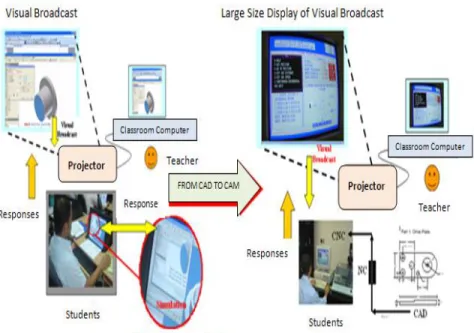
The Lecturer uses the computer interface of a projection unit (See Figure 1) in order to give theoretical background of the drawing process, explain standards and describe other activities. The resources available to students are CNC
manual, exercise book and access to fifteen computers. The Lecturer supervises students continuously during this Lecturer-centred session.
Page 2
Method 2 - Classroom teaching including supervised computer simulation – The Lecturer uses Autodesk Inventor (Wikipedia, 2009) to describe CAD-CAM applications and the students can follow the suggested procedures and be able to see the simulation results on the
computer screen (see Figure 2). The Lecturer delivers the lecture with the use of computer interface linked with projector. The students are given CNC manual, exercise book and access to computers to work in parallel with the Lecturer. The computer software describes the procedures step by step and in a dynamic way for CAD session.
Various activities are included in the CAM-CNC part as for example: create cutting parameter for each part; generate tool paths for different layers for each part; generate final checklist for prototype etc. A software package is used to adapt a drawing file from a CAD program in DXF format and convert into an NC code (CAM part). Each computer used by students is connected to a CNC machine tool so
the generated NC program is used to actually cut the real work piece on the CNC machine (See Figure 2).
Therefore the students are exposed to the laboratory environment for CM-CNC sessions and the Lecturers demonstrate to them the practical procedures applied to real CNC machines. Also the students are provided with computer simulation
models of these procedures which can be used whenever they want (Toogood and Zeeher, 2004;Bourne, Brodersen, Daw,
2000;Abdulrasool et al, 2005; Shahati, Alsafar, Abdulrasool, 1999).
Method 3 - Unsupervised CAD tutorials and supervised CAM-CNC computer simulation The Lecturer provides computer tutorials including video and animations which show the students how to use CAD (see Figure 3). They are asked to study these in their own time
(unsupervised study) and they have to solve exercises which are assessed by the Lecturers on the basis of a checklist. Students have the opportunity to switch between CAD programme and Power Point slides and discuss the subject matter with each other’s (peer tutoring) so collaborative learning takes place. After this formative assessment stage, the students are given supervised demonstrations of application of CAM –CNC so the regulations for health and safety are fulfilled (See Figure 3). These three T & L methods are examined for their usefulness and acceptability with the students by questionnaires.
Figure 2 Method 2
Page 3
3-
Questionnaire Design Process
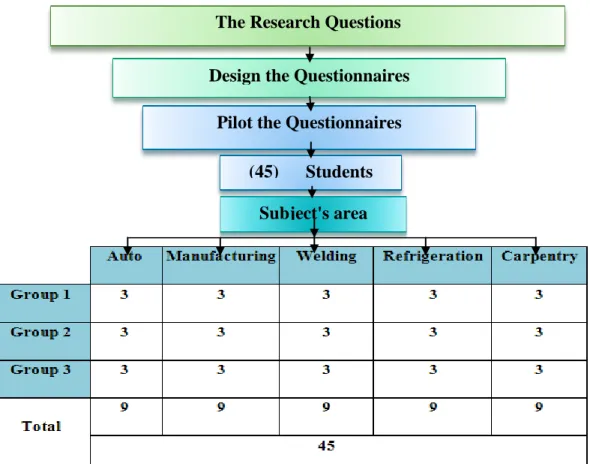
Figure 4 Questionnaire Design Flowchart
Tripartite classification distinguishes between the principles and techniques necessary to gain data analysis. It covers the main issues of the preparatory work, provides information to clarify the object and purpose of the enquiry.
The first step in designing the research was to identify the research purpose which dictates the selection of the research methods, bearing in our mind the dictum that "the purpose of the research determines the methodology and design of the research" (Felder, and Soloman, 2001). The second step was the design of questionnaires which was the main method of data collection. Then a pilot study was conducted for a number of students and the responses of the questionnaires were analysed.
The following research questions were considered when designing the questionnaires:
What is the CAD-CAM-CNC Lecturer’s teaching methodology from, students’ point of views? What are the student's views about teaching and learning CAD-CAM-CNC?
What are the student's opinions about teaching CAD-CAM-CNC? What are the student's attitudes towards CAD-CAM-CNC?
The main advantages of using questionnaires to evaluate a certain situation or product are: An efficient use of time.
Anonymity (for the respondents) The possibility of a high return rate.
Standardised questions (Felder and Soloman 2001). A clear idea of what is supposed to be measured.
The Research Questions
Design the Questionnaires
Pilot the Questionnaires
(45) Students
Subject's area
Page 4
Questionnaire Sampling – Three groups of 15 students from automotive, manufacturing, welding, refrigeration and carpentry courses (see Figure 4 Questionnaire Flowchart) have been taught by three T & L methods:
Group 1 - traditional classroom lectures and laboratory sessions.
Group 2 - classroom teaching including unsupervised computer simulation.
Group 3 - unsupervised CAD tutorials and supervised CAM-CNC computer simulation.
The present study was not carried out for whole population of mechanical engineering students of the institute due to factors such as expenses, time and accessibility (Cohen et al, 2000). This research employed the probability sample because it draws randomly from the wider population and allows the generalisation of questionnaire findings.
4-
Questionnaires Analysis
The aim is to find out the learning experience of students in the CAD-CAM-CNC module and effectiveness of the three T&L methods.
The study has been carried out to explore problems during teaching and learning process in the subject area of CAD-CAM-CNC. The questionnaires have been formulated to understand the mechanics of the learning process from student's perspective. Previous studies (Bhavnani, and Bonnie, 2000; Dye, 2003; James. 2002; Borg, and Gall 1979) suggested that a part of the problem in CAD-CAM-CNC subject area is the use of inappropriate T&L methods which affects students' achievement.
The questionnaires intend to examine the effectiveness of the three T & L methods versus the learning objectives for CAD-CAM-CNC modules. The changes performed in the T&L strategy (see Method 2 and Method 3) aim to make learning personal, ensure learners get the information in the way they need it, their knowledge is immediately applied in the context of realistic working situations and can make mistakes in safe environments (simulation).
Method 2 and method 3 are shifting the emphasis from Lecturer-centred to student-centred learning by including computer tutorials that encourage learning through problem solving, discovery and enquiry. So the student-centred learning approach with interactive learning and teaching enables the development of employability skills (such as learning how to learn, understanding, evaluating and using knowledge and continuous improvement). This aspect was considered when formulating the questions addressed to students.
The students’ questionnaires intend to ascertain how well the CAD-CAM-CNC modules meet the stated learning outcomes and to identify the main strengths and weaknesses of various T&L methods. Also it is intended to improve students’ learning experiences by increasing the student involvement in education process. So the questions referred to the following topics:
Student’s attitudes towards learning CAD-CAM-CNC subjects;
Student’s opinions about their Lecturers' approaches to teaching process;
Student's opinions and views about various aspects of T&L the CAD-CAM-CNC subjects such as: session planning and organising; delivery of course material; classroom management; assessment and feedback strategy; students’ interaction.
Analysis methods – A number of 45 first-year students are divided into three equal groups (see Figure 4 Questionnaire Flowchart):
Group 1 - exposed to method 1 (traditional classroom lectures and laboratory sessions); Group 2 – subjected to method 2 (classroom teaching with computer simulation);
Group 3 – exposed to method 3 (unsupervised CAD tutorials and supervised CAM-CNC computer simulation).
Generally the author (researcher on this case) analysed most of the items separately to provide specific information that contributes to the overall picture that is obtained. The use of one item test is quite satisfactory when one is seeking out specific fact (Bell, 1999; Boon, 1997). The students’ and Lecturers’ answers were ranked according to the following scale:
Agree – Neutral (Undecided) – Disagree
The agreement and disagreement of each answer was calculated by the summation of frequencies and summation of percentages of the positive perceptions (agree), and the negative responses (disagree), and the third category is undecided.
Page 5
# Statement Agree Undecided Disagree
G1 G2 G3 G1 G2 G3 G1 G2 G3
1 I do not like CAD/CAM/CNC as a subject 93.3 0 0 0 0 0 6.67 100 100
2 I like to participate in activities during CAD/CAM/CNC
lesson 46.7 73.3 86.7 0 13.3 6.67 53.3 13.3 6.67
3 Learning style used in CAD/CAM/CNC developed my
learning ability 6.67 86.7 93.3 0 0 0 93.3 13.3 6.67
4 I feel comfortable during CAD/CAM/CNC lesson 0 66.7 80 0 13.3 13.3 100 20 6.67
5 I like to have more CAD/CAM/CNC lesson using this
methods 0 73.3 93.3 0 20 6.67 100 6.67 0
6 Learning CAD/CAM/CNC with this method is waste of my
time 86.7 6.67 6.67 13.3 26.7 0 0 66.7 93.3
7 I feel bored in CAD/CAM/CNC lesson 80 13.3 6.67 6.67 13.3 0 13.3 73.3 93.3
8 Learning CAD/CAM/CNC improves my competencies 66.7 93.3 100 6.67 6.67 0 26.7 0 0
9 Learning CAD/CAM/CNC with computer improves my
knowledge 93.3 93.3 86.7 0 6.67 13.3 6.67 0 0
10 I like to spend more time in practicing CAD/CAM/CNC 13.3 93.3 100 0 6.67 0 86.7 0 0
11 I do not like to watch simulation program in CAD/CAM/CNC 6.67 6.67 13.3 0 13.3 0 93.3 80 86.7
12 I like CAD/CAM/CNC more than other school subjects 33.3 73.3 80 20 13.3 6.67 46.7 13.3 13.3
13 It is difficult to understand CAD/CAM/CNC 80 30 35 0 0 7 20 70 58
14 I like teaching methodology used in CAD/CAM/CNC 6.67 60 86.7 0 33.3 6.67 93.3 6.67 6.67
15 I find other school subjects more enjoyable than
CAD/CAM/CNC subject 93.3 20 20 0 20 13.3 6.67 60 66.7
16 In this method teachers correct my mistakes very easily 0 73 80 0 27 7 100 0 13
17 The method of presenting CAD/CAM/CNC makes me feel
bored 100 40 7 0 20 13 0 40 80
18 My teacher always in control of the class 20 80 93 7 13 0 73 7 7
19 Teacher makes links between the classroom teaching and
laboratories work 7 80 87 0 13 7 93 7 7
20
Teaching method motivates me and keeps my attention toward to the subject
Matter
13 80 100 0 13 0 87 7 0
21 Teaching with this method requires less effort than other
methods 0 60 80 0 27 20 100 13 0
22 In this method my teacher teaches in an interesting way 0 60 67 0 27 27 100 13 7
23 The CAD/CAM teachers rely too much on the textbook 100 13 7 0 20 13 0 67 80
24 My teacher does not pay attention to the students’ Individual
differences 73 27 20 0 7 13 27 67 67
25 My teacher enjoys teaching CAD/CAM 67 87 100 7 13 0 27 0 0
26 My teacher encourages me to learn CAD/CAM 47 100 93 0 0 7 53 0 0
27 My teacher always follows the same teaching method 93 47 53 7 27 40 0 27 7
28 The teacher does not explain the objectives of the lesson 13 13 20 0 0 7 87 87 73
29 My teacher does not follow up my work 80 20 40 0 7 7 20 73 53
30 My teacher respects me when I work with simulation work of
computer assisted instruction 0 73 73 40 27 27 60 0 0
31 My teacher is fair when he marks students’ work 20 73 73 0 27 27 80 0 0
32 It is easy to evaluate students work and assessing their
performance 0 80 73 0 20 13 100 0 13
33 The teacher does not use educational aids when
he teaches with these methods 90 33 33 7 7 13 3 60 53
34
The teacher follows the textbook teaching method to teach CAD/CAM/CNC.
Starting with examples and displaying the procedures
100 20 20 0 15 10 0 65 70
35 My teacher always prepares his CAD/CAM lesson well 100 93 80 0 7 0 0 0 20
36 My teacher encourages students to work in parallel with
simulation software 0 87 67 0 7 27 100 7 7
37 My teacher has adequate knowledge of this method 73 73 67 7 20 27 20 7 7
Page 6
Through this student's questionnaire has been attempted to elicit student’s views and opinions about teaching and learning process. A number of categories have been used to analyse student's learning experience. These categories have been designed to generate the interpretation and explanation of the student's response to the questionnaire. Also, various categories used in the questionnaire have been shown in the figure 5.The questionnaires have been formulated to understand the mechanics of the learning process from student's perspective. Previous studies (Bhavnani, and Bonnie, 2000; Dye, 2003; James. 2002; Borg, and Gall 1979) suggested that a part of the problem in CAD-CAM-CNC subject area is the use of inappropriate T&L methods which affects students' achievement. Through this student's questionnaire has been attempted to elicit student’s views and opinions about teaching and learning process. A number of categories have been used to analyse student's learning experience. These categories have been designed to generate the interpretation and explanation of the student's response to the questionnaire. Also, various categories used in the questionnaire have been shown in the figure 5
Figure 7 Key areas for students’ questionnaire
The distribution of students’ responses to the questionnaire is presented in Table1 and the results of quantitative data analysis for students responses divided in three key areas are:
Student’s attitudes towards learning CAD-CAM-CNC subjects;
Student’s opinions about their Lecturers' approaches to teaching process;
Student's opinions and views about various aspects of T&L the CAD-CAM-CNC subjects such as: session planning and organising; delivery of course material; classroom management; assessment and feedback strategy; students’ interaction.
Their effectiveness was determined by questionnaires completed by students. Their answers were analysed from quantitative and qualitative points of view.
Key area 1 - Student’s attitudes towards learning CAD-CAM-CNC subjects
93.3% of the traditional teaching students in group1 do not like engineering drawing and manufacturing as a subject. Also, the entire group 2&3 (teaching with support of computer technology) said they like T&L with computer package
Planning
and
organising
Presenting
the Lesson
Classroom
Management
Assessment
the students'
performance
The student's attitudes
towards the learning
Statement / No 19, 35 Statement / No 17, 20, 23, 27, 33, 34, 37 Statement / No 18, 21, 24, 28, 29 Statement / No 22, 25, 26, 30, 26 Statement / No 16, 31, 32
The student's attitudes towards
the Lecturer teaching method
The student's opinions and views
about teaching and learning
Interaction
and
enjoyment
Statement / No 1, 2, 3, 4, 8, 9, 10.11,13 Statement / No 5, 6, 7, 12, 14, 15Key areas
Questionnaire
Page 7
CAI subject. This could be because of the necessity of learning CAD-CAM with learning package that enables them to draw and manufacture correctly. Also 87% to 93% of the students agreed that learning with the help of computer technology helps to develop their learning abilities in engineering drawing and manufacturing.Most of the students in Group 2&3 agreed that learning CAD-CAM-CNC will improve their engineering skills in CAD-CAM-CNC of Mechanical Engineering subject area. The students value the subject matter taught but they have problems with the way it is taught. In traditional teaching group 67% students said will improved their skills because there is no enough time for interaction with subject activities. And most of the students in the three methods agreed that the knowledge of drawing and manufacturing features will help them to improve their practical skills. Also this will reduce their mistakes when they are practicing their drawings.
The students explain one of the reasons why they have negative attitudes towards teaching of CAD-CAM-CNC using traditional teaching method. 80% of the Group 1 (traditional method) students find it difficult to understand the material in the CAD-CAM-CNC book. The material itself sometimes does not suit the students' ability or their capability. Author’s experience indicates that there are a few lessons in the CAD-CAM student's book which are higher than their level of understanding. The author believes that the complexity of drawing and manufacturing material could cause negative attitudes to learning. At the same time 58% to 70% of Group 2 and 3 said they do not have any difficulty in understanding the CAD-CAM-CNC material in the book because the computer technology facilitates easy learning of even complex drawing for the students with all levels of abilities.
Key area 2 - Student’s opinions about their Lecturers' approaches to teaching process
All of the students in the Group 1 (traditional teaching method) do not like to have more CAD-CAM-CNC lessons. This indicates how much the students do not like engineering drawing and manufacturing lessons because they not understand the subject and they find difficulties in application of CAD-CAM-CNC subject (Complex tasks) and they considered as waste of time to work in it. 73% to 93% of the students in simulation and computer assisted instruction methods would like to have more CAD-CAM-CNC lessons, because the computer technology facilitates easy learning of complex tasks and they can communicate with each other.
Key area 3 - Student's opinions and views about various aspects of T&L the CAD-CAM- CNC
CAD-CAM-CNC subject area requires a careful integration of theoretical knowledge and laboratory work. In traditional teaching method it is difficult to manage teaching in a satisfactory manner. 93% of the students in group1 feel that theory and practical works are not linked properly. Whereas 80% to 87% of the students in the group 2 and 3 mentioned that their Lecturers link theoretical knowledge with practical work. For example, the Lecturer may ask one group or two groups of students to draw the CAD examples in the class and carry out in laboratory work and then find how they link information. Lecturers who teach group 2 and 3 have enough time to try and make a real connection between theoretical knowledge manufacturing operations (applying) with CNC machine.
a)Session planning and organising
80% to 100% of the students in Group 2 and 3 agreed that the Lecturer keeps motivating the students and attract them toward to the subject matter because of the tutorial Package CAI. The students feel that the atmosphere is friendly when they work with support of computer technology and this keeps students motivated.
93%of traditional the students mentioned that their Lecturers always follow the same method when they teach CAD-CAM-CNC and rely on the CAD-CAD-CAM-CNC book and over head projector which is difficult for learners to see movement of 3D task. 47% to 53 % of group 2 and 3 students said that the Lecturers bring educational aids and variety of teaching pattern to keep students interested.
67% to 73% students of all groups said that their Lecturers have adequate knowledge about engineering drawing and manufacturing teaching method than those who feel they have not. Lecturers need to be confident and know the system and methodology of teaching engineering subject.
Page 8
b)Classroom management
The Lecturer's ability to keep the students in control during their lesson does not mean directing the students or explaining to them what to do. The majority of the students in group 2&3 agree that the Lecturers have good control of their classes. One can say it is not an easy job for the Lecturers to control a class without any activities to keep student's attention all the time with subject matter students centre of learning approach. In Group 2 to 3 students work with the help of CAI in Group. And project work. In the class there is no need to move from one group to another and answer questions everywhere, because the computer simulation and computer assisted instructions give support to the students to understand the subject, so all the students are occupied. 73% of students in traditional teaching said it is difficult for the Lecturer to control the class because students need to discuss with each other working in group in both classroom and laboratory
The result shows 60% to 80% of group 2&3 of the students mentioned that the CAD-CAM-CNC Lecturer works with less effort than other Lecturers. Because of the use the computer technology CAI to teach different aspects of drawing and manufacturing in the classroom and laboratories. The Lecturers are busy explaining the drawing and manufacturing lesson, working hard with of efforts to enable the students to understand. This is not perceived by 20% of students only who believe that the engineering drawing and manufacturing Lecturer is working with less effort than the other Lecturers.
73% of the traditional students also mentioned that their Lecturers do not explain the target of their lesson and do not deal with them according to their ability. 67% of the students in computer simulation and computer assisted instruction method mentioned that the tutorial Package deal with individual differences when the Lecturer divides his students into groups of work and give them different activities to test their abilities.
80% of the traditional students mentioned that their Lecturers do not follow up their work and providing them with feedback which is important. 53% 73% of the students in group 2 and 3 mentioned that their Lecturers follow up their work and check it. They also provide them with feedback because of CAI database (Saved database).
c) Assessment and feedback strategy
The above statement revealed that 73% to 80% of the group 2 & 3 students mentioned that CAD-CAM Lecturer corrected their mistakes during the lesson. This Lecturer’s help is still an important issue by concerning on how the Lecturers do it. All the other surrounding circumstances of the teaching process indicate that the Lecturers do not have time to do corrections effectively. The Lecturers correct the student's work while they are busy with their drawing or machining using computer simulation and computer assisted instruction with help of verification checklist rather than afterwards. All students’ of traditional teaching said we know that the Lecturer of the CAD-CAM-CNC is always busy and overloaded with students and this makes it difficult for Lecturers to pay the kind of attention they need to support the constant correction to the pupils' work.
80% of the traditional students believe there is no justice, in terms of correcting their work. Such a view suggests that the Lecturers discriminate between their students, sometimes due to lack of time. There are many things to do in order to estimate the students' average in their subject. The assessment of the students' performance depends mainly on the assignment and exams, the students try to work very hard to get a good or at least a pass mark. If the Lecturer ignores that effort, the students lose their opportunity to pass. In such cases the students feel unfairness this will occur negative attitudes among students towards CAD-CAM Lecturers.
73% of the students in both groups 1&2 said their Lecturers are fair when they mark the students' work. The reason for that is, while the students work in group or individually using computer technology, it gives Lecturer an opportunity to correct their work during the drawing or manufacturing lesson.
73% to 80% of the students in group 2 and 3 mentioned that their Lecturers use different ways of assessing their performance during evaluation stage. These can include hearing students talk, marking work, testing them in lessons, submitting their assignments and examining them formally. Lecturers concentrate more on assignment and exam, specifically, on the questions which measure the students' application and analysis. In traditional group, it is demonstrated from the answers of the students that it is not easy to evaluate students work and assess their performance. The Lecturers do not always correct student's mistakes as a part of their task of helping to improve the students' skills in both engineering drawing and manufacturing.
Page 9
d)Delivery of course material and students’ interaction.
60% to 67% of the students learning with simulation and computer assisted instruction mentioned that the method of teaching the Lecturers use is interesting to them and 27% of them could not decide. In traditional teaching method the Lecturers believe that the traditional method of teaching CAD-CAM-CNC suits their students. All students in traditional teaching are either unconvinced or do not believe that their learning teaching method is interesting.
Most students’ answers are that Lecturers enjoy their job or they would not be doing it. And yet virtually 27% of traditional students did not see this pleasure, that Lecturers enjoy their teaching.
Lecturers ought to be encouraging. It is in their interest to be so, as they seek good results. 93% to 100% of the group 2 and 3 students perceived that the Lecturers encourage them to learn. The student’s achievement in his subject gives the impression that the Lecturer is a hard working and successful.
In traditional teaching method, the Lecturers mentioned however that they find it difficult to encourage their students during their lessons. 53% of the traditional students mentioned the Lecturers try to encourage them during their CAD-CAM-CNC lesson by asking them to rely in their book or to follow Lecturer’s procedure from the board. Encouragement can sometimes mean forcing the students to work for themselves. 47% of the traditional group said that they think this is the way of encouragement.
The result revealed that 73% of the students in group 2&3 mentioned that their Lecturers respect them. This answer is consistent with the Lecturer's answer when they were asked if they have friendly relationships with their students. But it is worth mentioning here that not all the Lecturers believe in friendly communication with their students; there are some Lecturers who remain formal with their students. 60% of traditional students mentioned that their Lecturers do not respect them, which is a startling finding. Being treated with contempt is not a good basis for learning. Being despised for not being clever or not working hard enough is not inspirational.
All of the students in traditional teaching mentioned that their Lecturers do not encourage them to work with computer support. It seems that it is not a popular method in teaching CAD-CAM-CNC for some Lecturers. Such a situation might be because a lack of training in using this method. At the same time 67% to 87% of students in group 2 and 3 mentioned that Lecturers in their group are aware that teaching with the computer technology can be very effective and successful if carried out properly.
The overall effectiveness of learning experience incorporates all answers and is presented in excel sheet (data analysis) with first author.
5-
Conclusions
It can be seen from the above discussion that computer assisted instructions greatly improve the teaching and learning process in the CAD-CAM-CNC module. For best effectiveness, however, the integration of computer assisted instructions with traditional teaching is required to be done with care.
Page 10
References
Abdulrasool, S. Mishra, R. Fieldhouse, J. Ward, S(2005) Effectiveness of computer aided learning in teaching operation of C.N.C milling machine School of Computing and Engineering Researchers’ Conference, University of Huddersfield, Nov 2005 (Work Shop)
Bhavnani, K. Suresh And John, E. Bonnie. (2000) Strategic Use of Complex Computer Systems. J, Human-Computer Interaction, 15, pp.107-137.
J, Bell, (1999) Doinf! Your Research Proiect. Milton Keynes: Open University Press.
Bourne, J. Brodersen, A. , Daw. (2000). The influence of technology on Engineering Education. 1st Ed NewYork, London, Tokyo.
H,C Boon, (1997) Professional Self-Esteem and Teachin Teachers in Malaysia, Unpublished, Manchester University. Cohen, Louis. Manion, L. Morrison, K. (2000) Research Methods In Education. (fifth edition). London Routledgefalmer. Dye, R.C.F. (2003) A Computer Generated Pseudo-Experiment In Fluid Mechanics. The International Journal Of Mech. Engineering Education, 31(2), Pp143-149.
Roger Toogood, Jack Zeeher. (2004). Pro – Engineer / Wildfire 2.0 .Tutorial and multimedia (CD). U.S.A R, W. Borg. D, M Gall. (1979) Educational Research: An Introduction (third edition). London: Longman.
M, R Felder. R.M. A, B. Soloman.(2001) Index of Learning Styles Questionnaire. North Carolina State University. Roger Toogood, Jack Zeeher. 2004. Pro – Engineer / Wildfire 2.0 .Tutorial and multimedia (CD). U.S.A
Shahati,T. Shata, J. Alsafar, J. Abdulrasool, S. .1999. Metal machining technology and practical work. V.E.D 1st Ed Kingdom of Bahrain.
Wikipedia (2009) – Autodesk Inventor. [online] Available: http://en.wikipedia.org/wiki/Inventor_(computer_program). Acessed 20 Nov 2007.
P, Mikell. Emory, Groover. Jr,W.Zimmers. (2002). CAD/CAM Computer aided design and computer aided manufacturing. New Jersey.