Evaluation PUM Programme
2001-2005
Table of contents
Nederlandstalige samenvatting ... i
Executive summary ...xii
1 Introduction ... 1
2 Approach to the evaluation ... 3
2.1 Scope of the evaluation 3 2.2 Concepts, criteria and operational questions 3 2.3 Information collection 5 3 Background PUM (General)... 11
3.1 Introduction 11 3.2 Questions 11 Activities carried out by PUM during the evaluation period ...11
Recommendations of the previous evaluation ...27
3.3 Conclusions 36 4 Policy relevance of PUM ... 37
4.1 Introduction 37 4.2 Questions 38 The extent to which PUM projects fit the objectives of the Ministries and the applicants ...38
The contribution of project results to the objectives of the programme ...42
4.3 Conclusions 49 5 Effectiveness of PUM... 50
5.1 Introduction 50 5.2 Questions 50 Effectiveness of Local Representatives ...50
Effectiveness of Sector and Country Coordinators ...59
Measures taken by PUM to increase the effectiveness of the organisation ...66
Registration, reporting and monitoring of the programme’s effectiveness...68
Contribution of monitoring the programme’s effects to the effectiveness of the programme...71
Effectiveness of the implemented policy for follow-up projects ...75
Effectiveness of the products “training and business links”...80
5.3 Conclusions 83 6 Efficiency of PUM... 85
6.1 Introduction 85 6.2 Questions 85 Realisation of the agreements under the terms of output financing ...85
Developments of the costs per project in relation to the achieved results...89
Assessment of the applied systems and procedures to monitor the efficiency of the project...93
Compliance of the internal monitoring system with financial reporting terms of EZ and DGIS...97
The extent to which the country policy of PUM meets the objectives of EZ and DGIS ...98
7 Business contacts as a result of PUM ... 103
7.1 Introduction 103 7.2 Questions 103 Business contacts developed between applicants and Dutch companies...103
Co-operation between PUM and Dutch stakeholders ...108
Effectiveness of the PUM policy to develop business contacts...109
Ways to further stimulate business contacts ...111
The extent to which business contacts are established in other countries ...113
7.3 Conclusions 114 8 Co-operation and contacts with local organisations ... 115
8.1 Introduction 115 8.2 Questions 115 Cooperation of PUM with Dutch organisations and local business support organisations ...115
Results of this cooperation...117
8.3 Conclusions 117 9 Other possibilities for PUM ... 118
9.1 Introduction 118 9.2 Questions 118 Cooperation with other Dutch governmental organisations and financial institutions...118
Ways to improve PUM’s contribution to the economic development of the target countries ...118
9.3 Conclusions 121 10 Conclusions and recommendations... 122
List of abbreviations and acronyms
Anamon Analysis and Monitoring
AWO (Dutch abbreviation) General Work Discussion BLP Business Link Programme
BSO Business Support Organisation
BZ (Dutch abbreviation) Ministry of Foreign Affairs
CBI Centre for Promotion of Import from Developing Countries CC Country Coordinator
CEEC Central and Eastern European Countries
CESES Confederation of European Senior Expert Services CSR Corporate Social Responsibility
CV Curriculum Vitae
DAC Development Assistance Committee
DGIS (Dutch abbreviation) Department of International Development (Ministry of Foreign Affairs) EE Enabling Environment
EU European Union
EVD Agency for International Business and Cooperation EZ (Dutch abbreviation) Ministry of Economic Affairs FMO Netherlands Development Finance Company FU Follow-up project
ICCO Interchurch organisation for development co-operation LC CC (Dutch abbreviation for Country Coordinator) LDC Least Developed Countries
LR Local Representative
LV LR (Dutch abbreviation for Local Representative) MEA Ministry of Economic Affairs
MFI Micro Finance Institution MWW Managers World Wide
NCDO National Committee for International Cooperation and Sustainable Development NGO Non-governmental organisation
NMCP previous name of PUM
ODA Official Development Assistance
OECD Organisation for Economic Co-operation and Development
ORET (Dutch abbreviation) Concessional Finance of Development Related Export Transactions PASP Pre-Accession Support Programme
PBR Project Support Mission
PRINS (Dutch abbreviation) Project Information System PrOf Project Officer
PSO Programme Co-operation Eastern Europe PSOM Programme Support of Emerging Markets PUA PASP (Dutch abbreviation)
PUM (Dutch abbreviation) Stichting PUM, Netherlands Senior Experts SC Sector Coordinator
SEAF Small Enterprise Assistance Funds
SES (German abbreviation) Senior Experten Service SME Small and Medium Sized Enterprises
SNV (Dutch abbreviation) Stichting Nederlandse Vrijwilligers (Foundation of Netherlands Volun-teers)
ToR Terms of Reference VC Venture Capital
VNO-NCW Confederation of Netherlands Industry and Employers WOS (Dutch abbreviation) Werkoverleg Sectorcoordinatoren WOLP (Dutch abbreviation) Werkoverleg Project Officers
WOLS (Dutch abbreviation) Werkoverleg Landen en Sector Coordinatoren WOTS (Dutch abbreviation) Werkoverleg Training en Stage Coordinatoren
Nederlandstalige samenvatting
1.
Introductie
In opdracht van het Ministerie van Buitenlandse Zaken, Directoraat-Generaal voor Internationale Samenwerking (DGIS) en het Ministerie van Economische Zaken (EZ), heeft NIBConsult een evalu-atie uitgevoerd van de Stichting PUM (hierna PUM genoemd). De evaluevalu-atie vond plaats in de perio-de juli 2006 tot perio-december 2006 en heeft betrekking op perio-de perioperio-de 2001-2005.
Het doel van PUM is om economische ontwikkeling te bevorderen en hiermee een bijdrage te leve-ren aan armoedebestrijding in ontwikkelingslanden. Hiertoe richt PUM zich allereerst op ondersteu-ning van individuele kleine- en middelgrote ondernemingen (het MKB). Daarnaast biedt PUM waar nodig hulp aan publieke en private organisaties, die van belang zijn voor een gezonde ontwikkeling van het bedrijfsleven (zogenaamde “Enabling Environment” organisaties).
PUM combineert de doelstellingen van zijn hoofdsponsors DGIS en EZ. Het DGIS beleid richt zich op de ontwikkeling van de particuliere sector in ontwikkelingslanden om bij te dragen aan de armoe-debestrijding. Het beleid van EZ richt zich ook op de ontwikkeling van de private sector, maar is daarnaast ook gericht op samenwerking tussen Nederlandse en buitenlandse ondernemingen.
2.
Doelstellingen en aanpak van de evaluatie
De doelstellingen en de scope van de evaluatie zijn vastgelegd in de Terms of Reference (ToR) van juni 2006. Het doel van de evaluatie is:
a) Het afleggen van verantwoording over het PUM-Programma over de periode 2001-2005, en b) Het verkrijgen van inzicht in mogelijke verbeterpunten voor de toekomst voor zowel EZ, DGIS als
Stichting PUM met betrekking tot de beleidsrelevantie, doelmatigheid (efficiency) en doeltreffend-heid (effectiviteit) van het PUM programma.
In de ToR zijn 23 operationele vragen gespecificeerd. Deze vragen hebben betrekking op beleids-relevantie, effectiviteit, efficiency, businesslinks en samenwerking met lokale organisaties. Daarnaast moesten enkele algemene vragen worden beantwoord. Daarnaast heeft de evaluator twee vragen toegevoegd die betrekking hebben op financieringskwesties waarmee PUM wordt geconfronteerd.
Voor de evaluatie zijn de volgende methoden van informatievergaring gebruikt:
Deskstudie
Deskstudie is uitgevoerd om een goed beeld van de PUM organisatie te krijgen, alsmede om de voornaamste ontwikkelingen in de evaluatieperiode 2001-2005 in beeld te krijgen. Hiervoor is een groot aantal rapporten geanalyseerd. Belangrijke bronnen van informatie waren jaarverslagen, jaarovereenkomsten tussen PUM en DGIS/EZ, budgetten, besprekingsverslagen en verschei-dene interne onderzoeken, uitgevoerd door PUM. Tevens zijn de projectgegevens, zoals opge-slagen in de database van PUM, de zogenaamde PRINS database, geanalyseerd.
Interviews in Nederland
in Nederland zijn interviews afgenomen met een groot aantal PUM personeelsleden en andere stakeholders. Samenvattend zijn de volgende personen geïnterviewd:
- Het PUM bestuur (voorzitter);
- Het managementteam (4 personen, inclusief de algemeen directeur en de financieel/ operati-oneel directeur);
- Het PUM personeel (3 Project Officers, 10 sectorcoördinatoren en 9 landencoördinatoren);
- PUM Experts (24 personen);
- Beleidsambtenaren van DGIS (3 personen) en EZ (2 personen);
- Andere organisaties (CBI, Triple Jump, Oiko Credit, FMO).
Enquêtes
Enquêtes zijn verspreid onder vier groepen stakeholders: 300 experts, 39 landencoördinatoren, 44 sectorcoördinatoren en 100 lokale vertegenwoordigers. Ongeveer 70% van het totale aantal en-quêtes is beantwoord.
Het veldonderzoek
Voor het veldonderzoek zijn zes landen bezocht: Bulgarije en de Russische Federatie (EZ focus-landen) en India, Peru, Kenia en Oeganda (DGIS focusfocus-landen). In deze landen zijn in de periode 2001-2005 bijna 1.000 projecten uitgevoerd (ongeveer 12,5% van het totale aantal uitgevoerde projecten). Per land werden gemiddeld 10 MKB-bedrijven/Enabling Environment-instellingen be-zocht. Daarnaast zijn ook vertegenwoordigers van de Nederlandse Ambassade, de lokale Kamers van Koophandel en andere lokale organisaties geïnterviewd. Bovendien zijn 11 lokale vertegen-woordigers van PUM geïnterviewd tijdens het veldonderzoek.
Dit rapport is voornamelijk gebaseerd op deskstudie, interviews en enquêtes; het veldonderzoek was beperkt en had als doel om de bevindingen en de resultaten van de deskstudie te illustreren en te verifiëren.
3.
Bevindingen en conclusies
Achtergrond PUM
De activiteiten van PUM zijn aanzienlijk toegenomen in de evaluatieperiode. Dit wordt onder meer aangetoond door de groei van zowel het aantal werknemers (van 80 in 2001 tot 165 in 2005) als het aantal projecten (van 1.600 in 2001 tot 1.800 in 2005). Bovendien hebben zich binnen de organisa-tie aanzienlijke operationele ontwikkelingen voltrokken. Hiervan is de introducorganisa-tie van de PRINS da-tabase wellicht het belangrijkst. De PRINS-dada-tabase bevat gegevens over alle aanvragers en pro-jecten. Daarnaast worden in de database alle gegevens opgeslagen, afkomstig van de formulieren die PUM gebruikt voor de evaluatie (achteraf ingevuld door het bedrijf), debriefing (achteraf ingevuld door de expert) en survey (steekproefsgewijs achteraf ingevuld door de landencoördinator). De for-mulieren worden verwerkt in de database van PUM en de gegevens worden gebruikt voor interne en externe rapportages en om de kwaliteit en de voortgang van de projecten te bewaken.
Verder is geconstateerd dat PUM de focus op MKB-bedrijven heeft gericht. Daarnaast is PUM meer aandacht aan vervolgprojecten gaan besteden.
In de vorige evaluatie is een aantal aanbevelingen geformuleerd. Al deze aanbevelingen hadden betrekking op een verdere professionalisering van de organisatie. In deze evaluatie is onderzocht in hoeverre deze aanbevelingen door PUM zijn opgevolgd. Op het moment dat de vorige evaluatie plaatsvond waren veel van de voorgestelde veranderingen reeds in gang gezet. Van de elf aanbe-velingen is er slechts één niet uitgevoerd. Dit betreft de aanbeveling betrekking hebbend op “het bereik van het PUM-programma”. De vorige evaluator deed de aanbeveling om niet actief te zijn in landen waar de "overheid niet openlijk de particuliere sector steunt”. Het PUM management is niet met deze aanbeveling akkoord gegaan, aangezien zij van mening is dat zij het overheidsbeleid in deze landen op een positieve manier kan beïnvloeden door de particuliere sector in deze landen te steunen. Van de resterende tien aanbevelingen zijn vijf aanbevelingen volledig uitgevoerd, terwijl nog eens vijf aanbevelingen gedeeltelijk zijn uitgevoerd. Deze laatste groep aanbevelingen heeft betrekking op de doelgroep en selectie criteria, de benadering van vervolgprojecten, de rol van de lokale vertegenwoordiger, de transparantie naar PUM-adviseurs en de kwaliteit van de administra-tie.
Beleidsrelevantie
De evaluatie heeft laten zien dat PUM projecten in het algemeen passen binnen de doelstellingen van de beide Ministeries en tegemoet komen aan de behoeften en wensen van de aanvragers. Hoewel het moeilijk is om de daadwerkelijke gevolgen van de PUM-ondersteuning te meten in ter-men van armoedebestrijding,geeft het onderzoek wel aanwijzingen dat de PUM-ondersteuning posi-tieve gevolgen heeft voor de lokale economie met betrekking tot het creëren van werkgelegenheid en de economische groei van bedrijven en derhalve past binnen de doelstelling van DGIS om de particuliere sector in ontwikkelingslanden in het kader van armoedebestrijding te stimuleren. Voor EZ landen sluiten de projectresultaten aan op de doelstelling om bij te dragen aan het creëren van gunstige voorwaarden voor internationale economische activiteiten van de Nederlandse private sec-tor. De resultaten van het veldonderzoek in Bulgarije en de Russische Federatie bevestigen een substantiële toename in aantallen zakelijke contacten.
De vraag in hoeverre de projectresultaten bijdragen aan de doelstelling van het programma bleek moeilijk om te beantwoorden. Noch EZ noch DGIS hebben eisen geformuleerd met betrekking tot de rapportage van de PUM doelstellingen. Daarnaast maakt de aard van deze doelstellingen het zeer moeilijk om deze op een eenduidige manier te vertalen naar de projectresultaten. Dientengevolge heeft PUM geen indicatoren ontwikkeld om de lange termijn doelstelling van het programma (ar-moedebestrijding) te meten en is er geen informatie over deze doelstellingen verzameld in de PRINS database. Vanwege de beperkte scope van het veldonderzoek, is het niet mogelijk om tot constateringen te komen die in direct verband gebracht kunnen worden met deze specifieke doel-stellingen.
Om in ieder geval enige indruk te geven van de bijdrage van de PUM projecten aan de programma doelstellingen is besloten om met behulp van de PRINS database de effecten van de PUM adviezen te onderzoeken op een aantal aspecten. Hierbij is onderzocht in hoeverre de projectresultaten heb-ben bijgedragen aan de algemene doelstelling “de bijdrage aan de groei van een sterke MKB sec-tor”, zoals genoemd in het jaarverslag van PUM. Vervolgens was het binnen de scope van de veld-studie mogelijk om de resultaten van een selectie van projecten te onderzoeken op bovengenoemde aspecten. Deze resultaten zijn vergeleken met de informatie die in de PRINS database is opgesla-gen.
De algemene indruk van de evaluator van de projecten die in de DGIS landen zijn bezocht is vrij positief, met name in India. Met betrekking tot de projecten die in Oeganda zijn bezocht, geven de bevindingen een minder eenduidig beeld. In het algemeen bevestigt het veldonderzoek van de DGIS landen de resultaten zoals opgeslagen in de PRINS database. De algemene indruk van de evaluator van de projecten die in de EZ landen zijn bezocht is ook positief, met name in de Russi-sche Federatie.
Tabel 1 vat voor elk ministerie de resultaten samen voor de aspecten die zowel in het veldonder-zoek als in de PRINS database inbegrepen waren.
Tabel 1: Vergelijking projectresultaten veldonderzoek, met informatie die is opgeslagen in de PRINS database
Uitstekend Goed Voldoende Zwak Niet van
toe-passing Kwaliteit van huidige producten
PUM-formulieren
28 % 58 % 7 % 0 % 8 %
Veldonderzoek 11 % 50 % 11 % 3 % 26 %
Kwaliteit van nieuwe producten
PUM- for-mulieren 30 % 51 % 12 % 0 % 7 % Veldonderzoek 12 % 51 % 2 % 2 % 34 % Efficiëntie PUM- formu-lieren 27 % 52% 11% 2% 9% Veldonderzoek 12% 53% 17% 0% 18% Bedrijfsomzet PUM- formu-lieren 24% 44% 8% 2% 23% Veldonderzoek 9% 41% 8% 2% 41% Werkomstandigheden PUM- formu-lieren 17% 39% 10% 2% 32% Veldonderzoek 2% 27% 17% 0% 55%
Resultaten t.o.v. de kosten PUM- formu-lieren
65% 33% 2% 0% 0%
Veldonderzoek 29% 58% 11% 2% 0%
Bronnen: Veldonderzoek, PRINS database
De resultaten laten geen grote verschillen zien. In vergelijking met de PRINS database gebruikt de evaluator de kwalificatie "uitstekend" minder vaak. Bovendien geeft de evaluator vaker aan dat een aspect niet van toepassing is.
Effectiviteit
Lokale Vertegenwoordiger (LV)
Het functioneren van de LV’s is tijdens de evaluatieperiode verbeterd, met name ten aanzien van de acquisitieactiviteiten. Tijdens de evaluatieperiode heeft PUM de verantwoordelijkheden van de LV’s uitgebreid, is geprobeerd om de prestatienorm van LV’s te verbeteren en is geprobeerd om de in-vloed op hun functioneren te verbeteren. De genomen maatregelen omvatten het geven van regel-matige en gedetailleerde instructies voor de vereiste werkmethode, het vervangen van minder goed functionerende LV’s en het verzorgen van een betere landelijke of regionale spreiding, waarin de
aanwezigheid van LV’s beter aansluit bij het activiteitenniveau. Niettemin is er nog ruimte voor ver-dere verbeteringen.
Stafvrijwilligers
De performance van de vrijwilligersorganisatie PUM is in het algemeen professioneel en effectief en lijkt in veel opzichten (structuur, betrokkenheid van werknemers, etc.) niet te verschillen van andere niet-vrijwilligersorganisaties. Hoewel de experts en de stafvrijwilligers niet altijd aan de verwachtin-gen voldoen en nu en dan een minder betrokken houding tonen, kan in het algemeen gesteld wor-den dat de betrokkenheid van de vrijwilligers uitstekend is. Zowel de sectorcoördinatoren (SC’s) als de landencoördinatoren (LC’s) hebben hun taken op een professionele en effectieve manier uitge-voerd en nemen de tijd die hun functies vereisen. In sommige gevallen heeft de evaluator geconsta-teerd dat de uitbreiding van het programma wat druk op de organisatie zet. Verder valt op dat niet altijd volledig wordt voldaan aan de gestelde rapportage eisen en dat daarop niet altijd voldoende controle wordt uitgeoefend. Tot slot is geconstateerd dat in een aantal gevallen aan de effectiviteit van de debriefing door de expert met de landencoördinator moet worden getwijfeld. Ook is het niet duidelijk waarom de sectorcoördinator niet bij de debriefing wordt betrokken.
Rekruteren en selecteren van (staf)vrijwilligers
In de evaluatie is geconstateerd dat de CV database niet altijd up-to-date is en CV’s bevat met on-voldoende informatie. Het selectieproces van stafvrijwilligers is niet transparant, wat bij sommige experts tot irritatie leidt. Hoewel kwaliteiten zoals ervaring als expert, managementvaardigheden, internationale - en landspecifieke ervaring in acht worden genomen, zijn de criteria niet voldoende duidelijk. Verder constateert de evaluator dat de pool van deskundigen, waar de sectorcoördinato-ren verantwoordelijk voor zijn, in een aantal gevallen te groot is: veel experts hebben nooit de sec-torcoördinatoren van hun sector ontmoet.
Effectiviteit van de organisatie
Gedurende de evaluatieperiode heeft PUM verschillende maatregelen genomen om de effectiviteit van de organisatie te vergroten. Thans is de informatie veel toegankelijker en is de organisatie beter gestructureerd. Belangrijke maatregelen die in dit verband genoemd kunnen worden zijn:
- De scheiding van de verantwoordelijkheden tussen de LC en de SC en de grotere functieverant-woordelijkheden van de laatstgenoemde;
- De aanpassing van de processen voor stages en het Business Link Programma (BLP);
- De introductie van de PRINS database;
- De verbetering van de PUM website (inclusief de mogelijkheid om het aanvraagformulier online in te vullen);
- De introductie van telewerken in 2003.
Vanwege de expansie van het programma gedurende de evaluatieperiode is er een druk op de ma-nagementstructuur ontstaan. Met name de taken en verantwoordelijkheden van de algemeen direc-teur zijn zeer uitgebreid en omvatten gedetailleerde managementtaken. Momenteel wordt onder-zocht hoe de span of control teruggebracht kan worden en hoe het management bevrijdt kan wor-den van enkele van haar operationele taken.
Met betrekking tot de stafvrijwilligers is ons opgevallen dat de span of control groot kan zijn, hetgeen kan leiden tot onvoldoende gerichte aansturing van experts, project officers (PrOf’s) en LV’s, zowel door de SC’s als de LC’s.
Registratie en rapportering
De registratie en rapportage, op zowel het individuele project- als op het programmaniveau, zijn dui-delijk verbeterd gedurende de evaluatieperiode. Geconcludeerd wordt dat de registratie en de rap-portering op beide niveaus voldoende wordt gemonitord om de effectiviteit van het programma te kunnen waarborgen. De introductie van de PRINS database moet in termen van effectiviteit worden gezien als een aanzienlijke aanwinst voor het operationele management van PUM. De database ondersteunt de monitoring van de projectcyclus en maakt het voor de PUM functionarissen mogelijk om te zien welke acties moeten worden ondernomen. Daarnaast stelt de database de afdeling Anamon in staat om voortgangsrapportages op te stellen op zowel individueel projectniveau als op programmaniveau. Op basis van deze rapportages is het PUM management in staat om de project-stroom te controleren.
Monitoring van de programma-effecten
De registratie en rapportage, op zowel het individuele project- als op het programmaniveau, zijn vol-doende op orde om de effectiviteit van het programma te monitoren,, tenminste in termen van nale-ving van de jaarlijkse overeenkomsten. Behalve de monitoring van kwantitatieve gegevens zoals het aantal aanvragen, projecten, landen en sectoren in kwestie en relevante betrokken personeelsle-den, monitort de PRINS database ook de projectresultaten op basis van de informatie afkomstig van de verschillende formulieren die PUM gebruikt voor de projecten. De aldus verzamelde informatie stelt PUM in staat om het proces goed te monitoren en zonodig op tijd in te springen. Wanneer de doelstellingen niet worden gehaald, kunnen trends worden geanalyseerd en de oorzaken worden geïdentificeerd. Hiermee heeft PUM de monitoring op de programma-effecten aanzienlijk verbeterd en ook de effectiviteit van het programma verhoogd.
Vervolgprojecten
Geconcludeerd wordt dat de realisatie en de uitvoering van het ingezette beleid ten aanzien van vervolgprojecten effectief is. Het beleid van PUM ten aanzien van vervolgprojecten bestaat uit het opbouwen van lange termijn relaties, het verbeteren van de kwaliteit van projecten en het verhogen van het potentieel aan businesslinks en stages. Het veldonderzoek heeft aangetoond dat de ver-volgprojecten de kwaliteit van projecten kunnen verbeteren. Dit komt hoofdzakelijk doordat er gedu-rende een langere tijd wordt samengewerkt tussen de aanvragende organisatie en de PUM expert. Als een vervolgproject heeft plaatsgevonden, is het waarschijnlijker dat er businesslinks tussen de aanvrager en een Nederlands bedrijf zullen worden ontwikkeld. Of een vervolgproject voor een be-drijf nuttig is moet per geval beoordeeld worden, aangezien elke situatie uniek is. Dit is bevestigd in het veldonderzoek.
In de afgelopen jaren heeft PUM vervolgprojecten gestimuleerd. Hoewel tijdens de evaluatieperiode een duidelijke toename van het percentage vervolgprojecten te zien is, voor zowel DGIS als EZ, heeft PUM het door zichzelf gestelde doel voor zowel EZ als DGIS nog niet bereikt.
Businesslinks en stages
De beoordeling van de effectiviteit van individuele businesslinks en stages was buiten de scope van deze evaluatie. De doelstellingen ten aanzien van businesslinks en stages zijn voor EZ vertaald in targets (in aantal personen dat deelneemt en in een verdeling in het soort cliënten (MKB, Enabling Environment organisaties, enz)). In de evaluatieperiode (2003-2005) zijn deze doelstellingen (welke tussentijds zijn verhoogd) eenvoudig behaald door PUM. Daarom zijn de producten stages en busi-nesslinks effectief ten aanzien van de doelstellingen van EZ. Bij DGIS is geen vertaling gemaakt van de doelstellingen naar concrete targets. In de evaluatieperiode is een toename van het aantal sta-ges en businesslinks tijdens de evaluatieperiode te zien (met een lichte daling in 2005). Omdat er
geen targets zijn gesteld is het niet mogelijk om te beoordelen of de producten voor DGIS effectief waren.
Net als businesslinks kunnen stages bijdragen aan de positionering van Nederlandse bedrijven in buitenlandse markten (EZ). Voor de doelstelling kennisoverdracht (DGIS) zijn stages meer zinvol. In de enquêtes kennen de experts een hoge waardering toe aan de producten businesslinks en sta-ges, al heeft maar de helft van de geënquêteerde experts ervaring met een van de programma’s.
Efficiency
Output financiering
PUM heeft zich in de evaluatieperiode gehouden aan de gemaakte afspraken ten aanzien van de output financiering. PUM heeft in grote mate voldaan aan de verplichtingen zoals deze in de over-eenkomsten met DGIS als EZ zijn geformuleerd. De werkelijke kosten zijn lager uitgevallen dan de beschikbare budgetten. Verder zijn de kosten van het PUM programma gestegen in de evaluatiepe-riode. Deze verhoging wordt met name verklaard door het verhoogde aantal projecten.
Kosten per project
De kosten per project hebben zich verschillend ontwikkeld voor DGIS en EZ. Tijdens de evaluatie-periode zijn de gemiddelde kosten per project voor DGIS gedaald met 7%. Verklaringen voor deze daling moeten worden gezocht in de ontwikkeling van vliegtarieven en de daling van de kosten voor daily allowances (dagelijkse vergoedingen) als gevolg van de kortere duur van DGIS projecten. Voor EZ zijn de gemiddelde kosten per project gestegen met 10% tijdens de evaluatieperiode. De verklaringen voor deze toename zijn een daling van het aantal projecten (de vaste overheadkosten moeten gedragen worden door een kleiner aantal projecten) en een verhoging van de reiskosten (met name de kosten van vliegtickets) als gevolg van een veranderde landenportefeuille;
Wanneer het indirecte deel van de kosten per project (dit omvat zowel projecten als stages en busi-nesslinks) in acht wordt genomen, verandert het beeld enigszins. In dit geval wordt een efficiency winst behaald voor zowel DGIS als EZ (respectievelijk 11% en 2%). Voor DGIS kan de grotere effi-ciencywinst per project worden verklaard door het feit dat het totale aantal projecten dat is uitge-voerd ook beduidend is gestegen, terwijl het totale aantal EZ projecten licht is gedaald.
De gemiddelde projectduur voor DGIS is afgenomen. Dientengevolge zijn de gemiddelde kosten per projectdag licht gestegen. Voor EZ is de gemiddelde projectduur constant gebleven. De gemiddelde duur per stage/businesslink is voor zowel DGIS als EZ teruggelopen. Hierdoor zijn de gemiddelde kosten per dag voor deze producten gedaald voor beide ministeries.
Efficiency van de projecten
Gedurende de evaluatieperiode heeft PUM maatregelen getroffen om de efficiency per project te vergroten. De gebruikte automatiseringssystemen en procedures zijn in de jaren 2001-2005 wezen-lijk verbeterd. Zij volstaan om de efficiency van de projecten te monitoren. De monitoring van de projectresultaten is gebaseerd op zowel de PRINS database als de verschillende formulieren die PUM gebruikt voor de projecten. In de loop van 2004 is het ontwerp van alle formulieren grondig aangepast. Van alle formulieren is zowel de lay-out verbeterd als het aantal onderwerpen/vragen uitgebreid.
De PRINS database bevat ook een aantal indicatoren die de efficiency van projecten monitoren. Deze indicatoren zijn niet allemaal gerelateerd aan individuele projecten. Het aantal projecten per PUM functionaris wordt beschouwd als een belangrijke indicator voor PUM, aangezien PUM sterk gefocust is op het bereiken van de outputdoelstellingen, welke in de jaarlijkse overeenkomsten wor-den geformuleerd.
Financiële verslaglegging
Het interne controlesysteem voldoet aan de eisen van EZ en DGIS. Op basis van de aangeleverde rapportages zijn de ministeries in staat om de activiteiten van PUM in voldoende mate te beïnvloe-den. Bovendien is de kwaliteit van de rapportages gedurende de evaluatieperiode verbeterd.
Landenbeleid
Het landenbeleid van PUM moet gebaseerd zijn op de eisen van beide ministeries. Geconcludeerd wordt dat het gevoerde landenbeleid van PUM aansluit op de doelstellingen van EZ en DGIS. Voor de EZ landen wordt elk jaar een lijst van focuslanden opgesteld. In de overeenkomst met DGIS voor de periode 2004-2007 staat dat PUM voor 25% van het aantal projecten vrij is om te beslissen in welke landen deze worden uitgevoerd, zolang het maar landen van de DAC-1 landenlijst betreft. Deze groep projecten wordt door PUM gebruikt om geconcentreerde steun te geven aan bepaalde regio’s. Een aspect dat bij DGIS landen aan de orde komt betreft de permanente monitoring van projectactiviteiten. Als een land gedurende een periode van drie jaar minder dan 10 projecten per jaar oplevert en hiervoor geen aanwijsbare oorzaken zijn, dan wordt dit land hoogstwaarschijnlijk van de lijst verwijderd. Deze monitoring wordt op structurele basis door PUM uitgevoerd. Op grond van het evaluatieonderzoek zijn op dit punt geen aanpassingen benodigd.
Businesslinks als een gevolg van PUM
Dit deel van de evaluatie concentreert zich op businesslinks die tussen de PUM-aanvragers en Ne-derlandse bedrijven tot stand zijn gekomen.
Beleid van PUM ten aanzien van businesslinks
PUM heeft twee belangrijke producten in haar beleid om de ontwikkeling van businesslinks te stimu-leren, namelijk het Business Link Programma (BLP) en het trainingprogramma. Het aantal busines-slinks dat tot stand kwam door middel van deze producten is tijdens de evaluatieperiode toegeno-men, voor zowel EZ als DGIS. Het beleid kan op dit punt dan ook effectief worden genoemd.
Businesslinks
Uit de evaluatie is gebleken dat bij een groot deel van de geholpen bedrijven businesslinks zijn ont-wikkeld. Het aantal businesslinks dat door middel van het BLP of het trainingprogramma tot stand is gekomen tijdens de evaluatieperiode, is zowel voor EZ als DGIS gestegen. De door PUM zelf uitge-voerde evaluatie, evenals de enquêtes en het veldonderzoek, laten zien dat er vele extra contacten buiten PUM om, d.w.z. niet door middel van het BLP of het trainingprogramma, zijn ontstaan. Het grootste deel van deze contacten betreft import en export en de aankoop van (tweedehands) goede-ren. Het veldonderzoek bevestigt deze bevindingen. In sommige gevallen zijn de resultaten nog niet zichtbaar, aangezien het tijd kost om deze contacten te ontwikkelen.
Samenwerking met Nederlandse stakeholders
Het PUM management organiseert vergaderingen met sommige Nederlandse stakeholders (FMO, EVD, CBI en sommige Nederlandse ngo's). Een gesprek met een stakeholder (CBI) toont aan dat er duidelijk mogelijkheden zijn voor verdere samenwerking. Eén van de hindernissen bij het ontwikke-len van relaties met Nederlandse stakeholders is het verschil in focus. Er zijn ook mogelijkheden voor samenwerking met brancheorganisaties, maar of dit potentieel volledig wordt gebruikt hangt grotendeels af van de sectorcoördinator.
Businesslinks in andere landen
Er is geen informatie beschikbaar met betrekking tot eventuele businesslinks tussen de aanvragen-de organisaties en anaanvragen-dere Westerse lanaanvragen-den. Tijaanvragen-dens het veldonaanvragen-derzoek is melding gemaakt van een aantal businesslinks tussen aanvragende bedrijven en bedrijven uit andere landen. Er lijkt weinig overlapping te zijn tussen PUM en andere soortgelijke programma's in Westerse landen (Frankrijk, Duitsland, de EU).
Samenwerking en contacten met lokale organisaties
De evaluatie had tevens ten doel om de samenwerking tussen PUM, Nederlandse organisaties die lokaal actief zijn en lokale organisaties in kaart te brengen. Geconstateerd is dat de contacten met Nederlandse organisaties in de PUM doellanden beperkt zijn, voornamelijk omdat de focus van de-ze organisaties verschilt van de focus van het PUM programma en de lokale vertegenwoordigers niet altijd op de hoogte zijn van de activiteiten van deze organisaties. Hoewel er regelmatige contac-ten met lokale BSO´s (Business Support Organisations) zijn, is het resultaat en het nut van deze contacten enigszins teleurstellend. In sommige landen (India en Peru) zijn echter successen gecon-stateerd. Het succes van deze contacten hang sterk af van de capaciteiten van deze BSO’s en van de kwaliteit en het netwerk van de contacten van de lokale PUM organisatie.
Andere mogelijkheden voor PUM
De evaluator heeft het onderwerp “financiële problemen” opgenomen in de evaluatie, aangezien dit onderwerp door experts en andere PUM vertegenwoordigers als een van de voornaamste kwesties werd genoemd. Financiering is een van de kwesties die het meest door experts genoemd worden in relatie tot de voortzetting en uitbreiding van de zakelijke activiteiten van aanvragende organisaties. Deze kwestie hangt samen met de ontwikkeling en het succes van de aanvragende organisaties en hierdoor met de economische ontwikkeling van de betrokken landen. Het is echter moeilijk om de financieringsproblemen te kwantificeren en de echte behoeften te bepalen. Geconstateerd is dat PUM tot nu toe geen gebruik maakt van een standaardbenadering om financieringsissues van cliën-ten te identificeren en te behandelen. PUM moet sterkere banden ontwikkelen met pocliën-tentiële finan-ciers voor PUM aanvragers, maar PUM moet niet betrokken raken in financieringskwesties, noch moet het overwegen om een fonds binnen de eigen gelederen op te zetten.
4.
Aanbevelingen
In het evaluatierapport zijn diverse aanbevelingen gedaan om de kwaliteit van de PUM organisatie verder te verbeteren teneinde haar doelstellingen te bereiken. Hieronder zijn de belangrijkste aan-bevelingen samengevat:
Indicatoren voor het meten van beleidsrelevantie
Het wordt aanbevolen dat afspraken worden gemaakt tussen het management van PUM en de twee ministeries ten aanzien van de noodzaak en de methodiek om de beleidsdoelstellingen van het pro-gramma (gerelateerd aan armoedebestrijding en het creëren van gunstige voorwaarden voor inter-nationale economische activiteiten van de Nederlandse private sector) te meten. Indien deze nood-zaak wordt bevestigd, wordt aanbevolen om heldere en realistische indicatoren te definiëren die
praktisch toepasbaar zijn en kunnen worden opgenomen in de PRINS database voor rapportage-doeleinden.
Positie en beloning van de Lokale Vertegenwoordiger (LV)
De LR dient meer te worden betrokken bij het definiëren en formuleren van de benodigde assisten-tie door de aanvragers, in het debriefing proces en zou toegang moeten hebben tot alle relevante informatie. Tevens wordt aanbevolen om het beloningsbeleid te herzien, door kwaliteitsaspecten daarin op te nemen en door rekening te houden met de kosten van levensonderhoud in de PUM landen.
Rekrutering en selectie van (staf)vrijwilligers
Het wordt aanbevolen om - als een standaardprocedure - alle kandidaat experts te laten interviewen door de SC, teneinde de expertise, de vaardigheden en de geschiktheid van de kandidaten te kun-nen beoordelen (incl. rapportagevaardigheden). Het selectieproces van experts moet verder worden verbeterd en geprofessionaliseerd door de introductie van een beter CV-format, het up-to-date hou-den van de CV database en een betere controle en gebruik van het CV-bestand.
Het selectieproces van de stafvrijwilligers (sectorcoördinator en landencoördinator) moet transpa-ranter zijn, waarbij ook de leidinggevende kwalificaties moeten worden beoordeeld.
Debriefing
Het debriefingproces (na afloop van de projectuitvoering door de expert) moet worden verbeterd door de sectorcoördinator erin te betrekken, met name in het geval van vervolgprojecten.
Management structuur
Aanbevolen wordt dat de algemeen directeur zich meer concentreert op zijn management taken en bepaalde taken (briefing en debriefing van LC’s) delegeert aan anderen. In dit verband wordt voor-gesteld de management structuur te versterken, door het creëren van een nieuwe functie (Area Co-ordinator).
Voorts wordt geadviseerd om het aantal experts per SC terug te brengen tot een acceptabele groot-te (bijvoorbeeld door het vergrogroot-ten van het aantal sectoren).
Kwaliteit van de PRINS database
De PRINS database kan op een aantal punten worden verbeterd (compleetheid, nauwkeurigheid en werkbaarheid). PUM kan de kwaliteit van de inputs van de PRINS database verbeteren door erop toe te zien dat in de formulieren alle vragen worden beantwoord en dat er een duidelijk begrip is onder de experts en stafvrijwilligers inzake de in de formulieren gebruikte kwalificaties (uitstekend, goed, etc.) om de opinies weer te geven.
Vervolgprojecten
PUM dient kritisch te blijven bij het beoordelen van de noodzaak van vervolgprojecten en rekening te houden met de benodigde expertise. Tevens zouden kwantitatieve targets op dit gebied moeten worden heroverwogen en zou tevens rekening moeten worden gehouden met kwalitatieve aspecten.
Budgettaire vereisten
Thans zijn de uitgaven van de PUM organisatie sterk gebonden aan de overheidregels op dit ge-bied. PUM ontvangt alleen het volledige bedrag dat beschikbaar is in een jaar indien het een projec-tomzet realiseert van tenminste 90% van het budget. Indien PUM een projecprojec-tomzet groter dan 110% van het budget realiseert, dan worden de additioneel gemaakte kosten niet vergoed.
Aanbe-volen wordt dat de ministeries een grotere flexibiliteit betrachten indien sprake is van een onder-schrijding of overonder-schrijding van de beschikbare budgetten.
Businesslinks
PUM kan een aantal maatregelen treffen om businesslinks te stimuleren. PUM zou de bekendheid van haar activiteiten kunnen vergroten onder bedrijven in Nederland. Dit kan tevens nuttig zijn voor de rekrutering van toekomstige vrijwilligers. Verder zou PUM een meer efficiënte organisatie kunnen creëren voor het arrangeren van businesslinks, door ondersteuning te beiden aan de expert (bijv. door het regelen van hotelaccommodatie en transport),
Samenwerking met lokale organisaties
De samenwerking met (Nederlandse) lokale organisaties (BSO's) moet worden versterkt door er-voor te zorgen dat lokale vertegenwoordigers een voldoende groot netwerk binnen deze organisa-ties opbouwen, door de Ambassades meer te betrekken bij de PUM projecten en door de samen-werking met het CBI te verbeteren.
Financieringskwesties
Met betrekking tot de financiering van de activiteiten van aanvragers, moeten de behoeften onder-zocht worden en de problemen gekwantificeerd worden. Experts op het gebied van banking en fi-nance zouden meer moeten worden betrokken in het ondersteunen van PUM klanten bij het ontwik-kelen van een levensvatbaar businessplan en door hen te helpen bij de aanvraag van vreemd of eigen vermogen bij financiële intermediars. PUM zou ook meer moeten worden ingeschakeld bij het identificeren van potentiële lokale financieringsbronnen, ontwikkelingsbanken, partners van FMO en Nederlandse subsidieverstrekkers zoals de EVD. De oprichting van een separaat fonds - zoals ge-suggereerd door enkele PUM managers en stafvrijwilligers - voor het financieren van PUM activitei-ten zou alleen moeactivitei-ten worden overwogen als uit onderzoek blijkt dat hieraan voldoende behoefte bestaat.
Executive summary
1.
Introduction
Under the authority of the Ministry of Foreign Affairs, Directorate General for International Co-operation (DGIS) and the Ministry of Economic Affairs (EZ), NIBConsult has carried out an evalua-tion of the Netherlands Management Co-operaevalua-tion Programme, in Dutch referred to as “Stichting PUM”, or PUM in short. The evaluation took place from July 2006 until December 2006 and covers the period 2001-2005.
PUM’s goal is to stimulate economic development and thereby contribute to poverty reduction in developing countries. PUM focuses primarily on assisting individual private small and medium sized enterprises (SME). Furthermore, PUM assists public and private organisations that contribute to the development of the economy (i.e. enabling environment organisations).
PUM combines the objectives of its main sponsors: DGIS and EZ. The DGIS policy focuses on the development of the private sector in underdeveloped countries in order to contribute to poverty re-duction. The policy of EZ focuses also on development of the private sector, but additionally its pol-icy is focused on co-operation between enterprises in foreign countries and in the Netherlands.
2.
Objectives and Approach to the evaluation
The objectives and scope of the evaluation are defined in the Terms of Reference (ToR) of June 2006. The evaluation should:
a) give accountability about the PUM-programme for the period 2001-2005, and b) provide insight in possible improvements for EZ, DGIS and the PUM foundation with
regard to the policy relevance, the effectiveness and the efficiency of the programme.
The ToR specified 23 operational questions that needed to be answered relating to policy relevance, effectiveness, efficiency, business contacts, co-operation with local organisations and some general questions. The evaluators added two questions related to financing issues encountered by PUM.
For the evaluation the following methods of information collection were used:
Desk research
The desk research is used to get a good overview of the PUM organisation and its developments during the evaluation period 2001-2005. In order to do this, a large number of reports were ana-lysed. Important sources of information included annual reports, annual agreements between PUM and DGIS and EZ, annual budgets, meeting reports and various internal studies carried out by PUM. In addition, data of the projects stored in the database of PUM (the so-called PRINS da-tabase) were analysed.
Interviews in The Netherlands
Interviews were held among a large number of PUM staff members and other stakeholders. In summary the following persons were interviewed:
- Management team (4 persons, incl. General Director and Financial/Operational Director)
- PUM staff (3 Project Officers, 10 Sector Coordinators and 9 Country Coordinators)
- PUM experts (24 persons)
- Policy Officers of DGIS (3 persons) and EZ (2 persons)
- Other organisations (CBI, Triple Jump, Oiko Credit, FMO)
Questionaires
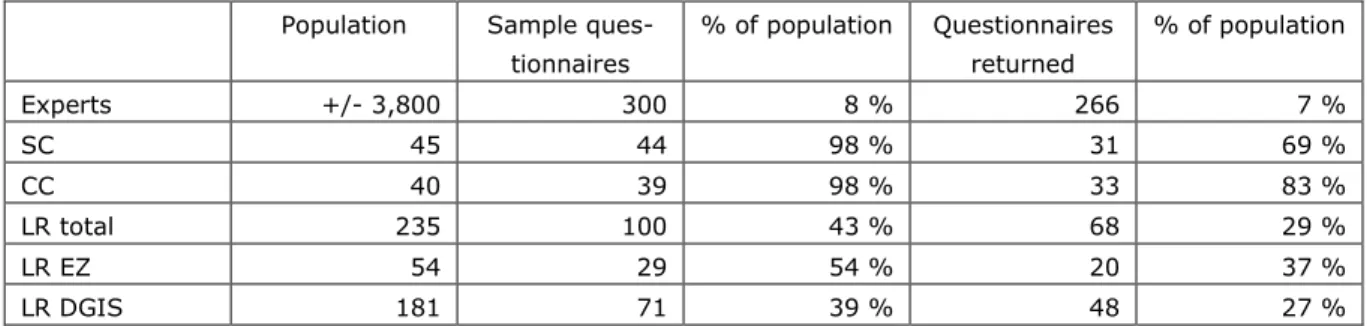
Questionnaires were distributed among four groups of stakeholders: 300 experts, 39 country co-ordinators, 44 sector coordinators and 100 local representatives. Approximately 70% of these were returned.
Field research
For the field research six countries were visited: Bulgaria and the Russian Federation (EZ focus countries) and India, Peru, Kenya and Uganda (DGIS countries). These countries benefited from almost 1,000 projects during the period 2001-2005 (around 12.5 % of total projects performed). Per country on average 10 SME-companies/enabling environment institutions were visited. Fur-thermore, representatives of the Dutch Embassy, local Chambers of Commerce and other local organisations were interviewed. Besides, 11 Local Representatives of PUM were interviewed during field research.
This report is primarily based on desk research, interviews and questionnaires; the field research was limited and was meant to illustrate and verify the findings and results of the desk study.
3.
Findings and conclusions
Background PUMThe activities of PUM have significantly increased during the evaluation period, as witnessed by the growth in both the number of employees (from 80 in 2001 to 165 in 2005) and the number of pro-jects (from 1,600 in 2001 to 1,800 in 2005). During the evaluation period PUM has increased its fo-cus on both SME companies and follow-up projects. In addition, the organisation has experienced significant operational developments, of which the introduction of the PRINS database is perhaps the most important. The PRINS database contains information on all applicant companies and pro-jects. In addition, all data are stored that are derived from the forms that are used by PUM for the project: the evaluation form (filled out by the applicant after a project is carried out), the debriefing form (filled out by the expert after a project is carried out) and the survey form (filled out by means of a random survey by the Country Coordinator, half a year after a project is carried out by the expert). The forms are processed in the database and the data are used for internal and external reporting and for monitoring the quality and progress of PUM projects.
In the previous evaluation a number of recommendations was formulated. These recommendations were all related to a further professionalisation of the organisation. In the evaluation it was examined to what extent these recommendations were followed up by PUM. Many of the proposed changes where already set in motion at the time the recommendations were made. From the eleven recom-mendations only one has not been implemented. This concerned the recommendation with respect to “the reach and coverage of the programme”. It was recommended by the previous evaluator not to be active in countries where the “government openly does not support the private sector”. PUM management did not agree with this recommendation as they feel that by supporting the private
sec-tor in these countries one could influence government policy in a positive manner. From the remain-ing ten recommendations five recommendations have been fully implemented while another five have been partly implemented. PUM did not fully implemented the recommendations regarding the target group and selection criteria, the approach to follow-up projects, the role of the Local Repre-sentative, the selection process of staff volunteers and regarding the quality of the administration on the projects undertaken.
Policy relevance
The evaluation showed that the PUM projects generally fit the objectives of both ministries and the needs and priorities of the applicants. Although it is difficult to measure the real effects of PUM sup-port in terms of poverty reduction, the results from the PRINS database, questionnaires and field research show that there are strong indications that PUM support has positive effects on the local economy in creating employment and economic growth of companies and, hence, fit into the objec-tive of DGIS to stimulate the private sector in developing countries in the framework of poverty re-duction. For EZ countries the project results comply with the objective to create favourable condi-tions for international economic activities of the Dutch private sector. The field research in Bulgaria and Russia confirms a substantial number of established business contacts.
The question to what degree the project results contribute to the objective of the programme proved to be difficult to answer. Neither EZ nor DGIS has formulated reporting requirements with respect to the objectives of PUM. Besides, the nature of these objectives make it very difficult to measure the results on these objectives in a direct way. As a result, PUM has not developed indicators to measure the long-term objective of the programme (poverty reduction) and, hence, does not gather information on these objectives in the PRINS database. Moreover, the scope of the field research was too limited to arrive at findings that can be related directly to these specific objectives.
In order to give at least some impressions of the contribution of the PUM projects to the objectives of the programme, it was decided to report on the effects of the PUM advice on different aspects stored in the PRINS database, which can be related to the overall objective mentioned in the annual report of PUM: “the contribution to the growth of a viable SME sector.” Moreover, within the scope of the field research it was possible to evaluate the results of the PUM advice on the same aspects and to com-pare these with the results stored in the PRINS database.
In this respect, the overall impression of the evaluator on the projects visited in DGIS countries is quite positive, particularly in India. In Uganda, the overall impression is more diverse. In general the field research in DGIS countries confirms the results stored in the PRINS database. The overall impression of the evaluator on the projects visited in EZ countries is positive, particularly in Russia.
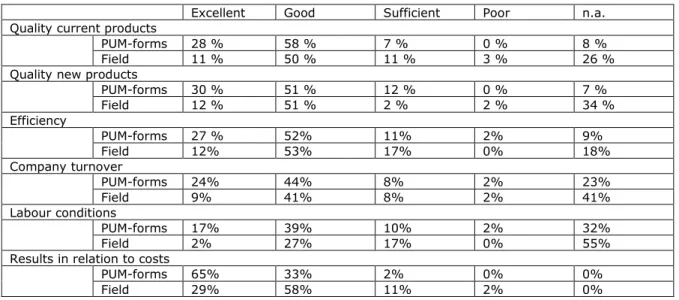
Table 1 summarizes for each ministry the results for the aspects that were included both in the field research and in the PRINS database.
Table 1 Project results field research compared to information stored in the PRINS database
Excellent Good Sufficient Poor n.a.
Quality current products
PUM-forms 28 % 58 % 7 % 0 % 8 %
Field 11 % 50 % 11 % 3 % 26 %
Quality new products
PUM-forms 30 % 51 % 12 % 0 % 7 % Field 12 % 51 % 2 % 2 % 34 % Efficiency PUM-forms 27 % 52% 11% 2% 9% Field 12% 53% 17% 0% 18% Company turnover PUM-forms 24% 44% 8% 2% 23% Field 9% 41% 8% 2% 41% Labour conditions PUM-forms 17% 39% 10% 2% 32% Field 2% 27% 17% 0% 55%
Results in relation to costs
PUM-forms 65% 33% 2% 0% 0%
Field 29% 58% 11% 2% 0%
Sources: Field research, PRINS database
The results show no big differences. The evaluator was less generous with the qualification “excel-lent” compared to the PRINS database. In addition, the evaluator was more frequent of the opinion that an aspect was “not applicable”.
Effectiveness
Local Representative (LR)
The functioning of the LR has improved during the evaluation period, in particular related to the ac-quisition activities. During the evaluation period PUM has increased the job responsibilities of the LR’s, tried to improve the performance standard of the LR’s and tried to increase the influence on their functioning. Measures taken include the provision of frequent and elaborate instructions on the required working method, the replacement of less performing LR’s and by establishing a better country or regional spread, in which the presence of LR’s better represent the degree of activities. Nevertheless, there is still room for further improvements.
Staff volunteers
The performance of the PUM volunteer organisation as a whole was found professional and effec-tive and in many aspects (structure, commitment of employees, etc.) does not differ from other non volunteer organisations. Although experts and staff volunteers do not always meet the expectations and occasionally demonstrate a somewhat non-committal attitude, one could say that the overall commitment of the volunteers is excellent. Both Sector Coordinators (SC’s) and Country Coordina-tors (CC’s) performed their tasks in a professional and effective manner and were able to spend the time which is required for the function. In some cases we noticed that the expansion of the pro-gramme puts some pressure on the organisation. Furthermore we noticed that the reporting re-quirements were not always fully met and were not properly monitored. Finally we found that the effectiveness of the debriefing by the expert with the CC is questioned in a number of cases and it is not clear why the SC is not involved in the debriefing.
Recruitment and selection of (staff) volunteers
During our research it was found that the CV database is not up-to-date and contains CV’s with in-sufficient information. The selection process of staff volunteers is not transparent and creates irrita-tion among some experts. Although experience as an expert, managerial skills as well as interna-tional and country specific experience are taken into account, the criteria are not sufficiently clear. Furthermore we found that the pool of experts where SC’s are responsible for, is in a number of cases too large and many experts have never met the SC of their sector.
Effectiveness of the organisation
During the evaluation period PUM has taken several measures to improve the effectiveness of the organisation. Information is much more accessible and the organisation is better structured. Impor-tant measures taken in this respect are:
- The separation of the responsibilities between the CC and SC and the larger job responsibilities of the latter;
- The matching of the processes of the training and Business Link Programme (BLP);
- The introduction of the PRINS database;
- The improvement of the PUM Website (including the possibility to fill out the application form online);
- The introduction of Tele-working in 2003.
Considering the expansion of the programme during the evaluation period, the management struc-ture of PUM needs to be reviewed. In particular the tasks and responsibilities of the General Director are very extensive and include very detailed management tasks. At present the management struc-ture is under consideration in order to relief the General Director from some of his tasks.
With respect to the staff volunteers we noticed that the span of control can be wide and may lead to inadequate guidance of experts, Project Officers (PrOf’s) and LR’s by both the SC and the CC.
Registration and reporting
The registration and reporting, both on individual and programme level, has improved considerably throughout the evaluation period. The introduction of the PRINS database is a substantial improve-ment to the PUM operational manageimprove-ment in terms of effectiveness. The database supports the monitoring of the project cycle and enables PUM officers to see what actions need to be taken. At the same time the database enables the Anamon department to produce progress reports on both project and programme level, which enables the PUM management to control the project flow.
Monitoring of the effects of the programme
The registration and reporting, both on individual and programme level, is sufficiently managed to monitor the programme’s effectiveness, at least in terms of compliance with the annual agreements. Besides monitoring quantitative data such as the number of applications, projects, countries and sectors involved, as well as relevant staff members involved, the PRINS database also keeps track of the results of the projects through different forms. The information gathered enables PUM to monitor the process closely and to act immediately when necessary. If targets are not met, trends can be analysed and causes can be identified.
Follow-up projects
The implementation and the execution of the implemented policy for follow-up projects is effective. The policy of PUM concerning follow-up projects consists of building long term relations, improving the quality of projects and increasing the potential for business links and trainings. The field re-search showed that follow-up projects can improve the quality of projects, mainly as a result of a
longer relationship between the applicant and the expert. If a follow-up has taken place, it is more likely that business contacts will be developed between the applicant and a Dutch company. Whether a follow-up project is useful for a particular company has to be decided case-by-case, since every situation is different, as was shown in the field research.
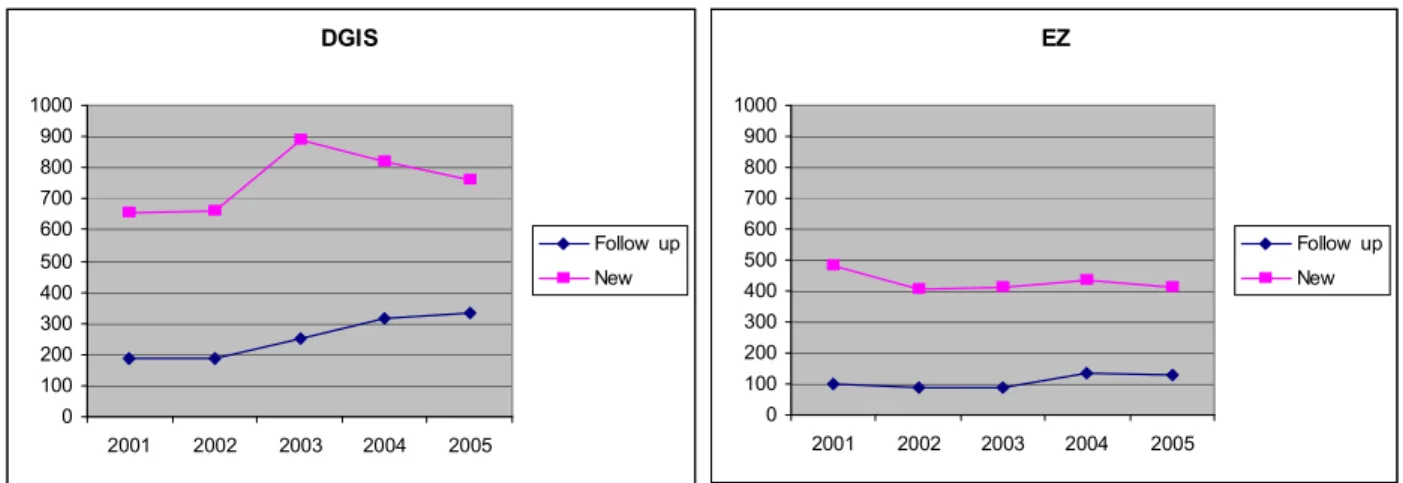
PUM has been stimulating follow-up projects for the past few years. Although a clear increase in the percentage of follow-up projects is shown throughout the evaluation period for both DGIS and EZ, PUM has not reached its target (set by itself) for both EZ and DGIS yet.
Business links and trainings
The assessment of the effectiveness of individual business links and trainings was beyond the scope of this evaluation. The objectives for EZ are translated into targets (in numbers of persons). PUM has reached these targets (which have been increased annually) easily during the applicable period (2003-2005). DGIS has not translated the objectives in targets. There has been an increase in the number of business links and trainings during the evaluation period (with a slight decrease in 2005), but since no targets were stated no comments can be made if the products were effective for DGIS. Trainings can serve the same purpose as business links for the positioning of Dutch compa-nies in foreign markets (EZ). For the purpose of knowledge transfer (DGIS) trainings could be more useful. In the questionnaires both business links and trainings are rated very well, though only half of the experts have experience with either one of the programmes.
Efficiency Output finance
PUM has realised the agreements under the terms of output financing in the evaluation period. To a large extent PUM has fulfilled its obligations that are mentioned in the agreements which have been made with both DGIS and EZ. The actual cost realisation was lower than the available budgets. An-other observation is that the costs of the PUM programme have increased during the evaluation pe-riod. This increase is mainly explained by the increased number of projects.
Costs per project
The costs per project have developed differently for DGIS and EZ. For DGIS, the average costs per project have decreased with 7% during the evaluation period. Explanations for this decrease must be found in the developments of airfares and the decrease in costs for daily allowances as a result of the reduced duration of DGIS projects. For EZ, the average costs per project have increased with 10% during the evaluation period. Explanations for this increase are a decrease in the number of projects (the fixed overhead costs have to be beared by a smaller number of projects) and an in-crease in travel costs (airfares) as a result of a changed country portfolio.
However, when the indirect costs are taken into account in the costs per product (this includes both projects and trainings/BLP’s), a different picture appears. In this case, an efficiency gain is obtained for DGIS and to lesser extent for EZ (respectively 11% and 2%). The higher efficiency gain for DGIS per project can be explained by the fact that the total number of projects that is carried out for DGIS has also significantly increased, while the total number of EZ projects has slightly decreased. Finally, it is observed that the average project duration has decreased for DGIS. As a result, the av-erage costs per project day have slightly increased. For EZ, the avav-erage project duration has re-mained constant. With regard to the average training/BLP, it is observed that the duration has de-creased for both DGIS and EZ. As a result, the average costs per training/BLP day have dede-creased.
Efficiency of the projects
Throughout the evaluation period, PUM has taken measures to increase the efficiency of the project. The applied automation systems and procedures have been improved substantially in the years 2001-2005. They are sufficient to monitor the efficiency of the projects. The monitoring of the project performances is arranged by both the PRINS database and the different forms used by PUM for the projects. The design of these forms has been thoroughly adjusted in the course of 2004. For all forms the layout has improved and the number of topics/questions has been expanded.
The PRINS database also registers a number of indicators that monitor the project efficiency. These indicators are not all related to individual projects. The number of projects per officer is considered an important indicator to PUM, as PUM is highly orientated on achieving the output goals, which are formulated in the annual agreements.
Financial reporting
The internal monitoring system complies with the terms of EZ and DGIS. It is observed that the min-istries can sufficiently influence PUM’s activities. In addition, the quality of the reports has increased during the evaluation period.
Country policy
The country policy of PUM is based on the requirements of the ministries. The present country pol-icy of PUM meets the objectives of EZ and DGIS. For the EZ-countries, every year a list of focus countries is decided. According to the agreement with DGIS for 2004-2007 PUM is free to decide in which countries 25% of projects will be executed as long as it concerns countries of part I of the DAC-list. For these projects PUM focuses on helping particular regions. Constant evaluation is part of the annual evaluation of the DGIS-country list. If a country generates less than 10 projects per year for a period of 3 years and no special circumstances have taken place, the country is likely to be removed from the list. This evaluation is done on a structural basis by PUM. Based on the find-ings no adjustments seem to be desirable.
Business contacts as a result of PUM
This part of the evaluation focused on business contacts established between PUM applicants and Dutch companies.
Policy of PUM for business contacts
PUM has two main products in its policy to stimulate the development of business contacts, namely the Business Link Programme (BLP) and the training programme. The number of developed busi-ness contacts as a result of the BLP and the training programme increased during the evaluation period, for both EZ and DGIS. Since the number of developed business contacts increased as a result of the products in the PUM policy, the policy can be considered effective.
Business contacts
The evaluation shows that a large part of the assisted companies has developed business contacts. The number of business contacts developed by means of the BLP or the training programme has increased during the evaluation period, both for EZ and DGIS. The evaluation by PUM itself, as well as the questionnaires and field research, show that many additional contacts have been established outside of PUM, i.e. not through the BLP or training programme. Most of these contacts concern import and export and the purchase of (second hand) goods. The field research confirmed this. Some results are not visible yet, since it takes time to develop the contacts.
Co-operation with Dutch stakeholders
The management of PUM has sometimes meetings with some Dutch stakeholders (FMO, EVD, CBI and some Dutch NGO’s). An interview with one stakeholder (CBI) made it clear that there is poten-tial for further co-operation. One of the obstacles in developing relations with Dutch stakeholders is the difference in focus. There is also potential for co-operation with branch organisations, but whether this potential is fully used depends largely on the Sector Coordinator.
Business contacts in other countries
There is no formal information about business contacts developed by applicants with other Western countries. During the field research a number of business contacts was mentioned with companies in other countries. There seems to be little overlap between PUM and other similar programmes in Western countries (France, Germany, EU).
Co-operation and contacts with local organisations
Part of the study was to define the co-operation between PUM, Dutch organisations that are locally represented, and local organisations. It was found that the contacts with Dutch organisations in the PUM target countries are rather limited, mainly because the focus of the organisations is different from the focus of the PUM programme and PUM representatives are not always familiar with the activities of these organisations. The outcome and usefulness of these contacts are somewhat dis-appointing, although in some countries (India and Peru) successes are reported. The success of these contacts very much depends on the capabilities of these BSO’s and the quality and network of the contacts of the PUM organisation locally.
Other possibilities for PUM
The evaluator included the subject “financing problems” in the evaluation as this subject seemed to be one of the important issues raised by experts and other PUM representatives. Financing is one of the frequently mentioned issues encountered by experts to continue or expand the business of PUM clients. This issue is connected to the development and successfulness of PUM clients and thereby the economic development of the countries concerned. However, it is difficult to quantify the financ-ing problems and to determine the real needs. Up to now PUM does not follow a standard approach to identify and handle financing issues with clients. PUM should develop stronger ties with potential financiers for the PUM applicants, but PUM should not be involved in financing issues nor consider to set up a fund under its premises.
4.
Recommendations
In the evaluation report several recommendations have been made to further improve the quality of the PUM organisation in achieving its objectives. Below we summarise the main recommendations:
Indicators for measuring policy relevance
It is recommended that an agreement is reached between the management of PUM and the two ministries on the need and methods to measure the policy objectives of the programme (relating to
poverty reduction and creating favourable conditions for international activities of the Dutch private sector). In case this need is confirmed, the evaluator recommends to define clear and realistic indi-cators that can be used and incorporated in the database of PUM for reporting purposes.
Position and allowance of Local Representative (LR)
The LR should be more involved in defining and formulating the assistance requested by the appli-cants, in the debriefing process and should be allowed access to all relevant information. Moreover, it is recommended to reconsider the allowance policy for LR’s by introducing quality aspects and taking into account the cost of living in the PUM countries.
Recruitment and selection of (staff) volunteers
It is recommended that - as a standard procedure - all candidate experts are interviewed by the SC to make sure that candidates have the right attitude and expertise (including reporting skills).
The selection of experts should be improved and professionalized by a better intake, improvement of the content of the CV’s and a better use, monitoring and updating of the population of CV’s. The selection process for staff volunteers (CC’s and SC’s) should be more transparent and focus more on managerial skills.
Debriefing
With respect to the debriefing (at the end of a project) it is strongly recommended to involve the SC, in particular when follow-up projects are considered.
Management structure
It is recommended that the General Director focuses more on his managerial tasks and delegates some tasks (briefing and debriefing meetings with CC’s) to others. For this it is suggested to strengthen the management structure by creating a new function (area coordinator).
With respect to the SC we recommend that the number of experts covered by the SC will be re-duced to a manageable size (i.e. by increasing the number of sectors).
The quality of the PRINS database
The PRINS database can be improved in some aspects (completeness, accurateness and workabil-ity). PUM can improve the quality of the inputs of the PRINS database by monitoring that in the forms all questions are answered and that there is a clear understanding among experts and staff volunteers on the qualifications used in the forms (excellent, good, etc.) to express opinions.
Follow-up projects
PUM should continue to be critical on the need for follow-up projects and take into account the ex-pertise which is requested. Moreover setting specific quantitative targets should be reconsidered and should also take into account qualitative aspects.
Budget constraints
At present the expenditures of the PUM organisation very much rely on government regulations. PUM only receives the full sum that is available for a year, when it realises a project turnover that is at least 90% of the budget. When PUM realises a project turnover larger than 110% of the budget, the additional costs are not refunded. We recommend that some more flexibility by the ministries will be considered in case of underperforming or exceeding the available budgets.
Business contacts
It is recommended that PUM takes some measures to stimulate business contacts. PUM should increase awareness about its activities among companies in the Netherlands. This could also be useful for the recruitment of future volunteers. Furthermore PUM should create a more efficient or-ganisation for arranging business contacts, by offering support to the assisting expert (i.e. by arrang-ing accommodation and transport).
Co-operation with local organisations
PUM should strengthen the co-operation with local business support organisations (BSO’s) and lo-cal representations of Dutch organisations by making sure that the LR’s have a sufficient network among these organisations, by involving the Embassies more in the PUM projects and by strength-ening the co-operation with CBI in the scope of BSO’s.
Financing issues among applicants
It is recommended to investigate the need and quantify the problems with respect to financing prob-lems among PUM clients. Experts in banking and finance should be more involved in assisting PUM clients to present a viable business plan and to assist them in applying for loans or equity with finan-cial intermediaries. Also PUM should be more involved in identifying possible financing possibilities locally as well as with development banks, partners of FMO and with Dutch subsidy intermediaries such as EVD. The establishment of a separate fund – as suggested by some of the PUM managers and volunteers – for financing PUM activities should only be considered after a proper investigation in that respect.