Human Resources-Geographical Information Systems
Data Development and Systems Implementation for
the Christian Social Services Commission of Tanzania:
Final Report
May 2009
Scott Todd, IMA World Health
Glen Brubaker, Consultant/IMA World Health
Sarla Chand, IMA World Health
Charles Franzén, IMA World Health
Craig Hafner, Capacity Project/IMA World Health
Adeline Kimambo, Christian Social Services Commission of Tanzania
Petro Pamba, Christian Social Services Commission of Tanzania
The views expressed in this document do not necessarily reflect the views of the United States Agency
for International Development or the United States Government.
Acknowledgements
First, we acknowledge the Christian Social Services Commission of Tanzania (CSSC) leadership and staff for their hard work and the enthusiasm with which they approached this project. In particular we want to recognize Dr. Adeline Kimambo, CSSC director, for her insight to commit significant time and
resources toward this technology effort. We also thank the CSSC zonal secretaries (Dr. Narcissus Kibozi, Irenius Lyimo, Dr. Richard Mbwambo, Simeon Kasoga and Fr. Lucas Komba) for their diligence in learning to apply the geographic information system (GIS) tools for local implementation, and for their initial and ongoing enthusiasm to collect and maintain the information in these systems.
In addition, we want to acknowledge the significant accomplishment and contribution of former zonal coordinators (Dr. Charles Mbwanji, Dr. Mganga Kipuyo and Dr. Edwin Kiula and former CSSC Technical Officer Dr. Simon Haule) for their hard work in deploying and administering the first round of data collection that achieved nearly 70% coverage in the first six months. We appreciate the early leadership of Dr. Fredrick Kigadye of the Tanzania Episcopal Conference, and the support of diocesan and other faith-based organizations in the CSSC network for providing keen insight and feedback on the workings, accomplishments and challenges of the project from initial stakeholder meetings through systems implementation and training.
We also wish to acknowledge and thank the Access Project for its opening investments into this project that were a primary catalyst for its inception. Also, Frank Baer’s involvement catalyzed the project initially by promoting the value of mapping technologies, and later by galvanizing ongoing support for this project. He also educated and involved stakeholders, guided initial survey design and systems development and advised the entire team throughout project execution.
Further, we are grateful to IMA World Health leadership for having faithful courage to start a multiyear, unconventional project without committed long-term funding, and also for the sustained leadership, advisory and technical support of Sarla Chand, Charles Franzén, Craig Hafner and Judy Gilbert. In addition, we appreciate IMA Tanzania Director Dr. Daniel Nyagawa and the staff for ongoing in-country support of this project as well as recurrent preparations and hospitality during and throughout every visit from US-based staff.
Finally, the authors thank the Capacity Project leadership and staff who supported this project. We also gratefully appreciate the ongoing commitment of USAID to support the Capacity Project’s efforts through IMA World Health and the CSSC over the past three years. Without the Capacity Project, the human resources GIS could not have achieved such success.
Table of Contents
Abbreviations and Acronyms ... v
EXECUTIVE SUMMARY ... 1 I. INTRODUCTION ... 2 1.1 BACKGROUND ... 2 1.2 PROBLEM ... 2 1.3 PURPOSE ... 3 1.4 CONCEPTS ... 4
1.4.1 Faith-Based Information Integration ... 4
1.4.2 Information Technology for Health Systems Strengthening ... 4
1.4.3 Data-Driven Decision-Making (DDDM) ... 5
1.4.4 HR Health Geography ... 5
1.4.5 Assisting National Information Systems Development ... 6
2. PROJECT EVENTS ... 7
2.1 HR-GISTECHNICAL APPROACH ... 7
2.2 PRELIMINARY EVENTS ... 8
2.3 CAPACITY PROJECT CSSCHR-GISYEAR ONE (JULY 2006 TO JUNE 2007) ... 8
2.4 CAPACITY PROJECT CSSCHR-GISPROGRAM YEAR TWO (JULY 2007 TO JUNE 2008) ... 9
2.5 CAPACITY PROJECT CSSCHR-GISPROGRAM YEAR THREE (JULY 2008 TO JUNE 2009) ... 9
3. KEY PROJECT THEMES ... 11
3.1 FBOINFORMATION INTEGRATION ... 11
3.1.1 National Health Assets and HR ... 11
3.1.2 Data Sharing MOU ... 11U 3.1.3 FBO/MOHSW Collaboration in Health Facilities Information ... 11
3.2 HEALTH SYSTEMS STRENGTHENING ... 12
3.2.1 ICT Strengthening Health Systems ... 12
3.2.2 CSSC Zonal Structure ... 12
3.2.3 CSSC Zonal Secretaries ... 12
3.3 DDDM ... 13
3.3.1 Understanding Information ... 13
3.3.2 Data Demand for Information Use ... 13
3.3.3 Zonal Decision-Making ... 14
3.4 HRGEOGRAPHY ... 15
3.4.1 Mapping for Visual Data Development ... 15
3.4.2 HR and Facility Asset Visualization by Mapping ... 15
3.4.3 Matching HR Strength with Program Needs ... 15
3.5 ASSISTING NATIONAL SYSTEMS ... 17
3.5.1 Collaboration ... 17
3.5.2 Population Demographics and Health Facility Data Gaps ... 17
3.5.3 Responding to Decentralized Health Systems ... 18
4. PROJECT ACCOMPLISHMENTS ... 20
4.1 INFORMATION INFRASTRUCTURE ... 20
4.3 CAPACITY-BUILDING ... 21
4.4 COLLABORATION ... 21
4.5 SUSTAINABILITY ... 22
5. PROJECT LESSONS LEARNED ... 23
5.1 FAITH BASED HRH IN TANZANIA ... 23
5.2 ICTINFRASTRUCTURE FOR HEALTH SYSTEMS STRENGTHENING ... 23
5.3 DECISION-DRIVEN DESIGN FOR DATA DEVELOPMENT ... 23
5.4 HEALTH FACILITIES FOR LOCATING HRH ... 23
5.5 DECENTRALIZED FRAMEWORK FOR HRHINFORMATION ... 23
REFERENCES ... 25
ANNEX A: MEMORANDUM OF UNDERSTANDING BETWEEN THE MOHSW AND CSSC ... 27
ANNEX B: TERMS OF REFERENCE FOR THE MOHSW MAPPING TASK TEAM ... 32
ANNEX C: PAPER-BASED SURVEY COLLECTION FORMS ... 33
ANNEX D: TERMS OF REFERENCE FOR CSSC ZONAL SECRETARIES ... 39
ANNEX E: FBO CLINICAL STAFF ANALYSIS CHARTS AND MAPS ... 41
ANNEX F: PROTOCOL FOR ESTABLISHING PARAMETERS FOR UNIQUE HEALTH FACILITY ID ... 43
Abbreviations and Acronyms
ANC Antenatal Care
ARHAP
CCHP African Religious Health Assets Program Comprehensive Council Health Plan CCIH
CHA Christian Connections for International Health Christian Health Association CSSC
DDDM DDIU ESRF
Christian Social Service Commission Data-Driven Decision-Making Data Demand and Information Use Economic and Social Research Foundation ESRI
FANC Environmental Systems Research Institute Focused Antenatal Care
FBO Faith-Based Organization
GIS Geographic Information System
GMI GRHAM GTZ
Global Mapping International
Global Religious Health Assets Mapping German Technical Cooperation
HC Health Center
HF Health Facility
HIS Health Information System
HMIS Health Management Information System
HR Human Resources
HRH HRIS
Human Resources for Health
Human Resources Information Systems ICT
IHRDC Information Communication Technology Ifakara Health Research and Development Centre
IMA Interchurch Medical Assistance
M&E MEDA MIP
Monitoring and Evaluation
Mennonite Economic Development Associates Malaria in Pregnancy
MOHSW Ministry of Health and Social Welfare MOU MSD MTT NACP NBS Memorandum of Understanding Medical Stores Department Mapping Task Team
National AIDS Control Programme National Bureau of Statistics NGO
NIMR NMCP PNP
Nongovernmental Organization National Institute for Medical Research National Malaria Control Program Private Not-for-Profit
PEPFAR REPOA TACAIDS
President’s Emergency Plan for AIDS Relief Research on Poverty Alleviation
Tanzania Commission for AIDS TEC
TGPSH Tanzania Episcopal Conference Tanzanian German Program to Support Health
TOR Terms of Reference
Executive Summary
Current estimates indicate that between 30% and 70% of health care services in Africa are operated by faith-based organizations (FBOs) (Karpf, 2007). However, these resources are not effectively integrated into national health information systems. While most partners providing health care in sub-Saharan Africa agree that FBOs play an important role in providing health services, there are few comprehensive data about the scope and scale of their contribution (ARHAP, 2008). Additionally, the absence of up-to-date and compatible personnel information in both the public and FBO health sectors is problematic, obscuring development of a clear picture on these issues.
Since 2006, the USAID-funded Capacity Project has engaged in programs designed to bolster more effective human resources for health (HRH) information and facilitate more intrasector data-sharing. As part of the Capacity Project consortium team, IMA World Health (IMA) with the Christian Social Service Commission (CCSC) developed a human resources-based geographic information system (HR-GIS) with a database containing multivariate information on 850 FBO health facilities and over 15,000 personnel. The project partners collected facility location and personnel information to support the mapping and database development processes. They designed systems and procedures for maintaining the data that utilized the information as a part of routine decision-making scenarios. Targeted training and technical assistance provided by IMA to the CSSC central office and five zonal secretaries also served to upgrade CSSC’s internal capacity for providing technical assistance to local partners. The information developed through this project provides new insight into the geographic distribution of FBO HR across Tanzania. Overall, this project has created compatible human resources information systems that can be integrated and used to assist with national health assets planning and policy development, improve health care service provision and reduce disparities in service delivery between FBOs and public facilities.
The implementers learned several key lessons during the three years of the project: 1) the CSSC and the Ministry of Health and Social Welfare of Tanzania have a long history and great capabilities for working together; 2) the recent work of both organizations makes clear that information technology is a basic requirement for effective health systems strengthening in the 21st century; 3) when information is
presented visually and decision-makers invest time and resources into understanding that information, it greatly increases both the capacity for making good decisions and the demand for good data upon which decisions can be made; 4) health systems personnel at all levels can readily understand and become engaged in higher-level GIS analysis of health system issues when information is presented on a map; and 5) it appears that decentralization of government authority has fundamentally changed the operating paradigm in Tanzania, yet this realization seems not yet fully realized in some ministries. As a result, the projects that progress more easily are those targeted at the local level that also seek buy-in from the central level.
I. Introduction
1.1
Background
Many of the earliest health facilities throughout sub-Saharan Africa (SSA), especially those in remote areas, were built and supported by Christian mission agencies. In the 19th century and continuing through
World Wars I and II, European nations established more formal hospitals to care for European soldiers, officers and settlers. Over the last half of the 20th century, after African nations gained their
independence, many of these health facilities were either handed over to larger church institutions or nationalized by governments ready to assume political control over basic services. As with other
infrastructure components that are expensive to maintain, hospitals and health facilities began to decline. While national health systems and basic health indicators deteriorated, exacerbated by changes in international funding models, various agencies and donors provided support to both health facilities and single disease control programs. Indigenization of basic service facilities such as hospitals and schools and the general decline in overseas church funding mean that formerly well-resourced facilities find
themselves completely dependent on regular government subsidies or fee-for-service structures in order to survive.
Since ownership, management, staffing and funding for faith-based organization (FBO) facilities are sometimes provided by different institutions, government ministries have difficulty implementing policies over these organizations uniformly. This can ultimately hinder equitable distribution of funds and support for human resources. It also means that there is no parity in employment conditions for health workers at FBO and government health facilities. This causes problems with recruitment and retention of staff, and results in compromised quality of care (ARHAP, 2008).
As fledgling governments nationalized mission hospitals and health facilities, many of the faith-based institutions that owned and managed them expanded the original purposes of their earlier health facility associations in order to advocate for equitable representation and inclusion of the FBO community. In the 1970s and 1980s these networks of facilities and providers came to be known as Christian Health Associations (CHAs). In 1992, Tanzania’s two largest CHAs—the Christian Council of Tanzania and the Tanzania Episcopal Conference (TEC)—established a memorandum of understanding (MOU) with the Government of Tanzania, thus establishing the Christian Social Services Commission of Tanzania (CSSC) as an ecumenical nonprofit agency. In 1994 the CSSC became incorporated as a legal entity.
The CSSC focuses on improving quality, accessibility and availability of health and education services by following three strategies: 1) fostering partnerships and institutional development; 2) capacity-building; and 3) lobbying and advocacy. Its primary roles and activities are ecumenical cooperation, advocacy and lobbying, capacity-building, applied research and dissemination of information, program work, consultancy and support services. In fulfilling these roles it supports both provision of health and education services, coordinating implementation of various projects such as the HIV/AIDS Project (Global Fund), the Malaria Communities Program (USAID), the Pay for Performance Project (Cordaid) and the Construction and Rehabilitation of school and health facilities (German Development Bank).
1.2
Problem
The CSSC estimates that FBOs in Tanzania manage 40% of hospitals and approximately 26% of all health facilities and provide 50% of health services in rural areas. However, these resources are poorly
integrated into national and global health information systems (HIS). For example, WHO has mapped health facilities in many countries that received funding from the President’s Emergency Plan for AIDS Relief (PEPFAR) in recent years, but until recently, most FBO facilities were not included.
In 2006, WHO commissioned another study that found that FBOs play a much larger role in disease prevention, care and treatment in SSA than previously realized. This report concluded that as much as
70% of Africa’s health infrastructure is currently owned by FBOs, yet there is often little cooperation between religious organizations and mainstream government health programs. Because they are so ubiquitous, health services often go unnoticed and FBOs continue caring for people, as they have done for the past 150 years (Karpf, 2007). These statistics show that FBOs must be better integrated into global and national HIS in order to improve their internal functioning and collaboration with health ministries, international donors, nongovernmental organizations (NGOs) and even the churches under which they operate.
Additionally, in terms of HRH, substantial international funding has been provided to PEPFAR countries in recent years as a response to the HIV/AIDS crisis. Most of these countries applied a large portion of these funds to increase the public health workforce, but often this process simply moves qualified personnel from FBO to MOH facilities. This “brain drain” needs to be better understood and addressed; however, absence of current, compatible personnel information in both the MOH and FBO sectors is problematic, obscuring development of a clear picture of these issues. FBOs, government health programs and other health care agencies need enhanced coordination and communication.
1.3
Purpose
From 2006-2009, IMA World Health (IMA), with the support of the Capacity Project and in collaboration with the CSSC, developed the HR-GIS. The purpose was to establish a solid basis for recognition of FBO contributions in health care provision, and to support integration of FBO
information within the broader global and national information infrastructure. The HR-GIS contains a relational database with multivariate information on over 850 FBO health facilities and 15,000 personnel. Through the design and development of this system, the project team recognized the need for CSSC ownership and opportunities for building its capacity by providing technical assistance in information communication technology (ICT) strengthening. Therefore CSSC personnel were intimately involved in the design and development of the system by establishing a clear goal and objectives to reach it. The goal of the CSSC in this project is to promote improved health care services delivery through a human resources information system (HRIS). In addition, this project sought to include the use of GIS
technology to enable ongoing analysis, monitoring and evaluation of health programs. The CSSC objectives are to:
1. Develop CSSC databases for HR and facilities
2. Integrate the CSSC health database into the national system and CSSC website 3. Build capacity for health management information systems (HMIS) and HRIS 4. Implement sustainable maintenance and quality assurance for information systems.
The HR-GIS project represented a massive data collection effort, requiring complex and dedicated collaboration among several teams. The CSSC had a lead role in managing data collection, while the central office coordinated five teams in each of five zones using global positioning system (GPS)
receivers to locate many of the facilities and three survey instruments to collect facility and HR data on hospitals, health centers and dispensaries.
Over the course of the project’s execution, these objectives helped the team maintain a clear direction for system development. This approach provided current data to document FBO contributions to health care provision, and enhanced internal capabilities for developing, operating and managing an information system across multiple levels of the organization. Finally, the project team gained recognition as ICT experts for health facilities and HR systems in Tanzania.
1.4
Concepts
In addition to pursuing the defined CSSC objectives through systems implementation, the project team recognized opportunities where technical assistance could provide further health system strengthening at various levels and through various agents of the CSSC network. The team applied five additional concepts, cutting across each of the CSSC-defined objectives. Through coincident application of these cross-cutting concepts (see Figure 1) for system design and data development, the team maintained the CSSC objectives and captured additional opportunities for health system strengthening.
Figure 1. Cross-cutting System Design and Data Development Concepts
1.4.1
Faith-Based Information Integration
By using an integration-oriented approach, the team sought to promote representation through integration of FBOs in national and global contexts, and in so doing, realized additional benefits by applying this concept through system design and data development. First, it is not possible to understand the resources of a national health system by looking at it from only one perspective. Since the
government, FBO, NGO and private not-for-profit (PNP) sectors operate in Tanzania, it is impossible to effectively plan, allocate or distribute resources without bringing information together on all of them. Second, while this project intended to document FBO information and health care contributions, it also intended to promote the integration of FBO information within the larger national information
infrastructure. The driving concept here was that collaborative opportunities for data-sharing would arise, and further connections with new and existing partners would emerge around the subject of health information. Finally, this integration-oriented approach also intended to elevate the level at which CSSC collaborates and create further opportunities for FBO participation in other existing health programs in Tanzania.
1.4.2
Information Technology for Health Systems Strengthening
Another cross-cutting concept was that the information being developed, and the technologies for using it, should be primarily promote overall health systems strengthening. This meant that systems and data should assist CSSC in its operations as the FBO health provider network, and that systems and data also
needed to assist the individual FBO health providers in directly strengthening the overall health care systems. This concept is apparent in the database design, and was emphasized to CSSC officers at the central and zonal levels through ongoing dialogue and training materials.
The HR-GIS project also targeted capacity-building of key individuals, namely the five zonal secretaries. The zonal secretaries are positioned both to be connected nationally and to operate locally in
coordinating and supporting the needs of diocese and FBO facilities within their respective zones. In order to create a sustainable system, the key individuals needed to understand the information, utilize it and make it available for planning and decision-making, thereby creating additional demand to fuel its ongoing utilization and maintenance as part of their routine operations. In their locally decentralized yet nationally integrated capacity, the zonal secretaries were the ideal candidates for performing this function. Therefore, CSSC zonal secretaries were trained to become technology trainers in order to pass along tools and techniques to the local district and health facility personnel in their respective zones.
1.4.3
Data-Driven Decision-Making (DDDM)
The concept of DDDM means that systems are designed and data are developed to support making better decisions for improved outcomes. Following this ideal, the key directions to shape database design should support the kinds of questions that system planners and decision-makers want to ask. However, many times it is impossible to know what questions to ask without understanding the
information available. Therefore, health system planners and decision-makers need to be educated about the information contained in their systems in order to utilize it for asking questions and then making decisions based on the informed answers.
Once the information is understood well enough to be utilized, additional tools can be developed to assist in planning and decision-making functions that are most critically important and will be most commonly used. In order for these tools to support DDDM, they must focus on key information that will be in highest demand. Activities that foster a concept known as data demand and information use (DDIU) involve a systematic approach that applies proven best practices and tools to help increase demand for health system data and ensure that the information is used in an evidence-based decision-making process.
1.4.4
HR Health Geography
Geography is a science that studies the earth and its life; it describes the location, distribution and relationships of physical features and biotic life, including people and the places where they live and operate. The primary tool of geography is a map. Therefore a fourth cross-cutting concept for strengthening overall health systems was to apply geographic methods (maps) to human resources for health (HRH) in order to visualize the location, distribution and relationships between health providers and those who need health care. This concept of HRH geography not only improves understanding of where facilities are located, it also highlights what programs are in operation relative to where health workers are located and what their professional capabilities are. Maps provide a clear picture of the FBO health system in Tanzania and reveal gaps in coverage, an important tool when addressing issues of equity and access with the Ministry of Health and Social Welfare (MOHSW) and donors.
One of the most important reasons for using GIS in this project was to highlight the fact that people provide health care at facilities. While this may seem apparent, most efforts to acquire HR information do not visually connect health workers to the places where they are located as part of data
development. One of the great strengths of applying this concept in data development is that it allows people to see data collection progress on the map as it is being accomplished. This visual factor in data
development promotes understanding of project intent, value and the need for ongoing maintenance as an integral function of system utilization.
1.4.5
Assisting National Information Systems Development
The cross-cutting concept of collaboration to assist in developing the national health information infrastructure was a recurring focus applied to every CSSC objective. This ties together all the concepts of FBO representation, health systems strengthening, decision-driven data and HR geography. In
addition, the engaging nature of mapping (and the generalized approach to data development that incorporates multiple layers of information) greatly enhances opportunities for open dialogue in discussing collaborative approaches to developing national systems for health facility and HR information.
Collaboration also provides credibility for reasoned engagement by all parties in sharing information. Through partnering, stakeholders work toward shared goals required for improving the national health information infrastructure for the sake of strengthening the entire state of health care in Tanzania. Health systems and HR cannot be understood or strengthened within the FBO sector alone; reasonable decisions cannot be made on the exclusive basis of FBO data, and an HR geography that only shows FBO facilities and people is incomplete for effectively describing the national state of either.
Finally, the concept of collaboration to assist in the development of national HIS applies at both the central and local levels. The Tanzanian health system is decentralized; therefore, collaboration must be pursued at regional, district and local levels of government and private practice. This collaborative concept successfully drove the development of the CSSC system at both the central and local levels. Collaboration at all levels will likely need to be applied in order for any public information infrastructure efforts to create sustainable systems and promote ever-expanding demand and effective utilization of health information at the national, regional, district and local levels in the future.
2. Project Events
2.1
HR-GIS Technical Approach
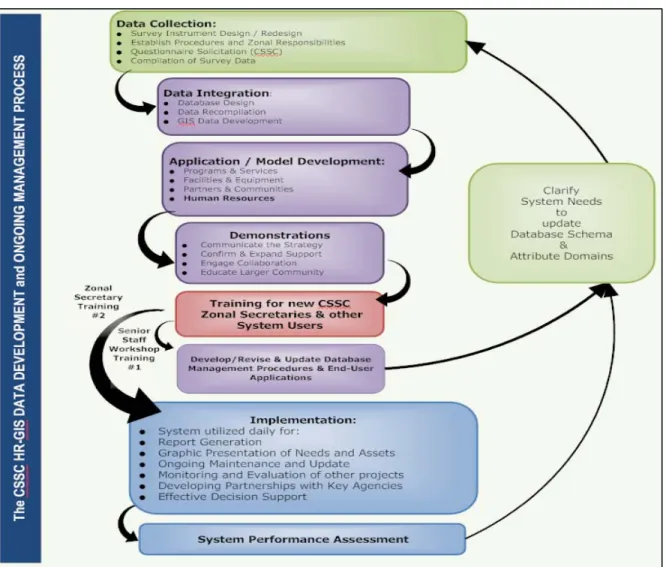
Throughout the project a widely varied course of events transpired, some according to the original plan and others as unexpected opportunities that were capitalized upon as possible. Overall, the technical approach in any information system development must be planned as iterative, with some phases needing to be revisited and procedures refined over the course of systems implementation. The following model (Figure 2) illustrates the process in this project.
Figure 2: HR-GIS Data Development and Ongoing Management Process
This general approach illustrates the overall process and methodology; however, there were also several key events that unfolded to support HR-GIS system development. In the following sections, program years are used as headings for organizing these key events in order to support a clearer description of the details in this iterative process.
2.2 Preliminary Events
In 2002, the Interfaith Health Program held a Global Religious Health Assets Initiatives meeting in Atlanta, Georgia, where health facility and program asset mapping were discussed. Christian Connections for International Health (CCIH) took the lead in health facilities assets mapping. This evolved into Global Religious Health Assets Mapping (GRHAM).
In 2005, a renewed interest in FBOs, CHAs and mapping resulted from:
• IMA’s engagement in FBO coordination in both the Access Project and the Capacity Project • The Capacity Project’s provision of core funding for GRHAM development
• Development of the GRHAM website to share existing information from CHA databases • WHO’s funding of African Religious Health Assets Program (ARHAP) for Lesotho and Zambia • The Partnership for Quality Medical Donations’ mapping of medical donations.
Early in 2006, various events and IMA interests converged on mapping and HRIS in Tanzania with the CSSC:
• The Access Project provided primary initial funding to support initiation of the HR-GIS including: a data entry person with CSSC technical supervision; funding for stakeholder interviews and survey instrument design; data collection training and IMA technical assistance and coordination; and all travel costs for three separate visits. In addition, the Access Project provided funding for seven laptops and seven sets of GIS software from Global Mapping International (GMI) via an FBO discount to CSSC for GIS base data and to improve coordination of focused antenatal care/malaria in pregnancy (FANC/MIP) activities in FBO health facilities.
• The Capacity Project’s FBO coordinator informed IMA of the Capacity Project IT team’s plans for an HRIS system with the MOHSW in Tanzania
• IMA sent a senior advisor to Tanzania for technical assistance to CSSC to prepare an action plan and comprehensive budget for CSSC health facilities mapping
• CSSC and stakeholder input were solicited for initial project design and identification of data elements, definition of content for survey and data collection instruments
• IMA provided technical assistance to CSSC for planning, budgeting and managing the initial data collection campaign across five zones throughout the country
• The IMA technical advisor assisted in developing survey instruments for data collection and provided preliminary training to CSSC technical officers.
2.3 Capacity Project CSSC HR-GIS Year One (July 2006 to June 2007)
• September 2006: IMA technical advisor traveled to Tanzania to provide CSSC training of zonal teams in data collection, GPS instrumentation and data entry
• September 2006: IMA consultant from GMI performed initial GIS data collection
• October 2006: Refined specific procedures for GPS instrument operation and coordinated data entry logistics and refining Microsoft Excel tables for data entry
• November 2006: Initial round of data collection completed within six months; all basic
information in all five CSSC zones yielded over 65% collection of attribute and mapping data; all attribute data elements and map feature layers further expanded and integrated into GIS project
workspaces to assess both content and completion of all data; defined queries and map variables and assesses potential for spatial analysis to establish of referral health areas
• December 2006: IMA team performed additional data cleaning and recompilation; relational database development in Microsoft Access; facilities and site HR-GIS data set development • January 2007: IMA presented the CSSC HR-GIS at the CHA annual conference in Bagamoyo and
held a meeting to present system capabilities and updates on project progress
• February 2007: Refined database and clarified required attribute domains and coded values • March 2007: Presentation designed, training materials developed, trainer provided first Zonal
Coordinator Training in Dar es Salaam
• April 2007: Another iteration of attribute variables defined • May 2007: Explored options for open-source GIS adoption
June 2007: IMA assisted the CSSC in developing the MOU for facilities data-sharing with the MOHSW.
2.4
Capacity Project CSSC HR-GIS Program Year Two (July 2007 to June 2008)
• July 2007: Held first meeting of the Mapping Task Team and CSSC secondary data collectionbudget
• August 2007: Began secondary data collection campaign
• September 2007: Terms of reference (TOR) developed for full-time zonal secretary, all positions filled in early 2008
• October 2007: Secondary cleaning, recompilation and GIS data set adjustment • November 2007: Reports generated on data quality and collection status
• December 2007: Held preliminary discussions for CSSC engagement of the Capacity Project’s iHRIS Manage software
• January 2008: Completed design and development of newly versioned Environmental Systems Research Institute (ESRI) GeoDatabase to integrate and contain all systems data; all non-GPS CSSC facility locations plotted via populated place data
• February 2008: IMA worked on design and development of system utilization and maintenance routines
• March 2008: Secondary training planned for three user levels (decision-maker, query, maintenance technician and training of trainers for ArcExplorer free GIS)
• April 2008: Held secondary training and installed updated data and new GIS tools; CSSC director requested iHRIS Manage implementation for CSSC; IMA coordinated collaborative workshop with the MOHSW and other stakeholders in Dar es Salaam
• June 2008: CSSC and the MOHSW signed MOU for facility data-sharing.
2.5
Capacity Project CSSC HR-GIS Program Year Three (July 2008 to June 2009)
• July 2008: CSSC conducted the ICT needs assessment process for each of the five zonal offices;• August 2008: Planned the iHRIS Manage CSSC implementation; IMA began remote coordination of remaining data collection with zonal secretaries; MOHSW requested IMA and CSSC
attendance at Geocodes Workshop in Kibaha; IMA sent Scott Todd, Daniel Nyagawa (IMA-Tanzania office director) and Petro Pamba (CSSC ICT officer)
• September 2008: CSSC developed TOR for new ICT officer to assist with iHRIS Manage software customization; conducted first consultation for iHRIS Manage
• October 2008: Data management and analysis routines to prepare four-week travel to zonal offices; CSSC completed ICT needs assessment to prepare for zonal office relocations • November 2008: All CSSC zonal secretaries acquired dedicated office space; IMA provided
technical assistance for new office ICT systems installation and networking; assisted in setup and configuration of broadband Internet at each location; performed HR-GIS system updates and follow-up training to zonal secretaries and assistants for full system-wide data update routines; provided iHRIS Manage information and demo software to anticipate future iHRIS installation at zonal offices
• December 2008: CSSC hired ICT officer for iHRIS software customization
• January 2009: Capacity Project staff conducted second consultation and installation of central office iHRIS Manage server and software customization; tested new mini-server (intended for each zonal office) to check compatibility with primary central office server
• February 2009: IMA provided remote technical assistance to zonal secretaries for data utilization and maintenance updates; reinforced collection of remaining HR data from selected hospitals • March 2009: Capacity Project staff prepared for the third consultation and installation of
upgraded central office server and provision of iHRIS Manage mini-servers and software updates for future CSSC installation in each zonal office.
3. Key Project Themes
Taken together, the key events of this project contributed to an application of the cross-cutting
concepts, in order to meet each of the CSSC-defined objectives: 1) develop CSSC databases for HR and facilities; 2) integrate the CSSC health database into the national system and CSSC website; 3) build CSSC capacity for HMIS, including HRIS; and 4) implement sustainable maintenance and quality assurance for information systems. This section details how the technical assistance provided by the Capacity Project team helped the CSSC realize those objectives through ICT for strengthening health systems, DDDM, understanding the geography of HRH and assisting national systems as integral parts of the project philosophy and approach.
3.1
FBO Information Integration
3.1.1
National Health Assets and HR
In order to establish a balanced understanding of Tanzania’s national health system, information on all the health assets and HR must be considered in totality. This requires not just looking at these assets and resources from the government perspective alone. In order to understand resource distribution, allocation and planning, and to reduce disparities between these sectors and public facilities in service delivery to the country, the FBO, NGO and PNP sectors must be included. Pursuing this need to share and integrate information across sectors and nationwide, the Capacity Project began specific activities with this end in mind.
3.1.2
Data-Sharing MOU
The CSSC has long had a strong connection and history of working with the MOHSW, yet until this project there were no explicit initiatives to promote the integration of any FBO information within the national information infrastructure, aside from basic reporting through the existing structures. A key event of this project was the establishment of a vision for nationally integrated health information by the signing of an MOU between the CSSC and the MOHSW. The MOU specified that that they would create “an integrated and shared database of health facility information that both organizations will update through a collaborative process” (see Annex A). While initial guidance and development of the MOU was provided by the Capacity Project team for CSSC, its modification, adaptation and execution was jointly owned and applied by both parties.
3.1.3
FBO/MOHSW Collaboration in Health Facilities Information
The establishment of an MOU between the CSSC and the MOHSW created a basis for FBO inclusion in other national-level health facilities information development efforts. From this formalized
understanding, a Mapping Task Team (MTT) formed with the purpose of “further coordinating, defining data collection, sharing policy and designating responsibilities as part of the comprehensive collaborative national database development process.” Key participants in the MTT came from a wide variety of FBO, NGO and public sector agencies. The organizations officially designated with representation on the MTT include the MOHSW, CSSC, National Institute for Medical Research (NIMR), National Malaria Control Program (NMCP), IMA, Mennonite Economic Development Associates (MEDA) and Jhpiego. Other organizations identified as key stakeholders who use or conduct geocoding activities included Ifakara Health Research and Development Centre (IHRDC), National Bureau of Statistics (NBS), Tanzania Commission for AIDS (TACAIDS), National AIDS Control Programme (NACP), Research on Poverty Alleviation (REPOA)/ Economic and Social Research Foundation (ESRF), German Technical
Cooperation/Tanzanian German Programme to Support Health (GTZ/TGPSH), Ardhi University and MOHSW/WHO (SAM).
The representation of agents from public, FBO, NGO and PNP sectors has also created further opportunities for FBO participation in existing programs operating at the national level. It indicated the
commitment and desire of these parties to work together in developing shared national health information, and in strengthening all operating health systems in Tanzania. The TOR for the MTT are included as Annex B.
3.2
Health Systems Strengthening
3.2.1
ICT Strengthening Health Systems
The CSSC objective to build capacity for HMIS, including HRIS, was reinforced by the concept that the information developed and the technologies for using it were fundamentally intended to promote overall health systems strengthening. Therefore, the systems and data developed also needed to assist FBO health providers directly to strengthen the health care systems. In order to accomplish this, the Capacity Project team provided training and technical assistance to the CSSC and its FBO members to upgrade the CSSC’s internal capacity for providing technical assistance to local facilities. Initially individuals from these organizations worked collaboratively to collect facility location and personnel information to support the mapping and database development process.
The primary data collection initiative began in March 2006, when an IMA consultant visited Tanzania to help prepare an action plan and comprehensive budget for the project. In April, the IMA technical advisor trained the five zonal teams in data collection, GPS instrumentation and data entry. In
September, a follow-up team facilitated data collection and provided quality assurance. At this time the project team decided that rather than using computerized data capture that would potentially require high-level technical support in the field, they would instead use simple paper forms (see Annex C). While this required subsequent office-based data entry, it also allowed more flexibility in data collection, substantially increasing user proficiency in spite of requiring moderate data cleaning during recompilation efforts.
By December 2006, in-country teams had completed 75% of the data collection for all CSSC health facilities, and 50% for health personnel data. IMA provided technical assistance to clean the data for subsequent recompilation and conversion to an Access database. This was followed by further
conversion into an ESRI geo-database to permit mapping and analysis with ArcGIS software. In January 2007, IMA presented preliminary results of the mapping and database development during a regional conference of CHAs in Bagamoyo. In March 2007, IMA trained the zonal teams to use the GIS software.
3.2.2
CSSC Zonal Structure
During the initial stages of development, each of the CSSC’s five zones was represented by a part-time zonal coordinator who generally operated out of a diocesan office, a health facility or his/her home. In the fall of 2007, through financial assistance from Cordaid, CSSC was able to create five full-time zonal secretary positions. In the spring of 2008, these full-time zonal secretaries received follow-up classroom training in the use of the HR-GIS as a resource and tool for performing a wide variety of tasks. One of their first assigned tasks was to locate suitable office space for representing the activities of CSSC within their respective zones. In November 2008, IMA provided technical assistance to each of the five CSSC zonal offices (Morogoro, Arusha, Mwanza, Tabora, Mbeya); all were made operational with the HR-GIS and Internet connectivity, and all five zonal secretaries (and one assistant each) received additional on-site HR-GIS training.
3.2.3
CSSC Zonal Secretaries
CSSC zonal secretaries are the frontline representatives who facilitate the flow of information and understanding of requirements between MOHSW structures (regional and district levels) and FBO structures (diocese and health facilities). They provide assistance with reporting, budget and workplan development; coordinate training; inform and educate on policy; provide technical assistance; advocate for the FBO sector; work across CSSC social sectors and perform other FBO representative activities
within their operational zones. The CSSC TOR for zonal secretaries is included as Annex D. An overarching concept has been that maintenance of the HR-GIS database should not be approached in a way that will create additional data documentation tasks for zonal secretaries; instead it should function as an information resource to support their day-to-day core activities and fuel expansion of health information development efforts. This was represented in terms of the database application design and emphasized to CSSC officers at the central and zonal levels through ongoing dialogue and training materials. Additionally, to further assist in health systems strengthening, technology training was provided to zonal secretaries using basic-level, freely available GIS applications (ESRI ArcExplorer and ArcReader) so that they can pass along tools and techniques to the district and health facility personnel.
3.3
DDDM
3.3.1
Understanding Information
After the first round of data development, during the initial system deployment the project team requested that CSSC decision-makers provide sample questions for testing. This exercise revealed that in order for hypothetical queries to be derived from intended system users, actual data would need to be generated in order to better illustrate the system’s potential. Therefore a midterm training for high-level decision-makers was also provided concurrent with the second round of zonal secretary training. This higher-level training promoted continued support and adoption at the CSSC central office and served to further leverage the utilization of system data for a wide variety of purposes such as assessment of subordinate proposals for in-country travel, feasibility of new program proposals and financial monitoring of other program activities.
3.3.2
Data Demand for Information Use
When decision-makers understand the information available and how it can assist them, demand for the information and systems for providing it is created. Once the information available is understood well enough to be utilized, additional tools can be developed to assist in planning and decision-making functions that are most important and will be most commonly used.
In order for this to occur, the focus of information to support DDDM must be placed upon key information to support those most important and common decisions. System tools that increase local demand for information and facilitate its use enhance evidence-based decision-making and help make the health system more effective. Activities that foster DDIU involve a systematic approach that applies proven, effective best practices and appropriate tools to help increase demand for health system data and ensure that the information is used in an evidence-based decision-making process. DDIU is a strategy developed by Measure Evaluation through support from USAID to identify opportunities for, and constraints to, effective and strategic data collection, analysis, availability and use. This strategy begins with an assessment that helps stakeholders, policy-makers and monitoring and evaluation (M&E) practitioners determine points of entry for DDIU intervention. Once specific needs are identified, DDIU core tools and approaches can be utilized to stimulate data demand, build capacity and enhance
evidence-based decision-making (Measure DDIU).
Decision-makers are normally not positioned to be the ones who manage, maintain and provide the information; therefore, key individuals must be targeted to fill this role. Additionally, systems and procedures for maintaining the data must then be designed to operate by utilizing the information as a part of routine decision-making scenarios. Therefore, once systems were deployed and use began, CSSC zonal secretaries were interviewed to gain a clearer understanding of how the operational systems could be further utilized to foster additional data demand from higher levels such as diocese head offices and to further strengthen health systems at lower facility-based levels.
3.3.3
Zonal Decision-Making
Zonal secretaries were previously described as the key individuals targeted for capacity-building to understand the information, utilize it and make it available for planning and decision-making, and thereby to create additional demand to fuel its ongoing utilization and maintenance as part of their routine operations. During interviews with zonal secretaries, areas where the concept of DDDM could be most fully applied were determined and their primary HR-GIS system utilization functions were discussed at length. Maintaining the HR-GIS data as described in the TOR refers to continuing to “update and maintain data on an ongoing basis” and “collect, compile, analyze, update, maintain, store and retrieve the data for utilization.” This includes using the system “for developing reports, graphics and to
coordinate among member organizations;” and to “track and monitor ongoing health facility and human resource data collection.” In this context, maintenance essentially translates into zonal secretaries possessing the skills to work with data in a wide variety of formats, applications and ways to translate it into information that is further applied to various analysis, reporting or decision-making functions. Based on interviews, IMA determined that zonal secretaries fill a crucial function in terms of
coordinating the transfer of policy and reporting requirements between MOHSW structures and FBO structures within their zone. Interactions operate in terms of zonal secretaries:
• Informing FBOs about MOHSW requirements
• Assisting FBOs to prepare MOHSW reports according to requirements • Assisting FBOs to prepare MOHSW applications for ongoing funding • Advocating to the MOHSW on behalf of the FBO community.
Zonal secretaries provide information to health facility officers to help them understand new MOHSW-assigned salary ranges, providing them with circulars and guidelines and assisting them to assemble and document information required for reporting on:
• Personnel meeting standard establishment; required versus available • Number of beds (for approval and direction of funding)
• Personnel qualified eligible for increases and/or training.
The CSSC receives public funding to support scholarships for health worker training (up to 70% of funds required). Therefore, zonal secretaries utilize HR information from the HR-GIS database to assist personnel managers in developing applications based on employee qualifications. They must follow up to document training qualifications and promotions by entering data into the HR-GIS on an ongoing basis after training is received.
The Comprehensive Council Health Plan (CCHP) is a district-level planning tool and document that health providers must submit as part of their application for basket funds. The CCHP is now used as the document to support eligibility. All CCHP requirements are specified at the district level; therefore, all are different. Zonal secretaries assist and coordinate between the various diocesan member
organizations. Diocesan offices assist their facilities in preparing the CCHP specific to the requirements of their own district and also represent their facilities at district levels. They assist in developing the CCHP using facility information from the HR-GIS database based on requirements. For example, requirements for the health information system known as MTUHA (Mfumo wa Taarifa za Uendeshaji wa Huduma za Afya) include information on patients served, programs operated, drugs consumed from the Medical Stores Department (MSD) and the top ten diseases reported in each district. All of this
child health and reproductive health to support the CCHP. Zonal secretaries also recently provided a diocesan workshop to educate facility managers and diocese personnel regarding these new
requirements and procedures for developing and submitting the CCHP.
In addition to these core health functions, the zonal secretaries provide support to other social sectors such as education. There is also great interest from CSSC for technical assistance to zonal secretaries in order to start developing educational facility mapping and database development. In these and other areas the CSSC zonal secretaries are learning to use the HR-GIS as a tool to assist them in performing their core functions.
3.4
HR Geography
3.4.1
Mapping for Visual Data Development
The information developed through this project provides new insight into the geographic distribution of FBO assets and HR across Tanzania. A theme fueled by the geographic approach for understanding HR distribution was that people provide health care at facilities. In order to understand where HR are adequate or inadequate, in terms of number or capability, it is essential to see and compare where they are located in the health system. Visualization of HR usually takes the form of a tabular approach to data development that can later be leveraged into charts, graphs and summary tables. As a result of this geographic approach, concepts of place, resource distribution and programmatic relationship (relative to service population density) were readily apparent to all members of the project team. This visualization assisted the CSSC team members in their comprehension of project intent, value and need for ongoing maintenance as an integral function of system utilization. Prior to project inception, the value of mapping to assist in data development was not fully realized; it occurred as a response to progress tracking. However, the high level of comprehension of system intent contributed to the focus on subsequent data collection and accelerated the process considerably.
3.4.2
HR and Facility Asset Visualization by Mapping
During preliminary data evaluations, implementers acquired insights regarding the distribution of HR in various regions around the country. While these insights (modified as additional data) were brought into the system, many early observations were later confirmed. While the mapping aspect of the system provides a key to visualization that resonates with those who know the systems and geography best, there is also a great deal of insight to be gained by the nature of geographically-oriented attribute (tabular) information. Annex E illustrates an analysis of the various aspects of HR related to quantity of service by region. These charts show a strong HR level in regions where large FBO hospitals are present. Taking the HR information to the next level by studying staff levels according to clinical staff categories (cadres) provides even further insight into the composition of the FBO workforce in various regions. Of note is that the number of medical attendants—a cadre with little training required and whose members often perform a wide variety of functions where few nurses are available—is off the scale with Standard Establishment target levels exceeding 100% in 13 out of the 20 regions. With the exception of Dar es Salaam, where fewer FBO facilities exist, nearly all of these low HR level facilities are in rural regions of the country. Alternatively, both medical officers and nursing officers, two of the highest trained cadres, occupy levels below 25% of the Standard Establishment target in both cases together. Individually one or the other of these cadres is below 25% in all but two regions, those regions being among the areas of highest tourist activity in the country. This example illustrates the importance of considering geographic factors in health systems and HR analysis.
3.4.3
Matching HR Strength with Program Needs
Figure 3 provides another view of HR and health facility data. In this case, both the existence of a health facility antenatal care (ANC) program and nurse midwives, the primary cadre required for dispensing the program, are overlayed.
Figure 3: Nurse Midwives Available to Support ANC Programs at FBO Health Facilities
This map shows FBO facilities in Tanzania color-coded by ANC program status (green for yes, pink for no). On top of the program layer are HR cadre data indicating the number of nurse midwives currently working at each facility. Large squares represent hospitals, medium-sized pentagons represent health centers and small circles represent dispensaries. In each case the lowest numbers of staff are color-coded red in a range up to the highest staff levels in blue. This analytical mapping technique highlights the lack of trained personnel available, in many cases where there is an existing qualified program in place, to administer this critical care function. Mapping emphasizes the potential for using GIS to analyze the depth and extent of the HR crisis in Tanzania.
In order to support further analyses of this nature, the overall data content of the CSSC database contains information on 36 other program areas, including variables dealing with maternal and child health issues, HIV/AIDS, malaria and a host of other health crisis areas for the more than 850 CSSC health facilities. While the personnel data shown here highlight the availability of nurse midwives, the database also includes 80 additional cadres in hospitals, health centers and dispensaries. The HR tables contain over 15,000 personnel records covering over 20 HR variables along with facility-based HR information. In addition to program and HR information, the database includes infrastructure and equipment available at facilities, data on funding partners, and the existence of complementary community-based programs and non-facility-based programs.
The CSSC appreciated the map-based data analysis tools. In response to the question “Why mapping?” the Capacity Project FBO coordinator replied:
The mapping makes the data easy to follow and understand; it captures people’s attention. It is attractive, like a photo (a picture is worth a 1000 words); it provides a clear picture of the whole country and it shows the gaps in coverage very clearly. This is important when addressing issues of equity and access. The maps are most helpful at the CSSC headquarters level to use for advocacy with MOHSW and donors. It can show population versus services and where there are gaps. It will also be
important at the zonal and or district level in illustrating gaps and coverage and finally, even at the facility level.
3.5
Assisting National Systems
3.5.1
Collaboration
This project facilitated the creation of compatible HRIS that can be readily integrated with other data sets locally and used to assist with national-level health assets decision-making, planning and policy development. Collaboration was important in all stages of project implementation, and each member of the project team pursued opportunities for reaching out to national-level players and initiatives at the MOHSW. This was the case with other public agencies, NGOs and health programs operating at local and national levels. The engaging nature of mapping, and the generalized approach to data development that incorporates multiple layers of information, greatly enhanced opportunities for open dialogue between CSSC and the MOHSW in developing national systems. The strengths of using GIS for developing a clearer understanding of system attributes also interested the MOHSW decision-makers who requested CSSC assistance on various occasions.
Three such occasions of interest by the MOHSW occurred within the last year. The first was during a phone call between CSSC director Dr. Adeline Kimambo and an MOHSW director-level colleague. Another occasion was during a Capacity Project-coordinated collaborative workshop in Dar es Salaam in April 2008 where several members of the MOHSW and other local NGO health systems
professionals were invited to attend a presentation of the CSSC HR-GIS, a demonstration of the Capacity Project iHRIS Manage application and a presentation on the AfyaMtandao initiative being pursued by CSSC. The third occasion was via the invitation of CSSC, IMA and GMI personnel to a Capacity Project-sponsored gathering of key stakeholders to discuss and plan for development of the national health database survey data collection instruments during the Geocodes Workshop at Kibaha in August 2008.
3.5.2
Population Demographics and Health Facility Data Gaps
Another illustration of the strength of geographic analysis for studying health systems strengthening intentions and needs is the map provided in Figure 4. This map shows a detailed analysis where referral health area (RHA) coverage is studied to determine actual population numbers within a hypothetical catchment area. In this case, RHAs are determined by a generalized radius from the health facility and sized according to facility (in-patient bed) capacity. The circular RHAs are then overlayed onto a
population data set that allows for high-level GIS analysis to interpolate specific numbers of people living within each facility’s RHA (Landscan, 2004). The estimated number of people within each RHA intersect area (where two facility catchment areas overlap) is labeled on the map and each area is color-coded according to the number of other RHAs intersected at any given intersecting location. The number of intersected RHAs is color-coded with light green indicating only one RHA overlap, orange showing an overlap with five other facility RHAs. This particular analysis is rather gross in specificity given that RHAs are unlikely to occur in a circular pattern, but rather would follow natural and man-made features of the landscape like mountains, rivers and roads. However, there is still considerable value in using this technique for beginning to determine health areas commensurate with health facility capacity and also relative to identifying overlaps and gaps in service coverage.
Figure 4: Referral Health Areas in the Morogoro Region
3.5.3
Responding to Decentralized Health Systems
The Tanzanian health system is decentralized, thus collaboration must be pursued at all levels of public, FBO, NGO and private practice. Figure 5 shows a detailed local map of health facilities in the Morogoro region overlayed on top of a population density map layer. Overall numbers of staff are displayed in the red to blue range, and the map reflects facilities located in areas of more dense population.
Figure 5: Detailed Map of Health Facilities in the Morogoro Region
As CSSC zonal office personnel became more comfortable and proficient with systems, they grew more interested in reaching out at the local and district levels to support a decentralized framework for ongoing collaborative data development and system implementation with MOHSW agents. These factors point to the growing potential for collaboration with regard to the information discussed, the questions raised and the analyses performed. The interest and need for movement in this direction does not solely rest with FBOs. This was shown to be an area of interest behind the adoption of the MOU focused around the subject of collaborative data development and information sharing with regard to health facilities.
4. Project Accomplishments
The headings outlined in this section do not align specifically with CSSC objectives. These headings describe larger and more comprehensive accomplishments that include and, in many cases, exceed the original project intent. However, given that CSSC objectives were driving factors behind the overall project direction, each subsection provided here explains how the objectives were also met in tandem with the substantive additional accomplishments.
4.1
Information Infrastructure
The results of implementing the CSSC HR-GIS accomplished measurable results in terms of meeting the first three of CSSCs original objectives. First, the project successfully developed CSSC databases for HR and health facilities. Second, while the CSSC database has not yet been integrated into the national system or the CSSC website, it is poised for those events, and prior to the end of Capacity Project-funded work the entire CSSC database will be fully available for both of those purposes. Third, the CSSC capacity for HMIS, HRIS and mapping has been strengthened to a significant degree and the current database maintained by CSSC could readily be leveraged to support any third-party HMIS and/or HRIS, with considerable mapping already produced and able to be replicated by various CSSC staff members. On that basis, the first three objectives were accomplished, representing a fairly substantial level of completion. Estimated status of data completion currently stands at 90% for facility attribute data, with all facilities geo-referenced; approximately 40% of those were GPS-derived with the
remainder based on populated place location. Estimates of HR data completion currently stand at over 85%. Additionally, with CSSC zonal secretaries now fully trained and equipped, the remaining data is intended for completion as part of ongoing system maintenance.
Additionally, since one of the basic concepts that guided project intent was for information to be useful and potentially sharable with the entire Tanzanian health sector, the design concept behind database development needed to be for ongoing planning and decision-making at a national scale and context, not just geared to the needs of FBO facilities or those of a specific project. While the basic intent of this approach was to supply quality data for decision-making purposes, the key to realizing that intent was an initial design guided by the concepts of DDDM and creating DDIU. As a result, the CSSC now has an information resource enabling it to overlay and assess multiple layers of data spanning a wide array of attributes on health facilities and HR.
In terms of specific database content, health facility information is now available to support decisions regarding administrative functions, geographic location specified down to the populated place level, facility-based program and service provision, infrastructure and equipment, funding partner composition and even some community based programs. HR decisions can also be made on the basis of information related to individual health workers in terms of their age, gender, staff category, qualifications and recent employment and training.
An additional contribution to national information infrastructure resulted from meetings and discussions with members of the Health-DB Group that was established following the efforts of members involved in the August 2008 Geocodes Workshop. The members of the Health-DB Group include two
representatives from the MOHSW, two consultants from the Government of Tanzania, one staff member from NIMR, one from NBS, two from IMA and one from the CSSC. A key contribution provided by the Capacity Project personnel was the establishment of a protocol for unique identifier creation to be utilized for defining the future national health facilities database. The guiding document developed by members of the Health-DB Group is included with this report in Annex F.Based upon follow-up discussions from those efforts, Benjamin Mayala of NIMR compiled a complete and cleaned list of all Tanzanian health facilities, with plans to proceed with calculation of the unique ID code based upon this protocol.
4.2
Technology Transfer
The efforts related to technology transfer also contributed substantially to accomplishing two of the CSSC objectives, those being supported by the development of the CSSC databases for HR and facilities and also the building of CSSC capacity for HMIS, HRIS and mapping. Specific accomplishments
considered as technology transfer included the provision of technical assistance and direction in the design and administration of data collection instruments, along with training and provision of both GPS receivers and several instances of training new and existing data collection personnel in their use and application. Additionally, while some CSSC staff members previously possessed reasonable proficiency with Microsoft Office applications, for others, additional training was required. In those cases training to bring the additional CSSC personnel up to speed represented significant technology transfer. The additional Office applications for which training was provided included Excel, Access and PowerPoint. In all cases of CSSC staff, the primary applications of note in terms of technology transfer were those associated with learning to apply and utilize the Global Ministry Mapping System software provided by GMI and the ArcGIS software that included ArcView, ArcExplorer and ArcReader GIS. Additionally, while no formal training was provided by the Capacity Project staff in the utilization of iHRIS Manage software, precursory orientation regarding the overall functions and intent was provided to CSSC zonal secretaries in order to prepare them for the upcoming technology training.
4.3
Capacity-Building
Nearly all technical assistance efforts provided by the Capacity Project staff can be considered capacity-building. Foremost among these are the training and technical assistance provided to CSSC zonal personnel that built their competence with systems and data management. It is important to point out that their promotion from part-time coordinators to full-time secretaries was financially supported by another organization. Additionally, the substantial efforts of the zonal secretaries and the CSSC ICT officer played the most significant role in the elevation of their status. The progress achieved in terms of their comprehension and growth as part of HR-GIS project activities contributed to their capacity for taking on the expanded responsibilities of their new posts, especially with so many aspects of their formal TOR being based upon their ability to operate, maintain and manage the HR-GIS.
In addition to the capacity-building contributions, during the November 2008 zonal visits IMA staff provided substantial ICT support with hardware and software set up and configuration of broadband Internet and e-mail capabilities at each of the four new zonal offices and the one existing zonal office. Finally, the adaptation and application of HR-GIS data being used in the Presidents Malaria Initiative-Malaria Communities Program provided additional capacity-building support in terms of assisting with data preparations to support pending integration of the CSSC health database into the national system and CSSC website, along with training and technical assistance to prepare the CSSC personnel for maintenance and quality assurance of information contained in the HR-GIS.
4.4
Collaboration
Collaboration was a recurrent theme during the course of the three-year HR-GIS project. Collaborative opportunities emerged around the subject of health information and the tools for its development and ongoing use. Additionally, as has been described in other sections of this report, many of these were new connections and many were related to strengthening collaborative relationships with existing partners. The fairly standard events and/or venues where collaboration occurred were generally in scheduled GIS training where collaborating organizations were invited and/or requested to be included. One prominent collaboration events was the collaborative workshop held in Dar es Salaam in April 2008; several members of the MOHSW attended for the technology demonstrations. This event also included a series of roundtable discussions focused on collaboration in data development and sharing. Another significant event was the invitation to attend the MOHSW Geocodes Workshop at Kibaha; for