Saarland University
Faculty of Mathematics and Computer Science
Department of Computer Science
Knowledge-driven Entity Recognition and
Disambiguation in Biomedical Text
Amy Siu
A dissertation submitted towards the degree
Doctor of Engineering
of the Faculty of Mathematics and Computer Science of
Saarland University
Colloquium: 4 September 2017
Examination Board
Supervisor and Prof. Gerhard Weikum First Reviewer:
Second Reviewer: Prof. Klaus Berberich Third Reviewer: Prof. Ulf Leser
Chairman: Prof. Dietrich Klakow Research Assistant: Dr. Luciano Del Corro
iii
Abstract
Entity recognition and disambiguation (ERD) for the biomedical domain are notori-ously difficult problems due to the variety of entities and their often long names in many variations. Existing works focus heavily on the molecular level in two ways. First, they target scientific literature as the input text genre. Second, they target single, highly specialized entity types such as chemicals, genes, and proteins. How-ever, a wealth of biomedical information is also buried in the vast universe of Web content. In order to fully utilize all the information available, there is a need to tap into Web content as an additional input. Moreover, there is a need to cater for other entity types such as symptoms and risk factors since Web content focuses on consumer health.
The goal of this thesis is to investigate ERD methods that are applicable to all entity types in scientific literature as well as Web content. In addition, we focus on under-explored aspects of the biomedical ERD problems – scalability, long noun phrases, and out-of-knowledge base (OOKB) entities.
This thesis makes four main contributions, all of which leverage knowledge in UMLS (Unified Medical Language System), the largest and most authoritative knowledge base (KB) of the biomedical domain. The first contribution is a fast dictionary lookup method for entity recognition that maximizes throughput while balancing the loss of precision and recall. The second contribution is a semantic type classification method targeting common words in long noun phrases. We develop a custom set of semantic types to capture word usages; besides biomedical usage, these types also cope with non-biomedical usage and the case of generic, non-informative usage. The third contribution is a fast heuristics method for entity disambiguation in MEDLINE abstracts, again maximizing throughput but this time maintaining accuracy. The fourth contribution is a corpus-driven entity disambiguation method that addresses OOKB entities. The method first captures the entities expressed in a corpus as latent representations that comprise in-KB and OOKB entities alike before performing entity disambiguation.
Kurzfassung
Die Erkennung und Disambiguierung von Entitäten für den biomedizinischen Bereich stellen, wegen der vielfältigen Arten von biomedizinischen Entitäten sowie deren oft langen und variantenreichen Namen, große Herausforderungen dar. Vorhergehende Arbeiten konzentrieren sich in zweierlei Hinsicht fast ausschließlich auf molekulare Entitäten. Erstens fokussieren sie sich auf wissenschaftliche Publikationen als Genre der Eingabetexte. Zweitens fokussieren sie sich auf einzelne, sehr spezialisierte En-titätstypen wie Chemikalien, Gene und Proteine. Allerdings bietet das Internet neben diesen Quellen eine Vielzahl an Inhalten biomedizinischen Wissens, das vernachläs-sigt wird. Um alle verfügbaren Informationen auszunutzen besteht der Bedarf weitere Internet-Inhalte als zusätzliche Quellen zu erschließen. Außerdem ist es auch erforder-lich andere Entitätstypen wie Symptome und Risikofaktoren in Betracht zu ziehen, da diese für zahlreiche Inhalte im Internet, wie zum Beispiel Verbraucherinformationen im Gesundheitssektor, relevant sind.
Das Ziel dieser Dissertation ist es, Methoden zur Erkennung und Disambiguierung von Entitäten zu erforschen, die alle Entitätstypen in Betracht ziehen und sowohl auf wissenschaftliche Publikationen als auch auf andere Internet-Inhalte anwendbar sind. Darüber hinaus setzen wir Schwerpunkte auf oft vernachlässigte Aspekte der biomedizinischen Erkennung und Disambiguierung von Entitäten, nämlich Skalier-barkeit, lange Nominalphrasen und fehlende Entitäten in einer Wissensbank.
In dieser Hinsicht leistet diese Dissertation vier Hauptbeiträge, denen allen das Wissen von UMLS (Unified Medical Language System), der größten und wichtigsten Wissensbank im biomedizinischen Bereich, zu Grunde liegt. Der erste Beitrag ist eine schnelle Methode zur Erkennung von Entitäten mittels Lexikonabgleich, welche den Durchsatz maximiert und gleichzeitig den Verlust in Genauigkeit und Trefferquote (precision and recall) balanciert. Der zweite Beitrag ist eine Methode zur Klas-sifizierung der semantischen Typen von Nomen, die sich auf gebräuchliche Nomen von langen Nominalphrasen richtet und auf einer selbstentwickelten Sammlung von semantischen Typen beruht, die die Verwendung der Nomen erfasst. Neben biomedi-zinischen können diese Typen auch nicht-biomedizinische und allgemeine, informa-tionsarme Verwendungen behandeln. Der dritte Beitrag ist eine schnelle Heuristik-methode zur Disambiguierung von Entitäten in MEDLINE Kurzfassungen, welche den Durchsatz maximiert, aber auch die Genauigkeit erhält. Der vierte Beitrag ist eine korpusgetriebene Methode zur Disambiguierung von Entitäten, die speziell fehlende Entitäten in einer Wissensbank behandelt. Die Methode wandelt erst die Entitäten, die in einem Textkorpus ausgedrückt aber nicht notwendigerweise in einer Wissens-bank sind, in latente Darstellungen um und führt anschließend die Disambiguierung durch.
v
Summary
In recent years, the amount of biomedical information disseminated in textual form is growing at an ever increasing pace. In response, text mining has emerged as a major research area to harness this information. A text mining system consists of a pipeline of tasks, of which entity recognition and disambiguation (ERD) are indispensable ones early in the pipeline. However, biomedical ERD is notoriously difficult since there are many entity types such as chemicals, genes, proteins, disease, and symptoms, etc., and each type features its own nomenclature. Furthermore, biomedical entities encompass proper nouns as well as compound noun phrases, many of which are long with numerous variations. Most existing works focus on named entities in individual entity types, as well as on PubMed scientific publications. As soon as text mining taps into Web content such as encyclopedic health portals and patient discussion forums, existing methods fall short of handling entity types beyond the molecular level such as symptoms and lifestyle risk factors. Longer noun phrases are mostly neglected, and, to the best of our knowledge, there are no ERD tools that can cope with large-scale corpora.
This thesis makes four contributions that address these limitations. A common theme of the contributions is leveraging of a knowledge base (KB), namely UMLS (Unified Medical Language System). This preeminent KB of the biomedical domain contains entity names, definitions, semantic types, and entity-entity relations that are essential ingredients throughout this thesis. Below we summarize each contribution.
Fast entity recognition. Of the existing entity recognition (ER) methods, few
are applicable to all entity types. In order to devise a method that addresses all types, we turn to a comprehensive dictionary covering all aspects of biomedicine, and devise a dictionary lookup method. That dictionary is UMLS, which contains 3.4 million entities, and is rich in lexical variants of entity names. By minimizing time-consuming natural language processing (NLP), and by speeding lookups up with Locality Sensitive Hashing and MinHash, our method aims to maximize throughput while balancing the loss of precision and coverage. When compared to MetaMap, the de facto standard tool, our method is two orders of magnitude faster while maintaining comparable precision, though at the cost of losing 13% coverage.
Semantic type classification of common words. Long noun phrases are
ubiq-uitous in biomedical text, but they are largely disregarded. We observe that not all words in a noun phrase are equally information-bearing. We also observe that some words even carry non-biomedical meanings; this phenomenon becomes more com-monplace as we go beyond scientific literature and venture into Web content. For
information extraction tasks, it is important to consider common nouns only when they carry crucial biomedical meaning. Therefore we devise a method to classify the semantic type of common nouns. Besides biomedical meanings, the semantic types explicitly include the negative case when nouns are used in a generic, non-informative sense, as well as non-biomedical meanings. We demonstrate the usefulness of the method with 50 common nouns and a custom set of fine-grained semantic types.
Fast entity disambiguation in topically annotated texts. Most existing
en-tity disambiguation (ED) methods focus on single enen-tity types such as chemicals, genes, proteins, and diseases. Of the few methods that do address all entity types, MetaMap is the only practical option as it is publicly available with an easy setup. Unfortunately, MetaMap is known to employ heavy NLP machinery, and its disam-biguation module has limited functionality. The former renders the tool unsuitable for large-scale use, and the latter negatively affects disambiguation quality. This spurs us to devise an entity-type-agnostic, heuristics method for topically annotated texts, such as MEDLINE abstracts. The method first exploits the expert-assigned indexing with MeSH (Medical Subject Headings) terms and the presence of unambiguous en-tity names in UMLS, to determine unambiguous text mentions. These intermediate results then become extra cues that can be leveraged by ED methods. Experiments demonstrate that our method is one order of magnitude faster as well as more accurate than MetaMap.
Corpus-driven entity discovery and disambiguation. Existing ED methods
are KB-driven – a text mention is disambiguated to one of the candidates selected from a KB. These methods either implicitly assume that the correct entity is always one of the candidates, or they declare that the text mention maps to a NIL placeholder when no correct candidate is found. The implicit assumption is unsatisfactory since no KB can be complete; there are always emerging entities waiting to be incorporated into the KB. The NIL placeholder is also unsatisfactory since no further information is available about the description-less, out-of-KB (OOKB) entity. Contrary to existing approaches, we devise a corpus-driven method. The method first discovers the latent topics an ambiguous entity name expresses in a corpus; each topic describes a latent entity, whether it exists in the KB or not. Then the method maps a text mention to a latent entity, which is in turn mapped to an in-KB or OOKB entity. To the best of our knowledge, our method is the first attempt in the biomedical domain to represent OOKB entities via their latent descriptions. We further demonstrate the applicability of the method for the political domain.
vii
Acknowledgments
Many people helped me reach the finish line. To all of them I say, “Thank you!” The biggest thank you goes to my advisor Gerhard Weikum; your patient tutelage single-handedly made this thesis possible. I also thank Cecilia Arighi, Vijay Shanker, and Cathy Wu at the University of Delaware for kickstarting me in biomedical text mining. These wonderful teachers taught me a lot about research (and other things). Members of the Databases and Information Systems Group made the workplace a fun place. Thank you, Patrick the teammate, for your ideas, collaboration, and advice on work-related things and beyond. Thank you, Dat and Sairam the officemates, for being more than just officemates. All of my colleagues gave me a lot of moral support. Thank you to my family – parents Franko and Shirley, brother Webster, husband Timo, and Cookie Cat – for even more moral support. One needs a lot of it for the long-distance march of pursuing a PhD.
My gratitude also goes to the Max Planck Institute for Informatics for funding this thesis.
ix
Contents
Abstract iii Kurzfassung iv Summary v 1 Introduction 1 1.1 Motivation . . . 1 1.2 Problem Statement . . . 2 1.3 Challenges . . . 2 1.4 Contributions . . . 4 1.5 Publications . . . 5 1.6 Thesis Outline . . . 6 2 Background 7 2.1 Domain and Sub-Domain . . . 72.2 Repositories of Knowledge . . . 7
2.3 Entity Discovery, Recognition, and Disambiguation . . . 8
2.4 Text Mining . . . 11
2.5 Natural Language Processing Preliminaries . . . 12
3 State of the Art 15 3.1 General Domain . . . 16 3.1.1 Entity Recognition . . . 16 3.1.2 Entity Typing . . . 16 3.1.3 Entity Disambiguation . . . 17 3.1.4 Competitions . . . 18 3.2 Biomedical Domain . . . 18 3.2.1 Entity Recognition . . . 18 3.2.2 Entity Typing . . . 21 3.2.3 Entity Disambiguation . . . 22 3.2.4 Competitions . . . 25
4 Fast Entity Recognition 27 4.1 Introduction . . . 27
4.1.1 Motivation . . . 27
4.1.2 Contribution . . . 28
4.3 Methodology . . . 31
4.3.1 Dictionary Construction . . . 31
4.3.2 Locality Sensitivity Hashing and MinHash . . . 33
4.3.3 Dictionary Lookup via String Similarity . . . 34
4.3.4 Selecting Text Mentions for Lookup . . . 34
4.4 Evaluation . . . 35
4.4.1 Data and Software Setup . . . 35
4.4.2 Precision . . . 36
4.4.3 Coverage . . . 38
4.4.4 Throughput . . . 40
4.5 Summary . . . 40
5 Semantic Type Classification of Common Words 41 5.1 Introduction . . . 41 5.1.1 Motivation . . . 41 5.1.2 Contribution . . . 43 5.2 Related work . . . 43 5.3 Methodology . . . 45 5.3.1 Outline . . . 45 5.3.2 Manual Preparation . . . 46 5.3.3 Node Construction . . . 47 5.3.4 Edge Construction . . . 48 5.3.5 Label Propagation . . . 50 5.4 Evaluation . . . 51
5.4.1 Dataset and Parameter Tuning . . . 51
5.4.2 Accuracy . . . 53
5.4.3 Impact of Context Types . . . 54
5.4.4 Other Sources of Error . . . 55
5.5 Summary . . . 55
6 Fast Entity Disambiguation in Topically Annotated Texts 57 6.1 Introduction . . . 57 6.1.1 Motivation . . . 57 6.1.2 Contribution . . . 59 6.2 Related Work . . . 59 6.3 Methodology . . . 61 6.3.1 Outline . . . 61
6.3.2 Phase 1: Identifying Unambiguous Anchors . . . 62
6.3.3 Phase 2: Disambiguating Non-anchor Entities . . . 63
6.4 Evaluation . . . 65
6.4.1 Data and Software Setup . . . 65
6.4.2 Ablation Study of Heuristics . . . 65
6.4.3 Comparison with MetaMap and Other Datasets . . . 69
6.4.4 Distribution of Entity Types . . . 70
6.5 Summary . . . 72
xi Contents 7.1 Introduction . . . 73 7.1.1 Motivation . . . 73 7.1.2 Contribution . . . 75 7.2 Related Work . . . 75 7.3 Methodology . . . 77 7.3.1 Preparation Stage . . . 78 7.3.2 Application Stage . . . 81 7.4 Evaluation . . . 81
7.4.1 Dataset and Parameter Tuning . . . 81
7.4.2 Disambiguation of In-KB Entities . . . 83
7.5 Applying the Methodology in the Politics Domain . . . 84
7.5.1 Related Work . . . 85 7.5.2 Methodology . . . 85 7.5.3 Evaluation . . . 85 7.6 Summary . . . 88 8 Conclusion 89 8.1 Contributions . . . 89 8.2 Outlook . . . 89 Bibliography 91 List of Figures 113 List of Tables 115 Appendices 117 Appendix A – List of suffixes removed from entity names in UMLS . . . 117
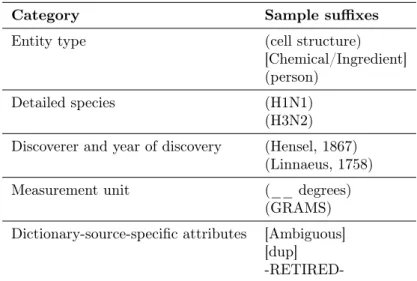
Appendix B – List of target nouns, custom semantic types, and seed phrases 119 Appendix C – Distribution of entity types in different corpora . . . 132
Appendix D – List of ambiguous entity names and candidates for the polit-ical domain . . . 142
1
Chapter 1
Introduction
1.1
Motivation
Biomedical information is discovered and disseminated at an extraordinary pace, and much of this dissemination is accomplished by publishing unstructured text, or free text. Two communities spreadhead this trend. The first community is the scientific community, who publish their research results in scientific literature. PubMed, the preeminent indexing service dedicated to the biomedical domain, contains to date over 26 million citations, and continues to grow at over 1 million new citations per year. The second community is the online community, who comprises experts and medical doctors, as well as patients and layman consumers. This community publishes a range of contents, from professional resources such as UpToDate.com that are written by experts for experts, to encyclopedic health portals such as Mayo Clinic and Medline Plus that are written by experts for patients, to online discussion forums in which only patients participate. Buried within these two universes of texts is a wealth of knowledge, but due to their sheer size and unstructured nature, automated methods are required to extract this knowledge.
The biomedical natural language processing (BioNLP) community employs text mining as a solution to automatically analyze the aforementioned texts. Text mining spans a range of information extraction (IE) tasks, from extracting proteprotein in-teractions, to drug-disease relations, to pharmacogenomics networks. Common to all these tasks, entity recognition and disambiguation (ERD) are the indispensable first steps in a text mining pipeline. Not only does the quality of downstream processes depend on the quality of entities extracted, these downstream analyses may not even begin without the entities as input. Besides fully automated text mining pipelines, there are also semi-automated ones such as indexing PubMed citations and curating knowledge bases, where entities are first automatically extracted to be manually se-lected and refined by experts. There is a large body of existing work addressing ERD; however, limitations exist.
Coverage in entity types. Biomedical text mining has to date focused heavily
on extracting information at the molecular level, such as information about proteins, genes, chemicals, drugs, their derivatives such as protein sequences and gene muta-tions, and their interactions such as protein pathways. This focus leads to two norms. First, existing ERD works target named entities, which are well cataloged in dictio-naries. Common nouns, long noun phrases, and in general entities not found in a
dictionary are largely neglected despite being ubiquitous in biomedical text. Second, the entity types addressed revolve around the few entity types corresponding to said proteins, genes, chemicals, and so on. Furthermore, the majority of existing ERD methods specialize in only one entity type. There is relatively little effort to develop methods that address all entity types simultaneously. The most prominent solution is MetaMap, the method implemented as a software tool that performs dictionary-based ERD. While it is the de facto standard tool for biomedical text mining, its limitations in processing speed and disambiguation power render it infeasible in PubMed-scale projects.
Coverage in text genres. Focusing on IE tasks at the molecular level naturally
in turn focuses the source texts to scientific literature, where the relevant information abounds. Consequently, the abstracts and full-length articles curated by PubMed have been the de facto standard corpus for biomedical text mining. The vast universe of Web contents mentioned above has been largely neglected. While much informa-tion is contained only in these non-scientific texts, they also contain fragments of text that stray away from a strictly biomedical focus. As soon as one mines texts beyond PubMed, it becomes mandatory to distinguish the non-biomedical content in order to disregard them. Since existing ERD methods are developed only with scientific liter-ature in mind, they implicitly assume that all the entities in text are of a biomedical nature, and do not address the presence of non-biomedical entities.
1.2
Problem Statement
In this thesis, we consider the problems of entity recognition and disambiguation for the biomedical domain. Entity recognition is the task of identifying, from un-structured text, mentions that refer to entities. Entity disambiguation is the task of selecting for these mentions the correct underlying entity from a pool of candidates. The proposed solutions should address the following requirements.
• The solution should go beyond single proper nouns for named entities and ad-dress compound noun phrases also.
• The solution should be applicable across all sub-domains of biomedicine. We intentionally depart from the norm of specializing in selected sub-domains, and opt to investigate sub-domain-agnostic approaches.
• The solution should be applicable to both scientific texts and Web content. Where the text contains non-biomedical entities, the solution should be able to distinguish them as such.
• The solution should be fast, so that it is feasible to apply it to large-scale corpora.
1.3
Challenges
In order to propose solutions addressing the above requirements, the following chal-lenges must be overcome.
3 1.3. Challenges
Diversity of entity names. Biomedical entity names are notoriously difficult to
recognize and disambiguate because they are often long with many variations; this applies to named entities and noun phrases alike. A comprehensive ERD method must also go beyond nouns and consider verbs, as verbs also provide crucial cues and can be leveraged as an entity also.
Incomplete dictionary. No dictionary can be 100% complete with all named
en-tities, and further cannot be expected to catalog biomedical noun phrases in all their myriad variations. UMLS (Unified Medical Language System), the largest metathe-saurus boasting 3.4 million entities sourced from 199 individual dictionaries (as of version 2016AB), still lacks entries such as meds the colloquial term for medicines, andarm the physical branch of a protein molecule.
Heterogeneous assortment of resources. The preeminent lexical resource for
biomedical text mining, UMLS, is actually a potpourri of many heterogeneous re-sources. Each of the 199 contributing dictionaries specializes on its sub-domain, with entities defined at different levels of granularity, and complete with dictionary-specific entity-entity relationships. Overarching this motley collection of entities is the UMLS semantic network, which is in itself three separate types of information: a set of 133 semantic types that form a taxonomy; 15 semantic groups that do not align with the taxonomy; and relationships between semantic types. Since each entity in UMLS is assigned at least one semantic type, any pair of entities can also be viewed through the lens of the semantic network, that is, orthogonal to the dictionary-specific rela-tionships. Additional resources such as the BioLexicon and the symptom terms in OMIM (Online Mendelian Inheritance of Man) further add to this tangled landscape. Putting all these together, judicious selection of resources that best suits the needs of a specific task is required.
Transcending sub-domains. Entities in each sub-domain has different
nomencla-tures. For instance, genes are often a mixture of English letters and numerical digits, while chemicals are often formulaic expressions involving chemical symbols. In order to go beyond sub-domains, we must also go beyond, for instance, the lexicographic features that apply only to one sub-domain. In other words, we must seek approaches that generalize to all sub-domains.
Transcending text genres. Different text genres have different language styles.
Scientific literature, especially abstracts, are terse with convoluted sentence struc-ture and specialized jargon. Web contents, on the other hand, have a more relaxed, everyday English style. In addition, biomedically themed Web contents are often “contaminated” with non-biomedical content. We must seek approaches that work for a range of language styles and can compensate for the presence of non-biomedical content.
Minimizing manual intervention. Manual intervention, such as labeling data
samples and selecting seed data, is expensive. Where a method cannot be completely automated, we aim to at least minimize the manual intervention needed.
Maintaining quality while being fast. Processing speed and output quality are
goals at odds with each other; higher speed is achieved by sacrificing quality, and vice versa. As mentioned, high quality entities are crucial for text mining. Therefore, in the pursuit of fast processing speed, we need to at least maintain quality comparable to a more sophisticated but slower method. Specifically for ERD tasks, that translates to maintaining good precision and good recall while achieving high throughput at PubMed-scale.
1.4
Contributions
A common theme of the various methods devised in this thesis is going beyond con-ventional specializations on corpora and sub-domains. Another theme is that each method leverages knowledge in UMLS according its respective goal. Specifically, we make the following contributions.
Fast entity recognition. To address the lack of entity recognition software tool
that can process texts fast enough to handle PubMed-scale corpora, we devise and implement a dictionary lookup method that uses UMLS as the underlying dictionary. The method also uses Locality Sensitive Hashing with MinHash to quickly estimate string similarity between text mentions and dictionary entries. When compared to MetaMap, this method achieves comparable precision at a throughput that is two orders of magnitude faster, though at the expense of losing 13% in entity coverage. The speedup is the critical improvement that makes other large-scale text mining projects possible, namely, KnowLife (knowledge base construction) [41] and DeepLife (search and analytics application for up-to-date health information) [40]. The result-ing implementation has been released as open source software.
Semantic type classification of common words. As an effort towards
disam-biguating long and complex noun phrases, we propose to disambiguate the semantic types of common nouns found in such phrases. We develop fine-grained, custom se-mantic types that encompass biomedical and non-biomedical types, as well as the non-informative type that denotes nouns used only in a generic way without carrying critical information. Using label propagation, a semi-supervised graph-based method, we demonstrate that only a small percentage of labeled seed nodes suffices to suc-cessfully label the rest of the nodes, hence minimizing manual effort in identifying seeds. The node-node relatedness in the graph reflects the similarity between the corresponding noun phrases, which is in turn derived by leveraging UMLS semantic types. To the best of our knowledge, this contribution is the first work in BioNLP that addresses general-domain content mingled in a biomedical-themed document.
Fast entity disambiguation in topically annotated texts. We devise an
au-tomatic and light-weight entity disambiguation method that exploits two key char-acteristics of biomedical resources: the indexing terms, or MeSH (Medical Subject Headings) terms, assigned by experts in all PubMed citations, and the lexical rich-ness as well as heterogeneity of UMLS. Using two heuristics, the method first identifies
5 1.5. Publications anchors, or non-ambiguous text mentions. Then using the anchors and five further heuristics based on linguistic cues, co-occurrence statistics, and prior distributions of entities estimated from UMLS, the method disambiguates the remaining mentions. When compared to MetaMap’s disambiguation module, our method is up to 11% more accurate at a throughput one order of magnitude faster. Not only is this method par-ticularly amenable to PubMed the de facto corpus, it is also sub-domain-agnostic. The implementation of the method has also been released as open source software.
Corpus-driven entity discovery and disambiguation. We address the
incom-pleteness of dictionary by first performing entity discovery in a corpus-driven ap-proach. Using dimensionality reduction, we model a corpus of text snippets all con-taining an ambiguous entity name as a low-dimension latent topic space. Each latent topic corresponds to an entity expressed in the corpus; in other words, each entity has a latent description. Such a latent entity can either be mapped to an entity in the dictionary, thereby achieving entity disambiguation, or can be declared out of knowledge base (OOKB). To the best of our knowledge, this work is the first in the biomedical domain to cater for OOKB entities by representing them via their latent descriptions. We further demonstrate the generalizability of the method via experiments in the politics domain.
1.5
Publications
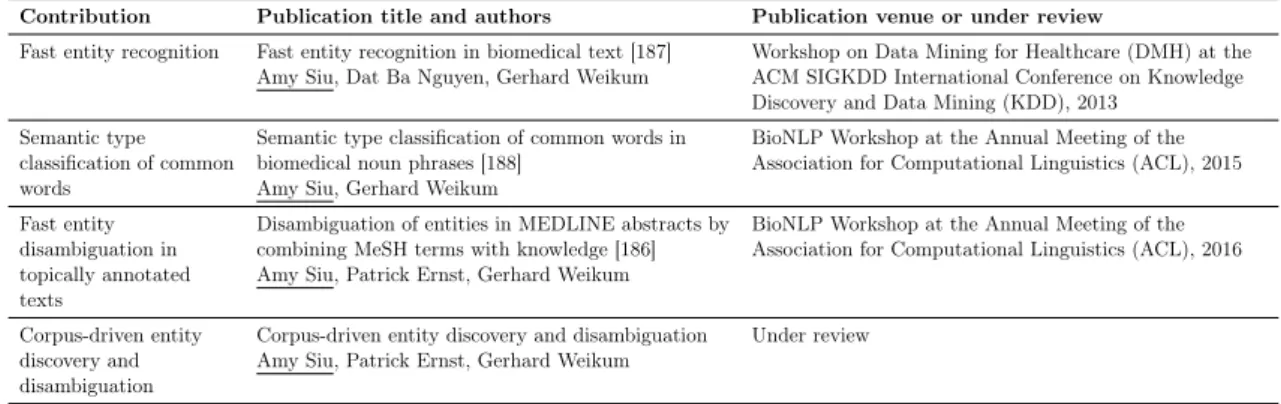
Parts of this thesis have been published or are in the process of attaining publication. We list here the relationships between the contributions and their publications:
Contribution Publication title and authors Publication venue or under review
Fast entity recognition Fast entity recognition in biomedical text [187]
Amy Siu, Dat Ba Nguyen, Gerhard Weikum Workshop on Data Mining for Healthcare (DMH) at theACM SIGKDD International Conference on Knowledge Discovery and Data Mining (KDD), 2013
Semantic type classification of common words
Semantic type classification of common words in biomedical noun phrases [188]
Amy Siu, Gerhard Weikum
BioNLP Workshop at the Annual Meeting of the Association for Computational Linguistics (ACL), 2015 Fast entity
disambiguation in topically annotated texts
Disambiguation of entities in MEDLINE abstracts by combining MeSH terms with knowledge [186] Amy Siu, Patrick Ernst, Gerhard Weikum
BioNLP Workshop at the Annual Meeting of the Association for Computational Linguistics (ACL), 2016
Corpus-driven entity discovery and disambiguation
Corpus-driven entity discovery and disambiguation
Amy Siu, Patrick Ernst, Gerhard Weikum Under review
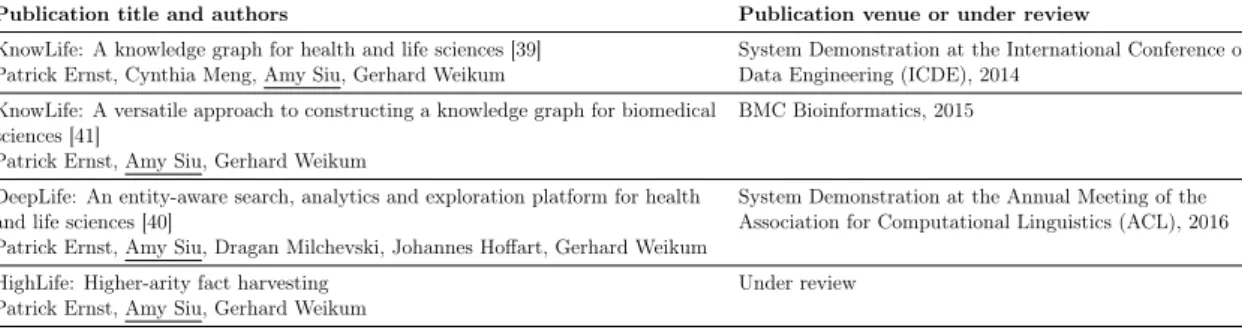
Table 1.1: Publications directly resulting from contributions in this thesis Methods developed in this thesis have also contributed to further publications, for which the author of this thesis is a co-author:
Publication title and authors Publication venue or under review
KnowLife: A knowledge graph for health and life sciences [39]
Patrick Ernst, Cynthia Meng, Amy Siu, Gerhard Weikum System Demonstration at the International Conference onData Engineering (ICDE), 2014 KnowLife: A versatile approach to constructing a knowledge graph for biomedical
sciences [41]
Patrick Ernst, Amy Siu, Gerhard Weikum
BMC Bioinformatics, 2015
DeepLife: An entity-aware search, analytics and exploration platform for health and life sciences [40]
Patrick Ernst, Amy Siu, Dragan Milchevski, Johannes Hoffart, Gerhard Weikum
System Demonstration at the Annual Meeting of the Association for Computational Linguistics (ACL), 2016 HighLife: Higher-arity fact harvesting
Patrick Ernst, Amy Siu, Gerhard Weikum Under review
Table 1.2: Publications using methods devised in this thesis Finally, we also list here other prior publications of the author of this thesis:
Publication title and authors Publication venue
eFIP: A tool for mining functional impact of phosphorylation from literature [4] Cecilia N. Arighi, Amy Siu, Catalina O. Tudor, Jules A. Nchoutmboube, Cathy H. Wu, Vijay K. Shanker
Book chapter in Methods in Molecular Biology – Bioinformatics for Comparative Proteomics, 2011 Knowledge discovery on incompatibility of medical concepts [57]
Adam Grycner, Patrick Ernst, Amy Siu, Gerhard Weikum International Conference on Intelligent Text Processingand Computational Linguistics (CICLing), 2013 Findings of the WMT 2017 biomedical translation shared task [85]
Antonio Jimeno Yepes, Aurélie Névéol, Mariana Neves, Karin Verspoor, Ondřej Bojar, Arthur Boyer, Cristian Grozea, Barry Haddow, Madeleine Kittner, Yvonne Lichtblau, Pavel Pecina, Roland Roller, Rudolf Rosa, Amy Siu, Philippe Thomas, Saskia Trescher
Conference on Machine Translation (WMT) at the Conference on Empirical Methods in Natural Language Processing (EMNLP), 2017
Table 1.3: Prior publications of the author of this thesis
1.6
Thesis Outline
The remainder of this thesis elaborates on the aforementioned contributions. In Chap-ter 2, we begin by visiting background concepts, preliminaries, and characChap-teristics of the biomedical texts that lead to challenges specific to the domain. Chapter 3 presents the state of the art in both the general and biomedical domains. The next four chapters each presents one contribution: Chapter 4 presents the dictionary-lookup method for entity recognition; Chapter 5 presents the classification of semantic types in long and complex noun phrases; Chapter 6 presents the disambiguation of entities in PubMed abstracts via heuristics; and Chapter 7 presents the discovery as well as disambiguation of entities using a corpus-driven approach. Finally, in Chapter 8 we summarize all contributions presented in this thesis and give an outlook on future directions.
7
Chapter 2
Background
2.1
Domain and Sub-Domain
Domain. Adomain, according to the Oxford English Dictionary and the Merriam-Webster Dictionary, is “a sphere of knowledge.” In terms of research, a domain is often the topic of a research community. Biomedicine, computer science, linguistics, politics, and psychology are all example domains.
Sub-domain. Just as a research community has a subset of researchers focusing
on a narrower topic within the larger, overarching topic, so a domain also has sub-domains. Within the biomedicine domain, in particular, are the sub-domains of bio-chemistry, diseases (of animals, humans, and plants), drugs, genetics, molecular bi-ology, cell bibi-ology, systems bibi-ology, and more. In biomedical literature, sub-domains are also referred to as disciplines, fields, and specialties [28].
General domain. The termgeneral domain describes when no particular domain
is in focus.
Using Wikipedia1 as an example, it is an encyclopedia in the general domain since it does not focus on any particular domain. The portals therein, however, such as the Biology, Medicine, Linguistics, Political Science, and Psychology Portals, corre-spond to domains. Some portals such as the Alternative Medicine Portal and the Dentistry Portals correspond to sub-domains as they are even more specialized than the Medicine Portal.
2.2
Repositories of Knowledge
Knowledge, be it in the general or biomedical domain, can be stored in different kinds of repositories.
Knowledge base. A knowledge base (KB) stores knowledge in some structured
manner. A common structure is the triple, where a subject–predicate–object con-struct represents a binary relation between two entities. Major knowledge bases in
1
the general domain such as DBpedia [104], Freebase [16] (now discontinued), Wikidata [216], and YAGO [199], as well UMLS (United Medical Language System) [15], the largest and most authoritative knowledge base in the biomedical domain, all follow this triple format.
Ontology. Anontology mandates a formal delineation between concepts as classes, and objects as instances of classes. Besides relations, additional formal constructs such as attributes, axioms, and rules enable logical reasoning to be performed upon the classes and objects [58].
Taxonomy. Ataxonomy aims at arranging entities in categories in a tree-like man-ner, such that each category is subsumed by a more general category. Another way to characterize this subsumption is the is-A relation; for instance, lung cancer is a kind of cancer, which in turn is a kind of disease.
Dictionary. A dictionary, also called controlled vocabulary [27] and terminology [55], aims at exhaustively collecting all the words and names used in a domain or sub-domain.
The precise characterization of various kinds of knowledge repositories is a matter of ongoing discussion [55, 58]. What is certain, however, is that knowledge resources in the biomedical domain often exhibit characteristics of multiple kinds of repositories. OMIM (Online Mendelian Inheritance of Man) [63] is a typical example: Primarily, it is a repository of human genetic disorders and the relevant genetic information. However, the detailed catalog of disease symptoms have often been leveraged as a dictionary [31, 137]. Similarly, while MeSH (Medical Subject Headings)2 is primarily a taxonomy and the NCI (National Cancer Institute) Thesaurus [185] a dictionary, they have been leveraged beyond their categories [35, 137] and dictionary entries [49], respectively.
Many sub-domains have their own ontologies, such as the Foundational Model of Anatomy [168], the Human Disease Ontology [174], the Drosophila Phenotype Ontology [142], among many others. The OBO Foundry3provides an online, one-stop service to search or browse the ontologies individually. Many of these ontologies as well as other knowledge resources – altogether 199 of them in the 2016 version – have been combined by human experts to produce UMLS, the authoritative metathesaurus for the biomedical domain. The major biomedical repositories have been surveyed and their contents compared by [76].
2.3
Entity Discovery, Recognition, and Disambiguation
Entity discovery. The task of determining whether a entity expressed in some text
is not yet registered in some KB is entity discovery. Such “newly discovered” entities are often new from a temporal point of view, such as emerging entities, but that is
2
www.nlm.nih.gov/mesh
3
9 2.3. Entity Discovery, Recognition, and Disambiguation not the default case. Other entities may be absent from a KB because the entities belong to the “long tail” and therefore are neglected or even intentionally omitted.
Entity recognition. Given a piece of text, the words that express an occurrence
of an entity is a text mention. Entity recognition, also known as entity tagging, is the task of identifying text mentions. Notice that entity recognition does not require a KB, though leveraging one for dictionary lookup is a common approach.
Entity disambiguation. A text mention isambiguous when it may refer to multi-ple candidate entities; for instance, “FISH” may refer to the gene, the animal, or the laboratory technique called Fluorescence in situ Hybridization. The task of selecting the correct entity from multiple candidates is then entity disambiguation. Given a text mention, the candidates are often selected from a KB, for example based on high string similarity to entity names. In this case, the selected candidate is the canonical entity; the task is further known as entity linking, entity normalization, and entity resolution, to emphasize the making of a connection between the text mention and the canonical entity. When the KB (such as UMLS) contains further information about the entity (such as entity type and entity definition), reaching the canonical entity means attaining this extra information.
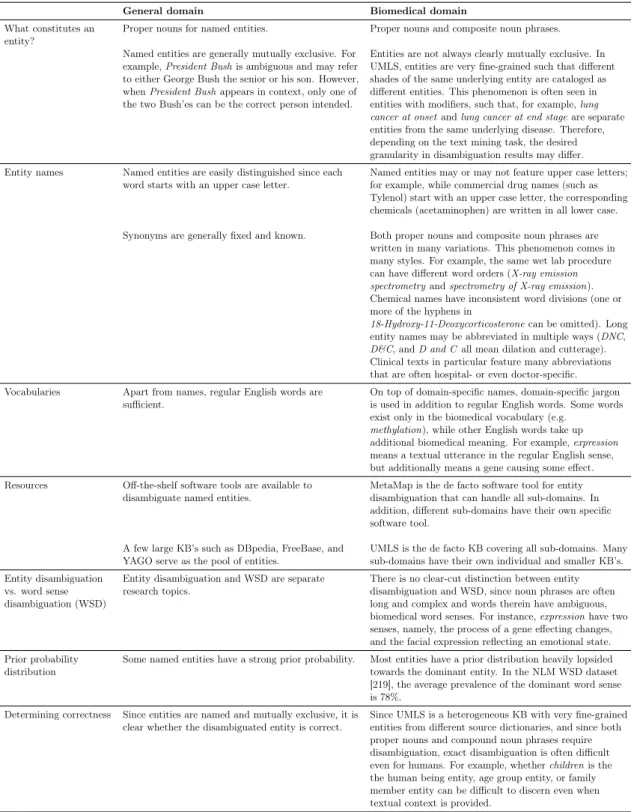
The inherent differences in texts in the general and biomedical domains lead to many differences in their handling of entities. Table 2.1 below compares these differ-ences.
General domain Biomedical domain
What constitutes an
entity? Proper nouns for named entities. Proper nouns and composite noun phrases. Named entities are generally mutually exclusive. For
example,President Bushis ambiguous and may refer
to either George Bush the senior or his son. However, whenPresident Bushappears in context, only one of
the two Bush’es can be the correct person intended.
Entities are not always clearly mutually exclusive. In UMLS, entities are very fine-grained such that different shades of the same underlying entity are cataloged as different entities. This phenomenon is often seen in entities with modifiers, such that, for example,lung cancer at onsetandlung cancer at end stageare separate entities from the same underlying disease. Therefore, depending on the text mining task, the desired granularity in disambiguation results may differ. Entity names Named entities are easily distinguished since each
word starts with an upper case letter. Named entities may or may not feature upper case letters;for example, while commercial drug names (such as Tylenol) start with an upper case letter, the corresponding chemicals (acetaminophen) are written in all lower case. Synonyms are generally fixed and known. Both proper nouns and composite noun phrases are
written in many variations. This phenomenon comes in many styles. For example, the same wet lab procedure can have different word orders (X-ray emission spectrometryandspectrometry of X-ray emission).
Chemical names have inconsistent word divisions (one or more of the hyphens in
18-Hydroxy-11-Deoxycorticosteronecan be omitted). Long entity names may be abbreviated in multiple ways (DNC, D&C, andD and Call mean dilation and cutterage).
Clinical texts in particular feature many abbreviations that are often hospital- or even doctor-specific. Vocabularies Apart from names, regular English words are
sufficient. On top of domain-specific names, domain-specific jargonis used in addition to regular English words. Some words exist only in the biomedical vocabulary (e.g.
methylation), while other English words take up
additional biomedical meaning. For example,expression
means a textual utterance in the regular English sense, but additionally means a gene causing some effect. Resources Off-the-shelf software tools are available to
disambiguate named entities. MetaMap is the de facto software tool for entitydisambiguation that can handle all sub-domains. In addition, different sub-domains have their own specific software tool.
A few large KB’s such as DBpedia, FreeBase, and
YAGO serve as the pool of entities. UMLS is the de facto KB covering all sub-domains. Manysub-domains have their own individual and smaller KB’s. Entity disambiguation
vs. word sense disambiguation (WSD)
Entity disambiguation and WSD are separate
research topics. There is no clear-cut distinction between entitydisambiguation and WSD, since noun phrases are often long and complex and words therein have ambiguous, biomedical word senses. For instance,expressionhave two senses, namely, the process of a gene effecting changes, and the facial expression reflecting an emotional state. Prior probability
distribution Some named entities have a strong prior probability. Most entities have a prior distribution heavily lopsidedtowards the dominant entity. In the NLM WSD dataset [219], the average prevalence of the dominant word sense is 78%.
Determining correctness Since entities are named and mutually exclusive, it is
clear whether the disambiguated entity is correct. Since UMLS is a heterogeneous KB with very fine-grainedentities from different source dictionaries, and since both proper nouns and compound noun phrases require disambiguation, exact disambiguation is often difficult even for humans. For example, whetherchildrenis the the human being entity, age group entity, or family member entity can be difficult to discern even when textual context is provided.
11 2.4. Text Mining
2.4
Text Mining
Text mining refers to a broad range of information extraction tasks, such as text categorization, sentiment analysis, linguistic trends analysis, entity extraction, and relation extraction. In the biomedical domain, text mining concentrates on relation extraction, where the relations are itself a broad range, such as protein-protein interac-tions, gene-disease correlainterac-tions, drug-adverse-effect relainterac-tions, and pharmacogenomics (i.e. gene-drug-response relations). Regardless of the kind of relations, biomedical text mining tasks share one common processing mode, namely, the processing of a large amount of input text in a pipeline fashion. Modules in a pipeline depends on the exact IE task, though most pipelines adopt the following order: segmenting the text into sentences, performing syntactic analyses such as part-of-speech and depen-dency parsing, recognizing and disambiguating entities, ending with analysis modules such as incorporating KB knowledge and reasoning that produce the final, desired information.
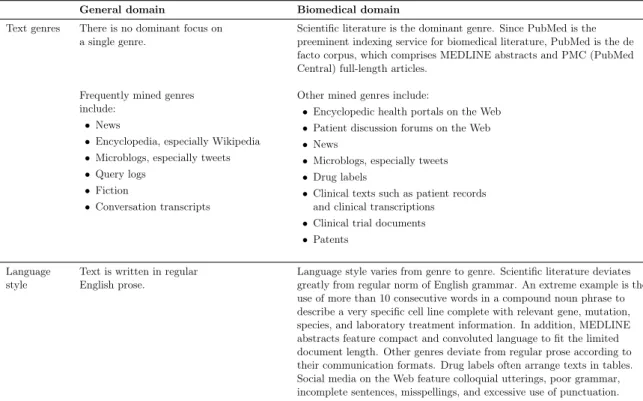
There are again differences between text mining in the general and biomedical domains. Table 2.2 below compares these differences.
General domain Biomedical domain
Text genres There is no dominant focus on
a single genre. Scientific literature is the dominant genre. Since PubMed is thepreeminent indexing service for biomedical literature, PubMed is the de facto corpus, which comprises MEDLINE abstracts and PMC (PubMed Central) full-length articles.
Frequently mined genres include:
• News
• Encyclopedia, especially Wikipedia • Microblogs, especially tweets • Query logs
• Fiction
• Conversation transcripts
Other mined genres include:
• Encyclopedic health portals on the Web • Patient discussion forums on the Web • News
• Microblogs, especially tweets • Drug labels
• Clinical texts such as patient records and clinical transcriptions
• Clinical trial documents • Patents
Language
style Text is written in regularEnglish prose. Language style varies from genre to genre. Scientific literature deviatesgreatly from regular norm of English grammar. An extreme example is the use of more than 10 consecutive words in a compound noun phrase to describe a very specific cell line complete with relevant gene, mutation, species, and laboratory treatment information. In addition, MEDLINE abstracts feature compact and convoluted language to fit the limited document length. Other genres deviate from regular prose according to their communication formats. Drug labels often arrange texts in tables. Social media on the Web feature colloquial utterings, poor grammar, incomplete sentences, misspellings, and excessive use of punctuation.
Table 2.2: Comparisons regarding text mining between the general and biomedical domains
2.5
Natural Language Processing Preliminaries
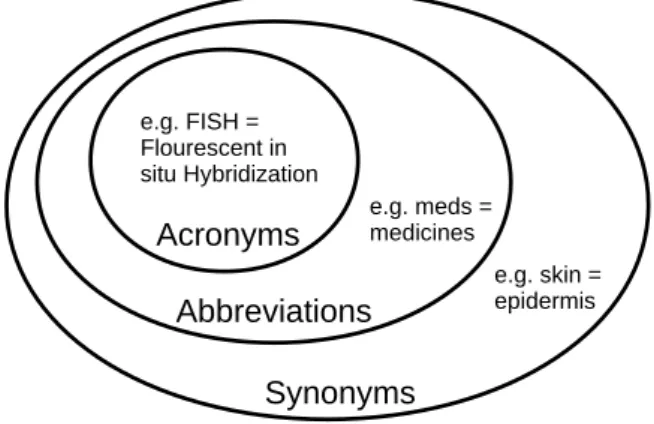
Synonym, abbreviation, and acronym. Figure 2.1 depicts the relationship
be-tween synonyms, abbreviations, and acronyms, which are different ways to describe identical items. e.g. FISH = Flourescent in situ Hybridization Synonyms Abbreviations
Acronyms e.g. meds =medicines
e.g. skin = epidermis
Figure 2.1: The relationships between synonym, abbreviation, and acronym. Two textual expressions aresynonyms if they refer to the same item, be it abstract or physical. For instance, skin and epidermis are synonyms.
Some synonyms are abbreviations, where a longer word or phrase is shortened. Abbreviations are typically noun phrases and entity names. For instance,meds is the abbreviation ofmedicines.
Some abbreviations areacronymswhere, in a multi-word expression, the first letters in each word are singled out and taped together. For instance,FISH is the acronym ofFluorescent in situ Hybridization.
Hypernym and hyponym. Figure 2.2 depicts the relationship between hypernyms
and hyponyms, which are hierarchical relations.
is a Hypernym e.g. cancer
Hyponym e.g. lung cancer
Figure 2.2: The relationships between hypernym and hyponym.
13 2.5. Natural Language Processing Preliminaries cancer is the hypernym of lung cancer; equivalently. lung cancer is the hyponym of cancer.
Part-of-speech and dependency. Figure 2.3 shows the grammatical analysis of
a sample sentence, computed by the Stanford CoreNLP tool4 [116], the standard as well as state-of-the-art tool.
Figure 2.3: POS tags and dependencies of a sample sentence.
Each word in a sentence can be assigned a part-of-speech (POS) tag, which de-scribes the word’s syntactic function. Noun, pronoun, verb, adjective, adverb, and preposition are the main parts-of-speech. In the sample sentence, POS tags are the colored boxes above each word.
From a syntactic point of view, words within a sentence relate to each other in predefined relations calleddependencies. In the sample sample sentence, dependencies are marked with arrows; for instance,headache depends onrelief with a “compound” dependency. Dependencies are directed from one word to another, forming a tree. Dependency parsing is the process of determining such a dependency tree, and having first determined the POS tags is a prerequisite.
Morphology. The same underlying word in the English language can be spelled in
different ways. Morphology describes how a root word (e.g. the verb inject in the infinitive form) should be modified in its various grammatical forms (injected as past tense andinjecting as the gerund form). Modification can also be applied to a noun (e.g. organization) to obtain its adjective form (organizational). This modification process is called inflection and, in the case of verbs, it is specifically called conjugation.
Lemmatization. The lemma of a word is its prefix letters such that various forms
all share that prefix. For instance, the lemma of writes and written is writ. As demonstrated by this example, lemmas are often themselves incomplete words.
Orthography. Orthography is the convention of using spelling, hyphenation,
cap-italization, word breaks, emphasis, and punctuation. For instance, Non-Hodgkin’s Lymphoma and non Hodgkin lymphoma are the same disease written orthographi-cally differently. Therefore one common strategy in unifying such differences is by transforming all letters to lower case and replacing non-letters with spaces. On the other hand, such differences are exactly the cues for recognizing certain entity types such as gene names. The combination of upper letters, digits, slashes, and italics (e.g. EGFR/HER1) is a strong indicator for gene name.
4
15
Chapter 3
State of the Art
Entity recognition and disambiguation are research problems in both the general and the biomedical domains. However, domain-specific characteristics of biomedical text lead to additional challenges, such that solutions in the general domain, if applicable at all, must be adjusted to address those challenges. In this chapter, we present the state of the art first in the general domain and then in the biomedical domain. Table 3.1 below provides an overview of this chapter.
General domain Biomedical domain
Entity recognition
Well studied for named entities. Well studied for named entities in sub-domains.
Noun phrases are also entities but under-explored.
Entity typing Well studied for coarse-grained types (person, organization, geographic location, and miscellaneous).
There are fewer methods for fine-grained types based on KB categories.
Entity typing is integrated into entity recognition.
Explicit typing methods are scarce.
Entity
disambiguation
Well studied for named entities. Well studied for selected individual sub-domains. There are few methods that address all sub-domains. Entity-centric
competitions
The few events are auxiliary to the research community.
Plentiful events are core to the research community, as well as trailblazer of research directions.
3.1
General Domain
3.1.1 Entity Recognition
Entities of interest in the general domain are named entities. Works in named en-tity recognition (NER) go as far back as the late 1990’s [32], and progressed through the next decade as language-independent shared tasks at the CoNLL (Computational Natural Language Learning) conference [205, 206]. The bulk of proposed methods em-ploy machine learning to assign, for each word in a passage, one of three labels – B to indicate the beginning of a named entity, I for “inside” or the continuation of a named entity, and O for “outside” of the named entity. Features for the machine learning include word-level ones (such as part-of-speech tags, orthographic patterns, lexical in-formation, and previous word) as well as document-level ones (such as gazetteers and document meta-information). Yet still later, as social media became a genre avail-able for text mining, there has been efforts [165, 198] to refine existing approaches to address the corresponding language style. Overall, this line of research recognizes entities and simultaneously classifies them into 4 types: persons, organizations, geo-graphical locations, and miscellaneous [155]. The Stanford CoreNLP toolkit [116] has emerged as the de facto method as well as software tool that is currently the state of the art.
3.1.2 Entity Typing
Four coarse types. As alluded to above, the task of entity recognition already
implicitly determines 4 coarse entity types (persons, organizations, geographical lo-cations, and miscellaneous).
Fine-grained types. Other existing works explicitly determine fine-grained types,
also often using entity recognition as a means of achieving that aim. From as few as 9 [164] to as many as 500 [234] types, various start-of-the-art methods address different levels of granularity.
FIGER [113] augments the 4 entity types by expanding each of them to more than a dozen types. It further introduces other types related to products, arts, and events to reach a total of 112 fine-grained types. In comparison, PEARL [133] and ClusType [164] use types that are more and less fine-grained, respectively. These two systems share two common themes in their methodologies. First, they both leverage relational phrases to infer the types of the entities involved in those relations. Second, they are both data-driven. By using efficient algorithms (integer linear programming for PEARL, and label propagation plus clustering for ClusType), both systems can process large amounts of data so that the system can accumulate a critical mass of information to draw meaningful conclusions.
Hierarchical types. Entity types do not need to be mutually exclusive. In
par-ticular, when they are arranged in a hierarchy of categories, an entity belonging to a more fine-grained sub-type (for instance, fruit) also belongs to the more coarse-grained super-type (food) simultaneously. Such is the premise for Rahman and Ng’s
17 3.1. General Domain method [153] and HYENA [234]. The former system arranges 92 sub-types in 29 super-types in a two-tier manner. The latter system goes as far as using 5 trees of 100 sub-types each, such that a tree can be up to 9 tiers deep. While both systems perform multi-label classification, the underlying algorithms employed are disparate. Rahman and Ng’s method constructs factor graphs and performs inference, while HYENA formulates the problem as a Support Vector Machine (SVM) instance. In-terestingly, despite the different choices of algorithm, the feature sets have much in common. Most notably, they include unigrams in the text mention, grammatical features such as part-of-speech and nearest verbs, as well as gazetteers.
3.1.3 Entity Disambiguation
Classic three-pronged approaches. There is a large body of prior works [112,
181] for named entity disambiguation (NED). State-of-the-art methods include AIDA [70], Babelfy [127], Spotlight [123], TagMe [46], and Wikifier [156]. All of these meth-ods draw upon three types of ingredients, as summarized by [109]. First, popularity or prior probability or an entity assumes that the most prominent candidate is the most likely underlying entity. Such a choice can be described as an educated guess that does not require any further information from the text mention or the document in which it occurs. The second ingredient, context similarity, takes the document into account. It stipulates that similarity between the document containing the text mention and a definitional document that describes the candidate (for example, the candidate’s Wikipedia article) must be high. The third ingredient, coherence, lever-ages further text mentions in the same document to stipulate that their underlying entities should all be related to the same topic. This is typically achieved by leverag-ing a KB, such that given a candidate, its categories, keywords, and related entities can be used to compare topic similarity.
Most of these state-of-the-art methods are also available as software tools. From a user’s point of view, they offer a range of choices, where one can “shop around” for the most suitable tool or combine results of multiple tools.
Approach based on word embeddings. Another recent method [230] deviates
from the above three-thronged approach, and opts for extending the popular skip-gram word embeddings to jointly model word-word, word-entity, and entity-entity similarities. A knowledge base (Wikipedia in this case) is still the backbone of the model, where link statistics are used to model the latter two similarities involving entities.
Joint NER and NED. Although NER and NED are separate tasks, each can
provide cues for the other. Jointly performing entity recognition and disambiguation in a combined manner can therefore enhance the performances of both tasks. Such a joint approach is investigated in three methods, namely NEREL [183], a method by Durrett and Klein [37], and J-NERD [140]. While the NEREL uses a re-ranking model based on relations, Point-wise Mutual Information (PMI), and co-occurrence information extracted from Freebase and Wikipedia, the latter two methods both converge on using Conditional Random Field (CRF). Specifically, in the method by
Durrett and Klein, a classic linear chain CRF is enhanced with 3 more types of edges to model relationships introduced by NER, coreference resolution, and NED. On the other hand, J-NERD constructs a CRF to reflect the dependency parse tree of a sentence, and adds extra edges to model coreferences across sentences.
3.1.4 Competitions
In contrast to the biomedical domain, entity-related competitions are fewer and are less prominent in the general domain. The CoNLL shared tasks take place yearly covering a wide range of topics, though only the two aforementioned ones concern named entities. Another yearly-recurring event is the Text Analysis Conference – Knowledge Base Population (TAC KBP)1, which offers the Entity Discovery and Linking (EDL) track. Apart from that, there are only one-off events such as the Cross-Device Entity Linking Challenge2 at the 2016 Conference on Information and Knowledge Management (CIKM), and even smaller events targeting languages such as Chinese [44], Dutch3, and German [11].
3.2
Biomedical Domain
The big picture of text mining in the biomedical domain has been comprehensively presented in surveys such as [71, 54, 167, 184, 241]. Under the umbrella of text mining is a range of tasks. We focus here on the entity-centric tasks.
3.2.1 Entity Recognition
Applicable to a Single Sub-domain
NED methods that target only a single sub-domain are the bulk of NED efforts in the community. Not only are there many methods proposed, the variety of sub-domains is also wide. Here we present a selection of the dominant sub-domains.
Genes and proteins. The two most prominent sub-domains are undoubtedly genes
and proteins, which are often tackled simultaneously since, conventionally, a gene and its protein product bear the same name. Among the many methods developed, BAN-NER [100] is a prominent one based on CRF using orthographic and morphological features, and shallow syntax features. A recent work by Sheikhshab et al. [179] also uses CRF, but further combines it with techniques borrowed from graph-based label propagation to model prior knowledge. Recognizing gene names in patents [59] is another recent development that to date is an under-studied area.
Derivatives of gene and protein. These entities have a nomenclature different
enough from regular genes and proteins that they require tailored methods to be rec-ognized. In addition to genes, GNormPlus [222] also recognizes protein domains. For
1 tac.nist.gov/tracks 2 competitions.codalab.org/competitions/11171 3 wordpress.let.vupr.nl/clin26/shared-task
19 3.2. Biomedical Domain gene mutations, tmVar [220] uses extensive word shape features to harness this nomen-clature and train a CRF, followed by applying regular expressions as post-processing to both pick up mentions missed by the CRF and filter out false positives. SETH [203] instead harnesses nomenclature grammar guidelines and regular expressions to pick up the mentions.
Chemicals. Being entities at the molecular level interacting with genes and
pro-teins, chemicals is another prominent sub-domain. The most popular underlying algorithm is CRF by far, as features such as word stem, prefix, suffix, word shape, and the use of Greek letters and Roman numbers are amenable to analyzing a chain of word tokens. Works such as the method by Grego et al. [56], ChemSpot [166], CheNER [212], and tmChem [103] all follow this line of methodology. Patents, as an under-studied text genre, are especially important for the pharmaceutical indus-try. Habibi et al. [60] investigate the efficacy of two of these tools (ChemSpot and tmChem) originally designed for regular biomedical text on this genre.
Drugs. Drug names have much overlap with chemicals, but they also have many
standardized names curated in dictionaries such as the DrugBank [228]. Therefore Korkontzelos et al. [96] develop an ensemble system that aggregates results from individual NER methods that leverage a dictionary, word token-level features taken from chemical NER, regular expressions, as well as statistics gleaned from existing gold standard corpora. They report that results aggregated by a maximum entropy model generally outperform those by a perceptron classifier.
Cell lines. In order to evaluate the performance of existing methods against a new
corpus, Kaewphan et al. [87] specifically include entities related to synthetic, lethal genes that appear in cancer literature. They also include a novel method based on CRF, and investigate the impact of dictionary and background corpus used in training the CRF.
Species. A closely related sub-domain to cell lines is species. However, unlike cell
line names, species names are relatively few and well cataloged in dictionaries. There-fore systems such as LINNAEUS [51] and SF4GN [221] adopt a dictionary lookup approach.
Anatomical parts. Anatomical entities have been well established and cataloged
in dictionaries. Moreover, their textual expressions have limited variations. Anato-myTagger [151] thus uses two dictionaries as the primary features for a CRF model, namely the species-independent Common Anatomy Reference Ontology (CARO) [61], and the human-centric Foundational Model of Anatomy (FMA) [168].
Diseases. Named entities such as Down’s Syndrome and Alzheimer’s Disease are
well cataloged in dictionaries. On the other hand, unnamed noun phrases such as inherited male breast metastatic cancer are also abundant. Although their exact expressions vary greatly, part of the phrases are often cataloged in dictionaries as well.
Despite these observations, Sahu and Anand [171] take a decidedly different approach and investigate the feasibility of avoiding sub-domain-specific features. Their work investigates instead the contributions of character- and word-level embeddings to multiple types of neural networks.
Phenotypes. A phenotype is an organism’s observable trait under the influence
of the organism’s genes and its environment. Like diseases, phenotypes encompass both named entities (for example Crouzon syndrome) and composite noun phrases (abnormality of head and neck). Therefore despite the existence of dictionaries such as the Human Phenotype Ontology [94], the ultimate goal of recent works is the construction of new dictionaries [2, 31] or expansion of existing ones [93], for which recognizing phenotypes in text is a means to achieving that goal.
Symptoms. Symptoms are closely related to phenotypes, since a symptom is a
par-ticular bodily trait that surfaces due to a disease or some environmental disturbance. There are relatively few existing works that focus on recognizing symptom entities. As a step towards fully recognizing text mentions of symptoms, Sondhi et al. [190] propose to identify whole sentences that contain symptom descriptions using word-and sentence-level features in separate CRF word-and SVM approaches. The recent intro-duction of the Micromed corpus [82] will be useful for future symptom recognition works since it provides annotations of symptom text mentions in tweets.
Applicable to Multiple Specific Sub-domains
Common sub-domain combinations. The set of sub-domains targeted by one
single NED method is often influenced by gold standards, which in turn reflects the focus of the research community at the molecular level. One popular corpus is the GENIA corpus [90], which contains text mentions annotated with 6 entity types: proteins, DNA”s, RNA”s, chemicals, cells, and cell lines. Another popular corpus is the CRAFT corpus [215], which contains text mentions annotated with entities from 7 ontologies about proteins, genes, chemicals, cells, and taxonomy. Proteins, chemicals, and cells are therefore a staple combination.
Funk et al. [48] compare two such methods, the ConceptMapper [201] and the NCBO Annotator [178], against the CRAFT corpus. Another two prominent systems are ABNER [177] and Gimli [20], both of which use CRF to recognize the 6 GENIA entity types. A survey by Neves and Leser [139] examines further annotation methods that target the same line of entity types.
Since PubMed abstracts are the standard corpus, and the sub-domains of interest are commonly shared amongst the research community, the team in the University of Turku has taken the initiative to provide a public service to the rest of the community [62]. They have applied NERsuite4 to the entire PubMed corpus and made the results publicly available. NERsuite is a tool built upon a fast CRF implementation called CRFsuite5 and, in this case, CRF models specifically trained for the few selected biomedical sub-domains are plugged into the tool.
4
nersuite.nlplab.org
5
21 3.2. Biomedical Domain
Ensemble Web service. Very recently (in 2016), the National Library of Medicine
(NLM) constructed a Web service [224] that combines 5 existing state-of-the-art NED methods targeting separate sub-domains. These individual methods have already been mentioned above (DNorm, GNormPLus, SF4GN, tmChem, tmVar). As a result, it is a one-stop Web-based tool that caters for the usual molecular-centric entity types (chemicals, genes, gene mutations, proteins) as well as diseases and species.
The BeCalm initiative. The “next big thing” may be the BeCalm online tool6
which, at the time of writing this thesis, is in the initial stage of the project. BeCalm TIP (Technical Interoperability and Performance of annotation servers) is a task for recognizing chemicals, genes, and proteins in the upcoming BioCreative 5 competition. Task participants place their NED implementation into a Web server, and different implementations will be compared against the same gold standard. The vision is that future users can request NED results from one or more implementations.
Applicable to All Sub-domains
MetaMap. There is no question that MetaMap [5, 6] is the de facto software tool
for the last decade. Its dominance can be attributed to its availability as a stand-alone, easy-to-use software, and to its applicability to all sub-domains. The latter is achieved by taking UMLS, the largest metathesaurus, as the dictionary. A major disadvantage of MetaMap is its slow speed. The publisher of the PubMed corpus and the owner of MetaMap, the National Library of Medicine (NLM), has responded by preprocessing the entire corpus with MetaMap7.
Other dictionary-based approaches. Besides MetaMap, other NED
implemen-tations are also available. The BioPortal API8 is a Web service that offers to annotate text mentions against dictionaries chosen by the user. MaxMatcher [238] implements an approximate entity name matching method with UMLS as the dictionary, taking into account that an entity in UMLS has multiple, often similar lexical variants.
Dictionary-less approaches. There are also methods proposed to perform NED
without attempting to tie the entities to any entity type. These methods generally forego the dictionary, and instead aim to more accurately delineate the text mentions that truly express named entities. For instance, Kim et al. [91] focus on linguistic cues such as head words and word patterns. Their method uses a SVM classifier, and considers noun phrases as named entities.
3.2.2 Entity Typing
As an integration in NER or NED. The study of explicitly typing biomedical
entities is scarce. We observe that entity type is often implicitly determined as an integrated part of an NED or NER method. In the case of NED, recall that a text
6
www.becalm.eu
7
ii.nlm.nih.gov/MMBaseline
8
mention is often recognized for one the 6 GENIA entity types. For many biomedical text mining tasks focused on the molecular level, those 6 types are already sufficient. In the case of NER, text mentions are generally mapped to UMLS entities. Every entity has at least one expert-assigned UMLS semantic type. Therefore by virtue of using UMLS as the KB, NER always provides the corresponding entity types.
Explicit typing approaches. Nevertheless, there exist works that study entity
typing as the primary concern. Stenetorp et al. [192] propose a machine-learning-based method and enhance it with approximate string matching. Depending on the gold standard, their method can disambiguate up to 97 entity types, which are therefore fine-grained likesub-cellular structure,multi-tissue structure, anddeveloping structure.
The DIEBOLDS method [13] uses label propagation to disambiguate entities be-tween only two types, namely diseases and drugs. In this work, the source texts are semi-structured Web pages; a typical page contains headings likeSymptoms,Side Ef-fects, andPrecautions which provide important cues to the entity types therein. The label propagation graph harnesses these document structures and relations in a KB to build the edges.
3.2.3 Entity Disambiguation
Difficulty aspects. That biomedical entity disambiguation is a difficult task is only
a blanket statement. Besides the better known reasons such as numerous synonyms and long noun phrases with diverse lexical variations, the task is also difficult in other aspects. For instance, different sub-domains have different levels of difficulty, which is reflected in highly varied disambiguation performances across sub-domains under the same method. Besides the inherent characteristics between entity names, other contributors include the abundance and distribution of training data [81, 235] as well as the quality and completeness of the KB being harnessed [79, 242]. From another point of view, textual style such as terms with regular English words and abbreviations also cause a rift in disambiguation performance [194].
Applicable to Single Sub-domain
Genes and proteins. Similar to entity recognition, genes and proteins are the
most prominent sub-domains for entity disambiguation. Rebholz-Schuhmann et al. [161] review various methods trained on different KB resources against multiple gold standards. The methods fall into two broad categories, namely machine-learning-based and lexical-resources-machine-learning-based.
Diseases. As mentioned, named diseases are well cataloged in dictionaries. DNorm
[101] and its clinical-text variant DNorm-C [102] exploit this unique arrangement by using pairwise learning to learn similarities between text mentions and dictionary entity names. Another work that targets clinical texts is a method by Zuccon et al. [240]. It first applies MetaMap to gather a first round of results. Knowing that many disease mentions are missed by MetaMap, it further applies CRF to pick up any remaining mentions. Jimeno-Yepes et al. [80] also leverage MetaMap, and use