HITACHI PROGRAMMABLE CONTROLLER
RESISTANCE TEMPERATURE DETECTIVE
INPUT MODULE(EH-PT4)
APPLICATION MANUAL
WARNING
To ensure that the equipment described by this manual. As well as all equipment connected
to and used with it, operate satisfactorily and safety, all applicable local and national codes
that apply to installing and operating the equipment must be followed. Since codes can vary
geographically and can change with time, it is the user’s responsibility to determine which
standard and codes apply, and to comply with them.
FAILURE TO COMPLY WITH APPLICABLE CODES AND STANDARDS CAN RESULT IN
DAMAGE TO EQUIPMENT AND/OR SERIOUS INJURY TO PERSONNEL.
INSTALL EMARGENCY POWER STOP SWITCH, WHICH OPERATES INDEPENDENTLY OF
THE PROGRAMMABLE CONTROLLER TO PROTECT THE EQUIPMENT AND/OR
PERSONNEL IN CASE OF THE CONTROLLER MALFUNCTION.
Personnel who are to install and operate the equipment should carefully study this manual
and any other referred to by it prior to installation and/or operation of the equipment. Hitachi
Industrial Equipment Systems Co., Ltd. constantly strives to improve its products, and the
equipment and the manual(s) that describe it may be different from those already in your
possession.
If you have any questions regarding the installation and operation of the equipment, or if
more information is desired, contact your local Authorized Distributor or Hitachi Industrial
Equipment Systems Co., Ltd.
IMPORTANT
THIS EQUIPMENT GENERATES, USES, AND CAN RADIATE RADIO FREQUENCY
ENERGY AND, IF NOT INSTALLED AND USED IN ACCORDANCE WITH THE
INSTRUCTION MANUAL, MAY CAUSE INTERFERENCE TO RADIO COMMUNICATIONS.
AS TEMPORARILY PERMITTED BY REGULATION, IT HAS NOT BEEN TESTED FOR
COMPLIANCE WITH THE LIMITS FOR CLASS A COMPUTING DEVICES PURSUANT TO
SUBPART J OF PART 15 OF FCC ROULES, WHICH ARE DESIGNED TO PROVIDE
PEASONABLE PROTECTION AGAINST SUCH INTERFERENCE.
OPERATION OF THIS EQUIPMENT IN A RESIDENTIAL AREA IS LIKELY TO CAUSE
INTERFERENCE IN WHICH CASE THE USER, AT HIS OWN EXPENSE, WILL BE
REQUIRED TO TAKE WHATEVER MEASURES MAY BE REQUIRED TO CORRECT THE
INTERFERENCE.
LIMITED WARRANTY AND IMITATION OF LIABILITY
Hitachi Industrial Equipment Systems Co., Ltd. (Hitachi) warrants to the original purchaser
that the programmable logic controller (PLC) manufactured by Hitachi is free from defects in
material and workmanship under normal use and service. The obligation of Hitachi under this
warranty shall be limited to the repair or exchange of any part or parts which may prove
defective under normal use and service within eighteen (18) months from the date of
manufacture or twelve (12) months from the date of installation by the original purchaser
which ever occurs first, such defect to be disclosed to the satisfaction of Hitachi after
examination by Hitachi of the allegedly defective part or parts. This warranty in expressly in
lieu of all other warranties expressed or implied including the warranties of merchantability
and fitness for use and of all other obligations or liabilities and Hitachi neither assumes, nor
authorizes any other person to assume for Hitachi, any other liability in connection with the
sale of this PLC. This warranty shall not apply to this PLC or any part hereof which has been
subject to accident, negligence, alternation, abuse, or misuse. Hitachi makes no warranty
whatsoever in respect to accessories or parts not supplied by Hitachi. The term “original
purchaser”, as used in this warranty, shall be deemed to mean that person for whom the
PLC in originally installed.
In no event, whether as a result of breach of contract, warranty, tort (including negligence) or
otherwise, shall Hitachi or its suppliers be liable for any special, consequential, incidental or
penal damages including but not limited to, loss or profit or revenues, loss of use of the
products or any associated equipment, damage to associated equipment, cost of capital,
cost of substitute products, facilities, services or replacement power, down time costs, or
claims of original purchaser’s customers for such damages.
To obtain warranty service, return the product to your distributor, or send it with a description
of the problem, proof of purchase, post paid, insured, and in a suitable package to:
Quality Assurance Dept.
Hitachi Industrial Equipment Systems Co., Ltd.
46-1 Ooaza-Tomioka Nakajo-machi
Kitakanbara-gun, Niigata-ken
959-2608 JAPAN
Copyright 2002 by Hitachi Industrial Equipment Systems Co., Ltd.
All Right Reserved – Printed in Japan
The Information and/or drawing set forth in this document and all right in and to
inventions disclosed herein and patent which might be granted thereon disclosing or
employing and the materials, methods, techniques or apparatus described herein
are the exclusive property of Hitachi Industrial Equipment Systems Co., Ltd .
No copies of the information or drawings shall be made without the prior constant of
Hitachi Industrial Equipment Systems Co., Ltd.
Hitachi Industrial Equipment Systems Co., Ltd. provides customer assistance in
varied technical areas. Since Hitachi does not possess full access to data
concerning all of the uses and applications of customer’s products, responsibility is
assumed by Hitachi neither for customer product design nor for any infringement of
patents or rights of others, which may result from Hitachi assistance.
The specifications and descriptions contained in this manual were accurate at the
time they were approved for printing. Since Hitachi Industrial Equipment Systems
Co., Ltd. Incorporated constantly strives to improve all its products, we reserve the
right to make changes to equipment and/or manual at any time without notice and
without incurring any obligation other than as noted in this manual.
Hitachi Industrial Equipment Systems Co., Ltd. assumes no responsibility for errors
that may appear in this manual.
As the product works with user program, and Hitachi Industrial Equipment Systems
Co., Ltd. cannot test all combination of user program components, it is assumed
that a bug or bugs may happen unintentionally. If it is happened: please inform the
fact to Hitachi Industrial Equipment Systems Co., Ltd. or its representative. Hitachi
will try to find the reason as much as possible and inform the countermeasure when
obtained.
Nevertheless Hitachi Industrial Equipment Systems Co., Ltd. intends to make
products with enough reliability, the product has possibility to be damaged at any
time. Therefore personnel who are to install and operate the equipment have to
prepare with the countermeasure such as power off switch can be operated
independently of the controller. Otherwise, it can result in damage to equipment
and/or serious injury to personnel.
Safety Precautions
Read this manual and related documents thoroughly before installing, operating, performing preventive maintenance or performing inspection, and be sure to use the unit correctly. Use this product after acquiring adequate knowledge of the unit, all safety information, and all cautionary information. Also, make sure this manual enters the possession of the chief person in charge of safety maintenance.
Safety caution items are classified as "Danger" and "Caution" in this document.
DANGER
: Cases where if handled incorrectly a dangerous circumstance may be created, resulting inpossible death or severe injury.
CAUTION
: Cases where if handled incorrectly a dangerous circumstance may be created, resultingin possible minor to medium injury to the body, or only mechanical damage.
However, depending on the circumstances, items marked with may result in major
accidents.
In any case, they both contain important information, so please follow them closely. Icons for prohibited items and required items are shown below:
: Indicates prohibited items (items that may not be performed). For example, when open flames are prohibited, is shown.
: Indicates required items (items that must be performed). For example, when grounding must be performed,
is shown.
1. About installation
CAUTION
lUse this product in an environment as described in the catalogue and this document.
If this product is used in an environment subject to high temperature, high humidity, excessive dust, corrosive gases, vibration or shock, it may result in electric shock, fire or malfunction.
lPerform installation according to this manual.
If installation is not performed adequately, it may result in dropping, malfunction or an operational error in the unit.
lDo not allow foreign objects such as wire chips to enter the unit.
They may become the cause of fire, malfunction or failure.
2. About wiring
REQUIRED
lAlways perform grounding (FE terminal).
If grounding is not performed, there is a risk of electric shocks and malfunctions.
CAUTION
lConnect power supply that meets rating.
If a power supply that does not meet rating is connected, fire may be caused.
lThe wiring operation should be performed by a qualified personnel.
If wiring is performed incorrectly, it may result in fire, damage, or electric shock.
3. Precautions when using the unit
DANGER
lDo not touch the terminals while the power is on. There is risk of electric shock.
lStructure the emergency stop circuit, interlock circuit, etc. outside the programmable controller
(hereinafter referred to as PC).
Damage to the equipment or accidents may occur due to failure of the PC.
However, do not interlock the unit to external load via relay drive power supply of the relay output module.
CAUTION
lWhen performing program change, forced output, RUN, STOP, etc., while the unit is running, be sure to verify safety.
Damage to the equipment or accidents may occur due to operation error.
lSupply power according to the power-up order.
4. About preventive maintenance
DANGER
lDo not connect the , of the battery in reverse. Also, do not charge, disassemble, heat,
place in fire, or short circuit the battery. There is a risk of explosion or fire.
PROHIBITED
lDo not disassemble or modify the unit.
These actions may result in fire or malfunction.
CAUTION
lTurn off the power supply before removing or attaching module/unit. Electric shock, malfunction or failure may result.
R e v i s i o n
Table of contents
1. Introduction 1-1 to 1-4 1.1 Before Use ・・・・・・・・・・・・・・・・・・・・・・・・・・・・・・・・・・・・・・・・・・・・・・・・・・・・・・・・・・・・・・1-2 1.2 Precaution on Use ・・・・・・・・・・・・・・・・・・・・・・・・・・・・・・・・・・・・・・・・・・・・・・・・・・・・・・・1-3 1.3 Features・・・・・・・・・・・・・・・・・・・・・・・・・・・・・・・・・・・・・・・・・・・・・・・・・・・・・・・・・・・・・・・・1-3 1.4 Principle of Operation ・・・・・・・・・・・・・・・・・・・・・・・・・・・・・・・・・・・・・・・・・・・・・・・・・・・1-42. Structure and Nameplate 2-1
2.1 Structure and Name of Each Part ・・・・・・・・・・・・・・・・・・・・・・・・・・・・・・・・・・・・・・・・・・2-1
3. Specification 3-1 to 3-2
3.1 Specification list ・・・・・・・・・・・・・・・・・・・・・・・・・・・・・・・・・・・・・・・・・・・・・・・・・・・・・・・・3-1 3.2 Terminal layout and internal circuit・・・・・・・・・・・・・・・・・・・・・・・・・・・・・・・・・・・・・・・3-2
4. Block Diagram 4-1
4.1 Internal Block Diagram・・・・・・・・・・・・・・・・・・・・・・・・・・・・・・・・・・・・・・・・・・・・・・・・・・4-1
5. External Wiring 5-1
5.1 Resistance Temperature Detective Connection Method and External Wiring
・・・・・・・・・・・・・・・・・・・・・・・・・・・・・・・・・・・・・・・・・・・・・・・・・・・・・・・・・・・・・・・・・・・・・・・・・5-1
6. Setting 6-1
6.1 Setting of Temperature Range ・・・・・・・・・・・・・・・・・・・・・・・・・・・・・・・・・・・・・・・・・・・6-1 7. Collection of Temperature Data 7-1 to 7-7
7.1 I/O Allocation ・・・・・・・・・・・・・・・・・・・・・・・・・・・・・・・・・・・・・・・・・・・・・・・・・・・・・・・・・・7-1 7.2 Temperature Data・・・・・・・・・・・・・・・・・・・・・・・・・・・・・・・・・・・・・・・・・・・・・・・・・・・・・・7-2 7.3 Example of Calculation・・・・・・・・・・・・・・・・・・・・・・・・・・・・・・・・・・・・・・・・・・・・・・・・・・7-4 7.4 Correspondence Table between Temperature and Temperature Data・・・・・・・・7-5
8. Error Detection Processing 8-1 to 8-2
8.1 Measured Temperature Range Over・・・・・・・・・・・・・・・・・・・・・・・・・・・・・・・・・・・・・・8-1 8.2 Treatment for Sudden Change of Temperature Conversion Data・・・・・・・・・・・・8-2
9. Mounting 9-1 to 9-2
9.1 Installation・・・・・・・・・・・・・・・・・・・・・・・・・・・・・・・・・・・・・・・・・・・・・・・・・・・・・・・・・・・・・9-1 9.2 Mounting Method・・・・・・・・・・・・・・・・・・・・・・・・・・・・・・・・・・・・・・・・・・・・・・・・・・・・・・・9-1 9.3 Maintenance and Inspection・・・・・・・・・・・・・・・・・・・・・・・・・・・・・・・・・・・・・・・・・・・・・9-1 9.4 Precautions on External Wiring・・・・・・・・・・・・・・・・・・・・・・・・・・・・・・・・・・・・・・・・・・9-2
10. Example of Programming 10-1 to 10-4
10.1 Example of Programming 1・・・・・・・・・・・・・・・・・・・・・・・・・・・・・・・・・・・・・・・・・・・・10-1 10.2 Example of Programming 2 (Offset adjustment)・・・・・・・・・・・・・・・・・・・・・・・・・10-4
11. Troubleshooting 11-1
11.1 The Allocation Error “41” is indicated in CPU・・・・・・・・・・・・・・・・・・・・・・・・・・・11-1 11.2 Data Error in a Specific Channel・・・・・・・・・・・・・・・・・・・・・・・・・・・・・・・・・・・・・・・11-1 11.3 Data Error in All Channels・・・・・・・・・・・・・・・・・・・・・・・・・・・・・・・・・・・・・・・・・・・・11-1
12. Appendix 12-1
1.Introduction
1-1
1 . I n t r o d u c t i o n
This manual describes how to operate the EH-PT4 (Resistance Temperature Detective input module) properly, which is one of the special function module of EH-150 Programmable Logic controller(PLC). Carefully read this manual to familiarize yourself with the procedures respectively of installation, operation, and maintenance and inspection.
Please be sure to read the related application manuals, too.
T a b l e 1 . 1 R e f e r e n c e M a n u a l l i s t
N o . D o c u m e n t M a n u a l N o .
1 About the detailed operation method of the programming unit
1) Instruction word programmer (PGM-CHH) Instruction word programmer manual 2) Portable indication programmer (PGM-GPH) Portable indication programmer manual 3) LADDER EDITOR FOR WINDOWS (HLW-PC3) Programming manual
4) LADDER EDITOR FOR DOS (HL-AT3E) Programming manual
NB981X*
NB982X*
NJI-206X*
NB335X*
2 EH-150 APPLICATION MANUAL NJI-280X*
“*” means revision of manual and up to A, B, C in order.
R e f e r e n c e
What is Resistance Temperature Detective(RTD)?
This is also called as “Resistance Thermometer Sensor”.
Refers to the device measuring the temperature by using the metal’s property that its
electric resistance changes with the temperature and is often made of Pt 100 ohm (platinum
with a resistance of 100 ohm at 0 °C.
As for the principle of the measurement, by feeding a constant current of 1 through 5 mA ( 2 mA in this module) to a resistance temperature detective, the change of resistance due to that of temperature is measured as the change of voltage.
1.Introduction
1-2
1 . 1 B e f o r e U s e
The resistance temperature detective input module (hear after EH-PT4) has been carefully manufactured, but you are kindly advised to make the following checks on receipt of it. (1) The type and specification of the module are as specified by the order.
(2) No damage is caused to the equipment during transport. If any failures is found, contact the sales office.
(3) The accessories listed in Table 1.2 are supplied.
T a b l e 1 . 2 P a c k a g e c o n t e n t s l i s t o f r e s i s t a n c e t e m p e r a t u r e d e t e c t i v e i n p u t m o d u l e
N o . C o n t e n t s Q u a n t i t y R e m a r k s
1 Resistance temperature detective input
module body
1
2 I/O cover 1
1.Introduction
1-3
1 . 2 P r e c a u t i o n s o n U s e
(1) Before the installation and removal of the module, turn off the power.
(2) Before the connection of the external wiring and removal of the terminal board, turn off the power.
(3) The terminal board handles fine signals. Therefore upon handling the module or wiring, be careful not to apply a voltage on it by mistake or leave it under the influence by excessive static electricity.
(4) Upon the connection of external wiring, before work, eliminate static electricity by touching a
grounded metal bar to prevent it from being damaged by excessive static electricity charged on the human body. To prevent a malfunction due to static electricity do not touch the terminal during power feeding.
(5) When the connection cable to a resistance temperature detective is cut, the temperature
conversion data becomes abnormal. If the temperature data exceeds the normal range to protect the external devices, adjust the control system so that the external devices operate with safety.
(6) If the resistance of a resistance temperature detective (RTD) exceeds 250 ohm (corresponding to
about 410 °C ) at PT100, or 2500 ohm(corresponding to about 410 ºC ) at PT1000, except when
the line is broken, the temperature conversion data is unstable.
1 . 3 F e a t u r e s
(1) EH-PT4 applies for two kinds of platinum resistance temperature detectives:
Pt100(IEC 751) and Pt1000.
(2) Temperature measurement range: Three kinds of ranges(selected by switch) Resistance temperature
detectives Temperature measurementrange(ºC) Accuracy(°C)
Pt100 -50 to + 400 ± 3
Pt100 -20 to + 40 ± 0.5
Pt1000 -50 to + 400 ± 6
(3) Because the accuracy of the temperature measurement range -20 to +40ºC is ± 0.5 ºC, EH-PT4 is suitable for exact measurement.
(4) Temperature conversion data: signed 15 bits. (5) Number of Inputs: 4 channels, 3-wire system.
2. Structure and Nameplate
2-1
2. Structure and Nameplate
2.1 Structure and Name of Each Part
Name and function of each part
Type EH-PT4
Weight Approx. 180 g
Dimensions(mm)
No. Name Function Remarks
1) Lock button This is used when removing the module from the
base unit. After it is installed to the base unit, the fixation can be reinforced using screws. In this case, use M4x10mm screws.
2) I/O cover This is the cover attached to the terminal block
area.
3) Terminal block This is the terminal block for connecting input
signals. The terminal block can be connected or disconnected.
4) Setting Switch This is used for setting of temperature range. Refer chapter 6.
Item Detailed explanation Remarks
Operation explanation The module receives input signals from outside. While the module energized,
The CPU module recognizes the status of the loaded module and when it matches the I/O assignment information included in the user program. Input information is received according to the contents of the user program.
Terminal block The screws for the terminal block are M3 screws.
Use a crimp terminal that fits the screw diameter. The maximum thickness of the cable should be only up to 0.75 SQ.
The recommended crimp terminal is indicated below. 1) Lock Button 2)I/O cover 4)Setting Switch 3) Terminal Block 30 95 100 6 単位:mm Unit: mm
3.Specification
3-1
3. Specification
3.1 Specification list
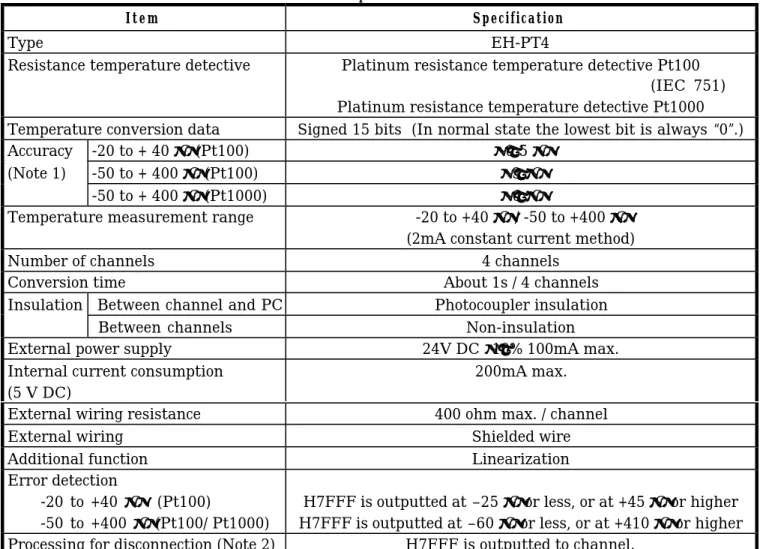
Table 3.1 shows the specifications of EH-PT4.
Table 3.1 Specification
Item Specification
Type EH-PT4
Resistance temperature detective Platinum resistance temperature detective Pt100
(IEC 751) Platinum resistance temperature detective Pt1000
Temperature conversion data Signed 15 bits (In normal state the lowest bit is always “0”.)
Accuracy -20 to + 40 °C (Pt100) ± 0.5 °C
(Note 1) -50 to + 400 °C (Pt100) ± 3 °C
-50 to + 400 °C (Pt1000) ± 6 °C
Temperature measurement range -20 to +40 °C / -50 to +400 °C
(2mA constant current method)
Number of channels 4 channels
Conversion time About 1s / 4 channels
Insulation Between channel and PC Photocoupler insulation
Between channels Non-insulation
External power supply 24V DC ±10% 100mA max.
Internal current consumption (5 V DC)
200mA max.
External wiring resistance 400 ohm max. / channel
External wiring Shielded wire
Additional function Linearization
Error detection
-20 to +40 °C (Pt100)
-50 to +400 °C (Pt100/ Pt1000)
H7FFF is outputted at –25 °C or less, or at +45 °C or higher
H7FFF is outputted at –60 °C or less, or at +410 °C or higher
Processing for disconnection (Note 2) H7FFF is outputted to channel.
Note 1: The accuracy is the value when 10 minutes pass after the start of power feeding. Just after power is fed, the value may increase slightly. Because a resistance temperature detective has an error, confirm it beforehand.
Note 2: This is the case when the current terminal wiring is broken. In case the voltage terminal wiring is broken, the data becomes unspecified. (“H” of “H7FFF” means the following data is hexadecimal.)
3.Specification
3-2
3.2 Terminal layout and internal circuit
Terminal layout Internal circuit
No. Signal name
1) b0 2) B0 3) b1 4) B1 5) b2 6) B2 7) b3 8) B3 9) 24V DC+ 10) A0 11) NC 12) A1 13) NC 14) A2 15) NC 16) A3 17) NC 18) 24V
DC-Note 1) Current terminals and a voltage terminals of unused channels should be wired. By this wiring read data becomes H7FFF.
1) 2) 3) 4) 5) 6) 7) 8) 9) 10) 11) 12) 13) 14) 15) 16) 17) 18) PT100 IN EH-PT4 RTD RTD -+ -+ A0 B0 b0 A3 B3 b3 Internal power circuit 24VDC+ 24VDC-Internal current
4. Block Diagram
4-1
4. Block Diagram
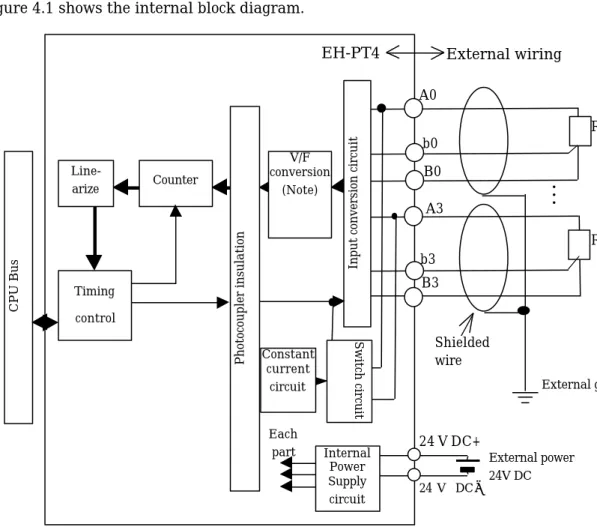
4.1 Internal Block Diagram
Figure 4.1 shows the internal block diagram.
Figure 4.1 Internal Block Diagram
Note: V/F conversion refers to the conversion of voltage(V) to frequency(F).
RTD External grounding ・・・ B0 b0 A3 B3 b3 External wiring CPU Bus 24 V DC− External power 24V DC 24 V DC+ EH-PT4 V/F conversion (Note) Counter Timing control
Input conversion circuit
Constant current circuit Each part Switch circuit Internal Power Supply circuit A0 Line-arize Shielded wire Photocoupler insulation RTD
5. External Wiring
5-1
5. External Wiring
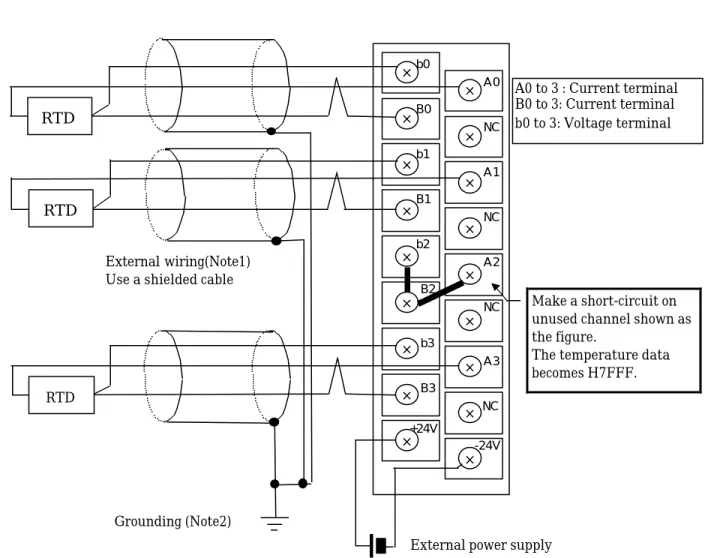
5.1 Resistance Temperature Detective Connection Method and External Wiring
Figure 5.1 External Wiring
Note 1: The external wire length shall be less than 200 m for each channel. In addition, the total resistance of the wires of each channels to be connected to the current terminals (A0 to A3, B0 to B3) shall be less than 400 ohm.
Note 2: Use shielded cable and connect shielded to functional earth on the both sides or one side, which depends on the noise environment.
Note 3: The earth terminal on the power supply module and External power supply 24 VDC must be connected to the functional earth. When functional earth area doesn't do, temperature data sometimes become unstable. The data becomes unspecified.
× × × × × × × × × × × × × × × × × × b0 B0 b1 B1 b2 B2 b3 B3 +24V A0 NC A1 NC A2 NC A3 NC -24V
External power supply 24VDC
Grounding (Note2) External wiring(Note1) Use a shielded cable
Make a short-circuit on unused channel shown as the figure.
The temperature data becomes H7FFF. A0 to 3 : Current terminal B0 to 3: Current terminal b0 to 3: Voltage terminal RTD RTD RTD
6. Setting
6-1
6. Setting
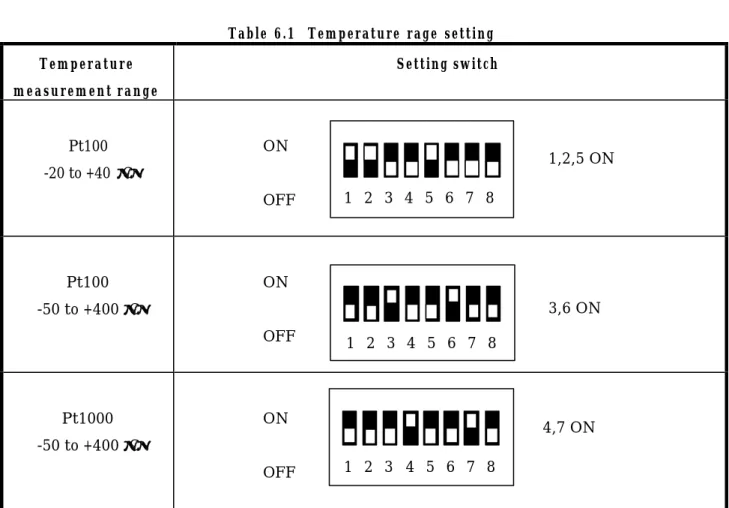
6.1 Setting of temperature range
This module can be set to three temperature ranges by the dip switch shown in below.
Table 6.1 Temperature rage setting Temperature measurement range Setting switch Pt100 -20 to +40 °C ON OFF Pt100 -50 to +400 °C ON OFF Pt1000 -50 to +400 °C ON OFF
Note: Do not use the setting which is not written in the table, because the temperature data becomes undefined. 1 2 3 4 5 6 7 8 1 2 3 4 5 6 7 8 1 2 3 4 5 6 7 8 Setting switch (Switch 1) 1,2,5 ON 3,6 ON 4,7 ON
7. Collection of Temperature Data
7-1
7 . C o l l e c t i o n o f T e m p e r a t e D a t a
7 . 1 I / O A l l o c a t i o n
The temperature data of each channel is collected in the CPU as the temperature conversion data corresponding to the temperature.
(1) I/O assignment
The I/O assignment shall be set as “WX4W" by your programming software or the peripheral equipment.
(2) I/O allocation
Depending on the module installation position, the temperature conversion data is stored in the word input number shown below.
F i g u r e 7 . 1
The setting of □□n is determined by the module installation position, as shown below.
Allocation address WX□n□ Word number (0 to 3) Slot number (0 to 7) Unit number (0 to 1) F i g u r e 7 . 2 WX□□n0 1 2 3 Channel 1 temperature conversion data Channel 2 temperature conversion data Channel 3 temperature conversion data Channel 4 temperature conversion data
Slot number EH-PT4
0 •••••••••• n
7. Collection of Temperate Data
7-2
7.2 Temperature Data
(1) Content of temperature conversion data [range : -50 to +400 °C] (Pt100/ Pt1000)
The meaning of the each bit( b0 to b15) of temperature conversion data (in WX**) is as shown below.
The sum of the bit “1” is the measured temperature.
<For example> (1) HF800 =“1111 1000 0000 0000" (HF) (H8) (H0) (H0) -800 + 400 + 200 + 100 + 50 = -50 °C (2) H0600 =“0000 0110 0000 0000" (H0) (H6) (H0) (H0) 25 + 12.5 = 37.5 °C
When an input error occurs( below -51°C and over 410 °C), the temperature conversion data is
H7FFF.
The following relation exits between temperature conversion data and actual temperature.
Temperature (℃) =
Note) “b0” is always “0” in normal time.
Relation between the temperature and temperature conversion data
Figure 7.3
a)Temperature conversion data(hexadecimal) -50 to +400 °C
H4000 H3000 H2000 H1000 H0800 -50 0 50 100 200 300 400 HF800 Temperate(°C) b15 b14 b13 b12 b11 b10 b9 b8 b7 b6 b5 b4 b3 b2 b1 b0 (°C) -800 400 200 100 50 25 12.5 6.25 3.125 1.563 0.781 0.391 0.195 0.0977 0.0488 0.0244 Note)
Temperature conversion data(signed decimal data) 40.96
7. Collection of Temperate
7-3
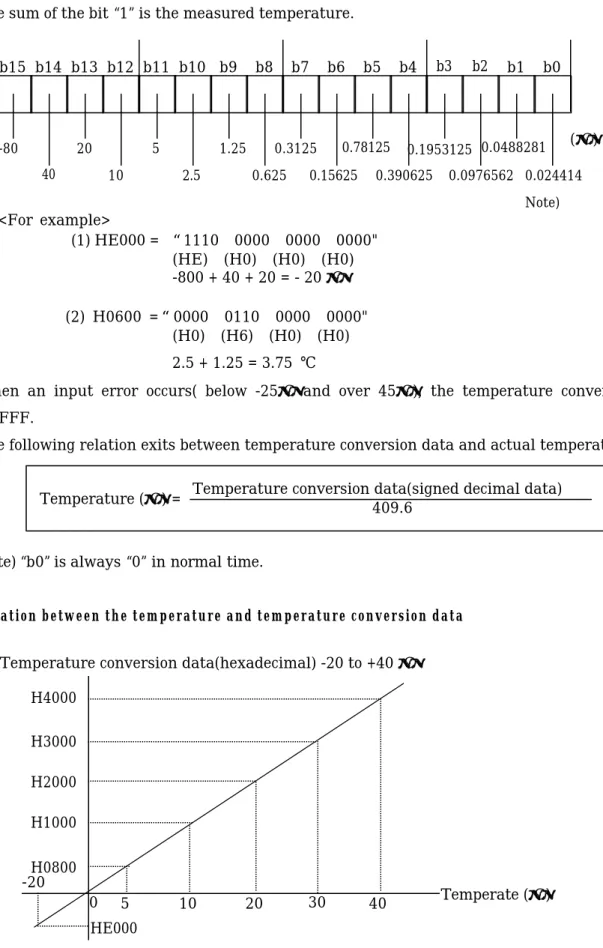
(2) Content of temperature conversion data [range : -20 to +40 °C] (Pt100)
The meaning of the each bit( b0 to b15) of temperature conversion data (in WX**) is as shown below.
The sum of the bit “1” is the measured temperature.
<For example> (1) HE000 = “1110 0000 0000 0000" (HE) (H0) (H0) (H0) -800 + 40 + 20 = - 20 °C (2) H0600 =“0000 0110 0000 0000" (H0) (H6) (H0) (H0) 2.5 + 1.25 = 3.75 ℃
When an input error occurs( below -25°C and over 45°C), the temperature conversion data is
H7FFF.
The following relation exits between temperature conversion data and actual temperature.
Temperature (°C) =
Note) “b0” is always “0” in normal time.
Relation between the temperature and temperature conversion data
Figure 7.4 b15 b14 b13 b12 b11 b10 b9 b8 b7 b6 b5 b4 b3 b2 b1 b0 (°C) -80 40 20 10 5 2.5 1.25 0.625 0.3125 0.15625 0.78125 0.390625 0.1953125 0.0976562 0.0488281 0.024414 Note) H4000 H3000 H2000 H1000 H0800 -20 0 5 10 20 30 40 HE000 Temperate (°C)
b)Temperature conversion data(hexadecimal) -20 to +40 °C
Temperature conversion data(signed decimal data) 409.6
7. Collection of Temperate Data
7-4
7.3 Example of Calculation
The program shown below as an example converts the temperature conversion data in WR0 to BCD 4 digit data in WM6.
In case the temperature is minus, the bit internal output R0 will be turned on.
(1) Because the calculation with sign is that by double words, extend the word temperature conversion data(WR0) to double word data(stored in DM0).
(2) (3) Calculate by the expression mentioned on previous page. Because the calculation with decimal point (dividing by 40.96) is not possible, multiply the numerator with 100 (2) and then divide by 4,096(3).
(4) When the temperature data (result of calculation) is minus, the R0 is turned on.
(5) Turn to an absolute variable (for plus temperature data, use as it is and for minus temperature data remove the sign to turn it to a plus value.) (Use WM0 because the result of calculation can be incorporated in a word (less than 16 bits).
(6) WM 4 is converted to BCD 4 digits vaule(WM6).
EXT (DM000,WR0000) (1) DM000 = DM000 S* 100 (2) DM002 = DM000 S/ 4096 (3) R0 = DM002 S< 0 (4) ABS (WM004,WM002) (5) BCD (WM006,WM004) (6)
7.Collection of Temperature Data
7-5
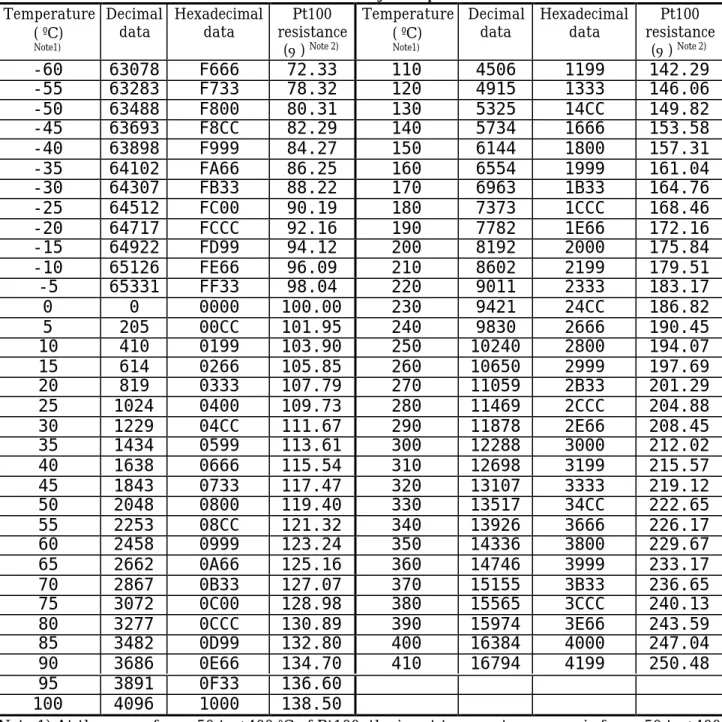
7.4 Correspondence Table between Temperature and Temperature Data
(1)Pt100/Pt1000 -50 to +400 ºC range
Table 7.4.1 Pt100 -50 to +400 ºC range Temperature conversion data
Temperature ( ºC)
Note1)
Decimal
data Hexadecimaldata resistancePt100 (Ω) Note 2)
Temperature ( ºC)
Note1)
Decimal
data Hexadecimaldata resistancePt100 (Ω) Note 2) -60 63078 F666 72.33 110 4506 1199 142.29 -55 63283 F733 78.32 120 4915 1333 146.06 -50 63488 F800 80.31 130 5325 14CC 149.82 -45 63693 F8CC 82.29 140 5734 1666 153.58 -40 63898 F999 84.27 150 6144 1800 157.31 -35 64102 FA66 86.25 160 6554 1999 161.04 -30 64307 FB33 88.22 170 6963 1B33 164.76 -25 64512 FC00 90.19 180 7373 1CCC 168.46 -20 64717 FCCC 92.16 190 7782 1E66 172.16 -15 64922 FD99 94.12 200 8192 2000 175.84 -10 65126 FE66 96.09 210 8602 2199 179.51 -5 65331 FF33 98.04 220 9011 2333 183.17 0 0 0000 100.00 230 9421 24CC 186.82 5 205 00CC 101.95 240 9830 2666 190.45 10 410 0199 103.90 250 10240 2800 194.07 15 614 0266 105.85 260 10650 2999 197.69 20 819 0333 107.79 270 11059 2B33 201.29 25 1024 0400 109.73 280 11469 2CCC 204.88 30 1229 04CC 111.67 290 11878 2E66 208.45 35 1434 0599 113.61 300 12288 3000 212.02 40 1638 0666 115.54 310 12698 3199 215.57 45 1843 0733 117.47 320 13107 3333 219.12 50 2048 0800 119.40 330 13517 34CC 222.65 55 2253 08CC 121.32 340 13926 3666 226.17 60 2458 0999 123.24 350 14336 3800 229.67 65 2662 0A66 125.16 360 14746 3999 233.17 70 2867 0B33 127.07 370 15155 3B33 236.65 75 3072 0C00 128.98 380 15565 3CCC 240.13 80 3277 0CCC 130.89 390 15974 3E66 243.59 85 3482 0D99 132.80 400 16384 4000 247.04 90 3686 0E66 134.70 410 16794 4199 250.48 95 3891 0F33 136.60 100 4096 1000 138.50
Note 1) At the range from -50 to +400 ºC of Pt100, the input temperature range is from -50 to +400 ºC. But the temperature data output is from -60 to + 410º C.
7.Collection of Temperature Data 7-6 (1)Pt100 -20 to +40℃ range T a b l e 7 . 4 . 2 P t 1 0 0 - 5 0 t o + 4 0 ºC r a n g e T e m p e r a t u r e c o n v e r s i o n d a t a Temperature ( ºC) Note1) Decimal
data Hexadecimaldata resistance (Pt100 Ω)
-25 55296 D800 90.19 -20 57344 E000 92.16 -15 59392 E800 94.12 -10 61440 F000 96.09 -5 63488 F800 98.04 0 0 0000 100.00 5 2048 0800 101.95 10 4096 1000 103.90 15 6144 1800 105.85 20 8192 2000 107.79 25 10240 2800 109.73 30 12288 3000 111.67 35 14336 3800 113.61 40 16384 4000 115.54 45 18432 4800 117.47
Note 1) At the range from -20 to +40 ºC of Pt100, the input temperature input range is from -20 to +40
8. Error Deception Processing
8-1
8 . E r r o r D e t e c t i o n P r o c e s s i n g
8 . 1 M e a s u r e d T e m p e r a t u r e R a n g e o v e r
(1)Interlock
If temperate conversion data is over the measuring range or current terminal wiring is disconnected, the temperature conversion data becomes H7FFF.
After this data is read, it is necessary to make a program externally for the treatment for an error. Example of an error detection program
Please take a proper countermeasure by using the coil Yb at error detection (M8 ON). Set the numbers of the sections “a” and “b” corresponding to the actual system.
M0008 Xa
Yb
Yb
The program checks for error data.
When one error data is found, M8 is turned on.
For error data, Yb is turned on. Xa is for reset. WM000 = H0000 M0000 = WX000 == H7FFF M0001 = WX001 == H7FFF M0002 = WX002 == H7FFF M0003 = WX003 == H7FFF M0008 = WM000 <> H0000
8. Error Detection Processing
8-2
8 . 2 T r e a t m e n t f o r a S u d d e n C h a n g e o f T e m p e r a t u r e C o n v e r s i o n D a t a
When the temperature conversion data is changed suddenly due to the disconnection of external wiring or influence of noise, the system judges it to be an abnormal condition.In the example shown below, every scanned data is read in. If a change of 5ºC(Note) or more from the previously read data is found, the condition is judged to be abnormal and data is aborted.
Note: Change each value to your system.
E x a m p l e o f p r o g r a m 1) 2) 3) 4) 5)
In the example of this program, no protective action or warning against abnormal data is performed. Make additional circuits depending on the situation.
WR000B < H00CC WR0008 < H00CC WR0009 < H00CC R7E3
Every scanned data is read in and the data is stored in DR0 and DR2.
For only the initial scanned data, put the read into the previous data(DR8 to DRA).
The absolute value of the difference between the previous data and read data is calculated.
If the difference between the previous data and read data is less than 5ºC, put the read data into WR10 to WR13. In the following program, the values of WR10 to WR13 are treaded a s normal value.
Updates the previous data.
When an error occurred, the data is not updated and instead the previous data is held. WR0008 == WR0008 - WR0000 ABS (WR0008 , WR0008) WR0009 == WR0009 - WR0001 ABS (WR0009 , WR0009) WR000A == WR000A - WR0002 ABS (WR000A , WR000A) WR000B == WR000B - WR0003 ABS (WR000B , WR000B) DR0008 == DR0010 DR000A == DR0012 DR000 == DX000 DR002 == DX002 DR008 == DR000 DR00A == DR002 WR0010 == WR0000 WR0012 == WR0002 WR0011 == WR0001 WR0013 == WR0003 WR000A < H00CC
9. Mounting
9-1
9 . M o u n t i n g
9 . 1 I n s t a l l a t i o n
(1) EH-PT4 module can be installed on both the basic base and expansion base. (2) Precaution on installation
Upon the installation of the EH-150 series, consider the operability, maintainability and environment.
(a) For use at proper ambient temperature range
• Secure a sufficient space allowing a good ventilation.
• Do not install the module just over a device generating a great amount of heat(such as heater,
transformer and large capacity resistor).
• If the ambient temperature around the module exceeds 55 °C, set a fan or air conditioner to keep
the temperature below 55 °C.
(b) Do not install the module in panel provided with a high-voltage device. (c) Keep more than 300 mm away from a high-voltage line and power line.
(d) Installing the basic base 1,000 mm through 1,600 mm from the floor improves the operability. (e) Secure a clearance of more than 50 mm between the upper and lower sections of the module for
ventilation and maintenance. For the right and left directions, secure a clearance of more than 10 mm.
(f) Never pull out or insert a alive line of the module.
9 . 2 M o u n t i n g M e t h o d
(1)Checking a connector
Before and after the installation, check the following two points.
(a) Is there an abnormality on the connector of the basic base or extensive base? (b) Is there an abnormality in the connector or the module side?
(2)Confirming the external wiring
Before running, confirm the following items:
(a) Check that the connection of the external wiring is proper.
(b) Check that the external wiring terminal board and the module are fastened securely with screws.
9 . 3 M a i n t e n a n c e a n d I n s p e c t i o n
Perform periodic inspection every six months according to the procedure mentioned below. (1) Remove dust and dirt off the terminal board.
(2) Confirm that the fixing screws of the external wiring terminal board and module are tightened firmly.
9. Mounting
9-2
9.4 Precautions on External Wiring
Because the external wiring of the EH-PT4 handles fine signals, be sure to use a shielded wire to suppress the influence of external noise and place the wire separately from the power line and signal line of different voltage.
Note) Weld joints of metallic conduits and ground the welded metallic conduits. (Grounding in accordance with local legal requirements)
Figure. 9.1 Wire Separation by Conduits or Ducts Caution
Use an external power supply which the over current protection character is as below
Figure. 9.2 Over current protection character 300 mm or more
Output voltage
Load current Power cable
Other signal cables
Wiring cable (shielded wire) of EH-PT4 module
Metallic conduit
Wiring cable (shielded wire) of EH-PT4 module
Other signal cables
10. Example of Programming
10-1
1 0 . E x a m p l e o f P r o g r a m m i n g
1 0 . 1 E x a m p l e o f P r o g r a m m i n g 1
(1)Control contents
(a) The program keeps the temperature of a liquid in a bath 10 to 12ºC higher than that of ambient air temperature.
(b) When the temperature difference between the upper part and the lower part of the liquid is 3ºC or higher, the program turns a stirrer on.
(c) When the temperature of the liquid exceeds 50 ºC or the temperature difference between the upper part and the lower part of the liquid exceeds 8 ºC, the program turns a temperature error lamp on to indicate an error and starts a cooler.
(d) When error data is found, the program turns a data error lamp on and starts the cooler. (e) When error data is found, the program turns a data error lamp on and starts cooler. (f) When an error occurs, the program stops a heater.
F i g u r e 1 0 . 1 E x t e r n a l d e v i c e
(2) Configuration and allocation
F i g u r e 1 0 . 2 P L C c o n f i g u r a t i o n Basic base
Install EH-PT4 on the fourth slot.
Use the relay output module installed on the slot 0 to output to the external device.
Y0: Motor Y1: Cooler Y2: Heater
Y3: Motor error lamp Y4: Temperature error lamp Y5: Data error lamp
WX40: Air temperature
WX41: Temperature at the upper part of the liquid WX42: Temperature at the lower part of the liquid WX43: Motor temperature
Setting of temperature range Pt100 , -50 to +400 ºC
1 2 3 4 5 6 7 8 ON
OFF
SW1 Temperature at the upper
part of the liquid
Temperature at the lower part of the liquid
Air temperature Stirrer Motor Cooler Heater Motor temperature Motor error Tempera -ture error Data error Lamp indication - Platinum resistance temperature detective PT100
AVR CPU Y16 EH-PT4
0 1 2 3 4
DUM16 DUM16 DUM1610. Example of Programming 10-2 (3)Program (1) (2) (3) (4) (5) (6) (7) (8) (9) Y0000 Y0003 SS0 SS0 R003 R004 R002 SS0
If R0 or R1 turns on, turn the motor for a minute.
However, if Y3 turns on, do not turn the motor.
The program stores the difference between the temperature at the upper part of the liquid and the air temperature in WR5.
When the air temperature is higher than the temperature at the upper part of the liquid, the program turns R5 on. When the temperature difference is 10ºC or lower, the program turns R6 on. When the temperature difference is 10ºC or higher, the program turns R7 on.
When the temperature at the upper part of the liquid is 50ºC or higher, the program turns R3 on. When the temperature at the lower part of the liquid is 50ºC or higher, the program turns R4 on.
When the motor temperature is 100ºC
or higher, the program turns R2. on When the temperature difference is 8ºC or higher, the program turns R0 on. The program stores the absolute value of the temperature difference between the upper part and the lower part of the liquid in WR4.
When an error is found, the program turns M4 on.
Data check
The program stores the temperature data for 4 channels in the internal output. R0001 R0000 DR0000 = DX0040 DR0002 = DX0042 WM0000 = H00000 M0000 = WR0000 == H7FFF M0001 = WR0001 == H7FFF M0002 = WR0002 == H7FFF M0003 = WR0003 == H7FFF M0004 = WM0000 <> H0000 WR0004 = WR0001 - WR0002 ABS (WR0004 , WR0004) R0000 = H007C <= WR0004 R0001 = H0148 <= WR0004 R0002 = H1000 <= WR0003 R0003 = H0800 <= WR0001 R0004 = H0800 <= WR0001 WR0005 = WR0001 - WR0000 R0005 = WR0001 <= WR0000 R0006 = WR0005 <= H0198 R0007 = H01EC <= WR0005
10.Program 10-3 (10) (11) (12) (13) (14) R006 R005 M004 R004 R007 R004 R003 R001 R002
Turn on either R5 or R6 to turn on the heater and turn off the cooler.
Turn on M4 to light the data abnormality lamp.
Turn on any one of R1, R3 and R4 to light the temperature abnormality lamp.
Turn on any one of R1, R3, R4, R7 and M4 to turn on the cooler and turn off the heater.
When R2 is turned on, the program turns the motor error lamp on.
R001 Y0003 = 1 M004 Y0004 = 1 Y0002 = 0 R003 Y0001 = 1 Y0005 = 1 Y0002 = 1 Y0004 = 0
10. Program
10-4
10.2 Example of Programming 2 (Offset adjustment)
The resistance temperature detective itself has an built-in error, therefore an offset error may occur in temperature conversion data. An offset error occurs due to the change with the passage of time also. An example of correction by programming in this case is shown below.
However, because an actual offset value is not always a specified value, it cannot be corrected completely. The offset error refers to the deviation of any temperature conversion data from the reference value(Note) in a specified rate. (The offset error means the constant deviation from the reference value.)
Example of offset
(1) Adjustment procedure
(a) Decide whether an offset error is on + or – side toward a reference value. (b) Obtain a temperature conversion data corresponding to offset error.
Offset error Temperature conversion data
1 ºC H0028 or H002C
2 ºC H0050 or H0054
3 °C H0078 or H007C
4 °C H00A0 or H00A4
5 °C H00CC or H00D0
(c) If offset error is on + side toward the reference value, subtract the value obtained in (b) from the temperature conversion data. If it is on – side, add the value obtained in (b) to the temperature conversion data.
(2) Example of programming (The configuration is the same as the example of programming 1)
If the channel 2 has + 2 °C offset, subtract H0050 from the temperature conversion data WX0042.
Temperature conversion data
A: Offset error Reference value A A - side offset + side offset EH-150 temperature conversion data
Note: Measure a reference value using a measuring device with a higher accuracy than EH-PT4. Or connect a resistor with a high accuracy instead of the resistance temperature device and obtain a direct offset error. For the relationship between the temperature and resistance, see Table 7.2.
WR0000 = WX0040 WR0001 = WX0041
WR0002 = WX0042 - H0050 WR0003 = WX0043
11. Troubleshooting
11-1
11 Troubleshooting
If you have some problems, please find the cause according to the following countermeasures. If the problem is not solved despite this countermeasures, contact the sales office.
If a spare unit is available, replace and see the condition.
11.1 The Allocation Error “41 ” is indicated in CPU.
Error code “41” is “I/O information verify error”. I/O assignment information and actual loading of module do not much. (Error codes are output as a hexadecimal to the WRF000.)
(1) Check the I/O assignment in CPU.
(2) Check the connection between the module and base.
(3) A defect may occur from the other modules. Check the other modules. too
11.2 Data Error in a Specific Channel
The type of data errors are (a) unstable data, (b) loss of accuracy and (c) that data is H7FFF. (1) Check if the wire for the data undergoing an error in its amount is connected properly. (2) Check if the wiring is placed on the same route as the power line (if so, noise is induced.) (3) Check if the terminal board screws are tightened securely.
(4) Check if the resistance temperature detective is the PT100/PT1000 complying with IEC 751. (5) Check if the external wiring resistance (current terminal wiring ) is less than 400 ohm. (6) Check if a measured temperature is out of the specification rage of EH-PT4.
11.3 Data Error in All Channels
The data of all channels may become H7FFF.
(1) If there is an unused channel, check if its current terminal is correct.
(2) Check the output voltage of external power supply. Check if the wiring of the current terminal is disconnected.
(3) Check the capacity of the external power supply.(Output current 1A or more)
[Precautions]
(1) Before replacing the module, be certain to turn off the power.
(2) Upon returning a module for a repair, notify us of the details of the abnormal condition. (3) For troubleshooting, the following tools are necessary.
(a) Phillips screwdriver and slotted screwdriver (+ / -) (b) Digital multi-meter, circuit tester
12. Appendix
12-1
In the case of Hitachi twisted shielded cable (CO-DS-IREVV-SX,(10 pairs to 52)), the
maximum conductor resistance in the cross section of 0.18mm2 under the temperature 20 °C is
121.5 ohm/km (according to Hitachi’s Guide Book).
12. Appendix
12.1 Calculation of External Wiring Resistance
Assuming that the cross section and length of tinned annealed copper wire are S(mm2), and L(m),
the resistance R(Ω) of the wire is
R ≒ 0.01854×L / S
For example, for a cable whose cross section is 0.18 mm2 and length is 200 m, the resistance is
R ≒ 0.01854×200 / 0.18 = 20.6 Ω
Because the current terminal of EH-PT4 doubles in both ways, the resistance also doubles
20.6 Ω × 2 = 41.2 Ω.
Because this resistance is the value when the ambient temperature around the wire is 20 °C, if the
ambient temperature is over 20 °C, the resistance rises. The rise per 1 °C is about 0.4%.
In case the ambient temperature is 40 °C, the resistance is
R = 41.2 × (1 + 0.004× (40 - 20))
≒ 44.5 Ω
Concerning the details of resistance, investigate individually for each wire. It may be slightly different from the calculated value.