PRODUCT HANDBOOK
COMPACT AUTOMATIC COMBINATION GAS CONTROLS
APPLICATION
The Compact Automatic has been specially developed for application in domestic central heating boilers, warm air furnaces or water heater gas appliances.
The Compact Automatic is used in a system context in conjunction with either a direct spark ignition (DSI), intermittent pilot (IP) or Hot Surface Ignition control module and associated devices to provide programmed safe light-up and supervision of the main burner of an appliance.
Contents
General
page
Description... 2 Feature ... 3Technical
Specifications ... 4 Capacity... 5Electrical data low voltage ... 15
Performance characteristics ... 16
Dimensional drawing VR46../VR86..A/C, AB/CB... 18
Dimensional drawing VR46../VR86..B/D ... 19
Dimensional drawing VR46../VR86..A/C, AA/CA... 20
Dimensional drawing VR46../VR86..E/T, EA/TA ... 21
Installation
Installation ... 22Adjustments and final checkout ... 23
Construction and working principles... 24
Various
Quality assurance statement ... 27boiler system design much easier as technical specifications and unit dimensions are the same for all system options. Options include servo pressure regulation, throttle valve, (switchable) softlite, electrical high-low control and electrical or mechanical modulation for the complete range of control applications.
Compact Automatic combination gas controls are available in line or low voltage versions and in three capacity ratings for total system versatility. Customer specific voltage models are also offered
Compact Automatic combination gas control consist of a first direct electric on/off operator for opening the safety valve of class A or class B according to EN 161 and a second electric on/off servo operator valve for opening the main valve of class B, C or class J according to EN 161; 1997 (for explanation class J see chapter “Standards and Approvals” page 40).
Compact Automatic combination gas controls are rated for gas families MFD Group A (G 110), MFD Group B (G 120), Natural H (G 20), Natural L (G 25) and LP (G 30).
All measurements are carried out under standard conditions, unless otherwise is indicated.
• Nominal voltage
• Upright position, i.e. the position when the operators are on top.
• Specially designed for use with gas appliances with a DSI, HSI or IP system to light the main burner.
• Incorporates time proven design concepts assuring reliability.
• ON/OFF control of main burner by electric on/off operator and electric on/off servo operator.
• At inlet side an internal fine mesh screen is incorporated in the Compact Automatic. This screen is not intended to be removable for cleaning. When flanges are used,
removable screens can be placed between the flanges and the Compact Automatic.
• Outlet screen (optional).
• Various closing force models are available: B + B, B + J,B + C, A + J and A + C.
• All adjustments are located on the top of the Compact Automatic.
• 9 mm outer diameter pressure tap at inlet and outlet side for checking and adjusting burner pressure.
• A wrench boss is incorporated at the inlet side of the Compact Automatic for pipe fitting.
• Compact Automatic mounting orientation may be within
90_ in any direction from the electric on/off operator
upright position.
• Two threaded mounting holes are at the bottom of the Compact Automatic for rigid attachment to the appliance. • Main valve on/off servo operator with DIN faced electrical connection has two threaded holes at the top for mounting purposes (e.g. cover).
• High, medium and low capacity models are available. • Main valve on/off servo operator employs DIN face
electrical connection which are also suitable for AMP connections.
• The coil of the electric on/off operator is field replacable and can also be positioned in other directions for better accessability.
Gas connection options
• Inlet and outlet connections are straight through and threaded (standard model).
• Inlet and outlet connections can receive flanges. • Side outlet options are available for both main and pilot
gas.
• The pilot gas connection for using break away connectors for various outer diameter tubing is located at the outlet end of the Compact Automatic (standard model). • The pilot gas side outlet and special end outlet are
suitable for manifold connections.
• High capacity model has straight through inlet and outlet with Ø 23 mm bore.
• Both top face and bottom face AMP electrical connection on electric on/off operator are available.
• Single plugs are available with cable and strain relief in several versions (IP 40)
• Seperate plugs on first and second electric on/off operator are available (IP 40).
• IP 44 connection by means of two DIN connectors is possible.
• Quick connect 6.3 mm fastons on both coils can be applied in combination with single cover or separate covers with strain relief.
• Line voltage on/off servo operators are provided with a ground screw and washer.
Functional options
• Servo pressure regulator provides stable outlet pressure. • Pressure feedback ensures constant burner
pressure(optional).
• A throttle valve version is available, where unregulated valves may be employed.
• Softlite option to facilitate a smooth light up of burners. • Switchable softlite option for changing over from one gas
to another and vice versa.
• Electrical or mechanical modulation. • Electrical High-Low control.
• Incorporated pilot filter (optional). • Pilot outlet for IP system.
2 pipe thread
- Inlet 1/2” ISO 7-1 internal parallel pipe thread and outlet
18.6 mm dia
- Inlet and outlet Ø 23 mm bore (high capacity models only
- Inlet and outlet can also be fitted with straight or elbow
flanges.
Side outlet (optional) can only be fitted with a flange.
Ambient temperature
VR46../VR86..xA: 0 ... 70°C
VR46../VR86..x: 0 ... 60°C
VR46../VR86..xB: 0 ... 60°C
Pilot gas connection
Standard at end outlet: M11 x 1 for 1/4”, 6 mm or
4 mm outer diameter tubing.
Special connection: incorporated in the side
outlet.
Pressure feedback connection
The servo pressure regulator has an M5 thread connection for pressure feedback.
Enclosure
IP 40 with covers or plugs
IP 44 with DIN plugs according to DIN 43650
Dimensions
See Dimensional drawing page 30 thru 33
Maximum operating pressure
The Pmax indication on the housing of the Compact
Automatic is the maximum pressure at which it functions safely. However, the maximum operating pressure is limited by the pressure range of the pressure regulator concerned, see table 2.
* This type can also be used for non regulation mode in LP
applications when pressure regulator adjustment screw is clockwise turned down until it stops.
Two M4 threaded holes on DIN faced electrical on/off servo operator are also for mounting purposes.
Minimum regulation capacity
0.31 m3/h
Minimum adjustable capacity (throttle valve only)
0.6 m3/h air at ∆P of 20 mbar
Minimum differential pressure at 0.31 m3/h air
* X = suffix letter
Table 2: Maximum operating pressure
Model Pressure range
(mbar) Maximum operating pressure (mbar) with regulation 2 ... 10 2.5 ... 20 30 3 ... 37* 45 5 ... 50* 60 10 ... 60* 100 without regulation - 60 with throttle - 60
Model* ∆P min (mbar)
VR4601/VR8601XA 1.8 VR4605/VR8605XA 1.8 VR4611/VR8611XA 3.9 VR4615/VR8615XA 3.9 VR4621/VR8621XA 3.9 VR4625/VR8625XA 3.9 VR4631/VR8631XA 1.8 VR4635/VR8635XA 1.8 VR4641/VR8641XA 3.9 VR4645/VR8645XA 3.9 VR4601/VR8601X 1.7 VR4605/VR8605X 1.7 VR4611/VR8611X 3.9 VR4615/VR8615X 3.9 VR4621/VR8621X 3.9 VR4625/VR8625X 3.9 VR4631/VR8631X 1.7 VR4635/VR8635X 1.7 VR4641/VR8641X 3.9 VR4645/VR8645X 3.9 VR4601/VR8601XB 1.7 VR4605/VR8605XB 1.7 VR4611/VR8611XB 3.9 VR4615/VR8615XB 3.9 VR4621/VR8621XB 3.9 VR4625/VR8625XB 3.9 VR4641/VR8641XB 3.9
See also the corresponding capacity curves
1) versions with side outlet have 0.3 m3/h less capacity
Safety valve Main valve
Model Remark Class Seat
(mm) Class Seat (mm) Capacity curve number ∆P (mbar) Capacity (m3/h) Inlet Outlet Straight Side 1) VR460.XA VR860.XA Standard B 11 J 17 C110 2.5 1.95 1/ 2” 1/2” VR460.XA VR860.XA Upgraded B 17 J 17 C210 3 2.7 1/ 2” 1/2” VR460.XA VR860.XA Standard B 11 J 17 C110 2.5 1.4 1/ 2” Flange VR461.XA VR861.XA Standard B 11 C 17 C120 5 1.8 1/ 2” 1/2” VR461.XA VR861.XA Upgraded B 17 C 17 5 2.5 1/ 2” 1/2” VR462.XA VR862.XA Standard B 11 B 17 5 2 1/ 2” 1/2” VR462.XA VR862.XA Upgraded B 17 B 17 C250* 5 2.5 1/ 2” 1/2” VR463.XA VR863.XA Standard A 11 J 17 C110 2.5 1.95 1/ 2” 1/2” VR464.XA VR864.XA Standard A 11 C 17 C120 5 1.8 1/ 2” 1/2” VR461.VA VR861.VA Standard B 11 C 11 F40 10 4.2 1/ 2” 1/2” VR464.VA VR864.VA Standard A 11 C 11 F40 10 4.2 1/ 2” 1/2” VR461.V VR861.V Standard B 17 C 17 C100 10 7.5 1/ 2” 1/2” VR464.V VR864.V Standard A 17 C 17 C100 10 7.5 1/ 2” 1/2” VR460.X VR860.X Standard B 17 J 17 C90 3 3.1 1/ 2” 1/2” VR461.X VR861.X Standard B 17 C 17 C100 5 3 1/ 2” 1/2” VR462.X VR862.X Standard B 17 B 17 5 3 1/ 2” 1/2” VR463.X VR863.X Standard A 17 J 17 C90 3 3.1 1/ 2” 1/2” VR464.X VR864.X Standard A 17 C 17 C100 5 3 1/ 2” 1/2” VR460.XB VR860.XB Standard B 18.5 D 17 C130 3 4.2 23 mm 23 mm VR461.XB VR861.XB Standard B 18.5 C 17 C170 5 4.6 23 mm 23 mm VR460.EB VR860.EB Standard B 18.5 J 17 C200 3 4.2 23 mm 23 mm VR460.TB VR860.TB Standard B 18.5 J 17 C200 3 4.2 23 mm 23 mm VR461.EB VR861.EB Standard B 18.5 C 17 5 4.0 23 mm 23 mm VR461.TB VR861.TB Standard B 18.5 C 17 5 4.0 23 mm 23 mm
012345
67
12 11 10 9 8 7 6 5 4 3 2 1 0
Pressure drop (mbar)
Flow (m /h at 1013 mbar and 15 C, dry)
_
3
G 30 Air G 25 G 20 G 140 G 110/120 1 2 3 4 5 6 1 2 3 4 5012345
67
12 11 10 9 8 7 6 5 4 3 2 1 0
Pressure drop (mbar)
Flow (m /h at 1013 mbar and 15 C, dry)
_
3
G 30 Air G 25 G 20 G 140 G 110/120 1 2 3 4 5 6 1 2 3 4 5 6012345
67
12 11 10 9 8 7 6 5 4 3 2 1 0
Pressure drop (mbar)
Flow (m /h at 1013 mbar and 15 C, dry)
_
3
G 30 Air G 25 G 20 G 140 G 110/120 1 2 3 4 5 6 1 2 4 5 3012345
67
12 11 10 9 8 7 6 5 4 3 2 1 0
Pressure drop (mbar)
Flow (m /h at 1013 mbar and 15 C, dry)
_
3
G 30 Air G 25 G 20 G 140 G 110/120 1 2 3 4 5 6 6 1 2 4 5 301 2 3 3 45 67 8 9 10 11 12 13 12 11 10 9 8 7 6 5 4 3 2 1 0
_
G 30 Air G 25 G 20 G 140 G 110/120Pressure drop (mbar)
Flow (m /h at 1013 mbar and 15 C, dry)
1 2 3 4 5 6 1 2 4 5 3
01 2 3 3 45 67 8 9 10 11 12 13 14 15 12 11 10 9 8 7 6 5 4 3 2 1 0
_
G 30 Air G 25 G 20 G 140 G 110/120Pressure drop (mbar)
Flow (m /h at 1013 mbar and 15 C, dry)
1 2 3 4 5 6 6 1 24 5 3
01 2 3 3 45 67 8 9 10 11 12 13 12 11 10 9 8 7 6 5 4 3 2 1 0
_
G 30 Air G 25 G 20 G 140 G 110/120Pressure drop (mbar)
Flow (m /h at 1013 mbar and 15 C, dry)
1 2 3 4 5 6 6 1 2 4 5 3
01 2 3 4 5 67 12 11 10 9 8 7 6 5 4 3 2 1 0 13 14 15 16 17 18 19 20
Pressure drop (mbar)
Flow (m /h at 1013 mbar and 15
C, dry)
_
3
G 30 Air G 25 G 20 G 140 G 110/120 1 2 3 4 5 6 1 2 3 45Model Voltage (V) Remark Operable voltage (V)
First solenoid operator Main valve operator
Current (A) Nominal power
consumption (W)
Current (A) Nominal power
consumption (W) Nominal At 110% Nominal At 110% VR860.XA 24, 50 Hz Standard 19.5 ... 27 0.28 0.4 3.5 0.211 0.242 3.8 VR862.XA 24, 50 Hz Standard 19.5 ... 27 0.28 0.4 3.5 0.211 0.242 3.8 VR860.XA 24, 50 Hz Upgraded 19.5 ... 27 0.42 0.54 4.8 0.211 0.242 3.8
VR860.XA 24, 50 Hz Upgraded, low consumption
19.5 ... 27 0.42 0.54 4.8 0.121 0.139 2.1
VR860.XA 24, 60 Hz Standard 19.5 ... 27 0.4 0.485 4.9 0.266 0.31 4.7
VR863.XA 24, 50 Hz Valve class A+D, small coil
19.5 ... 27 0.42 0.54 4.8 0.211 0.242 3.8
VR864.XA 24, 50 Hz Valve class A+C, small coil
19.5 ... 27 0.42 0.54 4.8 0.211 0.242 3.8
VR860.X 24, 50 Hz Standard 19.5 ... 27 0.45 0.56 7 0.211 0.242 3.8
VR860.X 24, 60 Hz Standard 19.5 ... 27 0.55 0.69 8.3 0.266 0.242 4.7
VR862.X 24, 50 Hz Standard 19.5 ... 27 0.45 0.56 7 0.211 0.242 3.8
VR863.X 24, 50 Hz Valve class A+D, large coil
19.5 ... 27 0.7 0.85 9.1 0.211 0.242 3.8
VR864.X 24, 50 Hz Valve class A+C, large coil
19.5 ... 27 0.7 0.85 9.1 0.211 0.242 3.8 VR860.XB 24, 50 Hz Standard 19.5 ... 27 0.07 0.85 9.1 0.211 0.242 3.8 VR460.XA 230, 50 Hz Standard 196 ... 253 0.042 0.052 4.8 0.023 0.027 4 VR462.XA 230, 50 Hz Standard 196 ... 253 0.042 0.052 4.8 0.023 0.027 4 VR460.XA 230, 50 Hz Upgraded 196 ... 253 0.042 0.052 4.8 0.023 0.027 4 VR460.XA 220, 60 Hz Standard 187 ... 242 0.045 0.055 4.9 0.021 0.025 3.5
VR463.XA 230, 50 Hz Valve class A+D, small coil
196 ... 253 0.042 0.052 4.8 0.023 0.027 4
VR464.XA 230, 50 Hz Valve class A+C, small coil
196 ... 253 0.042 0.052 4.8 0.023 0.027 4 VR460.X 230, 50 Hz Standard 196 ... 253 0.06 0.072 8.35 0.023 0.027 4 VR460.X 220, 50 Hz Pmax. 130 mbar 187 ... 242 0.057 0.07 8.3 0.021 0.025 3.5 VR460.X 230, 50 Hz Standard 196 ... 253 0.06 0.072 8.35 0.023 0.027 4 VR462.X 230, 50 Hz 196 ... 253 0.06 0.072 8.35 0.023 0.027 4 VR463.X 230, 50 Hz Standard 196 ... 253 0.06 0.072 8.35 0.023 0.027 4 VR464.X 230, 50 Hz Standard 196 ... 253 0.06 0.072 8.35 0.023 0.027 4 VR460.XB 230, 50 Hz Standard 196 ... 253 0.06 0.072 8.35 0.023 0.027 4
40 cm/h at test pressure of 8 and 150 mbar.
Outlet pressure adjustment range capability
Natural/manuf. gas: 2.5 ... 20 mbar.
Natural/LP gas: 3 ... 37 mbar.
LP gas: 5 ... 50 mbar.
10 ... 60 mbar.
Pilot flow
Pilot flow capacity will not be less than 0.1 m3/h at 9 mbar
pressure drop.
Bleed off/recovery time of servo system
The bleed off/ recovery time of the standard SOFTLITE system
shall be within 15 seconds from operator de-energization. For SOFTLITE system with switchable SOFTLITE adapter the bleed
off/recovery time shall be within 30 seconds from operator de-energization.
High pressure test
In the ”OFF” condition, the Compact Automatic will withstand 3 bar (air) inlet pressure without damage. Attempts to operate the Compact Automatic, while in this condition will not damage it.
Operable voltage range
The Compact Automatic will function satisfactory between 85% and 110% of the rated voltage. See table 3. and 4.
Valve closing characteristics
The Compact Automatic will close within 1 second from operator de-energization at an inlet pressure of 22.5 mbar and minimal 2.5 mbar pressure drop.
Main valve opening characteristics Fast opening versions
Under conditions where the supply pressure is at least 2.5 mbar above the outlet pressure setting, the dead time shall be 1 s maximum except fast opening versions with 0.2 mm inlet orifice and upright position the dead time will be 2.5 s maximum.
Outlet pressure will reach 50% of the outlet pressure setting within 1 second from start of flow or 75% within 2 seconds. Full outlet pressure will be reached within 5 seconds. Version without regulation or with throttle valve will reach full outlet pressure within 5 seconds.
Repeatability of outlet pressure set point
For all gases the maximum deviation from set point is $
0.3 mbar or $ 3% of the set point value, whichever is the
greatest.
Design life
500.000 cycles for safety and main valve operator. Cycle frequency max.100 cycles /h.
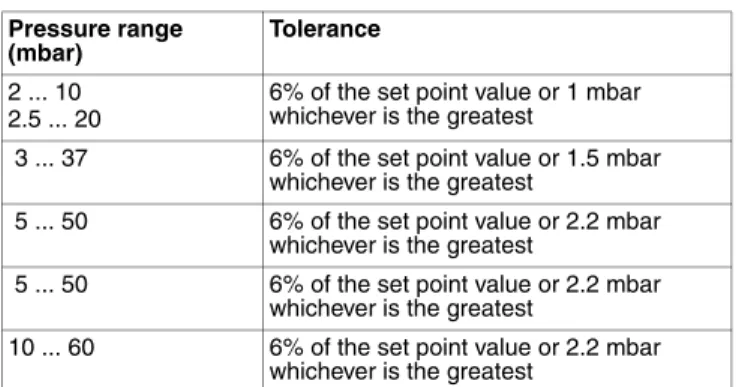
Table 4: Total set point shift Pressure range
(mbar)
Tolerance 2 ... 10
2.5 ... 20
6% of the set point value or 1 mbar whichever is the greatest
3 ... 37 6% of the set point value or 1.5 mbar whichever is the greatest
5 ... 50 6% of the set point value or 2.2 mbar whichever is the greatest
5 ... 50 6% of the set point value or 2.2 mbar whichever is the greatest
10 ... 60 6% of the set point value or 2.2 mbar whichever is the greatest
** For suffix T with throttle full open
*** In case of closed combustion chamber with negative
pressure, deadtime is 1.5 s 3 5 7 9 10 20 G 20/25 no 2.0*** 1.5 1.5 1.5 1.5 1.7 1.2 1.2 1.2 1.2 2.0 ... 4.0 2.5 ... 6.0 4.5 ... 7.5 6.5 ... 9.0 9.0 ... 15.0 3 5 7 9 10 yes 1.8*** 1.3 1.3 1.3 1.3 1.5 1.0 1.0 1.0 1.0 2.0 ... 3.5 3.0 ... 5.5 5.0 ... 7.0 7.0 ... 9.0 9.5 ...15.0 5 7 9 10 37 G 30/31 no 2.5 1.8 1.8 1.8 1.8 1.5 1.5 1.5 1.0 ... 4.5 2.5 ... 6.5 4.5 ... 8.0 7.5 ...14.5 5 7 9 10 yes 2.0 1.5 1.5 1.5 1.4 1.2 1.2 1.2 1.5 ... 4.0 3.0 ... 6.0 5.0 ... 7.5 8.0 ... 14.0 5 7 9 10 50 G 30/31 no 3.3 1.5 1.5 1.5 2.4 1.2 1.2 1.2 1.0 ... 4.5 2.5 ... 6.5 3.5 ... 8.0 6.5 ...14.5 5 7 9 10 yes 2.5 1.3 1.3 1.3 1.8 1.0 1.0 1.0 1.5 ... 4.0 2.5 ... 5.5 4.0 ... 7.5 7.5 ... 14.0
Mounting position
The Compact Automatic can be mounted 0 to 90 degrees in any direction from the upright position (from the position when the operators are on top).
Main gas connection
• Take care that dirt cannot enter the Compact Automatic during handling.
• Use a sound taper fitting with thread according to ISO 7-1 (BS 21) or a piece of new, properly reamed pipe, free from swarf.
• Do not thread or tighten the pipe or pipe fitting too far (see table below). Otherwise valve distortion and malfunction could result.
• Apply a moderate amount of good quality thread compound to the pipe or fitting only, leaving the two end threads bare. PTFE tape may be used as an alternative. • Ensure the gas flows in the same direction as the arrow on
the bottom of the Compact Automatic.
Pressure feedback connection
Warning
To avoid decreasing of performance of pressure regulator by pinching off the pressure feedback tubing, it is to be recommended to use a metal tubing.
Pilot gas connection at outlet side (if applicable)
• Square off the end of tubing and remove burrs. • Slip compression fitting over tubing.
• Insert tubing into Compact Automatic housing until it bottoms, slide fitting into place and turn finger tight.
• Use a wrench to tighten fitting about 11/2 turn beyond
finger tight to shear of the olive. Do not use jointing compound.
• Connect other end of tubing to pilot burner according to the manufacturer’s instructions.
CAUTION
Do not bend tubing at Compact Automatic after compression fitting has been tightened, as this may result in gas leakage at the connection.
Pilot gas connection at side outlet (if applicable)
The pilot outlet connection at the side is only applicable with a special flange.
solution any time work is done on a gas control.
Gas leak test
• Paint all pipe connections upstream of the gas control with with a rich soap and water solution.Bubbles indicate a gas leak.
• If a gas leak is detected, tighten the pipe connection. • Stand clear while lighting the main burner to prevent injury
caused from hidden gas leaks, which could cause flasback in the appliance vestibule. Light the main burner.
• With the main burner in operation, paint all pipe joints (including adapters) and gas control inlet and outlet with with a rich soap and water solution or an approved leak detection fluid.
• If another gas leak is detected, tighten adapter screws, joints and pipe connections.
• Replace the part if gas leak can not be stopped.
CAUTION
Keep soap and water solution away from electrical connections.
Electrical connection
CAUTION
Switch off power supply before making electrical connections.
Never jumper the terminals of low voltage Compact Automatic since this may burn out the room thermostat heat anticipator.
Take care that wiring is in accordance with local regulations.
Use lead wire which can withstand 105°C ambient. The electric on/off operator is provided with 6.3 mm quick connect terminals suitable for 6.3 mm receptacles (e.g. ”Series 250” AMP fasteners).
The electric on/off servo operator is provided with:
both 6.3 mm terminals suitable for 6.3 mm receptacles (e.g. ”Series 250” AMP fasteners) and screw terminals, or is provided with:
quick connect terminals suitable for 6.3 mm receptacles (e.g. ”Series 250” AMP fasteners) or for a female connector according to DIN 43650.
Wiring
Follow the instructions supplied by the appliance manufacturer.
Pipe size (inch) Max. length of pipe thread (mm)
1/
Adjustments must be made by qualified persons only. If the appliance manufacturer supplies checkout and/ or service and maintenance instructions carefully follow them. If these instructions are not provided then use the procedure outlined below.
CAUTION
To ensure a safe closing of the valves, it is essential that voltage over the terminals of both electric operators is reduced to 0 Volt.
Outlet pressure adjustment servo regulated versions (see page 32 or 36)
• Disconnect pressure feedback connection (if applicable) • Energize both electric operators in order to have gas input
to burner.
• Check gas input to the appliance using a clocking gas meter or alternatively a pressure gauge connected to the outlet pressure tap.
• Remove pressure regulator cap screw to expose pressure regulator adjustment screw.
• Slowly turn adjustment screw with a small screw driver until the burner pressure required is recorded on the pressure gauge. Turn adjustment screw clockwise to increase or counter-clockwise to decrease gas pressure to the burner.
• For non-regulating mode (LP gas) turn adjustment screw clockwise until it stops.
• Replace pressure regulator cap screw.
• Connect pressure feedback connection (if applicable).
• Energize both electric operators in order to have gas input to burner.
• Check input to the appliance using a clocking gas meter or alternatively a pressure gauge connected to the outlet pressure tap.
• Turn the flow adjustment screw with a screw driver either
way until the burner pressure required is recorded on the
pressure gauge.
Check of slow opening (SOFTLITE)
The SOFTLITE pressure is factory set.
Check burner performance at this pressure observing burner ignition and flame characteristics. Burner should ignite promptly and without flash back to orifice and all ports should remain lit. Cycle burner several times (wait 15 seconds between cycles to allow servo system to resume slow open action). Repeat check of slow opening after allowing the appliance to cool down.
Final checkout of the installation
Set appliance in operation after any adjustment and observe several complete cycles to ensure that all burner components function correctly.
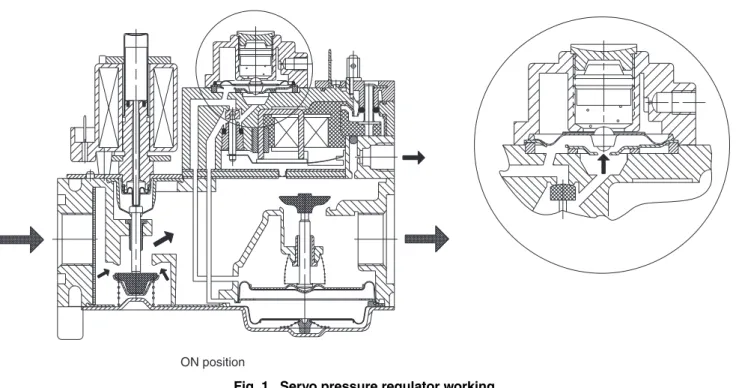
The heart of the system is the servo pressure regulator which consists of a pressure relief valve integrated in a regulator diaphragm which is fitted above and controls the main valve. When the direct on/off operator and servo on/off operator are energized, inlet gas flows through the servo orifice and through the open operator valve into the servo system and into the regulator. This servo gas moves the main valve diaphragm upwards enough to open the main valve. As soon as the main valve has opened, the outlet pressure generated by the Compact Automatic will be sensed by the regulator diaphragm via the feedback channel.
of the main valve accordingly. This means that a constant outlet pressure is maintained regardless of inlet pressure variations.
At shut down, the small volume of working gas in the regulator and in the diaphragm chamber is dumped into the main outlet chamber.
A reference pressure feedback connection further regulates the outlet pressure by compensating for differences in the air pressure in the combustion chamber and at the valve. If pressure regulation working is not needed, the regulator spring can be blocked by turning the adjustment screw down until it stops or the pressure regulation is removed. In these cases the full servo gas pressure opens the main valve as far as the pressure drop allows.
Fig. 1. Servo pressure regulator working
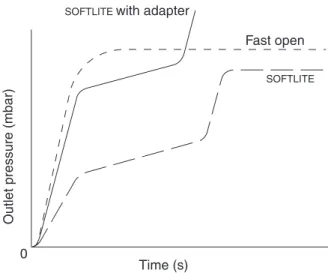
appliance combinations need a means of improving their ignition characteristics by providing quieter ignition and
reducing flame roll-out. The SOFTLITE mechanism achieves this
by changing the profile of the outlet pressure curve as shown in fig. 2.
An extra diaphragm and spring are inserted below the main diaphragm. When the electric servo operator valve is opened,
working gas enters the SOFTLITE module via the inlet orifice,
and is fed into the space between the diaphragms. Working gas pressure rapidly increases to a preset level, partially opening the main valve (See fig. 3.).
As soon as it reaches the start level it overcomes the SOFTLITE
spring pressure. The resultant move of the SOFTLITE
diaphragm inhibits the increase of working gas pressure.
Only when the SOFTLITE spring has been totally compressed
does the working gas pressure increase rapidly once again
until the full fire position is reached. Fig. 2. Opening characteristics
Fig. 3. Servo pressure regulation SOFTLITE models
Fast open
Time (s)
Outlet pressure (mbar)
0
SOFTLITE
SOFTLITE ON position,
SOFTLITE gas only, main valve partially open
SOFTLITE ON position, main valve open
Fig. 4. Throttle adjustment
Trottle closed Trottle open
and certified Quality System.
The quality system is described in the Honeywell Combustion Controls Center Quality Assurance Programme and its related operational procedures and instructions.
The quality system is approved by Gastec against certificate number 9.302/2.
The quality organisation is responsible for defining,
maintaining, improving and verification of the quality systems in the field of design, production process and field quality service.
Assembly processes are guided by work instructions. Patrol inspections form part of the assembly processes.
At the end of the assembly phase, all gas controls are leakage and performance tested/adjusted.
Assembly inspection is performed by employees of the quality control department, using their own equipment. All inspections (incoming and assembly) are performed by trained personel and according inspection procedures.
The servo operated main valve meets class J requirements in case of VR4601/VR8601 and VR4605/VR8605 and meets class C requirements in case of VR4615/VR8615.
A class J valve as mentioned in EN 161; 1997 is equal or better than a class D’ valve as mentioned in EN 297 and EN 483 and class D valves as mentined in other standards. According to bending stresses the Compact Automatic meets the highest requirements (group 2).
The pressure governor meets class B performance. Regarding electric safety, the Compact Automatic can be used in appliances according to European Standard for household electrical requirements EN 60335 series. The Compact Automatic also meets all Electro Magnetic Compatability standards for non-industrial appliances.
Compact Automatic meets more stringent requirements than laid down in the essential requirements stated in the directives and therefore meet the requirements in all EC and EFTA countries.
Details per O.S. number can be found in the Approvals List. In addition our controls have been certified by DIN-DVGW in Germany. The registration number specific for each O.S. number is mentioned on the label of the control.
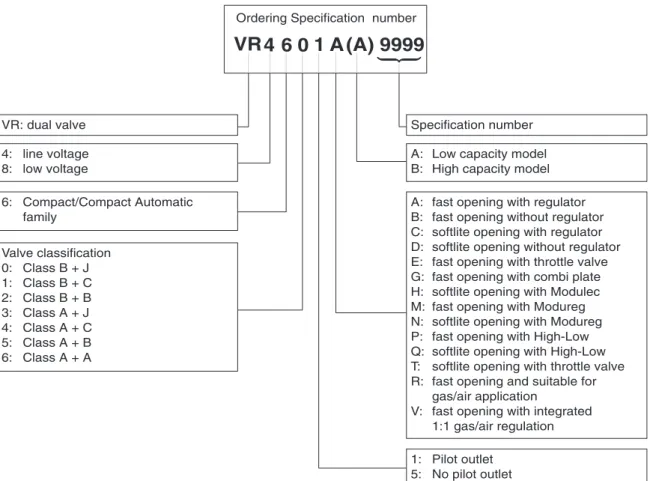
• Model number of Compact Automatic required: see fig. 6. • Inlet and outlet pipe sizes required: note pipe sizes
determines capacity.
• The correct pilot burner for the installation concerned: refer to Honeywell ignition products guide EN0R-0038. • Order numbers of replacement parts and accessories
required, i.e. flanges, compression fittings: see replacement parts/accessories.
accessories will be available under ”TRADELINE” label. Ask your wholesaler for details.
Fig. 5. Model number chart
VR 4 6 0
1
A (A) 9999
Ordering Specification number
Specification number A: Low capacity model B: High capacity model A: fast opening with regulator B: fast opening without regulator C: softlite opening with regulator D: softlite opening without regulator E: fast opening with throttle valve G: fast opening with combi plate H: softlite opening with Modulec M: fast opening with Modureg N: softlite opening with Modureg P: fast opening with High-Low Q: softlite opening with High-Low T: softlite opening with throttle valve R: fast opening and suitable for
gas/air application
V: fast opening with integrated 1:1 gas/air regulation VR: dual valve 4: line voltage 8: low voltage 6: Compact/Compact Automatic family Valve classification 0: Class B + J 1: Class B + C 2: Class B + B 3: Class A + J 4: Class A + C 5: Class A + B 6: Class A + A 1: Pilot outlet 5: No pilot outlet