private companies, development agencies, gov-ernment bodies and civil society actors. They combine the particular strengths and resources of each of the partners involved in order to con-tribute to poverty reduction and sustainable de-velopment. Development partnerships involving the private sector are viewed as particularly im-portant for achieving overarching poverty reduc-tion objectives such as the Millennium Develop-ment Goals (MDGs) and encouraging business to play a stronger development role.
In order to ensure that development partnerships endorse a focus on poverty reduction, GIZ has de-veloped a tool for identifying their potential and measuring and documenting their poverty im-pact which uses the Poverty Imim-pact Assessment (PIA) framework developed by the Development Assistance Committee (DAC) of the Organisation for Economic Cooperation and Development (OECD).1 This tool, and the experience and
knowl-edge gathered by development cooperation agen-cies in the field of impact assessment for partner-ships, has been used to investigate partnerships in the agricultural and health sectors of Ethiopia, Kenya and Tanzania.2
Purpose
This document provides a practical and user-friendly tool for poverty-oriented planning and re-porting of development partnerships. It has been developed to assist partnership managers to un-derstand the necessity and rationale for analysing poverty impacts and guide them through such an analysis. With the help of this tool, partnership
Chapter 1 provides an overview explaining what development partnerships are and why a poverty orientation is important, both generally and in particular relation to partnerships.
Chapter 2 sets out a 5-step process for analysing the poverty impact of a development partnership. The five steps include: studying the context; iden-tifying target groups; analysing transmission channels; assessing capabilities; and, checking contribution to the Millennium Development Goals (MDGs). Within each step, clarification is provided on the factor to be examined; the ration-ale for this; the particular areas that should be ex-amined; where relevant information may be ob-tained; and how this should be captured. Practi-cal tips are provided for addressing each step. The final section of the chapter gives information on how to prepare a summary and recommenda-tions. A checklist for development agency staff and business partners to ensure that their part-nerships incorporate poverty-related considera-tions is also provided.
Chapters 3 and 4 are intended for those interested in obtaining further details of how the 5-step pro-cess can be applied to development partnerships in the agricultural and health sectors. These exam-ples offer direction on how to strengthen poverty orientation in specific sectors by describing focus areas and effective approaches for poverty reduc-tion, as well as common constraints and problems.
Chapter 5 provides an overview of information sources used for developing this tool.
Foreword
Public–private partnerships, development partnerships, multi-sector partnerships, public– private dialogue, inclusive business models… global companies and state actors are increasingly working together in different partnership models. Donors are stepping up efforts to support such partnerships and create initiatives that serve public and private interests.
An important factor in the success of a partnership is its capacity to make a genuine contribution to poverty reduction. Which people and institutions actually benefit? How does the partnership impact on the poor and on the environment? What are the political and socio-cultural impli-cations? And does the partnership take adequate account of human rights?
On behalf of the German Federal Ministry for Economic Cooperation and Development (BMZ), the Deutsche Gesellschaft für Internationale Zusammenarbeit (GIZ) analysed 30 development partnerships in the health and agricultural sectors, to better understand their linkages with poverty reduction. The lessons learned have fed into this Poverty Impact Assessment tool for development partnerships.
This tool assists partnership practitioners in giving initiatives a pro-poor orientation. Working through the steps outlined will give you insights into the poverty-related aspects of your initia-tive and help you make decisions on which approaches work best. The tool can also be used to evaluate a partnership project in terms of its poverty impact.
We hope that partnership practitioners will find this tool useful. Our overall aim with this publication is to contribute towards increased poverty-orientation in partnerships between the public and the private sector.
Ellen Kallinowsky
Competence Centre Cooperation with the Private Sector Africa Department
Foreword 4
1 Setting the scene 7
1.1 What are development partnerships? 7
1.2 What is poverty in a development context? 7
1.3 Why analyse the poverty impact of development partnerships? 7
2 Analysing the poverty impact of development partnerships 9
2.1 The 5-step framework 9
Step 1: Studying the context 10
Step 2: Identifying target groups 12
Step 3: Analysing transmission channels 14
Step 4: Assessing capabilities 16
Step 5: Checking contribution to the MDGs 18
2.2 Concluding a Partnership Poverty Impact Assessment 20
3 Poverty-oriented planning and reporting in action: the agricultural sector 23
3.1 Partnerships in the agricultural sector 23
3.2 Identifying target groups 24
3.3 Analysing transmission channels 26
3.4 Assessing capabilities 28
3.5 Checking contribution to the MDGs 30
4 Poverty-oriented planning and reporting in action: the health sector 33
4.1 Partnerships in the health sector 33
4.2 Identifying target groups 34
4.3 Analysing transmission channels 36
4.4 Assessing capabilities 37
4.5 Checking contribution to the MDGs 39
partnerships?
Development partnerships are relationships be-tween diverse actors from the public, private and civil society sectors. These different partners work together in areas of mutual interest to reduce pover-ty in developing countries and support the achieve-ment of the Millennium Developachieve-ment Goals (MDGs). By sharing different resources partners may work together to target poor population groups direct-ly or indirectdirect-ly in order to foster economic growth and a sustainable environment. As a diversified and productive private sector can play an important development role, business involvement in such partnerships is particularly encouraged.
1.2 What is poverty in a development
context?
Germany’s development policy is centred on pov-erty reduction. In line with the World Bank, Ger-many classifies economic poverty as living on un-der $1.25 per day but uses a multidimensional definition of poverty as the basis for poverty re-duction strategies in five key areas: economic (in-come and assets), security (personal security and protection against hazards), human (health and education), political (voice and participation) and socio-cultural (discrimination). Furthermore, a human rights-based approach has been adopted in which particular attention is given to the poor, vulnerable and marginalised and their right to an adequate standard of living, physical and mental health, social security, and work. In view of this focus it is vital that the impact of development in-terventions for these groups is assessed and
moni-ed by poverty than men, an important cross-cut-ting factor in analysing poverty and vulnerability is gender equity. Another is environmental sus-tainability and the ability of individuals to man-age ecosystems that sustain their livelihoods.
1.3 Why analyse the poverty impact of
development partnerships?
To meet policy goals, development partnerships must provide adequate responses to the poverty sit-uation in the country, region or sector of interven-tion in which they are working. A poverty impact analysis (PIA) can assist all partners to strengthen poverty-oriented planning and results, as well as provide different stakeholders with information that will be of use for their work. As the private sec-tor plays a central role in development partner-ships, it is particularly important for them to under-stand why poverty reduction is central to develop-ment aims and how partnerships can contribute to this. Information and analysis from PIAs can:
YAssist policymakers to select the most appro-priate activities for achieving poverty reduc-tion goals such as the MDGs;
YEnsure that partnerships are harmonised with country development priorities;
YProvide better understanding of the positive and negative effects, and intended and unin-tended consequences, of partnerships for poor and vulnerable groups;
A poverty impact assessment (PIA) examines the extent to which a development project has, or will have, an impact on poverty reduction. In a devel-opment partnership a PIA can assist partners and other stakeholders to identify how far their activities will have a pro-poor impact, where im-provements in the partnership’s design might be required and what mitigation measures may be needed to address risks or negative impacts. A PIA can be carried out to support the planning and design of a partnership before it is conducted, or for reporting purposes during and after imple-mentation. An investigation of the poverty impact of development partnerships includes five inter-related steps.
steps requires, in order to:
YUnderstand what the step covers
YWhy it is important to consider this area
YWhat specific issues need to be examined
YWhere the information for this can be found
YHow the information can best be captured and presented.
At the end of each section, a series of tips are provided for further guidance.
Step 1
Studying the context
Step 2
Identifying target groups
Step 4
Step 3
Step 1: Studying the context
Step 1.1 What does the context include?
The context for a development partnership includes:
YThe geographical/historical/political/economic/ socio-cultural situation of the country, region or sector in which a partnership is working
YThe urgency of need among different target groups
YGovernment development policies
YLegal/regulatory frameworks that impact the partnership
YThe general situation of the private sector
YRelationships between different sectors
YThe nature and extent of previous collabora-tive activities to address poverty reduction.
Step 1.2 Why do we need to study the context?
In order to ensure a contextual “fit”, the design of a development partnership should incorporate an assessment of how the partnership makes connec-tions to national and sector plans, and activities to reduce poverty. It is also important to analyse which groups are the most poor and vulnerable and how they benefit from partnership activities.
Step 1.3 What should we consider?
A contextual analysis should provide information on:
YHow the focus of the partnership links to other economic, human, political, socio-cultural, protective dimensions of poverty in the coun-try and/or region
YWhich groups are the most poor and vulnerable and whether specific groups in a project zone are more affected by poverty and vulnerability than others e.g. women or ethnic minorities
YWhat the overall goals of policies and strate-gies are in the focus area of the partnership
YHow these policies and strategies aim to im-prove the situation of poor and vulnerable groups, with special reference to gender
YHow these policies and strategies intend to ad-dress issues of special concern for development partnerships e.g. legal frameworks, standards and controls, fiscal issues
YWhat role these policies and strategies attri-bute to the private sector
YWhether partnerships and multi-stakeholder approaches are promoted in policies and strategies, and if so how.
Step 1.4 Where can we find the relevant information?
Information for a partnership contextual analysis can be found from a variety of different sources. These include:
YPoverty Reduction Strategy Papers (PRSPs)
YUnited Nations Human Development reports
YNational Sector Plans, Policies, and Strategies
YGovernment polices and papers
YHuman Rights reports
YDemographic, Agricultural and Household surveys
YGender information
YDevelopment Agency websites
YPrivate Sector Strategies and papers
YNGO studies
Y Academic research
YNewspaper articles
contextual information?
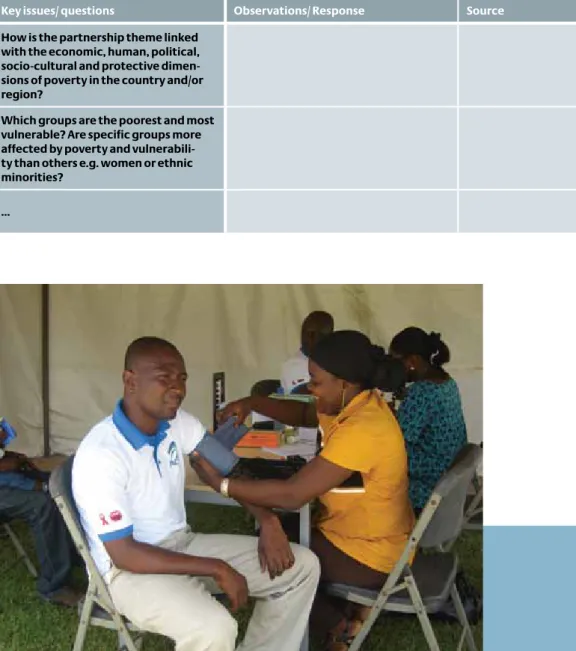
A simple table is a useful way to communicate in-formation about the partnership context (see table 1). Material can be presented by listing the key questions/issues identified in Step 1.3 above, and attributing observations or responses to each of them. It is important to ensure that sources are quoted so that findings can be easily accessed and verified.
the background section of the PIA.
Y Use the internet to gather information but en-sure that sources are clearly quoted and the date of access provided.
Y Always check for the most recent information by looking for updates on relevant surveys, reports and studies.
Table 1: Capturing contextual information
Key issues/ questions Observations/ Response Source
How is the partnership theme linked with the economic, human, political, socio-cultural and protective dimen-sions of poverty in the country and/or region?
Which groups are the poorest and most vulnerable? Are specific groups more affected by poverty and vulnerabili-ty than others e.g. women or ethnic minorities?
Step 2: Identifying target groups
Step 2.1 What are target groups?
Target groups are poor and vulnerable stakehold-ers who are the intended beneficiaries of partner-ship activities. In a development partnerpartner-ship stakeholders can be divided into three key groups:
YTarget groups who are the focus of the partner-ship project or programme
YImplementing partners who contribute re-sources and carry out concrete tasks for the partnership
YOther stakeholders who exert an influence upon the partnership, or are influenced by it
Step 2.2 Why do we need to identify target groups?
Clearly defining the poor and vulnerable target groups that are expected to benefit from a part-nership helps us to understand how the partner-ship can, or will, contribute to improving their sit-uation. As the poor and vulnerable do not com-pose a homogenous group and differ according to factors such as gender, age, urban/rural back-ground, religion and culture, etc. it is essential to clearly articulate which target groups a partner-ship is working with, and why. Careful target group identification assists in ensuring an ade-quate understanding the specific characteristics, needs, constraints and prospects of particular poor and vulnerable groups. At the same time im-plementing partners can assess how far their ap-proach is oriented towards poverty reduction.
Step 2.3 How do we identify target groups?
In order to ensure a clear poverty orientation in project planning and reporting, it is helpful to dis-tinguish between target groups, implementing partners and other stakeholders in different types of partnerships (see table 2).
Because stakeholder interactions can have both positive and negative impacts on the poverty ori-entation of a partnership, it is also important to look at:
YThe institutional context that governs relation-ships between target groups, business part-ners, the government, NGOs, faith-based or-ganisations, and other relevant stakeholders.
YHow stakeholders interact and how far their efforts to enhance the poverty orientation of the partnership are complementary.
YThe formal and informal factors that support or hinder stakeholder cooperation in the im-plementation of a pro-poor agenda.
Step 2.4 Where do we find the relevant information?
Stakeholder information may be drawn from con-textual studies as well as surveys, interviews and questionnaires. Civil society organisations focus-sing on poverty reduction and human rights are often particularly useful source for gathering data on target groups.
Table 2: Identifying partnership target groups and other stakeholders
Target groups Implementing partners Other stakeholders
Table 3: Analysing partnership target groups
Target groups Main roles and activities Interests Factors that may hinder access to partnership benefits
Possible ways of addressing challenges
information?
Information on target groups can be organised in table form (see table 3). As well as capturing the main roles, activities, interests and particular needs of different target groups, we should also identify factors that may affect their interest, in-volvement or access to benefits from the partner-ship; and suggest possible ways of addressing these impediments by reducing challenges (mit-igation measures) and/or strengthening and rein-forcing their position.
Businesses working in partnership can also en-sure their own pro-poor stance and respective constraints by asking the following questions:
YHave we considered all potential target groups in the design of the partnership?
YDo we understand their situation and roles, as well as the constraints that may hinder them from accessing partnership benefits?
YDo our business activities contribute to respect for the human rights of our workforce e.g. the right of employees to decent working condi-tions?
YDoes our business plan include resources and activities to put workplace safety and/or social protection schemes into practice?
YDo our managers accept responsibility for im-proving the living conditions of poor stake-holder groups that are directly or indirectly affected by our business?
been considered.
YAnalyse the differences among target groups carefully, especially in relation to levels of poverty and gender.
YCheck the formal and informal interconnec-tions between different players.
YDescribe the main benefits expected for target groups using available baseline information, plausible projections, probabilities and risks.
YInclude main results for the target groups and institutional analyses in the project proposal under the heading of “description of the part-nership”.
YSpecify mitigation measures for factors that may hinder access of target groups to partner-ship benefits.
YOutline contributions from each group of stakeholders under separate headings.
Step 3: Analysing transmission channels
Step 3.1 What are transmission channels?
Transmission channels are sets of cause-effect relationships or paths through which a develop-ment intervention generates change. In the case of partnerships, transmission channels explore the changes that are triggered for stakeholders as a consequence of a results chain of partnership inputs, outputs and outcomes.
Step 3.2 Why do we need to analyse transmission channels?
Transmission channels are important to explore because they help us to understand where, and how, a partnership has, or will have, an impact on the most poor and vulnerable. To ensure a poverty orientation in the analysis of transmission chan-nels poor and vulnerable groups must be explicit-ly mentioned. When planning and reporting on development partnerships these groups should be specifically highlighted in project objectives, activ-ities, and results, with the formulation of appropri-ate indicators to measure the nature and degree of the impact of the initiative on their situation.
Step 3.3 What transmission channels do we need to consider?
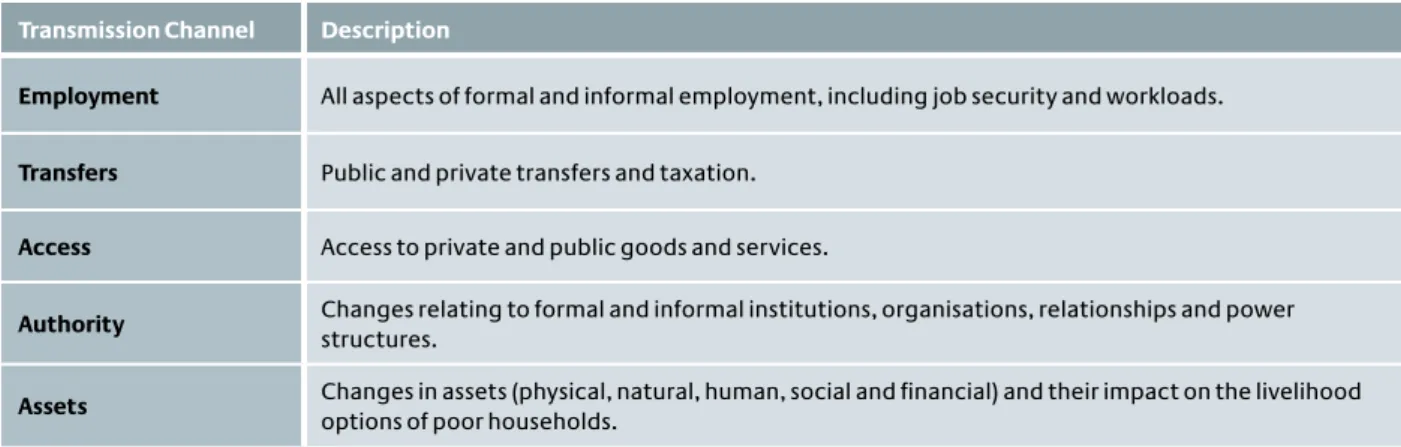
The six transmission channels identified in table 4 should be considered. Within each channel we can assess whether impacts are expected in the short or medium-term, and whether the expected impact is highly probable or if it may be affected by external factors.
Step 3.4 Where do we find the relevant information?
Information on transmission channels can be gathered from analysis of interviews with target groups, implementing partners and other stake-holders. In order to ensure a clear focus it is help-ful to subdivide transmission channels into de-tailed categories relating to a specific partner-ship intervention.
Step 3.5 How do we capture information on transmission channels?
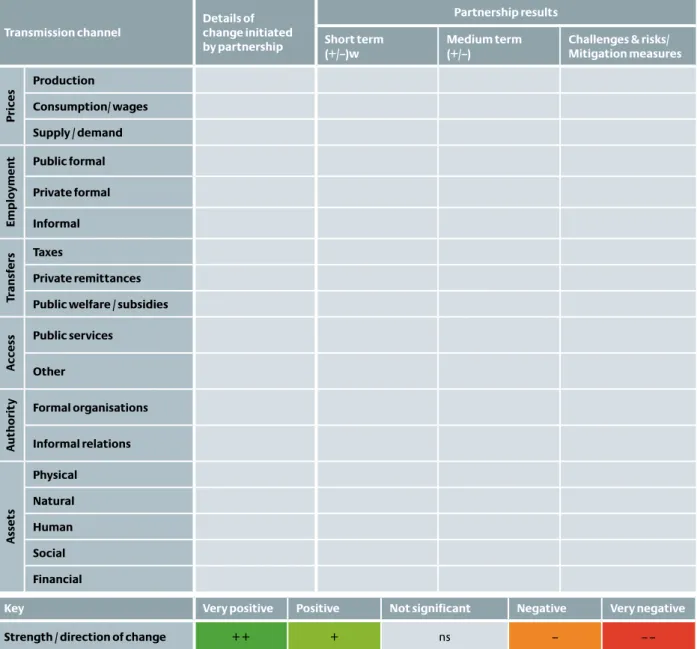
Information on transmission channels can be presented by analysing the short and medium-term effects of partnerships on relevant transmis-sion channel categories in a table form (see table 5). Such an analysis also highlights potential risks and possible measures for addressing these.
Table 4: Defining transmission channels
Transmission Channel Description
Employment All aspects of formal and informal employment, including job security and workloads. Transfers Public and private transfers and taxation.
Access Access to private and public goods and services.
Authority Changes relating to formal and informal institutions, organisations, relationships and power structures.
Assets Changes in assets (physical, natural, human, social and financial) and their impact on the livelihood options of poor households.
founded data and estimates to differentiate clearly between poor and non-poor groups, men and women, and other relevant categories.
Y Focus on the main expected and/or observed di-rect short and medium term impacts, in particu-lar where verifiable evidence is easily available.
YAvoid assumptions that cannot be observed or verified using simple and affordable monitor-ing tools.
YCarefully analyse risks and suggest measures that might be taken to address these.
Table 5: Analysis of transmission channels
Transmission channel Details of change initiated by partnership Partnership results Short term (+/–)w Medium term (+/–)
Challenges & risks/ Mitigation measures Prices Production Consumption/ wages Supply / demand Employmen t Public formal Private formal Informal Transfers Taxes Private remittances Public welfare / subsidies
Access
Public services Other
Step 4: Assessing capabilities
Step 4.1 What are capabilities?
Capabilities are the abilities of, and opportunities for, an individual to improve their quality of life and obtain development outcomes. Understand-ing how far individuals have the freedom to choose and what the limitations to their choices might be due to factors such as age, gender, en-vironmental, social and resource distribution factors, is central to assessing capabilities.
Step 4.2 Why do we need to assess capabilities?
It is important to conduct an assessment of capabil-ities prior to entering into a partnership in order to design concrete activities that will contribute to improving them. Understanding how partnerships influence target group capabilities can assist us to define partnership results more realistically and use relevant measures of progress (indicators) for them. We can thus ensure that the partnership strengthens the ability of target groups to provide for their needs and improve their conditions.
Step 4.3 What capabilities do we need to consider?
Capabilities can be divided into five key areas (see table 7).
Step 4.4 Where do we find the relevant information?
Data on capability changes can be obtained by analysing responses to questions in interviews and surveys, as well as reviews or reports.
Step 4.5 How do we capture information on capabilities?
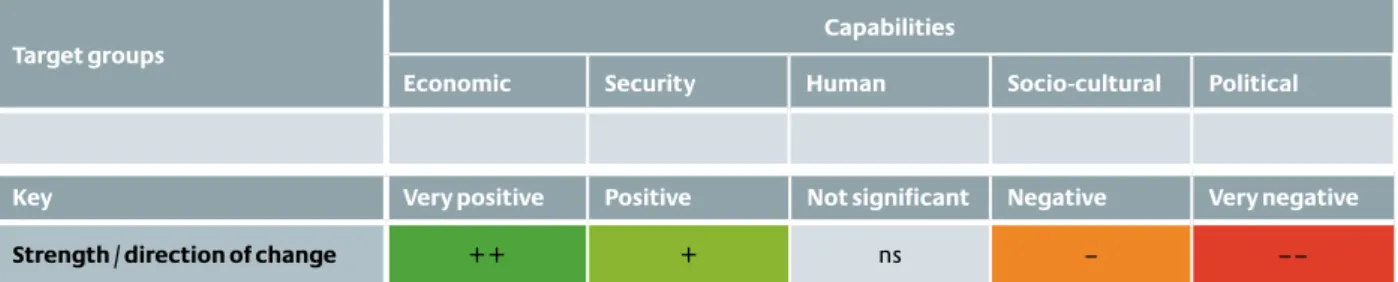
Expected and/or observed changes in target group capabilities can be organised in a table structure (see table 6). This form of summary should take into account all relevant target groups, where possible differentiated by gender, and briefly outline changes in their capabilities induced by the partnership. These changes should be measurable in terms of both quantity and quality.
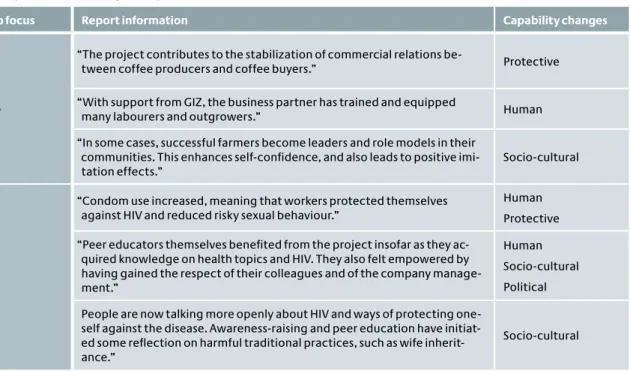
An ex-post assessment of capabilities can be con-ducted by drawing on material gathered in re-ports. Table 8 shows how quotes from GIZ reports have been used for this purpose.
Table 6: Defining capabilities
Capability Description
Economic The ability to earn an income, to consume and to have assets
Human The ability to access health, education, nutrition, clean water and shelter Political The ability to claim human rights, express opinions and exert influence Socio-cultural The ability to participate as a valued member of a community
Protective The ability to withstand economic and external shocks, to reduce insecurity and vulnerability.
Table 7: Analysis of change impact concerning capabilities and target groups
Target groups Capabilities
Economic Security Human Socio-cultural Political
Key Very positive Positive Not significant Negative Very negative
of poor or vulnerable groups as a result of the partnership are unlikely to be uniform.
Y Do not speculate on possible changes in capabilities if data is unreliable or absent.
Y Suggest ways in which data gaps and weak-nesses may be improved.
Y Always take the broader context into account so that “winners” and “losers” are identified in relation to market distortions, crowding-out effects, transfer of workloads or increased price fluctuations which may create inequities in terms of income, security and other factors, and lead to social and political conflict.
Y Monitoring and reporting should contribute on a continuous basis to the identification of risks/negative effects and the introduction of appropriate mitigation measures.
Table 8: Using reports to assess changes in capabilities
Partnership focus Report information Capability changes
Agriculture
“The project contributes to the stabilization of commercial relations
be-tween coffee producers and coffee buyers.” Protective
“With support from GIZ, the business partner has trained and equipped
many labourers and outgrowers.” Human
Step 5.1 What are the MDGs?
The Millennium Development Goals (MDGs) are a set of comprehensive development goals adopted by world leaders in 2000 in order to work towards securing peace, development and poverty reduc-tion, environmental protecreduc-tion, and the promo-tion of human rights, democracy and good govern-ance. A core principle of the MDGs is taking joint responsibility for halving global poverty by 2015.
Step 5.2 Why do we need to check partnership contributions to the MDGs?
The MDGs provide a common framework for as-sessing the needs of the most poor and vulnerable by strategically addressing disparities and in-equalities. As well as meeting policy goals, check-ing whether a partnership is meetcheck-ing MDG tar-gets can help to ensure coordinated responses to poverty and the targeting of resources where they are most needed.
Step 5.3 Which MDGs should we consider?
The MDGs cover eight key areas:
MDG 1 Eradicate extreme poverty and hunger MDG 2 Achieve universal primary education MDG 3 Promote gender equality and empower
women
MDG 4 Reduce child mortality MDG 5 Improve maternal health
MDG 6 Combat HIV/AIDS, malaria and other
diseases
MDG 7 Ensure environmental sustainability MDG 8 Develop a global partnership for
devel-opment
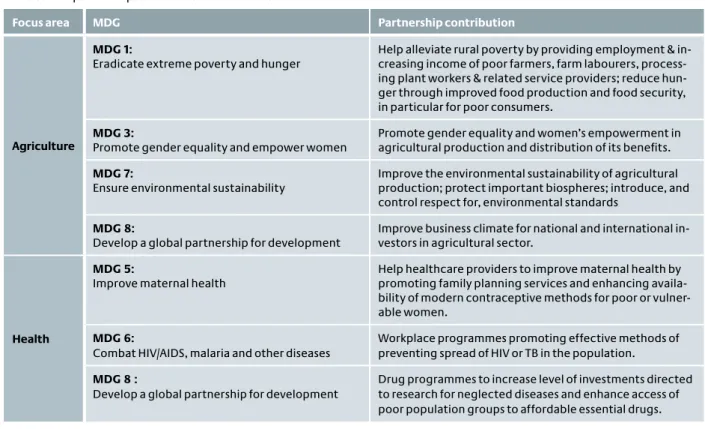
A partnership’s focus areas will determine where it can best contribute to the achievement of MDG targets. The example below outlines where agri-cultural and health partnerships can make a con-tribution.
Table 9: How partnerships can contribute to the MDGs
Focus area MDG Partnership contribution
Agriculture
MDG 1:
Eradicate extreme poverty and hunger Help alleviate rural poverty by providing employment & in-creasing income of poor farmers, farm labourers, process-ing plant workers & related service providers; reduce hun-ger through improved food production and food security, in particular for poor consumers.
MDG 3:
Promote gender equality and empower women Promote gender equality and women’s empowerment in agricultural production and distribution of its benefits. MDG 7:
Ensure environmental sustainability Improve the environmental sustainability of agricultural production; protect important biospheres; introduce, and control respect for, environmental standards
MDG 8:
Develop a global partnership for development Improve business climate for national and international in-vestors in agricultural sector.
Health
MDG 5:
Improve maternal health
Help healthcare providers to improve maternal health by promoting family planning services and enhancing availa-bility of modern contraceptive methods for poor or vulner-able women.
MDG 6:
Combat HIV/AIDS, malaria and other diseases
Workplace programmes promoting effective methods of preventing spread of HIV or TB in the population. MDG 8 :
Develop a global partnership for development
Drug programmes to increase level of investments directed to research for neglected diseases and enhance access of poor population groups to affordable essential drugs.
to achieving other pro-poor growth and human rights policy goals by:
YEnsuring the active participation of poor and vulnerable groups in the planning, implemtation and monitoring of partnerships, and en-couraging their participation in benefits from these interventions.
YReducing ethnic, racial and gender-based dis-crimination, discouraging and abolishing child labour, facilitating access to health and educational services and decent work, and pro-moting corporate social responsibility.
Step 5.4 How do we capture information on partnership contributions to MDGs?
Analysis of how far partnership impacts are meet-ing MDG targets may be presented in a simple ta-ble format, taking short and medium effects into account. The quality of the data used to make the assessment should be carefully considered.
focus on MDGs related directly to the partner-ship’s focus.
Y Use poverty data with direct relevance to spe-cific MDG targets and indicators.
Y Remember to take issues of equity (income dis-tribution etc.), risk management (conflict pre-vention etc.) and good economic governance (e.g. prevention of corruption) into account, whenever appropriate.
2.2 Concluding a Partnership
Poverty Impact Assessment
Summary and recommendations
Following completion of the 5-step PIA analysis, a summary and recommendations are required. This information will provide decision-makers and partnership practitioners with a clear under-standing of a partnership’s purpose and the extent to which it is likely to meet poverty-related goals. The summary should highlight the main points that emerge from each of the 5 steps and include:
YA short explanation of the partnership type and focus area
YPartnership target groups
YSelf-assessments of business partner/s
YMain partnership benefits
YKey risks / potential losers and proposed measures to address these
YAn assessment of the data and analysis used with identification of main gaps or difficulties
YIssues to be included in the monitoring of the partnership
YRecommendations on whether or not to start or continue a partnership with comment on areas requiring particular attention in relation to addressing poor and vulnerable groups.
Partner checklists
The following checklists can be used by partner-ship managers and business partners to assist analysis of overarching findings.
For partnership managers
YAre partnership objectives well-aligned with those of partner governments, in particular with regard to poverty reduction and achieve-ment of the MDGs?
YHave past experiences and lessons in similar projects been taken into consideration, in par-ticular with regard to reducing poverty and vulnerability?
YHave potential synergies with other relevant planned or ongoing donor-sponsored projects and programmes, both in the partner country and elsewhere, been taken into account?
YAre the roles and interests of all relevant stake-holders (target groups, business partners, and other stakeholders) sufficiently well-defined and understood?
YHas the potential for cooperation with persons and institutions with specific, poverty-relevant knowledge (e.g. civil society groups, social workers, research institutes etc.) been taken into account?
YHave the project’s possible positive and nega-tive effects in the broader context (e.g. imita-tion, crowding out, market distorimita-tion, price fluctuation) been taken into account?
YHave the main cross-cutting issues of devel-opment cooperation (gender equity, environ-ment, HIV/AIDS, human rights etc.) been taken into account at all levels of project planning, implementation and reporting?
YHow can information provided by business part-ners and other stakeholders be collated and utilised for project monitoring and evaluation?
sufficiently well focused on the partnership’s pro-poor outputs, outcomes and impacts?
YAre adequate resources available to track, verify and assess the partnership’s impacts on target groups?
For business partners
YIs the relation between the achievement of business objectives and the partnership’s pov-erty orientation sufficiently well-understood and accepted?
YAre the roles and interests of target groups and other stakeholders sufficiently well-defined, understood and compatible with envisaged business objectives?
YDoes the partnership address all potential target groups and understand their situation, roles and constraints? Does the partnership suggest mitigation measures where these groups face specific constraints, challenges and risks?
der-differentiated information gathering, data analysis and communication, with special ref-erence to the situation of target groups and the development of their capabilities?
YDo mechanisms exist in the business plan, or the context for its implementation, that may prevent the partnership from realising its full potential contribution to poverty reduction? If so, what measures may be undertaken to en-hance the partnership’s poverty impacts?
YIs communication with other partners regular, efficient and effective in the sense of facilitat-ing information-sharfacilitat-ing, joint project steerfacilitat-ing, and joint decision-making? Do communication procedures support measures that enhance the project’s poverty orientation?
YHow might lessons from the partnership be used to improve a business poverty orientation in the medium and long-term?
plementation of the 5-step process by looking at its application in the agricultural sector. Develop-ment partnerships in this sector have been the subject of recent study in East Africa and provide important insights into how collaborative initia-tives in specific sectors can strengthen a poverty orientation. The chapter includes information on the focus areas of agricultural sector partner-ships, examples of how the tool can be applied to partnership planning and reporting, and guid-ance on how difficulties can be identified and addressed.
the agricultural sector
Most of the poor and vulnerable in developing countries live and work in rural areas and rely on agriculture to make a living. Developing coun-tries are increasingly affected by climate change, the unsustainable exploitation of natural resourc-es and, in some casresourc-es, violent conflict, all of which contribute to the movement of populations away from rural areas. Rural development and efforts to support the sustainable production of raw ma-terials alongside the promotion of environmental conservation and climate protection is thus cen-tral to poverty reduction.
The following table (table 10) provides a brief over-view of the different types of development part-nerships promoted in the agricultural sector and their potential benefits for project partners, and poor and vulnerable groups.
Table 10: Agricultural partnership focus areas
Partnership focus Description
Support to cooperative
farming YY Supporting better negotiation powers for producers to purchase farm inputs and sell farm products Expansion in use of equipment, storage, processing and training
Y Empowerment visàvis public authorities and other stakeholders
Y Access to better information for marginal farmers
Support to outgrowers Y Small and mediumscale farmers supply part of their production to nearby largescale farm opera-tions, diversifying their knowledge and production, in many cases per contractual arrangement.
Y Largescale units expand their output, while poor smallscale farmers and casual labourers benefit
from additional income and employment. Introduction of new,
innovative products YY Diversification of farm outputs leading to less dependence on individual farm products Stabilisation of income and employment, in some cases for unskilled (poor) labour as well. Promotion of contract
3.2 Identifying target groups
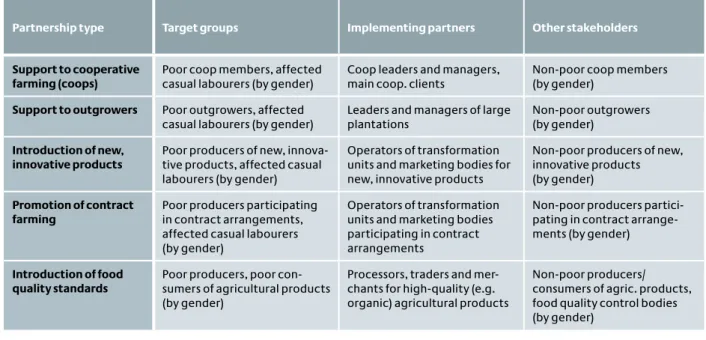
Information on the identification and analysis of target groups and other stakeholders in agricultur-al sector partnerships is provided below (table 11). Table 11: Agriculture sector partnership stakeholders
Partnership type Target groups Implementing partners Other stakeholders
Support to cooperative
farming (coops) Poor coop members, affected casual labourers (by gender) Coop leaders and managers, main coop. clients Non-poor coop members (by gender) Support to outgrowers Poor outgrowers, affected
casual labourers (by gender)
Leaders and managers of large plantations
Non-poor outgrowers (by gender)
Introduction of new,
innovative products Poor producers of new, innova-tive products, affected casual labourers (by gender)
Operators of transformation units and marketing bodies for new, innovative products
Non-poor producers of new, innovative products (by gender)
Promotion of contract
farming Poor producers participating in contract arrangements, affected casual labourers (by gender)
Operators of transformation units and marketing bodies participating in contract arrangements
Non-poor producers partici-pating in contract arrange-ments (by gender) Introduction of food
quality standards Poor producers, poor con-sumers of agricultural products (by gender)
Processors, traders and mer-chants for high-quality (e.g. organic) agricultural products
Non-poor producers/ consumers of agric. products, food quality control bodies (by gender)
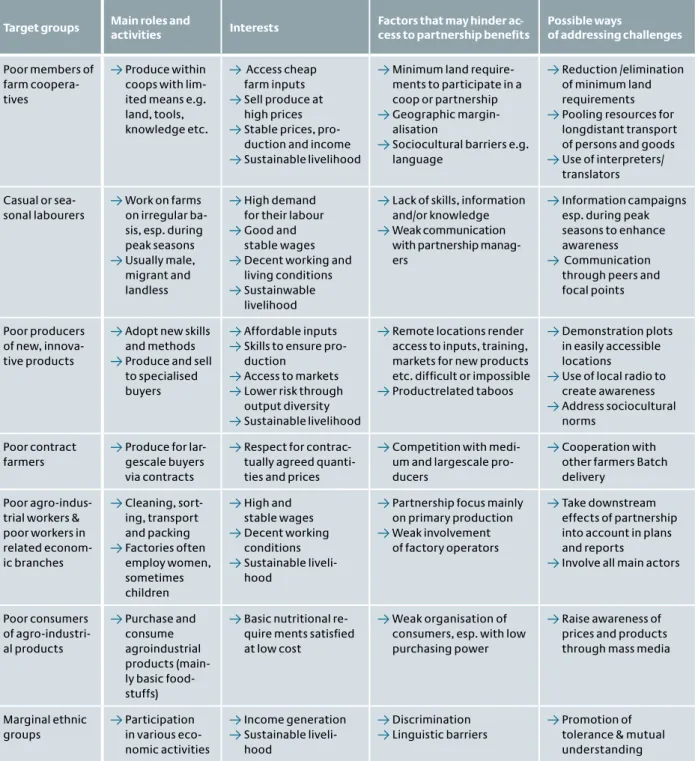
target groups in agricultural partnerships are presented below (table 12). The table also high-lights factors that may hinder target group par-ticipation in a partnership with suggestions for addressing these challenges.
Table 12: Target group analysis for an agricultural sector partnership
Target groups Main roles and activities Interests Factors that may hinder ac-cess to partnership benefits Possible ways of addressing challenges
Poor members of farm coopera-tives
Y Produce within
coops with lim-ited means e.g. land, tools, knowledge etc. Y Access cheap farm inputs YSell produce at high prices
YStable prices,
pro-duction and income
YSustainable livelihood
YMinimum land
require-ments to participate in a coop or partnership YGeographic margin-alisation
YSociocultural barriers e.g.
language YReduction /elimination of minimum land requirements
YPooling resources for
longdistant transport of persons and goods
YUse of interpreters/ translators Casual or sea-sonal labourers YWork on farms on irregular ba-sis, esp. during peak seasons YUsually male, migrant and landless YHigh demand
for their labour
YGood and
stable wages
YDecent working and
living conditions
YSustainwable
livelihood
YLack of skills, information
and/or knowledge
YWeak communication
with partnership manag-ers
YInformation campaigns
esp. during peak seasons to enhance awareness
Y Communication
through peers and focal points Poor producers
of new, innova-tive products
YAdopt new skills
and methods
YProduce and sell
to specialised buyers
YAffordable inputs
YSkills to ensure
pro-duction
YAccess to markets
YLower risk through
output diversity
YSustainable livelihood
YRemote locations render
access to inputs, training, markets for new products etc. difficult or impossible
YProductrelated taboos YDemonstration plots in easily accessible locations
YUse of local radio to
create awareness YAddress sociocultural norms Poor contract farmers
YProduce for
lar-gescale buyers via contracts
YRespect for
contrac-tually agreed quanti-ties and prices
YCompetition with
medi-um and largescale pro-ducers
YCooperation with
other farmers Batch delivery
Poor agro-indus-trial workers & poor workers in YCleaning, sort-ing, transport and packing YHigh and stable wages YDecent working
YPartnership focus mainly
on primary production YWeak involvement YTake downstream effects of partnership into account in plans
intervention, including a summary assessment of the overall impact, is usually sufficient for analys-ing transmission channels (see table 13).
3.3 Analysing transmission channels
A table describing the short and medium term effects of the planned or ongoing partnership
Table 13: Analysis of transmission channels in an agricultural sector partnership
Trans-mission
channel Details of change initiated by partnership
Partnership results Short term (+/–) Medium term (+/–)
Challenges & risks/ Mitigation measures
Prices
Production
Increased production and income, better quality produce, stable sales, healthy environment Small-scale farmers, casual farm labourers and unskilled labourers in related sub-sectors (input suppliers, packaging and transport services etc.) benefit from measures to enhance efficiency of farm production e.g. through drip irrigation, as well as the volume and quality of agricultural pro-duce, e.g. through advising and training small and medium-scale farmers in quality and safety standards.
Lower operational costs and/or higher prices for farm produce can translate into higher income for both small-scale farmers and labourers. Introduction of new and innovative supply chains can provide significant opportunities to poor stakeholders, even if they are unskilled and with-out land.
+ + +
Minimum land requirements for par-ticipation in contract farming schemes may lead to the exclusion of small-scale farmers with very limited land.
Improved income accruing to poor stakeholders is at risk if they do not have access to financial services to secure their savings.
Introduction of new supply chains can be highly dependent on a few individ-uals with good access to know-how and markets, with consequential risks to the sustainability of supply chain. Effects on workloads of men and women, as well as a lack of participa-tion of women in training, are some-times pointed out, but to date have not been systematically documented or analysed.
Supply
/
demand
Contractual arrangements between buyers and producers are facilitated, negotiated.
Better quality fresh produce available on domestic markets esp. supermarkets.
+ + +
Employmen
t
Public formal ns ns
Net effects on income and employ-ment will be reduced if competing farmers and/or operators in related sub-sectors are crowded out of market. Information on crowding out effects is difficult to gather and assess. Gender differences in employment impacts are mentioned in some cases, but require more systematic docu-mentation and assessment. Technical advisors and inspectors do not necessarily stem from poor households.
Private
formal
Quality standards give rise to new jobs for technical advisors and inspectors and some farmer groups pay salaries of technical advisors and inspectors.
Technical advisors and inspectors receive further training to improve their performance.
+ +
Informal
Contractual arrangements can lead to more sta-bility and sometimes increased demand for farm produce from small-scale farmers.
On medium and large-scales farms, such arrange-ments can stabilise and enhance demand for casual labourers.
In both cases, demand for unskilled labourers in related sub-sectors stands to increase.
Transfers
poor require political commitment.
Public welfare
/
subsidies
In some cases public sector staff participates in training
+ ns
The outcomes of training have not been systematically investigated
Access
Public ser
-vices
Increased income can facilitate access to most
public services ns +
Public services need to be available in respective regions but this may not be the case in remote areas.
Other
Development and provision of technical advice and inspection within producer groups lead to improved access to up-to-date technical know-how on standards etc. for farmers.
Through improved organisation and marketing know-how, small-scale farmers can gain better access to both safe, high quality farm inputs and local and international markets.
Access to information for production and market-ing is a key benefit to all participatmarket-ing stakeholders. Higher income from farming can facilitate access to primary health and education services.
+ +
Information on household expenditure among small-scale farmers, casual (sometimes migrant) labourers and un-skilled labourers in related areas tends to be weak.
Use of farm income for schooling, health, investment etc. is difficult to verify. Efforts to protect environment may lead to reduced access to land, with negative consequences for farm production and income.
Public health and schooling services should be available in respective re-gions.
Authorit
y
Formal
organisations
Creation and promotion of farmers’ groups and cooperatives for training, production, marketing. Through organisation into producer groups and cooperative entities, farmers have more influ-ence and acquire a stronger voice in both business and public administration.
+ + +
Benefits from having a “stronger voice” may be difficult to observe and assess at project level.
Other ns ns
Physi
-cal
Enhanced income can translate into additional savings and/or investments. Participation in training might improve tools and infrastructure.
ns +
Use of additional income in poor stake-holder households for purposes of edu-cation, health care, savings (financial assets) or investment e.g. housing (physical assets) is difficult to verify Business partner promotes domestic standards
A summary overview of expected or observed changes in target group capabilities is provided in table 14. This analysis takes all target groups into account, where possible differentiated by gender, and briefly describes variations in their capabilities as a result of the partnership.
3.4 Assessing capabilities
The following tables demonstrate how planning and reporting on development partnerships can assess capabilities and how changes in capabili-ties as a result of agriculture sector partnerships can be analysed.
Table 14: Analysis of capabilities in an agricultural sector partnership
Target groups Capabilities
Economic Security Human Socio-cultural Political
Poor members of farm cooperatives
Increased come, in-creased assets
More stable
in-come, savings Improved tech-nical and or-ganisational skills
More interac-tion with other coop members
More voice, influence through the coop
Casual or seasonal labourers Increased
in-come, increa-sed number of working days / year Working days spread more evenly through the year Enhanced tech-nical skills through train-ing
More stable so-cial relations within the mi-grant commu-nity
Not significant
Poor producers of new, innovative products Increased income, increased assets More diversified production, less risk Acquisition and use of new skills, tech-niques Recognition of pioneer achievements (role models) Access to tax exemptions, subsidies, pub-lic support
Poor contract farmers Increased
income, increased assets More stable commercial relations Acquisition of new skills esp. to ensure re-quired quantity and quality
More interac-tion with other contract farm-ers Improved ne-gotiating pow-er through group con-tracts Poor agro-industrial workers
and poor workers in other related economic branches Income gener-ation through forward and backward linkages More stable supply and de-mand within agro-industrial value chain Improved tech-nical skills through train-ing, awareness of own human rights Enhanced rec-ognition of workers’ needs, includ-ing specific needs of wom-en Enhanced worker em-powerment, esp. for female workers Poor consumers of agro-industrial products Better access to food, lower food prices, higher quality food Increased food security, reduced nutri-tional deficits leading to illness More aware-ness of food quality (esp. among women) via media cam-paigns
Not significant
Not significant
Marginal ethnic groups Increased
income and employment More stable livelihood Improved tech-nical skills through train-ing, awareness of own human rights Improved so-cial integra-tion, less dis-crimination
Key Very positive Positive Not significant Negative Very negative
explore how the outputs, outcomes and impacts induced by a partnership have changed target group capabilities. The final example illustrates how poverty-oriented planning and reporting can draw attention to possible negative impacts on poor and vulnerable groups, and ensure that mitigation measures are adopted to address this. Table 15: Using reports to assess capability changes
Report information Capability changes
“The economic capabilities of small-scale organic coffee farmers in the region have been enhanced through the project. Up- and downstream economic actors have also profited from the partnership. This enhances income and financial consumption and savings in most segments of the organic coffee supply chain.”
Economic
“The project contributes to the stabilization of commercial relations between coffee producers and coffee buyers.”
Protective “The ability to use agro-chemical products properly can help farmers to respond to crop diseases
quick-ly, efficiently and effectively. As a consequence, their vulnerability to disease-related crop failure can be reduced.”
Protective
“With support from GIZ, the business partner has trained and equipped many labourers and outgrowers.” Human
“In some cases, successful farmers become leaders and role models in their communities. This
enhanc-es self-confidence, and also leads to positive imitation effects.” Socio-cultural
“Through the organisation of farmers into producers’ groups and larger cooperative entities, the participating farmers are less vulnerable to pressure and malpractices from the suppliers’ and buyers’ sides. They are also better able to express their interests with one voice vis-à-vis Government, local administration and potential national and international partners.”
Protective Political
“The remote farmers and the poorest farmers living in the poverty pockets will probably lack labour ca-pacity and financial resources, may be marginalized by extension services if not especially targeted, and have less access to information and better prices.”
3.5 Checking contribution to the MDGs
Partnerships in the agricultural sector will gener-ally contribute to MDGs 1, 3, 7 and 8, with a strong emphasis on MDG 1. Project plans and progress reports should thus focus on these MDGs, draw-ing on poverty data, e.g. proportion of the popula-tion living below the poverty line, prevalence of underweight children in the project area, with a direct relevance for MDG targets and indicators (see table 16).
Table 16: How agricultural sector partnerships can contribute to MDGs
MDG Partnership contribution
MDG 1:
Eradicate extreme poverty and hunger Y Help alleviate rural poverty by providing employment and increasing income of poor farmers, farm labourers, processing plant workers and related service providers
YReduce hunger through improved food production and food security,
in particular for poor consumers MDG 3:
Promote gender equality and empower women Y Promote gender equality and women’s empowerment in agricultural production and distribution of its benefits MDG 7:
Ensure environmental sustainability YY Improve the environmental sustainability of agricultural productionProtect important biospheres
YIntroduce and control respect for environmental standards
MDG 8:
implementation of the 5-step process by looking at its application in the health sector. Develop-ment partnerships in this sector have been the subject of recent study in East Africa and provide important insights into how collaborative initia-tives in specific sectors can strengthen a poverty orientation. The chapter includes information on the focus areas of health sector partnerships, ex-amples of how the tool can be applied to partner-ship planning and reporting, and guidance on how difficulties can be identified and addressed.
German development policy aims to contribute to poverty reduction by improving access to health care, health information and healthy living condi-tions for disadvantaged population groups. While the private sector plays a key role in the provision of health care in developing countries, there are still questions about how far private providers ac-tually deliver quality services to poor and vulner-able population groups. It is therefore important to be able to demonstrate the advantages of pov-erty-oriented partnerships involving business in the health sector, ascertain where the challenges are, and offer suggestions for how constraints might be overcome.
The following table (table 17) provides an overview of different types of development partnerships in the health sector and the potential benefits they can deliver to project partners, and poor and vul-nerable groups.
Table 17: Health partnership focus areas
Partnership focus Description Key PIA questions
Workplace programmes Supporting partnership-based workplace pro-grammes in agricultural and industrial sectors, with a focus on both large and small and medi-um-sized enterprises (SMEs). Workplace pro-grammes that began with a focus on HIV/AIDS are now moving to include other diseases and more broadly address well-being of employees.
How far have workplace programmes included enhanced access of women, poor and vulnerable population groups to health information and services?
Social insurance
programmes Working with the private sector to enhance social and health insurance coverage of people working in private or/and informal sector of economy.
To what extent has social security scheme coverage been obtained for poor and vulner-able population groups?
The different characteristics, roles and interests of target groups in health sector partnerships are presented on the right (table 19). The table also highlights factors that may hinder target group participation in a partnership with suggestions for addressing these challenges.
4.2 Identifying target groups
Information on the identification and analysis of target groups and other stakeholders in health sector partnerships is provided below (table 18).
Table 18: Health sector partnership stakeholders
Partnership type Target groups Implementing partners Other stakeholders
Workplace
Programmes Y Poor workers and employees (by gender)
YPoor farmers (by gender)
YCasual workers
YPoor men and women in
surrounding communities YMultinational companies YSMEs
YNonpoor worker and employees
(by gender)
YNonpoor farmers (by gender)
YPublic and private health service
providers Social insurance
programmes Y Poor workers and employees of private companies (by gender)
YPoor farmers (by gender)
YPoor men and women
working in informal sector
YHealth insurance funds Y Nonpoor workers and employees
of private companies (by gender)
YNonpoor farmers (by gender)
YNonpoor men and women
working in informal sector
YGovernment health administration Drug research and development programmes
YPoor men, women and
children without access to affordable and safe drugs
YPharmaceutical companies Y Nonpoor drug consumers
YDrug control authorities
YUniversities and research
institutions YNGOs Support to private health care providers
YPoor men and women
exposed to health risks or in need of services
YPrivate forprofit health care
providers
YNonpoor health service users
(by gender)
YFaithbased and other
nongovern-mental health care providers
YGovernment health
YWorkforce often
predominantly male.
asset. ternal shocks and
lose jobs.
Y Women
employ-ees may be over-looked in infor-mation, communi-cation & training activities. educators. Casual or sea-sonal workers YInvolved in pro-duction during peak seasons or on irregular ba-sis for contrac-tor companies; often male and landless.
YPrecarious working
conditions & high turnover of staff can affect ability to benefit from health information and services pro-vided by a partner-ship.
YInvolve casual workers as peer educators.
YDevelop alternative information activities
for this group e.g. campaigns during peak seasons.
Poor small farmers
Y Grow crops e.g.
tea or coffee, and sell to pro-cessing compa-nies
YWomen often
own less land than men, thus may be more vulnerable to external shocks Y Access to health information and services provided by partnerships may be limited due to remote loca-tion.
YCoordinate with social insurance
pro-grammes to expand social security schemes & include poor female farmers.
Y-Coordinate with other public or private
health service providers to develop out-reach services in surrounding communities.
Poor men and women in sur-rounding com-munities YWives, husbands and children of workers and farmers. Often involved in sub-sistence farming and/or other small businesses. YSociocultural practices may discriminate against women and enhance their health YRemote location
may limit access to health information and services pro-vided by partner-ships.
YSociocultural
norms may hinder access of women and young unmar-ried people to sexual and repro-ductive health information and
YCoordinate with other public or private
health service providers to develop out-reach services in surrounding communities.
YAddress sociocultural norms and practices
that discriminate women.
YCreate awareness for needs and rights of
and medium term effects of the planned or ongo-ing partnership intervention, includongo-ing a summa-ry assessment of the overall impact (see table 20).
4.3 Analysing transmission channels
Transmission channels may be described and an-alysed using a simple table describing the short
Table 20: Analysis of transmission channels in a health sector partnership with a focus on social insurance
Transmission
channel Details of change initiated by partnership
Partnership results Short term (+/–) Medium term (+/–)
Challenges & risks/ Mitigation measures
Prices
Produc-tion
Through enrolment in health insurance schemes, small farmers, men and women in the informal sector may seek earlier care when ill. Better health may lead to higher productivity.
+ +
Supply /
demand No significant effects expected or identified. ns ns
Employmen
t Private formal
Through enrolment in health insurance, SME employees may benefit from enhanced job security.
+ +
Informal
Through enrolment in health insurance, poor men and particularly women working in the in-formal sector may benefit from enhanced job security.
+ +
Transfers
Taxes No significant effects expected or identified. ns ns Public
welfare / subsi-dies
Social insurance programmes increase level of funds collected by insurance fund and trans-ferred to districts. Health budget of districts authorities for primary health care is increased.
+ +
Mismanagement and corruption require development of mechanisms to enhance transparency in management of funds.
Access
Private
services No significant effects expected or identified. ns ns
Other
Social insurance programmes promote group enrolment leading to higher health insurance coverage. This may enhance the affordability of health care for poor households and their access to public health services.
+ + + +
Quality of services and availability of drugs are beyond the direct influence of partnerships. Service arrangements with the public sector under the stewardship of government need to be effective.
Authorit
y Formal organi-sations
Advocacy may enhance acceptance of social insurance concept among SME workers and members of cooperatives in the informal sector.
+ + +
Lack of commitment of management of SME and cooperatives / Exchange of in-formation between involved business partners to demonstrate positive effects of social insurance. Sustained commit-ment requires continuous advocacy. Other No significant effects expected or identified. ns ns
Asset
s
Human Enrolment in health insurance may reduce
vulnerability of poor households to illness. + + + +
Finan-cial
Enrolment in health insurance may reduce out-of-pocket payments for SME workers, and infor-mal sector employees. Risks to poor households of having to sell assets for health care may be reduced.
or observed changes in target group capabilities. This analysis takes all target groups into account, where possible differentiated by gender, and briefly describes variations in their capabilities as a result of the partnership.
The following tables demonstrate how reports can be used to assess capabilities and how to ana-lyse changes in capabilities as a result of health sec-tor partnerships.
Table 21: Analysis of target group capabilities in health sector partnerships
Target groups Capabilities
Economic Security Human Socio-cultural Political
Poor workers and employees (by gender) Increased productivity Reduced vulnerabil-ity to costs of illness and enhanced job security
Improved aware-ness of and capabili-ty to protect oneself against health risks
Improved gender relationships; in-creased awareness of importance of social insurance
More voice and influence on work-place policies; more voice for female workers Poor farmers (by gender) Increased productivity Reduced vulnerabil-ity to costs of illness
Improved aware-ness of and capabili-ty to protect oneself against health risks
Improved gender relationships; in-creased awareness of importance of social insurance
More voice and capability to claim right to quality health care Casual workers (by gender) Increased productivity Reduced vulnerabil-ity to costs of illness
Improved aware-ness of and capabili-ty to protect oneself against health risks
Improved gender relationships; in-creased awareness of importance of social insurance
More voice and capability to claim right to quality health care Poor men and
women working in informal sector
Increased productivity
Reduced vulnerabil-ity to costs of illness
Improved aware-ness of and capabili-ty to protect oneself against health risks
Improved gender relationships; in-creased awareness of importance of social insurance
More voice and capability to claim right to quality health care; im-proved negotiating power through networks Poor men,
women and chil-dren without ac-cess to affordable and safe drugs, health informa-tion and services
Not significant
Reduced vulnerabil-ity to costs of illness
Improved aware-ness of and capabili-ty to protect oneself against health risks
More dialogue on sensitive issues; im-proved gender rela-tionships and behav-iour change to over-come harmful prac-tices
Enhanced recogni-tion by service pro-viders of rights of poor patients to quality services; en-hanced capability of patients to claim
Table 22 shows how GIZ reports have been used to explore how the outputs, outcomes and impacts induced by a health partnership have changed target group capabilities.
Table 22: Using reports to assess capability changes
Report information Capability changes
“The project (social insurance programme) has contributed significantly to enhancing the protective capability of poor households by reducing their vulnerability to external shocks due to illness. Indirect impacts on their human (better health) and economic capabilities (enhanced productivity) may be assumed. The project benefits female head of households working in the informal sector, who are at a high risk of falling into the poverty trap in case of illness.”
Protective Economic Human “Condom use increased, meaning that workers protected themselves against HIV and reduced risky
sexual behaviour.”
Human Protective “Peer educators themselves benefited from the project insofar as they acquired knowledge on health
topics and HIV. They also felt empowered by having gained the respect of their colleagues and of the company management.”
Human Socio-cultural Political
“The project contributed to reduce stigma, as it became easier to talk about HIV at the workplace. It helped to create respect for people with HIV. The extent to which the partnership contributed to enhance the capability of the wives and sexual partners of the predominantly male workers to protect themselves against health risks is difficult to verify.”
Socio-cultural
People are now talking more openly about HIV and ways of protecting oneself against the disease. Awareness-raising and peer education have initiated some reflection on harmful traditional practices, such as wife inheritance.”
Socio-cultural
“The assumption that group enrolment in micro-insurance schemes empowers members to claim their right to quality services from service providers and local authorities warrants more evidence-based documentation. Group enrolment alone will probably not lead to more awareness on patients’ rights, if it is not accompanied by other capacity development measures.”