A
University
of
Sussex
PhD
thesis
Available
online
via
Sussex
Research
Online:
http://sro.sussex.ac.uk/
This
thesis
is
protected
by
copyright
which
belongs
to
the
author.
This
thesis
cannot
be
reproduced
or
quoted
extensively
from
without
first
obtaining
permission
in
writing
from
the
Author
The
content
must
not
be
changed
in
any
way
or
sold
commercially
in
any
format
or
medium
without
the
formal
permission
of
the
Author
When
referring
to
this
work,
full
bibliographic
details
including
the
author,
title,
awarding
institution
and
date
of
the
thesis
must
be
given
Socioeconomic Factors that Determine the Phenomenon of
Migration in Current Greece: A Quantitative Approach
Chrysoula Karli
The thesis is submitted in partial fulfilment of the requirements
for the award of the degree of
Doctor of Philosophy
of the University of Sussex
SCHOOL OF BUSINESS MANAGEMENT AND ECONOMICS
UNIVERSITY OF SUSSEX
ΜΑΥ 2016
i
Abstract
This doctoral thesis commences with a meticulous examination on whether financial, social and institutional determinants associate with the migration performance in Europe and accordingly in Greece. Motivated by the intensity, the magnitude and the financial recession, this thesis presents three empirical chapters on the examination of the determinants that affect the phenomenon of migration. Prior to these three empirical studies a chapter introduces and defines all the variables used as well as the theoretical and methodological framework of the thesis. The first empirical chapter demonstrates a comprehensive sample of 15 European countries from 1990 – 2012, which have been divided into 3 groups (Weak-EMU, Strong-EMU and Non-Strong-EMU countries) in order to investigate the behaviour of each group during these periods. It follows a quantitative analysis of the economic and social determinants on migration, in order to comprehend their relationship with the phenomenon. The chapter concludes with the discussion of our results with an analytical review of the selected variables upon migration. Results reveal that Portugal, Ireland, Italy, Greece and Spain are countries that are more exposed to the financial crisis, something that consequently affects negatively the behaviour of each employed economic variable. Additionally, results detect that one significant outcome is that the GDP growth rate, inflation and the imports of goods are related to migration, while on the other hand the 10-year government bond yield is not affiliated to the phenomenon.
The second empirical chapter covers the financial, social and institutional determinants that motivate Greek nationals to leave their country and emigrate to wealthier destinations during the recent financial crisis. First, it reviews the theoretical explanations for the efficiency of the factors on migration. It then provides a survey on the relevant empirical studies and subsequently an analysis of the variables, which have a significant impact on labour migration. Based on the theories presented, the study develops a model to explain how financial, social and institutional factors are correlated with the economic downturn and lead to adverse financial and social shocks such as massive migration outflows of Greek nationals. More precisely, the second chapter indicates that Greece has been very exposed to the financial crisis, thus had a strong impact on the decision of Greek natives to emigrate. As conditions deteriorate, Greece was in a severe financial situation due to the financial crisis and was dependent on the monetary policy support, something that emerged the country to experience major and drastic changes on its social cohesion. Further, we can identify, that
ii debt to GDP, exports of goods, ln of imports of goods, long term unemployment and population growth are positively related to emigration from Greece, while on the other hand cash surplus, foreign direct investment and bank capital are negatively associated to the phenomenon.
Finally, we employed advanced techniques to model the factors that motivate the existing regular immigrants in Greece to abandon the country and return to their own during the economic crisis period (return-migration). The findings reveal details on the imbalances of the economic, social and political framework of Greece that consequently affected negatively the growth rate of the country and created a fragile economy with high rates of unemployment and inflation. Hence, it compares the economic, social and institutional factors, which are related to the literature of return migration. According to the estimated results, the phenomenon of return migration is neither related in a predetermined way with unemployment rates nor poverty levels, but with tax revenue, corruption and government debt. Consequently, this situation had a strong negative impact in the behaviour of each financial, social and institutional determinant, with immediate result to the migrant families who pursue an improved quality of life back to their home country.
iii
Table of Contents
ABSTRACT I DECLARATION VII ABBREVIATIONS ... X ACKNOWLEDGEMENTS... XI CHAPTER 1. INTRODUCTION ... 1 1.1. BACKGROUND OF THESIS ... 11.2. RESEARCH PHILOSOPHY AND MOTIVATION OF THESIS ... 4
1.3. NECESSITY AND CONTRIBUTION OF THE CURRENT STUDY ... 6
1.4. HISTORIC EVOLUTION OF MIGRATION PATTERNS ... 7
1.5. THE RECENT CRISIS AND ITS PRESENT DIMENSION ... 11
1.6. CONTEMPORARY HISTORY OF MIGRATION IN GREECE ... 12
1.7. PRESENT DIMENSIONS OF THE PHENOMENON IN GREECE ... 14
1.8. METHODOLOGY AND STRUCTURE OF THESIS ... 15
CHAPTER 2. THEORETICAL FRAMEWORK, CONCEPTUAL FRAMEWORK AND LITERATURE REVIEW ON DETERMINANTS... 22
2.1. PUSH AND PULL THEORY ... 22
2.2. DEPENDENT VARIABLES... 25
2.3. FINANCIAL/ECONOMIC FACTORS ... 26
2.3.1. GDP GROWTH RATE ... 26
2.3.2. PUBLIC GOVERNMENT BOND YIELDS (10 YEARS) ... 28
2.3.3. INFLATION RATE ... 30
2.3.4. DEBT TO GDP RATIO ... 31
2.3.5. CENTRAL GOVERNMENT DEBT ... 33
2.3.6. IMPORTS OF GOODS AND SERVICES ... 34
2.3.7. EXPORTS OF GOODS AND SERVICES ... 36
iv
2.3.9. FOREIGN DIRECT INVESTMENT NET INFLOWS ... 39
2.3.10. GDP PER CAPITA ... 41
2.3.11. BANK CAPITAL TO ASSETS RATIO ... 44
2.3.12. LENDING INTEREST ... 46 2.3.13. TOTAL RESERVES ... 47 2.3.14. MARKET CAPITALIZATION ... 49 2.3.15. TAX REVENUE ... 51 2.4. SOCIAL FACTORS ... 52 2.4.1. UNEMPLOYMENT RATE ... 52
2.4.2. LONG – TERM UNEMPLOYMENT ... 55
2.4.3. POPULATION GROWTH ... 57 2.4.4. POVERTY ... 59 2.5. INSTITUTIONAL FACTORS ... 60 2.5.1. DEMOCRACY INDEX ... 60 2.5.2. CORRUPTION ... 61 2.5.3. BUREAUCRACY ... 63
2.6. SAMPLE AND DATA ... 64
2.7. METHODOLOGY – ANALYSIS PLAN ... 66
CHAPTER 3. FINANCIAL AND SOCIAL DETERMINANTS THAT AFFECT THE PHENOMENON OF MIGRATION IN EUROPE ... 69
3.1. INTRODUCTION ... 69
3.2. VARIABLES AND HYPOTHESES ... 73
3.3. ANALYSIS PLAN ... 79
3.4. RESULTS OF THE MULTIPLE REGRESSION MODEL ... 80
3.5. DISCUSSION - CONCLUSIONS ... 84
CHAPTER 4. A SOCIOECONOMIC EXPLANATION OF THE PHENOMENON OF EMIGRATION IN GREECE 96 4.1. INTRODUCTION ... 96
v
4.3. CAUSES OF THE GREEK DEBT CRISIS ... 103
4.4. TRANSFORMATION OF MIGRATION PATTERNS IN GREECE DURING THE ECONOMIC CRISIS 105 4.5. HYPOTHESIS DEVELOPMENT ... 110
4.6. ANALYSIS PLAN ... 121
4.7. EMPIRICAL ANALYSIS OF RESULTS ... 122
4.8. DISCUSSION - CONCLUSIONS ... 126
CHAPTER 5. RETURN MIGRATION FROM GREECE: DETERMINANTS THAT AFFECT THE PHENOMENON ... 138
5.1. INTRODUCTION ... 138
5.2. THEORETICAL FRAMEWORK ... 141
5.3. HYPOTHESIS DEVELOPMENT ... 142
5.4. ANALYSIS PLAN ... 147
5.5. REGRESSION ANALYSIS - RESULTS ... 148
5.6. DISCUSSION - CONCLUSIONS ... 150
CHAPTER 6. GENERAL DISCUSSION ... 160
6.1. FINANCIAL AND SOCIAL DETERMINANTS THAT AFFECT THE PHENOMENON OF MIGRATION IN EUROPE ... 160
6.1.1. EMPIRICAL FINDINGS ... 160
6.1.2. POLICY IMPLICATIONS ... 161
6.2. A FINANCIAL EXPLANATION OF THE PHENOMENON OF EMIGRATION IN GREECE ... 162
6.2.1. EMPIRICAL FINDINGS ... 162
6.2.2. POLICY IMPLICATIONS ... 162
6.3. RETURN MIGRATION FROM GREECE: DETERMINANTS THAT AFFECT THE PHENOMENON. ... 163
6.3.1. EMPIRICAL FINDINGS ... 163
6.3.2. POLICY IMPLICATIONS ... 164
6.4. IMMIGRATION, EMIGRATION AND RETURN MIGRATION: DETERMINANTS THAT AFFECT THE GLOBAL PHENOMENON. ... 164
vi
6.6. DIRECTIONS FOR FUTURE RESEARCH ... 169
APPENDIX A: VARIABLE DEFINITIONS ... 170
APPLIES FOR CHAPTER 3 ... 170
APPENDIX B: VARIABLE DEFINITIONS ... 171
APPLIES FOR CHAPTER 4 ... 171
APPENDIX C: VARIABLE DEFINITIONS ... 172
APPLIES FOR CHAPTER 5 ... 172
vii
Declaration
Whilst registered as a candidate for the above degree, I have not been registered for any other research award. The results and conclusions embodied in this thesis are the work of the named candidate and have not been submitted for any other academic award.
viii
List of Tables
Table 1.1: Table of Definition of Immigration, Emigration and Return Migration ... 18
Table 1.2: Table of Migration waves ... 20
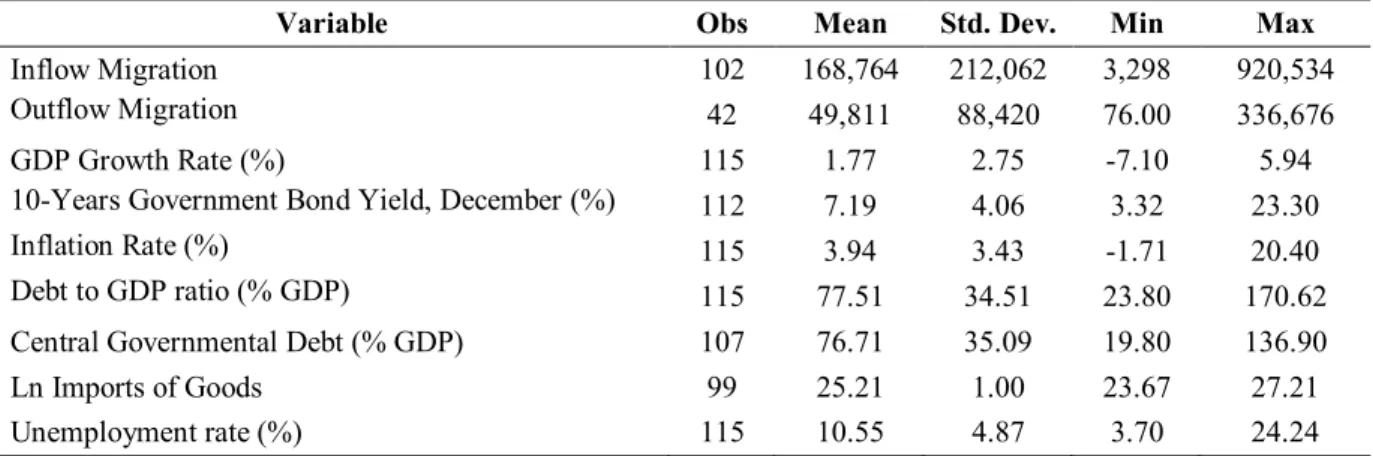
Table 3.1: Descriptive Statistics – Weak EMU (PIIGS) ... 88
Table 3.2: Descriptive Statistics – Strong EMU ... 88
Table 3.3: Descriptive Statistics – Non-EMU ... 88
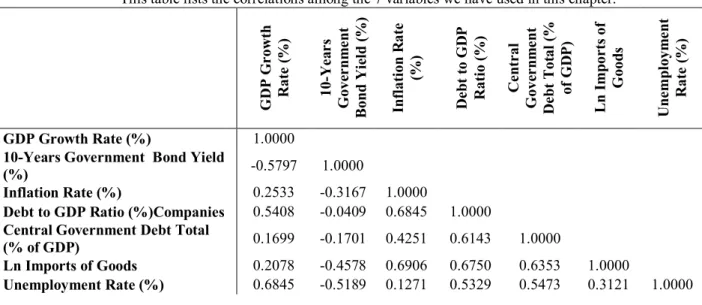
Table 3.4: Pearson Correlation Matrix ... 89
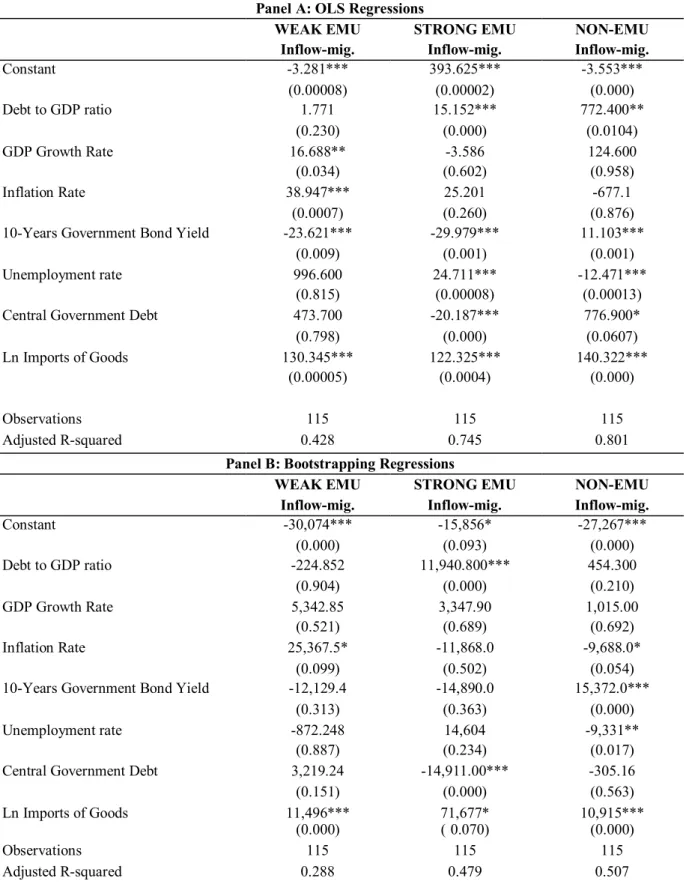
Table 3.5: Inflow migration WEAK EMU, STRONG EMU and NON-EMU Countries... 90
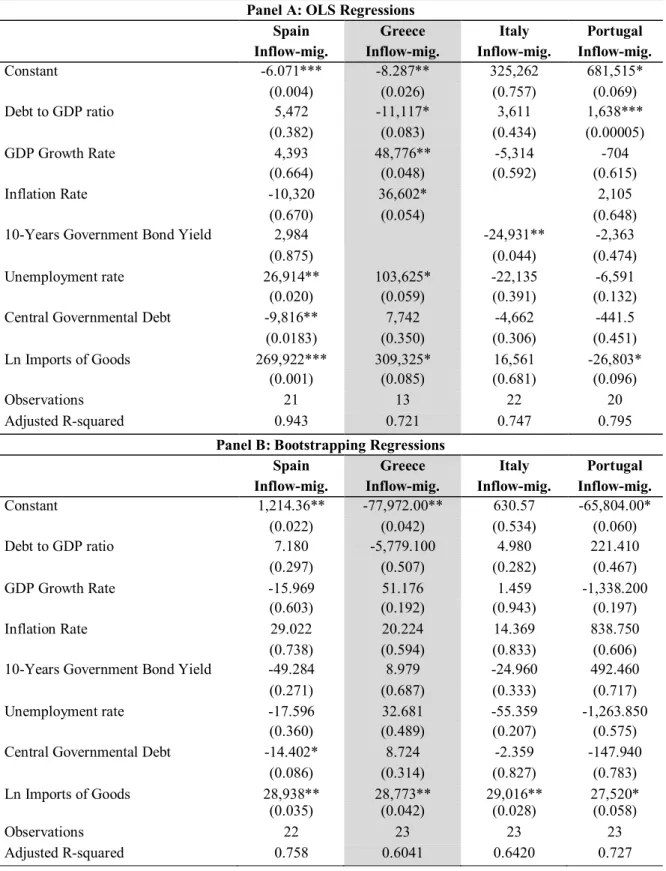
Table 3.6: Results WEAK EMU... 91
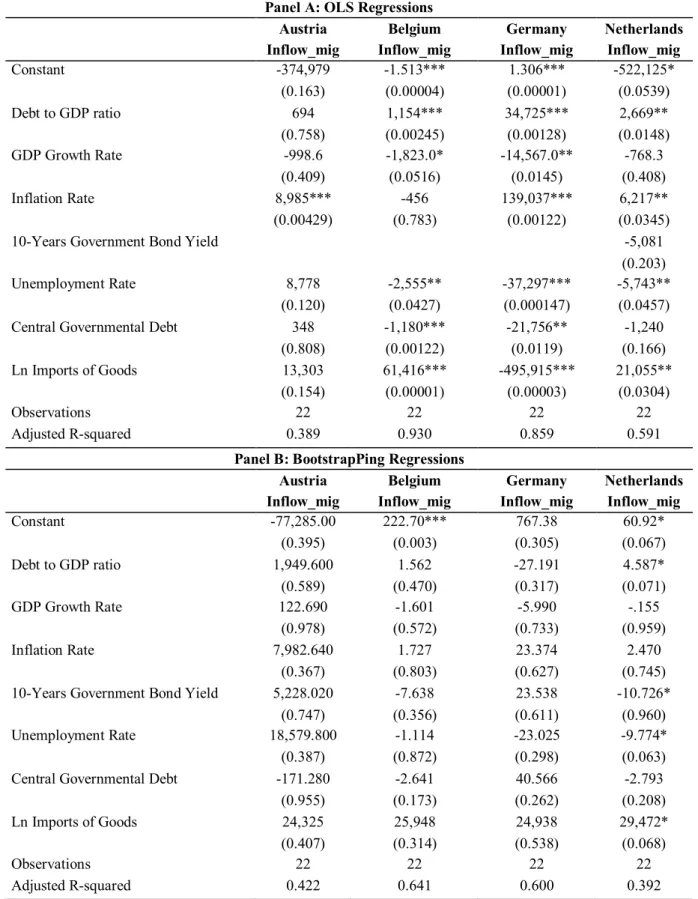
Table 3.7: Results STRONG EMU Countries ... 92
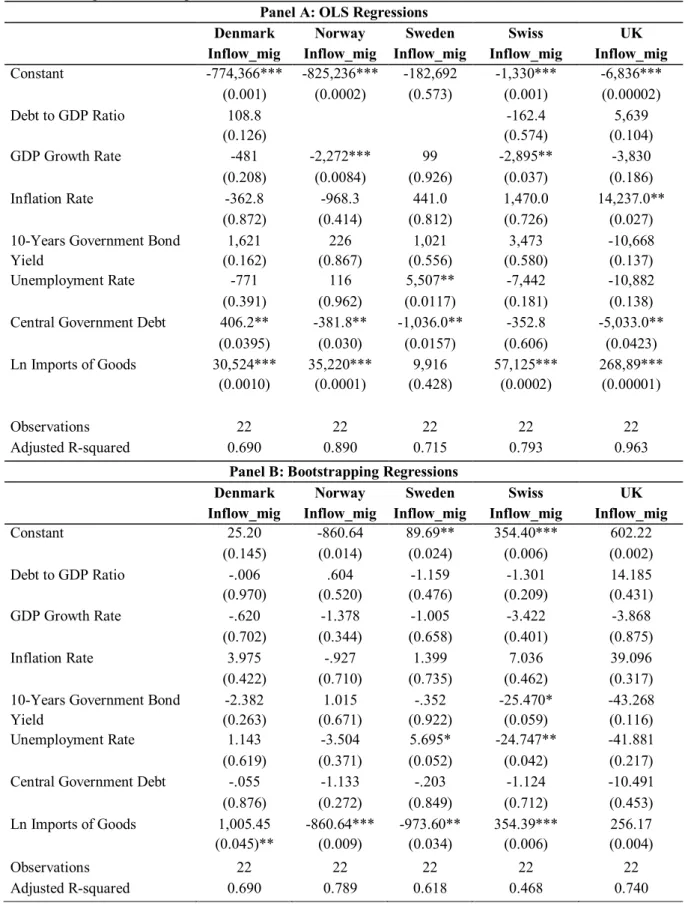
Table 3.8: Results NON-EMU Countries ... 93
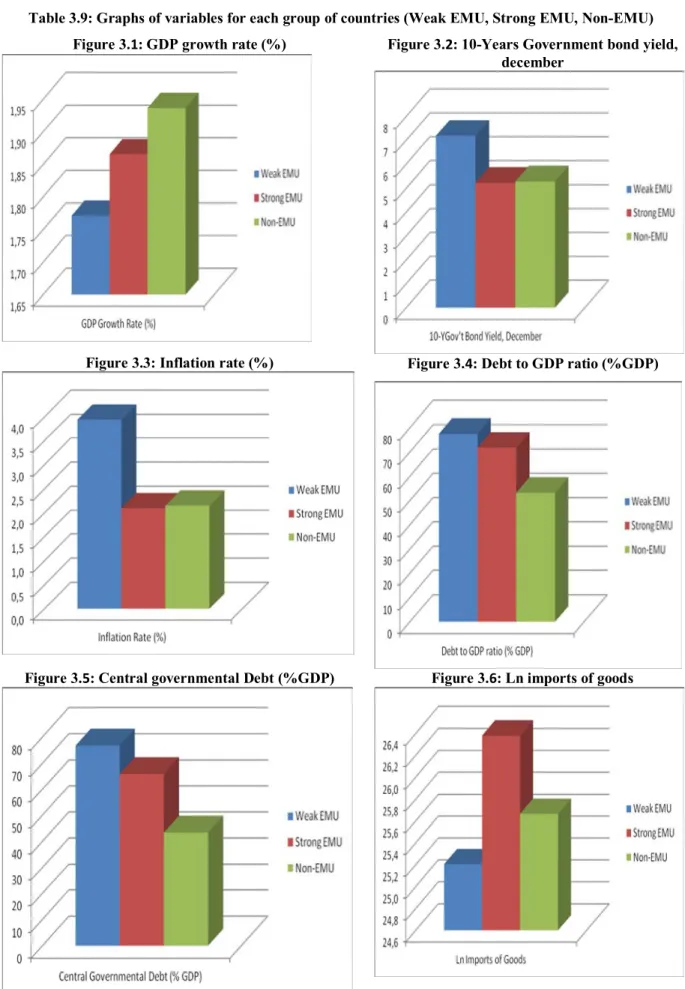
Table 3.9: Graphs of variables for each group of countries (Weak EMU, Strong EMU, Non-EMU) .... 93
Table 3.10: Collinearity diagnostics ... 95
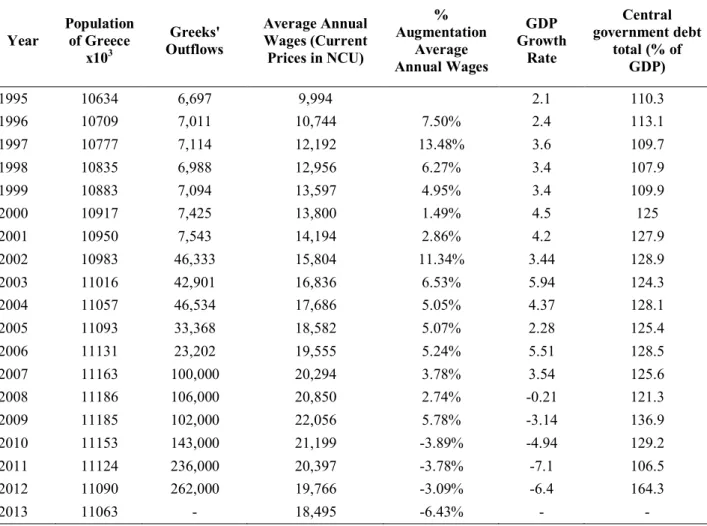
Table 4.1: Average Annual Wages, GDP Growth Rate and Central government debt total for Greece ... 132
Table 4.2: Descriptive of Greeks’ outflows ... 133
Table 4.3: Descriptive statistics of variables ... 134
Table 4.4: Pearson correlation matrix ... 135
Table 4.5: Cross – Sectional Regression Analysis for migration outflow ... 135
Table 4.6: Shapiro-Wilk W test for normal data ... 135
Table 4.7: Collinearity diagnostics ... 135
Table 5.1: Descriptive statistics for the period 1990 – 2012 in Greece ... 156
Table 5.2: Pearson Correlation Matrix ... 156
Table 5.3: Cross – Sectional Regression Results ... 156
Table 5.4: Shapiro-Wilk W test for normal data ... 156
ix
List of Figures
Figure 3.1: GDP growth rate (%)... 94
Figure 3.2: 10-Years Government bond yield, december (%) ... 94
Figure 3.3: Inflation rate (%) ... 94
Figure 3.4: Debt to GDP ratio (%GDP) ... 94
Figure 3.5: Central governmental Debt (%GDP) ... 94
Figure 3.5: Ln imports of goods ... 94
x
Abbreviations
CENTRAL GOV DEB = Central Government Debt COR = Corruption
EC = European Commission ECB = European Central Bank
ECOFIN = Economic and Financial Affairs EMU = European Monetary Union
ELSTAT = Hellenic Statistical Authority EU = European Union
EXP GOODS = Exports of Goods FDI = Foreign Direct Investment GDP = Gross Domestic Product GNP = Gross National Product GRRA = Growth Rate
ILO = International Labour Organization IMF = International Monetary Fund
IOM = International Organization for Migration MARK CAP = Market Capitalization
OECD = Organization for Economic Cooperation and Development OLS = Ordinary Least Square
PIIGS = Portugal, Ireland, Italy, Greece, Spain POP GROWTH = Population Growth
POV = Poverty
TAX REC = Tax Revenue TOT RES – Total Reserves UK = United Kingdom
UNCTAD = United Nations Conference on Trade and Development US = United States
xi
Acknowledgements
First and foremost, I offer my sincere gratitude to my supervisors, Prof. Dimitrios Gounopoulos and Dr. Jory Surendranath, two great researchers and mentors. This thesis is the destination of a very long journey, which would not have been successful without their support and encouragement. Initially, I would like to express my deepest gratitude to my 1st
supervisor, Prof. Dimitrios Gounopoulos, for his continuous and wholehearted support throughout the years of my doctoral studies. Going above and beyond a supervisor’s basic duties, Dimitrios created an ideal research environment for me in order to complete this thesis and lay the foundations of my future academic career. Indebted to him for their invaluable intellectual support and I am grateful for all the meetings and discussions we have had together whilst building the research presented in this thesis. These meetings never failed to be constructive, encouraging and stimulating. I was fortunate to work under his supervision, which was a perfect mix of freedom to research and constructive suggestions. His enthusiasm for research and academic life is both admirable and contagious. He taught me how to build a research paper in a methodical way, while his academic excellence inspired and motivated my research by providing invaluable support and encouragement over difficult moments. Thanks to him, I was fortunate enough to have had top academics in the field reviewing my work and providing invaluable feedback. Apart from research-related issues, Dimitrios has been both a friend and mentor to me; a person I knew I could always rely upon and share with any type of hardship that I encountered.
I would like to extend my sincere thanks to my 2nd
supervisor, Jory Surendranath for generously devoting his time to offer high-quality guidance. Jory provided me with numerous suggestions and recommendations for further improvement of my work, which collectively had a major impact on the present thesis. His also taught me that education demands above all ethos, dignity, modesty and fairness. His example proves that these values can be applied even at the highest academic level.
During my PhD studies, I received a fantastic support from my family and friends. Very special thanks, to my beloved parents Maria and Petros, my dear mother in law Maya, my father in law George, my sister and brother in law, Eugenia and Ioannis as well as my niece Maya. I will never be able to thank you enough for all you have done for me throughout my life. Without your limitless support, encouragement, patience and unconditional love this
xii Ph.D. would not have been possible. I would also like to thank Petro, Natassa, Julia and Billy for their valuable suggestions and friendly advice during my research work. Special thanks go to my best friends Dimitri, Penny, Vasso, Pinelopi, Dianna whose friendship, support, and encouragement has helped me over the frustrating moments of this journey.
Last but not least, I am eternally obliged to my beloved Husband and Daughter, Vassilio and Marilia for their understanding and their supporting my dream. Their love and support helped me succeed. You have always been here for me, especially during my less cheerful moments. Your patience and love have rescued me from peril more times than I can recall. I am lucky to have you next to me in all difficult and joyful moments.
1
CHAPTER 1.
Introduction
1.1.Background of ThesisThe recent example of Syria has emerged the importance for a study on the phenomenon of migration, which has gained unprecedented momentum in recent months. The situation along migratory routes to Europe and within Europe itself is changing faster than ever before. Approximately, 9 million Syrians have fled their homes since the outbreak of civil war in March 2011, taking refuge in neighboring countries. According to the United Nations High Commissioner for Refugees more than 3 million have fled to Syria's neighbor regions such as Turkey, Lebanon, Jordan and Iraq, while an estimated 6.5 million are internally displaced within Syria. Provisionally, around 150,000 Syrians have declared asylum in the European Union, while member states have pledged to resettle a further 33,000 Syrians. Specifically
,
on September 2015, it was reported that more than 8,000 refugees crossed into Europe on a daily basis, whereas 5,000 of those refugees were received by Greece alone, the majority of who came from Iraq or Syria. Accordingly on September of 2015, twenty - three European Union home affairs and interior ministers approved a plan without a consensus, compelling "member countries to take in 120,000 migrants seeking refuge on the Continent." Czech Republic Hungary, Romania and Slovakia disparate the plan and Finland desisted with poorer countries such as Hungary and Slovakia to be more concerned about the financial and social cost of absorbing large numbers of individuals while on the other hand, wealthier ones such as Germany and Sweden comprise ethnic diversity and are able to offer more compassionate support.The current thesis is inspired by the humanitarian crisis that became an important issue for migrants in Europe and Greece particularly, where 400,000 Syrians have entered the country since January 2015. By comparison, 60,000 Central Americans crossed the border into the US in 2014, something that concluded into an absolute crisis. Nonetheless, the US has approximately 360 million population, while Greece only 12. Specifically, the Greek island of Lesvos, which is primarily a tourist destination, is currently hosting around 10,000 abandoned migrants who escaped from war zones of Syria. As a consequence, their entrance in Greece has made the country and the island in particular a hotspot in Europe’s ongoing migration crisis. Whilst Greece is experiencing one of the most significant inflows of migrants in its history, this provoked to European leaders and policymakers their greatest
2 challenge since the debt crisis.
Additionally, encouraged by the surge of migrants across European region especially from Spain, Italy and Greece, who were detected at the EU’s borders during the 2008 financial crisis, this study focuses on the financial, social and institutional factors that ‘forcibly’ displaced people around the world. Significant losses in wages, elevated unemployment and inflation rates are the major drivers of the migration. In general, individuals and their families decided to migrate when the benefits expected in the destination are greater than those received at home.
Human migration according to Oiarzabal and Reips (2012) is the mobility of people from one place to another with the purpose of living temporarily or permanently in the new location. In addition, this kind of movement is usually over long distances and from one country to another. It is a very complex phenomenon which is determined, to large extent, by the perception and behaviour of individuals concerned. Therefore, there is no comprehensive general theory of migration. "Finding a general theory of migration with universal validity and applicability is the perpetual dream of those working on migration research. To the ambitious this has become an obsession; to the more realistic it has remained a fond hope" Chang (1981). However, the phenomenon of migration is governed by a set of social, economic, political and environmental factors. Many attempts have been made to integrate migration into economic and social theory, spatial analysis and behavioural theory, Johnston et al (1981). A historical review of theories of migration leads to 4 general theories of migration.
The first model based upon "general principles" or "Laws" formulated to explain geographic mobility was established by Ernst Ravenstein’s «Laws of Migration» (1885) since several of his laws can formulate the migration process. One of the laws states an inverse relation between distance and volume of migration.
Gravity model, based on Newton’s law of gravitation, goes one step further and states that the volume of migration between any two interacting centres is the function of not only distance between them but also their population size. The model was initially proposed by the exponents of social physics in the nineteenth century, and was later revived in the middle of the twentieth century. It was W.J. Reilly (1929) who had first applied the law of gravitation in 1929 to the retail
3 trade of a city centre.
The third model was introduced by Stouffer (1940) who modified the gravity model for maximum applicability to the study of various forms of flow patterns. These modifications relate to the introduction of some weights to the population size and use of distance in social and economic, rather than geometric, terms.
Finally, Everett Lee (1966) proposed another comprehensive theory of migration in 1966. Based on Ravenstein’s work, he begins his formulations with factors, which lead to spatial mobility of population in any area. His laws divide factors causing migrations into two groups of factors: push and pull factors. Push factors are things that are unfavourable about the area that one lives in, and pull factors are things that attract one to another area. Dorigo and Tobler (1983) describe the push factors as those that give one reason to a person to be dissatisfied with his current locale, while the pull factors are those which allege of distant places and make them appear appealing.
Consequently, the topic of migration generated extensive academic research since the early twentieth century Fairchild (1925); Price (1969); Petersen (1958); Mangalam (1968); Simmons et al., (1977); Kritz et al, (1981); Clark (1986); Borjas (1989); Massey et al (1994); Reilly and Benson (2009);Brettell and Hollifield (2014) with their empirical work provided interesting theoretical explanations in the research area of migration. Subsequent work covered other puzzling phenomena as the existence of return migration in cases of excessively economic crisis. The high volume of work on migration related with the recent financial recession continued after 2007. Evidence by Martin (2009b); Wright and Black (2011); Moser and Horn (2013) on migration, suggest that the impact of the global economic crisis had negative effects on the phenomenon. The development of various theories, such as the push and pull theory, coupled with detailed research into the extent and effects in the phenomenon of migration, lead to a more detailed search of the effects of the recent crisis to people’s decision to migrate for a more prosperous future.
Accordingly, this thesis will make an effort to relate the phenomenon of migration with financial, social and political factors based on the push and pull theory. Push and pull theory will be explained more extensively in section 2.1. of Chapter 2. In fact, it is particularly interesting to study the factors that affect the phenomenon of migration in Europe, and especially in Greece.
4 The geopolitical position of Greece, at the crossroads of Europe, Asia, and Africa, makes it not only a final destination for migrants from Asia and Africa but also a gateway or stepping stone to Western Europe, Antonopoulos (2006).
Moreover, most recent studies conclude that the global financial crisis had a great impact on migration flows Hooghe et al (2008); Mujica et al, (2012); Furthermore, as the 2008 – 2009 recession is the harshest in countries that had severe debt excess including Southern Europe and particularly Greece, the vast majority of the individuals decided to migrate Martin, (2009a); Papademetriou and Terrazas (2009).
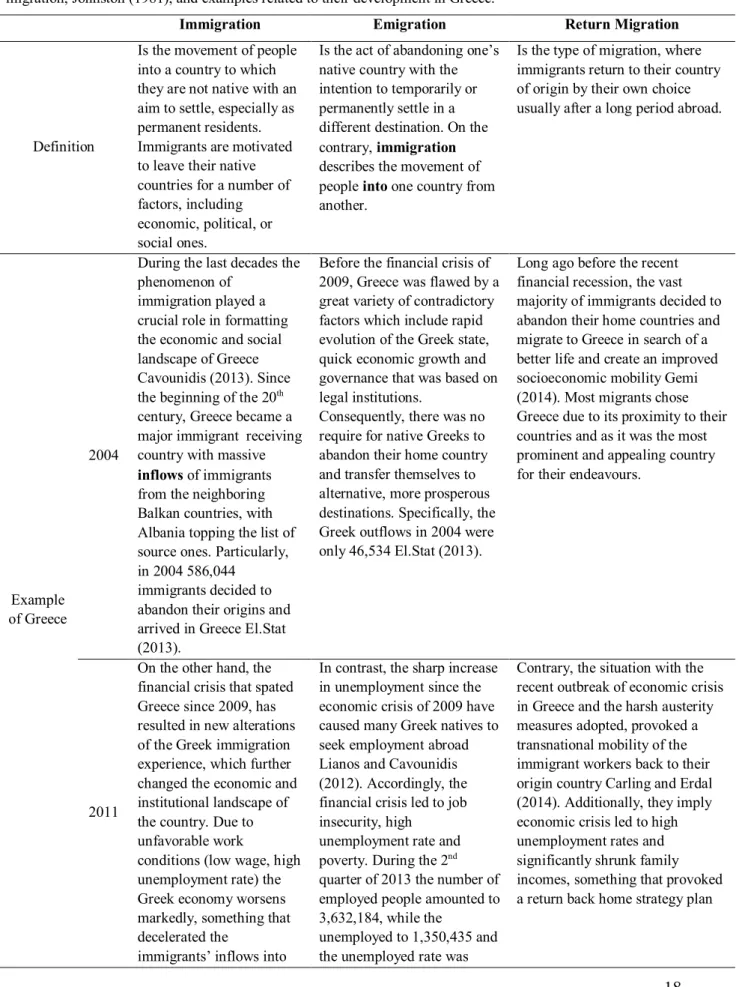
At this point we note that in Table 1.1 we give the definition of immigration, emigration and return migration as well as some concrete examples related to their development in Greece.
It is clear that at first glance two research problems arise concerning the phenomenon of migration in Greece:
1. How do push and pull factors affect the “immigration” flow towards Greece. 2. How do push and pull factors affect the “emigration” flow from Greece. Moreover, a third research problem, less obvious, appears for the case of Greece: 3. How do push and pull factors affect the phenomenon of “return migration” in
Greece.
Therefore, our thesis will be built upon those three main research problems. At that point, we need to make clear the motivation of our thesis.
1.2.Research Philosophy and Motivation of Thesis
The purpose of this thesis is to use a unique “crosschecked hand collected” database with information obtained by accurate and precise organization, such as World Bank database and the Hellenic Statistical Authority and address exclusive characteristics that the phenomenon of migration offers in the international literature. The study makes effort to shed light in puzzling issues of the phenomenon of migration and return migration as well, that they have not been studied yet in a satisfactory level and mainly not in a quantitative way. Further, there is a wish to extend the literature of the relationship between the current financial crisis and migration by providing empirical evidence in Greece, reviewing the financial, social and institutional factors that affect individual’s mobility.
Initially, this study analyses the accuracy of the underlying factors in the phenomenon of migration. The variables that we employ investigate their behaviour within the selected
5 country during the period 1990 – 2012 and shed light on the economic, social and institutional determinants that influence the phenomenon of migration. Therefore, once the financial crisis applies in several issues, the crucial point becomes its correlation with migration. De Grauwe (2010b); Arango (2013) argue that the financial crisis hit severely Europe and particularly Southern countries with high rates of unemployment and inflation, something that provoke elevated waves of migration, in order individuals to escape from financial anxiety. Lopez - Sala and Ferrero - Turrion (2009); Jones (2013) document the positive relationship between some financial, social and institutional variables, such as unemployment, high inflation rates, GDP per capita, population growth and migration. This is followed by an empirical analysis of the factors that may influence the performance of migration decisions. There is a general impression that the current global economic crisis hit Europe and Greece harder than expected, with severe negative consequences on economic and social performance of the countries, with notable increase of individuals’ mobility Castles and Vezzoli (2009); Martin (2009a). In order to explore the motives, this study investigates whether the employed determinants have a positive relationship with migration during the recent financial downturn and relates this activity to immigration not only within Greece but also regarding Europe. More precisely, we extend our investigation for the phenomenon of immigration to three different country – groups in Europe and then focus on the case of Greece. The emigration activity as well as the return migration will then be examined solely for the case of Greece.
This study makes important contribution to the financial and sociological literature. First it provides new evidence on the effect of a number of financial/economic, social and institutional factors on the phenomenon of migration, which shed light on the perplexing indication found in prior work on the subject. Second, to our knowledge this is the first study to examine and modelling the structural links between financial, social and institutional variables and migration in Greece in such context. Third, our study scrutinizes if the factors employed are applied in a similar manner in Europe and Greece particularly and provides insights on the components of migration, while simultaneously it tests how Greece reacts under the current financial crisis affecting thus immigration and return migration decisions. Our findings also have important implications for international academic community and political institutions, as they could use the methodology and extend the results with new data on human migration in the future, use the relevant factors in order to try and find the possible causes for the phenomenon of migration as well as possible solutions but even try to go one
6 step further by making some forecasting.
1.3.Necessity and contribution of the current study
It is well known that the phenomenon of migration has been explored in a satisfactory level by the researchers. Despite the extensive research, academia witnesses an increase in the volume of studies. One of the main reasons is the current financial crisis in 2008, which began in the US financial sector and spread globally Reinhart and Rogoff (2009). A credit fuel spending boom adjoined to elevated home prices not only in the US, but also in the European region, came along with a sharp fall of the global trade and rise to unemployment and inflation rates, Martin (2009b). The phenomenon of migration was selected because it presents a great number of financial, social and institutional determinants (i.e. unemployment, inflation rate, GDP per capita, central government debt) that make the study interesting in the context of the international evidence. Recent changes due to the financial crisis in major sectors of the society, such as construction, manufacturing, financial and travel related services, has sparked our interest to study the changes that they bring to migration process (ex. Return migration decisions).
The importance for this study becomes even stronger, as there are no similar studies at a global level in the issues that this study examines. Specifically, no international evidence concerning the accuracy of determinants associated with migration has been detected. This could be due to the fact that in some countries quantitative analysis of the factors that may affect migration are not included in their promises. It is a particular motive to fill the gap in the literature, as studying the variables that contribute to the growth of migration is considered more than necessary in order to assess the value of the phenomenon.
There are several important features of the analysis, which we believe extent the literature on the empirical aspects of the phenomenon of migration. Firstly, as all the evidence in migration is mainly restricted to the British Commonwealth countries, this study belongs among the very few that investigates non-Commonwealth countries as well with the focus on the case of Greece. Second, the analysis of the determinants is based on a unique database, which provides details on financial, social and institutional cohesion of each country. Third, the financial recession, which hit severely Europe since 2008, is a motive to search for factors that have a significant impact on migration. Fourth, this case is distinct from previous empirical studies as it will attempt, in the first empirical chapter, a direct
7 comparison among three different country groups regarding the extent the current crisis affect their migration procedures but also, in the other chapters, a focus on the case of Greece in which we study not only the phenomenon of immigration but also the emigration process as well as the return migration process that has been stimulated by the profound economical crisis.
The thesis builds on the findings of a numerous number of international studies namely finding by Reinhart and Rogoff (2010), Checherita and Rother (2010) on the relationship of the financial determinant, such as GDP growth rate on public debt and migration; by Mumtaz and Surico (2011) for the contribution of high inflation rates on the phenomenon of migration; by Barell et al, (2007), Koser (2010) (2010); De Haas (2010), Clemens (2015) who shed light on the economic factors that affect migration during the financial downturn.
Similarly, this study refers to the conjectures of the most recent empirical evidence in Greece by Cholezas and Tsakloglou (2008), Kouretas and Vlamis (2010), Christodoulou and Christodoulou (2013), Cavounidis (2013), Economou et al, (2014). These studies have mainly focused on the financial, social and institutional factors that affect the phenomenon of immigration to Greece and return migration intentions from the country but in a qualitative approach. To the best of the author’s knowledge, there is lack of quantitative studies in international level, regarding the precision of the factors that are related with migration which is our main contribution.
1.4.Historic evolution of migration patterns
In this section we will provide a historic review of the phenomenon, by paying particular emphasis to the period of the study. A summary table can be found at the end of this chapter (Table 1.1).
International migration has played a significant role in the rise and fall of empires, states, and affiliation of states as the world moved through the major political and financial stages of mercantilism, colonialism, industrialization and globalization Massey (1990). According to Patsiaouras (2008) the western culture during the great discoveries came in contact with many different tribes, which had different customs and ways of life and different way of thinking and living of the indigenous inhabitants of these areas. Long-distance migration definitely is not a new phenomenon. For thousands of years humans have moved
8 around the world in search for food, in flight from enemies, or in pursuit of riches, spreading their cultures, languages, diseases and genes. Human settlement spread through Europe, Africa and Asia but the process was very slow.
Historians, who thoroughly study the phenomenon of migration, agree that migration flows used to and continue to be until recent days important paths of social, economic and cultural change. Though it was not possible to determine at the past the exact number of immigrants, nonetheless, it turns out that there are enough data regarding the existence of immigrants in all periods of history.
Historically, the first big wave of human migration took place along the southern coastline of Asia to India and Australia approximately 50,000 years ago, Bowler et al. (2003), while the first humans reached Europe 40,000 years ago, Benazzi et al. (2011), and America in 3,000 BC. Very important civilizations such as the Egyptians, the Romans, Athenians and Mesopotamians were based on these population movements in order to improve their conditions of living. In ancient times, Greek sailors founded colonies along the Mediterranean and Black Sea coasts. In addition, the expansion and conquests of the Romans in Mesopotamia, Indian and Zhou made it a great empire. Manning and Sidorenko (2007) point out that during these centuries human migrations flows changed the culture of the people, not only of those who immigrated, but also of those who accepted the migrants. Other major migrations flows in the early history of the phenomenon include the Vikings and Crusaders in the Holy Land. About three centuries after the voyage of Christopher Columbus, a time created known as «early modern times» Manning (2005), during the course of which, about two million people crossed the Atlantic Ocean from Europe to settle in America. Between the 1630s and the American Revolution, approximately half of British migrants to North America travelled as assent servants. Nonetheless, the system soon came under pressure, particularly in the sugar colonies, where servants faced harsh working conditions and planters exploited a growing supply of slaves Galenson (1984). Even though they were not perfect surrogates, by the end of seventeenth century, slaves were displacing indentured servants as the main source of labour in the southern colonies, Grubb (1994).
The following period of immigration is focused on the US emergence as a major economic power. Millions of workers from economically stagnant areas and by oppressive political regimes of North, South and Eastern Europe moved to the US from 1850 until the
9 Great Depression of the 1930s. This period is characterized by free migration both within Europe and North America as Economic liberalism had abrogated all of the obstacles of mercantilism, including control over population movements, by the mid-1800s, Bankston et al. (2006).
During most of the half century leading up to World War I there were therefore no controls restricting travel abroad in Europe, with the exception of Czarist Russia. The number of those traveling abroad remained relatively modest at this time, and passports were not required for travel between countries. People could, in fact, begin to work in a new destination without seeking a permission to do so, Marrus (1985). It is during this same era that the European population began to significantly increase due to the combination of a high birth rate and a low death rate. Notably, between 1800 and 1860 approximately 66% of immigrants came from Great Britain and 22% from Germany Castles et al., (2005). Specifically, the period from 1820 to the First World War saw the rise of mass migration as 55 million Europeans emigrated to North America, South America (21%) and Australasia (7%) Hatton and Moloney (2015). Since 1800 through 1930, about 40 million people immigrated from Europe to North America.
Specifically, since 1850 to 1914, a great number of immigrants from many European countries, mainly from Italy, Spain and Eastern Europe moved to ensure a better quality of life. Particularly, the great growth in immigration from the 1870s was dominated by the countries of southern and eastern Europe, particularly Italy, Ireland, Spain, and Russia. Statistics hide enormous variations in immigration rates. The highest was Ireland with a gross immigration rate of 13 per thousand per annum between 1850 and 1913. Countries such as Sweden and Norway approached approximately five per thousand in 1870-1913, while the rates for Germany and Belgium were less than two per thousand and that for France was very limited Massey et al., (1994).
The era after the Second World War is characterized as another milestone in the history of migration. A large number of people got advantage by migratory programs that founded from USA, Canada, Australia and Argentina. This was the period in which the overwhelming majority of Turks migrated to Germany in order to improve their living standards. A similar situation was the inhabitants of Africa, who moved to France and Belgium. Mousourou (2003) mentions that during the post-war period, the migratory
10 movements that took place in Europe, that is, intra-European or modernist movements did not take place with political purposes (e.g. refugee waves), but mainly for economic reasons. While, according to Veremis (1983), the most modern migrations associated with industrialization are linked to socio-economic development of countries, as identified with the changes in place of residence of the respective workforce.
According to Zimmermann (1995) migration movements that took place in Europe after the Second World War, are categorized into four periods: the period of post-war adaptation and independence of the colonies beginning in 1945 until the early 60s, in which approximately 20 million refugees went to France, Great Britain and Belgium, in search of a better quality of life. The second period takes place from 1955 to 1973, in which there is a particular increase in labour migration. Especially, many countries such as Germany, France and Switzerland have opened their borders to immigrants in order to enrich their workforce. The 1973 Oil Crisis started on 15 October 1973, when the members of the Organization of Arab Petroleum Exporting Countries proclaimed an oil embargo in response to the US decision to re-supply the Israeli military during the Yom Kippur war. This followed several years of steep income declines after the end of Bretton Woods. The consequent increase in the price of oil led to the massive accumulation of wealth by oil exporting states, which led to a global recession and a global stock market crash. The 1973 oil crisis has been identified as a major turning point in global migration patterns and policies Castles and Vezzoli (2009).
Accordingly, the period between 1974 and 1988 is characterized by fairly limited migration because of rising social tensions and fear of recession after the first shock of oil prices. Nevertheless, the family and immigration policies increased as well as the number of first illegal immigrants. The fourth period occurs since 1988, after the fall of socialism. According to Zimmermann (1995) “the total number of refugees was only 190 000 in 1987, but had already reached 700,000 by 1992". Additionally, the Asian financial crisis began in July 1997 in Thailand with the financial collapse of the Thai baht. As the crisis spread, most of South-East Asia and Japan experienced devaluated currencies and stock markets, a reduction in asset prices, and a tremendous rise in private debt Koser (2010). Although the migration impacts of the crisis were modest, several governments introduced and started to expel migrants. According to Soonthornhada, (2001) a specific migration process reported during the Asian financial crisis was increasing exploitation by ‘middle men’ or agents, taking advantage of increased demand in countries most affected by the crisis to migrate
11 elsewhere for work. A number of employment agencies in Indonesia, for instance, were investigated for exorbitant charges to place maids in Hong Kong. Increasing profits for recruitment agencies were also reported in the case of Thailand.
1.5.The recent crisis and its present dimension
In September 2008, the collapse of Lehman Brothers, a sprawling global bank, almost crashed the global financial and social system, engendered a plethora of financial and institutional defaults with an extensive devastation of jobs and livelihoods Gemi (2014);. The subsequent credit crunch turned what was already a nasty plunge into the most severe recession since the 1930s Reinhart and Rogoff (2011); Aiyar and Chandra (2012). Hence, the financial crisis can be described as having been a "perfect storm": a confluence of various conditions that not only triggered financial and economic turbulence but also great social and political inequalities. In table 2.1 we illustrate the most important waves of immigration from the early prehistoric times until the most recent immigration outflows due to the financial recession.
According to United Nations (2009) among the numerous inequalities is the yawning gap between wage levels and productivity growth in the aftermath of the financial recession. Even though the productivity has been evidenced in many countries which in fact would lead to rising wages and incomes, the share of national income going to employers has been falling especially in the USA and Europe due to the financial crisis, International Labour Organization (2008).
Hence, the slowdown of the economy, which first impacted advanced economies, has produced undulate effects on almost every financially developed country. Employment losses and stoppage in job growth have contributed to extensive increases in unemployment rates,
Seguino (2010). As many countries faced difficulties on payment balances, alongside with the austerity measures adopted, the financial and social context has been altered dramatically and consequently impacted individuals’ conditions of living. Growing disparities in development, the segmentation of labour markets, revolutions in transportation and communications combine to explain why there is a growing number of migrants in the world today, approximately over 200 million Koser (2010). Douglas (2010) indicates that during the financial recession the world was challenged by a lack of employment crisis. The
12 International Labour Organization estimates that approximately 61 million people were unemployed due to the crisis, ILO (2015).
The economic slowdown had a notable impact on workers in certain industries not only inside the EU but internationally. Construction, as for instance, was among the most affected sectors in countries such as Ireland and Spain, where there had been a large boom in residential construction prior to crisis. In Ireland, the dramatic decrease in the construction sector explains most of the decline observed in total employment. In the United States, in 2008, the impact of the financial recession had already spread to most sectors but it was especially prominent in the construction sector. During the first two months of 2009 employment decreased further by more than 3% in construction Hatton and Williamson (2008). Accordingly, in the United Kingdom, the finance and business services industry has suffered the most while in France food processing and manufacturing industries, notably the car industry, have been all mostly affected so far, Kahanec and Zimmermann (2009).
Social change is a significant and enduring impact that the phenomenon of migration impose in all periods and in all countries. As prior homogeneous societies have gradually undergone change and have evolved into multicultural societies, this resulted in some countries to be considered as something undesirable, while in others it is still much debated, Topaloglou and Petrakos (2008).
Nowadays, governments face growing challenges regarding the issue of the management of migration and thus migratory policies are becoming more widespread and more globalized. In 1965, there were about 75 million migrants around the world, while by 2002 the number had risen to 175 million (IOM, 2012). Additionally, according to Kassimis and Papadopoulos (2006) in the 60s, about 30 million "guest" workers moved to Europe, introducing the concept of the "seventh man" as one in seven Europeans was a foreigner in their country of destination. Today almost every country seems to be the recipient of some migration wave and the traditional classification of countries affected by the phenomenon divided into countries of origin, transit and destination.
1.6.Contemporary History of migration in Greece
At the beginning of the twentieth century, Greece was mostly a country with outwards immigration flows, the majority of migrants had as their destination the United States. After
13 the second World War and until the mid seventies, approximately one million people, which corresponds to over ten percent of the total Greek population, left Greece to emigrate primarily to Europe, Australia, and North America, Karakatsanis (2003). In Europe, migration flowed towards countries such as in the Federal Republic of Germany, where there was a labour shortage in the rebuilding process after the second World War, or about 65,000 Greeks who sought refuge in former Soviet Bloc countries after the defeat of the left-wing forces in the Greek Civil War (1946-49), in France for its sociocultural context especially during the Greek military junta of (1967–1974), commonly known as the Regime of the Colonels, Kiprianos et al. (2003).
However, after the collapse of the military dictatorship in 1974, some of the Greek refugees began to resettle in Greece and together with other several occurrences the migration patterns changed in Greece. From a country of emigration, Greece became an immigration country, where most of the immigrants to Greece in this time period were repatriated Greeks, Faas (2011). The immigration boom reached its peak towards the beginning of the 1990s, following the fall of the Soviet Union in 1989, when co-ethnic Greeks (meaning foreigners with Greek heritage) from former Soviet bloc countries, co-ethnic Greeks from Albania and other Balkan nations, and economic migrants from the Balkans and Eastern European countries like Russia, Ukraine, Georgia, Bulgaria, Romania, and Poland, flooded into Greece, Faas (2011) and Triandafyllidou (2009). Many came to escape turmoil and conflict in their homeland or for the economic opportunities afforded to them in Greece, a member of the EU with a large informal market. However, at the beginning of the 1990s, Greece did not have the legislative framework to practically manage and control immigration, whose legislation was dated back to the 1920s and made it incredibly difficult for migrants to enter Greece legally for work purposes; it was obligatory for a migrant to have a work permit to enter Greece, which they must have obtained from their home consulate only after having acquired a job in Greece, Triandafyllidou (2009). The Greek government began immigration policy reform in 1991, Kiprianos (2003), In the mid-90s the Greek immigration policy relied mostly on massive deportation of mainly Albanian immigrants, hoping to discourage immigration to Greece. This policy tool was largely ineffective and the Greek government had to rethink its immigration policy at the beginning of the twenty-first century, Triandafyllidou (2009). While strides have been made to bring immigration policy in line with EU directives, immigration was still not a high priority for the Greek government, even as migrants continued to make up large portions of the Greek population, Lazaridis et al. (2002).
14 Until the last years, the large majority of immigrants to Greece come from Albania, which constituted the 63.7% of the total documented migrant population in Greece, followed by Bulgarians, Georgians, Romanians, Russians, and Ukrainians, Antonopoulos (2006). Immigrants were employed in construction, industrial manufacturing, and agriculture, Baldwin-Edwards (2002).
Documented immigrants in the 2011 census totalled 911,299, or almost 9% of the Greek population, NSOG (2014). More than half of the legal foreigners are in the greater Athens area, and a quarter can be found in Thessaloniki, Greece's second largest city to the north. About half of the legally employed foreigners are either ethnic Greeks or citizens of the EU; however, about 79% of undocumented immigrants come from former socialist countries, with the remaining 21% coming from over one hundred predominantly Third World countries, NSOG (2014).
The number of work permits to non-ethnic Greek foreigners is just 0.33% of the registered labour force, the lowest number in the EU, on the other hand, undocumented labour by foreign migrants is estimated to constitute 24% of the GDP of Greece, Faas (2011).
Many irregular entrants and illegal immigrants do not see Greece as their final destination; they plan to work only to raise enough funds to move on to other countries in the EU, others come to Greece to stay, no matter how long their stay in Greece, Faas (2011).
1.7.Present dimensions of the phenomenon in Greece
Migration movements particularly in the Mediterranean countries have received extraordinary impetus in recent months. The situation in Europe is altering faster than ever before. Approximately 9 million Syrians have abandoned their homes since the outbreak of civil war in March 2011. According to the United Nations High Commissioner for Refugees (United Nations Department of Economic and Social Affairs. 2012) more than 3 million immigrants have absconded to Syria’s neighbouring regions such as Turkey, Lebanon and Iraq, while 6.5 million are internally displaced with Syria and 150,000 have entered the EU.
According to Eurostat (Eurostat. 2015) EU member states received 626,000 asylum seeker applications in 2014, the second highest number since 1992. Four countries, Germany,
15 Sweden, Italy and France, received over two – thirds of the EU’s asylum applications and approved almost two – thirds of protection status in 2014. In the first half of 2015, EU member states received 395,000 new asylum applications, Eurostat (2015). In recent months, migrants in their vast majority from Syria and Afghanistan accounted for 90% of the arrivals in Greece, mainly to the islands. Migrants make an approximate of 6km water crossing to the Greek islands of Chios, Kos and Lesvos, which are close to Turkey.
Therefore, with the massive inflows of Syrians immigrants in Europe, this has created unexpected and very serious financial, social and political issues, which submerge the European continent and especially Greece. According to the Economist (2015) the continuing influx of immigrants arriving at the borders of the EU provoked great implications on public finances. The net direct contribution of immigrants tends to be smaller than the native ones as they pay fewer taxes due to their lower levels of employability, especially among women. Holger Schmieding (2015) indicates that extra spending on migration related issues will cost approximately 0.3 – 0.4% of annual GDP in Germany and a few other European countries such as Greece and Italy.
Alongside, Greece faces the financial crisis since 2009 with extremely high unemployment rates and elevated tax evasion, ELSTAT (2013). As a result, Greece would have been the last place in Europe ready to associate with the newest phenomenon. Nonetheless, Greece in order to make an effort to find solutions to face its record unemployment and debt, requests for more help from the EU. As immigrants, who arrive in Greece’s shores every day, need financial support, the country received 259 million from the Asylum, Migration and Integration Fund (2014-2020), which unfortunately were not enough. As a consequence Greece, that has been hit so hard by the austerity measures, will need an extra provision in order to fortify its capacity to offer help among the immigrants, Sciubba (2015).
1.8.Methodology and Structure of Thesis
The thesis is organized in the following way. After the present introductory chapter where we have set the background of the thesis, the research philosophy and motivation, the necessity and contribution of our study as well as a short historic evolution of migration patterns, we will use chapter 2 to explain the theoretical and conceptual framework of the thesis. We will start with the general theoretical framework which inspired our work,
16 followed by a literature review on the determinants. We will introduce and define all the financial, social and institutional factors that will be related to the phenomenon of migration. We will discuss the relevant research evidence and why some factors are rejected for our quantitative analysis. We will then give information about the way we set our database with the information obtained about the factors that we will study. Finally at the end of chapter 2 we will present the theoretical model that will be used in the rest of the thesis as well as the main hypothesis for regression models. In order to address our hypotheses for our empirical analysis, ordinary least square (OLS) model will be employed for the purpose of measurement of the behaviour of the selected variables. Thus, for the adaption of this model Stata 13 will be used in order to adopt a constant econometric analysis of our data. Nonetheless, whilst our sample size is small it is more than necessary to apply a method that does not require distributional assumptions such as normally distributed errors and can also provide more accurate inferences when the data are not well behaved. Particularly, bootstrapping offers a number of advantages, as it is quite general and it is possible to employ it to statistics with sampling distributions that are difficult to derive, while additionally it is relatively simple to employ it in complex data-collection plans as for instance stratified and clustered samples.
In each empirical chapter we state some hypotheses on the coefficients of the variables of the regression model.
We will calculate the Pearson correlation matrix among variables used in the cross sectional regressions. We discuss the significance of each coefficient and make some tests in order to check on how well our data meet the assumptions of OLS regression.
After each regression analysis we generate residuals with STATA’s ‘predict’ command and check normality using the Shapiro-Wilk W test for normality (‘swilk’ command in STATA). In this test the p-value is based on the assumption that the distribution is normal. If the p-value is too low, normality is rejected in which case our model would need further investigation.
Moreover, we also check multicollinearity by using the package COLLIN to compute variance inflation factors (VIF) for the variables. Tolerance, defined as 1/VIF, is used to check on the degree of collinearity. A tolerance value lower than 0.1 is comparable to a VIF greater than 10, in which case the variable could be considered as a linear combination of other independent variables and the model would need a different approach as for the independent variables.
17 Chapter 3 demonstrates a comprehensive sample of 15 European countries from 1990 up to 2012, which have been divided into 3 ‘monetary’ groups (Weak EMU, Strong EMU and Non-EMU) which seem to have same financial and economic characteristics, in order to investigate the behaviour of each group during these periods. It follows a quantitative analysis of the economic, social and institutional determinants on migration, in order to comprehend their relationship with the phenomenon. The chapter concludes with the discussion of our results with an analytical review of the selected variables upon migration not only for the 3 groups of countries but also for the special case of Greece that we will focus on in the two chapters to follow.
Chapter 4 covers the financial, social and institutional determinants that motivate Greek nationals to leave their country and emigrate to wealthier destinations during the recent financial crisis. First, it reviews the theoretical explanations for the efficiency of the factors on the phenomenon of emigration from Greece. It then provides a survey on the relevant empirical studies and then an analysis of the variables, which have a significant impact on labour migration. Based on the theories presented, the study develops a model to explain how financial, social and institutional factors are correlated with the economic downturn and lead to adverse financial and social shocks such as massive migration outflows of Greek nationals.
Chapter 5 outlines the factors that motivate the existing regular immigrants in Greece to abandon the country and return to their own during the economic crisis period. First it provides details on the imbalances of the economic, social and political framework of Greece that consequently affected negatively the growth rate of the country and created a fragile economy with high rates of unemployment and inflation. Second, it compares the economic, social and institutional factors, which are related to the literature of return migration. Third the study provides a comparative analysis of these factors and we apply regression analysis to test their accuracy allocated to migration. The chapter concludes with a discussion of the effect of the selected variables on immigrants to return to their home countries.
Finally, chapter 6 concludes the thesis by summarizing the stylized facts obtained from the research and discusses the findings. It also tries to link the results of the three empirical chapters in order to obtain a more general and conceptual overview of the phenomena. Additionally, it describes the contributions to the existing literature, limitations of this study and extensions for future research.
18
Table 1.1: Table of Definition of Immigration, Emigration and Return Migration
In the table, we have drawn the three different orientations among immigration, emigration and return migration, Johnston (1981), and examples related to their development in Greece.
Immigration Emigration Return Migration
Definition
Is the movement of people into a country to which they are not native with an aim to settle, especially as permanent residents. Immigrants are motivated to leave their native countries for a number of factors, including economic, political, or social ones.
Is the act of abandoning one’s native country with the intention to temporarily or permanently settle in a different destination. On the contrary, immigration
describes the movement of people into one country from another.
Is the type of migration, where immigrants return to their country of origin by their own choice usually after a long period abroad.
Example of Greece
2004
During the last decades the phenomenon of
immigration played a crucial role in formatting the economic and social landscape of Greece Cavounidis (2013). Since the beginning of the 20th
century, Greece became a major immigrant receiving country with massive
inflows of immigrants from the neighboring Balkan countries, with Albania topping the list of source ones. Particularly, in 2004 586,044
immigrants decided to abandon their origins and arrived in Greece El.Stat (2013).
Before the financial crisis of 2009, Greece was flawed by a great variety of contradictory factors which include rapid evolution of the Greek state, quick economic growth and governance that was based on legal institutions.
Consequently, there was no require for native Greeks to abandon their home country and transfer themselves to alternative, more prosperous destinations. Specifically, the Greek outflows in 2004 were only 46,534 El.Stat (2013).
Long ago before the recent financial recession, the vast majority of immigrants decided to abandon their home countries and migrate to Greece in search of a better life and create an improved socioeconomic mobility Gemi (2014). Most migrants chose Greece due to its proximity to their countries and as it was the most prominent and appealing country for their endeavours.
2011
On the other hand, the financial crisis that spated Greece since 2009, has resulted in new alterations of the Greek immigration experience, which further changed the economic and institutional landscape of the country. Due to unfavorable work
conditions (low wage, high unemployment rate) the Greek economy worsens markedly, something that decelerated the
immigrants’ inflows into
In contrast, the sharp increase in unemployment since the economic crisis of 2009 have caused many Greek natives to seek employment abroad Lianos and Cavounidis (2012). Accordingly, the financial crisis led to job insecurity, high
unemployment rate and poverty. During the 2nd
quarter of 2013 the number of employed people amounted to 3,632,184, while the
unemployed to 1,350,435 and the unemployed rate was
Contrary, the situation with the recent outbreak of economic crisis in Greece and the harsh austerity measures adopted, provoked a transnational mobility of the immigrant workers back to their origin country Carling and Erdal (2014). Additionally, they imply economic crisis led to high unemployment rates and significantly shrunk family incomes, something that provoked a return back home strategy plan
19
the country. Specifically, in 2011 the number of immigrants falls into 23,206, while the flows of return migration have significantly expanded El. Stat (2013).
27.1% El.Stat (2013). Particularly, we can observe that in 2011 23,600 Greek natives decided to emigrate and seek for an improved future abroad.
20
Table 1.2: Table of Migration waves
In the table, we have addressed the main migration periods within time.
Time Period Description
Prehistoric Distinguishable groups of people have moved from area to area of the world. In prehistory the movement of a group is usually evident through traces of a shared language, which the migrants bring to a new place. Sometimes, large numbers of people arrive so suddenly, and with such hostile intent, that they are unmistakably recognizable as a group. They usually have a close tribal link with each other, and their names are likely to be remembered with revulsion. There are therefore infinitely variable facets to the movement of peoples. Colonial ambitions take the Spaniards to America, where they exploit the Indian population but also interbreed with them. The same impulse takes the British to America and Australia, where they persecute the original inhabitants but they remain separate and exclusive.
1492-1787: The Age of Exploration and Colonial Migration
Migration researchers support that a significant turning point in the history of migration happened approximately 500 years ago with the voyages of the European explorers in search of the discovery of ‘’new worlds’’. The most crucial determinants that impacted these migration flows were economic and political.
1846 – 1939: The Industrial Revolution The importance of new industrial technologies, the industrialization of means of production and the merger of industrial activity contributed to large immigration outflows. Specifically, between 1846 – 1890 approximately 17 million people left Europe for the new world, while the pick of migration waves was at the end of the century. Over the whole period over than 50 million people decided to leave Europe and migrate to the US (38 million), Canada (7 million), Argentina (7 million), Brazil (4.6 million), Australia, New Zealand and South Africa (2.5 million)1
1914 – 1945: Migration in two World Wars The era between the two World Wars was one of reduced migration movements, due to the economic inactivity and due to the general background of uncertainty. During the 1930’s financial depression, migrant workers were seen as competitors for limited vacancies, thus levels of hostility regarding them elevated. The Second World War is identified as another significant milestone in migration history. The devastation created within the European area because of the war contributed to the movements inside the continent.
1