ADAPTIVE VARYING-COEFFICIENT LINEAR MODELS
by
Jianqing Fan
1
Department of Statistics, University of North Carolina, Chapel Hill
Qiwei Yao
2
Department of Statistics, London School of Economics and Political Science
Zongwu Cai
Department of Mathematics, University of North Carolina, Charlotte
Contents:
Abstract
1. Introduction
2. Overview of varying-coefficient modesl
3. Adaptive varying-coefficient linear models
4. Varying-coefficient linear models with
two indices
5. Numerical properties
Appendix: Proof of Theorem 1
References
Figure 7(a)
The Suntory Centre
Suntory and Toyota International Centres
for Economics and Related Disciplines
London School of Economics and Political Science
Discussion Paper
Houghton Street
No. EM/00/388
London WC2A 2AE
April 2000
Tel.: 020 7405 7686
1
Supported partially by NSF grant DMS-9803200.
2
Supported partially by EPSRC Grant L16385 and BBSRC/EPSRC Grant
96/MMI09785.
We thank Professors N C Stenseth and A R Gallant for making available Canadian
mink-muskrat data and pound/dollar exchange data analysed in Section 4.2.
Abstract
Varying-coefficient linear models arise from multivariate nonparametric
regression, nonlinear time series modelling and forecasting, functional data
analysis, longitudinal data analysis, and others. It has been a common
practice to assume that the vary-coefficients are functions of a given variable
which is often called an index. A frequently asked question is which variable
should be used as the index. In this paper, we explore the class of the
varying-coefficient linear models in which the index is unknown and is
estimated as a linear combination of regression and/or other variables. This
will enlarge the modelling capacity substantially. We search for the index such
that the derived varying-coefficient model provides the best approximation to
the underlying unknown multi-dimensional regression function in the least
square sense. The search is implemented through the newly proposed hybrid
backfitting algorithm. The core of the algorithm is the alternative iteration
between estimating the index through a one-step scheme and estimating
coefficient functions through a one-dimensional local linear smoothing. The
generalised cross-validation method for choosing bandwidth is efficiently
incorporated into the algorithm. The locally significant variables are selected
in terms of the combined use of t-statistic and Akaike information criterion. We
further extend the algorithm for the models with two indices. Simulation shows
that the proposed methodology has appreciable flexibility to model complex
multivariate nonlinear structure and is practically feasible with average
modern computers. The methods are further illustrated through the Canadian
mink-muskrat data in 1925-1994 and the pound/dollar exchange rates in
1974-1983.
Keywords: Akaike information criterion; backfitting algorithm; generalised
cross-validation; local linear regression; local significant variable selection;
one-step estimation; smoothing index; varying-coefficient linear models.
JEL No.: C22
©
by the authors. All rights reserved. Short sections of text, not to exceed two
paragraphs, may be quoted without explicit permission provided that full
credit, including © notice, is given to the source.
During the recent years, with increasing computing power it has become commonplace to access
and to attempt to analyze data of unprecedented size and complexity. With these changes has
comean increasingdemandforthedevelopment ofcomputationallyintensivemethodologieswhich
are designed to identifycomplicated data structures at not too excessive computing cost.
Data-analytic techniques developed from statistical prospective views have been proved powerful for
exploiting hidden structures in high-dimensional data. Witness of this includes, among others,
additive modeling (Breiman and Friedman, 1985; Hastie and Tibshirani, 1990), low-dimensional
interaction modeling (Friedman, 1991; Gu and Wahba, 1993; Stone et al., 1996), multiple-index
models (Friedman and Stuetzle, 1991; Hardle and Stoker, 1989; Li, 1991), partiallylinear models
(Wahba,1984;GreenandSilverman,1994),varying-coeÆcientlinearmodels(Clevelandetal.,1992;
Hastie and Tibshirani, 1993), and their hybrids(Carroll et al., 1997; Fan Hardle and Mammen,
1998). Those modelsare designed to attenuate the so-called`curse of dimensionality' problemby
exploring low-dimensional structures, although dierent modelsexplore dierent aspects of
high-dimensionaldata and incorporate dierent priorknowledge. The aim of theexercises isto reduce
possiblemodelingbias and to let dataselect a model whichdescribesthemselves well. Depending
on each particular data set, some methodsperform better and are more appropriate to use than
others, but none of them is uniformly superior. They together provide useful statistical toolkits
forexploringhiddenstructuresinhigh-dimensionaldata. Forgeneral knowledge ofnonparametric
and semi-parametricmodelingtechniques, we refer to thebooks by Hastieand Tibshirani(1990),
Wahba (1990), Greenand Silverman(1994), Wand and Jones (1995), Fan and Gijbels(1996) and
Simono (1996).
Supposewe are interested inestimating multivariateregression functionG(x ) E(YjX=x),
where Y is a random variable and X is a d1 random vector. In this paper, we propose to
approximatetheregression functionG(x) bya varying-coeÆcientmodel
g(x)= d X j=0 g j ( T x)x j ; (1.1) where2< d is anunknowndirection,x=(x 1 ;:::;x d ) T ,x 0 =1,and coeÆcients g 0 ();:::;g d ()
are unknown functions. We choose the direction and coeÆcient functions fg j
()g such that
EfG(X) g(X )g 2
obtains its minimum. The appeal of this model is that once is known, we
can directly estimate g j
() 0
s by the standard one-dimensional kernel regression localized around
T
x. Furthermore,thecoeÆcientfunctions fg j
()g can beeasilydisplayedgraphically,whichmay
be particularly helpful to visualize how the surface g() changes. The model (1.1) appears linear
in each coordinates of x when the index T
x is xed. It may include additional quadratic and
cross-product terms of x 0 j
s (or more generally any given functions of x 0 j
s)as `new' components of
x. Henceit isinfact considerablyexibleto cater to complexmultivariatenonlinearstructure.
1975) and estimating functions fg j
()g through a one-dimensional local linear smoothing. Since
we apply smoothing on a scalar T
X only, the method suers little from the so-called `curse of
dimensionality'which is the innate diÆculty associated with multivariatenonparametric ttings.
The generalized cross-validation method (GCV) for bandwidth selection is incorporated into the
algorithm in an eÆcient manner. To avoid over-tting, we delete local insignicant variables in
termsofthecombineduseoft-statisticandAkaikeinformationcriterion(AIC).Thisisparticularly
important when we include, for example, quadratic functions of x 0 j
s as new components in the
model,whichcouldlead to overparametrization. Theproposedmethodhasbeenfurtherextended
to estimate varying-coeÆcient modelswithtwoindices(oneof them isknown).
The form of the model (1.1) is not new. It was proposed in Ichimura (1993). Recently, Xia
and Li (1999a) extended the idea and the results of Hardle, Hall and Ichimura (1993) from the
single-indexmodel to the adaptive varying-coeÆcient model (1.1). Their basicidea is to estimate
thecoeÆcientfunctionswithagivenbandwidthandadirection,andthenchoosethebandwidth
and thedirection by the cross-validation. Based on the assumption that thebandwidth is of the
order O(n 1=5
) and the direction is within an O p
(n 1=2
) consistent neighborhood of the true
value, they obtained some interesting theoretical results. However, the approach suers from the
heavy computational expenses. This somehow explains why most previous work focused on the
case when the direction is given and is parallel to one of coordinates. See x2 for an overview.
The new approach inthis paperdiersfrom those inthe literaturein three key aspects: (a) only
one-dimensional smoother is used in estimation, (b) the index coeÆcient is estimated by data
and (c) within a local region around T
x, we select signicant variables x 0 j
s to avoid overtting.
Aspect (b) is dierent from Hardle, Hall and Ichimura (1993) and Xia and Li (1999a) since we
estimate the coeÆcient functions and the direction simultaneously; no cross-validation is needed.
This idea is similar in spirit to that of Caroll et al. (1997) who showed that a semiparametric
eÆcient estimator of the direction can be obtained via this approach. Further we provide a
theorem (i.e. Theorem 1(ii) in x3 below) on the model identication problem of the form (1.1),
which hasnotbeenaddressed before.
The applicationofvarying-coeÆcientmodelsisdiverse;rangingovergeneralized linearmodels,
nonlinear time series, functional data analysis, longitudinal data analysis, and other
interdisci-plinaryareas. Whiletheseproblemsareinnerrelated,they arenotoftenreferredto eachother. In
x2,wewillgiveanoverviewonthecurrentstate-of-artofthevarying-coeÆcientmodelsinpractice.
The rest of the paper is organized as follows. x3 deals with the adaptive varying-coeÆcient
model (1.1). Theextension to theadaptive varying-coeÆcientmodelsto thecase withtwo indices
is outlined in x4. The numerical results of three simulated examples are reported in x5.1, which
demonstratethattheproposedmethodologyiscapabletocapturecomplexnonlinearstructurewith
moderate samplesizes,andfurthertherequiredcomputationtypicallytakeslessthanaminuteon
mink-proofsare relegated intheAppendix.
2 Overview of varying-coeÆcient models
Varying coeÆcient models have beensuccessfully applied to multi-dimensional nonparametric
re-gression, generalized linearmodels, nonlineartimeseriesmodels,longitudinaland functionaldata
analysis, interest rate modeling in nance, international conict study in political sciences and
others. The basic idea is to approximate a unknown multi-dimensional regression function by a
(conditionally) linearmodel withthecoeÆcientsbeingfunctions ofa covariatecalledindex. Most
oftheworkto dateassumesthat theindexis given. Theadaptivevarying-coeÆcientmodelsallow
datatochoosetheindexautomatically. Thissectionpresentsanoverviewontherecentdevelopment
of thevarying-coeÆcientmodels.
2.1 Varying coeÆcient models
The varying-coeÆcient models were introduced by Cleveland, Grosse and Shyu (1992) in the
ex-tension oflocalregression techniquesfrom one-dimensionalto multi-dimensionalsetting. Suppose
that we are given a random sample f(U i ;X i ;Y i );1 i ng, where Y i
is the response variable
and (U i
;X i
) are covariates. The local polynomial regression essentially tsthe conditional linear
model Y i = d X j=0 g j (U i )X ij +" i ; (2.1) whereX ij isthej-thcomponentof X i ,X i0 1,and" i
hasconditional meanzeroand conditional
variance 2 (U i ), given U i and X i
. The coeÆcient functions fg j
()g are assumed to be smooth.
An extension of the local regression technique was given by Hastie and Tibshirani (1993) via
introducingkernel weights. Let K() be a kernel function on < and h =h n be a bandwidth. Set K h ()=h 1 K(=h). For agiven u 0 and xclose to u 0
,it followsa Taylorexpansionthat
g j (x)g j (u 0 )+g 0 j (u 0 )(x u 0 )b j +c j (x u 0 ): (2.2)
Here, the only local linear approximation is used for the sake of simplicity. It can be easily
gen-eralized to the local polynomialregression (Fan and Gijbels, 1996). Thus, forthose observations
whereU 0 i
s are aroundu 0
,thedatafollowan approximationlinear model:
Y i d X j=0 fb j +c j (U i u 0 )gX ij +" i :
The localparameters can beestimated via aweighted localregression,namely
b g j (u 0 )= b b j ; j=0;:::;d; (2.3)
wherefb j
;bc j
gis theleast-squaressolutionwhichminimizes
n X i=1 h Y i d X j=0 fb j +c j (U i u 0 )gX ij i 2 K h (U i u 0 ): (2.4)
The conditional bias and variance of the estimators were derived in Caroll, Ruppert and Welsh
(1998) and Fan and Zhang (2000a). As expected, the bias depends only on local approximation
errorandisoforderO(h 2 n
),andthevarianceisoforderO(1=(nh))anddependsonlyontheeective
number of local data points, the local (conditional) variance and local correlation matrix of the
covariates X. The asymptotic normality of the estimators and data-driven bandwidth selection
procedure were presented in Zhang and Lee (1999, 2000). Furthermore, the distribution of the
maximum discrepancy between the estimated coeÆcients and true coeÆcients was discussed by
Xia and Li (1999b) and Fan and Zhang (2000b). The condence bands and hypothesis testing
problemswerealso discussedtherein.
Complementaryto thelocal regression techniqueis thesmoothingsplinesmethod. Hastie and
Tibshirani(1993) proposedasmoothingsplineestimator derived via minimizing n X i=1 n Y i d X j=0 g j (U i )X ij o 2 + d X j=0 j kg 00 j k 2 2 ; (2.5) where f j
g are positive regularization parameters. As an initial attempt, one usually chooses
j
=for all j. Notethat thelocal regression solvesmany(usually intheorder of 100)weighted
regression problems(2.4),whilethesmoothingspline methodsolvesone largeparametric problem
(numberof parametersis intheorder ofnd).
The local regression estimator (2.3) assumes implicitly that the coeÆcient functions fg j
()g
admit a similar degree of smoothness so that they can be equally well approximated in a local
neighborhood (see (2.2)). When the functions fg j
()g have dierent degrees of smoothness, it is
showninFanand Zhang(2000a)thatthelocalregressionestimator(2.3) issuboptimalundertheir
asymptotic formulation. The intuition is clear: a smooth component asks for a large bandwidth
to reduce the variance, whilea rough component requires a small bandwidthto reduce the bias.
This problemcannot be overcome by, for example, simply usinga largebandwidth to estimating
a smooth component only; see Fan and Zhang (2000a). While the asymptotic properties for the
smoothingspline estimator (2.3) are not easy to derive, we expect that smoothing splines would
suer from thesame problemeven when f j
gare appropriately specied. However thedrawback
can beremoved byusinga two-stepprocedureproposedinFanand Zhang(2000a). Thebasicidea
isto getan initialestimatorforfbg j
()gusingasmallbandwidthh 0
. Thebandwidthh 0
issosmall
thatthe biasesinestimationof fbg j
()g are negligible. Then,computethe partialresiduals
b Y i;j =Y i X k6=j b g k (U i )X ik
and applythelocal linearregression technique to thepseudounivariatevarying-coeÆcient model
b Y i;j =g j (U i )X ij +" i
j j j nowbeselected purposelyforestimatingg
j
()onlyand univariatebandwidthselectiontechniques
can beapplied.
When themodel (2.1)is misspecied,theabove localttingtechniquesintendto ndthebest
linear function at each given U = u 0
to approximate the regression function E(YjU = u;X).
Similarly,thesmoothingspline(2.5) ndsthebestvarying-coeÆcientfunctionto approximatethe
regression surfaceE(YjU; X).
In nonparametric modeling, we are constantly challenged by the question whether a simpler
parametric model ts the data adequately or not. For example, we may ask if the coeÆcients in
themodel(2.1) areall constant. This amounts to testingthe parametrichypothesis
H 0 :g j ()= j ; j =0;:::;d;
against nonparametric alternative (2.1). We can also ask whether the covariates X 1
and X 2
are
signicant. This isequivalent to testing
H 0 :g 1 ()=0 and g 2 ()=0:
In thiscase, both nulland alternative hypotheses arenonparametric. While these questions arise
frequentlyinpractice,theyarepoorlyunderstood. Theconventionalapproachusesthediscrepancy
measuressuchasthedistancesbetweenestimatedfunctionsundernullandalternative hypotheses.
See,forexample,BickelandRosenblatt(1973), HardleandMammen(1993)andHart(1997). Fan,
Zhang and Zhang (1999) argued that these methods were not as fundamental as the likelihood
ratio based statistics. Generalized likelihood ratio tests are proposed there for various
nonpara-metric testing problems and the Wilks phenomenon and optimality properties are unveiled. The
basicideaofthegeneralizedlikelihoodratiotestsistondgoodestimatorsunderthenulland full
modelsand thensubstitute them into thelikelihoodfunctionto obtainalikelihoodratiostatistic.
Afundamentalpropertyofthederivedtest isthattheasymptoticnulldistribution isindependent
of nuisance functions and is 2
-distributed. This allows usto use either the asymptotic null
dis-tribution or bootstrap methods to determine the p-values of the tests. See also Cai, Fan and Li
(2000) forbootstrap estimationofnulldistributionsand empiricalpowercalculations.
2.2 Generalized varying-coeÆcient models
VaryingcoeÆcient modelscan be readilyextended tothecontext of thegeneralized linearmodels.
Thisallows usto model atransform oftheregression functionbya varying-coeÆcient model
`fE(YjU;X )g= d X j=0 g j (U)X j
withagiven linkfunction`(), whereX 0
=1. TheunknowncoeÆcient functionscan beestimated
viewed asa specic case of thelocal estimation equation method of Carroll, Ruppert and Welsh
(1998). The splinemethod can also be appliedinthiscontext (Hastie and Tibshirani,1993).
Carroll,RuppertandWelsh(1998)derivedtheasymptoticexpressionsforconditionalmeanand
varianceforthelocalequation estimators. Theresultscanbeextendedto thegeneralized
varying-coeÆcient modelswith some additional work. Cai, Fan and Li (2000) established theasymptotic
normalityof the local maximum likelihood estimator. They also proposed a fast implementation
algorithm based on a one-step local maximum likelihoodestimator. The basicidea is to compute
genuinelocalMLEsatafewwell-separategridpointsandthentousethemasinitialvaluesforthe
localMLEsattheirnearestgridpointsviaone-stepNewton-Raphsoniteration. Theestimatesatall
gridpointsareobtainedbyrepeatingtheaboveexerciseinwhichanewlydenedestimateistreated
as an initial estimate at its next grid point. Cai, Fan and Li (2000) showed that this estimator
shares the same asymptotic behavior as the genuine local likelihood estimator. Kauermann and
Tutz (1999) proposed a graphical technique to diagnose the discrepancy between a parametric
model and a varying-coeÆcient model. Cai (1999) used a two-step procedure to deal with the
situationwherethecoeÆcientfunctionsfg j
()gadmitdierentdegreesofsmoothness. Thetesting
procedure and estimation method in Cai, Fan and Li (2000) have been successfully applied by
Cedermanand Penubarti(1999) tothestudyof internationalrelationconictinpoliticalsciences.
2.3 Nonlinear time series
Varying-coeÆcientmodelshavebeenelegantlyappliedtomodelingandforecastingtimeseriesdata
(Nichollsand Quinn,1982;Chen and Tsay,1993). They arenaturalextensions of thethresholded
autoregression modelsofTong (1990). Let fX t
gbe atime series. The varying-coeÆcient modelis
of form X t =g 0 (X t p )+ d X j=1 g j (X t p )X t j +" t (2.6)
forsome givenlagsd andp. Thegeometricergodicityof thismodelwasstudiedbyChenandTsay
(1993), who also proposed a nearest neighborhood type of estimator. The local linear regression
estimation (2.4) applies readily to this autoregressive setting. The asymptotic normality of such
an estimator has been establishedin Cai, Fan and Yao (1998). They also proposed a generalized
pseudo-likelihoodtestfortestinglinearautoregressivemodelsorthresholdedmodelsagainstmodel
(2.6). The procedure is basically the same as the generalized likelihood ratio statistic for the
independent data, but now adapts to the time series setting. A bootstrap method is used to
estimatetheasymptoticnulldistribution. Thetestingprocedureandestimationmethodhavebeen
successfullyappliedbyHongand Lee(1999) totheinferenceandforecastof exchangeratesand by
Inmanyapplications,observationsfordierentindividualsarecollectedoveraperiodoftime. The
numberofobservationsfordierent individualsmaybe dierentand soisthetimewhen thedata
arerecorded. Thistype of dataistermed aslongitudinaldata. Often, interestliesinstudyingthe
association betweenthe covariates and theresponse variable. To this end,a linear modelis often
employed: Y i (t ij )= 0 +X i (t ij ) T +" i (t ij ); (2.7) where (X i (t ij );Y i (t ij
)) is the observed datum for the ith individual at time t ij and " i (t ij ) is the
stochastic noise. The key dierence from cross-sectional data is that the error process f" i
(t ij
)g
within subject i is correlated. See, for example, Diggle, Liang and Zeger (1994) and Hand and
Crowder(1996).
Despite of its success in many applications, the model (2.7) does not allow the association
to vary over time, even though the covariates and the response variable change over time and
environment. Toaccountforthis,ZegerandDiggle(1994)andMoyeedandDiggle(1994)proposeda
semiparametricmodelwhichallowstheintercept 0
tovaryovertime,butnottheothercoeÆcients.
To facilitate the genuine variation of the association over time, Brunback and Rice (1998) and
Hooveretal. (1998) proposedto usethevarying-coeÆcient model
Y i (t ij )= 0 (t ij )+X i (t ij ) T (t ij )+" i (t ij ); (2.8)
where the coeÆcient functions are assumed to be smooth functions of time. This is a specic
case of the functional linear model discussed in Ramsay and Silverman (1997) in the context of
functional data analysis. When there is no covariate, the model (2.8) was studied by Hart and
Wehrly (1986, 1993) for repeated measurements and byRice and Silverman (1991) for functional
data. There themean regression was estimated by the kernel and smoothingspline methods. A
`deleting one-subject each time' cross-validation was proposed in Rice and Silverman (1991) for
choosingsmoothingparameters.
ThecoeÆcientsinthemodel(2.8)canbeestimatedbythekernelandsmoothingsplinemethods
(BrumbackandRice,1998;Hooveretal.,1998). Thebasicideaisthesameasthoseoutlinedinx2.1.
BrumbackandRice (1998)pointedoutthatintensivecomputationisrequiredforusingsmoothing
splinesbecause one has to invertblindly a matrixof the order of thetotal number of datapoints
(i.e. sum of the number of repeated measurements for each individual). Fan and Zhang (2000)
proposed a two-stepmethod to overcome thisdrawback. Thebasicidea is relatedto thetwo-step
method outlinedin x2.1, butnowadapts to longitudinaldata setting. For eachdistinct datatime
pointt j
,collectthesubjectshavingobservationsattimet j
(ormoregenerallyaroundt j
)andtthe
linearmodel(2.7)forthosedatapoints. ThisgivesustheinitialestimatedcoeÆcientsattimet j
. In
thesecondstep, insteadofsmoothingon thepartialresiduals,theinitialestimated coeÆcientsare
asymptoticbiasand varianceofkernelmethodwasstudiedbyHooveret al. (1998). Furthermore,
Wu, Chiangand Hoover(1998) proposedapproaches forconstructing condenceregions based on
thekernelmethod.
3 Adaptive varying-coeÆcient linear models
3.1 Approximation and identiability
Since G(x)=E(Y jX=x)is aconditional expectation,itholdsthat
EfY g(X)g 2 =EfY G(X )g 2 +EfG(X) g(X )g 2
for any g() with nite second moment. Therefore, the search for the LS approximation g() of
G(), as dened in (1.1), is equivalent to the search for such a g() that EfY g(X)g 2
obtains
its minimum. Theorem1(i) below indicatesthat there always existssuch a g() under some mild
conditions. Obviously,ifG(x) isintheformoftheRHS of(1.1), g(x)G(x). Thesecond partof
thetheorempointsoutthatthecoeÆcientvectorisuniqueuptoaconstantunlessg()isinaclass
of special quadratic functions (see (3.2) below). In fact, the model (1.1) is an over-parametrized
form in the sense that one of fg j
()g can be represented in terms of the others. Theorem 1(ii)
conrms thatoncethedirection isspecied,thefunctiong() hasarepresentationwithat most
d (instead ofd+1) g j
()-functions. Furthermore,those g j
()-functionsareidentiable.
Theorem 1. (i) Assume that the distribution function of (X ;Y) is continuous, and EfY 2
+
jjXjj 2
g<1. Then,there existsa g() denedby(1.1) forwhich
EfY g(X)g 2 =inf inf f 0 ;:::;f d E 8 < : Y d X j=0 f j ( T X)X j 9 = ; 2 ; (3.1)
where the rst innitumis taken over all unit vectors in < d
, and the second over all measurable
functions f 0
();:::;f d
().
(ii) For any given twice dierentiable g() of the form (1.1), if we choose jjjj = 1, and the rst
non-zerocomponent of positive, sucha isunique unlessg() isof theform that
g(x)= T x T x+ T x+c; (3.2) where; 2< d
,c2<areconstants, and and arenotparallelwitheachother. Furthermore,
once = ( 1 ;:::; d ) T is given and d 6= 0, we may let g d
() 0. Consequently, all the other
g j
() 0
s areuniquelydetermined.
Remark 1. If theconditional expectation G(x) =E(YjX=x) cannot be expressedin the form
of the RHS of (1.1), there may exist more than one g(x) 0
s, being of the form of (1.1), for which
(3.1) holds. For example, let Y = X 2 1 +X 2 2 , where both X 1 and X 2
variables uniformly distributed on [0;1]. Then G(x 1 ;x 2 ) = x 1 +x 2
, which is not of the form of
varying-coeÆcientlinearmodel(1.1). However,(3.1)holdsforbothg(x 1 ;x 2 )=1:25x 2 1 ,and1.25x 2 2 .
Without lossofthegenerality,wealwaysassumefrom nowonthatinthemodel(1.1),jjjj=1
and therstnon-zerocomponent of ispositive. Toavoidthecomplicationcaused bythelackof
uniquenessoftheindexdirection,wealwaysassumethatG()admitsauniqueLSapproximation
of g() which cannotbeexpressed intheform of(3.2).
3.2 Estimation
Supposethatf(X t
;Y t
); 1tngareobservationsfromastrictlystationaryprocess,and(X t
;Y t
)
hasthesame marginaldistributionas(X;Y). Ofinterestisto estimatethesurfaceg()denedby
(1.1) and (3.1). It is clear from (3.1) that we needto search forthe minimizersof ff j
()g for any
givendirection andthenndthedirectionatwhichthemeansquarederror(MSE)isminimized.
Agenuinesearchisalmostalwaysintractableinpractice. Weadaptaback-ttingalgorithmwhich
has been demonstrated to be eÆcient for solving such a computationally intensive optimization
problem.
Weassumethat d
6=0. ItfollowsfromTheorem1(ii)thatweonlysearchforanapproximation
intheform g(x)= d 1 X j=0 g j ( T x)x j ; (3.3)
sincethetermg d
( T
x)x d
can beexpressedasalinearcombinationofterms in(3.3). Our taskcan
be formally split into two parts | estimation of functions g j
() 0
s with given and estimation of
theindex coeÆcient withgiven functions fg j
()g. We also discusshowto choose thesmoothing
parameter h, and how to apply backward deletion to choose locally signicant variables. The
algorithm forpracticalimplementationwillbe summarizedat theendof thissection.
3.2.1 Local linear estimators for g j () 0 s with given Forgiven with d 6=0,we needto estimate g(X)=arg min f2F() E h fY f(X)g 2 T X i ; (3.4) where F()= 8 < : f(x)= d 1 X j=0 f j ( T x)x j f 0 (); :::;f d 1
()measurable; and Eff(X)g 2 <1 9 = ; : (3.5)
The least-squares property in (3.4) suggests the estimators bg j (z) = b b j , j = 0; :::;d 1, where b b 0 ;:::; b b d 1
istheminimizer ofthe sumof weightedsquares
n X t=1 8 < : Y t d 1 X j=0 b j X tj 9 = ; 2 K h ( T X z)w( T X t );
boundaryeect. Since T
X isobservable when is given, theestimationof g j
() 0
s byminimizing
theabove sum of squarescan beviewed as an extension ofstandard kernel regression estimation.
Infact,byimposingaspeciedstructureontheformofg(),weareableto transfertheestimation
of amultivariatefunction into theestimationof several univariatefunctions. Therefore, only
one-dimensionalkernelsmoothingisinvolved.
The above estimation procedure is based on the local constant approximation: g j
(y) g j
(z)
foryinaneighborhoodofz. Ithasbeenpointedoutthatthelocalconstant regressionhasseveral
drawbacks comparing with local linear regression (Fan and Gijbels, 1996). Therefore we consider
thelocallinearestimators forfunctionsg 0
();:::;g d 1
(). Thisleadsto minimizingthesum
n X t=1 2 4 Y t d 1 X j=0 n b j +c j ( T X t z) o X tj 3 5 2 K h ( T X t z)w( T X t ) (3.6) withrespecttofb j gand fc j
g. Dene theestimators b g j (z)= b b j and b _ g j (z)= b c j forj=0;:::;d 1 and set b b b 0 ; :::; b b d 1 ; b c 0 ;:::; b c d 1 T :
It followsfrom theleast squarestheorythat
b =(z)X T (z)W(z)Y; and (z)=fX T (z)W(z)X(z)g 1 ; (3.7) where Y = (Y 1 ;:::;Y n ) T
, W(z) is an nn diagonal matrix with K h ( T X i z)w( T X i ) as its
i-th diagonal element, X(z) is an n2d matrix with (U T i ;( T X i z)U T i
) as its i-th row, and
U t =(1;X t1 ;:::;X t;d 1 ) T .
3.2.2 Search for -direction with g j
() 0
s xed
The minimizationpropertyin(3.1) suggests thatwe shouldsearch for forwhich thefunction
R ()= 1 n n X t=1 8 < : Y t d 1 X j=0 g j ( T X t )X tj 9 = ; 2 w( T X t ) (3.8)
obtainsitsminimum. Infact,we willusetheestimatorsoffg j
()g whichcannotbeestimatedwith
reasonable accuracy at the tails. Obviously, a genuine exhaustive search willbe a forbiddentask
even formoderate d. A simplewayoutis to employone-stepestimationscheme (see,forexample,
Bickel, 1975). The proposedmethod is in thespirit of one-step Newton-Raphsonestimation. We
anticipatethatthe derived estimator performswelliftheinitialvalue isreasonablygood (seeFan
and Chen,1997). We outline theprocedure below.
Supposethat b
is the minimizer of(3.8). Then _ R b =0, where _
R ()denotes thederivative
of R (). For any (0)
close to b
,we have theapproximation
0= _ R ( b ) _ R (0) + R (0) b (0) ;
where R () is the Hessian matrix of R (). The above observation leads us to dene the one-step
iterative estimatefor as
(1) = (0) n R (0) o 1 _ R (0) ; (3.9) where (0)
istheinitialvalue. Were-scale (1)
suchthatithasunitnormwhoserstnon-vanishing
element is positive. We needto evaluate all the rst two partial derivatives of R (). It is easy to
seefrom (3.8) that
_ R ()= 2 n n X t=1 8 < : Y t d 1 X j=0 g j ( T X t )X tj 9 = ; 8 < : d 1 X j=0 _ g j ( T X t )X tj 9 = ; X t w( T X t ); R ()= 2 n n X t=1 8 < : d 1 X j=0 _ g j ( T X t )X tj 9 = ; 2 X t X T t w( T X t ) 2 n n X t=1 8 < : Y t d 1 X j=0 g j ( T X t )X tj 9 = ; 8 < : d 1 X j=0 g j ( T X t )X tj 9 = ; X t X T t w( T X t ): (3.10)
Note that in the above derivation, we assume that the derivative of the weight functionw() is 0
for thesake of simplicity. In practice, we usuallylet w() be an indicator function. Further, in
w( T
X t
) isxed at thevalue of itspreviousiteration.
In practical implementation, the matrix
R () could be singularor nearly so. A common
tech-niqueto deal with thisproblemis theridge regression(Seift and Gasser,1996). Forthispurpose,
we proposeusingtheestimator(3.9) with
R replacedby R r
,which isdenedbytheRHSof(3.10)
withX t X T t replaced byX t X T t +q n I d
forsome positiveridgeparameter q n
.
Nowwebrieymentiontwoalternativemethodstoestimating,althoughwedon'texpectthat
theyareaseÆcientastheabovemethod. Therstoneisbasedonrandomsearchmethod,whichis
moredirectandtractablewhendissmall. Thebasicideaistokeepdrawingrandomlyfromthe
d-dimensionalunitspherebytheMonteCarolorquasi-MonteCarolmethods(FangandWang,1995)
andthencomputingR (). Stopthealgorithmiftheminimumfailstodecreasesignicantlyinevery
100newdraws(say). Thesecondapproachistoadapttheaverage derivativemethodofNewayand
Stoker(1993)andSamarov(1993). Underthemodel(1.1),thedirectionisparalleltotheexpected
dierencebetweengradient vector oftheregressionsurfaceand(g 1 ( T x); :::;g d 1 ( T x);0) T and
hence canbe estimatedbytheaverage derivative method viaiteration.
3.2.3 Bandwidth selection
We applythegeneralized cross-validation(GCV)method,proposedbyWahba (1977) andCraven
and Wahba(1979), to choose bandwidthh inestimationof fg j
()g. The criterion can be described
asfollows. Forgiven,let b Y t = P d 1 j=0 b g j ( T X t )X tj
. Itiseasytoseethatallthosepredictedvalues
arein factthelinear combinations ofY =(Y 1
;:::;Y n
) T
withcoeÆcientsdependingon fX t
gonly.
Namely,wecan write
( b Y 1 ;:::; b Y n ) T =H(h)Y;
GCV(h) 1 nf1 n 1 tr(H(h))g 2 n X t=1 fY t b Y t g 2 w( T X t ); (3.11)
which infactisan estimateof theweightedmean integratedsquare errors. Undersome regularity
conditions,itholdsthat
GCV (h)=a 0 +a 1 h 4 + a 2 nh +o p (h 4 +n 1 h 1 ):
Thus, up to the rst order asymptotics, the optimal bandwidth is h opt = (a 2 =(4na 1 )) 1=5 . The coeÆcients of a 0 and a 1 and a 2
will be estimated from fGCV (h k
)g via least squares regression.
This bandwidthselection rulewillbe appliedoutside the loopsbetween and g j
() 0
s. Seex2.2.5.
Thissimpleruleis inspiredbytheempiricalbias method ofRuppert (1997).
To calculatetrfH(h)g, we notethat for1in,
b Y i = 1 n n X t=1 Y t K h ( T X t T X i )w( T X t )(U T t ;0 T )( T X i ) 0 @ U t U t T (Xt Xi) h 1 A ;
where 0 denotes the d 1 vector with all components 0, and () is dened as in (3.7). The
coeÆcient infront ofY i
on theRHS of theabove expressionis
i 1 n K h (0)w( T X i )(U T i ;0 T )( T X i ) 0 @ U i 0 1 A :
Now, we have thattrfH(h)g= P n i=1 i .
3.2.4 Choosing locally signicant variables
As we discussed before, themodel (3.3) can be over-parametrized. Thus, it is necessary to select
signicantvariablesforeach givenzafter theinitialtting. Inourimplementation,weusea
back-wardstepwisedeletiontechniquewhichreliesonamodiedAICandt-statistics. Moreprecisely,we
deletetheleastsignicantvariableinagivenmodelaccordingtoitst-value,whichinthemeanwhile
yieldsa new and reducedmodel. We select thebest modelaccording to theAIC.We optfor this
rulebecause of its computationaleÆciencyand simplicity.
We startwiththefullmodel
g(x)= d 1 X j=0 g j ( T x)x j : (3.12) For xed T
X=z,(3.12) couldbe viewed asa (local) linear regressionmodel. The leastsquares
estimator b b (z) given in (3.7) entails RSS d (z)= n X t=1 2 4 Y t d 1 X j=0 fb g j (z)+ b _ g j (z)( T X t z)gX tj 3 5 2 K h ( T X t z)w( T X t ): (3.13)
d z z
asthenumberofobservationsusedinthelocalestimationandp(d;z)=trf(z)X T
(z)W 2
(z)X(z)g
asthenumberof localparameters. Now we denetheAIC forthismodelasfollows
AIC d (z)=logfRSS d (z)=m(d;z)g+2p(d;z)=n z :
To deletetheleastsignicantvariable among x 0 ;x 1 ;:::;x d 1 ,we search forx k
suchthat both
g k
(z)andg_ k
(z)arecloseto0. Thet-statisticsforthosetwovariablesinthe(local)linearregression
are t k (z)= b g k (z) p c k (z)RSS(z)=m(d;z) and t d+k = b _ g k (z) p c d+k (z)RSS(z)=m(d;z) respectively, where c k
(z) is the (k+1;k +1)-th element of matrix (z)X T
(z)W 2
(z)X(z)(z).
Discardingacommon factor,wedene
T 2 k (z)=fbg k (z)g 2 =c k (z)+f b _ g k (z)g 2 =c d+k (z):
Let j be the minimizer of T 2 k
(z) over 0 k < d, we delete x j
from the full model (3.12). This
leadsto a modelwith(d 1) `linearterms'. Repeatingthe above process, we may deneAIC l
(z)
for all 1 l d. The selected model should have k 1 `linear terms' x 0 j
s such that AIC k = min 1l d AIC l (z). 3.3 Implementation
Nowweoutline thealgorithm asfollows.
Step1: StandardizethedatasetfX t
gsuchthatithassamplemean0andthesample
varianceandcovariancematrixI d
. Specifyaninitialvalueof,say,thecoeÆcient
of the(global) lineartting.
Step 2: For each prescribed bandwidth value h k
, k = 1;:::;q, repeat (a) and (b)
belowuntiltwo successive valuesof R () denedin(3.8) dier insignicantly.
(a)Foragiven direction,we estimatethefunctions g j () 0 s by(2.8). (b)Forgiveng j () 0
s,wesearchdirectionusingthealgorithmsdescribedinx2.2.2.
Step 3: Fork=1;:::;q,calculateGCV(h k
) withequalitsestimated value,where
GCV()isdenedasinx2.2.3. Letba 1 andab 2 betheminimizerof P q k=1 fGCV(h k ) a 0 a 1 h 4 k a 2 =(nh k )g 2
: Dene the bandwidth b h =(ba 2 =(4nab 1 )) 1=5 , if ba 1 and ba 2 arepositive; b h=argmin h k GCV(h k ),otherwise. Step 4: Forh= b
hselectedinStep3,repeat(a)and(b)inStep2untiltwosuccessive
valuesofR ()dier insignicantly.
Step 5: For = b
selected from Step4, we regard(3.6) witheach xed z asa least
squares problem for a linear regression model, and apply the stepwise deletion
methoddescribed inx2.2.4to select signicant variables X 0 tj
Remark 2. (i) The standardization inStep 1 also ensures that the sample mean of f T
X t
g is 0
and thesample variance is1 foranyunitvector . Thiseectivelyre-writethe model(3.3) as
d X j=0 g j T b 1=2 (x b ) x j ; where b and b
arethesample mean andsample variance,respectively. Inthenumericalexamples
inx5,we report b 1=2 b =jj b 1=2 b
jj astheestimated value of dened in(3.3).
(ii) We may choose the weight function w(z) = I(jzj 2+Æ) for some small Æ 0. We
estimate the functions g j
() 0
s in Step 3 on 101 regular grids in the interval [ 1:5; 1:5] rst, and
then estimate thevaluesof thefunctions elsewhereby linearinterpolation. This willsignicantly
reduce thecomputationaltime, especiallywhen thesample sizen islarge. Finally(inStep 4),we
estimate g j
() 0
s on theinterval[ 2; 2].
(iii) We use the Epanechnikov kernel inour calculation. To estimate the bandwidth b h, we let q=15and h k =0:21:2 k 1
inStep3. Inthecasethatat leastone of b a 1 and b a 2 arenon-positive, we let b
h equalto theminimizerofGCV(h)overh k
fork =1;:::;q. Note thatthedatahave been
standardizedinStep1. Theselected valuesofbandwidthpracticallycoverstherangeof0.2to2.57
timesof thestandarddeviationofthedata. (Ifwe useGaussiankernel,we mayselecttherangeof
thebandwidthbetween0.1 and1.5 times ofthestandard deviation.)
(iv)Notethatalltheestimatorsforg j
() 0
sarexedinthesearchforinStep2(b). Tofurther
stabilize the search, we smooth the estimates of g j
() 0
s using a simplemoving-average technique:
replace anestimate on a grid point by aweighted average onits 5 nearest neighbors withweights
f1=2; 1=6;1=6; 1=12; 1=12g. The edgepointsshouldbe adjustedaccordingly.
(v) In the application of the one-step iterative algorithm to search for , we estimate the
derivatives ofg j
() 0
s based on theiradjusted estimates on thegrid points, smoothedbya
moving-average describedin(iv) above. Forexample,wedene
b _ g j (z)= fb g j (z 1 ) b g j (z 2 )g=(z 1 z 2 ); j=0; :::;d; (3.14) and b g j (z) =fbg j (z 1 ) 2bg j (z 2 )+bg j (z 3 )g=(z 1 z 2 ) 2 ; j=0;:::;d; (3.15) where z 1 > z 2 > z 3
are three nearest neighbors of z among the 101 regular grid points (see (ii)
above), and b g j (z k
) denote the adjusted estimate at z k
. We recommend to iterate equation (3.9)
a few times (instead of just once) to speedup the convergence, because a reasonably good initial
value is required to ensure the good performance of the iterative estimator (see Fan and Chen,
A natural extension of the method discussed in the previous section is to use varying-coeÆcient
functionswithmore thanone indices. Inthissection,weconsiderthemodelswithtwoindicesbut
one of them is known. We assume knowing one index in order to keep computation practically
feasible.
To simplify the notation, let Y and V be two random variables, and X be a d1 random
vector. We use V to denote theknown index, which couldbe a (known) linear combinationof X.
ThegoalistoapproximatetheconditionalexpectationG(x;v)=E(YjX=x;V =v),inthemean
squaresense(see (3.1)), bya functionofthe form
g(x;v)= d 1 X j=0 g j ( T x;v)x j ; (4.1) where=( 1 ;:::; d ) T
isad1unknownunitvector. SimilartoTheorem1(ii),itcan beproved
thatundersomemildconditionsong(x;v), theexpressionontheRHSof(4.1)isuniqueiftherst
non-zero k is positive and d 6= 0. Let f(X t ;V t ;Y t
);1 t ng be observations from a strictly
stationary process, and(X t
;V t
;Y t
) hasthe same distributionas(X;V;Y).
The estimation for g(x;v) can be carried out in the similar manner asin one index case (see
x3.3). We outlinethealgorithm belowbriey.
Step1: StandardizethedatasetfX t
gsuchthatithassamplemean0andthesample
variance and covariance matrix I d
. Standardize the data fV t
g such that V t
has
sample mean0 and samplevariance1. Specifyan initialvalueof .
Step 2: For each prescribed bandwidth value h k
, k = 1;:::;q, repeat (a) and (b)
belowuntiltwo successive valuesof R () denedin(4.2) dier by insignicantly.
(a) For a given direction , we estimate the functions g j (; ) 0 s in terms of local linearregression. (b)Forgiveng j (; ) 0
s,wesearchdirectionusingaone-stepiterationalgorithms.
Step 3: Fork=1;:::;q,calculateGCV(h k
) withequalitsestimated value,where
GCV()isasdenedinx3.2.3. Letba 1 andab 2 betheminimizerof P q k=1 fGCV(h k ) a 0 a 1 h 4 k a 2 =(nh 2 k )g 2
:Dene theoptimalbandwidth b h(ba 2 =(2nab 1 )) 1=6 . Step 4: Forh= b
hselectedinStep3,repeat(a)and(b)inStep2untiltwosuccessive
valuesofR ()dier bya smallamount.
Step 5: For = b
selected from Step 4, select local signicant variables for each
given point(z;v).
Remark 3. (i)In Step 2(a)above, Thelocallinear regression estimationleadsto theproblemof
minimizingtheweightedsumof squares
n X t=1 2 4 Y t d 1 X j=0 fa j +b j ( T X t z)+c j (V t v)gX tj 3 5 2 K h ( T X t z;V t v)w( T X t ;V t );
where K h
(z;v) = h K(z=h;v=h), K(; ) is a kernel function on < , and w(; ) is a bounded
weight functionwith a bounded supportin < 2
. We use a commonbandwidthh forthe simplicity
of implementation. The derived estimators are bg j (z;v) = ba j , b _ g j (z;v) = b b j and b _ g j;v (z;v) =cb j for j=0;:::;d 1,whereg_ j (z;v)=@g j (z;v)=@z andg_ j;v (z;v) =@g j (z;v)=@v.
(ii) InStep2(b), wesearch for which minimizesthefunction
R ()= 1 n n X t=1 8 < : Y t d 1 X j=0 g j ( T X t ;V t )X tj 9 = ; 2 w( T X t ;V t ): (4.2)
A one-stepiterative algorithmmaybeconstructedfor thepurposeinthesimilarmannerasinthe
case with one index only; see x3.2.2 above. The required estimates for the second derivatives of
g j
(z;v) maybeobtained viaa partiallylocalquadraticregression.
(iii) In Step 3, the estimated g(x;v) is linear in the variable fY t
g (for a given ). Thus, the
generalized cross-validation methodoutlinedinx3.2.3continuesto apply.
(iv) Further,locallyaroundthegiven indices T
x andv,model(4.1) isapproximatelyalinear
model. Thus, the local variable selection technique outlined in x3.2.4 is still applicable in Step 5
above.
5 Numerical properties
We always use the Epanechnikov kernel and its productive form for the bivariate kernel, in our
calculation. We always use the one-step iterative algorithm described in x3.2.2 to estimate the
index . In fact, we iterate ridge version of equation (3.9) two to four times to speed up the
convergence. We stop the search in Step 2 when either the two successive values of R () dier
lessthan 0.001, orthe numberof replications of(a) and (b)in Step2 exceeds30. We set initially
the ridge parameter q n
= 0:001n 1=2
and keep doubling its value until the R r
() is no longer
ill-conditionedwith respect to theprecisionof computers.
5.1 Simulation
We demonstrate the nite sample performance of the varying-coeÆcient model with one index
through Examples 1 and 2, and with two indicesin Example 3. Examples 1 and 3 are nonlinear
regressionmodelswithindependentobservationswhileExample2isanonlineartimeseriesmodel.
We use absolute inner product j T
b
j to measure the goodness of the estimated direction b .
Their inner product represents the cosine of the angles between the two directions. For both
Examples 1 and 2 below, we evaluate the performance of the estimator in terms of the mean
absolute deviationerror
E MAD = 1 101d d 1 X j=0 101 X k=1 jbg j (z k ) g j (z k )j; (5.1)
k 3,E
MAD
iscalculatedontheobservedvaluesinsteadofregulargridpointsasintheaboveexpression.
0.5
1.0
1.5
2.0
n=200
n=400
n=200
n=400
(a) Absolute deviation
0.5
0.6
0.7
0.8
0.9
1.0
n=200
n=400
(b) Inner product
0.0
0.5
1.0
1.5
2.0
2.5
n=200
n=400
(c) Bandwidth
(d) Relative frequence
z
-0.5
0.0
0.5
0.0
0.2
0.4
0.6
0.8
Figure1: SimulationresultsforExample1. (a)The boxplotsof themeanabsolutedeviationerror E
MAD
. The two panels on theleft are based on the estimated ,and the two panels on the right are basedon the true . (b)The boxplots of the absolute innerproduct j
T b
j. (c)The boxplots of selected bandwidths. (d)The plotsofthe relative frequencies ofdeletionof locally insignicant terms at z againstz: thinsolid line| fortheintercept; dotted line| forX
t1
,thicksolid line| forX
t2
,and dashed line|forX t3
.
Example 1. Letusconsidertheregression model
Y t = 3expf Z 2 t g+0:8Z t X t1 +1:5sin(Z t )X t3 +" t ; (5.2) with Z t = 1 3 (X t1 +2X t2 +2X t4 ); where X t (X t1 ;:::;X t4 ) T
, for t 1, are independent random vector uniformly distributed on
[ 1;1] 4
,and f" t
gisa sequenceofindependentstandardnormal randomvariables. It iseasyto see
thattheregressionfunctionintheabovemodelisintheformof(3.3)withd =4,= 1 3
(1;2;0;2) T
,
and thecoeÆcient functions
g 0 (z)=3e z 2 ; g 1 (z)=0:8z; g 2 (z)0; and g 3 (z) =1:5sin(z):
We nowapplythealgorithmdescribedinx3.2.5to estimateparametersinthismodel. We conduct
two simulationswith sample size200 and 400 respectively, each with 200 replications. The CPU
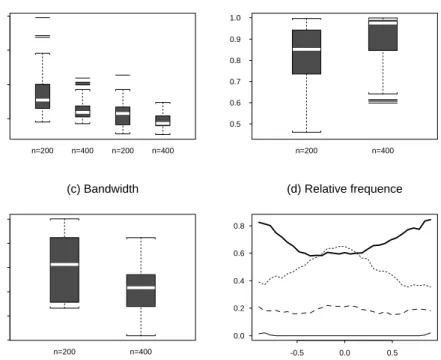
are summarized in Fig. 1. Fig. 1(a) displays the boxplots of the mean absolute deviation errors.
Wealsoplotthemeanabsolutedeviationerrorsobtainedusingthetruedirection. Thedeciency
due to unknown decreases when the sample size increases. Fig. 1(b) shows that the estimator b
derived fromthe one-stepiterative algorithm is closeto thetrue with highfrequencies inthe
simulationreplications. Theaverageiterationtimeinsearchforis14.43forn=400and18.25for
n=200. MostoutliersinFig.1(a)andFig.1(b)correspondtothecaseswherethesearchfordid
notconverge within30iterations,whichistheupperlimitsetinthesimulation. Fig.1(c)indicates
that theproposed bandwidthselector describedin x2.2.3 seems quite stable. We also appliedthe
methodinx2.2.4 to choosethelocalsignicant variablesat the31 regulargrid pointsintherange
from -1.5 to 1.5 times of thestandard deviationsof T
X. The relative frequencies of deletionare
depicted in Fig. 1(d). There is overwhelming evidence to include the `intercept' g 0
(z) =3e z
2 in
themodelforallthevaluesofz. Incontrast, wetendto deletemostoften thetermX t2
whichhas
`coeÆcient' g 2
(z)0. There isstrong evidence to keepthe termX t3
inthemodel. Note thatthe
termX t2
islesssignicant,themagnitudeof its`coeÆcient' g 1
(z)=0:8z beingsmaller thanthose
of bothg 0
(z) and g 3
(z).
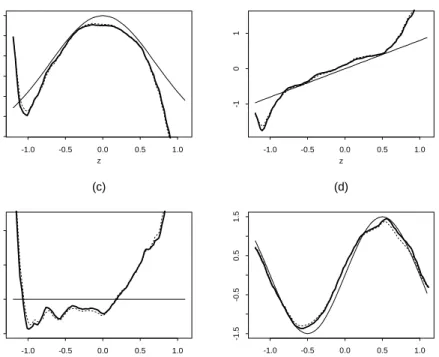
Fig. 2presentsa typicalexampleof theestimatedcoeÆcient functions. The curvesareplotted
on the range from -1.5 to 1.5 times of the standard deviation of T
X. The typical example
was selected in such a way that the corresponding E MAD
is equal to its median among the 200
replicated simulations withthe sample size n=400. For thisexample, the selected bandwidthis
0.597, T
b
= 0:946. For the sake of comparison, we also plot the estimated functions obtained
usingthetrue index. The deciencyduetounknown isalmostnegligibleonce b
isreasonably
accurate. Note thatthe biasesof estimatorsforthe coeÆcient functions g 0 ();g 1 () andg 2 () (but
notnecessarilyforg()) arelargenearto boundaries. We believethatthisisduetothecollinearity
ofvariablesX 1
;;X 4
andsmalleectivelocalsamplesizenearthetails. ThecoeÆcientfunctions
are notsoeasilyidentiedlocally inthose areas. However, there is no evidence that thisproblem
willdistorttheestimationforthetarget functiong(x).
Example 2. We nowconsidera timeseriesmodel
Y t = Y t 2 exp( Y 2 t 2 =2)+ 1 1+Y 2 t 2 cos(1:5Y t 2 )Y t 1 +" t ; (5.3) where f" t
gis a sequence of independent normalrandom variableswithmean 0 and variance0.25.
If we regard X t (Y t 1 ;Y t 2 ) T
as the regressor, (5.3) is of the form of model (3.3) with d = 2,
=(0;1), and g 0 (z)= zexp( z 2 =2); g 1 (z)=cos (1:5z)=(1+z 2 ):
Toillustratetheapplicationofouralgorithmtothismodel,weconducttwosimulationswithsample
size 200 and 400 respectivelywith 200 replications. For each replication, we predict the 50
post-sample pointsand compare them with thetrue values. One realizationwith samplesize 400 lasts
(a)
z
-1.0
-0.5
0.0
0.5
1.0
0.0
0.5
1.0
1.5
2.0
2.5
3.0
(b)
z
-1.0
-0.5
0.0
0.5
1.0
-1
0
1
(c)
z
-1.0
-0.5
0.0
0.5
1.0
-0.5
0.0
0.5
1.0
(d)
z
-1.0
-0.5
0.0
0.5
1.0
-1.5
-0.5
0.5
1.5
Figure 2: Simulationresults forExample1 (n =400). The plot of estimated coeÆcient functions (thick line), true functions (thin line), and estimated functions with true index (dotted line). (a)g 0 (z)=3e z 2 ;(b) g 1 (z)=0:8z; (c)g 2 (z)=0;(d)g 3 (z)=1:5sin(z).
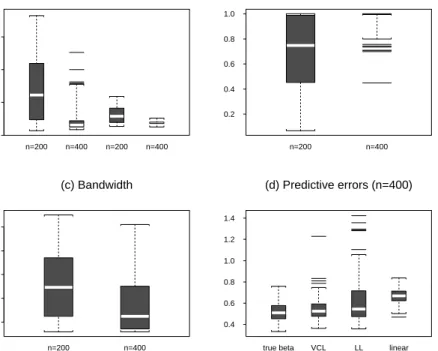
aPentiumII350MHzPC.TheresultsaresummarizedinFig.3. Fig.3(a)displaystheboxplots of
themeanabsolutedeviationerrors. Forsamplesizen=400,themediumsofE MAD
withestimated
and true areabout the same, although the distribution of E MAD
with b
hasa long tail on the
right. Fig.3(b) shows that the estimator b
derived from the one-step iterative algorithm is close
to the true with high frequencies in the simulation replications. The average iteration time in
search for is7.80 forn=400 and 17.62 forn=200. In fact, thesearchdid notconvergewithin
30 iterationsfor 21 out of 200 replications withn =200, and forone out of 200 replications with
n=400. Fig.3(c) is theboxplotof theselected bandwidths.
Wealso compared predictionperformanceofvariousmodelsinthesimulation withthesample
size n = 400. For each of 200 realizations, we predict 50 post-sample points from four dierent
models,namely thettedvarying-coeÆcientmodelswithtrue andestimated ,apurely
nonpara-metricmodel basedon locallinear regressionof Y t
on (Y t 1
;Y t 2
) withthebandwidthselected by
theGCV-criterion, and alinear autoregressive modelwith theorder (2) determinedbyAIC.In
oursimulation,AICalwaysselectedorder2inthe200replications. Fig.3(d)presentstheboxplots
of the average absolute predictive errors. The varying-coeÆcient models withtrue and estimated
arethetwo best predictorssincethey specifythecorrectform ofthetrue model(see Fig.3(d)).
Themedianofthepredictiveerrors fromthenonparametricmodelbasedonlocallinearregression
isaboutthesameasthatfromthevarying-coeÆcientmodel. Butthevarianceismuchlarger. The
Fig.4 presents a typical example of the estimated coeÆcient functions with the sample size
n=400. The curves are plottedon therange from -1.5 to 1.5 times of the standard deviation of
T
X. Forthecase withn=400, theselectedbandwidthis0.781, and T b =0:999. (Themedian of T b
inthesimulation of200 replications withn=400 is0.999.)
0.0
0.5
1.0
1.5
n=200
n=400
n=200
n=400
(a) Absolute deviation
0.2
0.4
0.6
0.8
1.0
n=200
n=400
(b) Inner product
0.5
1.0
1.5
2.0
2.5
n=200
n=400
(c) Bandwidth
0.4
0.6
0.8
1.0
1.2
1.4
true beta
VCL
LL
linear
(d) Predictive errors (n=400)
Figure3: SimulationresultsforExample2. The boxplotsof (a)themeanabsolutedeviationerror E
MAD
(the twopanelson theleftarebasedon b
,andthetwo panelsontherightarebased onthe true ), (b) the absolute inner product j
T b
j, (c) the selected bandwidths, and (d) the average absolutepredictiveerrorsofthevarying-coeÆcientmodelswithtrueand
b
,nonparametricmodel based onlocallinearregression, andlinear AR-modeldetermined byAIC(fromleft to right).
(a)
z
-1.5
-1.0
-0.5
0.0
0.5
1.0
1.5
-0.6
-0.4
-0.2
0.0
0.2
0.4
0.6
(b)
z
-1.5
-1.0
-0.5
0.0
0.5
1.0
1.5
-0.5
0.0
0.5
1.0
Figure4: SimulationresultsforExample2. TheplotofestimatedcoeÆcientfunctions(thickline), true functions (thin line). (a) g
0 (z) = ze z 2 =2 ; (b) g 1 (z) =cos (1:5z)=(1+z 2
). The sample size n=400.
Y t = 3exp ( Z 2 t +X t1 )+(Z t +X 2 t1 )X t1 log (Z 2 t +X 2 t1 )X t2 +1:5sin(Z t +X t1 )X t3 +" t ; withZ t = 1 2 (X t1 +X t2 +X t3 +X t4 ); wherefX t1 ;:::;X t4 gandf" t
garethesameasinExample1. Obviously,theregression functionin
theabovemodelisoftheform(4.1)withd=4,= 1 2 (1;1;1;1) T ,V t =X t1
andthetwo-dimensional
coeÆcient functions g 0 (z;v)=3e z 2 +v ; g 1 (z;v)=z+v 2 ; g 2 (z;v)= log (z 2 +v 2 ); g 3 (z;v)=1:5sin(z+v);
whichareplottedinFig.5. AssumingthedirectionofV t
=X t1
isgiven,wenowapplythealgorithm
described inx3.4 to estimate thecoeÆcient functions. We conduct three simulationswith sample
size200, 400 and 600 respectively,each with 100 replications. The CUPtime foreach realization,
inaSunUltra-10 300MHzWorkstation,isabout18 secondsforn=200, 1minuteand 20seconds
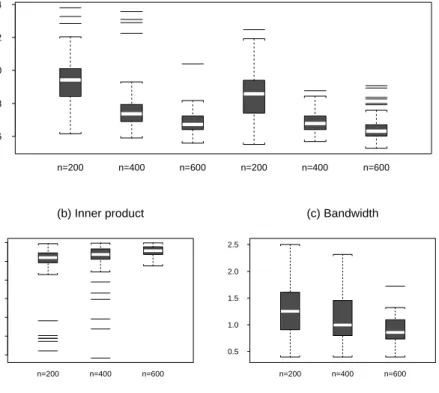
for n =400 and 3 minutes and 10 seconds for n = 600. Fig. 6(a) shows that the mean absolute
deviation errordecreaseswhen n increases. For thesake of comparison,we also presentthe mean
absolutedeviationerroroftheestimatorbasedontruevalueof. Fig.6(b)displaystheboxplotsof
theabsolute innerproductj T
b
j, whichindicates thatthe one-step iterationalgorithm described
inx3.2 worksreasonablywell. Theboxplotsof bandwidthsselected bytheGCV-methodstatedin
x3.3 aredepictedinFig. 6(c).
-1.5
-1
-0.5
0
0.5
1
1.5
z
-0.5
0
0.5
1
v
0
2
4
6
8
(a)
-1.5
-1
-0.5
0
0.5
1
1.5
z
-0.5
0
0.5
1
v
-2
-1
0
1
2
3
(b)
-1.5
-1
-0.5
0
0.5
1
1.5
z
-0.5
0
0.5
1
v
-2
0
2
4
6
8
(c)
-1.5
-1
-0.5
0
0.5
1
1.5
z
-0.5
0
0.5
1
v
-1.5
-1
-0.5
0
0.5
1
1.5
(d)
Figure 5: The coeÆcient functions of Example 3. (a) g 0 (z;v) = 3e z 2 +v , (b) g 1 (z;v) = z+v 2 , (c)g 2 (z;v)= log(z 2 +v 2 ),and (d)g 3 (z;v)=1:5sin(z+v).
0.6
0.8
1.0
1.2
1.4
n=200
n=400
n=600
n=200
n=400
n=600
(a) Absolute deviation
0.4
0.5
0.6
0.7
0.8
0.9
1.0
n=200
n=400
n=600
(b) Inner product
0.5
1.0
1.5
2.0
2.5
n=200
n=400
n=600
(c) Bandwidth
Figure 6: Thesimulationresults forExample3. The boxplots of (a) themean absolute deviation error E
MAD
, (b) the absolute inner product j T
b
j, and (c) the selected bandwidths. The three panelson theleftin(a)arebased onthe estimated,and thethree panelsontheright arebased on thetrue . Thethree panelson theleft in(a) arebased on theestimated ,and the three on theright arebased onthe true.
5.2 Real data examples
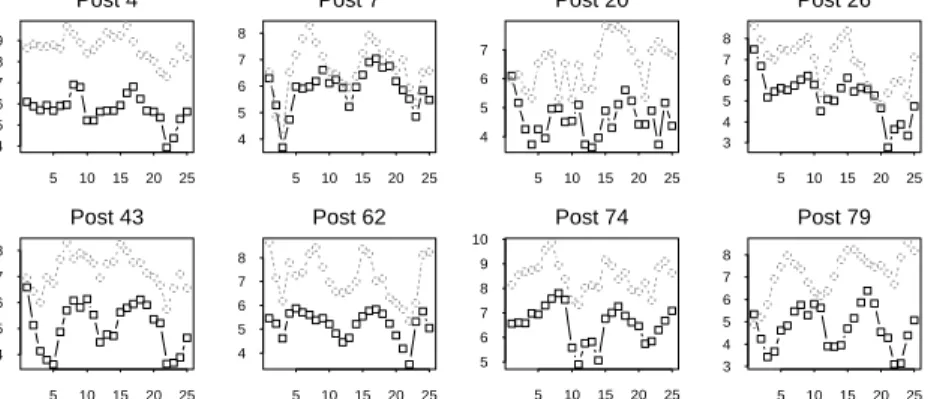
Example4. Theannualnumbersofmuskratsandminkcaughtover82trappingregionshavebeen
recentlyextractedfromthe recordscompiledbythe HudsonBayCompanyonfursalesat auction
in1925-1949. Fig. 7indicates the82 posts wherefurswerecollected. Biological evidence suggests
that mink is a key predator on muskrat (Errington, 1961, 1963). Fig. 7(b) plots the time series
of the mink and the muskrat (on the natural logarithmic scale) from 8 posts selected randomly
among the 82 posts. Most seriesexhibit cycles with a period of around 10 years. There exists a
clearsynchronybetweentheuctuationsofthetwospecieswithadelayofaboutone ortwoyears.
Since there is a general lackof data on bothprey and predator from thesame area and over the
same time period,this data set oers a unique opportunity for quantitative analysis aiming at a
deeperunderstandingof theinteractionbetweenprey(i.e. muskrat)and predator(i.e. mink). As
astartingpoint,weintroduceanecologicalmodelto describethemink-muskratinteraction. Based
(PutFig.7(a) here)
Post 4
5
10
15
20
25
4
5
6
7
8
9
Post 7
5
10
15
20
25
4
5
6
7
8
Post 20
5
10
15
20
25
4
5
6
7
Post 26
5
10
15
20
25
3
4
5
6
7
8
Post 43
5
10
15
20
25
4
5
6
7
8
Post 62
5
10
15
20
25
4
5
6
7
8
Post 74
5
10
15
20
25
5
6
7
8
9
10
Post 79
5
10
15
20
25
3
4
5
6
7
8
(b) Mink-muskrat time series from 8 posts
Figure7: (a) A mapof82 posts forthe minkand themuskrat inCanadain1925 {1949. (b)The timeseriesplots ofthemink and themuskrat datafrom 8 randomlyselected posts. Solidlines | mink;dashed lines| muskrats.
model to describethepredator-prey interaction,namely 8 < : X t+1 X t = a 0 ( t ) a 1 ( t )X t a 2 ( t )Y t ; Y t+1 Y t = b 0 ( t ) b 1 ( t )Y t +b 2 ( t )X t ; (5.4) where X t and Y t
denote the population abundances, on a natural logarithmic scale, of muskrat
and mink respectivelyat time t, a i
() and b i
() are non-negative functions, and t
is an indicator
representing the regime eect at time t, which is determined by X t
and/or Y t
. The term `regime
eect'collectivelyreferstothenonlineareectdueto,amongothers,thedierenthunting/escaping
behaviororthedierentreproductionratesofanimalsatdierentstages ofpopulationuctuation
(Stensethetal.,1999). Biologicallyspeaking, a 1 ( t )andb 1 ( t
)reectthewithinspeciesregulation
whereasa 2 ( t ) andb 2 ( t
)reectthefoodchaininteractionbetweenthetwospecies,anda 0 ( t )and b 0 ( t
) arethe intrinsicratesof changes. A simpleoptionwhich facilitates statisticaldata analysis
isto use athresholdvariable to denetheregime eect which switchesbetweentwo regimes. The
model implied,with addedrandomnoise,could have theform 8 < : X t+1 = (a 10 +a 11 X t +a 12 Y t )I(X t r 1 )+(a 20 +a 21 X t +a 22 Y t )I(X t >r 1 )+" 1;t+1 ; Y t+1 = (b 10 +b 11 Y t +b 12 X t )I(X t r 2 )+(b 20 +b 21 Y t +b 22 X t )I(X t >r 2 )+" 2;t+1 ; (5.5)
where we choose muskrat variable X t
as the threshold variable. It is easy to see from (5.4) that
botha 12
and a 22
shouldbe non-positive,andbothb 12
andb 22
shouldbe non-negative. The model
(5.5) assumesthepopulationsmuskrat andmink arepiecewiselinearfunctions oftheirimmediate
lagged values. Note that each time series has only 25 points, which imposes intrinsic diÆculties
for statistical data analysis even with simple nonlinear models such as (5.5). Yao et al. (1998)
and theother sixpostson itsrightinFig.7;thewesternareaconsistingofthe30 posts ontheleft
in Fig. 7 (i.e. post 17 and those on its left); and the centralarea consisting of theremaining 43
postsin themiddle. Yao etal. (1998) tted model (5.5) to each ofpooleddata sets and reported
some interesting andecologically interpretablendings.
(a) Mink model for central area
z
-1
0
1
-0.6
-0.4
-0.2
0.0
0.2
0.4
0.6
(b) Muskrat model for central area
z
-3
-2
-1
0
1
2
3
-1.0
-0.5
0.0
0.5
1.0
(c) Mink model for western area
z
-2
-1
0
1
2
-1.0
-0.5
0.0
0.5
1.0
(d) Muskrat model for western area
z
-1
0
1
2
-1.0
-0.5
0.0
0.5
1.0
(e) Mink model for eastern area
z
-1
0
1
-1.0
-0.5
0.0
0.5
1.0
1.5
(f) Muskrat model for eastern area
z
-2
-1
0
1
2
0.0
0.5
1.0
1.5
Figure 8: Estimated coeÆcient functions for Canadian mink-muskrat data. (a), (c) & (d): thick solid lines | g x (); solid lines | g y (); dashed lines | g 0
(). (b), (d) & (f): thick solid lines | f y (); solidlines| f x ();dashed lines| f 0 ().
Clearly,themodel(5.5)simpliesthenonlinearinteractioninto twostates(foreach ofmuskrat
or mink models) with a prescribed threshold variable X t . Note that X t X t 1 is the muskrat
population growth rate. It is biologically interesting to nd out which would be an appropriate
`threshold'variable to denethe regime eect among X t ,X t X t 1 ,Y t and Y t Y t 1 . Withthe
8 < : X t+1 = f 0 (Z t )+f 1 (Z t )Y t 1 +f 2 (Z t )Y t +f 3 (Z t )X t 1 +" 1;t+1 ; Y t+1 = g 0 (Z t )+g 1 (Z t )Y t 1 +g 2 (Z t )Y t +g 3 (Z t )X t 1 +" 2;t+1 ; (5.6) whereZ t = 1 Y t 1 + 2 Y t + 3 X t 1 + 4 X t with( 1 ; 2 ; 3 ; 4 ) T
selected bydata. Comparing
with(5.4)and(5.5),weincludefurtherlaggedvaluesX t 1
and Y t 1
intotheabovemodel. We will
applythelocalvariableselectiontechniqueinx2.2.4todetectanyredundantvariablesat31regular
gridpointsovertherangefrom-1.5to1.5timesofstandarddeviationofZ t
. Toeliminatetheeect
ofdierentsamplingweightsindierentregionsand fordierent species,we rststandardizedthe
mink series and muskrat series separately for each post. Since there are some missing values in
the data from post 15, we exclude it from our analysis. The sample size for eastern, central and
western areas aretherefore 207,989 and 667 respectively. Wedenote R MSE
theratioof themean
squareserrors fromthetted model over thesample variance ofthevariable to betted.
First,weusethesecondequationof(5.6)tomodelminkpopulationdynamicsinthecentralarea.
Theselected is(0:424;0:320;0:43 2;0:7 33 ) T
,theselected bandwidthis0.415, andR MSE
=0:449.
The local variable selection indicates that X t 1
is the least signicant variable over all, for it is
signicant at only7outof 31 grid points;see x2.2.4. Byleavingitout, we reduce to themodel
Y t+1 =g 0 (Z t )+g y (Z t )Y t +g x (Z t )X t +" 2;t+1 ; (5.7) whereZ t = 1 Y t + 2 X t + 3 Y t 1
. Our algorithm selected
Z t =(0:540Y t 0:634Y t 1 )+0:553X t ; (5.8)
which suggests that thenonlinearityis dominatedbythegrowth rateof mink and thepopulation
of muskrat inthe previousyear. The estimated coeÆcient functions are plottedin Fig.8(a). The
coeÆcient function g x
() is positive, which reects the fact that a large muskrat population will
facilitate the growth of the mink population. The coeÆcient function g y
() is also positive, which
indicatesanaturalreproductionprocessofminkpopulation. Bothg y
()andg x
()areapproximately
increasingwithrespecttothesumofgrowthrateofminkandpopulationofmuskrat;see(5.8). But
the`intercept' g 0
() drops sharplyafterZ t
reaches athresholdaround 1. This mightbe relatedto
thefact that mink populationcould suer from its over-sizedgrowth rate dueto the competition
for food and living environment among mink themselves. All the terms in the model (5.7) are
signicant inmost places; the number of signicant grid points for `intercept', Y t
and X t
are 21,
31 and 26(out of 31intotal). The selected bandwidthis0.597 and R MSE
=0:461.
Fitting the rst equation of (5.6) to muskrat dynamics in the central area, we obtained b = (0:632;0:308;0:21 0;0:6 80 ) T , b h=0:346 and R MSE
=0:518. The overall least signicantvariable is
Y t 1
whichis onlysignicantin 9outof 31 grid points. By leave itout, themodelisreducedto
X t+1 =f 0 (Z t )+f y (Z t )Y t +f x (Z t )X t +" 1;t+1 ; (5.9) whereZ t = 1 Y t + 2 X t + 3 X t 1
. Theresultsfromttingareasfollows: Z t =0:542Y t +0:720X t + 0:435X t 1 , b h=0:498 andR MSE
coeÆcient functionf y
()isalwaysnegative,whichreectsthefactthatminkisthekeypredatorof
muskratinthiscoreoftheborealforestinCanada. ThecoeÆcientf x
()ispositive,aswell-expected.
Werepeatedtheaboveexerciseforpooleddatainthewesternarea,andobtainedsimilarresults.
In fact, the model (5.7) appears appropriate for mink dynamics with Z t = 0:469Y t +0:723X t + 0:507Y t 1 , R MSE =0:446, b
h =0:415, and theestimated coeÆcient functions plotted inFig. 8(c).
Themodel(5.9)appearsappropriateformuskratdynamicswithZ t =0:419Y t +0:708X t +0:569X t 1 , b h=0:415, R MSE
=0:416, andthe estimatedcoeÆcient functionsplottedin Fig.8(d).
Finally,we tthedataintheeasternarea. Theresultsareradicallydierentfromthose ofthe
central and the west stated above. To t the mink dynamics with the second equation of (5.6),
we discovered that both X t
and X t 1
are signicant only in smallportions of the sample space.
After leavingoutX t 1
, the ttingwiththe model (5.7) give Z t =0:173Y t 0:394X t +0:901Y t 1 , b h = 0:597 and R MSE
= 0:681. The local variable selection indicates that out of 31 grid points,
the `intercept', Y t
and X t
are signicant at 15, 31 and 4 points respectively. There is clear
auto-dependenceinminkseriesfY t
gwhilemuskratdatafX t
gcarry littleinformationaboutmink. The
estimatedcoeÆcients, depictedinFig.8(e),areconsistentwiththeaboveobservations. Thetting
ofthemuskratdynamicsshowsagainthatthereseemslittleinteractionbetweenminkandmuskrat
inthisarea. Forexample, thetermY t
inthemodel(5.9) isnotsignicantat allthe31 gridpoints
tested. The estimated coeÆcient functionf y
() is plottedas thethick curve inFig. 8(f), which is
alwaysclose to 0. We t thedatawitha furthersimpliedmodel
X t+1 =f 0 (Z t )+f x (Z t )X t +" 1;t+1 :
Theresultsareasfollows: Z t =0:667X t 0:745X t 1 , b h=0:498andR MSE =0:584. Theestimated
coeÆcient functions are superimposed on Fig. 8(f). Note thedierent rangesof z-values are due
to dierent Z 0 t
s areused intheabove modeland themodel (5.9).
Insummary,wehavefacilitatedthedataanalysisofthebiologicalfoodchaininteractionmodel
ofStensethetal. (1997) byportrayingthenonlinearitythroughvarying-coeÆcientfunctions. The
selection of the index inour algorithm is equivalent in this context to the selection of the regime
eect indicator, which in itself is of biological interest. The numerical results indicatethat there
is a strong evidence of predator-prey interaction between mink and muskrat in the central and
western areas. However, no evidence forsuch an interactionexists inthe easternarea. In light of
what isknownintheeasternarea,thisisnotsurprising. Thereisalargerarrayof prey-speciesfor
the mink to feedon, making it less dependent on muskrat. It has been also observed that foxes
have amuch more pronouncedinuenceon theentiresystem ofthisarea (Elton,1942).
Example 5. This exampleconcerns thedaily closing bidprices of thepoundsterling interms of
USdollarfrom2January1974to30December1983,whichformsatimeseriesoflength2510. The
previousanalysisofthis`particularlydiÆcult'datasetcanbefoundinGallant,HsiehandTauchen
(1991) and the references within. Let X t