Appears in "Proceedings of the Nineth International Workshop on Languages and Compilers for Parallel Computing," pages 481-500, 1996.
Factor-Join: A Unique Approach to Compiling
Array Languages for Parallel Machines
?Bradford L. Chamberlain Sung-Eun Choi E Christopher Lewis
Calvin Liny Lawrence Snyder W. Derrick Weathersby
University of Washington, Seattle, WA 98195-2350 USA
y University of Texas, Austin, TX 78712 USA
Abstract. This paper describes a new approach to compiling and
op-timizing array languages for parallel machines. This approach rst de-composes array language operations intofactors, where each factor cor-responds to a dierent communication or computation structure. Op-timizations are then achieved by combining, or joining, these factors. Because factors preserve high level information about array operations, the analysis necessary to perform these join operations is simpler than that required for scalar programs. In particular, we show how data par-allel programs written in the ZPL programming language are compiled and optimized using thefactor-joinapproach, and we show that a small number of factors are sucient to represent ZPL programs.
1 Introduction
Array languages such as Fortran 90 and ZPL introduce compilation issues not encountered in the context of scalar languages such as Fortran 77 or C. Cer-tain problems vanish, others become more complicated, and still others call for techniques not previously available. This paper shows how compilers can exploit this new context. Using the ZPL compiler as an example, we describe a new ap-proach to compiling array languages that is particularly useful when compiling for parallel machines.
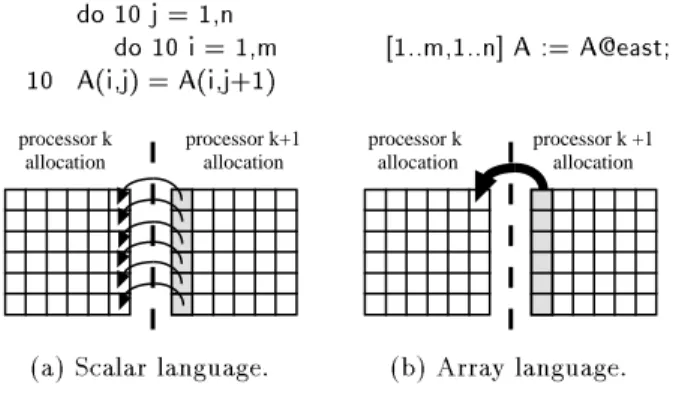
To see how an array language can simplify the compilation process, consider the problem of generating explicit interprocessor communication from a scalar language. One challenging problem in compiling scalar Fortran 77 code is per-formingmessage vectorization[9]|the transmission of multiple values in a single message rather than in separate messages. In scalar languages, the base unit of computation is a single value, and communication is generated per-value, making vectorization an optimization task. But in array languages the unit of computa-tion is a contiguous sub-array, resulting in natural and automatic vectorizacomputa-tion, as illustrated in Fig. 1.
To illustrate how an array language's high-level concepts motivate new op-timizations, consider ZPL's reduce operators which combine data elements of
an array using an associative operator such as plus, logical-and, or minimum. The implementation of reduce requires local computation, a global reduction, and a broadcast. The communication components of consecutive reduces can be merged to yield signicant performance improvements in much the same way that message vectorization optimizes access to consecutive scalar values. This optimization is illustrated in Fig. 2. In scalar languages, there is little chance for the compiler to optimize communication in this way. Even if the reduce concept is abstracted to a procedure, it is dicult for a compiler to recognize, much less realize, the opportunityto perform the optimization.
do 10 j = 1,n do 10 i = 1,m 10 A(i,j) = A(i,j+1) processor k allocation processor k+1 allocation
(a) Scalar language.
[1..m,1..n] A := A@east; processor k allocation processor k +1 allocation (b) Array language.
Fig.1.Message vectorization in parallelized Fortran 77 and ZPL.
The ZPL compiler achieves these sorts of optimizations with the factor-join
compilation strategy in which each array operation is decomposed into basic components called factors. Each factor describes an elementary computation or data transfer operation, and subsequent analyses manipulate and join these factors as optimizations. Though more basic than ZPL array operations, the
minvel := min<<Vel;
maxvel := max<<Vel;
(a) ZPL source.
t = DBL MAX;
for (i=mylow; i<myhi; i++)
t = min(t,Vel[i]);
Glob Reduce(<t,min>); Broadcast(<t,minvel>);
t = -DBL MAX;
for (i=mylow; i<myhi; i++)
t = max(t,Vel[i]);
Glob Reduce(<t,max>); Broadcast(<t,maxvel>);
(b) Naive code generation.
t1 = DBL MAX;
for (i=mylow; i<myhi; i++)
t1 = min(t,Vel[i]); t2 = -DBL MAX; for (i=mylow; i<myhi; i++)
t2 = max(t2,Vel[i]);
Glob Reduce(<t1,min>,<t2,max>); Broadcast(<t1, minvel>,<t2, maxvel>);
(c) Optimized code generation.
Fig.2.Combining the communication portions of reductions. Notice the reduce
factors preserve the source code's high-level semantics. In contrast to this high level approach the IBM HPF compiler may lose semantic information because
itscalarizesFortran 90 array structures early in the compilation process [12].
The ZPL compiler thus employs standard compilation concepts and tech-niques, but extends them to exploit the language's abstractions and to treat arrays atomically. Our presentation of the ZPL compiler will assume an under-standing of scalar compilation and concentrate only on areas of dierence. These include the following.
{
Internal representations, particularly the AST{
Run-time assumptions about the virtual machine{
Phases of compilation{
The factor-join technique and its resulting optimizations loop fusion and array contractionredundant communication removal
communication pipelining and combining
This paper presents the rst description of the ZPL compiler's internal work-ings, and as such it concentrates on compilation strategy rather than perfor-mance. Previous work has shown that the generated code's performance is com-parable with C using explicit message-passing [21] and is generally superior to the HPF compilers with which it has been compared [19, 22]. ZPL has also been successfully used for scientic and engineering applications [8, 18, 24], and its compiler is available on the Web.2
The remainder of this paper is structured as follows. Section 2 briey intro-duces basic ZPL language concepts|more complete descriptions are available elsewhere [27, 20]. Section 3 describes runtime assumptions that are used in the compilation process. The compilation process itself is described in Sect. 4, with an emphasis on its structure and use of the factor-join strategy. Section 5 dis-cusses the details of joining, and the nal two sections present related work and conclusions.
2 ZPL Language Summary
ZPL is an implicitly parallel array language designed for scientic computa-tions [27]. It is an imperative language, supporting standard data types (integer,
oat,char, etc.), standard operators (+,-,, etc.), C-like assignment operators (+=,=, etc.), procedures with by-value and by-reference parameters, recursion, a standard set of control constructs (if,for,while, etc.), and C-like I/O.
In addition, ZPL provides a number of abstractions and operations designed
to simplify programming while promoting eciency.Regionsare a fundamental
concept, implicitly specifying the parallelism in a ZPL program. A region is a set of indices and can be declared as follows. (Any text to the right of { {is a comment.)
region R = [1..m, 1..n]; { { Declare R=f(1,1), (1,2),:::, (m,n)g Regions are used to declare arrays as follows.
var A: [R] oat; { { A is an mn array of oats
Region speciers prex statements to dene the extent of array operations. A
statement whose arrays are of rank r requires a region specier of rankr, and the array indices for which the statement is executed are the indices in the region specier. For example, the following statement assigns the value 1 to the elements of Afor the indicesR = f(1,1), (1,2),:::, (m,n)g.
[R] A := 1;
Dynamically scoped region speciers allow a procedure either to supply region speciers explicitly in its body or to inherit them from the call site. Thus, proce-dures can be written in a region-independent fashion and execute over dierent regions with each call.
[east of R] A:=1
[R] A:=1 [east in R] A:=0 [2,1..n] A:=0 [R] ... A@east ...
(a) (b) (c) (d) (e) (f)
[R] A := A@east
Fig.3.Sequence of region usage examples. Grey boxes represent the value 1 and white
represents 0. The hashed area in (e) represents the elements referred to byA@east.
Regions can be expressed and manipulated in a variety of ways. Figure 3 shows a sequence of operations which use A,Randnas dened above, andeast
= [0,1]. Array and region names are capitalized, while scalar variables are not.
In Fig. 3(a), an array assignment, as just described, sets the R region ofA, to 1. Next, an assignment over the region east in Rsets the columninside theeast
border to 0. In 3(c), the regioneast of R causes the implicit allocation of a new column adjacent to, but outside of, the east border and sets it to 1.Dynamic
regionsbind their indices at runtime. Thedynamic region [2,1..n]in 3(d) species
that the rstnelements of the second row be set to 0. The@-operator translates the specied region, in this case R, by adding the directionto all indices in the region, so Fig. 3(e) uses diagonal hashing to indicate the values referenced by
A@east. In 3(f), the hashed portion of the array is assigned intoA, shifting the
array. Notice that the values in the east of Rregion are unchanged because they are outside of the applied regionR.
ZPL supports a full set of reduce and scan (parallel prex) operators. For example, the following statement reduces A to the value of its largest element using the max reduction operator (max<<) and assigns the value to the scalar
biggest := max<<A; { { Find largest element
Other reduction operations includemin<<,+<<,<<, and&<<. Scan is simi-lar to reduce, but it produces an array of the same shape and size as its operand, and each element contains the result of the reduction over all lower indexed el-ements (in row-major order).
Biggest so far := maxjjA; { { Scan nding progressively larger items
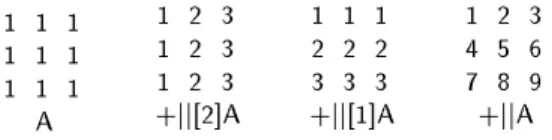
ZPL also has partial reduces and scans that apply an operator over a subset of the array's dimensions (see Fig. 4). The dimensions in brackets indicate the subset of dimensions to scan across.
1 1 1 1 1 1 1 1 1 A 1 2 3 1 2 3 1 2 3 +jj[2]A 1 1 1 2 2 2 3 3 3 +jj[1]A 1 2 3 4 5 6 7 8 9 +jjA
Fig.4.Partial scan operation examples.
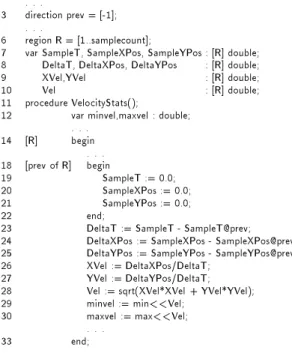
The concepts introduced up to this point are sucient for understanding the sample scientic computation shown in Fig. 5. This code takes as input a vector containing the sampled coordinates of an object at various times (
Sam-pleT,SampleXPos,SampleYPos). It assumes the object was at the origin at time
0 (lines 18-22) and computes the approximate velocity of the object for each sampled interval (lines 23-28). It then applies reduction operators to determine the object's minimum and maximum velocities (lines 29-30). This program will serve as a running example throughout the paper. A complete listing is provided in Appendix A.
In addition to the above operations, ZPL contains a number of expressive abstractions for array manipulation. Due to space limitations, we only give a brief survey below, but complete information is available elsewhere [27, 20].
{
Shattered control ow { ZPL has sequential control ow as long as controlstatements involve only scalars (e.g.,if (scalar=1) then:::). Control ow can also be specied using arrays, (e.g., [R] if (Array=1) then:::), so that each index in the region is given a concurrently-executing thread of control.
{
Flooding{ Arrays can be declared to beoodable, causing certain dimensionsto be replicated for all indices (e.g., var F:[1..m,] oat;). The ood opera-tor (>>[R]) can be used to assign rows or columns (indicated by regionR) of an array to a oodable array. For example:
. . .
3 direction prev = [-1]; . . .
6 region R = [1..samplecount];
7 var SampleT, SampleXPos, SampleYPos : [R] double; 8 DeltaT, DeltaXPos, DeltaYPos : [R] double; 9 XVel,YVel : [R] double;
10 Vel : [R] double;
11 procedure VelocityStats();
12 var minvel,maxvel : double; . . . 14 [R] begin . . . 18 [prev of R] begin 19 SampleT := 0.0; 20 SampleXPos := 0.0; 21 SampleYPos := 0.0; 22 end;
23 DeltaT := SampleT - SampleT@prev; 24 DeltaXPos := SampleXPos - SampleXPos@prev; 25 DeltaYPos := SampleYPos - SampleYPos@prev; 26 XVel := DeltaXPos/DeltaT;
27 YVel := DeltaYPos/DeltaT; 28 Vel := sqrt(XVel*XVel + YVel*YVel); 29 minvel := min<<Vel;
30 maxvel := max<<Vel;
. . . 33 end;
Fig.5. Excerpt from running example in Appendix A. This ZPL code computes
ap-proximate minimum and maximum velocities of a particle from a vector of sampled positions and times.
Since F is a ood array, it has no specic number of columns, and only a
single copy of its dening values is stored at each processor. This provides a highly ecient way to refer to substructures of an array. For example, after
column 4 of Ahas been ooded intoF (above), the statement [R] A:=AF
has the eect of multiplying each column ofAby column 4.
{
Reect/Wrap { Operations are provided to simplify the computation ofboundary values. When invoked in the context of anoforinregion specier, reect and wrap cause the array's values in that region to be lled with those mirrored across the border (reect) or from the opposite side of the array (wrap).
{
Scalars/Arrays/Indexed Arrays { Scalars are replicated and redundantlycomputed. ZPL has two kinds of arrays: parallel arrays (also referred to simply as \arrays") for which indexing is not needed, and indexed arrays for which indexing is required. Parallel arrays are distributed across all pro-cessors, while indexed arrays are replicated in the same manner as scalars. Indexed arrays are commonly used as elements of parallel arrays.
This concludes our introduction to ZPL. We note that the language's oper-ators, though very regular and structured, can be combined in non-trivial ways
to implement many scientic applications. The language is not ideally suited for certain applications, particularly highly irregular codes. These are handled by ZPL's more general parent language,Advanced ZPL[26].
3 The ZPL Runtime
Before describing the ZPL compiler, we state a few assumptions about ZPL's runtime environment. In ZPL, the region is the basis for a program's implied parallelism. In the current implementation, the union of all regions' index sets is block distributed across a two dimensional processor mesh. Each array is allocated based on this block distribution, so all array elements with the same indices are allocated to the same processor.
This assumption leads to the trivial identication of communication|both for the compiler and the user. For example, line 28 of the running example (Vel :=
sqrt(XVel*XVel + YVel*YVel);) can be executed in parallel because
correspond-ing elements of arraysVel,XVel, andYVelare known to reside on the same proces-sor. The shifted array reference in Line 23 (DeltaT := SampleT - SampleT@prev;) will require point-to-point communication to transfer non-local values of Sam-pleTto adjacent processors. As a nal example, line 29 (minvel := min<<Vel;) computes the minimum-reduction using collective communication involving all processors. This identication of necessary communication is crucial to the com-piler's factor-join scheme, as will be seen in Sect. 4.
Although arbitrary alignment is not supported, certain optimizations,such as aligning only interacting arrays, are straightforward extensions. However, in the common case, a single global distribution scheme has proven very eective. The use of a two-dimensional block distribution of higher-dimensional regions was a decision of convenience that results in eective compilation for the common case. Higher-dimensional and alternative (e.g., cyclic, block-cyclic) distributions are a relatively straightforward extension to the existing compiler.
4 Compiler Overview
This section describes how the ZPL compiler transforms ZPL source code into a loosely synchronous SPMD C program that can then be compiled and run on any target machine. The bulk of the work is in compiling array operations into an ecient distributed scalar implementation. Since source-level scalar operations are replicated on each processor, their compilation is straightforward and will receive little attention here.
The ZPL compiler rst parses the ZPL source into an abstract syntax tree (AST). The compiler preserves the source program's high-level array operations, rather thanscalarizing them, to allow the compiler to perform optimizations at the array level. The AST is not transformed into scalar code until the generation of the ANSI C output. Additional AST nodes are introduced during the compi-lation process, for example to explicitly represent data transfer that is implicitly specied by the source program.
After parsing, the compilernormalizesthe AST to produce a more uniform AST and to eliminate complex interactions between the dierent types of array operations. Normalization breaks heterogeneous array statements (i.e., state-ments containing dierent varieties of array operations) into a number of simpler array statements by inserting temporary scalars or arrays.
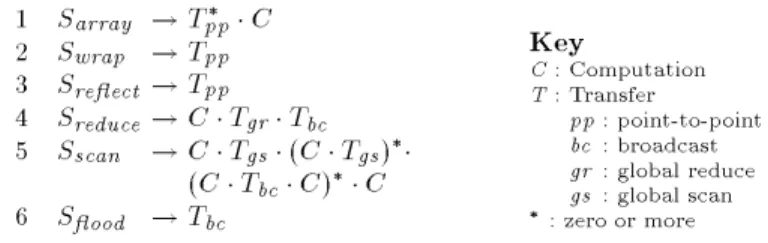
The compiler then performs optimizationsusing the factor-join strategy. Each normalized statement is decomposed into factors, where each factor represents an elementary array operation involving either local computation (C-factors) or interprocessor data transfer (T-factors). Because each factor represents a particular communication or computation structure, factors of the same type can always be joined. The joining of the various types of factors is discussed in Sect. 5. Figure 6 summarizes the factorization of the dierent types of ZPL array statements. 1 Sarray !T pp C 2 S wrap !T pp 3 S reect !Tpp 4 S reduce !CT gr T bc 5 Sscan !CTgs(CTgs) (CT bc C) C 6 S ood !T bc Key C: Computation T: Transfer pp: point-to-point bc : broadcast gr : global reduce gs : global scan : zero or more
Fig.6.Rules for factoring the dierent types of array statements.
As an example of factorization, the compiler classies line 28 (Vel:=sqrt(XVel*
XVel+YVel*YVel);) of the running example (Fig. 5) as an element-wise array
statement (S
array) and factors it using rule 1 (Fig. 6). This statement requires no data transfer because no communication-inducing operators are used. Thus, the compiler expands the statement into a single C-factor and no T-factors.
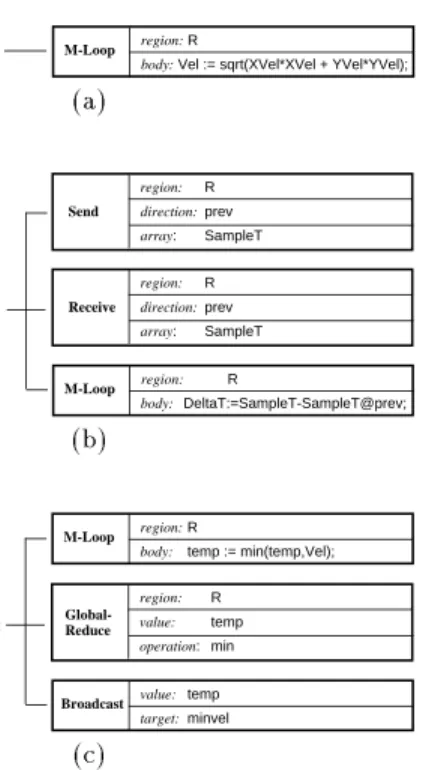
The correspondence between C-factors and local computation simplies sub-sequent analysis. Each C-factor is represented by a multi-loop(or m-loop) node that encapsulates all information needed to generate object code, including the region over which the statement is executed and the code that forms the loop body. The AST node that is generated for this example is shown in Fig. 7(a).
As another example, consider line 23 (Delta:=SampleT-SampleT@prev;) of the running example. This statement is also classied as an array statement but requires communication because it uses the @-operator, so a multi-part T-factor representing point-to-point communication (T
pp) is inserted prior to its C-factor. This T-factor is represented in the AST using Send and Receive nodes3 that 3The ZPL compiler actually uses the Ironman communication interface which is
more hardware independent than a send/receive interface [7]. By using machine-dependent libraries and an unassuming interface, Ironman allows the same ZPL object code to exploit each machine's customized interprocessor communication fea-tures. This document uses send/receive for simplicity.
M-Loop region: R
body: Vel := sqrt(XVel*XVel + YVel*YVel); Vel := sqrt(XVel*XVel + YVel*YVel);
(a) M-Loop region: R body: DeltaT:=SampleT-SampleT@prev; Receive region: R direction: prev array: SampleT Send region: R direction: prev array: SampleT DeltaT := SampleT-SampleT@prev; (b)
Broadcast value: temp
target: minvel Global-Reduce region: R value: temp operation: min minvel := min<<Vel; M-Loop region: R
body: temp := min(temp,Vel);
(c)
Fig.7. ZPL source code and the corresponding factored AST. Note that the various
node properties (e.g., region,direction, body) are actually pointers to symbol table entries or other parts of the AST.
describe the region, array, and direction of data transfer (Fig. 7(b)).
Some operators are translated into multiple factors. For example, the reduc-tion in line 29 (minvel:=min<<Vel;) of the running example is factored (by rule 4, Fig. 6) into a C-factor that computes the local result for each processor and two T-factors: one to combine the local results into a global result (T
gr) and a second to broadcast the global result to all processors (T
bc). AST nodes are inserted for each of these factors, as shown in Fig. 7(c).
5 Joining Factors
This section describes how the ZPL compiler performs optimizations by manip-ulating C-factors and T-factors. The optimization process is simplied because only a small number of C- and T-factors are needed to represent any array oper-ation, and because inter-statement optimizations can take place without having to consider how the many dierent types of array statements may interact.
5.1 Local Computation: M-Loops
As the only type of C-factor (i.e., the only way to iterate over arrays), m-loops represent the local portions of any array statement, including element-wise
as-signment, reductions, scans, etc. Thus, optimizing this single factor can yield substantial performance improvement. In the nal compilation step, an m-loop is translated into a loop nest that executes on each processor and iterates over that processor's portion of the applicable region.
When a loop nest is generated from an m-loop, the compiler determines the nest depth, determined by the rank of the region, and iteration direction of each generated loop, as constrained by the body of the m-loop. These constraints arise from data dependences and semantic restrictions. Specically, m-loops in-troduced by array statements are initially only semantically constrained, i.e., the right-hand side expression is evaulated before the left-hand side. (It is precisely this property that allows these operations to be directly parallelized.) M-loops introduced by reduce and scan operators induce a pseudo dependence due to the accumulation via an associative operator. The joining of factors introduces additional constraints, because additional dependences must be preserved.
Joining M-loops.
The joining of m-loop factors has the eect of fusing loopsin the object C code. Determining whether two m-loops may be legally joined is similar to the data dependence analysis required to fuse two loop nests [28]: (1) both m-loops must iterate over the same region, and (2) for the joined m-loop there must exist a loop nest that preserves the unjoined data dependences and respects semantic restrictions. This join transformation diers from traditional loop fusion in that the structure of the candidate loop nests is not xed when the joining decision is made. There are a number of benets to joining m-loops.Some are traditional, e.g., improved cache locality [6] and reduced loop overhead, and others are unique to the array language context, e.g., joining enablescontraction
of an array to a scalar when the array's denition only reaches uses in the same iteration.
Array Contraction.
Array contraction is a well-known technique for scalarlanguages [28], but it is more important for array languages because the pro-grammer has no control over the structure of the compiler-generated loops. This leads to a potential performance problem since the programmer cannot cache an array value in a scalarfor later use in the same iteration of a loop, a common technique employed in scalar languages. Instead, the array language programmer must use whole arrays as temporaries (e.g., array Velin the running example), which waste memory, induce contention in the data cache, and ultimately slow execution of the program. For the programmer, the only alternative to these intermediate arrays is to introduce redundant computation.
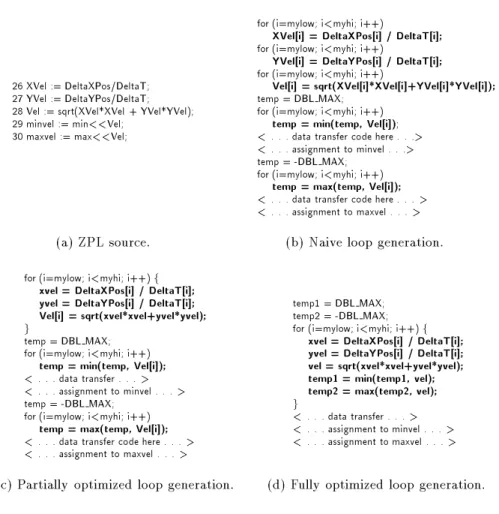
Consider the code fragment in Fig. 8(a). Figure 8(b) shows the naive code that is generated when factors are not joined. Notice that arrays XVel, YVel
and Velare used to cache computed values. If the denitions and uses of these variables can be joined into a single m-loop, then scalars can hold these values (Fig. 8(c)), as they are not live outside of the iteration. Since m-loops induced by reductions are no dierent from m-loops induced by element-wise assignment
26 XVel := DeltaXPos/DeltaT; 27 YVel := DeltaYPos/DeltaT; 28 Vel := sqrt(XVel*XVel + YVel*YVel); 29 minvel := min<<Vel;
30 maxvel := max<<Vel;
(a) ZPL source.
for (i=mylow; i<myhi; i++)
XVel[i] = DeltaXPos[i] / DeltaT[i];
for (i=mylow; i<myhi; i++)
YVel[i] = DeltaYPos[i] / DeltaT[i];
for (i=mylow; i<myhi; i++)
Vel[i] = sqrt(XVel[i]*XVel[i]+YVel[i]*YVel[i]);
temp = DBL MAX; for (i=mylow; i<myhi; i++)
temp = min(temp, Vel[i]);
<. . . data transfer code here . . .> <. . . assignment to minvel . . .>
temp = -DBL MAX; for (i=mylow; i<myhi; i++)
temp = max(temp, Vel[i]); <. . . data transfer code here . . .> <. . . assignment to maxvel . . .>
(b) Naive loop generation.
for (i=mylow; i<myhi; i++)f xvel = DeltaXPos[i] / DeltaT[i]; yvel = DeltaYPos[i] / DeltaT[i]; Vel[i] = sqrt(xvel*xvel+yvel*yvel); g
temp = DBL MAX; for (i=mylow; i<myhi; i++)
temp = min(temp, Vel[i]); <. . . data transfer . . .> <. . . assignment to minvel . . .>
temp = -DBL MAX; for (i=mylow; i<myhi; i++)
temp = max(temp, Vel[i]); <. . . data transfer code here . . .> <. . . assignment to maxvel . . .>
(c) Partially optimized loop generation.
temp1 = DBL MAX; temp2 = -DBL MAX; for (i=mylow; i<myhi; i++)f
xvel = DeltaXPos[i] / DeltaT[i]; yvel = DeltaYPos[i] / DeltaT[i]; vel = sqrt(xvel*xvel+yvel*yvel); temp1 = min(temp1, vel); temp2 = max(temp2, vel); g
<. . . data transfer . . .> <. . . assignment to minvel . . .> <. . . assignment to maxvel . . .>
(d) Fully optimized loop generation.
Fig.8.Eects of joining and contraction on an excerpt from the running example. A
number of the array references in the bold statements become scalar references. Arrays DeltaXPos,DeltaYPos,DeltaTin the running example may be similarly contracted.
statements, arrayVelmay also be contracted as in Fig. 8(d). In fact, for the run-ning example, all but theSamplearrays are eliminated by this array contraction. We cannot independently join m-loops and perform contraction if we expect to maximize contraction. The compiler therefore joins m-loops with the goal of enabling maximal array contraction. Using a heuristic ordering of the candidate arrays, all m-loops containing a candidate array are joined if the joining enables contraction of the candidate array. This simple greedy strategy produces very high quality code [17].
Our approach not only contracts arrays that a clever scalar language pro-grammer would, it often succeeds in non-obvious cases. There are cases when a group of m-loops may not legally be joined because they over-constrain the resulting loop nest, but simple transformations eliminate the constraints and
en-able the joining and contraction. The trick of eliminating the constraint is often suitably awkward that programmers are unwilling or unable to do this by hand.
Indexed Arrays.
While the use of m-loops nicely encapsulates the localcom-putation that results from array statements, the distinction between m-loops and source-level loops can produce a runtime performance penalty when these two types of loops interact. Consider the ZPL code fragment in Fig. 9(a), which uses a parallel array of indexed arrays. An m-loop will be used to iterate over the parallel array, while a source-level loop iterates over each element of the indexed array (Fig. 9(b)). The problem is that the generated code will exhibit poor cache behavior unless the source-level loop is moved inside the compiler generated loop, as in Fig. 9(c). A source-level loop is a candidate for this transformation when it iterates over an indexed array that is an element of a parallel array. The trans-formation is performed when all m-loops that contain the involved array may be joined.
region R = [1..n];
var A : [R] array [1..m] of integer; . . .
[R] for i := 1 to m do A[i] := 1; end;
(a)
for (i=1; i<=m; i++)
for (j=mylow; j<myhi; j++)
A[j][i] = 1;
(b)
for (j=mylow; j<myhi; j++)
for (i=1; i<=m; i++)
A[j][i] = 1;
(c)
Fig.9. The interaction of source-level loops and compiler generated loops. The ZPL
source (a) will naively be compiled into the code in (b). Bringing the source-level loop inside the compiler generated loop (c) will improve cache locality.
5.2 Data Transfer
There are several types of T-factors. Point-to-point T-factors are implied by the
wrap statement, the reect statement, and the@operator, while the remaining T-factors represent collective communication in operations such as scan, reduce and ood. A point-to-point T-factor is multi-part (send and receive), while a single T-factor can represent each variety of collective communication. This sec-tion discusses the optimizasec-tion of data transfer through the manipulasec-tion of T-factors.
Data transfer can be optimized in three ways. First, redundant T-factors may be removed. A T-factor is redundant if and only if the data transfer performed by the T-factor is preceded by a T-factor that satises the requested data trans-fer. Next, T-factors involving the same source and destination processors may be combined. Finally, the components of multi-part T-factors may be pushed apart to pipeline and overlap data transfer and computation. Recall that com-munication in array languages is naturally vectorized, so the compiler does not
perform explicit message vectorization. The removal of redundant T-factors and the combining of T-factors are exact instances of the join operation, while the pipelining of T-factors enables additional joins to occur. For convenience, we will refer to each optimization in isolation, though the actual implementation considers all three optimizations simultaneously.
Point-to-Point Communication.
Point-to-point T-factors can be optimizedby all three techniques. These optimizations require information about the uses and modications of the array variables being transferred. This information is maintained in the form of def/use-sets on aper statementbasis. Since arrays are never indexed, the compiler treats them atomically, much like scalars. Unlike languages such as Fortran 77, no index functions or loop bounds information need be examined. Rather, the region and direction indicate the slice of an array to be transferred. The compiler could perform symbolic analysis on the regions to obtain more precise def/use-sets, but this is generally not necessary as most data parallel computations use a small set of regions.
Figure 10 shows a sample code fragment that requires data transfer, along with unoptimized and optimized code generated for it. For simplicity, we again assume that the compiler generates message passing code (send and receive calls). To generate the unoptimized code in Fig. 10(b), the compiler need only generate a library call for each@induced T-factor. The code generated in Fig. 10(c)-(e) illustrate the three data transfer optimizations performed by the compiler, which are now discussed in turn.
Removing redundant T-factors. If the T-factor due to a statement (Fig. 10,
state-ment 4) is preceded by a T-factor that has already satised that data trans-fer (statement 3) and there are no intervening modications to the transtrans-ferred data, the T-factor for the original statement is redundant and can be eliminated (Fig. 10(c)).
Combining T-factors. If several T-factors perform data transfer on dierent
vari-ables in the same direction (statement 3), these T-factors my be combined (see Fig. 10(d)). T-factors from the same (as in this example) or dierent statements may be combined in this way.
Pipelining T-factors. The send portion of a T-factor may be pushed up to the
last statement that denes the variable involved in the data transfer. This over-laps communication and computation. Statement 2 is the most recent modi-cation of A or C before the use of A in statement 3. Therefore the pipelined T-factor can be started immediately after statement 2 (see Fig. 10(e)).
Appendix B (lines 20{23) shows the result of data transfer optimizations in the running example. Notice that the initialization of the identity elements for the reductions have been moved between the send and receive due to local joining operations. Though this is a small amount of computation, in general the separation of the send and receive may be large.
1 C := D; 2 A := B;
. . .
3 E := A@prev+C@prev; 4 F := A@prev;
(a) Original ZPL code.
<. . . assign C . . .> <. . . assign A . . .> . . . Send(R,<A,prev>); Recv(R,<A,prev>); Send(R,<C,prev>); Recv(R,<C,prev>); <. . . assign E . . .> Send(R,<A,prev>); Recv(R,<A,prev>); <. . . assign F . . .> (b) Unoptimized code. <. . . assign C . . .> <. . . assign A . . .> . . . Send(R,<A,prev>); Recv(R,<A,prev>); Send(R,<C,prev>); Recv(R,<C,prev>); <. . . assign E . . .> <. . . assign F . . .> (c) Redundant T-factors removed. <. . . assign C . . .> <. . . assign A . . .> . . .
Send(R,<A,prev>,<C,prev>);
Recv(R,<A,prev>,<C,prev>); <. . . assign E . . .> <. . . assign F . . .>
(d) Combined T-factors.
<. . . assign C . . .> <. . . assign A . . .>
Send(R,<A,prev>,<C,prev>);
. . .
Recv(R,<A,prev>,<C,prev>); <. . . assign E . . .> <. . . assign F . . .>
(e) Pipelined T-factors.
Fig.10.Example transformations on T-factors.
Collective Communication.
Just as in the point-to-point case, collectivecom-munication T-factors of the same type are optimized by one or more of the above techniques. Any redundant T-factors may be removed, and all types of collec-tive communication T-factors may be combined with other T-factors of the same type (see Fig. 2). The key to the optimization is that the communication pat-terns (each factor represents a dierent pattern) are exposed to the compiler. Library approaches cannot be optimized in this way, for the compiler is unaware of the libraries' contents.
Despite this xed collective communication interface, ZPL does not lose the advantages of library support. The combined communication compiles to proce-dure calls in the ZPL runtime library. These proceproce-dures are optimized for the particular platform's strengths [7]. For example, on the SP2, the procedure calls are mapped to MPI library routines, while our T3D implementation uses the native SHMEM library routines [2]. In this way, a single copy of optimized code exploits the strengths of all target platform.
Though we have introduced collective communication operations as each pro-ducing a single T-factor, we often use multi-part T-factors for these operations. These multi-part factors allow for better communicationhiding when implement-ing non-hardware supported operations (such as column broadcasts or reduces).
6 Related Work
ZPL was designed from rst principles to execute eciently across MIMD com-puters. There exist a number of compilation eorts that are similar in nature to that of ZPL. Several are summarized below.
The APL language supports the atomic manipulation of and computation on whole arrays [15]. APL was not designed with parallelismin mind,thus it encour-ages the use of locality insensitive operations. Greenlaw and Snyder demonstrate that the second most common data movement operation in APL (an array sub-scripted array) is very expensive on parallel machines [10]. Budd describes an APL compiler that decomposes array operations into vector operations for ex-ecution on a vector processor [5]. This ne grained approach does not extend
to distributed memory or MIMD machines. Ju et al. describe a classication
and fusion scheme for array language primitives (in APL, Fortran 90, etc.) [16]. Their fusion concept diers from our join transformation in that it only strives to eliminate intermediate storage. In addition, they assume a shared memory model and thus do not consider explicit communication. We optimize computation and communication separately.
NESL is a data-parallel programming language that emphasizes nested par-allelism [4]. NESL source code is compiled to an intermediate vector-based code, called Vcode, which is either interpreted or compiled [3]. The Vcode intermediate form is well suited for vector and low-latency shared memory machines but not for distributed memory machines. The primary MIMD compilation eort is in increasing the granularity of parallelism and reducing synchronization overhead. Cand its descendant Dataparallel C are derivatives of C with support for data parallel programming [25]. The Dataparallel Cdomainand the ZPLregion
both serve as bases for parallelism; they are used to dene distributed arrays and to distribute computation. Despite this similarity, the techniques for com-piling these languages greatly dier. In particular, the primary Dataparallel C compilation eort is in overcoming ineciencies due to the sequential nature of the parent language (C) and the SIMD nature of the language itself [13]. As an example of the former, a Dataparallel C program may contain arbitrary C code, which resists static analysis due to pointer arithmetic and weak typing.
High Performance Fortran (HPF) is a language that requires the user spec-ication of parallelism, distribution and alignment via directives in sequential Fortran 77 and Fortran 90 programs [14]. The primary compilation eort is in overcoming the sequential nature of the parent language. Arrays are manipu-lated at the element level, thus optimizations must be performed to vectorize communication and hoist it from inner loops. HPF and ZPL are similar in the types of parallel operations that they support, though ZPL makes clear to the programmer the execution cost of each operation [22].
Considerable research has been devoted to automatically parallelizing For-tran 77 programs [1, 23, 11]. In contrast to the ZPL approach in which the lan-guage was designed to facilitate the recognition and exploitation of parallelism, the primary eort for automatically parallelizing compilers is in recognizing, ex-posing and eciently exploiting the parallelism hidden in a sequential program.
Furthermore, optimal sequential and parallel solutions to the same problem of-ten require dierent algorithms, thus it seems unlikely that a compiler will be able (in general) to transform one to the other.
7 Conclusions
We have argued that when compiling for parallelism, array languages present compilers with new opportunities and challenges for optimization. The array op-erations of these languages make some standard optimizations (such as message vectorization) disappear, make new opportunities (such as combining reduction operations) appear, and add importance to other optimizations (such as array contraction).
We have described the factor-join approach to compiling array languages and shown how it is used to compile ZPL programs. This approach rst decomposes array language constructs into a series of factors, and then joins these factors to perform various optimizations. Each factor represents a unique communica-tion or computacommunica-tion structure, and only a small number of dierent factors are needed to describe ZPL programs. These factors cleanly separate the treatment of communication and computation. For example, C-factors represent the purely computational aspects of all operations (e.g., element-wise array assignments, reductions, scans, etc.), so optimizing C-factors simultaneously optimizes all in-ner loops that the compiler gein-nerates for array constructs. This factorization also simplies the movement and joining of the data-transfer factors (T-factors). This approach provides a framework for optimizations that includes redundant communication elimination, message combining, and communication pipelining; and the use of factors abstracts common features of dierent optimizations. For example, the combining of collective communication operations and the combin-ing of point-to-point communication use the same algorithm applied to dierent T-factors.
References
1. Saman P. Amarasinghe, Jennifer M. Anderson, Monica S. Lam, and Amy W. Lim. An overview of a compiler for scalable parallel machines. InSixth Workshop on Languages and Compilers for Parallel Computing, August 1993.
2. Ray Barriuso and Allan Knies. SHMEM user's guide for C. Technical report, Cray Research Inc., June 1994.
3. G. E. Blelloch, S. Chatterjee, J. C. Hardwick, J. Sipelstein, and M. Zagha. Im-plementation of a portable nested data-parallel language. Journal of Parallel and Distributed Computing, 21(1):4{14, April 1994.
4. Guy E. Blelloch. NESL: A nested data-parallel language (version 2.6). Technical Report CMU-CS-93-129, School of Computer Science, Carnegie Mellon University, 1993.
5. Timothy A. Budd. An APL compiler for a vector processor. ACM Transactions on Programming Languages and Systems, 6(3):297{313, July 1984.
6. Steve Carr, Kathryn S. McKinley, and Chau-Wen Tseng. Compiler optimizations for improved data locality. InProceedings of the International Conference on Ar-chitectural Support for Programming Languages and Operating Systems, October 1994. San Jose, CA.
7. Bradford L. Chamberlain, Sung-Eun Choi, and Lawrence Snyder. Ironman: An architecture indepedent communication interface for parallel computers. submitted for publication, 1996.
8. Marios D. Dikaiakos, Calvin Lin, Daphne Manoussaki, and Diana E. Woodward. The portable parallel implementation of two novel mathematical biology algo-rithms in ZPL. InNinth International Conference on Supercomputing, 1995. 9. Michael Gerndt. Updating distributed variables in local computations.
Con-currency{Practice and Experience, 2(3):171{193, September 1990.
10. R. Greenlaw and L. Snyder. Achieving speedups for APL on an SIMD distributed memory machine. International Journal of Parallel Programming, 19(2):111{127, April 1990.
11. Manish Gupta and Prithviraj Banerjee. PARADIGM: A compiler for automatic data distribution on multicomputers. InInternational Conference on Supercom-puting, July 1993.
12. Manish Gupta, Sam Midki, Edith Schonberg, Ven Seshadri, David Shields, Ko-Yang Wang, Wai-Mee Ching, and Ton Ngo. An HPF compiler for the IBM SP2. InProceedings of Supercomputing '95, December 1995.
13. Philip J. Hatcher, Anthony J. Lapadula, Robert R. Jones, Michael J. Quinn, and Ray J. Anderson. A production-quality C* compiler for hypercube multicomput-ers. InProceedings of Third ACM SIGPLAN Symposium on Principles and Prac-tice of Parallel Programming, April 1991.
14. High Performance Fortran Forum.High Performance Fortran Specication Version 1.1. November 1994.
15. Kenneth E. Iverson. A Programming Language. Wiley, 1962.
16. Dz-Ching R. Ju, Chaun-Lin Wu, and Paul Carini. The classication, fusion, and parallelization of array language primitives. IEEE Transactions on Parallel and Distributed Systems, 5(10):1113{1120, October 1994.
17. E Christopher Lewis and Calvin Lin. Array contraction in array languages. Tech-nical report, University of Washington, Department of Computer Science and En-gineering, 1996. Forthcoming.
18. E Christopher Lewis, Calvin Lin, Lawrence Snyder, and George Turkiyyah. A portable parallel n-body solver. In D. Bailey, P. Bjorstad, J. Gilbert, M. Mascagni, R. Schreiber, H. Simon, V. Torczon, and L. Watson, editors, Proceedings of the Seventh SIAM Conference on Parallel Processing for Scientic Computing, pages 331{336. SIAM, 1995.
19. C. Lin, L. Snyder, R. Anderson, B. Chamberlain, S. Choi, G. Forman, E. Lewis, and W. D. Weathersby. ZPL vs. HPF: A comparison of performance and pro-gramming style. Technical Report 95{11{05, Department of Computer Science and Engineering, University of Washington, 1994.
20. Calvin Lin. ZPL language reference manual. Technical Report 94{10{06, Depart-ment of Computer Science and Engineering, University of Washington, 1994. 21. Calvin Lin and Lawrence Snyder. SIMPLE performance results in ZPL. In Keshav
Pingali, Uptal Banerjee, David Gelernter, Alexandru Nicolau, and David Padua, editors,Workshop on Languages and Compilers for Parallel Computing, pages 361{ 375. Springer-Verlag, 1994.
22. Ton A. Ngo. The Eectiveness of Two Data Parallel Languages, HPF and ZPL. PhD thesis, University of Washington, Department of Computer Science, 1996. In preparation.
23. C. D. Polychronopoulos, M. B. Girkar, M. R. Haghighat, C. L. Lee, B. P. Leung, and D. A. Schouten. The structure of Parafrase-2: an advanced parallelizing com-piler for C and Fortran. InWorkshop on Languages and Compilers for Parallel Computing, pages 423{453, 1990.
24. George Wilkey Richardson. Evaluation of a parallel Chaos router simulator. Mas-ter's thesis, University of Arizona, Department of Electrical and Computer Engi-neering, 1995.
25. J.R. Rose and Guy L. Steele Jr. C*: An extended C language for data parallel programming. Technical Report PL 87-5, Thinking Machines Corporation, 1987. 26. Lawrence Snyder. Foundations of practical aprallel programming languages. In
Tony Hey and Jeanne Ferrante, editors, Portability and performance for parallel processing, pages 1{19, New York, 1994. Wiley.
27. Lawrence Snyder. The ZPL Programmer's Guide. May 1996.
28. Michael Wolfe. Optimizing Supercompilers for Supercomputers. MIT Press, Cam-bridge, MA, 1989.
A Sample ZPL Source Code
1 /* VelocityStats - compute approximate minimum and maximum velocity of particle from sample positions */ 2 program VelocityStats;
3 direction prev = [-1];
4 cong var samplecount : integer=10;
5 datale : string=\samples.dat"; 6 region R = [1..samplecount];
7 var SampleT, SampleXPos, SampleYPos : [R] double; - - samples of location (sorted by t) 8 DeltaT, DeltaXPos, DeltaYPos : [R] double; - - delta from one sample to next 9 XVel,YVel : [R] double; - - X- and Y-components of velocity
10 Vel : [R] double; - - velocity
11 procedure VelocityStats();
12 var minvel,maxvel : double; - - min/max velocities
13 inle : le; 14 [R] begin 15 inle := open(datale,\r"); 16 read(inle,SampleT,SampleXPos,SampleYPos); 17 close(inle); 18 [prev of R] begin 19 SampleT := 0.0; 20 SampleXPos := 0.0; 21 SampleYPos := 0.0; 22 end;
23 DeltaT := SampleT - SampleT@prev;
24 DeltaXPos := SampleXPos - SampleXPos@prev; 25 DeltaYPos := SampleYPos - SampleYPos@prev; 26 XVel := DeltaXPos/DeltaT;
27 YVel := DeltaYPos/DeltaT;
28 Vel := sqrt(XVel*XVel + YVel*YVel); 29 minvel := min<<Vel;
30 maxvel := max<<Vel;
31 writeln(\Minimum velocity was: ", minvel); 32 writeln(\Maximum velocity was: ", maxvel);
B Resulting Pseudo-C Code
1 integer samplecount = 10; 2 char * datale = \samples.dat"; 3 region R, prev of R;
4 double *SampleT, *SampleXPos, *SampleYPos; 5 double deltat, deltaxpos, deltaypos;
6 double xvel, yvel, vel; 7 void VelocityStats(void)f 8 double minvel, maxvel; 9 FILE * inle; 10 double temp1,temp2; 11 inle = fopen(datale,\r");
12 FScanParallelArray(inle,<R,SampleT>,<R,SampleXPos>, <R,SampleYPos>);
13 fclose(inle);
14 for (i = prev of R.mylo; i<=prev of R.myhi; i++) 15 SampleT[i] = 0.0;
16 for (i = prev of R.mylo; i<=prev of R.myhi; i++) 17 SampleXPos[i] = 0.0;
18 for (i = prev of R.mylo; i<=prev of R.myhi; i++) 19 SampleYPos[i] = 0.0;
20 Send(R,<SampleT,prev>,<SampleXPos,prev>, <SampleYPos,prev>);
21 temp1 = DBL MAX; 22 temp2 = -DBL MAX;
23 Receive(R,<SampleT,prev>,<SampleXPos,prev>, <SampleYPos,prev>);
24 for (i = R.mylo; i<=R.myhi; i++)f 25 deltat = SampleT[i] - SampleT[i-1];
26 deltaxpos = SampleXPos[i] - SampleXPos[i-1]; 27 deltaypos = SampleYPos[i] - SampleYPos[i-1]; 28 xvel = deltaxpos/deltat;
29 yvel = deltaypos/deltat; 30 vel = sqrt(xvel*xvel + yvel*yvel); 31 temp1 = min(temp1,vel); 32 temp2 = max(temp2,vel);
33 g
34 Glob Reduce(R,<temp1,min>,<temp2,max>); 35 Broadcast(<temp1,minvel>,<temp2,maxvel>); 36 printf(\Minimum velocity was: %fnn",minvel); 37 printf(\Maximum velocity was: %fnn",maxvel); 38 g
39 void main(int argc,char * argv[])f
40 DistributeRegions(<R,1,m>,<prev of R,0,0>); 41 AllocateArrays(<R,SampleT>,<R,SampleXPos>,
<R,SampleYPos>); 42 VelocityStats();