PATHWORKS: PC Integration Software
Digital Technical] ournal
Digital Equipment Corporation
Volume 4 Number 1
Cover Design
The red and blue threads woven together in our cover design represent the many PC clients and server systems that are inte grated in a network environment by the outstanding "thread" of PATHWORKS software. PATHWORKS software for the integration of PCs over fANs and WANs is the featured topic in this issue.
The cover was designed by Kathryn Cimis of the Corporate Design Group.
Editorial
Jane C. Blake, Editor
Kathleen M. Stetson, Associate Editor Helen L. Patterson, Associate Editor Circulation
Catherine M. Phillips, Administrator Sherry L. Gonzalez
Production
Mildred R. Rosenzweig, Production Editor Margaret L. Burdine, Typographer Peter R. Woodbury, Illustrator Advisory Board
Samuel H. Fuller, Chairman Robert M. Glorioso John W McCredie
Mahendra R. Patel
Richard]. Hollingsworth Alan G. Nemeth
F. Grant Saviers Victor A. Vyssotsky Gayn B. Winters
The Digital Technical journal is published quarterly by Digital Equipment Corporation, 146 Main Street ML01-3/B68, Maynard, Massachusetts 01754-2571. Subscriptions to the journal are $40.00 for four issues and must be prepaid in U.S. funds. University and college professors and Ph.D. students in the electrical engineering and computer science fields receive complimentary subscriptions upon request. Orders, inquiries, and address changes should be sent to the Digital Technical journal at the published-by address. Inquiries can also be sent electronically to DTJ®CRL.DEC.COM. Single copies and back issues are available for $16.00 each from Digital Press of Digital Equipment Corporation, 1 Burlington
Woods Drive, Burlington, MA 01830-4597
Digital employees may send subscription orders on the ENET to ROVAX::JOURNAL or by interoffice mail to mailstop ML01-3/B68. Orders should include badge number, site location code, and address. All employees must advise of changes of address. Comments on the content of any paper are welcomed and may be sent to the editor at the published-by or network address. Copyright© 1992 Digital Equipment Corporation. Copying without fee is permitted provided that such copies are made for use in educational institutions by faculty members and are not distributed for commercial advantage. Abstracting with credit of Digital Equipment Corporation's authorship is permitted.
All rights reserved.
The information in the journal is subject to change without notice and should not be construed as a commitment by Digital Equipment Corporation. Digital Equipment Corporation assumes no responsibility for any errors that may appear in the journal. !SSN 0898-901X Documentation Number EY-J825E-DP The following are trademarks of Digital Equipment Corporation:
ALL·lN-1, DEC, DEC EtherWorks, DECnet, DECperformance, DECquery, DECwindows, Digital, the Digital logo, DNA, eXcursion, LAT, PATHWORKS, ULTR!X, VAX, VAX C, VAX Performance Advisor, VAX 4000, VAX 6000, VAXcluster, VAXstation, and VAX.
3Com is a registered trademark of 3Com Corporation.
Apple, AppleShare, AppleTalk, LocaiTalk, and Macintosh are registered trademarks and QuickStart is a trademark of Apple Computer, Inc.
Code View, Microsoft, MS, and MS-DOS are registered trademarks and Windows is a trademark of Microsoft Corporation. CRAY is a registered trademark of Cray Research, lnc. i386, i486, and Intel are trademarks of Intel Corporation. IBM, Micro Channel, and OS/2 are registered trademarks of International Business Machines Corporation.
Motif is a registered trademark of Open Software Foundation, Inc. Motorola and 68000 are registered trademarks of Motorola, Inc. NetWare and Novell are registered trademarks of Novell, Inc. Network General and Sniffer are registered trademarks of Network General Corporation.
NFS and Sun are registered trademarks of Sun Microsystems, Inc. UNIX is a registered trademark of UNIX System Laboratories, Inc. X/Open is a trademark of X/Open Company Limited.
I
Contents
6 Foreword Joseph A. Carchidi
PATHWORKS: PC Integration Software
8 An Overview of the PAIHWORKS Product Family Alan Abrahams and David A . Low
15 PAIHWORKS for VMS File Server Edward W Bresnahan and Siu Yin Cheng
24 T he Development of an Optimized PAIHWORKS Transport Interface
Philip). Wells
31 Design of the PAIHWORKS for ULTRIX File Server Anthony). Rizzolo, Elizabeth A. Brewer, and Martha A. Chandler
40 DECnet Transport Architecture M itchell P Lichtenberg and jeffrey R. Curless
47 Microsoft Windows Network Virtual Device Drivers in PATHWORKS for DOS
Andrew W Nourse
56 eXcursion for Windows:
Integrating Two Windowing Systems Dennis G. Giokas and Andrew T. Leskowitz
68 Capacity Modeling of PAIHWORKS Client-Server Workloads
I
Editor:Js Introduction
Jane C. Blake Editor
The integration of personal computers in a net work environment is the subject of this issue of the Digital Technical journal. The software products that bring about this integration are known collec tively as PATHWORKS and are derived from Digital's Personal Computing Systems Architecture. The engineering challenge for developers was to inte grate a variety of client (PC) and server systems DOS, Windows, OS/2, Macintosh, VMS, and ULTIUX and to ensure that the intricacies of the meshing of these systems remained transparent to PC users. In the opening paper, Alan Abrahams and David Low provide background for the papers that follow by describing the technical aspects of the various hardware and software platforms, physical net works, and protocols that had to be addressed by PATHWORKS developers. They also present an over view of the PATHWORKS components which allow PC users to access network resources.
Among the capabilities PATH\VORKS enables, P C access t o files on server systems is one o f the most important for users. Two file servers, one for VMS and another for ULTRIX, were developed for this purpose. A paper on the development of the first of these, written by Eel Bresnahan and Siu Yin Cheng, contains an architectural overview of the VMS file server. The authors also detail the mapping done to bridge the differences between DOS, OS/2, and VMS operating systems. In a related paper, Phil Wells describes performance improvements made in ver sion 4.0 of the file server which were achieved by optimizing the transport interface and the data buffering algorithm. He discusses the analysis of server performance for various interface models, the implementation of the algorithm in the VlVlS server, and test results.
Like the VMS file server, the PATHWORKS software for ULTRJX systems integrates PC clients with a
2
server system on a LAN. However, as Anthony Rizzolo, Beth Brewer, and Martha Chandler explain in their paper, a multiple process model was cho sen rather than the single process used in the VMS file server. The authors give their reasons for this different approach as part of a general discussion of the server design and implementation.
The network is key to the exchange of data in the
PATHWORKS environment, and as is the case for the server software, multivendor systems must be addressed to ensure smooth integration. Mitch Lichtenberg and Jeff Curless describe how Digital has extended Microsoft's LA.i\f Manager across a LAN or a WAN by using the DECnet transport protocol as the transport layer. In addition, they present the reasoning behind the design of the transport com ponent for DOS and OS/2 products, and review steps taken to reduce memory usage and improve performance.
Further details on the integration of DECnet and LAN environments are provided in the paper on two network virtual device drivers for the Microsoft Windows environment. As Andy Nourse explains, these drivers manage DECnet and NetBIOS opera tions and enable the Windows operating system to support peripheral devices, memory resources, and software applications. Andy first gives readers background on the Windows operating modes, and then describes the development of the two virtual device drivers.
A significant new application in the PATHW ORKS family, called excursion, brings together the capabil ities of X Windows, DECnet, and the Microsoft envi ronment, resulting in the display of both Windows and X Windows on the same screen. Dennis Giokas and Andy Leskowitz present the integration philos ophy behind the display server and the implemen tation of the server architecture. They also relate how designers approached the mapping of the win dows in the X and Windows environments.
The issue concludes with a paper by Chris
Methot on capacity modeling of PATHWORKS
client-server workloads. Chris describes a queuing analytical model used to understand resource con sumption on the server and the special modeling process required in the client-server environment. The paper works through a specific example of the model's identification of bottlenecks in the system.
Biographies
Alan Abrahams Alan Abrahams is a consultant engineer in the Personal Com puting Systems Group Technical Office. He develops management and security strategies for integrating PCs into enterprise-wide networks. Alan joined Digital in 1982 and designed and implemented the PRO/Communications package. Since
1985, he has been the architect responsible for integrating Microsoft's LAN Manager into Digital's PCSA and helped design Digital's NetBIOS emulation and remote boot of MS-DOS systems. Alan received B.S degrees in computational and statistical science and in mathematics from the University of Liverpool.
Edward W. Bresnahan Senior software engineer Edward Bresnahan has been developing the PATHWORKS for VMS software since joining Digital's PCSG Server Engineering Group in 1988. He is currently responsible for the design and devel opment of a high-performance data cache to be used in future PATHWORKS server products. Prior to this, he was a co-op student at General Electric Company and at Charles Stark Draper Laboratory. Ed holds a B.S.C.S. (1988, hon ors) from Northeastern University and is pursuing an M.S.C.S. part-time.
Elizabeth A. Brewer Beth Brewer is a supervisor in the PCIE Server Develop ment Group-Open Systems. Beth served as project leader for the PATHWORKS for ULTRIX version 1.0 product as well as the principal architect and implemen tor of the PATHWORKS for ULTRIX administration process. She also worked for the PCIE Client Development Group-PC DECwindows. Beth joined Digital in
1987 after receiving a B.S. in mathematics with a minor in computer science from the University of Massachusetts at Lowell.
Martha A. Chandler A senior software engineer in the PCIE Server Develop ment Group-Open Systems, Martha Chandler was project leader for the PATHWORKS for ULTRIX version 1.1 product. She designed and implemented the management interface for the PATHWORKS for ULTRIX server. Prior to this work, Martha maintained M5-Windows terminal emulation for the PCIE Client Develop ment Group. Before joining Digital in 1988, she received a B.S. in mathematics with a minor in computer science from the University of Massachusetts at Lowell.
I
Biographies
4
Siu Yin Cheng Since joining Digital in 1987, Siu Yin Cheng has worked on server software in the Personal Computing Systems Group. As a senior software engineer, she is responsible for the design and development of the server config uration utility for future PATHWORKS products. Siu Yin designed and developed the server collector process to extract performance data from the file server; she also worked on server development. Prior to this, she led the system testing of PATHWORKS server V2.0-2.2. Siu Yin received a B.S.C.S (1987, honors) from Brown University.
jeffrey R. Curless As a principal software engineer in the Personal Com puting Systems Group, Jeff Curless worked on the OS/2 data link driver and on the PATHWORKS token ring implementation. He is currently developing a new configuration utility to support the future direction of the PATHWORKS product set. Since joining Digital in 1986, he has contributed to the development of PATHWORKS software under both the DOS and OS/2 operating systems. Jeff holds a B.S. in computer science from the University of New Hampshire.
Dennis G. Giokas Dennis Giokas is the group technical lead for PCSG's Net work Client Engineering and the engineering manager for its New User Interface Group. His primary responsibility is technical lead for the next generation of the PATHWORKS client. Prior to this work, Dennis contributed to PC DECwindows development. Before joining Digital in 1984, he was employed by Arco Oil & Gas and The Foxboro Company. Dennis holds a B.M. (1974) from the University of Massachusetts at Lowell, an M.M. (1976) from the New England Conservatory, and an M.S.C.S. (1989) from Boston University. He has two patents pending.
Andrew T. Leskowitz A principal software engineer in the PCSG X Server Development Group, Andy Leskowitz is the project leader for the eXcursion display server. Since coming to Digital in 1987, he has contributed to various X development projects and designed the PATI-IWORKS LANSESS component. Andy's prior experience includes engineering positions at Datatrol, The Foxboro Company, and Raytheon Company. He has a B.S. (1976) in biology from Swarthmore College. Andy has applied for a patent related to his X server devel opment work.
David A. Low David Low is a consultant engineer in the Personal Computing Systems Group. Since joining PCSG in 1988, David has worked in a variety of advanced development tasks involving PC networking technology. He is cur rently concerned with assessing approaches for pen-based computing and wire less P C networking. David has an A.B. in mathematics and an M. A.S. in computer science from Boston University He is a member of A AAS, IEEE, and ACM.
Christopher E. Methot Chris Methot has been analyzing client-server per formance since joining Digital in 1986. He has worked in performance charac
terization of LAVe systems and has contribu ted to VAX Performance Summaries.
Currently, he supervises capaci ty/performance engineering in the Personal Computing Systems Group. In addition to developing the P ATHWORKS client
server model ing process, his group is developing a standard performance test for Macintosh servers and has benchmarked many of Digital's hardware servers. Chris holds a B.S. (1967) in industrial design from the University of Cincinnati.
Andrew W. Nourse Principal software engineer Andrew Nourse has worked on network software for the PATHWORKS and DECnet-DOS products for the past
six years. He developed Microsoft Windows and non-Windows networking applications, l ibraries, and drivers. Prior to this, he wrote network utilities for
DECSY STEM-20, DECsystem-10, and RSTS/E products. Andy received a B. S. i n elec
tric;il engineering and computer science from the Massachusetts Institute of Technology in 1974 and joined Digital in 1976.
Anthony J. Rizzolo A principal software engineer in the PCI E Server Develop
ment Group-Open Systems, Anthony Rizzolo designed and implemented the
P ATHWORKS for ULTRIX file server process. He also designed the data l ink and
port driver layers for the P AT H WORK S for D OS product. Prior to this work, Tony
was a member of the Internal Software Support Group and the TOP S-10 Engineer
ing Group, where he designed and implemented the data link layer for the KLN!
Ethernet adapter. Tony joined Digital in 1981. He received a BSE.E. from Stevens Institute of Technology.
Philip J. Wells Phil Wells is the P AT H WORKS server archi tect and is responsi
ble for coordinating the design and implementation of the P ATHWORKS server
products. In previous positions at Digital, Phil worked for Corporate Tele communications designing Digital's internal network, the E ASYNET, and helped
support data centers and networks while in the Internal Software Services Group. Phil joined Digital in 1976 as a computer operator in the Corporate Data
Center.
I
I
6
Foreword
Joseph A. Carchidi
Group Engineering Manager, PC Integration
I n the 1990s, a major shift is occurring in personal computing, from isolated, individual work on desk tops to work in groups whose members are located throughout an enterprise. To support this impor tant change, Digital has developed a family of prod ucts, called PATHWORKS, that enables personal computer users to make the shift from the stand alone machine to the network environment and the resources of larger computer systems.
The roots of PATHWORKS were in place as early as 1980. D igital's engineering management recog nized that a significant part of the growth in the computer industry would be redirected from minicomputer to microcomputer p roducts. As the 80s progressed, we learned from our experience in personal computer hardware development and from the direction taken by the growing and highly competitive microcomputer market that industry standard-based products were more important than unique technologies; that is, open systems, comprising standard devices and interconnects, were what customers wanted, not more propri etary systems.
D igital's VAXmate personal computer, intro duced in 1987, was built on the industry standard model. Moreover, it offered something no other PC offered at that time: the VAXmate had the net work built in. With foresight, engineering manage ment determined that our microcomputer business would tie to our long-standing strength in building networks. Our strategy thus changed from a focus on hardware development to the development of microcomputer software.
between the disparate systems would have to be transparent to users, and without concessions on performance.
This chosen strategy, of course, was not the eas ier of the two to implement. One of our initial tasks was to select which operating systems to support among the many microcomputer operating sys tems available in the market. We decided to define the scope of our early development work by sup porting the most widely popu lar personal comput ers, which are those based on the DOS, OS/2, and Macintosh operating systems. Another important decision was the choice of a network transport that wou ld serve as the basis for the interconnection of the systems selected. We selected Microsoft's LAN Manager software as this transport. MS-NET, the predecessor to l.AJ'i Manager, had the advantage of being network transport i ndependent, thus allow i ng us to utilize the DECnet network to extend the PC LAN software to a wide area network.
In the papers in this issue, you will read about some of the extensive work that has been accom plished since we first embarked upon this software effort. Engineers have designed and implemented file servers and network transports that allow PCs to access files, appl ications, storage, and print
I
services on the l arger VMS and ULTRJX server systems. Further, a PATHWORKS appl ication, called eXcursion, brings together the X Window System, the Windows environment, and the OECnet net work. The effect is to l ink X-so important to users of UNIX systems-with the PC DOS system environ ment. These combined efforts represent a hallmark in Digital 's progress toward open, heterogeneous computing.Our achievement in the Personal Computing Sys tems Group has been our steady progress toward providing customers the open computing environ ment they need. The breadth of our product offer ing has taken on clear definition within the last year, and we will now begin the work of adding depth to the PATHWORKS product set. The possibili t ies for future developments are tru ly astounding. Looking ahead five years from now, c l ient work stations will have the power of supercomputers, and the dramatic progress in parallel computing wil l bring additional opportun ities for data sharing and application developments which are in embry onic stages today. Our chal lenge in software engi neering will be to make all these systems work together in a wel l-integrated, easy-to-use, wel l deployed computing environment.
Alan Abrahams DavidA. Low
An Overview of the PATHWORKS
Product Family
As the number of personal co1nputers continues to grow, so does the demand for networking products and services to allow these PCs to share networked resources. Digital:� Personal Computing Systems Architecture enables tbe integration of PCs into Digital's entetprise-uJide network systems. The sojtware products devel oped using this architecture are referred to as the PA1HWURKS product ftmzily P..4THWORKSproducts support a variety of PCplatforms and operating systems, and accomnwdate different physical networks and transport and service protocols. This flexibility allows PC users to access resources outside their PC erwironment; such as
remote Jiles, printers, databases, and electronic mail.
When the IBM Corporation introduced i ts first personal computer in 1981 , few cou ld have fore seen that by 1992 millions of res would have been sold worldwide, radically changing the computer market in the process. The term PC usually imp l ies an Intel 80x86 family or a Motorola 68000 series processor, sized to fit under a desk or smaller and com monly priced under $5000. The low price has helped to fuel an explosive growth in the number of hardware products and software appli cations available for PC platforms. PCs are now ubiquitous and represent the largest class of net worked computers.
Even before the introduction of the PC, small
computers were being networked together to share data and hardware resources. I n 1990, as many as 10 percent of the instal led PC:s were net
worked .1 By 1994, an estimated 75 percent of the increasing number of PCs will be linkcd togcther with products from many networking vendors. These vendors provide services that commonly include transparent access to remote files, printers, databases, and electronic mail.
Digital Equipment Corporation is a worldwide leader in networking services. Since 1986, we have been developing the Personal Computing Systems Archi tecture (PCSA) to meet the growing needs of
PC cl ient-server appl ications in local and wicle area network systems. Many technical obstaclcs were met and overcome in the design and development of PC integration products. The PATH\VORKS prod
uct family, derived from PC:SA, reflects the d iversity
8
of D igital's customers' needs and environments.
PATH\VORKS software products support a variety of
PC platforms and operating systems, and accommo date different physical networks and transport and service protocols.
'Jb help the reader comprehend the scope of the
PATH\VORKS offerings, we begin this paper with a
basic d iscussion of PC hardware and software, fol lowed by information about the various protocol s used in PC networking. We then describe how Digital's PATHWORKS p roduct set allows i ntegration
of PCs into network systems.
PC Hardware
This section describes the PATHWORKS Intel and
Macintosh cl ient platforms and i ntroduces related
PATHWORKS services.
Intel Platforms
The most popular operating systems in the world, IBM 's PC-DOS, Microsoft's \IS-DOS, and Microsoft
Windows, are designed to take advantage of the fea tures of t he family of Intel chips that includes the 8086, 80286, i386, and i486 microprocessors.
The 80x86 memory archi tectures have evolved from 16-bit addressing with implicitly referenced 64-kilobyte segments in the 8086 processor, to 32-bit addressing with a paged virtual memory i n the i386 o r higher processors. Recent Intel pro cessors have features previously associated with minicomputers. The i486 chip, for example, has
an integra ted flo a ti ng-poin t processor. instruction and data caches, ;1nd hardware support for multi tasking. This range of processor capacity highlights a major concern of the designers of Digital's
Pi\TJJWOI�KS products. i.e .. how to cfJicienth· accom
mml;l te the range of differing functionality found in the installed lntel-has<:d l'Cs.
Although this PC mark<:t has had little de jur<: regulation, lll.Vt's market presence has shaped the de facto int<:rfac<: stamlards. The industry standard architecture (!SA) system hus and the video graph ics :1rray (VCiA) clisplay technologi<:s arc examples of such standards.
The most common system bus, the ISA bus, pro vid<:s 1()-bit Jata access to a 24-hit (i.e .. 16-megabyte) address space. Physical ami electrical interface con ventions have been cstabl ishcd and thousands of interface boards arc available. m.vt introduced the
ISA bus and later dcvdopcd the JV!icro Channel
Architectur<: (:viC:t\) bus, which provides :)2-bit data access to a :)2-bit (i.e . -f-gigabyte) address space, automatic hus sizing, and accelerated data transkr mechanisms. IlK ,V\Ci\ bus is not compatible with
the !SA bus. ( :onsequcnth', a number of manufactur ers oth<:r than IB:Vl JOined forces and devised the extended lSi\ (EIS,\) bus, with features analogous to those of the .w:,\ bus. Even though Digital's PC:s use either the JS,\ or EIS,\ bus, we support our cus
tomers' ,'viC\ bus machines through software and peripheraldcvic<: offerings.
c;r:1phical us<:r interfaces (CL'Is) such as the one
provided hy the Microsoft Wimlows software are becoming the rule ra thn than the exception. !liM's color graphics ada pH::r (C:Gi\) display was an early standard at :120 columns h\· 200 rows and a range of 4 colors. VCi\ is a more recent standard, with variants that Gill gencrat<: a screen up to 1024 by 76H in 2-)6 colors. There is no widely accepted dis play standard beyond VGA. and it ma,· be sufficient for manufacturers of innovative displav technolo gies to provide device drivers for transparent usc bv Microsoft Windows applications. For example, thc l't\TIJW()I\KS eXcursion for Windows display
server, which im plements the X Window System
protocol and operates in the Microsoft \Vindows environment, uses the display driv<:rs supplied with the \Xiindows software. The eXcur:-;ion s<:rver thus leverages any new di:-;play technologies with which Windows drivers arc supplied. However, the standalone DOS-bascd :X Window System servers
supplied with the 1',\THWORKS software must be
modified to use a new display technology.
Dil!,i/(1/ Tecbuic"l.fourual I(>!. 1 -"'· I Winter /'J'-)1
An 01•en•ieu· of the J>ATfHVORKSProduct Family
Network interface cards (NICs) provide access to local area network (LAN) systems. N1Cs that adhere to ISA, MCA, and EISA standards arc avail able from dozens of manufacturers for many net working topologi<:s. Digital m;mufactures NICs for thick, thin, and twisted-pair Ethernet connec tions. I'ATHWOI{KS products support the Network Datalink Interface Specification (NDIS) and thus accommodate Ethernet and token ring cards from other vendors. NDIS also permits the use of parallel transport stacks in the PXllfWORKS for DOS and PATHWORKS for OS/2 products. Digital also supplies NetWare drivers for its DEC: EtherWORKS cards for use on Novell. networks.
Macintosh Platforms
The Apple Macintosh l'C embodies an integrated hardware and software system architecture that has not lwen cloned by competitors and thus has fewer variants than the lntcl-basnl PC:s. Macintosh PC:s use the Motorola 68000 series microprocessor. The later versions of these microprocessors proviJe :)2-bit operations on a 52-hit address bus, with virtual paged memory. Application programmers are largely shielded from the underlying hardware by an extensive operating svstem application pro gramming interface (API).
All current Macintosh PC:s are equippeJ with bit
mapped graphics, sound-generating hardware, a desktop bus for k<:yboard aml mouse connection, and an Applel�ilk network communications port. Some Macintosh PC:s have system buses that permit peripheral card extensions. All ,\1acintosh PC:s allow
communication by means of the AppkTalk family
of protocols over the Loc:1!'fal k LAN.2 Ethernet/ LocalTalk bridges and routers are available from
several vendors. Digital's PATHWOI�KS product fam
ily includes V,VIS Apple'Eilk transport stacks and an
AppleTa I k/DEC:net gateway.
PC Operating Systems
Tile PATHWORKS product sct supports several cl ient operating systems, namely .'vJS-DOS, Microsoft \XIindows, Apple ,VIacintosh, and OS/2, a joint effort of 11\M and Microsoft.
MS-DOS Operating ,�ystem
Microsoft's ,VIS-DOS (and JBM·s PC-DOS) operating system evolved as a collection of services for a single-tasking, lntel-based PC. In addition to file and print services. DOS provides a simple frame work for 1/0, memory management. and other
PATHWORKS: PC Integration Software
system services. A command line interpreter is used to load an application, which may invoke DOS ser vices or take over various hardware functions on its own. Although DOS is evolving in the direction of providing a protected virtual machine environ ment, applications may bypass or subvert systems services provided by current DOS versions. This complicates the design of DOS cl ient systems ser vices such as PATH\VORKS networking software.
Microsoft Windows Environment
Microsoft Windows software operates over the DOS operating system to provide a protected multitasking (nonpreemptive scheduling) virtual machine operating environment and a graphical user interface. Unlike DOS, the Windows environ ment imposes severe constraints on appl ication structure and interface design, and on the design of system support software such as PATHWORKS net work drivers. Although much of the success of the Windows software is due to its abi lity to mtllti task traditional DOS applications, there is a rapidly growing number of Windows-specific applications that take advantage of the graphical environment, such as the PATHWORKS eXcursion for Windows server.
Macintosh Client Software
The first Macintosh client was an integrated mu lti tasking hardware and software system with a well-defined application structure and interface definition. Subsequent h ardware and software development has refined and extended operating system services. The Macintosh Communications Toolbox, for instance, defines an API that is used by the PATHWORKS Macintosh client to enable Macintosh PCs to participate in a DECnet network.
OS/2 Operating System
OS/2 was conceived by Microsoft and IRM as a protected-mode operating system. OS/2 software fea tures preemptive multitasking, process threads, interprocess communication, and an extensive GUI. OS/2 provides only l im ited support for DOS applications, partly because of the constraints of the Intel 80286 microprocessor, and has yet to achieve its anticipated popu l arity. However, OS/2 remains a powerful operating system and applica tions development environment, and IBM is address ing perceived inadequacies. Digital's PATHWORKS family includes OS/2 LAN Manager server and cl ient offerings.
1 0
PC Networks
Even before IBM coined the term PC, microprocessor based machines were using networks to share expensive hard disks. Sales of networks on which PCs act as both servers and cl ients have under gone tremendous growth and have outpaced mini computer networks in the last several years. The most common service offered by PC networks is transparent access to remote files and printers, which permits PC applications to share resources provided by a network server.
The popu larity of PC networks has also spawned a variety of distributed appl ications such as data base, electronic mail, and group productivity prod ucts. Most PC client-server appl ications are simply PC applications that simultaneously share files stored on a remote file server. These appl ications use a file server to achieve their distributed nature. PC networks are implemented over more than a dozen underlying physical layers; D igital's PATHWORKS products support Ethernet, token ring networks, and asynchronous l i nes. Al l mini computer and mainframe vendors h ave products that permit PCs to obtain services from their enterprise-wide networks. Digi tal's PATHWORKS for VMS and PATHWORKS for ULTRJX products pro vide transparent file and print services to DOS, Windows, OS/2, and Macintosh PC clients. PC files stored on the VMS or ULTRJX operating system may be accessed by other PCs or by users of the host operating system. In add i tion, PATHWORKS prod ucts provide database access, X Window System support, terminal emulation, electronic mail, and many other services familiar to those in a Digital environment.
As noted above, PC networks use many physi cal networking protocols. In the fol lowing sec tions, we descri be PC transport protocols and the appl ication-level service protocols used to encode the remote service primitives.
Transport Protocols
Commercial PC networks use a wide variety of transport and service protocols. Although mini computer transports are available to meet some needs, most vendors have introduced their own to address concerns such as performance and size, which are critical in competitive concerns such as performance and code size.
The network basic I/O system (NetBIOS) soft ware, developed by IBM, defines an interface to a connection-oriented transport, a connectionless
datagram service. and a name service API.� In addi
tion to being the Microsoft LAN Manager transport
i nterface, NetBJOS has become a widely accepted
standard for PC applications communicating
[image:13.594.61.276.480.657.2]directly with transports.
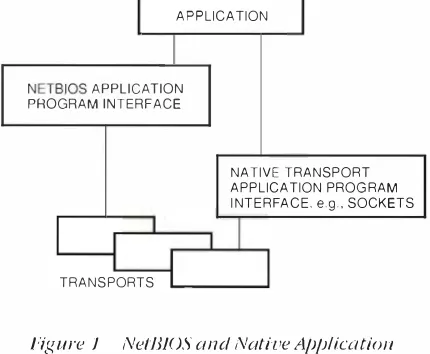
Figure l shows that NetBIOS can be implemented by I'C network vendors over a variety of underlying transports. J )igital's PATI I WO R KS products have NetfiiOS interfaces to the DECnet protocol and the transmission control protocol/internet protocol (TCP/IP). •> Other po pular com mercial transports incorpora t i ng NcrBlOS interfaces are the internet packet exchange ( I PX). the Xerox Network System (XNS), and the Netll i US extended user interf:lce ( Ne tB H I I ) . Many of these transports also have a native transport A P I that allows the application to make use of features not available t hrough the NetBlOS interface.
The TCP/I P protocol family is beginning to achieve some visibil ity in the PC network market. At first largely :1ssociated with l !N lX and U!TH I X net works and Sun Microsystems· Network File Service
(Nf'S) protocol, TCI� I l' has been lately offered as an underlying transport for Nettl!OS in several ven dors· products, including Digital's I 'ATH\VORKS fam
ily. In addition to transparent file and print services,
l'C users of TCI'/11' require acc<:ss to a variety of tools and utilities, such as mail and terminal emula tion, which may resemble U NI X or l i iT I \ l X tools anti
utilities. D igital's l'ATHWOHKS family has adopted the approach of m a i n t a i n i n g parallel TCP/lP and DECnet implemen t a t ions, bot h of which have a l'C-centric rather than a host-centric orientation. The I'ATHWORKS TCI'/I l' implementation operates over either an Ethernet or a token ring nenvork,
I
A P P LICATIONI
I
NETBIOS APPLICATION PROGRAM INTERFACE
NATIVE TRANSPORT APP LICATION PROG RAM I NTERFACE. e.g .. SOCKETS
l_____[
II
I
I
TRANS PORTS
Ngure J Nel/J/OS and Natiue AjJj;/icatio n Progmm fllterfaces
Dif!,ilal Tecbuical journal 11!1 .. J .Yo. I H inter I'.)C)l
A n Or,en•ieu• of" the PATJI W()NKS Fmduct Farnily
and provides a tile transfer protocol (FTl') utilitv, a TEl.NET terminal emulator, and a Berkeley Software Distri bu t i on (BSD)-1 ike socket interface for appl ica tion developers.
Many of Digital's customers have extensive DECnet n etworks. Digital's J>,\TH\XIOJ\ KS product
fa mily provides PC clients with ful.l Phase TV end node functionality. including tile access l istener (f'AI.), network tile transfer (NFl), command termi
nal (CTERM), and network utilities. l'AlHWORKS
products also support a NetB IOS implementation that uses the DECnet protocol as a transport. The
PATHWORKS DECnet i mplemen ta tion operates over e ither an Ethernet or a token ring network and pro vides a llSD-Iike socket interface for application developers.
NetWare software from Novell Corporation is a popu J ar family of I'C network serv ices. The internet packet exchange protocol is Novell's derivative of the Xerox internet datagram protocol. JI'X is the
network transport that underlies SPX. a sequenced
reliable protocol. lPX is also used by the NctWare core protocol , NCI'. Novell also su pplies an imple
mentation of the NetBIOS interface over the ll'X protoco l . Digital supports the I PX/SPX protocol on
DOS clients through the l'ATHWORKS for NetWare
coexistence product. and has announced plans to
integrate NetWare pro tocols into I'ATJ-JWOIZKS prod
ucts in a way that parallels current use of I.AN
Manager protocols.
The AppleTalk fam ily of protocols employed by Macintosh l'Cs accommodates three hardware lay
ers: token ring, Ethernet, and J.ocaiTal k . A ppleTalk
includes a datagram delivery protocol. routing and name binding protocols, and several session-level and service protocols.
for efficiency, many PC network vendors have invented their own protocols. For example. both the I R :\1/Microsoft NetBE ll1 and the :)Com Corpora tion N HI' transport protocols have been optimized to work on LAN ropologies .r' Digital's PATHWORKS software provides the local area t ra nsport (I.Af) and loc:-� 1 area system transport (LAST) protocols on several of its client platforms: these protocols are used to access term ina l services and lnfoScrver disk services.
Service Protocols
Service protocols encode high-level service requests a t the applica tion layer: these protocols are often vendor-specific. Typically. an appl ic1 tion issues a standard l/0 request, such as "open file, .. to
PATHWORKS: PC Integration Software
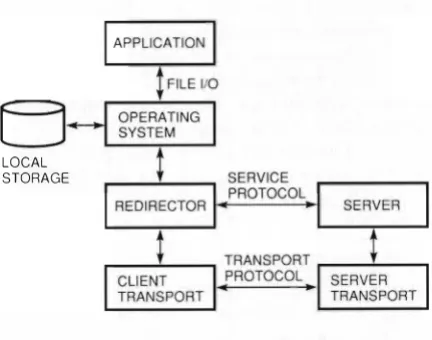
a systems i nterface to ohtain transparent access to a remote file or print service. The request may be ei ther i ntercepted (e.g . , in Novel l's NetWare soft ware on DOS) or channeled t hrough the operat ing system (e.g., in the Microsoft !.AN Manager or Apple Macintosh software) to a redirector or shell soft ware module that encodes it into a service protocol packet. The redi rector then sends the service request to the local transport. When the response packet arrives from the service provider, the recti rector i nterprets the service protocol and provides the application w i t h the appropriately format ted response. The redireetor may also provide an API for access to nontransparent services such as peer to-peer communication and management of a remote server. Figure 2 il lustrates the role of ser vice protocols in fulfi.J i ing a cl ient request.
The Microsoft LAN Manager red i rector software uses the server message block (SMB) protocol to access remote fi le and print services.-This proto col may run over multiple t ransports, each trans port accessed by means of a NetBIOS interface. The rcdirector a lso provides a cl ient API over the SMU protocol for many n ontransparent services such as peer-to-peer communications via namecl pipes, a messaging service, and remote server management. Novell's NetWare software uses the NCP protocol to access remote file and pri nt serv ices. This popu lar service protocol runs only on the IPX transport stack. The NetWare shel l provides client APis over NCI' for many nontransparent services such as t rans
action tracking, semaphores, ami remote server management.
Apple's AppleShare software uses t he Applc'Eilk su i te of protocols. These protocols include the AppleTalk fi l ing protocol (AFP) and printer access
LOCAL STORAGE
1 2
Figure 2 Seruice Protocols
protocol (PAP), wh ich perm it transparent file and printer redirection.
Sun's NFS system has widespread multivendor support in UNIX and ULTRIX environments. There arc a variety of PC products that work over the IP protocol fam ily to provide file ser\'ices from a standard l .. NIX or l JLI'JUX NFS server.
PATHWORKS Product Family
Com mensurate with Digital's role as a network integra tor, t he PATHWORKS prod uct family is large and diverse. In t he fol lowing sections we character ize the PATHWORKS family by its c l ient pla tforms, server pia tforms and services, and physical net works and network protocols. Table 1 shows the history of the PATHWORKS product fam i ly.
Since its introduction in 1986, the PATHWORKS product family has conti nued to expand the list of c l ient platforms, servers, and transports it sup ports. The most popu lar c l ie n t platforms are Intel based and operate under DOS and/or Microsoft Wi ndows. These clients can be serviced by VNJS, l i i.TRJX, and OS/2 servers. The Macintosh clients can be serviced by VMS servers.
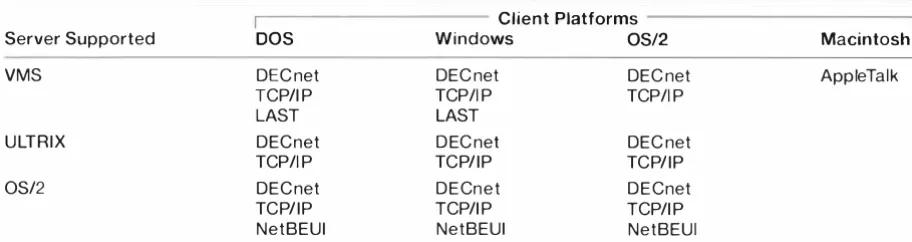
The PATH WORKS product family offers transparent file and print services through two technologies: the Microsoft L\N Manager is used for DOS, OS/2, and Windows client platforms; AppleShare is used for �'lac intosh platforms. In add it ion, on DOS and Windows platforms a dual-service stack approach is used to al low t hese pla t forms to access native NetWare services through the PATH\VORKS for NetWare Coexistence product. Table 2 shows how cl ients and servers can be connected by means of dif ferent transports. The first column is a l ist of the sup ported servers; each eel 1 shows the transports that can be used to com1ect the client and the server.
The Macintosh client also supports the DECnet transport. However, tile and print services are only ava i la ble through the Applt:'l\l lk stack. C lients also have access to a nu mber of transport gateways, including AppleTal k-DECnet, X . 25, and the System Network Architecture (SNA), the latter two through Digital network products.
The default PATI IWORKS network protocol is the DECnet protocol. TCI'/IP is available as an optional add-on to the base platform. The DECnet protocol al lows the user to access the following services in addition to the transparent file and print services:
• A fu l l set of management tools (e .g. , the DECnet network contro l program for managing the transport).
[image:14.598.83.299.540.710.2]A l l O t •erl' ieu· o(the PA '/J-I WONKS /_)roduct Fam 'l�·
Table 1 Prod uct H isto ry
Area Supported 1986-89 1990 1991
File and Print Service LAN Manager
AppleShare
LAN Manager LAN M anager
AppleShare
Server VMS VMS VMS
ULTRIX U LTRIX
OS/2 OS/2
Transport DEC net DEC net DEC net
AppleTalk AppleTalk
TCP/I P TCP/IP
NetBEUI
Network Ethernet Ethernet Ethernet
LocaiTalk LocaiTalk
Token Ring
Clients DOS DOS DOS
OS/2 Macintosh
M aci ntosh OS/2
Windows 3.0
NetWare Coex istence
Table 2 C l ie nt-Server Tra nsports
.--- Client Platforms ---,
Server Supported
VMS
U LTRIX
OS/2
DOS
DEC net TCP/I P LAST DEC net TCP/I P DEC net TCP/IP NetBEUI
• The N FT uti I ity for t r:111 s ferring h i es to S\'Stems t h:r t <.lo not han: server software.
• A remote d is k (as op posed to remote tile) mecha nism on:r the LAST protoco l . This mechanism
:i l l ows access to Digi tal's I n foServer prod ucts
that su pport networked CD·HO:VIs. i .e .. read-on ly optical d isks.
• DOS Mld \XIindows terminal e m u l a wrs opera ting over t he I .AT or CTEICVl pmtocols. as we l l as asyn
chronous I ines. The I .AT protocol m a1· also be used to a t t ;rch a local PC printer to a VMS print q ue u e .
• A nos-based X Window System server t ha t a l l ows t h e I'C to act as a dis play device for !Ylotif or D I :Cw i n dow� applica t i ons.
• A l o w - e n d electro n i c m a i l u t i l i tY t h a t p rov ides a PC fro n t end to the V,\·I S a n d lii TR l X m a i l systems.
J)ig,ilal Ti><.·hu icu!Joul"ua/ l iJI. 1 .\"u. I \� i11ler I'J'J.!
Windows OS/2 Macintosh
DEC net DEC net AppleTalk
TCP/I P TCP/I P
LAST
D EC net DEC net
TCP/IP TCP/IP
DEC net DEC net
TCP/I P TCP/I P
NetBEUI NetBEUI
• Development tools i n t he form o f program ming l i braries for access to peer-to-pen com m u n i ca t ion w i t h remote appl ica tions.
The TU'l'll' protocol allows t he user access to t he following services in addi tion to t hose I is ted above :
• The FTI' utility for fi le transfer
• The abi l i t y to use t he base term i n a l emu lator to a l low opera t ion over TEI.NET
• The abi l i tl' to r u n the DOS-ba�cd X Window System se rver over TCI'/1 P as wel l as over the DECnet protocol
Every :VIacintosh l'C includes software to access basic file and print services over the A F P . The I'ATH\VORKS i\tlacintosh pro d u c t family p rov ides those serv ices on server p l a t forms. but a lso pro v i des a set of t ransport protocols and u t i l i ties on
[image:15.595.59.513.52.250.2] [image:15.595.57.513.293.414.2]PATHWORKS: PC Integration Software
the Macintosh client. In particu lar, PATHWORKS products supply a DECnet stack with file transfer and managt:ment utilities, a !.AT implementation and terminal emulator, and an X Window System server implementation that operates over the OECnet or an optional TCP/IP stack. The PATHWORKS Macintosh client includes a programming tool for access to remote databases on Digital platforms.
The PATi fWORKS OS/2 cl ient provides a LAN Manager redirector and SMB access to basic file and print services over the DECnet protocol or an optional TCP/IP stack, and a collection of tools and util ities similar to thost: for the PATI IWORKS DOS cl ienr. Some feamres, such as an X Window System server, are lacking.
In addition to the applicat ions included in tht: base PATHWORKS product, the fol l owing client applications are availabk as layered products:
• eXcursion for Windows, a Microsoft Windows/ X Window System server application that allows X Window client appl ications to shan: the PC dis play device with native Windows :1ppl ications
• x .400 mail, which provides PC front-end access to Digital's X.400 mail server products
• Conferencing, which provides a PC front end to VAX Notes
• Videotex, which provides a PC front end to Digital's Videotex servers
• DECquery software, which provilks a PC front end to structural query language (SQL) services
Digital also provides development tools for building distributed appl ications on the PATHWORKS base system. Tht:se ckvclopmcnt tools include database access to a host-based SQI. server by means of the SQL services and d istributed trans action processing through the DECtp for AC.:VIS product.
Summary
The PATHWORKS product family provides direct access to the local and wide area enrerprise envi ronment from desktop devices. Clients can access multiple file and print servers, gateways, database servers, transaction processing systems, and elec
tronic mail systems on a variety of server pla t forms in a consistent manner from multiple desktop platforms.
The snvices provided by the PAT'HWORKS prod uct set are the fou ndation for the integration of
1 4
desktop applications with host system services such as those available with the VMS, Ul:J"R!X, and OS/2 systems. I'Xn JWORKS network software makes i t possible to develop front-end processors for today's host-based applications and to design new d istributed appl ications. Hence, PATHWORKS pro<.J ucts allow the existing computing infrastructure to progressively evolve towards a d istributed model.
References
1 . B . Baldwin, Local Area Communication Service, Metric Note LAN 40 (Stamford, CT: Gartner Group, Inc., December 1991).
2. G. Sidhu et al., Inside AppleTalk, 2nd eel. (Reading, MA: Addison-Wesley, 1990).
3. IBM NetBIOS Application Development Guide (Armonk, NY: IBM Corporation, Document No. S68X-2270-00, 1987).
4. Protocol Standard for NetB/05 Service on a TCP/ UDP Transport: Concepts and Methods, I nternet Engineering Task Force RFC 1001 (March 1 987).
5. Protocol Standard for NetB/05 Service on a TCP/ UDP Transport: JJetailed Specification, Internet Engineering Task Force RFC 1002 (March 1987)
6. Local Area Network- Technical Reference (Armonk, NY: IBM Corporation, Document No. SC30-3383-2, November 1988).
7. X/ Open Developer's Specification-Protocols for X/Open PC lnlerworking: 51'v!B (Read ing, U. K . : X/Open Company Limited, Document No. XO/DEV/91/0lO, 1991).
Edward W. Bresnahan Siu Yin Cheng
PATHWORKS for VMS File Server
Tbe mTHI'HJRKS
JiJr
VIIS file serl'er inteJ.;rates industr;·-standard personal com puters zl'ith V,4X VJJS .1ystems ouer a communimtions netzmrk. It implements Microsoft 's ser!'er 111essage block (SMB) core protocol. u•hich jJI'oz•ides resource shc/1' ing using a client-serl'er model. The seJ·t•erprot1ides transparent netu·ork access toV,4X VJ!S Fn£.)� 1 1 jiles from a PCs rwtit'e operating system. The arcbitecture sup ports multiple transports to ensure interoperability among all PCs connected on
mt open netzmrk. Due to the jJeJfomumce constraints of JJZClllJ' PC applications,
data caching and a I'Ciriet)' of other algorithms and heuristics were e11zplr�J'ed to decrease request response time. The file serl'er also implements a security model to prot'ide V:liS securit)' mechanisms to PC users.
Cou p led with the PATHWORKS for DOS or PATHWOKKS for OS/2 product, PATHWOR KS for VMS creates a distribu ted comp u ti ng e n v i ronment, based on a client-se rver model . This e nv i ronment a l lows pe rsonal comp uter (PC) users to access v;v1s system resources transp a rent ly. l'C c l ients access the system server from their n a t i ve operating sys tems, typica l l y .VIS-DOS, as if it were local to t he PC. The VAX VMS system resources to be shared, i . e . , Jiles o r prin ters, are offered a s serv ices over the network to PC clients. The comp u ter systems p rov i d i ng the shared resources are referred to as servers: and the PCs requesting the resou rces as cl ients. The SMfl p ro tocol from the Microsoft Networks/Open N ET ( 1VIS-N ET) A rch i tecture was chosen to provide file sharing from a VA .. '< V,VIS sys tem to ;\•IS-DOS and OS/2 cl ients. 1 The SMfl p rotoco l is a com ma nd/response appl ication- layer p rotocol designed to prov ide fi le shari ng in a PC n et work . Since SMII is an appl icat ion-layer protoco l , i t is transport independent and thus can be imple mented over heterogeneous networks.
Central to this enviro n ment is the file server, the component that processes the S M II requ ests to pro vide fi le and print sharing a long with m a n agemen t functions. The fi l e server m a ps S M ll fi l e req uests to the a ppropriate cal l s for the VAX VMS FI LES-1 1 fi le system i n terface and honors appl icable secu r i t y mechan isms. ;\1S-DOS and VAX V M S systems have dif ferent file systems ami security models. To i n tegrate these d i fferent env ironmen ts, m a pping pol ic ies, a l o ng with a n arch i tect u re a ppropriate for the VMS system , had to be developed ami im p lemented .
Di?,ilal Tecbuical jourua/ l (,f. · i So. I lr'i111�1· /')').!
This paper descri bes the design and i m p lemen tation of a nonded icated persona l com puter fi le server (PCrS) on a VA,\. VMS compu ter system. It deta ils the PATHWOR KS for VMS file system and discusses i t s transport l ayer i nterface and perfor m a nce consideratio ns. i ncl u d i ng data cach i ng effects and disk space a l location. The paper then exp la i n s fi le sharing a mong server processes i n a cl uster e n v i ronment a n d concl udes with a discus sion of the server con figu ra tion and m a n agement interface.
File Server Architecture
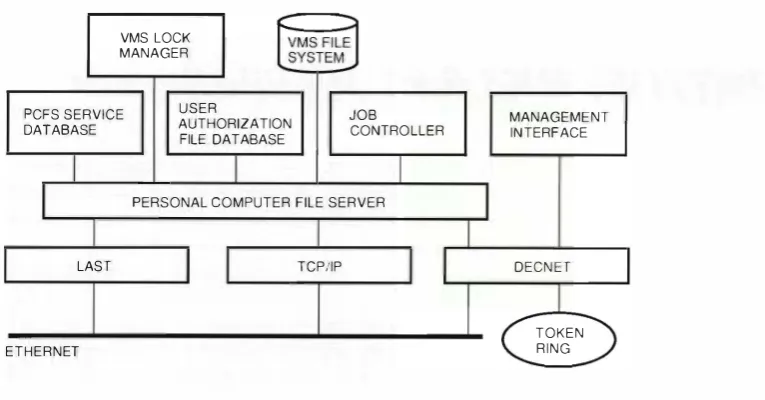
The file server is implemen ted as a single, m u l t i t h readed , nonblocking detached p rocess with an associa ted permanent DECnet object. This user mode p rocess is priv i leged and has a h igh priority. Figu re I shows the a rchi tectu re of the server. On ly one file server p rocess exists o n any one computer to hand le a l l cl ient requests. A n a l ternat ive choice wou ld be to have multiple processes service the c l ients. 1'he use of a single p rocess redu ces system resource requ irements and eliminates the l a tency that is i ncurred from con text swi t c hes among the m u l tiple server processes. A lso e l i m i na ted is the l atency t ha t resu l t s from process creat io n a t the t i me a cl ient connects.
A t h reads package wi th m u l tiple independent threads of executio n within a single process sup ports m u l tiple cl ients a n d periodic opera t ions within the til e serve r. The file serve r c rea tes a t h read for a cl ient when i t requests establ ishmen t of a v i rtual ci rc u i t to the fi le server. The t hread is
PATHWORKS: PC Integration Software
� ::::!
l
VMS FIL�
VMS LOCKMANAGER SYSTEM
PCFS SERVICE U S E R J O B MANAGEMENT
AUTHORIZATION DATABASE
FILE DATABASE CONTRO LLER I N TERFACE
II
I
I
I
PERSONAL COMPUTER FILE S E R V E RI
LAST
I
TCP/IPI I
DEC N ETI
T O K E N [image:18.596.148.531.86.286.2]E T H E R N ET R I N G
Figure 1 Seruer Architecture
deleted when the client term ina tes its connections. A client's thread carries out the operation specified in the request SMI1 wi thout bl ocking the process. With this scheme, processing SMH requests is sychro nous wi th respect to the client, yet asynchronous with rt:spect to the tile server process.
Since a server process may be processing the requests of hundreds of cl ients simultaneously, t he server operates in rea l-time. The threads packagt: contributes to these goals by providing an envi ronment in which the process never enters a wa it state a nd a cl ient thread is safe from CPU starva tion. Prevt:nting the process from blocking is accom pl ished by performi ng a l l file 1/0 asynchronously and by cal l ing operating system routines asynchro nously when possible. Starva tion is prevented by schedu l ing cl ients using a nonpreemptive first-in, first-ou t (FI FO) schedu ling algorithm. Wi th t h is pol icy, a thread executes u nt i l it voluntarily yields, usu a i. I y clue to an 110 operation or an operating system cal I . Csing a nonpreemptive scht:dul i ng algori thm also e l i m i nates the latency that wou ld result from a thread switch in a pret:mpt ive environment.
PATHWORKS
FileSystem
A file server needs to provide transparent tile access to a VMS file system and ensure tile accessibi l ity between D O S and VMS ust:rs. Since t hese opera t i ng systems have different file systems, I'ATH\VORKS for VMS mu st store the fi les i n Wv'X V,\1S Fli.ES-1 1 format and provide a mapping algorithm to bridge the two opera ti ng systems. Because the OS/2 and DOS systems use the same file system, the mappings
per-1 6
formed t o address the difference between the DOS and VMS systems can be appl iul to support trans parent tile access from an OS/2 cl ient.
File Name Mapping
DOS and VMS FI LES-11 support diffe rent nam ing syn taxes. DOS supports 8.3 naming format; that is, the file name is composed of a maximum of eight char acters with a maximum of three characters as the extension. ln con trast, the V.\IS F I LES- I I file name supports 39.39 fo rmat and includes a third compo nent, the file genera t ion nu mber. In addition, the legal character set for a file namt: is larger i n DOS than it is in the Vi'viS system.
The PAI'HWORKS tilL server does not include a mapping a lgorithm to convert a .W :W VMS file nam ing syntax to be accessible to DOS. Any VMS file that DOS system users need to share m ust be created w i t h a hie name that conforms to DOS 8.3 format. Since the 8.3 naming format maps directly to the :W.:W format, no mapping algori thm is requi red to guarantee a VMS system user access to fi les n amed by a DOS system user.
To overcome the d ifference i n character sets, a comprehensive mapping algorit h m was wri t ten to ensure shareabi l ity and transparency. Since nei ther operating system is case sensitive , the file server changes the tile name to uppercase before any oper ation is pe rformed on the file. The legal character set for V!VIS FILES-1 1 tik names incl udes uppercase alphanumerics, dol lar sign, hyphen, and u nder score. The character set in DOS inclmks al l noncon trol characters with the exception of a few special
signs. The J>,\TI I WO R K S sern�r maps t ile character sets based on the fol l owi ng ru les:
• Al l alphanu m eric charactl:rs are changed to
uppercase lett ers: an)· c haracter tha t is valiu in a V.VlS ti le name is passed through unchanged.
• All otbcr characters arc changed to two u n der scores. fo l l owed by two hex;tdecim;d digits that represen t the ASU ! code of t h e character being m a ppctl.
v,\•IS Fl i . E S- 1 1 a l l ows multi ple 1·e rsi ons of a ti le to be gener:tted a nt! stored i n a d i rector)·. These ti les are identified h)· the n u mn i c component, which rcpres enrs the version n u m ber. of a ti le name. There is no equivalent concept in the DOS system . The l'ATHWOHKS s erver maps the h ighest version ( o r most recent genera t i o n ) ro be accessible to DOS. Similarly. the se n·L -r. when creating a ti le on behalf of a DOS client, ge nera tes the tile w i t h a Yersion I i m it of I. · 1 (> prescr\'e ant! honor the ,·ersi on I imi t i n form;t t ion for t he V:VlS environment. the se rver preser ves the V,VlS tile at t r i butes of p revious ver sions of the ti l e . Consequen t l y, if t h e tile is crea ted by a V.VIS user. and is l a t e r updated by a DOS user. a new version of tl1C tile is genera ted . a n d the version l i m i t i n form;t t i un is pre.�en'C d .
Directory Mapping
The V .VIS system req u i res a di n:ctorv name to end with " d i r" as an ext ension. [)ut the D O S system does not post am· restriction in t h i s a rea. l'ATH WORKS m aps directory names i n DOS by including the ... ext" ch;� r;tctcrs as par t of a dirccton· n a m e . Si nce
the period is n ot a il'gal character for a D O S tl i rcc
tory. it is ma pped u s i ng the double u n d erscore fol l owed by the hcxatkc i m a l digit r u k . A n y d i rectory name in DOS that conforms to the V .VlS directory naming synux is passed through untouched.
DO"i File A ttribu te Mapping
Both ti le systems associate a set of a t tributes to the tiles. but tile ti l e attributes on a DOS ti le d o not have a one- to - o ne corresponde nce with th ose on a VMS tile. A D O S ti l e h;ts four t ypes of tile attribu tes: archi1·e. system. hidden. and read-only. The con cepts of archive. syst em. and h i dtlen a rc not recog nilul in the V \·IS ti l l' system. [',\lHWO R K S soft wa re sto res the DOS tile att ributes in an ap plication
access control entry when cre:a i ng a tile on behalf of a I'C workstation. rurrhermore. the reatl-only attribute of a DOS lilc is m apped to the read-emil· h i t
Di,f!,ilal JechuicaiJourual t f•l. 1 .\'u. I 1\"in./er /'.J'.Jl
flA J H \l/(}NJ\Sjor V,\/S File Sen •er
of the record management servict:s (Jni S) protec tion field for system , owner. and gro u p .
File 0JRtmization
A DOS ti le is organi zed as a byte strea m , h u t a V:-.·IS tile is organ i1ed as col lecti ons of records. Although the V M S system supports a form of s t ream tile. most V,VlS tiles are stored in record for m a t . furthe r more . a V.VlS tile with a stream record for m a t does not map d irectly to a ( ) OS stream format. This poses a n interesti ng problem i n i n t egra t i ng VMS and DOS ti le systems.
Since I'ATI IWO R K S soft ware provides transp arent
access to the V.VlS host system. a oos client v iews a l l ti les o n tile services as streams o f bytes, j ust as i f these files were stored local 1 \·. When the server cre a tes a ti le on he h a l f of a I'C, it specifics the tile orga n i za t i o n as sequential w i t h st rea m recoru fo r m a t . Th us. the byte stream characterist ic o f t h e D O S sys tem is p reservet l .
T h e more complex part of the problem is t o resolve t he sllarcah i l i ty issues bctwc<.:n VMS a n d DOS applicat i ons The l'AJ ' H WO R KS serve r is i mple mented to prov ide the necessary conversion between V.\·IS and DOS tile organiza t i o n o n stream tiles. The ti l e server v iews a tile as sl rea m i f it can read and wri te the tile without regard to any rccor(i boundari es. This inc ludc::s any tiles w i t h ti l l' organi za tion as sequent ial ami recortl r·o r m a t as stre a m . st ream cr. stream l t. and un dehnnl. as wel l as tix<.:tl . If a seque n t i a l ti l e has tixed record form a t, i t m u st conform to record si1e ;md at tri bu tes as fol lows: cvc:: n with no record a t t ri bu te: 512 w i t h no block_span: and power of 2 with no block_span. Thus, an R.VI S overhead in read ing allCI writing tiles<.:
ti les is avoided.
A n y ti le that docs nor meet t he criteria of the stream category is s a i d to be nonst ream. The l'ATHWO R K S serve r prov ides read-only access to any
VMS nonstream tile. This is ach ieved by using a VAX C run- t i me l i brarY call that provides stream l i l e semant ics a n d a conversion al gori t h m t o properly map any carriage return and I i n e ked informat ion. The ti ll' server cannot su pport writ ing to these ti les beca use the SMU protocol does not preserve record bo u n dan· i n formation. Thus. the protocol makes i t i m p ossible for t he ti l e se rver to guara ntee d a t a integrity when updating a nonstrcam ti l e .
J�vte Range locleing
The :VI S-I ET architecture a l l ows for concurrent
access to server-based ti les by multiple clients. PC